Mudasir Ahmad Bhat
4G Definition
4G is the fourth generation of wireless mobile 
telecommunications technology, succeeding 
3G. A 4G system must provide capabilities 
defined by ITU in IMT Advanced.
4G Networks are projected to provide speed of 
100Mbps while moving and 1Gbps while 
stationary.
3G Technology
Large capacity and broadband capabilities
Allows the transmission of 384kbps for mobile
systems and up to 2Mbps
Increased spectrum efficiency –5Mhz
A greater number of users that can be simultaneously
supported by a radio frequency bandwidth
High data rates at lower incremental cost than 2G–
Global roaming
Previous Technology - 3G
CDMA –Code Division Multiple Access
Form of multiplexing
Does not divide up the channel by time or frequency
Encodes data with a special code associated with each
channel
Code Division Multiple Access
IMT-Advanced requirements
Be based on an all-IP packet switched network.
Have peak data rates of up to approximately 100
Mbit/s
Be able to dynamically share and use the network
resources.
Use scale-able channel bandwidths of 5–20 MHz.
The ability to offer high quality of service for next
generation multimedia support,
LTE Advanced standardized by the 3GPP
802.16m standardized by the IEEE (i.e. WiMAX)
Types of Multiplexing
FDMA – Frequency Division Multiple Access
Each phone call is allocated one frequency for the
entire duration of the call
Types of Multiplexing
TDMA - Time Division Multiple Access
Each phone call is allocated a spot in the frequency for
a small amount of time, and "takes turns" being
transmitted
Types of Multiplexing
CDMA - Code Division Multiple Access
Each phone call is uniquely encoded and transmitted
across the entire spectrum, in a manner known as
spread spectrum transmission
Reasons for New Research
Even though 3G has successfully been introduced
to mobile users, there are some issues that are
debated by 3G providers and users.
High input fees for the 3G service licenses
Great differences in the licensing terms
3G phones are expensive
Fourth Generation
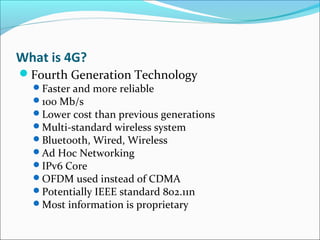
What is 4G?
Fourth Generation Technology
Faster and more reliable
100 Mb/s
Lower cost than previous generations
Multi-standard wireless system
Bluetooth, Wired, Wireless
Ad Hoc Networking
IPv6 Core
OFDM used instead of CDMA
Potentially IEEE standard 802.11n
Most information is proprietary
4G Architecture
Communications Architecture
Personal Layer Gateway:
devices that connect to upper layers; cell phone, fax,
voice, data modem, MP3 players, PDAs
Info-Sensor layer:
environmental sensors
Fiber-optic wire layer:
high speed subterranean labyrinth of fiber optic cables
and repeaters
Ad Hoc Networks
 Spontaneous self
organization of networks of
devices
 Not necessarily connected to
internet
 4G will create hybrid wireless
networks using Ad Hoc
networks
 Form of mesh networking–
Very reliable
Enhance Mobile Gaming
Experience enhance wireless capabilities that
deliver mobile gaming interaction with less
than five seconds
Play online multi player games while traveling
at high speeds or sitting outside
Broadband access in Remote
location
4G will provide a wireless alternative for broadband
access
I will provide first opportunity for broadband access
in remote locations without an infrastructure to
support cable or DSL access.
Key features
MIMO (multi-antenna and multi-user).
Frequency-domain-equalization for example multi-carrier
modulation (OFDM) in the downlink.
Frequency-domain statistical multiplexing,
Turbo principle error-correcting codes: To minimize the
required SNR at the reception side
Channel-dependent scheduling: To use the time-varying
channel
Link adaptation: Adaptive modulation and error-
correcting codes
Mobile IP utilized for mobility
4G technology

4G technology

  • 1.
  • 2.
  • 3.
    3G Technology Large capacityand broadband capabilities Allows the transmission of 384kbps for mobile systems and up to 2Mbps Increased spectrum efficiency –5Mhz A greater number of users that can be simultaneously supported by a radio frequency bandwidth High data rates at lower incremental cost than 2G– Global roaming
  • 4.
    Previous Technology -3G CDMA –Code Division Multiple Access Form of multiplexing Does not divide up the channel by time or frequency Encodes data with a special code associated with each channel
  • 5.
  • 6.
    IMT-Advanced requirements Be basedon an all-IP packet switched network. Have peak data rates of up to approximately 100 Mbit/s Be able to dynamically share and use the network resources. Use scale-able channel bandwidths of 5–20 MHz. The ability to offer high quality of service for next generation multimedia support, LTE Advanced standardized by the 3GPP 802.16m standardized by the IEEE (i.e. WiMAX)
  • 7.
    Types of Multiplexing FDMA– Frequency Division Multiple Access Each phone call is allocated one frequency for the entire duration of the call
  • 8.
    Types of Multiplexing TDMA- Time Division Multiple Access Each phone call is allocated a spot in the frequency for a small amount of time, and "takes turns" being transmitted
  • 9.
    Types of Multiplexing CDMA- Code Division Multiple Access Each phone call is uniquely encoded and transmitted across the entire spectrum, in a manner known as spread spectrum transmission
  • 10.
    Reasons for NewResearch Even though 3G has successfully been introduced to mobile users, there are some issues that are debated by 3G providers and users. High input fees for the 3G service licenses Great differences in the licensing terms 3G phones are expensive
  • 11.
  • 12.
    What is 4G? FourthGeneration Technology Faster and more reliable 100 Mb/s Lower cost than previous generations Multi-standard wireless system Bluetooth, Wired, Wireless Ad Hoc Networking IPv6 Core OFDM used instead of CDMA Potentially IEEE standard 802.11n Most information is proprietary
  • 13.
  • 14.
    Communications Architecture Personal LayerGateway: devices that connect to upper layers; cell phone, fax, voice, data modem, MP3 players, PDAs Info-Sensor layer: environmental sensors Fiber-optic wire layer: high speed subterranean labyrinth of fiber optic cables and repeaters
  • 15.
    Ad Hoc Networks Spontaneous self organization of networks of devices  Not necessarily connected to internet  4G will create hybrid wireless networks using Ad Hoc networks  Form of mesh networking– Very reliable
  • 16.
    Enhance Mobile Gaming Experienceenhance wireless capabilities that deliver mobile gaming interaction with less than five seconds Play online multi player games while traveling at high speeds or sitting outside
  • 17.
    Broadband access inRemote location 4G will provide a wireless alternative for broadband access I will provide first opportunity for broadband access in remote locations without an infrastructure to support cable or DSL access.
  • 18.
    Key features MIMO (multi-antennaand multi-user). Frequency-domain-equalization for example multi-carrier modulation (OFDM) in the downlink. Frequency-domain statistical multiplexing, Turbo principle error-correcting codes: To minimize the required SNR at the reception side Channel-dependent scheduling: To use the time-varying channel Link adaptation: Adaptive modulation and error- correcting codes Mobile IP utilized for mobility