GUIDE – SATHISH.B.M(M.Tech)
Asst.Prof of GCEM(ECE)
ADARSH KUMAR.M.N - 1GD11EC002
CONTENTS
 WIRELESS TECHNOLOGY
 EVOLUTION OF 0G – 5G
 INTRODUCTION TO 5G
 ARCHITECTURE OF 5G
 HARDWARE AND SOFTWARE OF 5G
 FEATURES & APPLICATONS OF 5G
 COMPARISON FROM 1G TO 5G
 CONCULSION
 FUTURE SCOPE
INTRODUCTION
 WHAT IS WIRELESS ?
 The word wireless is dictionary defined “having no wires ”.
 In networking terminology , wireless is the term used to
describe any computer network where there is no physical wired
connection between sender and receiver, but rather the network is
connected by radio waves and or microwaves to maintain
communications.
 Wireless networking utilizes specific equipment such as NICs
and Routers in place of wires (copper or optical fibre).
0G TECHNOLOGY
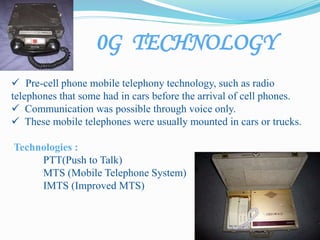
 Pre-cell phone mobile telephony technology, such as radio
telephones that some had in cars before the arrival of cell phones.
 Communication was possible through voice only.
 These mobile telephones were usually mounted in cars or trucks.
Technologies :
PTT(Push to Talk)
MTS (Mobile Telephone System)
IMTS (Improved MTS)
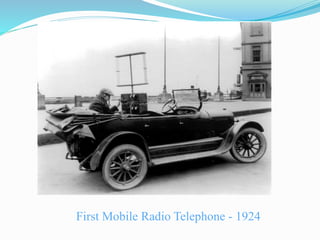
First Mobile Radio Telephone - 1924
1G TECHNOLOGY
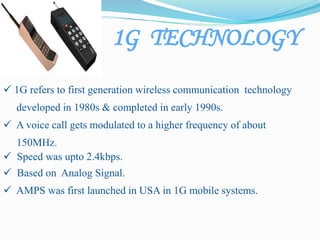
 1G refers to first generation wireless communication technology
developed in 1980s & completed in early 1990s.
 A voice call gets modulated to a higher frequency of about
150MHz.
 Speed was upto 2.4kbps.
 Based on Analog Signal.
 AMPS was first launched in USA in 1G mobile systems.
Technologies :
TACS(Total Acess Communication Systems)
NMT (Nordic Mobile Telephone)
AMPS (Advanced Mobile Phone System)
 Poor Voice links
 Poor Battery Life
 Large Phone Size
 No Security
 Limited Capacity
 Unreliable handoff
DRAWBACKS OF 1G
2G
2G TECHNOLOGY
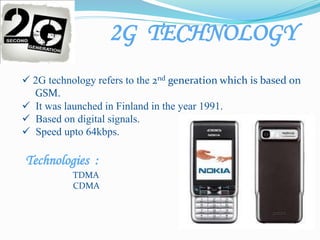
 2G technology refers to the 2nd generation which is based on
GSM.
 It was launched in Finland in the year 1991.
 Based on digital signals.
 Speed upto 64kbps.
Technologies :
TDMA
CDMA
Different Services
Digital voice calling
Short message service (SMS)
BENEFITS
 Consume less battery power.
 Improves the voice clarity.
 Reduces noise in the line.
 Secrecy and safety to the data and voice calls.
LIMITATIONS
 Strong digital signals are required to make the cell
phones work.
 Digital signals would be week if there is no proper
network coverage in the specified area.
 Difficult to handle complex data such as video etc.
2.5G TECHNOLOGY
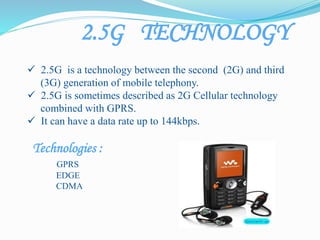
 2.5G is a technology between the second (2G) and third
(3G) generation of mobile telephony.
 2.5G is sometimes described as 2G Cellular technology
combined with GPRS.
 It can have a data rate up to 144kbps.
Technologies :
GPRS
EDGE
CDMA
FEATURES
 Phone Calls
 Send/Receive E-mail Messages
 Web Browsing
 Speed : 64-144 kbps
 Camera Phones
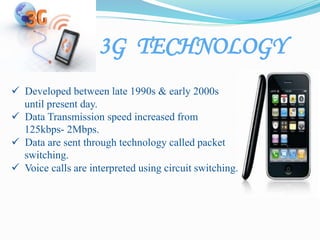
3G TECHNOLOGY
 Developed between late 1990s & early 2000s
until present day.
 Data Transmission speed increased from
125kbps- 2Mbps.
 Data are sent through technology called packet
switching.
 Voice calls are interpreted using circuit switching..
SERVICES
 Voice calls
 Global roaming
 Send/receive large email messages
 High-speed Web
 Navigation/maps
 Video conferencing
 Mobile TV
 3D gaming
Technologies :
W-CDMA
GSM EDGE
UMTS
DECT
WiMAX
CDMA 2000
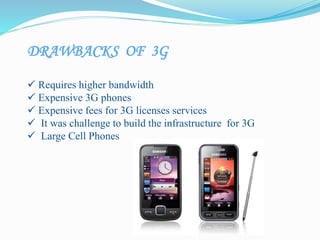
DRAWBACKS OF 3G
 Requires higher bandwidth
 Expensive 3G phones
 Expensive fees for 3G licenses services
 It was challenge to build the infrastructure for 3G
 Large Cell Phones
4G TECHNOLOGY
 Fourth Generation which was started from late 2000s.
 Capable of providing 100Mbps – 1Gbps speed.
 One of the basic term used to describe 4G is MAGIC.
• Mobile Multimedia
• Anytime Anywhere
• Global Mobility Support
• Integrated Wireless Solution
• Customized Personal Services
Also known as Mobile Broadband Everywhere
 High speed wireless network and data to and interface with
wire-line backbone network.
APPLICATIONS INCLUDE
 Mobile tv
 Tele-medicine
 Video on demand
 Video conferencing
 Location based service
 High Capacity
 Low Cost Per-bit etc.
Technologies :
LTE
Wi-MAX
DRAWBACKS OF 4G
 Battery uses is more
 Hard to implement
 Need complicated hardware
 Expensive equipment required to implement next
generation network.
5G TECHNOLOGY
 Fifth Generation which was started from late 2010s.
 Complete wireless network with no limitations
 Concept is theoritical & not yet implemented
 REAL wireless technology or WWWW or W4
 Incredible transmission speed in
gigabit range.
WHAT DOES 5G OFFERS ??
 Worldwide cellular phones
 Extraordinary data capabilities
 High connectivity
 More power & features in hand held phones
 Large phone memory, more dialing speed, more clarity in
audio & video
KEY CONCEPT
 Real wireless world with no more limitation with access and
zone issues.
 Wearable devices
 Ipv6, where a visiting care-of mobile ip address is assigned
according to location and connected network.
 One unified global standard.
 Smart-radio
 High altitude stratospheric platform station (HAPS) systems.
 The user can simultaneously be connected with several
wireless access technology
 Multiple concurrent data transfer path
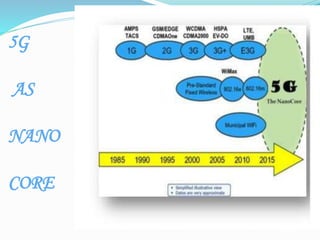
5G
AS
NANO
CORE
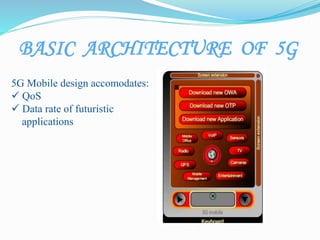
BASIC ARCHITECTURE OF 5G
5G Mobile design accomodates:
 QoS
 Data rate of futuristic
applications
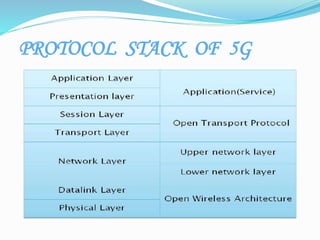
PROTOCOL STACK OF 5G
OPEN WIRELESS ARCHITECTURE
(OWA)
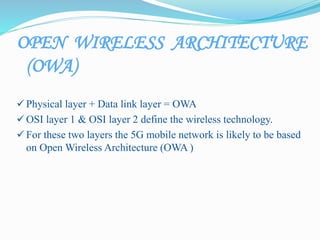
 Physical layer + Data link layer = OWA
 OSI layer 1 & OSI layer 2 define the wireless technology.
 For these two layers the 5G mobile network is likely to be based
on Open Wireless Architecture (OWA )
NETWORK LAYER
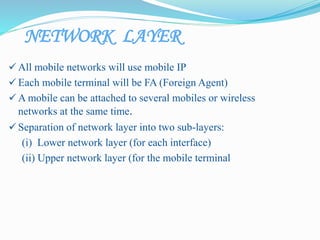
 All mobile networks will use mobile IP
 Each mobile terminal will be FA (Foreign Agent)
 A mobile can be attached to several mobiles or wireless
networks at the same time.
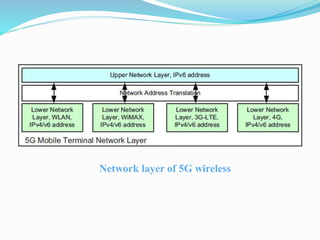
 Separation of network layer into two sub-layers:
(i) Lower network layer (for each interface)
(ii) Upper network layer (for the mobile terminal
Network layer of 5G wireless
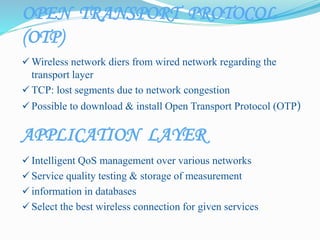
APPLICATION LAYER
 Intelligent QoS management over various networks
 Service quality testing & storage of measurement
 information in databases
 Select the best wireless connection for given services
 Wireless network diers from wired network regarding the
transport layer
 TCP: lost segments due to network congestion
 Possible to download & install Open Transport Protocol (OTP)
OPEN TRANSPORT PROTOCOL
(OTP)
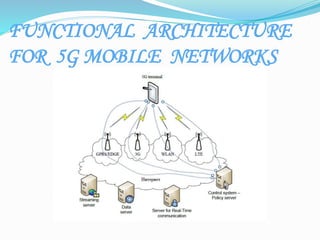
FUNCTIONAL ARCHITECTURE
FOR 5G MOBILE NETWORKS
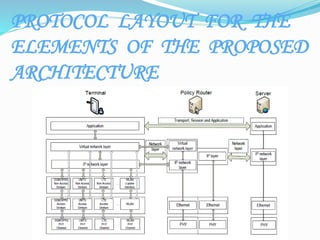
PROTOCOL LAYOUT FOR THE
ELEMENTS OF THE PROPOSED
ARCHITECTURE
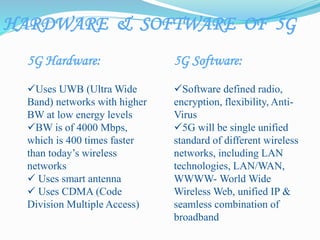
5G Hardware:
Uses UWB (Ultra Wide
Band) networks with higher
BW at low energy levels
BW is of 4000 Mbps,
which is 400 times faster
than today’s wireless
networks
 Uses smart antenna
 Uses CDMA (Code
Division Multiple Access)
5G Software:
Software defined radio,
encryption, flexibility, Anti-
Virus
5G will be single unified
standard of different wireless
networks, including LAN
technologies, LAN/WAN,
WWWW- World Wide
Wireless Web, unified IP &
seamless combination of
broadband
HARDWARE & SOFTWARE OF 5G
FEATURES
 High resolution for crazy cell phone users
 Bi-directional large BW
 Less traffic
 25 Mbps connectivity speed
 Enhanced & available connectivity just about the world
 Uploading & Downloading speed of 5G touching the peak (up
to 1 Gbps)
 Better & fast solution
FEATURES(cond..)
 High quality service based on policy to avoid error
 Support virtual private networks
 More attractive & effective
 Provides subscriber supervision tools for fast action
ADVANTAGES
 Data bandwidth of 1 Gbps or higher.
 Globally accessible.
 Dynamic information access beneficial to domestic user.
 Available at low cost.
APPLICATIONS OF 5G
 Wearable devices with AI (Artificial Intelligence) capabilities
 Pervasive (Global) networks
 Media independent handover
 Radio resource management
 VoIP (Voice over IP) enabled devices
 With 6th sense technology
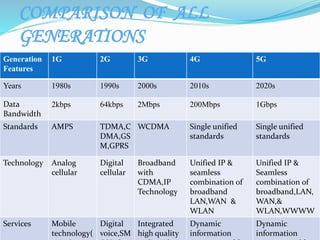
COMPARISON OF ALL
GENERATIONS
Generation
Features
1G 2G 3G 4G 5G
Years 1980s 1990s 2000s 2010s 2020s
Data
Bandwidth
2kbps 64kbps 2Mbps 200Mbps 1Gbps
Standards AMPS TDMA,C
DMA,GS
M,GPRS
WCDMA Single unified
standards
Single unified
standards
Technology Analog
cellular
Digital
cellular
Broadband
with
CDMA,IP
Technology
Unified IP &
seamless
combination of
broadband
LAN,WAN &
WLAN
Unified IP &
Seamless
combination of
broadband,LAN,
WAN,&
WLAN,WWWW
Services Mobile
technology(
Digital
voice,SM
Integrated
high quality
Dynamic
information
Dynamic
information
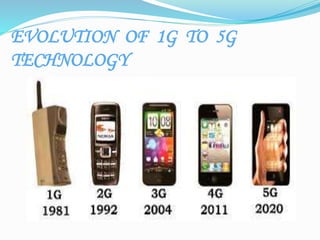
EVOLUTION OF 1G TO 5G
TECHNOLOGY
CONCLUSION
 3G - Operator centric
 4G - service centric whereas
 5G - user centric
 5G wireless concept designed as an open platform on
different layers.
 The new coming 5G technology will be avaliable in the
market at affordable rates,high peak future and much
realiability than preceding technolgies.
FUTURE SCOPES
 Combination of 5G with AI
(i)Control intelligent robot by mobile
(ii)Typing messages as brain thinks!
 Further evolution to 6G Networks
THANK YOU

Evolution of wireless technology 1 g 5g1 (2)

  • 1.
    GUIDE – SATHISH.B.M(M.Tech) Asst.Profof GCEM(ECE) ADARSH KUMAR.M.N - 1GD11EC002
  • 2.
    CONTENTS  WIRELESS TECHNOLOGY EVOLUTION OF 0G – 5G  INTRODUCTION TO 5G  ARCHITECTURE OF 5G  HARDWARE AND SOFTWARE OF 5G  FEATURES & APPLICATONS OF 5G  COMPARISON FROM 1G TO 5G  CONCULSION  FUTURE SCOPE
  • 3.
    INTRODUCTION  WHAT ISWIRELESS ?  The word wireless is dictionary defined “having no wires ”.  In networking terminology , wireless is the term used to describe any computer network where there is no physical wired connection between sender and receiver, but rather the network is connected by radio waves and or microwaves to maintain communications.  Wireless networking utilizes specific equipment such as NICs and Routers in place of wires (copper or optical fibre).
  • 4.
    0G TECHNOLOGY  Pre-cellphone mobile telephony technology, such as radio telephones that some had in cars before the arrival of cell phones.  Communication was possible through voice only.  These mobile telephones were usually mounted in cars or trucks. Technologies : PTT(Push to Talk) MTS (Mobile Telephone System) IMTS (Improved MTS)
  • 5.
    First Mobile RadioTelephone - 1924
  • 6.
    1G TECHNOLOGY  1Grefers to first generation wireless communication technology developed in 1980s & completed in early 1990s.  A voice call gets modulated to a higher frequency of about 150MHz.  Speed was upto 2.4kbps.  Based on Analog Signal.  AMPS was first launched in USA in 1G mobile systems.
  • 7.
    Technologies : TACS(Total AcessCommunication Systems) NMT (Nordic Mobile Telephone) AMPS (Advanced Mobile Phone System)  Poor Voice links  Poor Battery Life  Large Phone Size  No Security  Limited Capacity  Unreliable handoff DRAWBACKS OF 1G
  • 8.
    2G 2G TECHNOLOGY  2Gtechnology refers to the 2nd generation which is based on GSM.  It was launched in Finland in the year 1991.  Based on digital signals.  Speed upto 64kbps. Technologies : TDMA CDMA
  • 9.
    Different Services Digital voicecalling Short message service (SMS) BENEFITS  Consume less battery power.  Improves the voice clarity.  Reduces noise in the line.  Secrecy and safety to the data and voice calls.
  • 10.
    LIMITATIONS  Strong digitalsignals are required to make the cell phones work.  Digital signals would be week if there is no proper network coverage in the specified area.  Difficult to handle complex data such as video etc.
  • 11.
    2.5G TECHNOLOGY  2.5Gis a technology between the second (2G) and third (3G) generation of mobile telephony.  2.5G is sometimes described as 2G Cellular technology combined with GPRS.  It can have a data rate up to 144kbps. Technologies : GPRS EDGE CDMA
  • 12.
    FEATURES  Phone Calls Send/Receive E-mail Messages  Web Browsing  Speed : 64-144 kbps  Camera Phones
  • 13.
    3G TECHNOLOGY  Developedbetween late 1990s & early 2000s until present day.  Data Transmission speed increased from 125kbps- 2Mbps.  Data are sent through technology called packet switching.  Voice calls are interpreted using circuit switching..
  • 14.
    SERVICES  Voice calls Global roaming  Send/receive large email messages  High-speed Web  Navigation/maps  Video conferencing  Mobile TV  3D gaming Technologies : W-CDMA GSM EDGE UMTS DECT WiMAX CDMA 2000
  • 15.
    DRAWBACKS OF 3G Requires higher bandwidth  Expensive 3G phones  Expensive fees for 3G licenses services  It was challenge to build the infrastructure for 3G  Large Cell Phones
  • 16.
    4G TECHNOLOGY  FourthGeneration which was started from late 2000s.  Capable of providing 100Mbps – 1Gbps speed.  One of the basic term used to describe 4G is MAGIC. • Mobile Multimedia • Anytime Anywhere • Global Mobility Support • Integrated Wireless Solution • Customized Personal Services Also known as Mobile Broadband Everywhere  High speed wireless network and data to and interface with wire-line backbone network.
  • 17.
    APPLICATIONS INCLUDE  Mobiletv  Tele-medicine  Video on demand  Video conferencing  Location based service  High Capacity  Low Cost Per-bit etc. Technologies : LTE Wi-MAX
  • 18.
    DRAWBACKS OF 4G Battery uses is more  Hard to implement  Need complicated hardware  Expensive equipment required to implement next generation network.
  • 19.
    5G TECHNOLOGY  FifthGeneration which was started from late 2010s.  Complete wireless network with no limitations  Concept is theoritical & not yet implemented  REAL wireless technology or WWWW or W4  Incredible transmission speed in gigabit range.
  • 20.
    WHAT DOES 5GOFFERS ??  Worldwide cellular phones  Extraordinary data capabilities  High connectivity  More power & features in hand held phones  Large phone memory, more dialing speed, more clarity in audio & video
  • 21.
    KEY CONCEPT  Realwireless world with no more limitation with access and zone issues.  Wearable devices  Ipv6, where a visiting care-of mobile ip address is assigned according to location and connected network.  One unified global standard.  Smart-radio  High altitude stratospheric platform station (HAPS) systems.  The user can simultaneously be connected with several wireless access technology  Multiple concurrent data transfer path
  • 22.
  • 23.
    BASIC ARCHITECTURE OF5G 5G Mobile design accomodates:  QoS  Data rate of futuristic applications
  • 24.
  • 25.
    OPEN WIRELESS ARCHITECTURE (OWA) Physical layer + Data link layer = OWA  OSI layer 1 & OSI layer 2 define the wireless technology.  For these two layers the 5G mobile network is likely to be based on Open Wireless Architecture (OWA )
  • 26.
    NETWORK LAYER  Allmobile networks will use mobile IP  Each mobile terminal will be FA (Foreign Agent)  A mobile can be attached to several mobiles or wireless networks at the same time.  Separation of network layer into two sub-layers: (i) Lower network layer (for each interface) (ii) Upper network layer (for the mobile terminal
  • 27.
    Network layer of5G wireless
  • 28.
    APPLICATION LAYER  IntelligentQoS management over various networks  Service quality testing & storage of measurement  information in databases  Select the best wireless connection for given services  Wireless network diers from wired network regarding the transport layer  TCP: lost segments due to network congestion  Possible to download & install Open Transport Protocol (OTP) OPEN TRANSPORT PROTOCOL (OTP)
  • 29.
  • 30.
    PROTOCOL LAYOUT FORTHE ELEMENTS OF THE PROPOSED ARCHITECTURE
  • 31.
    5G Hardware: Uses UWB(Ultra Wide Band) networks with higher BW at low energy levels BW is of 4000 Mbps, which is 400 times faster than today’s wireless networks  Uses smart antenna  Uses CDMA (Code Division Multiple Access) 5G Software: Software defined radio, encryption, flexibility, Anti- Virus 5G will be single unified standard of different wireless networks, including LAN technologies, LAN/WAN, WWWW- World Wide Wireless Web, unified IP & seamless combination of broadband HARDWARE & SOFTWARE OF 5G
  • 32.
    FEATURES  High resolutionfor crazy cell phone users  Bi-directional large BW  Less traffic  25 Mbps connectivity speed  Enhanced & available connectivity just about the world  Uploading & Downloading speed of 5G touching the peak (up to 1 Gbps)  Better & fast solution
  • 33.
    FEATURES(cond..)  High qualityservice based on policy to avoid error  Support virtual private networks  More attractive & effective  Provides subscriber supervision tools for fast action
  • 34.
    ADVANTAGES  Data bandwidthof 1 Gbps or higher.  Globally accessible.  Dynamic information access beneficial to domestic user.  Available at low cost.
  • 35.
    APPLICATIONS OF 5G Wearable devices with AI (Artificial Intelligence) capabilities  Pervasive (Global) networks  Media independent handover  Radio resource management  VoIP (Voice over IP) enabled devices  With 6th sense technology
  • 36.
    COMPARISON OF ALL GENERATIONS Generation Features 1G2G 3G 4G 5G Years 1980s 1990s 2000s 2010s 2020s Data Bandwidth 2kbps 64kbps 2Mbps 200Mbps 1Gbps Standards AMPS TDMA,C DMA,GS M,GPRS WCDMA Single unified standards Single unified standards Technology Analog cellular Digital cellular Broadband with CDMA,IP Technology Unified IP & seamless combination of broadband LAN,WAN & WLAN Unified IP & Seamless combination of broadband,LAN, WAN,& WLAN,WWWW Services Mobile technology( Digital voice,SM Integrated high quality Dynamic information Dynamic information
  • 37.
    EVOLUTION OF 1GTO 5G TECHNOLOGY
  • 38.
    CONCLUSION  3G -Operator centric  4G - service centric whereas  5G - user centric  5G wireless concept designed as an open platform on different layers.  The new coming 5G technology will be avaliable in the market at affordable rates,high peak future and much realiability than preceding technolgies.
  • 39.
    FUTURE SCOPES  Combinationof 5G with AI (i)Control intelligent robot by mobile (ii)Typing messages as brain thinks!  Further evolution to 6G Networks
  • 40.

Editor's Notes