By
Thomas Smalley
   Change in the temp when no heat is added or
    taken away.
   This is called adiabatic temperature changes
   The wet adiabatic rate is always slower than
    the dry adiabatic rate
   Elevated terrains such as mountains block .
    flowing air.
   The mountains act like big walls or barriers.
   The boundary between colliding bodies
    of warm and cold air.
   this happens when cold air acts like a
    wall and blocks the warm air so the
    warm air rises.
   Air lifting from air in the lower atmosphere.
   This happens when unequal heating of the
    earths surface warms a pocket of air and
    lowers the airs density.
   Stable conditions happen when air temperature
    increases in height.
   This is called temperature inversion.
   The air above the ground particulate matter
    serve as surfaces for water vapor.
   The particulate matter is called condensation
    nuclei.
   The 3 types of clouds are cirrus, cumulus, and
    stratus.
   Cirrus clouds are high white and thin.
    Cumulus clouds are flat base clouds look like
    rising domes or towers. Stratus clouds are
    sheets or layers that cover most of the sky
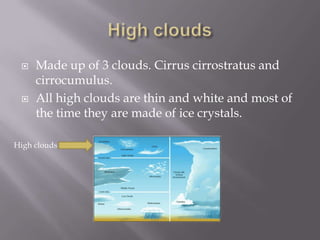
   Made up of 3 clouds. Cirrus cirrostratus and
     cirrocumulus.
    All high clouds are thin and white and most of
     the time they are made of ice crystals.

High clouds
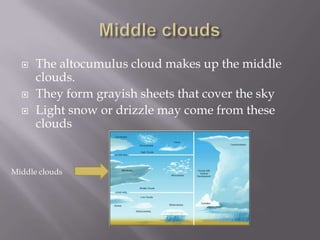
   The altocumulus cloud makes up the middle
      clouds.
     They form grayish sheets that cover the sky
     Light snow or drizzle may come from these
      clouds


Middle clouds
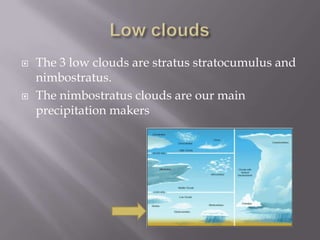
   The 3 low clouds are stratus stratocumulus and
    nimbostratus.
   The nimbostratus clouds are our main
    precipitation makers
   Some clouds do not fit into the 3 height
    categories.
   They all are associated with unstable air
   There are no physical differences between fog
    and clouds.
   Fog is defined as a cloud with its base low to
    the ground
   It is cold precipitation that will freeze when it
    hits a solid object
When air is 100 percent saturated and 100 percent
 relative humidity many droplets form together
 to form a rain drop.
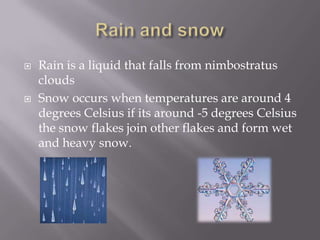
   Rain is a liquid that falls from nimbostratus
    clouds
   Snow occurs when temperatures are around 4
    degrees Celsius if its around -5 degrees Celsius
    the snow flakes join other flakes and form wet
    and heavy snow.
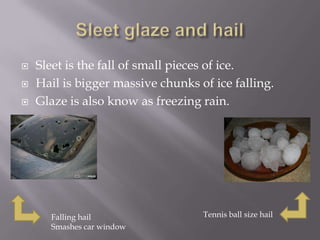
   Sleet is the fall of small pieces of ice.
   Hail is bigger massive chunks of ice falling.
   Glaze is also know as freezing rain.


      Falling hail                 Tennis ball size hail
      Smashes car window
2tsmalley

2tsmalley

  • 1.
  • 2.
    Change in the temp when no heat is added or taken away.  This is called adiabatic temperature changes  The wet adiabatic rate is always slower than the dry adiabatic rate
  • 3.
    Elevated terrains such as mountains block . flowing air.  The mountains act like big walls or barriers.
  • 4.
    The boundary between colliding bodies of warm and cold air.  this happens when cold air acts like a wall and blocks the warm air so the warm air rises.
  • 5.
    Air lifting from air in the lower atmosphere.
  • 6.
    This happens when unequal heating of the earths surface warms a pocket of air and lowers the airs density.
  • 7.
    Stable conditions happen when air temperature increases in height.  This is called temperature inversion.
  • 8.
    The air above the ground particulate matter serve as surfaces for water vapor.  The particulate matter is called condensation nuclei.
  • 9.
    The 3 types of clouds are cirrus, cumulus, and stratus.  Cirrus clouds are high white and thin. Cumulus clouds are flat base clouds look like rising domes or towers. Stratus clouds are sheets or layers that cover most of the sky
  • 10.
    Made up of 3 clouds. Cirrus cirrostratus and cirrocumulus.  All high clouds are thin and white and most of the time they are made of ice crystals. High clouds
  • 11.
    The altocumulus cloud makes up the middle clouds.  They form grayish sheets that cover the sky  Light snow or drizzle may come from these clouds Middle clouds
  • 12.
    The 3 low clouds are stratus stratocumulus and nimbostratus.  The nimbostratus clouds are our main precipitation makers
  • 13.
    Some clouds do not fit into the 3 height categories.  They all are associated with unstable air
  • 14.
    There are no physical differences between fog and clouds.  Fog is defined as a cloud with its base low to the ground
  • 15.
    It is cold precipitation that will freeze when it hits a solid object
  • 16.
    When air is100 percent saturated and 100 percent relative humidity many droplets form together to form a rain drop.
  • 17.
    Rain is a liquid that falls from nimbostratus clouds  Snow occurs when temperatures are around 4 degrees Celsius if its around -5 degrees Celsius the snow flakes join other flakes and form wet and heavy snow.
  • 18.
    Sleet is the fall of small pieces of ice.  Hail is bigger massive chunks of ice falling.  Glaze is also know as freezing rain. Falling hail Tennis ball size hail Smashes car window