Clouds and Precipitation

      By: Justin Haines
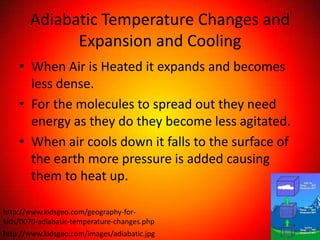
Adiabatic Temperature Changes and
             Expansion and Cooling
    • When Air is Heated it expands and becomes
      less dense.
    • For the molecules to spread out they need
      energy as they do they become less agitated.
    • When air cools down it falls to the surface of
      the earth more pressure is added causing
      them to heat up.

http://www.kidsgeo.com/geography-for-
kids/0070-adiabatic-temperature-changes.php
http://www.kidsgeo.com/images/adiabatic.jpg
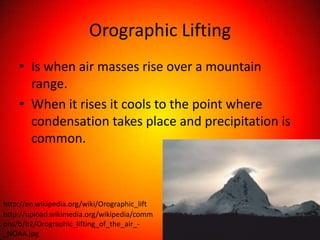
Orographic Lifting
    • Is when air masses rise over a mountain
      range.
    • When it rises it cools to the point where
      condensation takes place and precipitation is
      common.


http://en.wikipedia.org/wiki/Orographic_lift
http://upload.wikimedia.org/wikipedia/comm
ons/b/b2/Orographic_lifting_of_the_air_-
_NOAA.jpg
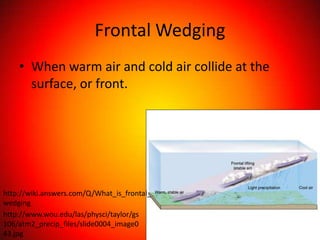
Frontal Wedging
    • When warm air and cold air collide at the
      surface, or front.


http://wiki.answers.com/Q/What_is_frontal_
wedging
http://www.wou.edu/las/physci/taylor/gs
106/atm2_precip_files/slide0004_image0
43.jpg
Convergence
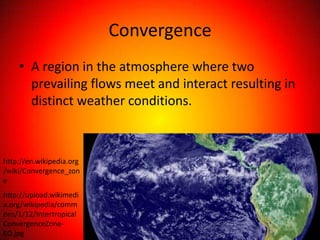
    • A region in the atmosphere where two
      prevailing flows meet and interact resulting in
      distinct weather conditions.


http://en.wikipedia.org
/wiki/Convergence_zon
e
http://upload.wikimedi
a.org/wikipedia/comm
ons/1/12/Intertropical
ConvergenceZone-
EO.jpg
Localized Convective Lifting
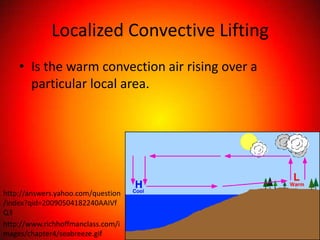
    • Is the warm convection air rising over a
      particular local area.


http://answers.yahoo.com/question
/index?qid=20090504182240AAIVf
Q3
http://www.richhoffmanclass.com/i
mages/chapter4/seabreeze.gif
Stability (Density Differences &
              Stability and Daily Weather)
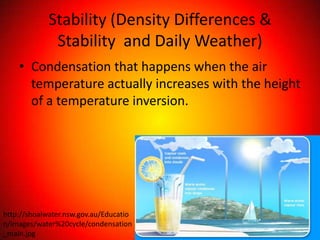
    • Condensation that happens when the air
      temperature actually increases with the height
      of a temperature inversion.


http://shoalwater.nsw.gov.au/Educatio
n/images/water%20cycle/condensation
_main.jpg
Condensation
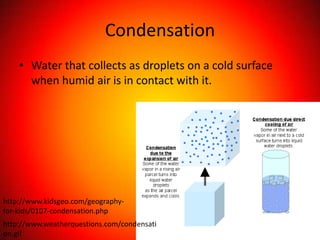
    • Water that collects as droplets on a cold surface
      when humid air is in contact with it.


http://www.kidsgeo.com/geography-
for-kids/0107-condensation.php
http://www.weatherquestions.com/condensati
on.gif
Types of Clouds
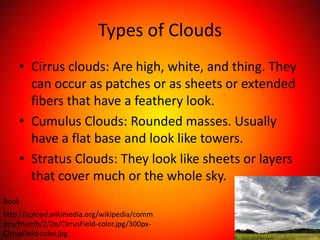
    • Cirrus clouds: Are high, white, and thing. They
      can occur as patches or as sheets or extended
      fibers that have a feathery look.
    • Cumulus Clouds: Rounded masses. Usually
      have a flat base and look like towers.
    • Stratus Clouds: They look like sheets or layers
      that cover much or the whole sky.
Book
http://upload.wikimedia.org/wikipedia/comm
ons/thumb/2/2e/CirrusField-color.jpg/300px-
CirrusField-color.jpg
High Clouds
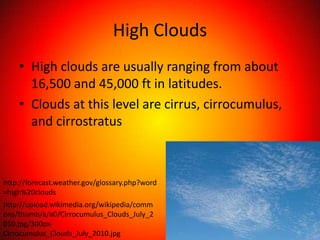
    • High clouds are usually ranging from about
      16,500 and 45,000 ft in latitudes.
    • Clouds at this level are cirrus, cirrocumulus,
      and cirrostratus


http://forecast.weather.gov/glossary.php?word
=high%20clouds
http://upload.wikimedia.org/wikipedia/comm
ons/thumb/a/a0/Cirrocumulus_Clouds_July_2
010.jpg/300px-
Cirrocumulus_Clouds_July_2010.jpg
Middle Clouds
    • Clouds at the altitude between 6,500 and
      23,000 ft.
    • These clouds are Altocumulus, altostratus, and
      nimbostratus


http://forecast.weather.gov/glossary.php?word
=Middle+clouds
http://upload.wikimedia.org/wikipedia/comm
ons/thumb/1/13/Altocumulus.jpg/300px-
Altocumulus.jpg
Low Clouds
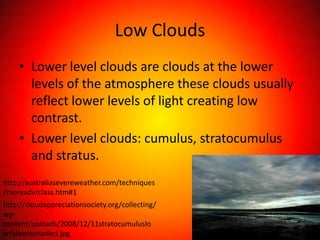
    • Lower level clouds are clouds at the lower
      levels of the atmosphere these clouds usually
      reflect lower levels of light creating low
      contrast.
    • Lower level clouds: cumulus, stratocumulus
      and stratus.
http://australiasevereweather.com/techniques
/moreadv/class.htm#1
http://cloudappreciationsociety.org/collecting/
wp-
content/uploads/2008/12/11stratocumuluslo
wtideantoniofeci.jpg
Clouds Of Vertical Development
    • These clouds are clouds that aren’t classified
      by any three of the scales
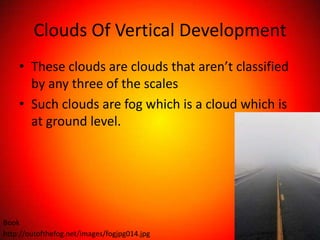
    • Such clouds are fog which is a cloud which is
      at ground level.


Book
http://outofthefog.net/images/fogjpg014.jpg
Fog
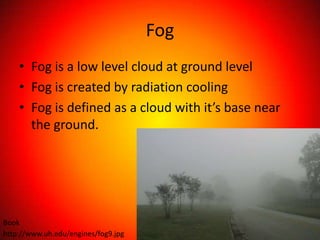
    • Fog is a low level cloud at ground level
    • Fog is created by radiation cooling
    • Fog is defined as a cloud with it’s base near
      the ground.


Book
http://www.uh.edu/engines/fog9.jpg
Cold Cloud Precipitation (Bergeron
                      process)
    • When cold clouds of the upper atmosphere
      form precipitation from ice crystal growth.


http://en.wikipedia.org/wiki/Bergeron_proces
s
http://www.geo.hunter.cuny.edu/~tbw/wc.not
es/5.cond.precip/precipitation/bergeron.proce
ss.jpg
Warm Cloud Precipitation (Collision-
             coalescene process)
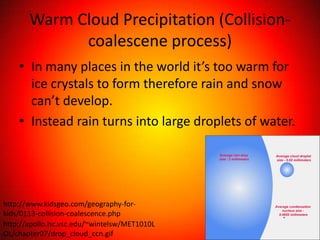
    • In many places in the world it’s too warm for
      ice crystals to form therefore rain and snow
      can’t develop.
    • Instead rain turns into large droplets of water.


http://www.kidsgeo.com/geography-for-
kids/0113-collision-coalescence.php
http://apollo.lsc.vsc.edu/~wintelsw/MET1010L
OL/chapter07/drop_cloud_ccn.gif
Rain and Snow
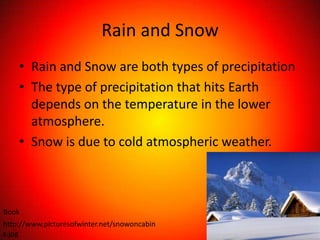
    • Rain and Snow are both types of precipitation
    • The type of precipitation that hits Earth
      depends on the temperature in the lower
      atmosphere.
    • Snow is due to cold atmospheric weather.


Book
http://www.picturesofwinter.net/snowoncabin
s.jpg
Sleet, Glaze, and Hail
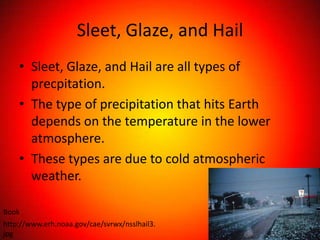
    • Sleet, Glaze, and Hail are all types of
      precpitation.
    • The type of precipitation that hits Earth
      depends on the temperature in the lower
      atmosphere.
    • These types are due to cold atmospheric
      weather.

Book
http://www.erh.noaa.gov/cae/svrwx/nsslhail3.
jpg
3JHaines

3JHaines

  • 1.
    Clouds and Precipitation By: Justin Haines
  • 2.
    Adiabatic Temperature Changesand Expansion and Cooling • When Air is Heated it expands and becomes less dense. • For the molecules to spread out they need energy as they do they become less agitated. • When air cools down it falls to the surface of the earth more pressure is added causing them to heat up. http://www.kidsgeo.com/geography-for- kids/0070-adiabatic-temperature-changes.php http://www.kidsgeo.com/images/adiabatic.jpg
  • 3.
    Orographic Lifting • Is when air masses rise over a mountain range. • When it rises it cools to the point where condensation takes place and precipitation is common. http://en.wikipedia.org/wiki/Orographic_lift http://upload.wikimedia.org/wikipedia/comm ons/b/b2/Orographic_lifting_of_the_air_- _NOAA.jpg
  • 4.
    Frontal Wedging • When warm air and cold air collide at the surface, or front. http://wiki.answers.com/Q/What_is_frontal_ wedging http://www.wou.edu/las/physci/taylor/gs 106/atm2_precip_files/slide0004_image0 43.jpg
  • 5.
    Convergence • A region in the atmosphere where two prevailing flows meet and interact resulting in distinct weather conditions. http://en.wikipedia.org /wiki/Convergence_zon e http://upload.wikimedi a.org/wikipedia/comm ons/1/12/Intertropical ConvergenceZone- EO.jpg
  • 6.
    Localized Convective Lifting • Is the warm convection air rising over a particular local area. http://answers.yahoo.com/question /index?qid=20090504182240AAIVf Q3 http://www.richhoffmanclass.com/i mages/chapter4/seabreeze.gif
  • 7.
    Stability (Density Differences& Stability and Daily Weather) • Condensation that happens when the air temperature actually increases with the height of a temperature inversion. http://shoalwater.nsw.gov.au/Educatio n/images/water%20cycle/condensation _main.jpg
  • 8.
    Condensation • Water that collects as droplets on a cold surface when humid air is in contact with it. http://www.kidsgeo.com/geography- for-kids/0107-condensation.php http://www.weatherquestions.com/condensati on.gif
  • 9.
    Types of Clouds • Cirrus clouds: Are high, white, and thing. They can occur as patches or as sheets or extended fibers that have a feathery look. • Cumulus Clouds: Rounded masses. Usually have a flat base and look like towers. • Stratus Clouds: They look like sheets or layers that cover much or the whole sky. Book http://upload.wikimedia.org/wikipedia/comm ons/thumb/2/2e/CirrusField-color.jpg/300px- CirrusField-color.jpg
  • 10.
    High Clouds • High clouds are usually ranging from about 16,500 and 45,000 ft in latitudes. • Clouds at this level are cirrus, cirrocumulus, and cirrostratus http://forecast.weather.gov/glossary.php?word =high%20clouds http://upload.wikimedia.org/wikipedia/comm ons/thumb/a/a0/Cirrocumulus_Clouds_July_2 010.jpg/300px- Cirrocumulus_Clouds_July_2010.jpg
  • 11.
    Middle Clouds • Clouds at the altitude between 6,500 and 23,000 ft. • These clouds are Altocumulus, altostratus, and nimbostratus http://forecast.weather.gov/glossary.php?word =Middle+clouds http://upload.wikimedia.org/wikipedia/comm ons/thumb/1/13/Altocumulus.jpg/300px- Altocumulus.jpg
  • 12.
    Low Clouds • Lower level clouds are clouds at the lower levels of the atmosphere these clouds usually reflect lower levels of light creating low contrast. • Lower level clouds: cumulus, stratocumulus and stratus. http://australiasevereweather.com/techniques /moreadv/class.htm#1 http://cloudappreciationsociety.org/collecting/ wp- content/uploads/2008/12/11stratocumuluslo wtideantoniofeci.jpg
  • 13.
    Clouds Of VerticalDevelopment • These clouds are clouds that aren’t classified by any three of the scales • Such clouds are fog which is a cloud which is at ground level. Book http://outofthefog.net/images/fogjpg014.jpg
  • 14.
    Fog • Fog is a low level cloud at ground level • Fog is created by radiation cooling • Fog is defined as a cloud with it’s base near the ground. Book http://www.uh.edu/engines/fog9.jpg
  • 15.
    Cold Cloud Precipitation(Bergeron process) • When cold clouds of the upper atmosphere form precipitation from ice crystal growth. http://en.wikipedia.org/wiki/Bergeron_proces s http://www.geo.hunter.cuny.edu/~tbw/wc.not es/5.cond.precip/precipitation/bergeron.proce ss.jpg
  • 16.
    Warm Cloud Precipitation(Collision- coalescene process) • In many places in the world it’s too warm for ice crystals to form therefore rain and snow can’t develop. • Instead rain turns into large droplets of water. http://www.kidsgeo.com/geography-for- kids/0113-collision-coalescence.php http://apollo.lsc.vsc.edu/~wintelsw/MET1010L OL/chapter07/drop_cloud_ccn.gif
  • 17.
    Rain and Snow • Rain and Snow are both types of precipitation • The type of precipitation that hits Earth depends on the temperature in the lower atmosphere. • Snow is due to cold atmospheric weather. Book http://www.picturesofwinter.net/snowoncabin s.jpg
  • 18.
    Sleet, Glaze, andHail • Sleet, Glaze, and Hail are all types of precpitation. • The type of precipitation that hits Earth depends on the temperature in the lower atmosphere. • These types are due to cold atmospheric weather. Book http://www.erh.noaa.gov/cae/svrwx/nsslhail3. jpg