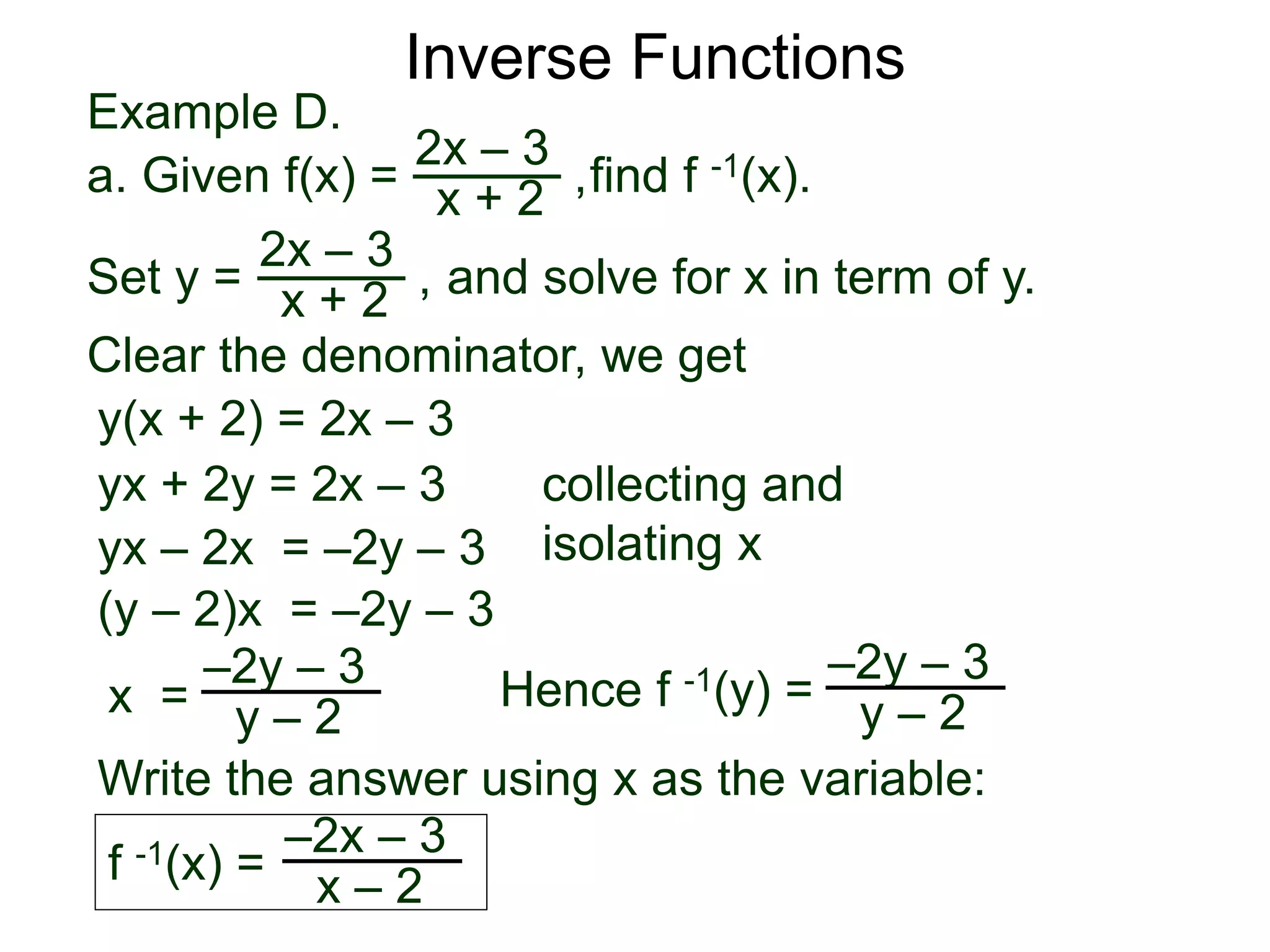
Example D.
Hence f -1(y) =
2x – 3
x + 2
Inverse Functions
a. Given f(x) = find f -1(x).,
Set y = and solve for x in term of y.
2x – 3
x + 2 ,
Clear the denominator, we get
y(x + 2) = 2x – 3
yx + 2y = 2x – 3 collecting and
isolating xyx – 2x = –2y – 3
(y – 2)x = –2y – 3
x =
–2y – 3
y – 2
–2y – 3
y – 2
Write the answer using x as the variable:
f -1(x) =
–2x – 3
x – 2
Inverse Functions
b. Verify that f(f -1(x)) = x
We've f(x) = and
2x – 3
x + 2 , f -1(x) =
–2x – 3
x – 2
f(f -1(x)) = f( )–2x – 3
x – 2
=
–2x – 3
x – 2
– 3
–2x – 3
x – 2
+ 2
( )2[
[ ]
](x – 2)
(x – 2)
=
2(-2x – 3) – 3(x – 2)
(-2x – 3) + 2(x – 2)
=
-4x – 6 – 3x + 6
-2x – 3 + 2x – 4
=
-7x
-7
= x
Your turn. Verify that f -1(f(x)) = x
Use the LCD to simplify
the complex fraction
Exercise A. Find the inverse f -1(x) of the following f(x)’s.
Inverse Functions
2. f(x) = x/3 – 2
2x – 3
x + 2
1. f(x) = 3x – 2 3. f(x) = x/3 + 2/5
5. f(x) = 3/x – 24. f(x) = ax + b 6. f(x) = 4/x + 2/5
7. f(x) = 3/(x – 2) 8. f(x) = 4/(x + 2) – 5
9. f(x) = 2/(3x + 4) – 5 10. f(x) = 5/(4x + 3) – 1/2
f(x) =11. 2x – 3
x + 2f(x) =12.
4x – 3
–3x + 2
f(x) =13.
bx + c
a
f(x) =14. cx + d
ax + b
f(x) =15.
16. f(x) = (3x – 2)1/3
18. f(x) = (x/3 – 2)1/3
17. f(x) = (x/3 + 2/5)1/3
19. f(x) = (x/3)1/3 – 2
20. f(x) = (ax – b)1/3 21. f(x) = (ax)1/3 – b
B. Verify your answers are correct by verifying that
f -1(f(x)) = x and f(f-1 (x)) = x for problem 1 – 21.
C. For each of the following graphs of f(x)’s, determine
a. the domain and the range of the f -1(x),
b. the end points and the fixed points of the graph of f -1(x).
Draw the graph of f -1(x).
Inverse Functions
(–3, –1)
y = x
(3,4)
1.
(–4, –2)
(5,7)
2.
(–2, –5)
(4,3)
3.
(–3, –1)
(3,4)4.
(–4, –2)
(5,7)
5.
(–2, –5)
(4,3)
6.
Inverse Functions
(2, –1)
7.
(–4, 3)
(c, d)
8.
(a, b)
C. For each of the following graphs of f(x)’s, determine
a. the domain and the range of the f -1(x),
b. the end points and the fixed points of the graph of f -1(x).
Draw the graph of f -1(x).
(Answers to the odd problems) Exercise A.
Inverse Functions
2x + 3
2 – x
1. f -1(x) = (x + 2) 3. f -1(x) = (5x – 2)
5. f -1(x) = 7. f -1(x) =
9. f -1(x) = – f -1(x) =11.
2x + 3
3x + 4
f -1 (x) =13. x – ac
ad – b
f -1 (x) =15.
17. f -1(x) = (5x3 – 2) 19. f -1(x) = 3 (x3 + 6x2 + 12x + 8)
21. f -1 (x) = (x + a)3/b
1
3
3
5
3
x + 2
2x + 3
x
2(2x + 9)
3(x + 5)
3
5
Exercise C.
Inverse Functions
(4, 3)
y = x
(-1, -3)
1. domain: [-1, 4]
range: [-3, 3]
(–5, –2)
(3,4)
3. domain: [-5, 3]
range: [-2, 4]
(–2, –4)
(7,5)
5. domain: [-2, 7]
range: [-4, 5]
(3, –4)
7. domain: [-1, 3], range: [-4,2]
(–1, 2)

4.1 inverse functions t

  • 1.
    Example D. Hence f-1(y) = 2x – 3 x + 2 Inverse Functions a. Given f(x) = find f -1(x)., Set y = and solve for x in term of y. 2x – 3 x + 2 , Clear the denominator, we get y(x + 2) = 2x – 3 yx + 2y = 2x – 3 collecting and isolating xyx – 2x = –2y – 3 (y – 2)x = –2y – 3 x = –2y – 3 y – 2 –2y – 3 y – 2 Write the answer using x as the variable: f -1(x) = –2x – 3 x – 2
  • 2.
    Inverse Functions b. Verifythat f(f -1(x)) = x We've f(x) = and 2x – 3 x + 2 , f -1(x) = –2x – 3 x – 2 f(f -1(x)) = f( )–2x – 3 x – 2 = –2x – 3 x – 2 – 3 –2x – 3 x – 2 + 2 ( )2[ [ ] ](x – 2) (x – 2) = 2(-2x – 3) – 3(x – 2) (-2x – 3) + 2(x – 2) = -4x – 6 – 3x + 6 -2x – 3 + 2x – 4 = -7x -7 = x Your turn. Verify that f -1(f(x)) = x Use the LCD to simplify the complex fraction
  • 3.
    Exercise A. Findthe inverse f -1(x) of the following f(x)’s. Inverse Functions 2. f(x) = x/3 – 2 2x – 3 x + 2 1. f(x) = 3x – 2 3. f(x) = x/3 + 2/5 5. f(x) = 3/x – 24. f(x) = ax + b 6. f(x) = 4/x + 2/5 7. f(x) = 3/(x – 2) 8. f(x) = 4/(x + 2) – 5 9. f(x) = 2/(3x + 4) – 5 10. f(x) = 5/(4x + 3) – 1/2 f(x) =11. 2x – 3 x + 2f(x) =12. 4x – 3 –3x + 2 f(x) =13. bx + c a f(x) =14. cx + d ax + b f(x) =15. 16. f(x) = (3x – 2)1/3 18. f(x) = (x/3 – 2)1/3 17. f(x) = (x/3 + 2/5)1/3 19. f(x) = (x/3)1/3 – 2 20. f(x) = (ax – b)1/3 21. f(x) = (ax)1/3 – b B. Verify your answers are correct by verifying that f -1(f(x)) = x and f(f-1 (x)) = x for problem 1 – 21.
  • 4.
    C. For eachof the following graphs of f(x)’s, determine a. the domain and the range of the f -1(x), b. the end points and the fixed points of the graph of f -1(x). Draw the graph of f -1(x). Inverse Functions (–3, –1) y = x (3,4) 1. (–4, –2) (5,7) 2. (–2, –5) (4,3) 3. (–3, –1) (3,4)4. (–4, –2) (5,7) 5. (–2, –5) (4,3) 6.
  • 5.
    Inverse Functions (2, –1) 7. (–4,3) (c, d) 8. (a, b) C. For each of the following graphs of f(x)’s, determine a. the domain and the range of the f -1(x), b. the end points and the fixed points of the graph of f -1(x). Draw the graph of f -1(x).
  • 6.
    (Answers to theodd problems) Exercise A. Inverse Functions 2x + 3 2 – x 1. f -1(x) = (x + 2) 3. f -1(x) = (5x – 2) 5. f -1(x) = 7. f -1(x) = 9. f -1(x) = – f -1(x) =11. 2x + 3 3x + 4 f -1 (x) =13. x – ac ad – b f -1 (x) =15. 17. f -1(x) = (5x3 – 2) 19. f -1(x) = 3 (x3 + 6x2 + 12x + 8) 21. f -1 (x) = (x + a)3/b 1 3 3 5 3 x + 2 2x + 3 x 2(2x + 9) 3(x + 5) 3 5
  • 7.
    Exercise C. Inverse Functions (4,3) y = x (-1, -3) 1. domain: [-1, 4] range: [-3, 3] (–5, –2) (3,4) 3. domain: [-5, 3] range: [-2, 4] (–2, –4) (7,5) 5. domain: [-2, 7] range: [-4, 5] (3, –4) 7. domain: [-1, 3], range: [-4,2] (–1, 2)