Lesson 2-1:
General Form of a
Polynomial Function
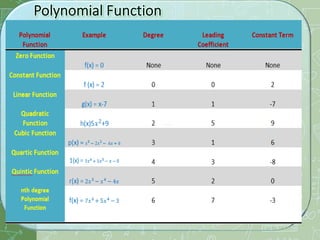
Polynomial Function
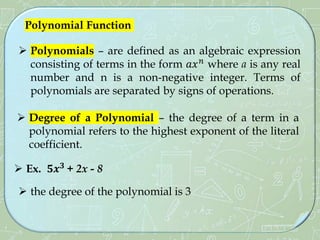
 Polynomials – are defined as an algebraic expression
consisting of terms in the form 𝑎𝑥𝑛
where a is any real
number and n is a non-negative integer. Terms of
polynomials are separated by signs of operations.
 Degree of a Polynomial – the degree of a term in a
polynomial refers to the highest exponent of the literal
coefficient.
 Ex. 𝟓𝒙𝟑
+ 2x - 8
 the degree of the polynomial is 3
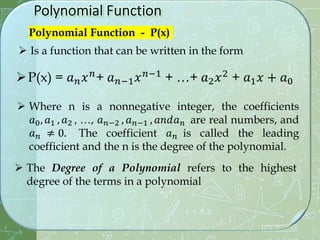
Polynomial Function - P(x)
 Is a function that can be written in the form
P(x) = 𝑎𝑛𝑥𝑛
+ 𝑎𝑛−1𝑥𝑛−1
+ …+ 𝑎2𝑥2
+ 𝑎1𝑥 + 𝑎0
 Where n is a nonnegative integer, the coefficients
𝑎0, 𝑎1 , 𝑎2 , …, 𝑎𝑛−2 , 𝑎𝑛−1 , 𝑎𝑛𝑑𝑎𝑛 are real numbers, and
𝑎𝑛 ≠ 0. The coefficient 𝑎𝑛 is called the leading
coefficient and the n is the degree of the polynomial.
 The Degree of a Polynomial refers to the highest
degree of the terms in a polynomial
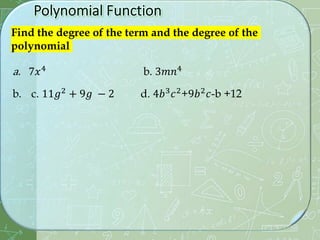
Find the degree of the term and the degree of the
polynomial
a. 7𝑥4
b. 3𝑚𝑛4
b. c. 11𝑔2
+ 9𝑔 − 2 d. 4𝑏3
𝑐2
+9𝑏2
𝑐-b +12
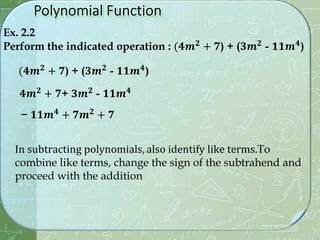
Ex. 2.2
Perform the indicated operation : (𝟒𝒎𝟐 + 𝟕) + (𝟑𝒎𝟐 - 𝟏𝟏𝒎𝟒)
(𝟒𝒎𝟐
+ 𝟕) + (𝟑𝒎𝟐
- 𝟏𝟏𝒎𝟒
)
𝟒𝒎𝟐 + 𝟕+ 𝟑𝒎𝟐 - 𝟏𝟏𝒎𝟒
− 𝟏𝟏𝒎𝟒
+ 𝟕𝒎𝟐
+ 𝟕
In subtracting polynomials, also identify like terms.To
combine like terms, change the sign of the subtrahend and
proceed with the addition
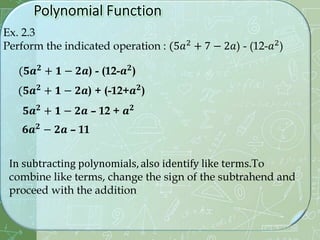
Ex. 2.3
Perform the indicated operation : (5𝑎2 + 7 − 2𝑎) - (12-𝑎2)
(𝟓𝒂𝟐
+ 𝟏 − 𝟐𝒂) - (12-𝒂𝟐
)
In subtracting polynomials, also identify like terms.To
combine like terms, change the sign of the subtrahend and
proceed with the addition
(𝟓𝒂𝟐
+ 𝟏 − 𝟐𝒂) + (-12+𝒂𝟐
)
𝟓𝒂𝟐
+ 𝟏 − 𝟐𝒂 – 12 + 𝒂𝟐
𝟔𝒂𝟐
− 𝟐𝒂 – 11
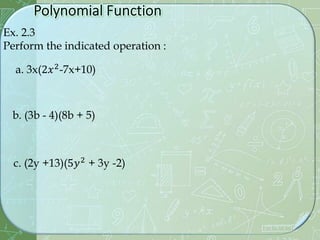
Ex. 2.3
Perform the indicated operation :
a. 3x(2𝑥2-7x+10)
b. (3b - 4)(8b + 5)
c. (2y +13)(5𝑦2
+ 3y -2)
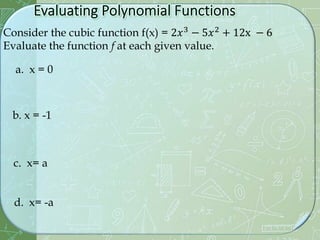
Consider the cubic function f(x) = 2𝑥3
− 5𝑥2
+ 12x − 6
Evaluate the function f at each given value.
a. x = 0
b. x = -1
c. x= a
d. x= -a
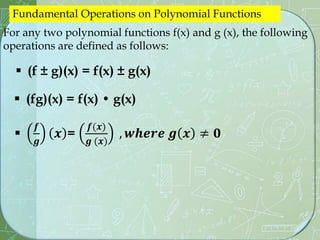
For any two polynomial functions f(x) and g (x), the following
operations are defined as follows:
 (f ± g)(x) = f(x) ± g(x)
Fundamental Operations on Polynomial Functions
 (fg)(x) = f(x) • g(x)

𝒇
𝒈
𝒙 =
𝒇(𝒙)
𝒈 (𝒙)
, 𝒘𝒉𝒆𝒓𝒆 𝒈 𝒙 ≠ 𝟎
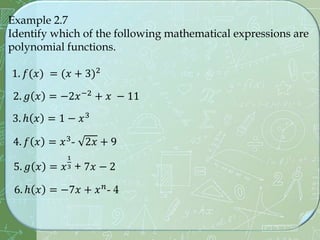
Example 2.7
Identify which of the following mathematical expressions are
polynomial functions.
1. 𝑓(𝑥) = (𝑥 + 3)2
2. 𝑔 𝑥 = −2𝑥−2
+ 𝑥 − 11
3. ℎ 𝑥 = 1 − 𝑥3
4. 𝑓 𝑥 = 𝑥3
- 2𝑥 + 9
5. 𝑔 𝑥 = 𝑥
1
3 + 7𝑥 − 2
6. ℎ 𝑥 = −7𝑥 + 𝑥𝑛- 4
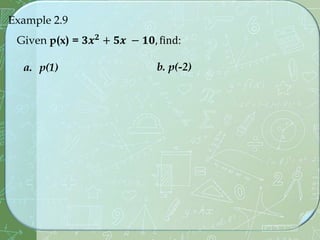
Example 2.9
Given p(x) = 𝟑𝒙𝟐 + 𝟓𝒙 − 𝟏𝟎, find:
a. p(1) b. p(-2)
Example 2.9
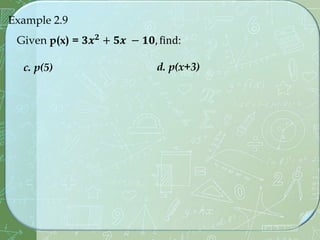
Given p(x) = 𝟑𝒙𝟐 + 𝟓𝒙 − 𝟏𝟎, find:
c. p(5) d. p(x+3)
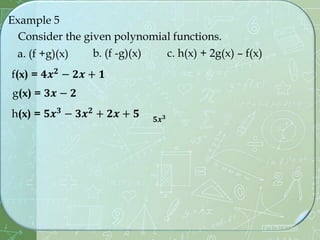
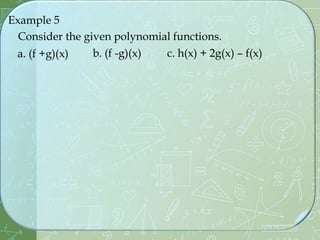
Example 5
Consider the given polynomial functions.
f(x) = 𝟒𝒙𝟐
− 𝟐𝒙 + 𝟏
g(x) = 𝟑𝒙 − 𝟐
a. (f +g)(x) b. (f -g)(x) c. h(x) + 2g(x) – f(x)
h(x) = 𝟓𝒙𝟑
− 𝟑𝒙𝟐
+ 𝟐𝒙 + 𝟓 𝟓𝒙𝟑
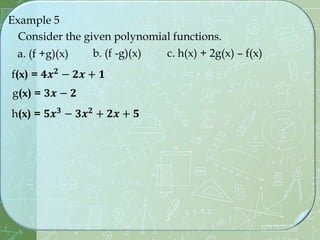
Example 5
Consider the given polynomial functions.
f(x) = 𝟒𝒙𝟐
− 𝟐𝒙 + 𝟏
g(x) = 𝟑𝒙 − 𝟐
a. (f +g)(x) b. (f -g)(x) c. h(x) + 2g(x) – f(x)
h(x) = 𝟓𝒙𝟑
− 𝟑𝒙𝟐
+ 𝟐𝒙 + 𝟓
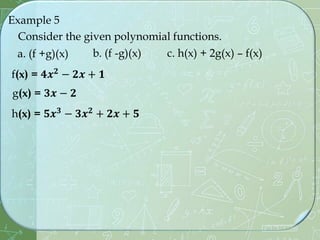
Example 5
Consider the given polynomial functions.
f(x) = 𝟒𝒙𝟐
− 𝟐𝒙 + 𝟏
g(x) = 𝟑𝒙 − 𝟐
a. (f +g)(x) b. (f -g)(x) c. h(x) + 2g(x) – f(x)
h(x) = 𝟓𝒙𝟑
− 𝟑𝒙𝟐
+ 𝟐𝒙 + 𝟓
Example 5
Consider the given polynomial functions.
a. (f +g)(x) b. (f -g)(x) c. h(x) + 2g(x) – f(x)
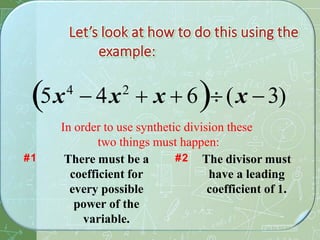
5x4
 4x2
 x  6(x 3)
In order to use synthetic division these
two things must happen:
There must be a
coefficient for
every possible
power of the
variable.
The divisor must
have a leading
coefficient of 1.
#1 #2
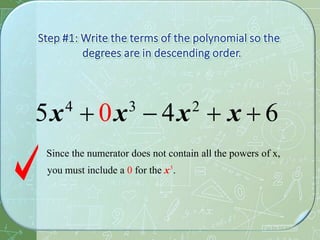
5x4
 0x3
 4x2
 x  6
Since the numerator does not contain all the powers of x,
you must include a 0 for the x3
.
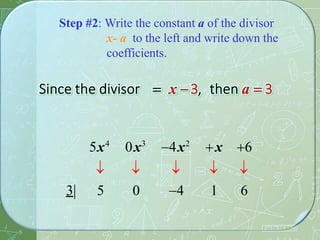
Step #2: Write the constant a of the divisor
x- a to the left and write down the
coefficients.
5x4
0x3
4x2
x 6
    
3 5 0 4 1 6
3 5 0 4 1 6

5
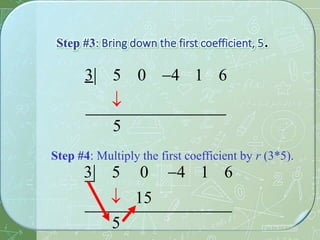
Step #4: Multiply the first coefficient by r (3*5).
5
3 5 0 4 1 6
 15
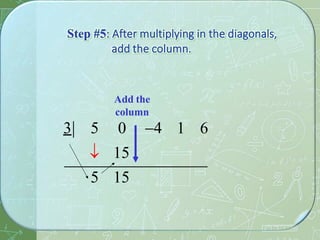
Add the
column
3 5 0 4 1 6
 15
5 15
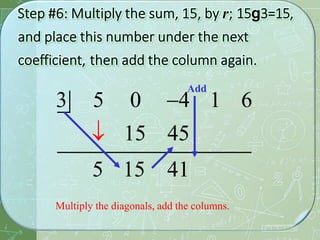
3 5 0 4 1 6
 15 45
Add
5 15 41
Multiply the diagonals, add the columns.
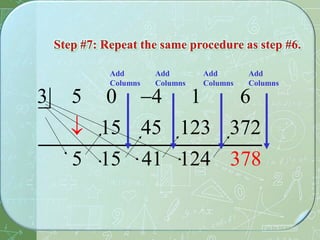
 15 45 123 372
5 15 41 124 378
3 5 0 4 1 6
Add
Columns
Add
Columns
Add
Columns
Add
Columns
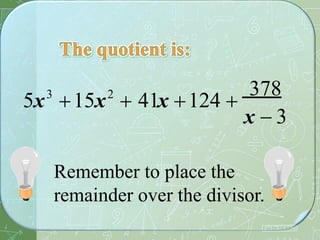
5x3
15x2
 41x 124 
378
x  3
Remember to place the
remainder over the divisor.
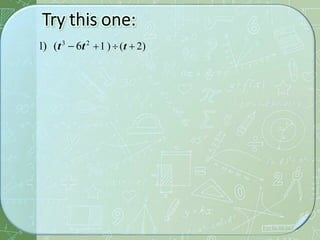
1) (t3
 6t2
1 ) (t  2)

Lesson 4- Math 10 - W4Q1_General Form of a Polynomial Function.pptx

  • 1.
    Lesson 2-1: General Formof a Polynomial Function
  • 2.
    Polynomial Function  Polynomials– are defined as an algebraic expression consisting of terms in the form 𝑎𝑥𝑛 where a is any real number and n is a non-negative integer. Terms of polynomials are separated by signs of operations.  Degree of a Polynomial – the degree of a term in a polynomial refers to the highest exponent of the literal coefficient.  Ex. 𝟓𝒙𝟑 + 2x - 8  the degree of the polynomial is 3
  • 3.
    Polynomial Function -P(x)  Is a function that can be written in the form P(x) = 𝑎𝑛𝑥𝑛 + 𝑎𝑛−1𝑥𝑛−1 + …+ 𝑎2𝑥2 + 𝑎1𝑥 + 𝑎0  Where n is a nonnegative integer, the coefficients 𝑎0, 𝑎1 , 𝑎2 , …, 𝑎𝑛−2 , 𝑎𝑛−1 , 𝑎𝑛𝑑𝑎𝑛 are real numbers, and 𝑎𝑛 ≠ 0. The coefficient 𝑎𝑛 is called the leading coefficient and the n is the degree of the polynomial.  The Degree of a Polynomial refers to the highest degree of the terms in a polynomial
  • 4.
    Find the degreeof the term and the degree of the polynomial a. 7𝑥4 b. 3𝑚𝑛4 b. c. 11𝑔2 + 9𝑔 − 2 d. 4𝑏3 𝑐2 +9𝑏2 𝑐-b +12
  • 6.
    Ex. 2.2 Perform theindicated operation : (𝟒𝒎𝟐 + 𝟕) + (𝟑𝒎𝟐 - 𝟏𝟏𝒎𝟒) (𝟒𝒎𝟐 + 𝟕) + (𝟑𝒎𝟐 - 𝟏𝟏𝒎𝟒 ) 𝟒𝒎𝟐 + 𝟕+ 𝟑𝒎𝟐 - 𝟏𝟏𝒎𝟒 − 𝟏𝟏𝒎𝟒 + 𝟕𝒎𝟐 + 𝟕 In subtracting polynomials, also identify like terms.To combine like terms, change the sign of the subtrahend and proceed with the addition
  • 7.
    Ex. 2.3 Perform theindicated operation : (5𝑎2 + 7 − 2𝑎) - (12-𝑎2) (𝟓𝒂𝟐 + 𝟏 − 𝟐𝒂) - (12-𝒂𝟐 ) In subtracting polynomials, also identify like terms.To combine like terms, change the sign of the subtrahend and proceed with the addition (𝟓𝒂𝟐 + 𝟏 − 𝟐𝒂) + (-12+𝒂𝟐 ) 𝟓𝒂𝟐 + 𝟏 − 𝟐𝒂 – 12 + 𝒂𝟐 𝟔𝒂𝟐 − 𝟐𝒂 – 11
  • 8.
    Ex. 2.3 Perform theindicated operation : a. 3x(2𝑥2-7x+10) b. (3b - 4)(8b + 5) c. (2y +13)(5𝑦2 + 3y -2)
  • 9.
    Consider the cubicfunction f(x) = 2𝑥3 − 5𝑥2 + 12x − 6 Evaluate the function f at each given value. a. x = 0 b. x = -1 c. x= a d. x= -a
  • 10.
    For any twopolynomial functions f(x) and g (x), the following operations are defined as follows:  (f ± g)(x) = f(x) ± g(x) Fundamental Operations on Polynomial Functions  (fg)(x) = f(x) • g(x)  𝒇 𝒈 𝒙 = 𝒇(𝒙) 𝒈 (𝒙) , 𝒘𝒉𝒆𝒓𝒆 𝒈 𝒙 ≠ 𝟎
  • 11.
    Example 2.7 Identify whichof the following mathematical expressions are polynomial functions. 1. 𝑓(𝑥) = (𝑥 + 3)2 2. 𝑔 𝑥 = −2𝑥−2 + 𝑥 − 11 3. ℎ 𝑥 = 1 − 𝑥3 4. 𝑓 𝑥 = 𝑥3 - 2𝑥 + 9 5. 𝑔 𝑥 = 𝑥 1 3 + 7𝑥 − 2 6. ℎ 𝑥 = −7𝑥 + 𝑥𝑛- 4
  • 12.
    Example 2.9 Given p(x)= 𝟑𝒙𝟐 + 𝟓𝒙 − 𝟏𝟎, find: a. p(1) b. p(-2)
  • 13.
    Example 2.9 Given p(x)= 𝟑𝒙𝟐 + 𝟓𝒙 − 𝟏𝟎, find: c. p(5) d. p(x+3)
  • 14.
    Example 5 Consider thegiven polynomial functions. f(x) = 𝟒𝒙𝟐 − 𝟐𝒙 + 𝟏 g(x) = 𝟑𝒙 − 𝟐 a. (f +g)(x) b. (f -g)(x) c. h(x) + 2g(x) – f(x) h(x) = 𝟓𝒙𝟑 − 𝟑𝒙𝟐 + 𝟐𝒙 + 𝟓 𝟓𝒙𝟑
  • 15.
    Example 5 Consider thegiven polynomial functions. f(x) = 𝟒𝒙𝟐 − 𝟐𝒙 + 𝟏 g(x) = 𝟑𝒙 − 𝟐 a. (f +g)(x) b. (f -g)(x) c. h(x) + 2g(x) – f(x) h(x) = 𝟓𝒙𝟑 − 𝟑𝒙𝟐 + 𝟐𝒙 + 𝟓
  • 16.
    Example 5 Consider thegiven polynomial functions. f(x) = 𝟒𝒙𝟐 − 𝟐𝒙 + 𝟏 g(x) = 𝟑𝒙 − 𝟐 a. (f +g)(x) b. (f -g)(x) c. h(x) + 2g(x) – f(x) h(x) = 𝟓𝒙𝟑 − 𝟑𝒙𝟐 + 𝟐𝒙 + 𝟓
  • 17.
    Example 5 Consider thegiven polynomial functions. a. (f +g)(x) b. (f -g)(x) c. h(x) + 2g(x) – f(x)
  • 18.
    5x4  4x2  x 6(x 3) In order to use synthetic division these two things must happen: There must be a coefficient for every possible power of the variable. The divisor must have a leading coefficient of 1. #1 #2
  • 19.
    5x4  0x3  4x2 x  6 Since the numerator does not contain all the powers of x, you must include a 0 for the x3 .
  • 20.
    Step #2: Writethe constant a of the divisor x- a to the left and write down the coefficients. 5x4 0x3 4x2 x 6      3 5 0 4 1 6
  • 21.
    3 5 04 1 6  5 Step #4: Multiply the first coefficient by r (3*5). 5 3 5 0 4 1 6  15
  • 22.
    Add the column 3 50 4 1 6  15 5 15
  • 23.
    3 5 04 1 6  15 45 Add 5 15 41 Multiply the diagonals, add the columns.
  • 24.
     15 45123 372 5 15 41 124 378 3 5 0 4 1 6 Add Columns Add Columns Add Columns Add Columns
  • 25.
    5x3 15x2  41x 124 378 x  3 Remember to place the remainder over the divisor.
  • 26.
    1) (t3  6t2 1) (t  2)