Chapter 7. Control Charts for Attributes
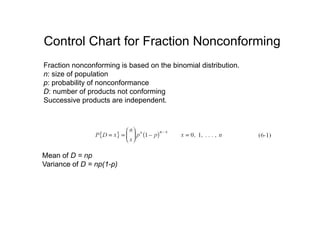
Control Chart for Fraction Nonconformingg
Fraction nonconforming is based on the binomial distribution.
n: size of populationp p
p: probability of nonconformance
D: number of products not conforming
Successive products are independent.
Mean of D = np
Variance of D = np(1-p)
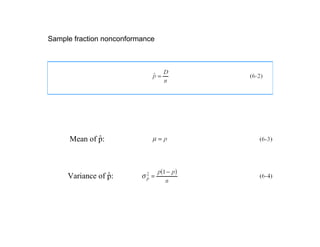
Sample fraction nonconformance
ˆMean of p:Mean of p:
ˆVariance of p:
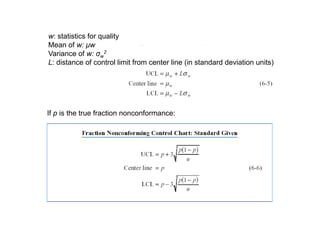
w: statistics for quality
Mean of w: µwMean of w: µw
Variance of w: σw
2
L: distance of control limit from center line (in standard deviation units)
If p is the true fraction nonconformance:
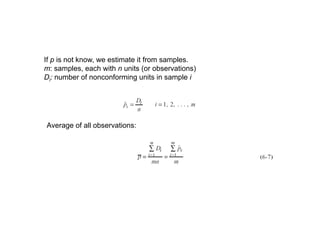
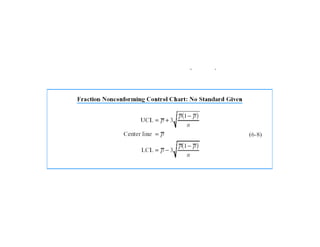
If p is not know, we estimate it from samples.
m: samples, each with n units (or observations)
D: number of nonconforming units in sample iDi: number of nonconforming units in sample i
Average of all observations:
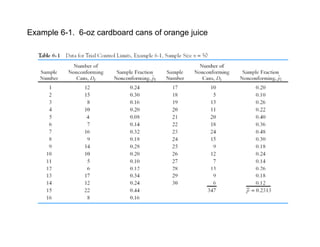
Example 6-1. 6-oz cardboard cans of orange juice
Design of Fraction Nonconforming ChartDesign of Fraction Nonconforming Chart
Three parameters to be specified:p p
1. sample size
2. frequency of sampling
3 width of control limits3. width of control limits
Common to base chart on 100% inspection of all process
output over time.
Rational subgroups may also play role in determining
sampling frequency.
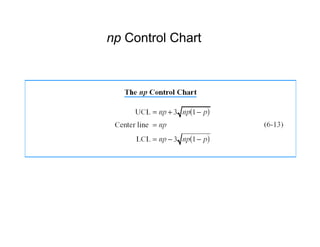
np Control Chart
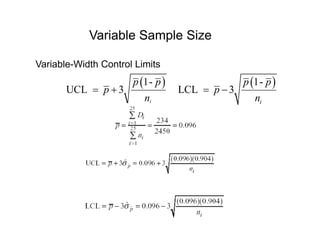
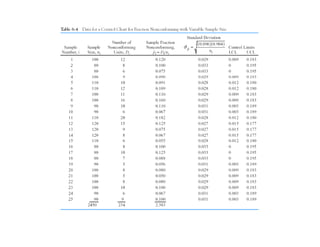
Variable Sample Size
Variable-Width Control Limits
( ) ( )( ) ( )1- 1-
UCL 3 LCL 3
i i
p p p p
p p
n n
= + = −
Variable Sample Size
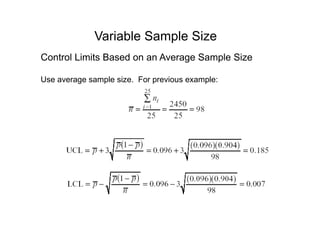
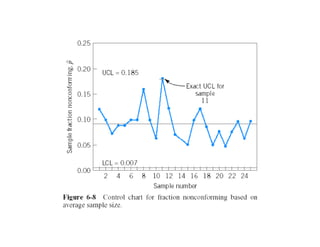
Control Limits Based on an Average Sample Size
U l i F i lUse average sample size. For previous example:
Variable Sample Size
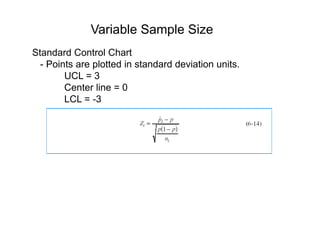
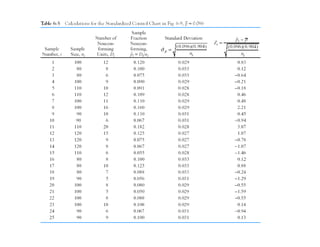
Standard Control Chart
- Points are plotted in standard deviation units.
UCL = 3UCL = 3
Center line = 0
LCL = -3
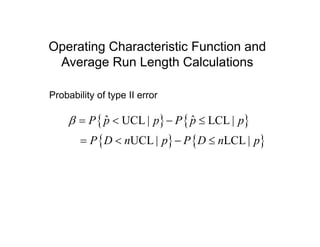
Operating Characteristic Function andOperating Characteristic Function and
Average Run Length Calculations
Probability of type II error
{ } { }
{ } { }
ˆ ˆUCL | LCL |
UCL | LCL |
P p p P p p
P D n p P D n p
β = < − ≤
< ≤{ } { }UCL | LCL |P D n p P D n p= < − ≤
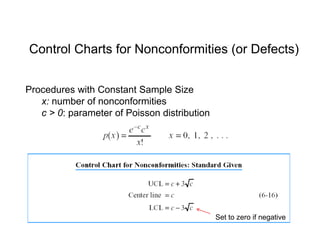
C t l Ch t f N f iti ( D f t )Control Charts for Nonconformities (or Defects)
Procedures with Constant Sample Size
x: number of nonconformities
c > 0: parameter of Poisson distribution
Set to zero if negative
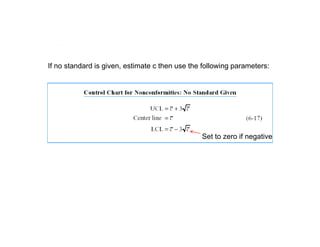
If no standard is given, estimate c then use the following parameters:
Set to zero if negativeg
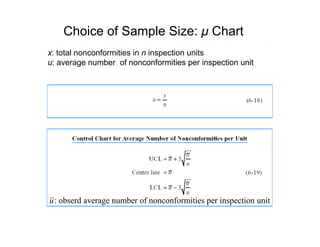
Choice of Sample Size: µ Chart
x: total nonconformities in n inspection units
u: average number of nonconformities per inspection unit
: obserd average number of nonconformities per inspection unitu: obserd average number of nonconformities per inspection unitu
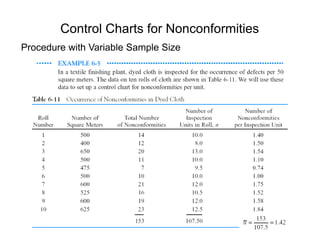
Control Charts for Nonconformities
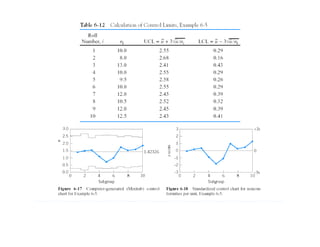
Procedure with Variable Sample SizeProcedure with Variable Sample Size
Control Charts for Nonconformities
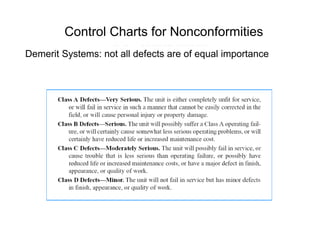
Demerit Systems: not all defects are of equal importance
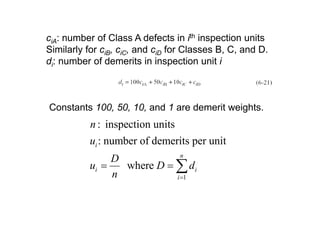
ciA: number of Class A defects in ith inspection units
Similarly for ciB, ciC, and ciD for Classes B, C, and D.
di: number of demerits in inspection unit i
Constants 100 50 10 and 1 are demerit weightsConstants 100, 50, 10, and 1 are demerit weights.
: inspection units
b f d it it
n
: number of demerits per unit
where
i
n
i i
u
D
u D d= = ∑1
i i
in =
∑
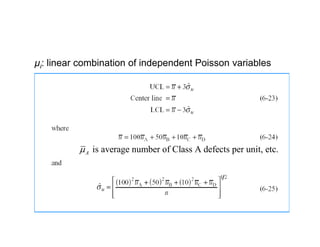
µi: linear combination of independent Poisson variables
is average number of Class A defects per unit, etc.Aµ
Control Charts for Nonconformities
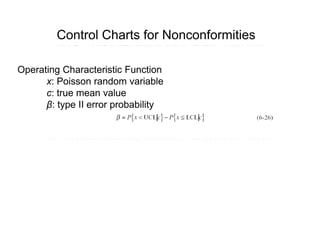
Operating Characteristic Function
x: Poisson random variable
c: true mean value
β: type II error probabilityβ ype e o p obab y
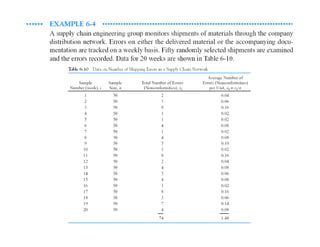
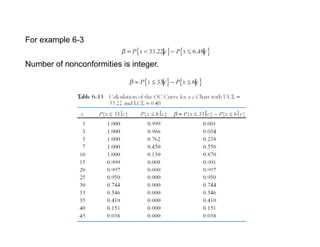
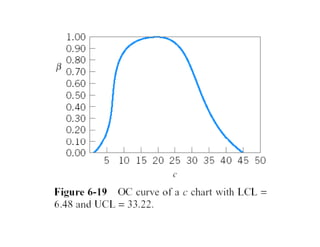
For example 6-3
Number of nonconformities is integer.
Control Charts for Nonconformities
• If defect level is low, <1000 per million, c and u charts become
ineffective
Dealing with Low Defect Levels
ineffective.
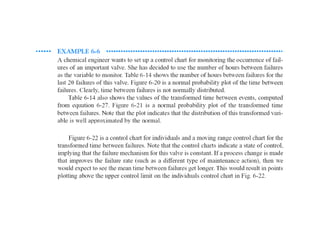
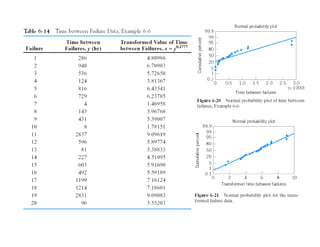
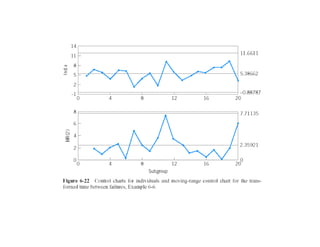
• The time-between-events control chart is more effective.
• If the defects occur according to a Poisson distribution, the
probability distribution of the time between events is the exponentialp y p
distribution.
• Constructing a time-between-events control chart is essentially
equivalent to control charting an exponentially distributed variable.
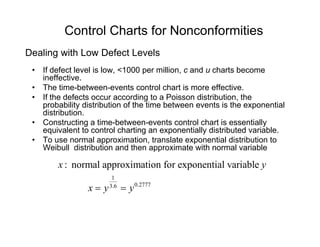
• To use normal approximation translate exponential distribution to• To use normal approximation, translate exponential distribution to
Weibull distribution and then approximate with normal variable
: normal approximation for exponential variablex y
1
0.27773.6
x y y= =
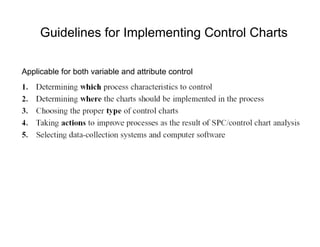
Guidelines for Implementing Control Charts
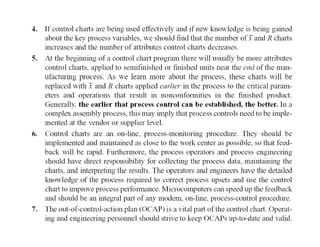
Applicable for both variable and attribute control
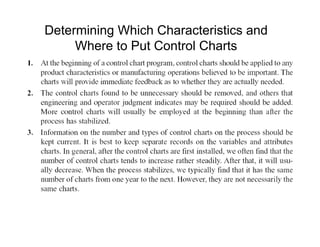
Determining Which Characteristics and
Where to Put Control ChartsWhere to Put Control Charts
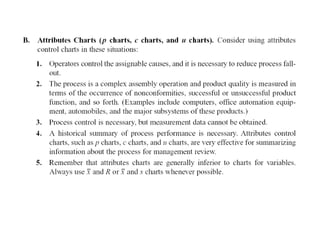
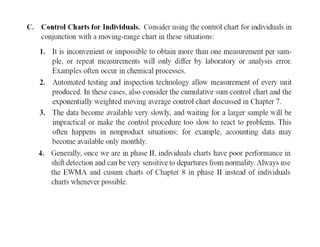
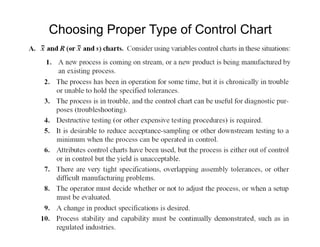
Choosing Proper Type of Control Chart
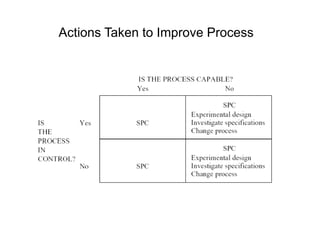
Actions Taken to Improve Process

control Chart u np c p

  • 1.
    Chapter 7. ControlCharts for Attributes
  • 2.
    Control Chart forFraction Nonconformingg Fraction nonconforming is based on the binomial distribution. n: size of populationp p p: probability of nonconformance D: number of products not conforming Successive products are independent. Mean of D = np Variance of D = np(1-p)
  • 3.
    Sample fraction nonconformance ˆMeanof p:Mean of p: ˆVariance of p:
  • 4.
    w: statistics forquality Mean of w: µwMean of w: µw Variance of w: σw 2 L: distance of control limit from center line (in standard deviation units) If p is the true fraction nonconformance:
  • 5.
    If p isnot know, we estimate it from samples. m: samples, each with n units (or observations) D: number of nonconforming units in sample iDi: number of nonconforming units in sample i Average of all observations:
  • 7.
    Example 6-1. 6-ozcardboard cans of orange juice
  • 8.
    Design of FractionNonconforming ChartDesign of Fraction Nonconforming Chart Three parameters to be specified:p p 1. sample size 2. frequency of sampling 3 width of control limits3. width of control limits Common to base chart on 100% inspection of all process output over time. Rational subgroups may also play role in determining sampling frequency.
  • 9.
  • 10.
    Variable Sample Size Variable-WidthControl Limits ( ) ( )( ) ( )1- 1- UCL 3 LCL 3 i i p p p p p p n n = + = −
  • 12.
    Variable Sample Size ControlLimits Based on an Average Sample Size U l i F i lUse average sample size. For previous example:
  • 14.
    Variable Sample Size StandardControl Chart - Points are plotted in standard deviation units. UCL = 3UCL = 3 Center line = 0 LCL = -3
  • 16.
    Operating Characteristic FunctionandOperating Characteristic Function and Average Run Length Calculations Probability of type II error { } { } { } { } ˆ ˆUCL | LCL | UCL | LCL | P p p P p p P D n p P D n p β = < − ≤ < ≤{ } { }UCL | LCL |P D n p P D n p= < − ≤
  • 17.
    C t lCh t f N f iti ( D f t )Control Charts for Nonconformities (or Defects) Procedures with Constant Sample Size x: number of nonconformities c > 0: parameter of Poisson distribution Set to zero if negative
  • 18.
    If no standardis given, estimate c then use the following parameters: Set to zero if negativeg
  • 21.
    Choice of SampleSize: µ Chart x: total nonconformities in n inspection units u: average number of nonconformities per inspection unit : obserd average number of nonconformities per inspection unitu: obserd average number of nonconformities per inspection unitu
  • 23.
    Control Charts forNonconformities Procedure with Variable Sample SizeProcedure with Variable Sample Size
  • 25.
    Control Charts forNonconformities Demerit Systems: not all defects are of equal importance
  • 26.
    ciA: number ofClass A defects in ith inspection units Similarly for ciB, ciC, and ciD for Classes B, C, and D. di: number of demerits in inspection unit i Constants 100 50 10 and 1 are demerit weightsConstants 100, 50, 10, and 1 are demerit weights. : inspection units b f d it it n : number of demerits per unit where i n i i u D u D d= = ∑1 i i in = ∑
  • 27.
    µi: linear combinationof independent Poisson variables is average number of Class A defects per unit, etc.Aµ
  • 28.
    Control Charts forNonconformities Operating Characteristic Function x: Poisson random variable c: true mean value β: type II error probabilityβ ype e o p obab y
  • 29.
    For example 6-3 Numberof nonconformities is integer.
  • 31.
    Control Charts forNonconformities • If defect level is low, <1000 per million, c and u charts become ineffective Dealing with Low Defect Levels ineffective. • The time-between-events control chart is more effective. • If the defects occur according to a Poisson distribution, the probability distribution of the time between events is the exponentialp y p distribution. • Constructing a time-between-events control chart is essentially equivalent to control charting an exponentially distributed variable. • To use normal approximation translate exponential distribution to• To use normal approximation, translate exponential distribution to Weibull distribution and then approximate with normal variable : normal approximation for exponential variablex y 1 0.27773.6 x y y= =
  • 35.
    Guidelines for ImplementingControl Charts Applicable for both variable and attribute control
  • 36.
    Determining Which Characteristicsand Where to Put Control ChartsWhere to Put Control Charts
  • 38.
    Choosing Proper Typeof Control Chart
  • 41.
    Actions Taken toImprove Process