



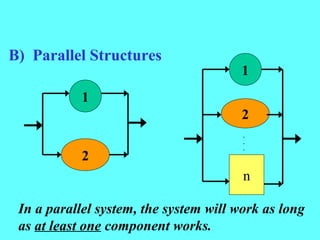
![B) A Parallel System
1
2
n
.
.
.
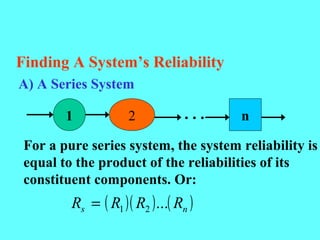
For a pure parallel system,
the overall system reliability
is equal to the product of the
component unreliabilities.
Thus, the reliability of the
parallel system is given by:
Rs = 1 – [(1 – R1)(1-R2)…(1-Rn)]](https://image.slidesharecdn.com/reliability-141229124949-conversion-gate01/85/Reliability-13-320.jpg)
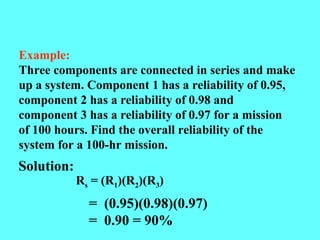
![Example: Three components are connected in parallel
and make up a system. Component 1 has a reliability of
0.95, component 2 has a reliability of 0.98 and component
3 has a reliability of 0.97 for a mission of 100 hours.
Find the overall reliability of the system for a 100-hr
mission.
Solution:
Rs = 1 – [(1 – R1)(1 – R2)(1 – R3)]
= 1 – [(1 – 0.95)(1-0.98)(1-0.97)]
= 0.99997
= 99.997 %
R1 = 0.95
R2 = 0.98
R3 = 0.97](https://image.slidesharecdn.com/reliability-141229124949-conversion-gate01/85/Reliability-14-320.jpg)
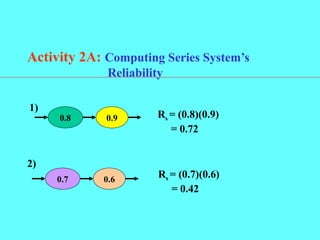
![Activity 3A:Computing Parallel System’s
Reliability
0.9
1)
0.8
Rs = 1 – [(1- 0.9)(1- 0.8)]
= 0.98
2)
0.7
0.8
Rs = 1 – [(1- 0.7)(1- 0.8)]
= 0.94](https://image.slidesharecdn.com/reliability-141229124949-conversion-gate01/85/Reliability-15-320.jpg)
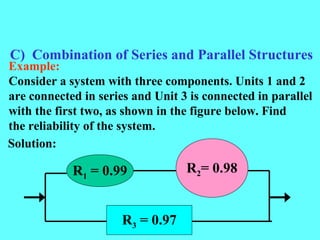
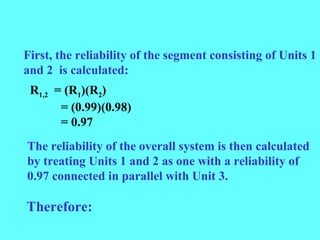
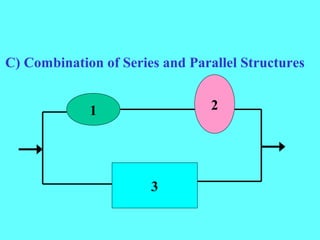
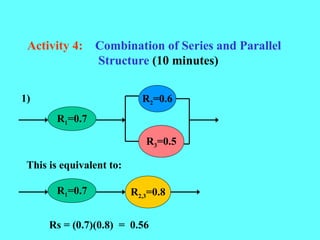
![R1,2= 0.97
R3 = 0.97
Rs = 1 – [(1 – 0.97)(1 – 0.97)]
= 0.9991
= 99.91%](https://image.slidesharecdn.com/reliability-141229124949-conversion-gate01/85/Reliability-19-320.jpg)
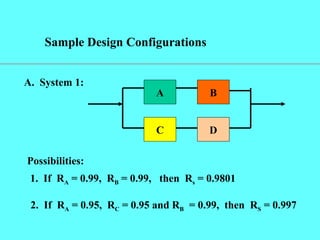
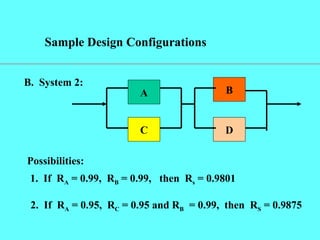

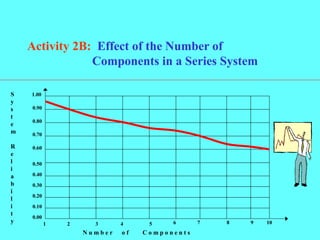
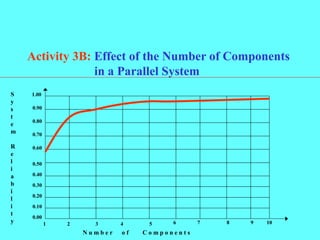
This document discusses reliability and its importance. It defines reliability as the probability that a system will work, and provides examples of calculating reliability for series and parallel systems. Key points made include: - Reliability measures the likelihood a system will function and is important for reputation, customer satisfaction, costs and competitive advantage. - The reliability of a series system is the product of the component reliabilities, while the reliability of a parallel system is 1 minus the product of the component unreliabilities. - More components in a series system lowers the overall reliability, while more components in a parallel system increases the overall reliability. - Complex systems can combine series and parallel components, requiring multi-step calculations to


