1
by: Haitham Farag Daw
2013-14
FACULITY OFELECTRONIC
TECNOLOGY
COMPUTETRENGINEERING
(MSc)
Outline
Introduction
AES Cryptosystem
Review of the article
NmapTool
Implementation (RSA)
Introduction
Cryptography
4
The term Cryptography is originally derived from the two
greek words “kryptos" and “graph", meaning hidden and
writing, 20th
.
Cryptography is the science and study of methods of
protecting data in computer and communication systems
from unauthorized disclosure and modification.
Classified into two cryptosystems, private-key
cryptosystem and public-key cryptosystem. Both are
based on complex mathematical algorithms and are
controlled by keys.
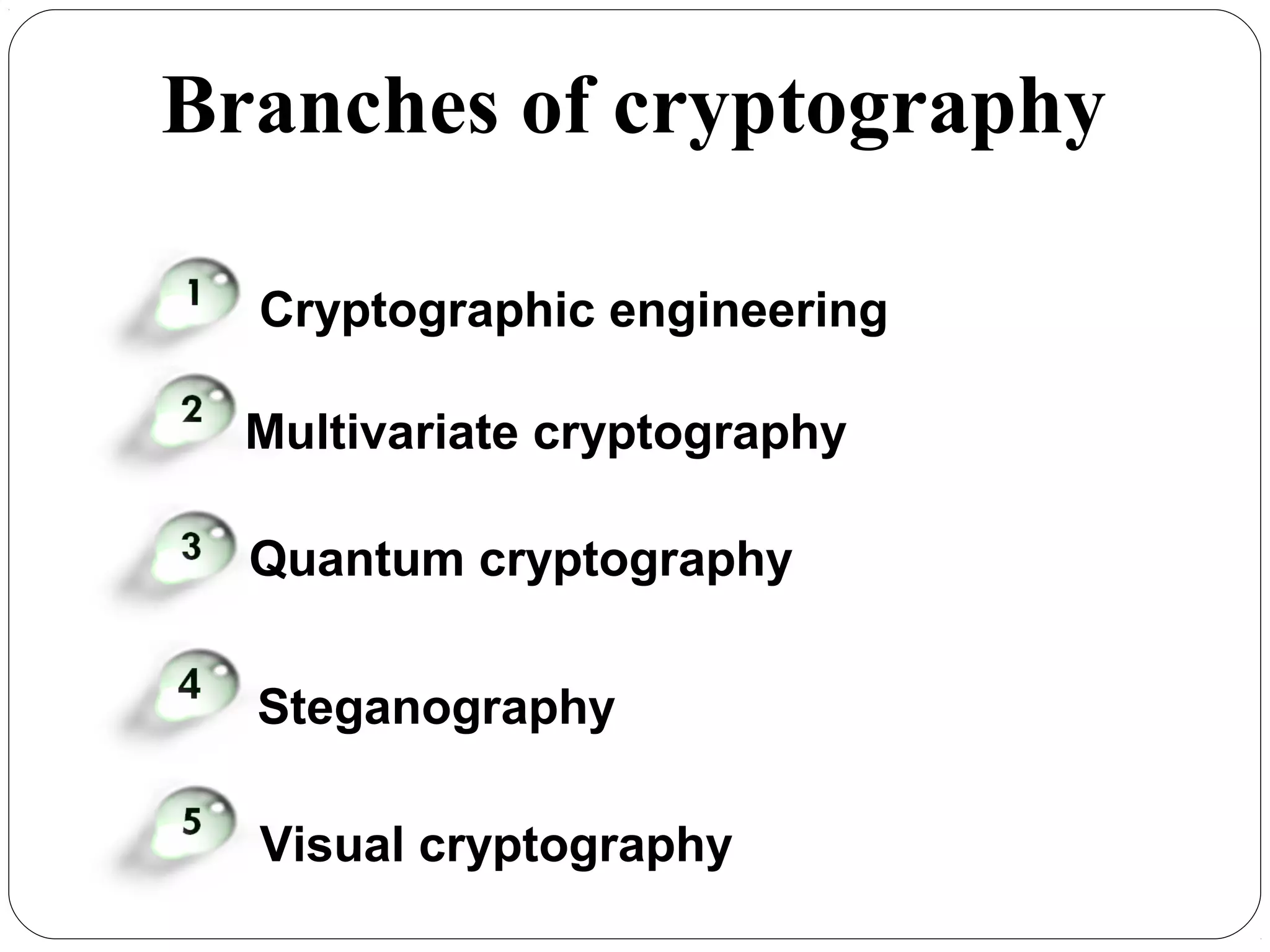
Branches of cryptography
Cryptographic engineering
Visual cryptography
Steganography
Quantum cryptography
Multivariate cryptography
6
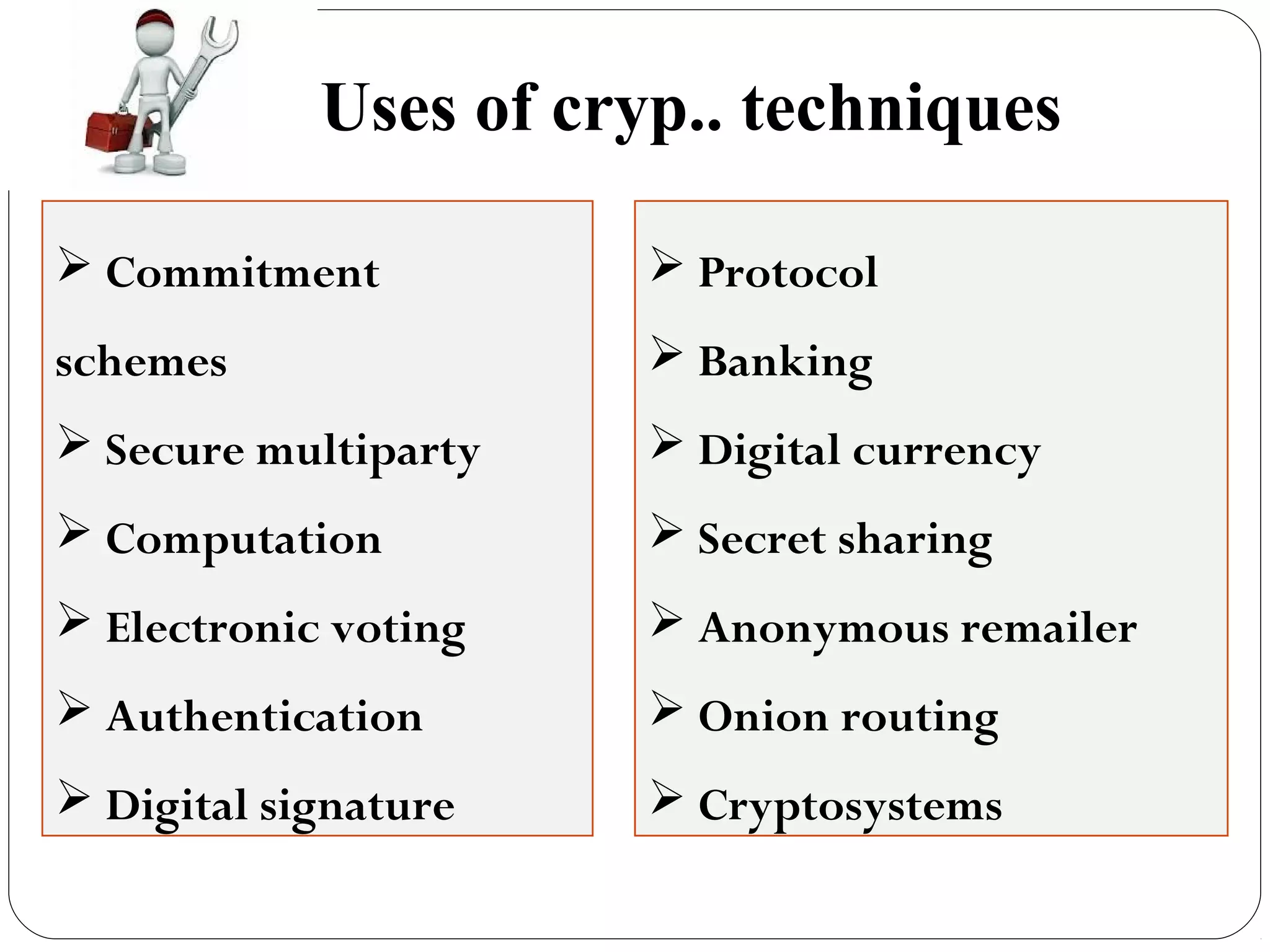
Uses of cryp.. techniques
 Commitment
schemes
 Secure multiparty
 Computation
 Electronic voting
 Authentication
 Digital signature
 Protocol
 Banking
 Digital currency
 Secret sharing
 Anonymous remailer
 Onion routing
 Cryptosystems
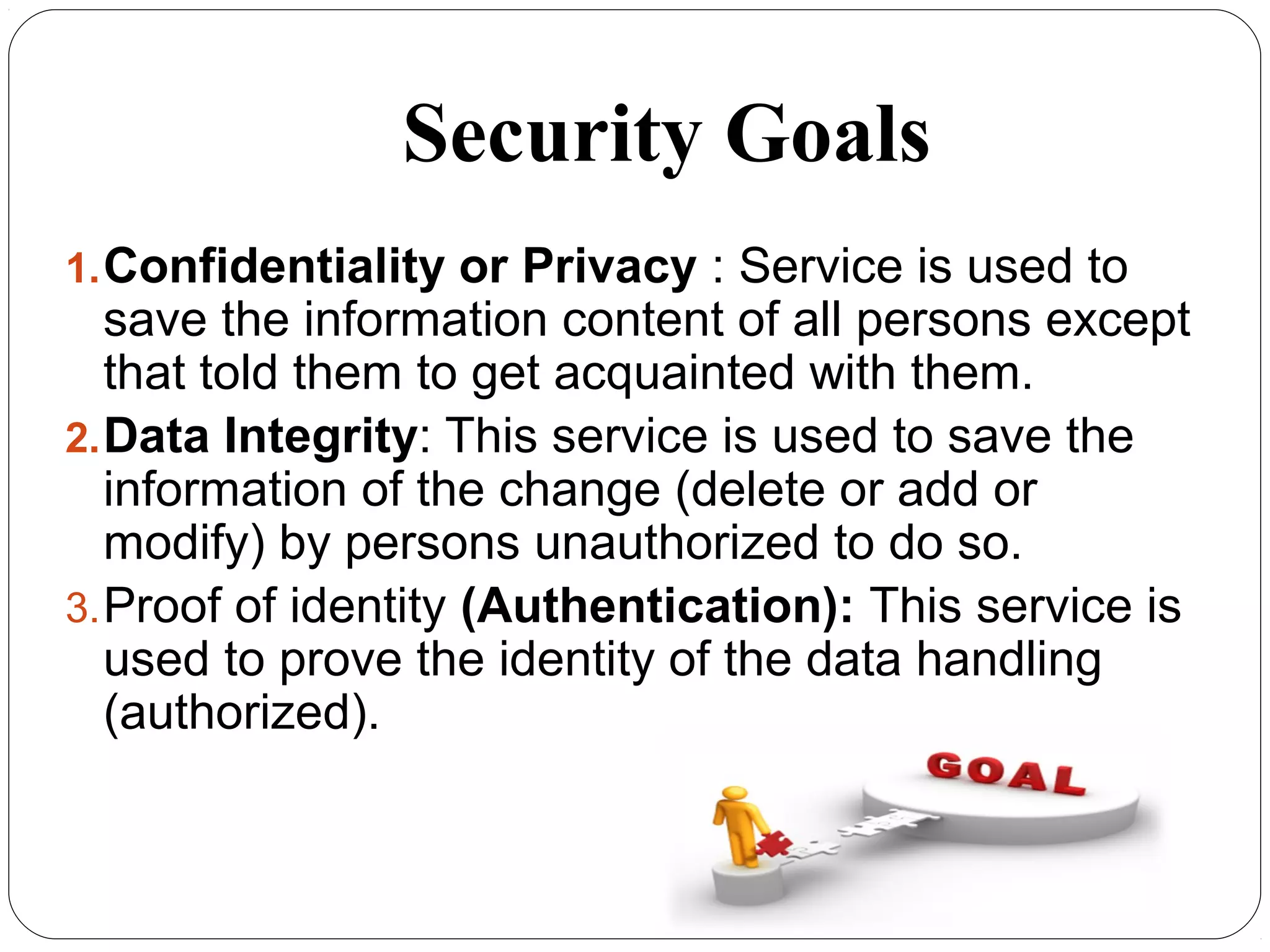
Security Goals
7
1.Confidentiality or Privacy : Service is used to
save the information content of all persons except
that told them to get acquainted with them.
2.Data Integrity: This service is used to save the
information of the change (delete or add or
modify) by persons unauthorized to do so.
3.Proof of identity (Authentication): This service is
used to prove the identity of the data handling
(authorized).
Cont.
8
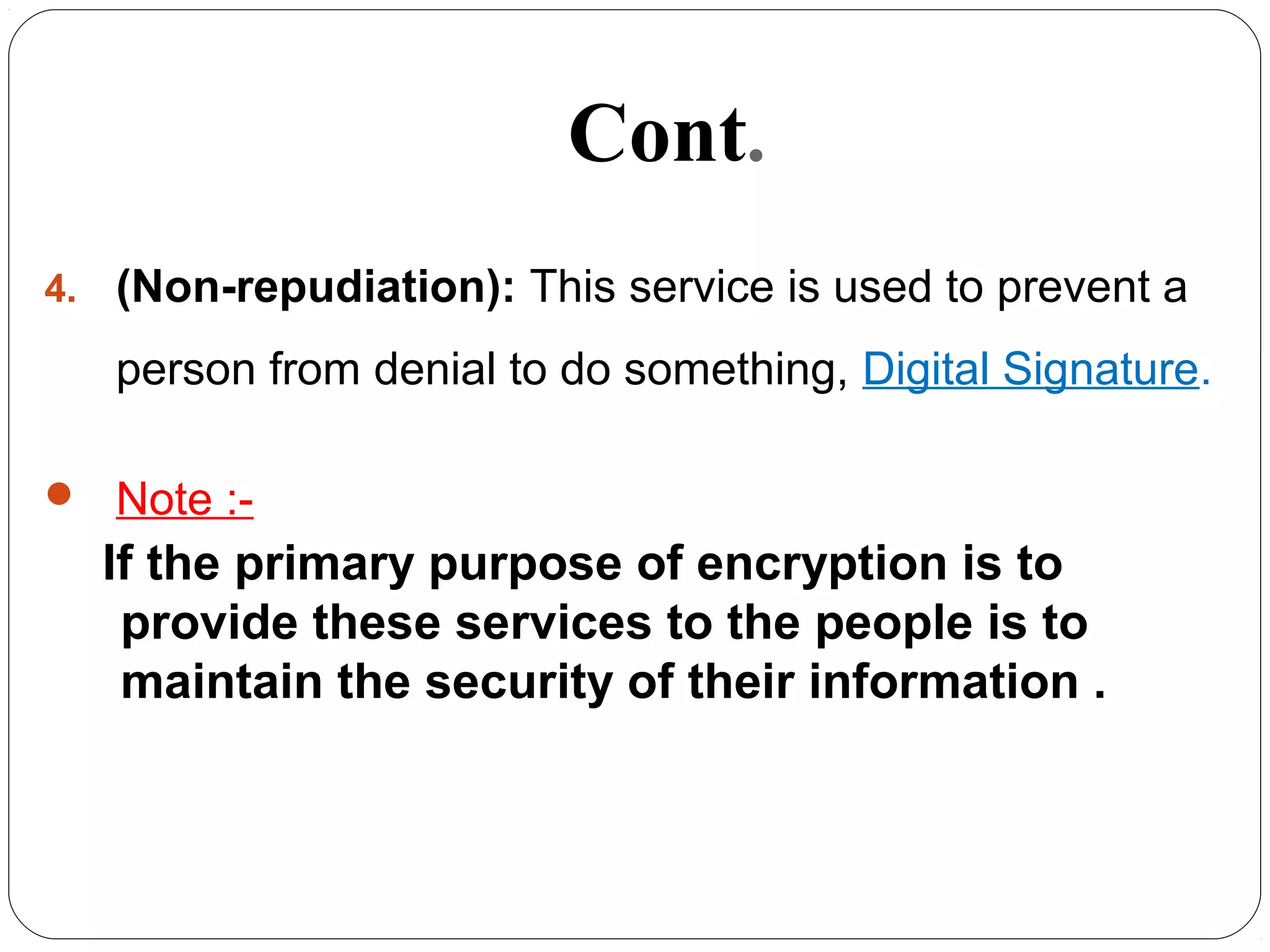
4. (Non-repudiation): This service is used to prevent a
person from denial to do something, Digital Signature.
 Note :-
If the primary purpose of encryption is to
provide these services to the people is to
maintain the security of their information .
9
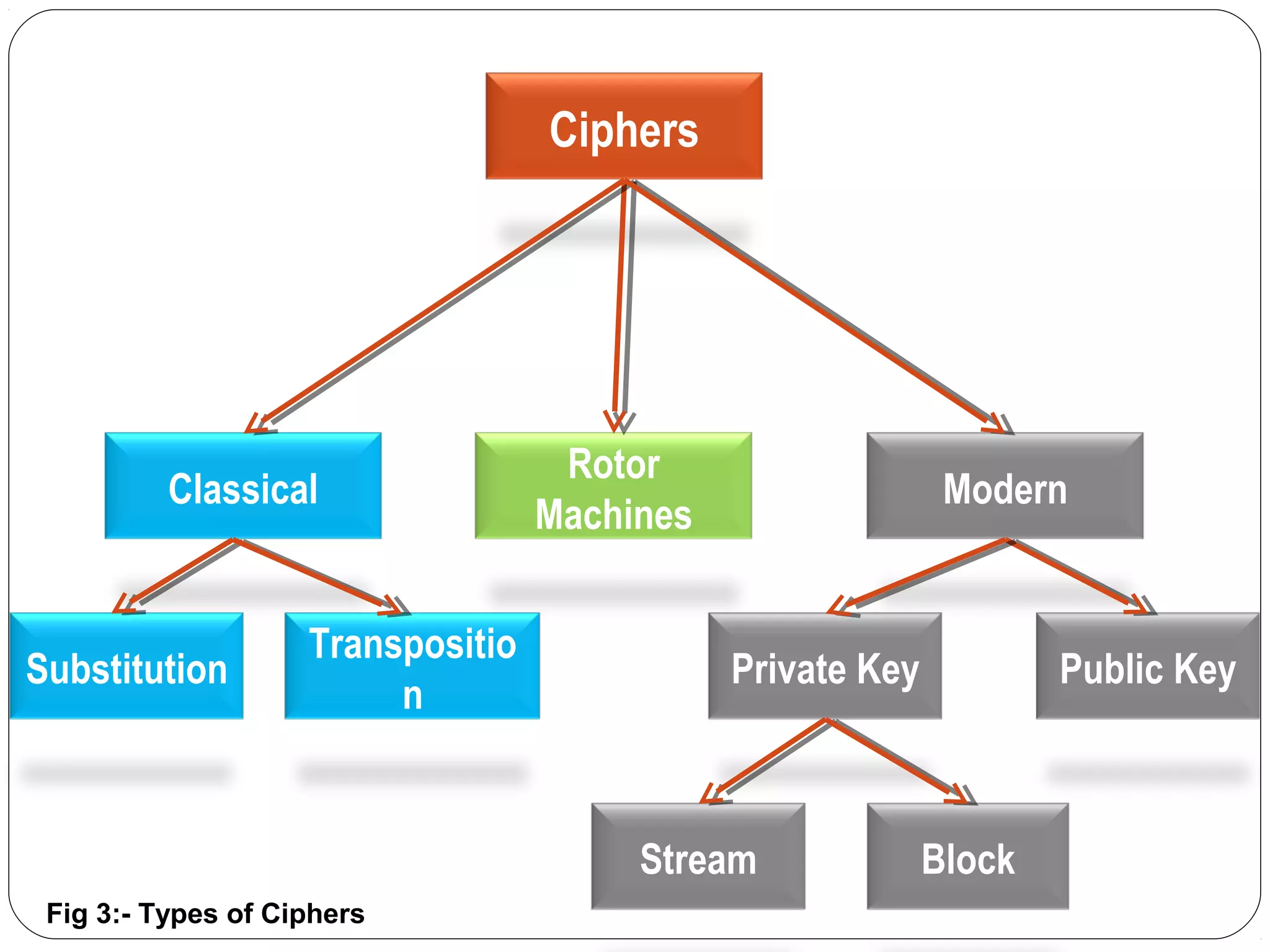
Ciphers
Classical
Rotor
Machines
Private KeySubstitution
Modern
Public Key
Stream Block
Transpositio
n
Fig 3:- Types of Ciphers
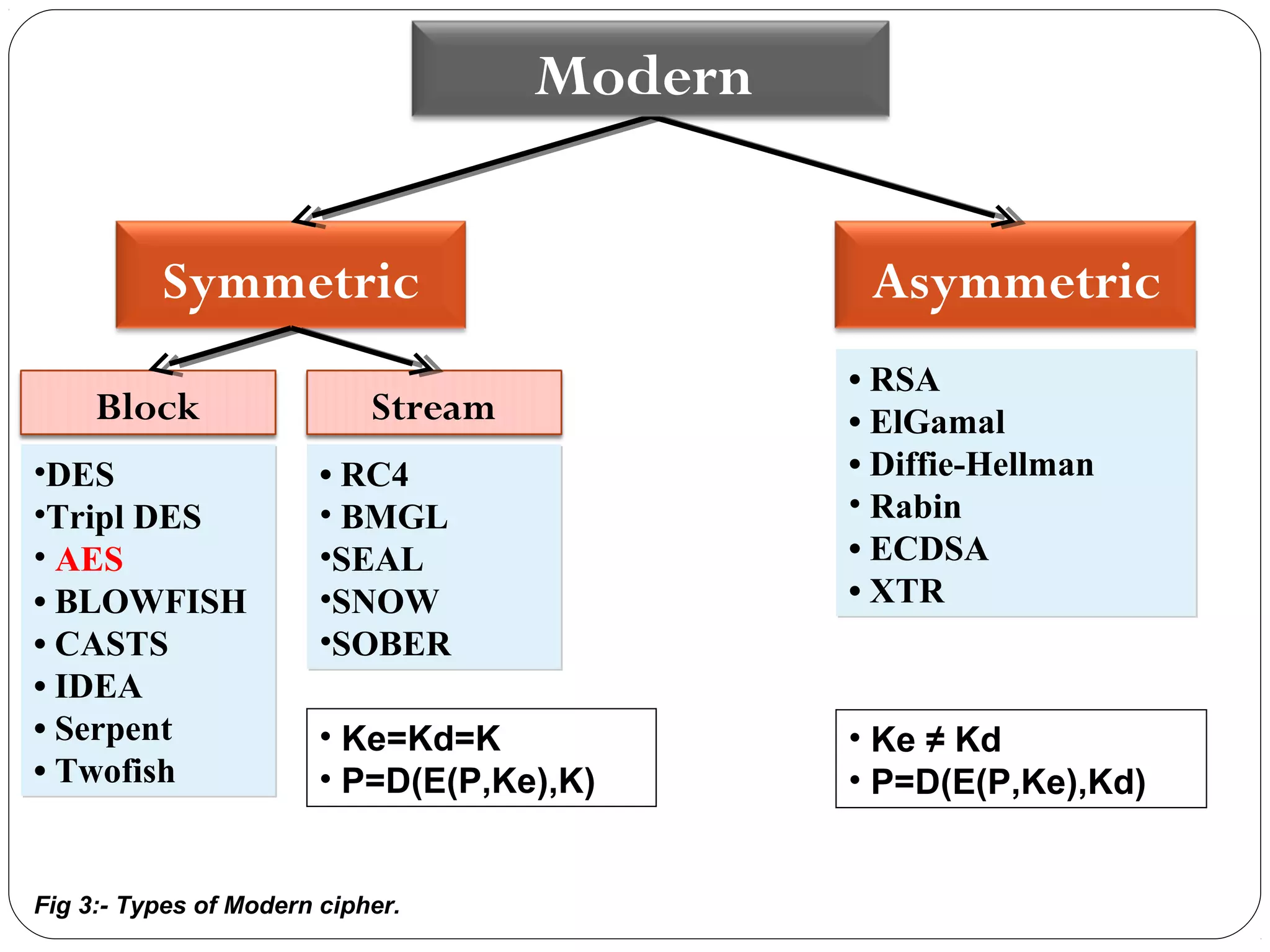
Fig 3:- Types of Modern cipher.
Symmetric Asymmetric
• Ke=Kd=K
• P=D(E(P,Ke),K)
• Ke ≠ Kd
• P=D(E(P,Ke),Kd)
•DES
•Tripl DES
• AES
• BLOWFISH
• CASTS
• IDEA
• Serpent
• Twofish
•DES
•Tripl DES
• AES
• BLOWFISH
• CASTS
• IDEA
• Serpent
• Twofish
• RSA
• ElGamal
• Diffie-Hellman
• Rabin
• ECDSA
• XTR
• RSA
• ElGamal
• Diffie-Hellman
• Rabin
• ECDSA
• XTR
Modern
• RC4
• BMGL
•SEAL
•SNOW
•SOBER
• RC4
• BMGL
•SEAL
•SNOW
•SOBER
Block Stream
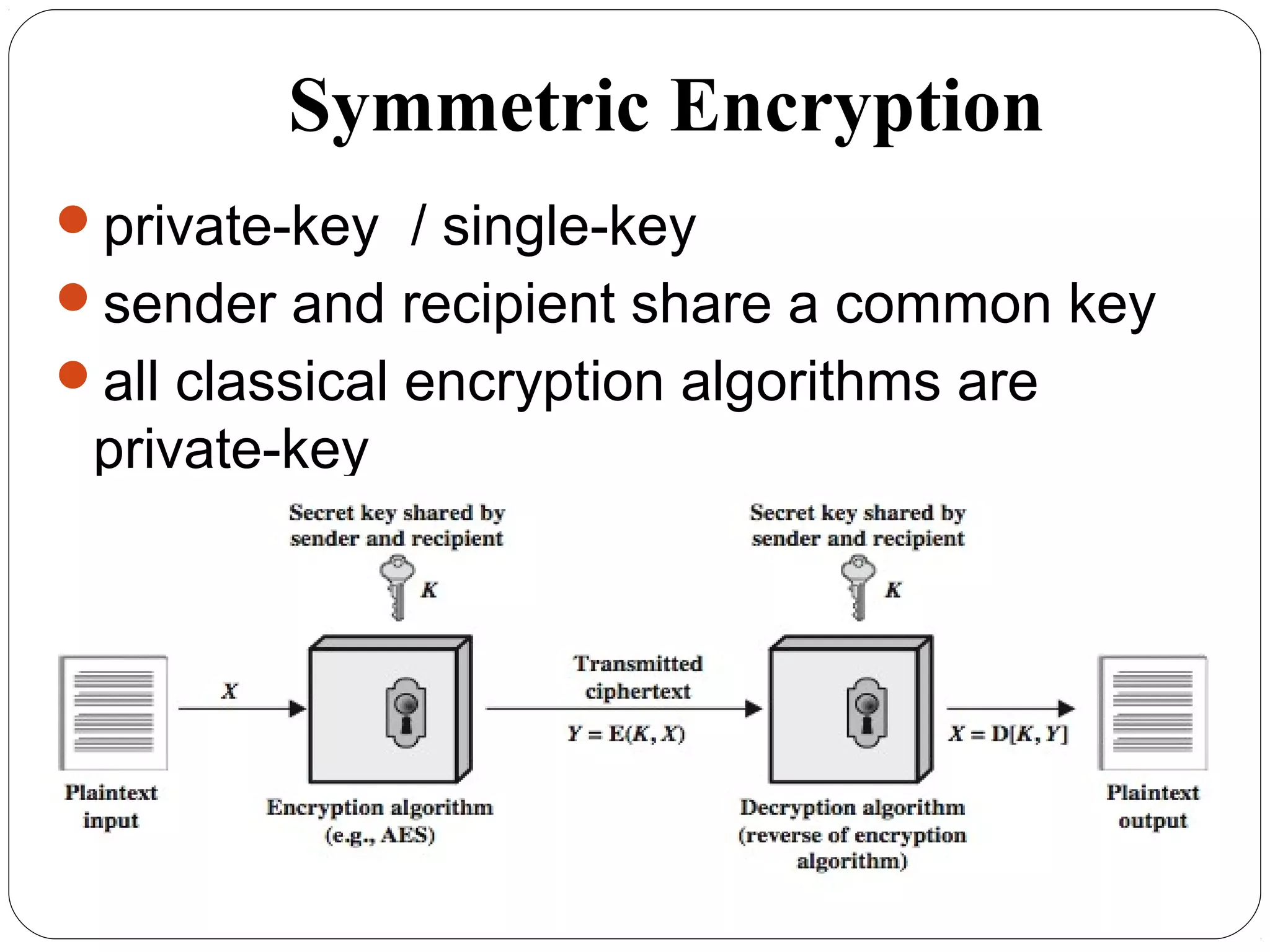
Symmetric Encryption
private-key / single-key
sender and recipient share a common key
all classical encryption algorithms are
private-key
Advanced Encryption Standard
(AES)
7.13
Main topics
 To review a short history of AES
 To define the basic structure and trans.. of AES
To define the key expansion process
 To define ANALYSIS and Uses of AES
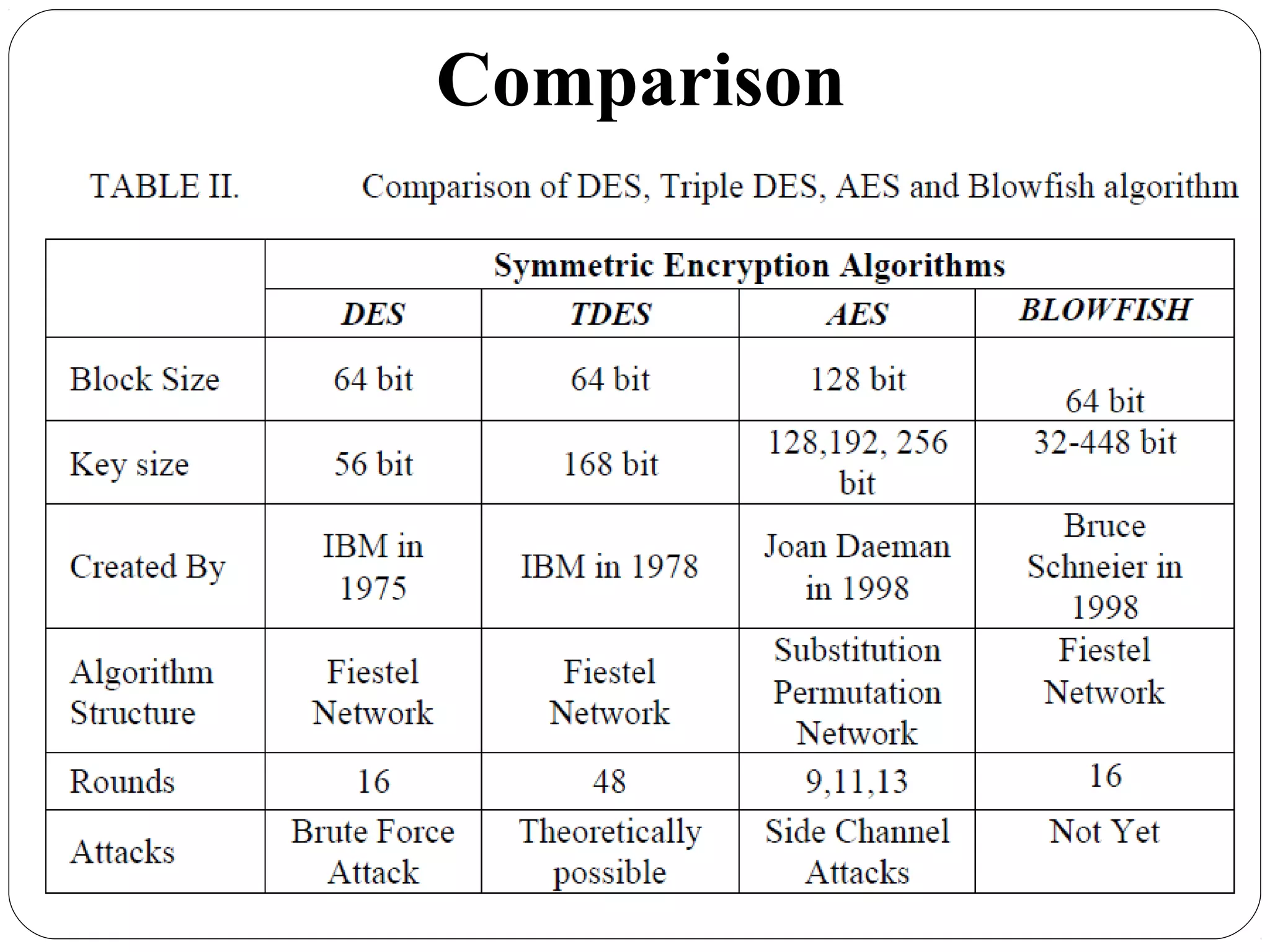
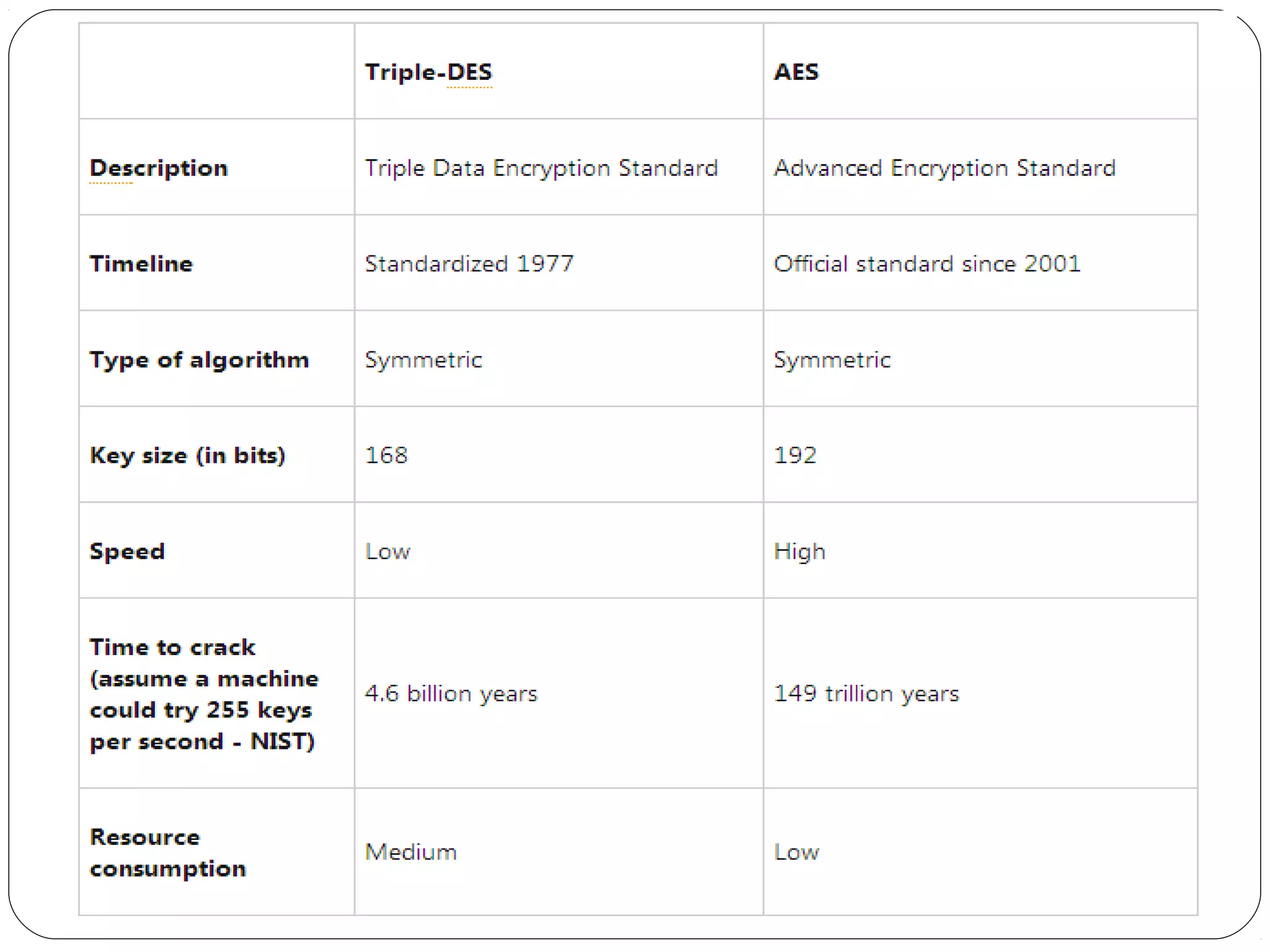
Comparison
Reference
7.14
 Clear a replacement for DES was needed
o
have theoretical attacks that can break it
o
have demonstrated exhaustive key search
attacks, ” deep crack (88b) in 3 days”
 Can use (3-DES) – but slow, has small blocks
 US NIST issued call for ciphers in 1997
 15 candidates accepted in Jun 98
 5 were shortlisted in Aug-99
o (Rijndael, SERPENT, TWOFISH, RC6, MARS).
History
Introduction
 The Advanced Encryption Standard (AES).
 Is a symmetric-key block cipher .
 Rijndael was selected as the AES in Oct-2000
 Published by the (NIST) in December 2001.
The criteria defined by NIST for selecting AES fall
into three areas:
1. Security
2. Cost
3. Implementation.
7.16
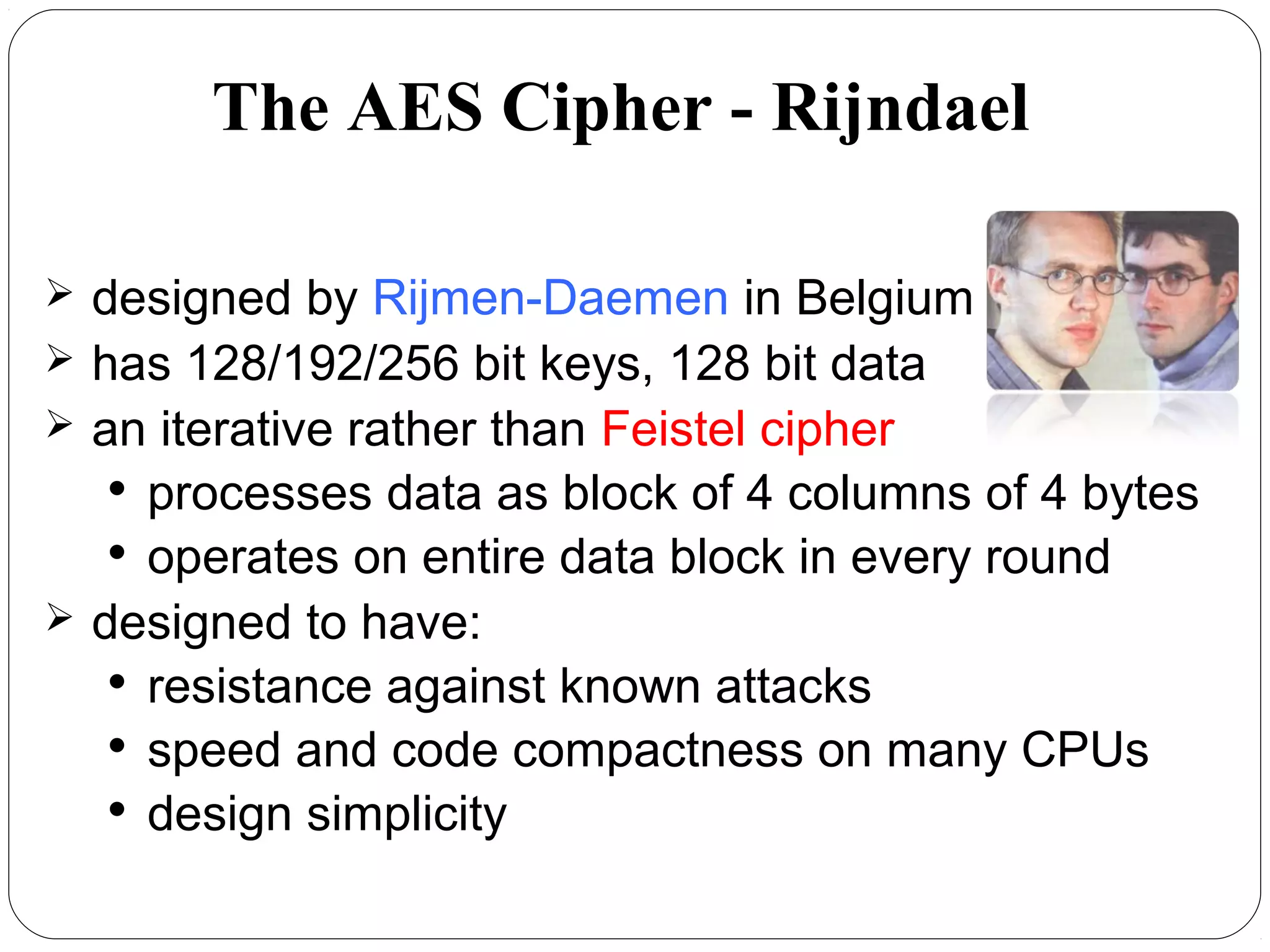
 designed by Rijmen-Daemen in Belgium
 has 128/192/256 bit keys, 128 bit data
 an iterative rather than Feistel cipher

processes data as block of 4 columns of 4 bytes

operates on entire data block in every round
 designed to have:

resistance against known attacks

speed and code compactness on many CPUs

design simplicity
The AES Cipher - Rijndael
7.17
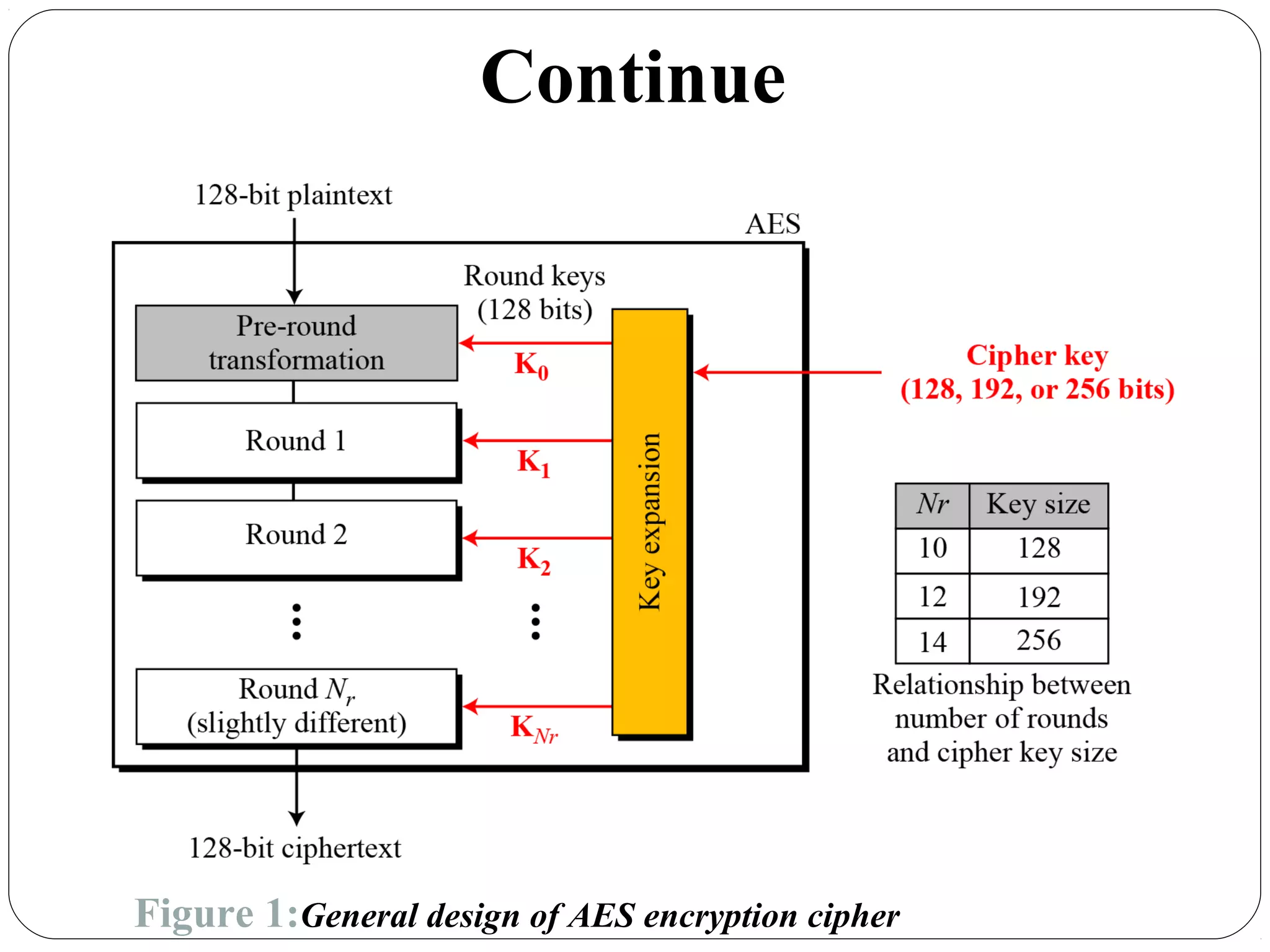
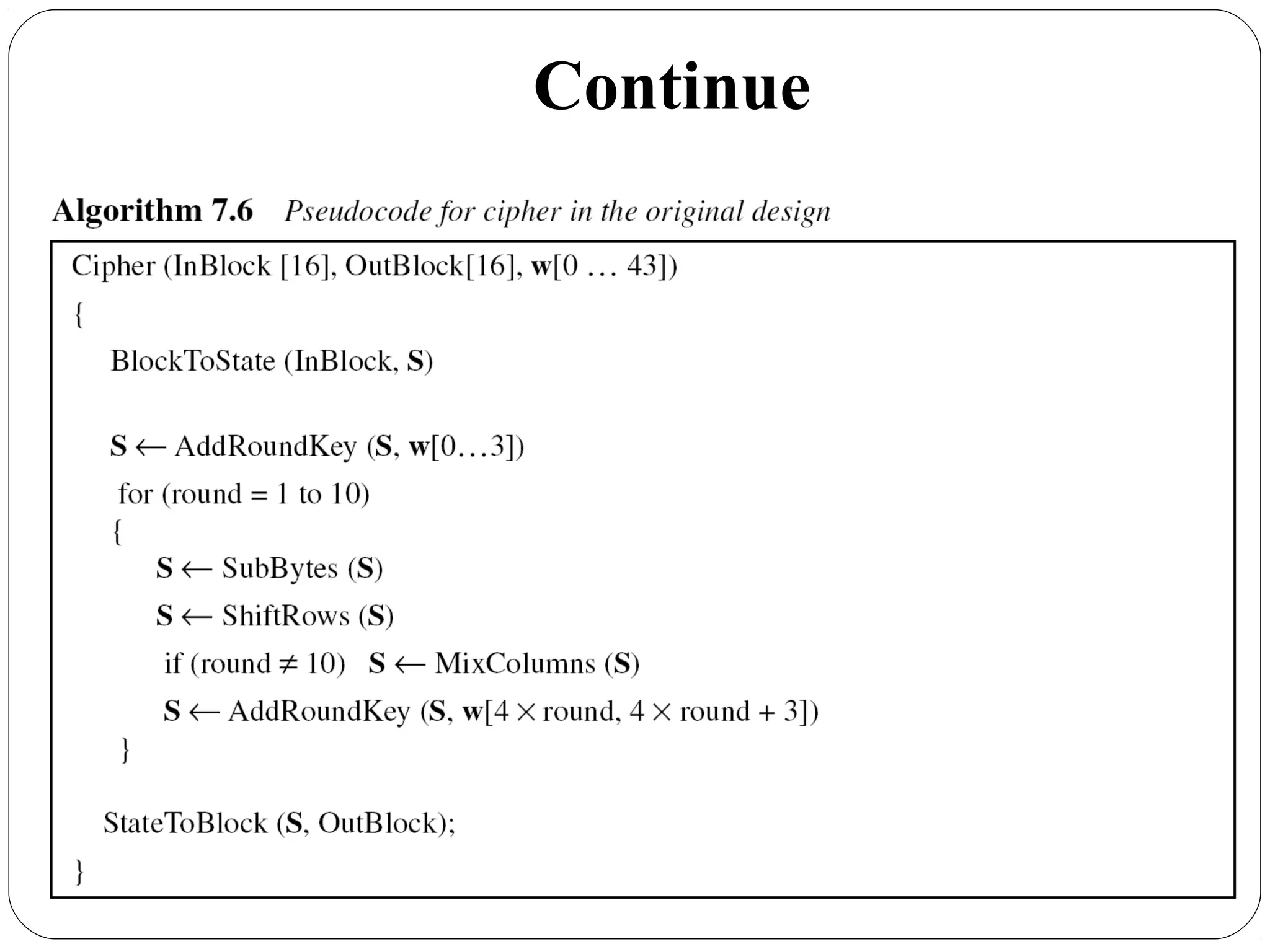
Continue
Figure 1:General design of AES encryption cipher
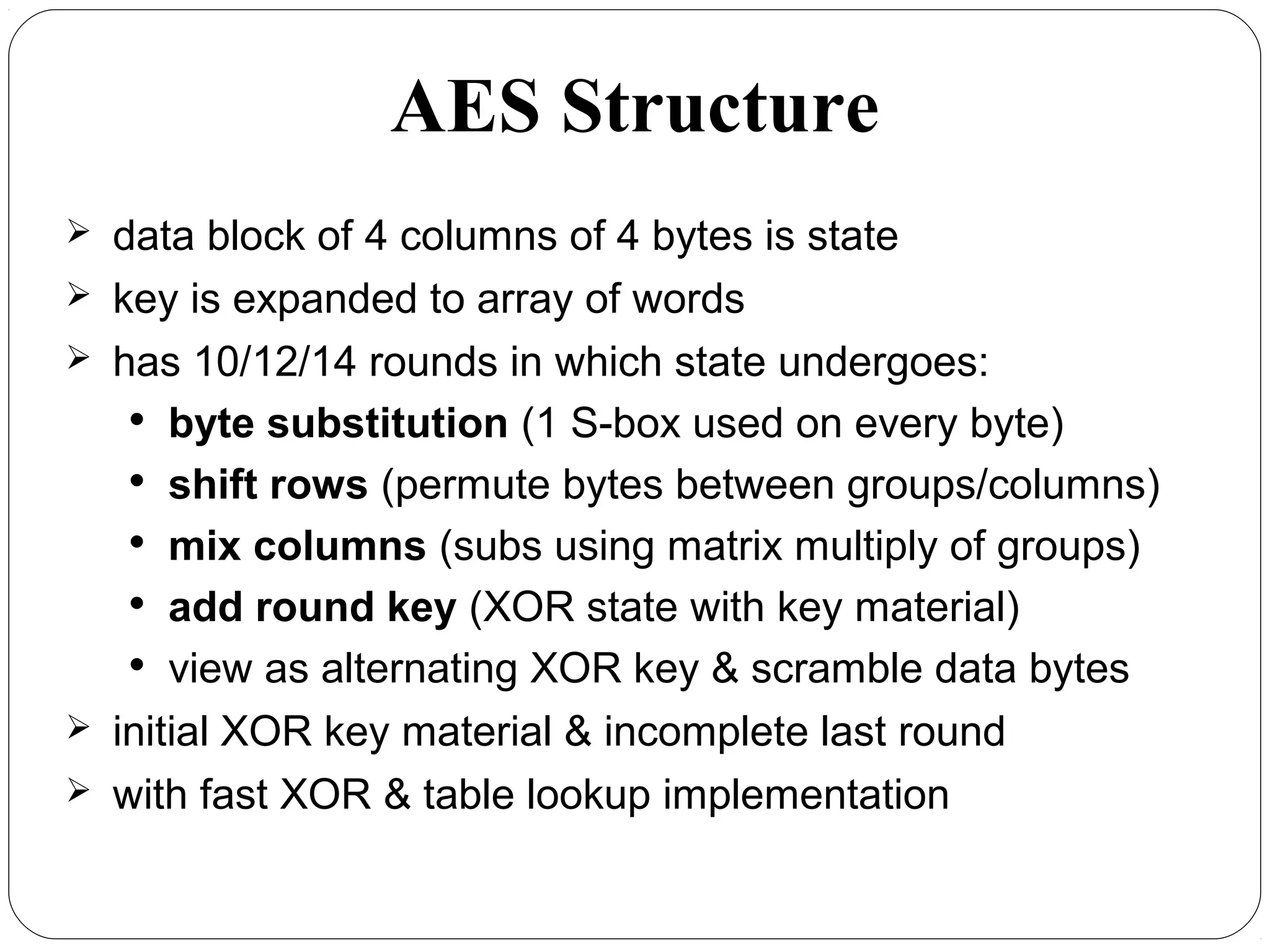
AES Structure
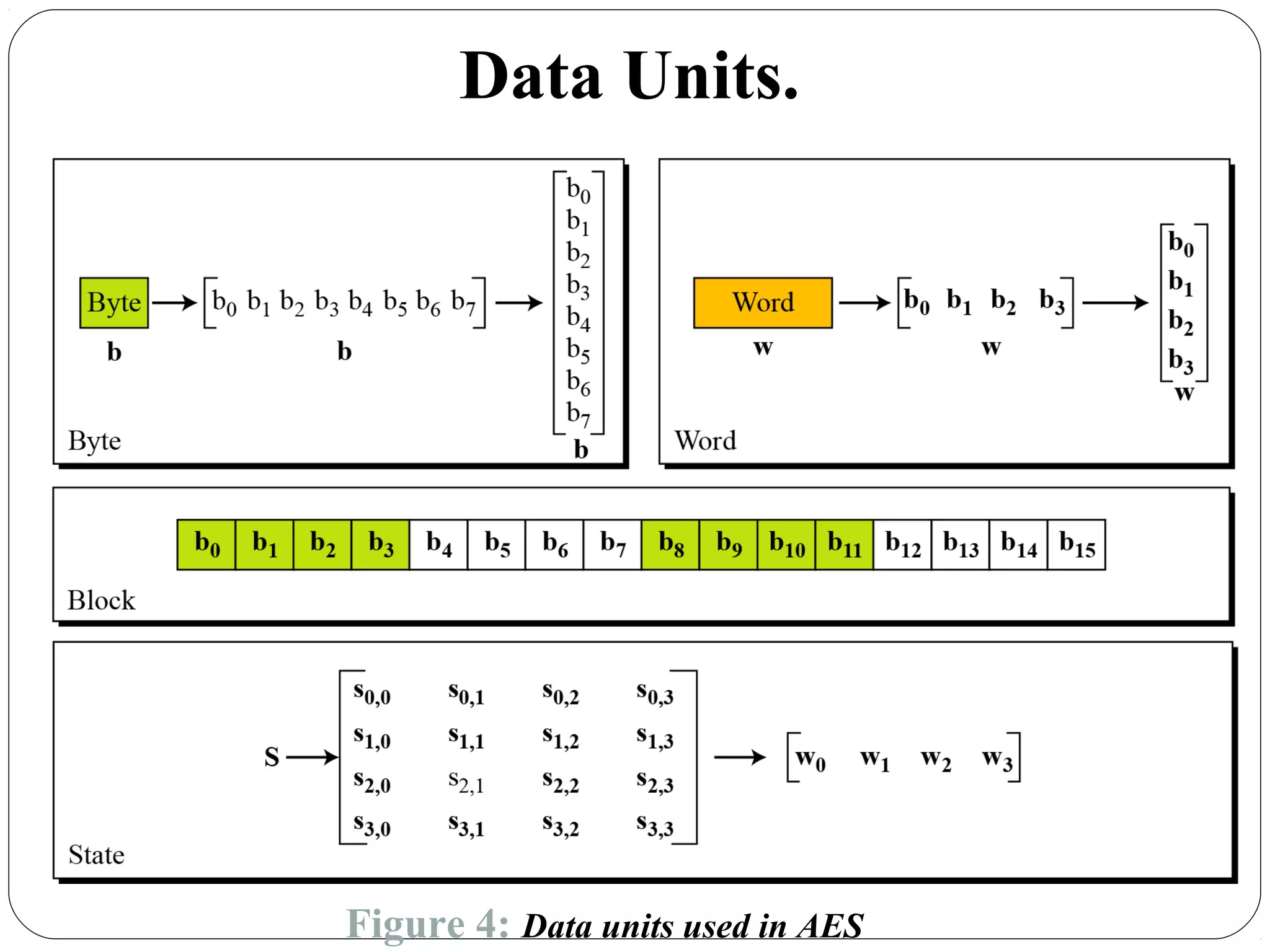
 data block of 4 columns of 4 bytes is state
 key is expanded to array of words
 has 10/12/14 rounds in which state undergoes:

byte substitution (1 S-box used on every byte)

shift rows (permute bytes between groups/columns)

mix columns (subs using matrix multiply of groups)

add round key (XOR state with key material)

view as alternating XOR key & scramble data bytes
 initial XOR key material & incomplete last round
 with fast XOR & table lookup implementation
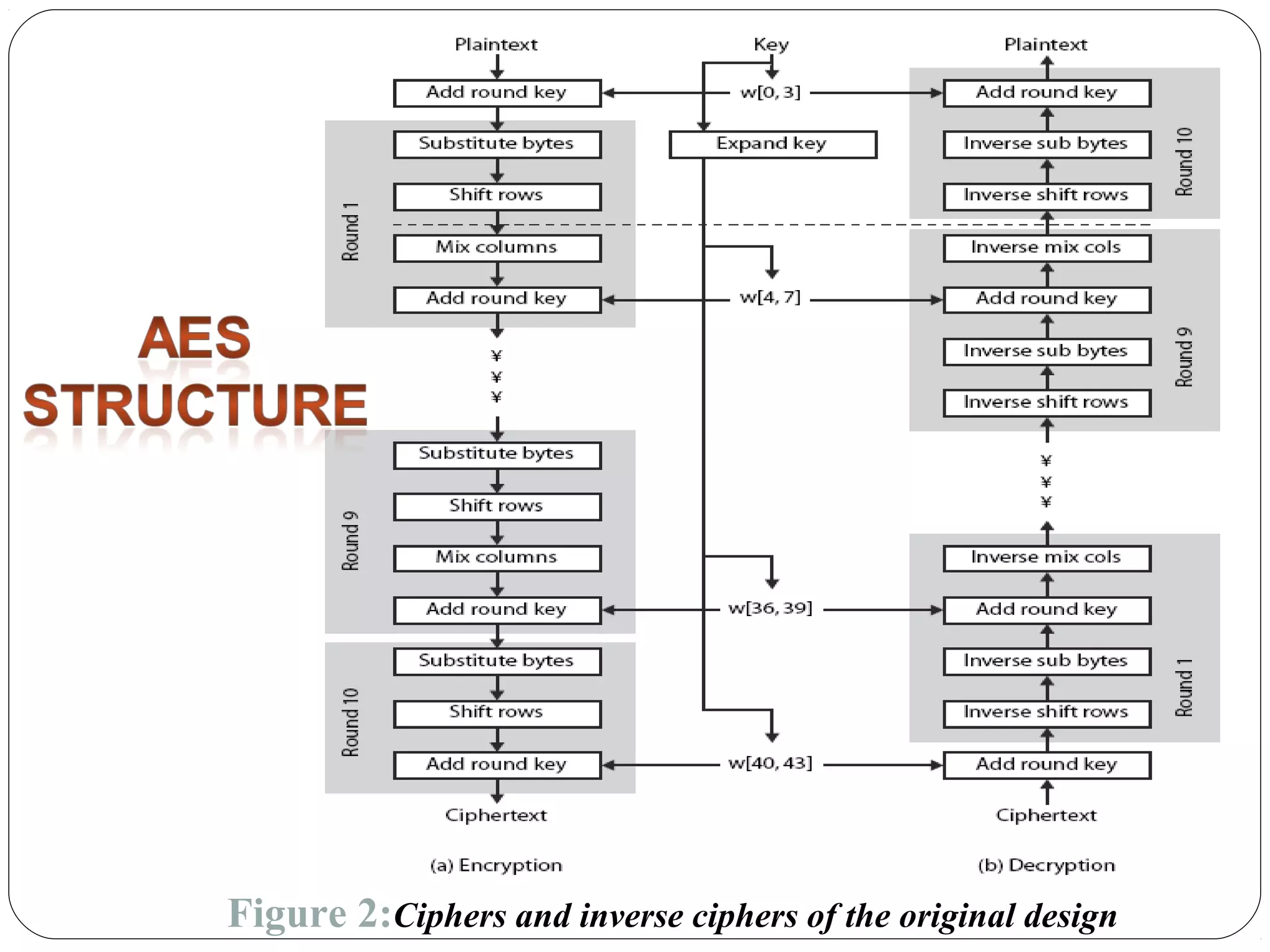
7.19
Figure 2:Ciphers and inverse ciphers of the original design
7.20
Continue
7.21
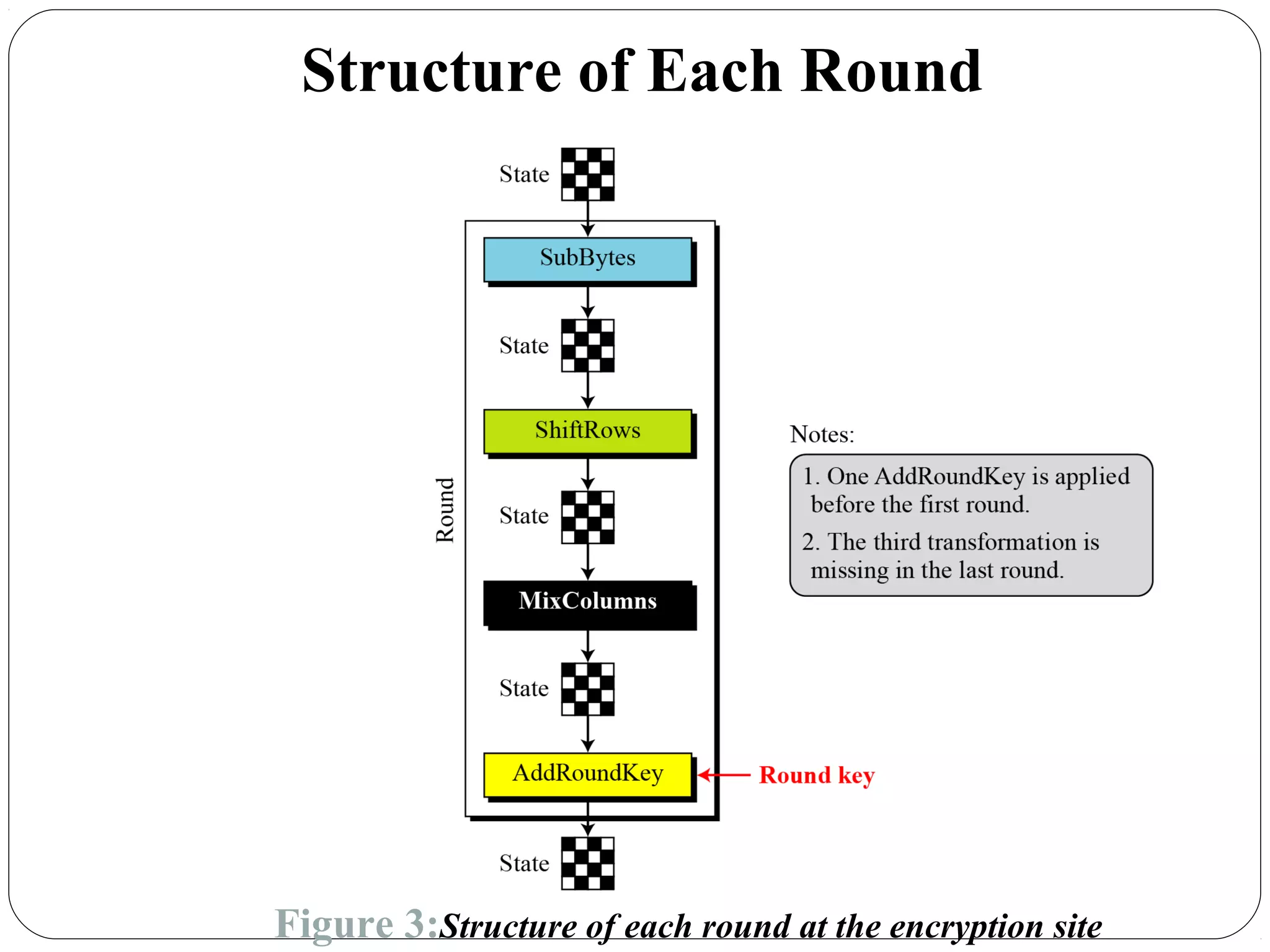
Structure of Each Round
Figure 3:Structure of each round at the encryption site
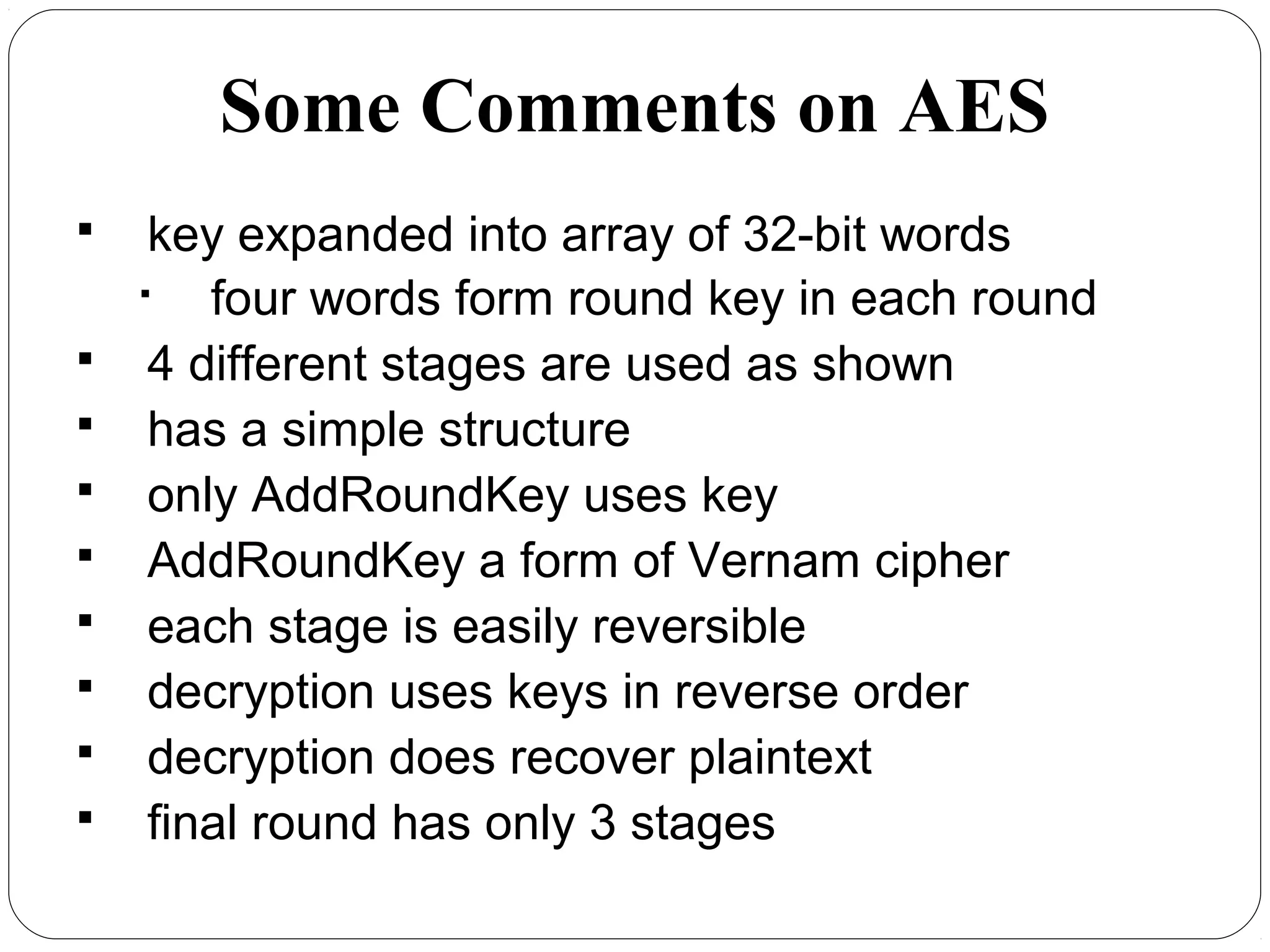
Some Comments on AES
 key expanded into array of 32-bit words

four words form round key in each round
 4 different stages are used as shown
 has a simple structure
 only AddRoundKey uses key
 AddRoundKey a form of Vernam cipher
 each stage is easily reversible
 decryption uses keys in reverse order
 decryption does recover plaintext
 final round has only 3 stages
7.23
Data Units.
Figure 4: Data units used in AES
7.24
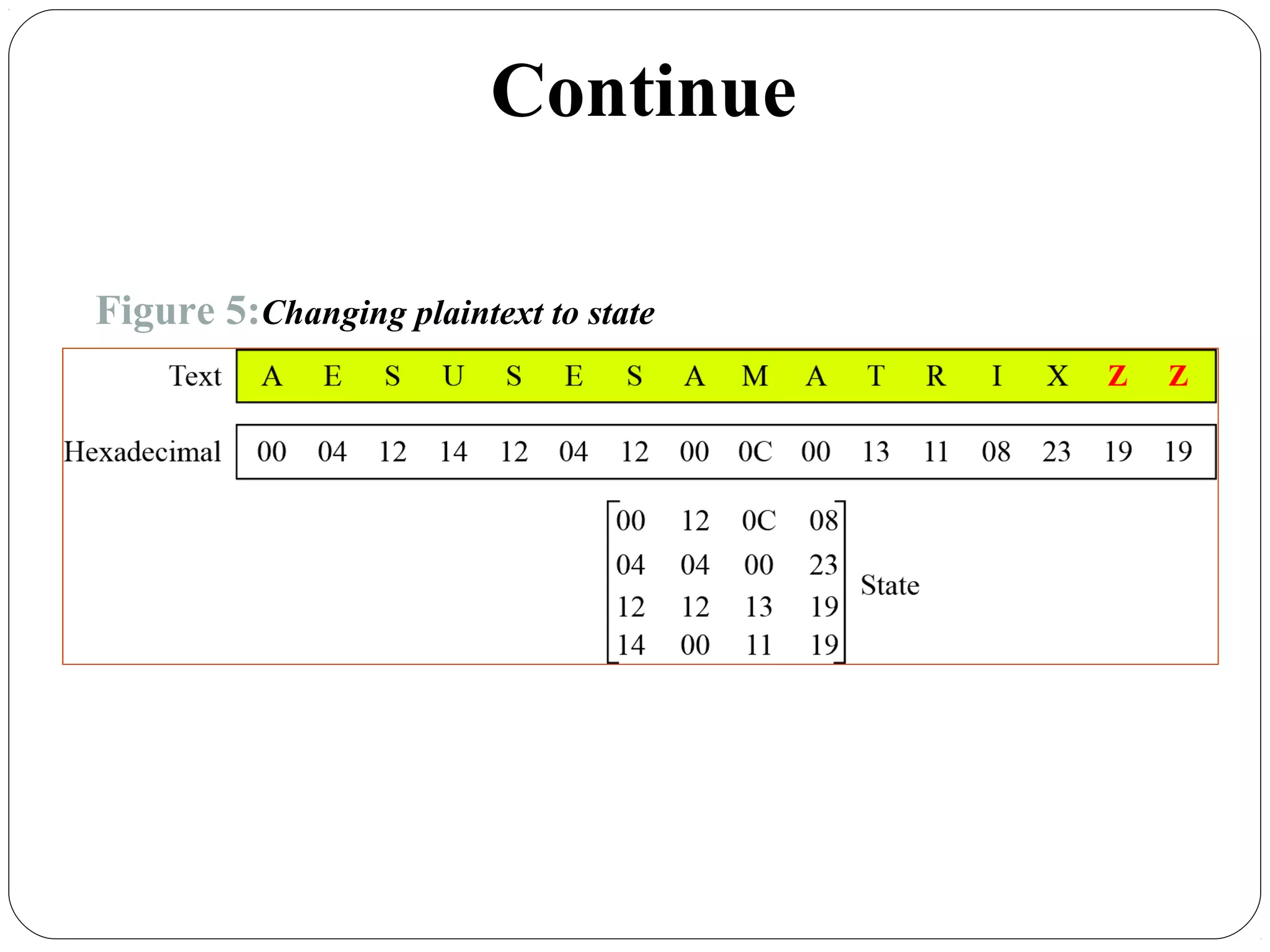
Figure 5:Changing plaintext to state
Continue
7.25
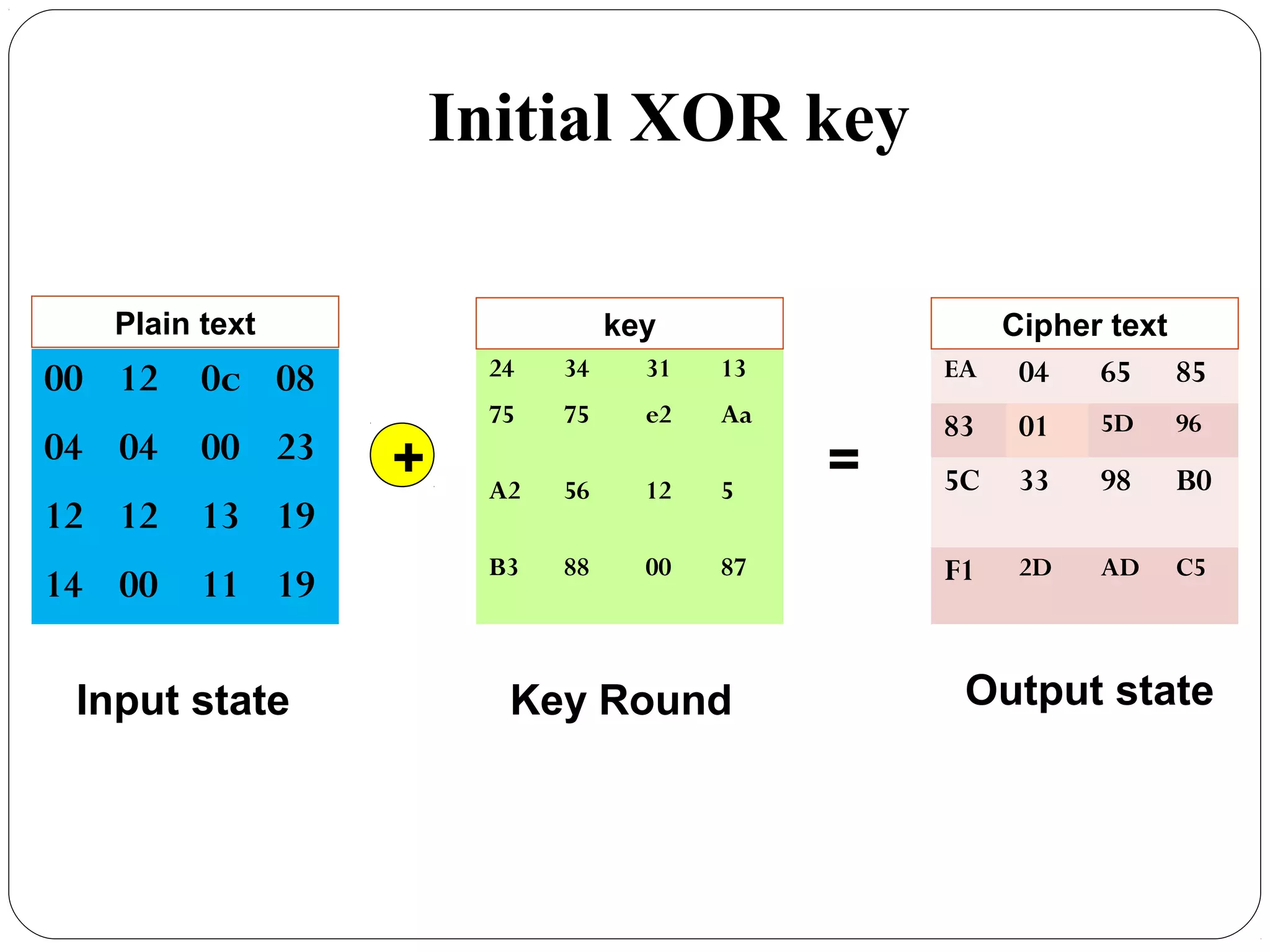
EA 04 65 85
83 01 5D 96
5C 33 98 B0
F1 2D AD C5
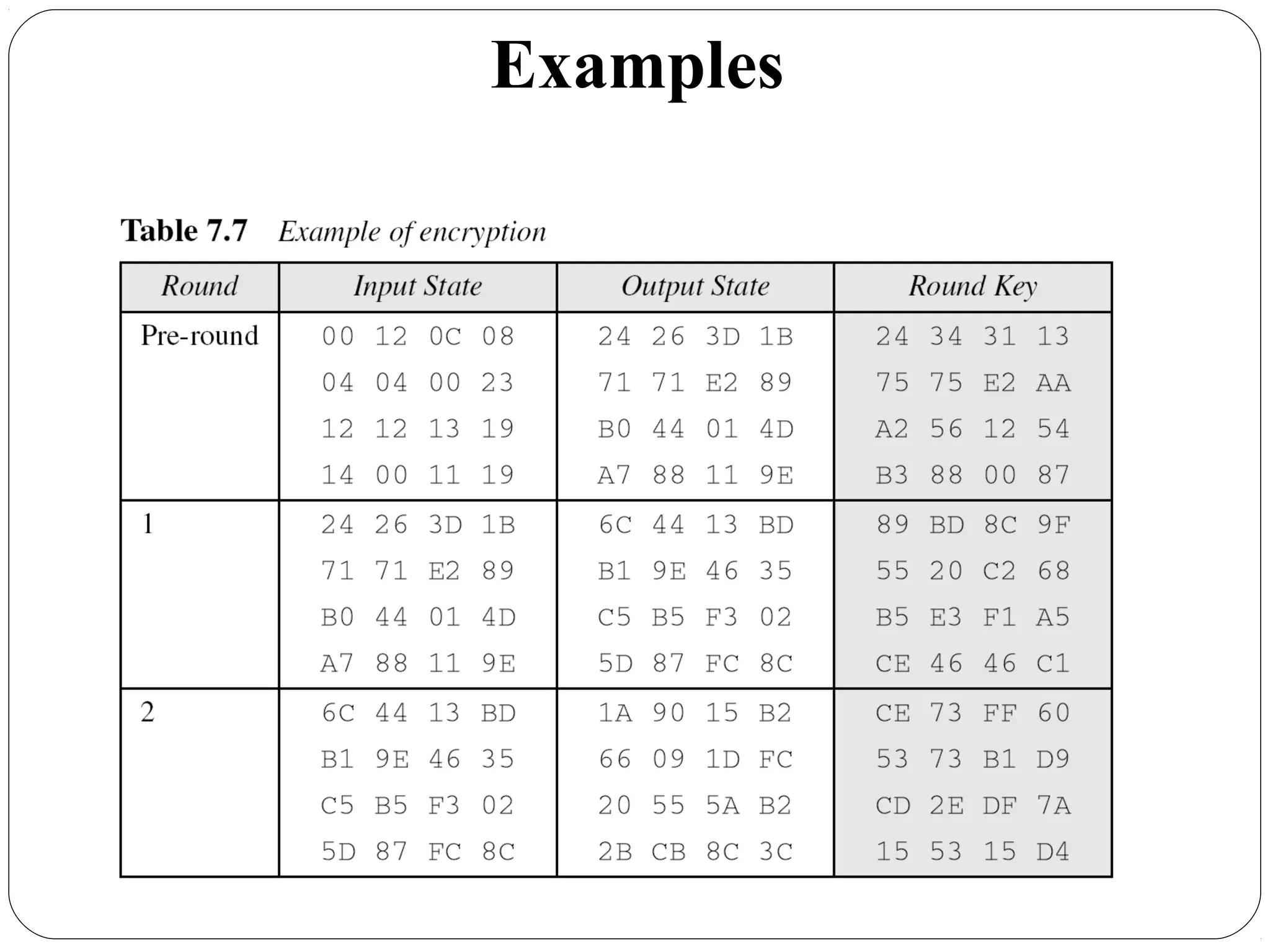
Initial XOR key
24 34 31 13
75 75 e2 Aa
A2 56 12 5
B3 88 00 87
00 12 0c 08
04 04 00 23
12 12 13 19
14 00 11 19
Input state Output stateKey Round
Plain text key Cipher text
+ =
7.26
TRANSFORMATIONS
To provide security, AES uses four types of
transformations: substitution, permutation, mixing, and
key-adding.
1. Substitution
2. Permutation
3. Mixing
4. Key Adding
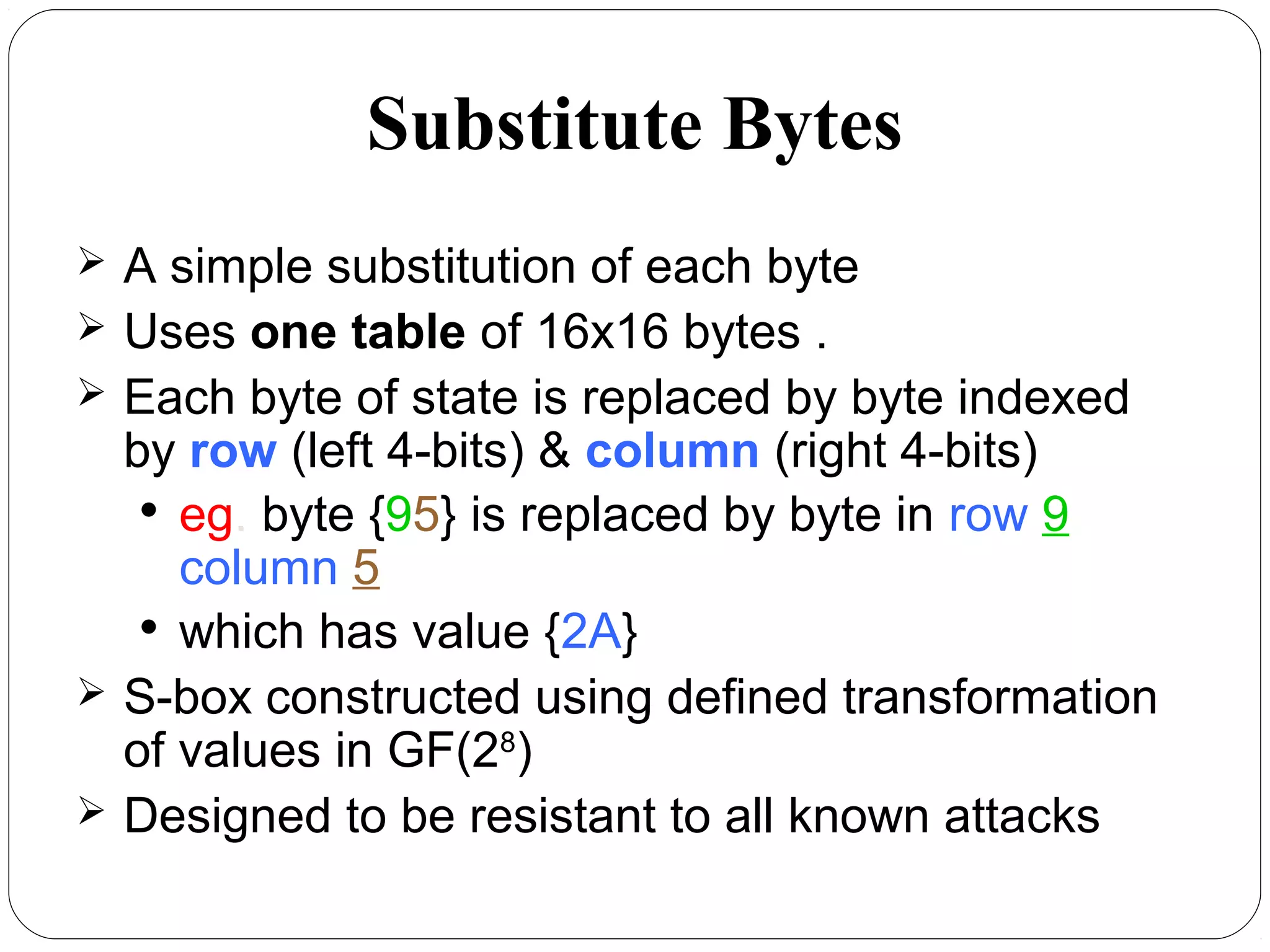
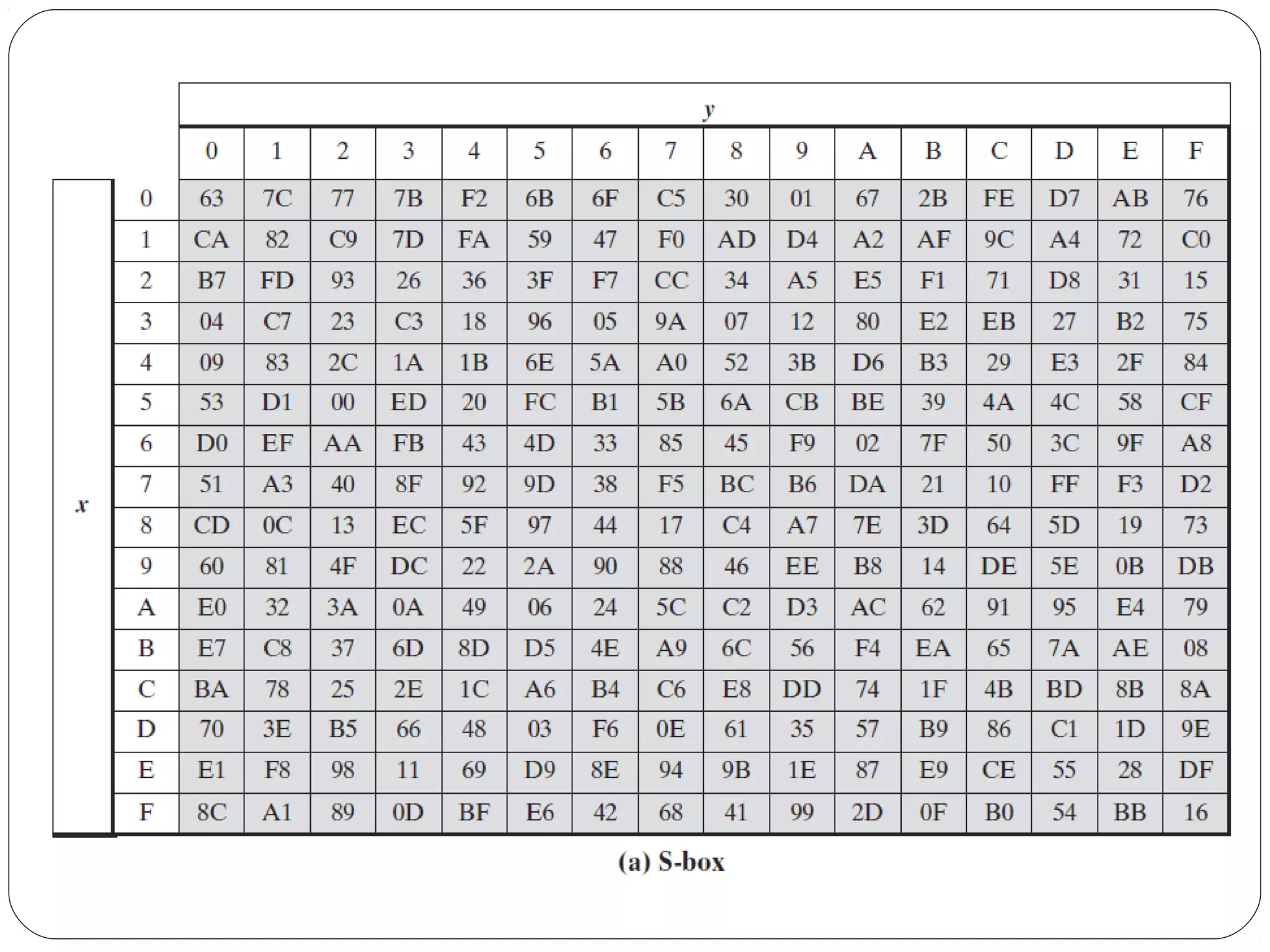
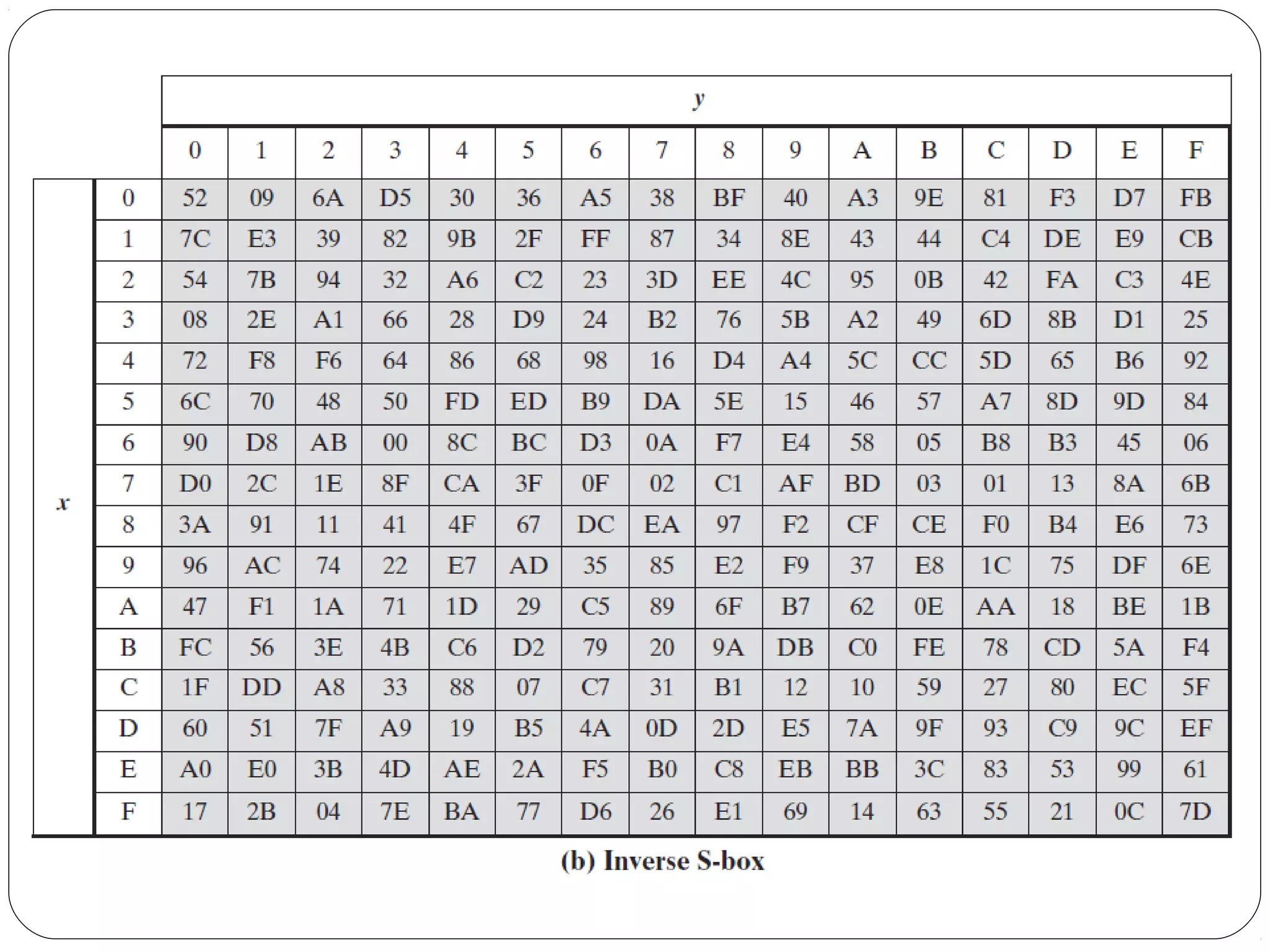
Substitute Bytes
 A simple substitution of each byte
 Uses one table of 16x16 bytes .
 Each byte of state is replaced by byte indexed
by row (left 4-bits) & column (right 4-bits)

eg. byte {95} is replaced by byte in row 9
column 5

which has value {2A}
 S-box constructed using defined transformation
of values in GF(28
)
 Designed to be resistant to all known attacks
7.28
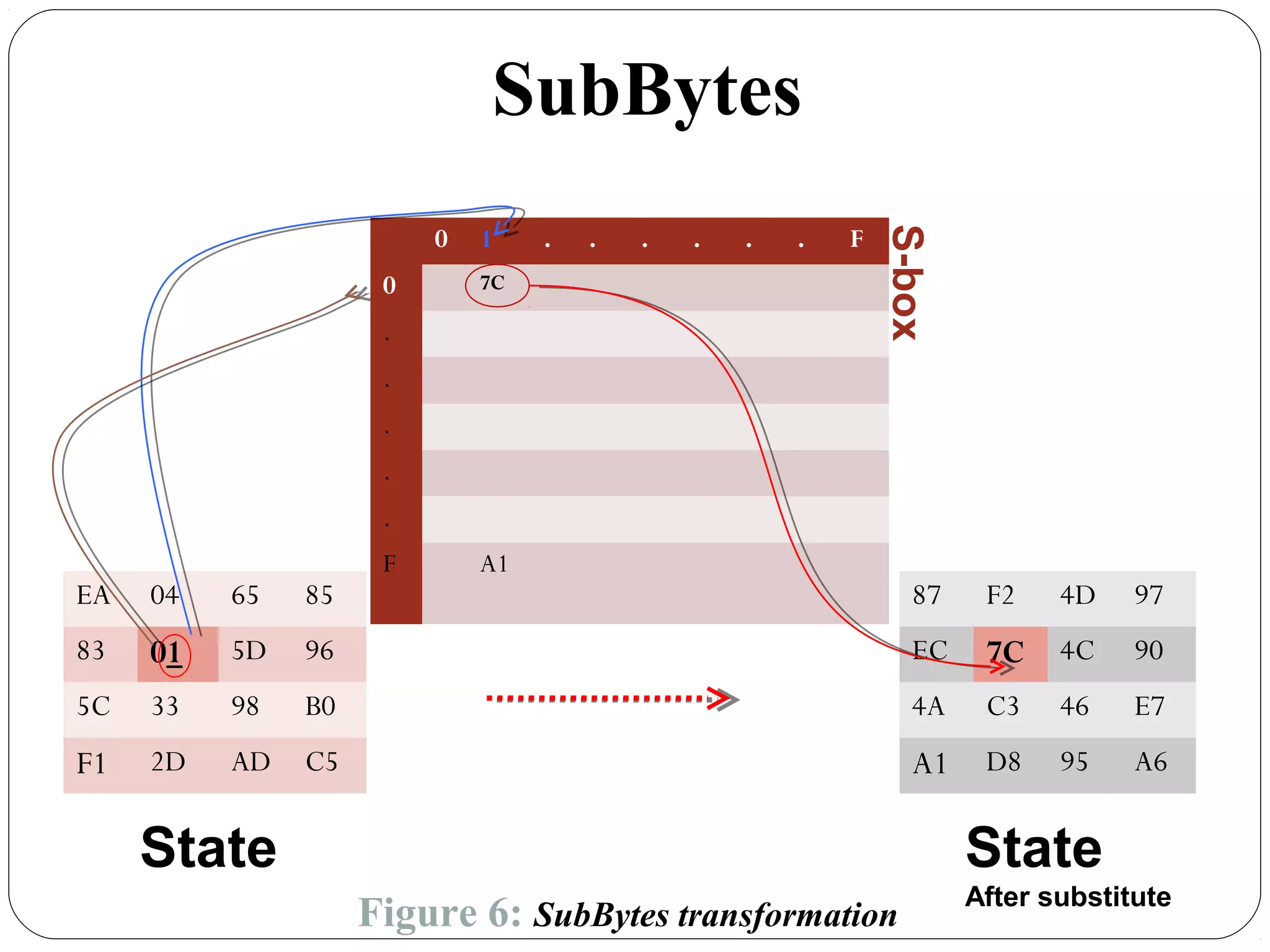
0 1 . . . . . . F
0 7C
.
.
.
.
.
F A1
EA 04 65 85
83 01 5D 96
5C 33 98 B0
F1 2D AD C5
State
87 F2 4D 97
EC 7C 4C 90
4A C3 46 E7
A1 D8 95 A6
State
After substituteS-box
SubBytes
Figure 6: SubBytes transformation
7.29
7.30
Shift Rows
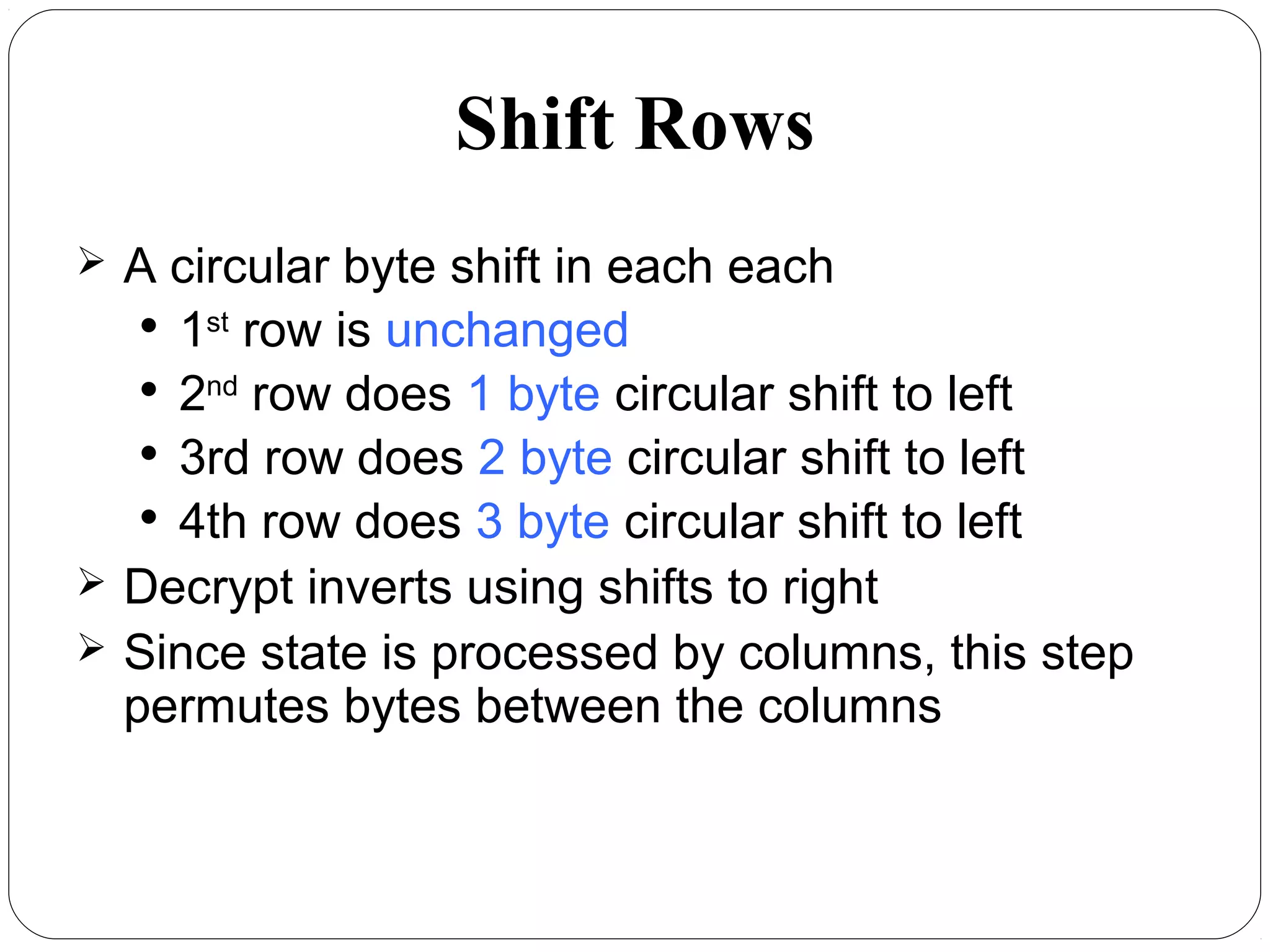
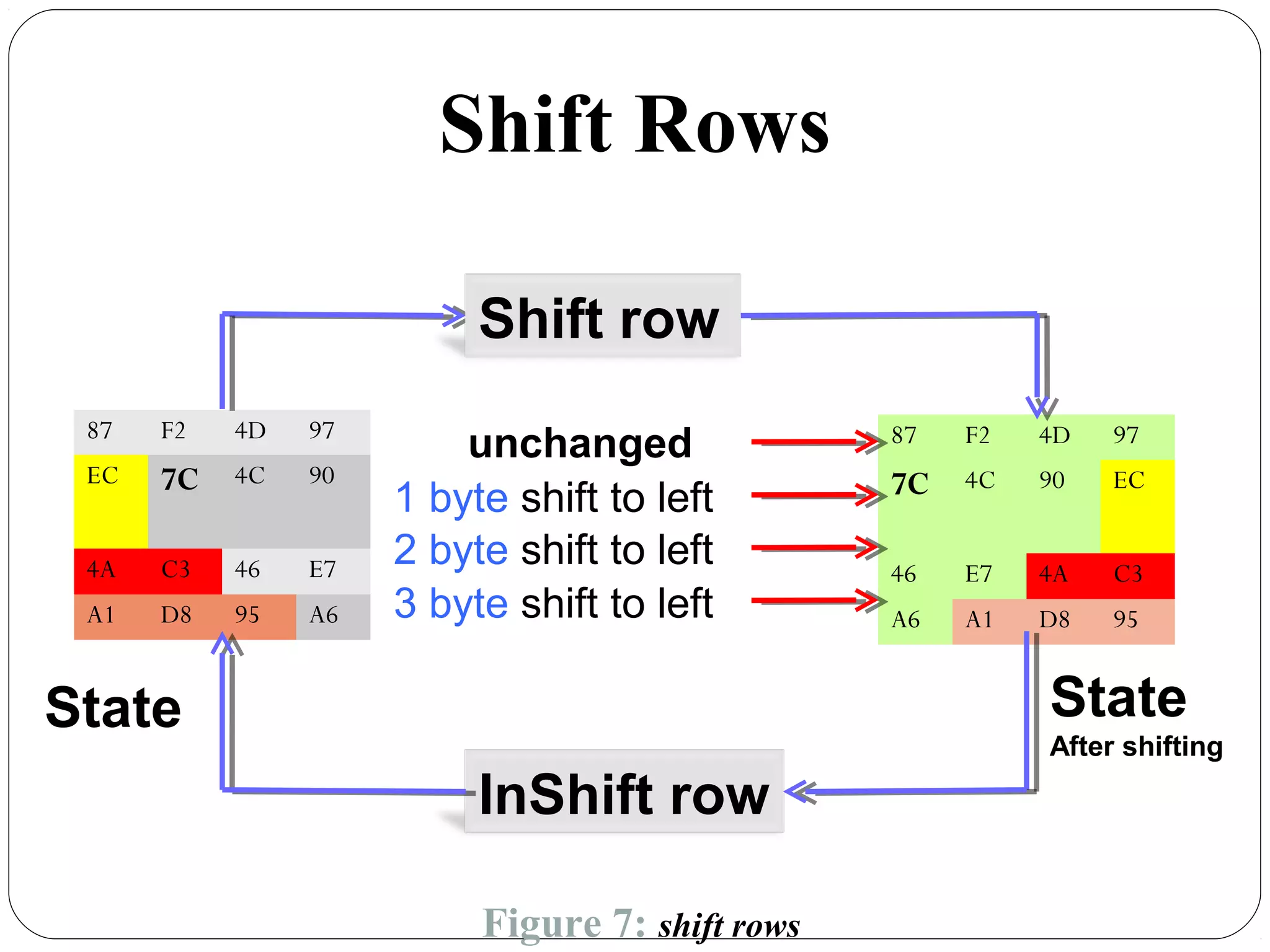
 A circular byte shift in each each

1st
row is unchanged

2nd
row does 1 byte circular shift to left

3rd row does 2 byte circular shift to left

4th row does 3 byte circular shift to left
 Decrypt inverts using shifts to right
 Since state is processed by columns, this step
permutes bytes between the columns
7.32
87 F2 4D 97
EC 7C 4C 90
4A C3 46 E7
A1 D8 95 A6
87 F2 4D 97
7C 4C 90 EC
46 E7 4A C3
A6 A1 D8 95
unchanged
1 byte shift to left
2 byte shift to left
3 byte shift to left
State
After shifting
State
Shift Rows
Shift row
InShift row
Figure 7: shift rows
Mix Columns
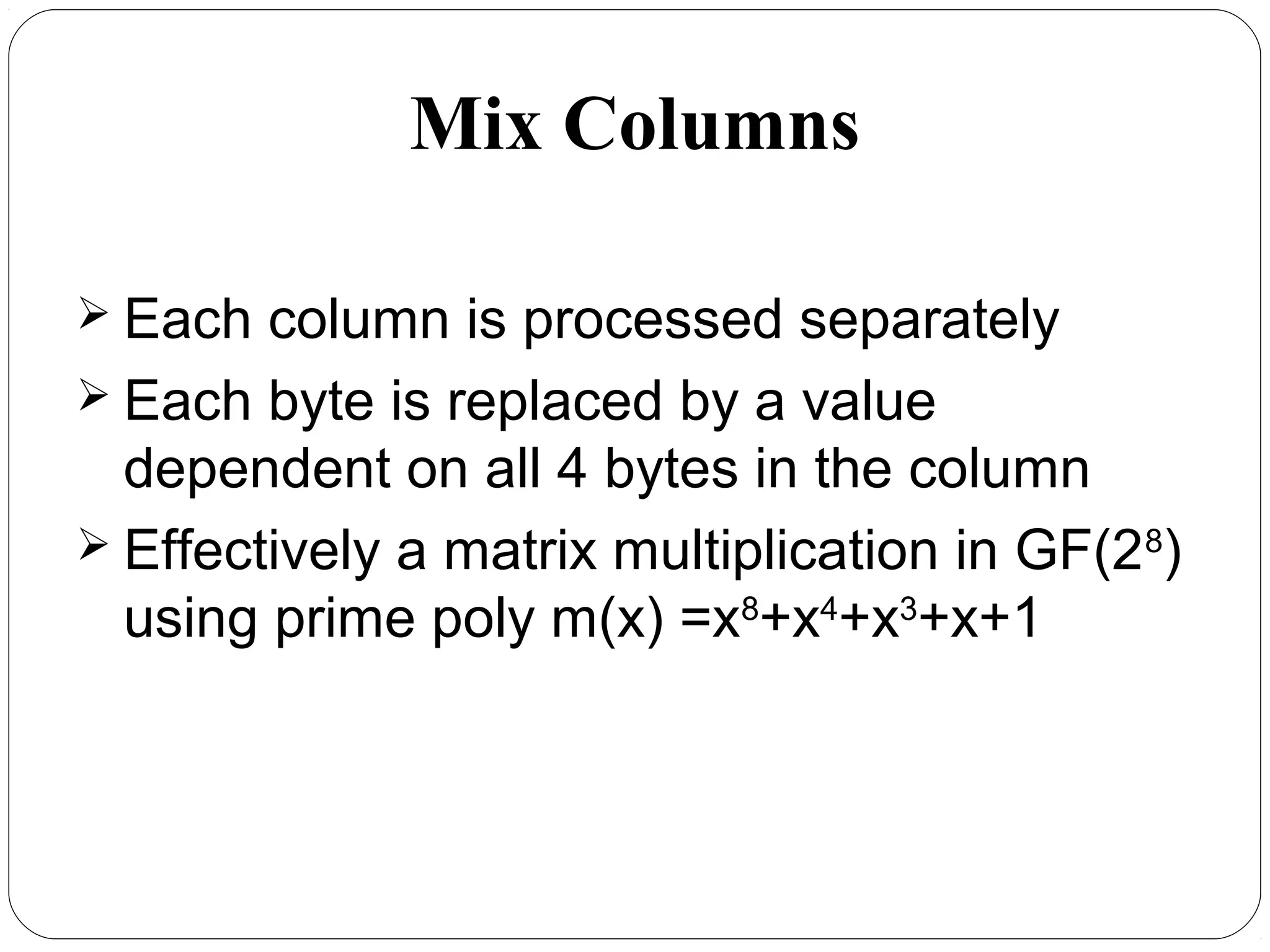
 Each column is processed separately
 Each byte is replaced by a value
dependent on all 4 bytes in the column
 Effectively a matrix multiplication in GF(28
)
using prime poly m(x) =x8
+x4
+x3
+x+1
Continue
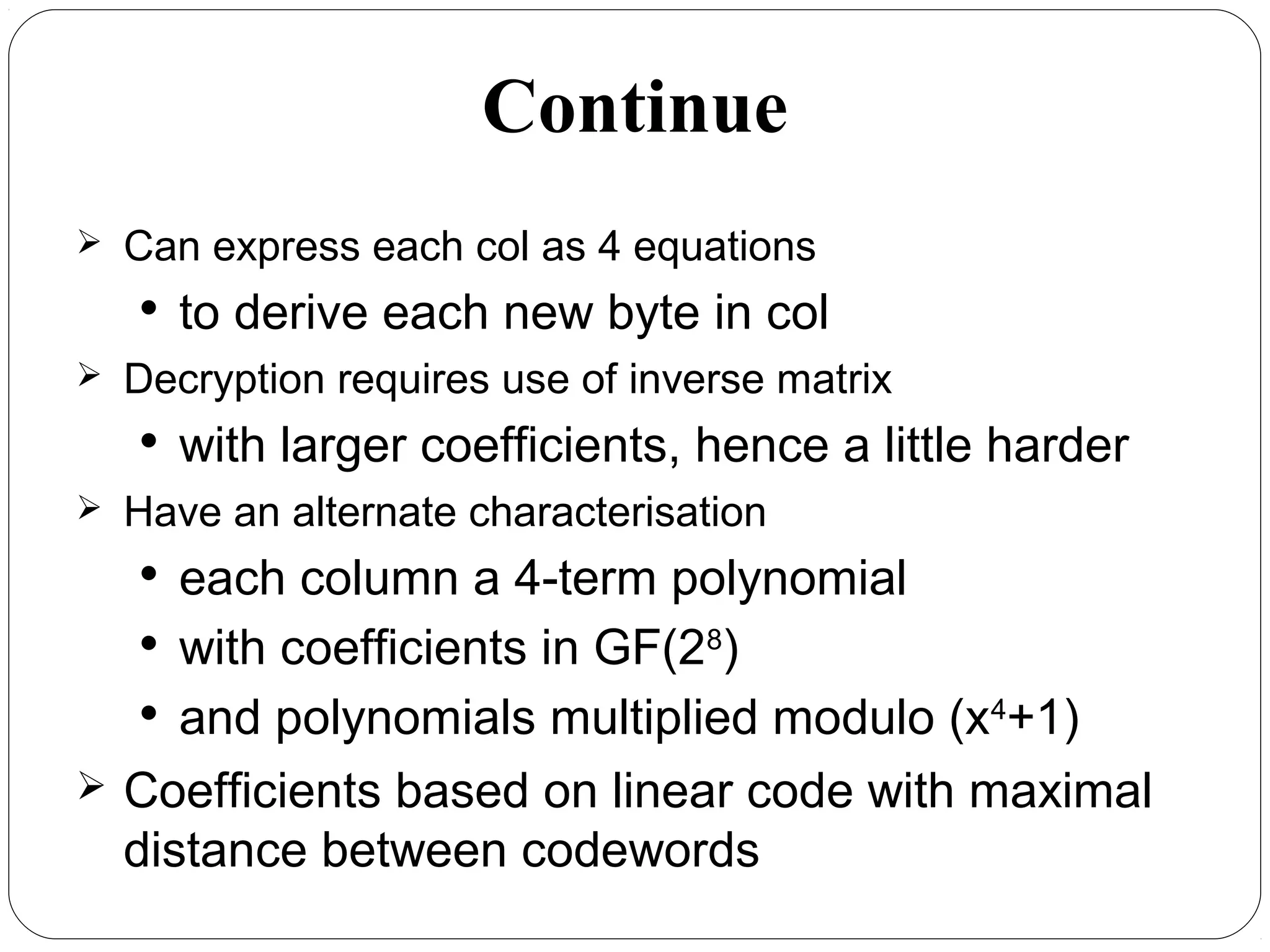
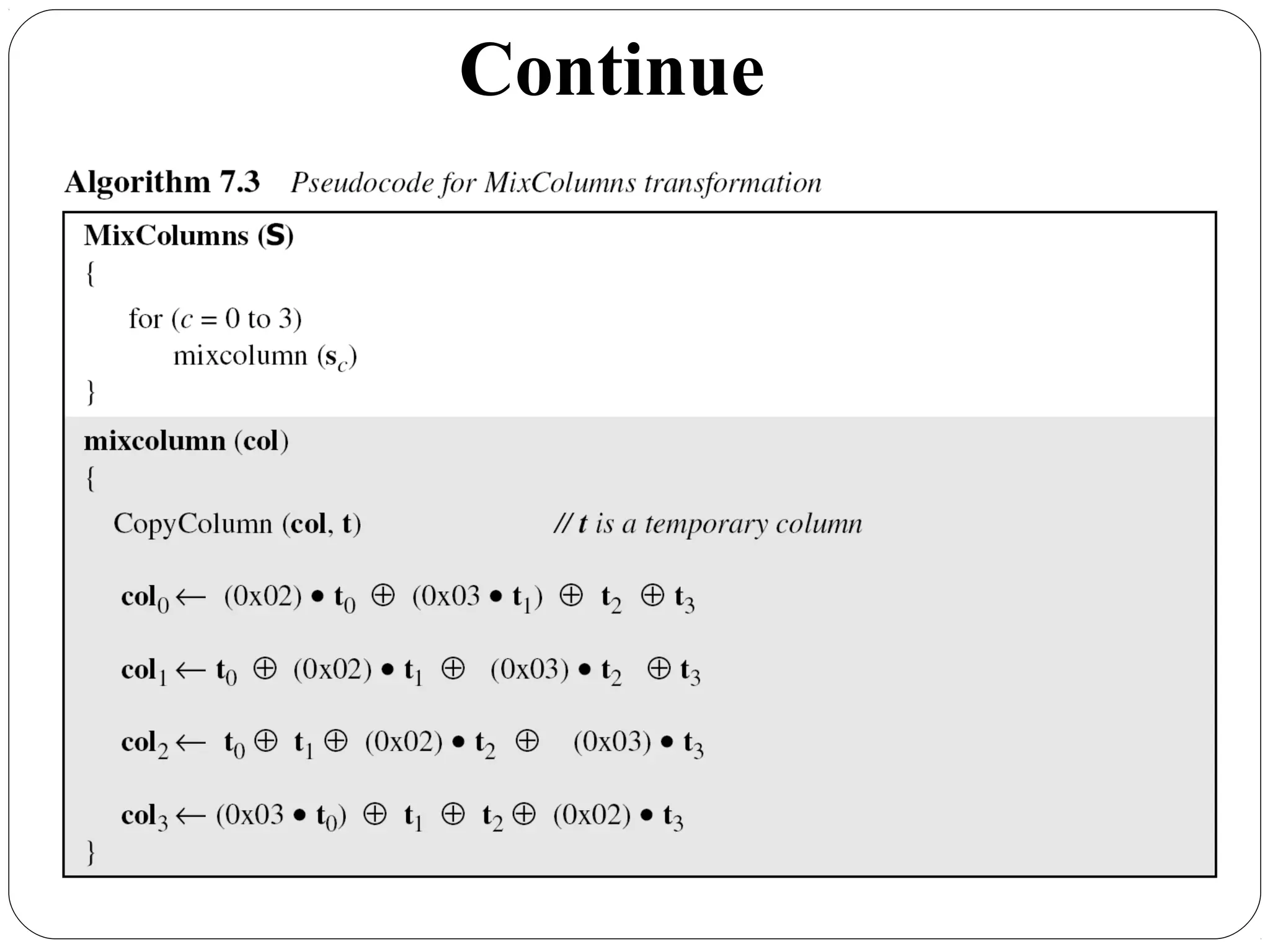
 Can express each col as 4 equations

to derive each new byte in col
 Decryption requires use of inverse matrix

with larger coefficients, hence a little harder
 Have an alternate characterisation

each column a 4-term polynomial

with coefficients in GF(28
)

and polynomials multiplied modulo (x4
+1)
 Coefficients based on linear code with maximal
distance between codewords
7.35
Continue
7.36
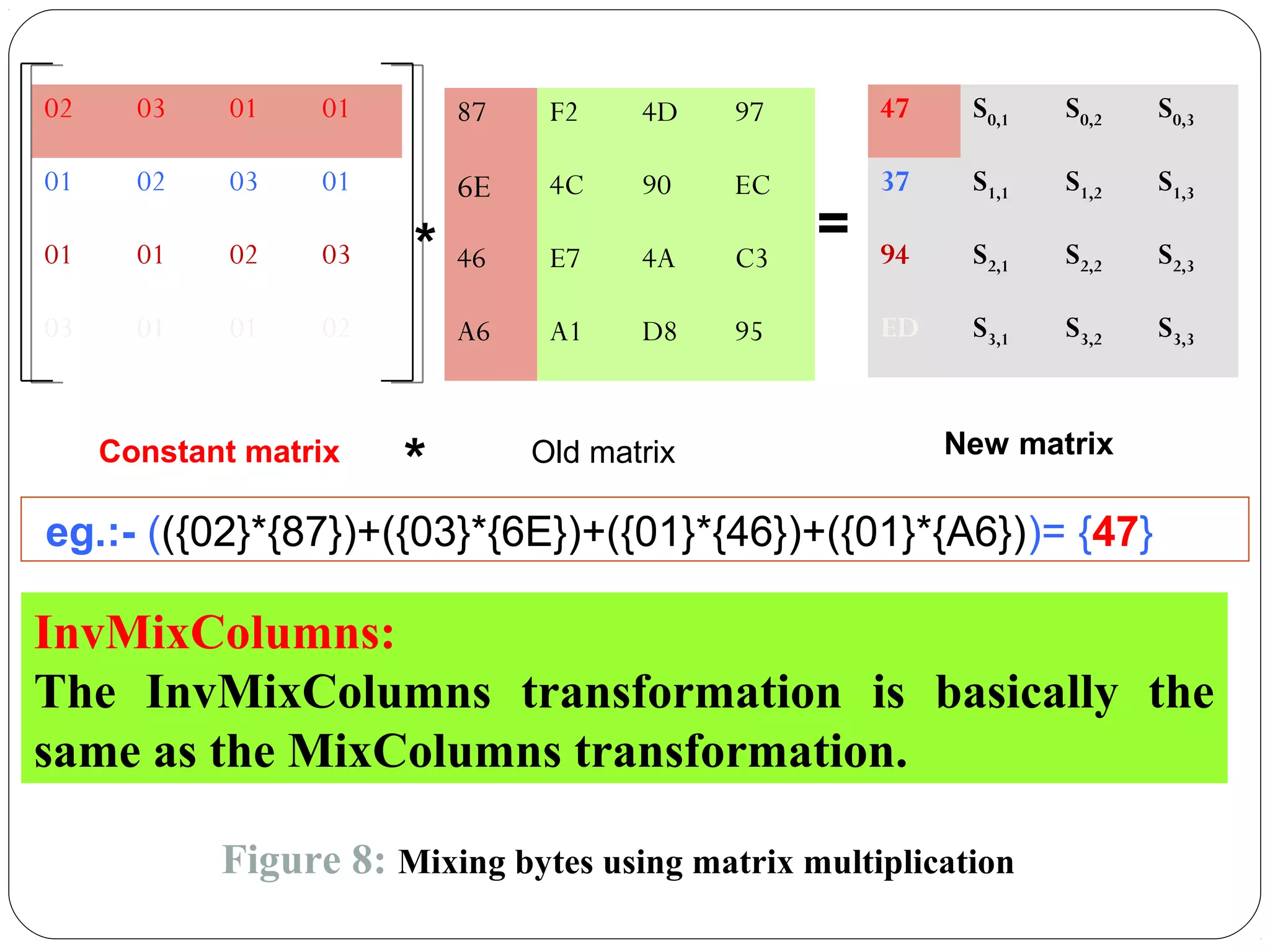
02 03 01 01
01 02 03 01
01 01 02 03
03 01 01 02
87 F2 4D 97
6E 4C 90 EC
46 E7 4A C3
A6 A1 D8 95
47 S0,1 S0,2 S0,3
37 S1,1 S1,2 S1,3
94 S2,1 S2,2 S2,3
ED S3,1 S3,2 S3,3
=*
Old matrix New matrixConstant matrix
*
eg.:- (({02}*{87})+({03}*{6E})+({01}*{46})+({01}*{A6}))= {47}
InvMixColumns:
The InvMixColumns transformation is basically the
same as the MixColumns transformation.
Figure 8: Mixing bytes using matrix multiplication
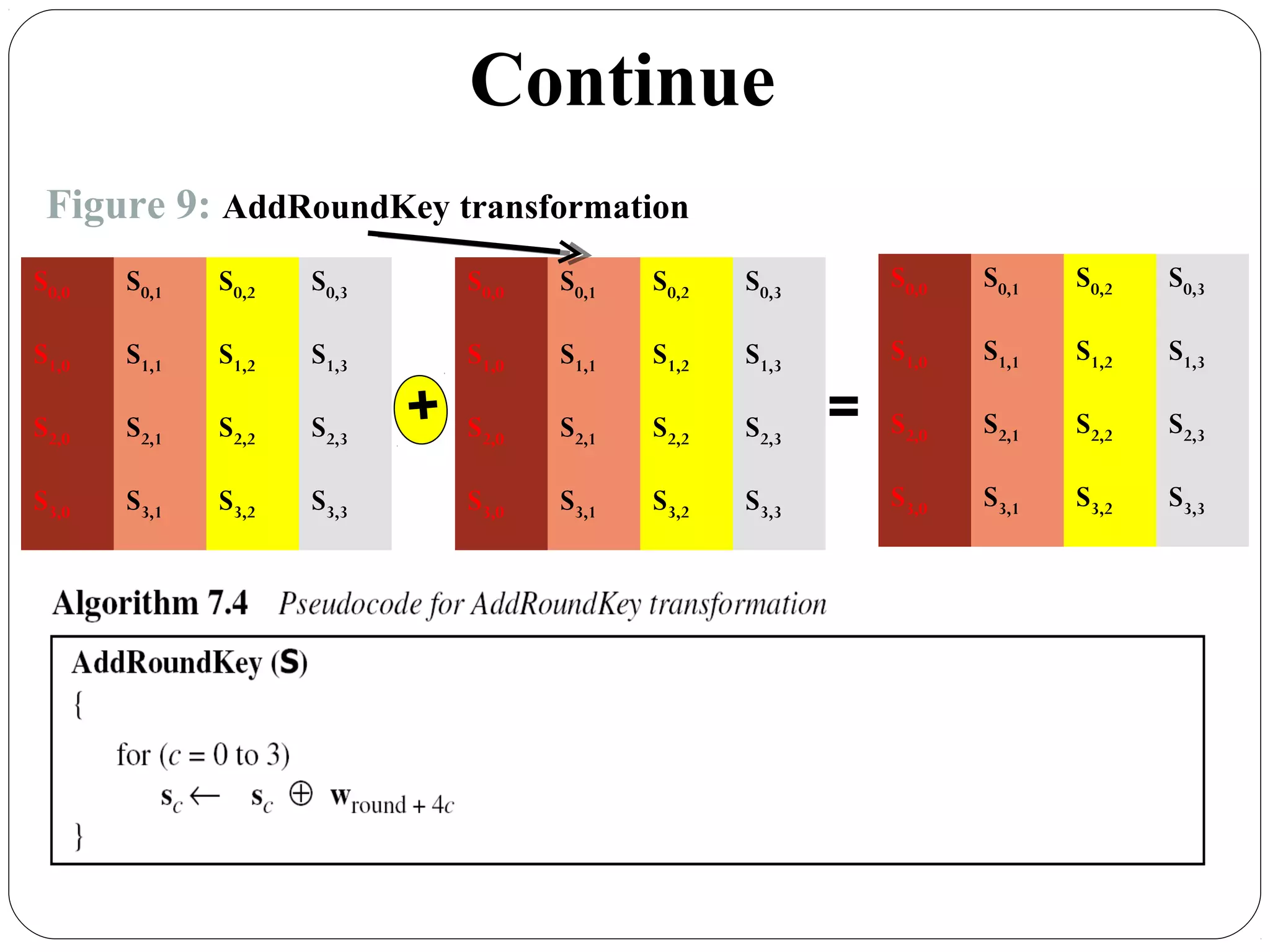
Add Round Key
 XOR state with 128-bits of the round key
 Again processed by column (though
effectively a series of byte operations)
 Inverse for decryption identical

since XOR own inverse, with reversed keys
 Designed to be as simple as possible

a form of Vernam cipher on expanded key

requires other stages for complexity / security
7.38
Continue
Figure 9: AddRoundKey transformation
S0,0 S0,1 S0,2 S0,3
S1,0 S1,1 S1,2 S1,3
S2,0 S2,1 S2,2 S2,3
S3,0 S3,1 S3,2 S3,3
S0,0 S0,1 S0,2 S0,3
S1,0 S1,1 S1,2 S1,3
S2,0 S2,1 S2,2 S2,3
S3,0 S3,1 S3,2 S3,3
S0,0 S0,1 S0,2 S0,3
S1,0 S1,1 S1,2 S1,3
S2,0 S2,1 S2,2 S2,3
S3,0 S3,1 S3,2 S3,3
+ =
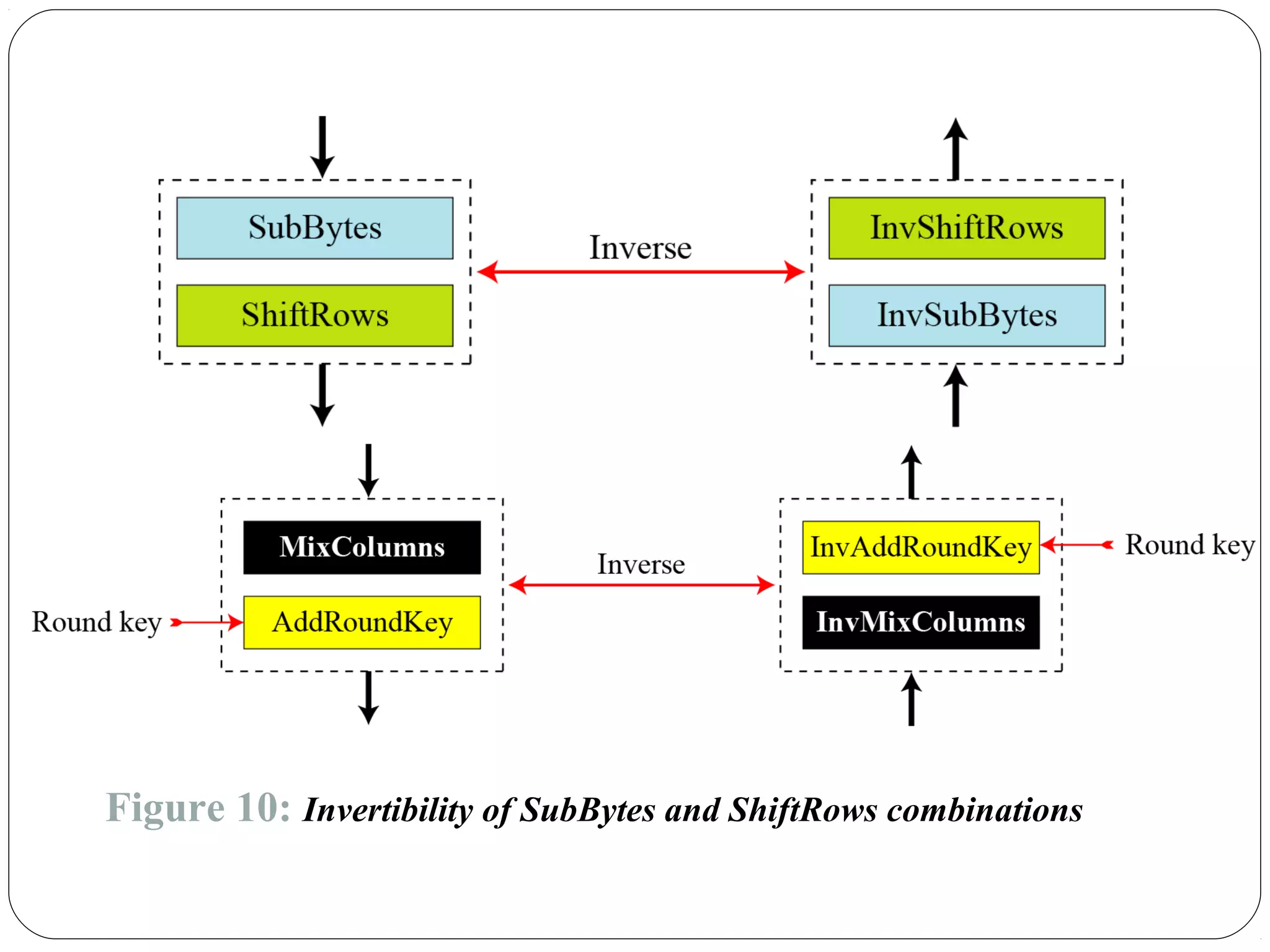
Figure 10: Invertibility of SubBytes and ShiftRows combinations
7.40
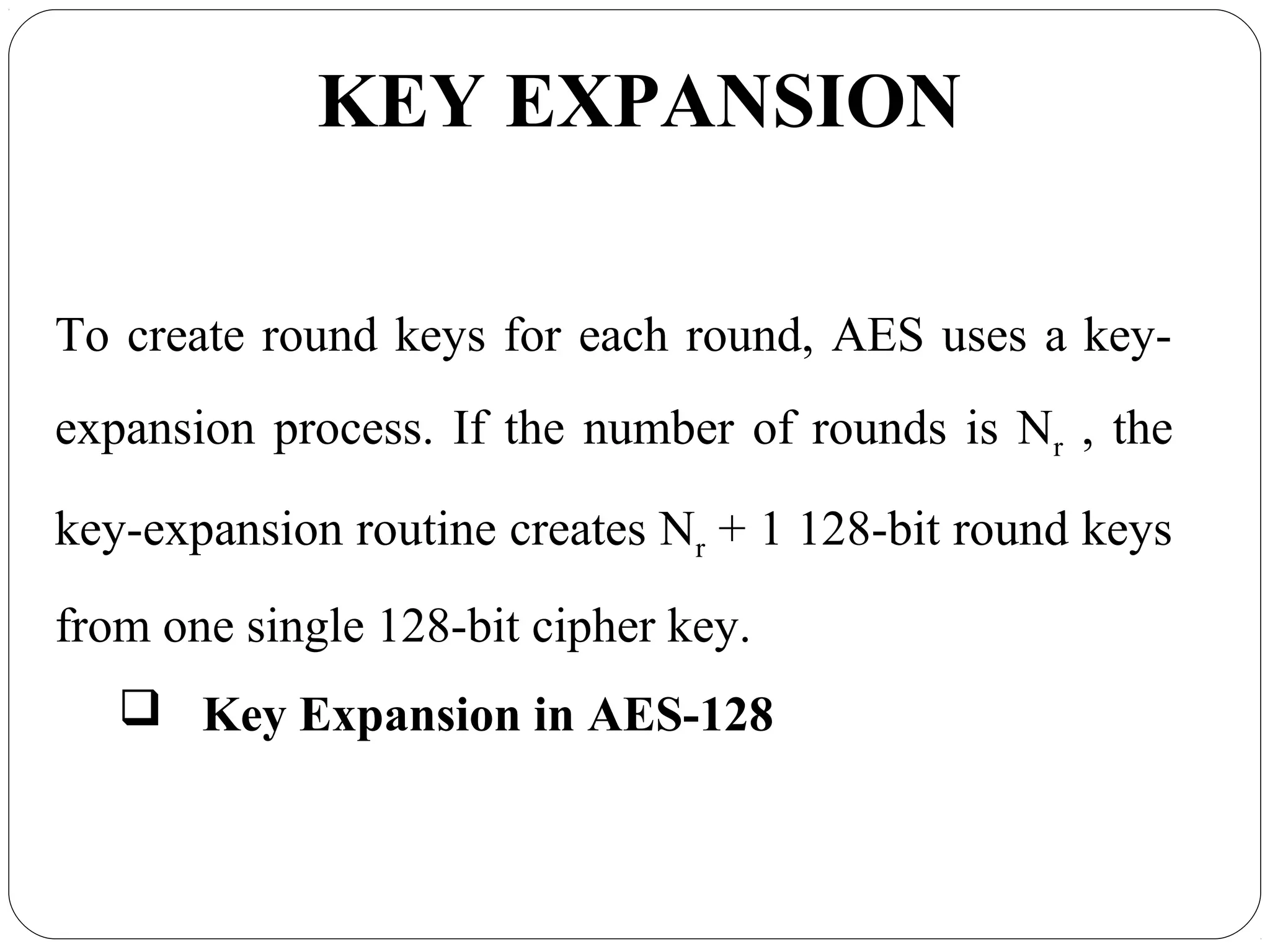
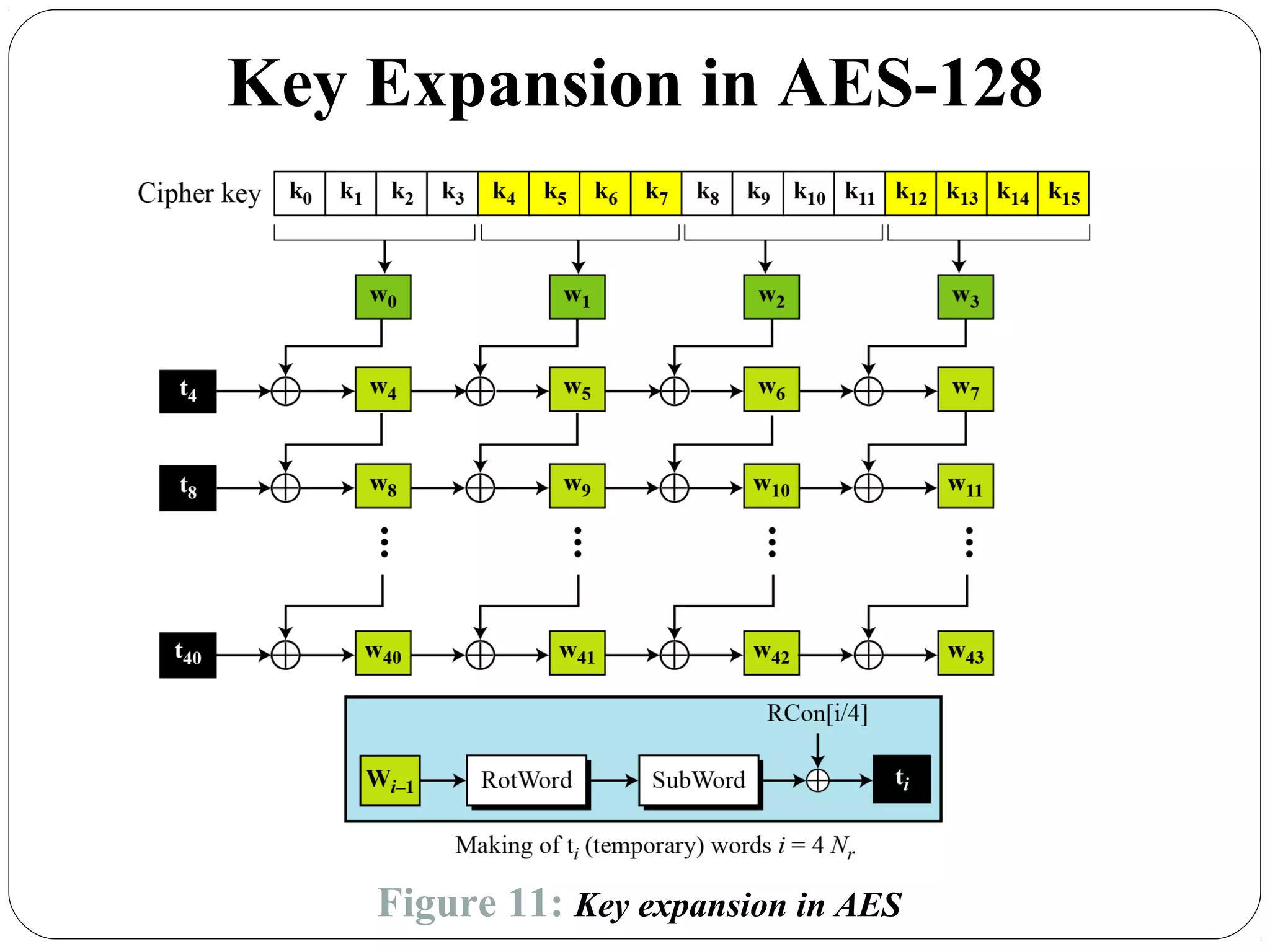
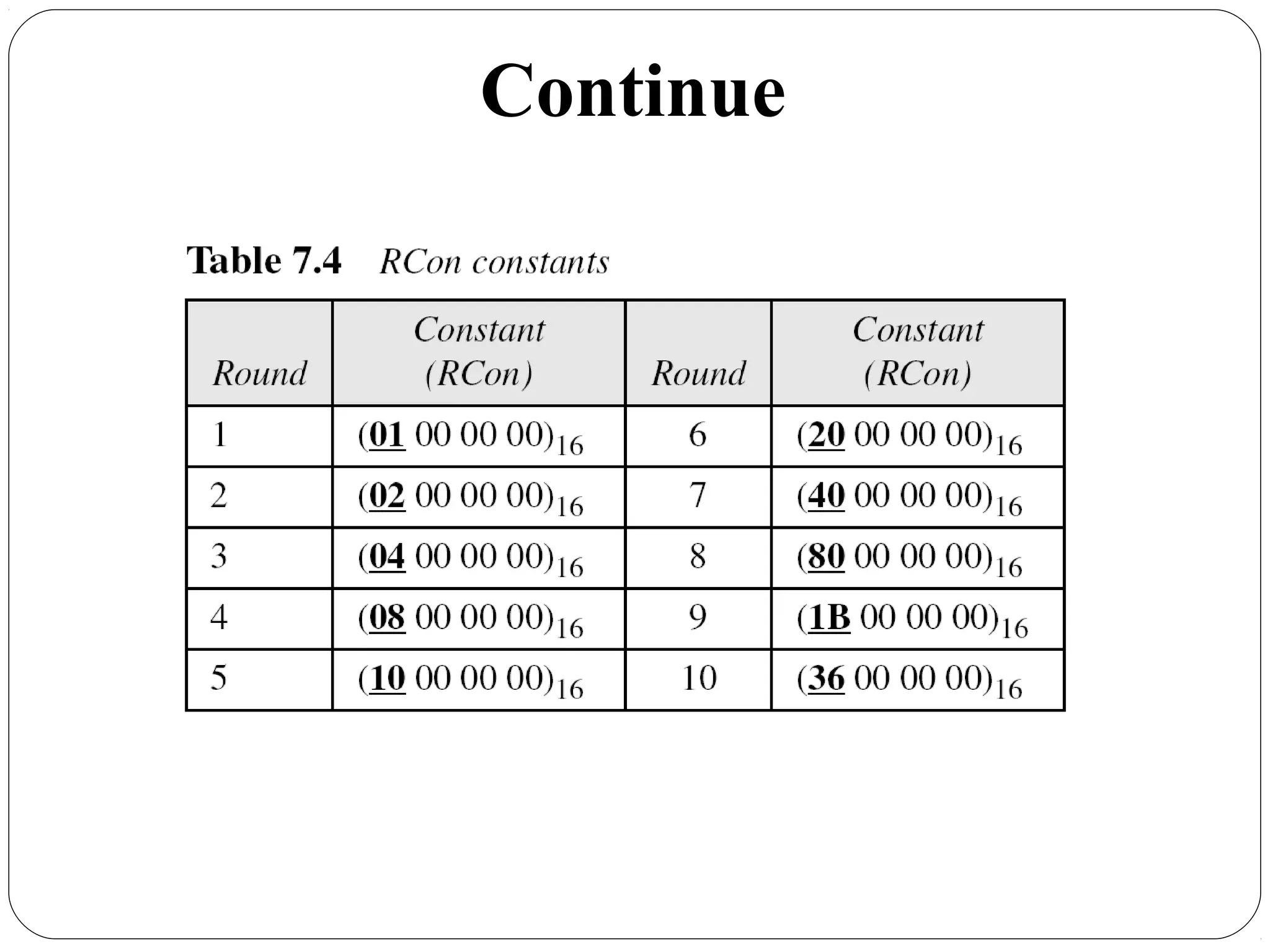
KEY EXPANSION
To create round keys for each round, AES uses a key-
expansion process. If the number of rounds is Nr , the
key-expansion routine creates Nr + 1 128-bit round keys
from one single 128-bit cipher key.
 Key Expansion in AES-128
7.41
Key Expansion in AES-128
Figure 11: Key expansion in AES
7.42
Continue
7.43
Examples
7.44
ContinuedContinued
7.45
ContinuedContinued
7.46
ContinuedContinued
Example :
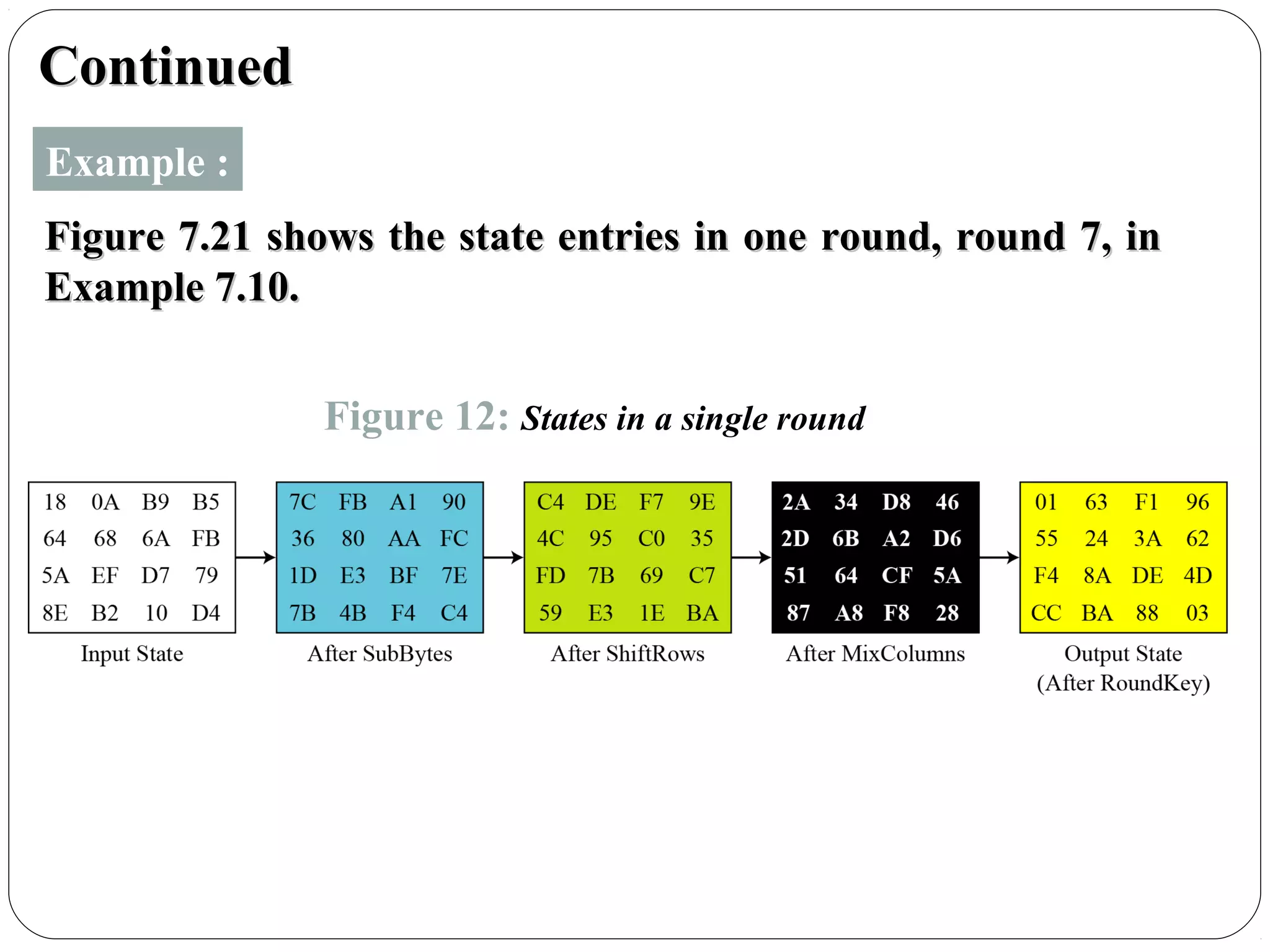
Figure 7.21 shows the state entries in one round, round 7, inFigure 7.21 shows the state entries in one round, round 7, in
Example 7.10.Example 7.10.
Figure 12: States in a single round
7.47
ContinuedContinued
Example :
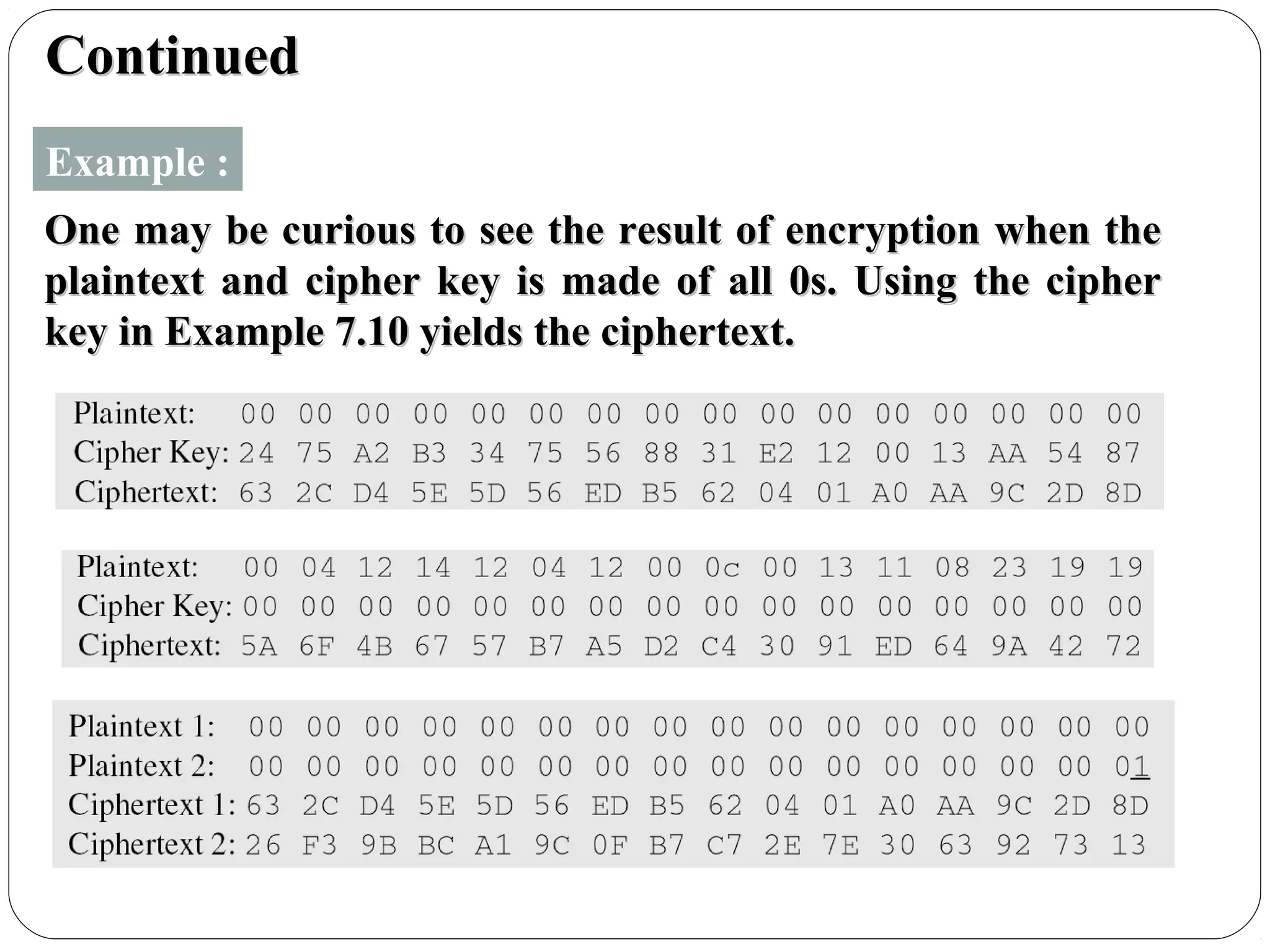
One may be curious to see the result of encryption when theOne may be curious to see the result of encryption when the
plaintext and cipher key is made of all 0s. Using the cipherplaintext and cipher key is made of all 0s. Using the cipher
key in Example 7.10 yields the ciphertext.key in Example 7.10 yields the ciphertext.
7.48
ANALYSIS OF AES
This section is a brief review of the three characteristics
of AES.
1. Security
2. Implementation
3. Simplicity and Cost
7.49
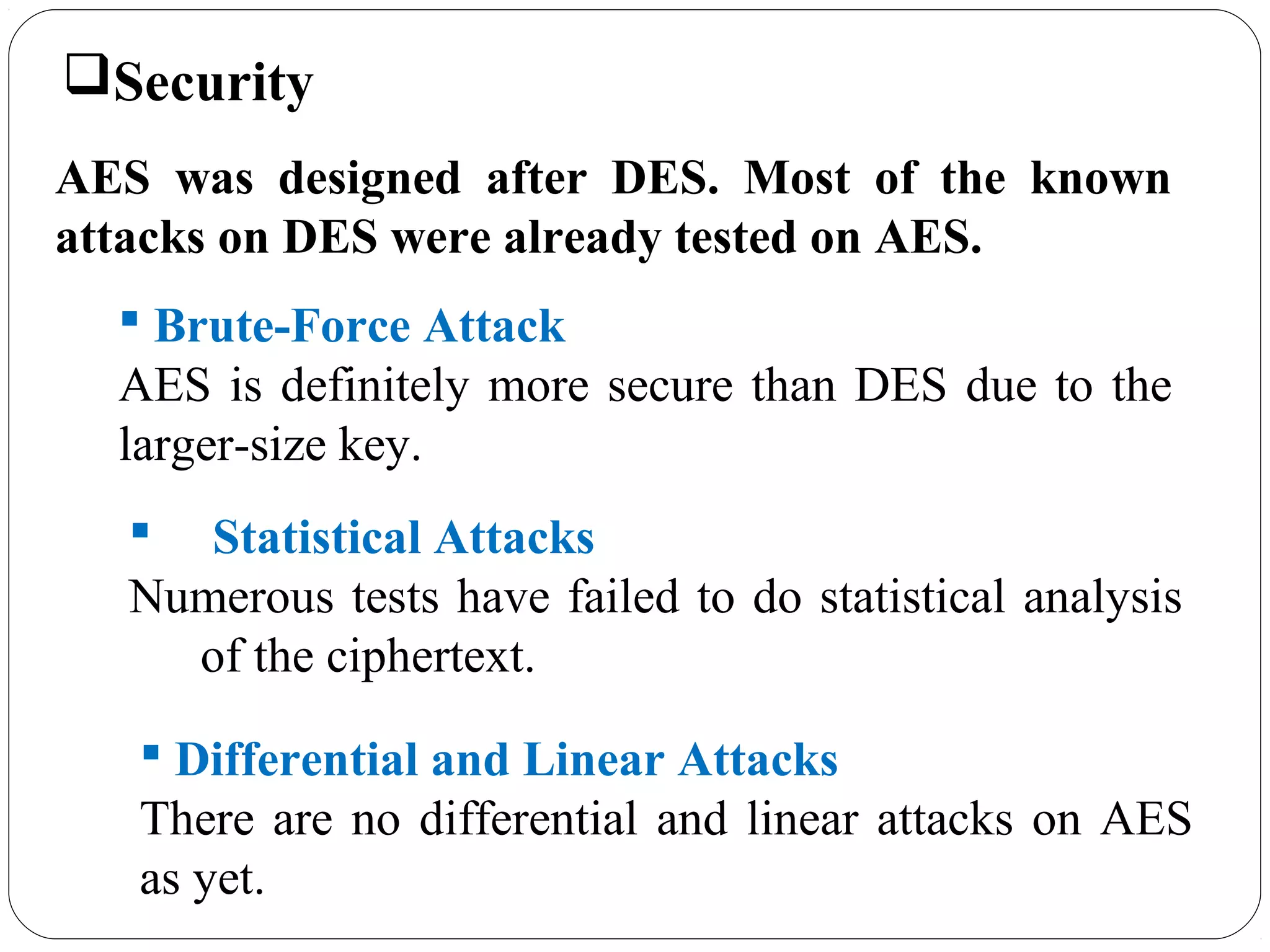
Security
AES was designed after DES. Most of the known
attacks on DES were already tested on AES.
 Brute-Force Attack
AES is definitely more secure than DES due to the
larger-size key.
 Statistical Attacks
Numerous tests have failed to do statistical analysis
of the ciphertext.
 Differential and Linear Attacks
There are no differential and linear attacks on AES
as yet.
7.50
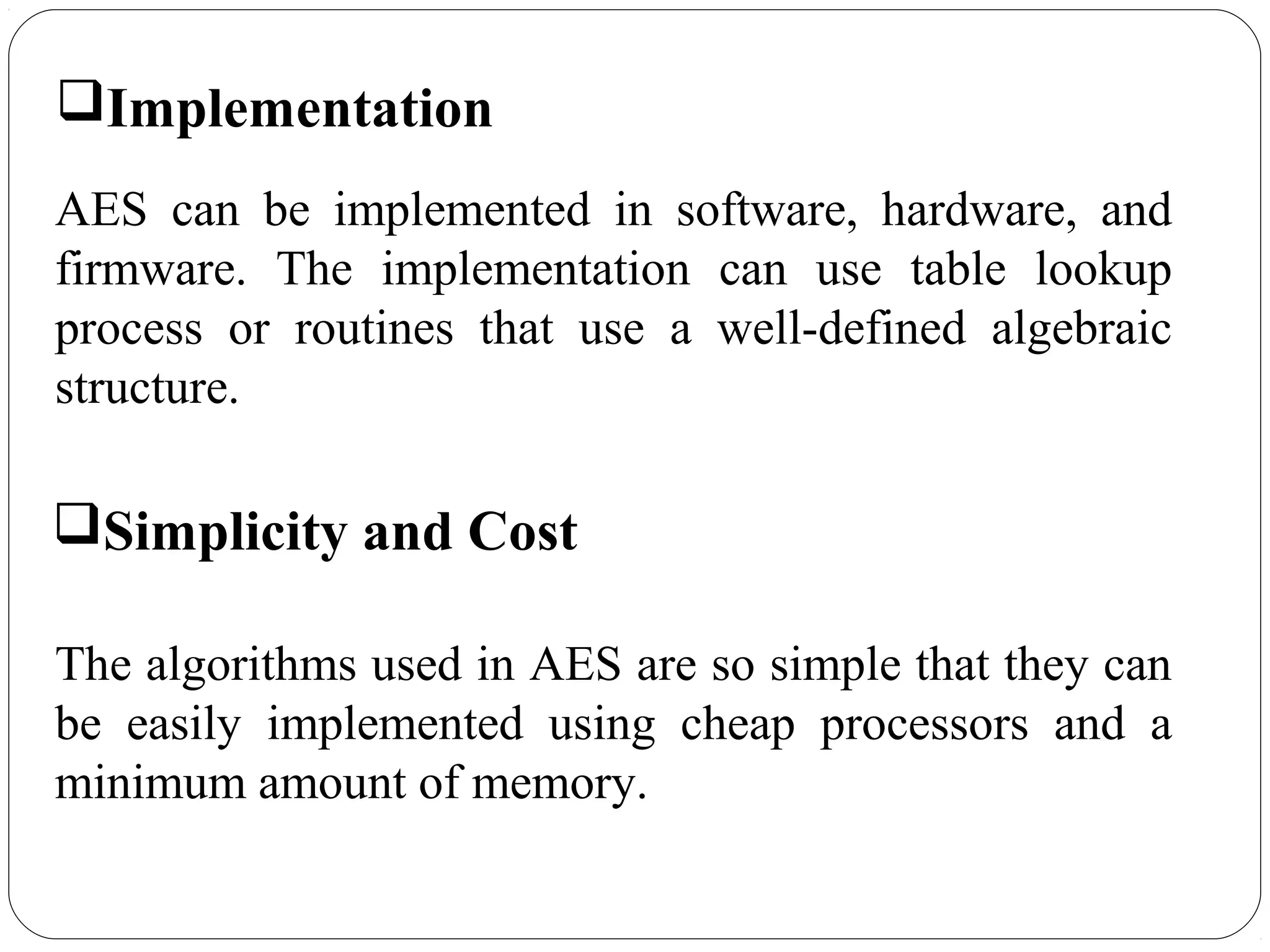
Implementation
AES can be implemented in software, hardware, and
firmware. The implementation can use table lookup
process or routines that use a well-defined algebraic
structure.
Simplicity and Cost
The algorithms used in AES are so simple that they can
be easily implemented using cheap processors and a
minimum amount of memory.
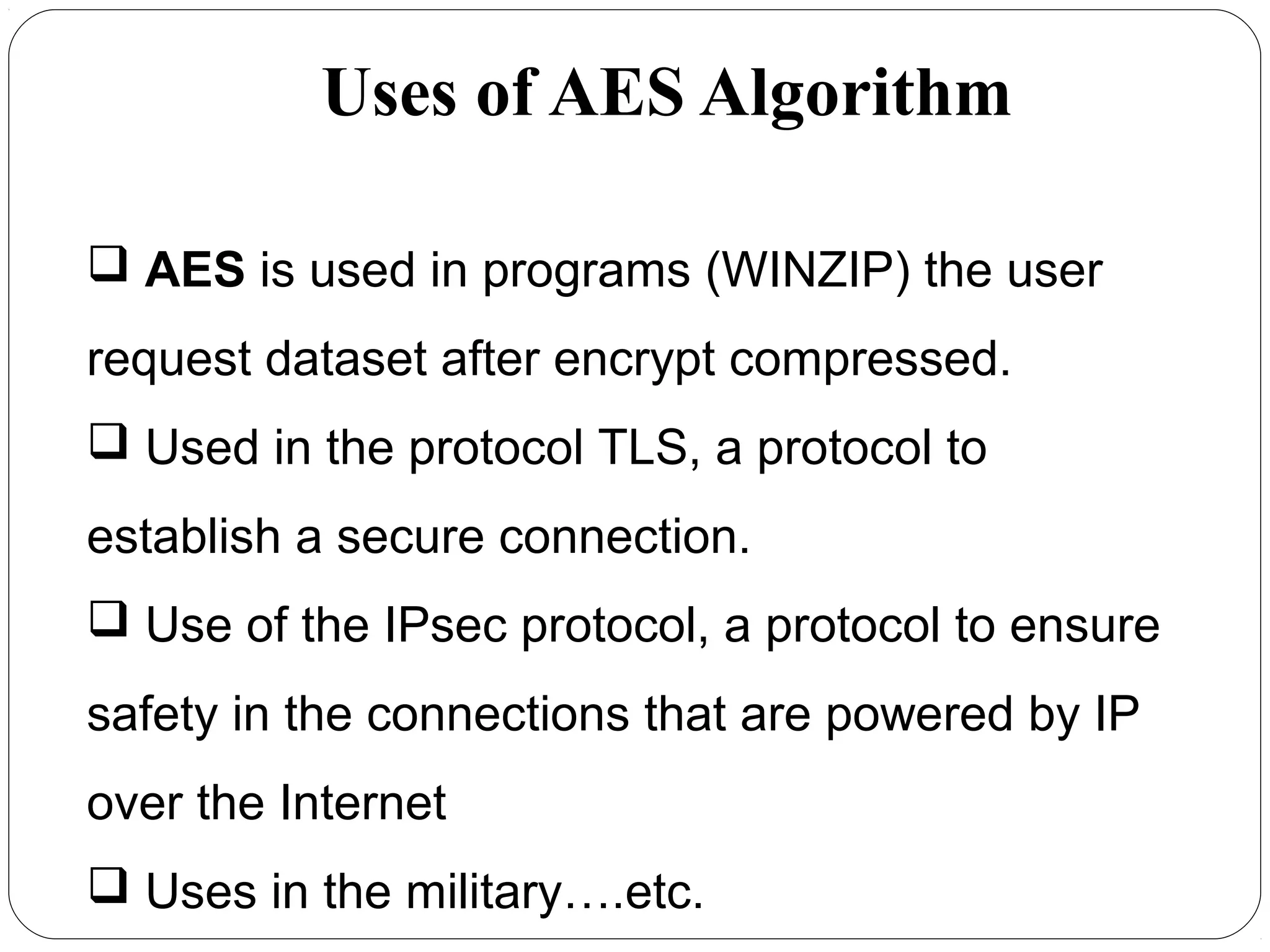
Uses of AES Algorithm
7.51
 AES is used in programs (WINZIP) the user
request dataset after encrypt compressed.
 Used in the protocol TLS, a protocol to
establish a secure connection.
 Use of the IPsec protocol, a protocol to ensure
safety in the connections that are powered by IP
over the Internet
 Uses in the military….etc.
7.52
Comparison
7.53
7.54
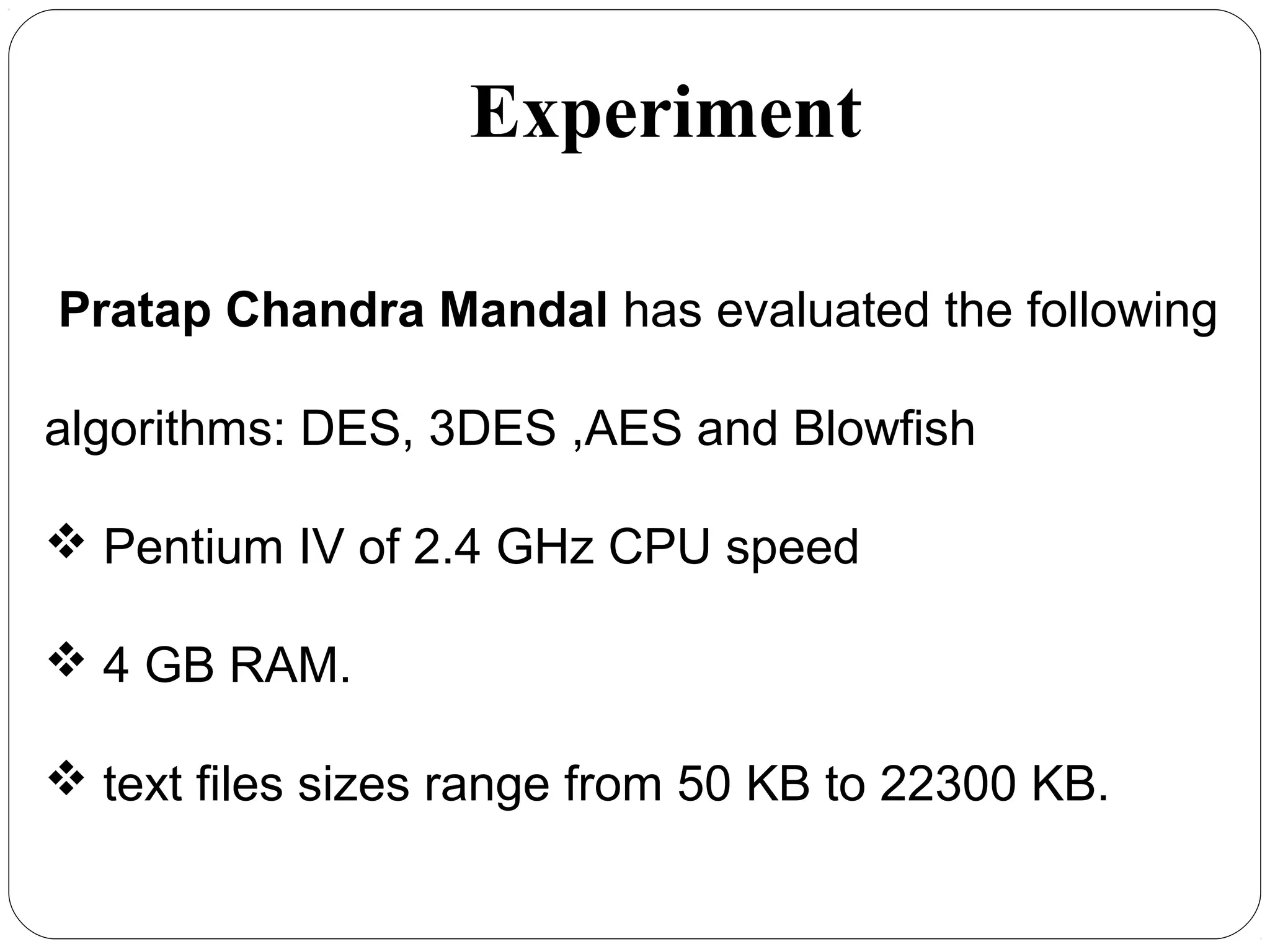
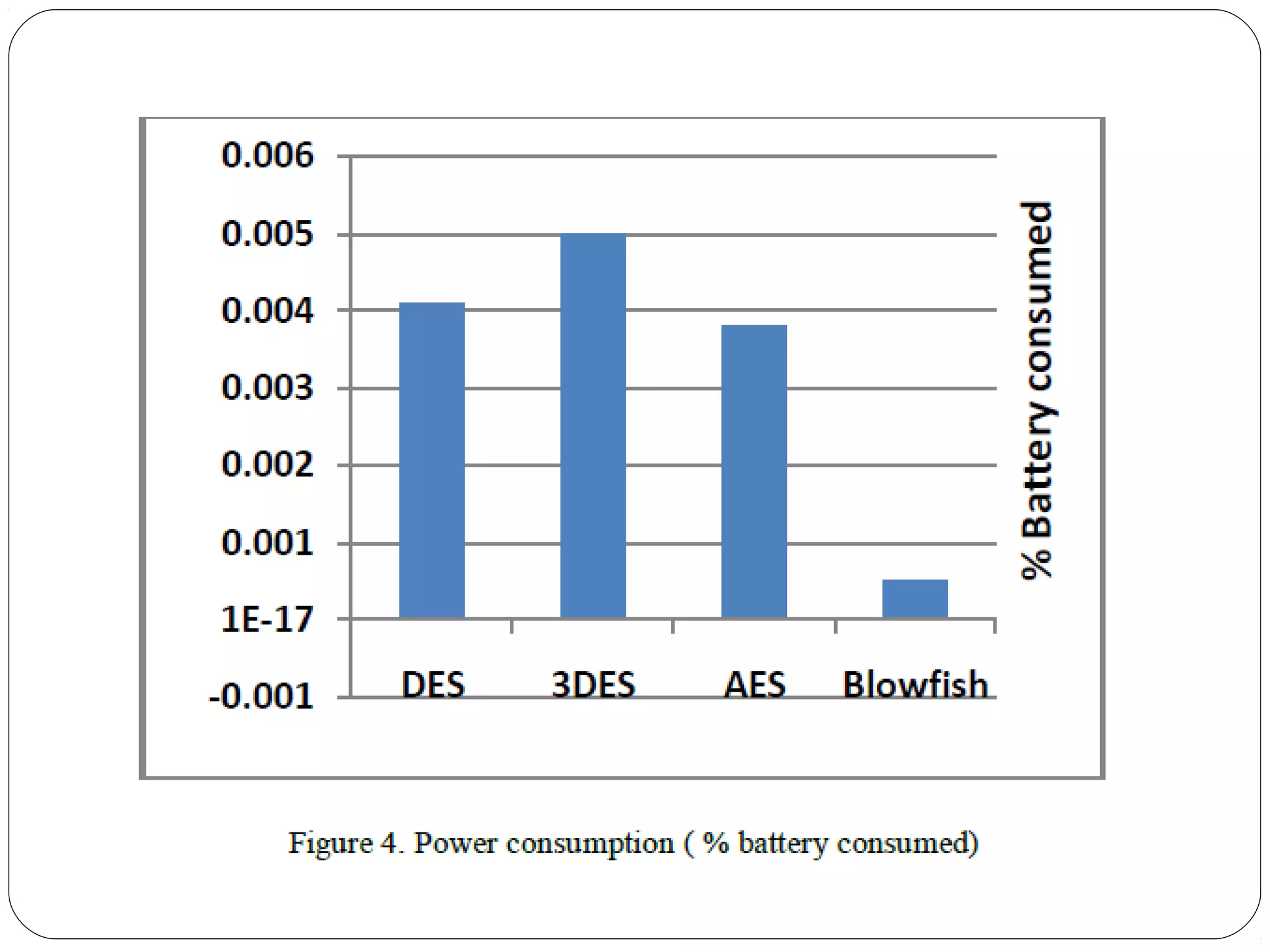
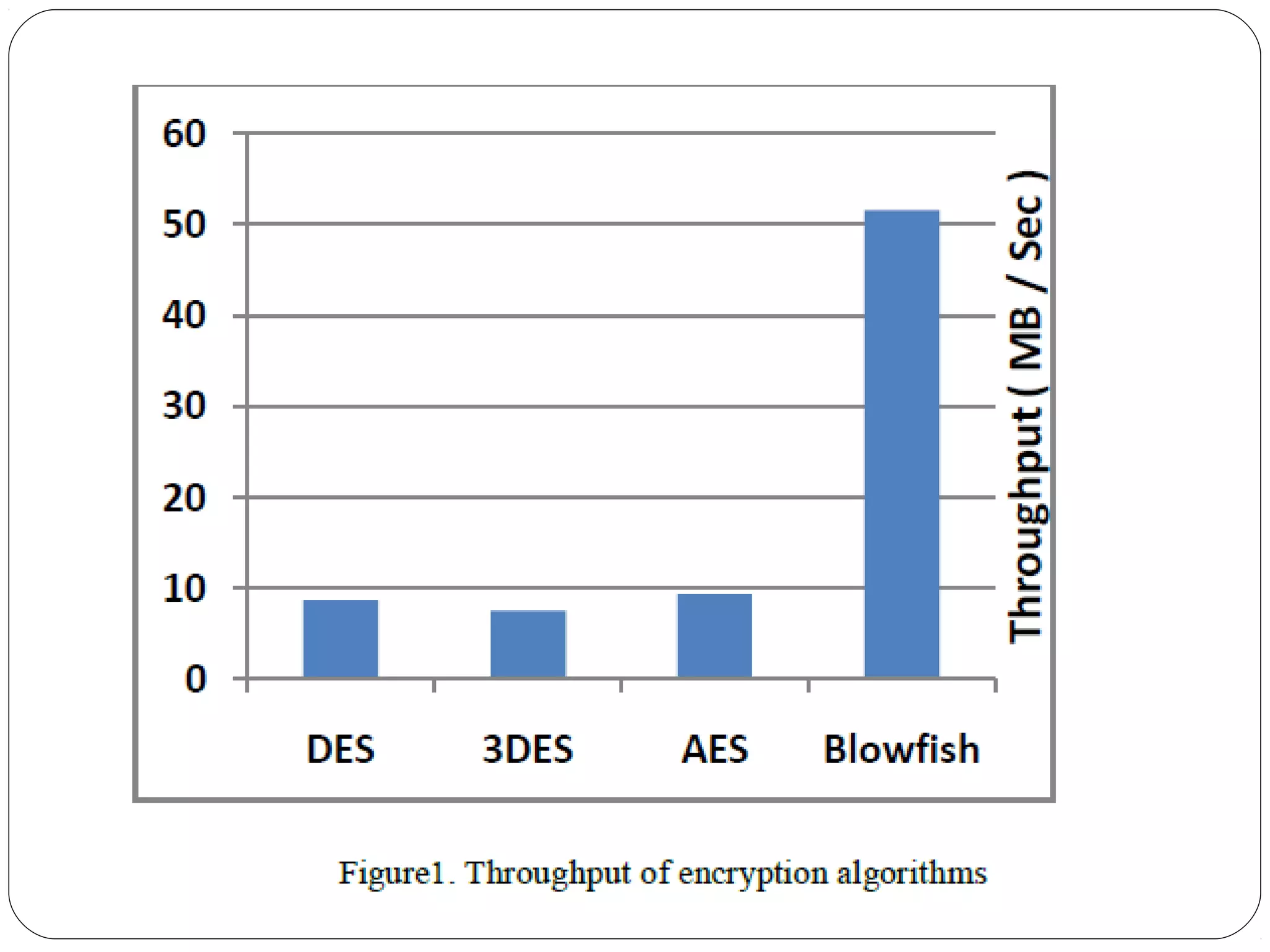
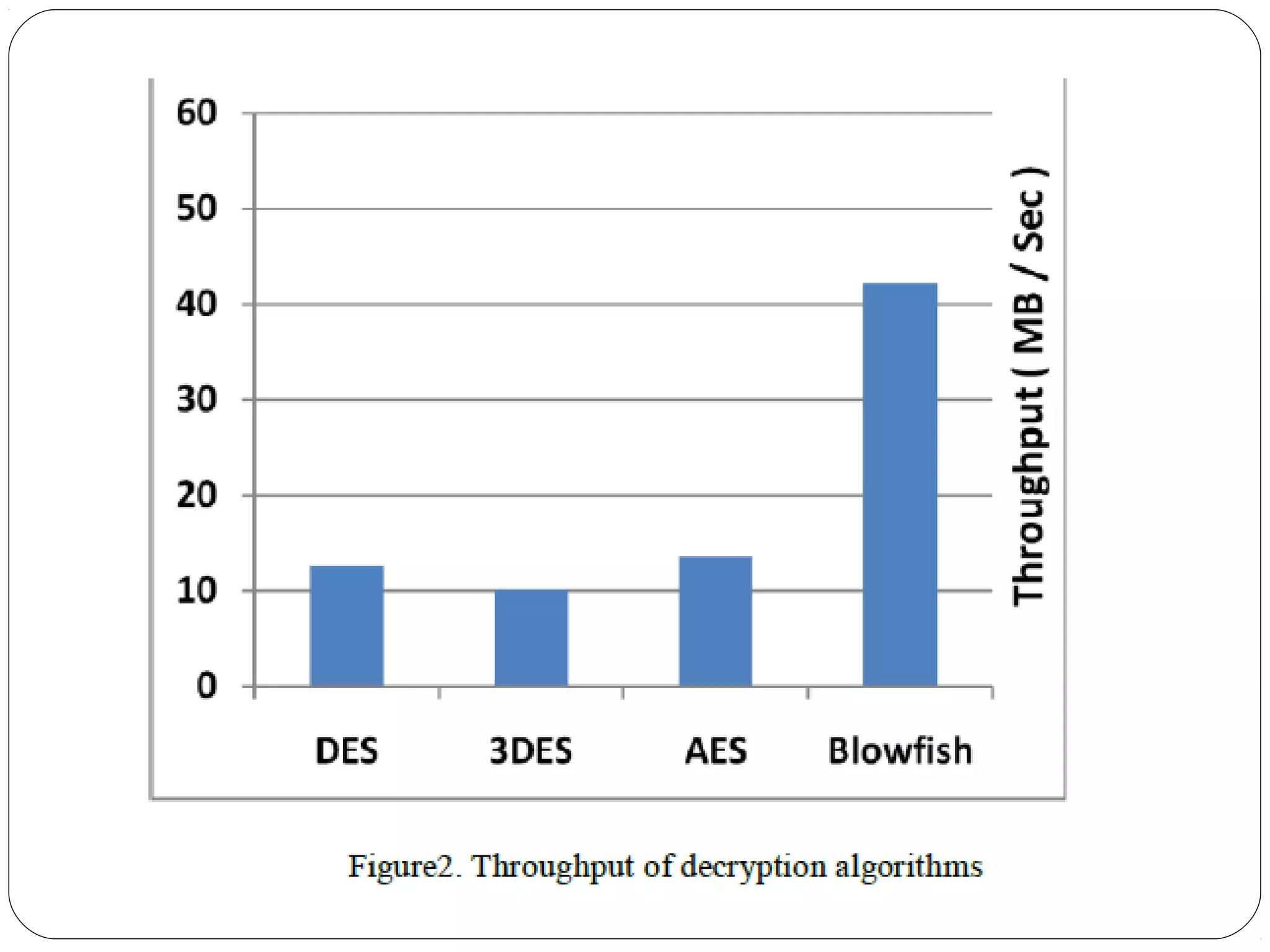
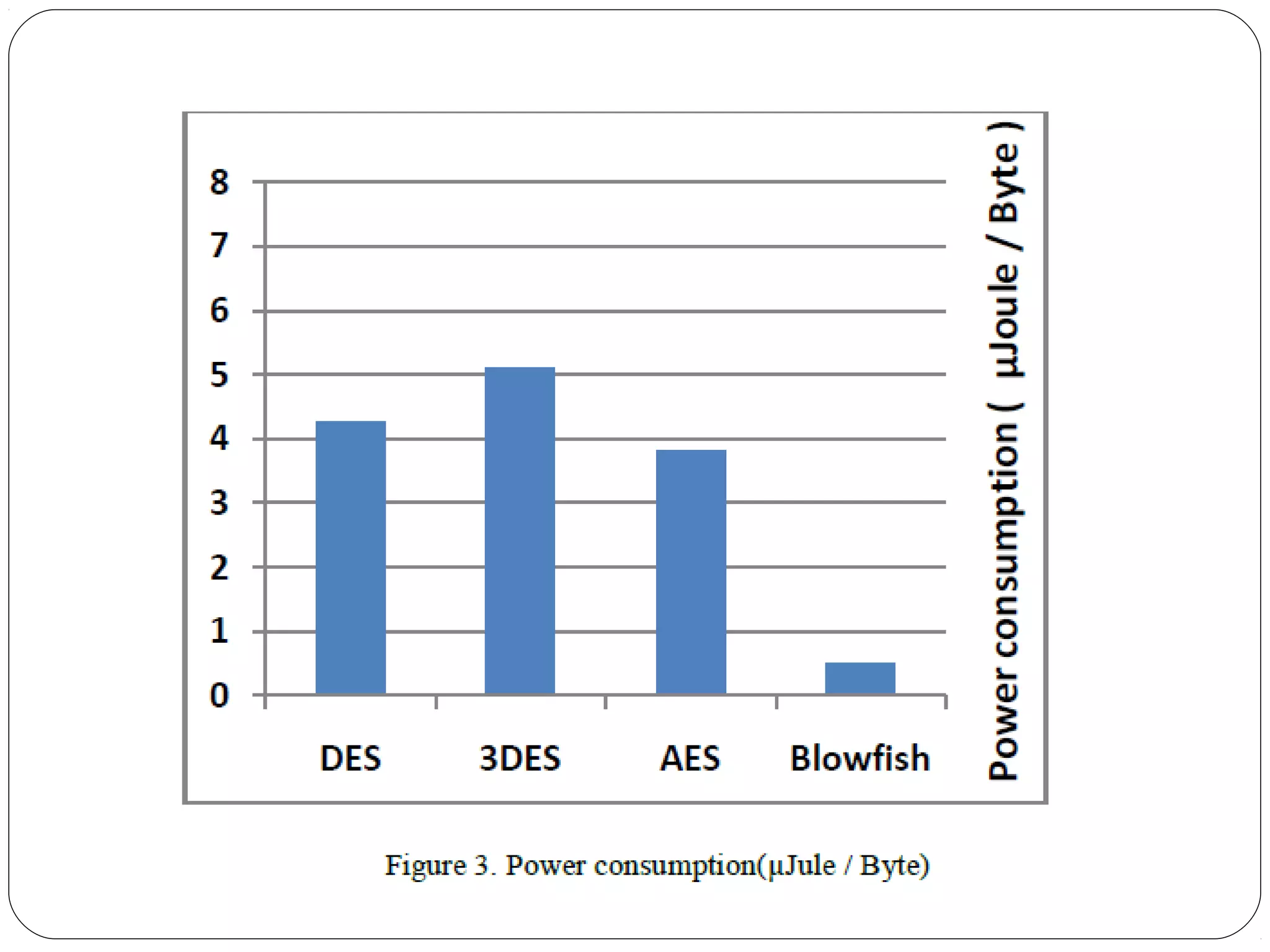
Pratap Chandra Mandal has evaluated the following
algorithms: DES, 3DES ,AES and Blowfish
 Pentium IV of 2.4 GHz CPU speed
 4 GB RAM.
 text files sizes range from 50 KB to 22300 KB.
Experiment
7.55
7.56
7.57
7.58
7.59
 William Stallings, CRYPTOGRAPHY AND NETWORK SECURITY, FIFTH
EDITION,2011, USA
 www.cs.bc.edu/~straubin/cs381-05/blockciphers/rijndael_ingles2004.swf
 http://en.wikipedia.org/wiki/Advanced_Encryption_Standard
 Pratap Chandra Mandal., Kolkata, W.B., Evaluation of performance of the
Symmetric Key Algorithms: DES, 3DES ,AES and Blowfish.Journal of Global
Research in Computer Science, 3 (8), August 2012, 67-70.
 Handout
Reference
Presentation of
review article
Performance Evaluation of Symetric
Cryptography Algorithm
by
Mohsin Khan, Sadaf Hussain, Malik Imran
Article journal, Volume 2, Issue,April 2012-13. Islamabad
Outline
 Abstract
 Introduction
 Description
 Modified Blowfish Algorithm
Conclusion
 Critique
Abstract
This survey paper discussed about the symmetric
cryptographic algorithms and their performance in
context of power consumption issues, Memory and
CPU processing time.
Also, their performance based on algorithm, key
generation process and length.
Introduction
Cryptography converts the message into a non
readable format and send it over an unsecure
channel.
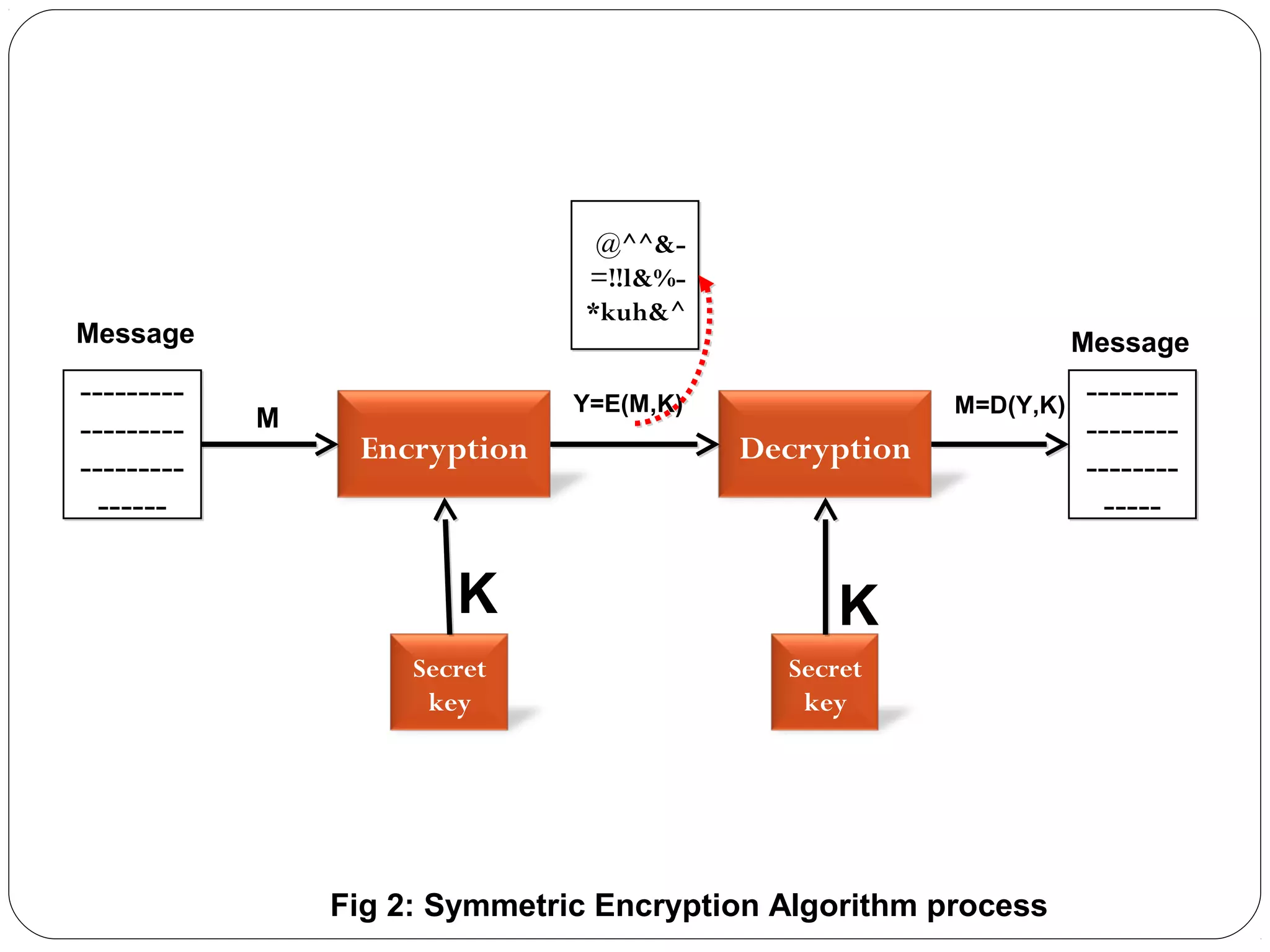
There are five requirements for symmetric
encryption, plain text, cipher text, encryption
algorithm, decryption algorithm, and secret key.
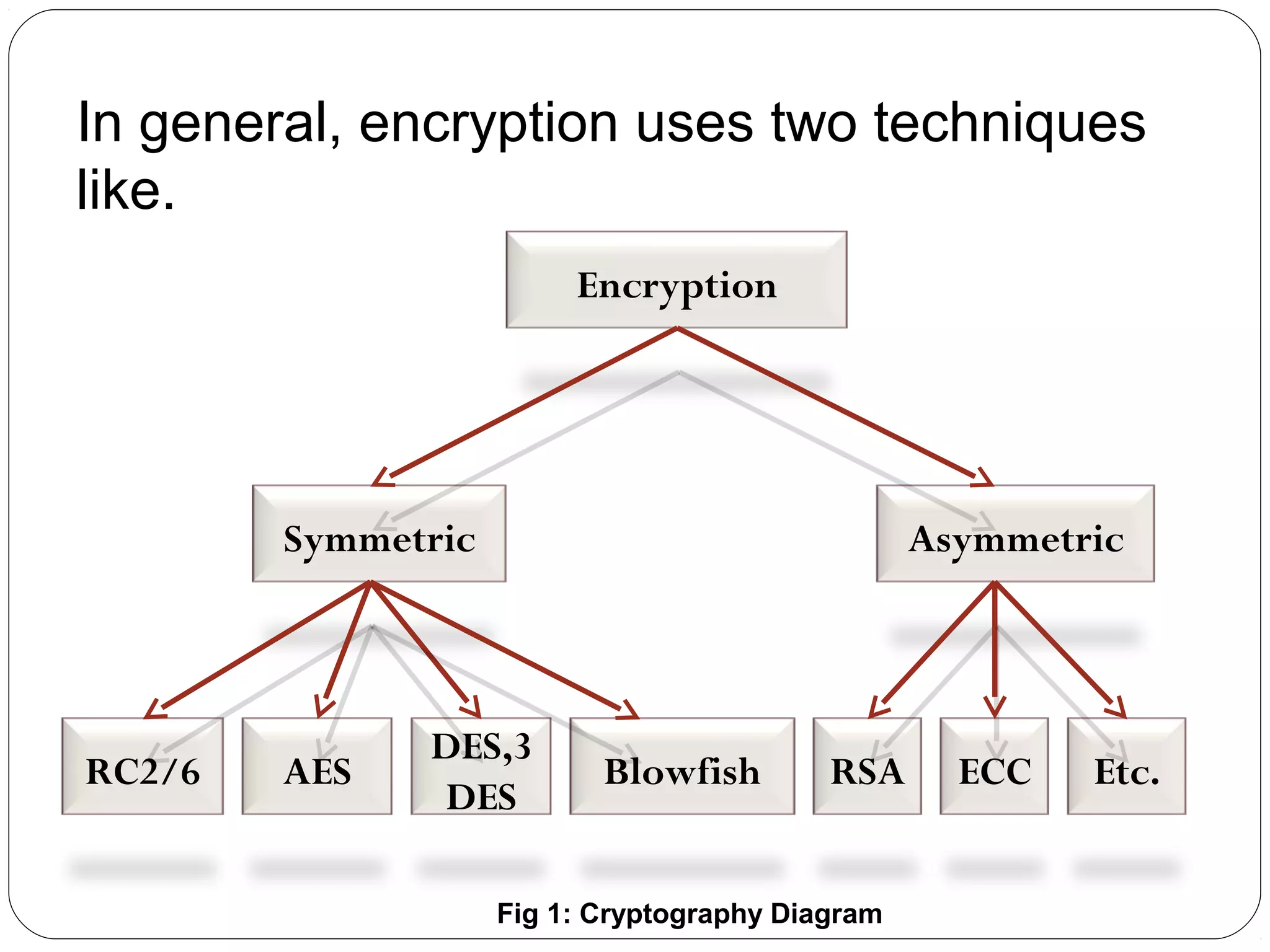
In general, encryption uses two techniques
like.
Encryption
Symmetric Asymmetric
RSA ECC Etc.Blowfish
DES,3
DES
AESRC2/6
Fig 1: Cryptography Diagram
---------
---------
---------
------
---------
---------
---------
------
Secret
key
Secret
key
Encryption Decryption
--------
--------
--------
-----
--------
--------
--------
-----
Message Message
M
Y=E(M,K) M=D(Y,K)
K K
@^^&-
=!!l&%-
*kuh&^
@^^&-
=!!l&%-
*kuh&^
Fig 2: Symmetric Encryption Algorithm process
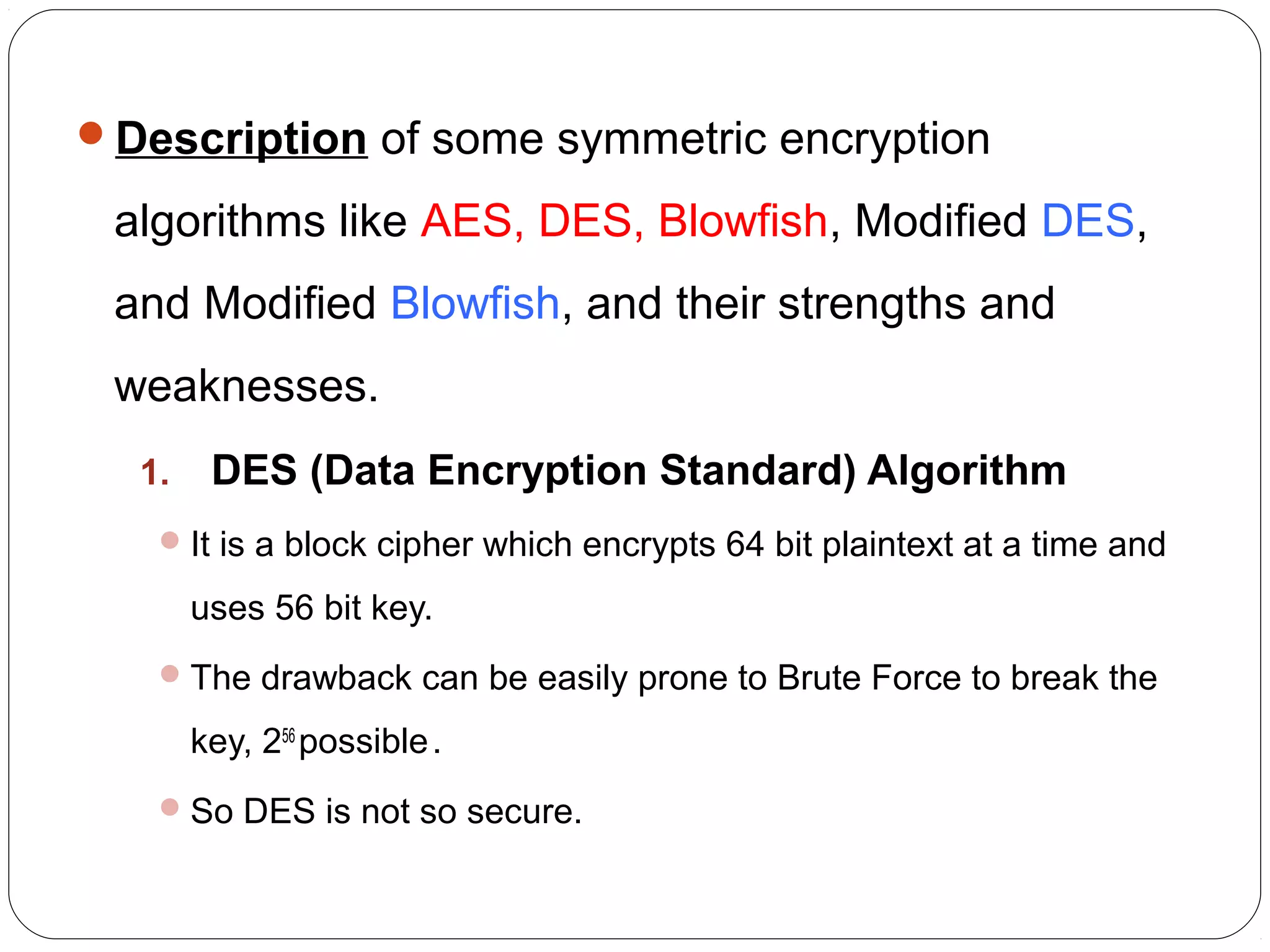
Description of some symmetric encryption
algorithms like AES, DES, Blowfish, Modified DES,
and Modified Blowfish, and their strengths and
weaknesses.
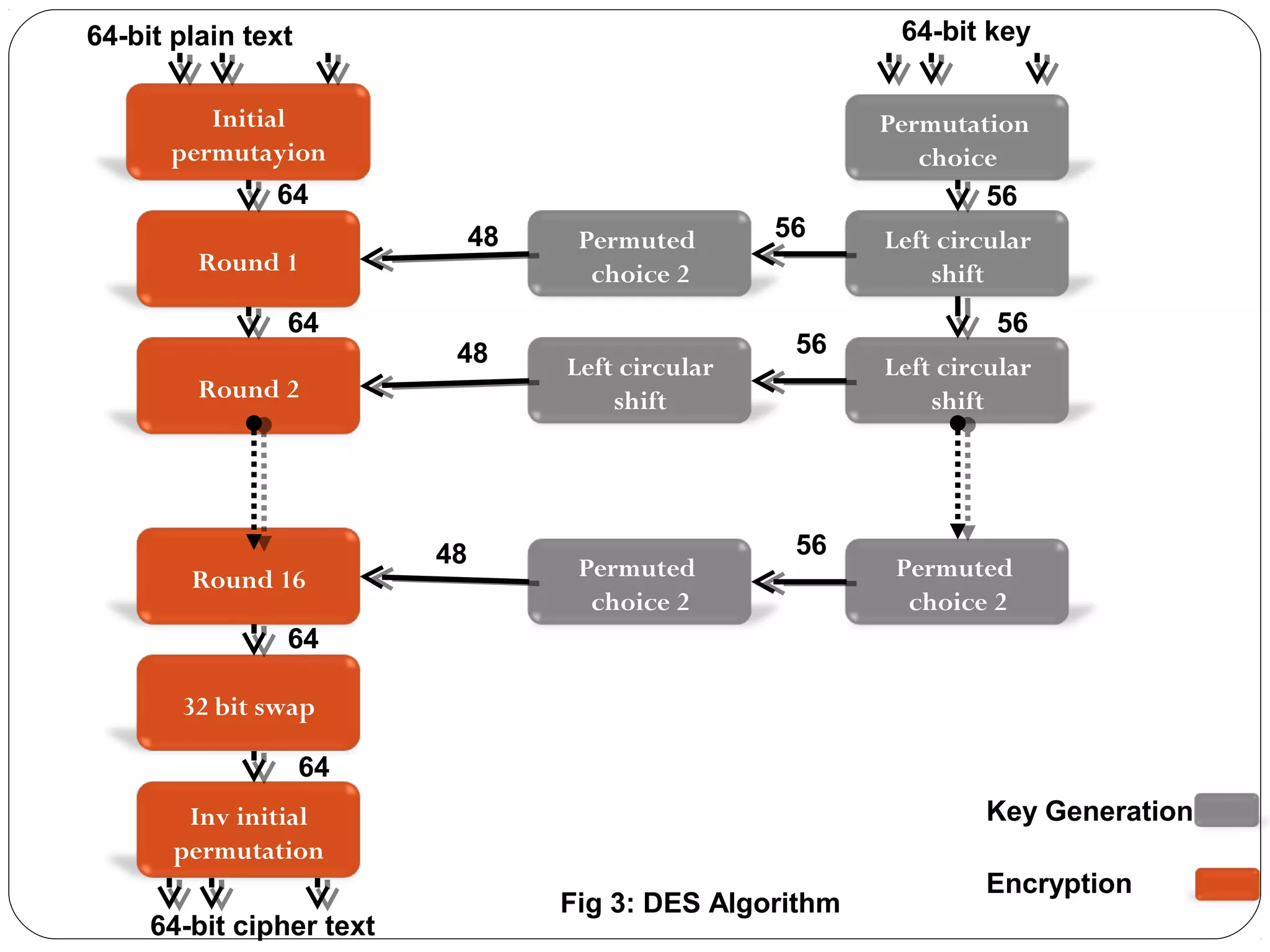
1. DES (Data Encryption Standard) Algorithm
It is a block cipher which encrypts 64 bit plaintext at a time and
uses 56 bit key.
The drawback can be easily prone to Brute Force to break the
key, 256
possible.
So DES is not so secure.
Round 1
Round 2
Initial
permutayion
Round 16
32 bit swap
Inv initial
permutation
Permuted
choice 2
Left circular
shift
Permuted
choice 2
Left circular
shift
Left circular
shift
Permuted
choice 2
Permutation
choice
64-bit plain text
64-bit cipher text
64-bit key
56
56
56
56
5648
48
48
64
64
64
64
Key Generation
Encryption
Fig 3: DES Algorithm
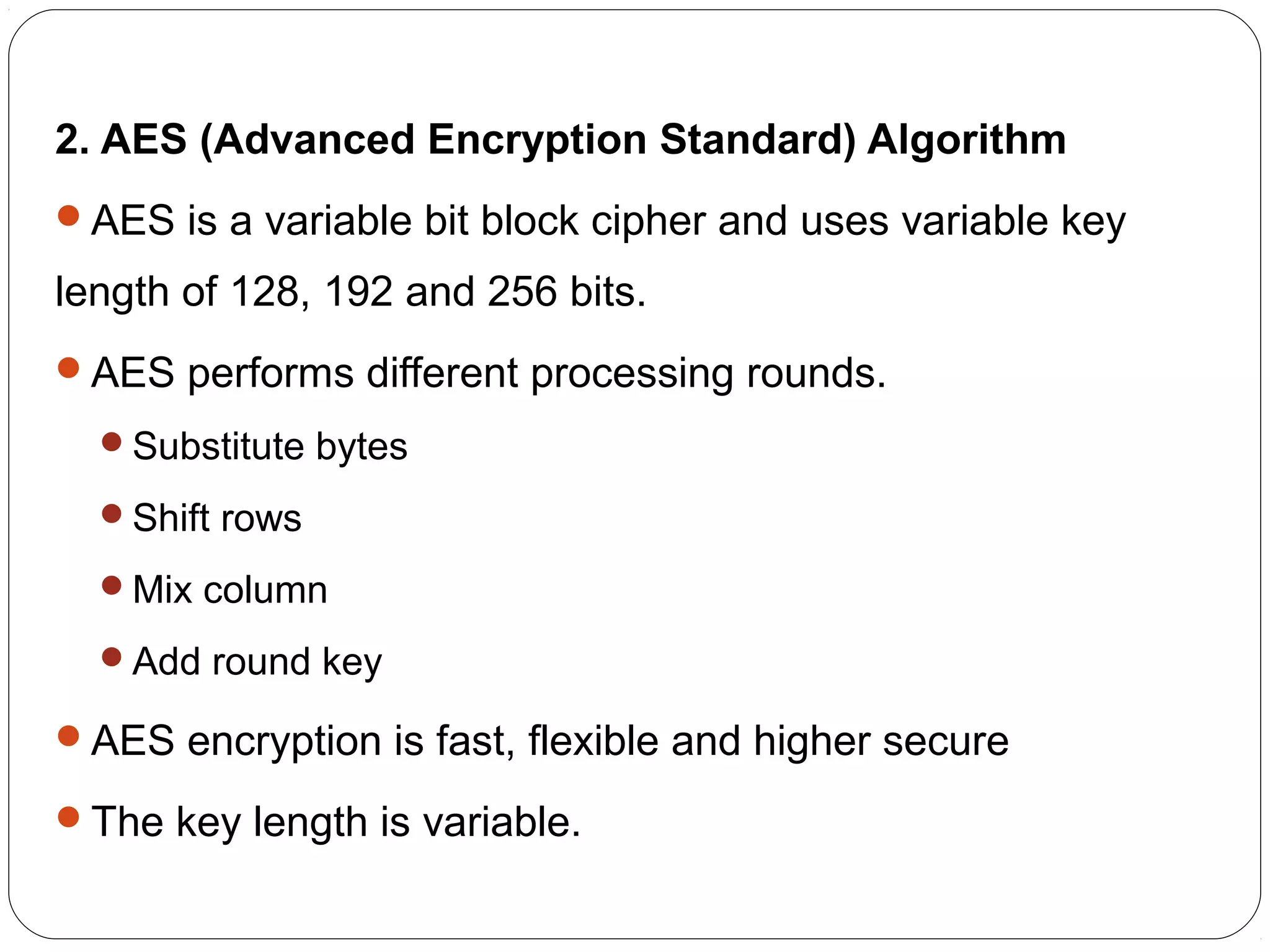
2. AES (Advanced Encryption Standard) Algorithm
AES is a variable bit block cipher and uses variable key
length of 128, 192 and 256 bits.
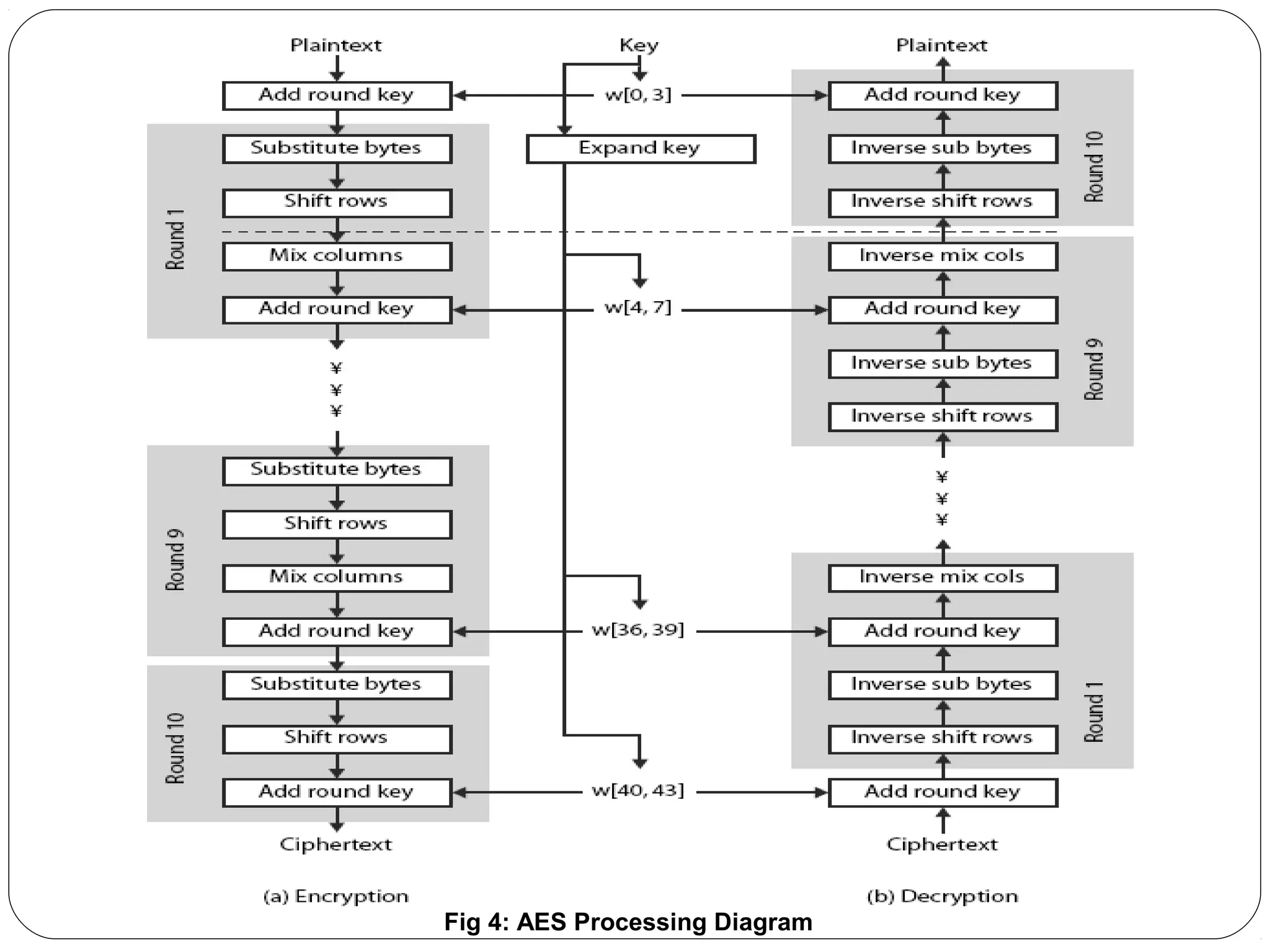
AES performs different processing rounds.
Substitute bytes
Shift rows
Mix column
Add round key
AES encryption is fast, flexible and higher secure
The key length is variable.
Fig 4: AES Processing Diagram
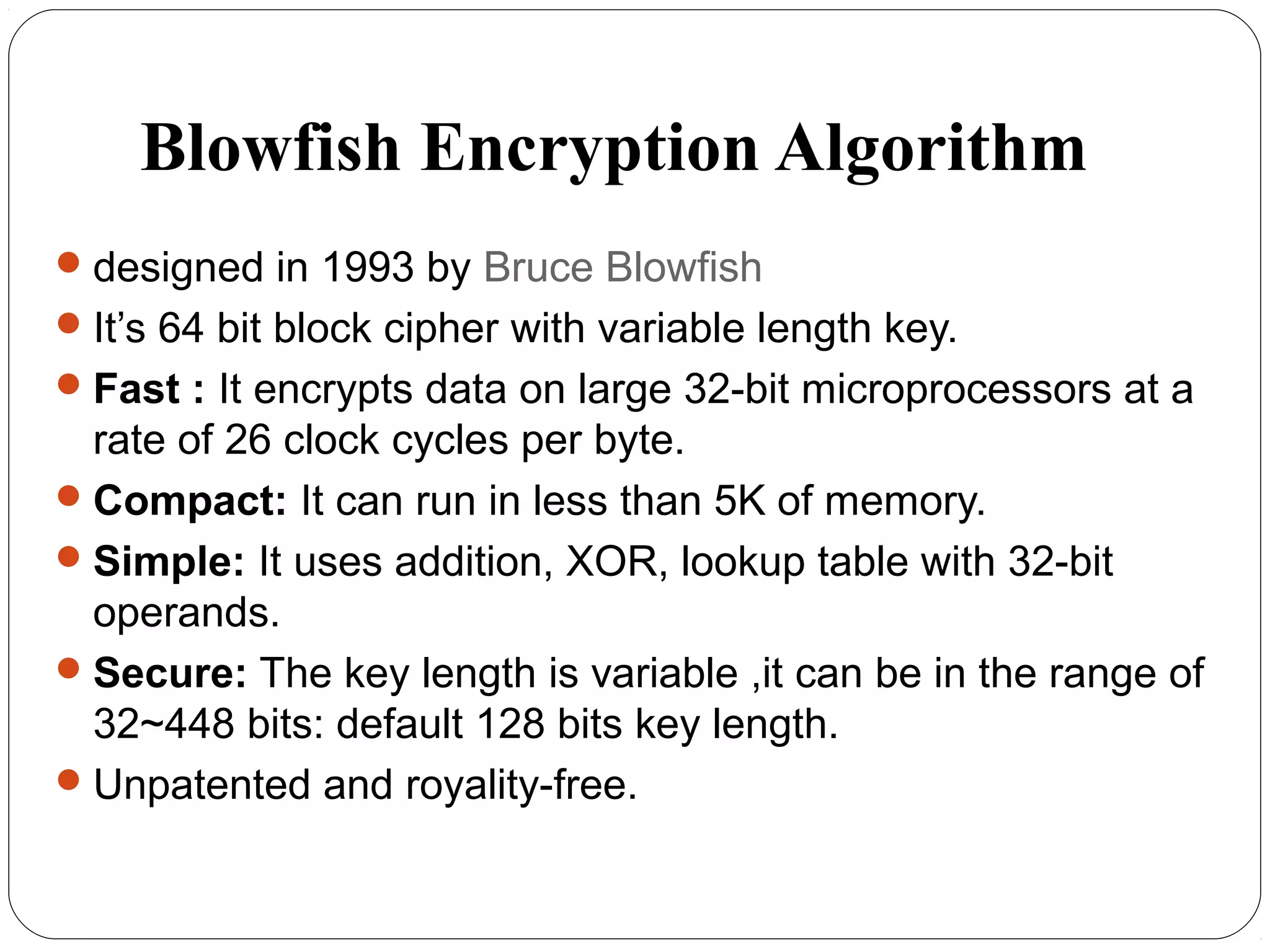
Blowfish Encryption Algorithm
designed in 1993 by Bruce Blowfish
It’s 64 bit block cipher with variable length key.
Fast : It encrypts data on large 32-bit microprocessors at a
rate of 26 clock cycles per byte.
Compact: It can run in less than 5K of memory.
Simple: It uses addition, XOR, lookup table with 32-bit
operands.
Secure: The key length is variable ,it can be in the range of
32~448 bits: default 128 bits key length.
Unpatented and royality-free.
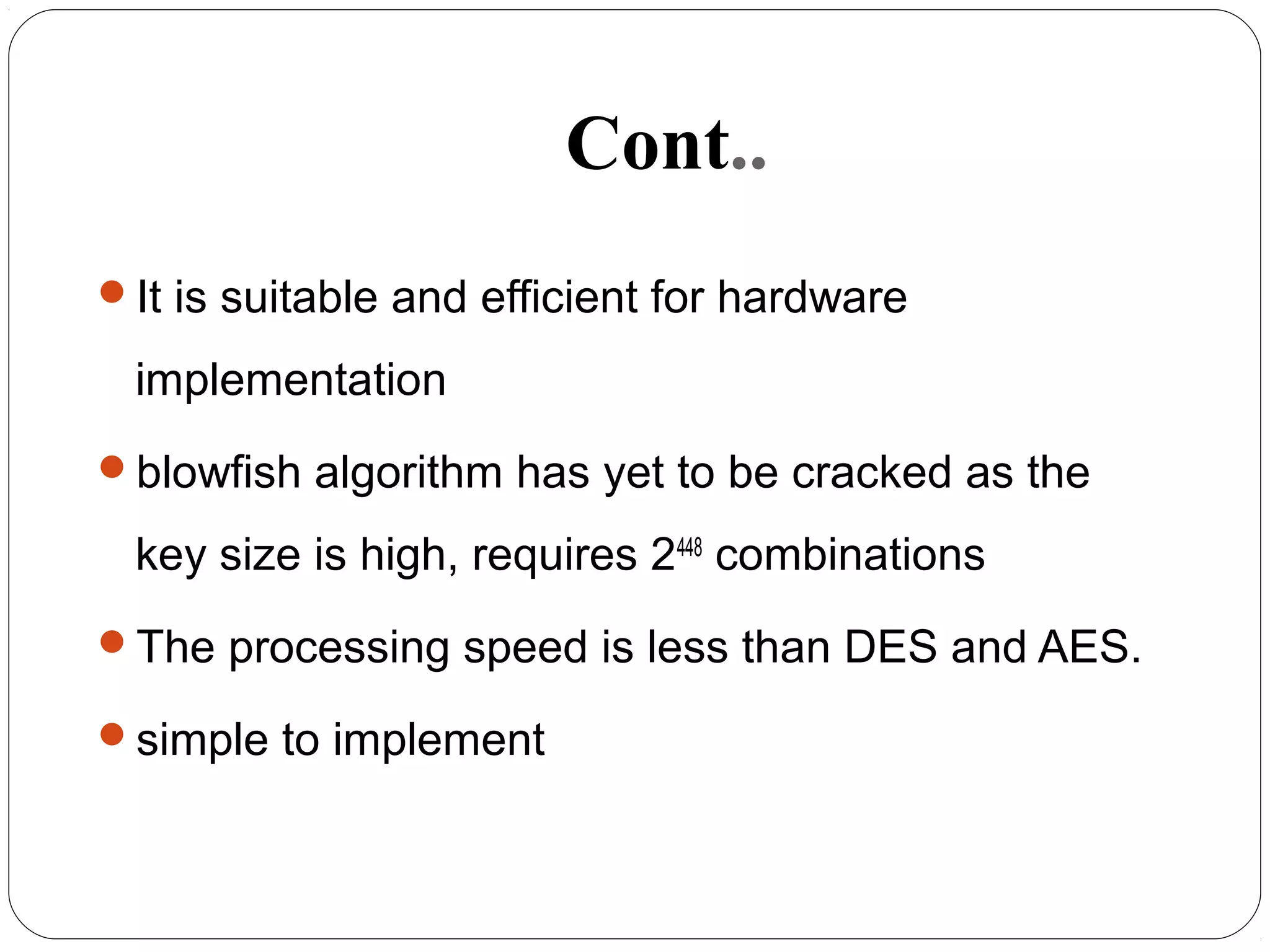
Cont..
It is suitable and efficient for hardware
implementation
blowfish algorithm has yet to be cracked as the
key size is high, requires 2448
combinations
The processing speed is less than DES and AES.
simple to implement
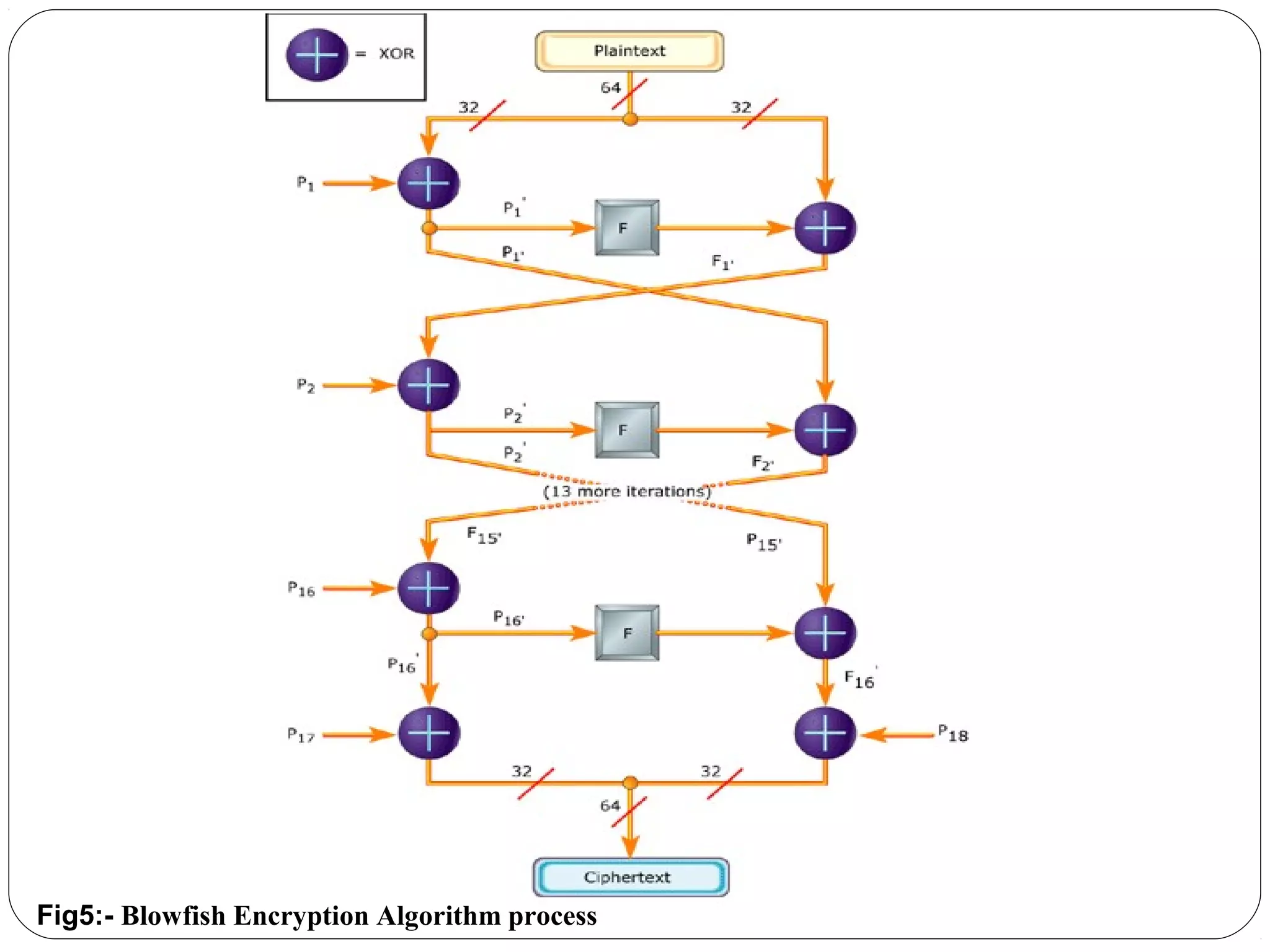
Fig5:- Blowfish Encryption Algorithm process
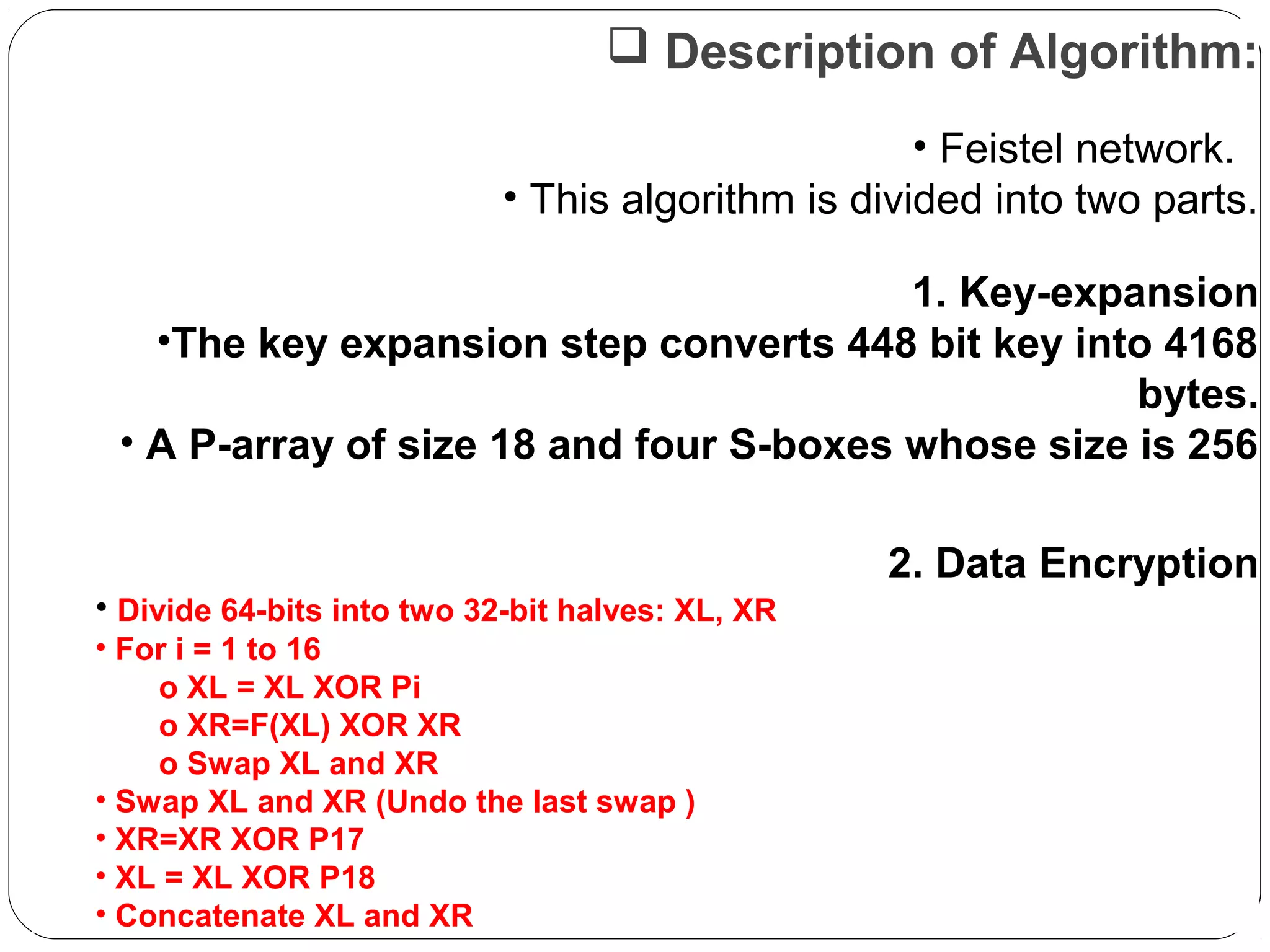
 Description of Algorithm:
• Feistel network.
• This algorithm is divided into two parts.
1. Key-expansion
•The key expansion step converts 448 bit key into 4168
bytes.
• A P-array of size 18 and four S-boxes whose size is 256
2. Data Encryption
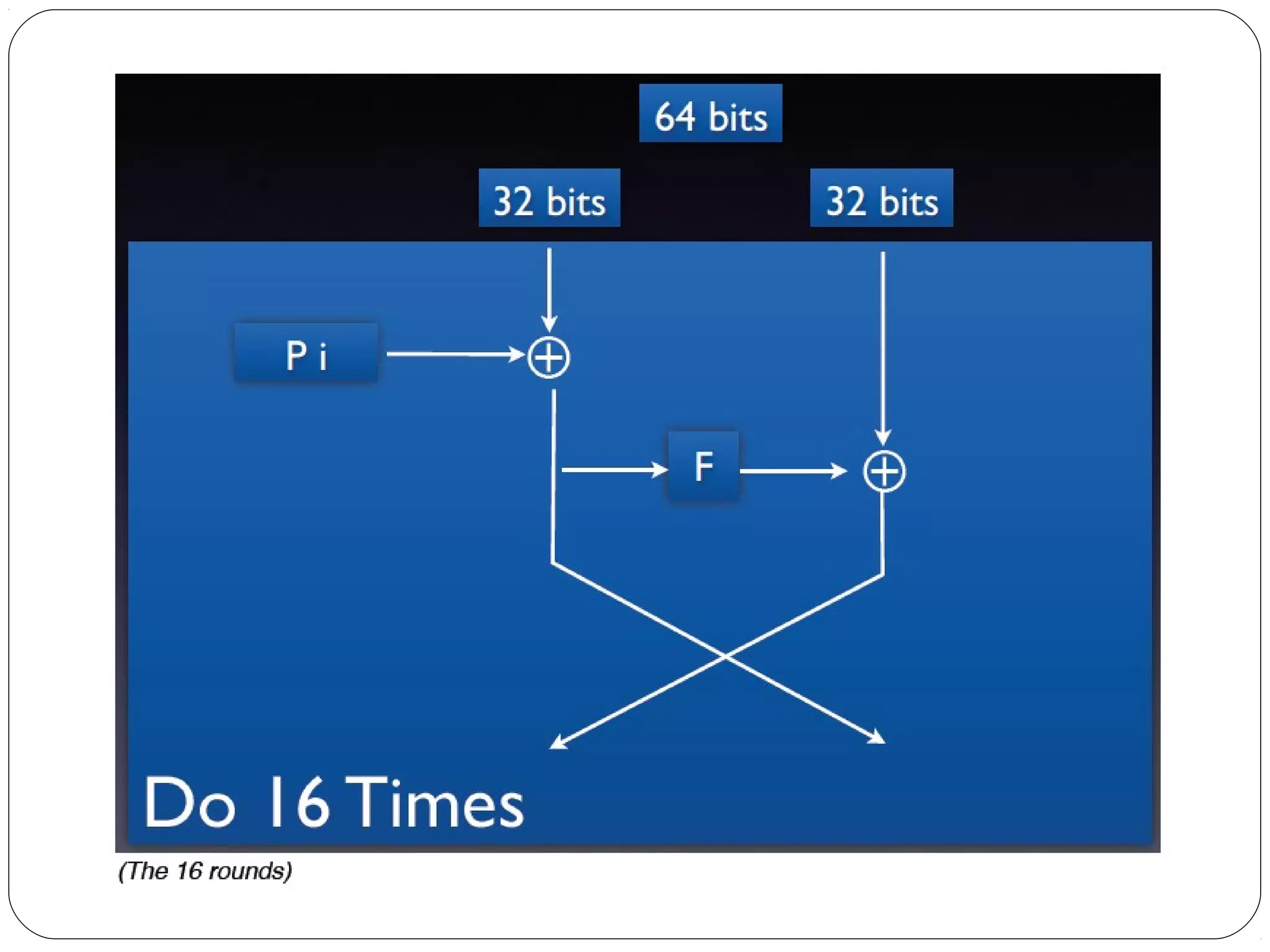
• Divide 64-bits into two 32-bit halves: XL, XR
• For i = 1 to 16
o XL = XL XOR Pi
o XR=F(XL) XOR XR
o Swap XL and XR
• Swap XL and XR (Undo the last swap )
• XR=XR XOR P17
• XL = XL XOR P18
• Concatenate XL and XR
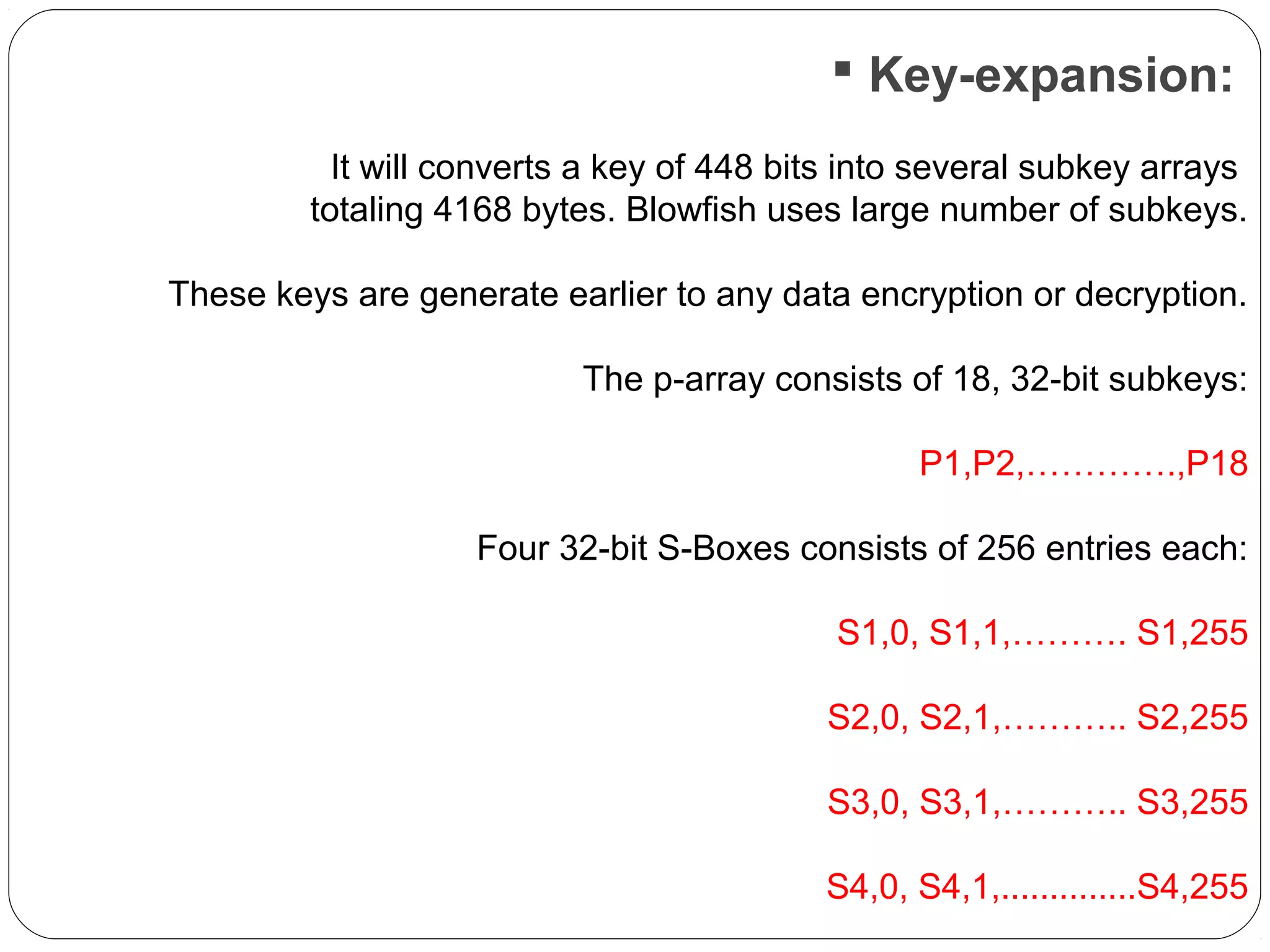
 Key-expansion:
It will converts a key of 448 bits into several subkey arrays
totaling 4168 bytes. Blowfish uses large number of subkeys.
These keys are generate earlier to any data encryption or decryption.
The p-array consists of 18, 32-bit subkeys:
P1,P2,………….,P18
Four 32-bit S-Boxes consists of 256 entries each:
S1,0, S1,1,………. S1,255
S2,0, S2,1,……….. S2,255
S3,0, S3,1,……….. S3,255
S4,0, S4,1,..............S4,255
Modified Blowfish Algorithm
Modified by Monika and Paradeep in 2012. They
modify the blowfish algorithm with a random number
Rn, the remaining processing is same as blowfish.
Modified blowfish algorithm uses the concept of
random number and flags,
flags decide where f function process is required or
not.
Cont...
As the result of the number of f function calls is
reduced, lead to,
 increase the CPU processing time
 decrease memory usage
increased the throughput.
 The second advantage of modified blowfish
algorithm is increased in security.
Modified DES Algorithm using Fuse
Data Technique
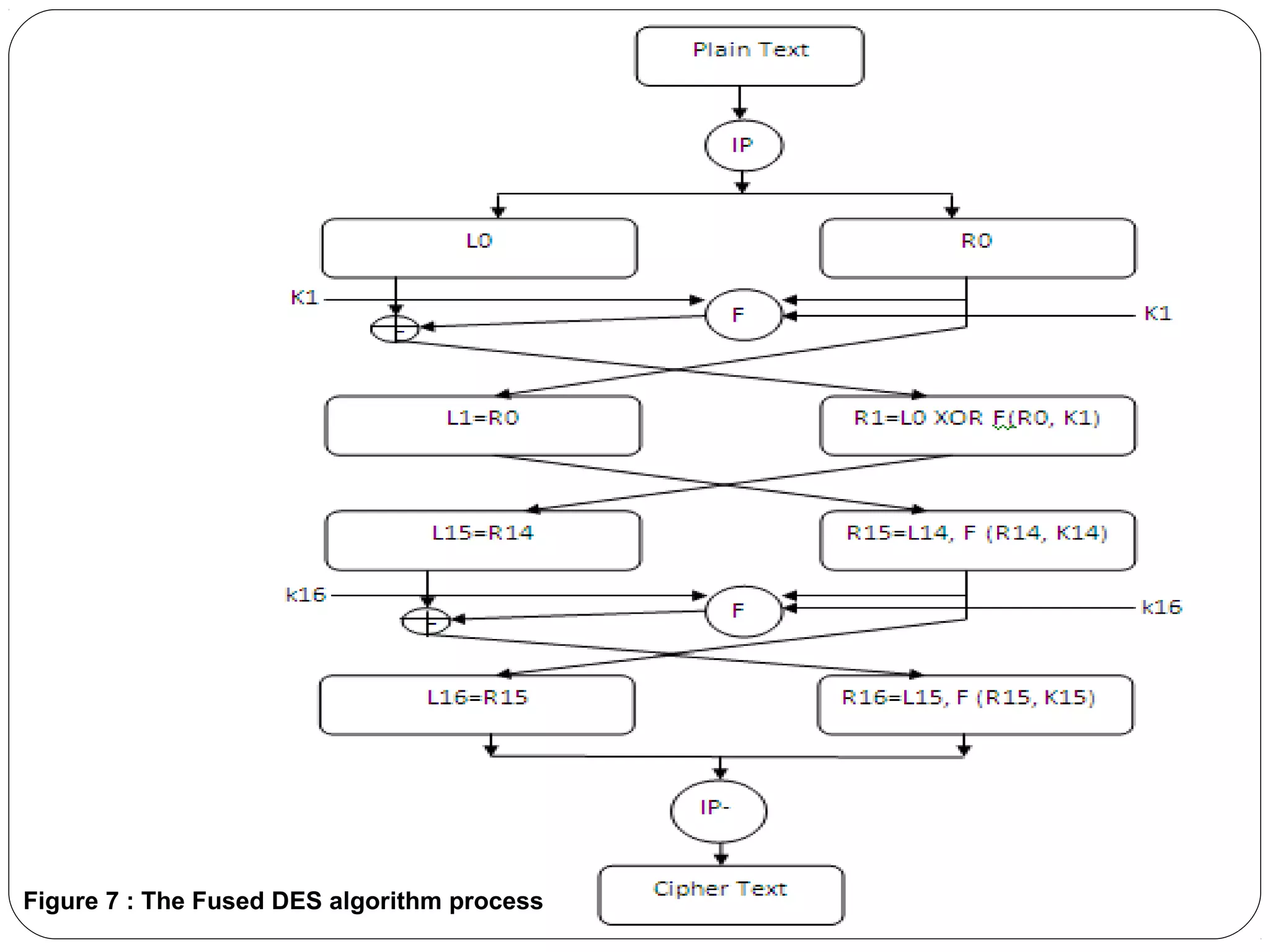
DES algorithm is modified by Al Hamami et al in .
They present Fuse DES with Blowfish and Genetic
Algorithm (GA).
DES has a disadvantage of shortest key, since it is not
more secure.
The algorithm uses 2 subkeys:-
right subkey and Left subkey is a 768 bit length and
16 blocks of 48 bits called Pi through both 16th round
left subkey is generated.
Cont..
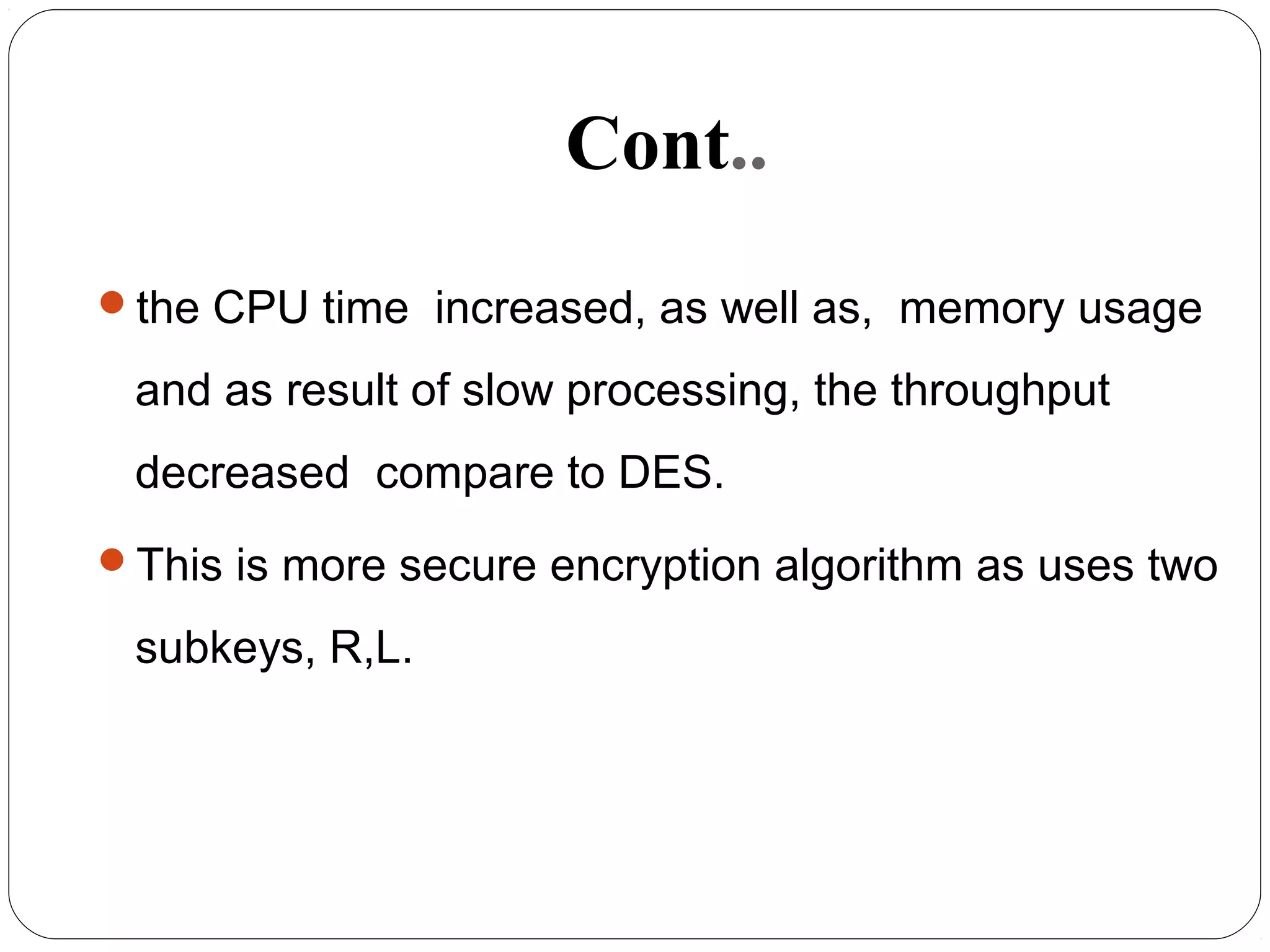
the CPU time increased, as well as, memory usage
and as result of slow processing, the throughput
decreased compare to DES.
This is more secure encryption algorithm as uses two
subkeys, R,L.
Figure 7 : The Fused DES algorithm process
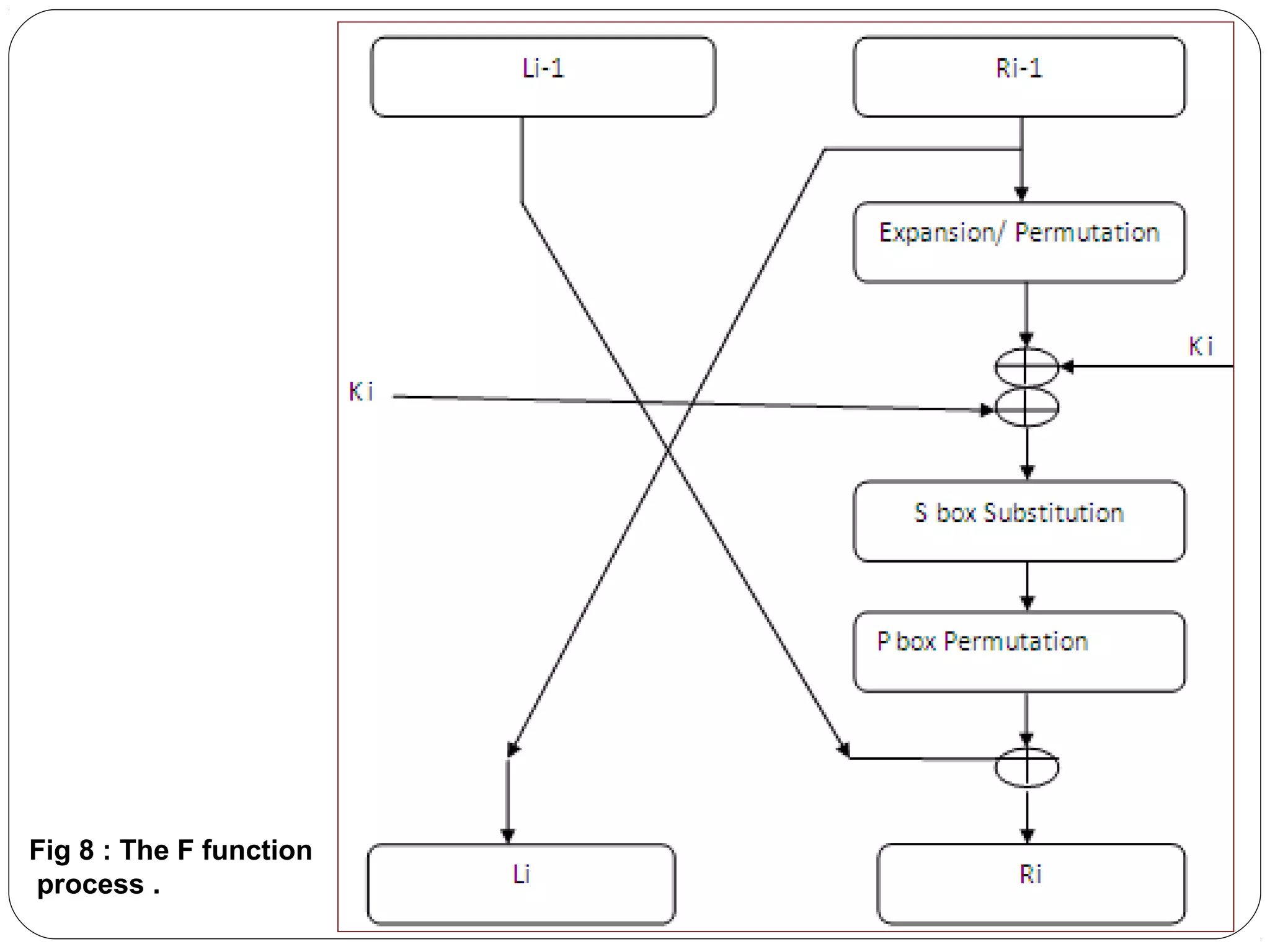
Fig 8 : The F function
process .
Conclusion
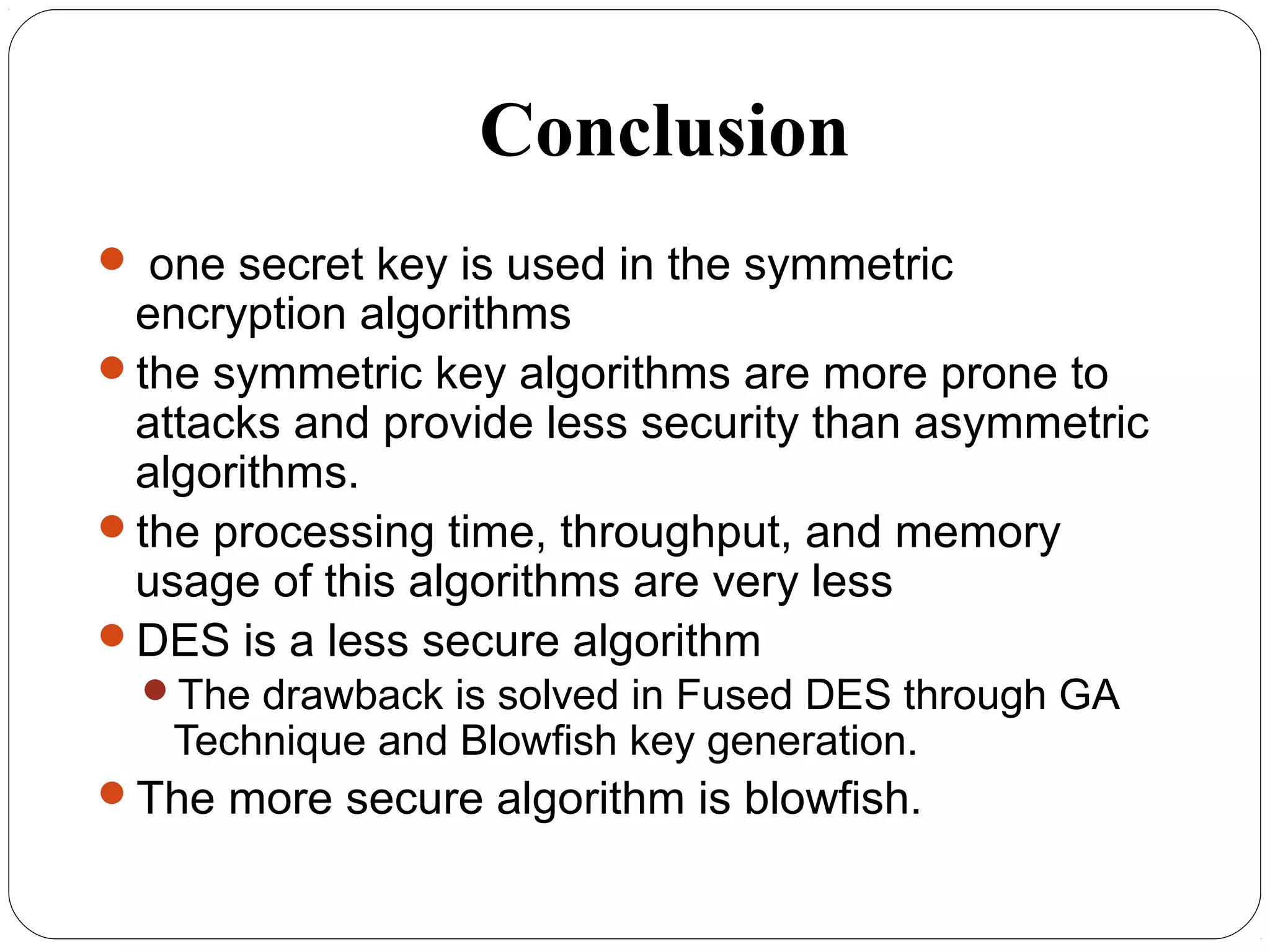
 one secret key is used in the symmetric
encryption algorithms
the symmetric key algorithms are more prone to
attacks and provide less security than asymmetric
algorithms.
the processing time, throughput, and memory
usage of this algorithms are very less
DES is a less secure algorithm
The drawback is solved in Fused DES through GA
Technique and Blowfish key generation.
The more secure algorithm is blowfish.
Critique
 The title of the article is appropriate and clear
However, the abstract is rather general and not
specific.
 In introduction, the purpose of the article was not
clearly stated
So few information regarding the description of
AES algorithm.
 Diagram of modified blowfish is required.
Overall Critique
 Modified Blowfish was not clearly described( round
numbers), as well as, GA
 There are so much repetition (DES)
 Figures and charts was not appropriately placed.
 Review of previous researches should be mentioned
in introduction.
 Language of the article was not properly academic.
Nmap Tool
Outline
 Introduction
 IPAddresses
 Port Scanning
 Nmap
 Anti-Port Scanning
 Reference
Introduction
Hacking is a term used to refer to activities
aimed at exploiting security flaws to obtain critical
information for gaining access to secured
networks.
General Hacking Methods
1. Identify the target system.
2. Gathering Information on the target system.
3. Finding a possible loophole in the target system.
4. Exploiting this loophole using exploit code.
5. Removing all traces from the log files and escaping
without a trace.
Various Types of Attacks
The most common ones are:
Denial of Services attacks (DOS Attacks)
SMURF Attacks
Threat from Sniffing and Key Logging
Trojan Attacks
RAT (Remote Administration Tool)
IP Spoofing
Buffer Overflows
All other types of Attacks
IPAddresses
An attacker’s first step is to find out the IP Address of
the target system.
IP Addresses: Finding out an IP Address
Through Instant Messaging Software
C:>netstat -n
Through Internet Relay Chat
Through Your website
by using simply JAVA applets or JavaScript code.
Through Email Headers
IPAddresses: Dangers &
Concerns
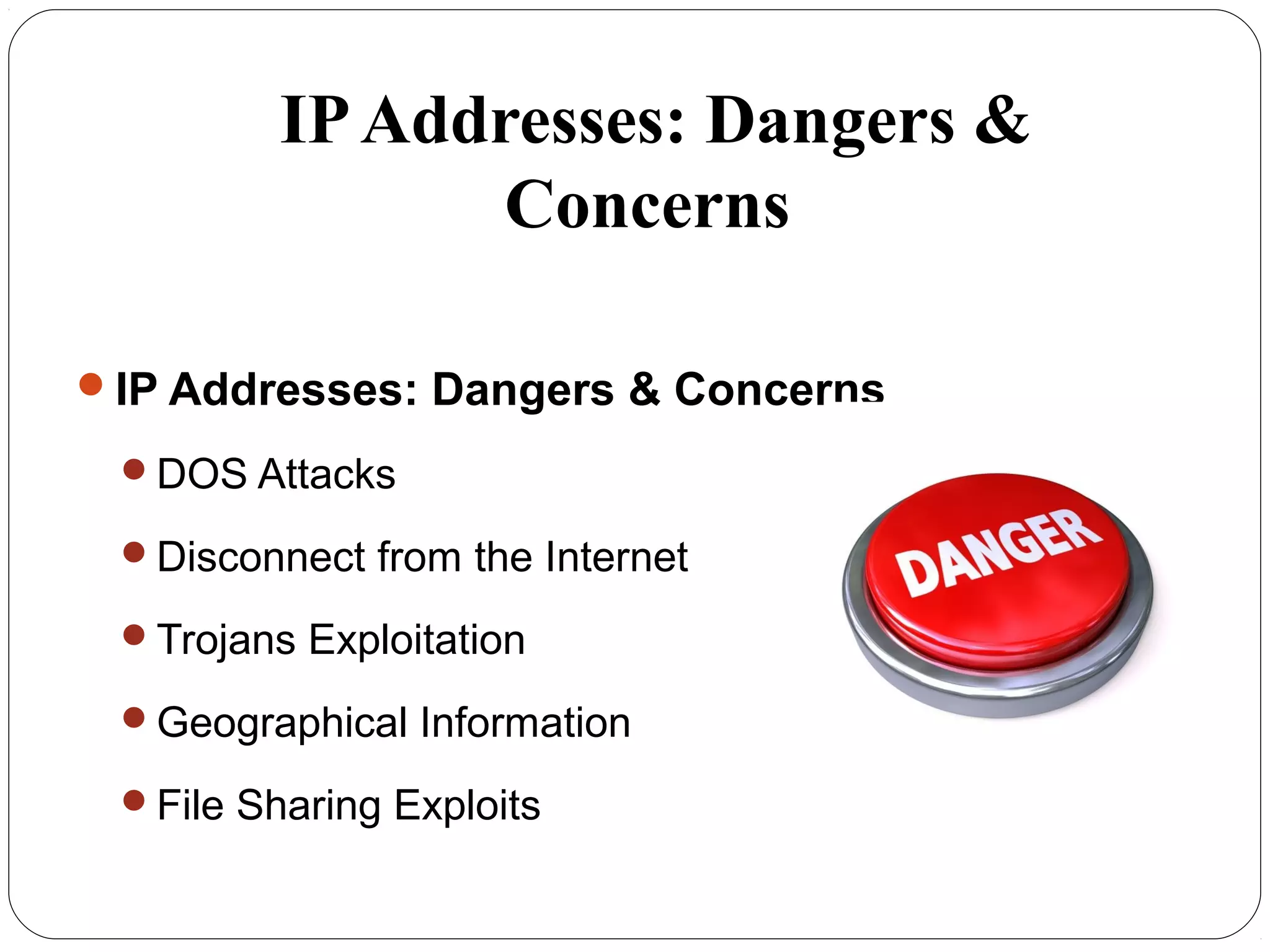
IP Addresses: Dangers & Concerns
DOS Attacks
Disconnect from the Internet
Trojans Exploitation
Geographical Information
File Sharing Exploits
Type of Scanning
Port scanning
Network scanning
Vulnerability scanning
Port Scanning
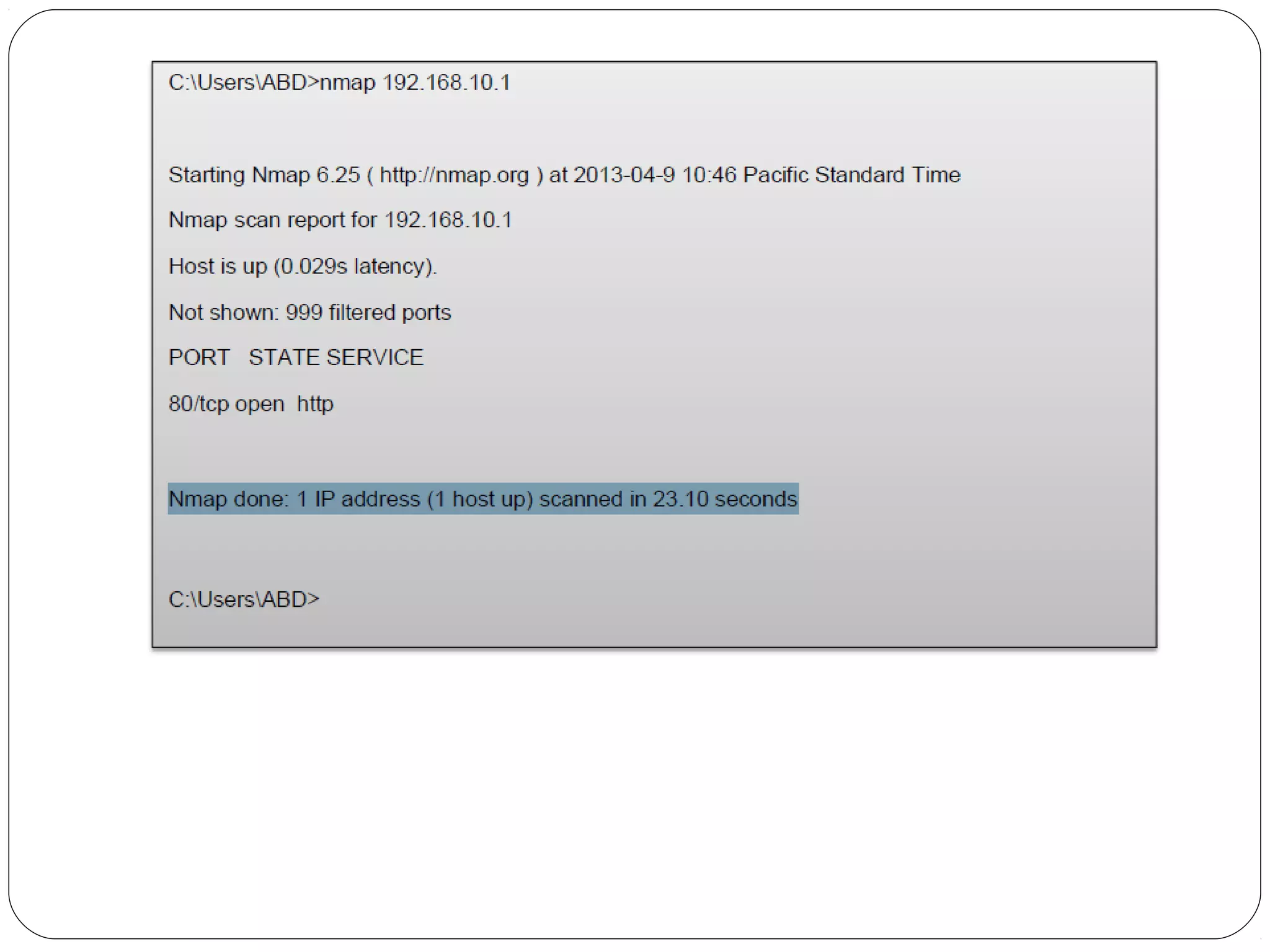
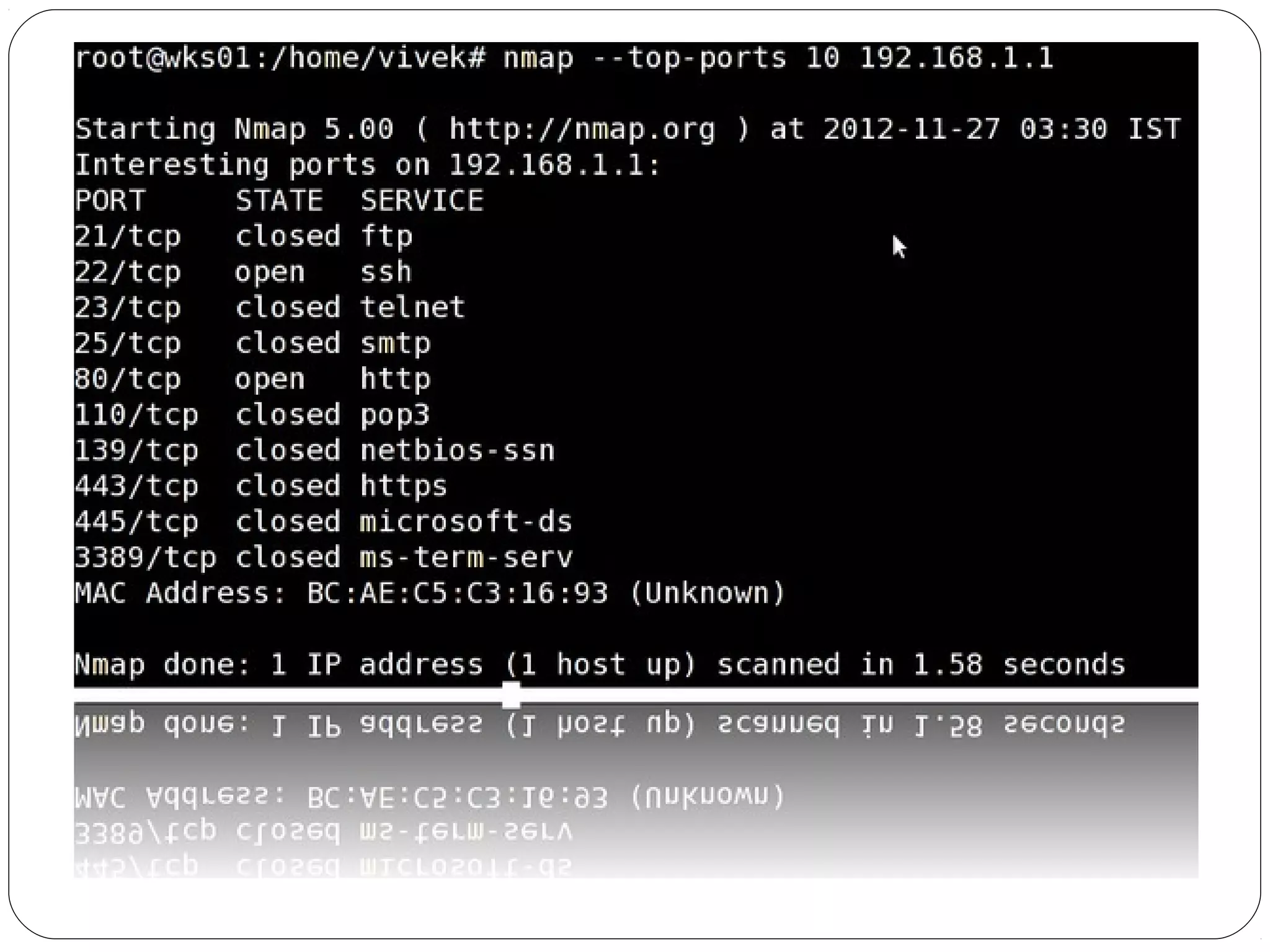
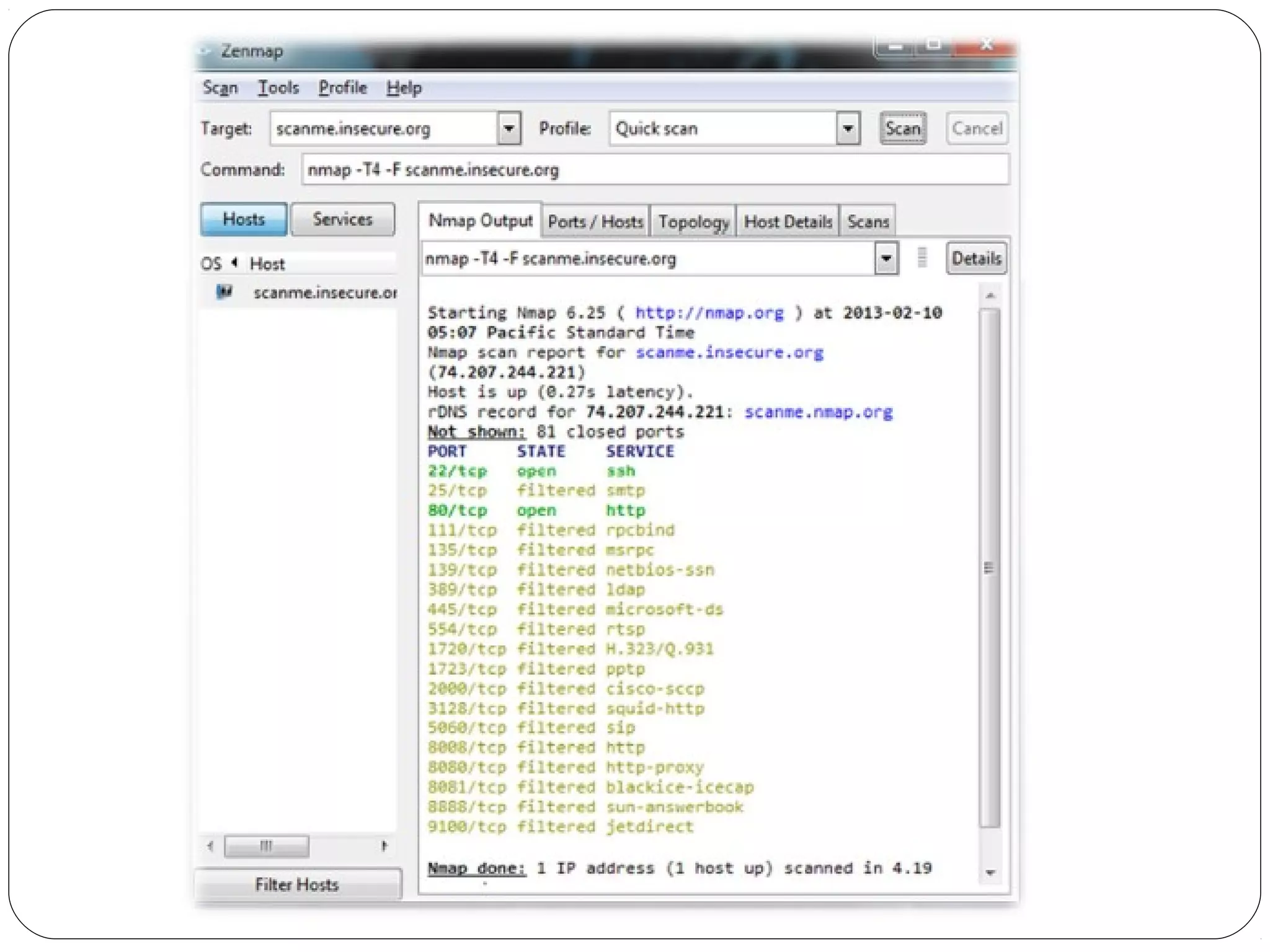
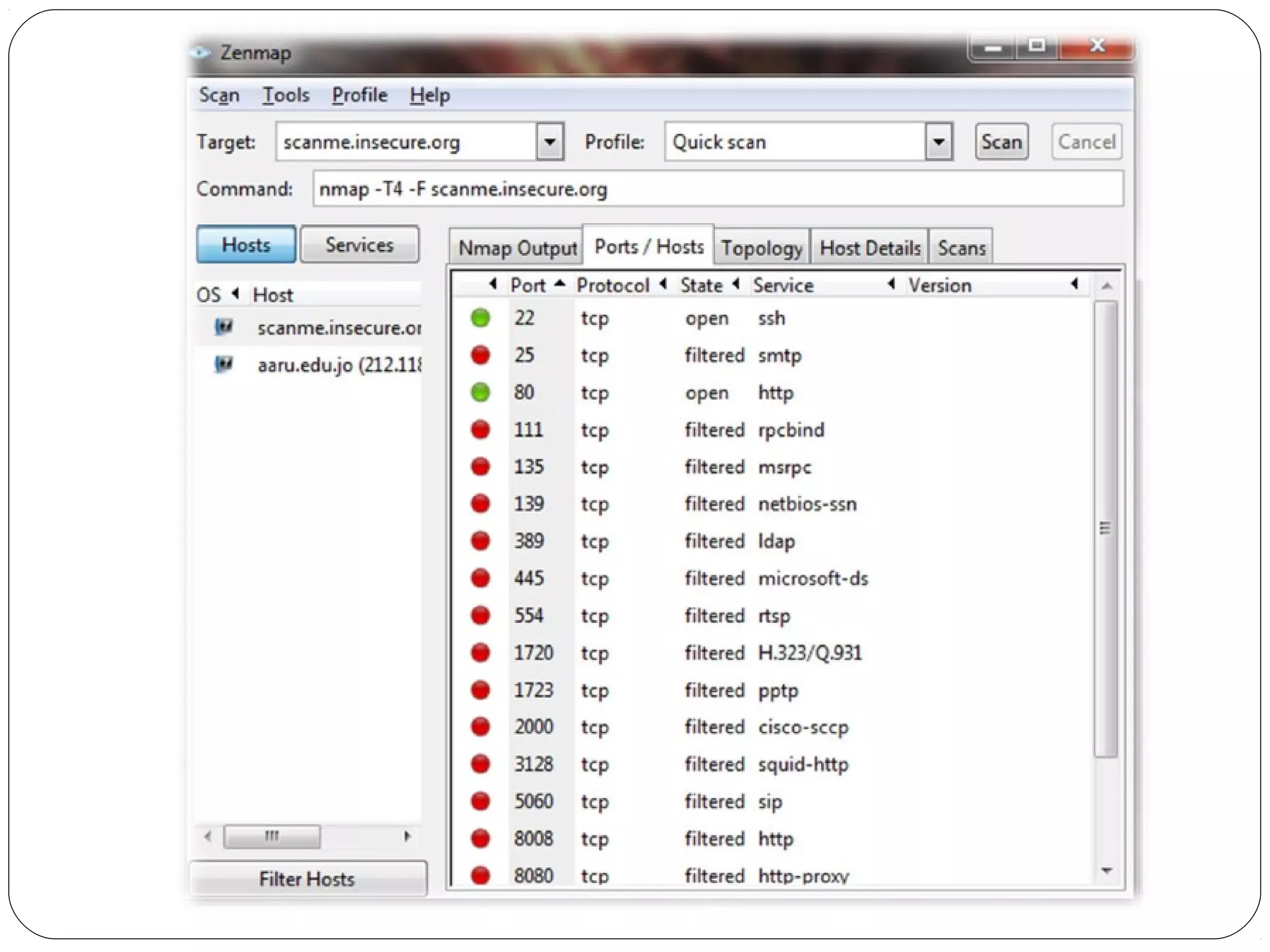
Port Scanning is normally the first step that an
attacker undertakes.
List of Open Ports
Services Running
Exact Names and Versions of all the Services or
Daemons.
Operating System name and version
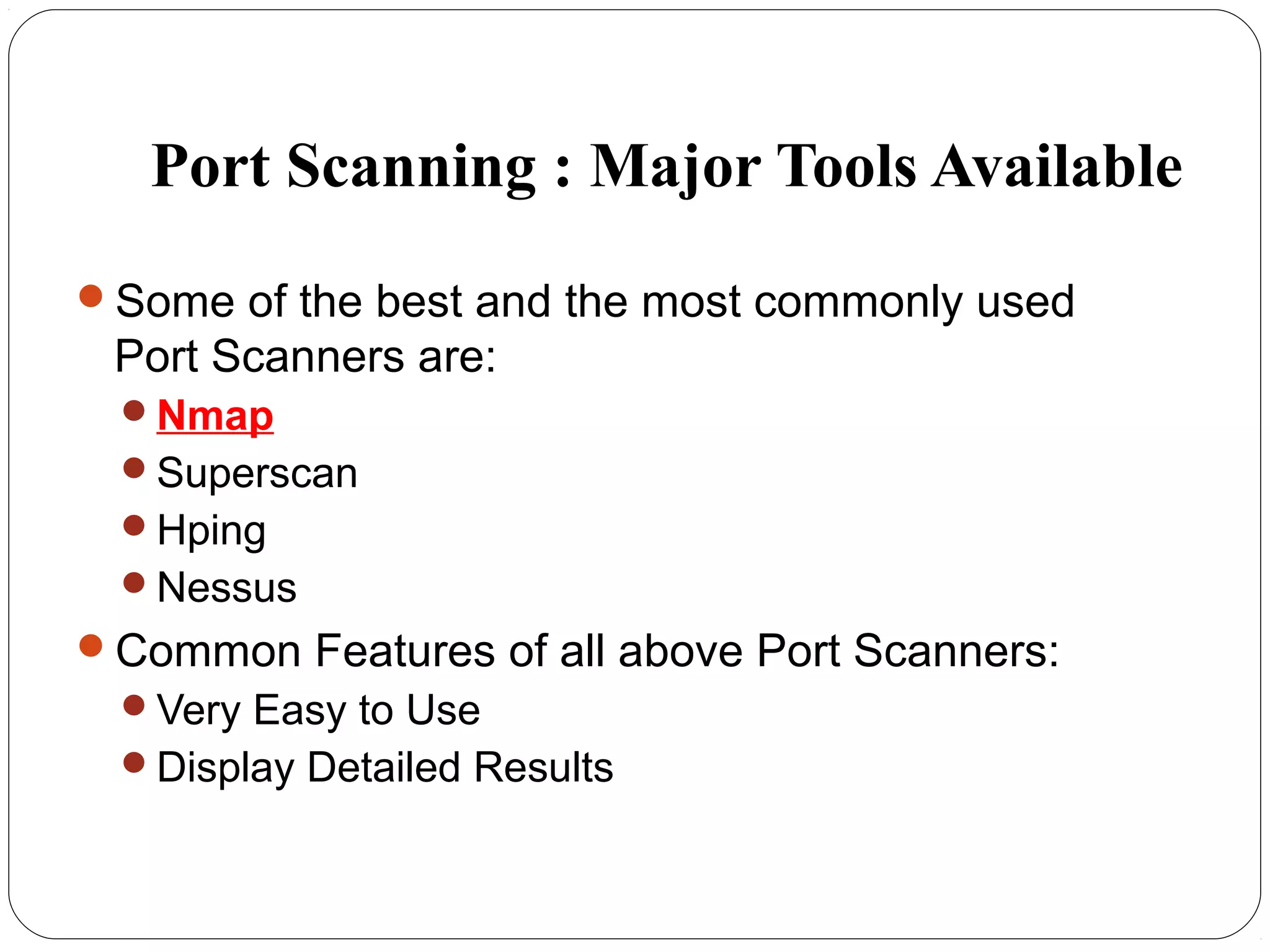
Port Scanning : Major Tools Available
Some of the best and the most commonly used
Port Scanners are:
Nmap
Superscan
Hping
Nessus
Common Features of all above Port Scanners:
Very Easy to Use
Display Detailed Results
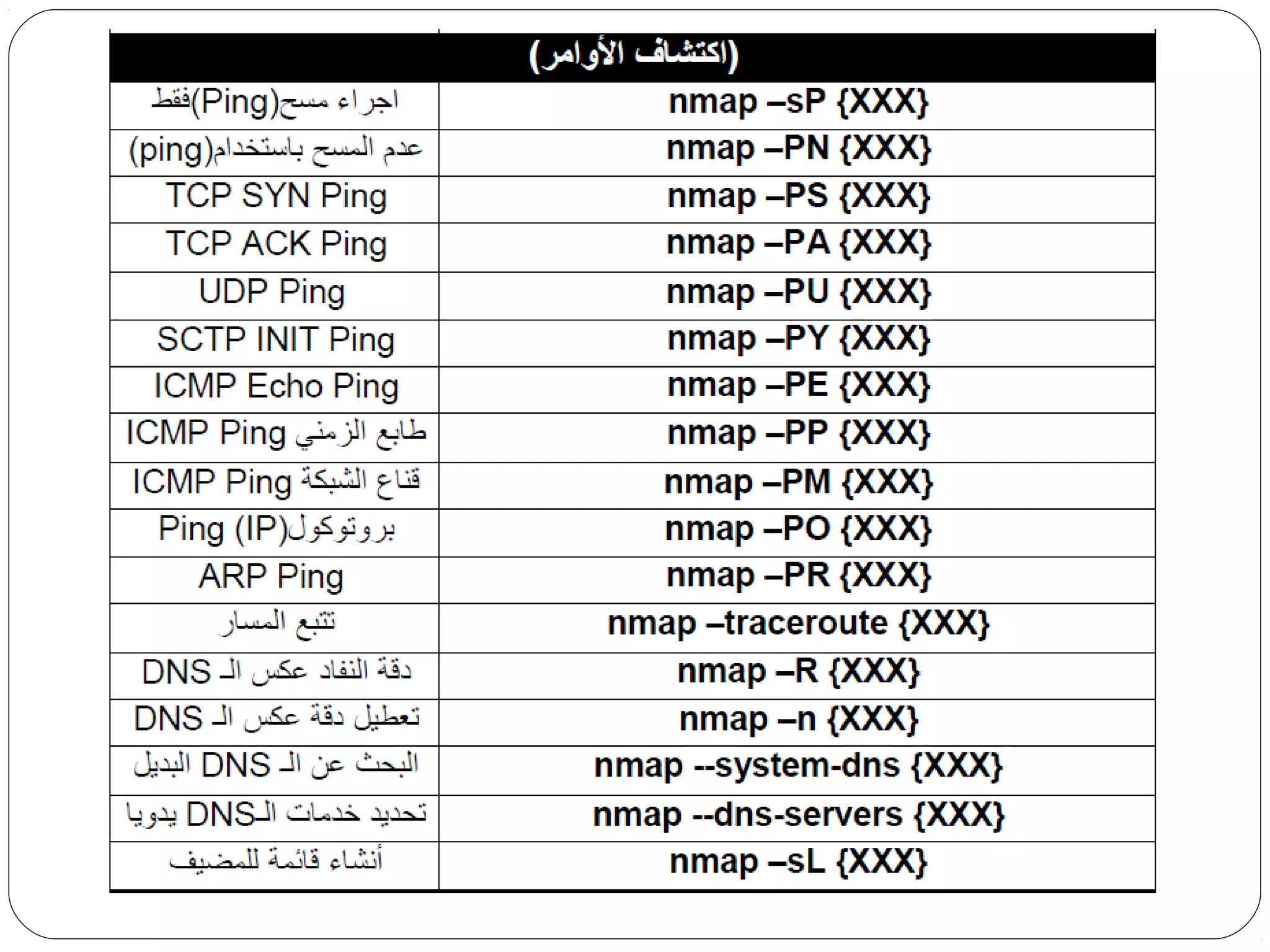
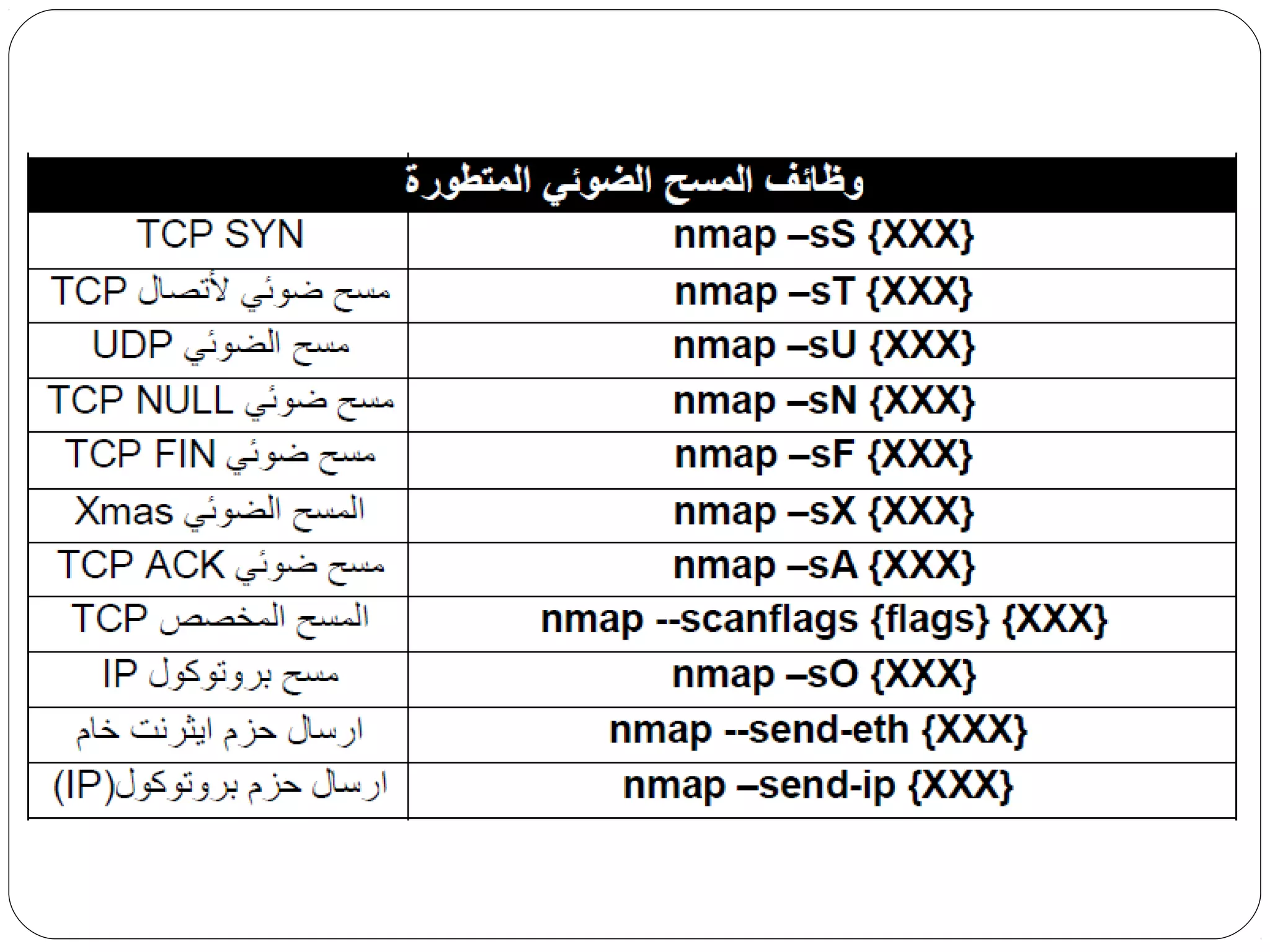
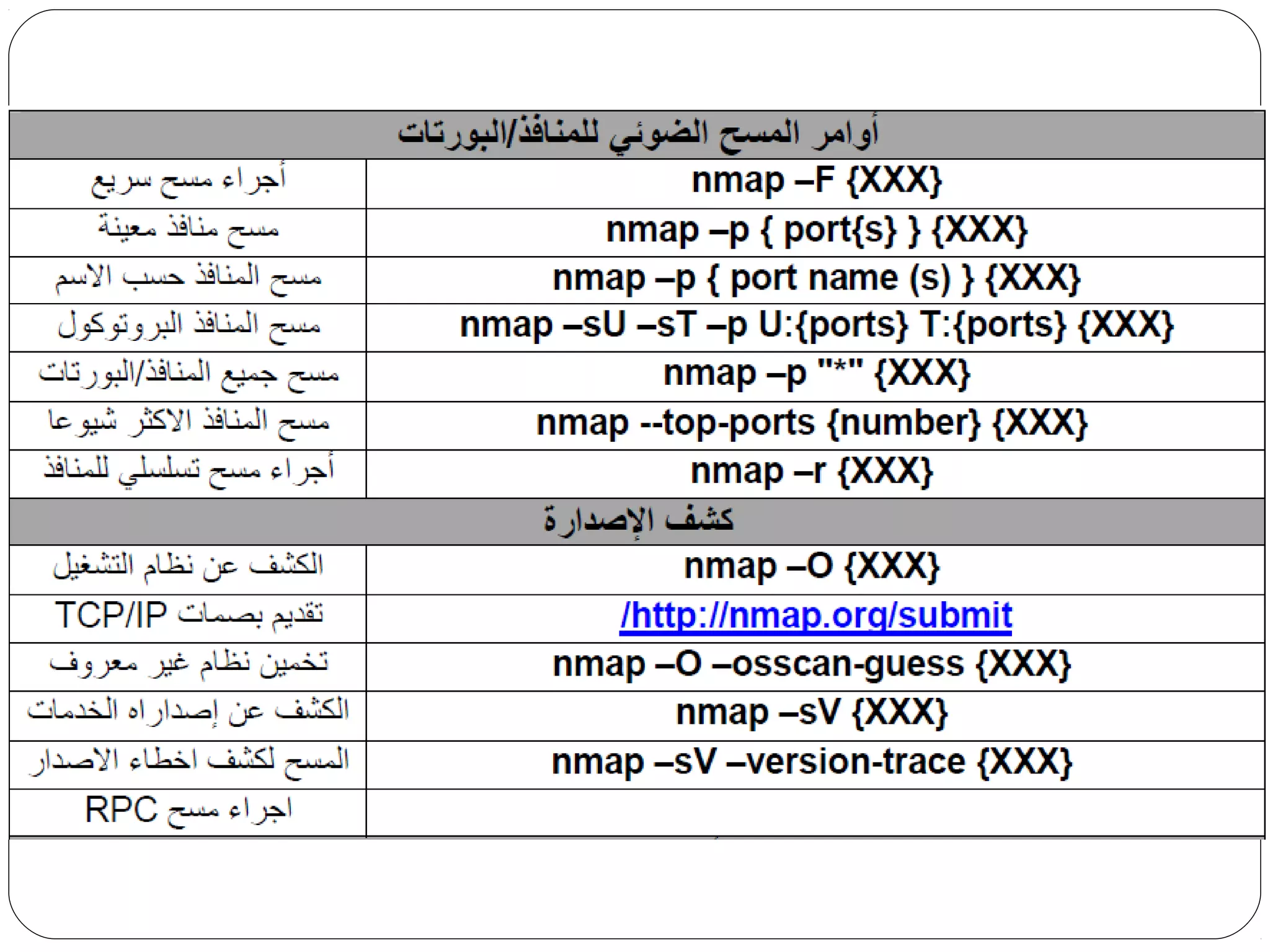
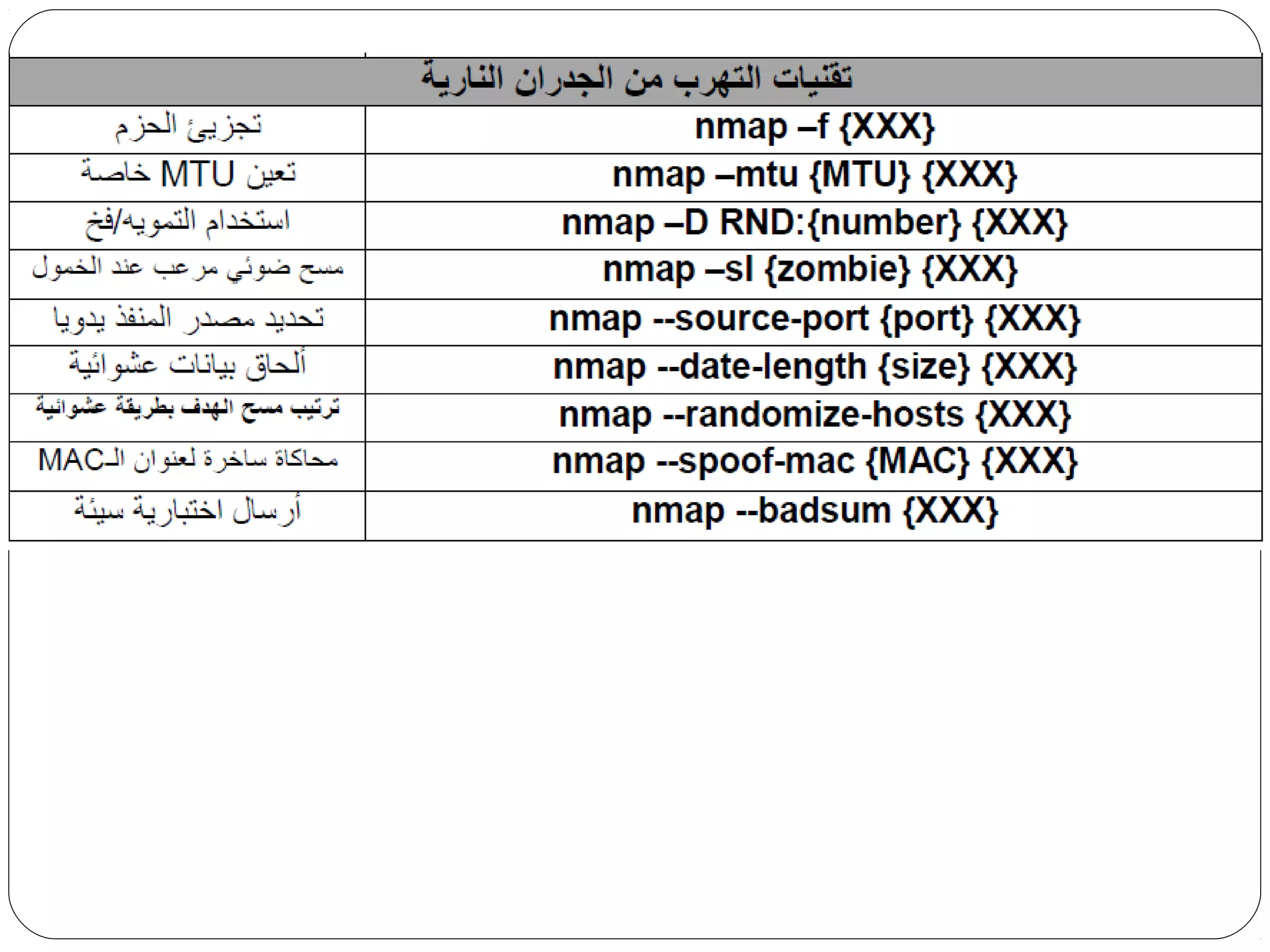
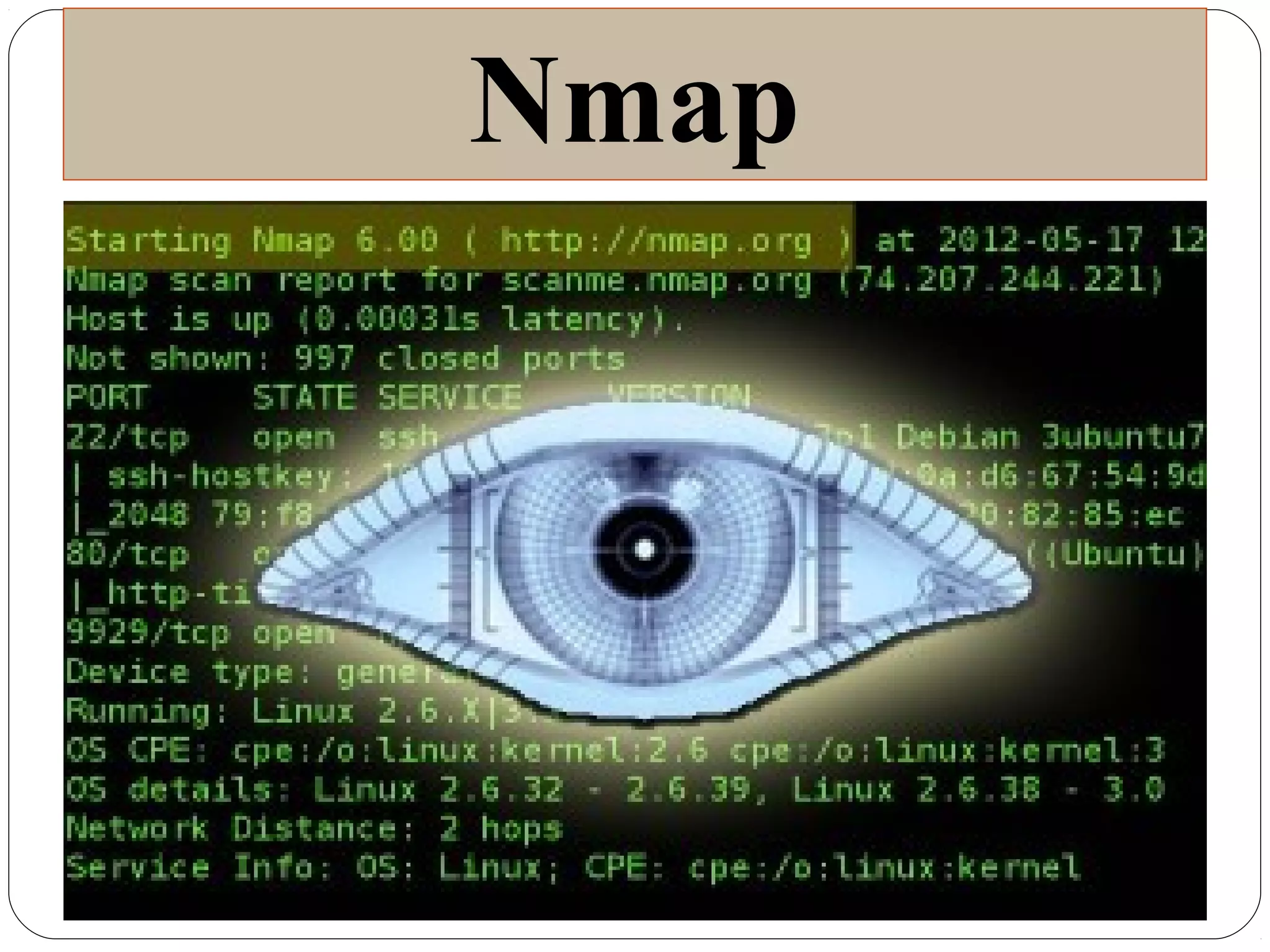
Nmap
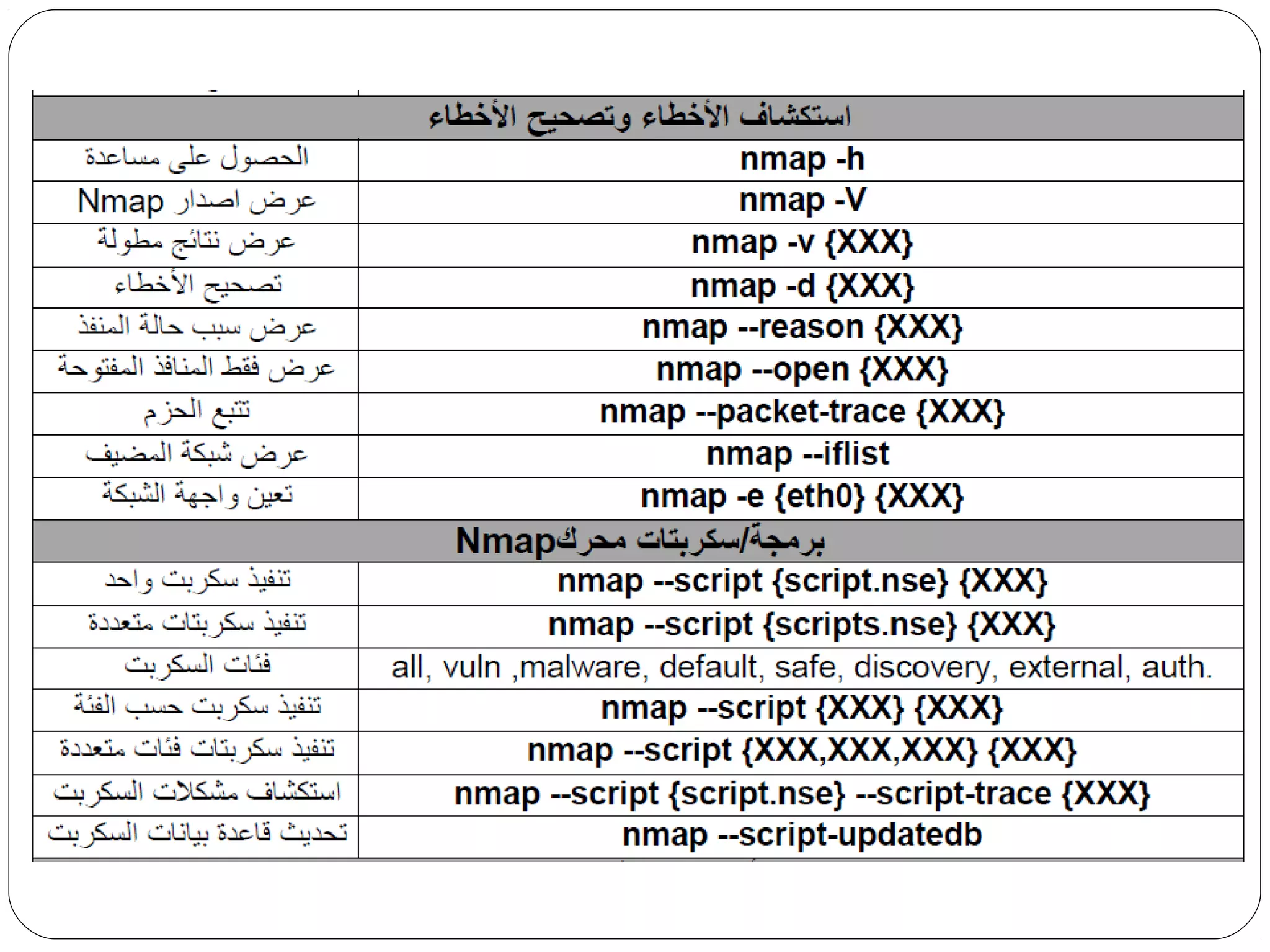
Introduction
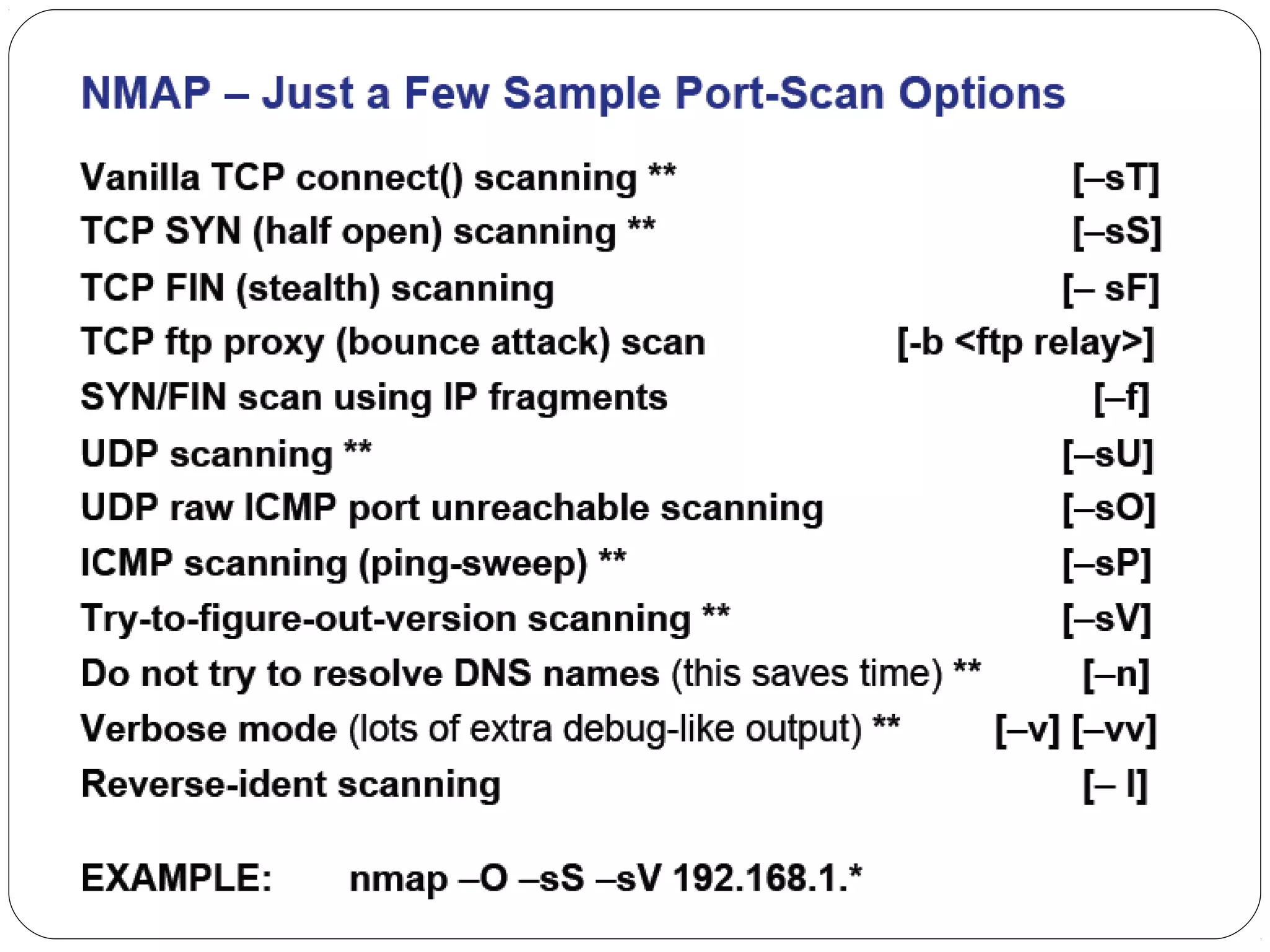
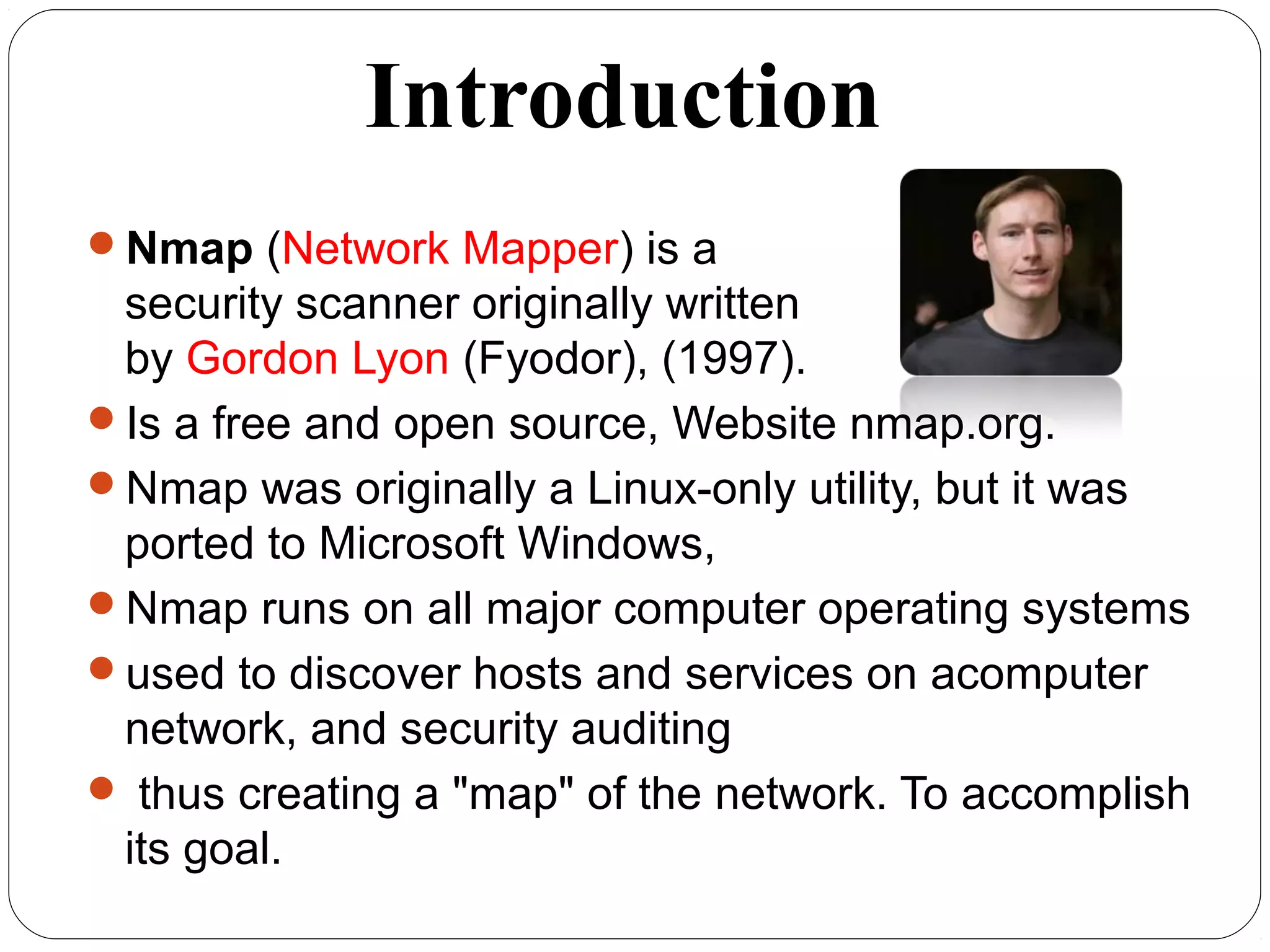
Nmap (Network Mapper) is a
security scanner originally written
by Gordon Lyon (Fyodor), (1997).
Is a free and open source, Website nmap.org.
Nmap was originally a Linux-only utility, but it was
ported to Microsoft Windows,
Nmap runs on all major computer operating systems
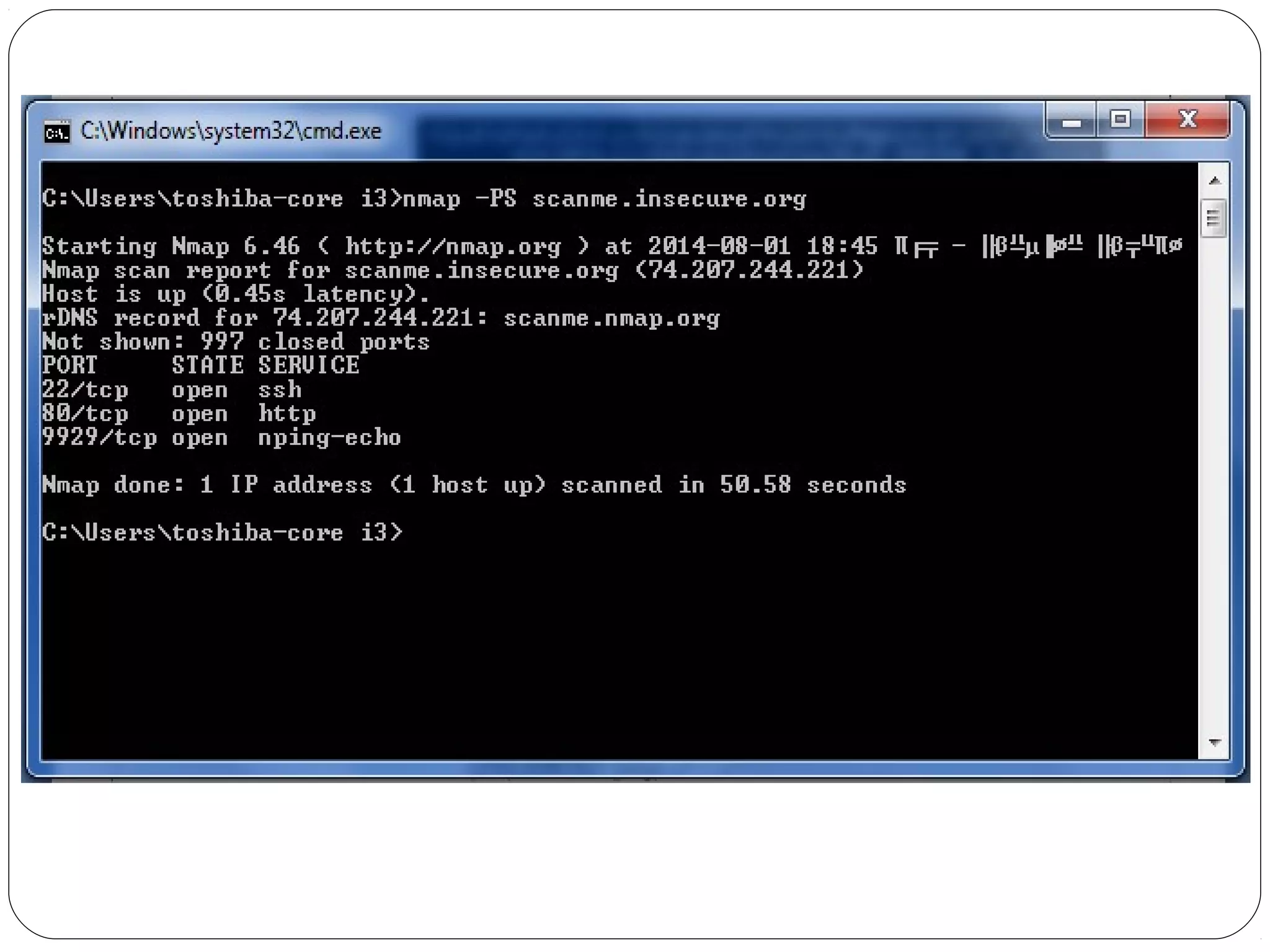
used to discover hosts and services on acomputer
network, and security auditing
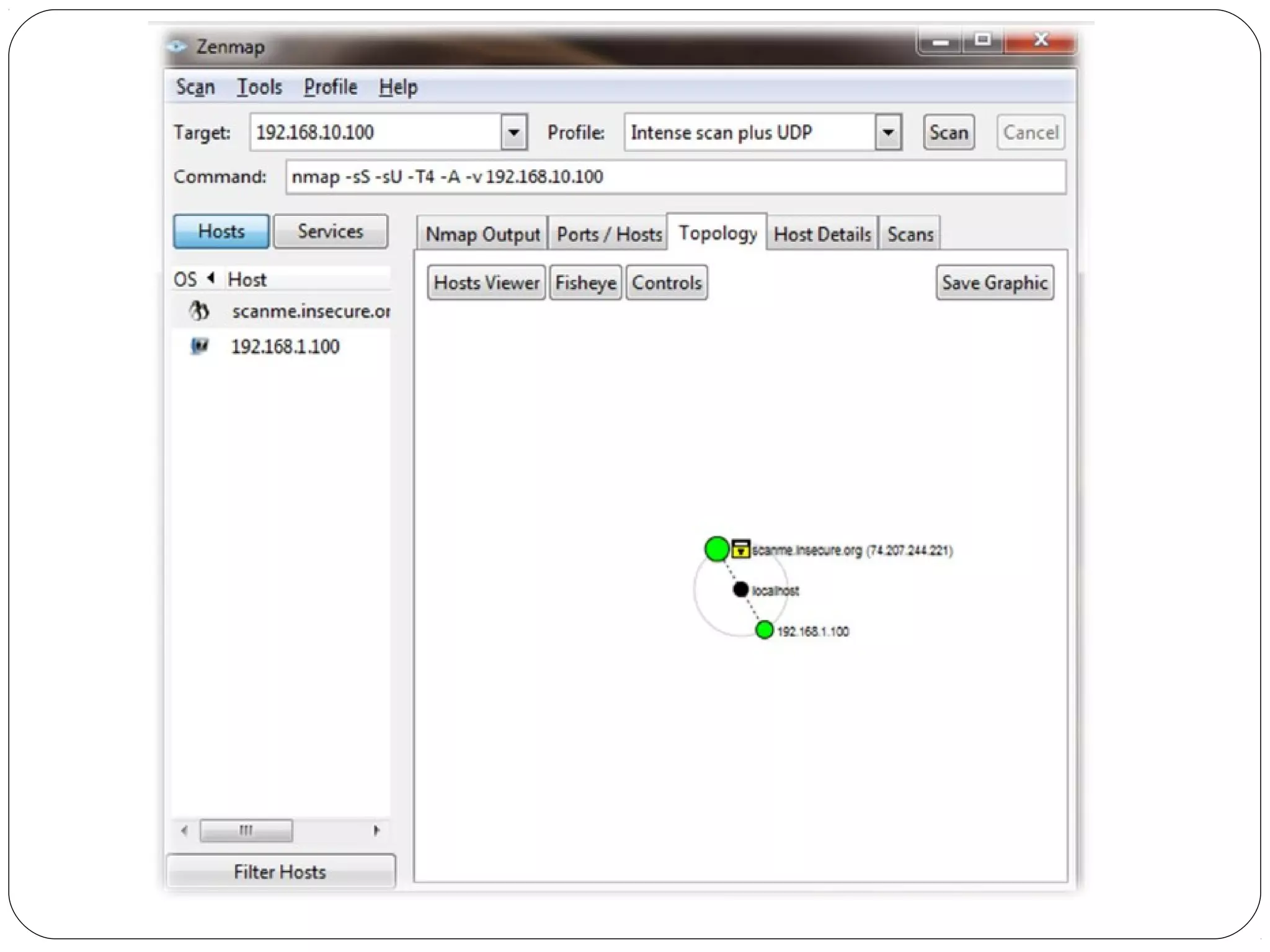
 thus creating a "map" of the network. To accomplish
its goal.
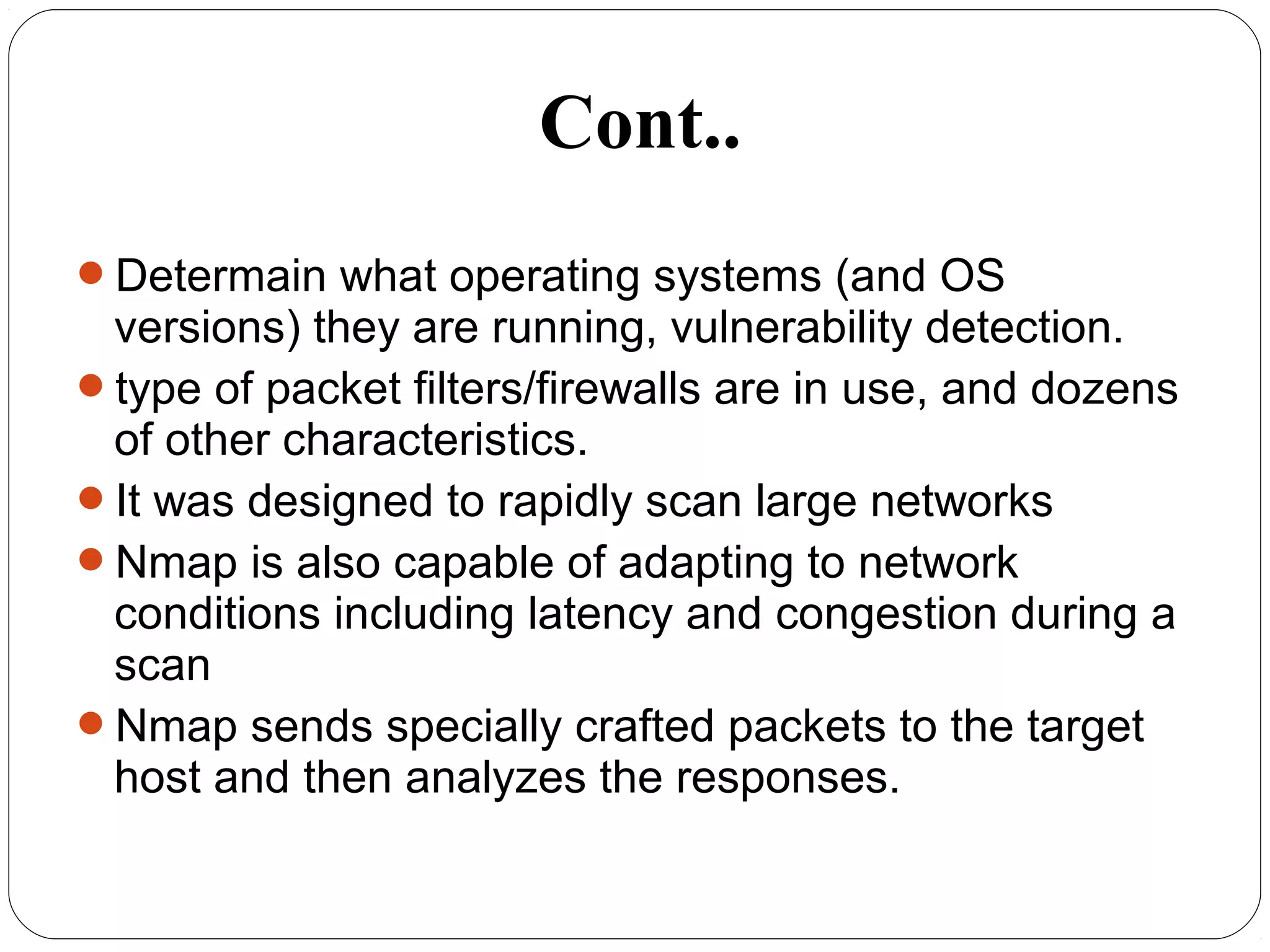
Determain what operating systems (and OS
versions) they are running, vulnerability detection.
type of packet filters/firewalls are in use, and dozens
of other characteristics.
It was designed to rapidly scan large networks
Nmap is also capable of adapting to network
conditions including latency and congestion during a
scan
Nmap sends specially crafted packets to the target
host and then analyzes the responses.
Cont..
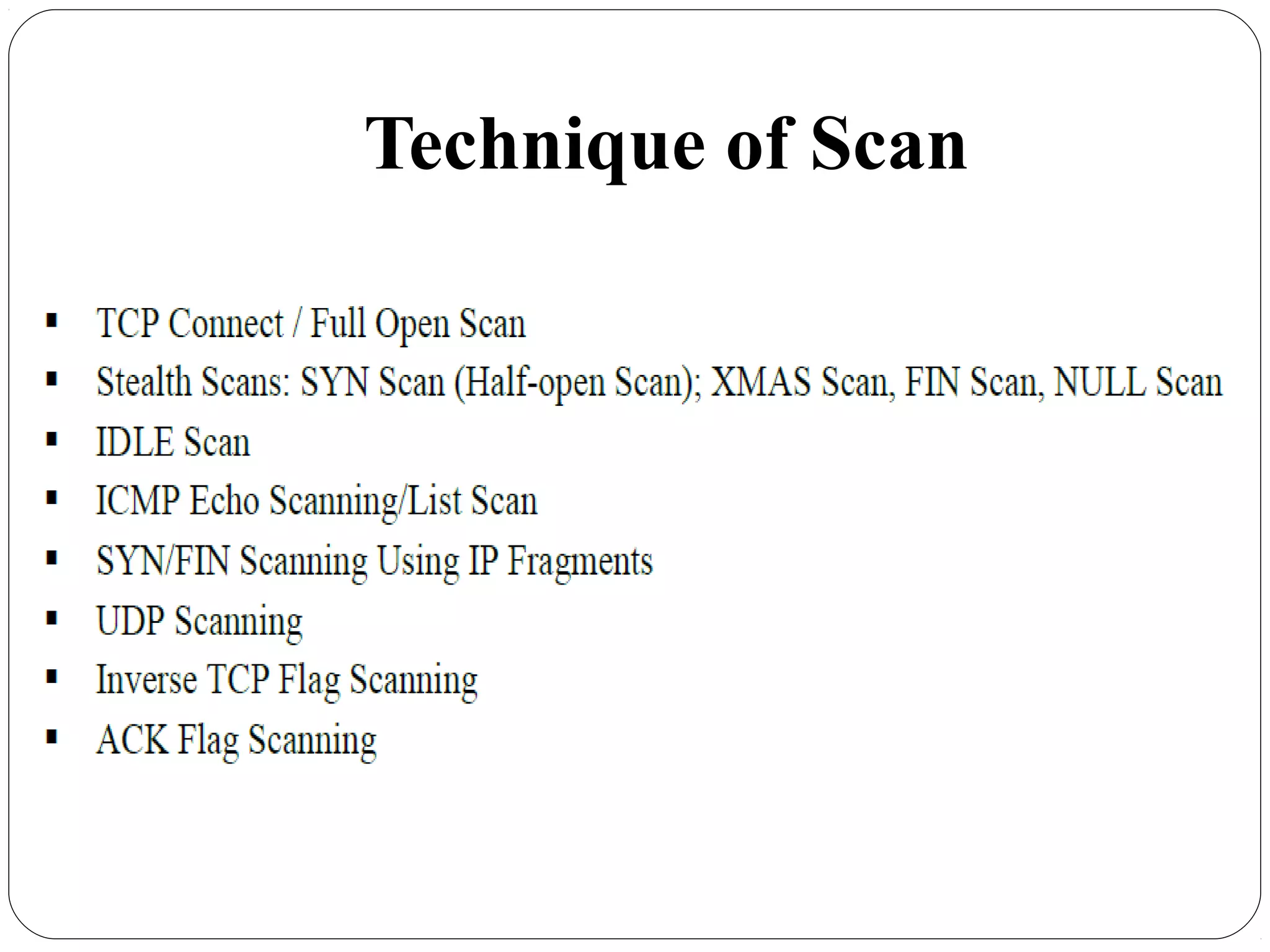
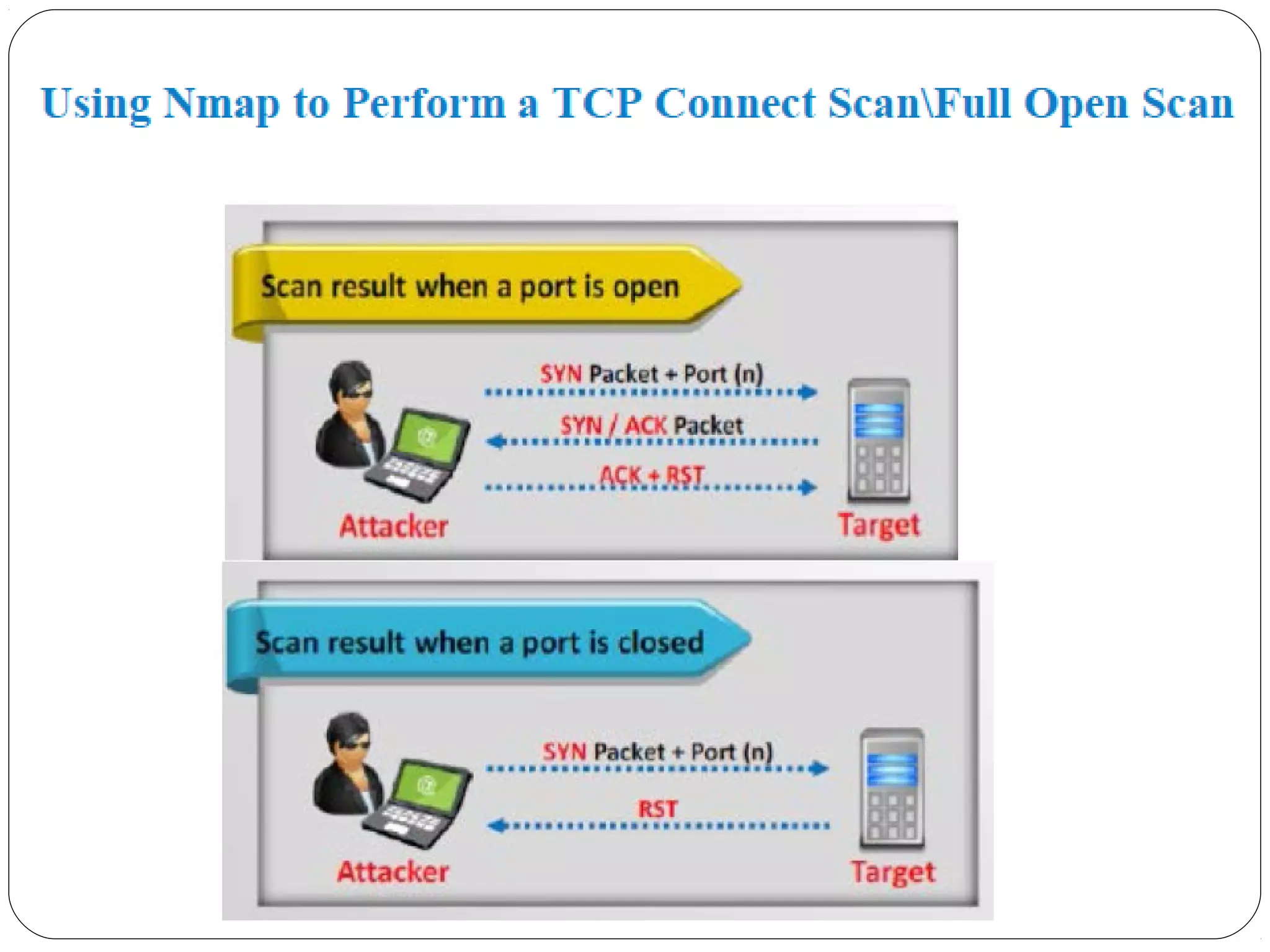
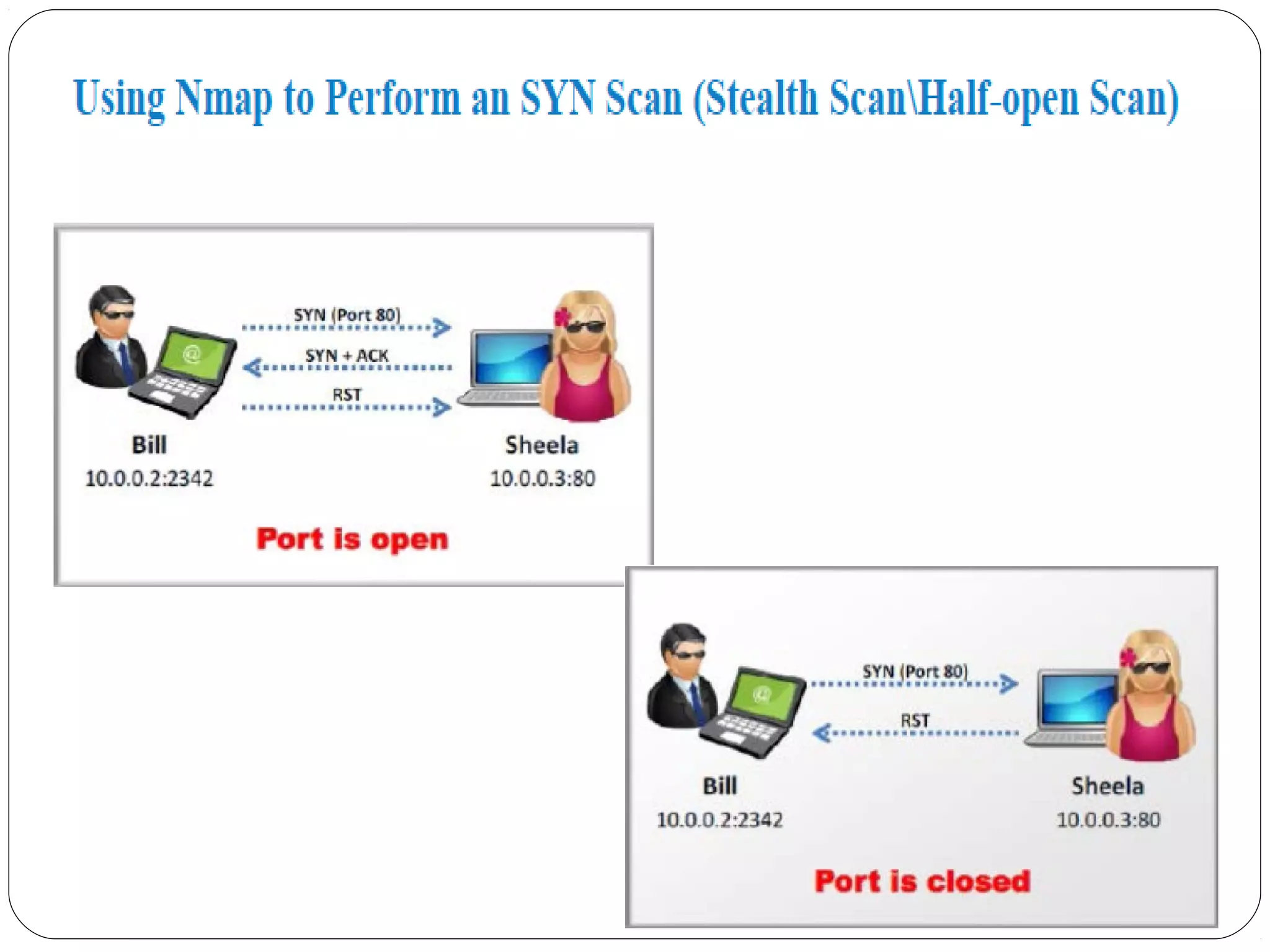
Technique of Scan
M///mm
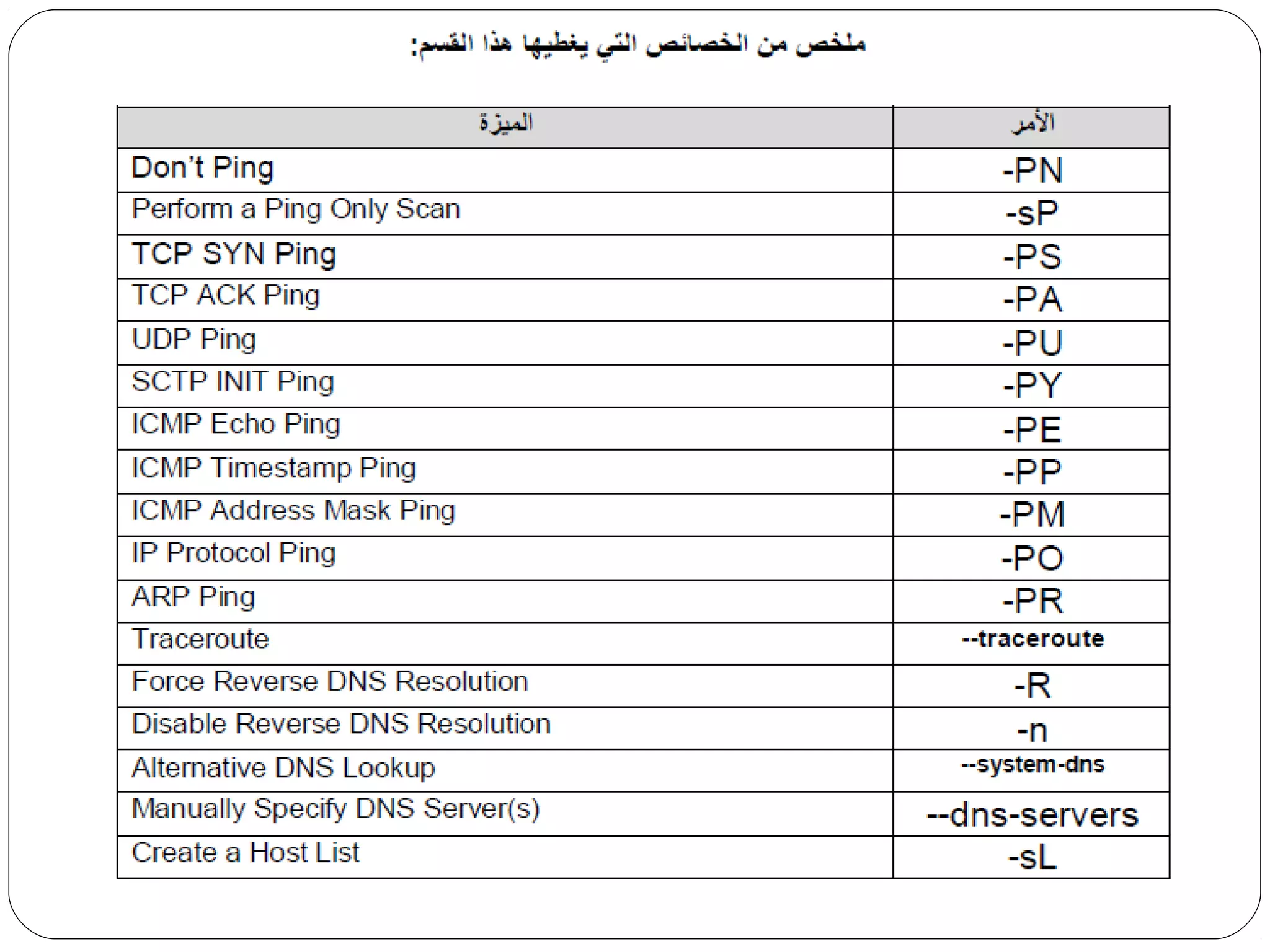
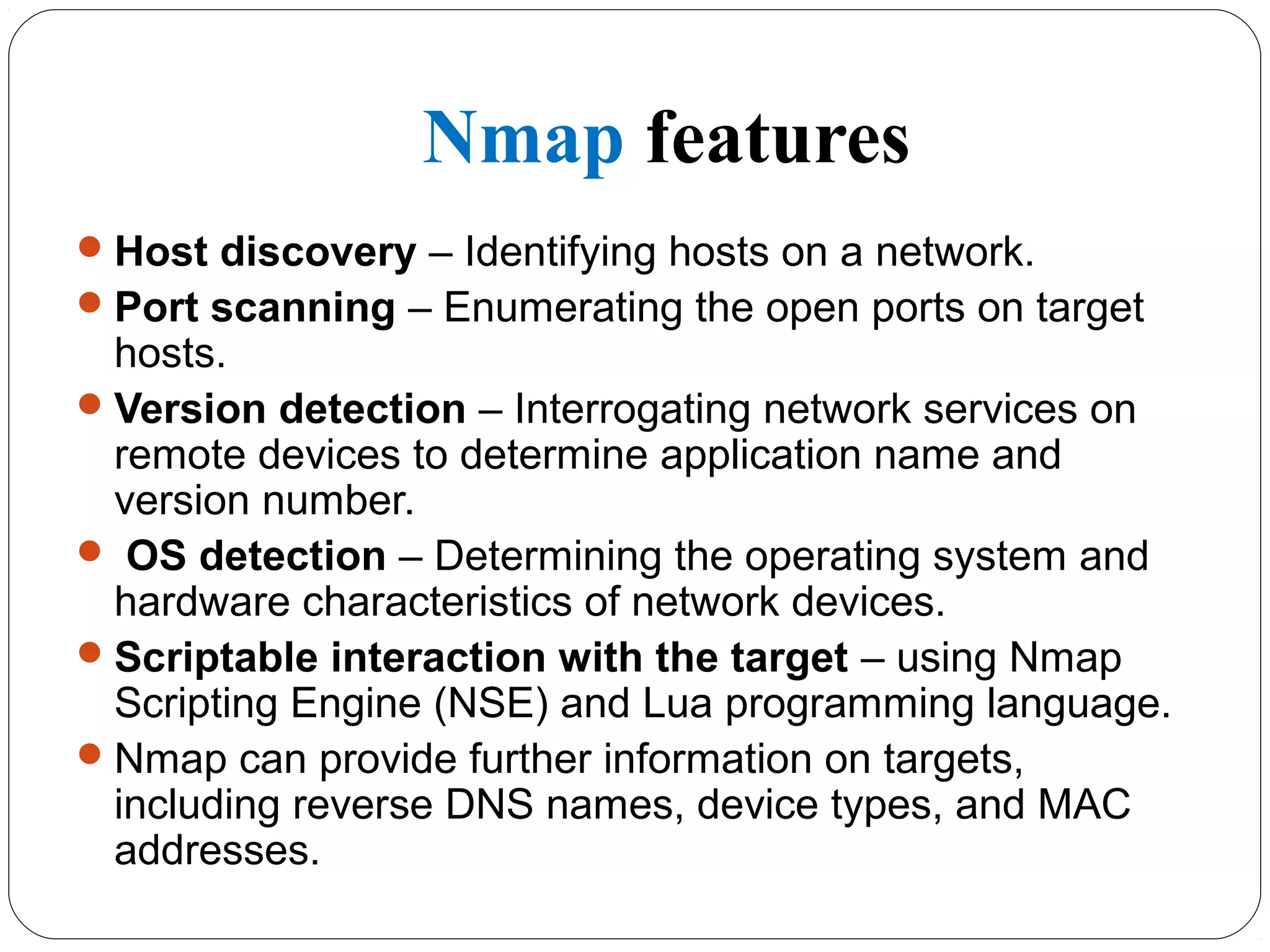
Nmap features
Host discovery – Identifying hosts on a network.
Port scanning – Enumerating the open ports on target
hosts.
Version detection – Interrogating network services on
remote devices to determine application name and
version number.
 OS detection – Determining the operating system and
hardware characteristics of network devices.
Scriptable interaction with the target – using Nmap
Scripting Engine (NSE) and Lua programming language.
Nmap can provide further information on targets,
including reverse DNS names, device types, and MAC
addresses.
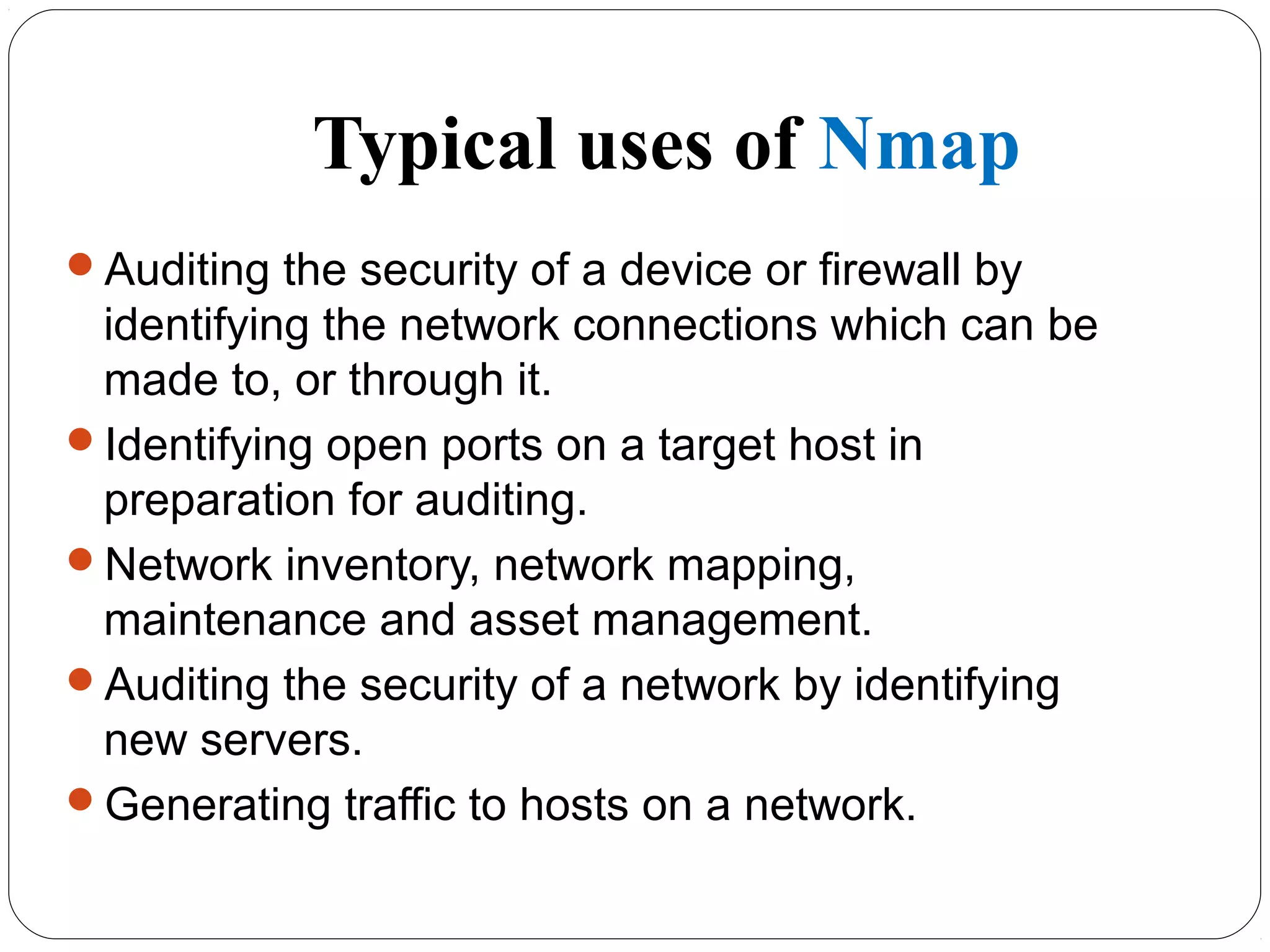
Typical uses of Nmap
Auditing the security of a device or firewall by
identifying the network connections which can be
made to, or through it.
Identifying open ports on a target host in
preparation for auditing.
Network inventory, network mapping,
maintenance and asset management.
Auditing the security of a network by identifying
new servers.
Generating traffic to hosts on a network.
Network scanning
GIF LANCUARD
Vulnerability scanning
Nessus
Anti-Port Scanning
Some useful Anti-Port Scanning software available are:
Scanlogd (A Unix based Port Scan Detector & Logger)
BlackICE (A Windows based Port Scan Detector &
Logger)
Snort: A packet sniffer cum IDS.
Abacus Port sentry: Capable of Detecting both normal
and stealth port scanning attempts.
Reference
http://nmap.org/book/man.html
http://nmap.org/book/install.html
http://nmap.org/nsedoc
http://nmap.org/book/zenmap.html
http://nmap.org/changelog.html
http://seclists.org
http://nmap.online-domain-tools.com
http://sectools.org
h.mondo89@yahoo.com
AES Cryptosystem

AES Cryptosystem

  • 1.
    1 by: Haitham FaragDaw 2013-14 FACULITY OFELECTRONIC TECNOLOGY COMPUTETRENGINEERING (MSc)
  • 2.
    Outline Introduction AES Cryptosystem Review ofthe article NmapTool Implementation (RSA)
  • 3.
  • 4.
    Cryptography 4 The term Cryptographyis originally derived from the two greek words “kryptos" and “graph", meaning hidden and writing, 20th . Cryptography is the science and study of methods of protecting data in computer and communication systems from unauthorized disclosure and modification. Classified into two cryptosystems, private-key cryptosystem and public-key cryptosystem. Both are based on complex mathematical algorithms and are controlled by keys.
  • 5.
    Branches of cryptography Cryptographicengineering Visual cryptography Steganography Quantum cryptography Multivariate cryptography
  • 6.
    6 Uses of cryp..techniques  Commitment schemes  Secure multiparty  Computation  Electronic voting  Authentication  Digital signature  Protocol  Banking  Digital currency  Secret sharing  Anonymous remailer  Onion routing  Cryptosystems
  • 7.
    Security Goals 7 1.Confidentiality orPrivacy : Service is used to save the information content of all persons except that told them to get acquainted with them. 2.Data Integrity: This service is used to save the information of the change (delete or add or modify) by persons unauthorized to do so. 3.Proof of identity (Authentication): This service is used to prove the identity of the data handling (authorized).
  • 8.
    Cont. 8 4. (Non-repudiation): Thisservice is used to prevent a person from denial to do something, Digital Signature.  Note :- If the primary purpose of encryption is to provide these services to the people is to maintain the security of their information .
  • 9.
  • 10.
    Fig 3:- Typesof Modern cipher. Symmetric Asymmetric • Ke=Kd=K • P=D(E(P,Ke),K) • Ke ≠ Kd • P=D(E(P,Ke),Kd) •DES •Tripl DES • AES • BLOWFISH • CASTS • IDEA • Serpent • Twofish •DES •Tripl DES • AES • BLOWFISH • CASTS • IDEA • Serpent • Twofish • RSA • ElGamal • Diffie-Hellman • Rabin • ECDSA • XTR • RSA • ElGamal • Diffie-Hellman • Rabin • ECDSA • XTR Modern • RC4 • BMGL •SEAL •SNOW •SOBER • RC4 • BMGL •SEAL •SNOW •SOBER Block Stream
  • 11.
    Symmetric Encryption private-key /single-key sender and recipient share a common key all classical encryption algorithms are private-key
  • 12.
  • 13.
    7.13 Main topics  Toreview a short history of AES  To define the basic structure and trans.. of AES To define the key expansion process  To define ANALYSIS and Uses of AES Comparison Reference
  • 14.
    7.14  Clear areplacement for DES was needed o have theoretical attacks that can break it o have demonstrated exhaustive key search attacks, ” deep crack (88b) in 3 days”  Can use (3-DES) – but slow, has small blocks  US NIST issued call for ciphers in 1997  15 candidates accepted in Jun 98  5 were shortlisted in Aug-99 o (Rijndael, SERPENT, TWOFISH, RC6, MARS). History
  • 15.
    Introduction  The AdvancedEncryption Standard (AES).  Is a symmetric-key block cipher .  Rijndael was selected as the AES in Oct-2000  Published by the (NIST) in December 2001. The criteria defined by NIST for selecting AES fall into three areas: 1. Security 2. Cost 3. Implementation.
  • 16.
    7.16  designed byRijmen-Daemen in Belgium  has 128/192/256 bit keys, 128 bit data  an iterative rather than Feistel cipher  processes data as block of 4 columns of 4 bytes  operates on entire data block in every round  designed to have:  resistance against known attacks  speed and code compactness on many CPUs  design simplicity The AES Cipher - Rijndael
  • 17.
    7.17 Continue Figure 1:General designof AES encryption cipher
  • 18.
    AES Structure  datablock of 4 columns of 4 bytes is state  key is expanded to array of words  has 10/12/14 rounds in which state undergoes:  byte substitution (1 S-box used on every byte)  shift rows (permute bytes between groups/columns)  mix columns (subs using matrix multiply of groups)  add round key (XOR state with key material)  view as alternating XOR key & scramble data bytes  initial XOR key material & incomplete last round  with fast XOR & table lookup implementation
  • 19.
    7.19 Figure 2:Ciphers andinverse ciphers of the original design
  • 20.
  • 21.
    7.21 Structure of EachRound Figure 3:Structure of each round at the encryption site
  • 22.
    Some Comments onAES  key expanded into array of 32-bit words  four words form round key in each round  4 different stages are used as shown  has a simple structure  only AddRoundKey uses key  AddRoundKey a form of Vernam cipher  each stage is easily reversible  decryption uses keys in reverse order  decryption does recover plaintext  final round has only 3 stages
  • 23.
    7.23 Data Units. Figure 4:Data units used in AES
  • 24.
  • 25.
    7.25 EA 04 6585 83 01 5D 96 5C 33 98 B0 F1 2D AD C5 Initial XOR key 24 34 31 13 75 75 e2 Aa A2 56 12 5 B3 88 00 87 00 12 0c 08 04 04 00 23 12 12 13 19 14 00 11 19 Input state Output stateKey Round Plain text key Cipher text + =
  • 26.
    7.26 TRANSFORMATIONS To provide security,AES uses four types of transformations: substitution, permutation, mixing, and key-adding. 1. Substitution 2. Permutation 3. Mixing 4. Key Adding
  • 27.
    Substitute Bytes  Asimple substitution of each byte  Uses one table of 16x16 bytes .  Each byte of state is replaced by byte indexed by row (left 4-bits) & column (right 4-bits)  eg. byte {95} is replaced by byte in row 9 column 5  which has value {2A}  S-box constructed using defined transformation of values in GF(28 )  Designed to be resistant to all known attacks
  • 28.
    7.28 0 1 .. . . . . F 0 7C . . . . . F A1 EA 04 65 85 83 01 5D 96 5C 33 98 B0 F1 2D AD C5 State 87 F2 4D 97 EC 7C 4C 90 4A C3 46 E7 A1 D8 95 A6 State After substituteS-box SubBytes Figure 6: SubBytes transformation
  • 29.
  • 30.
  • 31.
    Shift Rows  Acircular byte shift in each each  1st row is unchanged  2nd row does 1 byte circular shift to left  3rd row does 2 byte circular shift to left  4th row does 3 byte circular shift to left  Decrypt inverts using shifts to right  Since state is processed by columns, this step permutes bytes between the columns
  • 32.
    7.32 87 F2 4D97 EC 7C 4C 90 4A C3 46 E7 A1 D8 95 A6 87 F2 4D 97 7C 4C 90 EC 46 E7 4A C3 A6 A1 D8 95 unchanged 1 byte shift to left 2 byte shift to left 3 byte shift to left State After shifting State Shift Rows Shift row InShift row Figure 7: shift rows
  • 33.
    Mix Columns  Eachcolumn is processed separately  Each byte is replaced by a value dependent on all 4 bytes in the column  Effectively a matrix multiplication in GF(28 ) using prime poly m(x) =x8 +x4 +x3 +x+1
  • 34.
    Continue  Can expresseach col as 4 equations  to derive each new byte in col  Decryption requires use of inverse matrix  with larger coefficients, hence a little harder  Have an alternate characterisation  each column a 4-term polynomial  with coefficients in GF(28 )  and polynomials multiplied modulo (x4 +1)  Coefficients based on linear code with maximal distance between codewords
  • 35.
  • 36.
    7.36 02 03 0101 01 02 03 01 01 01 02 03 03 01 01 02 87 F2 4D 97 6E 4C 90 EC 46 E7 4A C3 A6 A1 D8 95 47 S0,1 S0,2 S0,3 37 S1,1 S1,2 S1,3 94 S2,1 S2,2 S2,3 ED S3,1 S3,2 S3,3 =* Old matrix New matrixConstant matrix * eg.:- (({02}*{87})+({03}*{6E})+({01}*{46})+({01}*{A6}))= {47} InvMixColumns: The InvMixColumns transformation is basically the same as the MixColumns transformation. Figure 8: Mixing bytes using matrix multiplication
  • 37.
    Add Round Key XOR state with 128-bits of the round key  Again processed by column (though effectively a series of byte operations)  Inverse for decryption identical  since XOR own inverse, with reversed keys  Designed to be as simple as possible  a form of Vernam cipher on expanded key  requires other stages for complexity / security
  • 38.
    7.38 Continue Figure 9: AddRoundKeytransformation S0,0 S0,1 S0,2 S0,3 S1,0 S1,1 S1,2 S1,3 S2,0 S2,1 S2,2 S2,3 S3,0 S3,1 S3,2 S3,3 S0,0 S0,1 S0,2 S0,3 S1,0 S1,1 S1,2 S1,3 S2,0 S2,1 S2,2 S2,3 S3,0 S3,1 S3,2 S3,3 S0,0 S0,1 S0,2 S0,3 S1,0 S1,1 S1,2 S1,3 S2,0 S2,1 S2,2 S2,3 S3,0 S3,1 S3,2 S3,3 + =
  • 39.
    Figure 10: Invertibilityof SubBytes and ShiftRows combinations
  • 40.
    7.40 KEY EXPANSION To createround keys for each round, AES uses a key- expansion process. If the number of rounds is Nr , the key-expansion routine creates Nr + 1 128-bit round keys from one single 128-bit cipher key.  Key Expansion in AES-128
  • 41.
    7.41 Key Expansion inAES-128 Figure 11: Key expansion in AES
  • 42.
  • 43.
  • 44.
  • 45.
  • 46.
    7.46 ContinuedContinued Example : Figure 7.21shows the state entries in one round, round 7, inFigure 7.21 shows the state entries in one round, round 7, in Example 7.10.Example 7.10. Figure 12: States in a single round
  • 47.
    7.47 ContinuedContinued Example : One maybe curious to see the result of encryption when theOne may be curious to see the result of encryption when the plaintext and cipher key is made of all 0s. Using the cipherplaintext and cipher key is made of all 0s. Using the cipher key in Example 7.10 yields the ciphertext.key in Example 7.10 yields the ciphertext.
  • 48.
    7.48 ANALYSIS OF AES Thissection is a brief review of the three characteristics of AES. 1. Security 2. Implementation 3. Simplicity and Cost
  • 49.
    7.49 Security AES was designedafter DES. Most of the known attacks on DES were already tested on AES.  Brute-Force Attack AES is definitely more secure than DES due to the larger-size key.  Statistical Attacks Numerous tests have failed to do statistical analysis of the ciphertext.  Differential and Linear Attacks There are no differential and linear attacks on AES as yet.
  • 50.
    7.50 Implementation AES can beimplemented in software, hardware, and firmware. The implementation can use table lookup process or routines that use a well-defined algebraic structure. Simplicity and Cost The algorithms used in AES are so simple that they can be easily implemented using cheap processors and a minimum amount of memory.
  • 51.
    Uses of AESAlgorithm 7.51  AES is used in programs (WINZIP) the user request dataset after encrypt compressed.  Used in the protocol TLS, a protocol to establish a secure connection.  Use of the IPsec protocol, a protocol to ensure safety in the connections that are powered by IP over the Internet  Uses in the military….etc.
  • 52.
  • 53.
  • 54.
    7.54 Pratap Chandra Mandalhas evaluated the following algorithms: DES, 3DES ,AES and Blowfish  Pentium IV of 2.4 GHz CPU speed  4 GB RAM.  text files sizes range from 50 KB to 22300 KB. Experiment
  • 55.
  • 56.
  • 57.
  • 58.
  • 59.
    7.59  William Stallings,CRYPTOGRAPHY AND NETWORK SECURITY, FIFTH EDITION,2011, USA  www.cs.bc.edu/~straubin/cs381-05/blockciphers/rijndael_ingles2004.swf  http://en.wikipedia.org/wiki/Advanced_Encryption_Standard  Pratap Chandra Mandal., Kolkata, W.B., Evaluation of performance of the Symmetric Key Algorithms: DES, 3DES ,AES and Blowfish.Journal of Global Research in Computer Science, 3 (8), August 2012, 67-70.  Handout Reference
  • 60.
  • 61.
    Performance Evaluation ofSymetric Cryptography Algorithm by Mohsin Khan, Sadaf Hussain, Malik Imran Article journal, Volume 2, Issue,April 2012-13. Islamabad
  • 62.
    Outline  Abstract  Introduction Description  Modified Blowfish Algorithm Conclusion  Critique
  • 63.
    Abstract This survey paperdiscussed about the symmetric cryptographic algorithms and their performance in context of power consumption issues, Memory and CPU processing time. Also, their performance based on algorithm, key generation process and length.
  • 64.
    Introduction Cryptography converts themessage into a non readable format and send it over an unsecure channel. There are five requirements for symmetric encryption, plain text, cipher text, encryption algorithm, decryption algorithm, and secret key.
  • 65.
    In general, encryptionuses two techniques like. Encryption Symmetric Asymmetric RSA ECC Etc.Blowfish DES,3 DES AESRC2/6 Fig 1: Cryptography Diagram
  • 66.
  • 67.
    Description of somesymmetric encryption algorithms like AES, DES, Blowfish, Modified DES, and Modified Blowfish, and their strengths and weaknesses. 1. DES (Data Encryption Standard) Algorithm It is a block cipher which encrypts 64 bit plaintext at a time and uses 56 bit key. The drawback can be easily prone to Brute Force to break the key, 256 possible. So DES is not so secure.
  • 68.
    Round 1 Round 2 Initial permutayion Round16 32 bit swap Inv initial permutation Permuted choice 2 Left circular shift Permuted choice 2 Left circular shift Left circular shift Permuted choice 2 Permutation choice 64-bit plain text 64-bit cipher text 64-bit key 56 56 56 56 5648 48 48 64 64 64 64 Key Generation Encryption Fig 3: DES Algorithm
  • 69.
    2. AES (AdvancedEncryption Standard) Algorithm AES is a variable bit block cipher and uses variable key length of 128, 192 and 256 bits. AES performs different processing rounds. Substitute bytes Shift rows Mix column Add round key AES encryption is fast, flexible and higher secure The key length is variable.
  • 70.
    Fig 4: AESProcessing Diagram
  • 71.
    Blowfish Encryption Algorithm designedin 1993 by Bruce Blowfish It’s 64 bit block cipher with variable length key. Fast : It encrypts data on large 32-bit microprocessors at a rate of 26 clock cycles per byte. Compact: It can run in less than 5K of memory. Simple: It uses addition, XOR, lookup table with 32-bit operands. Secure: The key length is variable ,it can be in the range of 32~448 bits: default 128 bits key length. Unpatented and royality-free.
  • 72.
    Cont.. It is suitableand efficient for hardware implementation blowfish algorithm has yet to be cracked as the key size is high, requires 2448 combinations The processing speed is less than DES and AES. simple to implement
  • 73.
    Fig5:- Blowfish EncryptionAlgorithm process
  • 74.
     Description ofAlgorithm: • Feistel network. • This algorithm is divided into two parts. 1. Key-expansion •The key expansion step converts 448 bit key into 4168 bytes. • A P-array of size 18 and four S-boxes whose size is 256 2. Data Encryption • Divide 64-bits into two 32-bit halves: XL, XR • For i = 1 to 16 o XL = XL XOR Pi o XR=F(XL) XOR XR o Swap XL and XR • Swap XL and XR (Undo the last swap ) • XR=XR XOR P17 • XL = XL XOR P18 • Concatenate XL and XR
  • 75.
     Key-expansion: It willconverts a key of 448 bits into several subkey arrays totaling 4168 bytes. Blowfish uses large number of subkeys. These keys are generate earlier to any data encryption or decryption. The p-array consists of 18, 32-bit subkeys: P1,P2,………….,P18 Four 32-bit S-Boxes consists of 256 entries each: S1,0, S1,1,………. S1,255 S2,0, S2,1,……….. S2,255 S3,0, S3,1,……….. S3,255 S4,0, S4,1,..............S4,255
  • 78.
    Modified Blowfish Algorithm Modifiedby Monika and Paradeep in 2012. They modify the blowfish algorithm with a random number Rn, the remaining processing is same as blowfish. Modified blowfish algorithm uses the concept of random number and flags, flags decide where f function process is required or not.
  • 79.
    Cont... As the resultof the number of f function calls is reduced, lead to,  increase the CPU processing time  decrease memory usage increased the throughput.  The second advantage of modified blowfish algorithm is increased in security.
  • 80.
    Modified DES Algorithmusing Fuse Data Technique DES algorithm is modified by Al Hamami et al in . They present Fuse DES with Blowfish and Genetic Algorithm (GA). DES has a disadvantage of shortest key, since it is not more secure. The algorithm uses 2 subkeys:- right subkey and Left subkey is a 768 bit length and 16 blocks of 48 bits called Pi through both 16th round left subkey is generated.
  • 81.
    Cont.. the CPU timeincreased, as well as, memory usage and as result of slow processing, the throughput decreased compare to DES. This is more secure encryption algorithm as uses two subkeys, R,L.
  • 82.
    Figure 7 :The Fused DES algorithm process
  • 83.
    Fig 8 :The F function process .
  • 84.
    Conclusion  one secretkey is used in the symmetric encryption algorithms the symmetric key algorithms are more prone to attacks and provide less security than asymmetric algorithms. the processing time, throughput, and memory usage of this algorithms are very less DES is a less secure algorithm The drawback is solved in Fused DES through GA Technique and Blowfish key generation. The more secure algorithm is blowfish.
  • 85.
    Critique  The titleof the article is appropriate and clear However, the abstract is rather general and not specific.  In introduction, the purpose of the article was not clearly stated So few information regarding the description of AES algorithm.  Diagram of modified blowfish is required.
  • 86.
    Overall Critique  ModifiedBlowfish was not clearly described( round numbers), as well as, GA  There are so much repetition (DES)  Figures and charts was not appropriately placed.  Review of previous researches should be mentioned in introduction.  Language of the article was not properly academic.
  • 87.
  • 88.
    Outline  Introduction  IPAddresses Port Scanning  Nmap  Anti-Port Scanning  Reference
  • 89.
    Introduction Hacking is aterm used to refer to activities aimed at exploiting security flaws to obtain critical information for gaining access to secured networks.
  • 90.
    General Hacking Methods 1.Identify the target system. 2. Gathering Information on the target system. 3. Finding a possible loophole in the target system. 4. Exploiting this loophole using exploit code. 5. Removing all traces from the log files and escaping without a trace.
  • 91.
    Various Types ofAttacks The most common ones are: Denial of Services attacks (DOS Attacks) SMURF Attacks Threat from Sniffing and Key Logging Trojan Attacks RAT (Remote Administration Tool) IP Spoofing Buffer Overflows All other types of Attacks
  • 92.
    IPAddresses An attacker’s firststep is to find out the IP Address of the target system. IP Addresses: Finding out an IP Address Through Instant Messaging Software C:>netstat -n Through Internet Relay Chat Through Your website by using simply JAVA applets or JavaScript code. Through Email Headers
  • 93.
    IPAddresses: Dangers & Concerns IPAddresses: Dangers & Concerns DOS Attacks Disconnect from the Internet Trojans Exploitation Geographical Information File Sharing Exploits
  • 94.
    Type of Scanning Portscanning Network scanning Vulnerability scanning
  • 95.
    Port Scanning Port Scanningis normally the first step that an attacker undertakes. List of Open Ports Services Running Exact Names and Versions of all the Services or Daemons. Operating System name and version
  • 97.
    Port Scanning :Major Tools Available Some of the best and the most commonly used Port Scanners are: Nmap Superscan Hping Nessus Common Features of all above Port Scanners: Very Easy to Use Display Detailed Results
  • 98.
  • 99.
    Introduction Nmap (Network Mapper)is a security scanner originally written by Gordon Lyon (Fyodor), (1997). Is a free and open source, Website nmap.org. Nmap was originally a Linux-only utility, but it was ported to Microsoft Windows, Nmap runs on all major computer operating systems used to discover hosts and services on acomputer network, and security auditing  thus creating a "map" of the network. To accomplish its goal.
  • 100.
    Determain what operatingsystems (and OS versions) they are running, vulnerability detection. type of packet filters/firewalls are in use, and dozens of other characteristics. It was designed to rapidly scan large networks Nmap is also capable of adapting to network conditions including latency and congestion during a scan Nmap sends specially crafted packets to the target host and then analyzes the responses. Cont..
  • 101.
  • 106.
  • 109.
    Nmap features Host discovery– Identifying hosts on a network. Port scanning – Enumerating the open ports on target hosts. Version detection – Interrogating network services on remote devices to determine application name and version number.  OS detection – Determining the operating system and hardware characteristics of network devices. Scriptable interaction with the target – using Nmap Scripting Engine (NSE) and Lua programming language. Nmap can provide further information on targets, including reverse DNS names, device types, and MAC addresses.
  • 110.
    Typical uses ofNmap Auditing the security of a device or firewall by identifying the network connections which can be made to, or through it. Identifying open ports on a target host in preparation for auditing. Network inventory, network mapping, maintenance and asset management. Auditing the security of a network by identifying new servers. Generating traffic to hosts on a network.
  • 120.
  • 121.
    Anti-Port Scanning Some usefulAnti-Port Scanning software available are: Scanlogd (A Unix based Port Scan Detector & Logger) BlackICE (A Windows based Port Scan Detector & Logger) Snort: A packet sniffer cum IDS. Abacus Port sentry: Capable of Detecting both normal and stealth port scanning attempts.
  • 122.

Editor's Notes

  • #12 Symmetric encryption, also referred to as conventional encryption or single-key encryption, was the only type of encryption in use prior to the development of public-key encryption in the 1970s. It remains by far the most widely used of the two types of encryption. All traditional schemes are symmetric / single key / private-key encryption algorithms, with a single key, used for both encryption and decryption. Since both sender and receiver are equivalent, either can encrypt or decrypt messages using that common key.
  • #19 The input to the AES encryption and decryption algorithms is a single 128-bit block, depicted in FIPS PUB 197, as a square matrix of bytes .This block is copied into the State array, which is modified at each stage of encryption or decryption. After the final stage, State is copied to an output. The key is expanded into 44/52/60 lots of 32-bit words (see later), with 4 used in each round. Note that the ordering of bytes within a matrix is by column. So, for example, the first four bytes of a 128-bit plaintext input to the encryption cipher occupy the first column of the in matrix, the second four bytes occupy the second column, and so on. Similarly, the first four bytes of the expanded key, which form a word, occupy the first column of the w matrix. The data computation then consists of an “add round key” step, then 9/11/13 rounds with all 4 steps, and a final 10th/12th/14th step of byte subs + mix cols + add round key. This can be viewed as alternating XOR key & scramble data bytes operations. All of the steps are easily reversed, and can be efficiently implemented using XOR’s & table lookups.
  • #23 Before delving into details, can make several comments about the overall AES structure. See text for details.
  • #28 We now turn to a discussion of each of the four transformations used in AES. For each stage, we mention the forward (encryption) algorithm, the inverse (decryption) algorithm, and the rationale for the design of that stage. The Substitute bytes stage uses an S-box to perform a byte-by-byte substitution of the block. There is a single 8-bit wide S-box used on every byte. This S-box is a permutation of all 256 8-bit values, constructed using a transformation which treats the values as polynomials in GF(28) – however it is fixed, so really only need to know the table when implementing. Decryption requires the inverse of the table. These tables are given in Stallings Table 5.2. The table was designed to be resistant to known cryptanalytic attacks. Specifically, the Rijndael developers sought a design that has a low correlation between input bits and output bits, with the property that the output cannot be described as a simple mathematical function of the input, with no fixed points and no “opposite fixed points”.
  • #32 The ShiftRows stage provides a simple “permutation” of the data, whereas the other steps involve substitutions. Further, since the state is treated as a block of columns, it is this step which provides for diffusion of values between columns. It performs a circular rotate on each row of 0, 1, 2 & 3 places for respective rows. When decrypting it performs the circular shifts in the opposite direction for each row. This row shift moves an individual byte from one column to another, which is a linear distance of a multiple of 4 bytes, and ensures that the 4 bytes of one column are spread out to four different columns.
  • #34 The forward mix column transformation, called MixColumns, operates on each column individually. Each byte of a column is mapped into a new value that is a function of all four bytes in that column. It is a substitution that makes use of arithmetic over GF(2^8). Each byte of a column is mapped into a new value that is a function of all four bytes in that column. It is designed as a matrix multiplication where each byte is treated as a polynomial in GF(28). The inverse used for decryption involves a different set of constants. The constants used are based on a linear code with maximal distance between code words – this gives good mixing of the bytes within each column. Combined with the “shift rows” step provides good avalanche, so that within a few rounds, all output bits depend on all input bits.
  • #35 In practise, you implement Mix Columns by expressing the transformation on each column as 4 equations (Stallings equation 5.4) to compute the new bytes for that column. This computation only involves shifts, XORs & conditional XORs (for the modulo reduction). The decryption computation requires the use of the inverse of the matrix, which has larger coefficients, and is thus potentially a little harder & slower to implement. The designers & the AES standard provide an alternate characterisation of Mix Columns, which treats each column of State to be a four-term polynomial with coefficients in GF(28). Each column is multiplied by a fixed polynomial a(x) given in Stallings eqn 5.7. Whilst this is useful for analysis of the stage, the matrix description is all that’s required for implementation. The coefficients of the matrix are based on a linear code with maximal distance between code words, which ensures a good mixing among the bytes of each column. The mix column transformation combined with the shift row transformation ensures that after a few rounds, all output bits depend on all input bits. In addition, the choice of coefficients in MixColumns, which are all {01}, {02}, or {03}, was influenced by implementation considerations.
  • #38 Lastly is the Add Round Key stage which is a simple bitwise XOR of the current block with a portion of the expanded key. Note this is the only step which makes use of the key and obscures the result, hence MUST be used at start and end of each round, since otherwise could undo effect of other steps. But the other steps provide confusion/diffusion/non-linearity. That us you can look at the cipher as a series of XOR with key then scramble/permute block repeated. This is efficient and highly secure it is believed.