Outline
Overview of the AES
algorithm Internal
structure of AES
Decryption
Practical
issues
Dr. Hong Biao
Zeng
Materials are coming from Textbook of Understanding
Cryptography A Textbook for Students and Practitioners by Christof
Paar and Jan Pelzl
Fall
2022
In this chapter, students shall learn:
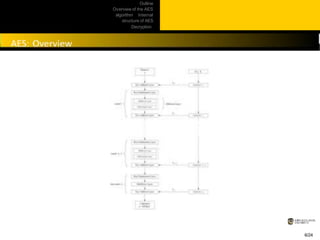
Overview of the AES algorithm
1/24
Outline
Overview of the AES
algorithm Internal
structure of AES
Decryption
Practical
issues
Internal structure of
AES Byte
Substitution layer
Diffusion layer
Key Addition layer
Key schedule
Decryption
Practical
issues
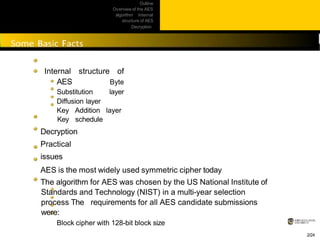
AES is the most widely used symmetric cipher today
The algorithm for AES was chosen by the US National Institute of
Standards and Technology (NIST) in a multi-year selection
process The requirements for all AES candidate submissions
were:
Block cipher with 128-bit block size
2/24
Outline
Overview of the AES
algorithm Internal
structure of AES
Decryption
Practical
issues
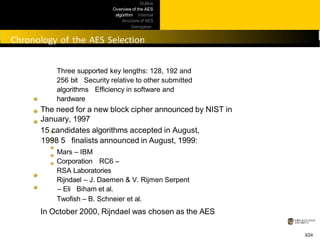
Three supported key lengths: 128, 192 and
256 bit Security relative to other submitted
algorithms Efficiency in software and
hardware
The need for a new block cipher announced by NIST in
January, 1997
15 candidates algorithms accepted in August,
1998 5 finalists announced in August, 1999:
Mars – IBM
Corporation RC6 –
RSA Laboratories
Rijndael – J. Daemen & V. Rijmen Serpent
– Eli Biham et al.
Twofish – B. Schneier et al.
In October 2000, Rijndael was chosen as the AES
3/24
Outline
Overview of the AES
algorithm Internal
structure of AES
Decryption
Practical
issues
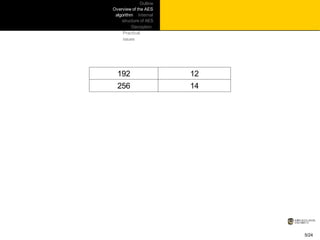
AES was formally approved as a US federal standard in November
2001 The number of rounds depends on the chosen key length:
Key length (bits) Number of rounds
128 10
4/24
Outline
Overview of the AES
algorithm Internal
structure of AES
Decryption
Practical
issues
192 12
256 14
5/24
Outline
Overview of the AES
algorithm Internal
structure of AES
Decryption
Practical
issues
6/24
Outline
Overview of the AES
algorithm Internal
structure of AES
Decryption
Practical
issues
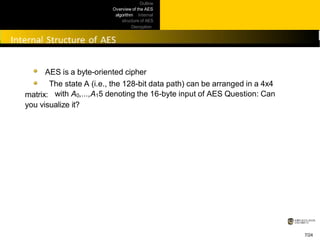
AES is a byte-oriented cipher
The state A (i.e., the 128-bit data path) can be arranged in a 4x4
matrix: with A0,...,A15 denoting the 16-byte input of AES Question: Can
you visualize it?
7/24
Outline
Overview of the AES
algorithm Internal
structure of AES
Decryption
Practical
issues
,
,...,
–
8/24
Outline
Overview of the AES
algorithm Internal
structure of AES
Decryption
Practical
issues
9/24
Outline
Overview of the AES
algorithm Internal
structure of AES
Decryption
Practical
issues
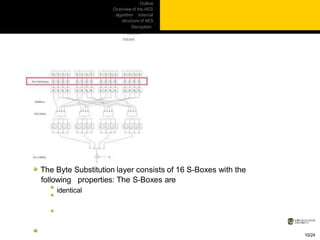
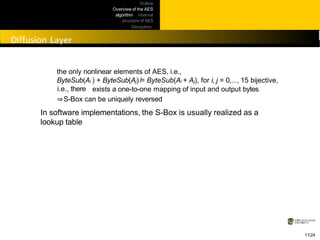
The Byte Substitution layer consists of 16 S-Boxes with the
following properties: The S-Boxes are
identical
10/24
Outline
Overview of the AES
algorithm Internal
structure of AES
Decryption
Practical
issues
the only nonlinear elements of AES, i.e.,
ByteSub(Ai ) + ByteSub(Aj) ̸= ByteSub(Ai + Aj), for i, j = 0,..., 15 bijective,
i.e., there exists a one-to-one mapping of input and output bytes
⇒S-Box can be uniquely reversed
In software implementations, the S-Box is usually realized as a
lookup table
11/24
Outline
Overview of the AES
algorithm Internal
structure of AES
Decryption
Practical
issues
12/24
Outline
Overview of the AES
algorithm Internal
structure of AES
Decryption
Practical
issues
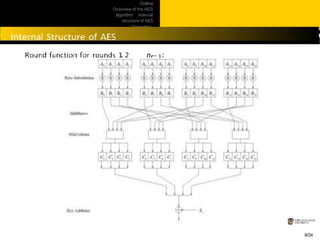
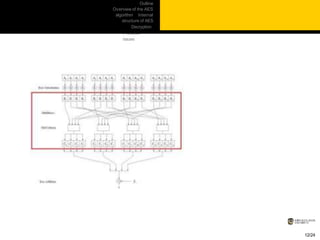
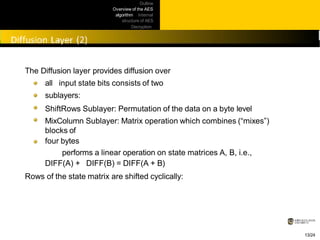
The Diffusion layer provides diffusion over
all input state bits consists of two
sublayers:
ShiftRows Sublayer: Permutation of the data on a byte level
MixColumn Sublayer: Matrix operation which combines (“mixes”)
blocks of
four bytes
performs a linear operation on state matrices A, B, i.e.,
DIFF(A) + DIFF(B) = DIFF(A + B)
Rows of the state matrix are shifted cyclically:
13/24
Outline
Overview of the AES
algorithm Internal
structure of AES
Decryption
Practical
issues
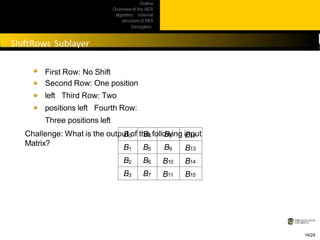
First Row: No Shift
Second Row: One position
left Third Row: Two
positions left Fourth Row:
Three positions left
Challenge: What is the output of the following input
Matrix?
B0 B4 B8 B12
B1 B5 B9 B13
B2 B6 B10 B14
B3 B7 B11 B15
14/24
Outline
Overview of the AES
algorithm Internal
structure of AES
Decryption
Practical
issues
Linear transformation which mixes each column of the state matrix Each 4-
byte column is considered as a vector and multiplied by a fixed 4x4 matrix
All arithmetic is done in the Galois field GF(28)
Example: Assume that the input state to the MixColumn layer
is B = (25,25,...,25).
Note: This is the point to introduce math background about Galois Fields.
Input:
16-byte state matrix C
16-byte subkey ki
15/24
Outline
Overview of the AES
algorithm Internal
structure of AES
Decryption
Practical
issues
Output: C⊕ki
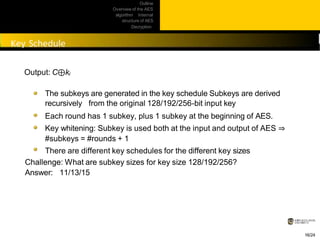
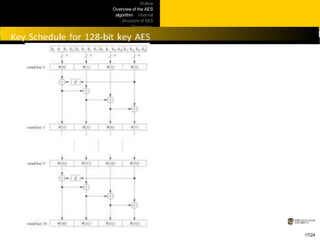
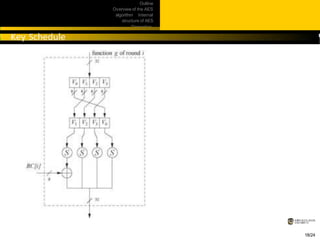
The subkeys are generated in the key schedule Subkeys are derived
recursively from the original 128/192/256-bit input key
Each round has 1 subkey, plus 1 subkey at the beginning of AES.
Key whitening: Subkey is used both at the input and output of AES ⇒
#subkeys = #rounds + 1
There are different key schedules for the different key sizes
Challenge: What are subkey sizes for key size 128/192/256?
Answer: 11/13/15
16/24
Outline
Overview of the AES
algorithm Internal
structure of AES
Decryption
Practical
issues
17/24
Outline
Overview of the AES
algorithm Internal
structure of AES
Decryption
Practical
issues
18/24
Outline
Overview of the AES
algorithm Internal
structure of AES
Decryption
Practical
issues
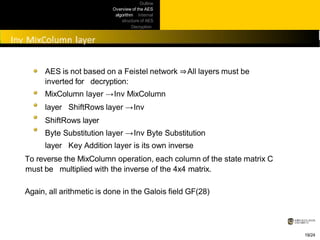
AES is not based on a Feistel network ⇒All layers must be
inverted for decryption:
MixColumn layer →Inv MixColumn
layer ShiftRows layer →Inv
ShiftRows layer
Byte Substitution layer →Inv Byte Substitution
layer Key Addition layer is its own inverse
To reverse the MixColumn operation, each column of the state matrix C
must be multiplied with the inverse of the 4x4 matrix.
Again, all arithmetic is done in the Galois field GF(28)
19/24
Outline
Overview of the AES
algorithm Internal
structure of AES
Decryption
Practical
issues
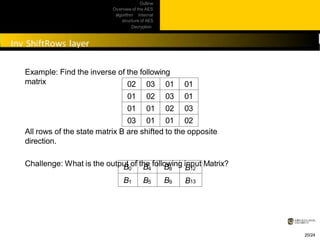
Example: Find the inverse of the following
matrix
20/24
02 03 01 01
01 02 03 01
01 01 02 03
03 01 01 02
All rows of the state matrix B are shifted to the opposite
direction.
Challenge: What is the output of the following input Matrix?
B0 B4 B8 B12
B1 B5 B9 B13
Outline
Overview of the AES
algorithm Internal
structure of AES
Decryption
Practical
issues
B2 B6 B10 B14
B3 B7 B11 B15
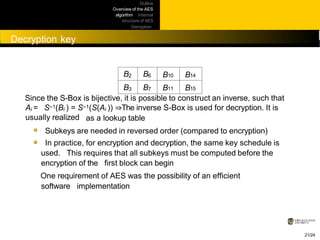
Since the S-Box is bijective, it is possible to construct an inverse, such that
Ai = S−1(Bi ) = S−1(S(Ai )) ⇒The inverse S-Box is used for decryption. It is
usually realized as a lookup table
Subkeys are needed in reversed order (compared to encryption)
In practice, for encryption and decryption, the same key schedule is
used. This requires that all subkeys must be computed before the
encryption of the first block can begin
One requirement of AES was the possibility of an efficient
software implementation
Decryption key
schedule
21/24
Outline
Overview of the AES
algorithm Internal
structure of AES
Decryption
Practical
issues
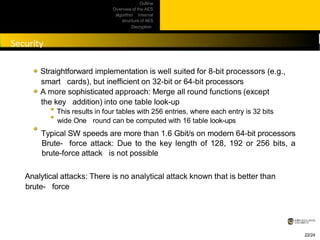
Straightforward implementation is well suited for 8-bit processors (e.g.,
smart cards), but inefficient on 32-bit or 64-bit processors
A more sophisticated approach: Merge all round functions (except
the key addition) into one table look-up
This results in four tables with 256 entries, where each entry is 32 bits
wide One round can be computed with 16 table look-ups
Typical SW speeds are more than 1.6 Gbit/s on modern 64-bit processors
Brute- force attack: Due to the key length of 128, 192 or 256 bits, a
brute-force attack is not possible
Analytical attacks: There is no analytical attack known that is better than
brute- force
Implementation in
Software
22/24
Outline
Overview of the AES
algorithm Internal
structure of AES
Decryption
Practical
issues
Side-channel attacks:
Several side-channel attacks have been published
Note that side-channel attacks do not attack the underlying
algorithm but the implementation of it
AES is a modern block cipher which supports three key lengths of 128,
192 and 256 bit. It provides excellent long-term security against brute-
force attacks.
AES has been studied intensively since the late 1990s and no
attacks have been found that are better than brute-force.
AES is not based on Feistel networks. Its basic operations use
Galois field arithmetic and provide strong diffusion and confusion.
Lesson
Learned
23/24
Outline
Overview of the AES
algorithm Internal
structure of AES
Decryption
Practical
issues
AES is part of numerous open standards such as IPsec or TLS, in
addition to being the mandatory encryption algorithm for US
government applications. It seems likely that the cipher will be the
dominant encryption algorithm for many years to come.
AES is efficient in software and hardware.
24/24

AES (Intro Advanced Encryption Standard).pptx

  • 1.
    Outline Overview of theAES algorithm Internal structure of AES Decryption Practical issues Dr. Hong Biao Zeng Materials are coming from Textbook of Understanding Cryptography A Textbook for Students and Practitioners by Christof Paar and Jan Pelzl Fall 2022 In this chapter, students shall learn: Overview of the AES algorithm 1/24
  • 2.
    Outline Overview of theAES algorithm Internal structure of AES Decryption Practical issues Internal structure of AES Byte Substitution layer Diffusion layer Key Addition layer Key schedule Decryption Practical issues AES is the most widely used symmetric cipher today The algorithm for AES was chosen by the US National Institute of Standards and Technology (NIST) in a multi-year selection process The requirements for all AES candidate submissions were: Block cipher with 128-bit block size 2/24
  • 3.
    Outline Overview of theAES algorithm Internal structure of AES Decryption Practical issues Three supported key lengths: 128, 192 and 256 bit Security relative to other submitted algorithms Efficiency in software and hardware The need for a new block cipher announced by NIST in January, 1997 15 candidates algorithms accepted in August, 1998 5 finalists announced in August, 1999: Mars – IBM Corporation RC6 – RSA Laboratories Rijndael – J. Daemen & V. Rijmen Serpent – Eli Biham et al. Twofish – B. Schneier et al. In October 2000, Rijndael was chosen as the AES 3/24
  • 4.
    Outline Overview of theAES algorithm Internal structure of AES Decryption Practical issues AES was formally approved as a US federal standard in November 2001 The number of rounds depends on the chosen key length: Key length (bits) Number of rounds 128 10 4/24
  • 5.
    Outline Overview of theAES algorithm Internal structure of AES Decryption Practical issues 192 12 256 14 5/24
  • 6.
    Outline Overview of theAES algorithm Internal structure of AES Decryption Practical issues 6/24
  • 7.
    Outline Overview of theAES algorithm Internal structure of AES Decryption Practical issues AES is a byte-oriented cipher The state A (i.e., the 128-bit data path) can be arranged in a 4x4 matrix: with A0,...,A15 denoting the 16-byte input of AES Question: Can you visualize it? 7/24
  • 8.
    Outline Overview of theAES algorithm Internal structure of AES Decryption Practical issues , ,..., – 8/24
  • 9.
    Outline Overview of theAES algorithm Internal structure of AES Decryption Practical issues 9/24
  • 10.
    Outline Overview of theAES algorithm Internal structure of AES Decryption Practical issues The Byte Substitution layer consists of 16 S-Boxes with the following properties: The S-Boxes are identical 10/24
  • 11.
    Outline Overview of theAES algorithm Internal structure of AES Decryption Practical issues the only nonlinear elements of AES, i.e., ByteSub(Ai ) + ByteSub(Aj) ̸= ByteSub(Ai + Aj), for i, j = 0,..., 15 bijective, i.e., there exists a one-to-one mapping of input and output bytes ⇒S-Box can be uniquely reversed In software implementations, the S-Box is usually realized as a lookup table 11/24
  • 12.
    Outline Overview of theAES algorithm Internal structure of AES Decryption Practical issues 12/24
  • 13.
    Outline Overview of theAES algorithm Internal structure of AES Decryption Practical issues The Diffusion layer provides diffusion over all input state bits consists of two sublayers: ShiftRows Sublayer: Permutation of the data on a byte level MixColumn Sublayer: Matrix operation which combines (“mixes”) blocks of four bytes performs a linear operation on state matrices A, B, i.e., DIFF(A) + DIFF(B) = DIFF(A + B) Rows of the state matrix are shifted cyclically: 13/24
  • 14.
    Outline Overview of theAES algorithm Internal structure of AES Decryption Practical issues First Row: No Shift Second Row: One position left Third Row: Two positions left Fourth Row: Three positions left Challenge: What is the output of the following input Matrix? B0 B4 B8 B12 B1 B5 B9 B13 B2 B6 B10 B14 B3 B7 B11 B15 14/24
  • 15.
    Outline Overview of theAES algorithm Internal structure of AES Decryption Practical issues Linear transformation which mixes each column of the state matrix Each 4- byte column is considered as a vector and multiplied by a fixed 4x4 matrix All arithmetic is done in the Galois field GF(28) Example: Assume that the input state to the MixColumn layer is B = (25,25,...,25). Note: This is the point to introduce math background about Galois Fields. Input: 16-byte state matrix C 16-byte subkey ki 15/24
  • 16.
    Outline Overview of theAES algorithm Internal structure of AES Decryption Practical issues Output: C⊕ki The subkeys are generated in the key schedule Subkeys are derived recursively from the original 128/192/256-bit input key Each round has 1 subkey, plus 1 subkey at the beginning of AES. Key whitening: Subkey is used both at the input and output of AES ⇒ #subkeys = #rounds + 1 There are different key schedules for the different key sizes Challenge: What are subkey sizes for key size 128/192/256? Answer: 11/13/15 16/24
  • 17.
    Outline Overview of theAES algorithm Internal structure of AES Decryption Practical issues 17/24
  • 18.
    Outline Overview of theAES algorithm Internal structure of AES Decryption Practical issues 18/24
  • 19.
    Outline Overview of theAES algorithm Internal structure of AES Decryption Practical issues AES is not based on a Feistel network ⇒All layers must be inverted for decryption: MixColumn layer →Inv MixColumn layer ShiftRows layer →Inv ShiftRows layer Byte Substitution layer →Inv Byte Substitution layer Key Addition layer is its own inverse To reverse the MixColumn operation, each column of the state matrix C must be multiplied with the inverse of the 4x4 matrix. Again, all arithmetic is done in the Galois field GF(28) 19/24
  • 20.
    Outline Overview of theAES algorithm Internal structure of AES Decryption Practical issues Example: Find the inverse of the following matrix 20/24 02 03 01 01 01 02 03 01 01 01 02 03 03 01 01 02 All rows of the state matrix B are shifted to the opposite direction. Challenge: What is the output of the following input Matrix? B0 B4 B8 B12 B1 B5 B9 B13
  • 21.
    Outline Overview of theAES algorithm Internal structure of AES Decryption Practical issues B2 B6 B10 B14 B3 B7 B11 B15 Since the S-Box is bijective, it is possible to construct an inverse, such that Ai = S−1(Bi ) = S−1(S(Ai )) ⇒The inverse S-Box is used for decryption. It is usually realized as a lookup table Subkeys are needed in reversed order (compared to encryption) In practice, for encryption and decryption, the same key schedule is used. This requires that all subkeys must be computed before the encryption of the first block can begin One requirement of AES was the possibility of an efficient software implementation Decryption key schedule 21/24
  • 22.
    Outline Overview of theAES algorithm Internal structure of AES Decryption Practical issues Straightforward implementation is well suited for 8-bit processors (e.g., smart cards), but inefficient on 32-bit or 64-bit processors A more sophisticated approach: Merge all round functions (except the key addition) into one table look-up This results in four tables with 256 entries, where each entry is 32 bits wide One round can be computed with 16 table look-ups Typical SW speeds are more than 1.6 Gbit/s on modern 64-bit processors Brute- force attack: Due to the key length of 128, 192 or 256 bits, a brute-force attack is not possible Analytical attacks: There is no analytical attack known that is better than brute- force Implementation in Software 22/24
  • 23.
    Outline Overview of theAES algorithm Internal structure of AES Decryption Practical issues Side-channel attacks: Several side-channel attacks have been published Note that side-channel attacks do not attack the underlying algorithm but the implementation of it AES is a modern block cipher which supports three key lengths of 128, 192 and 256 bit. It provides excellent long-term security against brute- force attacks. AES has been studied intensively since the late 1990s and no attacks have been found that are better than brute-force. AES is not based on Feistel networks. Its basic operations use Galois field arithmetic and provide strong diffusion and confusion. Lesson Learned 23/24
  • 24.
    Outline Overview of theAES algorithm Internal structure of AES Decryption Practical issues AES is part of numerous open standards such as IPsec or TLS, in addition to being the mandatory encryption algorithm for US government applications. It seems likely that the cipher will be the dominant encryption algorithm for many years to come. AES is efficient in software and hardware. 24/24