3G VS 4G
and
Cellular Networks
Team members
Contents…
3G VS 4G
3
◎Introduction
◎1G wireless technology and its drawbacks
◎2G wireless technology and its drawbacks
◎2.5G wireless technology and its drawbacks
◎3G wireless technology and its drawbacks
◎4G wireless technology and its drawbacks
◎5G wireless technology and its drawbacks
◎Future technology
4
Introduction
The word wireless in dictionary defined “having no
wires ” .
In networking terminology , wireless is the term
used to describe any computer network where there
is no physical wired connection
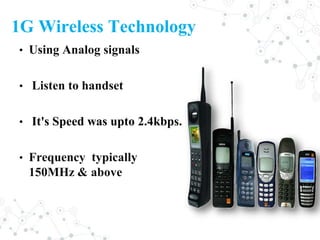
• Using Analog signals
• Listen to handset
• It's Speed was upto 2.4kbps.
• Frequency typically
150MHz & above
1G Wireless Technology
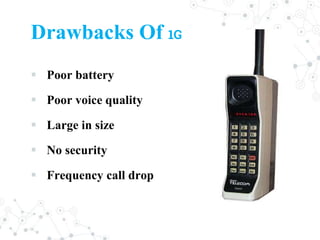
Drawbacks Of 1G
 Poor battery
 Poor voice quality
 Large in size
 No security
 Frequency call drop
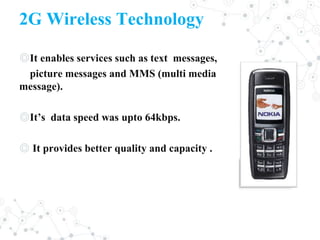
2G Wireless Technology
◎It enables services such as text messages,
picture messages and MMS (multi media
message).
◎It’s data speed was upto 64kbps.
◎ It provides better quality and capacity .
Drawbacks Of 2G
◎Weaker digital signal
◎These systems are unable to handle complex data
such as Videos.
◎Reduce range of sound
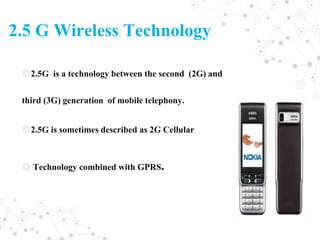
2.5 G Wireless Technology
◎2.5G is a technology between the second (2G) and
third (3G) generation of mobile telephony.
◎2.5G is sometimes described as 2G Cellular
◎ Technology combined with GPRS.
Features Includes in 2.5 G:
◎Phone Calls
◎ Send/Receive E-mail Messages
◎ Web Browsing
◎ Speed : 64-144 kbps
◎ Camera Phones
3G Wireless Technology
◎Data Transmission speed increased from
144kbps- 2Mbps.
◎Providing Faster Communication
◎ Send/Receive Large Email Messages
◎High Speed Web / More Security
◎Video Conferencing / 3D Gaming
◎TV Streaming/ Mobile TV/ Phone Calls
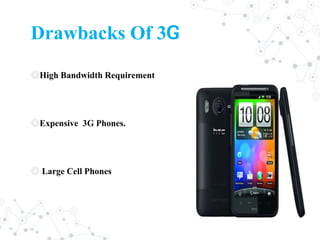
Drawbacks Of 3G
◎High Bandwidth Requirement
◎Expensive 3G Phones.
◎ Large Cell Phones
4G Wireless Technology
“ Any time any where”
◎Capable of providing 100Mbps – 1Gbps speed.
◎ More Security
◎ High Speed
◎ High Capacity
◎ Low Cost Per-bit
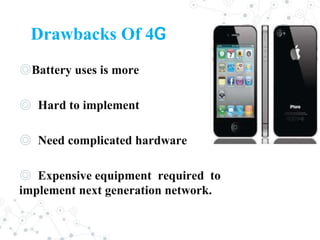
Drawbacks Of 4G
◎Battery uses is more
◎ Hard to implement
◎ Need complicated hardware
◎ Expensive equipment required to
implement next generation network.
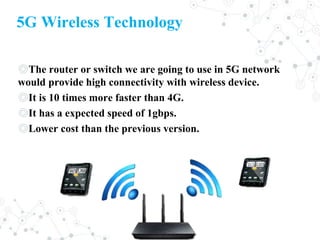
5G Wireless Technology
◎The router or switch we are going to use in 5G network
would provide high connectivity with wireless device.
◎It is 10 times more faster than 4G.
◎It has a expected speed of 1gbps.
◎Lower cost than the previous version.
Features
◎Uploading & Downloading speed of 5G touching the peak (up to 1Gbps)
◎Better & fast solution
◎It is highly supportable to WWWW
(Wireless World Wide Web).
◎Large Phone Memory, Dialing Speed,
clarity in Audio/Video.
◎5G technology is going to give tough competition to Computers and
Laptops.
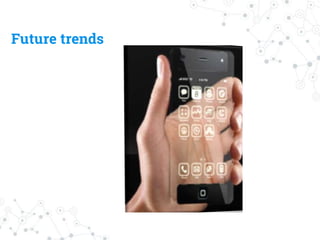
Future trends
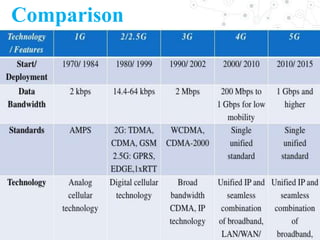
Comparison
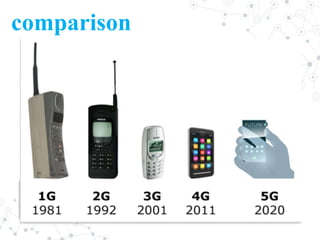
comparison
Cellular
Networks
CONTENTS
◎Introduction
◎Working
◎Benefits
◎Characteristics
◎Movement From Cell To Cell
◎Mobile Phone Networks
◎Future Scope
◎Bibliography
21
22
INTRODUCTION
22
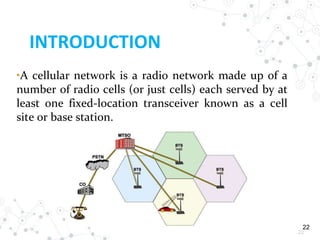
•A cellular network is a radio network made up of a
number of radio cells (or just cells) each served by at
least one fixed-location transceiver known as a cell
site or base station.
Example
 An example of a simple non-telephone cellular system is
an taxi driver's radio system where the taxi company
has several transmitters based around a city that can
communicate directly with each taxi.
23
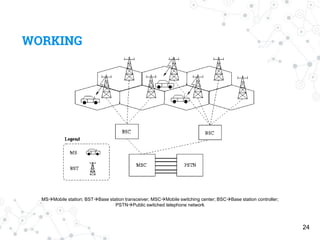
WORKING
24
MSMobile station; BSTBase station transceiver; MSCMobile switching center; BSCBase station controller;
PSTNPublic switched telephone network
BENEFITS
◎More capacity due to spectral reuse
◎Lower transmission power due to smaller
transmitter/receiver distances
◎reduced power usage
◎larger coverage area
◎reduced interference from other signals
25
CHARACTERISTICS
PAGING
26
• Paging takes place by sending the broadcast message
to all of the cells.
• In mobile telephony systems, the most important use of
broadcast information is to set up channels for one to
one communication between the mobile transceiver and
the base station.
• Paging messages can be used for information transfer.
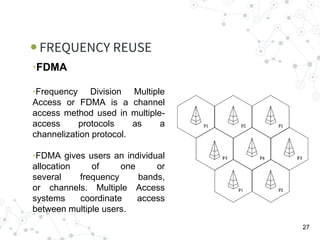
FREQUENCY REUSE
27
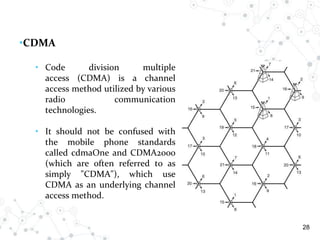
•FDMA
•Frequency Division Multiple
Access or FDMA is a channel
access method used in multiple-
access protocols as a
channelization protocol.
•FDMA gives users an individual
allocation of one or
several frequency bands,
or channels. Multiple Access
systems coordinate access
between multiple users.
28
•CDMA
• Code division multiple
access (CDMA) is a channel
access method utilized by various
radio communication
technologies.
• It should not be confused with
the mobile phone standards
called cdmaOne and CDMA2000
(which are often referred to as
simply "CDMA"), which use
CDMA as an underlying channel
access method.
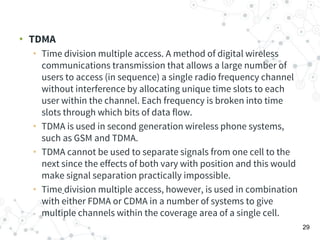
• TDMA
• Time division multiple access. A method of digital wireless
communications transmission that allows a large number of
users to access (in sequence) a single radio frequency channel
without interference by allocating unique time slots to each
user within the channel. Each frequency is broken into time
slots through which bits of data flow.
• TDMA is used in second generation wireless phone systems,
such as GSM and TDMA.
• TDMA cannot be used to separate signals from one cell to the
next since the effects of both vary with position and this would
make signal separation practically impossible.
• Time division multiple access, however, is used in combination
with either FDMA or CDMA in a number of systems to give
multiple channels within the coverage area of a single cell.
29
MOVEMENT FROM CELL TO CELL & HANDOVER
manual switching
30
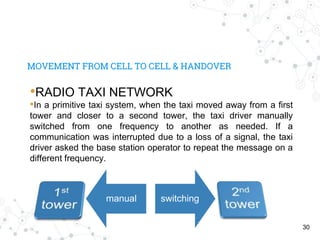
•RADIO TAXI NETWORK
•In a primitive taxi system, when the taxi moved away from a first
tower and closer to a second tower, the taxi driver manually
switched from one frequency to another as needed. If a
communication was interrupted due to a loss of a signal, the taxi
driver asked the base station operator to repeat the message on a
different frequency.
MOVEMENT FROM CELL TO CELL & HANDOVER
•CELLULAR NETWORK
•In a cellular system, as the distributed mobile transceivers
move from cell to cell during an ongoing continuous
communication, switching from one cell frequency to a different
cell frequency is done electronically without interruption.
•This is called the handover or handoff.
MOBILE PHONE NETWORKS
The most common example of a cellular network is a mobile
phone (cell phone) network.
A mobile phone is a portable telephone which receives or makes
calls through a cell site (base station), or transmitting tower.
Since almost all mobile phones use cellular technology,
including GSM, CDMA, and AMPS (analog), the term "cell phone" is in
some regions, notably the US, used interchangeably with "mobile
phone".
However, satellite phones are mobile phones that do not
communicate directly with a ground-based cellular tower, but may
do so indirectly by way of a satellite.
32
MOBILE PHONE NETWORKS
(Contd.)
◎There are a number of different digital cellular technologies, including:
○Global System for Mobile Communications (GSM)
○ General Packet Radio Service (GPRS)
○ Code Division Multiple Access (CDMA)
○ Evolution-Data Optimized (EV-DO)
○ Enhanced Data Rates for GSM Evolution (EDGE or GSM EDGE)
○ 3GSM
○ Digital Enhanced Cordless Telecommunications (DECT)
○ Digital AMPS (IS-136/TDMA)
○ Integrated Digital Enhanced Network (iDEN).
CDMA
◎Interim Standard 95 (IS-95) is the first CDMA-based digital cellular
standard pioneered by Qualcomm. The brand name for IS-95 is cdmaOne.
◎It is a 2G Mobile Telecommunications Standard that uses CDMA,
a multiple access scheme for digital radio, to send voice, data and signaling
data (such as a dialed telephone number) between
mobile telephones and cell sites.
◎CDMA or "code division multiple access" is a digital radio system that
transmits streams of bits (PN codes).
◎CDMA permits several radios to share the same frequencies.
◎Unlike TDMA "time division multiple access", a competing system used
in 2G GSM, all radios can be active all the time, because network capacity
does not directly limit the number of active radios.
34
CDMA (Contd.)
◎Since larger numbers of phones can be served by smaller numbers
of cell-sites, CDMA-based standards have a significant economic
advantage over TDMA-based standards that used frequency-division
multiplexing.
35
GSM
◎GSM (Global System for Mobile communications: originally
from Groupe Spécial Mobile) is the most popular standard for mobile
phones in the world.
◎Its promoter, the GSM Association, estimates that 80% of the global
mobile market uses the standard. GSM is used by over 3 billion people
across more than 212 countries and territories.
◎GSM differs from its predecessors in that both signaling and speech
channels are digital, and thus is considered a second generation (2G) mobile
phone system.
◎This has also meant that data communication was easy to build into the
system. GSM EDGE is a 3G version of the protocol.
36
FUTURE SCOPE
◎Next Generation Mobile Networks (NGMN) Ltd. - Consortium
with partnership of major mobile operators
◎Recommendations without specific technology prescriptions
◎Target to establish performance targets, recommendations
and deployment scenarios for future wide-area mobile
broadband network packet switched core.
◎The architecture intended to provide a smooth migration of
existing 2G/3G networks towards an IP network that is cost
competitive and has broadband performance.
◎Multi-hopping Networks.
37
BIBLIOGRAPHY
◎www.google.com
◎www.wikipedia.org
◎http://www.acm.org/crossroads/xrds7-
2/cellular.html
38
Thanks!

3G vs 4G and Cellular Networks

  • 1.
  • 2.
  • 3.
    Contents… 3G VS 4G 3 ◎Introduction ◎1Gwireless technology and its drawbacks ◎2G wireless technology and its drawbacks ◎2.5G wireless technology and its drawbacks ◎3G wireless technology and its drawbacks ◎4G wireless technology and its drawbacks ◎5G wireless technology and its drawbacks ◎Future technology
  • 4.
    4 Introduction The word wirelessin dictionary defined “having no wires ” . In networking terminology , wireless is the term used to describe any computer network where there is no physical wired connection
  • 5.
    • Using Analogsignals • Listen to handset • It's Speed was upto 2.4kbps. • Frequency typically 150MHz & above 1G Wireless Technology
  • 6.
    Drawbacks Of 1G Poor battery  Poor voice quality  Large in size  No security  Frequency call drop
  • 7.
    2G Wireless Technology ◎Itenables services such as text messages, picture messages and MMS (multi media message). ◎It’s data speed was upto 64kbps. ◎ It provides better quality and capacity .
  • 8.
    Drawbacks Of 2G ◎Weakerdigital signal ◎These systems are unable to handle complex data such as Videos. ◎Reduce range of sound
  • 9.
    2.5 G WirelessTechnology ◎2.5G is a technology between the second (2G) and third (3G) generation of mobile telephony. ◎2.5G is sometimes described as 2G Cellular ◎ Technology combined with GPRS.
  • 10.
    Features Includes in2.5 G: ◎Phone Calls ◎ Send/Receive E-mail Messages ◎ Web Browsing ◎ Speed : 64-144 kbps ◎ Camera Phones
  • 11.
    3G Wireless Technology ◎DataTransmission speed increased from 144kbps- 2Mbps. ◎Providing Faster Communication ◎ Send/Receive Large Email Messages ◎High Speed Web / More Security ◎Video Conferencing / 3D Gaming ◎TV Streaming/ Mobile TV/ Phone Calls
  • 12.
    Drawbacks Of 3G ◎HighBandwidth Requirement ◎Expensive 3G Phones. ◎ Large Cell Phones
  • 13.
    4G Wireless Technology “Any time any where” ◎Capable of providing 100Mbps – 1Gbps speed. ◎ More Security ◎ High Speed ◎ High Capacity ◎ Low Cost Per-bit
  • 14.
    Drawbacks Of 4G ◎Batteryuses is more ◎ Hard to implement ◎ Need complicated hardware ◎ Expensive equipment required to implement next generation network.
  • 15.
    5G Wireless Technology ◎Therouter or switch we are going to use in 5G network would provide high connectivity with wireless device. ◎It is 10 times more faster than 4G. ◎It has a expected speed of 1gbps. ◎Lower cost than the previous version.
  • 16.
    Features ◎Uploading & Downloadingspeed of 5G touching the peak (up to 1Gbps) ◎Better & fast solution ◎It is highly supportable to WWWW (Wireless World Wide Web). ◎Large Phone Memory, Dialing Speed, clarity in Audio/Video. ◎5G technology is going to give tough competition to Computers and Laptops.
  • 17.
  • 18.
  • 19.
  • 20.
  • 21.
    CONTENTS ◎Introduction ◎Working ◎Benefits ◎Characteristics ◎Movement From CellTo Cell ◎Mobile Phone Networks ◎Future Scope ◎Bibliography 21
  • 22.
    22 INTRODUCTION 22 •A cellular networkis a radio network made up of a number of radio cells (or just cells) each served by at least one fixed-location transceiver known as a cell site or base station.
  • 23.
    Example  An exampleof a simple non-telephone cellular system is an taxi driver's radio system where the taxi company has several transmitters based around a city that can communicate directly with each taxi. 23
  • 24.
    WORKING 24 MSMobile station; BSTBasestation transceiver; MSCMobile switching center; BSCBase station controller; PSTNPublic switched telephone network
  • 25.
    BENEFITS ◎More capacity dueto spectral reuse ◎Lower transmission power due to smaller transmitter/receiver distances ◎reduced power usage ◎larger coverage area ◎reduced interference from other signals 25
  • 26.
    CHARACTERISTICS PAGING 26 • Paging takesplace by sending the broadcast message to all of the cells. • In mobile telephony systems, the most important use of broadcast information is to set up channels for one to one communication between the mobile transceiver and the base station. • Paging messages can be used for information transfer.
  • 27.
    FREQUENCY REUSE 27 •FDMA •Frequency DivisionMultiple Access or FDMA is a channel access method used in multiple- access protocols as a channelization protocol. •FDMA gives users an individual allocation of one or several frequency bands, or channels. Multiple Access systems coordinate access between multiple users.
  • 28.
    28 •CDMA • Code divisionmultiple access (CDMA) is a channel access method utilized by various radio communication technologies. • It should not be confused with the mobile phone standards called cdmaOne and CDMA2000 (which are often referred to as simply "CDMA"), which use CDMA as an underlying channel access method.
  • 29.
    • TDMA • Timedivision multiple access. A method of digital wireless communications transmission that allows a large number of users to access (in sequence) a single radio frequency channel without interference by allocating unique time slots to each user within the channel. Each frequency is broken into time slots through which bits of data flow. • TDMA is used in second generation wireless phone systems, such as GSM and TDMA. • TDMA cannot be used to separate signals from one cell to the next since the effects of both vary with position and this would make signal separation practically impossible. • Time division multiple access, however, is used in combination with either FDMA or CDMA in a number of systems to give multiple channels within the coverage area of a single cell. 29
  • 30.
    MOVEMENT FROM CELLTO CELL & HANDOVER manual switching 30 •RADIO TAXI NETWORK •In a primitive taxi system, when the taxi moved away from a first tower and closer to a second tower, the taxi driver manually switched from one frequency to another as needed. If a communication was interrupted due to a loss of a signal, the taxi driver asked the base station operator to repeat the message on a different frequency.
  • 31.
    MOVEMENT FROM CELLTO CELL & HANDOVER •CELLULAR NETWORK •In a cellular system, as the distributed mobile transceivers move from cell to cell during an ongoing continuous communication, switching from one cell frequency to a different cell frequency is done electronically without interruption. •This is called the handover or handoff.
  • 32.
    MOBILE PHONE NETWORKS Themost common example of a cellular network is a mobile phone (cell phone) network. A mobile phone is a portable telephone which receives or makes calls through a cell site (base station), or transmitting tower. Since almost all mobile phones use cellular technology, including GSM, CDMA, and AMPS (analog), the term "cell phone" is in some regions, notably the US, used interchangeably with "mobile phone". However, satellite phones are mobile phones that do not communicate directly with a ground-based cellular tower, but may do so indirectly by way of a satellite. 32
  • 33.
    MOBILE PHONE NETWORKS (Contd.) ◎Thereare a number of different digital cellular technologies, including: ○Global System for Mobile Communications (GSM) ○ General Packet Radio Service (GPRS) ○ Code Division Multiple Access (CDMA) ○ Evolution-Data Optimized (EV-DO) ○ Enhanced Data Rates for GSM Evolution (EDGE or GSM EDGE) ○ 3GSM ○ Digital Enhanced Cordless Telecommunications (DECT) ○ Digital AMPS (IS-136/TDMA) ○ Integrated Digital Enhanced Network (iDEN).
  • 34.
    CDMA ◎Interim Standard 95(IS-95) is the first CDMA-based digital cellular standard pioneered by Qualcomm. The brand name for IS-95 is cdmaOne. ◎It is a 2G Mobile Telecommunications Standard that uses CDMA, a multiple access scheme for digital radio, to send voice, data and signaling data (such as a dialed telephone number) between mobile telephones and cell sites. ◎CDMA or "code division multiple access" is a digital radio system that transmits streams of bits (PN codes). ◎CDMA permits several radios to share the same frequencies. ◎Unlike TDMA "time division multiple access", a competing system used in 2G GSM, all radios can be active all the time, because network capacity does not directly limit the number of active radios. 34
  • 35.
    CDMA (Contd.) ◎Since largernumbers of phones can be served by smaller numbers of cell-sites, CDMA-based standards have a significant economic advantage over TDMA-based standards that used frequency-division multiplexing. 35
  • 36.
    GSM ◎GSM (Global Systemfor Mobile communications: originally from Groupe Spécial Mobile) is the most popular standard for mobile phones in the world. ◎Its promoter, the GSM Association, estimates that 80% of the global mobile market uses the standard. GSM is used by over 3 billion people across more than 212 countries and territories. ◎GSM differs from its predecessors in that both signaling and speech channels are digital, and thus is considered a second generation (2G) mobile phone system. ◎This has also meant that data communication was easy to build into the system. GSM EDGE is a 3G version of the protocol. 36
  • 37.
    FUTURE SCOPE ◎Next GenerationMobile Networks (NGMN) Ltd. - Consortium with partnership of major mobile operators ◎Recommendations without specific technology prescriptions ◎Target to establish performance targets, recommendations and deployment scenarios for future wide-area mobile broadband network packet switched core. ◎The architecture intended to provide a smooth migration of existing 2G/3G networks towards an IP network that is cost competitive and has broadband performance. ◎Multi-hopping Networks. 37
  • 38.
  • 39.