Cholera
• Cholera is an
infectious disease that causes severe
watery
diarrhea ,
which leads to
dehydration .
•
Caused
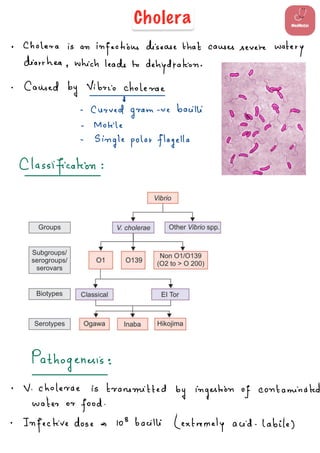
by Vibrio cholerae
11
-
Curved
gram
-
ve bacilli
-
Motile
-
Single polar flagella
Classification :
Pathogenesis :
•
V. cholerae is transmitted
by ingestion of contaminated
water or
food .
•
Infective dose 108 bacilli (extremely acid -
labile )
Cholera Toxins :
• The toxin molecule consists of two peptide fragments
- A & B
A causes ADP
ribosylation of G- protein >
upregulates
the
activity of Adenylate cyclase → A CAMP .
B Binds to GMI
ganglia side receptors .
•
Increase in CAMP leads to :
(a) Inhibition of absorptive sodium transport system
in villus cells & activates
secretory chloride
which leads to Nacl in lumen .
(b) Inla ten moves
passively into bowel lumen .
(c) loss
of fluid &
electrolytes leads to shock &
acidosis .
•
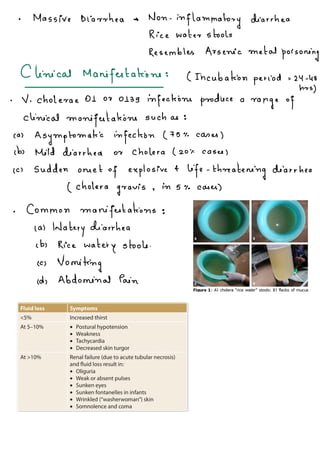
Massive Diarrhea Non -
inflammatory diarrhea
Rice water stools
Resembles Arsenic metal
poisoning
Clinical Manifestations :
( Incubation period = 24-48
hrs)
• V. cholerae 01 00 0139
infections produce a
range of
clinical
manifestations such as :
(a)
Asymptomatic infection ( 75% cases )
(b) Mild diarrhea or cholera ( 20% cases )
(c) Sudden onset
of explosive &
life -
threatening diarrhea
( cholera
gravis ,
in 5% cases)
• Common manifestations :
(a)
lnlatery diarrhea
(b) Rice
watery stools .
(c)
Vomiting
(d) Abdominal Pain
MedNotes [ www.mednotes.in ]
Full MedNotes : mednotesebooks.company.site
App Available on PlayStore
laboratory Diagnosis :
( is
Transport media - YR ( Venkatraman Ramakrishnan
)
Media
-
Cary - Blair Medium
ciii Enrichment Media -
Alkaline
Peptone water .
ciii, selective media -
T CBs ( Green to Yellow )
Treatment :
ii. Fluid
replacement
cii, Antibiotics (minor role)
Is
Doc = Macrolides ( Azithromycin or
Erythromycin )
C

4. Cholera.pdf

  • 1.
    Cholera • Cholera isan infectious disease that causes severe watery diarrhea , which leads to dehydration . • Caused by Vibrio cholerae 11 - Curved gram - ve bacilli - Motile - Single polar flagella Classification : Pathogenesis : • V. cholerae is transmitted by ingestion of contaminated water or food . • Infective dose 108 bacilli (extremely acid - labile )
  • 2.
    Cholera Toxins : •The toxin molecule consists of two peptide fragments - A & B A causes ADP ribosylation of G- protein > upregulates the activity of Adenylate cyclase → A CAMP . B Binds to GMI ganglia side receptors . • Increase in CAMP leads to : (a) Inhibition of absorptive sodium transport system in villus cells & activates secretory chloride which leads to Nacl in lumen . (b) Inla ten moves passively into bowel lumen . (c) loss of fluid & electrolytes leads to shock & acidosis .
  • 3.
    • Massive Diarrhea Non- inflammatory diarrhea Rice water stools Resembles Arsenic metal poisoning Clinical Manifestations : ( Incubation period = 24-48 hrs) • V. cholerae 01 00 0139 infections produce a range of clinical manifestations such as : (a) Asymptomatic infection ( 75% cases ) (b) Mild diarrhea or cholera ( 20% cases ) (c) Sudden onset of explosive & life - threatening diarrhea ( cholera gravis , in 5% cases) • Common manifestations : (a) lnlatery diarrhea (b) Rice watery stools . (c) Vomiting (d) Abdominal Pain
  • 4.
    MedNotes [ www.mednotes.in] Full MedNotes : mednotesebooks.company.site App Available on PlayStore laboratory Diagnosis : ( is Transport media - YR ( Venkatraman Ramakrishnan ) Media - Cary - Blair Medium ciii Enrichment Media - Alkaline Peptone water . ciii, selective media - T CBs ( Green to Yellow ) Treatment : ii. Fluid replacement cii, Antibiotics (minor role) Is Doc = Macrolides ( Azithromycin or Erythromycin ) C