Course:M.Sc. Nursing
Subject: Nursing Education
Unit : II. Teaching and Learning
Topic :Teaching and Learning Process
Prepared By
Dr.M.Kavimani Adhavan, Ph.D(N).,
Principal
OBJECTIVES
At the end of the session the students will be able to,
Define teaching and leaning .
Mention the concept of learning.
Describe the teaching and learning process.
Explain the functions and qualities of teaching.
List the principles of teaching and leaning .
Describe the theories of teaching and learning.
Explain the relationship between the teaching and learning.
TEACHING
INTRODUCTION
“Teaching is an interactive process, primarily involving class room
talk, which takes place between the teacher and pupils and
occurs during certain definable activities".
DEFINITION OF TEACHING
‱ “Teaching is the task of the teacher which is performed for the
development of the child or learner”.
-Ethmas P Green
‱ “Teaching is the stimulation, guidance, direction and
encouragement of learning”.
-Burton
‱ “Teaching is a form of interpersonal influence aimed at changing
the behavior potential of another person”.
-N.L Gage (1962)
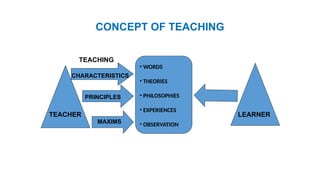
CONCEPT OF TEACHING
TEACHER LEARNER
CHARACTERISTICS
TEACHING
PRINCIPLES
MAXIMS
‱ WORDS
‱ THEORIES
‱ PHILOSOPHIES
‱ EXPERIENCES
‱ OBSERVATION
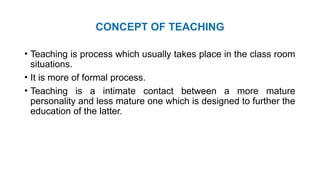
CONCEPT OF TEACHING
‱ Teaching is process which usually takes place in the class room
situations.
‱ It is more of formal process.
‱ Teaching is a intimate contact between a more mature
personality and less mature one which is designed to further the
education of the latter.
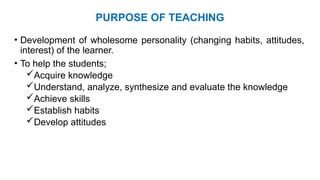
PURPOSE OF TEACHING
‱ Development of wholesome personality (changing habits, attitudes,
interest) of the learner.
‱ To help the students;
Acquire knowledge
Understand, analyze, synthesize and evaluate the knowledge
Achieve skills
Establish habits
Develop attitudes
8
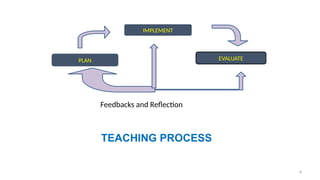
TEACHING PROCESS
IMPLEMENT
PLAN EVALUATE
Feedbacks and Reflection
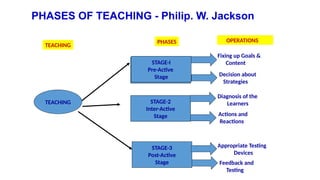
STGE-I
Pre-Active
Stage
STAGE-2
Inter-Active
Stage
STAGE-3
Post-Active
Stage
TEACHING
STAGE-I
Pre-Active
Stage
Fixing up Goals &
Content
Decision about
Strategies
Diagnosis of the
Learners
Actions and
Reactions
Appropriate Testing
Devices
Feedback and
Testing
TEACHING
PHASES OPERATIONS
PHASES OF TEACHING - Philip. W. Jackson
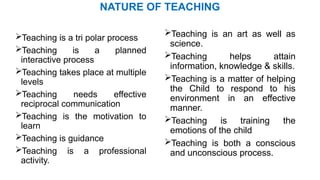
NATURE OF TEACHING
Teaching is a tri polar process
Teaching is a planned
interactive process
Teaching takes place at multiple
levels
Teaching needs effective
reciprocal communication
Teaching is the motivation to
learn
Teaching is guidance
Teaching is a professional
activity.
Teaching is an art as well as
science.
Teaching helps attain
information, knowledge & skills.
Teaching is a matter of helping
the Child to respond to his
environment in an effective
manner.
Teaching is training the
emotions of the child
Teaching is both a conscious
and unconscious process.
NEED OF TEACHING
Through teaching, the teacher aims at
Giving knowledge to the students
Passing information to them
Making the students acquire some skill
Changing the attitude of the learners
Modifying the behavior of the students
Giving some experiences of life
VARIABLES OF TEACHING
Independent variables: in the process of teaching, teacher
plays the role of independent variables
Dependent variables: the student is the dependent variable in
the process of teaching
Intervening or mediating variables: the content of teaching,
strategies, tactics of teaching and techniques of motivation are
intervening variables.
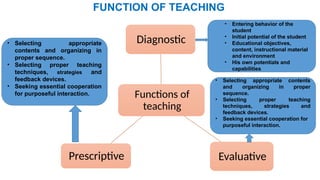
FUNCTION OF TEACHING
Functions of
teaching
Diagnostic
Evaluative
Prescriptive
‱ Entering behavior of the
student
‱ Initial potential of the student
‱ Educational objectives,
content, instructional material
and environment
‱ His own potentials and
capabilities
‱ Selecting appropriate
contents and organizing in
proper sequence.
‱ Selecting proper teaching
techniques, strategies and
feedback devices.
‱ Seeking essential cooperation
for purposeful interaction.
‱ Selecting appropriate contents
and organizing in proper
sequence.
‱ Selecting proper teaching
techniques, strategies and
feedback devices.
‱ Seeking essential cooperation for
purposeful interaction.
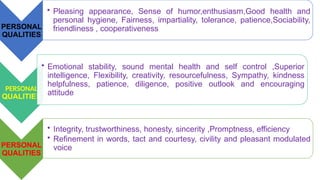
QUALITIES OF A TEACHER
PERSONAL PROFESSIONAL
PERSONAL
QUALITIES
‱ Pleasing appearance, Sense of humor,enthusiasm,Good health and
personal hygiene, Fairness, impartiality, tolerance, patience,Sociability,
friendliness , cooperativeness
PERSONAL
QUALITIES
‱ Emotional stability, sound mental health and self control ,Superior
intelligence, Flexibility, creativity, resourcefulness, Sympathy, kindness
helpfulness, patience, diligence, positive outlook and encouraging
attitude
PERSONAL
QUALITIES
‱ Integrity, trustworthiness, honesty, sincerity ,Promptness, efficiency
‱ Refinement in words, tact and courtesy, civility and pleasant modulated
voice
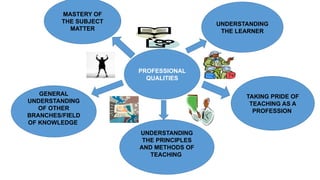
PROFESSIONAL
QUALITIES
MASTERY OF
THE SUBJECT
MATTER
GENERAL
UNDERSTANDING
OF OTHER
BRANCHES/FIELD
OF KNOWLEDGE
UNDERSTANDING
THE LEARNER
UNDERSTANDING
THE PRINCIPLES
AND METHODS OF
TEACHING
TAKING PRIDE OF
TEACHING AS A
PROFESSION
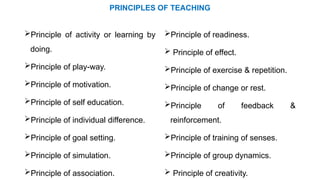
PRINCIPLES OF TEACHING
Principle of activity or learning by
doing.
Principle of play-way.
Principle of motivation.
Principle of self education.
Principle of individual difference.
Principle of goal setting.
Principle of simulation.
Principle of association.
Principle of readiness.
 Principle of effect.
Principle of exercise & repetition.
Principle of change or rest.
Principle of feedback &
reinforcement.
Principle of training of senses.
Principle of group dynamics.
 Principle of creativity.
PRINCIPLES
Principle of activity or learning by doing.
1. Child as a “Hero” in the drama of education.
2. Teaching is to keep the children active in the class.
Principle of play-way.
3. Related to principle of learning by doing.
4. Play is the chief activity of childhood-Froebel.
5. It gives joy, freedom, contentment, inner, outer peace.
Principle of motivation.
1. Satisfying the curiosity of children.
2. Utilizing all the senses of children.
3. Relating closely bogy & mind.
4. Linking teaching-learning with life.
-contd
Principle of self education.
1. Best teaching is enabling the child learn by this own efforts.
2. Teaching enable the child to work independently & without the teacher at a later
stage.
3. Encourage students in the development of their natural desire to work .
Principle of individual difference.
4. No two children are alike.
5. Teaching to be effective must cater to individual difference of children.
Principle of goal setting.
6. Definite goal according to the standard of the each students.
7. Short term of immediate goals should be set before small children .
8. Goals should be very clear & definite & understand by children.
-contd
Principle of simulation.
1. Teaching is the stimulation , guidance , direction & encouragement of learning.
Principle of association.
2. If wants to go together should be put together.
3. Discuss at various places ideas & thing associated in a number of ways.
Principle of readiness.
4. Prepare for action.
5. Make the mind to participate in the teaching –learning process.
6. Teacher must be alive to this principle.
Principle of effect.
7. Response is strengthened if it followed by pleasure.
8. Response is weakened if it followed by displeasure.
-contd
Principle of exercise & repetition.
1. Exercise strengthens the bond between situation & response.
2. Two subparts:
 Principle of use.
 Principle of disuse.
Principle of change or rest.
3. Fatigue, lack of attention overcome by providing change, rest & recreation.
4. While framing the time table that the students do not experience boredom & fatigue.
5. Two consecutive periods of a subjects are not provided in a class.
Praise, grade, certificate, token money & other to incentives make the learning joy able.
Principle of feedback & reinforcement.
Praise, grade, certificate, token money & other to incentives make the learning joy able.
-contd
Principle of training of senses.
1. Senses are gateways of knowledge .
2. The power of observation discrimination, identification, generalization &
application are developed through the effective functioning of senses.
Principle of group dynamics.
3. Group behavior, changes the behavior of the members of the group.
4. A suitable climate for group to be created in the classroom.
Principle of creativity.
5. Provide opportunities to the students to explore things events & find cause-effect
relationship.
6. Creativity explored & developed to the maximum extend.
NEEDS OF TEACHING THEORIES
1. Explains the relationship between teaching and learning and common
factors.
2. Gives the knowledge about the teaching activities which provides
guideline for organizing teaching.
3. Instructional designs can be developed with the help of theory of
teaching.
4. Provides scientific basis for planning, organizing, leading and
evaluation of teaching.
5. Classroom teaching problems may be studied scientifically.
6. Pupil-teachers can develop teaching skills and competency.
7. Teaching objectives may be successfully achieved.
8. Helps in further understanding, prediction and control of teaching.
TYPES OF TEACHING THEORIES
A. Formal theory of teaching
1. Meutic theory
2. Communication theory of teaching
3. Moulding theory of teaching
4. The mutual inquiry theory
B. Descriptive theory of teaching
1. Theories of instruction
2. Prescriptive theory of teaching
C. Normative theory of teaching
1. Cognitive theory
2. Theory of teacher
3. Psychological theory of teaching
4. General theory of teaching
A). FORMAL THEORY OF TEACHING
Based upon certain logic, certain metaphysical, epistemological assumptions
and propositions is known as formal theory of teaching.
1. Meutic theory of teaching:
‱ It conceives that teaching process helps to recollect or unfold that
knowledge with questioning techniques.
‱ The socratic’s method is an essential for this theory.
‱ The heredity plays an important role in teaching process.
2. Communication theory of teaching:
‱ Based on assumptions that the teacher possesses all knowledge and
information which student does not possess.
‱ The teacher presents, explains, demonstrates and performs in the
classroom.
A). FORMAL THEORY OF TEACHING
3. The moulding theory of teaching:
‱ John Dewey is the advocate and it focus on shape, form and moulding of
the students behavior.
‱ Human personality is formed, shaped and moulded by their environment.
4. The mutual inquiry theory:
‱ This theory assumes that each individual has the capacity to discover new
knowledge with mutual inquiry.
‱ True knowledge is inquiry.
‱ This theory of teaching is clearly applicable to research and art.
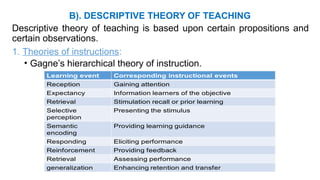
B). DESCRIPTIVE THEORY OF TEACHING
Descriptive theory of teaching is based upon certain propositions and
certain observations.
1. Theories of instructions:
‱ Gagne’s hierarchical theory of instruction.
1. THEORIES OF INSTRUCTION
Atkinson’s decision-theoretic analysis for optimizing learning.
Atkinson proposed four characteristics:
Model of the learning process should be involved.
It should involve specified instructional actions.
The instructional objectives should be specified in behavioral terms.
Each instructional objective can be measured by Burner advocates
that a theory of instruction is designing measurement scale or
questions.
1. THEORIES OF INSTRUCTION
Bruner’s cognitive developmental theory of instruction
Four features are
Predisposition to learn- a theory of instruction must be concerned with the
experiences and context that will tend to make the child willing and able to
learn when he enters the school.
Structure of knowledge-a theory of instruction should specify the ways in
which body of knowledge should be structures so that it can be most readily
grasped by the learner.
Sequence of instruction-a theory of instruction should specify the most
effective sequences to present the material.
Reinforcement-a theory of instruction should specify the nature and pacing
of rewards, moving from extrinsic rewards of intrinsic one.
2. PRESCRIPTIVE THEORY OF TEACHING
E. Stones and Morries have attempted to explain the nature of
teaching with the help of three types of related variables:
The first phase includes the teacher in the analysis of the teaching
problems and teaching tests before teaching takes place.
In the second phase decision are made about the interrelationship of
the variables deemed appropriate to teaching objectives.
The third phase concerns with evaluating the effectiveness and
workability of phase two.
C). NORMATIVE THEORY OF TEACHING
1. The cognitive theory of teaching
Types of teacher's activity- Adviser, counselor, motivator, demonstrator,
curriculum planner and evaluator.
Types of educational objectives- Cognitive, Affective and Psychomotor.
Types of learning theories- philosophical theories of learning psychological
theories of learning.
Types of components of learning- drive, cue, response and reward
2. Theory of teacher behavior
D.G. Ryan has tried to explain the concept of teacher-behavior and
formulated a theory of teacher-behavior.
“Teacher behavior consists of those acts that the teacher performs typically
in the classroom in order to induce-learning”. M. Meux and B.O. Smith
It is based upon two postulates:
Teacher behavior is social in nature and relative.
C). NORMATIVE THEORY OF TEACHING
3. The psychological theory of teaching
This theory considers teaching a sort contractual relationship between the
teacher and the pupils.
That relationship consists of certain activities to be performed by the
teacher such as: analyzing teaching task, determining learning goals,
identifying entering behavior and selecting strategy.
4. General theory of teaching
S.C.T. Clark has formulated a general theory of teaching.
It assumes that teaching is process which is designed and performed to
produce change in behavior of students.
MAXIMS OF TEACHING
Simple to complex
‱ Teaching is to be made successful & essential by using a maxim called “ From
simple to complex”.
‱ Teacher should be divided the subject- matter into simple aspects & complex
aspect.
‱ Teacher should tell simple concept first &difficult concepts latter.
From known to unknown
‱ A good teacher bases this new knowledge on previous knowledge of students.
From analysis to synthesis
‱ Analysis means breaking a problem into convenient parts and synthesis
means grouping of these separated parts into one complete whole.
-CONTD
From seen to unseen
‱ Psychological, the pupils ranging from 6 to 14 years are at perceptual level –
only.
‱ Teacher use the seen or perceptual things to impart the knowledge regarding
unseen or non-perceptual things.
Form concrete to abstract
‱ The mental development of the pupils begins with the concrete objects &
afterwards the gains micro words for them.
From particular to general
‱ Specific examples should be presented before the pupils first and then the
general laws or principles should be derived from those specific examples.
-CONTD
From whole to part
Gestalt : Perceive the objects as a whole and then its part. We gain
knowledge about the “whole” first and then its “parts”.
From infinite to definite
‱ Pupils intellectual development proceeds from indefinite to definite.
‱ Through sense organs, gaining the knowledge regarding different
objects while living in the contact of this parents, brother – sister, other
family members.
‱ On the basis of this gained knowledge, the gradually develops this
personal concepts regarding objects.
-CONTD
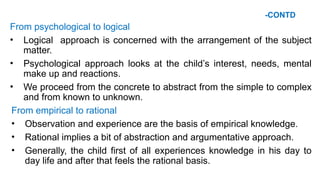
From psychological to logical
‱ Logical approach is concerned with the arrangement of the subject
matter.
‱ Psychological approach looks at the child’s interest, needs, mental
make up and reactions.
‱ We proceed from the concrete to abstract from the simple to complex
and from known to unknown.
From empirical to rational
‱ Observation and experience are the basis of empirical knowledge.
‱ Rational implies a bit of abstraction and argumentative approach.
‱ Generally, the child first of all experiences knowledge in his day to
day life and after that feels the rational basis.
CONCEPT OF LEARNING:
Learning is the lifelong process of transforming information and
experience into knowledge, skills, behaviors, and attitudes.
DEFINITION OF LEARNING
“Learning is the process by which behavior is originated or changes through
practice and training”.
 -Woodworth, R.S
“Learning is the modification in behavior to meet environmental requirements”.
 -Gates
“Learning is a process that result in the modification of behavior”.
 -J. F. Travers
“ Learning is the acquisition of habits, knowledge and attitudes. It involves new
ways of doing things, and it operates in an individual’s attempts to overcome
obstacles or to adjust to new situations”.
 -Crow and Crow
“ learning is the process of progressive behavior adaptation.”
 -Skinner
VARIOUS FACETS OF LEARNING PROCESS
Who is to learn- child
From whom to learn- teacher, environment
Why to learn- aims of teaching
What to learn- acquisition of knowledge, skills etc.
How to learn- methodology
When to learn- motivation
Where to learn- classroom ,play field
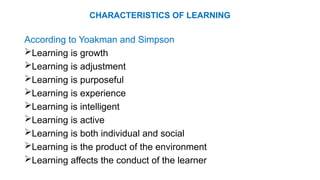
CHARACTERISTICS OF LEARNING
According to Yoakman and Simpson
Learning is growth
Learning is adjustment
Learning is purposeful
Learning is experience
Learning is intelligent
Learning is active
Learning is both individual and social
Learning is the product of the environment
Learning affects the conduct of the learner
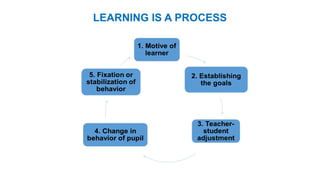
LEARNING IS A PROCESS
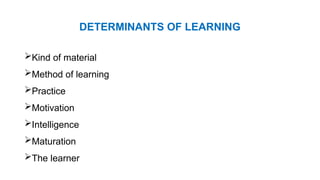
Kind of material
Method of learning
Practice
Motivation
Intelligence
Maturation
The learner
DETERMINANTS OF LEARNING
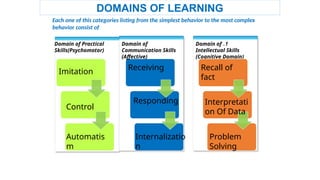
DOMAINS OF LEARNING
Each one of this categories listing from the simplest behavior to the most complex
behavior consist of
Domain of Practical
Skills(Psychomotor)
1
.
Domain of
Intellectual Skills
(Cognitive Domain)
Recall of
fact
Domain of
Communication Skills
(Affective)
Imitation
Responding
Internalizatio
n
Receiving
Interpretati
on Of Data
Problem
Solving
Automatis
m
Control
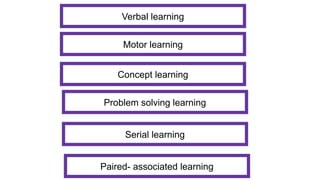
Motor learning
Verbal learning
Paired- associated learning
Concept learning
Serial learning
Problem solving learning
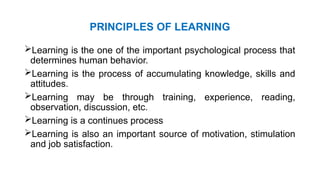
PRINCIPLES OF LEARNING
Learning is the one of the important psychological process that
determines human behavior.
Learning is the process of accumulating knowledge, skills and
attitudes.
Learning may be through training, experience, reading,
observation, discussion, etc.
Learning is a continues process
Learning is also an important source of motivation, stimulation
and job satisfaction.
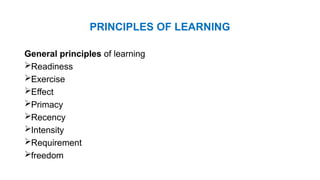
PRINCIPLES OF LEARNING
General principles of learning
Readiness
Exercise
Effect
Primacy
Recency
Intensity
Requirement
freedom
PRINCIPLES OF LEARNING
READINESS
Readiness implies a degree of concentration and eagerness.
 Individuals learn best when they are physically, mentally, and emotionally ready
to learn, and do not learn well if they see no reason for learning.
Getting students ready to learn, creating interest by showing the value of the
subject matter, and providing continuous mental or physical challenge, is usually
the instructor’s responsibility.
EXERCISE
The principle of exercise states that those things most often repeated are best
remembered. It is the basis of drill and practice.
It has been proven that students learn best and retain information longer when
they have meaningful practice and repetition. The key here is that the practice
must be meaningful.
It is clear that practice leads to improvement only when it is followed by positive
feedback.
PRINCIPLES OF LEARNING
EFFECT
The principle of effect is based on the emotional reaction of the student. It has
a direct relationship to motivation.
Learning is strengthened when accompanied by a pleasant or satisfying
feeling, and that learning is weakened when associated with an unpleasant
feeling.
Every learning experience should contain elements that leave the student with
some good feelings.
PRIMACY
The state of being first, often creates a strong, almost unshakable, impression.
Things learn first create a strong impression in the mind that is difficult to
erase.
The student’s first experience should be positive, functional, and lay the
foundation for all that is to follow.
PRINCIPLES OF LEARNING
RECENCY
The principle of recency states that things most recently learned are
best remembered.
 Conversely, the further a student is removed time-wise from a new fact
or understanding, the more difficult it is to remember.
 For example, it is fairly easy to recall a telephone number dialed a few
minutes ago, but it is usually impossible to recall a new number dialed
last week.
INTENSITY
The principle of intensity implies that a student will learn more from the
real thing than from a substitute.
For example, a student is likely to gain greater understanding of tasks
by performing them rather than merely reading about them.
PRINCIPLES OF LEARNING
REQUIREMENT
The law of requirement states that “ we must have something to obtain or
do something”.
It can be ability, skill, instrument or anything that may help us to learn or
gain something.
FREEDOM
The principle of freedom states that things freely learned are best learned.
The further a student is coerced, the more difficult is for him to learn,
assimilate and implement what is learned. Compulsion and coercion are
antithetical to personal growth.
Since learning is an active process, students must have freedom: freedom
of choice, freedom of action, freedom to bear the results of action.
PRINCIPLES OF LEARNING
Learning is continuous.
Learning is purposeful and must make sense to the learner.
Learning involves as many senses as possible.
Learning activities must be appropriate for the situation.
Learning must be stimulating.
Learning must result in the ability to perform.
Learning is affected by emotions.
Learning is affected by the physical and social environment.
12 PRINCIPLES OF EFFECTIVE TEACHING AND LEARNING
1) Teacher’s knowledge of the subject
matter is essential to the
implementation of important
teaching tasks.
2) Active involvement of the learner
enhances learning.
3) Interaction between teachers and
students is the most important factor
in student motivation and
involvement.
4) Students benefit from taking
responsibility for their learning.
5) There are many roads to learning.
6) Expect more and your will achieve
more.
7). learning is enhanced in an
atmosphere of cooperation.
8). Material must be meaningful.
9). Both teaching and learning are
enhanced by descriptive feedback.
10). Critical feedback is only useful if
the learner has alternatives to pursue.
11). Time plus energy equals learning.
12). Experience usually improves
teaching.
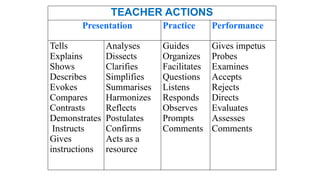
TEACHER ACTIONS
Presentation Practice Performance
Tells
Explains
Shows
Describes
Evokes
Compares
Contrasts
Demonstrates
Instructs
Gives
instructions
Analyses
Dissects
Clarifies
Simplifies
Summarises
Harmonizes
Reflects
Postulates
Confirms
Acts as a
resource
Guides
Organizes
Facilitates
Questions
Listens
Responds
Observes
Prompts
Comments
Gives impetus
Probes
Examines
Accepts
Rejects
Directs
Evaluates
Assesses
Comments
THEORIES OF LEARNING
1. Behaviorism
2. Cognitivism
3. Social learning theory
LEARNING THEORIES
1). Behaviorism
 It is confined to observable and measurable behavior.
 Learning is defined by the outward expression of new behaviors and
context-independent.
 Biological basis for learning.
 Focuses on observable behaviors.
1). BEHAVIORISM
Classical conditioning (Pavlov)
A stimulus is presented in order to get a response.
It is about reflexes.
Operant conditioning (Skinner)
The response is made first then reinforcement follows.
It is about feedback/reinforcement.
-Contd
Behaviorism in the classroom
Rewards and punishments.
Responsibility for student learning rests squarely with the
teacher.
Lecture-based and highly structured.
2). CONGITIVISM
Grew in response to behaviorism.
Knowledge is stored cognitively as symbols.
Learning is the process of connecting symbols in a meaningful
and memorable way.
Studies focused on the mental processes that facilitate symbol
connection.
2). COGNITIVE LEARNING THEORIES
Discovery learning (bruner)
Anybody can learn anything at any age, provided it is stated in
terms they can understand.
Powerful concepts (not isolated facts)
 transfer to many different situations.
Only possible through discovery learning
Confront the learner with problems and help them find
solutions. Do not present sequenced materials.
2). COGNITIVE LEARNING THEORY
Meaningful verbal learning (ausubel)
Advance organizers:
New material is presented in a systematic way and is
connected to existing cognitive structures in a meaningful way.
When learners have difficulty with new material, go back to the
concrete anchors (advance organizers).
Provide a discovery approach and they will learn.
CONGNITIVISM IN THE CLASSROOM
Inquiry-oriented projects
Provide opportunities for the testing of hypotheses.
Curiosity is encouraged
Stage scaffholding
3). SOCIAL LEARNING THEORY
Grew out of cognitivism.
Learning takes place through observation and sensorial
experiences.
Imitation is the sincerest form of flattery.
Social learning theory is the basis of the movement against
violence in media and video games.
3). SOCIAL LEARNING THEORY
Learning from models:
Attend to pertinent clues.
Code for memory (store a visual image).
Retain in memory.
Accurately reproduce the observed activity.
Possess sufficient motivation to apply new learning.
RELATIONSHIP BETWEEN TEACHING AND LEARNING
Both teaching and learning may be formal or informal.
Both are goal oriented.
Good teaching results in good learning.
One can observe teaching but not learning.
Both teaching and learning require skills, creativity, intelligence an
operate on definite principles.
Good teaching requires good communication skill an good learning
requires good listening skills.
Only good learner become good teachers.
RELATIONSHIP BETWEEN TEACHING AND LEARNING
Need for relating teaching and learning:
Teaching can be made effective by relating it to learning.
Teaching objectives can be identified in behavioral terms and by
appropriate learning situations.
The appropriate teaching conditions or structures may be generated for
effective learning.
The effective teaching aids may be selected for creating learning
situations.
Aid to understand the nature of teaching and teaching theories may be
evolved.
The knowledge of relationship will be helpful to teacher educator to
produce effective teachers.
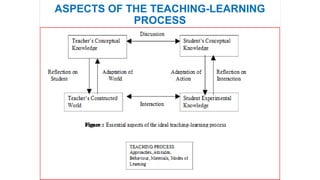
ASPECTS OF THE TEACHING-LEARNING
PROCESS
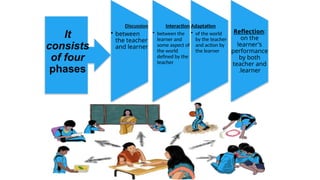
It
consists
of four
phases
Discussion
‱ between
the teacher
and learner
Interaction
‱ between the
learner and
some aspect of
the world
defined by the
teacher
Adaptation
‱ of the world
by the teacher
and action by
the learner
Reflection:
on the
learner's
performance
by both
teacher and
learner
.
CONCLUSION
Teacher and learner are the major variables of teaching.
It is narrow and specific.
Teaching theories are developed by dealing with human
subjects in normal situations , while learning theories are
formulated by conducting experiments in animal.
More concerned with effective learning and development of the
learner
THANK YOU

Jitendra bhargav SlideShare Unit-II-Teaching-Learning.pptx

  • 1.
    Course:M.Sc. Nursing Subject: NursingEducation Unit : II. Teaching and Learning Topic :Teaching and Learning Process Prepared By Dr.M.Kavimani Adhavan, Ph.D(N)., Principal
  • 2.
    OBJECTIVES At the endof the session the students will be able to, Define teaching and leaning . Mention the concept of learning. Describe the teaching and learning process. Explain the functions and qualities of teaching. List the principles of teaching and leaning . Describe the theories of teaching and learning. Explain the relationship between the teaching and learning.
  • 3.
    TEACHING INTRODUCTION “Teaching is aninteractive process, primarily involving class room talk, which takes place between the teacher and pupils and occurs during certain definable activities".
  • 4.
    DEFINITION OF TEACHING ‱“Teaching is the task of the teacher which is performed for the development of the child or learner”. -Ethmas P Green ‱ “Teaching is the stimulation, guidance, direction and encouragement of learning”. -Burton ‱ “Teaching is a form of interpersonal influence aimed at changing the behavior potential of another person”. -N.L Gage (1962)
  • 5.
    CONCEPT OF TEACHING TEACHERLEARNER CHARACTERISTICS TEACHING PRINCIPLES MAXIMS ‱ WORDS ‱ THEORIES ‱ PHILOSOPHIES ‱ EXPERIENCES ‱ OBSERVATION
  • 6.
    CONCEPT OF TEACHING ‱Teaching is process which usually takes place in the class room situations. ‱ It is more of formal process. ‱ Teaching is a intimate contact between a more mature personality and less mature one which is designed to further the education of the latter.
  • 7.
    PURPOSE OF TEACHING ‱Development of wholesome personality (changing habits, attitudes, interest) of the learner. ‱ To help the students; Acquire knowledge Understand, analyze, synthesize and evaluate the knowledge Achieve skills Establish habits Develop attitudes
  • 8.
  • 9.
    STGE-I Pre-Active Stage STAGE-2 Inter-Active Stage STAGE-3 Post-Active Stage TEACHING STAGE-I Pre-Active Stage Fixing up Goals& Content Decision about Strategies Diagnosis of the Learners Actions and Reactions Appropriate Testing Devices Feedback and Testing TEACHING PHASES OPERATIONS PHASES OF TEACHING - Philip. W. Jackson
  • 10.
    NATURE OF TEACHING Teachingis a tri polar process Teaching is a planned interactive process Teaching takes place at multiple levels Teaching needs effective reciprocal communication Teaching is the motivation to learn Teaching is guidance Teaching is a professional activity. Teaching is an art as well as science. Teaching helps attain information, knowledge & skills. Teaching is a matter of helping the Child to respond to his environment in an effective manner. Teaching is training the emotions of the child Teaching is both a conscious and unconscious process.
  • 11.
    NEED OF TEACHING Throughteaching, the teacher aims at Giving knowledge to the students Passing information to them Making the students acquire some skill Changing the attitude of the learners Modifying the behavior of the students Giving some experiences of life
  • 12.
    VARIABLES OF TEACHING Independentvariables: in the process of teaching, teacher plays the role of independent variables Dependent variables: the student is the dependent variable in the process of teaching Intervening or mediating variables: the content of teaching, strategies, tactics of teaching and techniques of motivation are intervening variables.
  • 13.
    FUNCTION OF TEACHING Functionsof teaching Diagnostic Evaluative Prescriptive ‱ Entering behavior of the student ‱ Initial potential of the student ‱ Educational objectives, content, instructional material and environment ‱ His own potentials and capabilities ‱ Selecting appropriate contents and organizing in proper sequence. ‱ Selecting proper teaching techniques, strategies and feedback devices. ‱ Seeking essential cooperation for purposeful interaction. ‱ Selecting appropriate contents and organizing in proper sequence. ‱ Selecting proper teaching techniques, strategies and feedback devices. ‱ Seeking essential cooperation for purposeful interaction.
  • 14.
    QUALITIES OF ATEACHER PERSONAL PROFESSIONAL
  • 15.
    PERSONAL QUALITIES ‱ Pleasing appearance,Sense of humor,enthusiasm,Good health and personal hygiene, Fairness, impartiality, tolerance, patience,Sociability, friendliness , cooperativeness PERSONAL QUALITIES ‱ Emotional stability, sound mental health and self control ,Superior intelligence, Flexibility, creativity, resourcefulness, Sympathy, kindness helpfulness, patience, diligence, positive outlook and encouraging attitude PERSONAL QUALITIES ‱ Integrity, trustworthiness, honesty, sincerity ,Promptness, efficiency ‱ Refinement in words, tact and courtesy, civility and pleasant modulated voice
  • 16.
    PROFESSIONAL QUALITIES MASTERY OF THE SUBJECT MATTER GENERAL UNDERSTANDING OFOTHER BRANCHES/FIELD OF KNOWLEDGE UNDERSTANDING THE LEARNER UNDERSTANDING THE PRINCIPLES AND METHODS OF TEACHING TAKING PRIDE OF TEACHING AS A PROFESSION
  • 17.
    PRINCIPLES OF TEACHING Principleof activity or learning by doing. Principle of play-way. Principle of motivation. Principle of self education. Principle of individual difference. Principle of goal setting. Principle of simulation. Principle of association. Principle of readiness.  Principle of effect. Principle of exercise & repetition. Principle of change or rest. Principle of feedback & reinforcement. Principle of training of senses. Principle of group dynamics.  Principle of creativity.
  • 18.
    PRINCIPLES Principle of activityor learning by doing. 1. Child as a “Hero” in the drama of education. 2. Teaching is to keep the children active in the class. Principle of play-way. 3. Related to principle of learning by doing. 4. Play is the chief activity of childhood-Froebel. 5. It gives joy, freedom, contentment, inner, outer peace. Principle of motivation. 1. Satisfying the curiosity of children. 2. Utilizing all the senses of children. 3. Relating closely bogy & mind. 4. Linking teaching-learning with life.
  • 19.
    -contd Principle of selfeducation. 1. Best teaching is enabling the child learn by this own efforts. 2. Teaching enable the child to work independently & without the teacher at a later stage. 3. Encourage students in the development of their natural desire to work . Principle of individual difference. 4. No two children are alike. 5. Teaching to be effective must cater to individual difference of children. Principle of goal setting. 6. Definite goal according to the standard of the each students. 7. Short term of immediate goals should be set before small children . 8. Goals should be very clear & definite & understand by children.
  • 20.
    -contd Principle of simulation. 1.Teaching is the stimulation , guidance , direction & encouragement of learning. Principle of association. 2. If wants to go together should be put together. 3. Discuss at various places ideas & thing associated in a number of ways. Principle of readiness. 4. Prepare for action. 5. Make the mind to participate in the teaching –learning process. 6. Teacher must be alive to this principle. Principle of effect. 7. Response is strengthened if it followed by pleasure. 8. Response is weakened if it followed by displeasure.
  • 21.
    -contd Principle of exercise& repetition. 1. Exercise strengthens the bond between situation & response. 2. Two subparts:  Principle of use.  Principle of disuse. Principle of change or rest. 3. Fatigue, lack of attention overcome by providing change, rest & recreation. 4. While framing the time table that the students do not experience boredom & fatigue. 5. Two consecutive periods of a subjects are not provided in a class. Praise, grade, certificate, token money & other to incentives make the learning joy able. Principle of feedback & reinforcement. Praise, grade, certificate, token money & other to incentives make the learning joy able.
  • 22.
    -contd Principle of trainingof senses. 1. Senses are gateways of knowledge . 2. The power of observation discrimination, identification, generalization & application are developed through the effective functioning of senses. Principle of group dynamics. 3. Group behavior, changes the behavior of the members of the group. 4. A suitable climate for group to be created in the classroom. Principle of creativity. 5. Provide opportunities to the students to explore things events & find cause-effect relationship. 6. Creativity explored & developed to the maximum extend.
  • 23.
    NEEDS OF TEACHINGTHEORIES 1. Explains the relationship between teaching and learning and common factors. 2. Gives the knowledge about the teaching activities which provides guideline for organizing teaching. 3. Instructional designs can be developed with the help of theory of teaching. 4. Provides scientific basis for planning, organizing, leading and evaluation of teaching. 5. Classroom teaching problems may be studied scientifically. 6. Pupil-teachers can develop teaching skills and competency. 7. Teaching objectives may be successfully achieved. 8. Helps in further understanding, prediction and control of teaching.
  • 24.
    TYPES OF TEACHINGTHEORIES A. Formal theory of teaching 1. Meutic theory 2. Communication theory of teaching 3. Moulding theory of teaching 4. The mutual inquiry theory B. Descriptive theory of teaching 1. Theories of instruction 2. Prescriptive theory of teaching C. Normative theory of teaching 1. Cognitive theory 2. Theory of teacher 3. Psychological theory of teaching 4. General theory of teaching
  • 25.
    A). FORMAL THEORYOF TEACHING Based upon certain logic, certain metaphysical, epistemological assumptions and propositions is known as formal theory of teaching. 1. Meutic theory of teaching: ‱ It conceives that teaching process helps to recollect or unfold that knowledge with questioning techniques. ‱ The socratic’s method is an essential for this theory. ‱ The heredity plays an important role in teaching process. 2. Communication theory of teaching: ‱ Based on assumptions that the teacher possesses all knowledge and information which student does not possess. ‱ The teacher presents, explains, demonstrates and performs in the classroom.
  • 26.
    A). FORMAL THEORYOF TEACHING 3. The moulding theory of teaching: ‱ John Dewey is the advocate and it focus on shape, form and moulding of the students behavior. ‱ Human personality is formed, shaped and moulded by their environment. 4. The mutual inquiry theory: ‱ This theory assumes that each individual has the capacity to discover new knowledge with mutual inquiry. ‱ True knowledge is inquiry. ‱ This theory of teaching is clearly applicable to research and art.
  • 27.
    B). DESCRIPTIVE THEORYOF TEACHING Descriptive theory of teaching is based upon certain propositions and certain observations. 1. Theories of instructions: ‱ Gagne’s hierarchical theory of instruction.
  • 28.
    1. THEORIES OFINSTRUCTION Atkinson’s decision-theoretic analysis for optimizing learning. Atkinson proposed four characteristics: Model of the learning process should be involved. It should involve specified instructional actions. The instructional objectives should be specified in behavioral terms. Each instructional objective can be measured by Burner advocates that a theory of instruction is designing measurement scale or questions.
  • 29.
    1. THEORIES OFINSTRUCTION Bruner’s cognitive developmental theory of instruction Four features are Predisposition to learn- a theory of instruction must be concerned with the experiences and context that will tend to make the child willing and able to learn when he enters the school. Structure of knowledge-a theory of instruction should specify the ways in which body of knowledge should be structures so that it can be most readily grasped by the learner. Sequence of instruction-a theory of instruction should specify the most effective sequences to present the material. Reinforcement-a theory of instruction should specify the nature and pacing of rewards, moving from extrinsic rewards of intrinsic one.
  • 30.
    2. PRESCRIPTIVE THEORYOF TEACHING E. Stones and Morries have attempted to explain the nature of teaching with the help of three types of related variables: The first phase includes the teacher in the analysis of the teaching problems and teaching tests before teaching takes place. In the second phase decision are made about the interrelationship of the variables deemed appropriate to teaching objectives. The third phase concerns with evaluating the effectiveness and workability of phase two.
  • 31.
    C). NORMATIVE THEORYOF TEACHING 1. The cognitive theory of teaching Types of teacher's activity- Adviser, counselor, motivator, demonstrator, curriculum planner and evaluator. Types of educational objectives- Cognitive, Affective and Psychomotor. Types of learning theories- philosophical theories of learning psychological theories of learning. Types of components of learning- drive, cue, response and reward 2. Theory of teacher behavior D.G. Ryan has tried to explain the concept of teacher-behavior and formulated a theory of teacher-behavior. “Teacher behavior consists of those acts that the teacher performs typically in the classroom in order to induce-learning”. M. Meux and B.O. Smith It is based upon two postulates: Teacher behavior is social in nature and relative.
  • 32.
    C). NORMATIVE THEORYOF TEACHING 3. The psychological theory of teaching This theory considers teaching a sort contractual relationship between the teacher and the pupils. That relationship consists of certain activities to be performed by the teacher such as: analyzing teaching task, determining learning goals, identifying entering behavior and selecting strategy. 4. General theory of teaching S.C.T. Clark has formulated a general theory of teaching. It assumes that teaching is process which is designed and performed to produce change in behavior of students.
  • 33.
    MAXIMS OF TEACHING Simpleto complex ‱ Teaching is to be made successful & essential by using a maxim called “ From simple to complex”. ‱ Teacher should be divided the subject- matter into simple aspects & complex aspect. ‱ Teacher should tell simple concept first &difficult concepts latter. From known to unknown ‱ A good teacher bases this new knowledge on previous knowledge of students. From analysis to synthesis ‱ Analysis means breaking a problem into convenient parts and synthesis means grouping of these separated parts into one complete whole.
  • 34.
    -CONTD From seen tounseen ‱ Psychological, the pupils ranging from 6 to 14 years are at perceptual level – only. ‱ Teacher use the seen or perceptual things to impart the knowledge regarding unseen or non-perceptual things. Form concrete to abstract ‱ The mental development of the pupils begins with the concrete objects & afterwards the gains micro words for them. From particular to general ‱ Specific examples should be presented before the pupils first and then the general laws or principles should be derived from those specific examples.
  • 35.
    -CONTD From whole topart Gestalt : Perceive the objects as a whole and then its part. We gain knowledge about the “whole” first and then its “parts”. From infinite to definite ‱ Pupils intellectual development proceeds from indefinite to definite. ‱ Through sense organs, gaining the knowledge regarding different objects while living in the contact of this parents, brother – sister, other family members. ‱ On the basis of this gained knowledge, the gradually develops this personal concepts regarding objects.
  • 36.
    -CONTD From psychological tological ‱ Logical approach is concerned with the arrangement of the subject matter. ‱ Psychological approach looks at the child’s interest, needs, mental make up and reactions. ‱ We proceed from the concrete to abstract from the simple to complex and from known to unknown. From empirical to rational ‱ Observation and experience are the basis of empirical knowledge. ‱ Rational implies a bit of abstraction and argumentative approach. ‱ Generally, the child first of all experiences knowledge in his day to day life and after that feels the rational basis.
  • 38.
    CONCEPT OF LEARNING: Learningis the lifelong process of transforming information and experience into knowledge, skills, behaviors, and attitudes.
  • 39.
    DEFINITION OF LEARNING “Learningis the process by which behavior is originated or changes through practice and training”.  -Woodworth, R.S “Learning is the modification in behavior to meet environmental requirements”.  -Gates “Learning is a process that result in the modification of behavior”.  -J. F. Travers “ Learning is the acquisition of habits, knowledge and attitudes. It involves new ways of doing things, and it operates in an individual’s attempts to overcome obstacles or to adjust to new situations”.  -Crow and Crow “ learning is the process of progressive behavior adaptation.”  -Skinner
  • 40.
    VARIOUS FACETS OFLEARNING PROCESS Who is to learn- child From whom to learn- teacher, environment Why to learn- aims of teaching What to learn- acquisition of knowledge, skills etc. How to learn- methodology When to learn- motivation Where to learn- classroom ,play field
  • 41.
  • 42.
    CHARACTERISTICS OF LEARNING Accordingto Yoakman and Simpson Learning is growth Learning is adjustment Learning is purposeful Learning is experience Learning is intelligent Learning is active Learning is both individual and social Learning is the product of the environment Learning affects the conduct of the learner
  • 43.
  • 44.
    Kind of material Methodof learning Practice Motivation Intelligence Maturation The learner DETERMINANTS OF LEARNING
  • 45.
    DOMAINS OF LEARNING Eachone of this categories listing from the simplest behavior to the most complex behavior consist of Domain of Practical Skills(Psychomotor) 1 . Domain of Intellectual Skills (Cognitive Domain) Recall of fact Domain of Communication Skills (Affective) Imitation Responding Internalizatio n Receiving Interpretati on Of Data Problem Solving Automatis m Control
  • 47.
    Motor learning Verbal learning Paired-associated learning Concept learning Serial learning Problem solving learning
  • 48.
    PRINCIPLES OF LEARNING Learningis the one of the important psychological process that determines human behavior. Learning is the process of accumulating knowledge, skills and attitudes. Learning may be through training, experience, reading, observation, discussion, etc. Learning is a continues process Learning is also an important source of motivation, stimulation and job satisfaction.
  • 49.
    PRINCIPLES OF LEARNING Generalprinciples of learning Readiness Exercise Effect Primacy Recency Intensity Requirement freedom
  • 50.
    PRINCIPLES OF LEARNING READINESS Readinessimplies a degree of concentration and eagerness.  Individuals learn best when they are physically, mentally, and emotionally ready to learn, and do not learn well if they see no reason for learning. Getting students ready to learn, creating interest by showing the value of the subject matter, and providing continuous mental or physical challenge, is usually the instructor’s responsibility. EXERCISE The principle of exercise states that those things most often repeated are best remembered. It is the basis of drill and practice. It has been proven that students learn best and retain information longer when they have meaningful practice and repetition. The key here is that the practice must be meaningful. It is clear that practice leads to improvement only when it is followed by positive feedback.
  • 51.
    PRINCIPLES OF LEARNING EFFECT Theprinciple of effect is based on the emotional reaction of the student. It has a direct relationship to motivation. Learning is strengthened when accompanied by a pleasant or satisfying feeling, and that learning is weakened when associated with an unpleasant feeling. Every learning experience should contain elements that leave the student with some good feelings. PRIMACY The state of being first, often creates a strong, almost unshakable, impression. Things learn first create a strong impression in the mind that is difficult to erase. The student’s first experience should be positive, functional, and lay the foundation for all that is to follow.
  • 52.
    PRINCIPLES OF LEARNING RECENCY Theprinciple of recency states that things most recently learned are best remembered.  Conversely, the further a student is removed time-wise from a new fact or understanding, the more difficult it is to remember.  For example, it is fairly easy to recall a telephone number dialed a few minutes ago, but it is usually impossible to recall a new number dialed last week. INTENSITY The principle of intensity implies that a student will learn more from the real thing than from a substitute. For example, a student is likely to gain greater understanding of tasks by performing them rather than merely reading about them.
  • 53.
    PRINCIPLES OF LEARNING REQUIREMENT Thelaw of requirement states that “ we must have something to obtain or do something”. It can be ability, skill, instrument or anything that may help us to learn or gain something. FREEDOM The principle of freedom states that things freely learned are best learned. The further a student is coerced, the more difficult is for him to learn, assimilate and implement what is learned. Compulsion and coercion are antithetical to personal growth. Since learning is an active process, students must have freedom: freedom of choice, freedom of action, freedom to bear the results of action.
  • 54.
    PRINCIPLES OF LEARNING Learningis continuous. Learning is purposeful and must make sense to the learner. Learning involves as many senses as possible. Learning activities must be appropriate for the situation. Learning must be stimulating. Learning must result in the ability to perform. Learning is affected by emotions. Learning is affected by the physical and social environment.
  • 55.
    12 PRINCIPLES OFEFFECTIVE TEACHING AND LEARNING 1) Teacher’s knowledge of the subject matter is essential to the implementation of important teaching tasks. 2) Active involvement of the learner enhances learning. 3) Interaction between teachers and students is the most important factor in student motivation and involvement. 4) Students benefit from taking responsibility for their learning. 5) There are many roads to learning. 6) Expect more and your will achieve more. 7). learning is enhanced in an atmosphere of cooperation. 8). Material must be meaningful. 9). Both teaching and learning are enhanced by descriptive feedback. 10). Critical feedback is only useful if the learner has alternatives to pursue. 11). Time plus energy equals learning. 12). Experience usually improves teaching.
  • 56.
    TEACHER ACTIONS Presentation PracticePerformance Tells Explains Shows Describes Evokes Compares Contrasts Demonstrates Instructs Gives instructions Analyses Dissects Clarifies Simplifies Summarises Harmonizes Reflects Postulates Confirms Acts as a resource Guides Organizes Facilitates Questions Listens Responds Observes Prompts Comments Gives impetus Probes Examines Accepts Rejects Directs Evaluates Assesses Comments
  • 57.
    THEORIES OF LEARNING 1.Behaviorism 2. Cognitivism 3. Social learning theory
  • 58.
    LEARNING THEORIES 1). Behaviorism It is confined to observable and measurable behavior.  Learning is defined by the outward expression of new behaviors and context-independent.  Biological basis for learning.  Focuses on observable behaviors.
  • 59.
    1). BEHAVIORISM Classical conditioning(Pavlov) A stimulus is presented in order to get a response. It is about reflexes. Operant conditioning (Skinner) The response is made first then reinforcement follows. It is about feedback/reinforcement.
  • 60.
    -Contd Behaviorism in theclassroom Rewards and punishments. Responsibility for student learning rests squarely with the teacher. Lecture-based and highly structured.
  • 61.
    2). CONGITIVISM Grew inresponse to behaviorism. Knowledge is stored cognitively as symbols. Learning is the process of connecting symbols in a meaningful and memorable way. Studies focused on the mental processes that facilitate symbol connection.
  • 62.
    2). COGNITIVE LEARNINGTHEORIES Discovery learning (bruner) Anybody can learn anything at any age, provided it is stated in terms they can understand. Powerful concepts (not isolated facts)  transfer to many different situations. Only possible through discovery learning Confront the learner with problems and help them find solutions. Do not present sequenced materials.
  • 63.
    2). COGNITIVE LEARNINGTHEORY Meaningful verbal learning (ausubel) Advance organizers: New material is presented in a systematic way and is connected to existing cognitive structures in a meaningful way. When learners have difficulty with new material, go back to the concrete anchors (advance organizers). Provide a discovery approach and they will learn.
  • 64.
    CONGNITIVISM IN THECLASSROOM Inquiry-oriented projects Provide opportunities for the testing of hypotheses. Curiosity is encouraged Stage scaffholding
  • 65.
    3). SOCIAL LEARNINGTHEORY Grew out of cognitivism. Learning takes place through observation and sensorial experiences. Imitation is the sincerest form of flattery. Social learning theory is the basis of the movement against violence in media and video games.
  • 66.
    3). SOCIAL LEARNINGTHEORY Learning from models: Attend to pertinent clues. Code for memory (store a visual image). Retain in memory. Accurately reproduce the observed activity. Possess sufficient motivation to apply new learning.
  • 67.
    RELATIONSHIP BETWEEN TEACHINGAND LEARNING Both teaching and learning may be formal or informal. Both are goal oriented. Good teaching results in good learning. One can observe teaching but not learning. Both teaching and learning require skills, creativity, intelligence an operate on definite principles. Good teaching requires good communication skill an good learning requires good listening skills. Only good learner become good teachers.
  • 68.
    RELATIONSHIP BETWEEN TEACHINGAND LEARNING Need for relating teaching and learning: Teaching can be made effective by relating it to learning. Teaching objectives can be identified in behavioral terms and by appropriate learning situations. The appropriate teaching conditions or structures may be generated for effective learning. The effective teaching aids may be selected for creating learning situations. Aid to understand the nature of teaching and teaching theories may be evolved. The knowledge of relationship will be helpful to teacher educator to produce effective teachers.
  • 69.
    ASPECTS OF THETEACHING-LEARNING PROCESS
  • 70.
    It consists of four phases Discussion ‱ between theteacher and learner Interaction ‱ between the learner and some aspect of the world defined by the teacher Adaptation ‱ of the world by the teacher and action by the learner Reflection: on the learner's performance by both teacher and learner .
  • 71.
    CONCLUSION Teacher and learnerare the major variables of teaching. It is narrow and specific. Teaching theories are developed by dealing with human subjects in normal situations , while learning theories are formulated by conducting experiments in animal. More concerned with effective learning and development of the learner
  • 72.