CHOLERA
Ardal Koprulu 295-B
Cholera
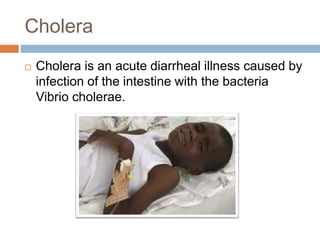
 Cholera is an acute diarrheal illness caused by
infection of the intestine with the bacteria
Vibrio cholerae.
Epidemiology
 Cholera was prevalent in the 1800s, but due to
proper treatment of sewage and drinking
water, has become rare in developed
countries.
 Cholera is a fecal disease, meaning that it
spreads when the feces of an infected person
come into contact with food or water.
 Incidence: 1 in 100,000 worldwide.
 Over 1 million cases and nearly 10,000
fatalities.
INCUBATION PERIOD
Ranges from a few hours to 5 days.
Universal I/P is 5 days.
Shorter incubation period:
High gastric pH (from use of antacids)
Consumption of high dosage of cholera
Period of Communicability
During acute stage
A few days after recovery
By end of week, 70% of patients non-infectious
By end of third week, 98% non-infectious
HOST FACTORS
1. Age: Children: 10x more susceptible than adults,
And Elderly also higher susceptible.
2. Sex: Equal in both male and female.
3. Immunity: Less immune higher risk.
4. People with low gastric acid levels
5. Blood types
O>> B > A > AB
Vibrio cholerae
 Gram negative.
 Type of
Gammaproteobacteri
a
 Distinguishing factors:
Oxidase-positive,
motile via polar
flagellum, and both
respiratory and
fermentative
metabolism.
 Organism can
Pathophysiology of cholera
V. cholerae
accumulates in
stomach
Produces toxins
Toxins will bind
to G-protein
coupled
receptor
Inactivation of
GTPase
G- protein stuck
in "on" position
increase cAMP
activation of ion
channels
NaCl influx into
intestinal lumen
to drag water
into lumen
lead to watery
diarrhea
Signs & Symptoms
 Most people remain asymptomatic. The
symptoms of cholera include :
profuse,
watery
diarrhea
stomach
pains
leg
cramps
Mild fever
Vomiting Sunken
eyes and
Dry
mucous
Decreased
urinary output
Signs & Symptoms
 The primary symptoms of cholera are
profuse, painless diarrhea and vomiting of
clear fluid.
 The diarrhea is frequently described as
"rice water" in nature and may have a
fishy odor.
 An untreated person with cholera may
produce 10 to 20 litres of diarrhea a day
with fatal results.
 patient's skin turning a bluish-gray hue
from extreme loss of fluids.
Signs & Symptoms
 If the severe diarrhea is not treated with
intravenous rehydration, it can result in life-
threatening dehydration and electrolyte
imbalances.
 The typical symptoms of dehydration include
low blood pressure, poor skin turgor (wrinkled
hands), sunken eyes, and a rapid pulse.
Complications
severe dehydration Shock
Renal failure Death
Risk Factors
• Rare in developed countries
• Common in Asia, Africa, & Latin
America
Poor sanitary
conditions
• Contaminated seafood, even in
developed countries.
• Especially shellfish.
Raw or
undercooked food
• People with low levels of stomach acid
• Such as children, older adults, and
some medications.
Hypochlorhydria
• Reasons aren't entirely clear
• Twice more likely
Type O blood
Causes (transmission mood)
Drinking
contaminat
ed water.
eating raw
or
undercook
ed
shellfish
diagnosis
Clinical diagnosis
Cholera should be
considered in all cases
with severe watery
diarrhea and vomiting.
Traveling to affected
areas and eating shellfish
No distinguishing clinical
manifestations for cholera.
Differential diagnosis
Enterotoxigenic e. Coli
Bacterial food poisoning
Viral gastroenteritis
Laboratory Diagnosis
 Culture
 Vibrios often detected by
dark field or phase contrast
microscopy of stool
 Organisms are motile,
appearing like “shooting
stars”
 Microscopy show sheets of
curved Gram negative
rods.
 When plated on sucrose
dishes, yellow colonies
appear confirming cholera
present
Laboratory Diagnosis
 Additional methods of detection include PCR
and monoclonal antibody-based stool tests.
Treatment
 Continued eating speeds the recovery of
normal intestinal function.
 The World Health Organization recommends
this generally for cases of diarrhea no matter
what the underlying cause.
 A CDC training manual specifically for
cholera states: “Continue to breastfeed your
baby if the baby has watery diarrhea, even
when traveling to get treatment. Adults and
older children should continue to eat
frequently
Treatment
 Fluids: In most cases, cholera can be
successfully treated with oral rehydration
therapy (ORT), which is highly effective, safe,
and simple to administer.
 Electrolytes: As there frequently is initially
acidosis, the potassium level may be normal,
even though large losses have occurred.
Treatment
 Antibiotic treatments for one to three
days shorten the course of the disease
and reduce the severity of the symptoms.
Doxycycline is typically used first line,
 Other antibiotics proven to be effective
include cotrimoxazole, erythromycin,
tetracycline, chloramphenicol, and
furazolidone.
Prevention
 Basic health education and hygiene
 Mass chemoprophylaxis
 Provision of safe water and sanitation
 Comprehensive Multidisciplinary Approach:
water, sanitation, education, and
communication
Vaccines
Parenteral Vaccine :
• 2 doses administered 2 weeks apart
• Efficacy of approximately 50% and hardly exceeds 6 months
• Not recommended
Killed WC/rBS Vaccine :
• Killed whole-cell V.cholerae in combination with a recombinant B-subunit of cholera
toxin
• Safe in pregnancy and breastfeeding
• Efficacy of approximately 50% after 3 years
• Only mild side-effects
Live, attenuated CVD 103-HgR Vaccine :
• Protection as early as 1 week after vaccination, with >90%
• Unknown efficacy for children under 2
• No adverse side-effects
Controlling cholera
Treatment
centers Set up treatment centers for prompt
treatment.
Sanitary
measures. food safety and animal health
measures
Comprehensive
surveillance
data
(adapt to each situation) for a
comprehensive multidisciplinary
approach.
References
 http://www.mayoclinic.com/health/cholera/DS0
0579/DSECTION=risk-factors
 http://www.safewater.org/PDFS/resourceskno
wthefacts/Cholera.pdf?noframe
 http://tropicaldisease.files.wordpress.com/200
8/01/cholera-rose-ricardo-compatible-v.ppt
 http://cti.itc.virginia.edu/~whg2n/biom204/ppt/c
holera.ppt
 http://www.socgastro.org.pe/biblioteca/present
acion/archivos/diarrea/2007Cholera3.ppt
THANK YOU

Cholera 121224075437-phpapp01

  • 1.
  • 2.
    Cholera  Cholera isan acute diarrheal illness caused by infection of the intestine with the bacteria Vibrio cholerae.
  • 3.
    Epidemiology  Cholera wasprevalent in the 1800s, but due to proper treatment of sewage and drinking water, has become rare in developed countries.  Cholera is a fecal disease, meaning that it spreads when the feces of an infected person come into contact with food or water.  Incidence: 1 in 100,000 worldwide.  Over 1 million cases and nearly 10,000 fatalities.
  • 4.
    INCUBATION PERIOD Ranges froma few hours to 5 days. Universal I/P is 5 days. Shorter incubation period: High gastric pH (from use of antacids) Consumption of high dosage of cholera
  • 5.
    Period of Communicability Duringacute stage A few days after recovery By end of week, 70% of patients non-infectious By end of third week, 98% non-infectious
  • 6.
    HOST FACTORS 1. Age:Children: 10x more susceptible than adults, And Elderly also higher susceptible. 2. Sex: Equal in both male and female. 3. Immunity: Less immune higher risk. 4. People with low gastric acid levels 5. Blood types O>> B > A > AB
  • 7.
    Vibrio cholerae  Gramnegative.  Type of Gammaproteobacteri a  Distinguishing factors: Oxidase-positive, motile via polar flagellum, and both respiratory and fermentative metabolism.  Organism can
  • 8.
    Pathophysiology of cholera V.cholerae accumulates in stomach Produces toxins Toxins will bind to G-protein coupled receptor Inactivation of GTPase G- protein stuck in "on" position increase cAMP activation of ion channels NaCl influx into intestinal lumen to drag water into lumen lead to watery diarrhea
  • 9.
    Signs & Symptoms Most people remain asymptomatic. The symptoms of cholera include : profuse, watery diarrhea stomach pains leg cramps Mild fever Vomiting Sunken eyes and Dry mucous Decreased urinary output
  • 10.
    Signs & Symptoms The primary symptoms of cholera are profuse, painless diarrhea and vomiting of clear fluid.  The diarrhea is frequently described as "rice water" in nature and may have a fishy odor.  An untreated person with cholera may produce 10 to 20 litres of diarrhea a day with fatal results.  patient's skin turning a bluish-gray hue from extreme loss of fluids.
  • 11.
    Signs & Symptoms If the severe diarrhea is not treated with intravenous rehydration, it can result in life- threatening dehydration and electrolyte imbalances.  The typical symptoms of dehydration include low blood pressure, poor skin turgor (wrinkled hands), sunken eyes, and a rapid pulse.
  • 12.
  • 13.
    Risk Factors • Rarein developed countries • Common in Asia, Africa, & Latin America Poor sanitary conditions • Contaminated seafood, even in developed countries. • Especially shellfish. Raw or undercooked food • People with low levels of stomach acid • Such as children, older adults, and some medications. Hypochlorhydria • Reasons aren't entirely clear • Twice more likely Type O blood
  • 14.
    Causes (transmission mood) Drinking contaminat edwater. eating raw or undercook ed shellfish
  • 15.
    diagnosis Clinical diagnosis Cholera shouldbe considered in all cases with severe watery diarrhea and vomiting. Traveling to affected areas and eating shellfish No distinguishing clinical manifestations for cholera. Differential diagnosis Enterotoxigenic e. Coli Bacterial food poisoning Viral gastroenteritis
  • 16.
    Laboratory Diagnosis  Culture Vibrios often detected by dark field or phase contrast microscopy of stool  Organisms are motile, appearing like “shooting stars”  Microscopy show sheets of curved Gram negative rods.  When plated on sucrose dishes, yellow colonies appear confirming cholera present
  • 17.
    Laboratory Diagnosis  Additionalmethods of detection include PCR and monoclonal antibody-based stool tests.
  • 18.
    Treatment  Continued eatingspeeds the recovery of normal intestinal function.  The World Health Organization recommends this generally for cases of diarrhea no matter what the underlying cause.  A CDC training manual specifically for cholera states: “Continue to breastfeed your baby if the baby has watery diarrhea, even when traveling to get treatment. Adults and older children should continue to eat frequently
  • 19.
    Treatment  Fluids: Inmost cases, cholera can be successfully treated with oral rehydration therapy (ORT), which is highly effective, safe, and simple to administer.  Electrolytes: As there frequently is initially acidosis, the potassium level may be normal, even though large losses have occurred.
  • 20.
    Treatment  Antibiotic treatmentsfor one to three days shorten the course of the disease and reduce the severity of the symptoms. Doxycycline is typically used first line,  Other antibiotics proven to be effective include cotrimoxazole, erythromycin, tetracycline, chloramphenicol, and furazolidone.
  • 21.
    Prevention  Basic healtheducation and hygiene  Mass chemoprophylaxis  Provision of safe water and sanitation  Comprehensive Multidisciplinary Approach: water, sanitation, education, and communication
  • 22.
    Vaccines Parenteral Vaccine : •2 doses administered 2 weeks apart • Efficacy of approximately 50% and hardly exceeds 6 months • Not recommended Killed WC/rBS Vaccine : • Killed whole-cell V.cholerae in combination with a recombinant B-subunit of cholera toxin • Safe in pregnancy and breastfeeding • Efficacy of approximately 50% after 3 years • Only mild side-effects Live, attenuated CVD 103-HgR Vaccine : • Protection as early as 1 week after vaccination, with >90% • Unknown efficacy for children under 2 • No adverse side-effects
  • 23.
    Controlling cholera Treatment centers Setup treatment centers for prompt treatment. Sanitary measures. food safety and animal health measures Comprehensive surveillance data (adapt to each situation) for a comprehensive multidisciplinary approach.
  • 24.
    References  http://www.mayoclinic.com/health/cholera/DS0 0579/DSECTION=risk-factors  http://www.safewater.org/PDFS/resourceskno wthefacts/Cholera.pdf?noframe http://tropicaldisease.files.wordpress.com/200 8/01/cholera-rose-ricardo-compatible-v.ppt  http://cti.itc.virginia.edu/~whg2n/biom204/ppt/c holera.ppt  http://www.socgastro.org.pe/biblioteca/present acion/archivos/diarrea/2007Cholera3.ppt
  • 25.