Algebraic Expressions – Rules for Exponents
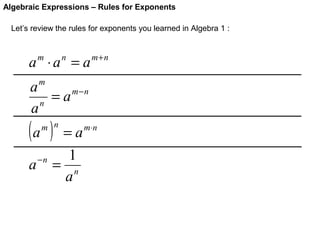
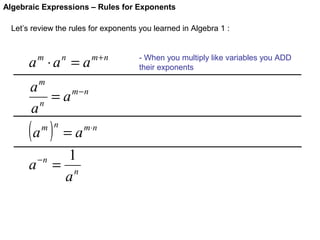
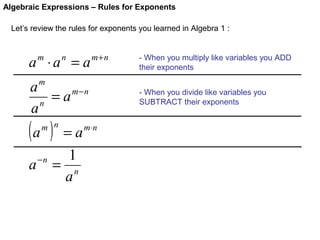
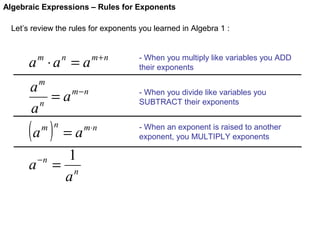
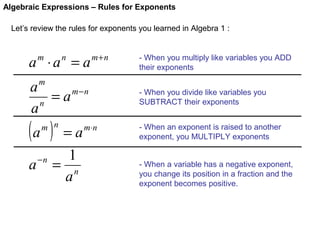
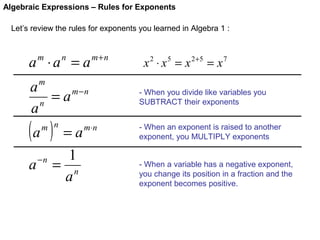
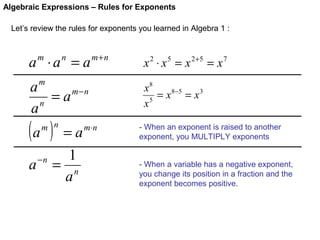
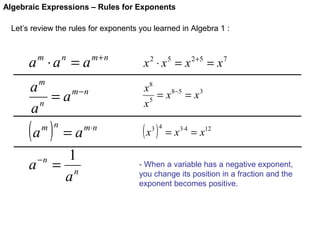
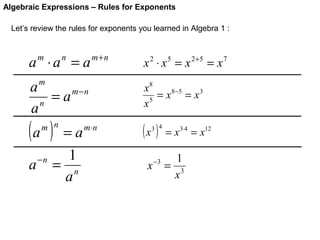
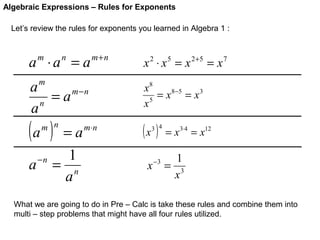
Let’s review the rules for exponents you learned in Algebra 1 :

a ⋅a = a
m

n

m+n

m

a
= a m−n
n
a

(a )

m n

a

−n

=a
1
= n
a

m⋅ n
Algebraic Expressions – Rules for Exponents
Let’s review the rules for exponents you learned in Algebra 1 :

a ⋅a = a
m

n

m+n

m

a
= a m−n
n
a

(a )

m n

a

−n

=a
1
= n
a

m⋅ n

- When you multiply like variables you ADD
their exponents
Algebraic Expressions – Rules for Exponents
Let’s review the rules for exponents you learned in Algebra 1 :

a ⋅a = a
m

n

m+n

- When you multiply like variables you ADD
their exponents

m

a
= a m−n
n
a

(a )

m n

a

−n

=a
1
= n
a

m⋅ n

- When you divide like variables you
SUBTRACT their exponents
Algebraic Expressions – Rules for Exponents
Let’s review the rules for exponents you learned in Algebra 1 :

a ⋅a = a
m

n

m+n

- When you multiply like variables you ADD
their exponents

m

a
= a m−n
n
a

(a )

m n

a

−n

=a
1
= n
a

m⋅ n

- When you divide like variables you
SUBTRACT their exponents
- When an exponent is raised to another
exponent, you MULTIPLY exponents
Algebraic Expressions – Rules for Exponents
Let’s review the rules for exponents you learned in Algebra 1 :

a ⋅a = a
m

n

m+n

- When you multiply like variables you ADD
their exponents

m

a
= a m−n
n
a

(a )

m n

a

−n

=a
1
= n
a

m⋅ n

- When you divide like variables you
SUBTRACT their exponents
- When an exponent is raised to another
exponent, you MULTIPLY exponents
- When a variable has a negative exponent,
you change its position in a fraction and the
exponent becomes positive.
Algebraic Expressions – Rules for Exponents
Let’s review the rules for exponents you learned in Algebra 1 :

a ⋅a = a
m

n

m+n

x 2 ⋅ x 5 = x 2+5 = x 7

m

a
= a m−n
n
a

(a )

m n

a

−n

=a
1
= n
a

m⋅ n

- When you divide like variables you
SUBTRACT their exponents
- When an exponent is raised to another
exponent, you MULTIPLY exponents
- When a variable has a negative exponent,
you change its position in a fraction and the
exponent becomes positive.
Algebraic Expressions – Rules for Exponents
Let’s review the rules for exponents you learned in Algebra 1 :

a ⋅a = a
m

n

m+n

m

a
= a m−n
n
a

(a )

m n

a

−n

=a
1
= n
a

m⋅ n

x 2 ⋅ x 5 = x 2+5 = x 7
x8
= x 8−5 = x 3
x5
- When an exponent is raised to another
exponent, you MULTIPLY exponents
- When a variable has a negative exponent,
you change its position in a fraction and the
exponent becomes positive.
Algebraic Expressions – Rules for Exponents
Let’s review the rules for exponents you learned in Algebra 1 :

a ⋅a = a
m

n

m+n

m

a
= a m−n
n
a

(a )

m n

a

−n

=a
1
= n
a

m⋅ n

x 2 ⋅ x 5 = x 2+5 = x 7
x8
= x 8−5 = x 3
x5

(x )

3 4

= x 3⋅4 = x12

- When a variable has a negative exponent,
you change its position in a fraction and the
exponent becomes positive.
Algebraic Expressions – Rules for Exponents
Let’s review the rules for exponents you learned in Algebra 1 :

a ⋅a = a
m

n

m+n

m

a
= a m−n
n
a

(a )

m n

a

−n

=a
1
= n
a

m⋅ n

x 2 ⋅ x 5 = x 2+5 = x 7
x8
= x 8−5 = x 3
x5

(x )

3 4

x

−3

= x 3⋅4 = x12

1
= 3
x
Algebraic Expressions – Rules for Exponents
Let’s review the rules for exponents you learned in Algebra 1 :

a ⋅a = a
m

n

m+n

m

a
= a m−n
n
a

(a )

m n

a

−n

=a
1
= n
a

m⋅ n

x 2 ⋅ x 5 = x 2+5 = x 7
x8
= x 8−5 = x 3
x5

(x )

3 4

x

−3

= x 3⋅4 = x12

1
= 3
x

What we are going to do in Pre – Calc is take these rules and combine them into
multi – step problems that might have all four rules utilized.
Algebraic Expressions – Rules for Exponents

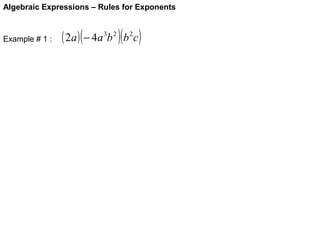
Example # 1 :

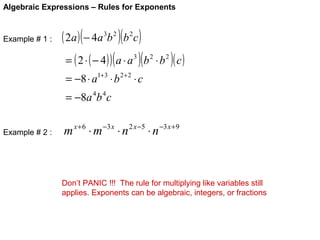
( 2a ) ( − 4a 3b 2 )(b 2c )
Algebraic Expressions – Rules for Exponents

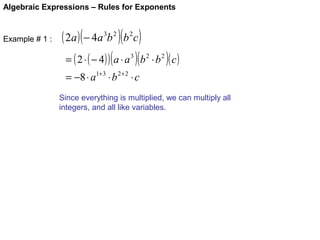
Example # 1 :

( 2a ) ( − 4a 3b 2 )(b 2c )
= ( 2 ⋅ ( − 4) ) ( a ⋅ a 3 )( b 2 ⋅ b 2 )( c )
= −8 ⋅ a1+3 ⋅ b 2+ 2 ⋅ c
Since everything is multiplied, we can multiply all
integers, and all like variables.
Algebraic Expressions – Rules for Exponents

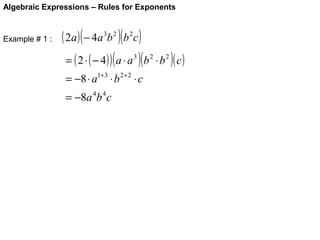
Example # 1 :

( 2a ) ( − 4a 3b 2 )(b 2c )

= ( 2 ⋅ ( − 4 ) ) ( a ⋅ a 3 )( b 2 ⋅ b 2 )( c )
= −8 ⋅ a1+3 ⋅ b 2+ 2 ⋅ c
= −8a 4b 4 c
Algebraic Expressions – Rules for Exponents

Example # 1 :

( 2a ) ( − 4a 3b 2 )(b 2c )

= ( 2 ⋅ ( − 4 ) ) ( a ⋅ a 3 )( b 2 ⋅ b 2 )( c )
= −8 ⋅ a1+3 ⋅ b 2+ 2 ⋅ c
= −8a 4b 4 c

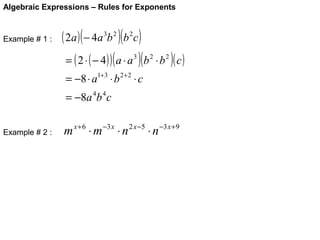
Example # 2 :

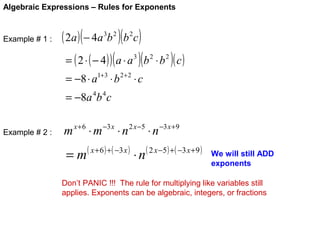
m x + 6 ⋅ m −3 x ⋅ n 2 x −5 ⋅ n −3 x +9
Algebraic Expressions – Rules for Exponents

Example # 1 :

( 2a ) ( − 4a 3b 2 )(b 2c )

= ( 2 ⋅ ( − 4 ) ) ( a ⋅ a 3 )( b 2 ⋅ b 2 )( c )
= −8 ⋅ a1+3 ⋅ b 2+ 2 ⋅ c
= −8a 4b 4 c

Example # 2 :

m x + 6 ⋅ m −3 x ⋅ n 2 x −5 ⋅ n −3 x +9

Don’t PANIC !!! The rule for multiplying like variables still
applies. Exponents can be algebraic, integers, or fractions
Algebraic Expressions – Rules for Exponents

Example # 1 :

( 2a ) ( − 4a 3b 2 )(b 2c )

= ( 2 ⋅ ( − 4 ) ) ( a ⋅ a 3 )( b 2 ⋅ b 2 )( c )
= −8 ⋅ a1+3 ⋅ b 2+ 2 ⋅ c
= −8a 4b 4 c

Example # 2 :

m x + 6 ⋅ m −3 x ⋅ n 2 x −5 ⋅ n −3 x +9

=m

( x + 6 ) + ( −3 x )

⋅n

( 2 x −5 ) + ( −3 x + 9 )

We will still ADD
exponents

Don’t PANIC !!! The rule for multiplying like variables still
applies. Exponents can be algebraic, integers, or fractions
Algebraic Expressions – Rules for Exponents

Example # 1 :

( 2a ) ( − 4a 3b 2 )(b 2c )

= ( 2 ⋅ ( − 4 ) ) ( a ⋅ a 3 )( b 2 ⋅ b 2 )( c )
= −8 ⋅ a1+3 ⋅ b 2+ 2 ⋅ c
= −8a 4b 4 c

Example # 2 :

m x + 6 ⋅ m −3 x ⋅ n 2 x −5 ⋅ n −3 x +9

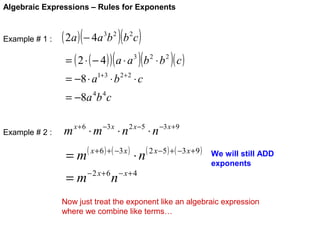
= m ( x + 6 ) + ( −3 x ) ⋅ n ( 2 x −5 ) + ( −3 x +9 )
=m

−2 x+6

n

We will still ADD
exponents

− x+4

Now just treat the exponent like an algebraic expression
where we combine like terms…
Algebraic Expressions – Rules for Exponents

Example # 3 :

[ 4( − 2 x y ) ]
2

3
3 2

When you have imbedded parentheses and
exponents outside, start with the innermost set and
work your way “out”.
Algebraic Expressions – Rules for Exponents

Example # 3 :

[ 4( − 2 x y ) ]

3
3 2

2

[(

= 4 ( − 2) ⋅ x
2

2⋅2

⋅y

3⋅2

)]

3

Evaluate this first, applying the exponent outside to
ALL of the terms inside.
Algebraic Expressions – Rules for Exponents

Example # 3 :

[ 4( − 2 x y ) ]
2

[(

3
3 2

= 4 ( − 2) ⋅ x

[(

2

= 4 4x y
4

6

)]

2⋅2

3

⋅y

3⋅2

)]

3
Algebraic Expressions – Rules for Exponents

Example # 3 :

[ 4( − 2 x y ) ]
= [ 4( ( − 2 ) ⋅ x
2

3
3 2

2

[(
)]
= [16 x y ]
= 4 4x y
4

4

6

2⋅2

⋅y

3⋅2

)]

3

3

6 3

I like to multiply what is inside the brackets before I
apply the outside exponent.
Algebraic Expressions – Rules for Exponents

Example # 3 :

[ 4( − 2 x y ) ]
= [ 4( ( − 2 ) ⋅ x
2

3
3 2

2

[(
)]
= [16 x y ]
= 4 4x y
4

4

6

2⋅2

⋅y

3⋅2

)]

3

6 3

= 163 ⋅ x 4⋅3 y 6⋅3
Apply the outside exponent.

3
Algebraic Expressions – Rules for Exponents

Example # 3 :

[ 4( − 2 x y ) ]
2

3
3 2

[(

= 4 ( − 2) ⋅ x
2

[(
)]
= [16 x y ]
= 4 4x y
4

4

6

⋅y

3⋅2

)]

3

3

6 3

4⋅3

= 16 ⋅ x y
3

2⋅2

= 163 x12 y18

6⋅3

or 4096 x12 y18
Algebraic Expressions – Rules for Exponents

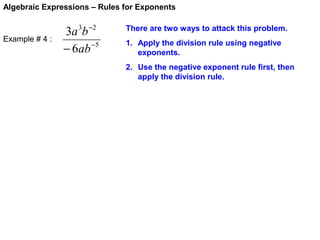
Example # 4 :

3a 3b −2
− 6ab −5

There are two ways to attack this problem.
1. Apply the division rule using negative
exponents.
2. Use the negative exponent rule first, then
apply the division rule.
Algebraic Expressions – Rules for Exponents

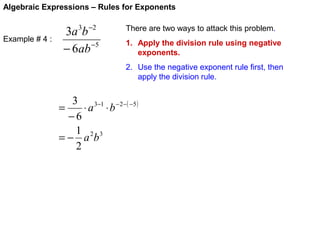
Example # 4 :

3a 3b −2
− 6ab −5

There are two ways to attack this problem.
1. Apply the division rule using negative
exponents.
2. Use the negative exponent rule first, then
apply the division rule.

3 3−1 − 2−( −5 )
=
⋅ a ⋅b
−6
1 2 3
=− a b
2
Algebraic Expressions – Rules for Exponents

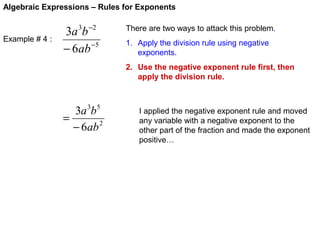
Example # 4 :

3a 3b −2
− 6ab −5

There are two ways to attack this problem.
1. Apply the division rule using negative
exponents.
2. Use the negative exponent rule first, then
apply the division rule.

3a 3b 5
=
− 6ab 2

I applied the negative exponent rule and moved
any variable with a negative exponent to the
other part of the fraction and made the exponent
positive…
Algebraic Expressions – Rules for Exponents

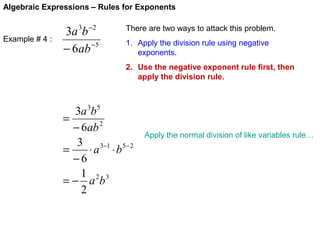
Example # 4 :

3a 3b −2
− 6ab −5

There are two ways to attack this problem.
1. Apply the division rule using negative
exponents.
2. Use the negative exponent rule first, then
apply the division rule.

3a 3b 5
=
− 6ab 2
3 3−1 5− 2
=
⋅ a ⋅b
−6
1 2 3
=− a b
2

Apply the normal division of like variables rule…
Algebraic Expressions – Rules for Exponents

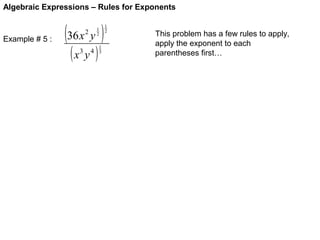
Example # 5 :

(36 x y )
1
2

2

(x y )
3

4

1
3

1
2

This problem has a few rules to apply,
apply the exponent to each
parentheses first…
Algebraic Expressions – Rules for Exponents

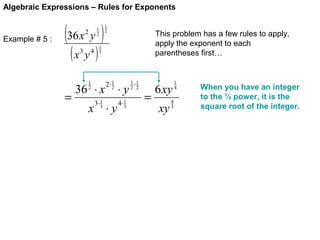
Example # 5 :

(36 x y )
1
2

2

(x y )
3

=

4

1
2

This problem has a few rules to apply,
apply the exponent to each
parentheses first…

1
3

1
2

36 ⋅ x
3⋅ 1
3

2⋅ 1
2

x ⋅y

⋅y
4⋅ 1
3

1⋅1
2 2

=

6 xy
xy

4
3

1
4

When you have an integer
to the ½ power, it is the
square root of the integer.
Algebraic Expressions – Rules for Exponents

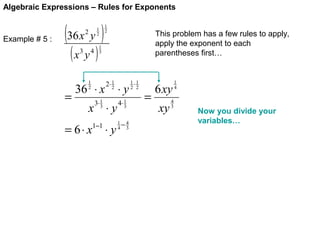
Example # 5 :

(36 x y )
1
2

2

(x y )
3

=

4

1
2

This problem has a few rules to apply,
apply the exponent to each
parentheses first…

1
3

1
2

36 ⋅ x

2⋅ 1
2

⋅y

3⋅ 1
3

4⋅ 1
3

1−1

1−4
4 3

x ⋅y

= 6⋅ x

⋅y

1⋅1
2 2

=

6 xy
xy

4
3

1
4

Now you divide your
variables…
Algebraic Expressions – Rules for Exponents

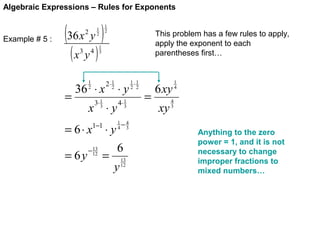
Example # 5 :

(36 x y )
1
2

2

(x y )
3

=

4

1
2

This problem has a few rules to apply,
apply the exponent to each
parentheses first…

1
3

1
2

36 ⋅ x

2⋅ 1
2

⋅y

3⋅ 1
3

4⋅ 1
3

1−1

1−4
4 3

x ⋅y

= 6⋅ x
= 6y

13
− 12

⋅y

=

6
y

13
12

1⋅1
2 2

=

6 xy
xy

1
4

4
3

Anything to the zero
power = 1, and it is not
necessary to change
improper fractions to
mixed numbers…
Algebraic Expressions – Rules for Exponents

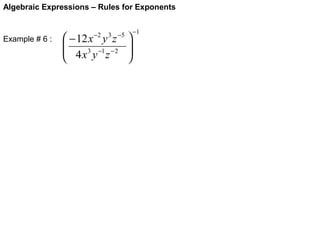
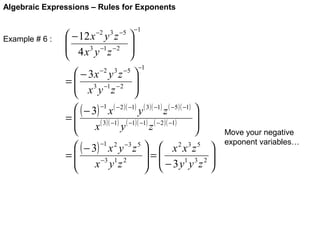
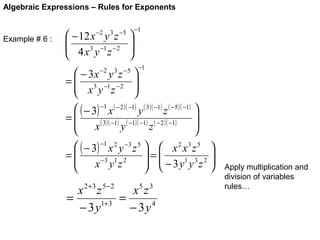
Example # 6 :

 − 12 x y z

 4 x 3 y −1 z − 2

−2

3 −5






−1
Algebraic Expressions – Rules for Exponents

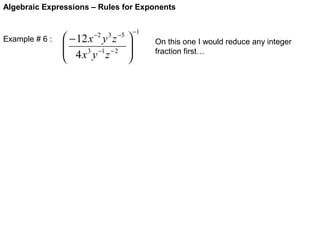
Example # 6 :

 − 12 x y z

 4 x 3 y −1 z − 2

−2

3 −5






−1

On this one I would reduce any integer
fraction first…
Algebraic Expressions – Rules for Exponents

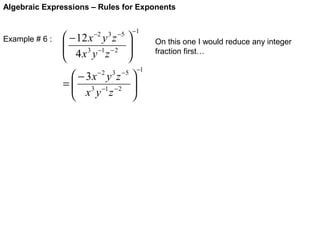
Example # 6 :

 − 12 x y z

 4 x 3 y −1 z − 2

−2

3 −5

 − 3x y z
=  3 −1 − 2
 x y z

−2






3 −5

−1






On this one I would reduce any integer
fraction first…
−1
Algebraic Expressions – Rules for Exponents

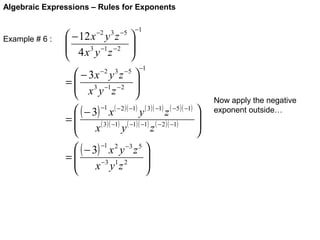
Example # 6 :

 − 12 x y z

 4 x 3 y −1 z − 2

−2

3 −5






−1

−1

 − 3x y z 
=  3 −1 − 2 
 x y z



 ( − 3) −1 x ( − 2 )( −1) y ( 3 )( −1) z ( −5 )( −1)
=

x ( 3 )( −1) y ( −1)( −1) z ( − 2 )( −1)

 ( − 3) −1 x 2 y −3 z 5 

=
−3 1 2


x yz


−2

3 −5






Now apply the negative
exponent outside…
Algebraic Expressions – Rules for Exponents

Example # 6 :

 − 12 x y z

 4 x 3 y −1 z − 2

−2

3 −5






−1

−1

 − 3x y z 
=  3 −1 − 2 
 x y z



 ( − 3) −1 x ( − 2 )( −1) y ( 3 )( −1) z ( −5 )( −1) 

=
( 3 )( −1) ( −1)( −1) ( − 2 )( −1)


x
y
z


 ( − 3) −1 x 2 y −3 z 5   x 2 x 3 z 5 
=
=
−3 1 2
 − 3 y1 y 3 z 2 



x yz


 
−2

3 −5

Move your negative
exponent variables…
Algebraic Expressions – Rules for Exponents

Example # 6 :

 − 12 x y z

 4 x 3 y −1 z − 2

−2

3 −5






−1

−1

 − 3x y z 
=  3 −1 − 2 
 x y z



 ( − 3) −1 x ( − 2 )( −1) y ( 3 )( −1) z ( −5 )( −1) 

=
( 3 )( −1) ( −1)( −1) ( − 2 )( −1)


x
y
z


 ( − 3) −1 x 2 y −3 z 5   x 2 x 3 z 5 
=
=
−3 1 2
 − 3 y1 y 3 z 2 



x yz


 
−2

3 −5

x 2 + 3 z 5− 2
x5 z 3
=
=
1+ 3
− 3y
− 3y4

Apply multiplication and
division of variables
rules…

1 rules for exponents

  • 1.
    Algebraic Expressions –Rules for Exponents Let’s review the rules for exponents you learned in Algebra 1 : a ⋅a = a m n m+n m a = a m−n n a (a ) m n a −n =a 1 = n a m⋅ n
  • 2.
    Algebraic Expressions –Rules for Exponents Let’s review the rules for exponents you learned in Algebra 1 : a ⋅a = a m n m+n m a = a m−n n a (a ) m n a −n =a 1 = n a m⋅ n - When you multiply like variables you ADD their exponents
  • 3.
    Algebraic Expressions –Rules for Exponents Let’s review the rules for exponents you learned in Algebra 1 : a ⋅a = a m n m+n - When you multiply like variables you ADD their exponents m a = a m−n n a (a ) m n a −n =a 1 = n a m⋅ n - When you divide like variables you SUBTRACT their exponents
  • 4.
    Algebraic Expressions –Rules for Exponents Let’s review the rules for exponents you learned in Algebra 1 : a ⋅a = a m n m+n - When you multiply like variables you ADD their exponents m a = a m−n n a (a ) m n a −n =a 1 = n a m⋅ n - When you divide like variables you SUBTRACT their exponents - When an exponent is raised to another exponent, you MULTIPLY exponents
  • 5.
    Algebraic Expressions –Rules for Exponents Let’s review the rules for exponents you learned in Algebra 1 : a ⋅a = a m n m+n - When you multiply like variables you ADD their exponents m a = a m−n n a (a ) m n a −n =a 1 = n a m⋅ n - When you divide like variables you SUBTRACT their exponents - When an exponent is raised to another exponent, you MULTIPLY exponents - When a variable has a negative exponent, you change its position in a fraction and the exponent becomes positive.
  • 6.
    Algebraic Expressions –Rules for Exponents Let’s review the rules for exponents you learned in Algebra 1 : a ⋅a = a m n m+n x 2 ⋅ x 5 = x 2+5 = x 7 m a = a m−n n a (a ) m n a −n =a 1 = n a m⋅ n - When you divide like variables you SUBTRACT their exponents - When an exponent is raised to another exponent, you MULTIPLY exponents - When a variable has a negative exponent, you change its position in a fraction and the exponent becomes positive.
  • 7.
    Algebraic Expressions –Rules for Exponents Let’s review the rules for exponents you learned in Algebra 1 : a ⋅a = a m n m+n m a = a m−n n a (a ) m n a −n =a 1 = n a m⋅ n x 2 ⋅ x 5 = x 2+5 = x 7 x8 = x 8−5 = x 3 x5 - When an exponent is raised to another exponent, you MULTIPLY exponents - When a variable has a negative exponent, you change its position in a fraction and the exponent becomes positive.
  • 8.
    Algebraic Expressions –Rules for Exponents Let’s review the rules for exponents you learned in Algebra 1 : a ⋅a = a m n m+n m a = a m−n n a (a ) m n a −n =a 1 = n a m⋅ n x 2 ⋅ x 5 = x 2+5 = x 7 x8 = x 8−5 = x 3 x5 (x ) 3 4 = x 3⋅4 = x12 - When a variable has a negative exponent, you change its position in a fraction and the exponent becomes positive.
  • 9.
    Algebraic Expressions –Rules for Exponents Let’s review the rules for exponents you learned in Algebra 1 : a ⋅a = a m n m+n m a = a m−n n a (a ) m n a −n =a 1 = n a m⋅ n x 2 ⋅ x 5 = x 2+5 = x 7 x8 = x 8−5 = x 3 x5 (x ) 3 4 x −3 = x 3⋅4 = x12 1 = 3 x
  • 10.
    Algebraic Expressions –Rules for Exponents Let’s review the rules for exponents you learned in Algebra 1 : a ⋅a = a m n m+n m a = a m−n n a (a ) m n a −n =a 1 = n a m⋅ n x 2 ⋅ x 5 = x 2+5 = x 7 x8 = x 8−5 = x 3 x5 (x ) 3 4 x −3 = x 3⋅4 = x12 1 = 3 x What we are going to do in Pre – Calc is take these rules and combine them into multi – step problems that might have all four rules utilized.
  • 11.
    Algebraic Expressions –Rules for Exponents Example # 1 : ( 2a ) ( − 4a 3b 2 )(b 2c )
  • 12.
    Algebraic Expressions –Rules for Exponents Example # 1 : ( 2a ) ( − 4a 3b 2 )(b 2c ) = ( 2 ⋅ ( − 4) ) ( a ⋅ a 3 )( b 2 ⋅ b 2 )( c ) = −8 ⋅ a1+3 ⋅ b 2+ 2 ⋅ c Since everything is multiplied, we can multiply all integers, and all like variables.
  • 13.
    Algebraic Expressions –Rules for Exponents Example # 1 : ( 2a ) ( − 4a 3b 2 )(b 2c ) = ( 2 ⋅ ( − 4 ) ) ( a ⋅ a 3 )( b 2 ⋅ b 2 )( c ) = −8 ⋅ a1+3 ⋅ b 2+ 2 ⋅ c = −8a 4b 4 c
  • 14.
    Algebraic Expressions –Rules for Exponents Example # 1 : ( 2a ) ( − 4a 3b 2 )(b 2c ) = ( 2 ⋅ ( − 4 ) ) ( a ⋅ a 3 )( b 2 ⋅ b 2 )( c ) = −8 ⋅ a1+3 ⋅ b 2+ 2 ⋅ c = −8a 4b 4 c Example # 2 : m x + 6 ⋅ m −3 x ⋅ n 2 x −5 ⋅ n −3 x +9
  • 15.
    Algebraic Expressions –Rules for Exponents Example # 1 : ( 2a ) ( − 4a 3b 2 )(b 2c ) = ( 2 ⋅ ( − 4 ) ) ( a ⋅ a 3 )( b 2 ⋅ b 2 )( c ) = −8 ⋅ a1+3 ⋅ b 2+ 2 ⋅ c = −8a 4b 4 c Example # 2 : m x + 6 ⋅ m −3 x ⋅ n 2 x −5 ⋅ n −3 x +9 Don’t PANIC !!! The rule for multiplying like variables still applies. Exponents can be algebraic, integers, or fractions
  • 16.
    Algebraic Expressions –Rules for Exponents Example # 1 : ( 2a ) ( − 4a 3b 2 )(b 2c ) = ( 2 ⋅ ( − 4 ) ) ( a ⋅ a 3 )( b 2 ⋅ b 2 )( c ) = −8 ⋅ a1+3 ⋅ b 2+ 2 ⋅ c = −8a 4b 4 c Example # 2 : m x + 6 ⋅ m −3 x ⋅ n 2 x −5 ⋅ n −3 x +9 =m ( x + 6 ) + ( −3 x ) ⋅n ( 2 x −5 ) + ( −3 x + 9 ) We will still ADD exponents Don’t PANIC !!! The rule for multiplying like variables still applies. Exponents can be algebraic, integers, or fractions
  • 17.
    Algebraic Expressions –Rules for Exponents Example # 1 : ( 2a ) ( − 4a 3b 2 )(b 2c ) = ( 2 ⋅ ( − 4 ) ) ( a ⋅ a 3 )( b 2 ⋅ b 2 )( c ) = −8 ⋅ a1+3 ⋅ b 2+ 2 ⋅ c = −8a 4b 4 c Example # 2 : m x + 6 ⋅ m −3 x ⋅ n 2 x −5 ⋅ n −3 x +9 = m ( x + 6 ) + ( −3 x ) ⋅ n ( 2 x −5 ) + ( −3 x +9 ) =m −2 x+6 n We will still ADD exponents − x+4 Now just treat the exponent like an algebraic expression where we combine like terms…
  • 18.
    Algebraic Expressions –Rules for Exponents Example # 3 : [ 4( − 2 x y ) ] 2 3 3 2 When you have imbedded parentheses and exponents outside, start with the innermost set and work your way “out”.
  • 19.
    Algebraic Expressions –Rules for Exponents Example # 3 : [ 4( − 2 x y ) ] 3 3 2 2 [( = 4 ( − 2) ⋅ x 2 2⋅2 ⋅y 3⋅2 )] 3 Evaluate this first, applying the exponent outside to ALL of the terms inside.
  • 20.
    Algebraic Expressions –Rules for Exponents Example # 3 : [ 4( − 2 x y ) ] 2 [( 3 3 2 = 4 ( − 2) ⋅ x [( 2 = 4 4x y 4 6 )] 2⋅2 3 ⋅y 3⋅2 )] 3
  • 21.
    Algebraic Expressions –Rules for Exponents Example # 3 : [ 4( − 2 x y ) ] = [ 4( ( − 2 ) ⋅ x 2 3 3 2 2 [( )] = [16 x y ] = 4 4x y 4 4 6 2⋅2 ⋅y 3⋅2 )] 3 3 6 3 I like to multiply what is inside the brackets before I apply the outside exponent.
  • 22.
    Algebraic Expressions –Rules for Exponents Example # 3 : [ 4( − 2 x y ) ] = [ 4( ( − 2 ) ⋅ x 2 3 3 2 2 [( )] = [16 x y ] = 4 4x y 4 4 6 2⋅2 ⋅y 3⋅2 )] 3 6 3 = 163 ⋅ x 4⋅3 y 6⋅3 Apply the outside exponent. 3
  • 23.
    Algebraic Expressions –Rules for Exponents Example # 3 : [ 4( − 2 x y ) ] 2 3 3 2 [( = 4 ( − 2) ⋅ x 2 [( )] = [16 x y ] = 4 4x y 4 4 6 ⋅y 3⋅2 )] 3 3 6 3 4⋅3 = 16 ⋅ x y 3 2⋅2 = 163 x12 y18 6⋅3 or 4096 x12 y18
  • 24.
    Algebraic Expressions –Rules for Exponents Example # 4 : 3a 3b −2 − 6ab −5 There are two ways to attack this problem. 1. Apply the division rule using negative exponents. 2. Use the negative exponent rule first, then apply the division rule.
  • 25.
    Algebraic Expressions –Rules for Exponents Example # 4 : 3a 3b −2 − 6ab −5 There are two ways to attack this problem. 1. Apply the division rule using negative exponents. 2. Use the negative exponent rule first, then apply the division rule. 3 3−1 − 2−( −5 ) = ⋅ a ⋅b −6 1 2 3 =− a b 2
  • 26.
    Algebraic Expressions –Rules for Exponents Example # 4 : 3a 3b −2 − 6ab −5 There are two ways to attack this problem. 1. Apply the division rule using negative exponents. 2. Use the negative exponent rule first, then apply the division rule. 3a 3b 5 = − 6ab 2 I applied the negative exponent rule and moved any variable with a negative exponent to the other part of the fraction and made the exponent positive…
  • 27.
    Algebraic Expressions –Rules for Exponents Example # 4 : 3a 3b −2 − 6ab −5 There are two ways to attack this problem. 1. Apply the division rule using negative exponents. 2. Use the negative exponent rule first, then apply the division rule. 3a 3b 5 = − 6ab 2 3 3−1 5− 2 = ⋅ a ⋅b −6 1 2 3 =− a b 2 Apply the normal division of like variables rule…
  • 28.
    Algebraic Expressions –Rules for Exponents Example # 5 : (36 x y ) 1 2 2 (x y ) 3 4 1 3 1 2 This problem has a few rules to apply, apply the exponent to each parentheses first…
  • 29.
    Algebraic Expressions –Rules for Exponents Example # 5 : (36 x y ) 1 2 2 (x y ) 3 = 4 1 2 This problem has a few rules to apply, apply the exponent to each parentheses first… 1 3 1 2 36 ⋅ x 3⋅ 1 3 2⋅ 1 2 x ⋅y ⋅y 4⋅ 1 3 1⋅1 2 2 = 6 xy xy 4 3 1 4 When you have an integer to the ½ power, it is the square root of the integer.
  • 30.
    Algebraic Expressions –Rules for Exponents Example # 5 : (36 x y ) 1 2 2 (x y ) 3 = 4 1 2 This problem has a few rules to apply, apply the exponent to each parentheses first… 1 3 1 2 36 ⋅ x 2⋅ 1 2 ⋅y 3⋅ 1 3 4⋅ 1 3 1−1 1−4 4 3 x ⋅y = 6⋅ x ⋅y 1⋅1 2 2 = 6 xy xy 4 3 1 4 Now you divide your variables…
  • 31.
    Algebraic Expressions –Rules for Exponents Example # 5 : (36 x y ) 1 2 2 (x y ) 3 = 4 1 2 This problem has a few rules to apply, apply the exponent to each parentheses first… 1 3 1 2 36 ⋅ x 2⋅ 1 2 ⋅y 3⋅ 1 3 4⋅ 1 3 1−1 1−4 4 3 x ⋅y = 6⋅ x = 6y 13 − 12 ⋅y = 6 y 13 12 1⋅1 2 2 = 6 xy xy 1 4 4 3 Anything to the zero power = 1, and it is not necessary to change improper fractions to mixed numbers…
  • 32.
    Algebraic Expressions –Rules for Exponents Example # 6 :  − 12 x y z   4 x 3 y −1 z − 2  −2 3 −5     −1
  • 33.
    Algebraic Expressions –Rules for Exponents Example # 6 :  − 12 x y z   4 x 3 y −1 z − 2  −2 3 −5     −1 On this one I would reduce any integer fraction first…
  • 34.
    Algebraic Expressions –Rules for Exponents Example # 6 :  − 12 x y z   4 x 3 y −1 z − 2  −2 3 −5  − 3x y z =  3 −1 − 2  x y z  −2     3 −5 −1     On this one I would reduce any integer fraction first… −1
  • 35.
    Algebraic Expressions –Rules for Exponents Example # 6 :  − 12 x y z   4 x 3 y −1 z − 2  −2 3 −5     −1 −1  − 3x y z  =  3 −1 − 2   x y z     ( − 3) −1 x ( − 2 )( −1) y ( 3 )( −1) z ( −5 )( −1) =  x ( 3 )( −1) y ( −1)( −1) z ( − 2 )( −1)   ( − 3) −1 x 2 y −3 z 5   = −3 1 2   x yz   −2 3 −5     Now apply the negative exponent outside…
  • 36.
    Algebraic Expressions –Rules for Exponents Example # 6 :  − 12 x y z   4 x 3 y −1 z − 2  −2 3 −5     −1 −1  − 3x y z  =  3 −1 − 2   x y z     ( − 3) −1 x ( − 2 )( −1) y ( 3 )( −1) z ( −5 )( −1)   = ( 3 )( −1) ( −1)( −1) ( − 2 )( −1)   x y z    ( − 3) −1 x 2 y −3 z 5   x 2 x 3 z 5  = = −3 1 2  − 3 y1 y 3 z 2     x yz     −2 3 −5 Move your negative exponent variables…
  • 37.
    Algebraic Expressions –Rules for Exponents Example # 6 :  − 12 x y z   4 x 3 y −1 z − 2  −2 3 −5     −1 −1  − 3x y z  =  3 −1 − 2   x y z     ( − 3) −1 x ( − 2 )( −1) y ( 3 )( −1) z ( −5 )( −1)   = ( 3 )( −1) ( −1)( −1) ( − 2 )( −1)   x y z    ( − 3) −1 x 2 y −3 z 5   x 2 x 3 z 5  = = −3 1 2  − 3 y1 y 3 z 2     x yz     −2 3 −5 x 2 + 3 z 5− 2 x5 z 3 = = 1+ 3 − 3y − 3y4 Apply multiplication and division of variables rules…