3D Drone Surveying
Todd Stellanova
todd@droneflow.com
Droneflow
Current Drone Surveys
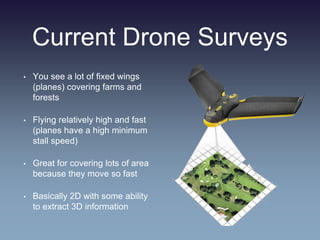
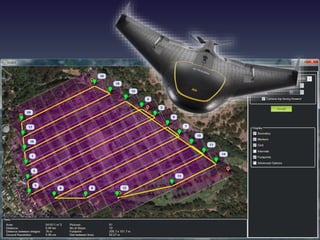
• You see a lot of fixed wings
(planes) covering farms and
forests
• Flying relatively high and fast
(planes have a high minimum
stall speed)
• Great for covering lots of area
because they move so fast
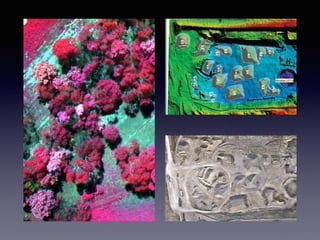
• Basically 2D with some ability
to extract 3D information
The Problem
• What if you need to cover a smaller volume in much
greater detail?
• What if you want to use special sensors that require
slower flight?
• What if you need to map 3D features such as cliff
sides, caves, lava tubes, sinkholes, forest canopy
structures?
• What if you want to monitor the same spot over and
over at altitude?
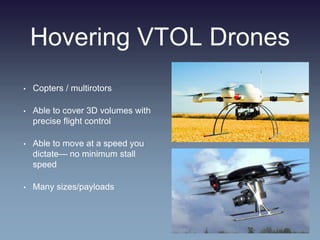
Hovering VTOL Drones
• Copters / multirotors
• Able to cover 3D volumes with
precise flight control
• Able to move at a speed you
dictate— no minimum stall
speed
• Many sizes/payloads
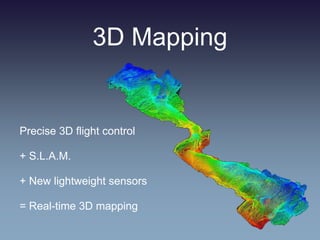
3D Mapping
Precise 3D flight control
+ S.L.A.M.
+ New lightweight sensors
= Real-time 3D mapping
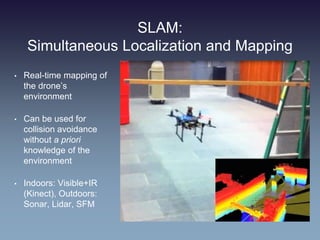
SLAM:
Simultaneous Localization and Mapping
• Real-time mapping of
the drone’s
environment
• Can be used for
collision avoidance
without a priori
knowledge of the
environment
• Indoors: Visible+IR
(Kinect), Outdoors:
Sonar, Lidar, SFM
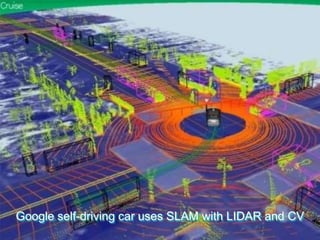
Google self-driving car uses SLAM with LIDAR and CV
Alternative Sensors
Take advantage of flying low and slow
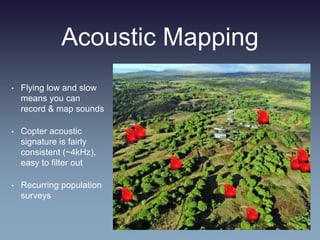
Acoustic Mapping
• Flying low and slow
means you can
record & map sounds
• Copter acoustic
signature is fairly
consistent (~4kHz),
easy to filter out
• Recurring population
surveys
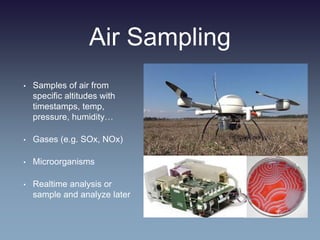
Air Sampling
• Samples of air from
specific altitudes with
timestamps, temp,
pressure, humidity…
• Gases (e.g. SOx, NOx)
• Microorganisms
• Realtime analysis or
sample and analyze later
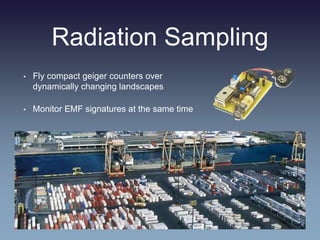
Radiation Sampling
• Fly compact geiger counters over
dynamically changing landscapes
• Monitor EMF signatures at the same time
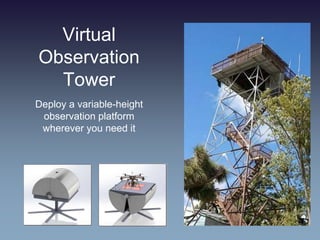
Virtual
Observation
Tower
Deploy a variable-height
observation platform
wherever you need it
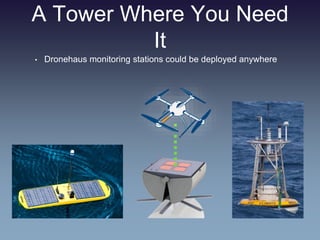
A Tower Where You Need
It
• Dronehaus monitoring stations could be deployed anywhere
Droneflow
Q&A
todd@droneflow.com

3D Drone Surveying

  • 1.
    3D Drone Surveying ToddStellanova todd@droneflow.com Droneflow
  • 2.
    Current Drone Surveys •You see a lot of fixed wings (planes) covering farms and forests • Flying relatively high and fast (planes have a high minimum stall speed) • Great for covering lots of area because they move so fast • Basically 2D with some ability to extract 3D information
  • 5.
    The Problem • Whatif you need to cover a smaller volume in much greater detail? • What if you want to use special sensors that require slower flight? • What if you need to map 3D features such as cliff sides, caves, lava tubes, sinkholes, forest canopy structures? • What if you want to monitor the same spot over and over at altitude?
  • 6.
    Hovering VTOL Drones •Copters / multirotors • Able to cover 3D volumes with precise flight control • Able to move at a speed you dictate— no minimum stall speed • Many sizes/payloads
  • 7.
    3D Mapping Precise 3Dflight control + S.L.A.M. + New lightweight sensors = Real-time 3D mapping
  • 8.
    SLAM: Simultaneous Localization andMapping • Real-time mapping of the drone’s environment • Can be used for collision avoidance without a priori knowledge of the environment • Indoors: Visible+IR (Kinect), Outdoors: Sonar, Lidar, SFM
  • 9.
    Google self-driving caruses SLAM with LIDAR and CV
  • 10.
    Alternative Sensors Take advantageof flying low and slow
  • 11.
    Acoustic Mapping • Flyinglow and slow means you can record & map sounds • Copter acoustic signature is fairly consistent (~4kHz), easy to filter out • Recurring population surveys
  • 12.
    Air Sampling • Samplesof air from specific altitudes with timestamps, temp, pressure, humidity… • Gases (e.g. SOx, NOx) • Microorganisms • Realtime analysis or sample and analyze later
  • 13.
    Radiation Sampling • Flycompact geiger counters over dynamically changing landscapes • Monitor EMF signatures at the same time
  • 14.
  • 15.
    A Tower WhereYou Need It • Dronehaus monitoring stations could be deployed anywhere
  • 16.