Th
e
Trut
h
aboutDrone
sin Mapping and
Surveying
Surveyors already have access to ground-based, manned flight,
and satellite data, so will they embrace this new technology in
earnest?
By Bill McNeil, Contributor/Advisor, and Colin Snow, CEO and Founder, Skylogic
Research, LLC
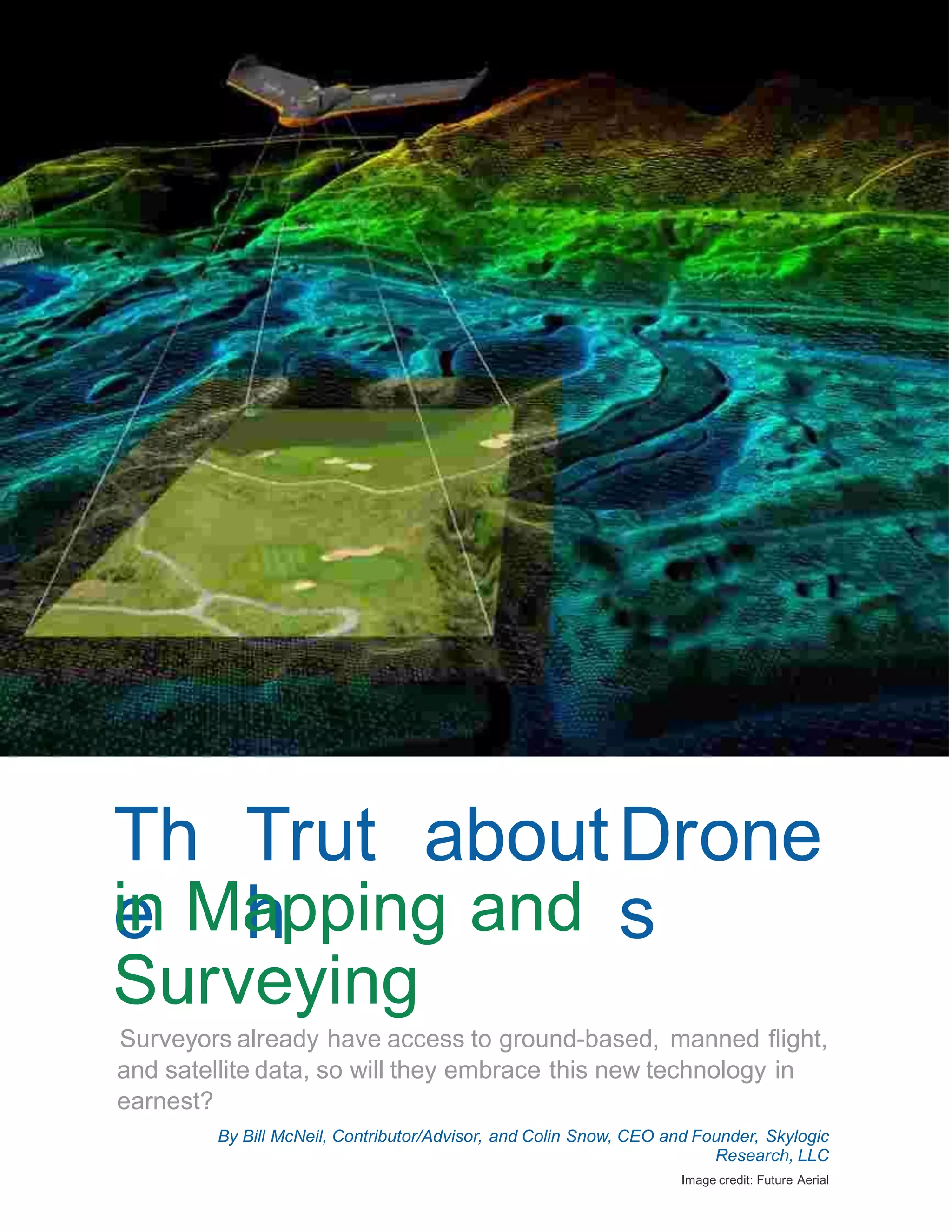
Image credit: Future Aerial
Introduction
According to 2015 statistics from the US Department of
Labor,
there are 44,300 surveyors in the United States. But mapping
is
practiced by a larger population of cartographers,
topographers,
photogrammetrists, civil engineers, and geographers – it’s
not
exclusive to the surveying industry. The American Society of
Civil
Engineers lists more than 150,000 members in 177
countries,
and the Imaging and Geospatial Society has 7,000
supporters.
All of these disciplines can be grouped under a broader
category
called geographic information systems (GIS). GIS
professionals
provide a wide variety of land-related services like identifying
property boundaries, subdividing land, and surveying
construc-
tion sites for placement of buildings. They also produce
topographic and hydrographic maps, volumetric calculations
for
stockpiles, and flood insurance maps, among other services.
A June 2016 Wall Street Journal article mentions that
survey-
ing and engineering company McKim and Creed plan to
have
one drone pilot per each of their 21 field offices. According
to
Christian Stallings, their research and development
manager,
drones can inexpensively create images with resolutions of
fea-
tures 1 to 2 inches in size when conducting survey plots of a
square mile or less.
Drones capture data that can be used in a wide variety of
sur-
veying and mapping applications. Some of these include
the
following:1. Automated mapping – Workflow for automated
mapping ap-
plications begins by establishing control points. These
are
either ground features with known coordinates or
markers
placed at known locations around the area to be
mapped.
This is a fundamental element of mapping because
ground
control points establish (1) scale, or the relationship be-
tween the map distance to the real world distance, (2)
fea-
ture height, and (3) north orientation.
The number of surveyors is actually projected to decline by
two
percent from 2014 to 2024 because of improved surveying
technology. Even though surveyors are a fraction of the
broader
population of GIS professionals, how will the improved
survey-
ing technology that is affecting them apply to that broader
GIS
population? And given the downbeat forecast for surveyors
compared with the numerous upbeat billion dollar
projections
of drone use from the FAA and other industry observers,
the
question becomes, Where do commercial unmanned
aircraft
systems (UAS) or drones fit into the surveying technology
mix?
Once control points are in place, the drone’s flight path
is
calculated by using a mission planning application. This
so-
lution enables the drone to fly autonomously at a set
alti-
tude while taking pictures at two or three-second
intervals.
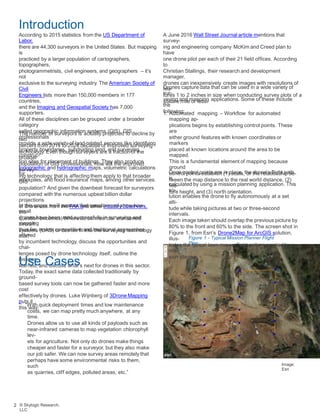
Each image taken should overlap the previous picture by
80% to the front and 60% to the side. The screen shot in
Figure 1, from Esri’s Drone2Map for ArcGIS solution,
illus-
trates the typical lawn mower flight pattern created by a
mis-
sion planner.
In this paper, we’ll answer that question and show how
small
drones have been used successfully in surveying and
mapping
thus far, review competitive and traditional approaches
offered
by incumbent technology, discuss the opportunities and
chal-
lenges posed by drone technology itself, outline the
lessons
learned, and discuss what’s next for drones in this sector.
Figure 1 - Typical Mission Planner Flight
Plan
Use Cases
Today, the exact same data collected traditionally by
ground-
based survey tools can now be gathered faster and more
cost
effectively by drones. Luke Wijnberg of 3Drone Mapping
puts it
this way:
“With quick deployment times and low maintenance
costs, we can map pretty much anywhere, at any
time.
Drones allow us to use all kinds of payloads such as
near-infrared cameras to map vegetation chlorophyll
lev-
els for agriculture. Not only do drones make things
cheaper and faster for a surveyor, but they also make
our job safer. We can now survey areas remotely that
perhaps have some environmental risks to them,
such
as quarries, cliff edges, polluted areas, etc.”
Image:
Esri
2 © Skylogic Research,
LLC
extract measurements of the environment. This is
achieved
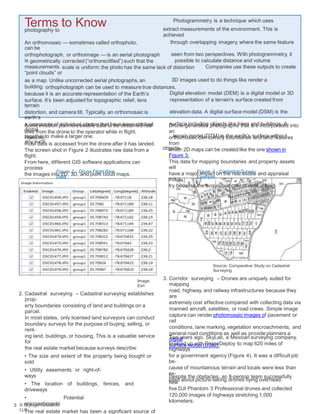
Some mission planners enable data to be streamed real
time from the drone to the operator while in flight.
However,
most data is accessed from the drone after it has landed.
The screen shot in Figure 2 illustrates raw data from a
flight.
From here, different GIS software applications can
process
the images into 2D, 3D, and point cloud maps.
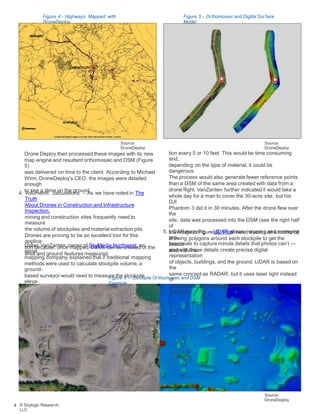
Drone-generated photographs that are incorporated into
an
orthomosaic can identify boundaries and land features
from
which 2D maps can be created like the one shown in
Figure 3.
This data for mapping boundaries and property assets
will
have a major impact on the real estate and appraisal
indus-
try because the acquisition cost of data is low.
Figure 2 - Drone Flight Raw
Data
Figure 3 - Cadastral Survey
Example
Source: Comparative Study on Cadastral
Surveying
3. Corridor surveying – Drones are uniquely suited for
mapping
road, highway, and railway infrastructures because they
are
extremely cost effective compared with collecting data via
manned aircraft, satellites, or road crews. Simple image
capture can render photomosaic images of pavement or
rail
conditions, lane marking, vegetation encroachments, and
general road conditions as well as provide planners a
digital
surface model (DSM).
Image:
Esri
2. Cadastral surveying – Cadastral surveying establishes
prop-
erty boundaries consisting of land and buildings on a
parcel.
In most states, only licensed land surveyors can conduct
boundary surveys for the purpose of buying, selling, or
rent-
ing land, buildings, or housing. This is a valuable service
for
the real estate market because surveys describe:
• The size and extent of the property being bought or
sold
• Utility easements or right-of-
ways
• The location of buildings, fences, and
driveways
• Potential
encroachments
The real estate market has been a significant source of
Two years ago, SkyLab, a Mexican surveying company,
teamed up with DroneDeploy to map 620 miles of
highways
for a government agency (Figure 4). It was a difficult job
be-
cause of mountainous terrain and locals were less than
ex-
cited about picture-taking drones flying overhead.
Despite the obstacles, an 8-person team successfully
flew
five DJI Phantom 3 Professional drones and collected
120,000 images of highways stretching 1,000
kilometers.
3 © Skylogic Research,
LLC
Terms to Know Photogrammetry is a technique which uses
photography to
An orthomosaic — sometimes called orthophoto, through overlapping imagery, where the same feature
can be
orthophotograph, or orthoimage — is an aerial photograph seen from two perspectives. With photogrammetry, it
is geometrically corrected (“orthorectified”) such that the possible to calculate distance and volume
measurements. scale is uniform; the photo has the same lack of distortion Companies use these outputs to create
“point clouds” or
as a map. Unlike uncorrected aerial photographs, an 3D images used to do things like render a
building. orthophotograph can be used to measure true distances,
because it is an accurate representation of the Earth’s Digital elevation model (DEM) is a digital model or 3D
surface. It’s been adjusted for topographic relief, lens representation of a terrain's surface created from
terrain
distortion, and camera tilt. Typically, an orthomosaic is elevation data. A digital surface model (DSM) is the
earth’s
a composite of individual photos that have been stitched surface including objects like trees and buildings. A
digital
together to make a larger one. terrain model (DTM) is the earth’s surface without
any such
objects.
Figure 4 - Highways Mapped with
DroneDeploy
Figure 5 - Orthomosaic and Digital Surface
Model
Source:
DroneDeploy
Source:
DroneDeploy
tion every 5 or 10 feet. This would be time consuming
and,
depending on the type of material, it could be
dangerous.
The process would also generate fewer reference points
than a DSM of the same area created with data from a
drone flight. VanZanten further indicated it would take a
whole day for a man to cover the 30-acre site, but his
DJI
Phantom 3 did it in 30 minutes. After the drone flew over
the
site, data was processed into the DSM (see the right half
of
the image in Figure 6). From here, it was just a matter of
drawing polygons around each stockpile to get the
associ-
ated volume.
Drone Deploy then processed these images with its new
map engine and resultant orthomosaic and DSM (Figure
5)
was delivered on time to the client. According to Michael
Winn, DroneDeploy’s CEO, the images were detailed
enough
to see a dime on the ground.
4. Volumetric calculations – As we have noted in The
Truth
About Drones in Construction and Infrastructure
Inspection,
mining and construction sites frequently need to
measure
the volume of stockpiles and material extraction pits.
Drones are proving to be an excellent tool for this
applica-
tion because, once mapped, DSMs can be created of the
area and ground features measured.
5. LiDAR mapping – LiDAR allows mapping and surveying
pro-
fessionals to capture minute details that photos can’t —
and with those details create precise digital
representation
of objects, buildings, and the ground. LiDAR is based on
the
same concept as RADAR, but it uses laser light instead
of
radio waves. By sending out laser beams in all
directions,
Dallas VanZanten, owner of SkyMedia Northwest, an
aerial
mapping company, explained that if traditional mapping
methods were used to calculate stockpile volume, a
ground-
based surveyor would need to measure the stockpile
eleva-
Figure 6 – Stockpile Orthomosaic and DSM
Example
Source:
DroneDeploy
4 © Skylogic Research,
LLC
Opportunitie
s
Drones are going to have a major impact on the surveying
and
mapping industry, but perhaps to a lesser degree on
traditional
surveyors. As mentioned earlier, the Department of Labor
is
forecasting a 2% drop in the number of surveyors from 2014
to 2024. On the other hand, the Labor Department is
project-
ing 29% growth for the photogrammetry category. This
means
more and more photogrammetrists will do surveying work
and
more surveyors will use photogrammetry tools for
mapping.
In other words, inexpensive data collected from drones
has
and will continue to blur the lines between
photogrammetry
and mapping.
collecting the reflected energy, and performing some
nifty
high-speed computer processing, a scanner can create
a
real-time, virtual map of the surrounding area. These
repre-
sentations have many uses.
But most LiDAR units are heavy and — up to now — had
to
be mounted on trucks or manned aircraft. So over the
past
couple of years manufacturers like Riegl, Routescene,
Velodyne, and YellowScan have reduced the size and
weight
of their units such that it’s now possible to mount them on
large multicopter drones. By coupling novel drone-
mounted
LiDAR systems with vision cameras, advanced computer
pro-
cessing, and GPS, it has become possible to create a re-
motely piloted flying LiDAR scanner. Vendors like Phoenix
Aerial Systems and XactSense offer integrated solutions.
There is another issue at play here. The process of
physically
flying a drone is not unique to map making. The type of
data
collected is determined by the instrument payload — not
by
the drone operator. In other words, it really doesn’t make
any
difference if the application is precision agriculture or
mapping
a pipeline, the deliverables are the information extracted
and
processed by the crop consultant, the photogrammetrist, or
the
surveyor.
LiDAR drone solutions cost significantly less than
vehicle-
based mobile mapping systems. Photogrammetry-
based so-
lutions may be a low-cost purchase, but results are
time-consuming to produce and thus expensive to under-
take. Also, when compared with photogrammetry, LiDAR
is a
much better mapping technology when the potential for
strong shadows, areas of poor contrast, or featureless
sur-
faces exist. Photogrammetry also requires you have
access
to the site to survey your ground control points, which is
a
time-consuming task. LiDAR eliminates this task
altogether.
Drone technology is moving extremely fast. It’s very
possible
many surveyors would rather hire a service provider to
collect
data than invest in a tool that can be obsolete is as little as
six
months. They may also consider short-term leases to
ensure
their technology is relatively current or just rent a drone
when
needed. Regardless of how small drones fit into the
workflow,
they will not only affect the industry, but they will also create
new opportunities for independent contractors who, based
on
their experience, may be able to fly and collect data less ex-
pensively than surveyors. The value add is the knowledge
and
data processing skills of the surveyor and photogrammetrist,
not their drone-flying skills.
The real industry growth may come not from the surveying
and
mapping community using drones but rather from the
surveying
and mapping community using drone data purchased from
in-
dependent UAS contractors or service providers. If you
think
about it, how many survey companies own satellites?
Inexpensive drone data has created opportunities for those
people or companies that want to provide drone flights for
hire,
and it’s also spawned new GIS software applications to
process the data.
Challenges
Drones are not just another tool in the surveyor’s toolbox —
there are strings attached. Under newly released Federal
Avia-
tion Administration (FAA) Part 107 regulations, small
commer-
cial drones must remain within visual line-of-sight (VLOS) of
the
remote pilot. This may not be too much of a hardship when
sur-
veying a real estate parcel, but it could be a significant
impedi-
ment when mapping a long narrow highway.5 © Skylogic Research,
LLC
Competitive Traditional
Approaches
Today, surveyors have access to a variety of terrestrial
data. Satellite data from companies like DigitalGlobe,
Air-
bus Defense & Space, TerraBella, and PlanetLabs
offers
extensive coverage with wide spectral capabilities, but
at
times resolution can be relatively poor and clouds may
provide inconsistence coverage. Higher resolution data
with the same wide spectral capabilities can be
acquired
from manned aircraft, but it can be expensive and is
also
subject to weather conditions. Drone data, suited for
smaller jobs, can be acquired on demand, is of very
high
resolution, and is the least expensive. Ground-based
data acquisition using GPS receivers and total
stations
(an electronic transit and distance meter for reading
slope distances) also collects high-resolution data
but
the process can be time consuming and expensive.
Satellite, manned aircraft, and ground-based data
sources have been trusted and reliable resources
that
surveyors have been using for years. Many
mapmakers
will need to see real cost savings and operational
bene-
What’s Next for Drones
in
Surveying and
Mapping?
In this paper, we selected examples of prosumer drones
and
cloud-based software because they are inexpensive,
ubiquitous
tools that hold the promise of collecting and processing data
at an affordable price. On the surface, these prosumer
drones
look like pretty much alike. And even at second glance, it’s
hard to differentiate their current technology from that
offered
by the major survey equipment vendors. But these vendors
—
like Leica Geosystems, Riegl, Trimble, and Topcon —
which
now sell their own drones costing $25,000 or more, are
much
better known brands among surveying and mapping firms.
That’s their advantage. At this time, there is simply too
much
of a disparity between the $2,000 cost of a prosumer drone
and the $25,000 or $50,000 cost of a well-known brand.
The range of small drones continues to be a problem. Most
quadcopter drones have a flight time of less than 30
minutes.
It is certainly possible to land, change batteries, and
continue
the mission, but this interruption can affect the flow of data
and introduce a manual process that adds labor cost.
Package cost is another consideration. Quadcopters that
have
good cameras are available from vendors like 3D Robotics,
DJI,
and Yuneec and are priced under $2,000. However, this only
buys the drone -- and maybe a couple batteries. If you want
to
be in the mapping business, you will need more. The
“system”
part of a UAS part includes things like the mission planning
and data processing software needed to convert raw drone
data into orthomosaics, 2D, 3D, and point cloud maps –
and
that does not come cheap. GIS data solutions have quite a
dis-
parity in price. For instance, 3DR’s Site Scan UAS can cost
over $10,000; Esri’s Drone2Map desktop solution costs
$3,500 plus data storage fees; and Pix4Dmapper can be
li-
censed for $5,000 per year. The point being, many
surveyors
and other mapmakers may not want to invest in
expensive
technology that could be obsolete in 18 months.
The same is true for mapping and surveying software. As
the
demand for drone-sourced data grows, the pressure to
provide
lower cost data processing solutions will mount. We expect
es-
tablished companies like Esri will be able to maintain a
higher
price for their applications because they are selling to their
in-
stalled base – at least for a while. As the 800-pound gorilla
in
the GIS industry, Esri can sell 1,000 copies of Drone2Map
without acquiring one new customer. Other solutions like
3DR’s
Site Scan, DroneDeploy, PrecisionHawk’s Datamaper, and
Pix4Dmapper may be forced to lower the cost of their
applica-
tions or see less expensive solutions enter the market.
Lessons Learned
One of the things we’re learning is fast-moving technology
often
outpaces the market it is supposed to serve. Many sur-
veyors
will be more than content to sit on the sideline and pur-
chase
data from licensed drone pilots, just as they now do with
manned aircraft and satellite vendors. We expect we will wit-
ness a greater adoption rate when UAS technology
becomes
less fluid and less expensive.
On the horizon we see that DroneDeploy is working closely
with
DJI to make thermal mapping a reality now that the
Zenmuse
XT camera is widely available for the DJI Inspire and
Matrice
drones. The company reports in their newsletter that
process-
ing is currently in the beta test phase, with automated flight
for
the XT coming soon.
But others are not sitting on sidelines; they are innovating
and
finding new ways to use drones. Cemetery mapping
probably
wouldn’t be near the top of the list when thinking about map-
ping applications, but it’s a simple example that illustrates
the
power of what small drones can do. According to AARP,
there
are 115,000 cemeteries in the US. Many still use old paper
records to map out new property. This antiquated system
can
lead to burying people in the wrong grave plot. PlotBox, an
Irish
startup, has developed a cloud-based application that uses
drones to identify and map available plots on cemetery
grounds. The founders, Sean and Leona McAllister,
indicated
they could fly a 50-acre cemetery that would normally take
up
to 100 hours, in 30 minutes. Plotbox has been called the
Google of cemeteries and has already sold $280,000
worth
of services.
Keep your eye on this space for more innovation. We
believe
there will be more technological advances as the resolution
of
camera sensors goes up and the cost, size, and weight of
LiDAR comes down. We also expect GIS professionals will
con-
tinue to find new ways to use drones beyond the ones men-
tioned here.
ABOUT SKYLOGIC RESEARCH
Skylogic Research, LLC is a research, content, and advisory services firm supporting all participants in the
commercial
unmanned aircraft systems (UAS) industry. We provide research-based insights needed to make critical investment
decisions
with confidence. Drone Analyst® is the registered trademark and the brand name for Skylogic Research.
6 © Skylogic Research,
LLC

The Truth About Drones in Mapping and Surveying

  • 1.
    Th e Trut h aboutDrone sin Mapping and Surveying Surveyorsalready have access to ground-based, manned flight, and satellite data, so will they embrace this new technology in earnest? By Bill McNeil, Contributor/Advisor, and Colin Snow, CEO and Founder, Skylogic Research, LLC Image credit: Future Aerial
  • 2.
    Introduction According to 2015statistics from the US Department of Labor, there are 44,300 surveyors in the United States. But mapping is practiced by a larger population of cartographers, topographers, photogrammetrists, civil engineers, and geographers – it’s not exclusive to the surveying industry. The American Society of Civil Engineers lists more than 150,000 members in 177 countries, and the Imaging and Geospatial Society has 7,000 supporters. All of these disciplines can be grouped under a broader category called geographic information systems (GIS). GIS professionals provide a wide variety of land-related services like identifying property boundaries, subdividing land, and surveying construc- tion sites for placement of buildings. They also produce topographic and hydrographic maps, volumetric calculations for stockpiles, and flood insurance maps, among other services. A June 2016 Wall Street Journal article mentions that survey- ing and engineering company McKim and Creed plan to have one drone pilot per each of their 21 field offices. According to Christian Stallings, their research and development manager, drones can inexpensively create images with resolutions of fea- tures 1 to 2 inches in size when conducting survey plots of a square mile or less. Drones capture data that can be used in a wide variety of sur- veying and mapping applications. Some of these include the following:1. Automated mapping – Workflow for automated mapping ap- plications begins by establishing control points. These are either ground features with known coordinates or markers placed at known locations around the area to be mapped. This is a fundamental element of mapping because ground control points establish (1) scale, or the relationship be- tween the map distance to the real world distance, (2) fea- ture height, and (3) north orientation. The number of surveyors is actually projected to decline by two percent from 2014 to 2024 because of improved surveying technology. Even though surveyors are a fraction of the broader population of GIS professionals, how will the improved survey- ing technology that is affecting them apply to that broader GIS population? And given the downbeat forecast for surveyors compared with the numerous upbeat billion dollar projections of drone use from the FAA and other industry observers, the question becomes, Where do commercial unmanned aircraft systems (UAS) or drones fit into the surveying technology mix? Once control points are in place, the drone’s flight path is calculated by using a mission planning application. This so- lution enables the drone to fly autonomously at a set alti- tude while taking pictures at two or three-second intervals. Each image taken should overlap the previous picture by 80% to the front and 60% to the side. The screen shot in Figure 1, from Esri’s Drone2Map for ArcGIS solution, illus- trates the typical lawn mower flight pattern created by a mis- sion planner. In this paper, we’ll answer that question and show how small drones have been used successfully in surveying and mapping thus far, review competitive and traditional approaches offered by incumbent technology, discuss the opportunities and chal- lenges posed by drone technology itself, outline the lessons learned, and discuss what’s next for drones in this sector. Figure 1 - Typical Mission Planner Flight Plan Use Cases Today, the exact same data collected traditionally by ground- based survey tools can now be gathered faster and more cost effectively by drones. Luke Wijnberg of 3Drone Mapping puts it this way: “With quick deployment times and low maintenance costs, we can map pretty much anywhere, at any time. Drones allow us to use all kinds of payloads such as near-infrared cameras to map vegetation chlorophyll lev- els for agriculture. Not only do drones make things cheaper and faster for a surveyor, but they also make our job safer. We can now survey areas remotely that perhaps have some environmental risks to them, such as quarries, cliff edges, polluted areas, etc.” Image: Esri 2 © Skylogic Research, LLC
  • 3.
    extract measurements ofthe environment. This is achieved Some mission planners enable data to be streamed real time from the drone to the operator while in flight. However, most data is accessed from the drone after it has landed. The screen shot in Figure 2 illustrates raw data from a flight. From here, different GIS software applications can process the images into 2D, 3D, and point cloud maps. Drone-generated photographs that are incorporated into an orthomosaic can identify boundaries and land features from which 2D maps can be created like the one shown in Figure 3. This data for mapping boundaries and property assets will have a major impact on the real estate and appraisal indus- try because the acquisition cost of data is low. Figure 2 - Drone Flight Raw Data Figure 3 - Cadastral Survey Example Source: Comparative Study on Cadastral Surveying 3. Corridor surveying – Drones are uniquely suited for mapping road, highway, and railway infrastructures because they are extremely cost effective compared with collecting data via manned aircraft, satellites, or road crews. Simple image capture can render photomosaic images of pavement or rail conditions, lane marking, vegetation encroachments, and general road conditions as well as provide planners a digital surface model (DSM). Image: Esri 2. Cadastral surveying – Cadastral surveying establishes prop- erty boundaries consisting of land and buildings on a parcel. In most states, only licensed land surveyors can conduct boundary surveys for the purpose of buying, selling, or rent- ing land, buildings, or housing. This is a valuable service for the real estate market because surveys describe: • The size and extent of the property being bought or sold • Utility easements or right-of- ways • The location of buildings, fences, and driveways • Potential encroachments The real estate market has been a significant source of Two years ago, SkyLab, a Mexican surveying company, teamed up with DroneDeploy to map 620 miles of highways for a government agency (Figure 4). It was a difficult job be- cause of mountainous terrain and locals were less than ex- cited about picture-taking drones flying overhead. Despite the obstacles, an 8-person team successfully flew five DJI Phantom 3 Professional drones and collected 120,000 images of highways stretching 1,000 kilometers. 3 © Skylogic Research, LLC Terms to Know Photogrammetry is a technique which uses photography to An orthomosaic — sometimes called orthophoto, through overlapping imagery, where the same feature can be orthophotograph, or orthoimage — is an aerial photograph seen from two perspectives. With photogrammetry, it is geometrically corrected (“orthorectified”) such that the possible to calculate distance and volume measurements. scale is uniform; the photo has the same lack of distortion Companies use these outputs to create “point clouds” or as a map. Unlike uncorrected aerial photographs, an 3D images used to do things like render a building. orthophotograph can be used to measure true distances, because it is an accurate representation of the Earth’s Digital elevation model (DEM) is a digital model or 3D surface. It’s been adjusted for topographic relief, lens representation of a terrain's surface created from terrain distortion, and camera tilt. Typically, an orthomosaic is elevation data. A digital surface model (DSM) is the earth’s a composite of individual photos that have been stitched surface including objects like trees and buildings. A digital together to make a larger one. terrain model (DTM) is the earth’s surface without any such objects.
  • 4.
    Figure 4 -Highways Mapped with DroneDeploy Figure 5 - Orthomosaic and Digital Surface Model Source: DroneDeploy Source: DroneDeploy tion every 5 or 10 feet. This would be time consuming and, depending on the type of material, it could be dangerous. The process would also generate fewer reference points than a DSM of the same area created with data from a drone flight. VanZanten further indicated it would take a whole day for a man to cover the 30-acre site, but his DJI Phantom 3 did it in 30 minutes. After the drone flew over the site, data was processed into the DSM (see the right half of the image in Figure 6). From here, it was just a matter of drawing polygons around each stockpile to get the associ- ated volume. Drone Deploy then processed these images with its new map engine and resultant orthomosaic and DSM (Figure 5) was delivered on time to the client. According to Michael Winn, DroneDeploy’s CEO, the images were detailed enough to see a dime on the ground. 4. Volumetric calculations – As we have noted in The Truth About Drones in Construction and Infrastructure Inspection, mining and construction sites frequently need to measure the volume of stockpiles and material extraction pits. Drones are proving to be an excellent tool for this applica- tion because, once mapped, DSMs can be created of the area and ground features measured. 5. LiDAR mapping – LiDAR allows mapping and surveying pro- fessionals to capture minute details that photos can’t — and with those details create precise digital representation of objects, buildings, and the ground. LiDAR is based on the same concept as RADAR, but it uses laser light instead of radio waves. By sending out laser beams in all directions, Dallas VanZanten, owner of SkyMedia Northwest, an aerial mapping company, explained that if traditional mapping methods were used to calculate stockpile volume, a ground- based surveyor would need to measure the stockpile eleva- Figure 6 – Stockpile Orthomosaic and DSM Example Source: DroneDeploy 4 © Skylogic Research, LLC
  • 5.
    Opportunitie s Drones are goingto have a major impact on the surveying and mapping industry, but perhaps to a lesser degree on traditional surveyors. As mentioned earlier, the Department of Labor is forecasting a 2% drop in the number of surveyors from 2014 to 2024. On the other hand, the Labor Department is project- ing 29% growth for the photogrammetry category. This means more and more photogrammetrists will do surveying work and more surveyors will use photogrammetry tools for mapping. In other words, inexpensive data collected from drones has and will continue to blur the lines between photogrammetry and mapping. collecting the reflected energy, and performing some nifty high-speed computer processing, a scanner can create a real-time, virtual map of the surrounding area. These repre- sentations have many uses. But most LiDAR units are heavy and — up to now — had to be mounted on trucks or manned aircraft. So over the past couple of years manufacturers like Riegl, Routescene, Velodyne, and YellowScan have reduced the size and weight of their units such that it’s now possible to mount them on large multicopter drones. By coupling novel drone- mounted LiDAR systems with vision cameras, advanced computer pro- cessing, and GPS, it has become possible to create a re- motely piloted flying LiDAR scanner. Vendors like Phoenix Aerial Systems and XactSense offer integrated solutions. There is another issue at play here. The process of physically flying a drone is not unique to map making. The type of data collected is determined by the instrument payload — not by the drone operator. In other words, it really doesn’t make any difference if the application is precision agriculture or mapping a pipeline, the deliverables are the information extracted and processed by the crop consultant, the photogrammetrist, or the surveyor. LiDAR drone solutions cost significantly less than vehicle- based mobile mapping systems. Photogrammetry- based so- lutions may be a low-cost purchase, but results are time-consuming to produce and thus expensive to under- take. Also, when compared with photogrammetry, LiDAR is a much better mapping technology when the potential for strong shadows, areas of poor contrast, or featureless sur- faces exist. Photogrammetry also requires you have access to the site to survey your ground control points, which is a time-consuming task. LiDAR eliminates this task altogether. Drone technology is moving extremely fast. It’s very possible many surveyors would rather hire a service provider to collect data than invest in a tool that can be obsolete is as little as six months. They may also consider short-term leases to ensure their technology is relatively current or just rent a drone when needed. Regardless of how small drones fit into the workflow, they will not only affect the industry, but they will also create new opportunities for independent contractors who, based on their experience, may be able to fly and collect data less ex- pensively than surveyors. The value add is the knowledge and data processing skills of the surveyor and photogrammetrist, not their drone-flying skills. The real industry growth may come not from the surveying and mapping community using drones but rather from the surveying and mapping community using drone data purchased from in- dependent UAS contractors or service providers. If you think about it, how many survey companies own satellites? Inexpensive drone data has created opportunities for those people or companies that want to provide drone flights for hire, and it’s also spawned new GIS software applications to process the data. Challenges Drones are not just another tool in the surveyor’s toolbox — there are strings attached. Under newly released Federal Avia- tion Administration (FAA) Part 107 regulations, small commer- cial drones must remain within visual line-of-sight (VLOS) of the remote pilot. This may not be too much of a hardship when sur- veying a real estate parcel, but it could be a significant impedi- ment when mapping a long narrow highway.5 © Skylogic Research, LLC Competitive Traditional Approaches Today, surveyors have access to a variety of terrestrial data. Satellite data from companies like DigitalGlobe, Air- bus Defense & Space, TerraBella, and PlanetLabs offers extensive coverage with wide spectral capabilities, but at times resolution can be relatively poor and clouds may provide inconsistence coverage. Higher resolution data with the same wide spectral capabilities can be acquired from manned aircraft, but it can be expensive and is also subject to weather conditions. Drone data, suited for smaller jobs, can be acquired on demand, is of very high resolution, and is the least expensive. Ground-based data acquisition using GPS receivers and total stations (an electronic transit and distance meter for reading slope distances) also collects high-resolution data but the process can be time consuming and expensive. Satellite, manned aircraft, and ground-based data sources have been trusted and reliable resources that surveyors have been using for years. Many mapmakers will need to see real cost savings and operational bene-
  • 6.
    What’s Next forDrones in Surveying and Mapping? In this paper, we selected examples of prosumer drones and cloud-based software because they are inexpensive, ubiquitous tools that hold the promise of collecting and processing data at an affordable price. On the surface, these prosumer drones look like pretty much alike. And even at second glance, it’s hard to differentiate their current technology from that offered by the major survey equipment vendors. But these vendors — like Leica Geosystems, Riegl, Trimble, and Topcon — which now sell their own drones costing $25,000 or more, are much better known brands among surveying and mapping firms. That’s their advantage. At this time, there is simply too much of a disparity between the $2,000 cost of a prosumer drone and the $25,000 or $50,000 cost of a well-known brand. The range of small drones continues to be a problem. Most quadcopter drones have a flight time of less than 30 minutes. It is certainly possible to land, change batteries, and continue the mission, but this interruption can affect the flow of data and introduce a manual process that adds labor cost. Package cost is another consideration. Quadcopters that have good cameras are available from vendors like 3D Robotics, DJI, and Yuneec and are priced under $2,000. However, this only buys the drone -- and maybe a couple batteries. If you want to be in the mapping business, you will need more. The “system” part of a UAS part includes things like the mission planning and data processing software needed to convert raw drone data into orthomosaics, 2D, 3D, and point cloud maps – and that does not come cheap. GIS data solutions have quite a dis- parity in price. For instance, 3DR’s Site Scan UAS can cost over $10,000; Esri’s Drone2Map desktop solution costs $3,500 plus data storage fees; and Pix4Dmapper can be li- censed for $5,000 per year. The point being, many surveyors and other mapmakers may not want to invest in expensive technology that could be obsolete in 18 months. The same is true for mapping and surveying software. As the demand for drone-sourced data grows, the pressure to provide lower cost data processing solutions will mount. We expect es- tablished companies like Esri will be able to maintain a higher price for their applications because they are selling to their in- stalled base – at least for a while. As the 800-pound gorilla in the GIS industry, Esri can sell 1,000 copies of Drone2Map without acquiring one new customer. Other solutions like 3DR’s Site Scan, DroneDeploy, PrecisionHawk’s Datamaper, and Pix4Dmapper may be forced to lower the cost of their applica- tions or see less expensive solutions enter the market. Lessons Learned One of the things we’re learning is fast-moving technology often outpaces the market it is supposed to serve. Many sur- veyors will be more than content to sit on the sideline and pur- chase data from licensed drone pilots, just as they now do with manned aircraft and satellite vendors. We expect we will wit- ness a greater adoption rate when UAS technology becomes less fluid and less expensive. On the horizon we see that DroneDeploy is working closely with DJI to make thermal mapping a reality now that the Zenmuse XT camera is widely available for the DJI Inspire and Matrice drones. The company reports in their newsletter that process- ing is currently in the beta test phase, with automated flight for the XT coming soon. But others are not sitting on sidelines; they are innovating and finding new ways to use drones. Cemetery mapping probably wouldn’t be near the top of the list when thinking about map- ping applications, but it’s a simple example that illustrates the power of what small drones can do. According to AARP, there are 115,000 cemeteries in the US. Many still use old paper records to map out new property. This antiquated system can lead to burying people in the wrong grave plot. PlotBox, an Irish startup, has developed a cloud-based application that uses drones to identify and map available plots on cemetery grounds. The founders, Sean and Leona McAllister, indicated they could fly a 50-acre cemetery that would normally take up to 100 hours, in 30 minutes. Plotbox has been called the Google of cemeteries and has already sold $280,000 worth of services. Keep your eye on this space for more innovation. We believe there will be more technological advances as the resolution of camera sensors goes up and the cost, size, and weight of LiDAR comes down. We also expect GIS professionals will con- tinue to find new ways to use drones beyond the ones men- tioned here. ABOUT SKYLOGIC RESEARCH Skylogic Research, LLC is a research, content, and advisory services firm supporting all participants in the commercial unmanned aircraft systems (UAS) industry. We provide research-based insights needed to make critical investment decisions with confidence. Drone Analyst® is the registered trademark and the brand name for Skylogic Research. 6 © Skylogic Research, LLC