Using GIS to Connect
Communities
Lea Hong, Hawaiian Islands
State Director
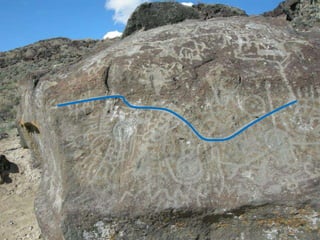
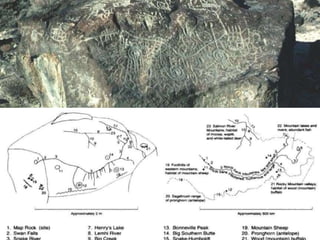
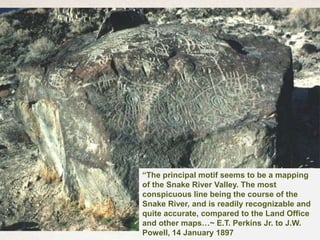
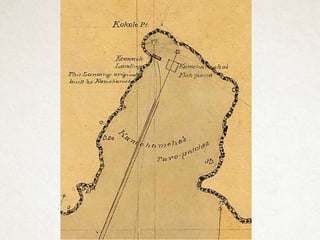
“The principal motif seems to be a mapping
of the Snake River Valley. The most
conspicuous line being the course of the
Snake River, and is readily recognizable and
quite accurate, compared to the Land Office
and other maps…~ E.T. Perkins Jr. to J.W.
Powell, 14 January 1897
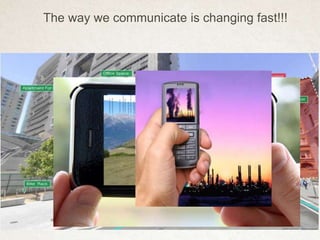
The way we communicate is changing fast!!!
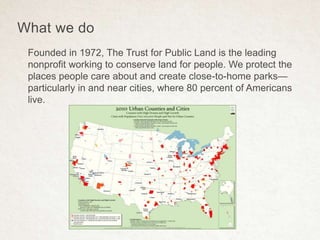
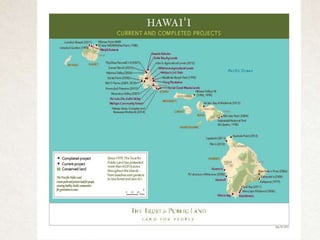
What we do
Founded in 1972, The Trust for Public Land is the leading
nonprofit working to conserve land for people. We protect the
places people care about and create close-to-home parks—
particularly in and near cities, where 80 percent of Americans
live.
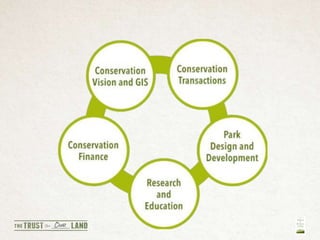
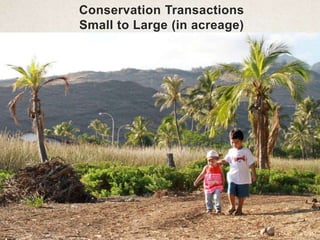
Conservation Transactions
Small to Large (in acreage)
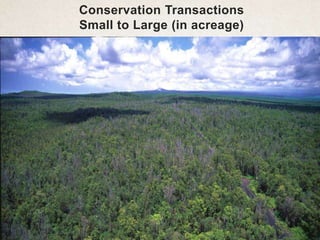
Conservation Transactions
Small to Large (in acreage)
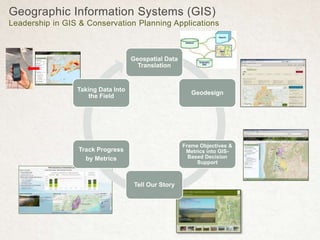
Geographic Information Systems (GIS)
Leadership in GIS & Conservation Planning Applications
Geospatial Data
Translation
Geodesign
Frame Objectives &
Metrics into GIS-
Based Decision
Support
Tell Our Story
Track Progress
by Metrics
Taking Data Into
the Field
TPL Connecting Communities Through GIS
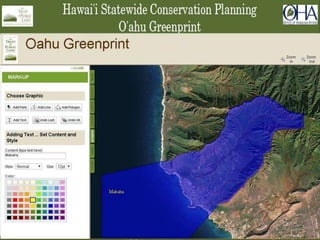
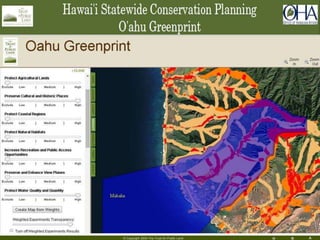
 Greenprinting
 Parkscore and Park Planning
 Climate Smart Cities
Greenprinting
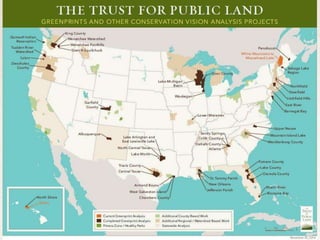
Providing services and support at all levels and
scale
H R A
16
© Copyright 2004 The Trust for Public Land
h
w
t
The
S
t
H R A
17
© Copyright 2004 The Trust for Public Land
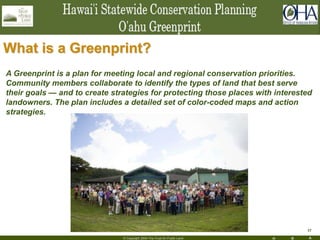
What is a Greenprint?
A Greenprint is a plan for meeting local and regional conservation priorities.
Community members collaborate to identify the types of land that best serve
their goals — and to create strategies for protecting those places with interested
landowners. The plan includes a detailed set of color-coded maps and action
strategies.
H R A
18
© Copyright 2004 The Trust for Public Land
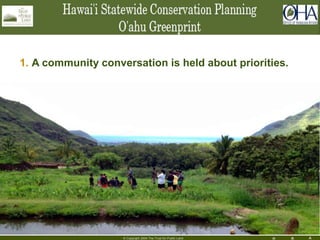
1. A community conversation is held about priorities.
H R A
19
© Copyright 2004 The Trust for Public Land
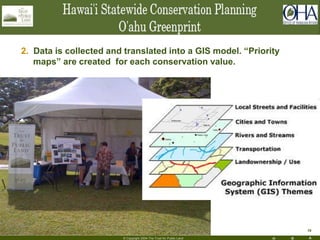
2. Data is collected and translated into a GIS model. “Priority
maps” are created for each conservation value.
H R A
20
© Copyright 2004 The Trust for Public Land
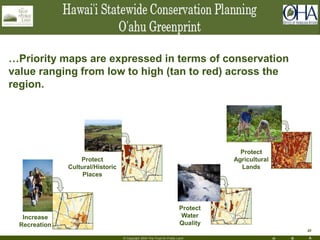
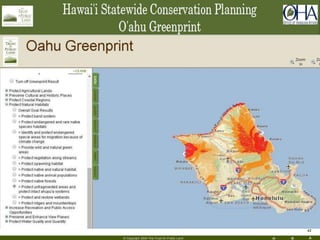
…Priority maps are expressed in terms of conservation
value ranging from low to high (tan to red) across the
region.
Increase
Recreation
Protect
Cultural/Historic
Places
Protect
Water
Quality
Protect
Agricultural
Lands
H R A
21
© Copyright 2004 The Trust for Public Land
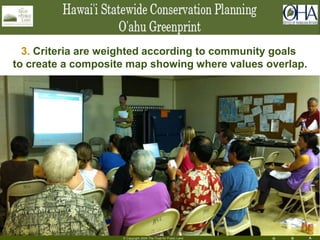
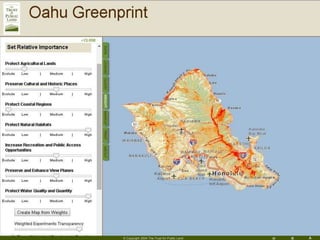
3. Criteria are weighted according to community goals
to create a composite map showing where values overlap.
H R A
22
© Copyright 2004 The Trust for Public Land
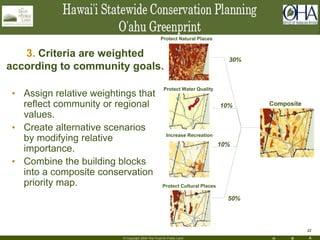
• Assign relative weightings that
reflect community or regional
values.
• Create alternative scenarios
by modifying relative
importance.
• Combine the building blocks
into a composite conservation
priority map.
50%
10%
10%
30%
Composite
Protect Cultural Places
Increase Recreation
Protect Natural Places
Protect Water Quality
3. Criteria are weighted
according to community goals.
H R A
23
© Copyright 2004 The Trust for Public Land
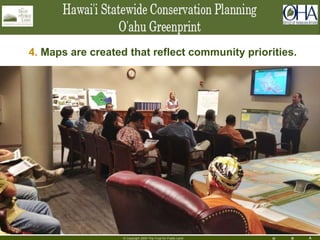
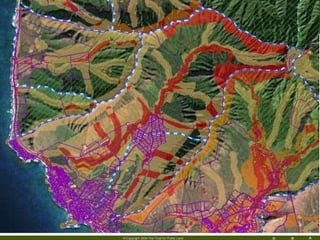
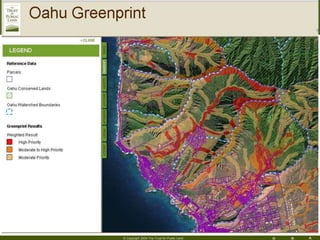
4. Maps are created that reflect community priorities.
H R A
24
© Copyright 2004 The Trust for Public Land
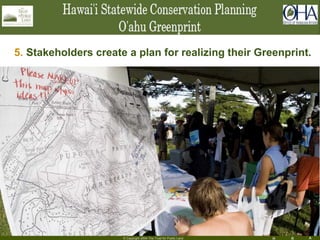
5. Stakeholders create a plan for realizing their Greenprint.
H R A
25
© Copyright 2004 The Trust for Public Land
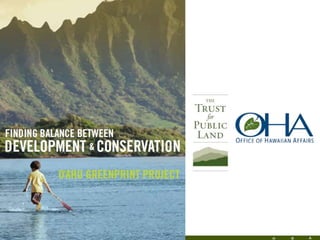
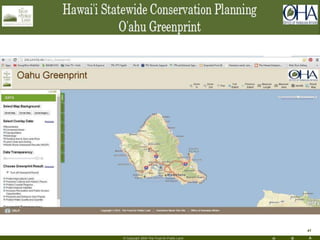
The O‘ahu
Greenprint
Project
h
w
t
The
S
t
H R A
26
© Copyright 2004 The Trust for Public Land
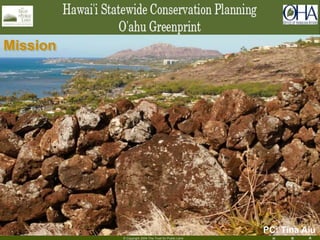
Mission
PC: Tina Aiu
H R A
27
© Copyright 2004 The Trust for Public Land
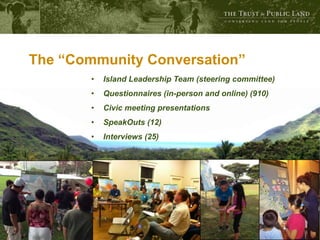
The “Community Conversation”
• Island Leadership Team (steering committee)
• Questionnaires (in-person and online) (910)
• Civic meeting presentations
• SpeakOuts (12)
• Interviews (25)
H R A
28
© Copyright 2004 The Trust for Public Land
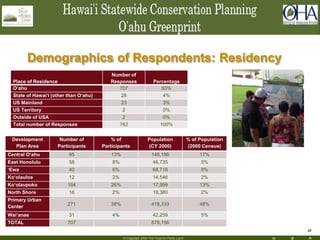
Demographics of Respondents: Residency
Place of Residence
Number of
Responses Percentage
O‘ahu 707 93%
State of Hawai‘i (other than O‘ahu) 28 4%
US Mainland 23 3%
US Territory 2 0%
Outside of USA 2 0%
Total number of Responses 762 100%
Development
Plan Area
Number of
Participants
% of
Participants
Population
(CY 2000)
% of Population
(2000 Census)
Central Oʻahu 95 13% 148,186 17%
East Honolulu 58 8% 46,735 5%
ʻEwa 40 6% 68,718 8%
Koʻolauloa 12 2% 14,546 2%
Koʻolaupoko 184 26% 17,999 13%
North Shore 16 2% 18,380 2%
Primary Urban
Center 271 38% 418,333 48%
Waiʻanae 31 4% 42,259 5%
TOTAL 707 876,156
H R A
29
© Copyright 2004 The Trust for Public Land
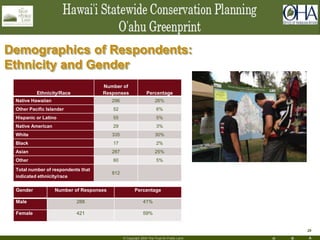
Demographics of Respondents:
Ethnicity and Gender
Ethnicity/Race
Number of
Responses Percentage
Native Hawaiian 296 26%
Other Pacific Islander 52 6%
Hispanic or Latino 55 5%
Native American 29 3%
White 335 30%
Black 17 2%
Asian 287 25%
Other 60 5%
Total number of respondents that
indicated ethnicity/race
812
Gender Number of Responses Percentage
Male 288 41%
Female 421 59%
H R A
30
© Copyright 2004 The Trust for Public Land
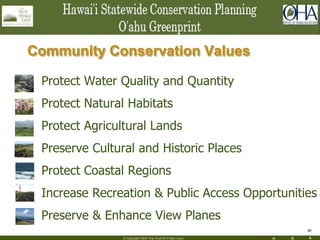
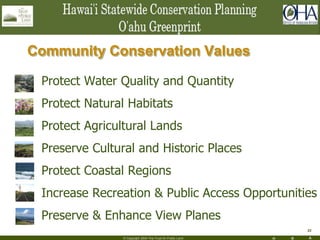
Protect Water Quality and Quantity
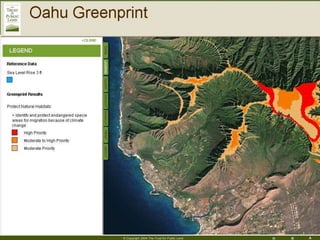
Protect Natural Habitats
Protect Agricultural Lands
Preserve Cultural and Historic Places
Protect Coastal Regions
Increase Recreation & Public Access Opportunities
Preserve & Enhance View Planes
Community Conservation Values
H R A
31
© Copyright 2004 The Trust for Public Land
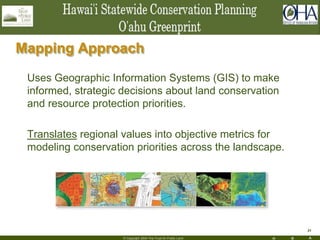
Uses Geographic Information Systems (GIS) to make
informed, strategic decisions about land conservation
and resource protection priorities.
Translates regional values into objective metrics for
modeling conservation priorities across the landscape.
Mapping Approach
H R A
32
© Copyright 2004 The Trust for Public Land
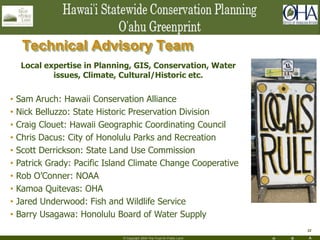
Technical Advisory Team
Local expertise in Planning, GIS, Conservation, Water
issues, Climate, Cultural/Historic etc.
• Sam Aruch: Hawaii Conservation Alliance
• Nick Belluzzo: State Historic Preservation Division
• Craig Clouet: Hawaii Geographic Coordinating Council
• Chris Dacus: City of Honolulu Parks and Recreation
• Scott Derrickson: State Land Use Commission
• Patrick Grady: Pacific Island Climate Change Cooperative
• Rob O’Conner: NOAA
• Kamoa Quitevas: OHA
• Jared Underwood: Fish and Wildlife Service
• Barry Usagawa: Honolulu Board of Water Supply
H R A
33
© Copyright 2004 The Trust for Public Land
Protect Water Quality and Quantity
Protect Natural Habitats
Protect Agricultural Lands
Preserve Cultural and Historic Places
Protect Coastal Regions
Increase Recreation & Public Access Opportunities
Preserve & Enhance View Planes
Community Conservation Values
H R A
34
© Copyright 2004 The Trust for Public Land
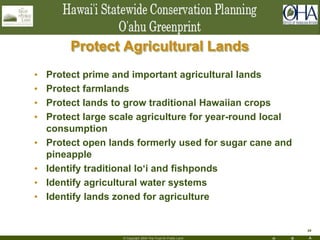
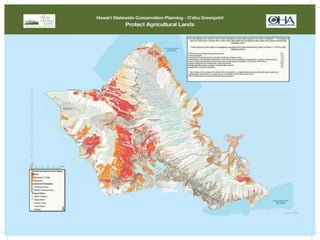
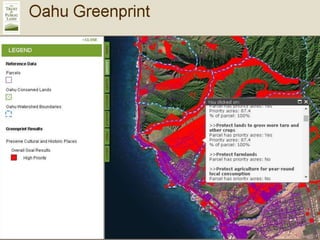
Protect Agricultural Lands
• Protect prime and important agricultural lands
• Protect farmlands
• Protect lands to grow traditional Hawaiian crops
• Protect large scale agriculture for year-round local
consumption
• Protect open lands formerly used for sugar cane and
pineapple
• Identify traditional lo‘i and fishponds
• Identify agricultural water systems
• Identify lands zoned for agriculture
H R A
35
© Copyright 2004 The Trust for Public Land
H R A
36
© Copyright 2004 The Trust for Public Land
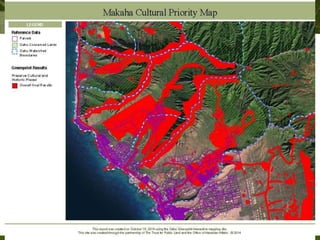
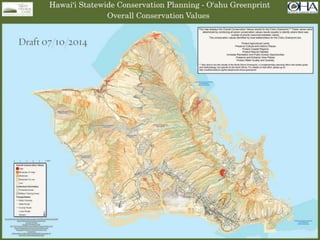
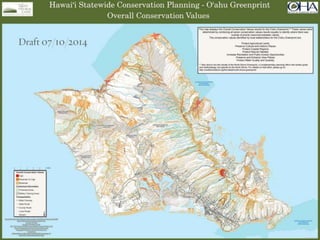
Overall Maps
or Various
Combined
Value Maps
h
w
t
The
S
t
H R A
37
© Copyright 2004 The Trust for Public Land
H R A
38
© Copyright 2004 The Trust for Public Land
H R A
39
© Copyright 2004 The Trust for Public Land
Action Plan
h
w
t
The
S
t
H R A
40
© Copyright 2004 The Trust for Public Land
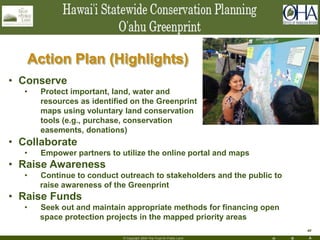
Action Plan (Highlights)
• Conserve
• Protect important, land, water and
resources as identified on the Greenprint
maps using voluntary land conservation
tools (e.g., purchase, conservation
easements, donations)
• Collaborate
• Empower partners to utilize the online portal and maps
• Raise Awareness
• Continue to conduct outreach to stakeholders and the public to
raise awareness of the Greenprint
• Raise Funds
• Seek out and maintain appropriate methods for financing open
space protection projects in the mapped priority areas
H R A
41
© Copyright 2004 The Trust for Public Land
H R A
42
© Copyright 2004 The Trust for Public Land
H R A
43
© Copyright 2004 The Trust for Public Land
H R A
44
© Copyright 2004 The Trust for Public Land
H R A
45
© Copyright 2004 The Trust for Public Land
H R A
46
© Copyright 2004 The Trust for Public Land
H R A
47
© Copyright 2004 The Trust for Public Land
H R A
48
© Copyright 2004 The Trust for Public Land
H R A
49
© Copyright 2004 The Trust for Public Land
H R A
50
© Copyright 2004 The Trust for Public Land
H R A
51
© Copyright 2004 The Trust for Public Land
Parks for People Initiative
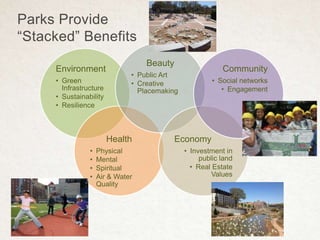
Parks Provide
“Stacked” Benefits
Environment
• Green
Infrastructure
• Sustainability
• Resilience
Health
• Physical
• Mental
• Spiritual
• Air & Water
Quality
Beauty
• Public Art
• Creative
Placemaking
Economy
• Investment in
public land
• Real Estate
Values
Community
• Social networks
• Engagement
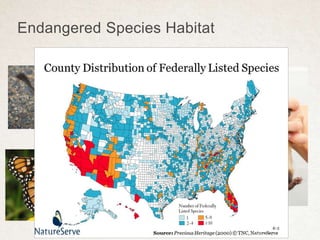
Endangered Species Habitat
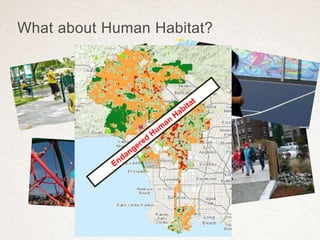
What about Human Habitat?
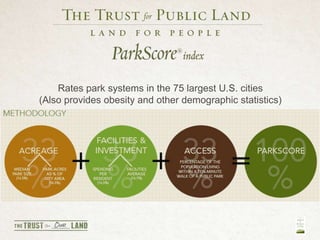
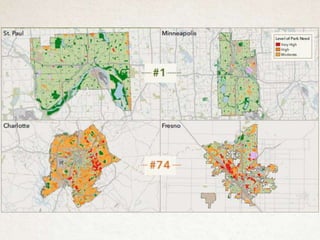
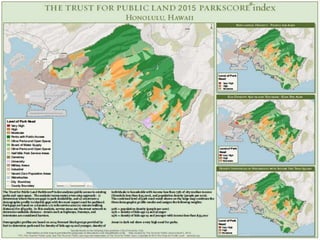
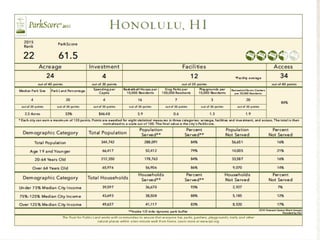
Rates park systems in the 75 largest U.S. cities
(Also provides obesity and other demographic statistics)
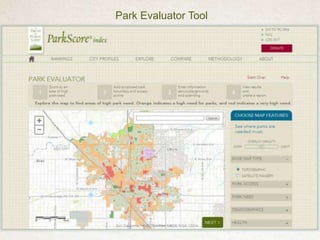
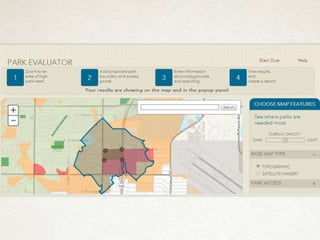
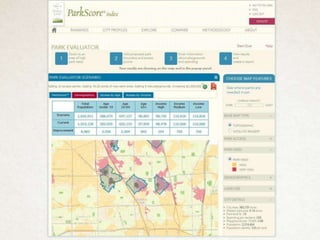
Park Evaluator Tool
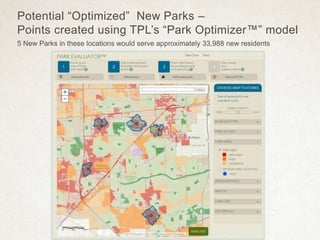
Potential “Optimized” New Parks –
Points created using TPL’s “Park Optimizer™” model
5 New Parks in these locations would serve approximately 33,988 new residents
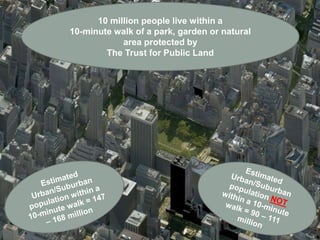
10 million people live within a
10-minute walk of a park, garden or natural
area protected by
The Trust for Public Land
Our Climate Smart Cities
Initiative
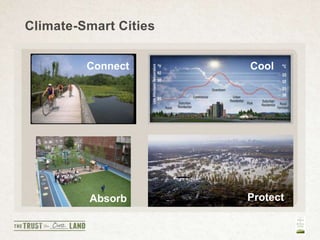
Climate-Smart Cities
Connect
Absorb Protect
Cool
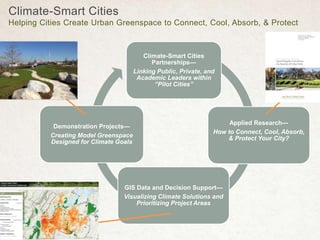
Climate-Smart Cities
Helping Cities Create Urban Greenspace to Connect, Cool, Absorb, & Protect
Climate-Smart Cities
Partnerships—
Linking Public, Private, and
Academic Leaders within
“Pilot Cities”
Applied Research—
How to Connect, Cool, Absorb,
& Protect Your City?
GIS Data and Decision Support—
Visualizing Climate Solutions and
Prioritizing Project Areas
Demonstration Projects—
Creating Model Greenspace
Designed for Climate Goals
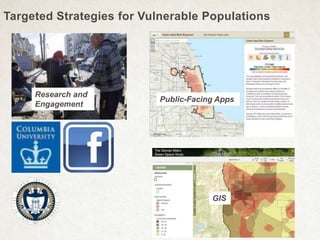
Targeted Strategies for Vulnerable Populations
Research and
Engagement
Public-Facing Apps
GIS
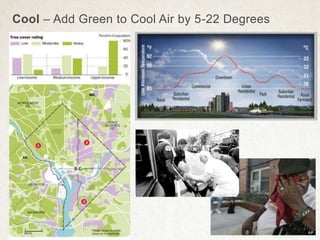
Cool – Add Green to Cool Air by 5-22 Degrees
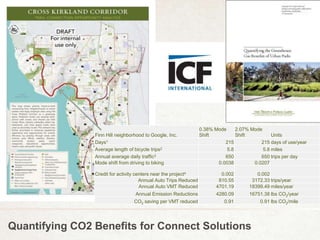
Finn Hill neighborhood to Google, Inc.
0.38% Mode
Shift
2.07% Mode
Shift Units
Days1 215 215 days of use/year
Average length of bicycle trips2 5.8 5.8 miles
Annual average daily traffic3 650 650 trips per day
Mode shift from driving to biking 0.0038 0.0207
Credit for activity centers near the project4 0.002 0.002
Annual Auto Trips Reduced 810.55 3172.33 trips/year
Annual Auto VMT Reduced 4701.19 18399.49 miles/year
Annual Emission Reductions 4280.09 16751.38 lbs CO2/year
CO2 saving per VMT reduced 0.91 0.91 lbs CO2/mile
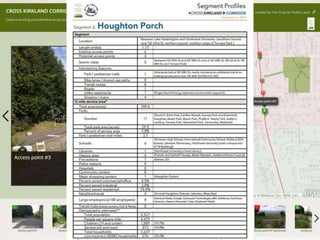
Quantifying CO2 Benefits for Connect Solutions
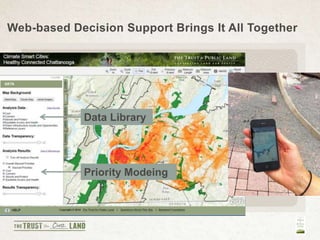
Web-based Decision Support Brings It All Together
Data Library
Priority Modeing
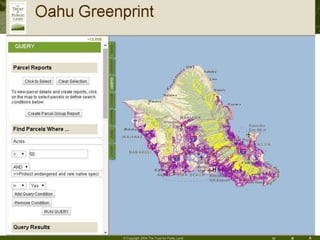
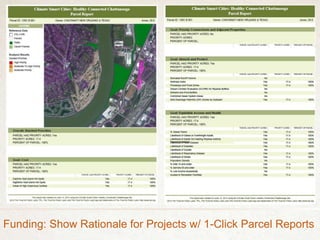
Funding: Show Rationale for Projects w/ 1-Click Parcel Reports
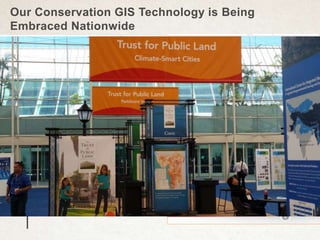
Our Conservation GIS Technology is Being
Embraced Nationwide
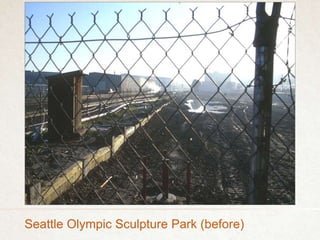
Seattle Olympic Sculpture Park (before)
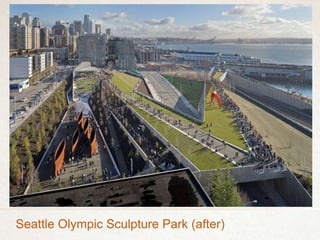
Seattle Olympic Sculpture Park (after)
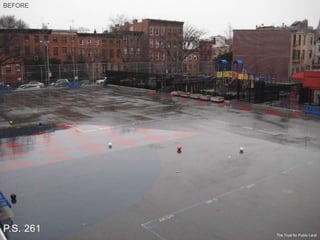
BEFORE
The Trust for Public Land
P.S. 261
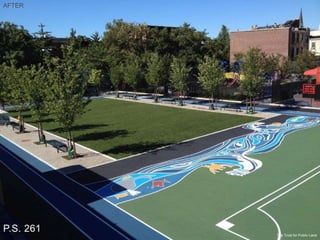
The Trust for Public Land
AFTER
P.S. 261
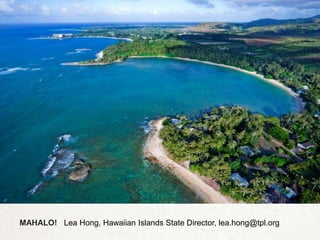
MAHALO! Lea Hong, Hawaiian Islands State Director, lea.hong@tpl.org

Using GIS to Connect Communities

  • 1.
    Using GIS toConnect Communities Lea Hong, Hawaiian Islands State Director
  • 4.
    “The principal motifseems to be a mapping of the Snake River Valley. The most conspicuous line being the course of the Snake River, and is readily recognizable and quite accurate, compared to the Land Office and other maps…~ E.T. Perkins Jr. to J.W. Powell, 14 January 1897
  • 6.
    The way wecommunicate is changing fast!!!
  • 7.
    What we do Foundedin 1972, The Trust for Public Land is the leading nonprofit working to conserve land for people. We protect the places people care about and create close-to-home parks— particularly in and near cities, where 80 percent of Americans live.
  • 10.
  • 11.
  • 12.
    Geographic Information Systems(GIS) Leadership in GIS & Conservation Planning Applications Geospatial Data Translation Geodesign Frame Objectives & Metrics into GIS- Based Decision Support Tell Our Story Track Progress by Metrics Taking Data Into the Field
  • 13.
    TPL Connecting CommunitiesThrough GIS  Greenprinting  Parkscore and Park Planning  Climate Smart Cities
  • 14.
  • 15.
    Providing services andsupport at all levels and scale
  • 16.
    H R A 16 ©Copyright 2004 The Trust for Public Land h w t The S t
  • 17.
    H R A 17 ©Copyright 2004 The Trust for Public Land What is a Greenprint? A Greenprint is a plan for meeting local and regional conservation priorities. Community members collaborate to identify the types of land that best serve their goals — and to create strategies for protecting those places with interested landowners. The plan includes a detailed set of color-coded maps and action strategies.
  • 18.
    H R A 18 ©Copyright 2004 The Trust for Public Land 1. A community conversation is held about priorities.
  • 19.
    H R A 19 ©Copyright 2004 The Trust for Public Land 2. Data is collected and translated into a GIS model. “Priority maps” are created for each conservation value.
  • 20.
    H R A 20 ©Copyright 2004 The Trust for Public Land …Priority maps are expressed in terms of conservation value ranging from low to high (tan to red) across the region. Increase Recreation Protect Cultural/Historic Places Protect Water Quality Protect Agricultural Lands
  • 21.
    H R A 21 ©Copyright 2004 The Trust for Public Land 3. Criteria are weighted according to community goals to create a composite map showing where values overlap.
  • 22.
    H R A 22 ©Copyright 2004 The Trust for Public Land • Assign relative weightings that reflect community or regional values. • Create alternative scenarios by modifying relative importance. • Combine the building blocks into a composite conservation priority map. 50% 10% 10% 30% Composite Protect Cultural Places Increase Recreation Protect Natural Places Protect Water Quality 3. Criteria are weighted according to community goals.
  • 23.
    H R A 23 ©Copyright 2004 The Trust for Public Land 4. Maps are created that reflect community priorities.
  • 24.
    H R A 24 ©Copyright 2004 The Trust for Public Land 5. Stakeholders create a plan for realizing their Greenprint.
  • 25.
    H R A 25 ©Copyright 2004 The Trust for Public Land The O‘ahu Greenprint Project h w t The S t
  • 26.
    H R A 26 ©Copyright 2004 The Trust for Public Land Mission PC: Tina Aiu
  • 27.
    H R A 27 ©Copyright 2004 The Trust for Public Land The “Community Conversation” • Island Leadership Team (steering committee) • Questionnaires (in-person and online) (910) • Civic meeting presentations • SpeakOuts (12) • Interviews (25)
  • 28.
    H R A 28 ©Copyright 2004 The Trust for Public Land Demographics of Respondents: Residency Place of Residence Number of Responses Percentage O‘ahu 707 93% State of Hawai‘i (other than O‘ahu) 28 4% US Mainland 23 3% US Territory 2 0% Outside of USA 2 0% Total number of Responses 762 100% Development Plan Area Number of Participants % of Participants Population (CY 2000) % of Population (2000 Census) Central Oʻahu 95 13% 148,186 17% East Honolulu 58 8% 46,735 5% ʻEwa 40 6% 68,718 8% Koʻolauloa 12 2% 14,546 2% Koʻolaupoko 184 26% 17,999 13% North Shore 16 2% 18,380 2% Primary Urban Center 271 38% 418,333 48% Waiʻanae 31 4% 42,259 5% TOTAL 707 876,156
  • 29.
    H R A 29 ©Copyright 2004 The Trust for Public Land Demographics of Respondents: Ethnicity and Gender Ethnicity/Race Number of Responses Percentage Native Hawaiian 296 26% Other Pacific Islander 52 6% Hispanic or Latino 55 5% Native American 29 3% White 335 30% Black 17 2% Asian 287 25% Other 60 5% Total number of respondents that indicated ethnicity/race 812 Gender Number of Responses Percentage Male 288 41% Female 421 59%
  • 30.
    H R A 30 ©Copyright 2004 The Trust for Public Land Protect Water Quality and Quantity Protect Natural Habitats Protect Agricultural Lands Preserve Cultural and Historic Places Protect Coastal Regions Increase Recreation & Public Access Opportunities Preserve & Enhance View Planes Community Conservation Values
  • 31.
    H R A 31 ©Copyright 2004 The Trust for Public Land Uses Geographic Information Systems (GIS) to make informed, strategic decisions about land conservation and resource protection priorities. Translates regional values into objective metrics for modeling conservation priorities across the landscape. Mapping Approach
  • 32.
    H R A 32 ©Copyright 2004 The Trust for Public Land Technical Advisory Team Local expertise in Planning, GIS, Conservation, Water issues, Climate, Cultural/Historic etc. • Sam Aruch: Hawaii Conservation Alliance • Nick Belluzzo: State Historic Preservation Division • Craig Clouet: Hawaii Geographic Coordinating Council • Chris Dacus: City of Honolulu Parks and Recreation • Scott Derrickson: State Land Use Commission • Patrick Grady: Pacific Island Climate Change Cooperative • Rob O’Conner: NOAA • Kamoa Quitevas: OHA • Jared Underwood: Fish and Wildlife Service • Barry Usagawa: Honolulu Board of Water Supply
  • 33.
    H R A 33 ©Copyright 2004 The Trust for Public Land Protect Water Quality and Quantity Protect Natural Habitats Protect Agricultural Lands Preserve Cultural and Historic Places Protect Coastal Regions Increase Recreation & Public Access Opportunities Preserve & Enhance View Planes Community Conservation Values
  • 34.
    H R A 34 ©Copyright 2004 The Trust for Public Land Protect Agricultural Lands • Protect prime and important agricultural lands • Protect farmlands • Protect lands to grow traditional Hawaiian crops • Protect large scale agriculture for year-round local consumption • Protect open lands formerly used for sugar cane and pineapple • Identify traditional lo‘i and fishponds • Identify agricultural water systems • Identify lands zoned for agriculture
  • 35.
    H R A 35 ©Copyright 2004 The Trust for Public Land
  • 36.
    H R A 36 ©Copyright 2004 The Trust for Public Land Overall Maps or Various Combined Value Maps h w t The S t
  • 37.
    H R A 37 ©Copyright 2004 The Trust for Public Land
  • 38.
    H R A 38 ©Copyright 2004 The Trust for Public Land
  • 39.
    H R A 39 ©Copyright 2004 The Trust for Public Land Action Plan h w t The S t
  • 40.
    H R A 40 ©Copyright 2004 The Trust for Public Land Action Plan (Highlights) • Conserve • Protect important, land, water and resources as identified on the Greenprint maps using voluntary land conservation tools (e.g., purchase, conservation easements, donations) • Collaborate • Empower partners to utilize the online portal and maps • Raise Awareness • Continue to conduct outreach to stakeholders and the public to raise awareness of the Greenprint • Raise Funds • Seek out and maintain appropriate methods for financing open space protection projects in the mapped priority areas
  • 41.
    H R A 41 ©Copyright 2004 The Trust for Public Land
  • 42.
    H R A 42 ©Copyright 2004 The Trust for Public Land
  • 43.
    H R A 43 ©Copyright 2004 The Trust for Public Land
  • 44.
    H R A 44 ©Copyright 2004 The Trust for Public Land
  • 45.
    H R A 45 ©Copyright 2004 The Trust for Public Land
  • 46.
    H R A 46 ©Copyright 2004 The Trust for Public Land
  • 47.
    H R A 47 ©Copyright 2004 The Trust for Public Land
  • 48.
    H R A 48 ©Copyright 2004 The Trust for Public Land
  • 49.
    H R A 49 ©Copyright 2004 The Trust for Public Land
  • 50.
    H R A 50 ©Copyright 2004 The Trust for Public Land
  • 51.
    H R A 51 ©Copyright 2004 The Trust for Public Land
  • 52.
    Parks for PeopleInitiative
  • 53.
    Parks Provide “Stacked” Benefits Environment •Green Infrastructure • Sustainability • Resilience Health • Physical • Mental • Spiritual • Air & Water Quality Beauty • Public Art • Creative Placemaking Economy • Investment in public land • Real Estate Values Community • Social networks • Engagement
  • 54.
  • 55.
  • 56.
    Rates park systemsin the 75 largest U.S. cities (Also provides obesity and other demographic statistics)
  • 60.
  • 63.
    Potential “Optimized” NewParks – Points created using TPL’s “Park Optimizer™” model 5 New Parks in these locations would serve approximately 33,988 new residents
  • 64.
    10 million peoplelive within a 10-minute walk of a park, garden or natural area protected by The Trust for Public Land
  • 65.
    Our Climate SmartCities Initiative
  • 66.
  • 67.
    Climate-Smart Cities Helping CitiesCreate Urban Greenspace to Connect, Cool, Absorb, & Protect Climate-Smart Cities Partnerships— Linking Public, Private, and Academic Leaders within “Pilot Cities” Applied Research— How to Connect, Cool, Absorb, & Protect Your City? GIS Data and Decision Support— Visualizing Climate Solutions and Prioritizing Project Areas Demonstration Projects— Creating Model Greenspace Designed for Climate Goals
  • 68.
    Targeted Strategies forVulnerable Populations Research and Engagement Public-Facing Apps GIS
  • 69.
    Cool – AddGreen to Cool Air by 5-22 Degrees
  • 70.
    Finn Hill neighborhoodto Google, Inc. 0.38% Mode Shift 2.07% Mode Shift Units Days1 215 215 days of use/year Average length of bicycle trips2 5.8 5.8 miles Annual average daily traffic3 650 650 trips per day Mode shift from driving to biking 0.0038 0.0207 Credit for activity centers near the project4 0.002 0.002 Annual Auto Trips Reduced 810.55 3172.33 trips/year Annual Auto VMT Reduced 4701.19 18399.49 miles/year Annual Emission Reductions 4280.09 16751.38 lbs CO2/year CO2 saving per VMT reduced 0.91 0.91 lbs CO2/mile Quantifying CO2 Benefits for Connect Solutions
  • 72.
    Web-based Decision SupportBrings It All Together Data Library Priority Modeing
  • 73.
    Funding: Show Rationalefor Projects w/ 1-Click Parcel Reports
  • 74.
    Our Conservation GISTechnology is Being Embraced Nationwide
  • 75.
  • 76.
  • 77.
    BEFORE The Trust forPublic Land P.S. 261
  • 78.
    The Trust forPublic Land AFTER P.S. 261
  • 79.
    MAHALO! Lea Hong,Hawaiian Islands State Director, lea.hong@tpl.org