big data science
Albert Bifet (@abifet)
Paris, 7 October 2015
albert.bifet@telecom-paristech.fr
data science
Data Science is an interdisciplinary field focused on
extracting knowledge or insights from large
volumes of data.
1
data scientist
Figure 1: http://www.marketingdistillery.com/2014/11/29/
is-data-science-a-buzzword-modern-data-scientist-defined/
2
data science
Figure 2: Drew Convay’s Venn diagram
3
classification
classification
Definition
Given nC different classes, a classifier algorithm builds a
model that predicts for every unlabelled instance I the class C
to which it belongs with accuracy.
Example
A spam filter
Example
Twitter Sentiment analysis: analyze tweets with positive or
negative feelings
5
classification
Data set that
describes e-mail
features for
deciding if it is
spam.
Example
Contains Domain Has Time
“Money” type attach. received spam
yes com yes night yes
yes edu no night yes
no com yes night yes
no edu no day no
no com no day no
yes cat no day yes
Assume we have to classify the following new instance:
Contains Domain Has Time
“Money” type attach. received spam
yes edu yes day ?
6
k-nearest neighbours
k-NN Classifier
• Training: store all instances in memory
• Prediction:
• Find the k nearest instances
• Output majority class of these k instances
7
bayes classifiers
Naïve Bayes
• Based on Bayes Theorem:
P(c|d) =
P(c)P(d|c)
P(d)
posterior =
prior×likelikood
evidence
• Estimates the probability of observing attribute a and the
prior probability P(c)
• Probability of class c given an instance d:
P(c|d) =
P(c)∏a∈d P(a|c)
P(d)
8
bayes classifiers
Multinomial Naïve Bayes
• Considers a document as a bag-of-words.
• Estimates the probability of observing word w and the prior
probability P(c)
• Probability of class c given a test document d:
P(c|d) =
P(c)∏w∈d P(w|c)nwd
P(d)
9
perceptron
Attribute 1
Attribute 2
Attribute 3
Attribute 4
Attribute 5
Output h⃗w(⃗xi)
w1
w2
w3
w4
w5
• Data stream: ⟨⃗xi,yi⟩
• Classical perceptron: h⃗w(⃗xi) = sgn(⃗wT⃗xi),
• Minimize Mean-square error: J(⃗w) = 1
2 ∑(yi −h⃗w(⃗xi))2
10
perceptron
Attribute 1
Attribute 2
Attribute 3
Attribute 4
Attribute 5
Output h⃗w(⃗xi)
w1
w2
w3
w4
w5
• We use sigmoid function h⃗w = σ(⃗wT⃗x) where
σ(x) = 1/(1+e−x
)
σ′
(x) = σ(x)(1−σ(x))
10
perceptron
• Minimize Mean-square error: J(⃗w) = 1
2 ∑(yi −h⃗w(⃗xi))2
• Stochastic Gradient Descent: ⃗w =⃗w−η∇J⃗xi
• Gradient of the error function:
∇J = −∑
i
(yi −h⃗w(⃗xi))∇h⃗w(⃗xi)
∇h⃗w(⃗xi) = h⃗w(⃗xi)(1−h⃗w(⃗xi))
• Weight update rule
⃗w =⃗w+η ∑
i
(yi −h⃗w(⃗xi))h⃗w(⃗xi)(1−h⃗w(⃗xi))⃗xi
10
restricted boltzmann machines (rbms)
z4z3z2z1
x5x4x3x2x1
• Energy-based models, where
P(⃗x,⃗z) ∝ e−E(⃗x,⃗z)
.
• Manipulate a weight matrix W to find low-energy states and
thus generate high probability P(⃗x,⃗z), where
E(⃗x,⃗z) = −W.
• RBMs can be stacked on top of each other to form so-called
Deep Belief Networks (DBNs)
11
classification
Data set that
describes e-mail
features for
deciding if it is
spam.
Example
Contains Domain Has Time
“Money” type attach. received spam
yes com yes night yes
yes edu no night yes
no com yes night yes
no edu no day no
no com no day no
yes cat no day yes
Assume we have to classify the following new instance:
Contains Domain Has Time
“Money” type attach. received spam
yes edu yes day ?
12
classification
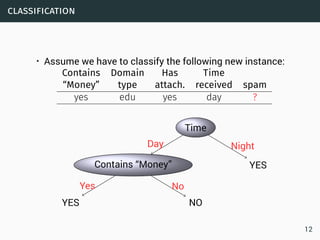
• Assume we have to classify the following new instance:
Contains Domain Has Time
“Money” type attach. received spam
yes edu yes day ?
Time
Contains “Money”
YES
Yes
NO
No
Day
YES
Night
12
decision trees
Basic induction strategy:
• A ← the “best” decision attribute for next node
• Assign A as decision attribute for node
• For each value of A, create new descendant of node
• Sort training examples to leaf nodes
• If training examples perfectly classified, Then STOP, Else
iterate over new leaf nodes
13
bagging
Example
Dataset of 4 Instances : A, B, C, D
Classifier 1: B, A, C, B
Classifier 2: D, B, A, D
Classifier 3: B, A, C, B
Classifier 4: B, C, B, B
Classifier 5: D, C, A, C
Bagging builds a set of M base models, with a bootstrap
sample created by drawing random samples with
replacement.
14
random forests
• Bagging
• Random Trees: trees that in each node only uses a random
subset of the attributes
Random Forests is one of the most popular methods in
machine learning.
15
boosting
The strength of Weak Learnability, Schapire 90
A boosting algorithm transforms a weak learner
into a strong one
16
boosting
A formal description of Boosting (Schapire)
• given a training set (x1,y1),...,(xm,ym)
• yi ∈ {−1,+1} correct label of instance xi ∈ X
• for t = 1,...,T
• construct distribution Dt
• find weak classifier
ht : X → {−1,+1}
with small error εt = PrDt
[ht(xi) ̸= yi] on Dt
• output final classifier
17
boosting
AdaBoost
1: Initialize D1(i) = 1/m for all i ∈ {1,2,...,m}
2: for t = 1,2,...T do
3: Call WeakLearn, providing it with distribution Dt
4: Get back hypothesis ht : X → Y
5: Calculate error of ht : εt = ∑i:ht(xi)̸=yi
Dt(i)
6: Update distribution
Dt : Dt+1(i) = Dt(i)
Zt
×
{
εt/(1−εt) if ht(xi) = yi
1 otherwise
where Zt is a normalization constant (chosen so Dt+1 is a
probability distribution)
7: return hfin(x) = argmaxy∈Y ∑t:ht(x)=y −logεt/(1−εt)
18
boosting
AdaBoost
1: Initialize D1(i) = 1/m for all i ∈ {1,2,...,m}
2: for t = 1,2,...T do
3: Call WeakLearn, providing it with distribution Dt
4: Get back hypothesis ht : X → Y
5: Calculate error of ht : εt = ∑i:ht(xi)̸=yi
Dt(i)
6: Update distribution
Dt : Dt+1(i) = Dt(i)
Zt
×
{
εt if ht(xi) = yi
1−εt otherwise
where Zt is a normalization constant (chosen so Dt+1 is a
probability distribution)
7: return hfin(x) = argmaxy∈Y ∑t:ht(x)=y −logεt/(1−εt)
18
stacking
Use a classifier to combine predictions of base classifiers
Example
• Use a perceptron to do stacking
• Use decision trees as base classifiers
19
clustering
clustering
Definition
Clustering is the distribution of a set of instances of examples
into non-known groups according to some common relations
or affinities.
Example
Market segmentation of customers
Example
Social network communities
21
clustering
Definition
Given
• a set of instances I
• a number of clusters K
• an objective function cost(I)
a clustering algorithm computes an assignment of a cluster
for each instance
f : I → {1,...,K}
that minimizes the objective function cost(I)
22
clustering
Definition
Given
• a set of instances I
• a number of clusters K
• an objective function cost(C,I)
a clustering algorithm computes a set C of instances with
|C| = K that minimizes the objective function
cost(C,I) = ∑
x∈I
d2
(x,C)
where
• d(x,c): distance function between x and c
• d2(x,C) = minc∈Cd2(x,c): distance from x to the nearest point 23
k-means
• 1. Choose k initial centers C = {c1,...,ck}
• 2. while stopping criterion has not been met
• For i = 1,...,N
• find closest center ck ∈ C to each instance pi
• assign instance pi to cluster Ck
• For k = 1,...,K
• set ck to be the center of mass of all points in Ci
24
k-means++
• 1. Choose a initial center c1
• For k = 2,...,K
• select ck = p ∈ I with probability d2(p,C)/cost(C,I)
• 2. while stopping criterion has not been met
• For i = 1,...,N
• find closest center ck ∈ C to each instance pi
• assign instance pi to cluster Ck
• For k = 1,...,K
• set ck to be the center of mass of all points in Ci
25
performance measures
Internal Measures
• Sum square distance
• Dunn index D = dmin
dmax
• C-Index C = S−Smin
Smax−Smin
External Measures
• Rand Measure
• F Measure
• Jaccard
• Purity
26
density based methods
DBSCAN
• ε-neighborhood(p): set of points that are at a distance of p
less or equal to ε
• Core object: object whose ε-neighborhood has an overall
weight at least µ
• A point p is directly density-reachable from q if
• p is in ε-neighborhood(q)
• q is a core object
• A point p is density-reachable from q if
• there is a chain of points p1,...,pn such that pi+1 is directly
density-reachable from pi
• A point p is density-connected from q if
• there is point o such that p and q are density-reachable from o
27
density based methods
DBSCAN
• A cluster C of points satisfies
• if p ∈ C and q is density-reachable from p, then q ∈ C
• all points p,q ∈ C are density-connected
• A cluster is uniquely determined by any of its core points
• A cluster can be obtained
• choosing an arbitrary core point as a seed
• retrieve all points that are density-reachable from the seed
28
dbscan
Figure 3: DBSCAN Point Example with µ=3
29
density based methods
DBSCAN
• select an arbitrary point p
• retrieve all points density-reachable from p
• if p is a core point, a cluster is formed
• If p is a border point
• no points are density-reachable from p
• DBSCAN visits the next point of the database
• Continue the process until all of the points have been
processed
30
frequent pattern mining
frequent patterns
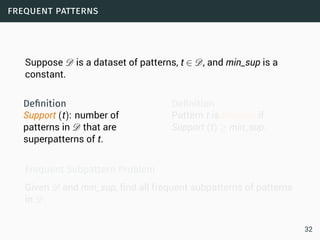
Suppose D is a dataset of patterns, t ∈ D, and min_sup is a
constant.
Definition
Support (t): number of
patterns in D that are
superpatterns of t.
Definition
Pattern t is frequent if
Support (t) ≥ min_sup.
Frequent Subpattern Problem
Given D and min_sup, find all frequent subpatterns of patterns
in D.
32
frequent patterns
Suppose D is a dataset of patterns, t ∈ D, and min_sup is a
constant.
Definition
Support (t): number of
patterns in D that are
superpatterns of t.
Definition
Pattern t is frequent if
Support (t) ≥ min_sup.
Frequent Subpattern Problem
Given D and min_sup, find all frequent subpatterns of patterns
in D.
32
frequent patterns
Suppose D is a dataset of patterns, t ∈ D, and min_sup is a
constant.
Definition
Support (t): number of
patterns in D that are
superpatterns of t.
Definition
Pattern t is frequent if
Support (t) ≥ min_sup.
Frequent Subpattern Problem
Given D and min_sup, find all frequent subpatterns of patterns
in D.
32
frequent patterns
Suppose D is a dataset of patterns, t ∈ D, and min_sup is a
constant.
Definition
Support (t): number of
patterns in D that are
superpatterns of t.
Definition
Pattern t is frequent if
Support (t) ≥ min_sup.
Frequent Subpattern Problem
Given D and min_sup, find all frequent subpatterns of patterns
in D.
32
pattern mining
Dataset Example
Document Patterns
d1 abce
d2 cde
d3 abce
d4 acde
d5 abcde
d6 bcd
33
itemset mining
d1 abce
d2 cde
d3 abce
d4 acde
d5 abcde
d6 bcd
Support Frequent
d1,d2,d3,d4,d5,d6 c
d1,d2,d3,d4,d5 e,ce
d1,d3,d4,d5 a,ac,ae,ace
d1,d3,d5,d6 b,bc
d2,d4,d5,d6 d,cd
d1,d3,d5 ab,abc,abe
be,bce,abce
d2,d4,d5 de,cde
minimal support = 3
34
itemset mining
d1 abce
d2 cde
d3 abce
d4 acde
d5 abcde
d6 bcd
Support Frequent
6 c
5 e,ce
4 a,ac,ae,ace
4 b,bc
4 d,cd
3 ab,abc,abe
be,bce,abce
3 de,cde
35
itemset mining
d1 abce
d2 cde
d3 abce
d4 acde
d5 abcde
d6 bcd
Support Frequent Gen Closed
6 c c c
5 e,ce e ce
4 a,ac,ae,ace a ace
4 b,bc b bc
4 d,cd d cd
3 ab,abc,abe ab
be,bce,abce be abce
3 de,cde de cde
35
itemset mining
d1 abce
d2 cde
d3 abce
d4 acde
d5 abcde
d6 bcd
Support Frequent Gen Closed Max
6 c c c
5 e,ce e ce
4 a,ac,ae,ace a ace
4 b,bc b bc
4 d,cd d cd
3 ab,abc,abe ab
be,bce,abce be abce abce
3 de,cde de cde cde
35
itemset mining
d1 abce
d2 cde
d3 abce
d4 acde
d5 abcde
d6 bcd
Support Frequent Gen Closed Max
6 c c c
5 e,ce e ce
4 a,ac,ae,ace a ace
4 b,bc b bc
4 d,cd d cd
3 ab,abc,abe ab
be,bce,abce be abce abce
3 de,cde de cde cde
36
itemset mining
d1 abce
d2 cde
d3 abce
d4 acde
d5 abcde
d6 bcd
e → ce
Support Frequent Gen Closed Max
6 c c c
5 e,ce e ce
4 a,ac,ae,ace a ace
4 b,bc b bc
4 d,cd d cd
3 ab,abc,abe ab
be,bce,abce be abce abce
3 de,cde de cde cde
36
itemset mining
d1 abce
d2 cde
d3 abce
d4 acde
d5 abcde
d6 bcd
Support Frequent Gen Closed Max
6 c c c
5 e,ce e ce
4 a,ac,ae,ace a ace
4 b,bc b bc
4 d,cd d cd
3 ab,abc,abe ab
be,bce,abce be abce abce
3 de,cde de cde cde
36
itemset mining
d1 abce
d2 cde
d3 abce
d4 acde
d5 abcde
d6 bcd
Support Frequent Gen Closed Max
6 c c c
5 e,ce e ce
4 a,ac,ae,ace a ace
4 b,bc b bc
4 d,cd d cd
3 ab,abc,abe ab
be,bce,abce be abce abce
3 de,cde de cde cde
37
itemset mining
d1 abce
d2 cde
d3 abce
d4 acde
d5 abcde
d6 bcd
a → ace
Support Frequent Gen Closed Max
6 c c c
5 e,ce e ce
4 a,ac,ae,ace a ace
4 b,bc b bc
4 d,cd d cd
3 ab,abc,abe ab
be,bce,abce be abce abce
3 de,cde de cde cde
37
itemset mining
d1 abce
d2 cde
d3 abce
d4 acde
d5 abcde
d6 bcd
Support Frequent Gen Closed Max
6 c c c
5 e,ce e ce
4 a,ac,ae,ace a ace
4 b,bc b bc
4 d,cd d cd
3 ab,abc,abe ab
be,bce,abce be abce abce
3 de,cde de cde cde
38
closed patterns
Usually, there are too many frequent patterns. We can
compute a smaller set, while keeping the same information.
Example
A set of 1000 items, has 21000 ≈ 10301 subsets, that is more
than the number of atoms in the universe ≈ 1079
39
closed patterns
A priori property
If t′ is a subpattern of t, then Support (t′) ≥ Support (t).
Definition
A frequent pattern t is closed if none of its proper
superpatterns has the same support as it has.
Frequent subpatterns and their supports can be generated
from closed patterns.
39
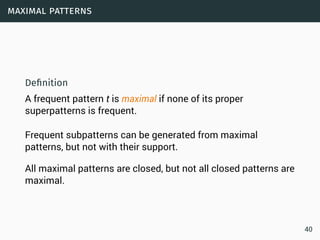
maximal patterns
Definition
A frequent pattern t is maximal if none of its proper
superpatterns is frequent.
Frequent subpatterns can be generated from maximal
patterns, but not with their support.
All maximal patterns are closed, but not all closed patterns are
maximal.
40
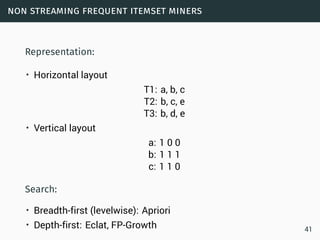
non streaming frequent itemset miners
Representation:
• Horizontal layout
T1: a, b, c
T2: b, c, e
T3: b, d, e
• Vertical layout
a: 1 0 0
b: 1 1 1
c: 1 1 0
Search:
• Breadth-first (levelwise): Apriori
• Depth-first: Eclat, FP-Growth 41
the apriori algorithm
Apriori Algorithm
1 Initialize the item set size k = 1
2 Start with single element sets
3 Prune the non-frequent ones
4 while there are frequent item sets
5 do create candidates with one item more
6 Prune the non-frequent ones
7 Increment the item set size k = k+1
8 Output: the frequent item sets
42
the eclat algorithm
Depth-First Search
• divide-and-conquer scheme : the problem is processed by
splitting it into smaller subproblems, which are then
processed recursively
• conditional database for the prefix a
• transactions that contain a
• conditional database for item sets without a
• transactions that not contain a
• Vertical representation
• Support counting is done by intersecting lists of transaction
identifiers
43
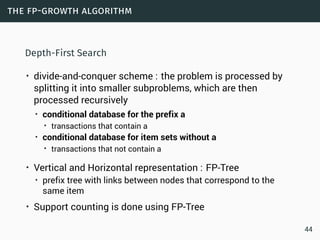
the fp-growth algorithm
Depth-First Search
• divide-and-conquer scheme : the problem is processed by
splitting it into smaller subproblems, which are then
processed recursively
• conditional database for the prefix a
• transactions that contain a
• conditional database for item sets without a
• transactions that not contain a
• Vertical and Horizontal representation : FP-Tree
• prefix tree with links between nodes that correspond to the
same item
• Support counting is done using FP-Tree
44
mining graph data
Problem
Given a data set D of graphs, find frequent graphs.
Transaction Id Graph
1
C C S N
O
O
2
C C S N
O
C
3 C C S N
N
45
the gspan algorithm
gSpan(g,D,min_sup,S)
Input: A graph g, a graph dataset D, min_sup.
Output: The frequent graph set S.
1 if g ̸= min(g)
2 then return S
3 insert g into S
4 update support counter structure
5 C ← /0
6 for each g′ that can be right-most
extended from g in one step
7 do if support(g) ≥ min_sup
8 then insert g′ into C
9 for each g′ in C
10 do S ← gSpan(g′,D,min_sup,S)
11 return S
46

Introduction to Big Data Science

  • 1.
    big data science AlbertBifet (@abifet) Paris, 7 October 2015 albert.bifet@telecom-paristech.fr
  • 2.
    data science Data Scienceis an interdisciplinary field focused on extracting knowledge or insights from large volumes of data. 1
  • 3.
    data scientist Figure 1:http://www.marketingdistillery.com/2014/11/29/ is-data-science-a-buzzword-modern-data-scientist-defined/ 2
  • 4.
    data science Figure 2:Drew Convay’s Venn diagram 3
  • 5.
  • 6.
    classification Definition Given nC differentclasses, a classifier algorithm builds a model that predicts for every unlabelled instance I the class C to which it belongs with accuracy. Example A spam filter Example Twitter Sentiment analysis: analyze tweets with positive or negative feelings 5
  • 7.
    classification Data set that describese-mail features for deciding if it is spam. Example Contains Domain Has Time “Money” type attach. received spam yes com yes night yes yes edu no night yes no com yes night yes no edu no day no no com no day no yes cat no day yes Assume we have to classify the following new instance: Contains Domain Has Time “Money” type attach. received spam yes edu yes day ? 6
  • 8.
    k-nearest neighbours k-NN Classifier •Training: store all instances in memory • Prediction: • Find the k nearest instances • Output majority class of these k instances 7
  • 9.
    bayes classifiers Naïve Bayes •Based on Bayes Theorem: P(c|d) = P(c)P(d|c) P(d) posterior = prior×likelikood evidence • Estimates the probability of observing attribute a and the prior probability P(c) • Probability of class c given an instance d: P(c|d) = P(c)∏a∈d P(a|c) P(d) 8
  • 10.
    bayes classifiers Multinomial NaïveBayes • Considers a document as a bag-of-words. • Estimates the probability of observing word w and the prior probability P(c) • Probability of class c given a test document d: P(c|d) = P(c)∏w∈d P(w|c)nwd P(d) 9
  • 11.
    perceptron Attribute 1 Attribute 2 Attribute3 Attribute 4 Attribute 5 Output h⃗w(⃗xi) w1 w2 w3 w4 w5 • Data stream: ⟨⃗xi,yi⟩ • Classical perceptron: h⃗w(⃗xi) = sgn(⃗wT⃗xi), • Minimize Mean-square error: J(⃗w) = 1 2 ∑(yi −h⃗w(⃗xi))2 10
  • 12.
    perceptron Attribute 1 Attribute 2 Attribute3 Attribute 4 Attribute 5 Output h⃗w(⃗xi) w1 w2 w3 w4 w5 • We use sigmoid function h⃗w = σ(⃗wT⃗x) where σ(x) = 1/(1+e−x ) σ′ (x) = σ(x)(1−σ(x)) 10
  • 13.
    perceptron • Minimize Mean-squareerror: J(⃗w) = 1 2 ∑(yi −h⃗w(⃗xi))2 • Stochastic Gradient Descent: ⃗w =⃗w−η∇J⃗xi • Gradient of the error function: ∇J = −∑ i (yi −h⃗w(⃗xi))∇h⃗w(⃗xi) ∇h⃗w(⃗xi) = h⃗w(⃗xi)(1−h⃗w(⃗xi)) • Weight update rule ⃗w =⃗w+η ∑ i (yi −h⃗w(⃗xi))h⃗w(⃗xi)(1−h⃗w(⃗xi))⃗xi 10
  • 14.
    restricted boltzmann machines(rbms) z4z3z2z1 x5x4x3x2x1 • Energy-based models, where P(⃗x,⃗z) ∝ e−E(⃗x,⃗z) . • Manipulate a weight matrix W to find low-energy states and thus generate high probability P(⃗x,⃗z), where E(⃗x,⃗z) = −W. • RBMs can be stacked on top of each other to form so-called Deep Belief Networks (DBNs) 11
  • 15.
    classification Data set that describese-mail features for deciding if it is spam. Example Contains Domain Has Time “Money” type attach. received spam yes com yes night yes yes edu no night yes no com yes night yes no edu no day no no com no day no yes cat no day yes Assume we have to classify the following new instance: Contains Domain Has Time “Money” type attach. received spam yes edu yes day ? 12
  • 16.
    classification • Assume wehave to classify the following new instance: Contains Domain Has Time “Money” type attach. received spam yes edu yes day ? Time Contains “Money” YES Yes NO No Day YES Night 12
  • 17.
    decision trees Basic inductionstrategy: • A ← the “best” decision attribute for next node • Assign A as decision attribute for node • For each value of A, create new descendant of node • Sort training examples to leaf nodes • If training examples perfectly classified, Then STOP, Else iterate over new leaf nodes 13
  • 18.
    bagging Example Dataset of 4Instances : A, B, C, D Classifier 1: B, A, C, B Classifier 2: D, B, A, D Classifier 3: B, A, C, B Classifier 4: B, C, B, B Classifier 5: D, C, A, C Bagging builds a set of M base models, with a bootstrap sample created by drawing random samples with replacement. 14
  • 19.
    random forests • Bagging •Random Trees: trees that in each node only uses a random subset of the attributes Random Forests is one of the most popular methods in machine learning. 15
  • 20.
    boosting The strength ofWeak Learnability, Schapire 90 A boosting algorithm transforms a weak learner into a strong one 16
  • 21.
    boosting A formal descriptionof Boosting (Schapire) • given a training set (x1,y1),...,(xm,ym) • yi ∈ {−1,+1} correct label of instance xi ∈ X • for t = 1,...,T • construct distribution Dt • find weak classifier ht : X → {−1,+1} with small error εt = PrDt [ht(xi) ̸= yi] on Dt • output final classifier 17
  • 22.
    boosting AdaBoost 1: Initialize D1(i)= 1/m for all i ∈ {1,2,...,m} 2: for t = 1,2,...T do 3: Call WeakLearn, providing it with distribution Dt 4: Get back hypothesis ht : X → Y 5: Calculate error of ht : εt = ∑i:ht(xi)̸=yi Dt(i) 6: Update distribution Dt : Dt+1(i) = Dt(i) Zt × { εt/(1−εt) if ht(xi) = yi 1 otherwise where Zt is a normalization constant (chosen so Dt+1 is a probability distribution) 7: return hfin(x) = argmaxy∈Y ∑t:ht(x)=y −logεt/(1−εt) 18
  • 23.
    boosting AdaBoost 1: Initialize D1(i)= 1/m for all i ∈ {1,2,...,m} 2: for t = 1,2,...T do 3: Call WeakLearn, providing it with distribution Dt 4: Get back hypothesis ht : X → Y 5: Calculate error of ht : εt = ∑i:ht(xi)̸=yi Dt(i) 6: Update distribution Dt : Dt+1(i) = Dt(i) Zt × { εt if ht(xi) = yi 1−εt otherwise where Zt is a normalization constant (chosen so Dt+1 is a probability distribution) 7: return hfin(x) = argmaxy∈Y ∑t:ht(x)=y −logεt/(1−εt) 18
  • 24.
    stacking Use a classifierto combine predictions of base classifiers Example • Use a perceptron to do stacking • Use decision trees as base classifiers 19
  • 25.
  • 26.
    clustering Definition Clustering is thedistribution of a set of instances of examples into non-known groups according to some common relations or affinities. Example Market segmentation of customers Example Social network communities 21
  • 27.
    clustering Definition Given • a setof instances I • a number of clusters K • an objective function cost(I) a clustering algorithm computes an assignment of a cluster for each instance f : I → {1,...,K} that minimizes the objective function cost(I) 22
  • 28.
    clustering Definition Given • a setof instances I • a number of clusters K • an objective function cost(C,I) a clustering algorithm computes a set C of instances with |C| = K that minimizes the objective function cost(C,I) = ∑ x∈I d2 (x,C) where • d(x,c): distance function between x and c • d2(x,C) = minc∈Cd2(x,c): distance from x to the nearest point 23
  • 29.
    k-means • 1. Choosek initial centers C = {c1,...,ck} • 2. while stopping criterion has not been met • For i = 1,...,N • find closest center ck ∈ C to each instance pi • assign instance pi to cluster Ck • For k = 1,...,K • set ck to be the center of mass of all points in Ci 24
  • 30.
    k-means++ • 1. Choosea initial center c1 • For k = 2,...,K • select ck = p ∈ I with probability d2(p,C)/cost(C,I) • 2. while stopping criterion has not been met • For i = 1,...,N • find closest center ck ∈ C to each instance pi • assign instance pi to cluster Ck • For k = 1,...,K • set ck to be the center of mass of all points in Ci 25
  • 31.
    performance measures Internal Measures •Sum square distance • Dunn index D = dmin dmax • C-Index C = S−Smin Smax−Smin External Measures • Rand Measure • F Measure • Jaccard • Purity 26
  • 32.
    density based methods DBSCAN •ε-neighborhood(p): set of points that are at a distance of p less or equal to ε • Core object: object whose ε-neighborhood has an overall weight at least µ • A point p is directly density-reachable from q if • p is in ε-neighborhood(q) • q is a core object • A point p is density-reachable from q if • there is a chain of points p1,...,pn such that pi+1 is directly density-reachable from pi • A point p is density-connected from q if • there is point o such that p and q are density-reachable from o 27
  • 33.
    density based methods DBSCAN •A cluster C of points satisfies • if p ∈ C and q is density-reachable from p, then q ∈ C • all points p,q ∈ C are density-connected • A cluster is uniquely determined by any of its core points • A cluster can be obtained • choosing an arbitrary core point as a seed • retrieve all points that are density-reachable from the seed 28
  • 34.
    dbscan Figure 3: DBSCANPoint Example with µ=3 29
  • 35.
    density based methods DBSCAN •select an arbitrary point p • retrieve all points density-reachable from p • if p is a core point, a cluster is formed • If p is a border point • no points are density-reachable from p • DBSCAN visits the next point of the database • Continue the process until all of the points have been processed 30
  • 36.
  • 37.
    frequent patterns Suppose Dis a dataset of patterns, t ∈ D, and min_sup is a constant. Definition Support (t): number of patterns in D that are superpatterns of t. Definition Pattern t is frequent if Support (t) ≥ min_sup. Frequent Subpattern Problem Given D and min_sup, find all frequent subpatterns of patterns in D. 32
  • 38.
    frequent patterns Suppose Dis a dataset of patterns, t ∈ D, and min_sup is a constant. Definition Support (t): number of patterns in D that are superpatterns of t. Definition Pattern t is frequent if Support (t) ≥ min_sup. Frequent Subpattern Problem Given D and min_sup, find all frequent subpatterns of patterns in D. 32
  • 39.
    frequent patterns Suppose Dis a dataset of patterns, t ∈ D, and min_sup is a constant. Definition Support (t): number of patterns in D that are superpatterns of t. Definition Pattern t is frequent if Support (t) ≥ min_sup. Frequent Subpattern Problem Given D and min_sup, find all frequent subpatterns of patterns in D. 32
  • 40.
    frequent patterns Suppose Dis a dataset of patterns, t ∈ D, and min_sup is a constant. Definition Support (t): number of patterns in D that are superpatterns of t. Definition Pattern t is frequent if Support (t) ≥ min_sup. Frequent Subpattern Problem Given D and min_sup, find all frequent subpatterns of patterns in D. 32
  • 41.
    pattern mining Dataset Example DocumentPatterns d1 abce d2 cde d3 abce d4 acde d5 abcde d6 bcd 33
  • 42.
    itemset mining d1 abce d2cde d3 abce d4 acde d5 abcde d6 bcd Support Frequent d1,d2,d3,d4,d5,d6 c d1,d2,d3,d4,d5 e,ce d1,d3,d4,d5 a,ac,ae,ace d1,d3,d5,d6 b,bc d2,d4,d5,d6 d,cd d1,d3,d5 ab,abc,abe be,bce,abce d2,d4,d5 de,cde minimal support = 3 34
  • 43.
    itemset mining d1 abce d2cde d3 abce d4 acde d5 abcde d6 bcd Support Frequent 6 c 5 e,ce 4 a,ac,ae,ace 4 b,bc 4 d,cd 3 ab,abc,abe be,bce,abce 3 de,cde 35
  • 44.
    itemset mining d1 abce d2cde d3 abce d4 acde d5 abcde d6 bcd Support Frequent Gen Closed 6 c c c 5 e,ce e ce 4 a,ac,ae,ace a ace 4 b,bc b bc 4 d,cd d cd 3 ab,abc,abe ab be,bce,abce be abce 3 de,cde de cde 35
  • 45.
    itemset mining d1 abce d2cde d3 abce d4 acde d5 abcde d6 bcd Support Frequent Gen Closed Max 6 c c c 5 e,ce e ce 4 a,ac,ae,ace a ace 4 b,bc b bc 4 d,cd d cd 3 ab,abc,abe ab be,bce,abce be abce abce 3 de,cde de cde cde 35
  • 46.
    itemset mining d1 abce d2cde d3 abce d4 acde d5 abcde d6 bcd Support Frequent Gen Closed Max 6 c c c 5 e,ce e ce 4 a,ac,ae,ace a ace 4 b,bc b bc 4 d,cd d cd 3 ab,abc,abe ab be,bce,abce be abce abce 3 de,cde de cde cde 36
  • 47.
    itemset mining d1 abce d2cde d3 abce d4 acde d5 abcde d6 bcd e → ce Support Frequent Gen Closed Max 6 c c c 5 e,ce e ce 4 a,ac,ae,ace a ace 4 b,bc b bc 4 d,cd d cd 3 ab,abc,abe ab be,bce,abce be abce abce 3 de,cde de cde cde 36
  • 48.
    itemset mining d1 abce d2cde d3 abce d4 acde d5 abcde d6 bcd Support Frequent Gen Closed Max 6 c c c 5 e,ce e ce 4 a,ac,ae,ace a ace 4 b,bc b bc 4 d,cd d cd 3 ab,abc,abe ab be,bce,abce be abce abce 3 de,cde de cde cde 36
  • 49.
    itemset mining d1 abce d2cde d3 abce d4 acde d5 abcde d6 bcd Support Frequent Gen Closed Max 6 c c c 5 e,ce e ce 4 a,ac,ae,ace a ace 4 b,bc b bc 4 d,cd d cd 3 ab,abc,abe ab be,bce,abce be abce abce 3 de,cde de cde cde 37
  • 50.
    itemset mining d1 abce d2cde d3 abce d4 acde d5 abcde d6 bcd a → ace Support Frequent Gen Closed Max 6 c c c 5 e,ce e ce 4 a,ac,ae,ace a ace 4 b,bc b bc 4 d,cd d cd 3 ab,abc,abe ab be,bce,abce be abce abce 3 de,cde de cde cde 37
  • 51.
    itemset mining d1 abce d2cde d3 abce d4 acde d5 abcde d6 bcd Support Frequent Gen Closed Max 6 c c c 5 e,ce e ce 4 a,ac,ae,ace a ace 4 b,bc b bc 4 d,cd d cd 3 ab,abc,abe ab be,bce,abce be abce abce 3 de,cde de cde cde 38
  • 52.
    closed patterns Usually, thereare too many frequent patterns. We can compute a smaller set, while keeping the same information. Example A set of 1000 items, has 21000 ≈ 10301 subsets, that is more than the number of atoms in the universe ≈ 1079 39
  • 53.
    closed patterns A prioriproperty If t′ is a subpattern of t, then Support (t′) ≥ Support (t). Definition A frequent pattern t is closed if none of its proper superpatterns has the same support as it has. Frequent subpatterns and their supports can be generated from closed patterns. 39
  • 54.
    maximal patterns Definition A frequentpattern t is maximal if none of its proper superpatterns is frequent. Frequent subpatterns can be generated from maximal patterns, but not with their support. All maximal patterns are closed, but not all closed patterns are maximal. 40
  • 55.
    non streaming frequentitemset miners Representation: • Horizontal layout T1: a, b, c T2: b, c, e T3: b, d, e • Vertical layout a: 1 0 0 b: 1 1 1 c: 1 1 0 Search: • Breadth-first (levelwise): Apriori • Depth-first: Eclat, FP-Growth 41
  • 56.
    the apriori algorithm AprioriAlgorithm 1 Initialize the item set size k = 1 2 Start with single element sets 3 Prune the non-frequent ones 4 while there are frequent item sets 5 do create candidates with one item more 6 Prune the non-frequent ones 7 Increment the item set size k = k+1 8 Output: the frequent item sets 42
  • 57.
    the eclat algorithm Depth-FirstSearch • divide-and-conquer scheme : the problem is processed by splitting it into smaller subproblems, which are then processed recursively • conditional database for the prefix a • transactions that contain a • conditional database for item sets without a • transactions that not contain a • Vertical representation • Support counting is done by intersecting lists of transaction identifiers 43
  • 58.
    the fp-growth algorithm Depth-FirstSearch • divide-and-conquer scheme : the problem is processed by splitting it into smaller subproblems, which are then processed recursively • conditional database for the prefix a • transactions that contain a • conditional database for item sets without a • transactions that not contain a • Vertical and Horizontal representation : FP-Tree • prefix tree with links between nodes that correspond to the same item • Support counting is done using FP-Tree 44
  • 59.
    mining graph data Problem Givena data set D of graphs, find frequent graphs. Transaction Id Graph 1 C C S N O O 2 C C S N O C 3 C C S N N 45
  • 60.
    the gspan algorithm gSpan(g,D,min_sup,S) Input:A graph g, a graph dataset D, min_sup. Output: The frequent graph set S. 1 if g ̸= min(g) 2 then return S 3 insert g into S 4 update support counter structure 5 C ← /0 6 for each g′ that can be right-most extended from g in one step 7 do if support(g) ≥ min_sup 8 then insert g′ into C 9 for each g′ in C 10 do S ← gSpan(g′,D,min_sup,S) 11 return S 46