REACTION RATE
REACTION RATE
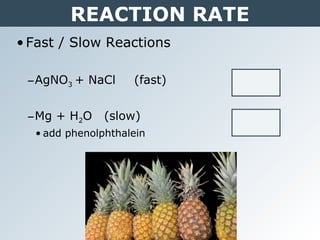
•Fast / Slow Reactions
–AgNO3 + NaCl (fast)
–Mg + H2O (slow)
• add phenolphthalein
REACTION RATE
rate of reaction - how quickly
reactants disappear to form
products
Chemical reactions indicate the
overall change that is observed.
Most reactions take place through
a series of steps which are
usually too quick to observe.
REACTION RATE
Factors AffectingFactors Affecting
Reaction RatesReaction Rates
1. Chemical nature of reactants
2. Surface area
3. Reactant concentration
4. Temperature
5. Presence of a catalyst
REACTION RATE
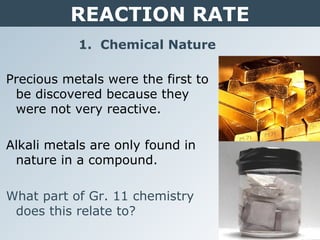
1. Chemical Nature
Precious metals were the first to
be discovered because they
were not very reactive.
Alkali metals are only found in
nature in a compound.
What part of Gr. 11 chemistry
does this relate to?
REACTION RATE
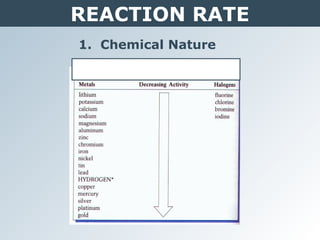
1. Chemical Nature
REACTION RATE
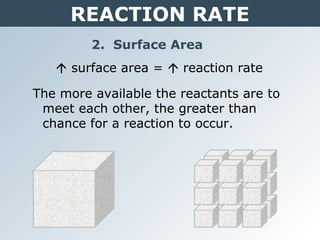
2. Surface Area
 surface area =  reaction rate
The more available the reactants are to
meet each other, the greater than
chance for a reaction to occur.
REACTION RATE
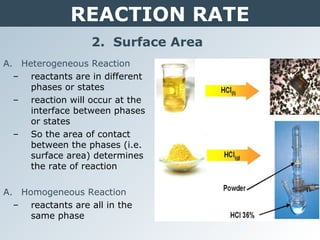
2. Surface Area
A. Heterogeneous Reaction
– reactants are in different
phases or states
– reaction will occur at the
interface between phases
or states
– So the area of contact
between the phases (i.e.
surface area) determines
the rate of reaction
A. Homogeneous Reaction
– reactants are all in the
same phase
REACTION RATE
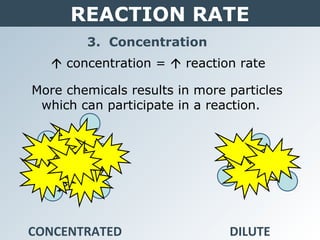
3. Concentration
 concentration =  reaction rate
More chemicals results in more particles
which can participate in a reaction.
CONCENTRATED DILUTE
REACTION RATE
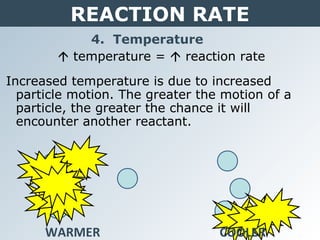
4. Temperature
 temperature =  reaction rate
Increased temperature is due to increased
particle motion. The greater the motion of a
particle, the greater the chance it will
encounter another reactant.
WARMER COOLER
REACTION RATE
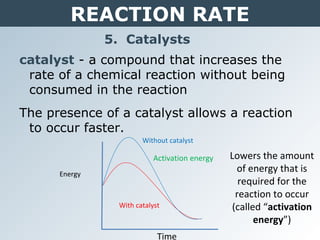
5. Catalysts
catalyst - a compound that increases the
rate of a chemical reaction without being
consumed in the reaction
The presence of a catalyst allows a reaction
to occur faster.
Lowers the amount
of energy that is
required for the
reaction to occur
(called “activation
energy”)
Time
Energy
Activation energy
With catalyst
Without catalyst
REACTION RATE
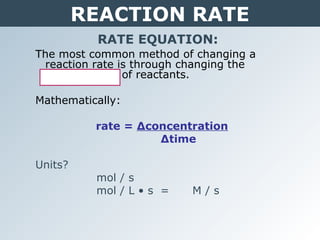
RATE EQUATION:
The most common method of changing a
reaction rate is through changing the
concentration of reactants.
Mathematically:
rate = Δconcentration
Δtime
Units?
mol / s
mol / L • s = M / s
REACTION RATE
RATE LAW EQUATION:
rate = Δconcentration
Δtime
For a reaction:
A + B  C + D
rate α [A]m
[B]n
rate = k[A]m
[B]n
REACTION RATE
RATE LAW EQUATION:
rate = k[A]x
[B]y
x & y - values determined by experiment
k - the rate constant
–determined by the reaction and the
conditions the experiment was conducted in
REACTION RATE
RATE LAW EQUATION:
Write out the rate law equation for:
H2SeO3 + 6 I-
+ 4 H+
 Se + 2 I3
-
+ 3 H2O
rate = k[H2SeO3]x
[I-
]y
[H+
]z
EXAMPLE 1
REACTION RATE
RATE LAW EQUATION:
rate = k[H2SeO3]x
[I-
]y
[H+
]z
At 0°C, k = 5.0 x 10⁵
x = 1, y = 3, z = 2
Rewrite the rate law.
What is the unit for rate?
What are the units for k in this case?
L5
• mol-5
• s-1
EXAMPLE 1
REACTION RATE
RATE LAW EQUATION:
rate = 5.0x10⁵
L5
mol-5
s-1
[H2SeO3]1
[I-
]3
[H+
]2
Determine the rate of reaction at 0°C given:
[H2SeO3] = 2.0x10⁻²
M
[I-
] = 2.0x10⁻³
M
[H+
] = 1.0x10⁻³
M
EXAMPLE 1
REACTION RATE
RATE LAW EQUATION:
rate = 5.0x10⁵
L5
mol-5
s-1
[2.0x10⁻²
M]1
[2.0x10⁻³
M]3
[1.0x10⁻³
M]2
= 5.0x10⁵
L5
mol-5
s-1
[2.0x10⁻²
mol L-1
]x[8.0x10⁻⁹
mol3
L-3
]
x[1.0x10⁻⁶
mol2
L-2
]
= 8.0x10⁻¹¹
mol L-1
S-1
= 8.0x10⁻¹¹
mol/L∙s
Therefore the rate of the reaction at 0°C is 8.0x10⁻¹¹
mol/L∙s
EXAMPLE 1
REACTION RATE
RATE LAW EQUATION:
EXAMPLE 2
The rate law for the decomposition of HI is:
rate = k[HI]2
= 2.5x10⁻⁴
mol L-1
s-1
When [HI] is 0.0558 M, what is the value of
the rate constant?
REACTION RATE
RATE LAW EQUATION:
EXAMPLE 2
rate = k[HI]2
= 2.5x10⁻⁴
mol L-1
s-1
rate = k[HI]2
(2.5x10⁻⁴
mol L-1
s-1
) = k
(0.0558 mol L-1
)2
8.0x 10⁻²
mol-1
L s-1
= k
8.0x 10⁻²
L mol-1
s-1
= k
Therefore the value of the rate constant is
8.0x 10⁻²
L mol-1
s-1
REACTION RATE
RATE LAW EXPONENTS:
rate = k[A]x
[B]y
Exponents of the rate law are NOT
related to the coefficients of the
balanced chemical reaction.  They
may be by coincidence, but do not
make this assumption.
REACTION RATE
RATE LAW EXPONENTS:
The exponents are related to the order
of the reaction.
order of a reaction - experimentally
determined by changing one
[reactant] at a time and looking at how
the reaction rate changes.
REACTION RATE
RATE LAW EXPONENTS:
Given [X]1
:
• first order reaction
• when [X] is doubled, the reaction rate
is doubled (multiplying by 21
)
• when [X] is tripled, the reaction rate is
tripled (multiplying by 31
)
• when [X] is halved, the reaction rate is
halved (multiplying by ½1
)
REACTION RATE
RATE LAW EXPONENTS:
Given [Y]2
:
• second order reaction
• when [Y] is doubled, the rate
increases by four (22
)
• when [Y] is tripled, the rate increases
by 9 (32
)
• when [Y] is halved, the rate decreased
by 4 (½2
)
REACTION RATE
RATE LAW EXPONENTS:
Given [Z]0
:
• zeroth order reaction
• increasing or decreasing [Z] will result
in no change of reaction rate
(multiplying by x0
= 1)
REACTION RATE
REACTION ORDER:
The order of a reaction is the sum of the
rate law exponents.
What is the order of the reaction which
has the rate law of rate = k[X]2
[Y]2
and
reaction of X + Y + Z  A + B?
What are the units of k for this reaction?
4
L3
mol-3
s-1
REACTION RATE
REACTION ORDER:
Identify the order of the reaction and
units of k:
a) rate = k[N]
b) rate = k[D]1/2
[E]2
c) rate = k[J]-3
[L]2
1st
order, s-1
2.5 order, L1.5
mol-1.5
s-1
-1 order, mol2
L-2
s-1

Tang 06 reaction rate

  • 1.
  • 2.
    REACTION RATE •Fast /Slow Reactions –AgNO3 + NaCl (fast) –Mg + H2O (slow) • add phenolphthalein
  • 3.
    REACTION RATE rate ofreaction - how quickly reactants disappear to form products Chemical reactions indicate the overall change that is observed. Most reactions take place through a series of steps which are usually too quick to observe.
  • 4.
    REACTION RATE Factors AffectingFactorsAffecting Reaction RatesReaction Rates 1. Chemical nature of reactants 2. Surface area 3. Reactant concentration 4. Temperature 5. Presence of a catalyst
  • 5.
    REACTION RATE 1. ChemicalNature Precious metals were the first to be discovered because they were not very reactive. Alkali metals are only found in nature in a compound. What part of Gr. 11 chemistry does this relate to?
  • 6.
  • 7.
    REACTION RATE 2. SurfaceArea  surface area =  reaction rate The more available the reactants are to meet each other, the greater than chance for a reaction to occur.
  • 8.
    REACTION RATE 2. SurfaceArea A. Heterogeneous Reaction – reactants are in different phases or states – reaction will occur at the interface between phases or states – So the area of contact between the phases (i.e. surface area) determines the rate of reaction A. Homogeneous Reaction – reactants are all in the same phase
  • 9.
    REACTION RATE 3. Concentration concentration =  reaction rate More chemicals results in more particles which can participate in a reaction. CONCENTRATED DILUTE
  • 10.
    REACTION RATE 4. Temperature temperature =  reaction rate Increased temperature is due to increased particle motion. The greater the motion of a particle, the greater the chance it will encounter another reactant. WARMER COOLER
  • 11.
    REACTION RATE 5. Catalysts catalyst- a compound that increases the rate of a chemical reaction without being consumed in the reaction The presence of a catalyst allows a reaction to occur faster. Lowers the amount of energy that is required for the reaction to occur (called “activation energy”) Time Energy Activation energy With catalyst Without catalyst
  • 12.
    REACTION RATE RATE EQUATION: Themost common method of changing a reaction rate is through changing the concentration of reactants. Mathematically: rate = Δconcentration Δtime Units? mol / s mol / L • s = M / s
  • 13.
    REACTION RATE RATE LAWEQUATION: rate = Δconcentration Δtime For a reaction: A + B  C + D rate α [A]m [B]n rate = k[A]m [B]n
  • 14.
    REACTION RATE RATE LAWEQUATION: rate = k[A]x [B]y x & y - values determined by experiment k - the rate constant –determined by the reaction and the conditions the experiment was conducted in
  • 15.
    REACTION RATE RATE LAWEQUATION: Write out the rate law equation for: H2SeO3 + 6 I- + 4 H+  Se + 2 I3 - + 3 H2O rate = k[H2SeO3]x [I- ]y [H+ ]z EXAMPLE 1
  • 16.
    REACTION RATE RATE LAWEQUATION: rate = k[H2SeO3]x [I- ]y [H+ ]z At 0°C, k = 5.0 x 10⁵ x = 1, y = 3, z = 2 Rewrite the rate law. What is the unit for rate? What are the units for k in this case? L5 • mol-5 • s-1 EXAMPLE 1
  • 17.
    REACTION RATE RATE LAWEQUATION: rate = 5.0x10⁵ L5 mol-5 s-1 [H2SeO3]1 [I- ]3 [H+ ]2 Determine the rate of reaction at 0°C given: [H2SeO3] = 2.0x10⁻² M [I- ] = 2.0x10⁻³ M [H+ ] = 1.0x10⁻³ M EXAMPLE 1
  • 18.
    REACTION RATE RATE LAWEQUATION: rate = 5.0x10⁵ L5 mol-5 s-1 [2.0x10⁻² M]1 [2.0x10⁻³ M]3 [1.0x10⁻³ M]2 = 5.0x10⁵ L5 mol-5 s-1 [2.0x10⁻² mol L-1 ]x[8.0x10⁻⁹ mol3 L-3 ] x[1.0x10⁻⁶ mol2 L-2 ] = 8.0x10⁻¹¹ mol L-1 S-1 = 8.0x10⁻¹¹ mol/L∙s Therefore the rate of the reaction at 0°C is 8.0x10⁻¹¹ mol/L∙s EXAMPLE 1
  • 19.
    REACTION RATE RATE LAWEQUATION: EXAMPLE 2 The rate law for the decomposition of HI is: rate = k[HI]2 = 2.5x10⁻⁴ mol L-1 s-1 When [HI] is 0.0558 M, what is the value of the rate constant?
  • 20.
    REACTION RATE RATE LAWEQUATION: EXAMPLE 2 rate = k[HI]2 = 2.5x10⁻⁴ mol L-1 s-1 rate = k[HI]2 (2.5x10⁻⁴ mol L-1 s-1 ) = k (0.0558 mol L-1 )2 8.0x 10⁻² mol-1 L s-1 = k 8.0x 10⁻² L mol-1 s-1 = k Therefore the value of the rate constant is 8.0x 10⁻² L mol-1 s-1
  • 21.
    REACTION RATE RATE LAWEXPONENTS: rate = k[A]x [B]y Exponents of the rate law are NOT related to the coefficients of the balanced chemical reaction.  They may be by coincidence, but do not make this assumption.
  • 22.
    REACTION RATE RATE LAWEXPONENTS: The exponents are related to the order of the reaction. order of a reaction - experimentally determined by changing one [reactant] at a time and looking at how the reaction rate changes.
  • 23.
    REACTION RATE RATE LAWEXPONENTS: Given [X]1 : • first order reaction • when [X] is doubled, the reaction rate is doubled (multiplying by 21 ) • when [X] is tripled, the reaction rate is tripled (multiplying by 31 ) • when [X] is halved, the reaction rate is halved (multiplying by ½1 )
  • 24.
    REACTION RATE RATE LAWEXPONENTS: Given [Y]2 : • second order reaction • when [Y] is doubled, the rate increases by four (22 ) • when [Y] is tripled, the rate increases by 9 (32 ) • when [Y] is halved, the rate decreased by 4 (½2 )
  • 25.
    REACTION RATE RATE LAWEXPONENTS: Given [Z]0 : • zeroth order reaction • increasing or decreasing [Z] will result in no change of reaction rate (multiplying by x0 = 1)
  • 26.
    REACTION RATE REACTION ORDER: Theorder of a reaction is the sum of the rate law exponents. What is the order of the reaction which has the rate law of rate = k[X]2 [Y]2 and reaction of X + Y + Z  A + B? What are the units of k for this reaction? 4 L3 mol-3 s-1
  • 27.
    REACTION RATE REACTION ORDER: Identifythe order of the reaction and units of k: a) rate = k[N] b) rate = k[D]1/2 [E]2 c) rate = k[J]-3 [L]2 1st order, s-1 2.5 order, L1.5 mol-1.5 s-1 -1 order, mol2 L-2 s-1