Copyright  Š  The McGraw-Hill Companies, Inc. Permission required for reproduction or display. Chapter 32 Gas Exchange and Transport in Animals
Animals Have  Gas-Exchange Surfaces 32-
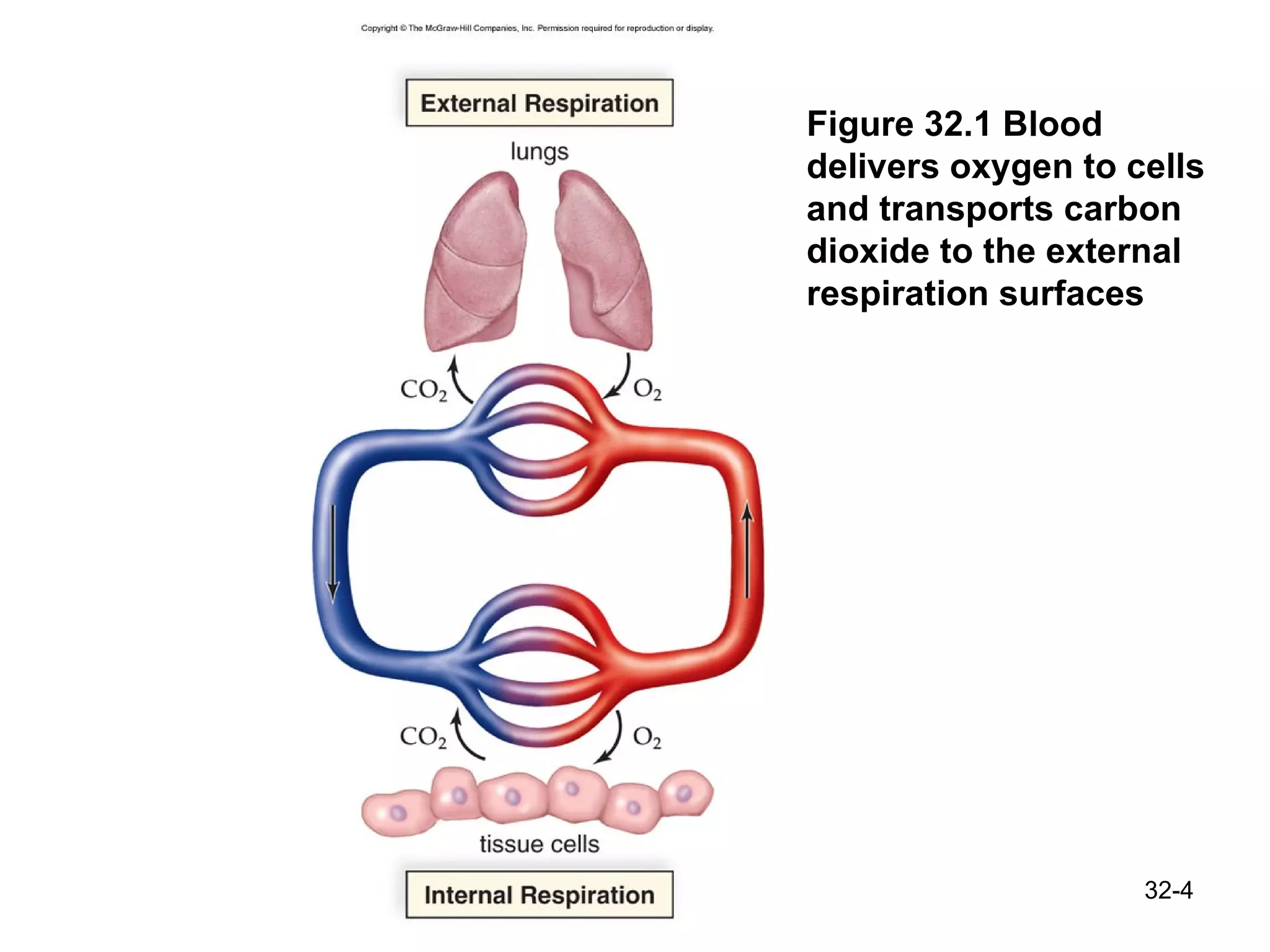
32.1 Respiration involves  several steps Respiration -  sequence of events that results in gas exchange between the body’s cells and the environment Ventilation -  (i.e., breathing) includes inspiration (entrance of air into the lungs) and expiration (exit of air from the lungs) External respiration -  gas exchange between the air and the blood within the lungs Blood transports oxygen from lungs to tissues Internal respiration -  gas exchange between blood and tissue fluid Body’s cells exchange gases with tissue fluid Blood then transports carbon dioxide to the lungs For external respiration to be effective, gas-exchange region must be  Moist Thin Large in relation to the size of the body 32-
Figure 32.1 Blood delivers oxygen to cells and transports carbon dioxide to the external respiration surfaces 32-
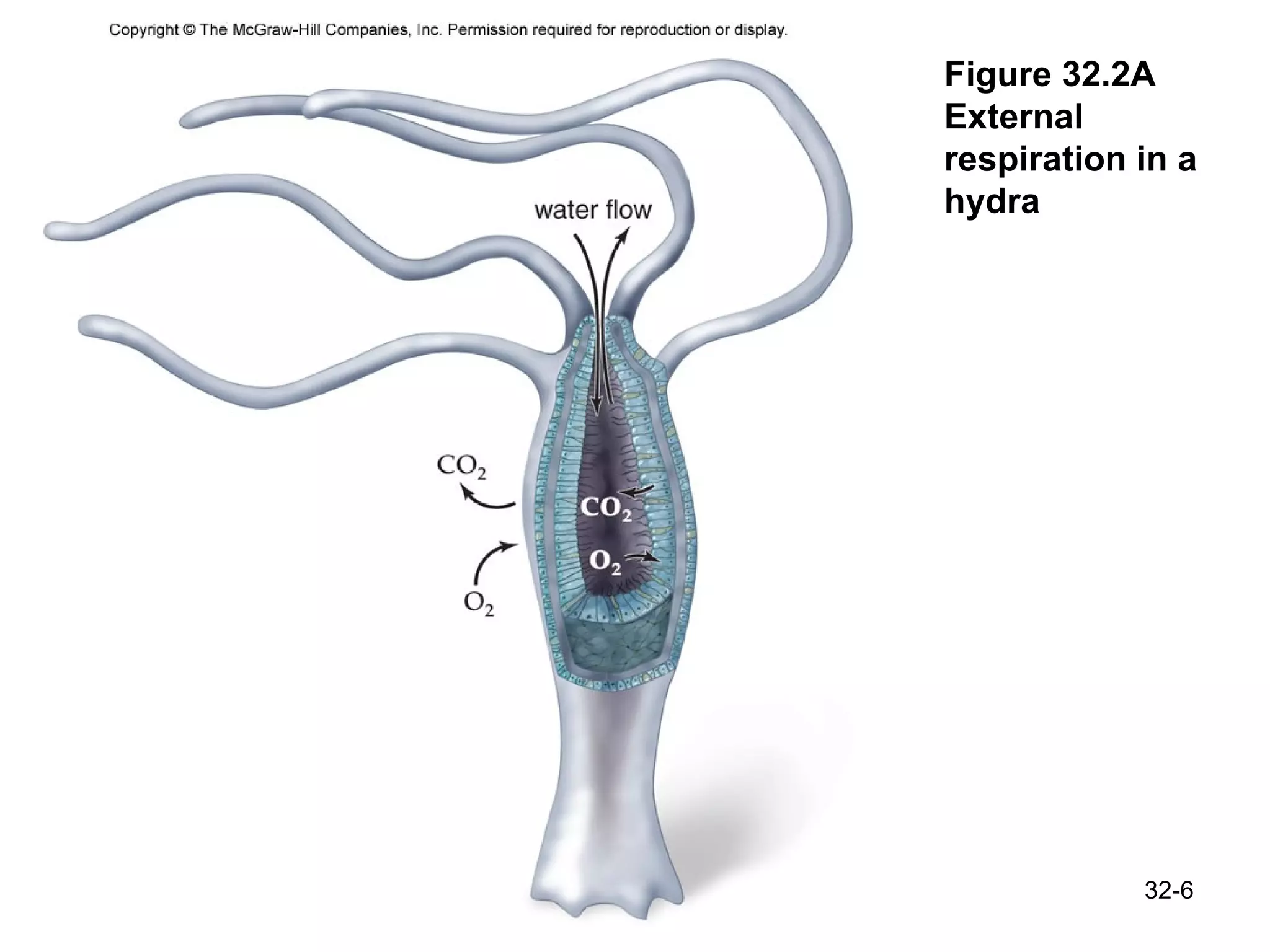
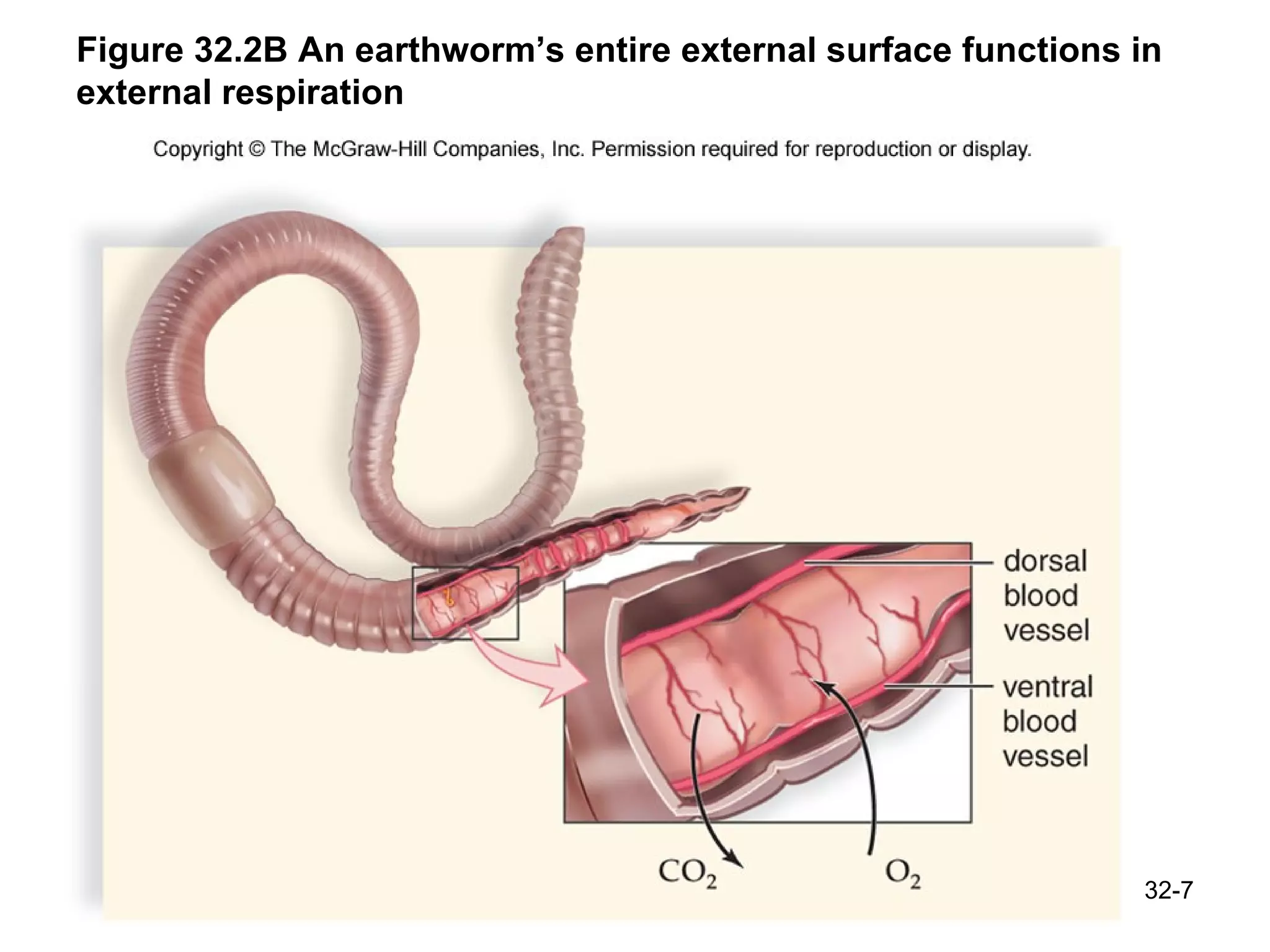
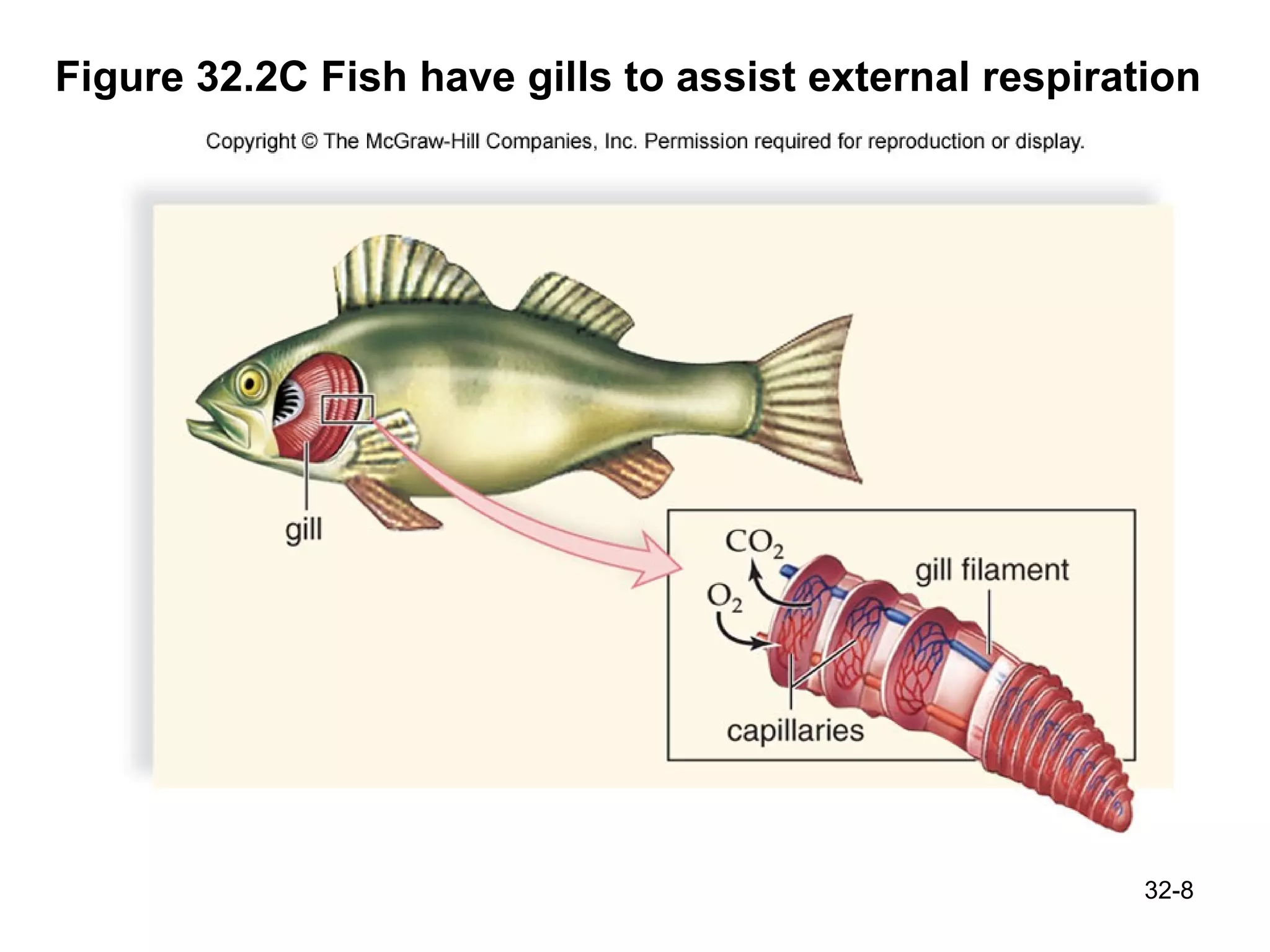
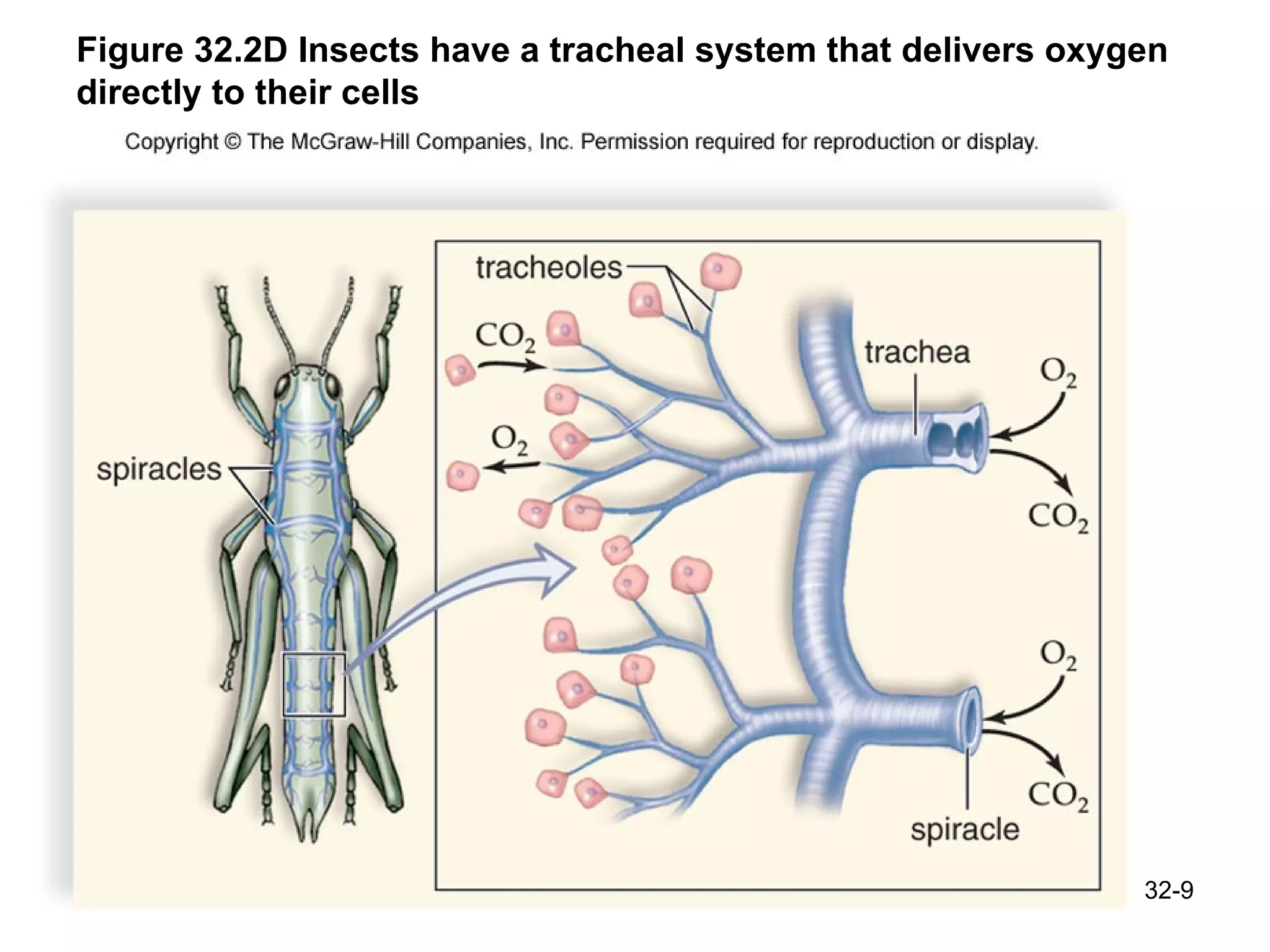
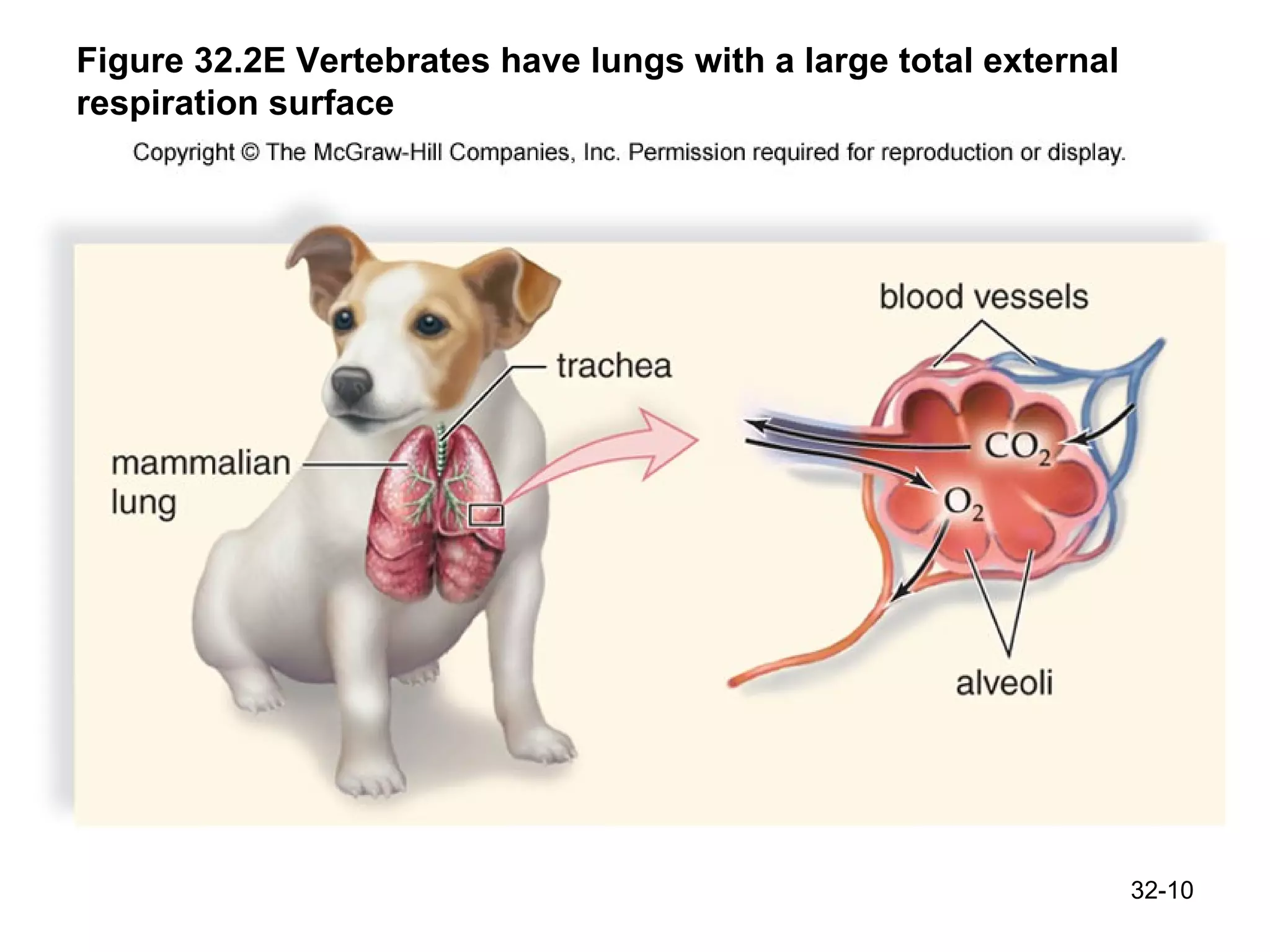
32.2 External respiration surfaces must be moist More difficult for animals to obtain oxygen from water than from air Water fully saturated with air contains only a fraction of the amount of oxygen that would be present in the same volume of air Hydras and planarians have a large surface area in comparison to their size Makes it possible for most of their cells to exchange gases with the environment The earthworm is able to use its body surface for respiration because the capillaries come close to the surface Aquatic invertebrates (clams and crayfish) and aquatic vertebrates (fish and tadpoles) have gills to extract oxygen from water Gills -  finely divided, vascularized outgrowths of body surface or pharynx Insects have a system of air tubes called tracheae through which oxygen is delivered directly to the cells without entering the blood Terrestrial vertebrates usually have  lungs , vascularized outgrowths from the lower pharyngeal region The lungs of birds and mammals are elaborately subdivided into small passageways and spaces, respectively 32-
Figure 32.2A External respiration in a hydra 32-
Figure 32.2B An earthworm’s entire external surface functions in external respiration 32-
Figure 32.2C Fish have gills to assist external respiration 32-
Figure 32.2D Insects have a tracheal system that delivers oxygen directly to their cells 32-
Figure 32.2E Vertebrates have lungs with a large total external respiration surface 32-
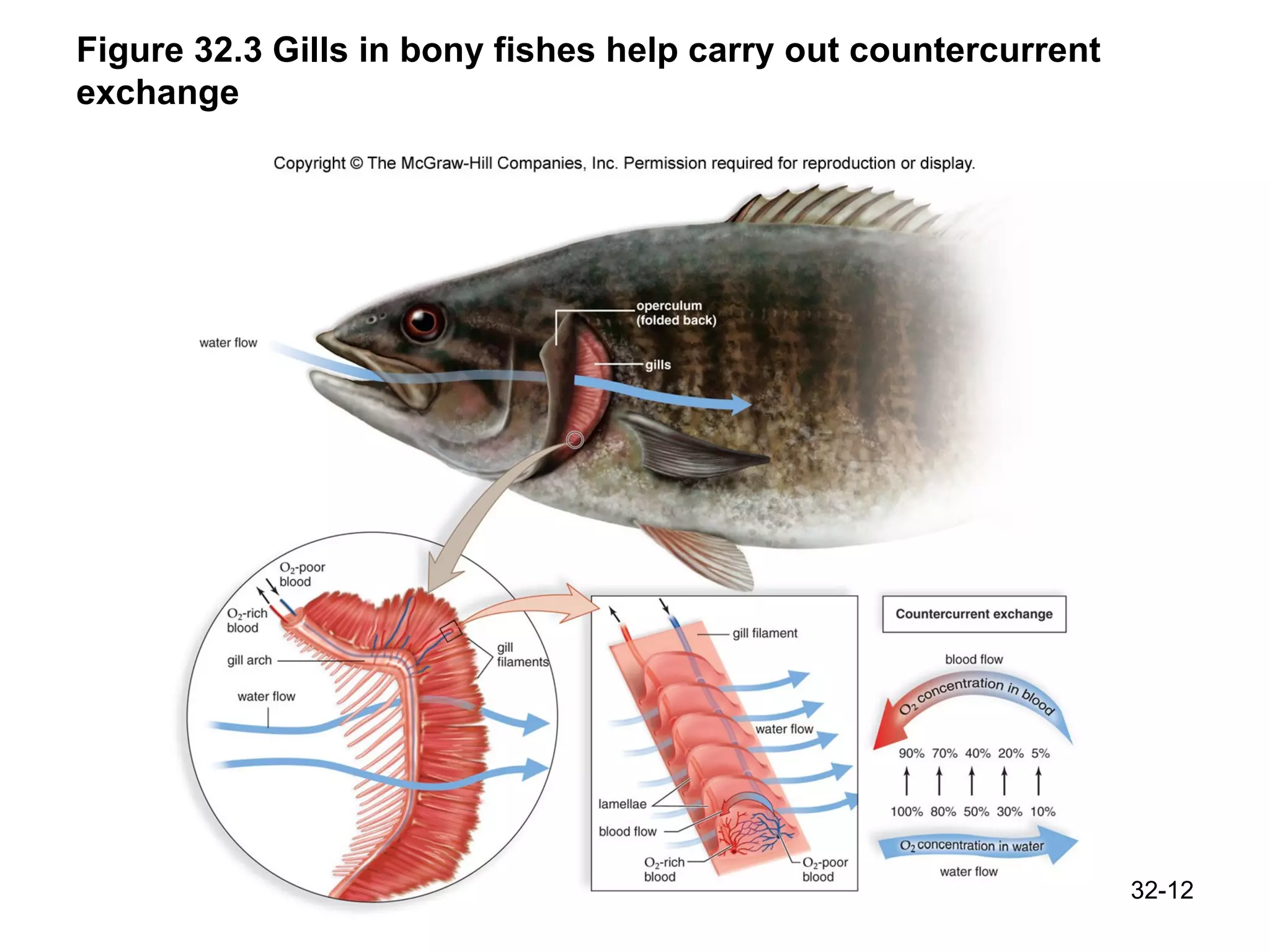
32.3 Gills are an efficient gas-exchange surface in water Animals with gills use various means of ventilation In molluscs (clam or squid) water is drawn into the mantle cavity and passes through gills In crustaceans (crabs and shrimps) gills are located in thoracic chambers covered by the exoskeleton In fish, ventilation is brought about by the combined action of the mouth and gill covers, or opercula (sing., operculum) Bony fish’s gills are outward extensions of pharynx Fish use  counter current exchange to transfer oxygen from the surrounding water into their blood Two fluids flow in opposite directions and as blood gains oxygen, it always encounters water having an even higher oxygen content Prevents an equilibrium point from being reached, and about 80–90% of the initial dissolved oxygen in water is extracted 32-
Figure 32.3 Gills in bony fishes help carry out countercurrent exchange 32-
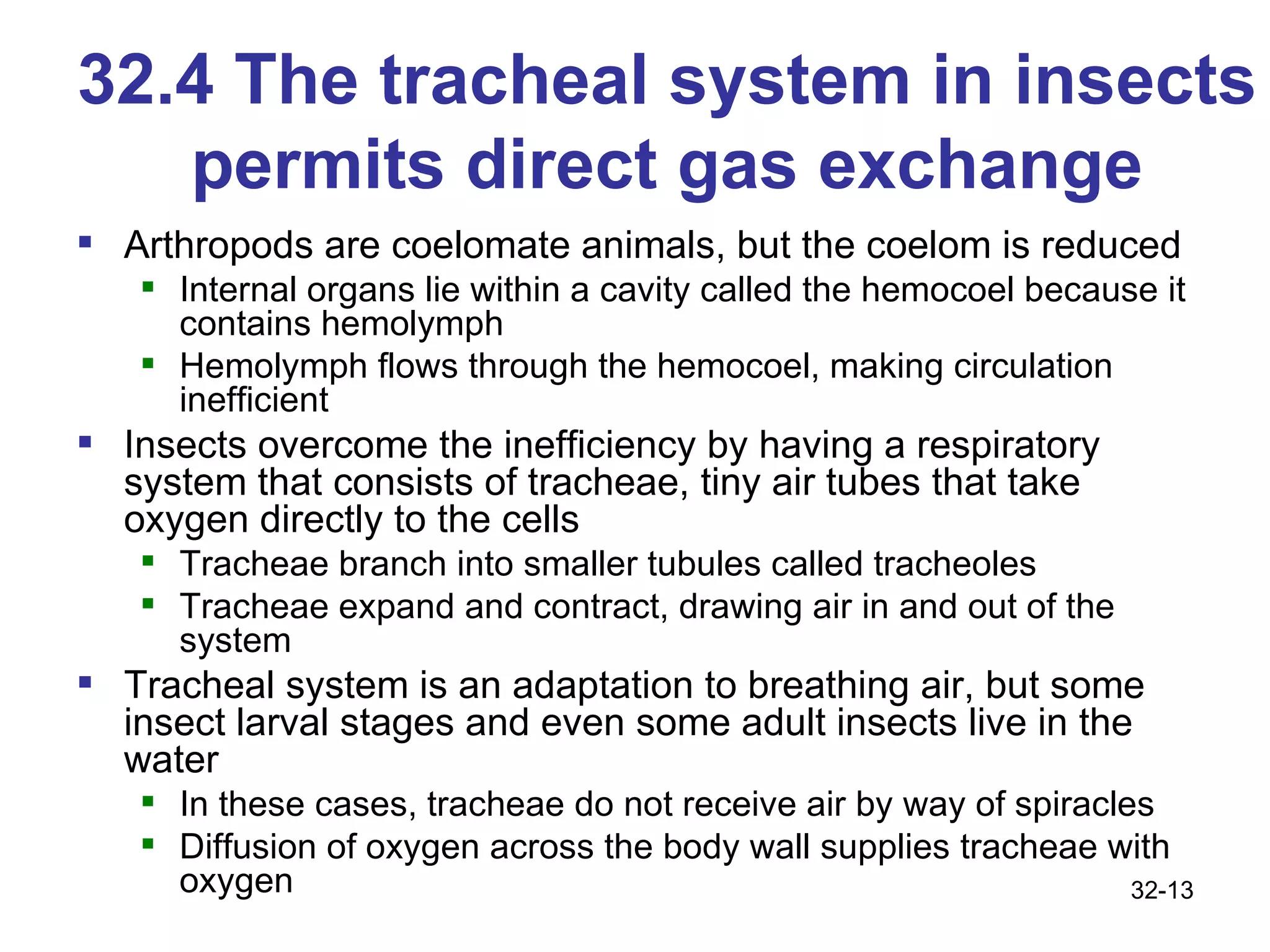
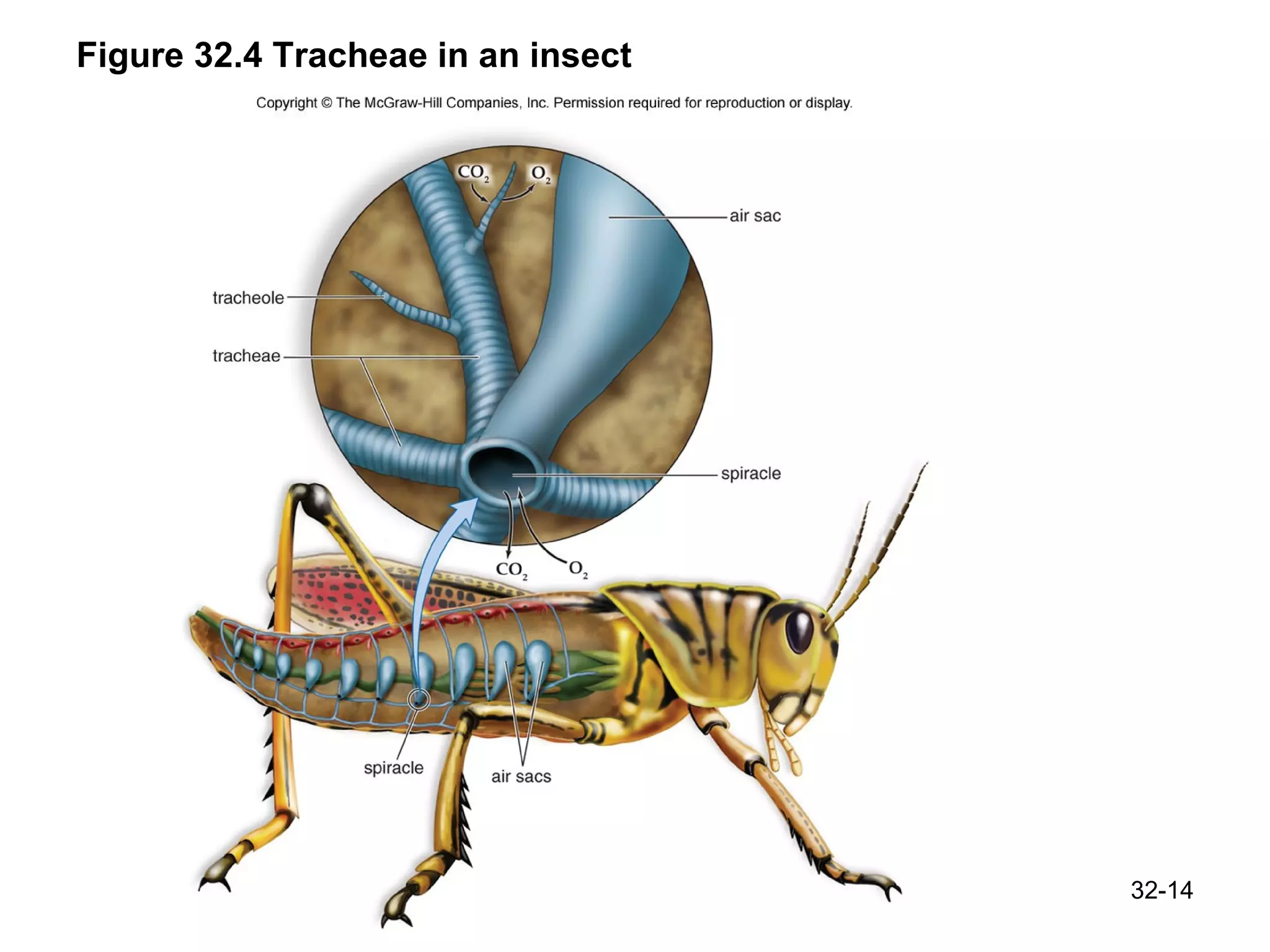
32.4 The tracheal system in insects permits direct gas exchange Arthropods are coelomate animals, but the coelom is reduced Internal organs lie within a cavity called the hemocoel because it contains hemolymph Hemolymph flows through the hemocoel, making circulation inefficient Insects overcome the inefficiency by having a respiratory system that consists of tracheae, tiny air tubes that take oxygen directly to the cells Tracheae branch into smaller tubules called tracheoles Tracheae expand and contract, drawing air in and out of the system Tracheal system is an adaptation to breathing air, but some insect larval stages and even some adult insects live in the water In these cases, tracheae do not receive air by way of spiracles Diffusion of oxygen across the body wall supplies tracheae with oxygen 32-
Figure 32.4 Tracheae in an insect 32-
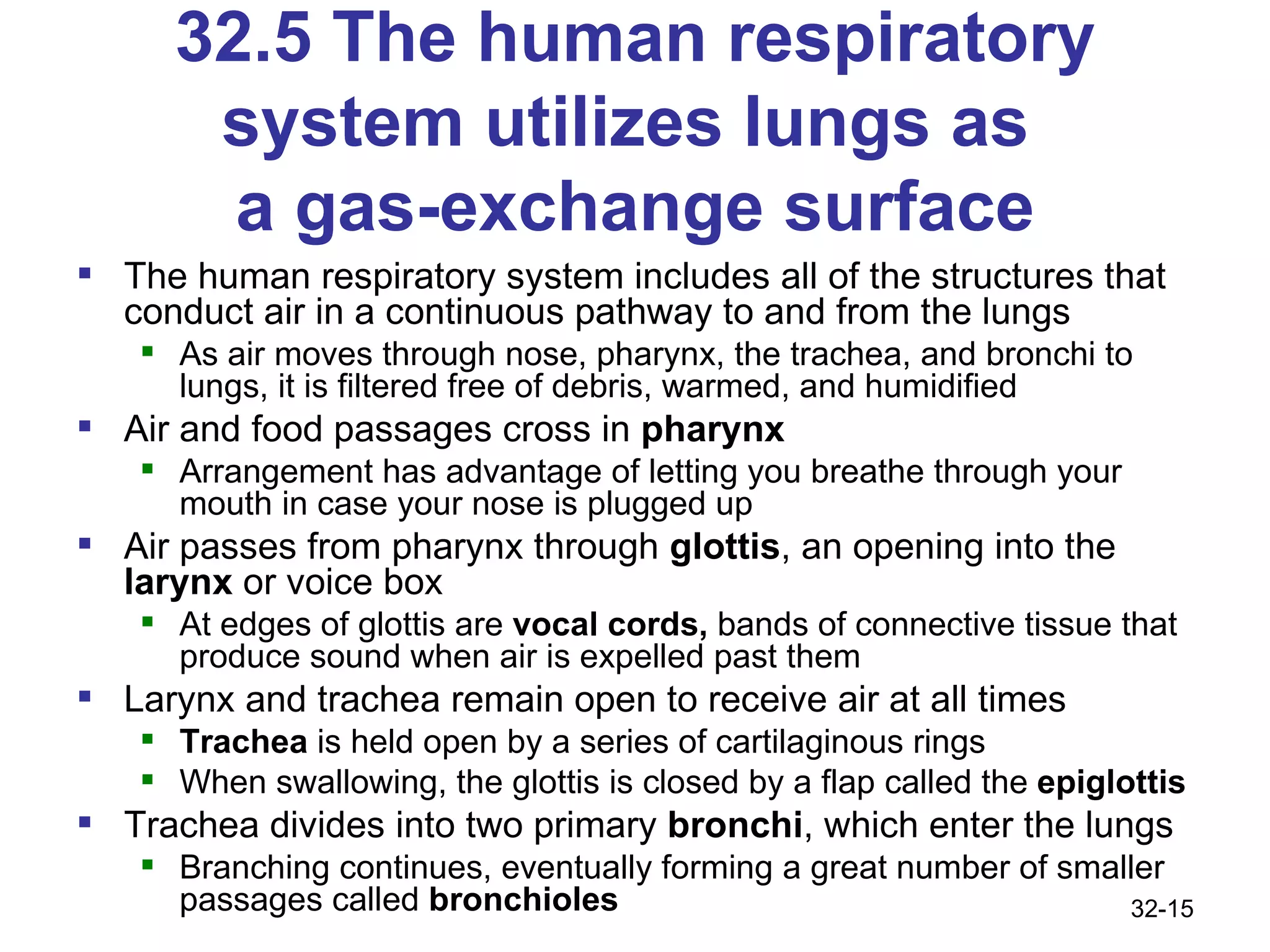
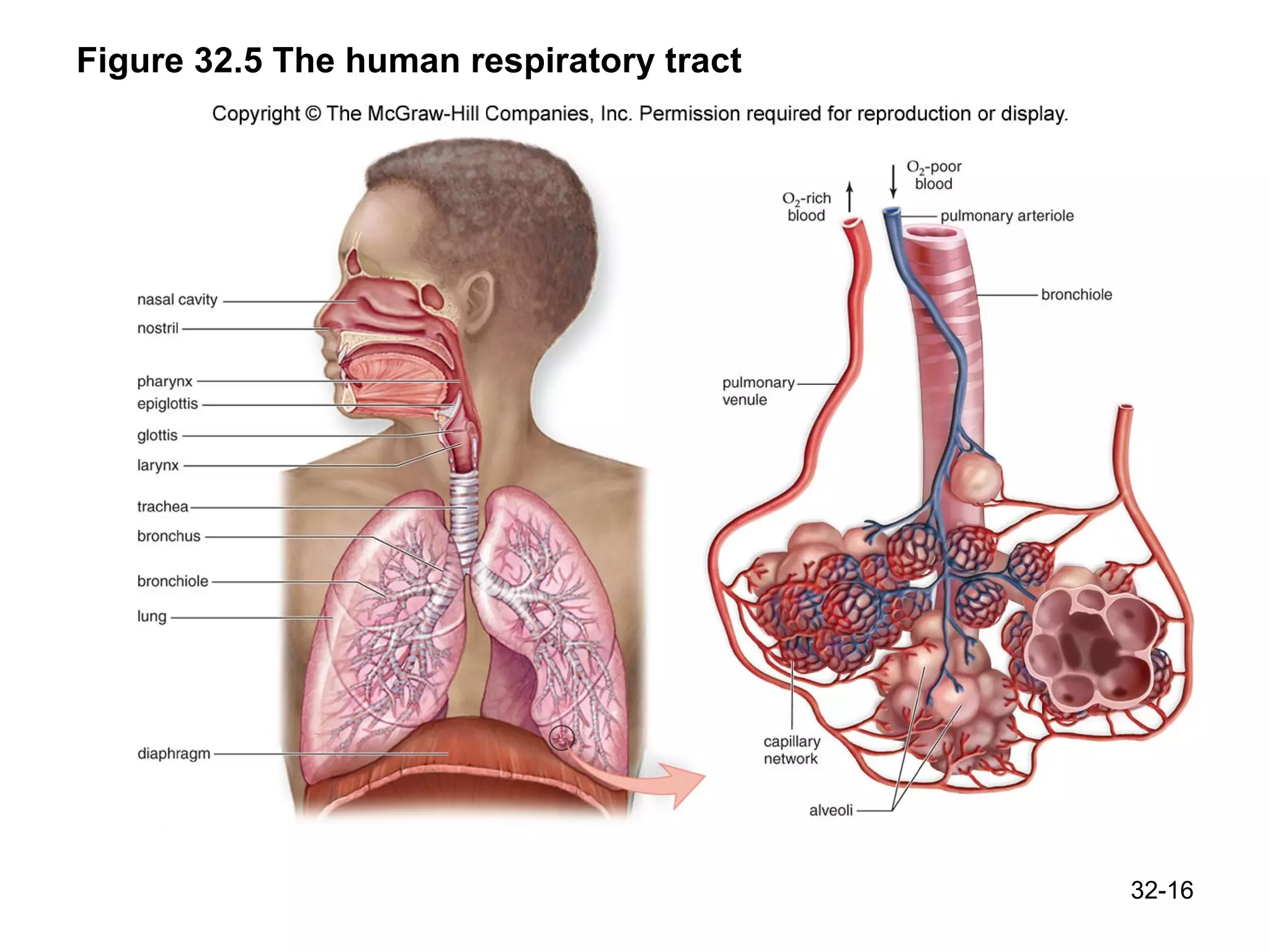
32.5 The human respiratory system utilizes lungs as  a gas-exchange surface The human respiratory system includes all of the structures that conduct air in a continuous pathway to and from the lungs As air moves through nose, pharynx, the trachea, and bronchi to lungs, it is filtered free of debris, warmed, and humidified Air and food passages cross in  pharynx Arrangement has advantage of letting you breathe through your mouth in case your nose is plugged up Air passes from pharynx through  glottis , an opening into the  larynx  or voice box At edges of glottis are  vocal cords,  bands of connective tissue that produce sound when air is expelled past them Larynx and trachea remain open to receive air at all times Trachea  is held open by a series of cartilaginous rings When swallowing, the glottis is closed by a flap called the  epiglottis Trachea divides into two primary  bronchi , which enter the lungs Branching continues, eventually forming a great number of smaller passages called  bronchioles 32-
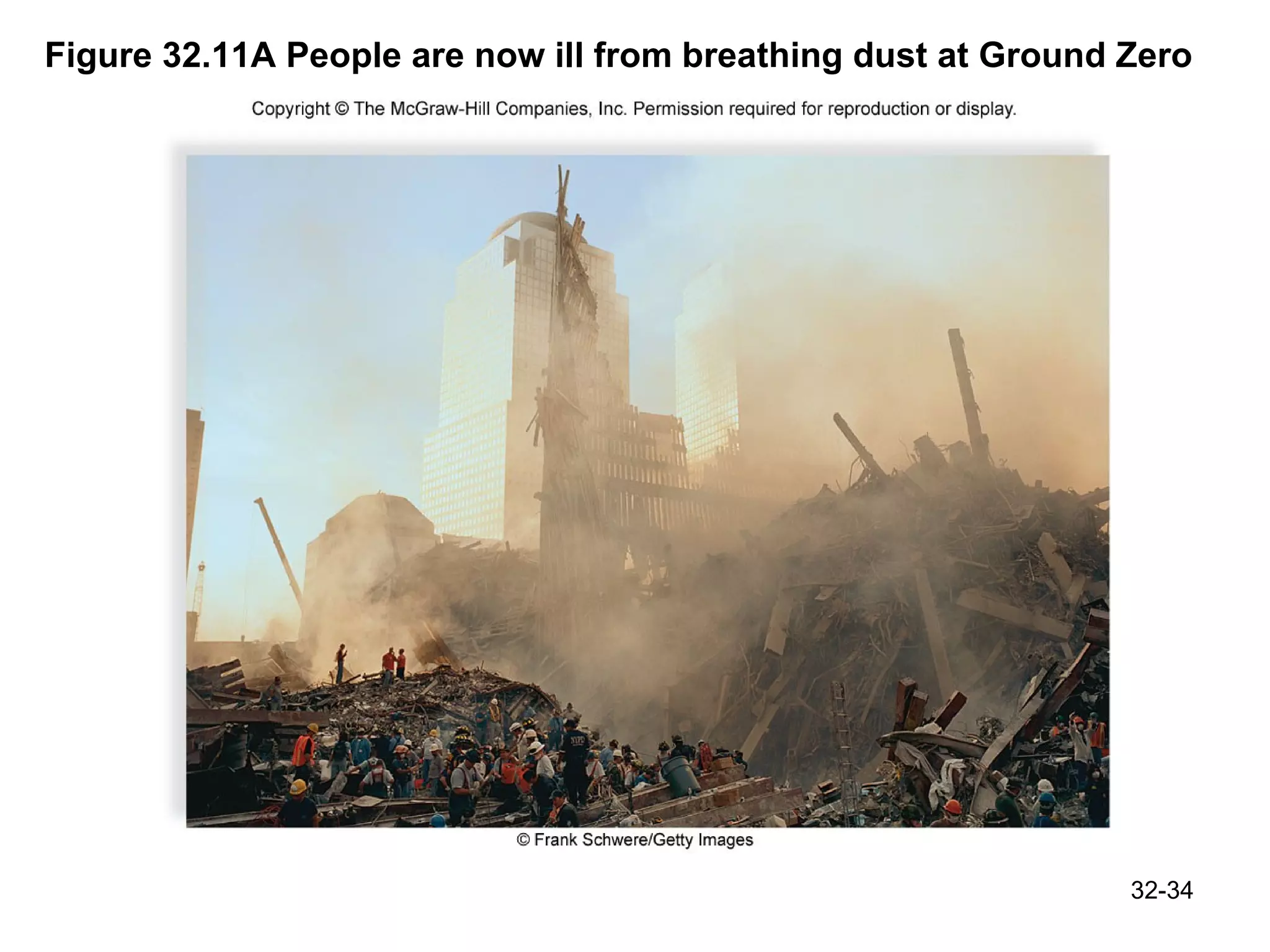
Figure 32.5 The human respiratory tract 32-
APPLYING THE CONCEPTS—HOW BIOLOGY IMPACTS OUR LIVES 32.6 Questions about tobacco, smoking, and health Is there a safe way to smoke? No. All cigarettes can damage the body Is cigarette smoking really addictive?  Yes. Small amounts of nicotine make the smoker want to smoke more and smokers usually suffer withdrawal symptoms when they stop Does smoking cause cancer?  Yes. Tobacco use accounts for about one-third of all cancer deaths in the United States How does cigarette smoke affect the lungs? All smokers have a lower level of lung function than nonsmokers Why do smokers have “smoker’s cough”? When a smoker inhales, the body tries to protect itself by producing mucus and stimulating coughing If you smoke but do not inhale, is there any danger?  Yes. Wherever smoke touches living cells, it does harm Does cigarette smoking affect the heart?  Yes. Smoking increases the risk of heart disease, which is the number-one cause of death in the United States 32-
How does smoking affect pregnant women and their babies?  Smoking during pregnancy is linked to a greater chance of miscarriage, premature delivery, stillbirth, infant death, low birth weight, and sudden infant death syndrome What are some of the short-term and long-term effects of smoking cigarettes?  Short-term effects include shortness of breath and a nagging cough, diminished ability to smell and taste, premature aging of the skin, and increased risk of sexual impotence in men Long-term effects include many types of cancer, heart disease, aneurysms, bronchitis, emphysema, and stroke What are the dangers of environmental tobacco smoke (ETS)? Children of smokers are more likely to suffer from asthma, pneumonia or bronchitis, ear infections, coughing, wheezing, and increased mucus production Are chewing tobacco and snuff safe alternatives to cigarette smoking?  No. The juice from smokeless tobacco is absorbed directly through the lining of the mouth, creating sores that often lead to mouth cancer 32-
Ventilation Precedes Transport 32-
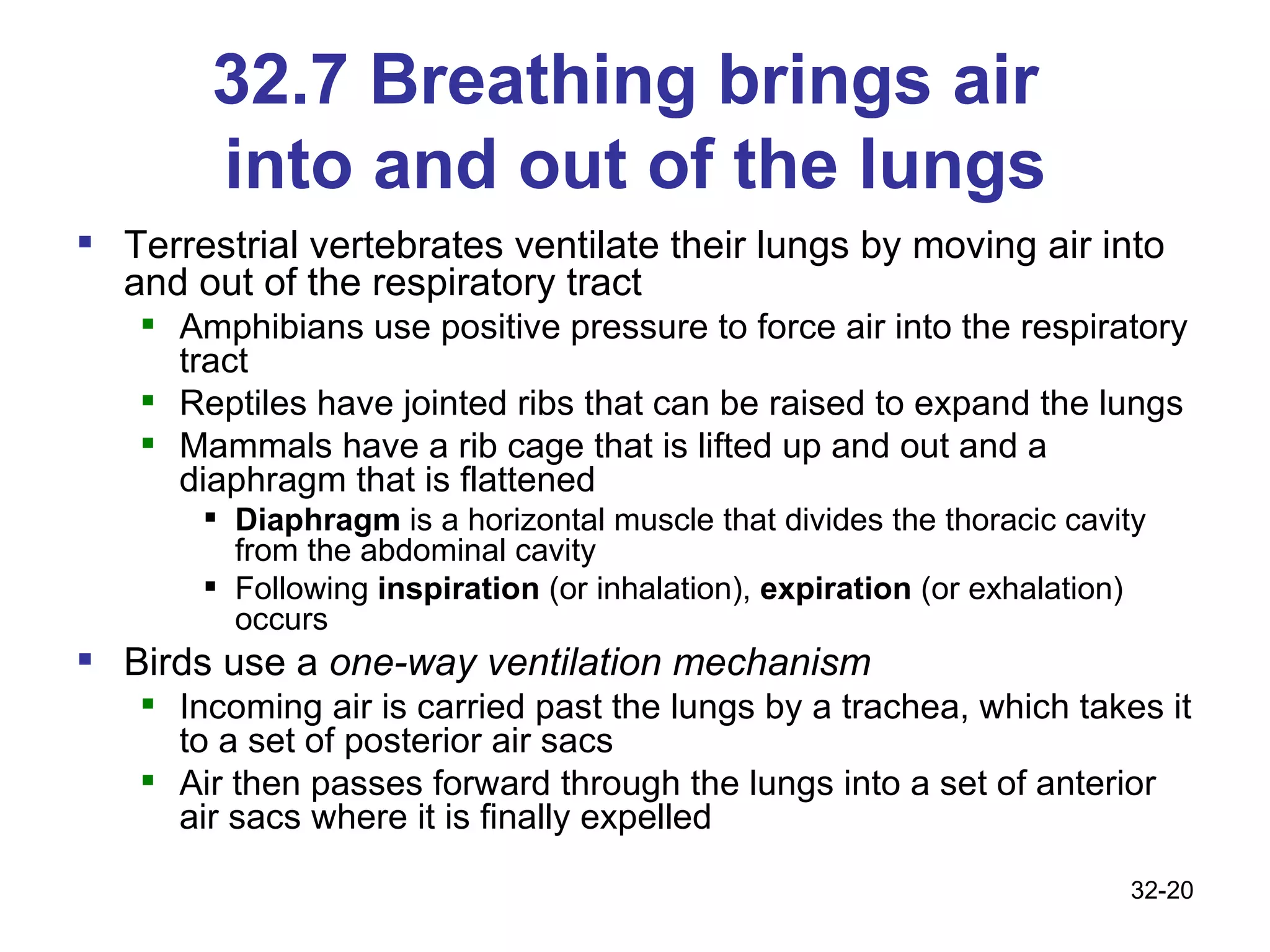
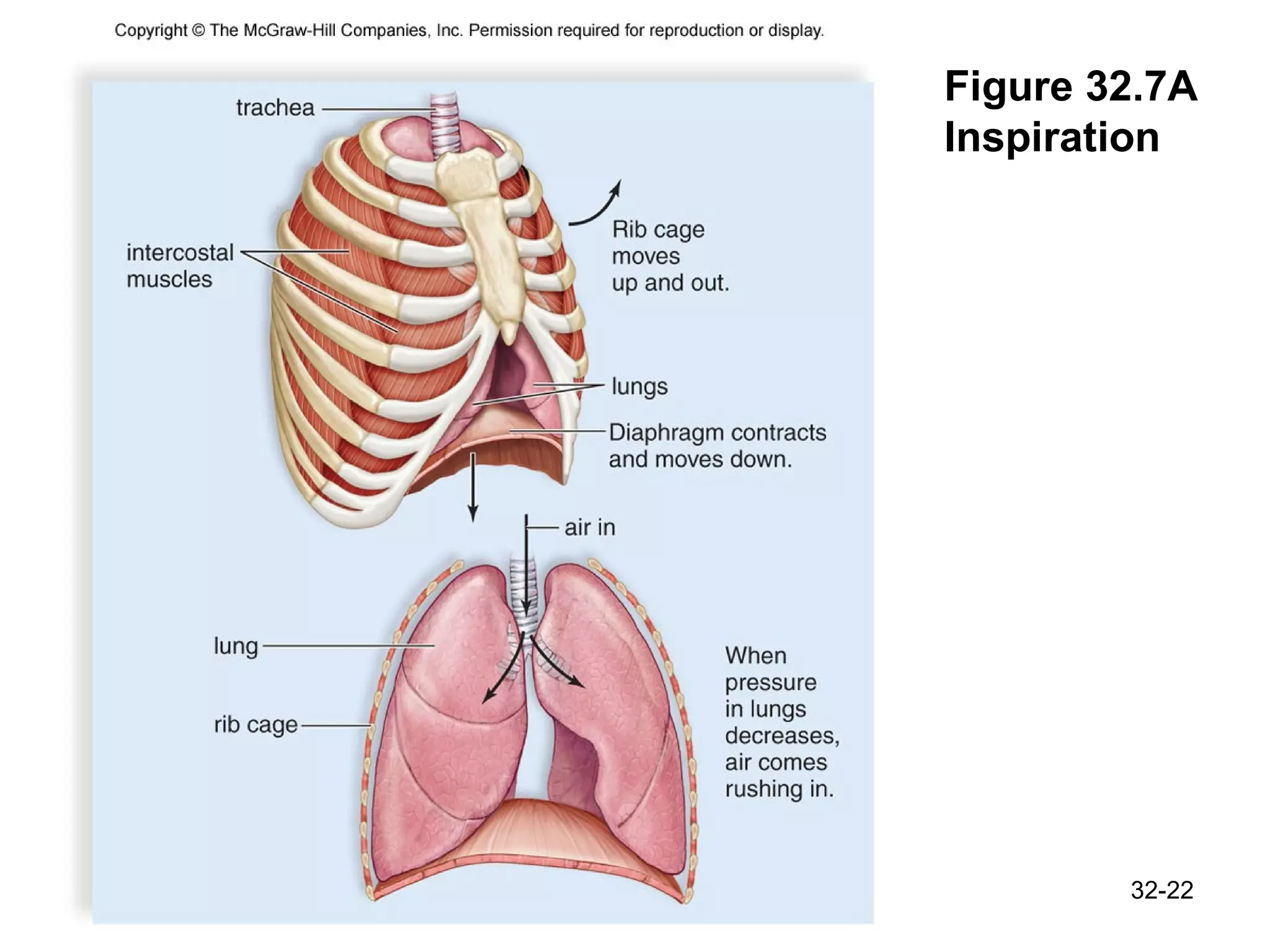
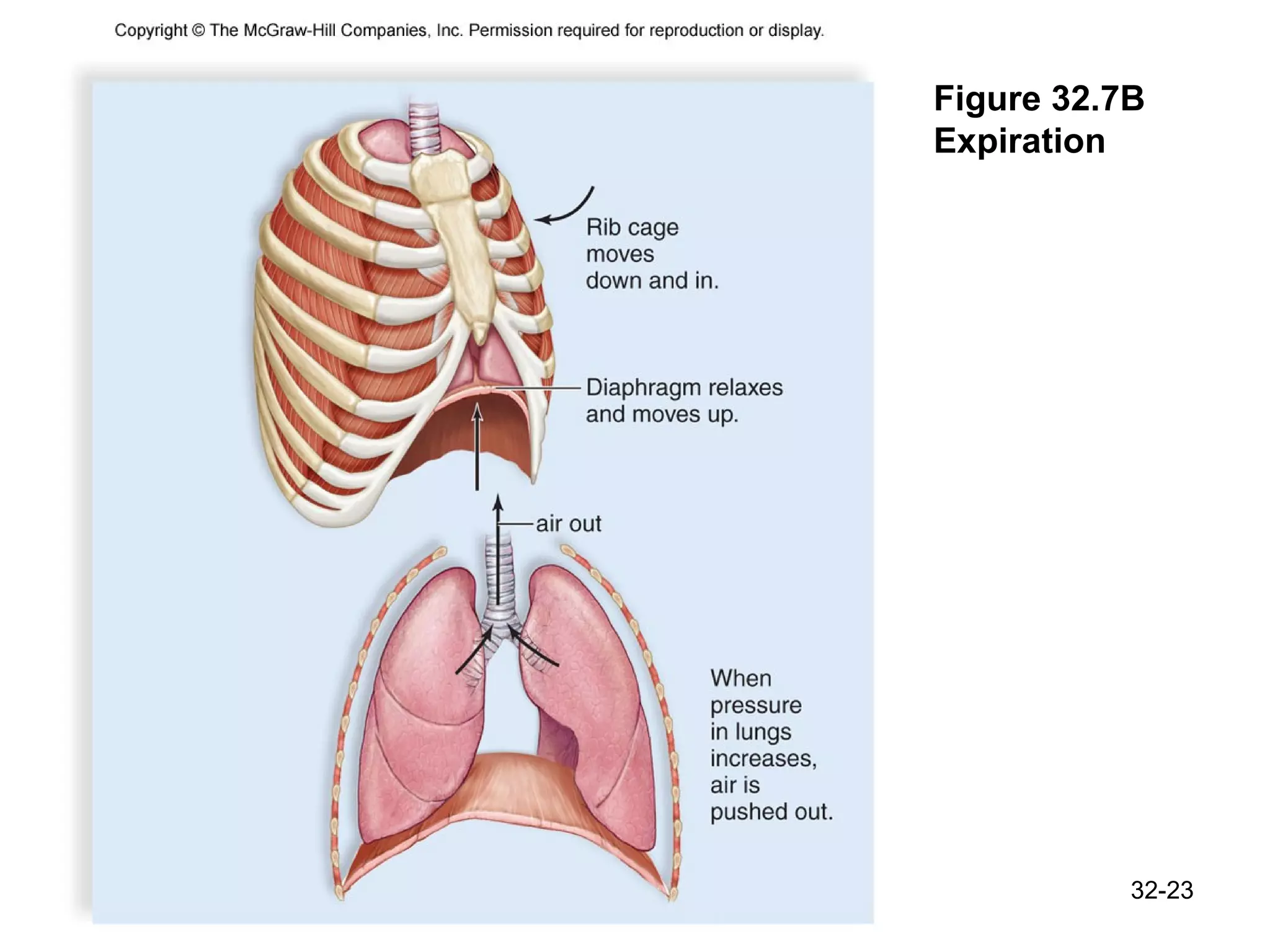
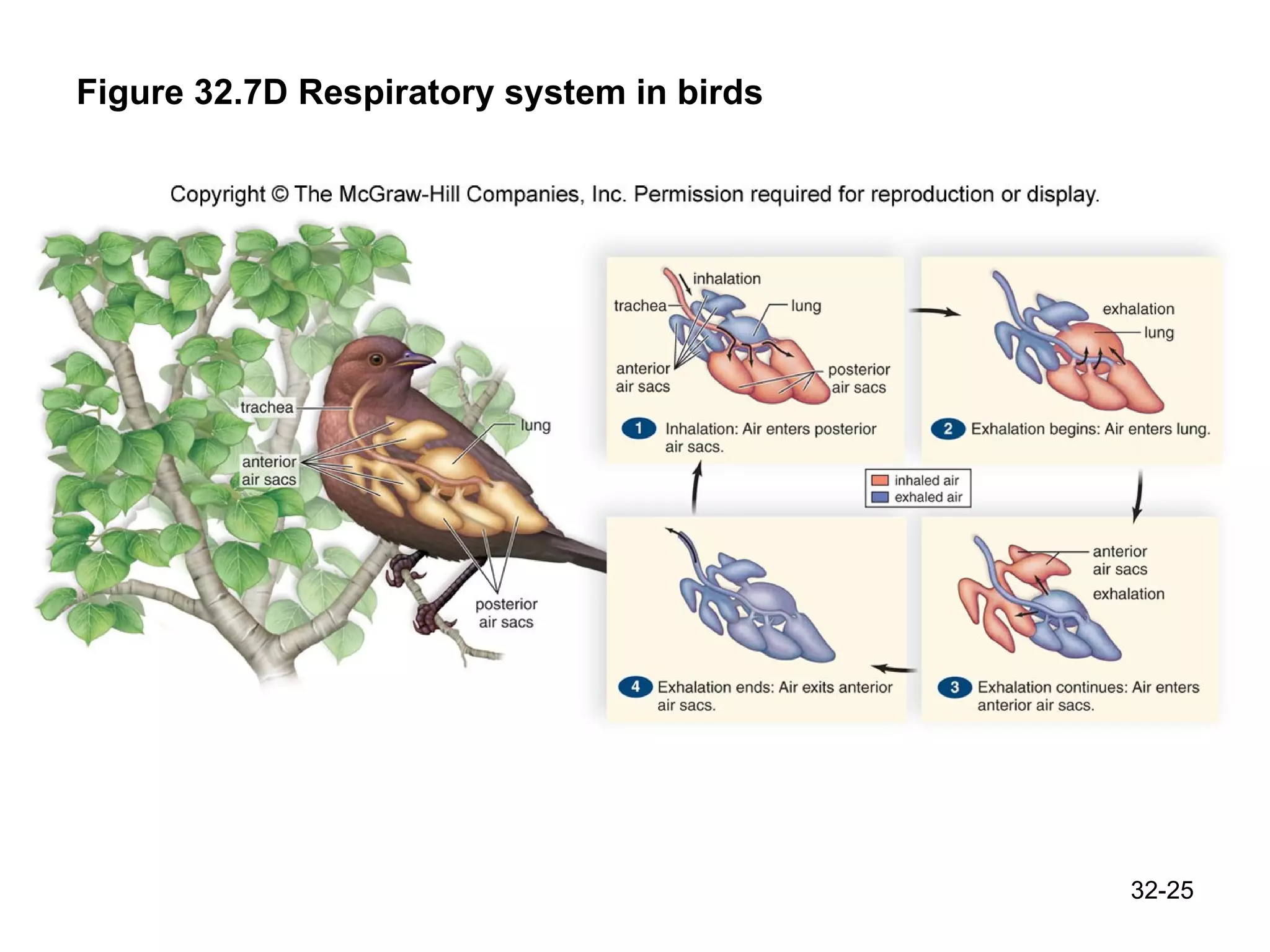
32.7 Breathing brings air  into and out of the lungs Terrestrial vertebrates ventilate their lungs by moving air into and out of the respiratory tract Amphibians use positive pressure to force air into the respiratory tract Reptiles have jointed ribs that can be raised to expand the lungs Mammals have a rib cage that is lifted up and out and a diaphragm that is flattened Diaphragm  is a horizontal muscle that divides the thoracic cavity from the abdominal cavity  Following  inspiration  (or inhalation),  expiration  (or exhalation) occurs Birds use a  one-way ventilation mechanism  Incoming air is carried past the lungs by a trachea, which takes it to a set of posterior air sacs Air then passes forward through the lungs into a set of   anterior air sacs where it is finally expelled 32-
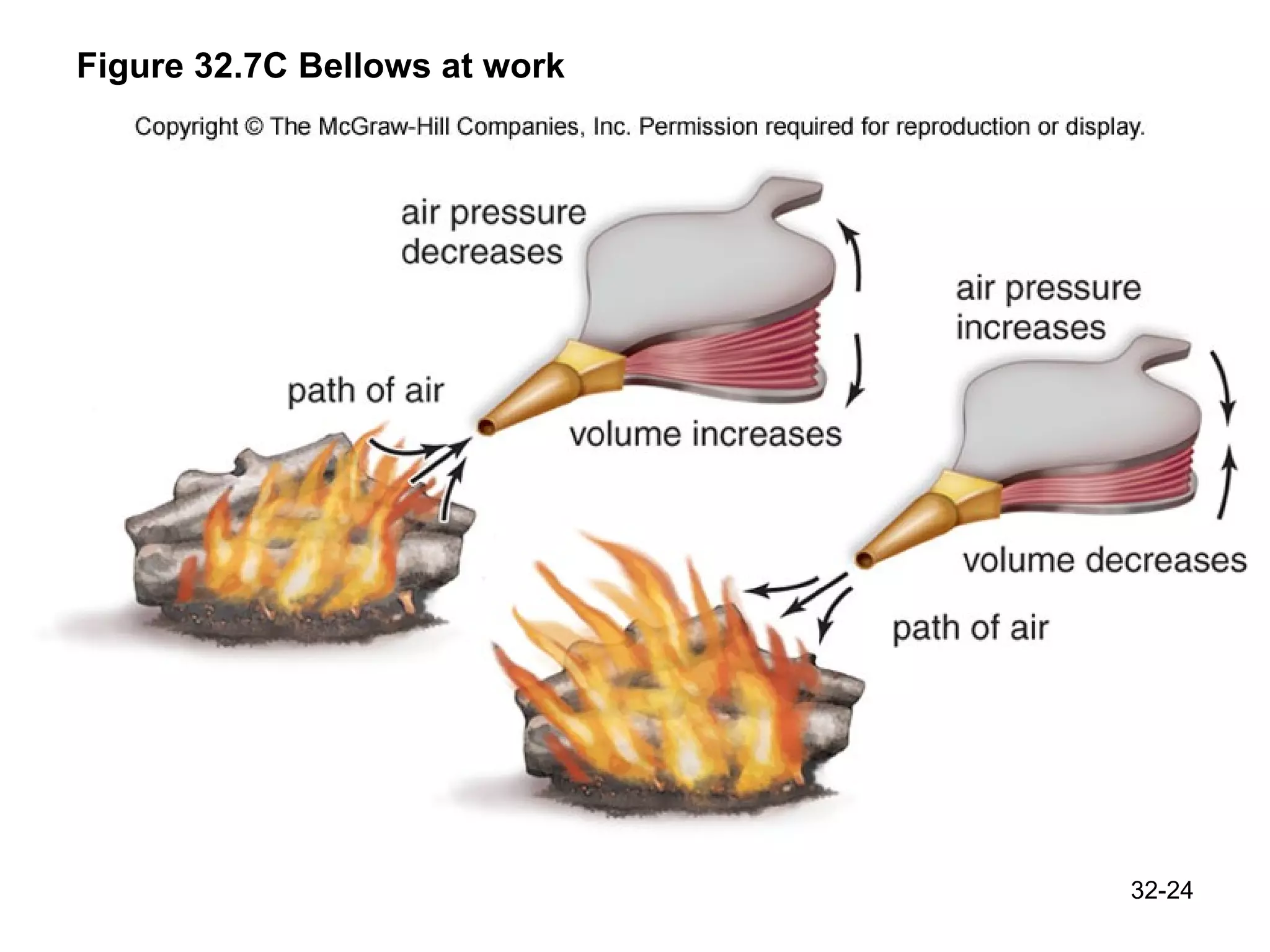
Breathing in Humans During inspiration in humans, the volume of the thoracic cavity and lungs is increased by muscle contractions that lower the diaphragm and raise the ribs  Creates a negative pressure and air flows into the lungs During expiration, rib and diaphragm muscles relax, and air flows out as a result of increased pressure in the thoracic cavity and lungs All terrestrial vertebrates, except birds, use a  tidal ventilation mechanism   Air moves in and out by the same route 32-
Figure 32.7A Inspiration 32-
Figure 32.7B Expiration 32-
Figure 32.7C Bellows at work 32-
Figure 32.7D Respiratory system in birds 32-
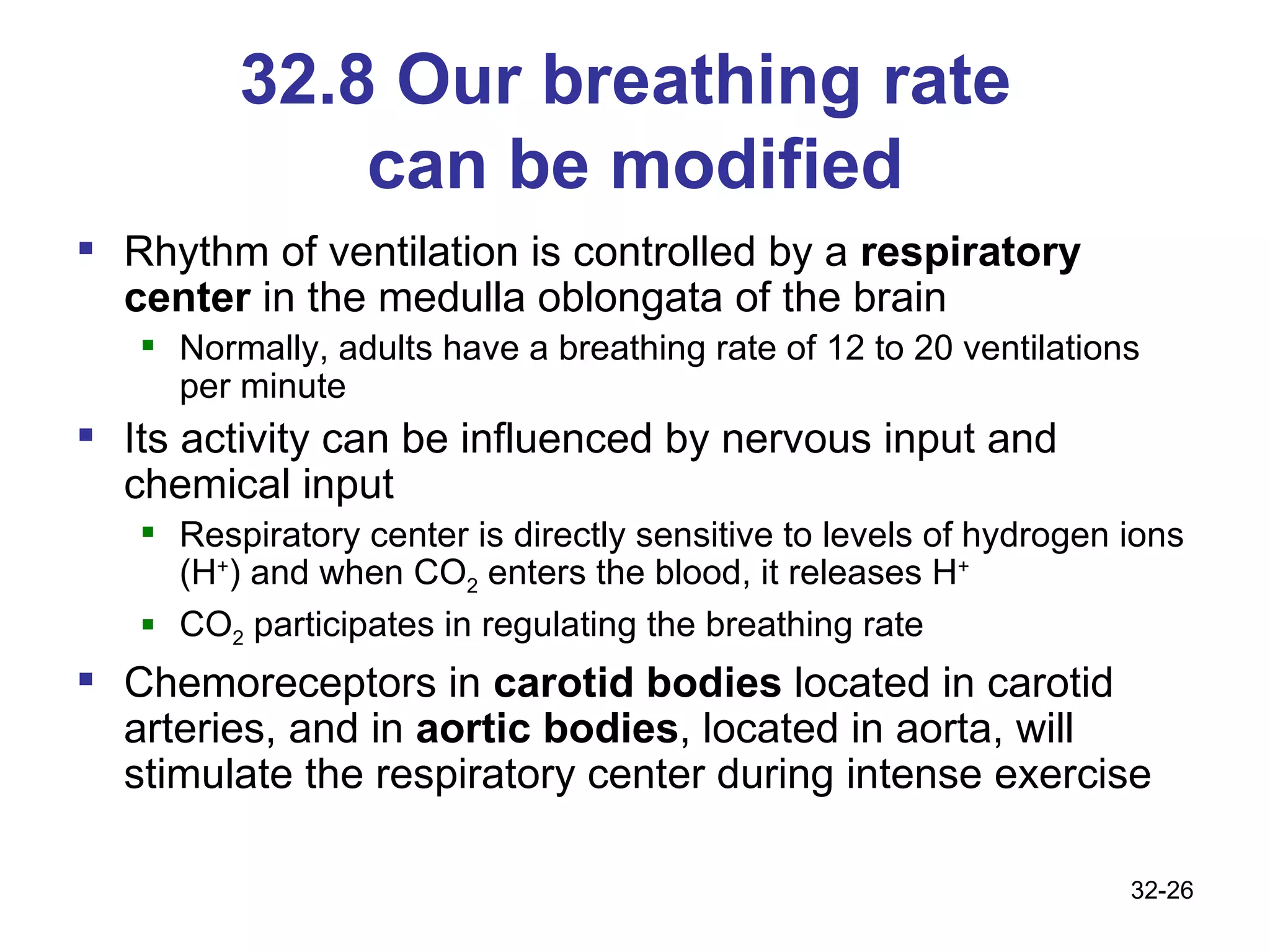
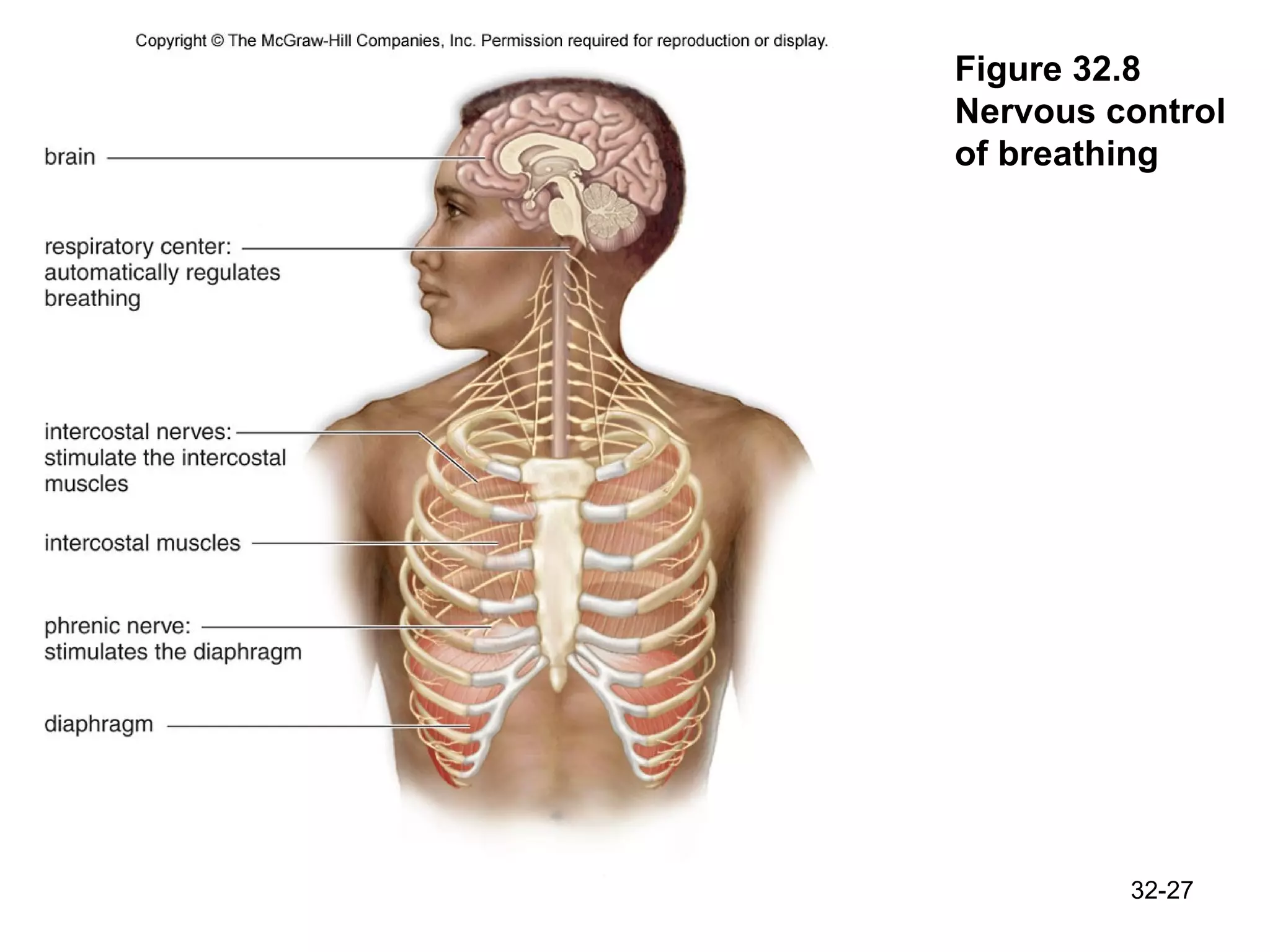
32.8 Our breathing rate  can be modified Rhythm of ventilation is controlled by a  respiratory center  in the medulla oblongata of the brain Normally, adults have a breathing rate of 12 to 20 ventilations per minute Its activity can be influenced by nervous input and chemical input Respiratory center is directly sensitive to levels of hydrogen ions (H + ) and when CO 2  enters the blood, it releases H +   CO 2  participates in regulating the breathing rate Chemoreceptors in  carotid bodies  located in carotid arteries, and in  aortic bodies , located in aorta, will stimulate the respiratory center during intense exercise 32-
Figure 32.8 Nervous control of breathing 32-
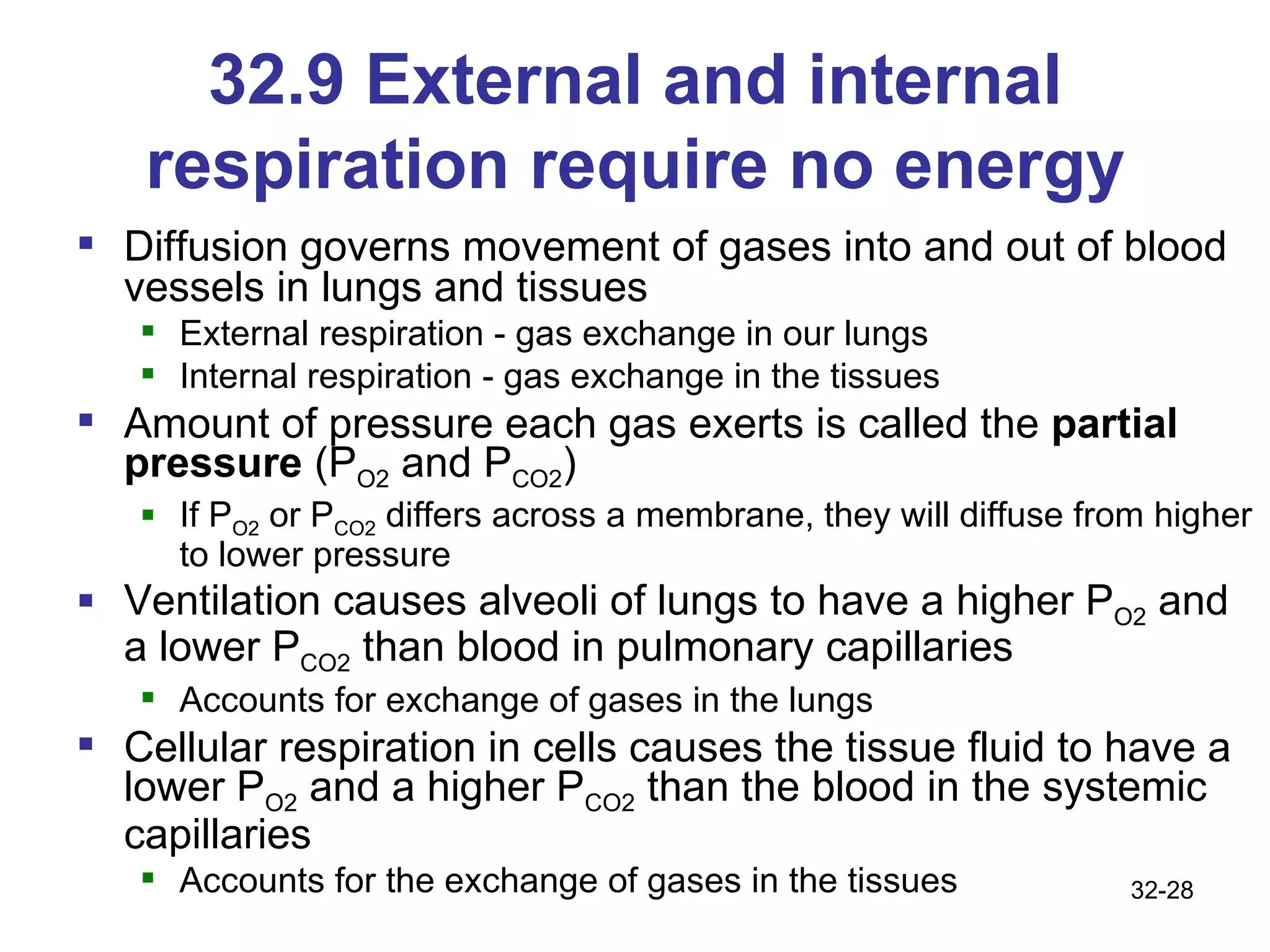
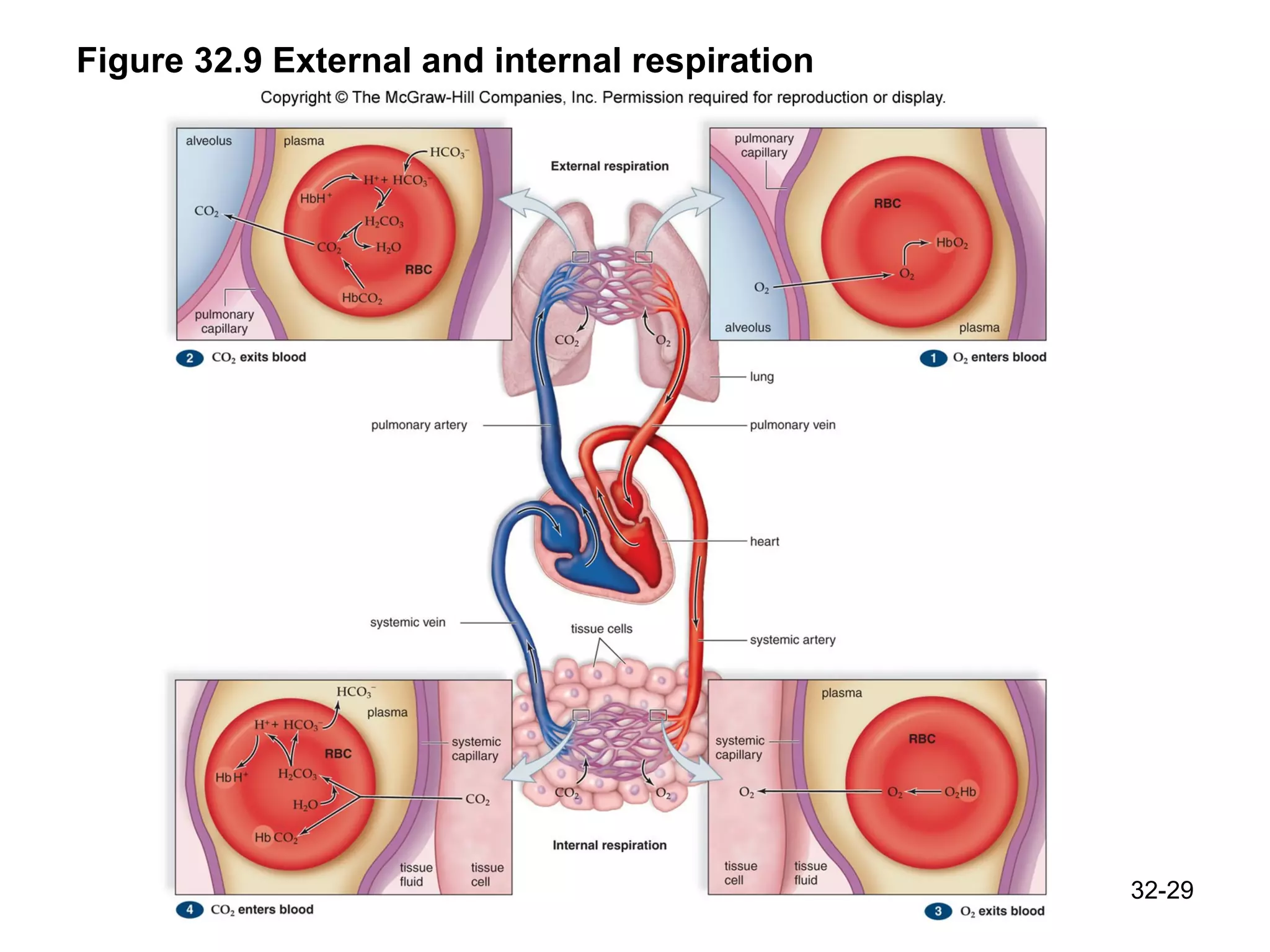
32.9 External and internal respiration require no energy Diffusion governs movement of gases into and out of blood vessels in lungs and tissues External respiration - gas exchange in our lungs Internal respiration - gas exchange in the tissues Amount of pressure each gas exerts is called the  partial pressure  (P O2  and P CO2 ) If P O2  or P CO2  differs across a membrane, they will diffuse from higher to lower pressure Ventilation causes alveoli of lungs to have a higher P O2  and a lower P CO2  than blood in pulmonary capillaries Accounts for exchange of gases in the lungs Cellular respiration in cells causes the tissue fluid to have a lower P O2  and a higher P CO2  than the blood in the systemic capillaries  Accounts for the exchange of gases in the tissues 32-
Figure 32.9 External and internal respiration 32-
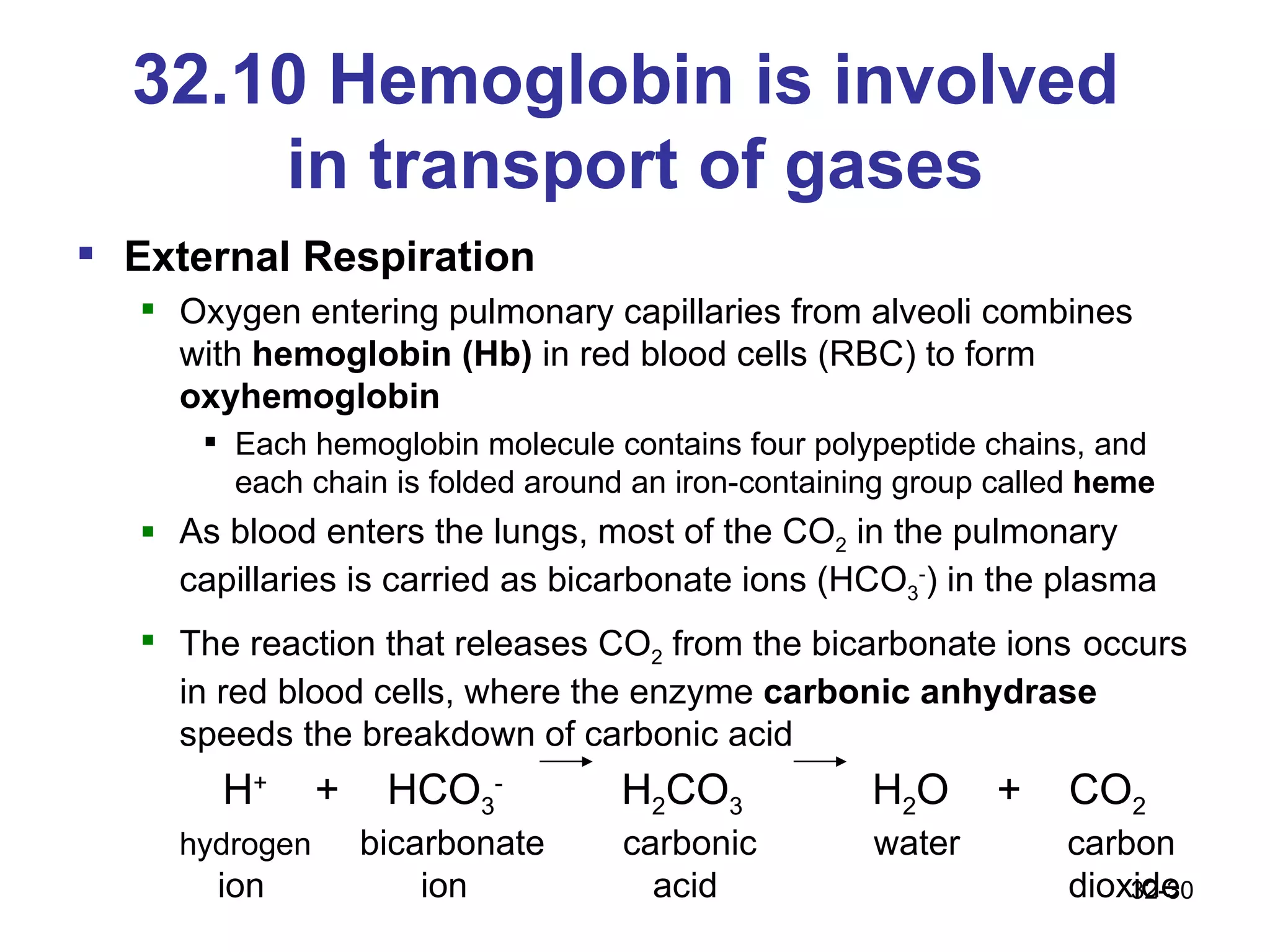
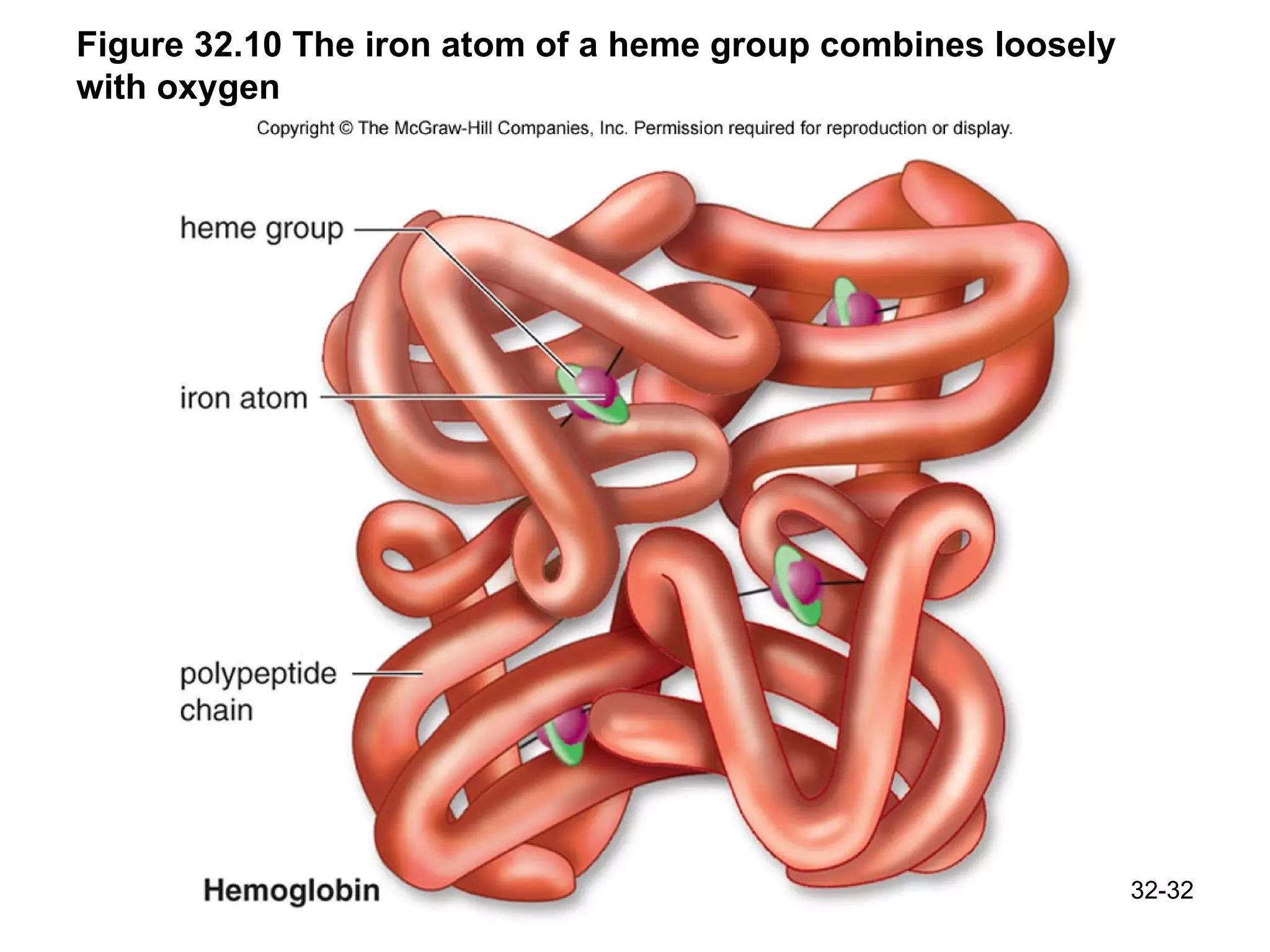
32.10 Hemoglobin is involved  in transport of gases External Respiration  Oxygen entering pulmonary capillaries from alveoli combines with  hemoglobin (Hb)  in red blood cells (RBC) to form  oxyhemoglobin Each hemoglobin molecule contains four polypeptide chains, and each chain is folded around an iron-containing group called  heme As blood enters the lungs, most of the CO 2  in the pulmonary capillaries is carried as bicarbonate ions (HCO 3 - ) in the plasma The reaction that releases CO 2  from the bicarbonate ions   occurs in red blood cells, where the enzyme  carbonic anhydrase  speeds the breakdown of carbonic acid   H +   +  HCO 3 -    H 2 CO 3   H 2 O  +  CO 2  hydrogen   bicarbonate  carbonic  water  carbon ion  ion  acid  dioxide 32-
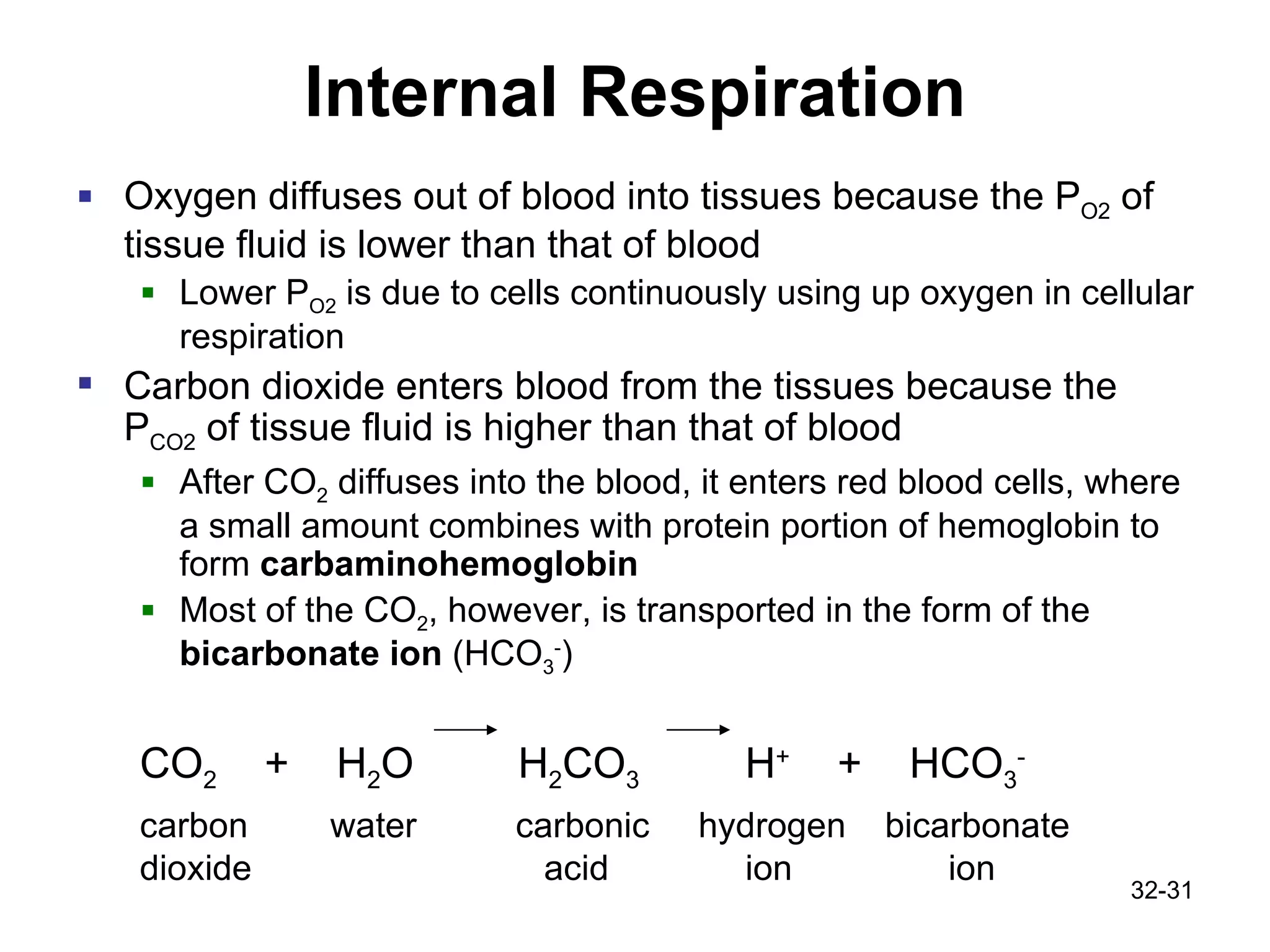
Internal Respiration Oxygen diffuses out of blood into tissues because the P O2  of tissue fluid is lower than that of blood Lower P O2  is due to cells continuously using up oxygen in cellular respiration Carbon dioxide enters blood from the tissues because the P CO2  of tissue fluid is higher than that of blood After CO 2  diffuses into the blood, it enters red blood cells, where a small amount combines with protein portion of hemoglobin to form  carbaminohemoglobin Most of the CO 2 , however, is transported in the form of the  bicarbonate ion  (HCO 3 - ) CO 2   +  H 2 O    H 2 CO 3   H +   +  HCO 3 - carbon water   carbonic  hydrogen  bicarbonate dioxide  acid  ion  ion  32-
Figure 32.10 The iron atom of a heme group combines loosely with oxygen 32-
APPLYING THE CONCEPTS—HOW BIOLOGY IMPACTS OUR LIVES 32.11 Respiratory disorders have resulted from breathing 9/11 dust Dust particles at Ground Zero after the September 11, 2001, attack contained asbestos, mercury from light bulbs, and lead from computers Respiratory disorders could occur in people who breathed this dust Restrictive Pulmonary Disorders  Lung capacity is reduced because the lungs have lost their elasticity Obstructive Pulmonary Disorders  Chronic bronchitis -  airways are inflamed and filled with mucus Emphysema -  chronic and incurable disorder in which the alveoli are distended and their walls damaged Asthma -  disease of the bronchi and bronchioles marked by wheezing, breathlessness, and a cough with mucus Lung Cancer First event appears to be thickening and callusing of cells lining bronchi Cilia are lost, making it impossible to prevent dust and dirt from settling in lungs Atypical nuclei appear in the callused lining and a tumor consisting of disordered cells with atypical nuclei occurs 32-
Figure 32.11A People are now ill from breathing dust at Ground Zero 32-
Figure 32.11B A normal lung (with the heart in place) compared to the lungs of a heavy smoker 32-
Connecting the Concepts: Chapter 32 Assuming an adequate supply of O 2 , cells of most organisms continuously carry on cellular respiration and produce a comparable amount of CO 2   Respiration is the exchange of gases between an organism and its external environment In small, thin, aquatic invertebrates, cells take care of their own respiratory needs Complex invertebrates and vertebrates have respiratory organs, which usually consist of gills in aquatic forms and lungs in terrestrial forms Ventilation is the active movement of water across a respiratory surface (such as gills) or the movement of air into and out of lungs to increase the efficiency of gas exchange Respiratory organs of complex organisms work in conjunction with a circulatory system to transport oxygen to cells and rid them of carbon dioxide We are well aware that breathing polluted air is dangerous to our health The human respiratory system is impaired by the foreign particles and molecules present in 9/11 dust and in cigarette smoke 32-

32 Lecture Ppt

  • 1.
    Copyright Š The McGraw-Hill Companies, Inc. Permission required for reproduction or display. Chapter 32 Gas Exchange and Transport in Animals
  • 2.
    Animals Have Gas-Exchange Surfaces 32-
  • 3.
    32.1 Respiration involves several steps Respiration - sequence of events that results in gas exchange between the body’s cells and the environment Ventilation - (i.e., breathing) includes inspiration (entrance of air into the lungs) and expiration (exit of air from the lungs) External respiration - gas exchange between the air and the blood within the lungs Blood transports oxygen from lungs to tissues Internal respiration - gas exchange between blood and tissue fluid Body’s cells exchange gases with tissue fluid Blood then transports carbon dioxide to the lungs For external respiration to be effective, gas-exchange region must be Moist Thin Large in relation to the size of the body 32-
  • 4.
    Figure 32.1 Blooddelivers oxygen to cells and transports carbon dioxide to the external respiration surfaces 32-
  • 5.
    32.2 External respirationsurfaces must be moist More difficult for animals to obtain oxygen from water than from air Water fully saturated with air contains only a fraction of the amount of oxygen that would be present in the same volume of air Hydras and planarians have a large surface area in comparison to their size Makes it possible for most of their cells to exchange gases with the environment The earthworm is able to use its body surface for respiration because the capillaries come close to the surface Aquatic invertebrates (clams and crayfish) and aquatic vertebrates (fish and tadpoles) have gills to extract oxygen from water Gills - finely divided, vascularized outgrowths of body surface or pharynx Insects have a system of air tubes called tracheae through which oxygen is delivered directly to the cells without entering the blood Terrestrial vertebrates usually have lungs , vascularized outgrowths from the lower pharyngeal region The lungs of birds and mammals are elaborately subdivided into small passageways and spaces, respectively 32-
  • 6.
    Figure 32.2A Externalrespiration in a hydra 32-
  • 7.
    Figure 32.2B Anearthworm’s entire external surface functions in external respiration 32-
  • 8.
    Figure 32.2C Fishhave gills to assist external respiration 32-
  • 9.
    Figure 32.2D Insectshave a tracheal system that delivers oxygen directly to their cells 32-
  • 10.
    Figure 32.2E Vertebrateshave lungs with a large total external respiration surface 32-
  • 11.
    32.3 Gills arean efficient gas-exchange surface in water Animals with gills use various means of ventilation In molluscs (clam or squid) water is drawn into the mantle cavity and passes through gills In crustaceans (crabs and shrimps) gills are located in thoracic chambers covered by the exoskeleton In fish, ventilation is brought about by the combined action of the mouth and gill covers, or opercula (sing., operculum) Bony fish’s gills are outward extensions of pharynx Fish use counter current exchange to transfer oxygen from the surrounding water into their blood Two fluids flow in opposite directions and as blood gains oxygen, it always encounters water having an even higher oxygen content Prevents an equilibrium point from being reached, and about 80–90% of the initial dissolved oxygen in water is extracted 32-
  • 12.
    Figure 32.3 Gillsin bony fishes help carry out countercurrent exchange 32-
  • 13.
    32.4 The trachealsystem in insects permits direct gas exchange Arthropods are coelomate animals, but the coelom is reduced Internal organs lie within a cavity called the hemocoel because it contains hemolymph Hemolymph flows through the hemocoel, making circulation inefficient Insects overcome the inefficiency by having a respiratory system that consists of tracheae, tiny air tubes that take oxygen directly to the cells Tracheae branch into smaller tubules called tracheoles Tracheae expand and contract, drawing air in and out of the system Tracheal system is an adaptation to breathing air, but some insect larval stages and even some adult insects live in the water In these cases, tracheae do not receive air by way of spiracles Diffusion of oxygen across the body wall supplies tracheae with oxygen 32-
  • 14.
    Figure 32.4 Tracheaein an insect 32-
  • 15.
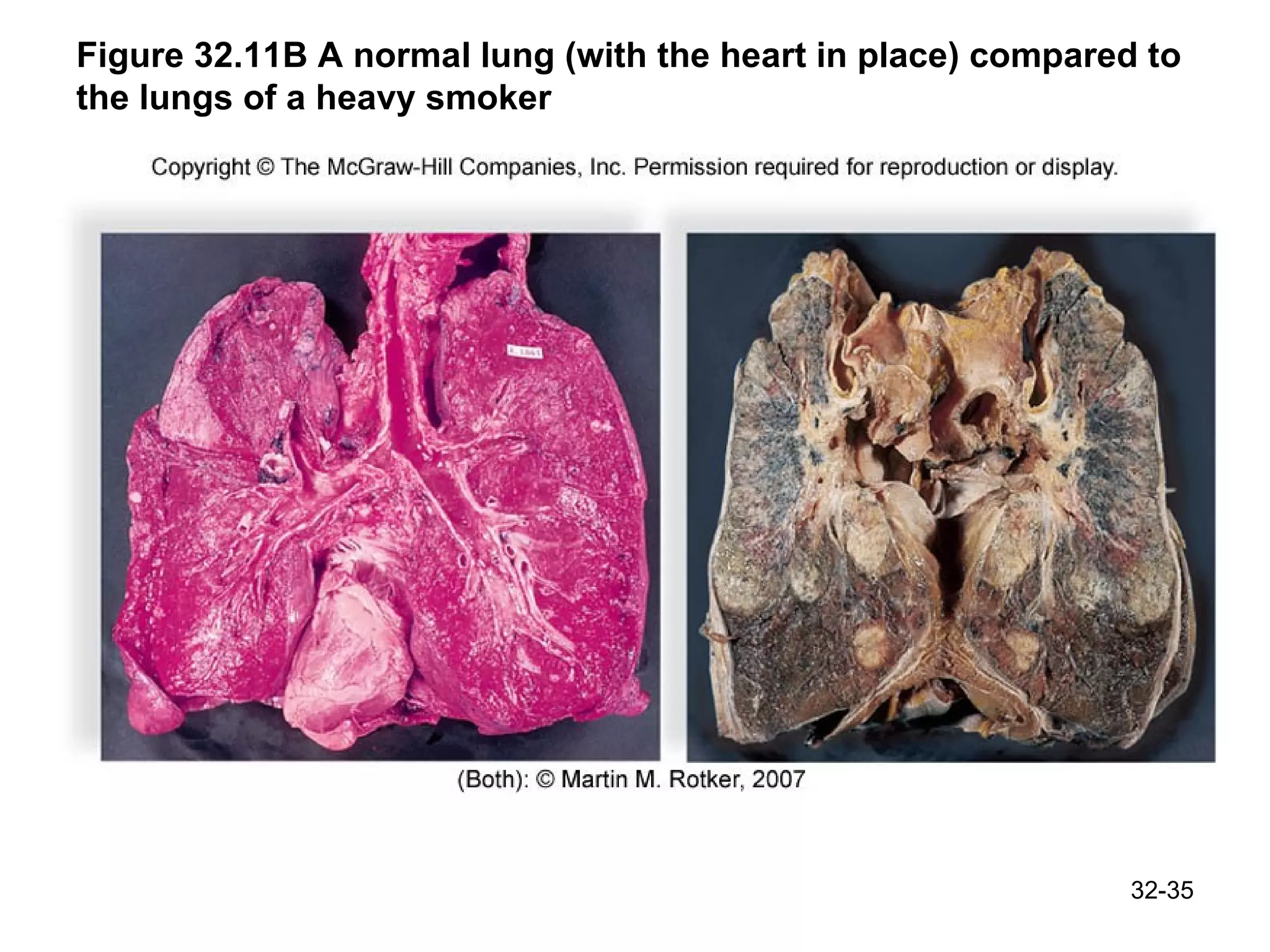
    32.5 The humanrespiratory system utilizes lungs as a gas-exchange surface The human respiratory system includes all of the structures that conduct air in a continuous pathway to and from the lungs As air moves through nose, pharynx, the trachea, and bronchi to lungs, it is filtered free of debris, warmed, and humidified Air and food passages cross in pharynx Arrangement has advantage of letting you breathe through your mouth in case your nose is plugged up Air passes from pharynx through glottis , an opening into the larynx or voice box At edges of glottis are vocal cords, bands of connective tissue that produce sound when air is expelled past them Larynx and trachea remain open to receive air at all times Trachea is held open by a series of cartilaginous rings When swallowing, the glottis is closed by a flap called the epiglottis Trachea divides into two primary bronchi , which enter the lungs Branching continues, eventually forming a great number of smaller passages called bronchioles 32-
  • 16.
    Figure 32.5 Thehuman respiratory tract 32-
  • 17.
    APPLYING THE CONCEPTS—HOWBIOLOGY IMPACTS OUR LIVES 32.6 Questions about tobacco, smoking, and health Is there a safe way to smoke? No. All cigarettes can damage the body Is cigarette smoking really addictive? Yes. Small amounts of nicotine make the smoker want to smoke more and smokers usually suffer withdrawal symptoms when they stop Does smoking cause cancer? Yes. Tobacco use accounts for about one-third of all cancer deaths in the United States How does cigarette smoke affect the lungs? All smokers have a lower level of lung function than nonsmokers Why do smokers have “smoker’s cough”? When a smoker inhales, the body tries to protect itself by producing mucus and stimulating coughing If you smoke but do not inhale, is there any danger? Yes. Wherever smoke touches living cells, it does harm Does cigarette smoking affect the heart? Yes. Smoking increases the risk of heart disease, which is the number-one cause of death in the United States 32-
  • 18.
    How does smokingaffect pregnant women and their babies? Smoking during pregnancy is linked to a greater chance of miscarriage, premature delivery, stillbirth, infant death, low birth weight, and sudden infant death syndrome What are some of the short-term and long-term effects of smoking cigarettes? Short-term effects include shortness of breath and a nagging cough, diminished ability to smell and taste, premature aging of the skin, and increased risk of sexual impotence in men Long-term effects include many types of cancer, heart disease, aneurysms, bronchitis, emphysema, and stroke What are the dangers of environmental tobacco smoke (ETS)? Children of smokers are more likely to suffer from asthma, pneumonia or bronchitis, ear infections, coughing, wheezing, and increased mucus production Are chewing tobacco and snuff safe alternatives to cigarette smoking? No. The juice from smokeless tobacco is absorbed directly through the lining of the mouth, creating sores that often lead to mouth cancer 32-
  • 19.
  • 20.
    32.7 Breathing bringsair into and out of the lungs Terrestrial vertebrates ventilate their lungs by moving air into and out of the respiratory tract Amphibians use positive pressure to force air into the respiratory tract Reptiles have jointed ribs that can be raised to expand the lungs Mammals have a rib cage that is lifted up and out and a diaphragm that is flattened Diaphragm is a horizontal muscle that divides the thoracic cavity from the abdominal cavity Following inspiration (or inhalation), expiration (or exhalation) occurs Birds use a one-way ventilation mechanism Incoming air is carried past the lungs by a trachea, which takes it to a set of posterior air sacs Air then passes forward through the lungs into a set of anterior air sacs where it is finally expelled 32-
  • 21.
    Breathing in HumansDuring inspiration in humans, the volume of the thoracic cavity and lungs is increased by muscle contractions that lower the diaphragm and raise the ribs Creates a negative pressure and air flows into the lungs During expiration, rib and diaphragm muscles relax, and air flows out as a result of increased pressure in the thoracic cavity and lungs All terrestrial vertebrates, except birds, use a tidal ventilation mechanism Air moves in and out by the same route 32-
  • 22.
  • 23.
  • 24.
  • 25.
    Figure 32.7D Respiratorysystem in birds 32-
  • 26.
    32.8 Our breathingrate can be modified Rhythm of ventilation is controlled by a respiratory center in the medulla oblongata of the brain Normally, adults have a breathing rate of 12 to 20 ventilations per minute Its activity can be influenced by nervous input and chemical input Respiratory center is directly sensitive to levels of hydrogen ions (H + ) and when CO 2 enters the blood, it releases H + CO 2 participates in regulating the breathing rate Chemoreceptors in carotid bodies located in carotid arteries, and in aortic bodies , located in aorta, will stimulate the respiratory center during intense exercise 32-
  • 27.
    Figure 32.8 Nervouscontrol of breathing 32-
  • 28.
    32.9 External andinternal respiration require no energy Diffusion governs movement of gases into and out of blood vessels in lungs and tissues External respiration - gas exchange in our lungs Internal respiration - gas exchange in the tissues Amount of pressure each gas exerts is called the partial pressure (P O2 and P CO2 ) If P O2 or P CO2 differs across a membrane, they will diffuse from higher to lower pressure Ventilation causes alveoli of lungs to have a higher P O2 and a lower P CO2 than blood in pulmonary capillaries Accounts for exchange of gases in the lungs Cellular respiration in cells causes the tissue fluid to have a lower P O2 and a higher P CO2 than the blood in the systemic capillaries Accounts for the exchange of gases in the tissues 32-
  • 29.
    Figure 32.9 Externaland internal respiration 32-
  • 30.
    32.10 Hemoglobin isinvolved in transport of gases External Respiration Oxygen entering pulmonary capillaries from alveoli combines with hemoglobin (Hb) in red blood cells (RBC) to form oxyhemoglobin Each hemoglobin molecule contains four polypeptide chains, and each chain is folded around an iron-containing group called heme As blood enters the lungs, most of the CO 2 in the pulmonary capillaries is carried as bicarbonate ions (HCO 3 - ) in the plasma The reaction that releases CO 2 from the bicarbonate ions occurs in red blood cells, where the enzyme carbonic anhydrase speeds the breakdown of carbonic acid H + + HCO 3 - H 2 CO 3 H 2 O + CO 2 hydrogen bicarbonate carbonic water carbon ion ion acid dioxide 32-
  • 31.
    Internal Respiration Oxygendiffuses out of blood into tissues because the P O2 of tissue fluid is lower than that of blood Lower P O2 is due to cells continuously using up oxygen in cellular respiration Carbon dioxide enters blood from the tissues because the P CO2 of tissue fluid is higher than that of blood After CO 2 diffuses into the blood, it enters red blood cells, where a small amount combines with protein portion of hemoglobin to form carbaminohemoglobin Most of the CO 2 , however, is transported in the form of the bicarbonate ion (HCO 3 - ) CO 2 + H 2 O H 2 CO 3 H + + HCO 3 - carbon water carbonic hydrogen bicarbonate dioxide acid ion ion 32-
  • 32.
    Figure 32.10 Theiron atom of a heme group combines loosely with oxygen 32-
  • 33.
    APPLYING THE CONCEPTS—HOWBIOLOGY IMPACTS OUR LIVES 32.11 Respiratory disorders have resulted from breathing 9/11 dust Dust particles at Ground Zero after the September 11, 2001, attack contained asbestos, mercury from light bulbs, and lead from computers Respiratory disorders could occur in people who breathed this dust Restrictive Pulmonary Disorders Lung capacity is reduced because the lungs have lost their elasticity Obstructive Pulmonary Disorders Chronic bronchitis - airways are inflamed and filled with mucus Emphysema - chronic and incurable disorder in which the alveoli are distended and their walls damaged Asthma - disease of the bronchi and bronchioles marked by wheezing, breathlessness, and a cough with mucus Lung Cancer First event appears to be thickening and callusing of cells lining bronchi Cilia are lost, making it impossible to prevent dust and dirt from settling in lungs Atypical nuclei appear in the callused lining and a tumor consisting of disordered cells with atypical nuclei occurs 32-
  • 34.
    Figure 32.11A Peopleare now ill from breathing dust at Ground Zero 32-
  • 35.
    Figure 32.11B Anormal lung (with the heart in place) compared to the lungs of a heavy smoker 32-
  • 36.
    Connecting the Concepts:Chapter 32 Assuming an adequate supply of O 2 , cells of most organisms continuously carry on cellular respiration and produce a comparable amount of CO 2 Respiration is the exchange of gases between an organism and its external environment In small, thin, aquatic invertebrates, cells take care of their own respiratory needs Complex invertebrates and vertebrates have respiratory organs, which usually consist of gills in aquatic forms and lungs in terrestrial forms Ventilation is the active movement of water across a respiratory surface (such as gills) or the movement of air into and out of lungs to increase the efficiency of gas exchange Respiratory organs of complex organisms work in conjunction with a circulatory system to transport oxygen to cells and rid them of carbon dioxide We are well aware that breathing polluted air is dangerous to our health The human respiratory system is impaired by the foreign particles and molecules present in 9/11 dust and in cigarette smoke 32-