Done By: Ronald
McDonald
Gabrielle Lindo
Joel Murphy
Objectives
• Define the following terms: pollination,
fertilization, double fertilization.
• Types of pollination.
• Agents of pollination.
• Function and parts of a flowering plant.
• Explain the sequence of events from pollination
to fertilization using annotated diagrams.
• Explain the significance of double fertilization in
the embryo sac.
Pollination
• Pollination is the transfer of pollen from the
anthers of a flower to the stigma of the same
flower or of another flower. Plants can be
pollinated whether by itself (self-pollination)
and or with another plant (cross-pollination).
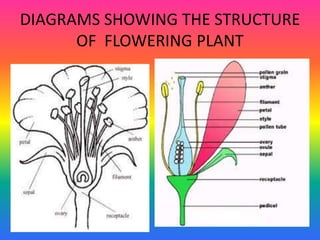
DIAGRAMS SHOWING THE STRUCTURE
OF FLOWERING PLANT
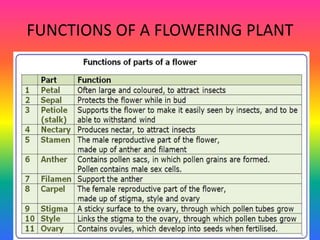
FUNCTIONS OF A FLOWERING PLANT
Difference between self-pollination
and cross-pollination
• Self-pollination is the transfer of pollen grains
from the anther of a flower to the stigma of
either the same or genetically similar flower
while cross-pollination is the transfer of pollen
from the anther of a flower on one plant to a
stigma of a flower on another plant of the
same species.
Agent of pollination
• Pollen grains from another anther is
transferred onto the stigma of the recipient
flower by any of these pollinated agents:
wind, animal, insect, mechanical explosive and
water.
Process of pollination in terms of
insect pollination
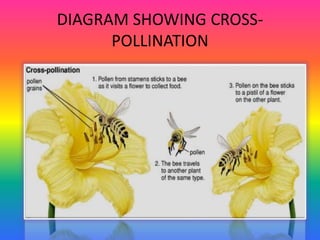
• Pollinators gather nectar for food. As
pollinators move from one flower to another to
gather more nectar, the pollen grains on the
pollinator’s body gets transferred to the stigma
of the recipient flower. For example: Bees.
DIAGRAM SHOWING CROSS-
POLLINATION
Fertilization
• Fertilization is the process of fusion of the
female gamete, the ovule and the male
gamete produced in the pollen tube by the
pollen grain.
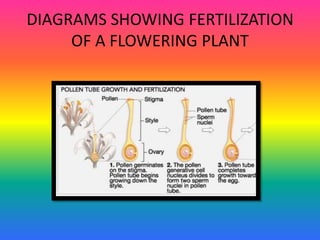
Fertilization process
• Pollen tubes from the pollen grains will start to
grow into the style. This will create a pathway
for the pollen grain to travel down to the ovary.
•Once the pollen grain reaches the ovary, the
male sex cell inside the pollen grain fuses with
the female sex cell inside the ovule.
DIAGRAMS SHOWING FERTILIZATION
OF A FLOWERING PLANT
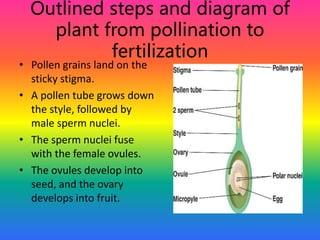
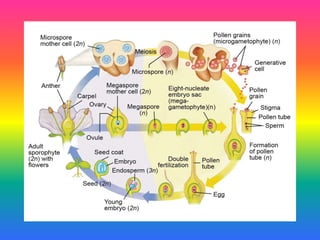
Outlined steps and diagram of
plant from pollination to
fertilization
• Pollen grains land on the
sticky stigma.
• A pollen tube grows down
the style, followed by
male sperm nuclei.
• The sperm nuclei fuse
with the female ovules.
• The ovules develop into
seed, and the ovary
develops into fruit.
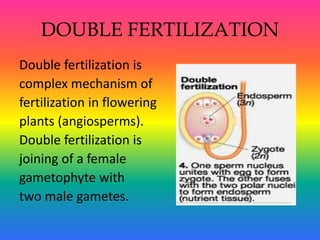
DOUBLE FERTILIZATION
Double fertilization is
complex mechanism of
fertilization in flowering
plants (angiosperms).
Double fertilization is
joining of a female
gametophyte with
two male gametes.
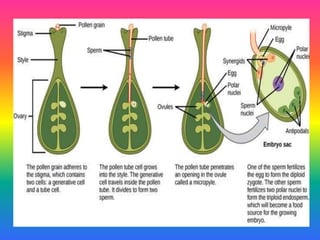
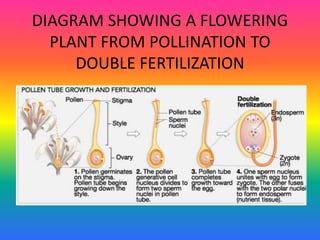
DIAGRAM SHOWING A FLOWERING
PLANT FROM POLLINATION TO
DOUBLE FERTILIZATION
THE SIGNIFICANCE OF DOUBLE
FERTILIZATION IN THE EMBRYO
SAC
• The triploid endosperm nucleus divides by
mitosis to give a tissue that surrounds the
developing embryo. In some cases, the
endosperm is used up before the embryo is
mature.

Pollination and fertilization

  • 1.
  • 2.
    Objectives • Define thefollowing terms: pollination, fertilization, double fertilization. • Types of pollination. • Agents of pollination. • Function and parts of a flowering plant. • Explain the sequence of events from pollination to fertilization using annotated diagrams. • Explain the significance of double fertilization in the embryo sac.
  • 3.
    Pollination • Pollination isthe transfer of pollen from the anthers of a flower to the stigma of the same flower or of another flower. Plants can be pollinated whether by itself (self-pollination) and or with another plant (cross-pollination).
  • 4.
    DIAGRAMS SHOWING THESTRUCTURE OF FLOWERING PLANT
  • 5.
    FUNCTIONS OF AFLOWERING PLANT
  • 6.
    Difference between self-pollination andcross-pollination • Self-pollination is the transfer of pollen grains from the anther of a flower to the stigma of either the same or genetically similar flower while cross-pollination is the transfer of pollen from the anther of a flower on one plant to a stigma of a flower on another plant of the same species.
  • 7.
    Agent of pollination •Pollen grains from another anther is transferred onto the stigma of the recipient flower by any of these pollinated agents: wind, animal, insect, mechanical explosive and water.
  • 8.
    Process of pollinationin terms of insect pollination • Pollinators gather nectar for food. As pollinators move from one flower to another to gather more nectar, the pollen grains on the pollinator’s body gets transferred to the stigma of the recipient flower. For example: Bees.
  • 9.
  • 10.
    Fertilization • Fertilization isthe process of fusion of the female gamete, the ovule and the male gamete produced in the pollen tube by the pollen grain.
  • 11.
    Fertilization process • Pollentubes from the pollen grains will start to grow into the style. This will create a pathway for the pollen grain to travel down to the ovary. •Once the pollen grain reaches the ovary, the male sex cell inside the pollen grain fuses with the female sex cell inside the ovule.
  • 12.
  • 14.
    Outlined steps anddiagram of plant from pollination to fertilization • Pollen grains land on the sticky stigma. • A pollen tube grows down the style, followed by male sperm nuclei. • The sperm nuclei fuse with the female ovules. • The ovules develop into seed, and the ovary develops into fruit.
  • 15.
    DOUBLE FERTILIZATION Double fertilizationis complex mechanism of fertilization in flowering plants (angiosperms). Double fertilization is joining of a female gametophyte with two male gametes.
  • 16.
    DIAGRAM SHOWING AFLOWERING PLANT FROM POLLINATION TO DOUBLE FERTILIZATION
  • 18.
    THE SIGNIFICANCE OFDOUBLE FERTILIZATION IN THE EMBRYO SAC • The triploid endosperm nucleus divides by mitosis to give a tissue that surrounds the developing embryo. In some cases, the endosperm is used up before the embryo is mature.