IGCSE COORDINATED SCIENCE 9
B6 ANIMAL NUTRITION
Content
Lesson
B6.1 Diet
CORE
1. State what is meant by the term balanced diet
for humans
2 List the principal sources of, and describe the
dietary importance of:
– carbohydrates
– fats
– proteins
– vitamins, limited to C and D
– mineral salts, limited to calcium and iron
– fbre (roughage)
– water
Supplement
3 Explain how age, gender and activity affect
the dietary needs of humans including during
pregnancy and whilst breast-feeding
4 Describe the effects of malnutrition in relation
to starvation, constipation, coronary heart
disease, obesity and scurvy
5 Explain the causes and effects of vitamin D and
iron deficiencies
6 Explain the causes and effects of proteinenergy
malnutrition, e.g. kwashiorkor and marasmus
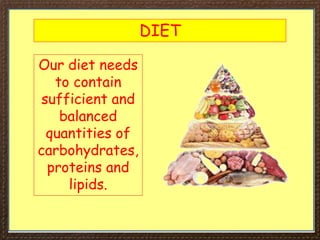
DIET
Our diet needs
to contain
sufficient and
balanced
quantities of
carbohydrates,
proteins and
lipids.
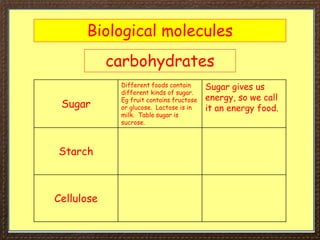
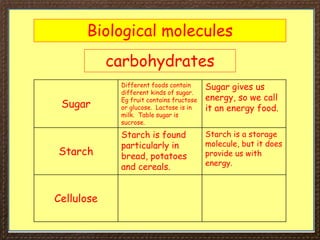
Biological molecules
carbohydrates
Sugar
Different foods contain
different kinds of sugar.
Eg fruit contains fructose
or glucose. Lactose is in
milk. Table sugar is
sucrose.
Sugar gives us
energy, so we call
it an energy food.
Starch
Cellulose
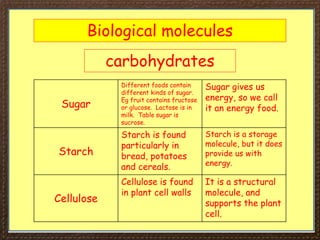
Biological molecules
carbohydrates
Sugar
Different foods contain
different kinds of sugar.
Eg fruit contains fructose
or glucose. Lactose is in
milk. Table sugar is
sucrose.
Sugar gives us
energy, so we call
it an energy food.
Starch
Starch is found
particularly in
bread, potatoes
and cereals.
Starch is a storage
molecule, but it does
provide us with
energy.
Cellulose
Biological molecules
carbohydrates
Sugar
Different foods contain
different kinds of sugar.
Eg fruit contains fructose
or glucose. Lactose is in
milk. Table sugar is
sucrose.
Sugar gives us
energy, so we call
it an energy food.
Starch
Starch is found
particularly in
bread, potatoes
and cereals.
Starch is a storage
molecule, but it does
provide us with
energy.
Cellulose
Cellulose is found
in plant cell walls
It is a structural
molecule, and
supports the plant
cell.
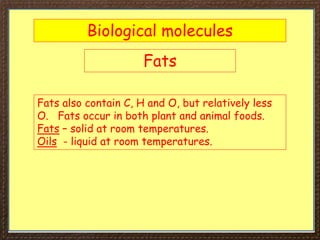
Biological molecules
Fats
Fats also contain C, H and O, but relatively less
O. Fats occur in both plant and animal foods.
Fats – solid at room temperatures.
Oils - liquid at room temperatures.
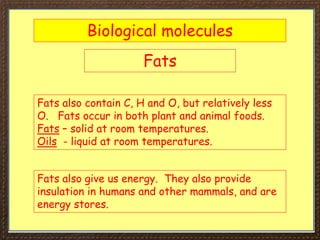
Biological molecules
Fats
Fats also contain C, H and O, but relatively less
O. Fats occur in both plant and animal foods.
Fats – solid at room temperatures.
Oils - liquid at room temperatures.
Fats also give us energy. They also provide
insulation in humans and other mammals, and are
energy stores.
Biological molecules
Proteins
Proteins contain C, H and O, and also some
nitrogen (N) and a little suplhur (S).
Proteins are found in milk, eggs, meat and fish.
Biological molecules
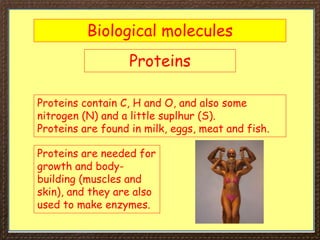
Proteins
Proteins contain C, H and O, and also some
nitrogen (N) and a little suplhur (S).
Proteins are found in milk, eggs, meat and fish.
Proteins are needed for
growth and body-
building (muscles and
skin), and they are also
used to make enzymes.
Components of our diet
Minerals: contain certain elements essential for
the proper functioning of our bodies.
Components of our diet
Minerals: contain certain elements essential for
the proper functioning of our bodies.
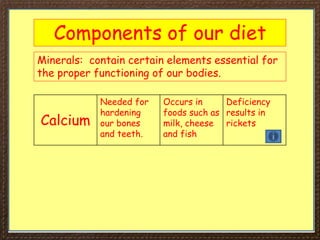
Calcium
Needed for
hardening
our bones
and teeth.
Occurs in
foods such as
milk, cheese
and fish
Deficiency
results in
rickets
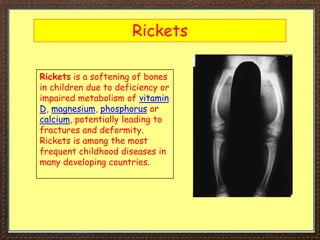
Rickets
Rickets is a softening of bones
in children due to deficiency or
impaired metabolism of vitamin
D, magnesium, phosphorus or
calcium, potentially leading to
fractures and deformity.
Rickets is among the most
frequent childhood diseases in
many developing countries.
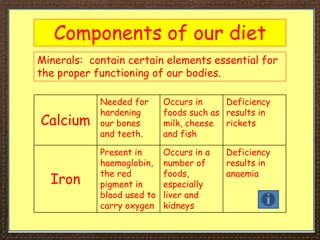
Components of our diet
Minerals: contain certain elements essential for
the proper functioning of our bodies.
Calcium
Needed for
hardening
our bones
and teeth.
Occurs in
foods such as
milk, cheese
and fish
Deficiency
results in
rickets
Iron
Present in
haemoglobin,
the red
pigment in
blood used to
carry oxygen
Occurs in a
number of
foods,
especially
liver and
kidneys
Deficiency
results in
anaemia
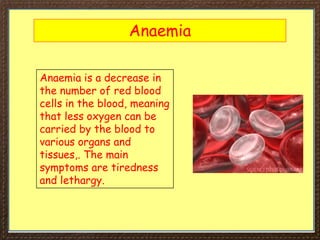
Anaemia
Anaemia is a decrease in
the number of red blood
cells in the blood, meaning
that less oxygen can be
carried by the blood to
various organs and
tissues,. The main
symptoms are tiredness
and lethargy.
Components of our diet
Vitamins: a collection of organic substances
needed in small quantities in the body. Their
overall function is to help control the chemical
reactions taking place in the body.
Components of our diet
Vitamins: a collection of organic substances
needed in small quantities in the body. Their
overall function is to help control the chemical
reactions taking place in the body.
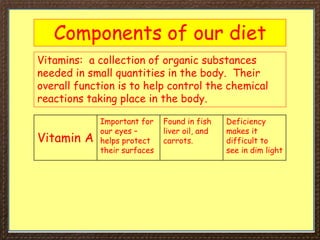
Vitamin A
Important for
our eyes –
helps protect
their surfaces
Found in fish
liver oil, and
carrots.
Deficiency
makes it
difficult to
see in dim light
Components of our diet
Vitamins: a collection of organic substances
needed in small quantities in the body. Their
overall function is to help control the chemical
reactions taking place in the body.
Vitamin A
Important for
our eyes –
helps protect
their surfaces
Found in fish
liver oil, and
carrots.
Deficiency
makes it
difficult to
see in dim light
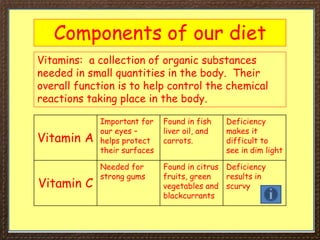
Vitamin C
Needed for
strong gums
Found in citrus
fruits, green
vegetables and
blackcurrants
Deficiency
results in
scurvy
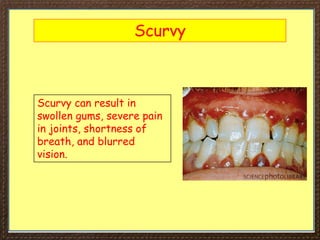
Scurvy
Scurvy can result in
swollen gums, severe pain
in joints, shortness of
breath, and blurred
vision.
Components of our diet
Vitamins: a collection of organic substances
needed in small quantities in the body. Their
overall function is to help control the chemical
reactions taking place in the body.
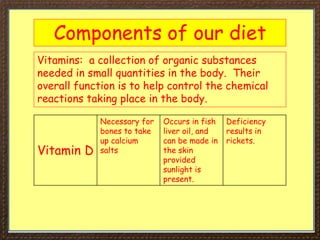
Vitamin D
Necessary for
bones to take
up calcium
salts
Occurs in fish
liver oil, and
can be made in
the skin
provided
sunlight is
present.
Deficiency
results in
rickets.
Components of our diet
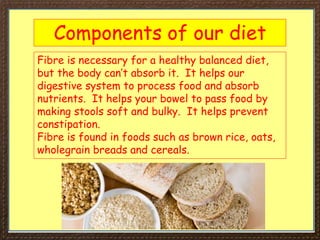
Fibre is necessary for a healthy balanced diet,
but the body can’t absorb it. It helps our
digestive system to process food and absorb
nutrients. It helps your bowel to pass food by
making stools soft and bulky. It helps prevent
constipation.
Fibre is found in foods such as brown rice, oats,
wholegrain breads and cereals.
Components of our diet
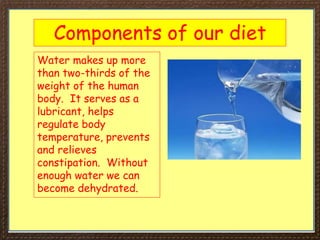
Water makes up more
than two-thirds of the
weight of the human
body. It serves as a
lubricant, helps
regulate body
temperature, prevents
and relieves
constipation. Without
enough water we can
become dehydrated.
Core
1 Define ingestion as the taking of substances, e.g. food and drink, into
the body through the mouth
2 Define digestion as the breakdown of large, insoluble food molecules
into small, water soluble molecules using mechanical and chemical
processes
5 Define absorption as movement of digested food molecules through
the wall of the intestine into the blood
6 Define assimilation as the movement of digested food molecules into
the cells of the body where they are used, becoming part of
the cells
7 Define egestion as passing out of food that has not been digested, as
faeces, through the anus
8 Identify the main regions of the alimentary canal and associated
organs, including mouth, salivary glands, esophagus, stomach, small
intestine, pancreas, liver, gall bladder, large intestine and anus.
9 Describe the functions of the regions of the alimentary canal listed
above, in relation to ingestion, digestion, absorption, assimilation and
egestion of food
Supplement
3 Define mechanical digestion as the breakdown of food into smaller
pieces without chemical change to the food molecules
4 Define chemical digestion as the breakdown of large, insoluble
molecules into small, soluble molecules
B6.2 Alimentary
canal
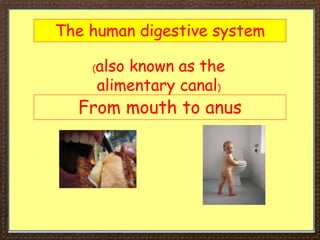
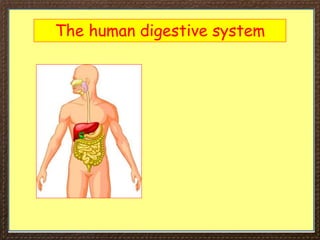
The human digestive system
(also known as the
alimentary canal)
From mouth to anus
The human digestive system
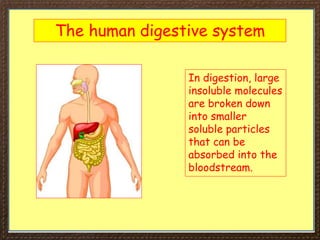
In digestion, large
insoluble molecules
are broken down
into smaller
soluble particles
that can be
absorbed into the
bloodstream.
The human digestive system
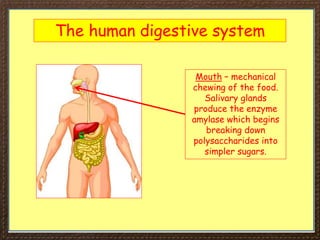
Mouth – mechanical
chewing of the food.
Salivary glands
produce the enzyme
amylase which begins
breaking down
polysaccharides into
simpler sugars.
The human digestive system
Oesophagus (also
known as the gullet).
Passes food down
from the mouth to the
stomach by a process
known as peristalsis.
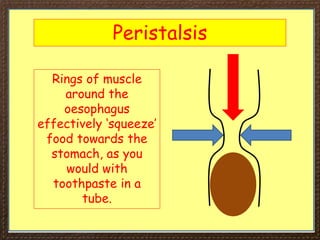
Peristalsis
Rings of muscle
around the
oesophagus
effectively ‘squeeze’
food towards the
stomach, as you
would with
toothpaste in a
tube.
The human digestive system
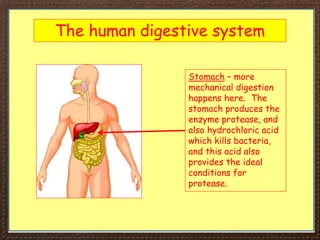
Stomach – more
mechanical digestion
happens here. The
stomach produces the
enzyme protease, and
also hydrochloric acid
which kills bacteria,
and this acid also
provides the ideal
conditions for
protease.
The human digestive system
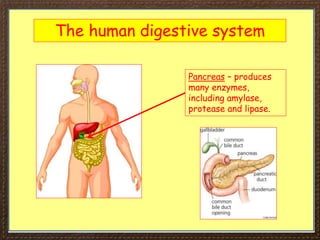
Pancreas – produces
many enzymes,
including amylase,
protease and lipase.
The human digestive system
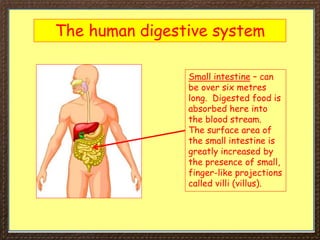
Small intestine – can
be over six metres
long. Digested food is
absorbed here into
the blood stream.
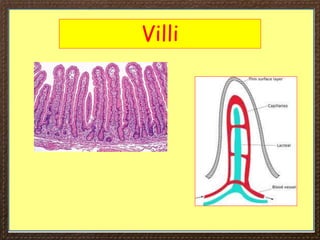
The surface area of
the small intestine is
greatly increased by
the presence of small,
finger-like projections
called villi (villus).
Villi
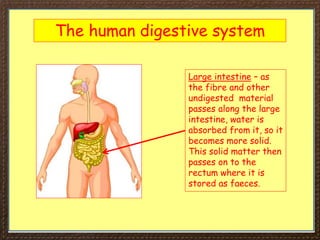
The human digestive system
Large intestine – as
the fibre and other
undigested material
passes along the large
intestine, water is
absorbed from it, so it
becomes more solid.
This solid matter then
passes on to the
rectum where it is
stored as faeces.
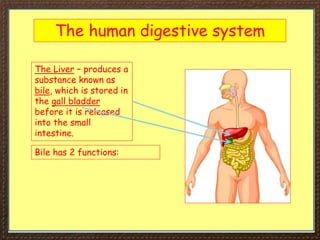
The human digestive system
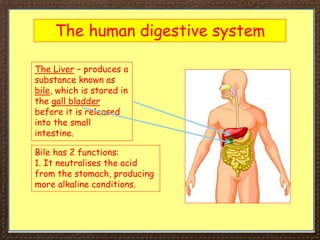
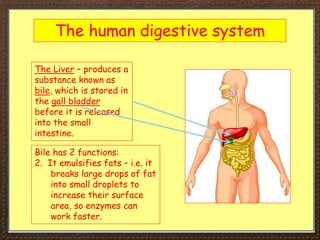
The Liver – produces a
substance known as
bile, which is stored in
the gall bladder
before it is released
into the small
intestine.
Bile has 2 functions:
The human digestive system
The Liver – produces a
substance known as
bile, which is stored in
the gall bladder
before it is released
into the small
intestine.
Bile has 2 functions:
1. It neutralises the acid
from the stomach, producing
more alkaline conditions.
The human digestive system
The Liver – produces a
substance known as
bile, which is stored in
the gall bladder
before it is released
into the small
intestine.
Bile has 2 functions:
2. It emulsifies fats – i.e. it
breaks large drops of fat
into small droplets to
increase their surface
area, so enzymes can
work faster.
Pause time!
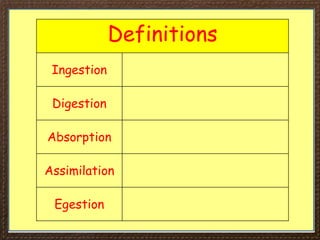
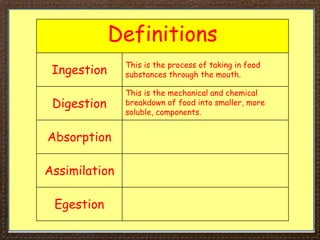
Definitions
Ingestion
Digestion
Absorption
Assimilation
Egestion
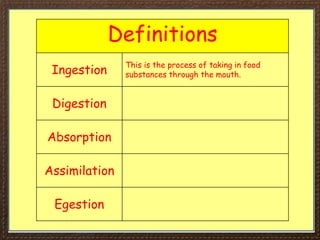
Definitions
Ingestion
This is the process of taking in food
substances through the mouth.
Digestion
Absorption
Assimilation
Egestion
Definitions
Ingestion
This is the process of taking in food
substances through the mouth.
Digestion
This is the mechanical and chemical
breakdown of food into smaller, more
soluble, components.
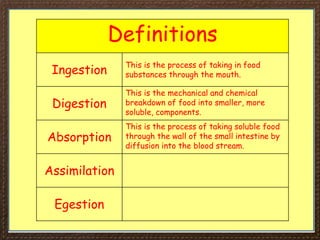
Absorption
Assimilation
Egestion
Definitions
Ingestion
This is the process of taking in food
substances through the mouth.
Digestion
This is the mechanical and chemical
breakdown of food into smaller, more
soluble, components.
Absorption
This is the process of taking soluble food
through the wall of the small intestine by
diffusion into the blood stream.
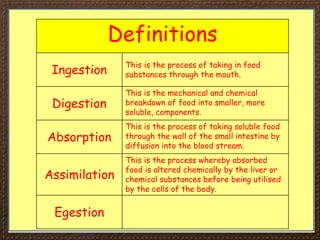
Assimilation
Egestion
Definitions
Ingestion
This is the process of taking in food
substances through the mouth.
Digestion
This is the mechanical and chemical
breakdown of food into smaller, more
soluble, components.
Absorption
This is the process of taking soluble food
through the wall of the small intestine by
diffusion into the blood stream.
Assimilation
This is the process whereby absorbed
food is altered chemically by the liver or
chemical substances before being utilised
by the cells of the body.
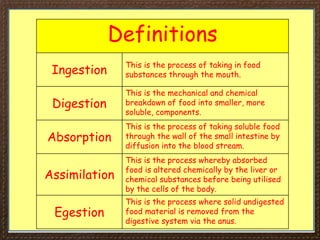
Egestion
Definitions
Ingestion
This is the process of taking in food
substances through the mouth.
Digestion
This is the mechanical and chemical
breakdown of food into smaller, more
soluble, components.
Absorption
This is the process of taking soluble food
through the wall of the small intestine by
diffusion into the blood stream.
Assimilation
This is the process whereby absorbed
food is altered chemically by the liver or
chemical substances before being utilised
by the cells of the body.
Egestion
This is the process where solid undigested
food material is removed from the
digestive system via the anus.
B6.3
Digestion
Core
1 Identify the types of human teeth (incisors,canines,
premolars and molars)
2 Describe the structure of human teeth, limited to
enamel, dentine, pulp, nerves and cement, as well as
the gums.
3 Describe the functions of the types of human teeth in
mechanical digestion of food
4 Describe the proper care of teeth in terms of
diet and regular brushing
6 State the significance of chemical digestion in the
alimentary canal in producing small, soluble molecules
that can be absorbed
https://www.bbc.com/bitesize/articles/zsp76
yc
What is the
digestive
system?
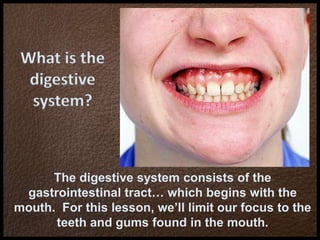
The digestive system consists of the
gastrointestinal tract… which begins with the
mouth. For this lesson, we’ll limit our focus to the
teeth and gums found in the mouth.
The baby teeth…
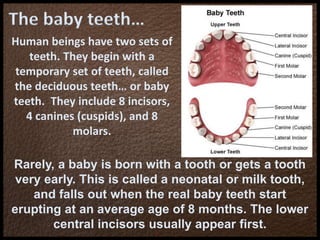
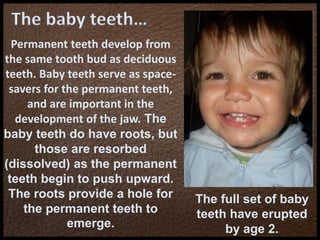
Human beings have two sets of
teeth. They begin with a
temporary set of teeth, called
the deciduous teeth… or baby
teeth. They include 8 incisors,
4 canines (cuspids), and 8
molars.
Rarely, a baby is born with a tooth or gets a tooth
very early. This is called a neonatal or milk tooth,
and falls out when the real baby teeth start
erupting at an average age of 8 months. The lower
central incisors usually appear first.
The baby teeth…
Permanent teeth develop from
the same tooth bud as deciduous
teeth. Baby teeth serve as space-
savers for the permanent teeth,
and are important in the
development of the jaw. The
baby teeth do have roots, but
those are resorbed
(dissolved) as the permanent
teeth begin to push upward.
The roots provide a hole for
the permanent teeth to
emerge.
The full set of baby
teeth have erupted
by age 2.
Permanent teeth…
Baby teeth begin falling out
around age 6, and are replaced
by permanent teeth.
By age 12 most children have
28 of their 32 permanent teeth.
The first permanent teeth to
erupt are the 1st molars. The
four 3rd molars do not erupt
until the age of 17-21.
The incisors…
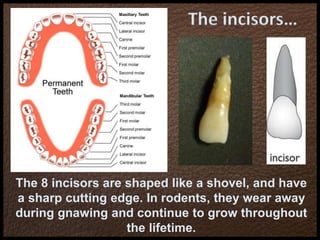
The 8 incisors are shaped like a shovel, and have
a sharp cutting edge. In rodents, they wear away
during gnawing and continue to grow throughout
the lifetime.
The canines…
The 4 canines (cuspids) are longer and stronger
than the incisors, rooted deeply into the bones of
the jaw. Pointed upper canines are commonly
called eye teeth; their function is tearing food.
The canines…
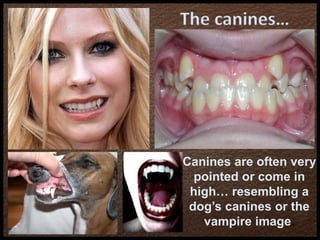
Canines are often very
pointed or come in
high… resembling a
dog’s canines or the
vampire image.
The bicuspids…
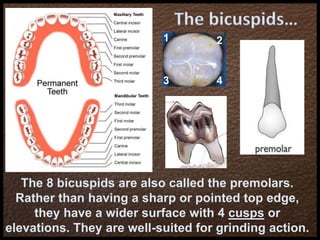
The 8 bicuspids are also called the premolars.
Rather than having a sharp or pointed top edge,
they have a wider surface with 4 cusps or
elevations. They are well-suited for grinding action.
1
3
2
4
The molars…
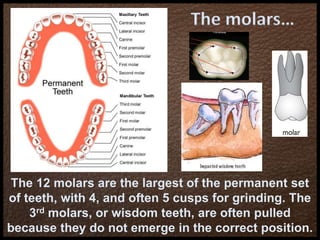
The 12 molars are the largest of the permanent set
of teeth, with 4, and often 5 cusps for grinding. The
3rd molars, or wisdom teeth, are often pulled
because they do not emerge in the correct position.
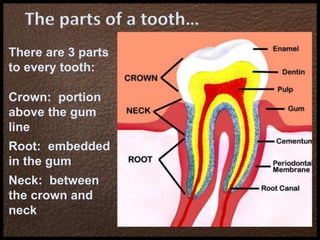
There are 3 parts
to every tooth:
Crown: portion
above the gum
line
Root: embedded
in the gum
Neck: between
the crown and
neck
The parts of a tooth…
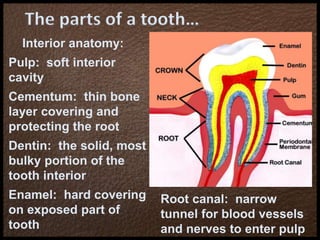
Interior anatomy:
Pulp: soft interior
cavity
Cementum: thin bone
layer covering and
protecting the root
Dentin: the solid, most
bulky portion of the
tooth interior
Enamel: hard covering
on exposed part of
tooth
The parts of a tooth…
Root canal: narrow
tunnel for blood vessels
and nerves to enter pulp
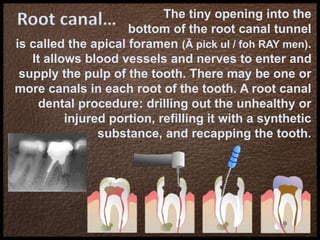
The tiny opening into the
bottom of the root canal tunnel
is called the apical foramen (Ā pick ul / foh RAY men).
It allows blood vessels and nerves to enter and
supply the pulp of the tooth. There may be one or
more canals in each root of the tooth. A root canal
dental procedure: drilling out the unhealthy or
injured portion, refilling it with a synthetic
substance, and recapping the tooth.
Root canal…
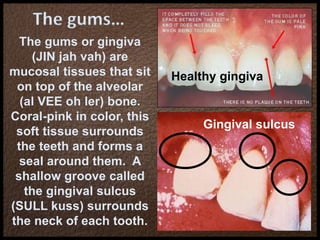
The gums…
The gums or gingiva
(JIN jah vah) are
mucosal tissues that sit
on top of the alveolar
(al VEE oh ler) bone.
Coral-pink in color, this
soft tissue surrounds
the teeth and forms a
seal around them. A
shallow groove called
the gingival sulcus
(SULL kuss) surrounds
the neck of each tooth.
Gingival sulcus
Healthy gingiva
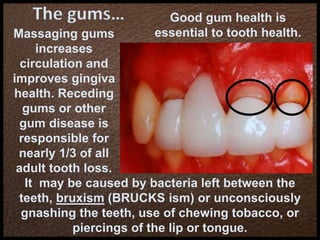
The gums…
Massaging gums
increases
circulation and
improves gingiva
health. Receding
gums or other
gum disease is
responsible for
nearly 1/3 of all
adult tooth loss.
Good gum health is
essential to tooth health.
It may be caused by bacteria left between the
teeth, bruxism (BRUCKS ism) or unconsciously
gnashing the teeth, use of chewing tobacco, or
piercings of the lip or tongue.
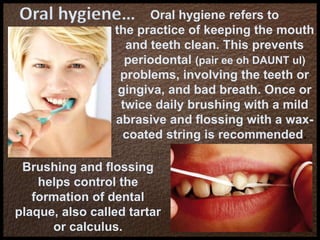
Oral hygiene… Oral hygiene refers to
the practice of keeping the mouth
and teeth clean. This prevents
periodontal (pair ee oh DAUNT ul)
problems, involving the teeth or
gingiva, and bad breath. Once or
twice daily brushing with a mild
abrasive and flossing with a wax-
coated string is recommended.
Brushing and flossing
helps control the
formation of dental
plaque, also called tartar
or calculus.
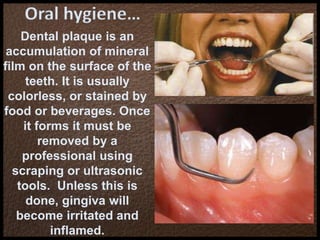
Oral hygiene…
Dental plaque is an
accumulation of mineral
film on the surface of the
teeth. It is usually
colorless, or stained by
food or beverages. Once
it forms it must be
removed by a
professional using
scraping or ultrasonic
tools. Unless this is
done, gingiva will
become irritated and
inflamed.
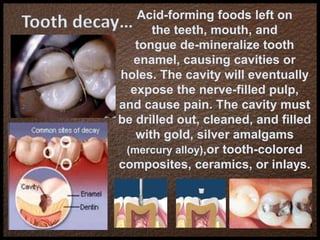
Tooth decay… Acid-forming foods left on
the teeth, mouth, and
tongue de-mineralize tooth
enamel, causing cavities or
holes. The cavity will eventually
expose the nerve-filled pulp,
and cause pain. The cavity must
be drilled out, cleaned, and filled
with gold, silver amalgams
(mercury alloy),or tooth-colored
composites, ceramics, or inlays.
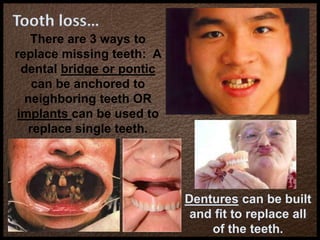
Tooth loss…
There are 3 ways to
replace missing teeth: A
dental bridge or pontic
can be anchored to
neighboring teeth OR
implants can be used to
replace single teeth.
Dentures can be built
and fit to replace all
of the teeth.
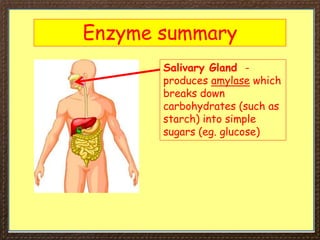
Enzyme summary
Salivary Gland -
produces amylase which
breaks down
carbohydrates (such as
starch) into simple
sugars (eg. glucose)
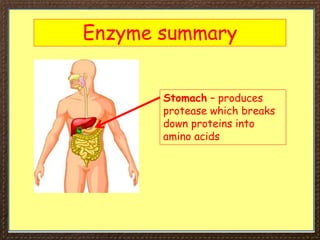
Enzyme summary
Stomach – produces
protease which breaks
down proteins into
amino acids
Enzyme summary
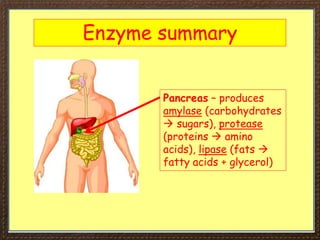
Pancreas – produces
amylase (carbohydrates
 sugars), protease
(proteins  amino
acids), lipase (fats 
fatty acids + glycerol)
Enzyme summary
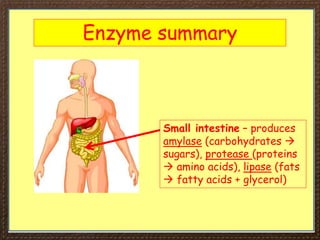
Small intestine – produces
amylase (carbohydrates 
sugars), protease (proteins
 amino acids), lipase (fats
 fatty acids + glycerol)
Enzyme summary
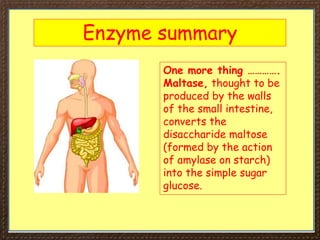
One more thing ………….
Maltase, thought to be
produced by the walls
of the small intestine,
converts the
disaccharide maltose
(formed by the action
of amylase on starch)
into the simple sugar
glucose.

B6 ANIMAL NUTRITION.ppt

  • 1.
    IGCSE COORDINATED SCIENCE9 B6 ANIMAL NUTRITION
  • 2.
    Content Lesson B6.1 Diet CORE 1. Statewhat is meant by the term balanced diet for humans 2 List the principal sources of, and describe the dietary importance of: – carbohydrates – fats – proteins – vitamins, limited to C and D – mineral salts, limited to calcium and iron – fbre (roughage) – water Supplement 3 Explain how age, gender and activity affect the dietary needs of humans including during pregnancy and whilst breast-feeding 4 Describe the effects of malnutrition in relation to starvation, constipation, coronary heart disease, obesity and scurvy 5 Explain the causes and effects of vitamin D and iron deficiencies 6 Explain the causes and effects of proteinenergy malnutrition, e.g. kwashiorkor and marasmus
  • 3.
    DIET Our diet needs tocontain sufficient and balanced quantities of carbohydrates, proteins and lipids.
  • 4.
    Biological molecules carbohydrates Sugar Different foodscontain different kinds of sugar. Eg fruit contains fructose or glucose. Lactose is in milk. Table sugar is sucrose. Sugar gives us energy, so we call it an energy food. Starch Cellulose
  • 5.
    Biological molecules carbohydrates Sugar Different foodscontain different kinds of sugar. Eg fruit contains fructose or glucose. Lactose is in milk. Table sugar is sucrose. Sugar gives us energy, so we call it an energy food. Starch Starch is found particularly in bread, potatoes and cereals. Starch is a storage molecule, but it does provide us with energy. Cellulose
  • 6.
    Biological molecules carbohydrates Sugar Different foodscontain different kinds of sugar. Eg fruit contains fructose or glucose. Lactose is in milk. Table sugar is sucrose. Sugar gives us energy, so we call it an energy food. Starch Starch is found particularly in bread, potatoes and cereals. Starch is a storage molecule, but it does provide us with energy. Cellulose Cellulose is found in plant cell walls It is a structural molecule, and supports the plant cell.
  • 7.
    Biological molecules Fats Fats alsocontain C, H and O, but relatively less O. Fats occur in both plant and animal foods. Fats – solid at room temperatures. Oils - liquid at room temperatures.
  • 8.
    Biological molecules Fats Fats alsocontain C, H and O, but relatively less O. Fats occur in both plant and animal foods. Fats – solid at room temperatures. Oils - liquid at room temperatures. Fats also give us energy. They also provide insulation in humans and other mammals, and are energy stores.
  • 9.
    Biological molecules Proteins Proteins containC, H and O, and also some nitrogen (N) and a little suplhur (S). Proteins are found in milk, eggs, meat and fish.
  • 10.
    Biological molecules Proteins Proteins containC, H and O, and also some nitrogen (N) and a little suplhur (S). Proteins are found in milk, eggs, meat and fish. Proteins are needed for growth and body- building (muscles and skin), and they are also used to make enzymes.
  • 11.
    Components of ourdiet Minerals: contain certain elements essential for the proper functioning of our bodies.
  • 12.
    Components of ourdiet Minerals: contain certain elements essential for the proper functioning of our bodies. Calcium Needed for hardening our bones and teeth. Occurs in foods such as milk, cheese and fish Deficiency results in rickets
  • 13.
    Rickets Rickets is asoftening of bones in children due to deficiency or impaired metabolism of vitamin D, magnesium, phosphorus or calcium, potentially leading to fractures and deformity. Rickets is among the most frequent childhood diseases in many developing countries.
  • 14.
    Components of ourdiet Minerals: contain certain elements essential for the proper functioning of our bodies. Calcium Needed for hardening our bones and teeth. Occurs in foods such as milk, cheese and fish Deficiency results in rickets Iron Present in haemoglobin, the red pigment in blood used to carry oxygen Occurs in a number of foods, especially liver and kidneys Deficiency results in anaemia
  • 15.
    Anaemia Anaemia is adecrease in the number of red blood cells in the blood, meaning that less oxygen can be carried by the blood to various organs and tissues,. The main symptoms are tiredness and lethargy.
  • 16.
    Components of ourdiet Vitamins: a collection of organic substances needed in small quantities in the body. Their overall function is to help control the chemical reactions taking place in the body.
  • 17.
    Components of ourdiet Vitamins: a collection of organic substances needed in small quantities in the body. Their overall function is to help control the chemical reactions taking place in the body. Vitamin A Important for our eyes – helps protect their surfaces Found in fish liver oil, and carrots. Deficiency makes it difficult to see in dim light
  • 18.
    Components of ourdiet Vitamins: a collection of organic substances needed in small quantities in the body. Their overall function is to help control the chemical reactions taking place in the body. Vitamin A Important for our eyes – helps protect their surfaces Found in fish liver oil, and carrots. Deficiency makes it difficult to see in dim light Vitamin C Needed for strong gums Found in citrus fruits, green vegetables and blackcurrants Deficiency results in scurvy
  • 19.
    Scurvy Scurvy can resultin swollen gums, severe pain in joints, shortness of breath, and blurred vision.
  • 20.
    Components of ourdiet Vitamins: a collection of organic substances needed in small quantities in the body. Their overall function is to help control the chemical reactions taking place in the body. Vitamin D Necessary for bones to take up calcium salts Occurs in fish liver oil, and can be made in the skin provided sunlight is present. Deficiency results in rickets.
  • 21.
    Components of ourdiet Fibre is necessary for a healthy balanced diet, but the body can’t absorb it. It helps our digestive system to process food and absorb nutrients. It helps your bowel to pass food by making stools soft and bulky. It helps prevent constipation. Fibre is found in foods such as brown rice, oats, wholegrain breads and cereals.
  • 22.
    Components of ourdiet Water makes up more than two-thirds of the weight of the human body. It serves as a lubricant, helps regulate body temperature, prevents and relieves constipation. Without enough water we can become dehydrated.
  • 23.
    Core 1 Define ingestionas the taking of substances, e.g. food and drink, into the body through the mouth 2 Define digestion as the breakdown of large, insoluble food molecules into small, water soluble molecules using mechanical and chemical processes 5 Define absorption as movement of digested food molecules through the wall of the intestine into the blood 6 Define assimilation as the movement of digested food molecules into the cells of the body where they are used, becoming part of the cells 7 Define egestion as passing out of food that has not been digested, as faeces, through the anus 8 Identify the main regions of the alimentary canal and associated organs, including mouth, salivary glands, esophagus, stomach, small intestine, pancreas, liver, gall bladder, large intestine and anus. 9 Describe the functions of the regions of the alimentary canal listed above, in relation to ingestion, digestion, absorption, assimilation and egestion of food Supplement 3 Define mechanical digestion as the breakdown of food into smaller pieces without chemical change to the food molecules 4 Define chemical digestion as the breakdown of large, insoluble molecules into small, soluble molecules B6.2 Alimentary canal
  • 24.
    The human digestivesystem (also known as the alimentary canal) From mouth to anus
  • 25.
  • 26.
    The human digestivesystem In digestion, large insoluble molecules are broken down into smaller soluble particles that can be absorbed into the bloodstream.
  • 27.
    The human digestivesystem Mouth – mechanical chewing of the food. Salivary glands produce the enzyme amylase which begins breaking down polysaccharides into simpler sugars.
  • 28.
    The human digestivesystem Oesophagus (also known as the gullet). Passes food down from the mouth to the stomach by a process known as peristalsis.
  • 29.
    Peristalsis Rings of muscle aroundthe oesophagus effectively ‘squeeze’ food towards the stomach, as you would with toothpaste in a tube.
  • 30.
    The human digestivesystem Stomach – more mechanical digestion happens here. The stomach produces the enzyme protease, and also hydrochloric acid which kills bacteria, and this acid also provides the ideal conditions for protease.
  • 31.
    The human digestivesystem Pancreas – produces many enzymes, including amylase, protease and lipase.
  • 32.
    The human digestivesystem Small intestine – can be over six metres long. Digested food is absorbed here into the blood stream. The surface area of the small intestine is greatly increased by the presence of small, finger-like projections called villi (villus).
  • 33.
  • 34.
    The human digestivesystem Large intestine – as the fibre and other undigested material passes along the large intestine, water is absorbed from it, so it becomes more solid. This solid matter then passes on to the rectum where it is stored as faeces.
  • 35.
    The human digestivesystem The Liver – produces a substance known as bile, which is stored in the gall bladder before it is released into the small intestine. Bile has 2 functions:
  • 36.
    The human digestivesystem The Liver – produces a substance known as bile, which is stored in the gall bladder before it is released into the small intestine. Bile has 2 functions: 1. It neutralises the acid from the stomach, producing more alkaline conditions.
  • 37.
    The human digestivesystem The Liver – produces a substance known as bile, which is stored in the gall bladder before it is released into the small intestine. Bile has 2 functions: 2. It emulsifies fats – i.e. it breaks large drops of fat into small droplets to increase their surface area, so enzymes can work faster.
  • 38.
  • 40.
  • 41.
    Definitions Ingestion This is theprocess of taking in food substances through the mouth. Digestion Absorption Assimilation Egestion
  • 42.
    Definitions Ingestion This is theprocess of taking in food substances through the mouth. Digestion This is the mechanical and chemical breakdown of food into smaller, more soluble, components. Absorption Assimilation Egestion
  • 43.
    Definitions Ingestion This is theprocess of taking in food substances through the mouth. Digestion This is the mechanical and chemical breakdown of food into smaller, more soluble, components. Absorption This is the process of taking soluble food through the wall of the small intestine by diffusion into the blood stream. Assimilation Egestion
  • 44.
    Definitions Ingestion This is theprocess of taking in food substances through the mouth. Digestion This is the mechanical and chemical breakdown of food into smaller, more soluble, components. Absorption This is the process of taking soluble food through the wall of the small intestine by diffusion into the blood stream. Assimilation This is the process whereby absorbed food is altered chemically by the liver or chemical substances before being utilised by the cells of the body. Egestion
  • 45.
    Definitions Ingestion This is theprocess of taking in food substances through the mouth. Digestion This is the mechanical and chemical breakdown of food into smaller, more soluble, components. Absorption This is the process of taking soluble food through the wall of the small intestine by diffusion into the blood stream. Assimilation This is the process whereby absorbed food is altered chemically by the liver or chemical substances before being utilised by the cells of the body. Egestion This is the process where solid undigested food material is removed from the digestive system via the anus.
  • 46.
    B6.3 Digestion Core 1 Identify thetypes of human teeth (incisors,canines, premolars and molars) 2 Describe the structure of human teeth, limited to enamel, dentine, pulp, nerves and cement, as well as the gums. 3 Describe the functions of the types of human teeth in mechanical digestion of food 4 Describe the proper care of teeth in terms of diet and regular brushing 6 State the significance of chemical digestion in the alimentary canal in producing small, soluble molecules that can be absorbed
  • 47.
  • 48.
    What is the digestive system? Thedigestive system consists of the gastrointestinal tract… which begins with the mouth. For this lesson, we’ll limit our focus to the teeth and gums found in the mouth.
  • 49.
    The baby teeth… Humanbeings have two sets of teeth. They begin with a temporary set of teeth, called the deciduous teeth… or baby teeth. They include 8 incisors, 4 canines (cuspids), and 8 molars. Rarely, a baby is born with a tooth or gets a tooth very early. This is called a neonatal or milk tooth, and falls out when the real baby teeth start erupting at an average age of 8 months. The lower central incisors usually appear first.
  • 50.
    The baby teeth… Permanentteeth develop from the same tooth bud as deciduous teeth. Baby teeth serve as space- savers for the permanent teeth, and are important in the development of the jaw. The baby teeth do have roots, but those are resorbed (dissolved) as the permanent teeth begin to push upward. The roots provide a hole for the permanent teeth to emerge. The full set of baby teeth have erupted by age 2.
  • 51.
    Permanent teeth… Baby teethbegin falling out around age 6, and are replaced by permanent teeth. By age 12 most children have 28 of their 32 permanent teeth. The first permanent teeth to erupt are the 1st molars. The four 3rd molars do not erupt until the age of 17-21.
  • 52.
    The incisors… The 8incisors are shaped like a shovel, and have a sharp cutting edge. In rodents, they wear away during gnawing and continue to grow throughout the lifetime.
  • 53.
    The canines… The 4canines (cuspids) are longer and stronger than the incisors, rooted deeply into the bones of the jaw. Pointed upper canines are commonly called eye teeth; their function is tearing food.
  • 54.
    The canines… Canines areoften very pointed or come in high… resembling a dog’s canines or the vampire image.
  • 55.
    The bicuspids… The 8bicuspids are also called the premolars. Rather than having a sharp or pointed top edge, they have a wider surface with 4 cusps or elevations. They are well-suited for grinding action. 1 3 2 4
  • 56.
    The molars… The 12molars are the largest of the permanent set of teeth, with 4, and often 5 cusps for grinding. The 3rd molars, or wisdom teeth, are often pulled because they do not emerge in the correct position.
  • 57.
    There are 3parts to every tooth: Crown: portion above the gum line Root: embedded in the gum Neck: between the crown and neck The parts of a tooth…
  • 58.
    Interior anatomy: Pulp: softinterior cavity Cementum: thin bone layer covering and protecting the root Dentin: the solid, most bulky portion of the tooth interior Enamel: hard covering on exposed part of tooth The parts of a tooth… Root canal: narrow tunnel for blood vessels and nerves to enter pulp
  • 59.
    The tiny openinginto the bottom of the root canal tunnel is called the apical foramen (Ā pick ul / foh RAY men). It allows blood vessels and nerves to enter and supply the pulp of the tooth. There may be one or more canals in each root of the tooth. A root canal dental procedure: drilling out the unhealthy or injured portion, refilling it with a synthetic substance, and recapping the tooth. Root canal…
  • 60.
    The gums… The gumsor gingiva (JIN jah vah) are mucosal tissues that sit on top of the alveolar (al VEE oh ler) bone. Coral-pink in color, this soft tissue surrounds the teeth and forms a seal around them. A shallow groove called the gingival sulcus (SULL kuss) surrounds the neck of each tooth. Gingival sulcus Healthy gingiva
  • 61.
    The gums… Massaging gums increases circulationand improves gingiva health. Receding gums or other gum disease is responsible for nearly 1/3 of all adult tooth loss. Good gum health is essential to tooth health. It may be caused by bacteria left between the teeth, bruxism (BRUCKS ism) or unconsciously gnashing the teeth, use of chewing tobacco, or piercings of the lip or tongue.
  • 62.
    Oral hygiene… Oralhygiene refers to the practice of keeping the mouth and teeth clean. This prevents periodontal (pair ee oh DAUNT ul) problems, involving the teeth or gingiva, and bad breath. Once or twice daily brushing with a mild abrasive and flossing with a wax- coated string is recommended. Brushing and flossing helps control the formation of dental plaque, also called tartar or calculus.
  • 63.
    Oral hygiene… Dental plaqueis an accumulation of mineral film on the surface of the teeth. It is usually colorless, or stained by food or beverages. Once it forms it must be removed by a professional using scraping or ultrasonic tools. Unless this is done, gingiva will become irritated and inflamed.
  • 64.
    Tooth decay… Acid-formingfoods left on the teeth, mouth, and tongue de-mineralize tooth enamel, causing cavities or holes. The cavity will eventually expose the nerve-filled pulp, and cause pain. The cavity must be drilled out, cleaned, and filled with gold, silver amalgams (mercury alloy),or tooth-colored composites, ceramics, or inlays.
  • 65.
    Tooth loss… There are3 ways to replace missing teeth: A dental bridge or pontic can be anchored to neighboring teeth OR implants can be used to replace single teeth. Dentures can be built and fit to replace all of the teeth.
  • 66.
    Enzyme summary Salivary Gland- produces amylase which breaks down carbohydrates (such as starch) into simple sugars (eg. glucose)
  • 67.
    Enzyme summary Stomach –produces protease which breaks down proteins into amino acids
  • 68.
    Enzyme summary Pancreas –produces amylase (carbohydrates  sugars), protease (proteins  amino acids), lipase (fats  fatty acids + glycerol)
  • 69.
    Enzyme summary Small intestine– produces amylase (carbohydrates  sugars), protease (proteins  amino acids), lipase (fats  fatty acids + glycerol)
  • 70.
    Enzyme summary One morething …………. Maltase, thought to be produced by the walls of the small intestine, converts the disaccharide maltose (formed by the action of amylase on starch) into the simple sugar glucose.