DNA Science Biology I Factoids
Factoid 154 Section 10 DNA controls the production of every protein in a cell.  Proteins control all of the process in a cell.
Factoid 153 DNA is made up of nucleotides.  Nucleotides are made up of a sugar (either ribose for RNA or deoxiribose for DNA), a phosphate group, and a nitrogen base.
Factoid 154 There are 5 nitrogen bases: Adenine and Guanine are purines. Cytosine, Thymine, and Uracil are Pyrimidines.  Uracil is only found in RNA not DNA.
Factoid 155 In 1953 two scientists named James Watson and Francis Crick were the first people to determine the structure of DNA
Factoid 156 DNA is like a twisted ladder (called a double helix) whereby the sugar and phosphate units make up the sides of the ladder and the nitrogen bases make up the steps of the ladder.
Factoid 157 The sequence of the nucleotides in DNA determines the information that is passed on by the genes.
Factoid 158 DNA replication (during the S phase of the cell cycle) makes a copy of the DNA.  The DNA ladder splits and nucleotides join to form an extra copy of DNA.
Factoid 159 Since DNA will contain one old strand and one new strand of DNA, the process is called semi-conservative.
Factoid 160 There are 3 ways DNA and RNA are different: RNA has a ribose sugar unit instead of the deoxiribose sugar unit. DNA is double stranded and RNA is single stranded. In RNA A pairs with U and not T.  There is no Thymine in RNA.
Factoid 161 There are 3 types of RNA Messenger RNA (mRNA) carries instruction from the DNA to the ribosomes.
Factoid 162 Transfer RNA (tRNA) bring amino acids to the ribosomes.
Factoid 163 Ribosomal RNA (rRNA) bind with the ribosomes to help make proteins.
Factoid 165 Protein synthesis (the making of proteins) has two parts:  Transcription and translation.
Factoid 165 To  transcribe  DNA means to make a copy of it.  When DNA is transcribed, a copy of the nucleotide sequence is copied by RNA.
Factoid 166 Transcription makes mRNA in the nucleus.  The mRNA then leaves the nucleus.
Factoid 167 Nucleotides are “read” in groups of 3 (called a codon).  Every 3 nucleotides code for 1 amino acid.
Factoid 168 During translation, the mRNA is bound to an rRNA and a ribosome.  The ribosome makes the new protein.
Factoid 169 The tRNA brings an amino acid to the ribosome to build the protein.
Factoid 170 Chargaff’s Rules A always bonds with T and visa versa  C always bonds with G and visa versa In RNA, A always bonds with U and visa versa.
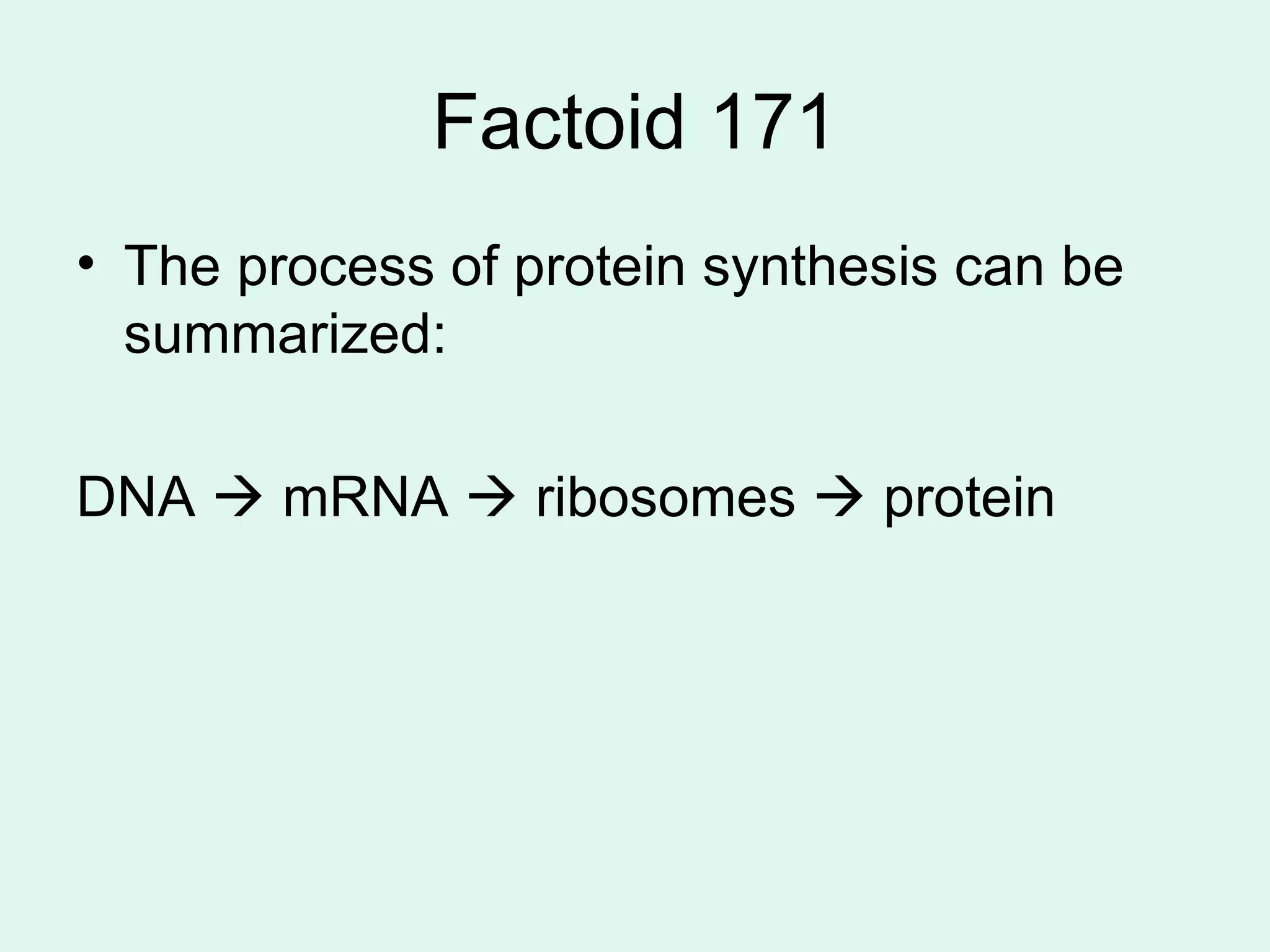
Factoid 171 The process of protein synthesis can be summarized: DNA    mRNA    ribosomes    protein
Factoid 172 The study of DNA molecules and making changes in DNA is called molecular genetics.
Factoid 173 A subfield of molecular genetics is called genetic engineering which involves changing an organism’s DNA
Factoid 174 The first step in examining an organisms DNA is DNA extraction or removing the DNA from the cell.
Factoid 175 DNA is very large.  It must be cut into smaller pieces using restriction enzymes.
Factoid 176 Restriction enzymes cut DNA in very specific sequences.  They will only work on a specific nucleotide sequence.
Factoid 177 Once cut into pieces (called fragments) the DNA is separated using gel electrophoresis.
Factoid 178 DNA travels from the negative side of the DNA gel to the positive side of the gel.  The smaller fragments travel farther and make a banding pattern on the gel.
Factoid 179 Patterns on a DNA gel can be used to prove or disprove  paternity , guilt or innocence of a crime, determining evolutionary history, etc
Factoid 180 Taking short pieces of DNA from one organism and joining it to the DNA of another organism is called recombinant DNA.
Factoid 181 Transgenic organisms are organisms that contain genes from a different organism.
Factoid 182 Cloning refers to taking genetic information out of a donor cell and placing it into an egg, then implanting the egg in a female for birth.
Factoid 183 Mutations are mistakes in DNA that can be beneficial, harmful, or have no effect at all.
Factoid 184 There are two types of mutations gene mutations (or point mutations) or chromosome mutations.
Factoid 185 There are three types of gene mutations Insertion – A nucleotide is added and changes the codons. Substitution – A different nucleotide is inserted instead of the intended one. Deletion – A nucleotide is left out.
Factoid 186 There are 4 types of chromosome mutations Deletion – A piece of chromosome is removed. Duplication – Part of a chromosome is copied Inversion – Pieces of chromosomes switch places. Translocation – Pieces of one chromosome change places with pieces from another chromosome.
Factoid 187 Karyotype – A picture of chromosomes used to see if there are abnormal numbers of chromosomes

Section10

  • 1.
  • 2.
    Factoid 154 Section10 DNA controls the production of every protein in a cell. Proteins control all of the process in a cell.
  • 3.
    Factoid 153 DNAis made up of nucleotides. Nucleotides are made up of a sugar (either ribose for RNA or deoxiribose for DNA), a phosphate group, and a nitrogen base.
  • 4.
    Factoid 154 Thereare 5 nitrogen bases: Adenine and Guanine are purines. Cytosine, Thymine, and Uracil are Pyrimidines. Uracil is only found in RNA not DNA.
  • 5.
    Factoid 155 In1953 two scientists named James Watson and Francis Crick were the first people to determine the structure of DNA
  • 6.
    Factoid 156 DNAis like a twisted ladder (called a double helix) whereby the sugar and phosphate units make up the sides of the ladder and the nitrogen bases make up the steps of the ladder.
  • 7.
    Factoid 157 Thesequence of the nucleotides in DNA determines the information that is passed on by the genes.
  • 8.
    Factoid 158 DNAreplication (during the S phase of the cell cycle) makes a copy of the DNA. The DNA ladder splits and nucleotides join to form an extra copy of DNA.
  • 9.
    Factoid 159 SinceDNA will contain one old strand and one new strand of DNA, the process is called semi-conservative.
  • 10.
    Factoid 160 Thereare 3 ways DNA and RNA are different: RNA has a ribose sugar unit instead of the deoxiribose sugar unit. DNA is double stranded and RNA is single stranded. In RNA A pairs with U and not T. There is no Thymine in RNA.
  • 11.
    Factoid 161 Thereare 3 types of RNA Messenger RNA (mRNA) carries instruction from the DNA to the ribosomes.
  • 12.
    Factoid 162 TransferRNA (tRNA) bring amino acids to the ribosomes.
  • 13.
    Factoid 163 RibosomalRNA (rRNA) bind with the ribosomes to help make proteins.
  • 14.
    Factoid 165 Proteinsynthesis (the making of proteins) has two parts: Transcription and translation.
  • 15.
    Factoid 165 To transcribe DNA means to make a copy of it. When DNA is transcribed, a copy of the nucleotide sequence is copied by RNA.
  • 16.
    Factoid 166 Transcriptionmakes mRNA in the nucleus. The mRNA then leaves the nucleus.
  • 17.
    Factoid 167 Nucleotidesare “read” in groups of 3 (called a codon). Every 3 nucleotides code for 1 amino acid.
  • 18.
    Factoid 168 Duringtranslation, the mRNA is bound to an rRNA and a ribosome. The ribosome makes the new protein.
  • 19.
    Factoid 169 ThetRNA brings an amino acid to the ribosome to build the protein.
  • 20.
    Factoid 170 Chargaff’sRules A always bonds with T and visa versa C always bonds with G and visa versa In RNA, A always bonds with U and visa versa.
  • 21.
    Factoid 171 Theprocess of protein synthesis can be summarized: DNA  mRNA  ribosomes  protein
  • 22.
    Factoid 172 Thestudy of DNA molecules and making changes in DNA is called molecular genetics.
  • 23.
    Factoid 173 Asubfield of molecular genetics is called genetic engineering which involves changing an organism’s DNA
  • 24.
    Factoid 174 Thefirst step in examining an organisms DNA is DNA extraction or removing the DNA from the cell.
  • 25.
    Factoid 175 DNAis very large. It must be cut into smaller pieces using restriction enzymes.
  • 26.
    Factoid 176 Restrictionenzymes cut DNA in very specific sequences. They will only work on a specific nucleotide sequence.
  • 27.
    Factoid 177 Oncecut into pieces (called fragments) the DNA is separated using gel electrophoresis.
  • 28.
    Factoid 178 DNAtravels from the negative side of the DNA gel to the positive side of the gel. The smaller fragments travel farther and make a banding pattern on the gel.
  • 29.
    Factoid 179 Patternson a DNA gel can be used to prove or disprove paternity , guilt or innocence of a crime, determining evolutionary history, etc
  • 30.
    Factoid 180 Takingshort pieces of DNA from one organism and joining it to the DNA of another organism is called recombinant DNA.
  • 31.
    Factoid 181 Transgenicorganisms are organisms that contain genes from a different organism.
  • 32.
    Factoid 182 Cloningrefers to taking genetic information out of a donor cell and placing it into an egg, then implanting the egg in a female for birth.
  • 33.
    Factoid 183 Mutationsare mistakes in DNA that can be beneficial, harmful, or have no effect at all.
  • 34.
    Factoid 184 Thereare two types of mutations gene mutations (or point mutations) or chromosome mutations.
  • 35.
    Factoid 185 Thereare three types of gene mutations Insertion – A nucleotide is added and changes the codons. Substitution – A different nucleotide is inserted instead of the intended one. Deletion – A nucleotide is left out.
  • 36.
    Factoid 186 Thereare 4 types of chromosome mutations Deletion – A piece of chromosome is removed. Duplication – Part of a chromosome is copied Inversion – Pieces of chromosomes switch places. Translocation – Pieces of one chromosome change places with pieces from another chromosome.
  • 37.
    Factoid 187 Karyotype– A picture of chromosomes used to see if there are abnormal numbers of chromosomes