General BiologyGeneral Biology
ชีววิทยาทั่วไปชีววิทยาทั่วไป
Adisri Charoenpanich, PhD
Department of Biology, Faculty of Science,
Silpakorn University
1
ดร. อดิศรี เจริญพานิช
ภาควิชาชีววิทยา คณะวิทยาศาสตร์
มหาวิทยาลัย ศิลปากร
acharoe@ncsu.edu
TopicsTopics
• Introductions: Today Technologies
• Tools and Method in Biological Studies
• Biomolecules
• Structure and functions of cells
• Reproduction
• Genetics and Technology
• Animal Tissue and Development
• Human Physiology
2
3
http://www.burpee.com/fruit-
plants/melon/watermelon/watermelon-seedless-
big-tasty-hybrid-prod000552.html
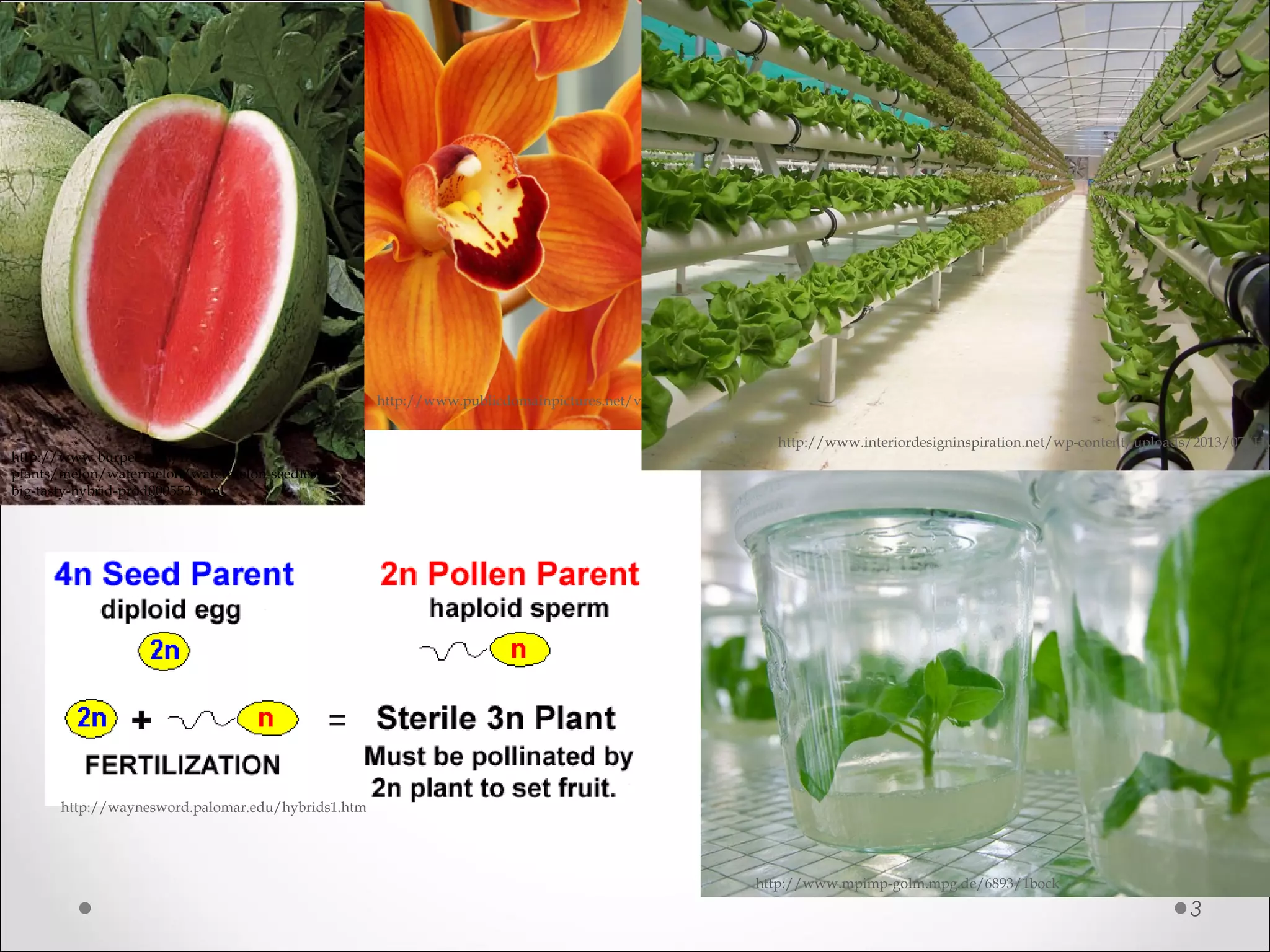
http://waynesword.palomar.edu/hybrids1.htm
http://www.publicdomainpictures.net/view-image.php?image=6750
http://www.mpimp-golm.mpg.de/6893/1bock
http://www.interiordesigninspiration.net/wp-content/uploads/2013/07/Hy
DNA FingerprintDNA Fingerprint
4
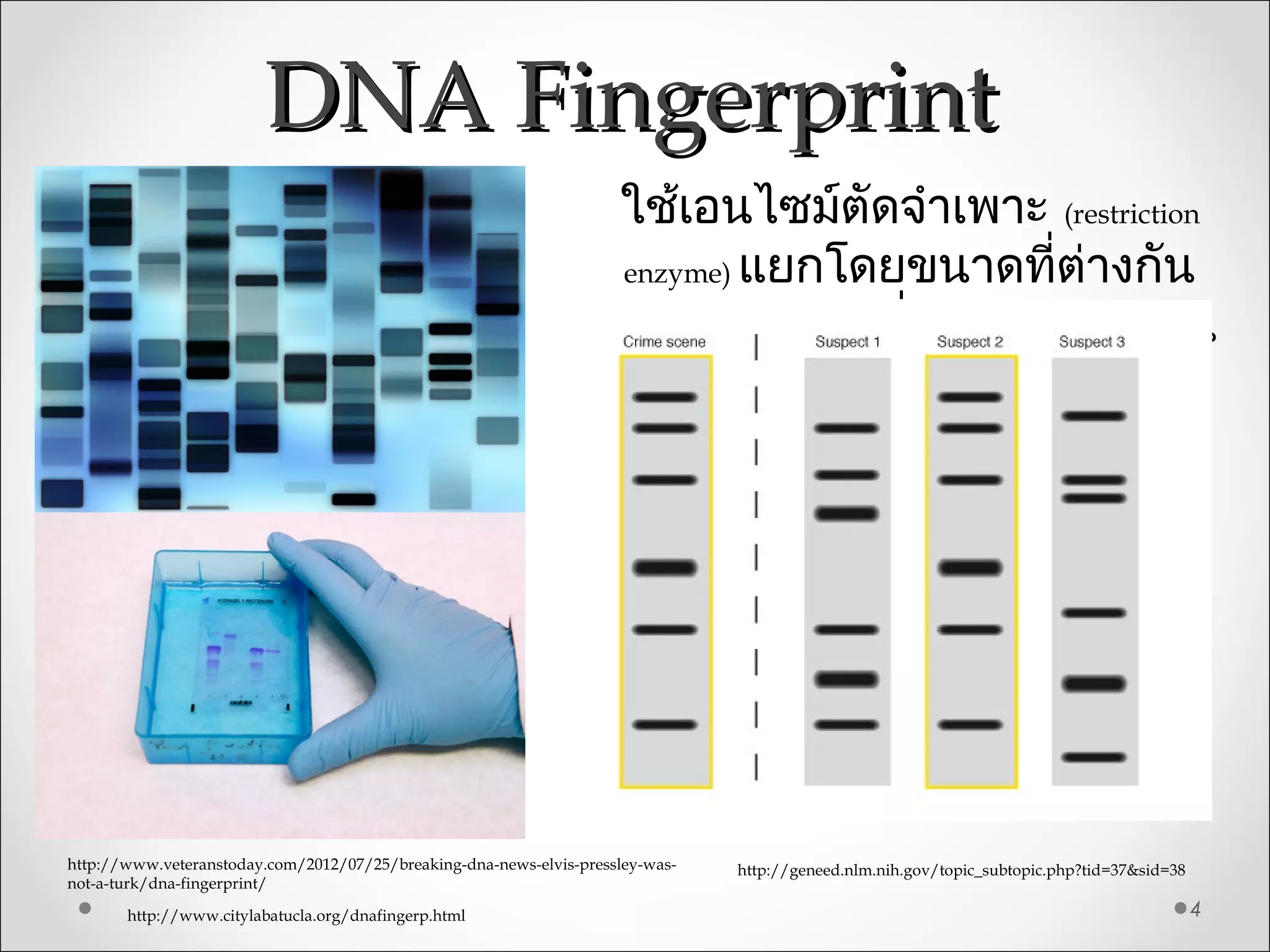
ใช้เอนไซม์ตัดจำาเพาะ (restriction
enzyme) แยกโดยขนาดที่ต่างกัน
จากการตัดได้ที่ตำาแหน่งต่างกัน
http://www.veteranstoday.com/2012/07/25/breaking-dna-news-elvis-pressley-was-
not-a-turk/dna-fingerprint/
http://www.citylabatucla.org/dnafingerp.html
http://geneed.nlm.nih.gov/topic_subtopic.php?tid=37&sid=38
5
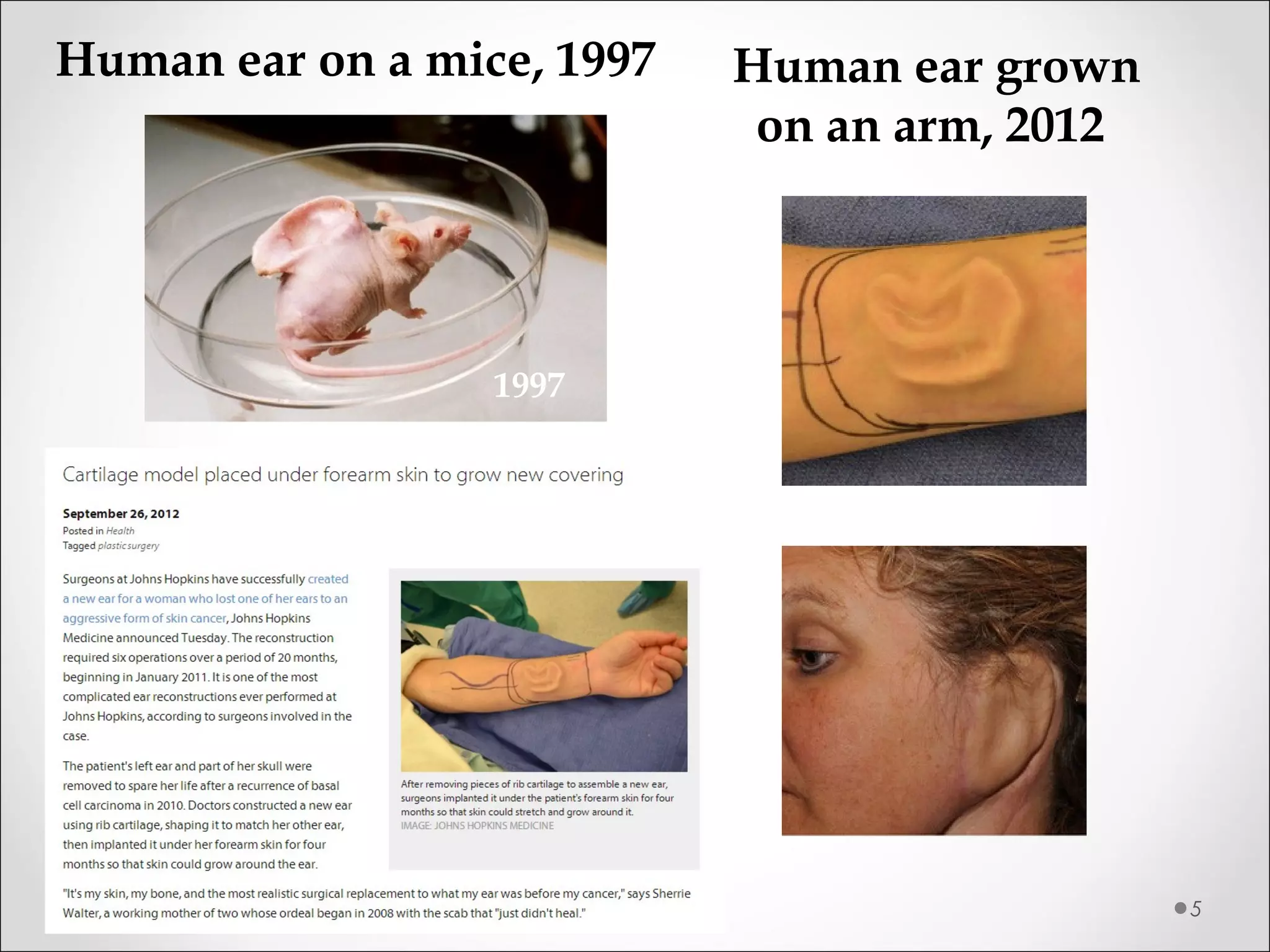
1997
Human ear on a mice, 1997 Human ear grown
on an arm, 2012
Bioprinting-3D printingBioprinting-3D printing
6
http://mariakonovalenko.files.wordpress.com/2010/10/bio-
printing-image.jpg
http://www.bbc.co.uk/news/technology-20972018
http://elitedaily.com/news/technology/coolest-3d-
print/
http://www.hangthebankers.com/3d-printing-join-effs-effort-to-keep-
this-game-changing-technology-alive/
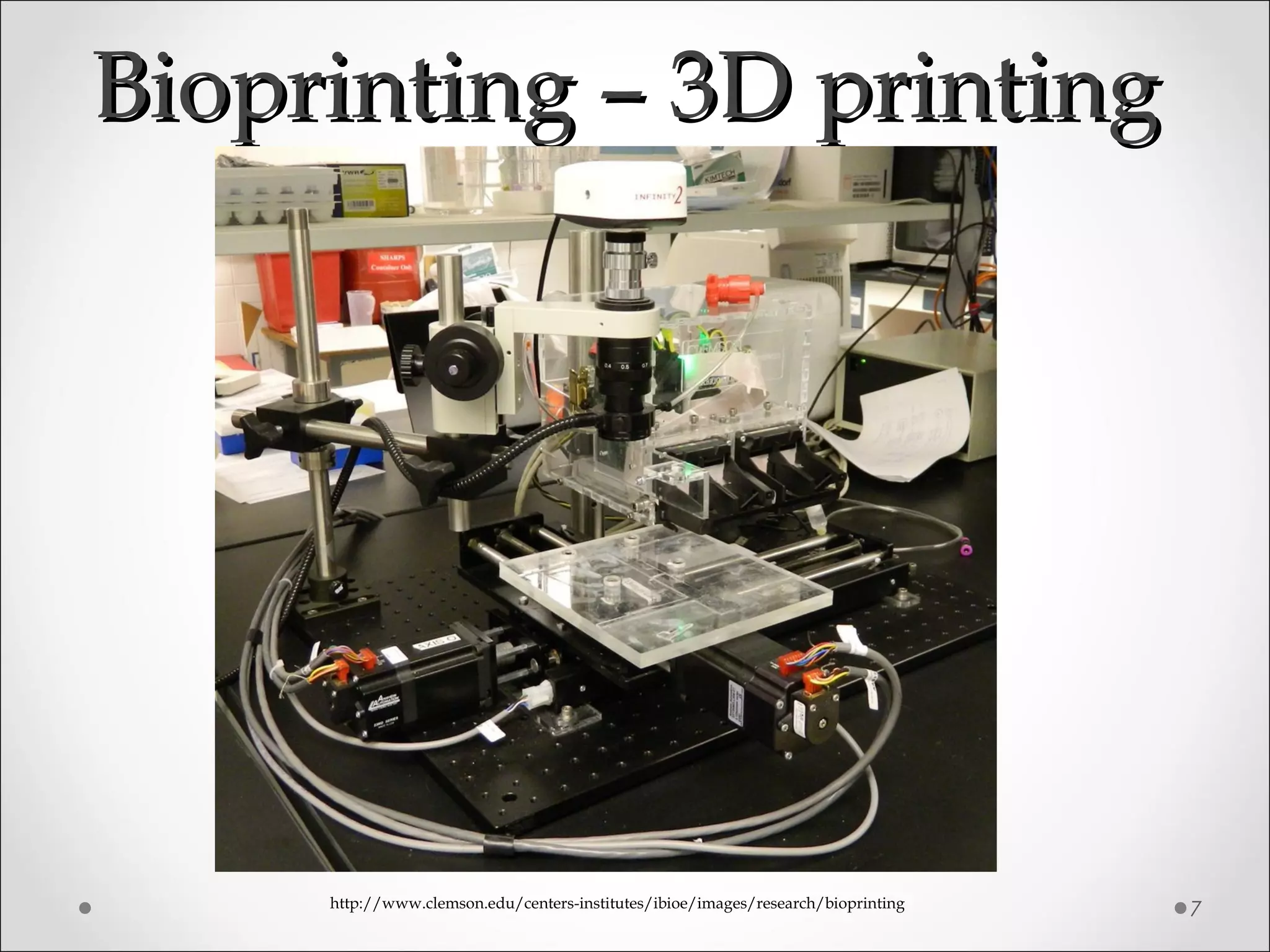
Bioprinting – 3D printingBioprinting – 3D printing
7http://www.clemson.edu/centers-institutes/ibioe/images/research/bioprinting
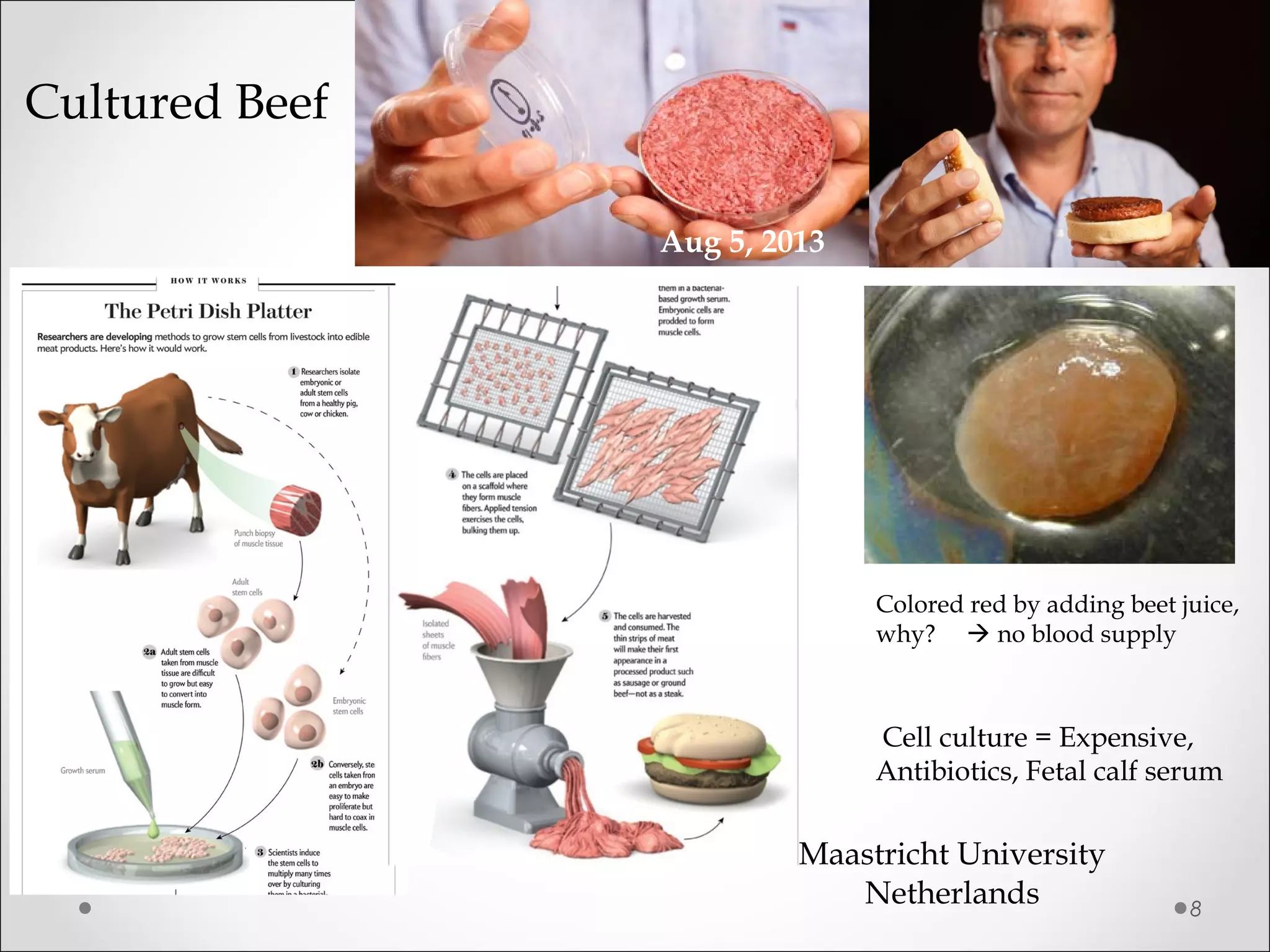
8
Aug 5, 2013
Cultured Beef
Cell culture = Expensive,
Antibiotics, Fetal calf serum
Colored red by adding beet juice,
why?  no blood supply
Maastricht University
Netherlands
9
http://yclickit.com/wp-content/uploads/2013/02/vlcsnap-2013-02-12-12h01m01s86.png
Cultured Meet
GraftsGrafts การปลูกถ่ายการปลูกถ่าย
อวัยวะอวัยวะ
• Autografts จากผู้ป่วยเองจากส่วนอื่นในร่างกาย มา
ซ่อมแซมส่วนที่เสียหาย เช่น การใช้กระดูดซี่โครงส่วน
ปลายหรือกระดูกจากใบหู ในการศัลยกรรมใบหน้า หรือ
ผิวหนัง
• Allografts จากผู้ให้บริจาค (human donors) เช่น การปลูก
ถ่ายไต
• Xenografts จากสัตว์ เช่น ลิ้นหัวใจจากหมู วัว
• Synthetic biomaterials วัสดุสังเคราะห์ เช่น titanium bone,
การฟอกไต, pace maker
• Tissue engineering เป็นการสร้างเนื้อเยื่อขึ้นมาใหม่ โดย
10
Inert Graft
Bioactive Graft
(Graft + Bioactive Factors)
Synthetic Cell-Free
Approaches
Grafts
Autograft
Combination
Morbidity at donor site Immunogenicity/ Disease
Transmission/ Variable
efficiency
Allograft
Immunogenicity/ Complex
material property problems
Rejection
Tissue Engineering
Why Tissue Engineering?Why Tissue Engineering?
12
http://biomed.brown.edu/Courses/BI108/BI
108_2007_Groups/group12/Homepage.html
http://www.nature.com/nature/journal/v
414/n6859/fig_tab/414118a0_F1.html
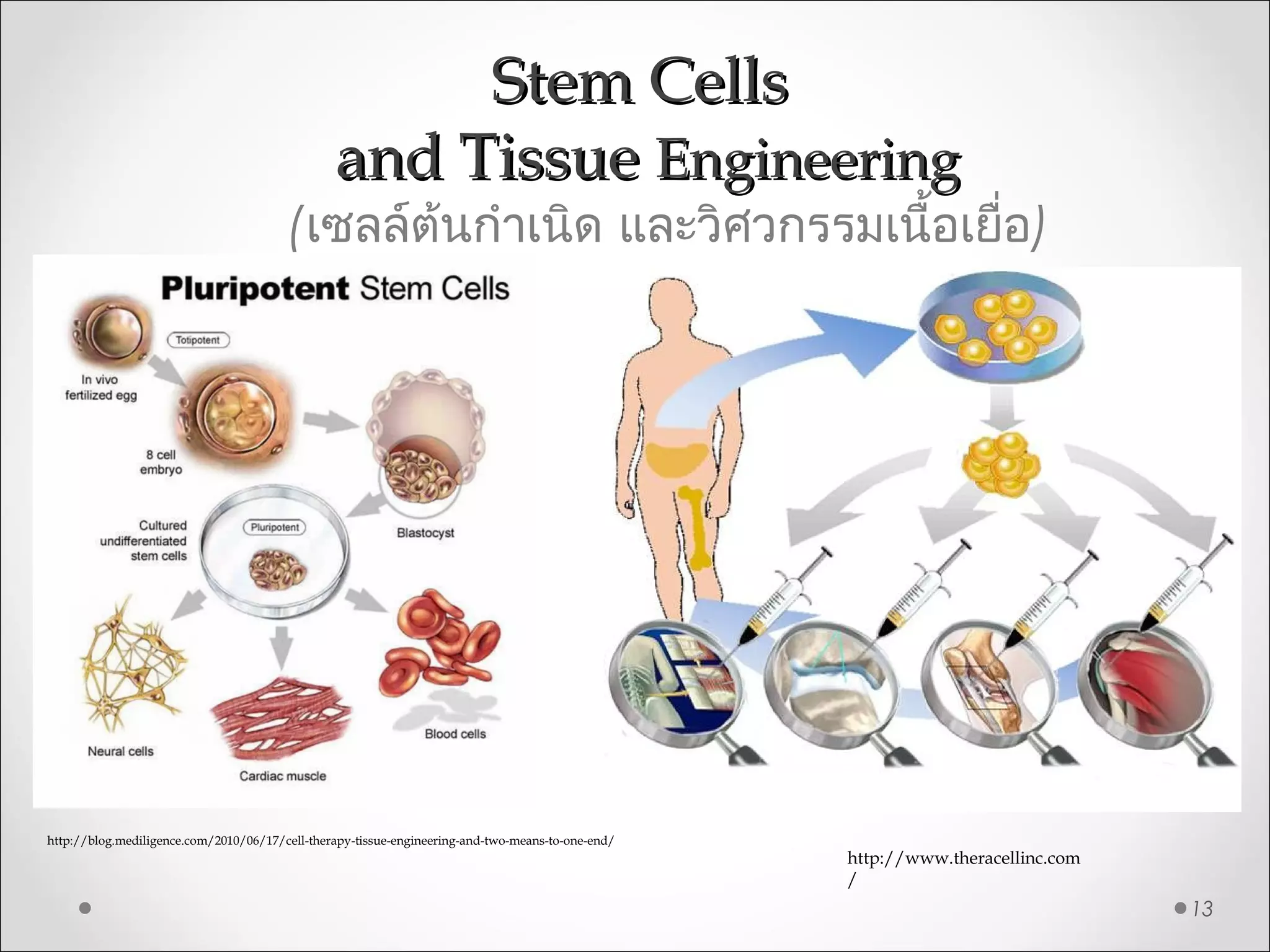
Stem CellsStem Cells
and Tissueand Tissue EngineeringEngineering
(เซลล์ต้นกำาเนิด และวิศวกรรมเนื้อเยื่อ)
13
http://www.theracellinc.com
/
http://blog.mediligence.com/2010/06/17/cell-therapy-tissue-engineering-and-two-means-to-one-end/
Stem Cells Isolation and PreservationStem Cells Isolation and Preservation
การคัดแยกและเก็บรักษาเซลล์ต้นกำาเนิดการคัดแยกและเก็บรักษาเซลล์ต้นกำาเนิด
14
http://www.genengnews.com/gen-news-highlights/fda-grants-510-k-clearance-for-
life-technologies-mesenchymal-stem-cell-medium/81244813/
http://rbg-web2.rbge.org.uk/bbs/learning/exsitu/exsitu.htm
www.yalescientific.org
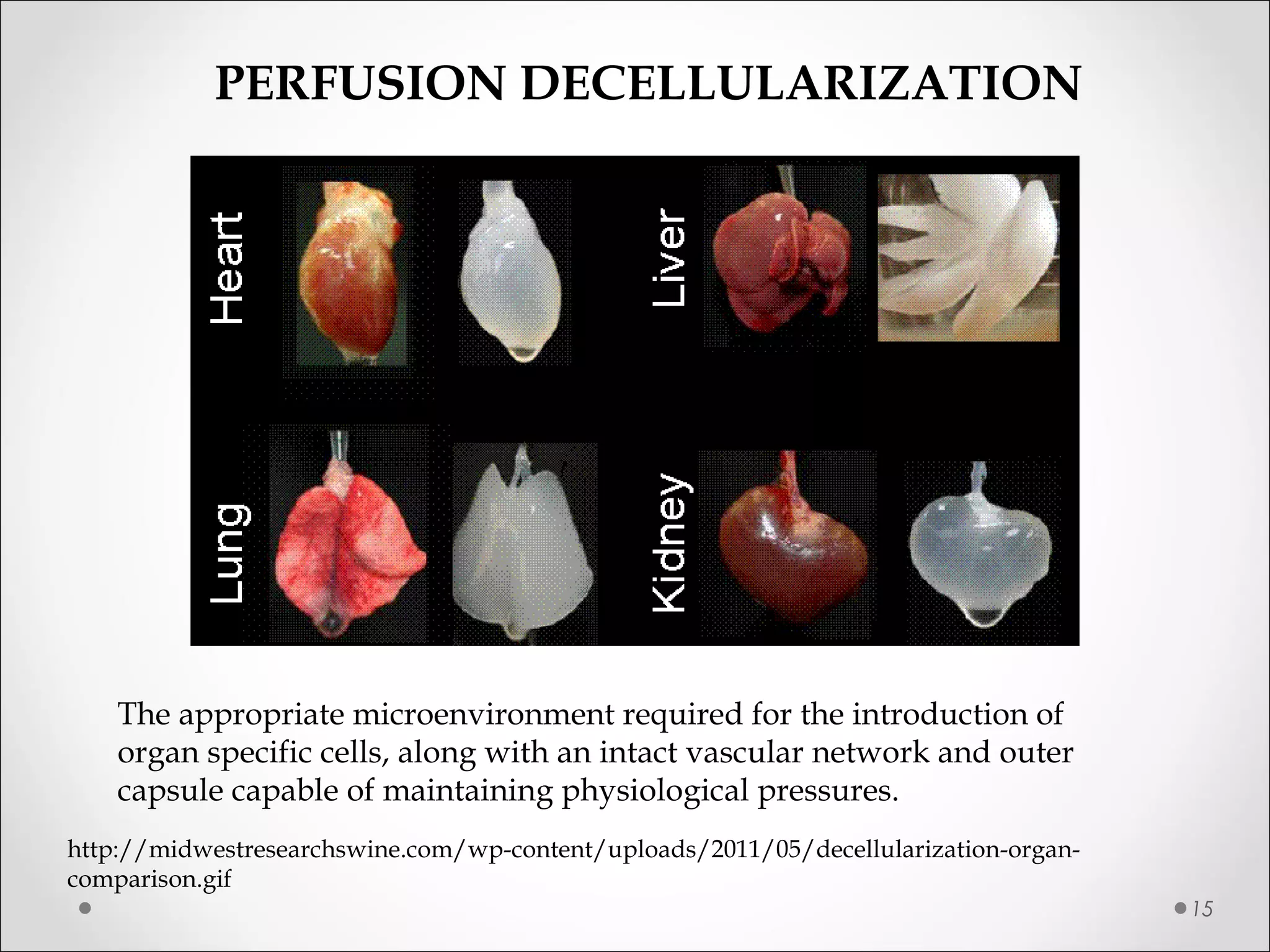
15
http://midwestresearchswine.com/wp-content/uploads/2011/05/decellularization-organ-
comparison.gif
PERFUSION DECELLULARIZATION
The appropriate microenvironment required for the introduction of
organ specific cells, along with an intact vascular network and outer
capsule capable of maintaining physiological pressures.
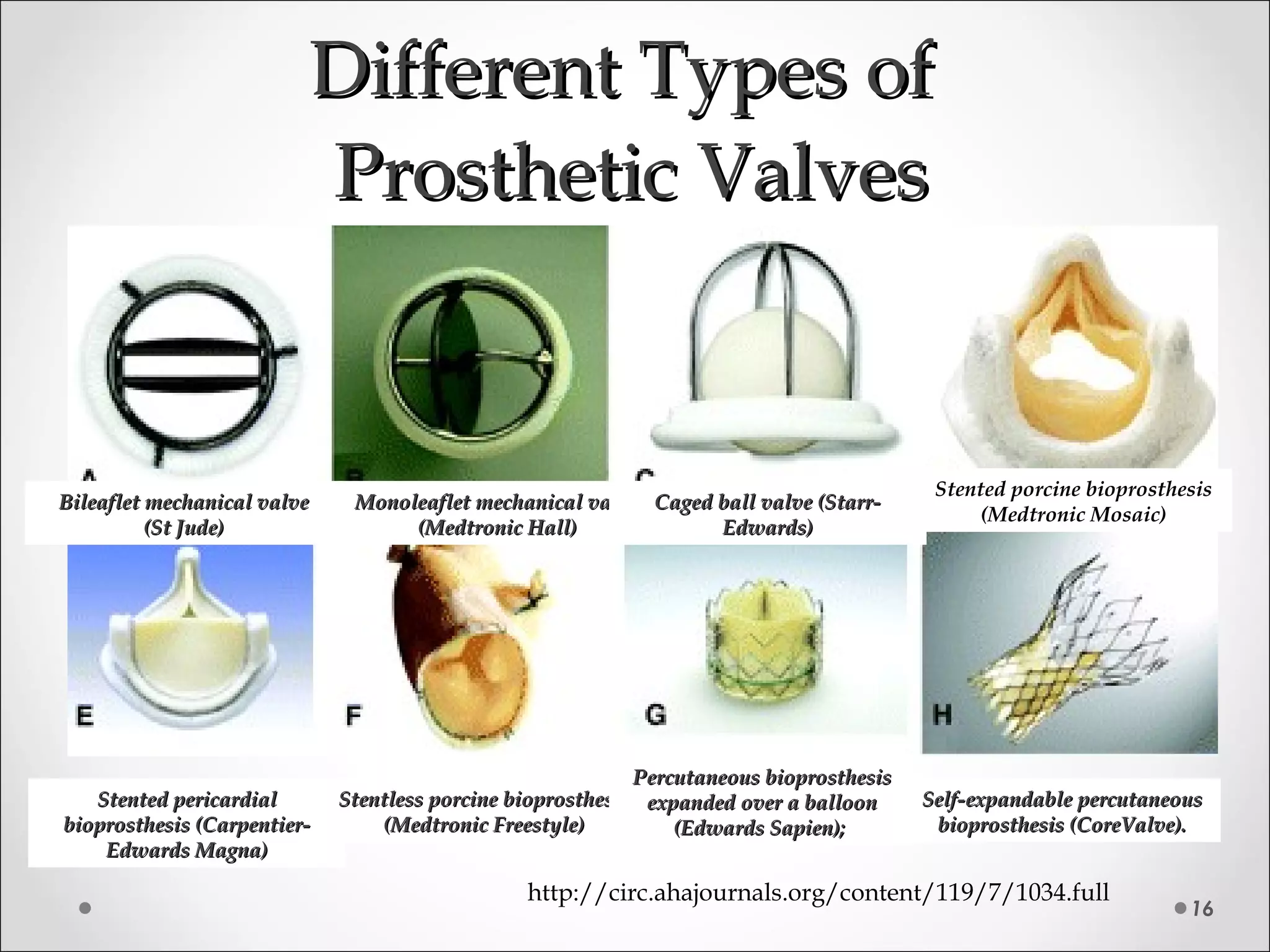
Different Types ofDifferent Types of
Prosthetic ValvesProsthetic Valves
16
Bileaflet mechanical valveBileaflet mechanical valve
(St Jude)(St Jude)
Monoleaflet mechanical valveMonoleaflet mechanical valve
(Medtronic Hall)(Medtronic Hall)
Caged ball valve (Starr-Caged ball valve (Starr-
Edwards)Edwards)
Stented porcine bioprosthesis
(Medtronic Mosaic)
Stented pericardialStented pericardial
bioprosthesis (Carpentier-bioprosthesis (Carpentier-
Edwards Magna)Edwards Magna)
Stentless porcine bioprosthesisStentless porcine bioprosthesis
(Medtronic Freestyle)(Medtronic Freestyle)
Percutaneous bioprosthesisPercutaneous bioprosthesis
expanded over a balloonexpanded over a balloon
(Edwards Sapien);(Edwards Sapien);
Self-expandable percutaneousSelf-expandable percutaneous
bioprosthesis (CoreValve).bioprosthesis (CoreValve).
http://circ.ahajournals.org/content/119/7/1034.full
Engineering of Skin Tissue
17
http://www.mdbiosciences.
com/in-vitro/3d-human-
skin-equivalent-model/
Culture of Human Skin Equivalent (HSE)
18
http://www.agilethinkers.com/johanna_rothman_qa/
http://blueeyednightowl.blogspot.com/2011/07/q.html
Tools and Methods in Biological StudiesTools and Methods in Biological Studies
19http://apps.pathology.jhu.edu/blogs/pathology/tissue-microarrays
http://www.genscript.com/images/Figure1-IP.jpg?src=dm
http://www.telegraph.co.uk/science/picture-
galleries/7397841/Creepy-crawlies-Amazing-
Scanning-Electron-Microscope-pictures-of-insects-
and-spiders.html
http://fineartamerica.com/featured/1-hacat-
culture-cells-light-micrograph-dr-torsten-
wittmann.html
http://www.gala-instrumente.de/images/deben_CCD_Cilia.jpghttp://onlinelibrary.wiley.com/doi/10.1111/php.2012.88.issue-4/issuetoc
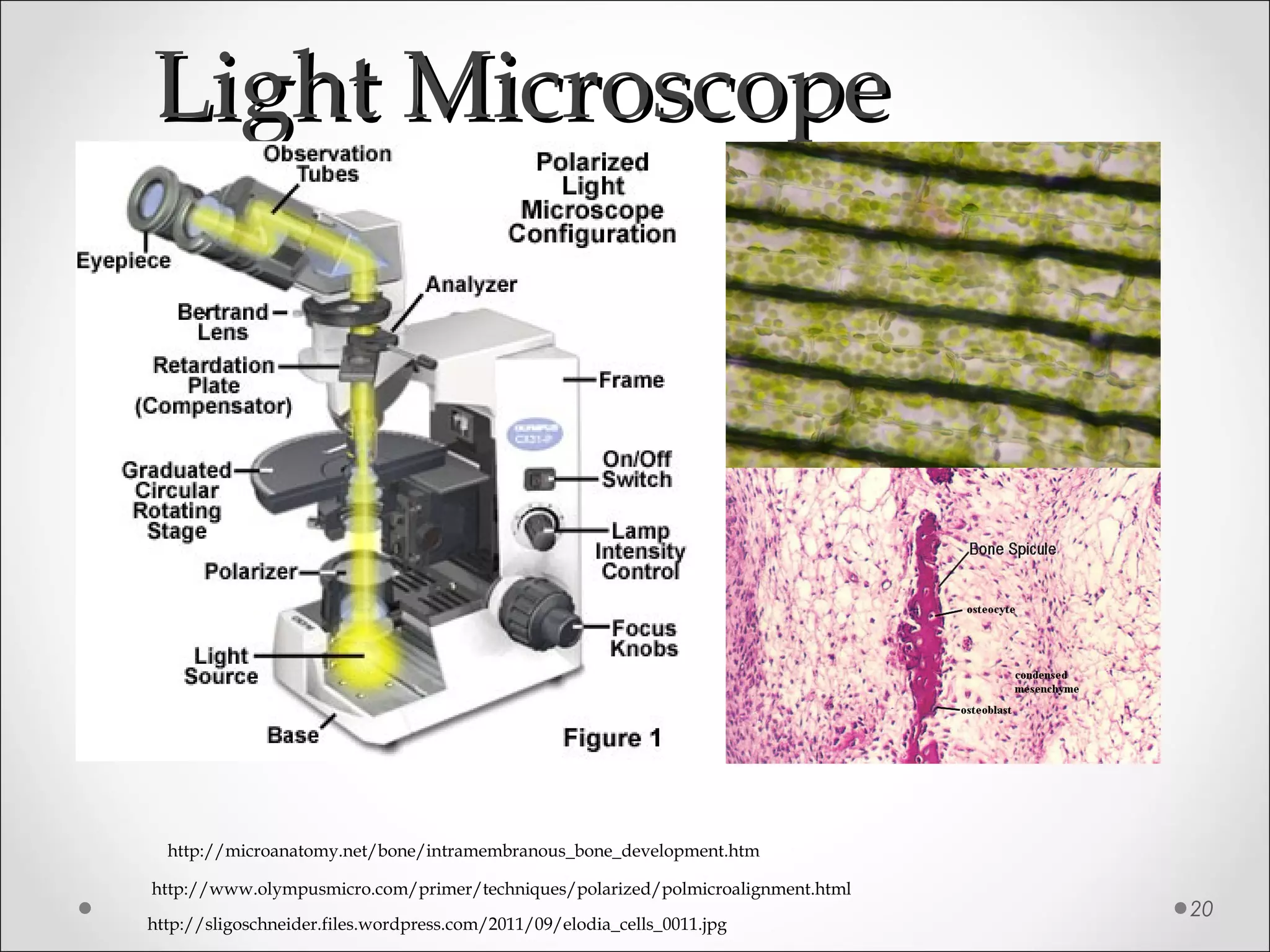
Light MicroscopeLight Microscope
20
http://www.olympusmicro.com/primer/techniques/polarized/polmicroalignment.html
http://sligoschneider.files.wordpress.com/2011/09/elodia_cells_0011.jpg
http://microanatomy.net/bone/intramembranous_bone_development.htm
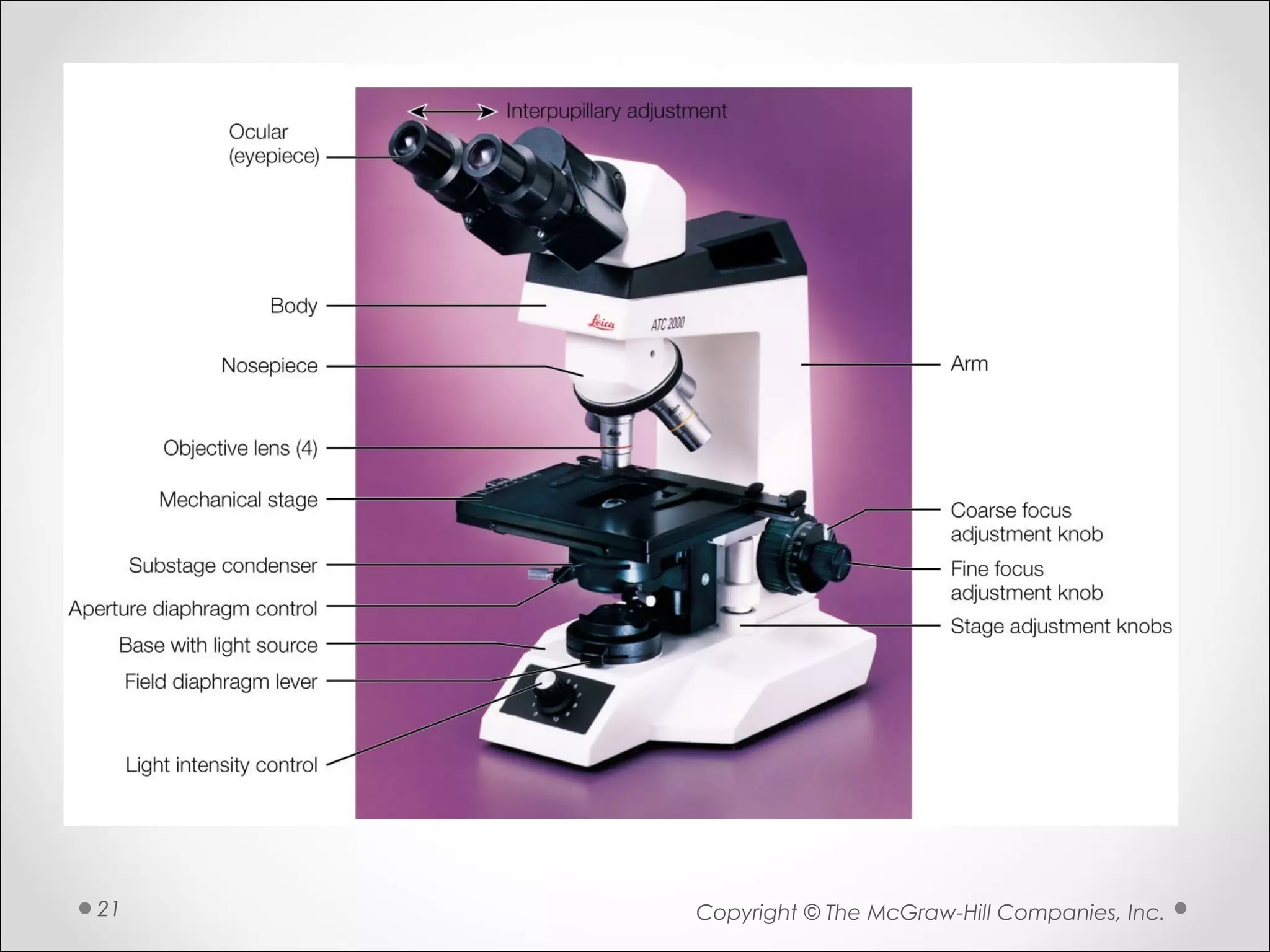
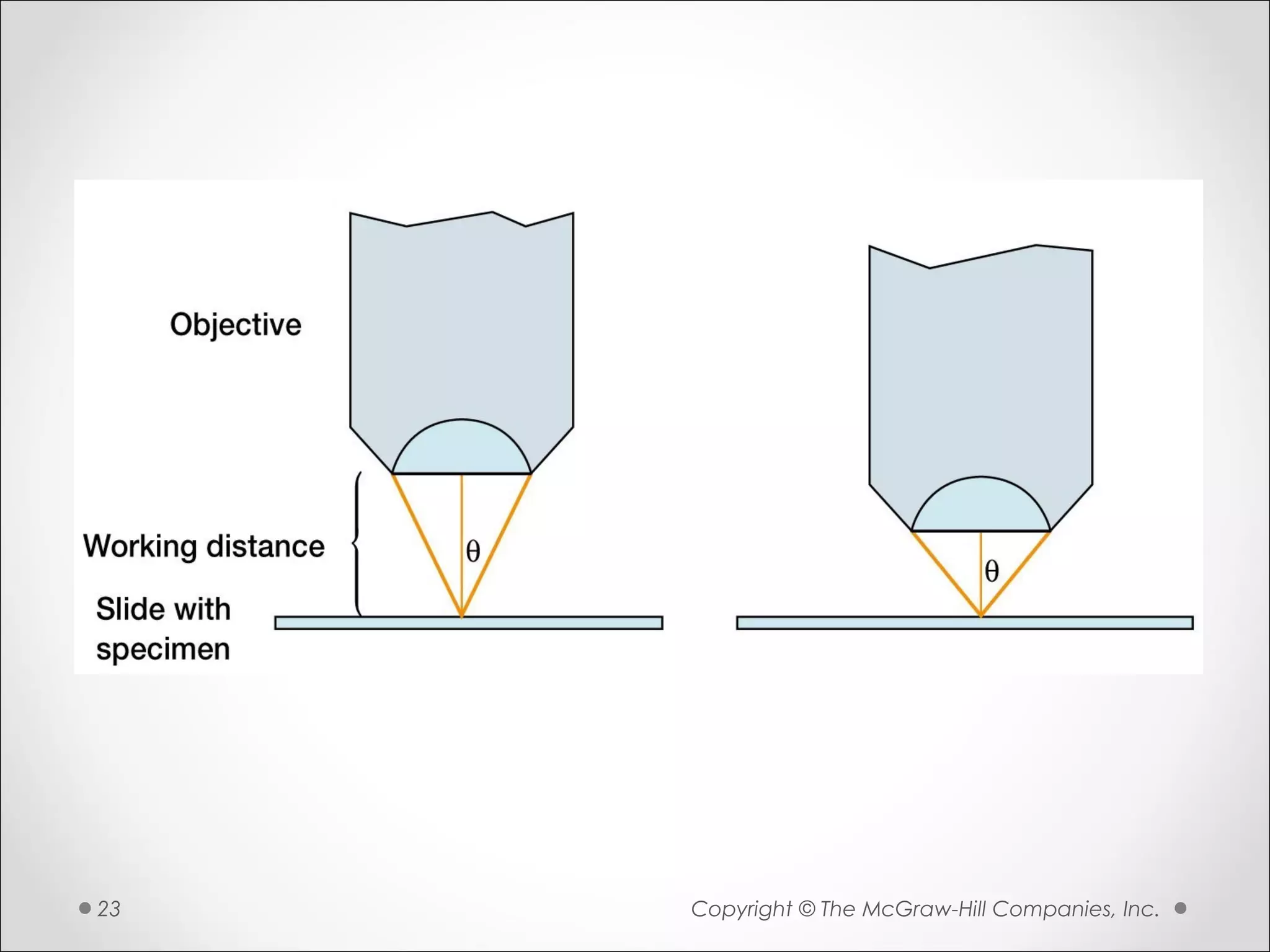
Copyright © The McGraw-Hill Companies, Inc.21
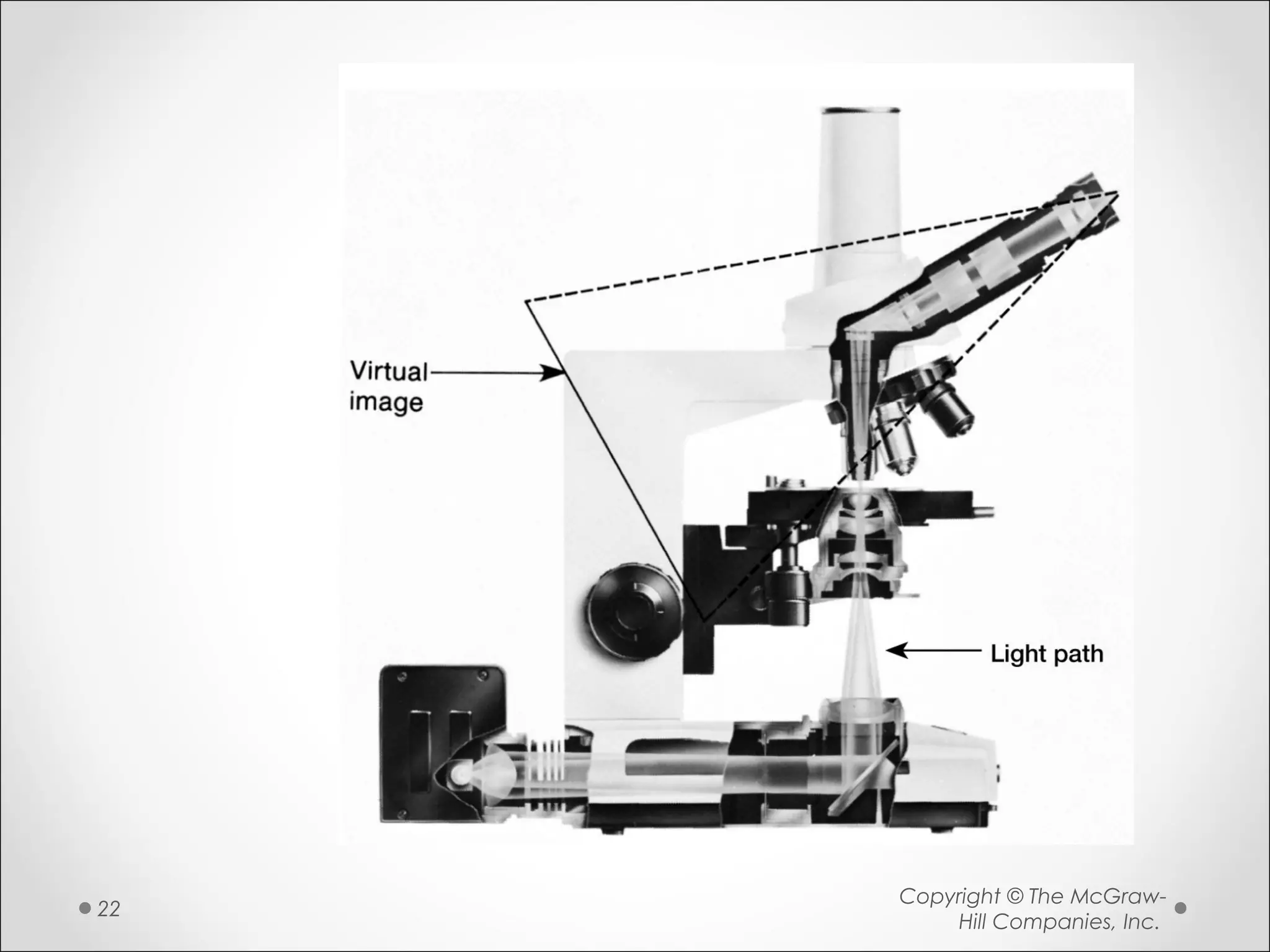
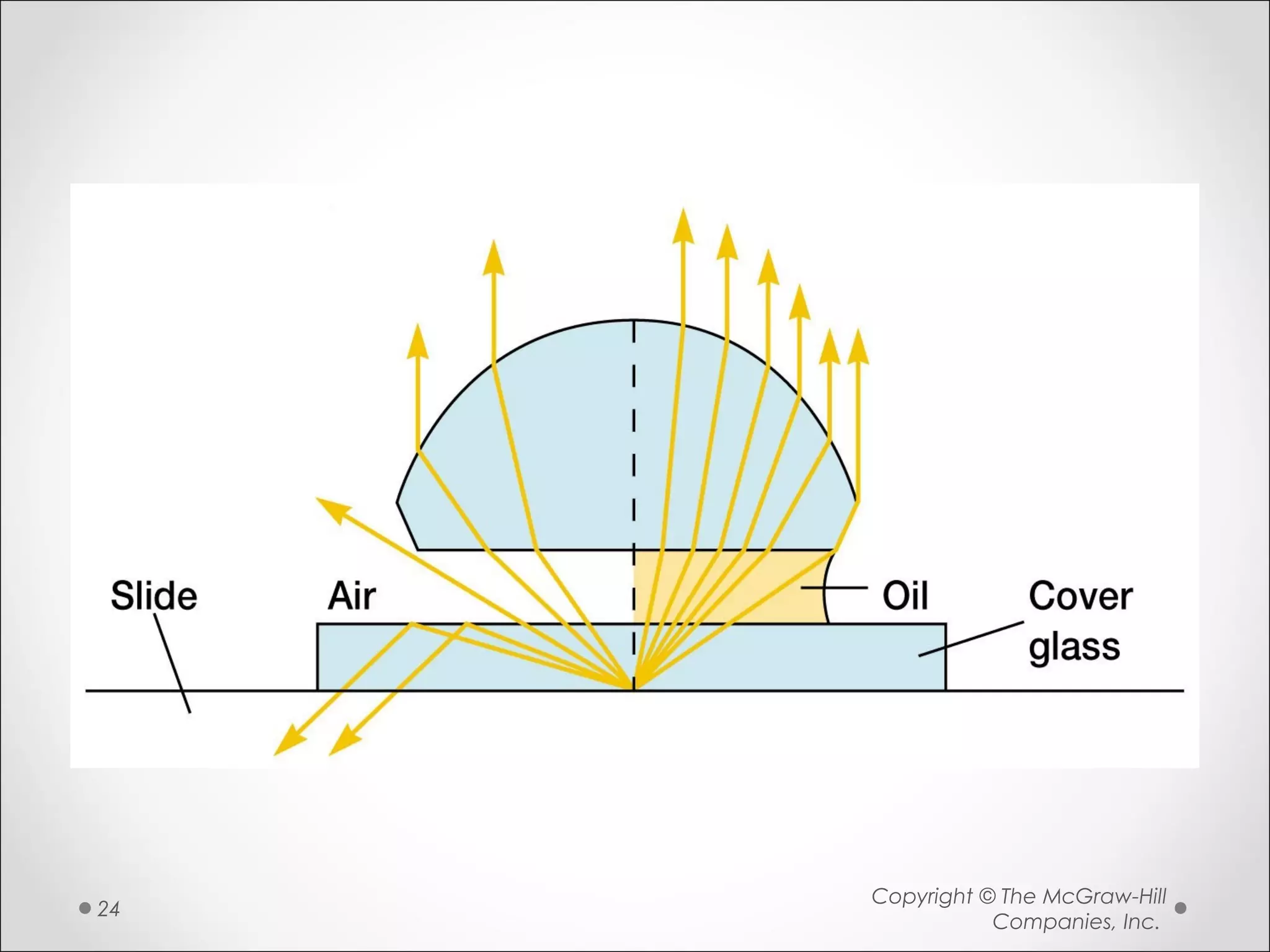
Copyright © The McGraw-
Hill Companies, Inc.
22
Copyright © The McGraw-Hill Companies, Inc.23
Copyright © The McGraw-Hill
Companies, Inc.
24
Copyright © The McGraw-
Hill Companies, Inc.
25
26
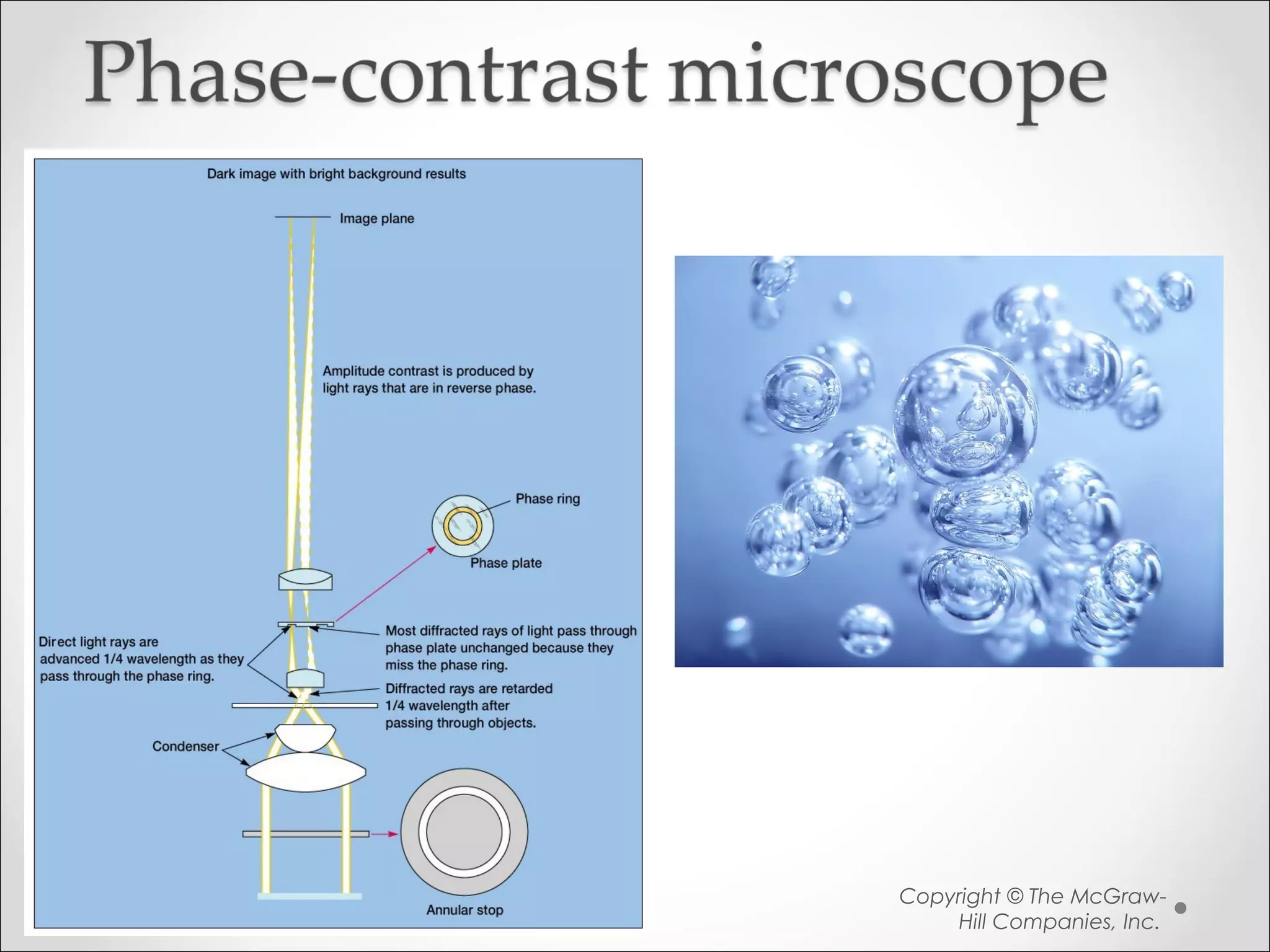
Phase-contrast microscopePhase-contrast microscope
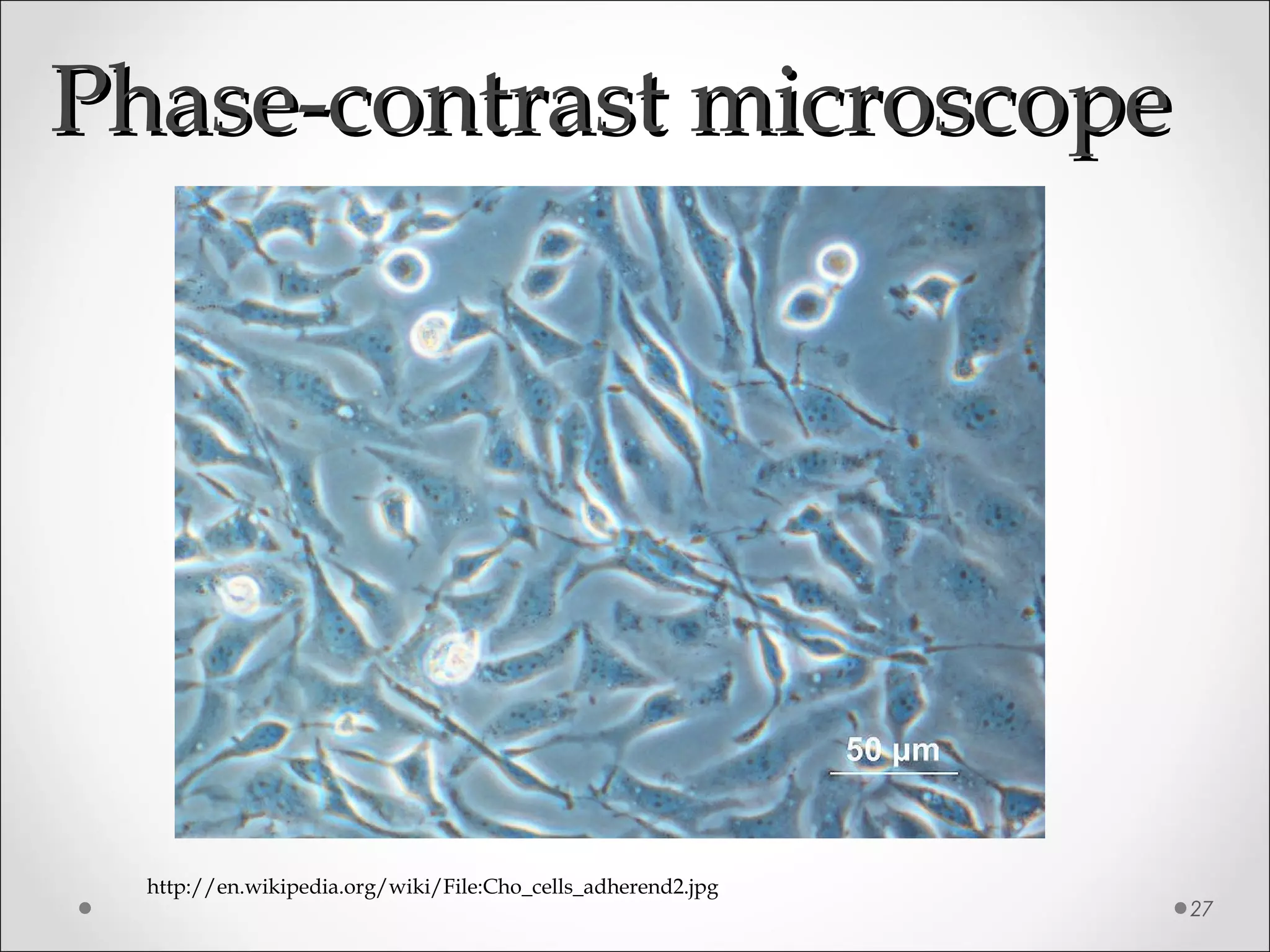
27
http://en.wikipedia.org/wiki/File:Cho_cells_adherend2.jpg
Laminar flow hood
Incubator
Microcentrifuge
Vortex
Water bath
Centrifuge
เครื่องมือเครื่องมือ
Digital scale
เครื่องมือเครื่องมือ
Hot air oven
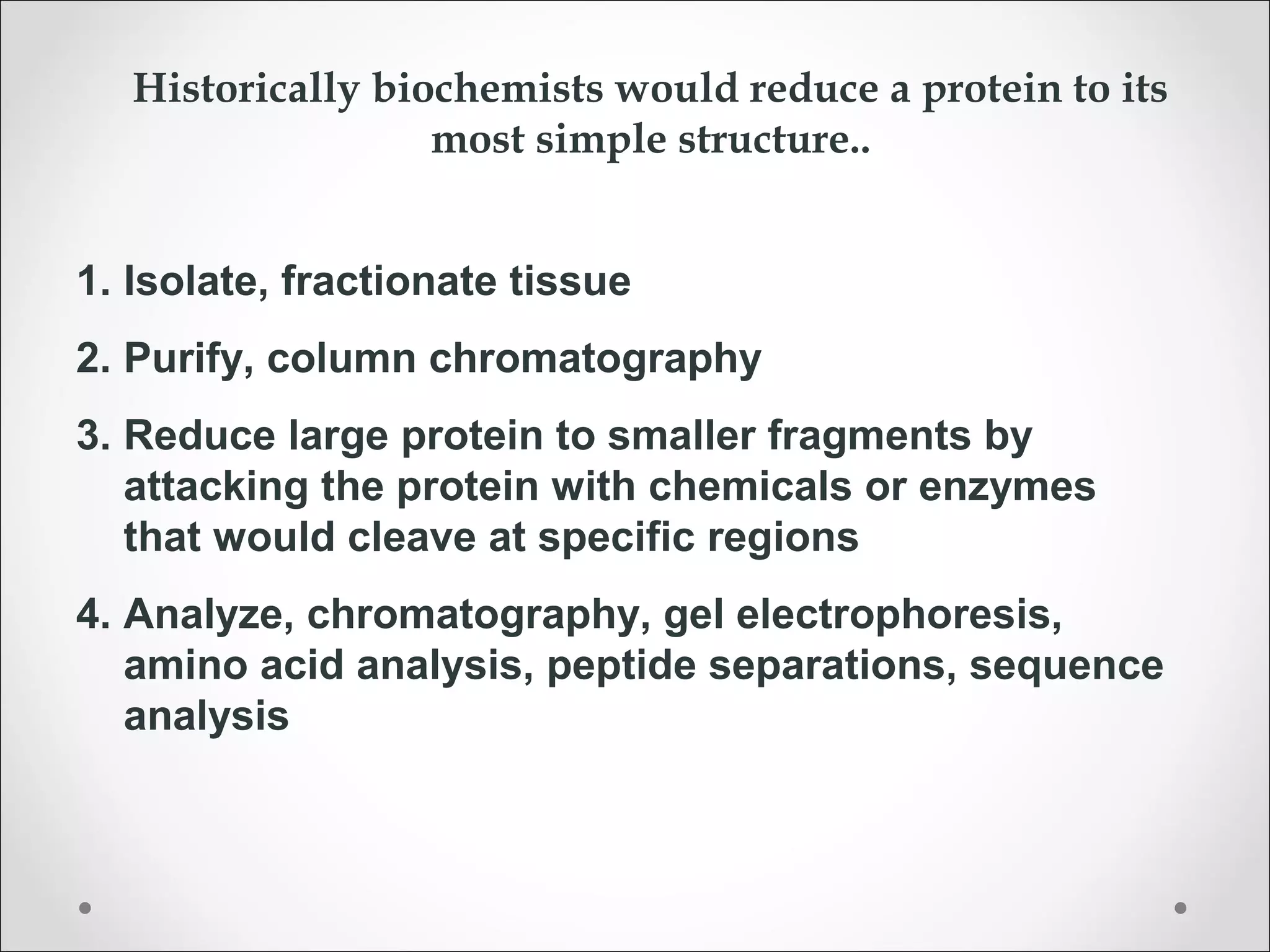
Historically biochemists would reduce a protein to its
most simple structure..
1. Isolate, fractionate tissue
2. Purify, column chromatography
3. Reduce large protein to smaller fragments by
attacking the protein with chemicals or enzymes
that would cleave at specific regions
4. Analyze, chromatography, gel electrophoresis,
amino acid analysis, peptide separations, sequence
analysis
44
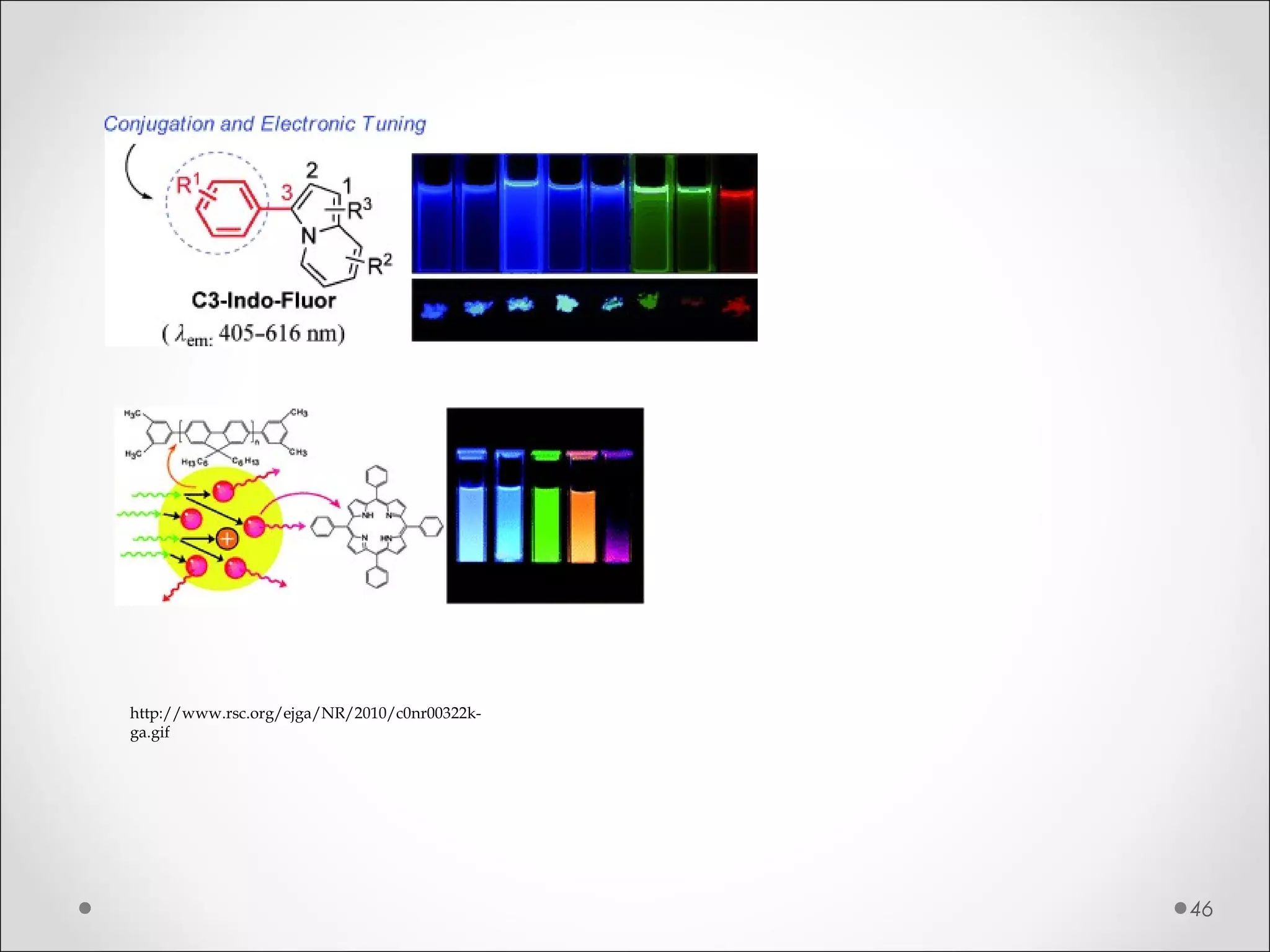
46
http://www.rsc.org/ejga/NR/2010/c0nr00322k-
ga.gif
47
BiomoleculesBiomolecules ชีวโมเลกุลชีวโมเลกุล
http://nanomedicine.ucsd.edu/research/tissue-engineering
BiomoleculesBiomolecules ชีวโมเลกุลชีวโมเลกุล
• Organic สารอินทรีย์ / Inorganic สารอนินทรีย์
• สารอนินทรีย์ = นำ้า และ แร่ธาตุ
• สารอินทรีย์ = มี คาร์บอน และ ไฮโดรเจน เป็น
องค์ประกอบสำาคัญ
o Carbohydrate คาร์โบไฮเดรต เช่น นำ้าตาล
แป้ง
o Protein โปรตีน เช่น กรดอะมิโน คอลลาเจน
เอนไซม์
o Lipid ไขมัน ได้แก่ Fat, Oils, Phospholipids,
Steroids, Waxes
o Nucleic acid กรดนิวคลีอีก ATP, DNA, RNA 48
Inorganic VS Organic MoleculesInorganic VS Organic Molecules
49
http://classconnection.s3.amazonaws.com/359/flashcards/551359/jpg/inorganic_versus_organic_molecules1306681267242.jpg
BiomoleculesBiomolecules
50
From Carbon atom (4 electron at the outer valence shell = 4 bonds
with H, N, O, P, S or C itself… to make stable)
http://d1jqu7g1y74ds1.cloudfront.net/wp-content/uploads/2010/02/c-atom_e.gif
http://bilingualbiology11a.blogspot.com/2010/09/lesson-2-chemistry-of-life-organic.html
Functional GroupsFunctional Groups
51
http://guweb2.gonzaga.edu/faculty/cronk/CHEM198pub/L11-index.cfm?L11resource=functional_groups
CarbohydrateCarbohydrate
52
• แหล่งพลังงาน เช่น นำ้าตาล แป้ง ไกลโคเจนแหล่งพลังงาน เช่น นำ้าตาล แป้ง ไกลโคเจน
• โครงสร้างเซลล์ เช่น เซลลูโลสในผนังเซลล์พืชโครงสร้างเซลล์ เช่น เซลลูโลสในผนังเซลล์พืช,, ไคตินไคติน
ในกระดองปู หรือ เปปทิโดไกลแคนในกระดองปู หรือ เปปทิโดไกลแคน (peptidoglycan)(peptidoglycan)
ในผนังเซลล์ของแบคทีเรียในผนังเซลล์ของแบคทีเรีย
• องค์ประกอบหลัก คือ คาร์บอนองค์ประกอบหลัก คือ คาร์บอน,, ไฮโดรเจนไฮโดรเจน,, และและ
ออกซิเจนออกซิเจน
• อัตราส่วนของอัตราส่วนของ C:H:OC:H:O ส่วนใหญ่เป็นส่วนใหญ่เป็น 1:2:11:2:1
• Monosaccharide, Disaccharide, PolysaccharidesMonosaccharide, Disaccharide, Polysaccharides
http://cnx.org/content/m46008/latest/?collection=col11540/latest
CarbohydrateCarbohydrate
53
Monosaccharide, Disaccharide, PolysaccharidesMonosaccharide, Disaccharide, Polysaccharides
http://cnx.org/content/m46008/latest/?collection=col11540/latest
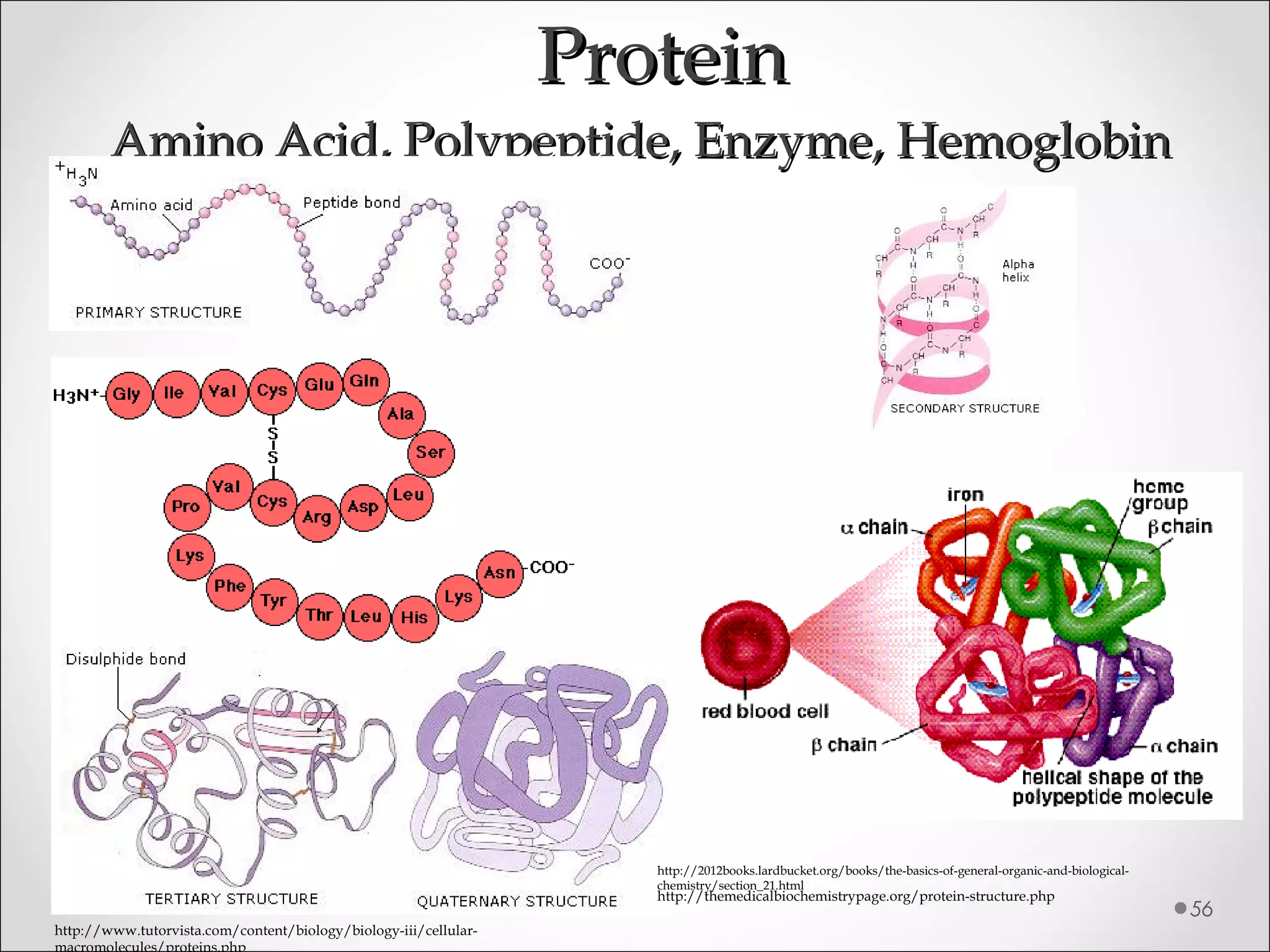
ProteinProtein
C, H, O, N plus S, PC, H, O, N plus S, P
• ประกอบด้วยกรดอะมิโน
• เซลล์ทั่วไป มีโปรตีนเป็นองค์ประกอบมากกว่า 50%
ของนำ้าหนักแห้ง
• โครงร่างและคำ้าจุน keratin, collagen
• เอนไซม์ ควบคุมการทำางานของร่างกาย เช่น
phosphatase, insulin, hemoglobin
• Peptide bond เกิดจาก dehydration ของ หมู่
carboxyl กับหมู่ amiono
http://www.clinicares.com/clinical_data.hthttp://www.whitetigernaturalmedicine.com/wp-content/uploads/2012/02/amino-acid-
structure.jpg
ProteinProtein
Shape and StructureShape and Structure
• Primary Structure: Polypeptide ที่เรียงตัวต่อกัน
ลำาดับตามที่ถอดรหัสจากพันธุกรรม
• Secondary Structure: มีการขดเกลียว (alpha
helix) หรือพับไปมาเป็นจีบ (Beta pleated sheet)
• Tertiary structure: โครงสร้างสามมิติที่เกิดจากพันธะ
ต่างๆ
• (H-bond, ionic, covalent, disulfide)
หรือhydrophobic interaction ของ R-group ใน
กรดอะมิโน
• Quaternary structure ประกอบด้วยมากกว่า หนึ่ง
ProteinProtein
56
Amino Acid, Polypeptide, Enzyme, HemoglobinAmino Acid, Polypeptide, Enzyme, Hemoglobin
http://www.tutorvista.com/content/biology/biology-iii/cellular-
macromolecules/proteins.php
http://2012books.lardbucket.org/books/the-basics-of-general-organic-and-biological-
chemistry/section_21.html
http://themedicalbiochemistrypage.org/protein-structure.php
Protein: CollagenProtein: Collagen
http://www.1234yourhealth.com/collagen_body.php
LipidLipid• มีมี C, H, OC, H, O เหมือน คาร์โบไฮเดรต แต่อัตราส่วนของเหมือน คาร์โบไฮเดรต แต่อัตราส่วนของ
ธาตุและคุณสมบัติต่างกันธาตุและคุณสมบัติต่างกัน
• ไม่ละลายนำ้า แต่ละลายได้ดีในตัวทำาละลายอื่นไม่ละลายนำ้า แต่ละลายได้ดีในตัวทำาละลายอื่น
• Fat, Oils, Phospholipids, Steroids, WaxesFat, Oils, Phospholipids, Steroids, Waxes
http://www.yumsugar.com/Burning-Question-How-Come-Recipes-Call-Oil-Butter-7124992
http://stilettosontheglassceiling.com/wp-content/uploads/2013/11/good-fat.jpg
Fat and OilsFat and Oils
http://www.citycollegiate.com/biochemistry5.htm
• ประกอบด้วย กรดไขมันและ
กลีเซอรัล (fatty acid +
glycerol)
• สายไฮโดรคาร์บอน ที่มี –
COOH (carboxyl group)
อยู่ที่ปลายสุดของโมเลกุล
• กรดไขมันอิ่มตัว
(saturated fatty acid)
• กรดไขมันไม่อิ่มตัว
(unsaturated fatty acid)
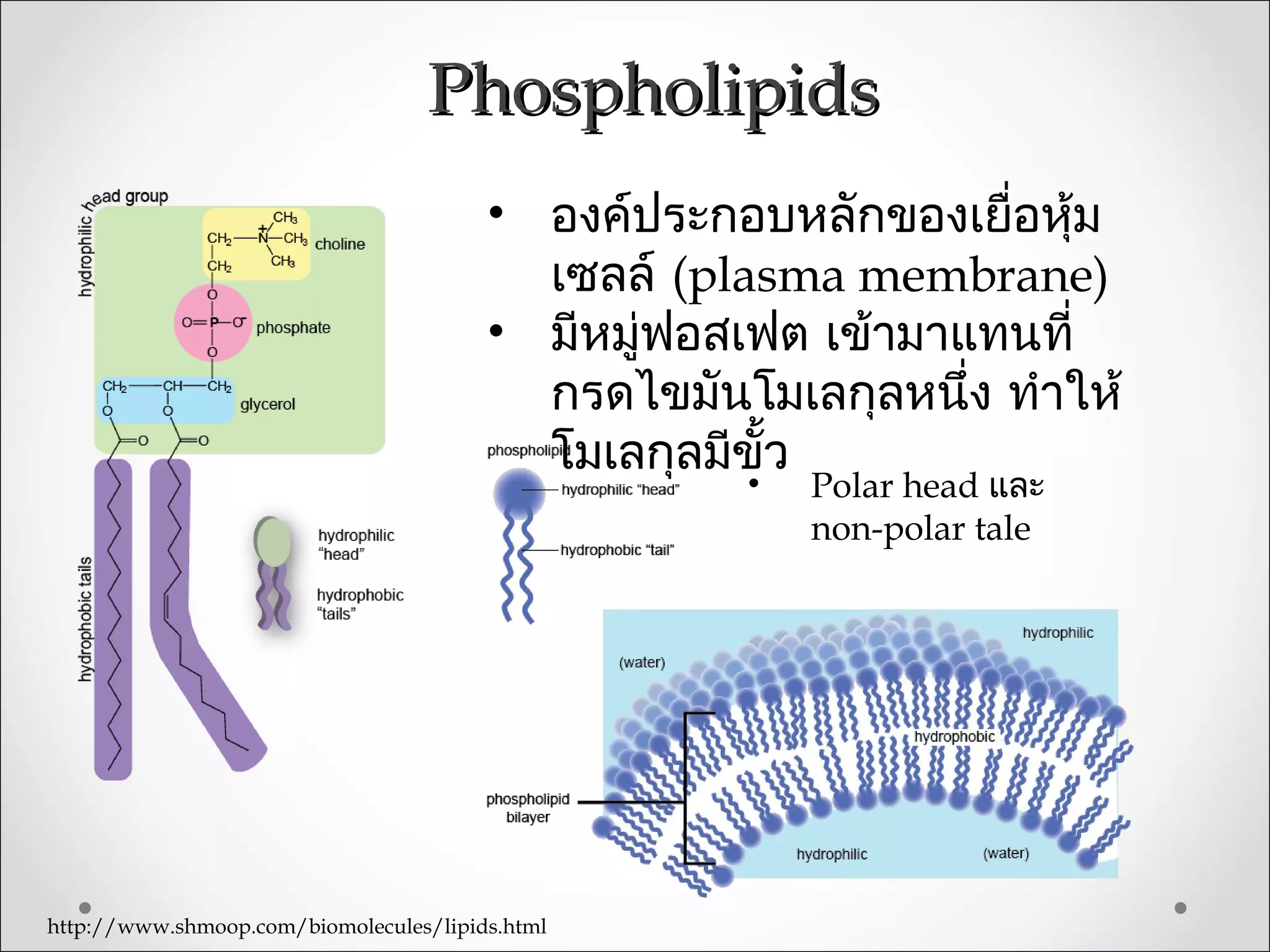
PhospholipidsPhospholipids
http://www.shmoop.com/biomolecules/lipids.html
• องค์ประกอบหลักของเยื่อหุ้ม
เซลล์ (plasma membrane)
• มีหมู่ฟอสเฟต เข้ามาแทนที่
กรดไขมันโมเลกุลหนึ่ง ทำาให้
โมเลกุลมีขั้ว
• Polar head และ
non-polar tale
SteroidsSteroids
http://www.web-books.com/MoBio/Free/Ch1B3.htm
• โครงสร้างต่างจาก lipid
ชนิดอื่น
• องค์ประกอบหลักคือ 4
cycloalkane rings ที่
เชื่อมต่อกัน
• เช่น cholesterol,
testosterone, estrogen
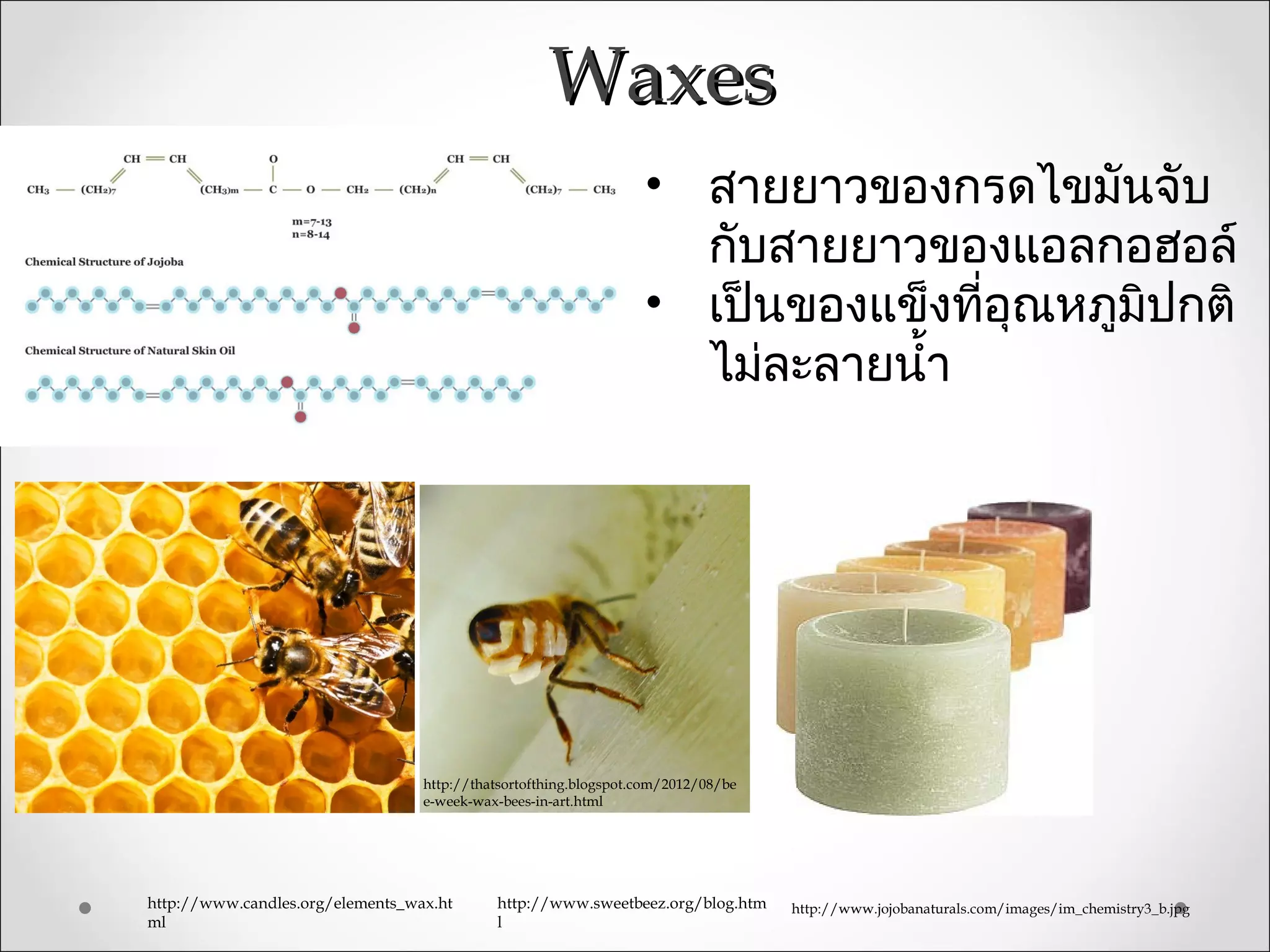
WaxesWaxes
• สายยาวของกรดไขมันจับ
กับสายยาวของแอลกอฮอล์
• เป็นของแข็งที่อุณหภูมิปกติ
ไม่ละลายนำ้า
http://www.candles.org/elements_wax.ht
ml
http://www.sweetbeez.org/blog.htm
l
http://www.jojobanaturals.com/images/im_chemistry3_b.jpg
http://thatsortofthing.blogspot.com/2012/08/be
e-week-wax-bees-in-art.html
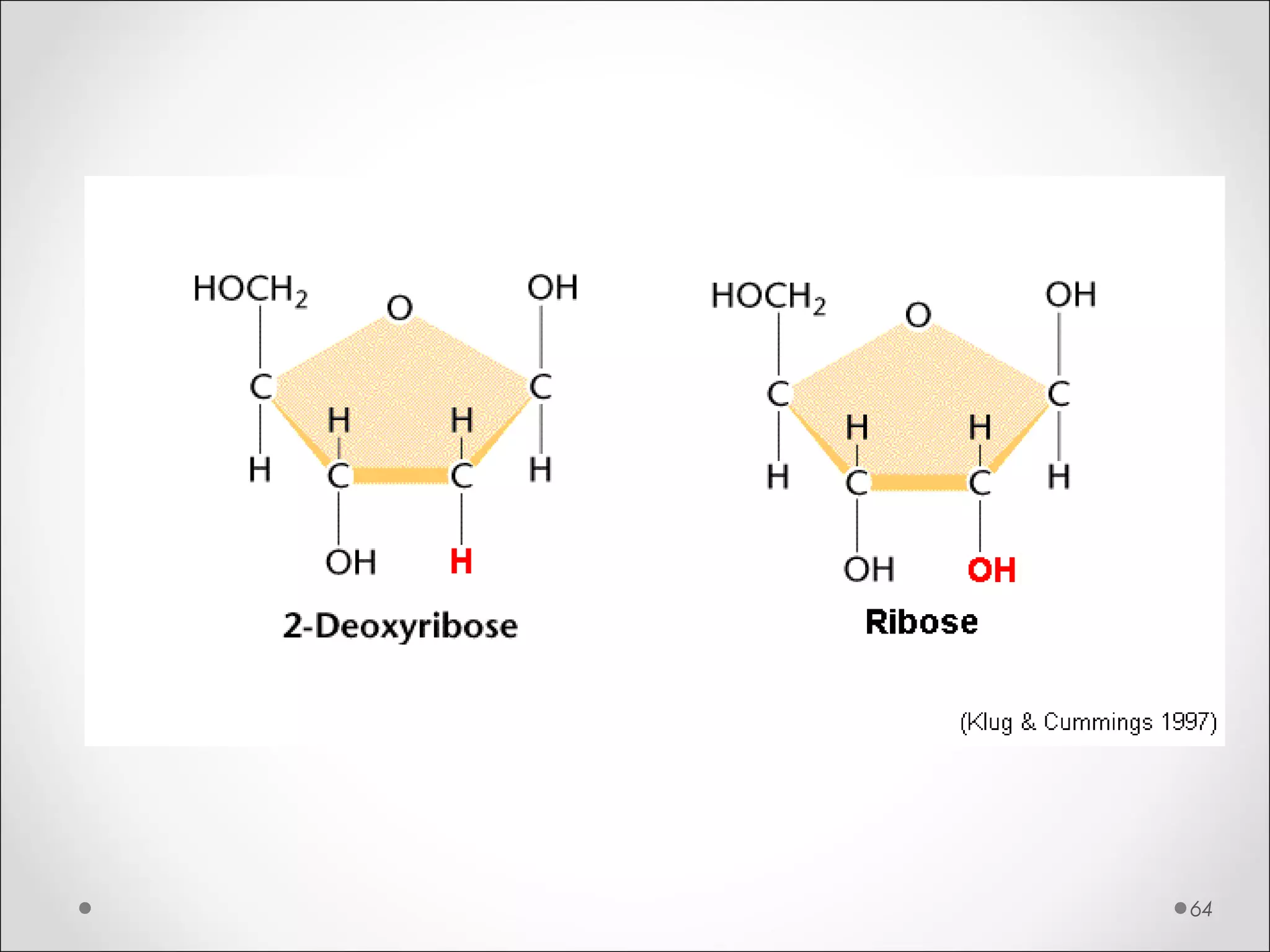
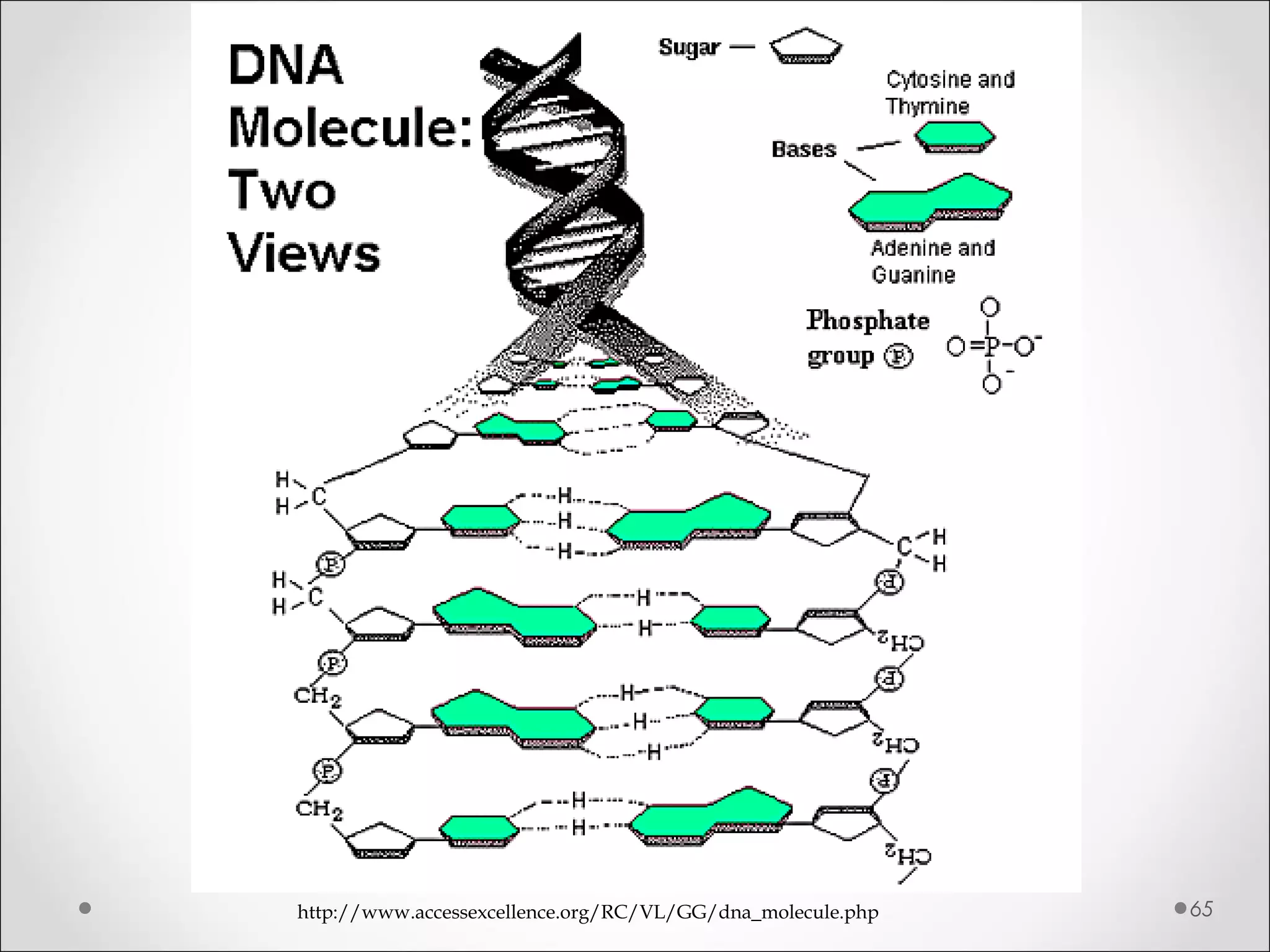
Nucleic AcidNucleic Acid
63
RNA DNA
ATP:
Adenosine triphosphate
Ribonucleic acid Deoxyribonucleic acid
64
65http://www.accessexcellence.org/RC/VL/GG/dna_molecule.php
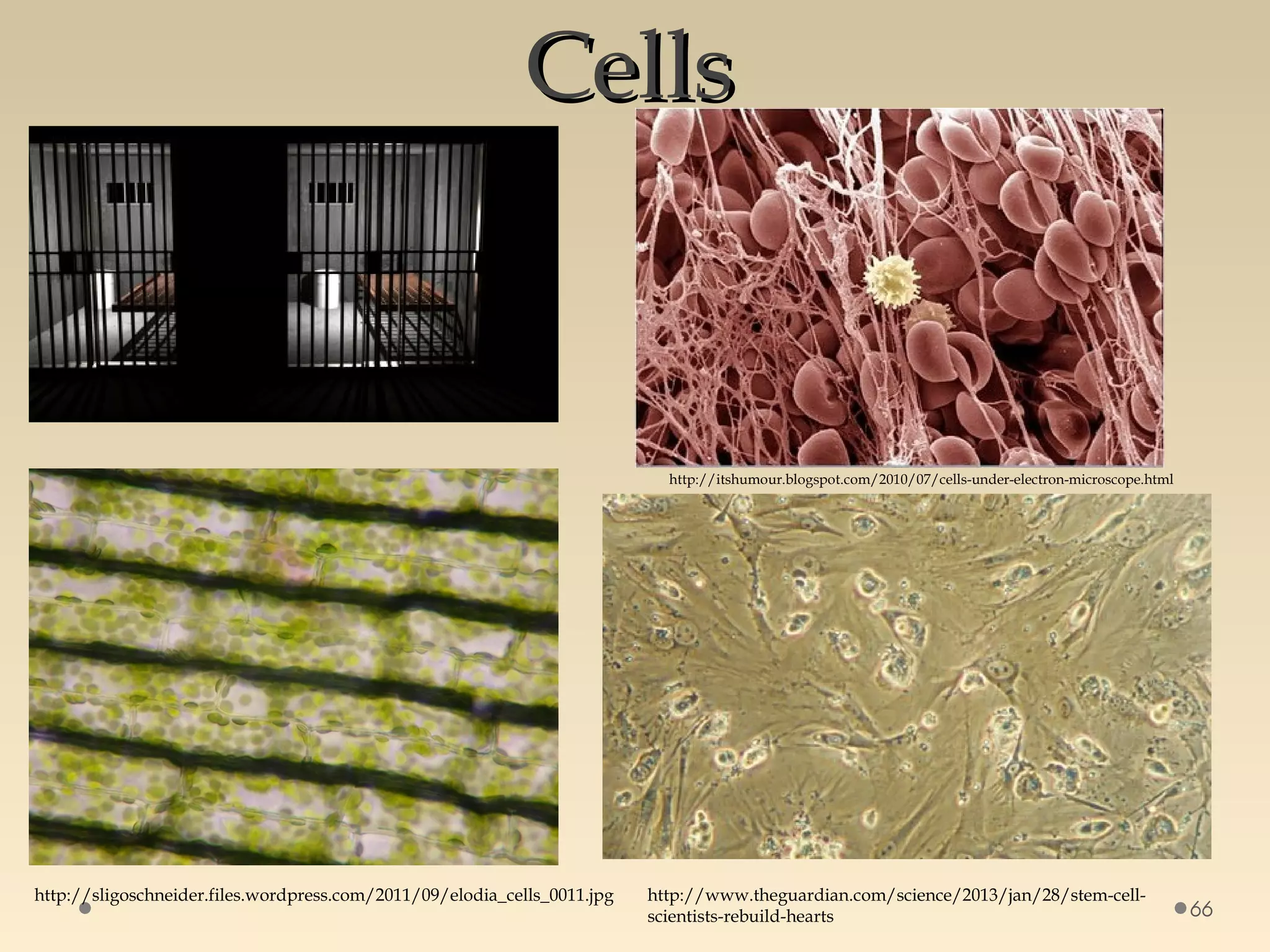
CellsCells
66
http://sligoschneider.files.wordpress.com/2011/09/elodia_cells_0011.jpg
http://itshumour.blogspot.com/2010/07/cells-under-electron-microscope.html
http://www.theguardian.com/science/2013/jan/28/stem-cell-
scientists-rebuild-hearts
Examples of human cells: Variations in shapes and sizes
http://iesbscience.files.wordpress.com/2013
/04/blood-cells.jpg
http://www.theoslotimes.com/not-all-sperm-are-able-to-successfully-fertilise-an-egg-
but-protein-could-give-ivf-couples-hope/
http://images.sciencedaily.com/2007/05/0705200
91842-large.jpg
Red Blood cell
Nerve
cell
Sperm and
egg
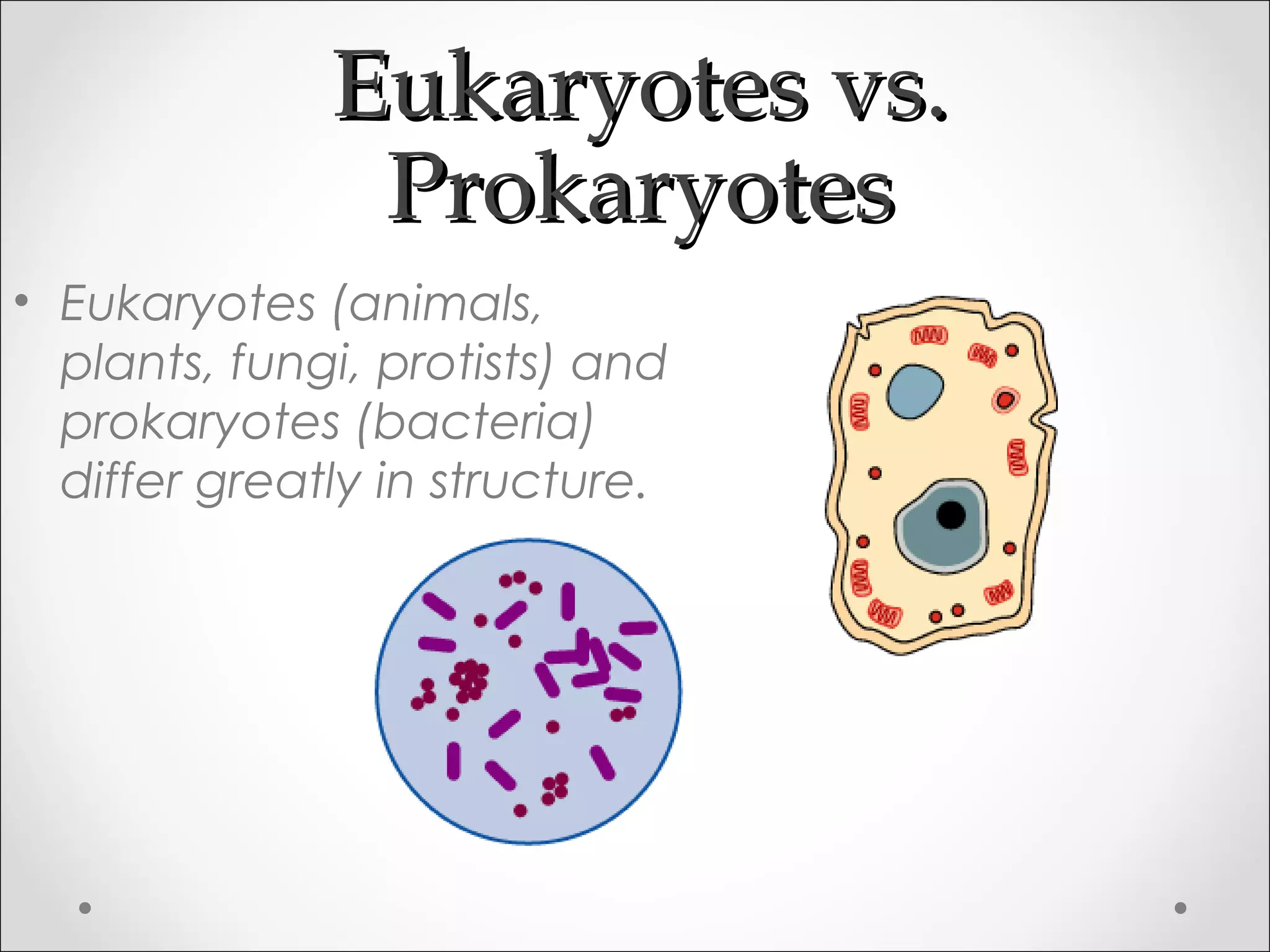
Eukaryotes vs.Eukaryotes vs.
ProkaryotesProkaryotes
• Eukaryotes (animals,
plants, fungi, protists) and
prokaryotes (bacteria)
differ greatly in structure.
Examples ofExamples of
Unicellular OrganismsUnicellular Organisms
• Amoeba
• Bacteria
• Some algae
• Yeasts
• Paramecium
http://www.microscopy-
uk.org.uk/mag/imgsep01/amoebaproteus450.j
pg
http://cdn.thedoctorschannel.com/wp-
content/uploads/2013/12/Bacteria-1.jpg
http://microbewiki.kenyon.edu/images/9/9a
/Saccromyces.jpg
http://upload.wikimedia.org/
wikipedia/commons/thumb/c
/cb/Paramecium.jpg/610px-
Paramecium.jpg
http://protist.i.hosei.ac.jp/PDB4/PCD2851/C/11.jpg
MulticellularMulticellular
OrganismsOrganisms
http://jonlieffmd.com/wp-
content/uploads/2013/11/plants-1.jpg
http://www.hdpaperwall.com/wp-
content/uploads/2013/11/japanese_white_eyed_birds-1920x1200-660x330.jpg
http://www.afranko.com/wp-
content/uploads/2013/11/aee9bb382b8847123fc9e5fb6ff272f53.jp
g
http://upload.wikimedia.org/wikipedia/commons/thu
mb/7/77/Puffer_Fish_DSC01257.JPG/701px-
Puffer_Fish_DSC01257.JPG
http://wallike.com/growing-plant.html
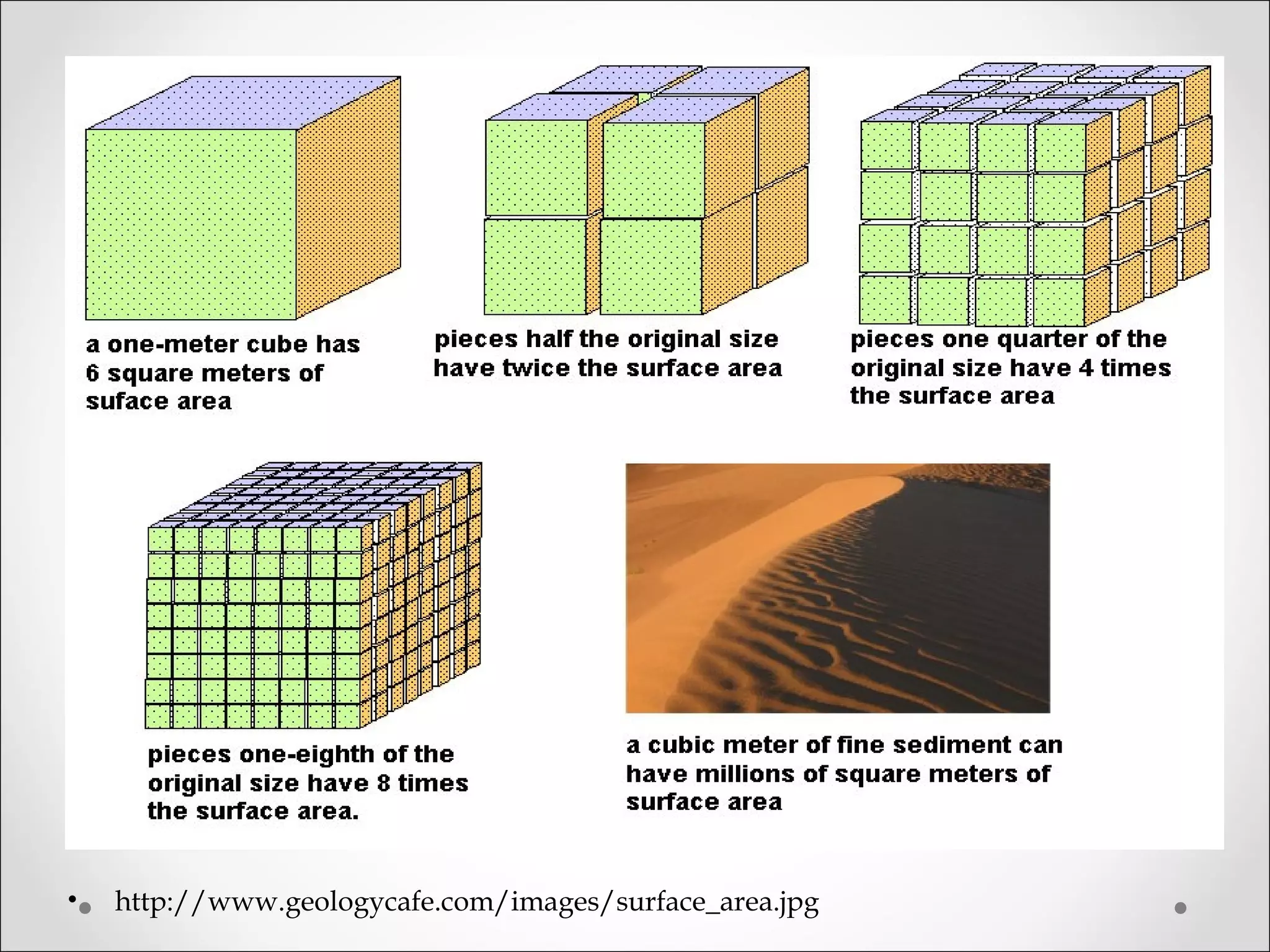
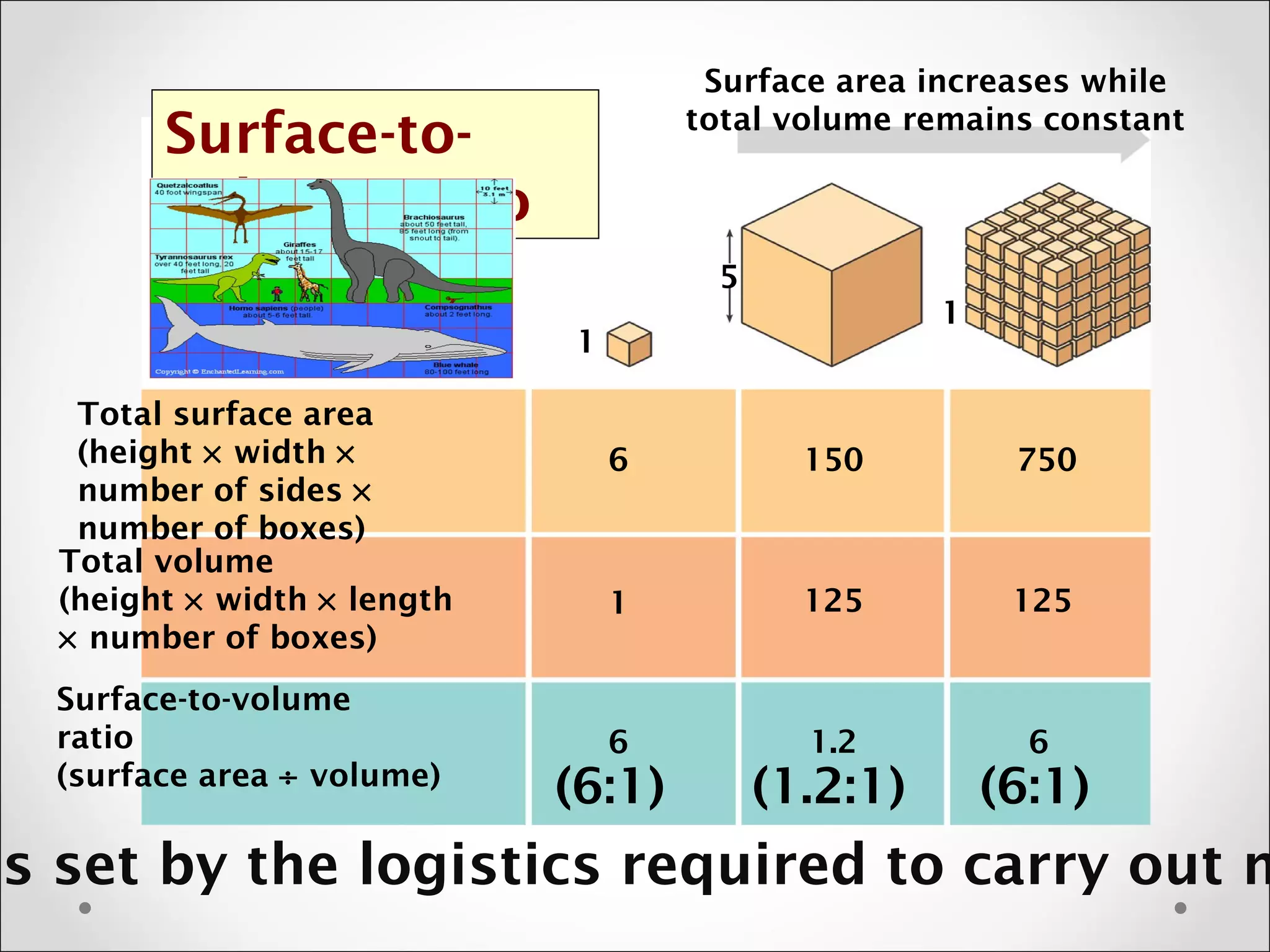
• http://www.geologycafe.com/images/surface_area.jpg
Surface area increases while
total volume remains constant
5
1
1
Total surface area
(height × width ×
number of sides ×
number of boxes)
Total volume
(height × width × length
× number of boxes)
Surface-to-volume
ratio
(surface area ÷ volume)
6
1
6
150
125
1.2
750
125
6
Surface-to-
volume ratio
(6:1) (1.2:1) (6:1)
is set by the logistics required to carry out m
Smaller size of cellSmaller size of cell
 increase surface areaincrease surface area
• What is the surface of cells?
*** Cell membrane***
What would be the function of cell membrane?
*Selective Barrier* allow only selected molecules to
move across (in or out)
Unicellular usuallyUnicellular usually
lives in lake, sea, orlives in lake, sea, or
river.river.
Why????
What is the common
feature of these places?
Water, a major substanceWater, a major substance
in living organismin living organism
• Stay in water- some unicellular organism
• Exchange water with environment
• Protect body from water lost
. ( skin, mucus, hard shell, wax)
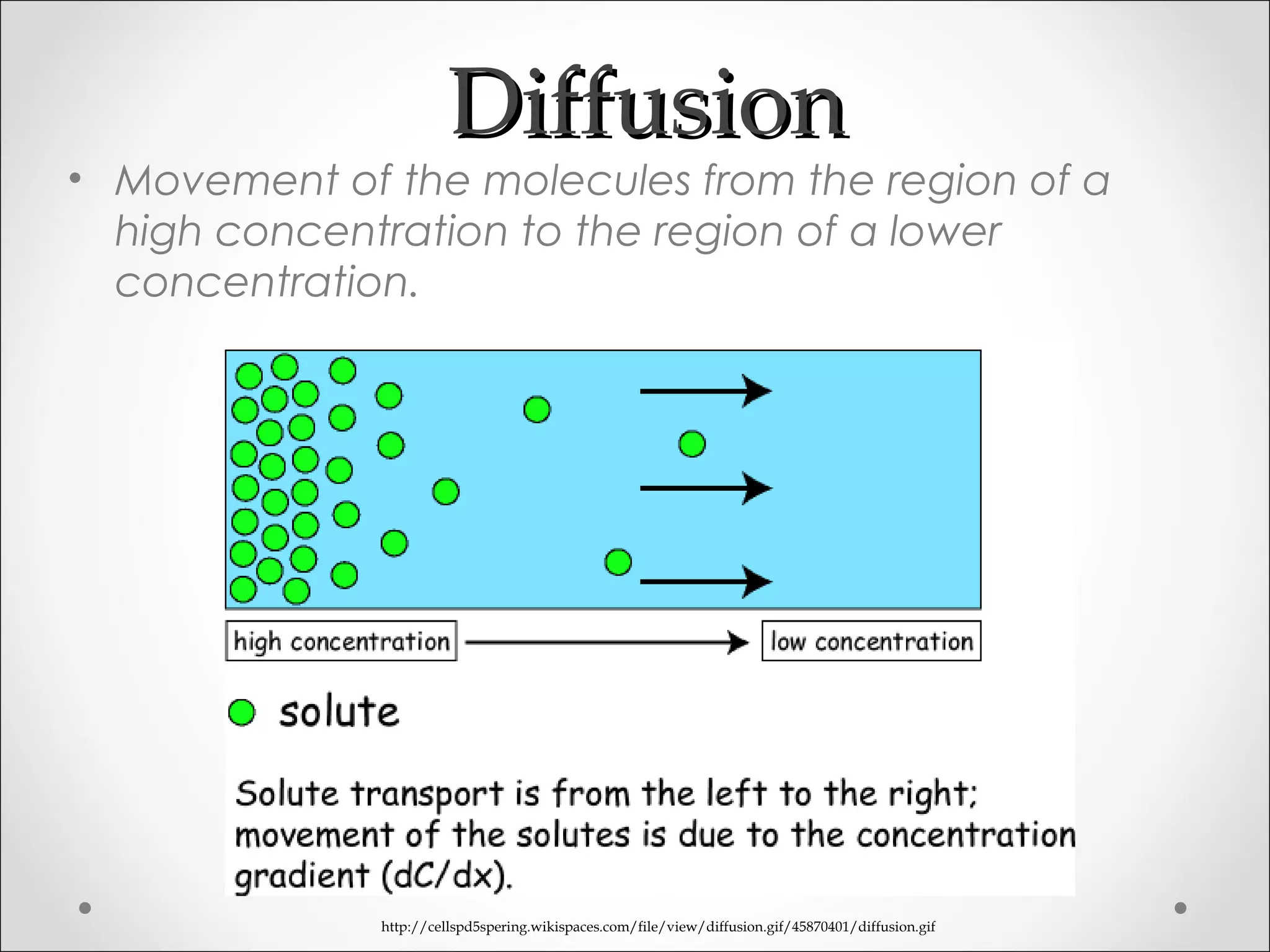
DiffusionDiffusion
• Movement of the molecules from the region of a
high concentration to the region of a lower
concentration.
http://cellspd5spering.wikispaces.com/file/view/diffusion.gif/45870401/diffusion.gif
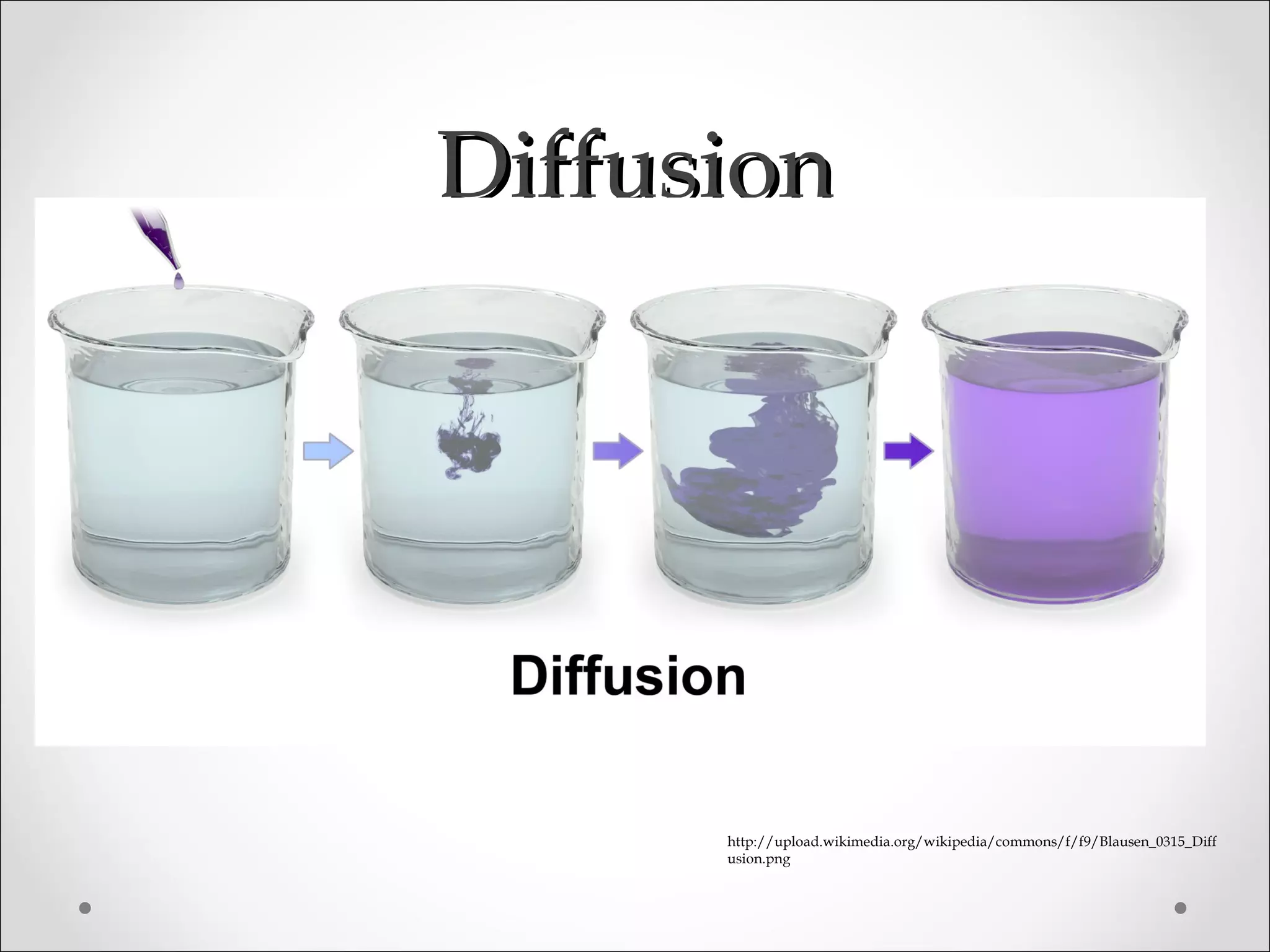
DiffusionDiffusion
http://upload.wikimedia.org/wikipedia/commons/f/f9/Blausen_0315_Diff
usion.png
Diffusion for nutrition/gasDiffusion for nutrition/gas
exchangesexchanges
http://3.bp.blogspot.com/-8vhPOBiovaY/UJaais2IeUI/AAAAAAAAAAk/cnj_uolsh3c/s1600/Screen+shot+2012-11-
2007-2008
The Special Case ofThe Special Case of
WaterWater
Movement of waterMovement of water
acrossacross
the cell membranethe cell membrane
OsmosisOsmosis
• Net movement of water molecules across
semipermeable membrane
• From higher water potential to lower water
potential
http://estebanwhitmore.wordpress.com/2010/07/27/learning-by-osmosis/
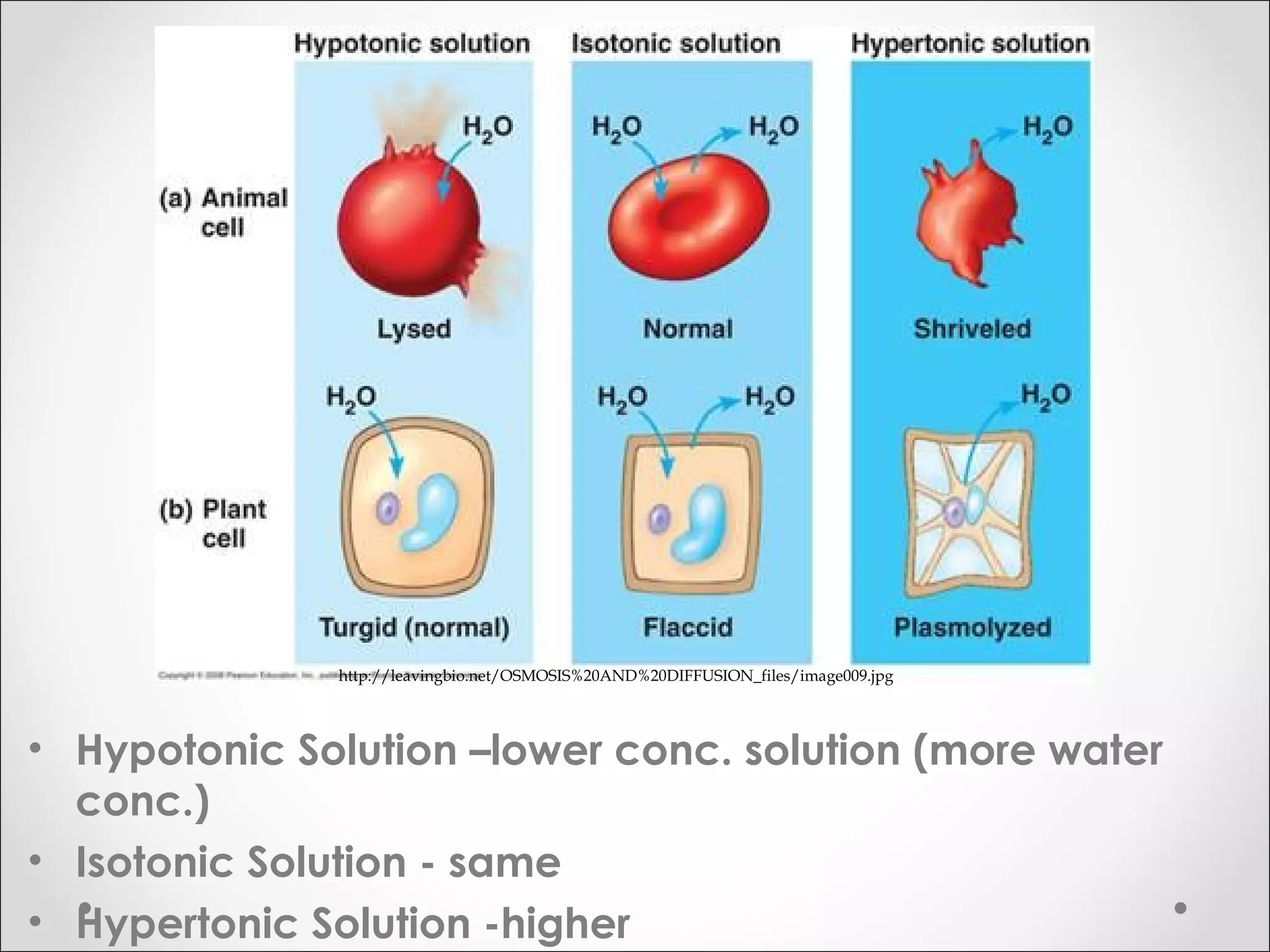
• Hypotonic Solution –lower conc. solution (more water
conc.)
• Isotonic Solution - same
• Hypertonic Solution -higher
http://leavingbio.net/OSMOSIS%20AND%20DIFFUSION_files/image009.jpg
82
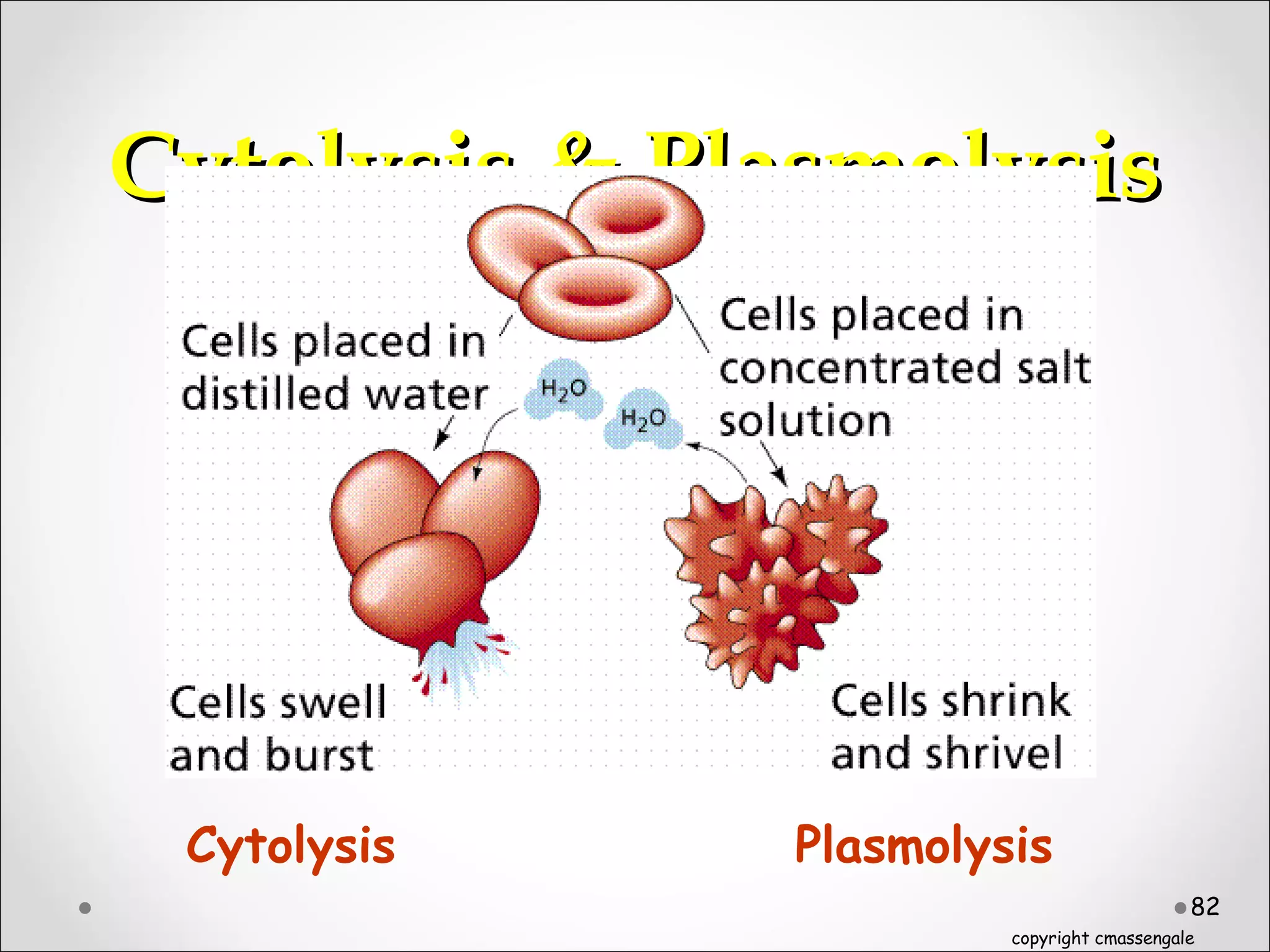
Cytolysis & PlasmolysisCytolysis & Plasmolysis
Cytolysis Plasmolysis
copyright cmassengale
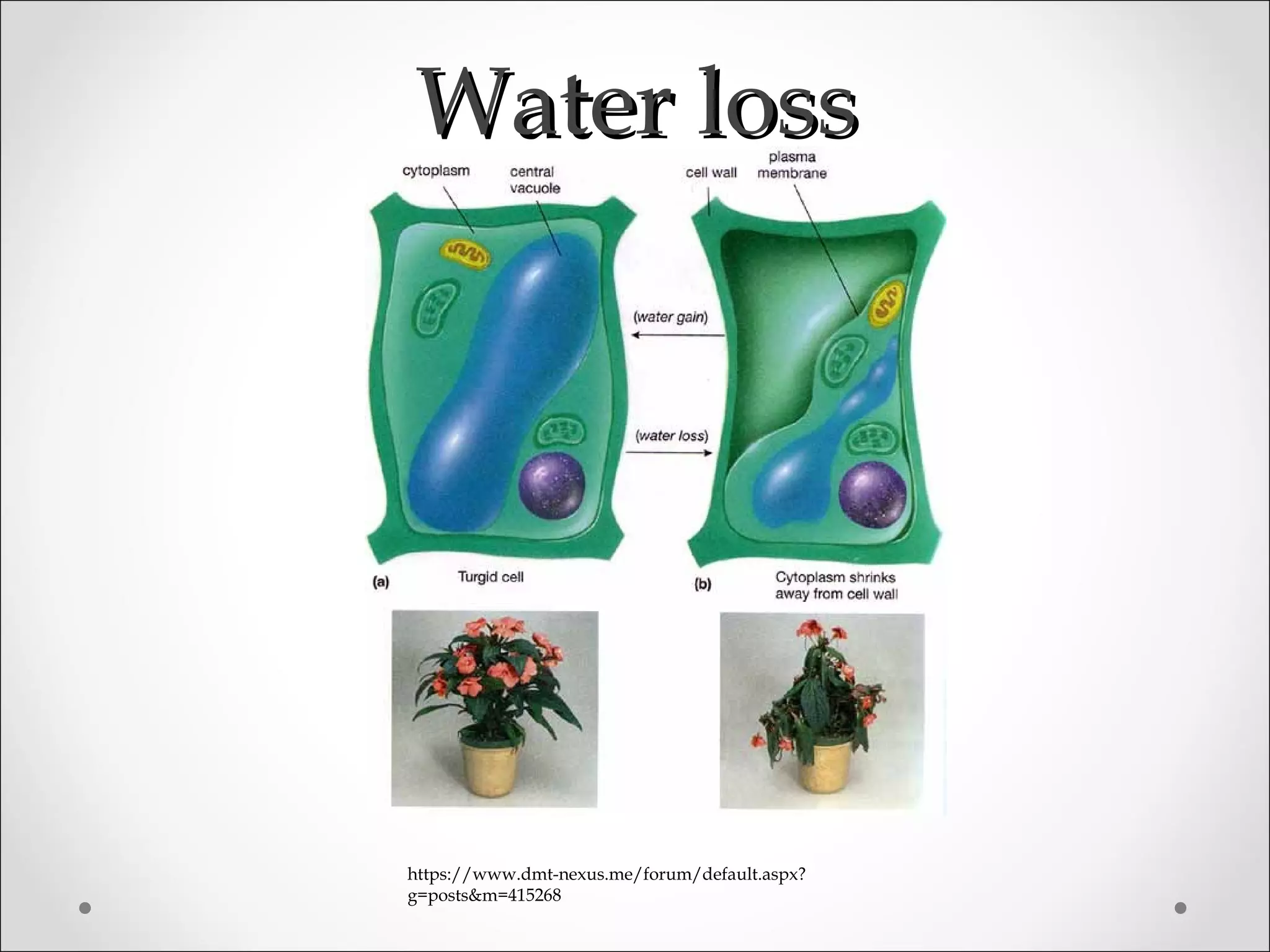
Water lossWater loss
https://www.dmt-nexus.me/forum/default.aspx?
g=posts&m=415268
Egg OsmosisEgg Osmosis
• One of the cup has
syrup another one
has water. Can you
match them with
the egg?
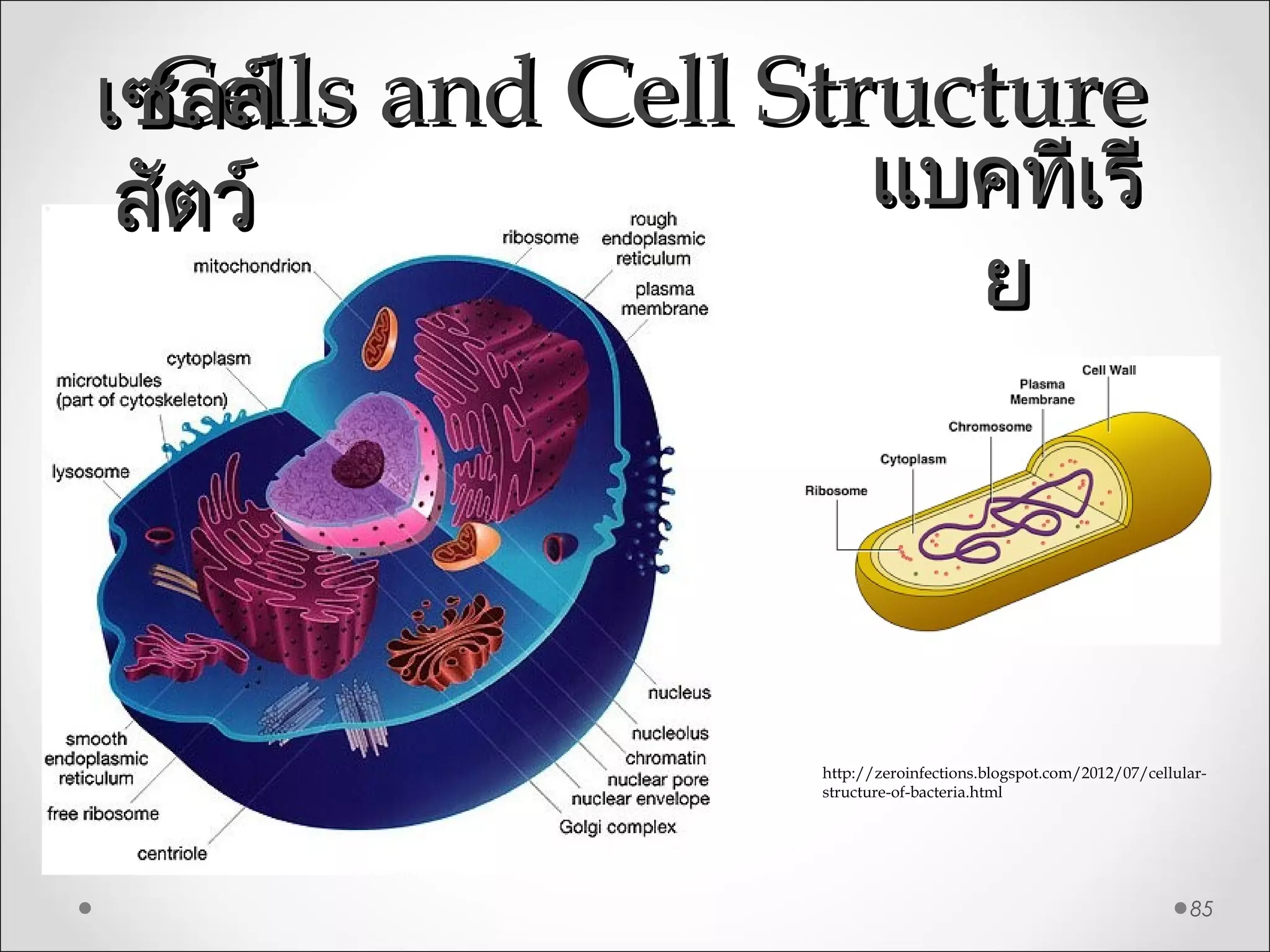
Cells and Cell StructureCells and Cell Structure
85
เซลล์เซลล์
สัตว์สัตว์ แบคทีเรีแบคทีเรี
ยย
http://zeroinfections.blogspot.com/2012/07/cellular-
structure-of-bacteria.html
ส่วนประกอบพื้นฐานของเซลล์
(Basic features of all cells)
- Plasma membrane
- Semifluid substance
called the cytosol
- Genetic material
- Ribosomes
Cell membraneCell membrane เยื่อหุ้มเยื่อหุ้ม
เซลล์เซลล์
87
http://blogs.scientificamerican.com/lab-
rat/files/2013/01/CellMembraneDrawing.jpg
Phospholipid Bilayers : Selective MembranesPhospholipid Bilayers : Selective Membranes เยื่อเลือกเยื่อเลือก
ผ่านผ่าน
88
NucleusNucleus นิวเคลียสนิวเคลียส ,,
Endoplasmic Reticulum (ER)Endoplasmic Reticulum (ER)
http://micro.magnet.fsu.edu/cells/nucleus/nucleus.h
tml
นิวเคลียส:
ศูนย์กลางของ
เซลล์ เป็นที่
เก็บสาร
พันธุกรรม
(DNA)
ER :
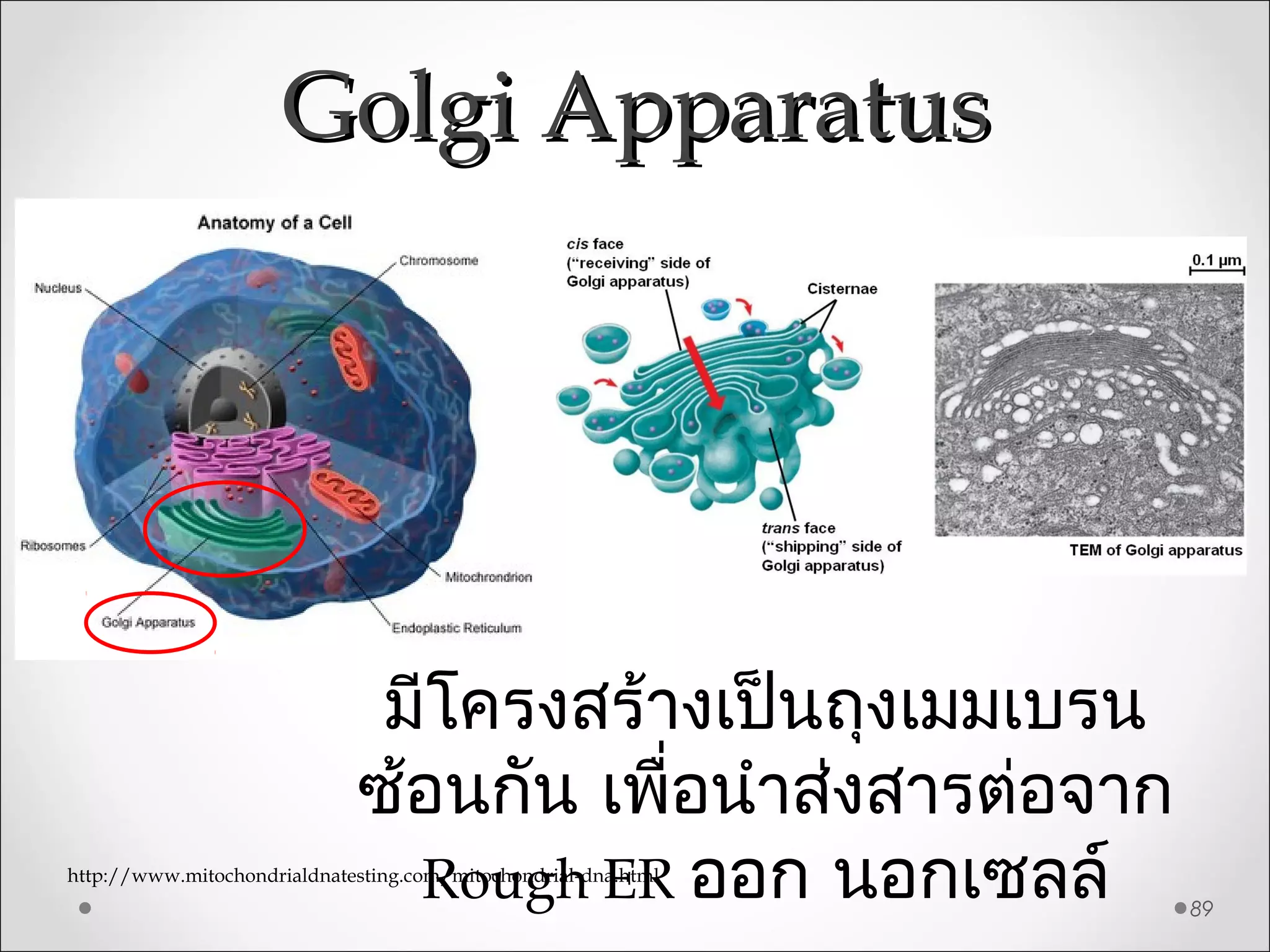
Golgi ApparatusGolgi Apparatus
89
http://www.mitochondrialdnatesting.com/mitochondrial-dna.html
มีโครงสร้างเป็นถุงเมมเบรน
ซ้อนกัน เพื่อนำาส่งสารต่อจาก
Rough ER ออก นอกเซลล์
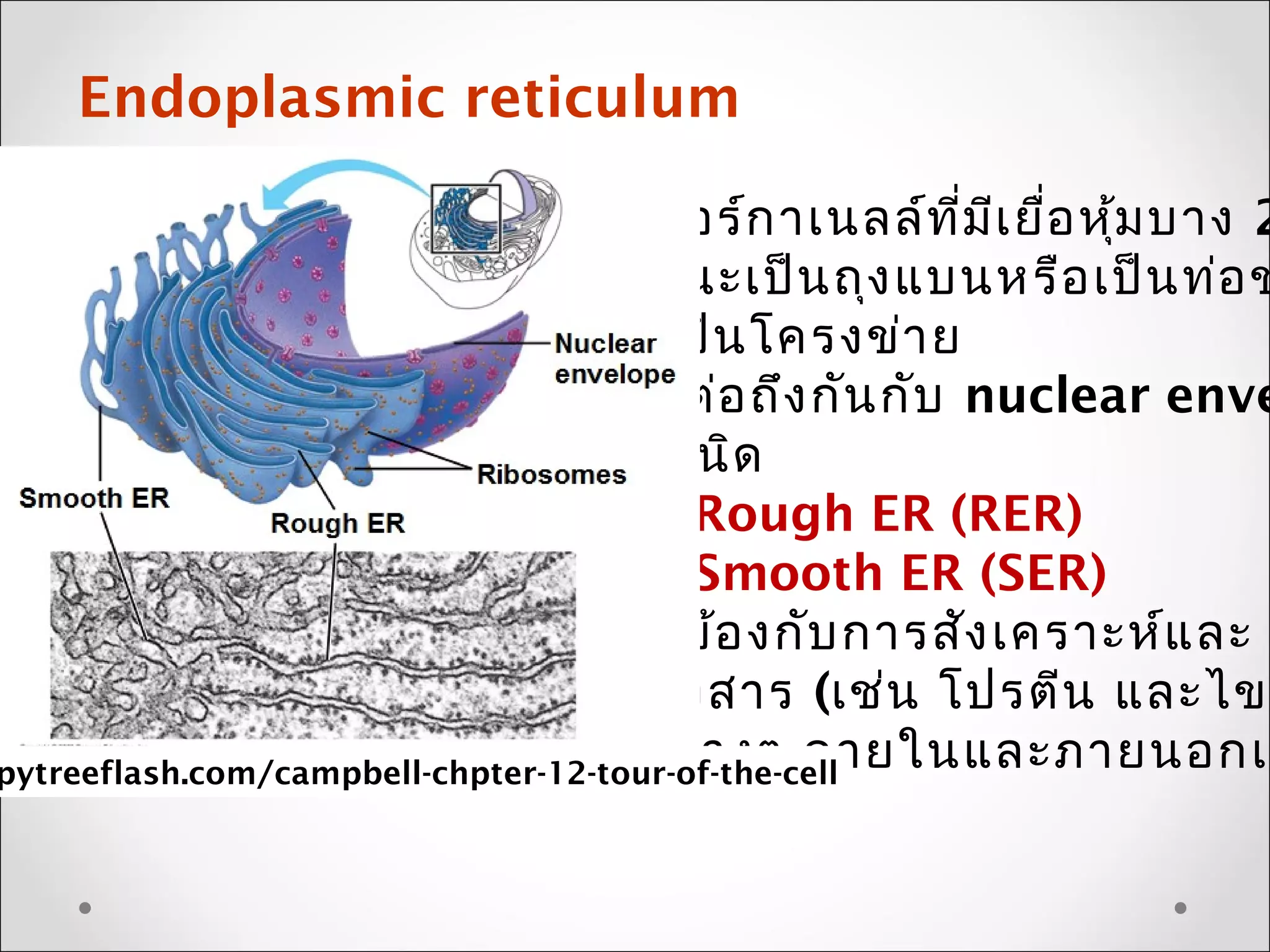
Endoplasmic reticulum
: เป็นออร์กาเนลล์ที่มีเยื่อหุ้มบาง 2
มีลักษณะเป็นถุงแบนหรือเป็นท่อข
ไปมาเป็นโครงข่าย
: เชื่อมต่อถึงกันกับ nuclear enve
: มีทั้งชนิด
Rough ER (RER)
Smooth ER (SER)
: เกี่ยวข้องกับการสังเคราะห์และ
ลำาเลียงสาร (เช่น โปรตีน และไขม
ไปสู่ที่ต่างๆ ภายในและภายนอกเซpytreeflash.com/campbell-chpter-12-tour-of-the-cell
Rough ER (RER) : เกี่ยวข้องกับ*
1. การสังเคราะห์โปรตีนบางชนิด
2. การเปลี่ยนแปลงโปรตีนที่สังเค
เสร็จ
3. การลำาเลียงสาร (เช่น โปรตีน
ไขมัน)ไปสู่ที่ต่างๆ ภายในและภายนอ
(* ขึ้นกับชนิด
Smooth ER (SER) : เกี่ยวข้องกับ*
1. metabolism ของคาร์โบไฮเดร
2. สังเคราะห์ไขมัน (เช่น phosph
steroids)
3. การกำาจัดสารพิษ
(* ขึ้นกับชนิด
ของเซลล์)
The main SER tasks
include synthesis of
lipids, maintenance of
calcium homeostasis and
detoxification reactions
necessary for the
conversion of harmful
water-insoluble
substances into water-
cis face
(“receiving” side of
Golgi apparatus)
Vesicles move
from ER to GolgiVesicles also
transport certain
proteins back to ER
Vesicles coalesce to
form new cis Golgi cisternae
Cisternal
maturation:
Golgi cisternae
move in a cis-
to-trans
direction
Vesicles form and
leave Golgi, carrying
specific proteins to
other locations or to
the plasma mem-
brane for secretionVesicles transport specific
proteins backward to newer
Golgi cisternae
Cisternae
trans face
(“shipping” side of
Golgi apparatus)
0.1 0 µm1
6
5
2
3
4
Golgi apparatus: organelle actives in
modification, sorting, secretion of cell
products and manufactures
polysaccharides secreted by cell (pectin,
hyaluronic acid)
: มีลักษณะเป็นถุงเยื่อหุ้มแบน
หลายถุง (cisternae)
เรียงซ้อนกัน
w.biologyjunction.com/06-%20Cell%20text.ppt#295,16
: เซลล์ที่สร้างสารหลั่ง จะมี Golgi apparatu
Lysosome : digestive organelle where
macromolecules are hydrolyzed
: เป็นออร์กาเนลล์ที่มีเมมเบรน 1 ชั้น ส่วนใหญ่
พบในเซลล์สัตว์
: ภายในมีเอนไซม์หลายชนิด เช่น lipases,
nucleases และ proteases เป็นต้น
: เป็นถุงเมมเบรนที่หลุดจาก tran face ของ
Golgi apparatus
//www.pleasanton.k12.ca.uhttp://www.youtube.com/watch?v=ekdIEpSf-1I
: เกี่ยวข้องกับการย่อยสารต่างๆ
ทั้งภายในและภายนอกเซลล์
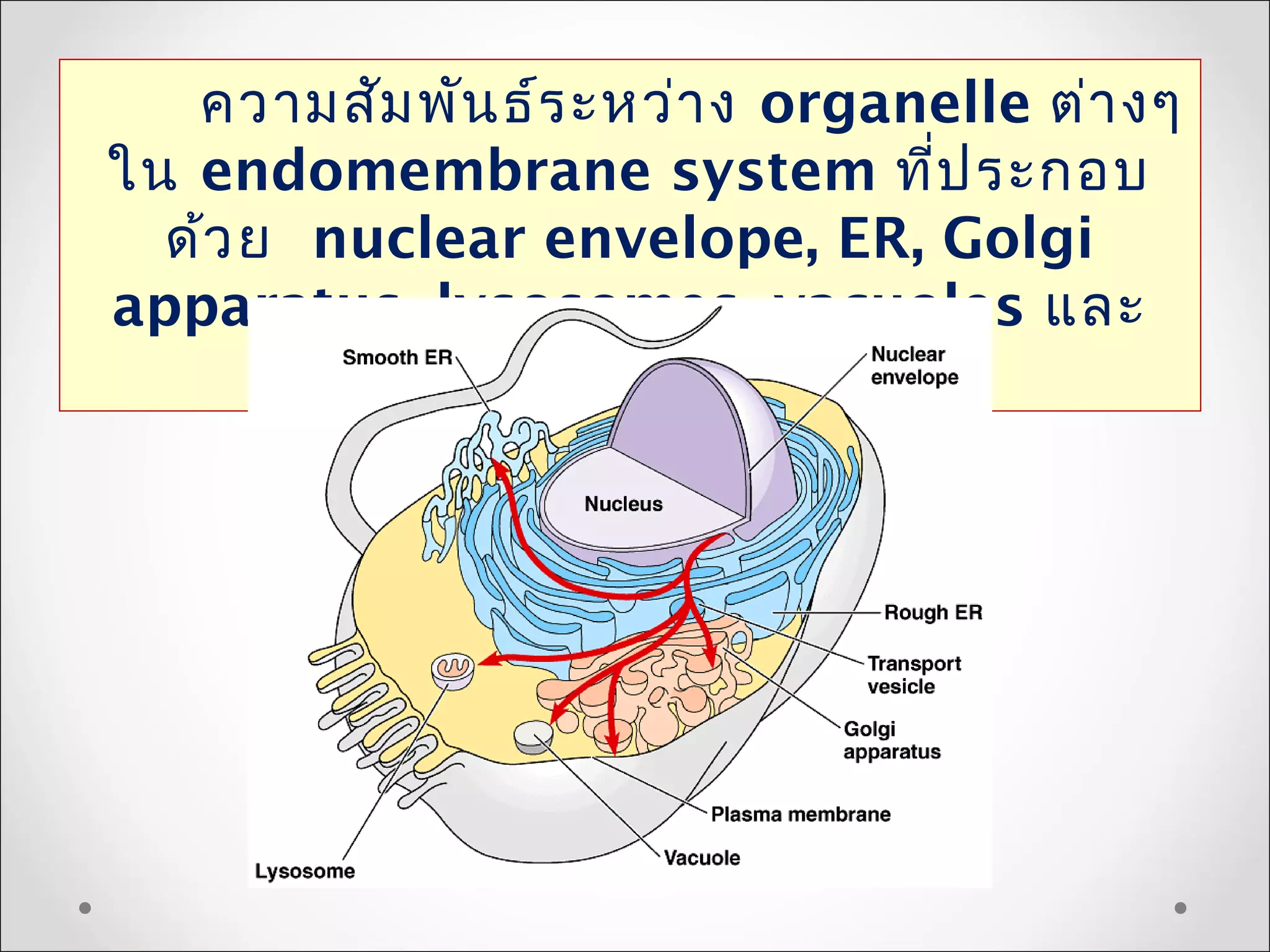
ความสัมพันธ์ระหว่าง organelle ต่างๆ
ใน endomembrane system ที่ประกอบ
ด้วย nuclear envelope, ER, Golgi
apparatus, lysosomes, vacuoles และ
plasma membrane
MitochondriaMitochondria ไมโทคอนเดไมโทคอนเด
รียรีย
97
Energy Source แหล่งสร้าง
พลังงานMitochondrial DNA or mtDNA about
16,500 DNA building blocks (base pairs)
Mitochondrial DNA contains 37 genes, all
of which are essential for normal
mitochondrial function, instructions for
making enzymes involved in oxidative
phosphorylation,making molecules called
transfer RNA (tRNA) and ribosomal RNA
(rRNA).
Mitochondrial genes are among the
estimated 20,000 to 25,000 total genes in
the human genome.
เกี่ยวข้องกับ
กระบวนการหายใจระดับ
เซลล์ (cellular
respiration)
1. บริเวณ cristae ของ
เยื่อหุ้มชั้นในมี เอ็นไซม์ที่
เกี่ยวข้องกับ electron
transport chain และ การ
สังเคราะห์ ATP
2. ใน matrix มีเอ็นไซม์ที่
เกี่ยวข้องกับ Kreb’s cycle
Chloroplast : photosynthetic organelle;
converts energy of sunlight to
chemical energy stored in sugar molecules
: รูปร่างกลมรี มีเมมเบรน 2 ชั้น เมมเบรนชั้นใน
ยื่นเข้าไปเป็นถุงแบนๆ เรียก
thylakoid
เรียงซ้อนเป็นตั้งเรียก grana เกี่ยวข้องกับ
การ
สังเคราะห์ด้วยแสงแบบ light reaction
w.biologyjunction.com/06-%20Cell%20text.ppt#295,16
Chloroplast
Chloroplast
DNA
Ribosomes
Stroma
Inner and outer
membranes
Thylakoid
1 µm
Granum
Ribosome
: nonmembranous organelle ที่ประกอบด้วย
หน่วยย่อย (subunit) 2 หน่วย
pytreeflash.com/campbell-chpter-12-tour-of-the-cell
1. free ribosomes ทำำหน้ำที่สร้ำงโปรตีนที่
ใช้ใน cytosol
2. bound ribosomes เป็น ribosome ที่
เกำะอยู่ด้ำนผิวนอกของ ER ทำำหน้ำที่สร้ำงโปรตีน
ที่จะถูกส่งไปรวมกับ organelles อื่นๆ และโปรตีน
ที่จะถูกส่งออกไปใช้นอกเซลล์
: เกี่ยวข้องกับกำรสังเครำะห์โปรตีน พบเป็นอิสระ
ในไซโทพลำซึม (free ribosomes)
หรือติดอยู่กับ ER ชนิด RER (bound ribosomes)
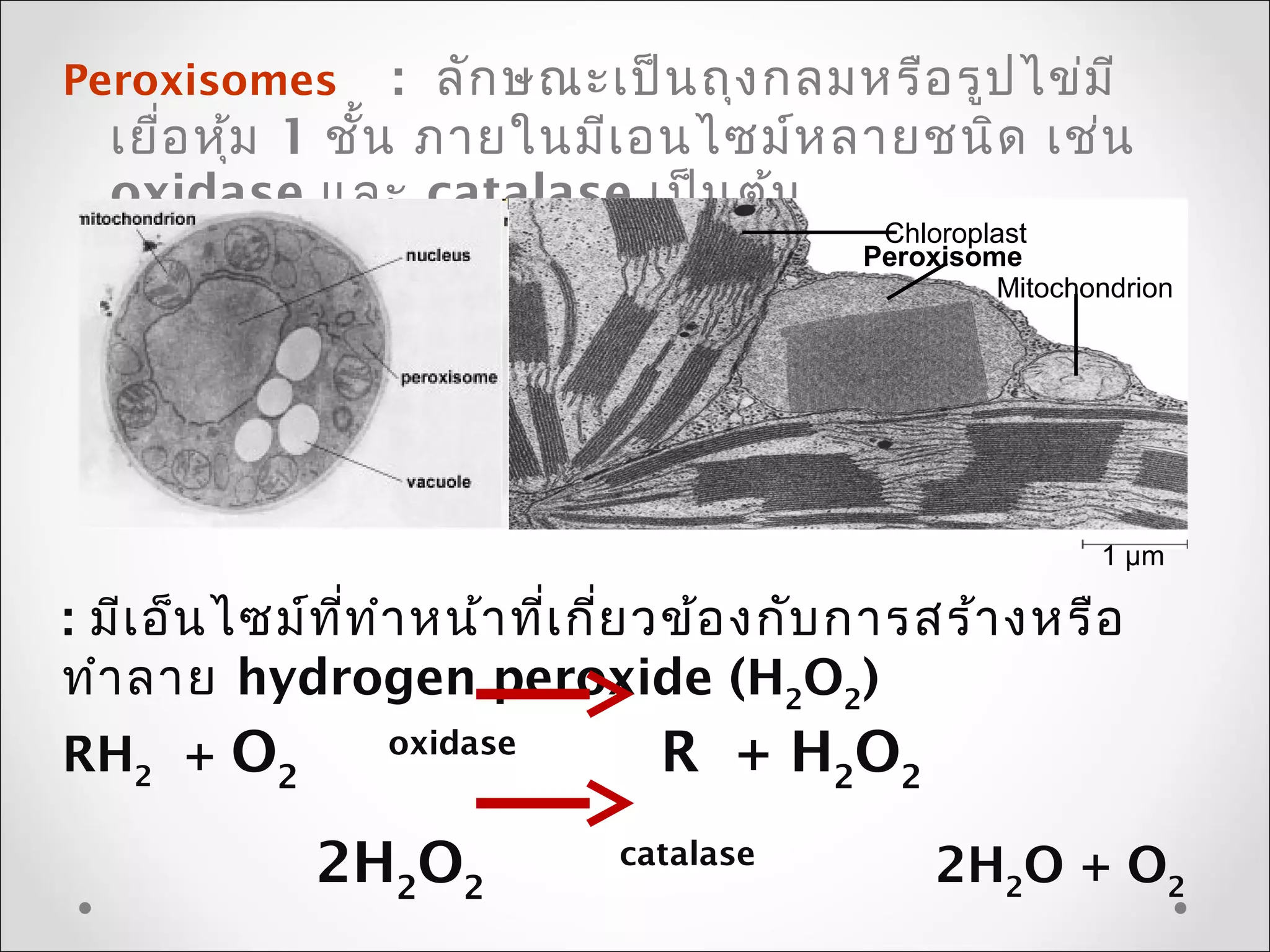
Peroxisomes : ลักษณะเป็นถุงกลมหรือรูปไข่มี
เยื่อหุ้ม 1 ชั้น ภำยในมีเอนไซม์หลำยชนิด เช่น
oxidase และ catalase เป็นต้น
Chloroplast
Peroxisome
Mitochondrion
1 µm
: มีเอ็นไซม์ที่ทำำหน้ำที่เกี่ยวข้องกับกำรสร้ำงหรือ
ทำำลำย hydrogen peroxide (H2
O2
)
RH2
+ O2
oxidase
R + H2
O2
2H2
O2
catalase
2H2
O + O2
Cytoskeleton : reinforces cell’s shape,
function in cell movement;
components are made of proteins
Microtubule : มีลักษณะ
เป็นท่อกลวงยำว
เกิดจำกกำรจับกันของ
tubulin subunit
(α: β subunit)
Microfilament
: หรือ actin filament
ประกอบขึ้น
ด้วยโปรตีน actin
(globular
protein)
ที่จับกันเป็นสำยยำว 2
Intermediate
filament
: เป็นเส้นใยบำงๆ มี
ขนำดอยู่ระหว่ำง
microtubule และ
microfilament
: มีหลำยชนิดแตก http://www.noble.or
Microtubule
0.25 µm Microfilaments
Intermediate filament
Diagram comparing the morphologic effects of
strongylophorine-26 with those of other inhibitors of
cell motility and angiogenesis. A, migrating cells with a
lamellipodium extending in the direction of cell
migration, focal adhesions, a meshwork of
lamellipodial actin filaments and actin stress fibers. B,
dihydromotuporamine C and several inhibitors of cell
motility and angiogenesis disrupt cell polarity and
prevent cell migration by stabilizing focal adhesions
and actin stress fibers (14, 15). C, strongylophorine-26
disrupts cell polarity and prevents cell migration by
stabilizing focal adhesions and inducing the formation
of radial protrusions resembling lamellipodia that
contain a dense meshwork of peripheral actin filaments
and few stress fibers.
http://mct.aacrjournals.org/content/4/5/772/F6.expansion
Vinculin Containing Focal Adhesions and
Actin Stress Fibers in a Fibroblast-like Cell
The picture shows vinculin (green)
containing focal adhesions and actin stress
fibers (red) in a fibroblast like cell
http://www.pediatrics.wisc.edu/research/research-
groups/huttenlocher/
: Microfilaments that function in cellular motility
oMuscle contraction
Actin filament
Myosin filament
Myosin motors in muscle cell contraction.(a)
Muscle cell
Myosin arm
http://www.youtube.com/watch?v=zQocsLRm7_A&feature=fvwrel
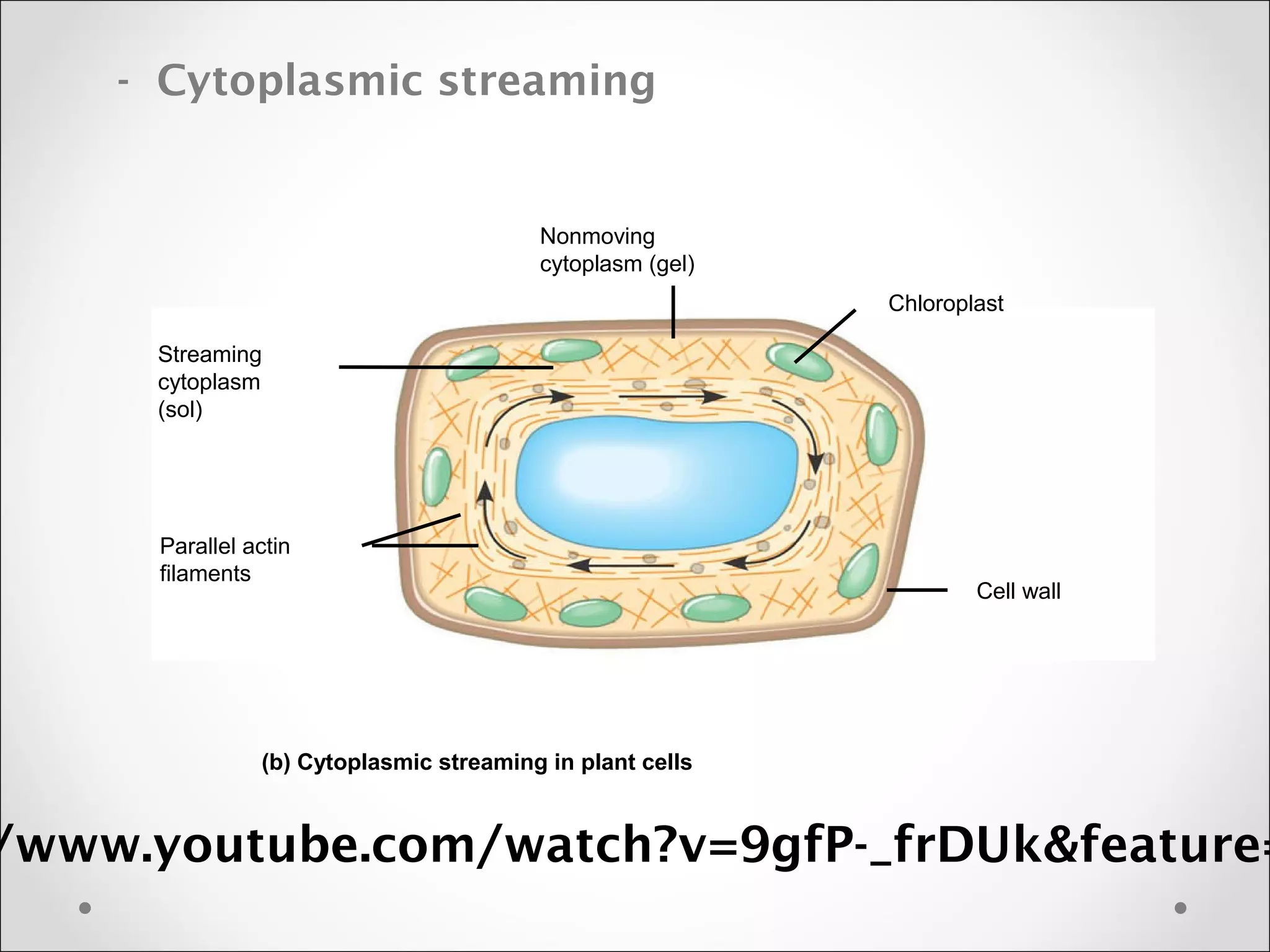
- Cytoplasmic streaming
Nonmoving
cytoplasm (gel)
Chloroplast
Streaming
cytoplasm
(sol)
Parallel actin
filaments
Cell wall
(b) Cytoplasmic streaming in plant cells
/www.youtube.com/watch?v=9gfP-_frDUk&feature=
- Amoeboid movement
(actin and myosin filaments)
Cortex (outer cytoplasm):
gel with actin network
Inner cytoplasm: sol
with actin subunits
Extending
pseudopodium
(b) Amoeboid movement
http://www.youtube.com/watch?v=7pR7TNzJ_pA
ออร์กำเนลล์หรือโครงสร้ำงที่เกิดจำกกำร
จัดเรียงตัวของ microtubule
ww.google.co.th/imglanding?q=centriole&imgurl
triole เป็นออร์กำเนลล์ที่ไม่มีเยื่อหุ้ม
ประกอบด้วยกลุ่มของ microtubule 9 ชุด
มำจัดเรียงเป็นวงกลมแบบ 9+0
agella มีโครงสร้ำงคล้ำยกัน (ต่ำงกันที่จำำนวน ควำมยำว
กอบด้วยกลุ่มของ microtubule 9 ชุด มำจัดเรียงเป็นวงก
crotubule อีก 2 อัน (9+2)
www.bothbrainsandbeauty.com/acad...ella
• Flagella beating pattern
(a) Motion of flagella. A flagellum
usually undulates, its snakelike
motion driving a cell in the same
direction as the axis of the
flagellum. Propulsion of a human
sperm cell is an example of
flagellatelocomotion (LM).
1 µm
Direction of swimming
(b) Motion of cilia. Cilia have a back-
and-forth motion that moves the
cell in a direction perpendicular
to the axis of the cilium. A dense
nap of cilia, beating at a rate of
about 40 to 60 strokes a second,
covers this Colpidium, a
freshwater protozoan (SEM).
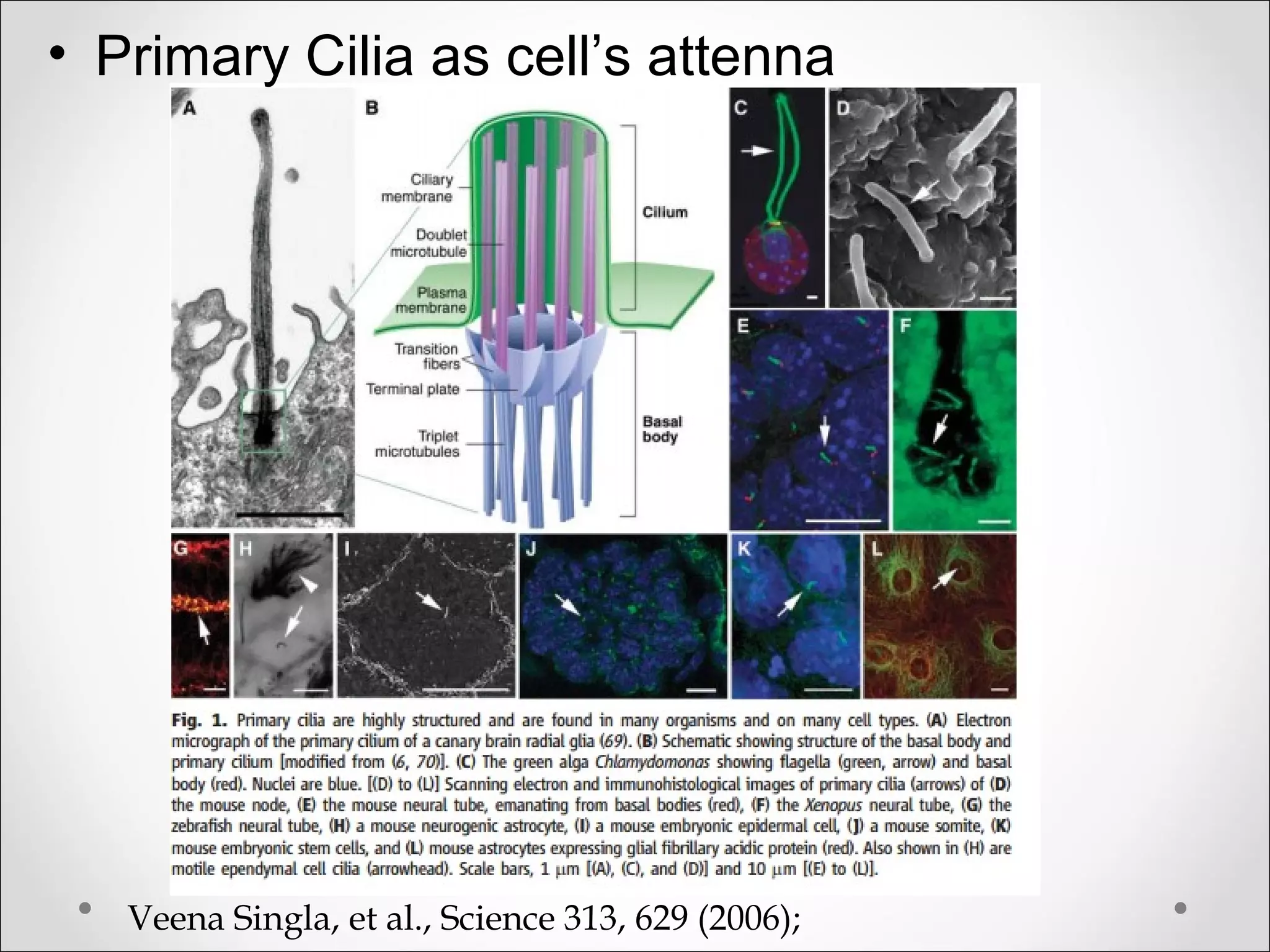
• Primary Cilia as cell’s attenna
Veena Singla, et al., Science 313, 629 (2006);
Central
vacuole
of cell
Plasma
membrane
Secondary
cell wall
Primary
cell wall
Middle
lamella
1 µm
Central
vacuole
of cell
Central vacuole
Cytosol
Plasma membrane
Plant cell walls
Plasmodesmata
ละ Cell coat
ซลล์พืช: ประกอบด้วยเซลลูโลส (cellulose) เป็นส่วนใหญ
lamella
)
y cell wall
ose + hemicellulose)
ary cell wall
ose + lignin)
ซลล์ของรำและ ยีสต์: ประกอบด้วย cellulose และ chitin
ซลล์ของสำหร่ำย: ประกอบด้วย cellulose และ siliga
115
er and Hausman, 2007
เซลล์สัตว์ไม่มี cell wall แต่มีสำรที่ถูกสร้ำง
ออกมำอยู่ด้ำนนอกของเยื่อหุ้มเซลล์ เรียกว่ำ
extracellular matrix พบว่ำองค์ประกอบและ
โครงสร้ำงของ ECM จะแตกต่ำงกันในเซลล์
แต่ละชนิด
Cell coat หรือ Extracellular matrix
(ECM) ของเซลล์สัตว์
Glycocalyx: ประกอบด้วย glycoprotein
(collagen, fibronectin, proteoglycans)
Collagen
Fibronectin
Plasma
membrane
EXTRACELLULAR FLUID
Micro-
filaments
CYTOPLASM
Integrins
Polysaccharide
molecule
Carbo-
hydrates
Proteoglycan
molecule
Core
protein
Integrin
A proteoglycan
complex
http://jasn.asnjournals.org/content/18/1
หน้ำที่: จดจำำเซลล์ที่อยู่ชิดกัน
และยึดเซลล์ให้ติดกัน
1. Collagen fiber ฝังตัวอยู่ในร่ำงแหของ
proteoglycans ซึ่งประกอบด้วยคำร์โบไฮเดรต 95 %
2. Fibronectin เป็น glycoprotein ที่เกำะอยู่กับ
receptor protein ที่อยู่ที่เยื่อหุ้มเซลล์ (integrin)
3. Integrin จะเชื่อมโยงระหว่ำง ECM กับ
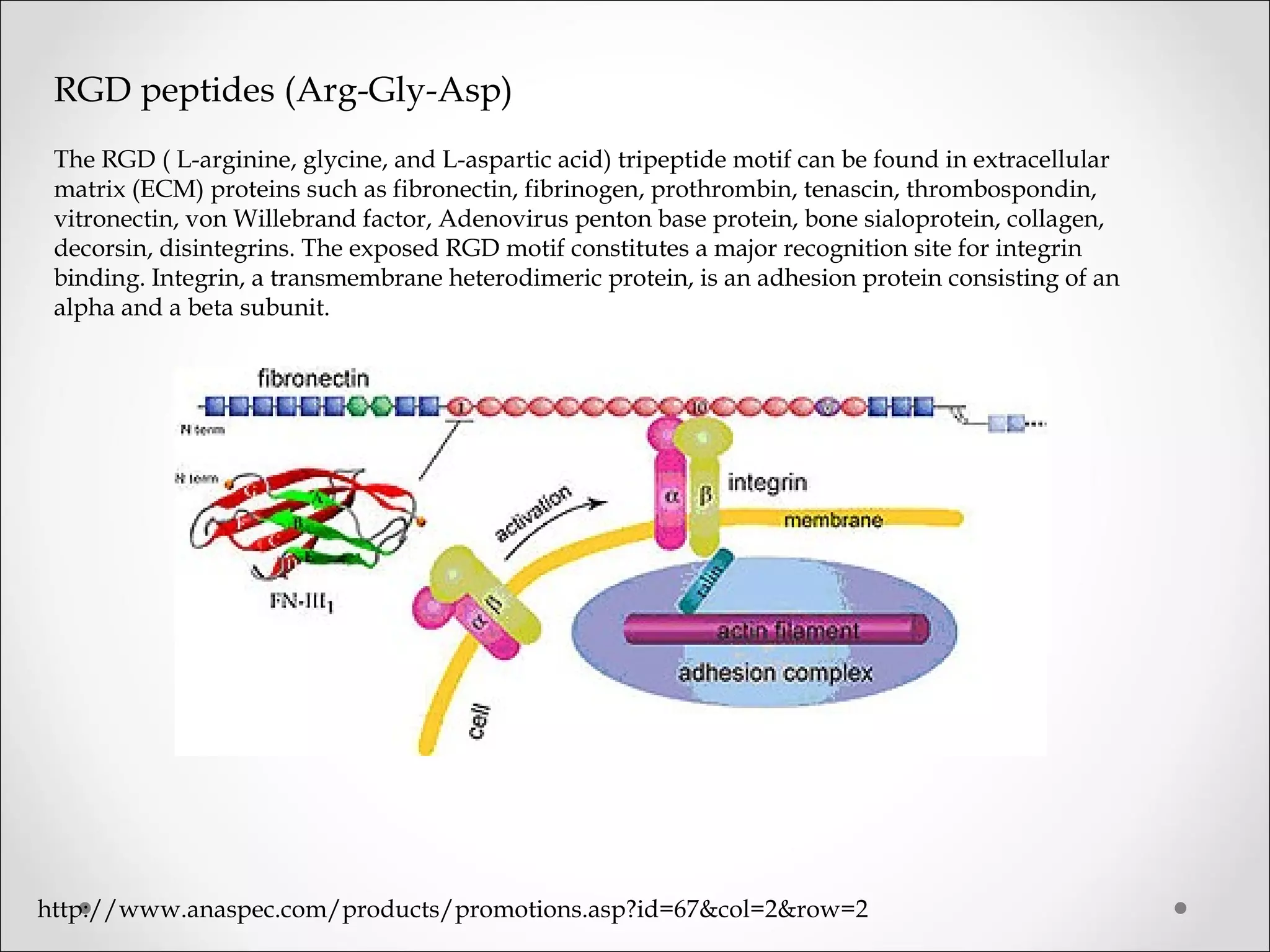
RGD peptides (Arg-Gly-Asp)
The RGD ( L-arginine, glycine, and L-aspartic acid) tripeptide motif can be found in extracellular
matrix (ECM) proteins such as fibronectin, fibrinogen, prothrombin, tenascin, thrombospondin,
vitronectin, von Willebrand factor, Adenovirus penton base protein, bone sialoprotein, collagen,
decorsin, disintegrins. The exposed RGD motif constitutes a major recognition site for integrin
binding. Integrin, a transmembrane heterodimeric protein, is an adhesion protein consisting of an
alpha and a beta subunit.
http://www.anaspec.com/products/promotions.asp?id=67&col=2&row=2
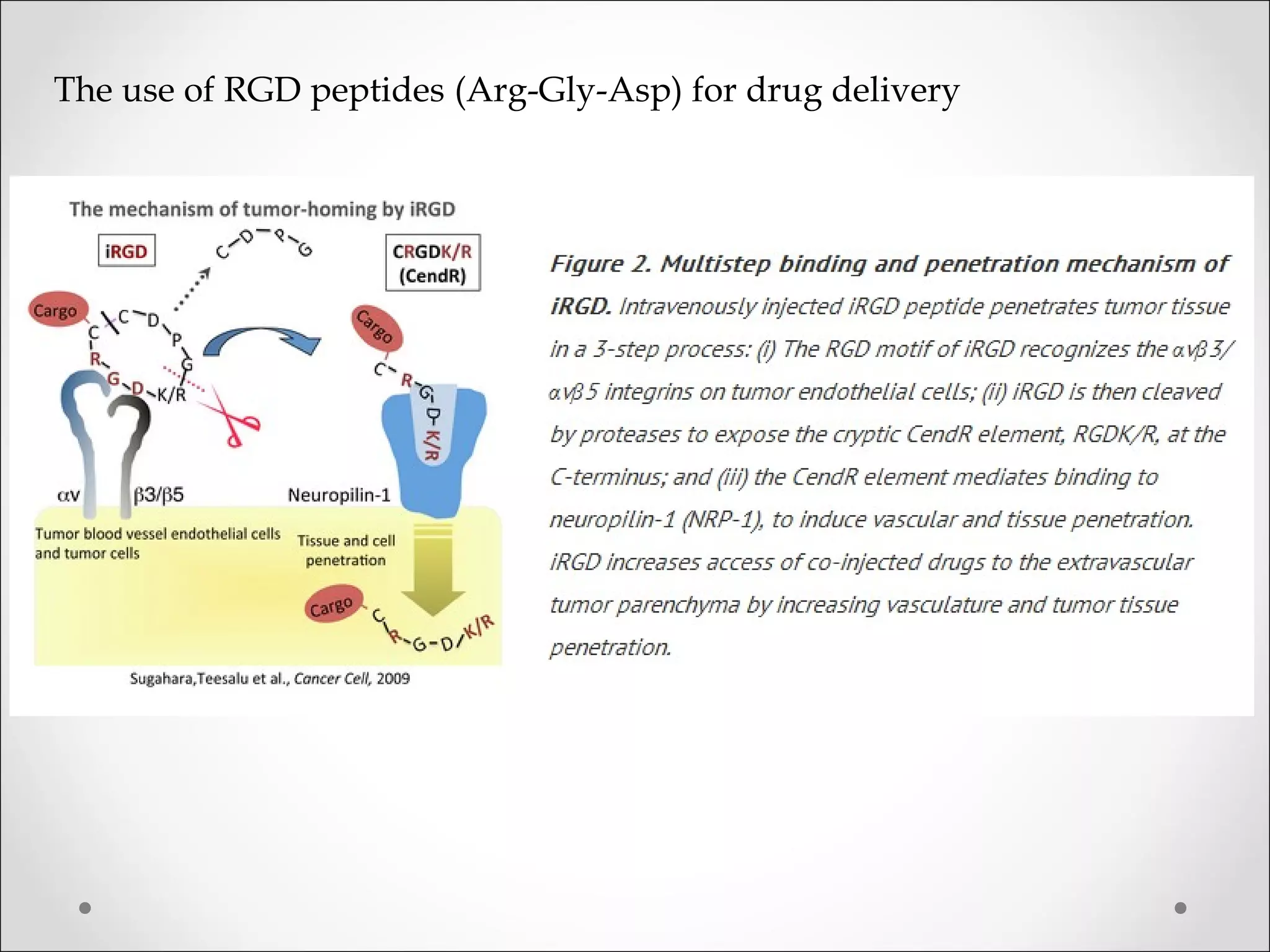
The use of RGD peptides (Arg-Gly-Asp) for drug delivery
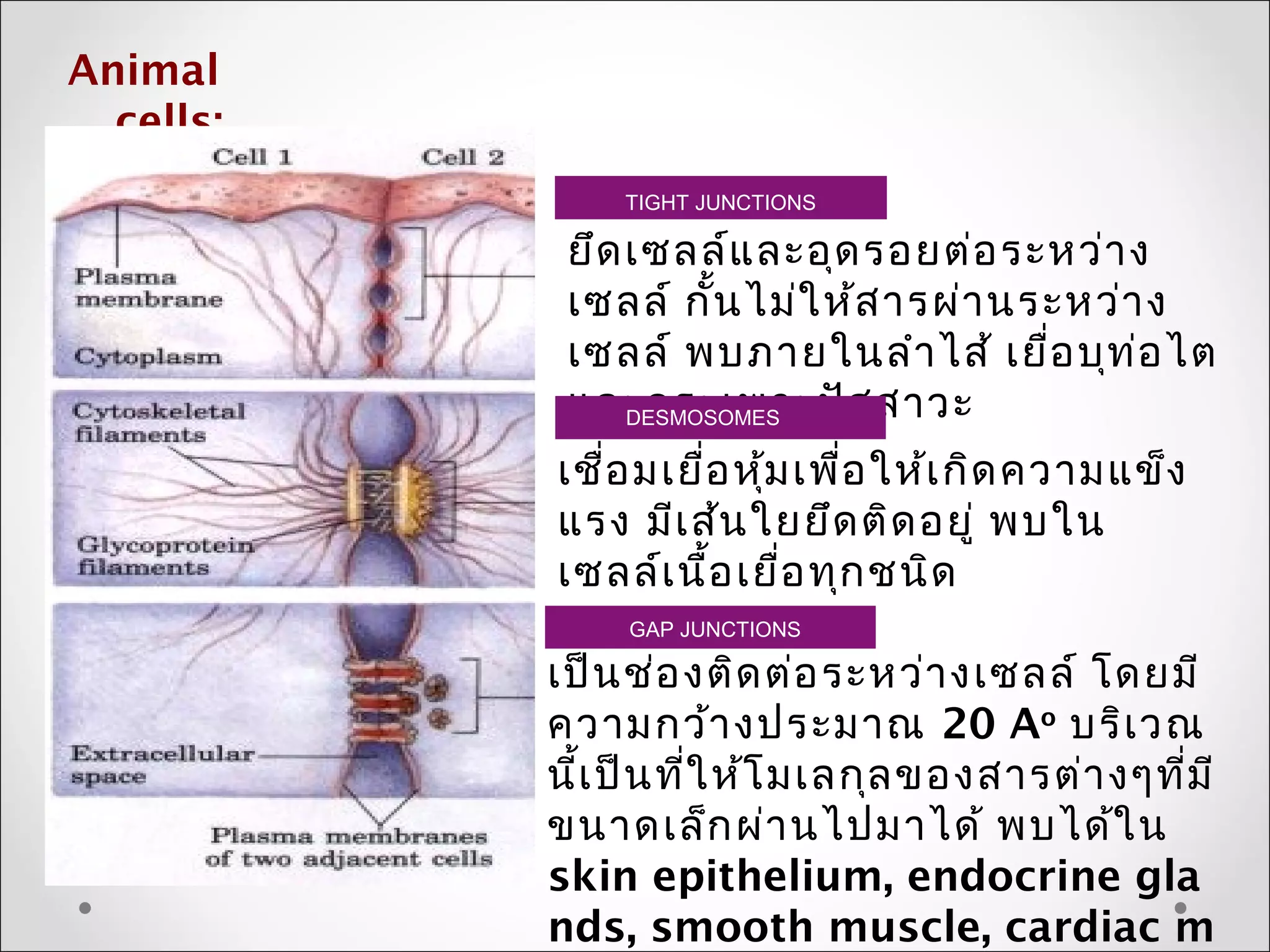
13. Cell junction
13.1 Animal cells:
Tight junctions
Desmosomes
Gap junctions
1.1 Adhering junction : Tight junctions และ Desmo
1.2 Communicating junction: Gap junctions
Animal
cells:
TIGHT JUNCTIONS
ยึดเซลล์และอุดรอยต่อระหว่ำง
เซลล์ กั้นไม่ให้สำรผ่ำนระหว่ำง
เซลล์ พบภำยในลำำไส้ เยื่อบุท่อไต
และกระเพำะปัสสำวะDESMOSOMES
เชื่อมเยื่อหุ้มเพื่อให้เกิดควำมแข็ง
แรง มีเส้นใยยึดติดอยู่ พบใน
เซลล์เนื้อเยื่อทุกชนิด
GAP JUNCTIONS
เป็นช่องติดต่อระหว่ำงเซลล์ โดยมี
ควำมกว้ำงประมำณ 20 Ao
บริเวณ
นี้เป็นที่ให้โมเลกุลของสำรต่ำงๆที่มี
ขนำดเล็กผ่ำนไปมำได้ พบได้ใน
skin epithelium, endocrine gla
nds, smooth muscle, cardiac m
121
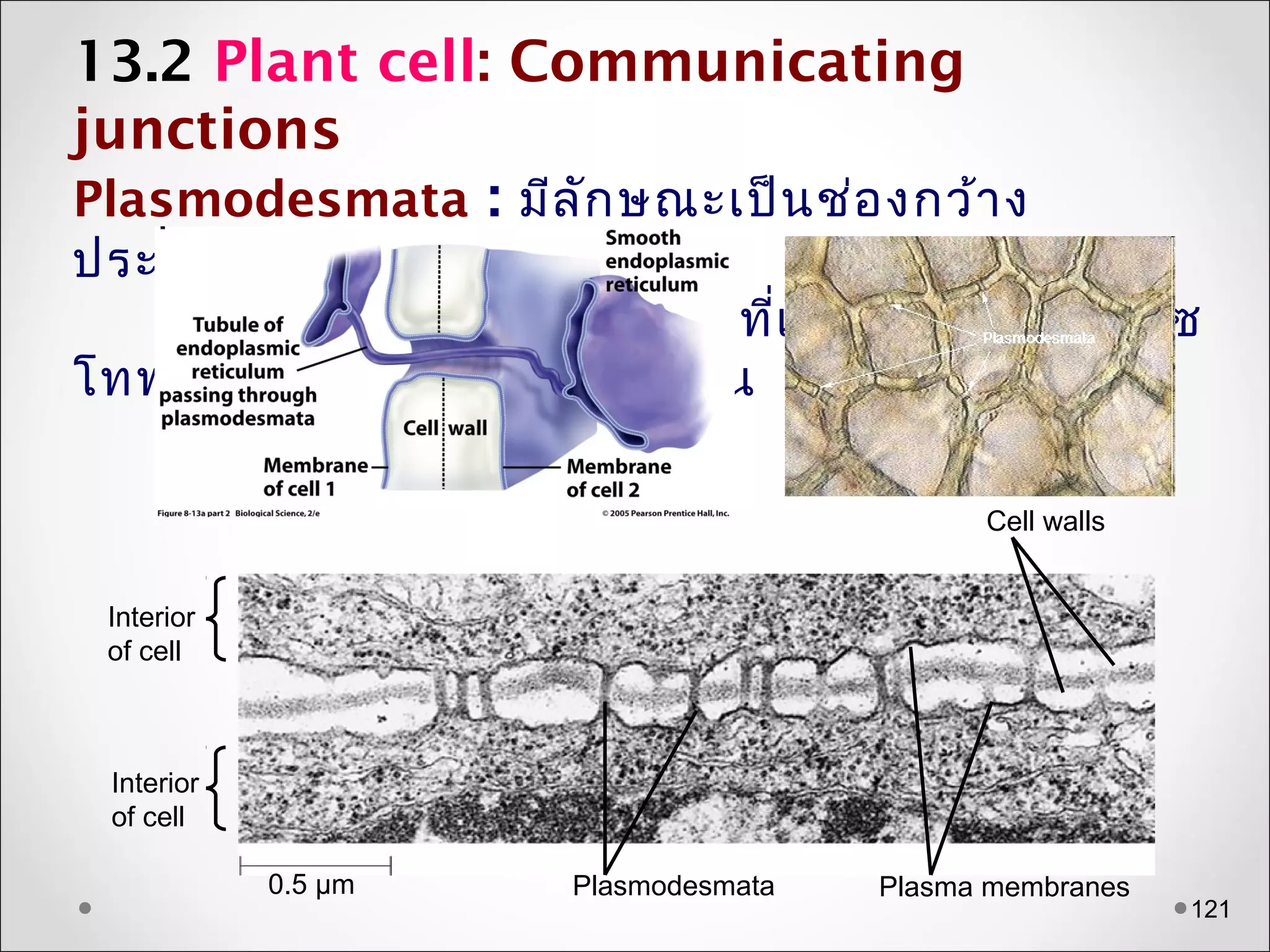
13.2 Plant cell: Communicating
junctions
Plasmodesmata : มีลักษณะเป็นช่องกว้ำง
ประมำณ 20-200 nm
: เป็นช่องที่เชื่อมต่อระหว่ำงไซ
โทพลำซึมของเซลล์ที่อยู่ติดกัน
Interior
of cell
Interior
of cell
0.5 µm Plasmodesmata Plasma membranes
Cell walls
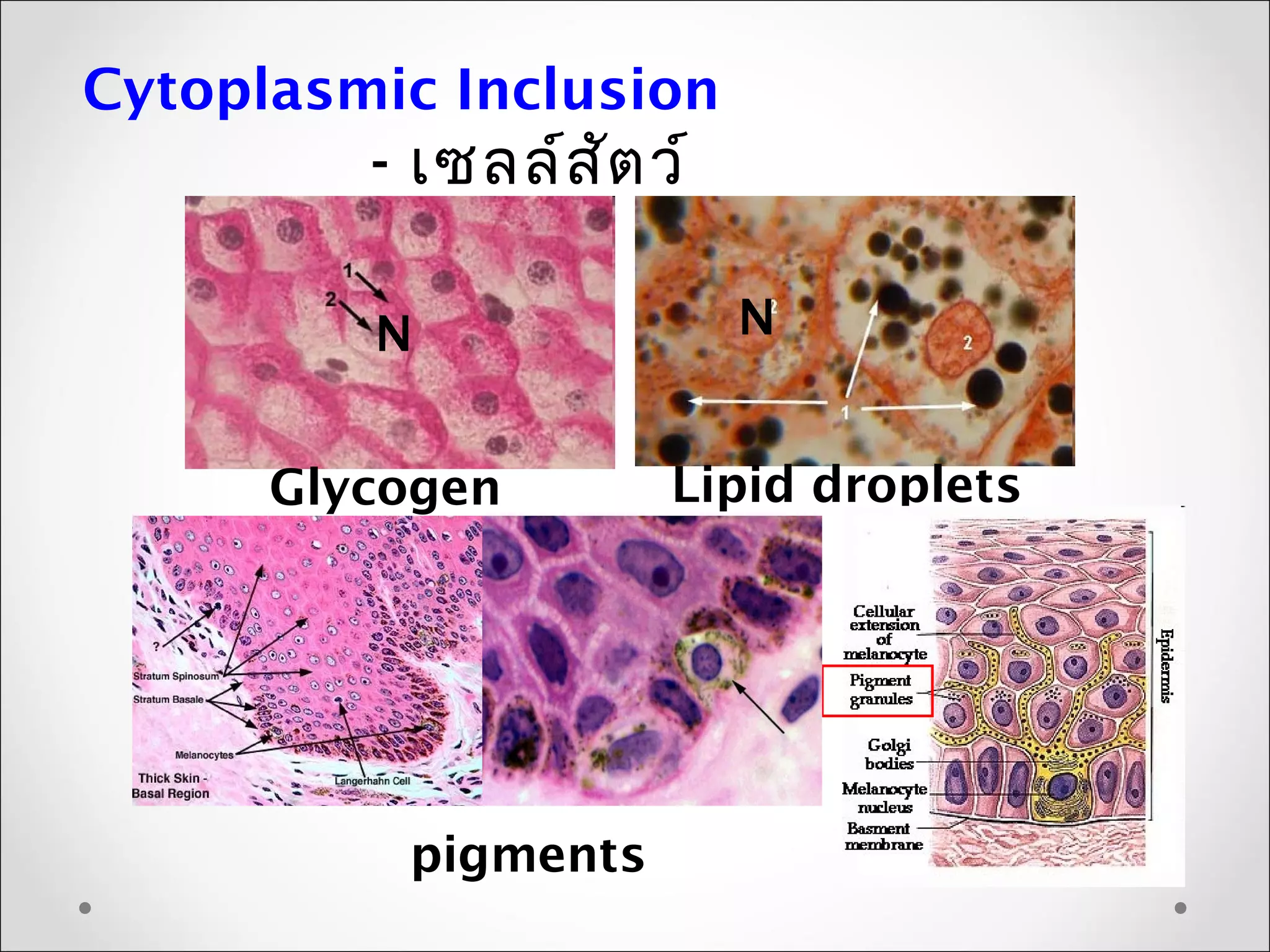
Cytoplasmic Inclusion
- เซลล์สัตว์
N
Glycogen Lipid droplets
N
pigments
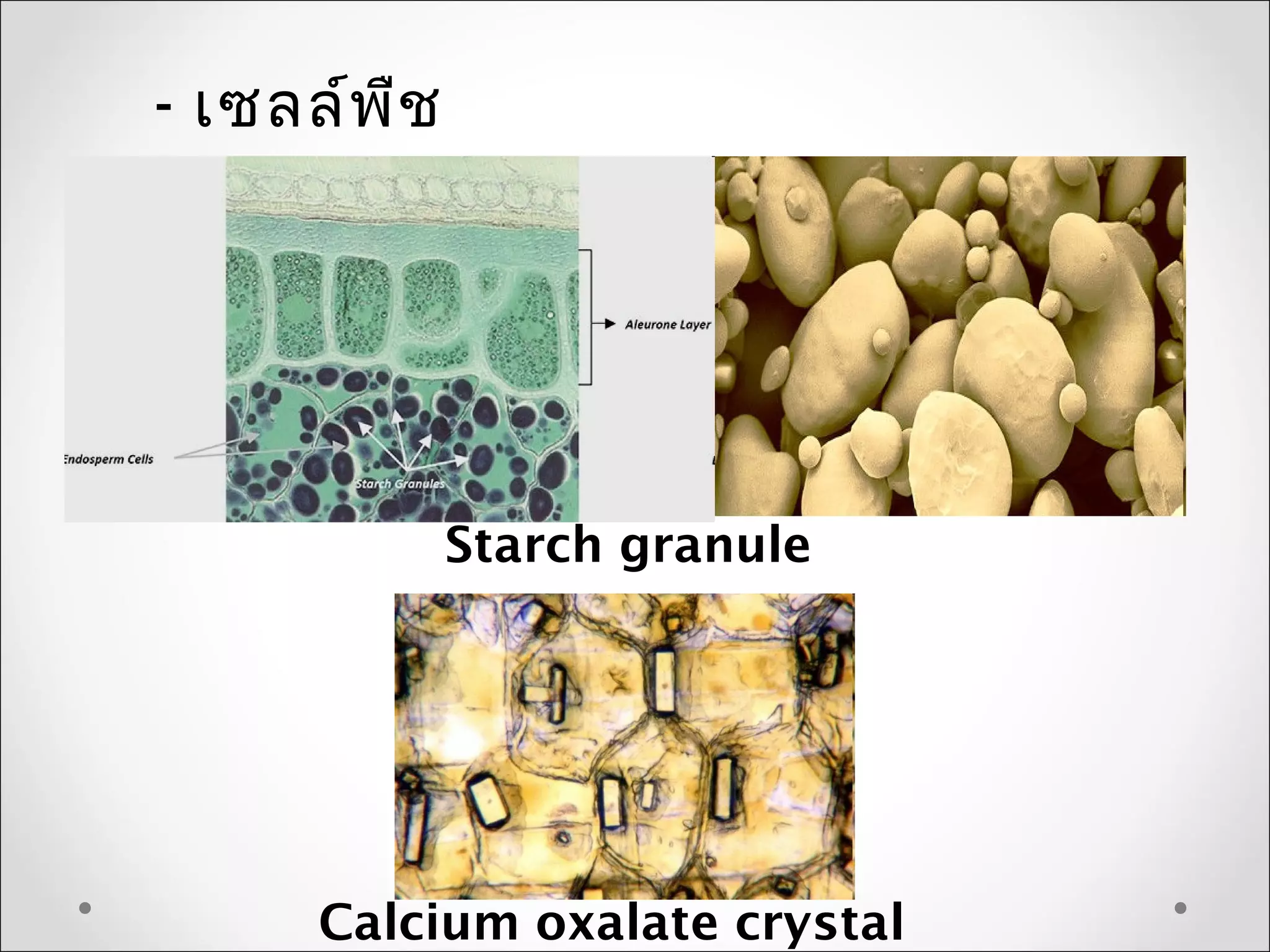
Calcium oxalate crystal
Starch granule
- เซลล์พืช
124
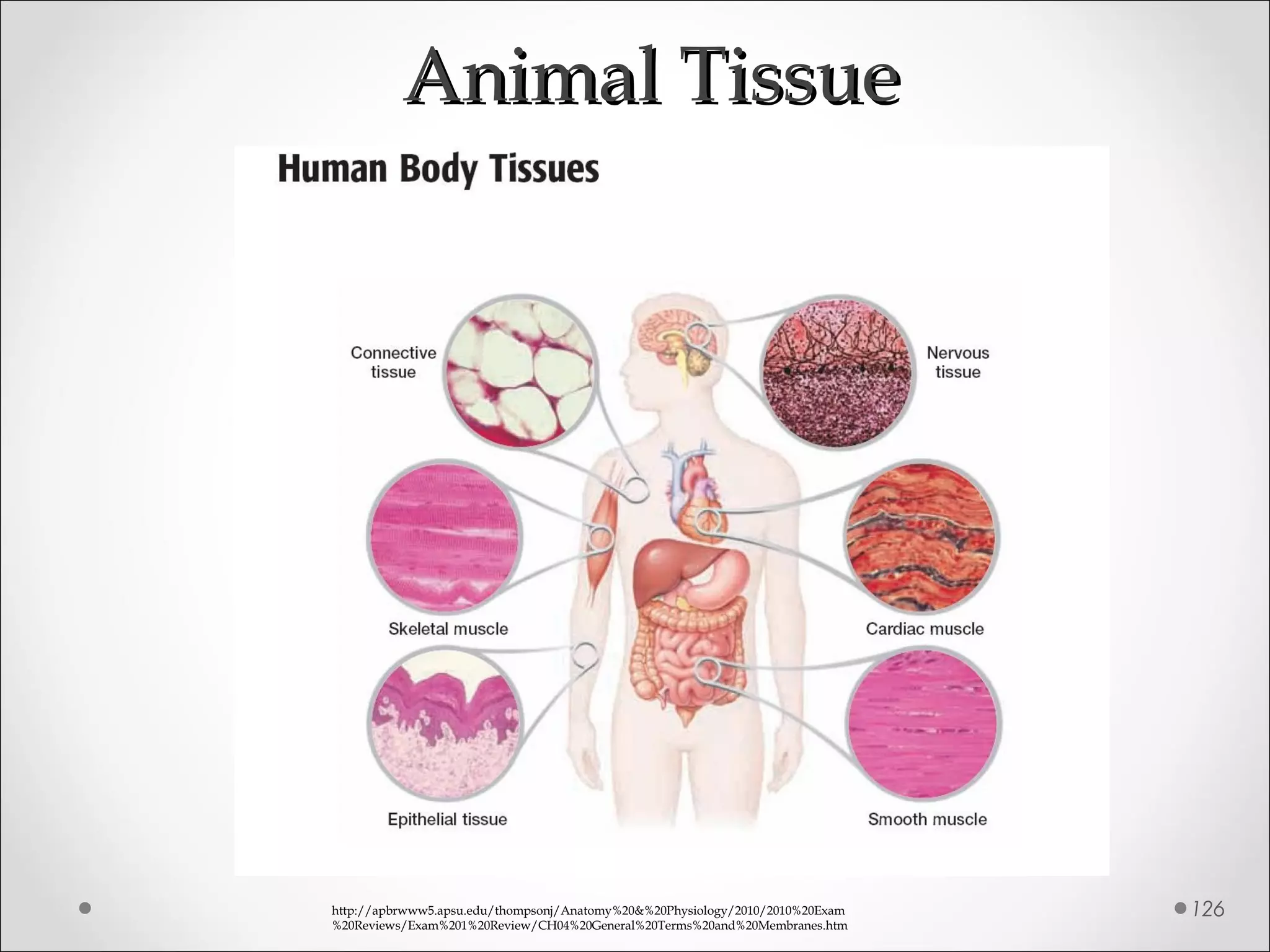
Animal TissueAnimal Tissue
http://apbrwww5.apsu.edu/thompsonj/Anatomy%20&%20Physiology/2010/2010%20Exam
%20Reviews/Exam%201%20Review/CH04%20General%20Terms%20and%20Membranes.htm
125
Germ Layer TheoryGerm Layer Theory
http://www.carteret.edu/keoughp/LFreshwater/NEO/blackboard/EmbDev/germ_layers.jpg
126
Animal TissueAnimal Tissue
http://apbrwww5.apsu.edu/thompsonj/Anatomy%20&%20Physiology/2010/2010%20Exam
%20Reviews/Exam%201%20Review/CH04%20General%20Terms%20and%20Membranes.htm
Tissues – IntroductionTissues – Introduction
• a group of similar cells specialized to carry
on a particular function
• tissue = cells + extracellular matrix
o nonliving portion of a tissue that supports cells
• 4 types
o epithelial = protection, secretion, absorption
o connective = support soft body parts and bind
structures together
o muscle = movement
o nervous = conducts impulses used to help
control and coordinate body activities
Animal TissueAnimal Tissue เนื้อเยื่อสัตว์เนื้อเยื่อสัตว์
• Epithelial Tissue เนื้อเยื่อบุผิว จัดจำำแนกกำรเรียงตัว (ชั้น
เดียวหรือมำกกว่ำหนึ่ง) และรูปร่ำงของเซลล์ Simple or Stratified –
squamous, cuboidal, columnar
• Connective Tissue เนื้อเยื่อเกี่ยวพัน ทำำหน้ำที่เชื่อมยึด และคำ้ำจุน
เนื้อเยื่ออื่นๆ
o เนื้อเยื่อเกี่ยวพันโปร่งบำง แทรกและทำำหน้ำที่ยึดเหนี่ยวเนื้อเยื่ออื่นๆ
เช่น พังผืดที่ยึดมัดกล้ำมเนื้อ
o เนื้อเยื่อไขมัน มี adipose tissue เป็นที่เก็บสะสมไขมัน เช่น ใต้ชั้น
ผิวหนัง ในช่องท้อง เซลล์ไขมันขยำยใหญ่ได้ รับแรงกระแทก เป็น
ฉนวนป้องกันกำรสูญเสียควำมร้อนของร่ำงกำย
o เนื้อเยื่อเกี่ยวพันแน่นทึบ มี Collagenous fiber หนำแน่น จัดเรียง
ตัวอย่ำงมีทิศทำง เช่น เอ็นที่ยึดกล้ำมเนื้อและกระดูก
o กระดูกและกระดูกอ่อน
o เลือด
• Muscle Tissue เนื้อเยื่อกล้ำมเนื้อ ได้แก่ กล้ำมเนื้อลำย
กล้ำมเนื้อเรียบ และกล้ำมเนื้อหัวใจ
128
129
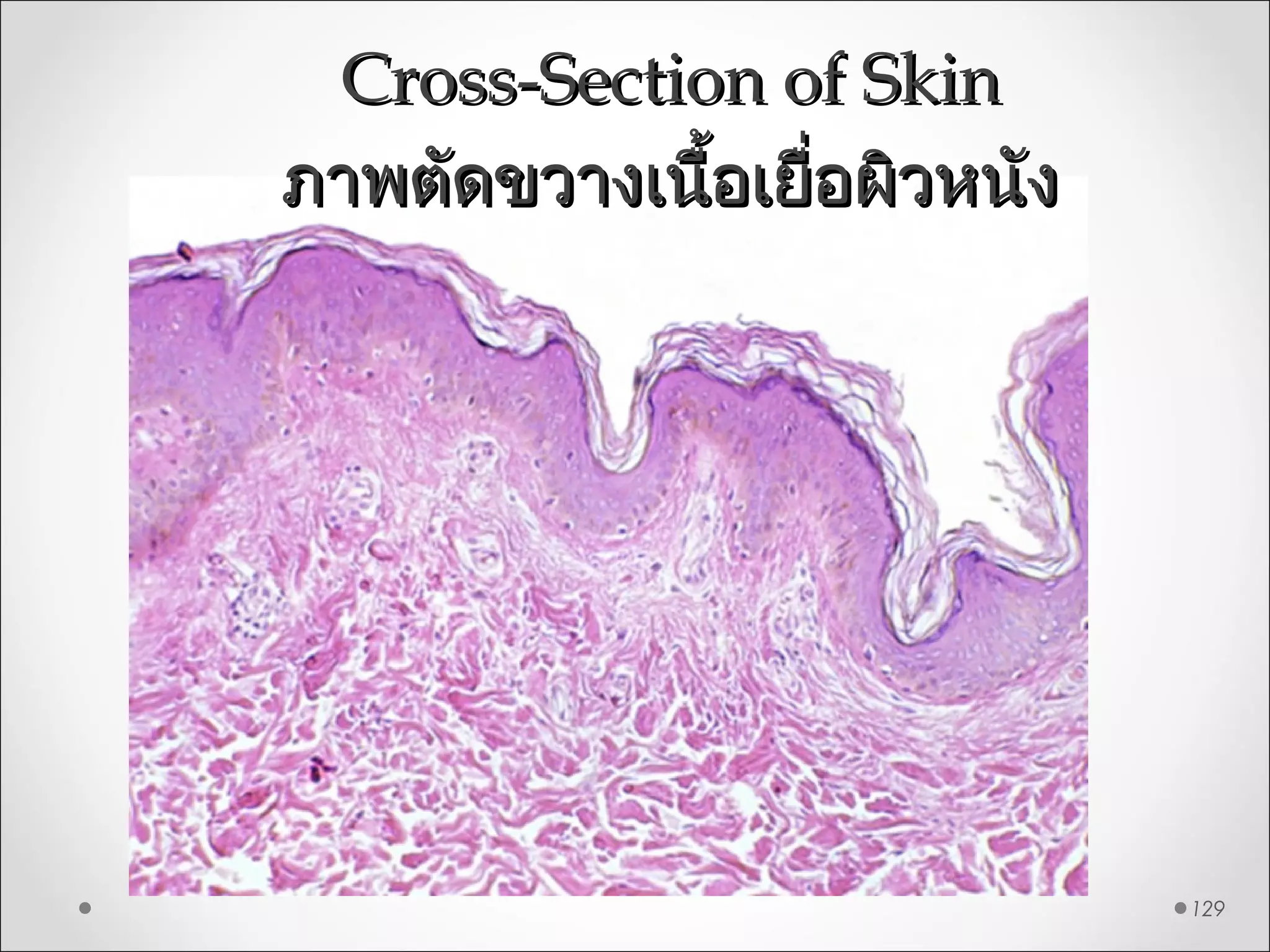
Cross-SectionCross-Section of Skinof Skin
ภำพตัดขวำงเนื้อเยื่อผิวหนังภำพตัดขวำงเนื้อเยื่อผิวหนัง
130
Tissue SectioningTissue Sectioning
1. Preparation of histological specimens
o fixation
o sections
o mounted on slides & stained
2. Sectioning (slicing) an organ or tissue reduces a 3-
dimensional structure to a 2-dimensional slice (see
the next 3 slides)
1 2 3 4 5
1
2
3
4
5
•Slices 1 & 5
miss the
yolk / cell
nucleus
•Cell nucleus
is smaller in
sections 2 & 4
Tissue Sectioning
131
132
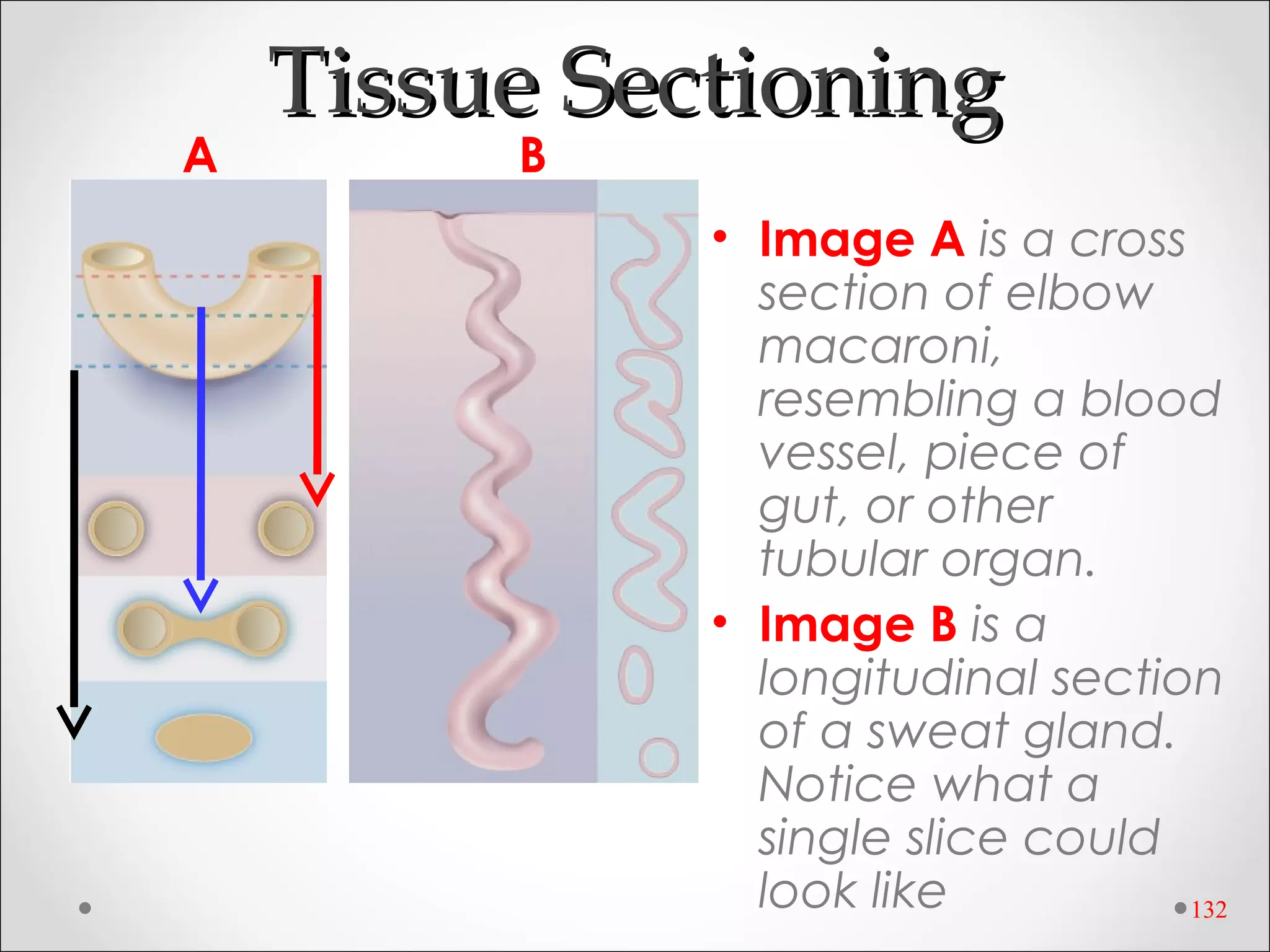
Tissue SectioningTissue Sectioning
• Image A is a cross
section of elbow
macaroni,
resembling a blood
vessel, piece of
gut, or other
tubular organ.
• Image B is a
longitudinal section
of a sweat gland.
Notice what a
single slice could
look like
A B
133
Types of Tissue SectionsTypes of Tissue Sections
• Longitudinal section
o tissue cut along the
longest direction of
an organ
• Cross section
o tissue cut
perpendicular to the
length of an organ
• Oblique section
o tissue cut at an angle
between a cross &
longitudinal section
134
Types of Tissue SectionsTypes of Tissue Sections
• Would you classify
the egg sections
as longitudinal,
cross, or oblique
sections?
• How would the
egg look if
sectioned in the
other two planes?
Practice at home.
135
Epithelial Tissue
http://www.proprofs.com/quiz-
school/story.php?title=tissue-quizhttp://memorize.com/epithelial-tissue-
images/rixikifa
H&E Staining Blue for nuclei, Pink for cytoplasm
Epithelial ClassificationsEpithelial Classifications
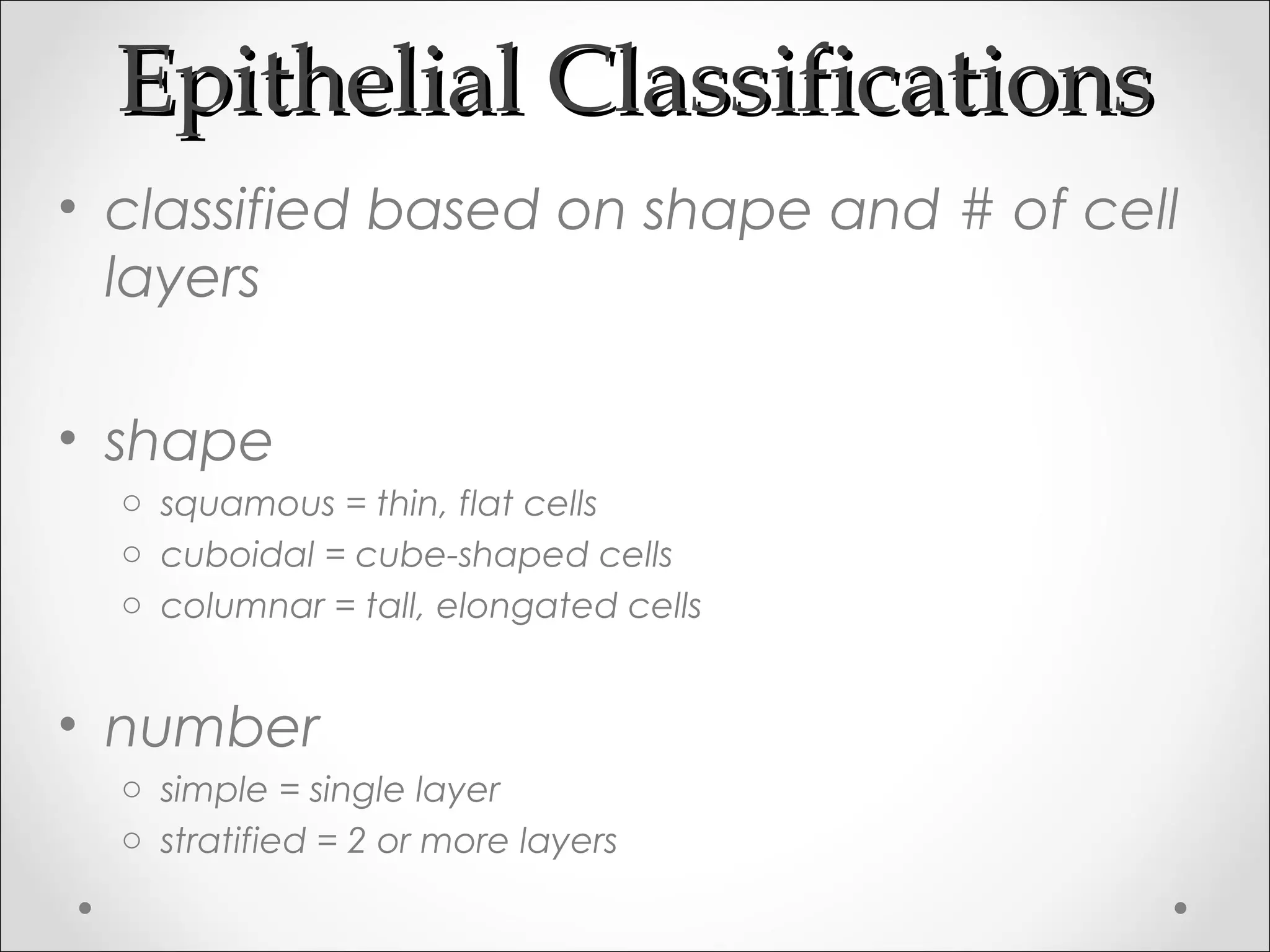
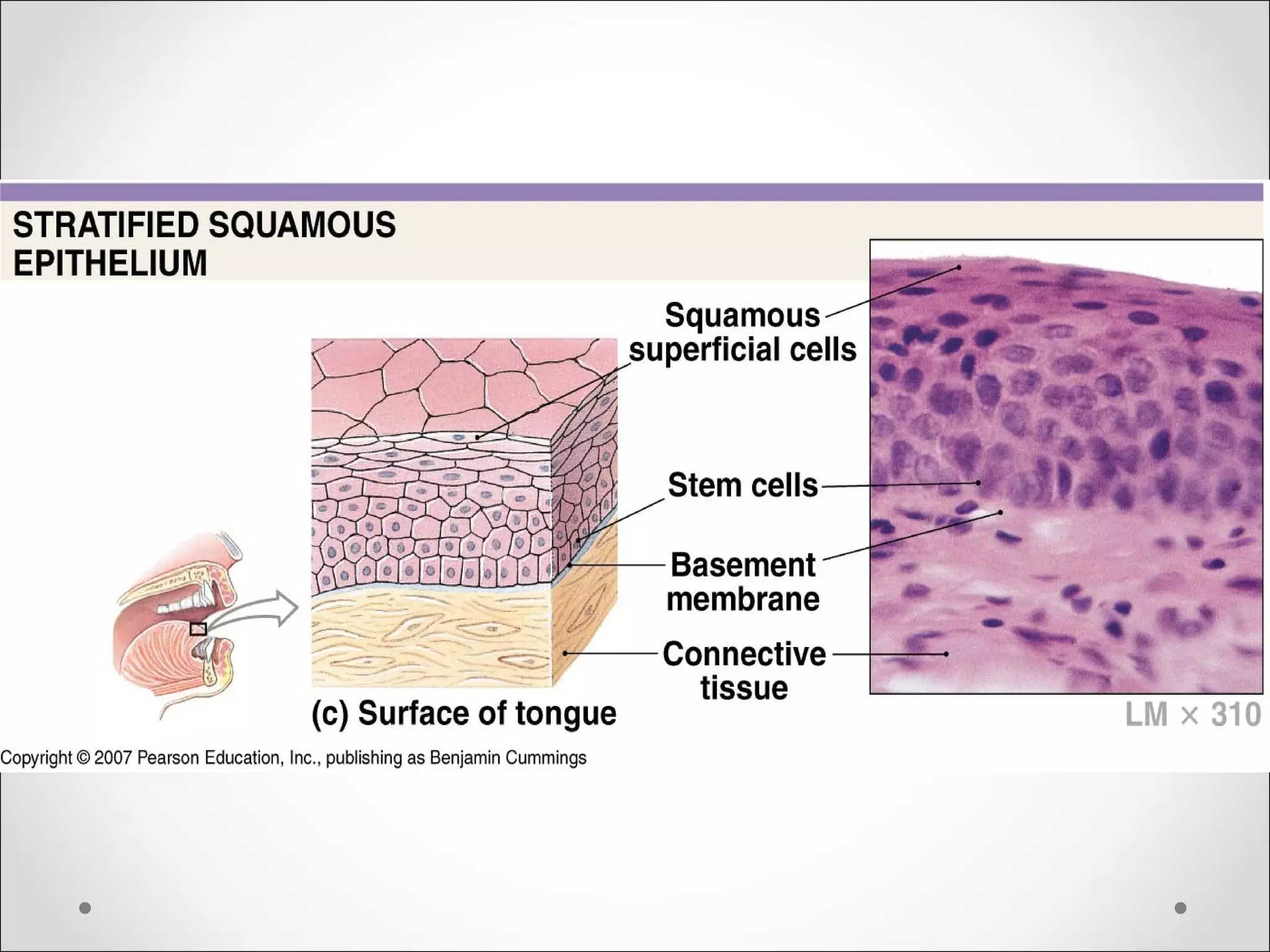
• classified based on shape and # of cell
layers
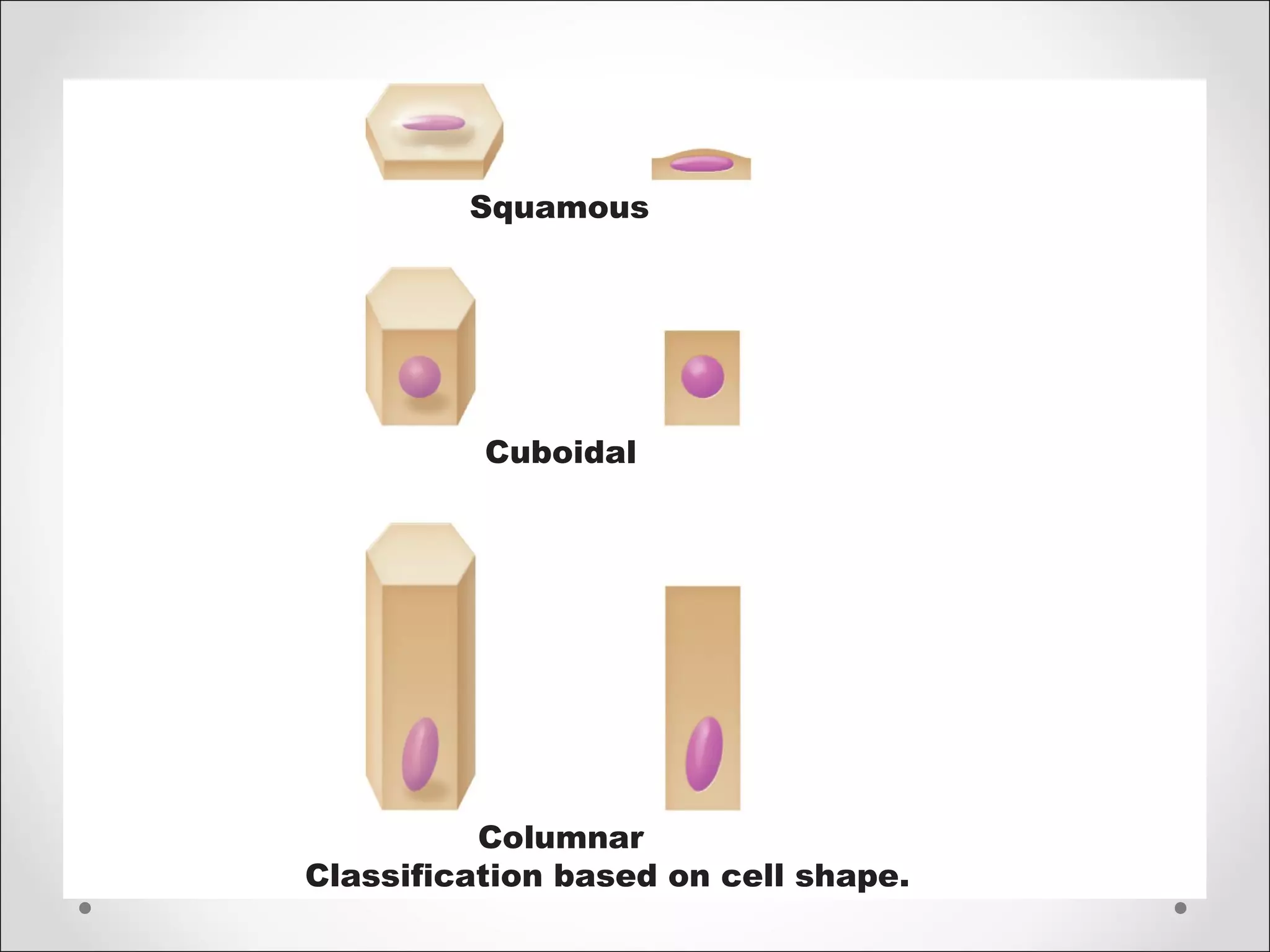
• shape
o squamous = thin, flat cells
o cuboidal = cube-shaped cells
o columnar = tall, elongated cells
• number
o simple = single layer
o stratified = 2 or more layers
Stratified
Simple
Apical surface
Basal surface
Apical surface
Basal surface
Classification based on number of cell layers.
Squamous
Cuboidal
Columnar
Classification based on cell shape.
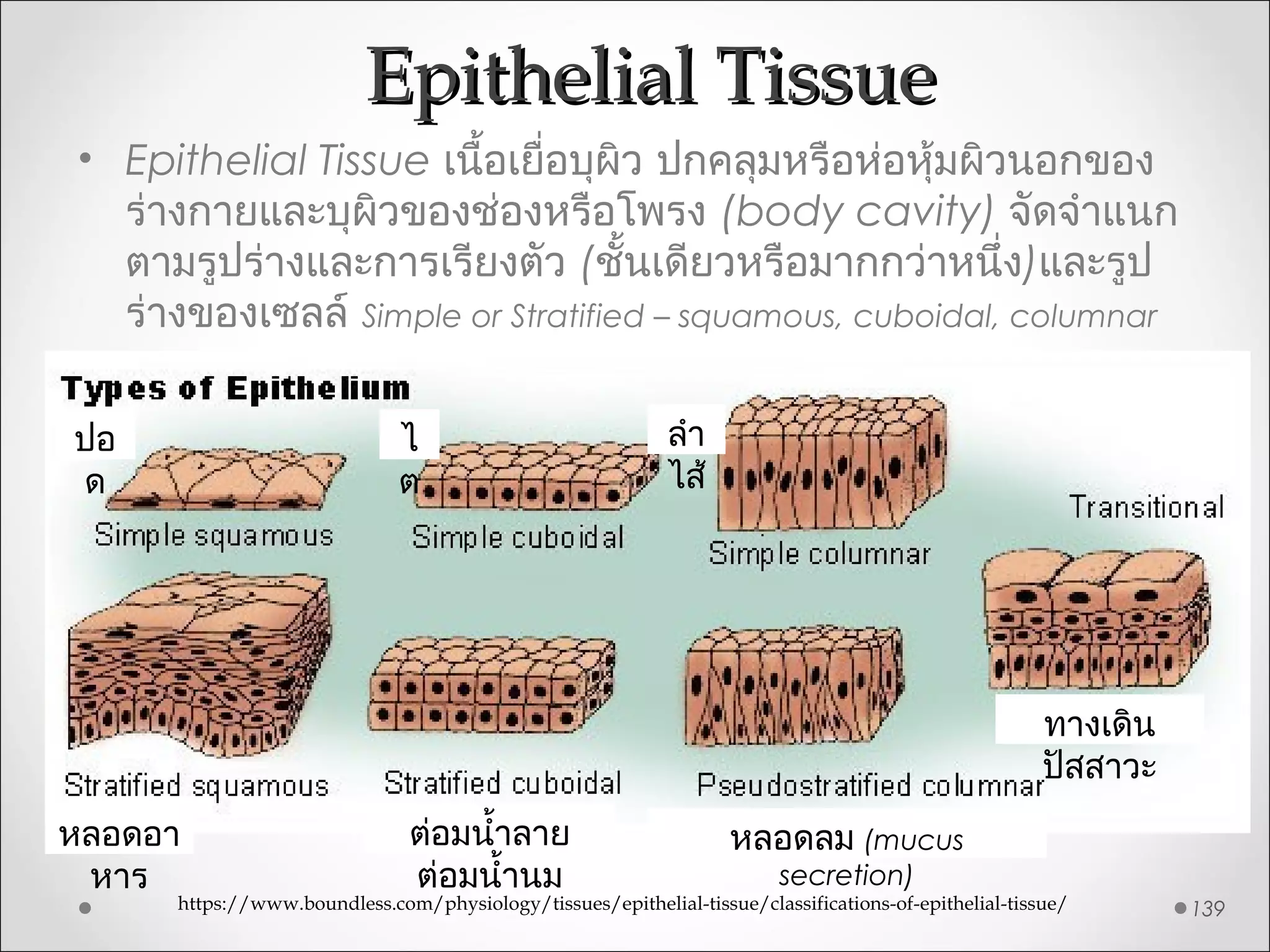
Epithelial TissueEpithelial Tissue
• Epithelial Tissue เนื้อเยื่อบุผิว ปกคลุมหรือห่อหุ้มผิวนอกของ
ร่ำงกำยและบุผิวของช่องหรือโพรง (body cavity) จัดจำำแนก
ตำมรูปร่ำงและกำรเรียงตัว (ชั้นเดียวหรือมำกกว่ำหนึ่ง)และรูป
ร่ำงของเซลล์ Simple or Stratified – squamous, cuboidal, columnar
139https://www.boundless.com/physiology/tissues/epithelial-tissue/classifications-of-epithelial-tissue/
ปอ
ด
ไ
ต
ลำำ
ไส้
หลอดอำ
หำร
ต่อมนำ้ำลำย
ต่อมนำ้ำนม
หลอดลม (mucus
secretion)
ทำงเดิน
ปัสสำวะ
Exocrine glandsExocrine glands
• merocrine = release watery, protein-rich fluid
by exocytosis
o salivary glands, sweat glands
• apocrine = lose small portions of their cell body
during secretion
o mammary glands, ear wax
• holocrine = entire cell lysis (breaks apart) during
secretion
o sebaceous glands of the skin
Exocrine vs. EndocrineExocrine vs. Endocrine
• exocrine = secrete sub. into ducts that open onto
surfaces
o skin or linings of digestive tract
• endocrine = secrete sub. into tissue fluid or blood
o hormones
Serous vs. MucousSerous vs. Mucous
• serous = typically watery with lots of enzymes
o lubrication
• mucous = mucus
o digestive and respiratory systems
o protection
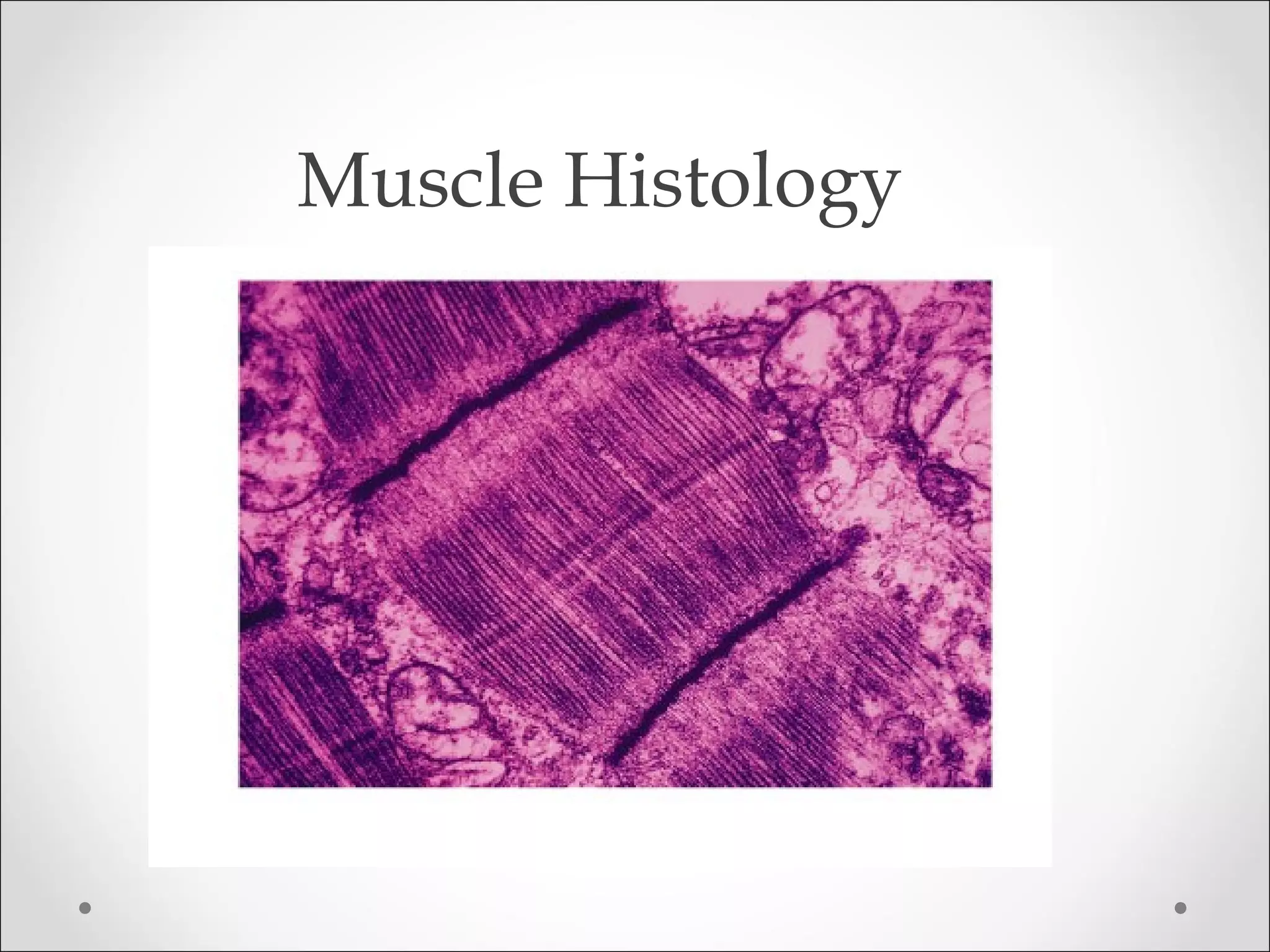
Muscle Histology
Functions of muscle tissue
 Movement
 Maintenance of posture
 Joint stabilization
 Heat generation
Special functional characteristics of muscle
 Contractility
 Only one action: to shorten
 Shortening generates pulling force
 Excitability
 Nerve fibers cause electrical impulse to travel
 Extensibility
 Stretch with contraction of an opposing
muscle
 Elasticity
 Recoils passively after being stretched
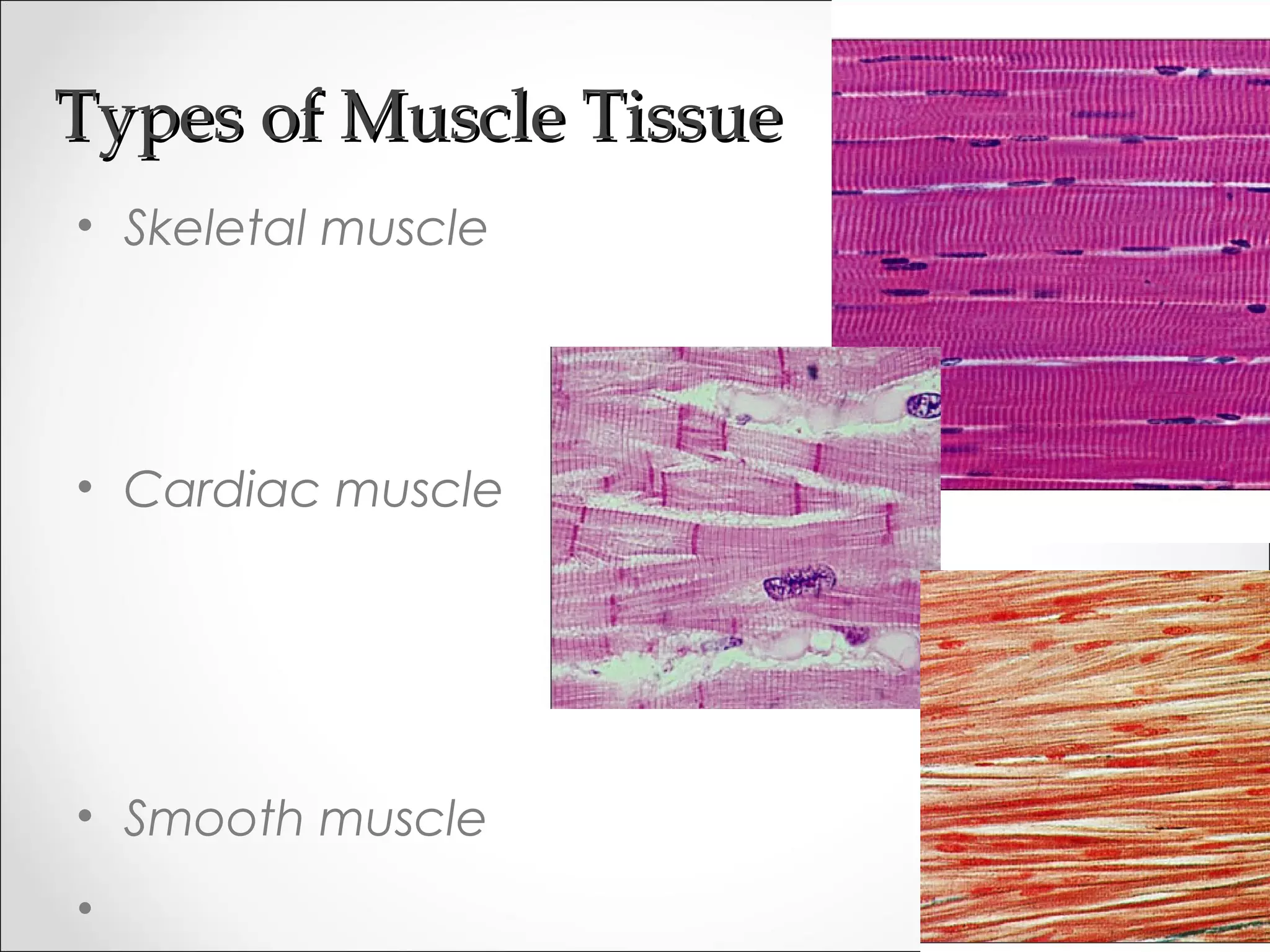
Types of Muscle TissueTypes of Muscle Tissue
• Skeletal muscle
• Cardiac muscle
• Smooth muscle
Types of Muscle TissueTypes of Muscle Tissue
Skeletal
•Attach to and move skeleton
•40% of body weight
•Fibers = multinucleate cells
(embryonic cells fuse)
•Cells with obvious striations
•Contractions are voluntary
Cardiac: only in the wall of the
heart
•Cells are striated
•Contractions are
involuntary (not
voluntary)
Smooth: walls of hollow organs
•Lack striations
•Contractions are involuntary (not voluntary)
Similarities…Similarities…
• Their cells are called fibers because they are
elongated
• Contraction depends on myofilaments
o Actin
o Myosin
• Plasma membrane is called sarcolemma
o Sarcos = flesh
o Lemma = sheath
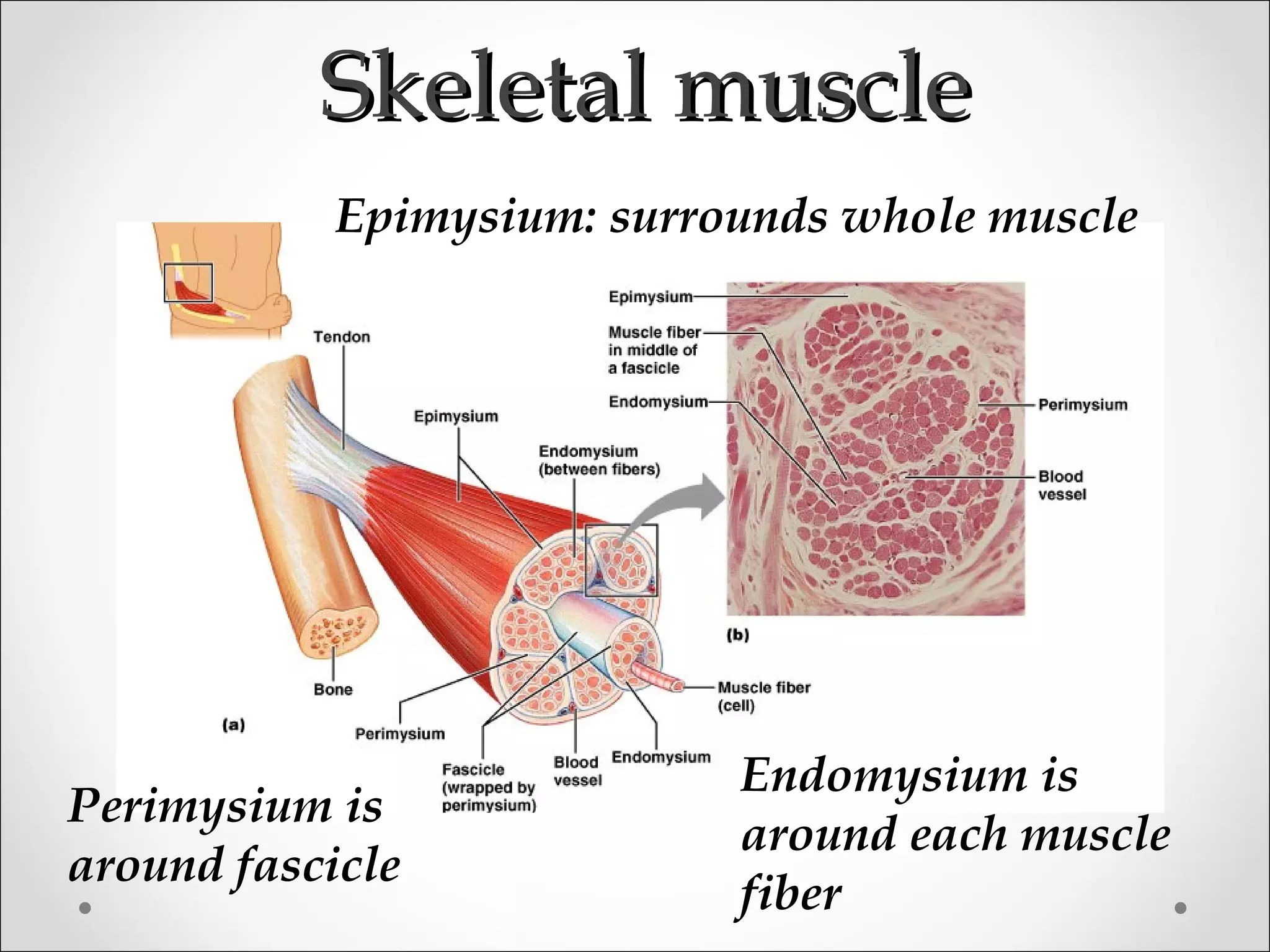
Skeletal muscleSkeletal muscle
Epimysium: surrounds whole muscle
Perimysium is
around fascicle
Endomysium is
around each muscle
fiber
SkeletalSkeletal
MuscleMuscle
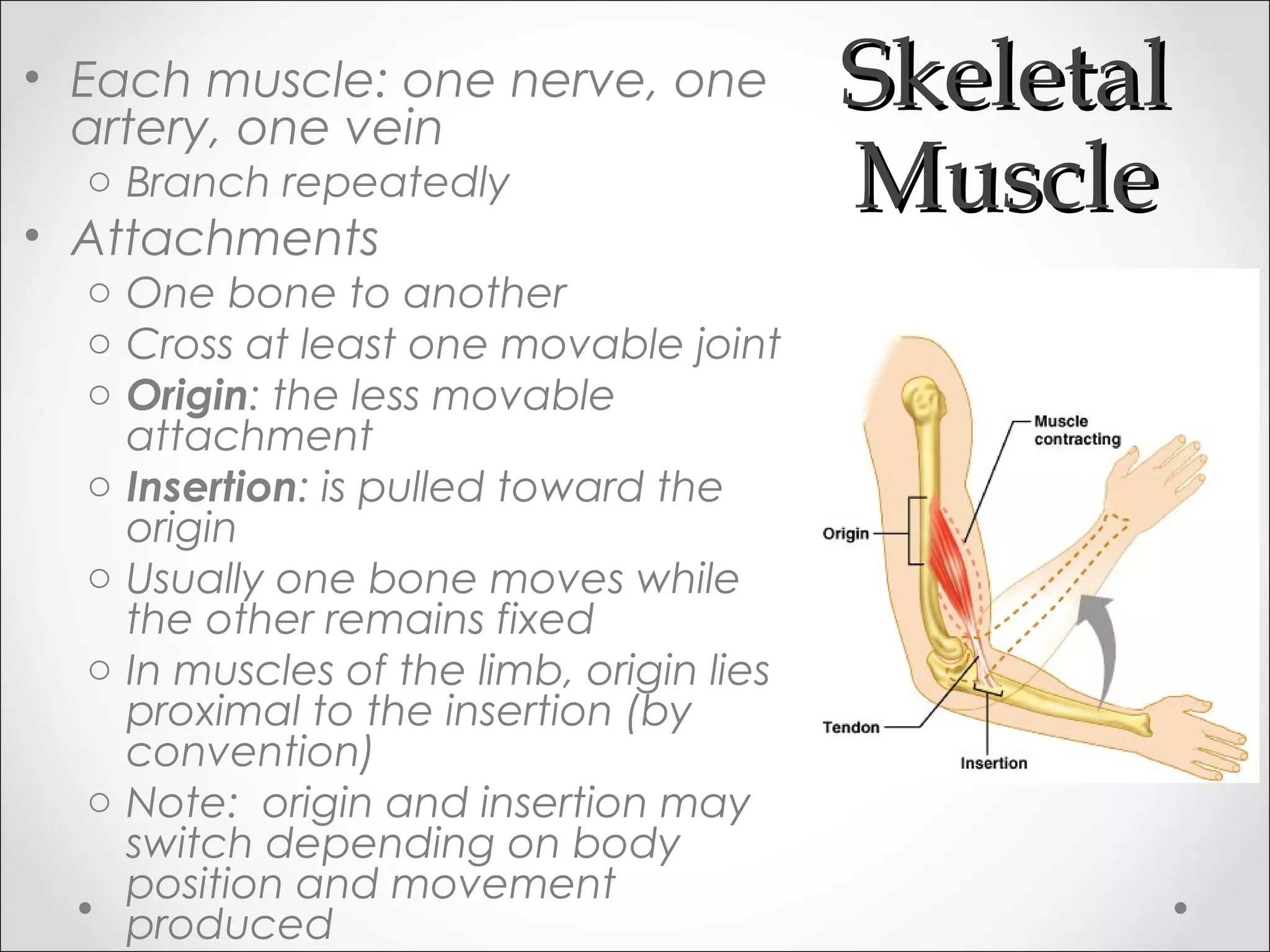
• Each muscle: one nerve, one
artery, one vein
o Branch repeatedly
• Attachments
o One bone to another
o Cross at least one movable joint
o Origin: the less movable
attachment
o Insertion: is pulled toward the
origin
o Usually one bone moves while
the other remains fixed
o In muscles of the limb, origin lies
proximal to the insertion (by
convention)
o Note: origin and insertion may
switch depending on body
position and movement
produced
Attachments continuedAttachments continued
• Many muscles span two or more joints
o Called biarticular or multijoint muscles
o Cause movements at two joints
• Direct or “fleshy” attachments
o Attachments so short that muscle appears to
attach directly to bone
• Indirect: connective tissue extends well
beyond the muscle (more common)
o Tendon: cordlike (most muscles have tendons)
o Aponeurosis: flat sheet
o Raised bone markings where tendons meet
bones
• Tubercles, trochanters, crests, etc.
Some sites showing animationsSome sites showing animations
of muscle contractionof muscle contraction
• http://www.youtube.com/watch?v=WVuW560nRII
• http://www.youtube.com/watch?v=l-_fgHwHN-E
Skeletal muscleSkeletal muscle
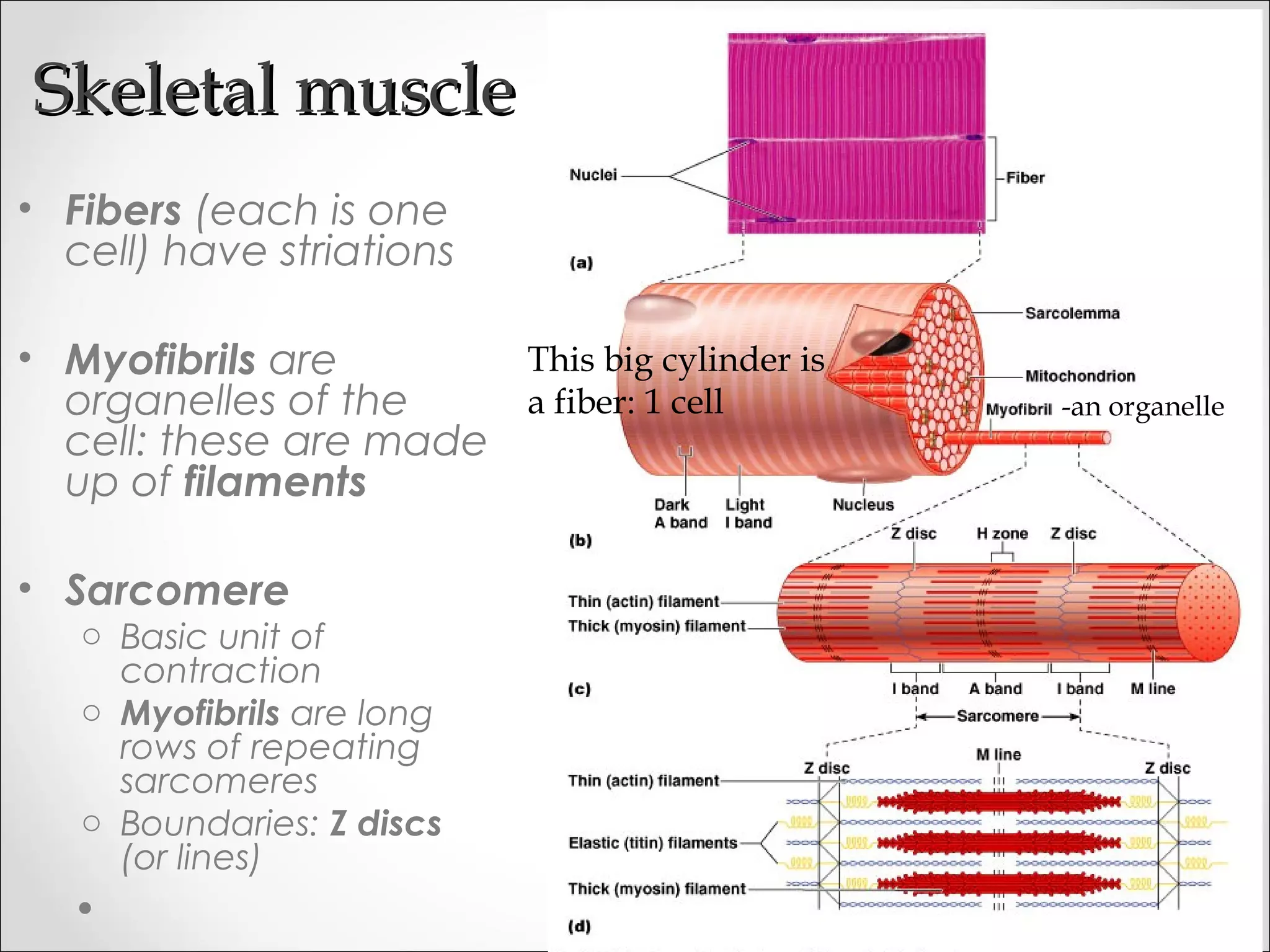
• Fibers (each is one
cell) have striations
• Myofibrils are
organelles of the
cell: these are made
up of filaments
• Sarcomere
o Basic unit of
contraction
o Myofibrils are long
rows of repeating
sarcomeres
o Boundaries: Z discs
(or lines)
This big cylinder is
a fiber: 1 cell -an organelle
MyofibrilsMyofibrils
• Made of three types of filaments (or myofilaments):
o Thick (myosin)
o Thin (actin)
o Elastic (titin)
______actin
_____________myosintitin_____
Sliding Filament ModelSliding Filament Model
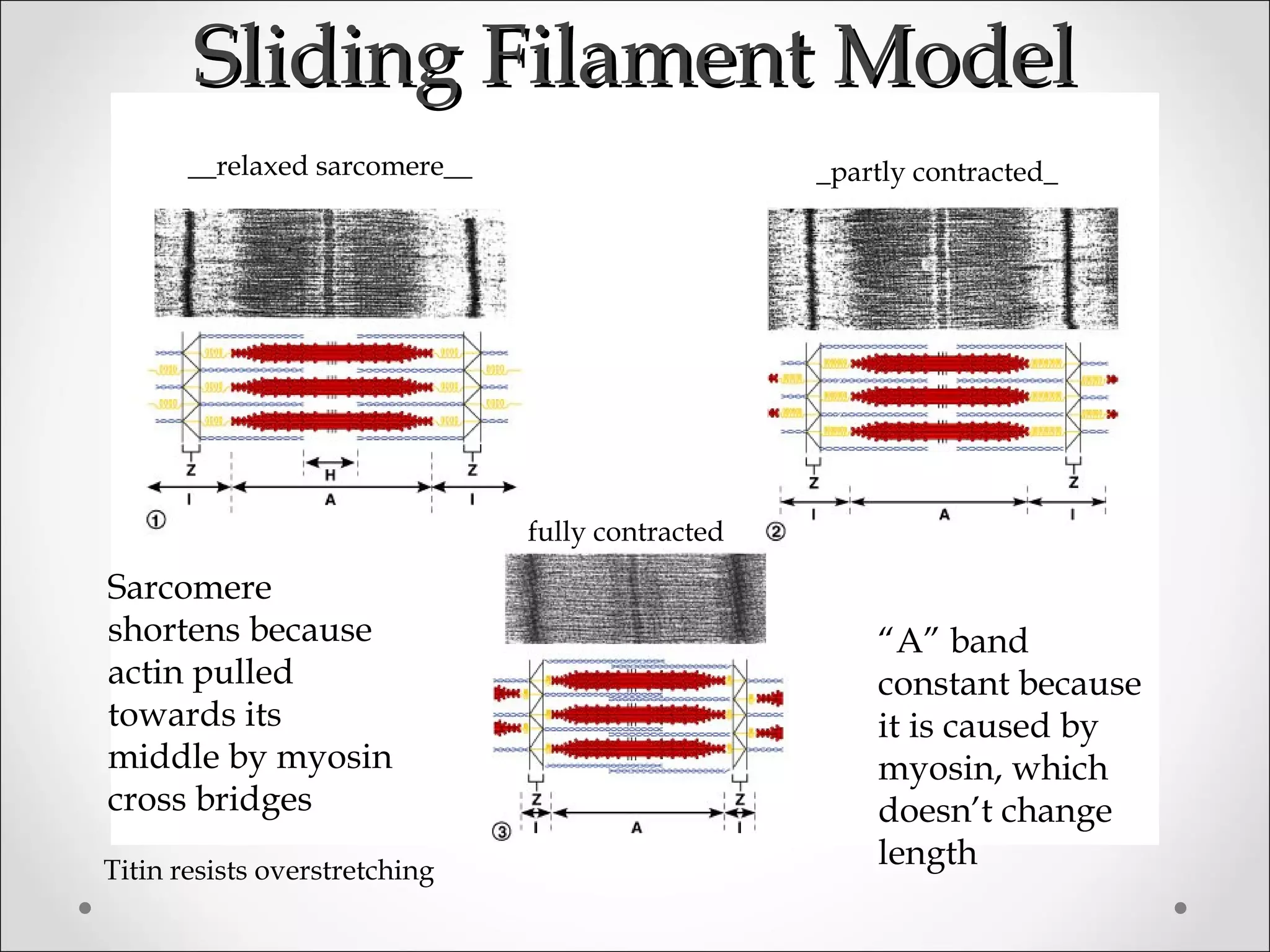
__relaxed sarcomere__ _partly contracted_
fully contracted
“A” band
constant because
it is caused by
myosin, which
doesn’t change
length
Sarcomere
shortens because
actin pulled
towards its
middle by myosin
cross bridges
Titin resists overstretching
Another pic
EM (electronEM (electron
microscope): partsmicroscope): parts
of 2 myofibrilsof 2 myofibrils
Labeled and unlabeled
• Sarcoplasmic reticulum is smooth ER
o Tubules surround myofibrils
o Cross-channels called “terminal cisternae”
o Store Ca++ and release when muscle stimulated to contract
o To thin filaments triggering sliding filament mechanism of
contraction
o T tubules are continuous with sarcolemma, therefore whole
muscle (deep parts as well) contracts simultaneously
NeuromuscularNeuromuscular
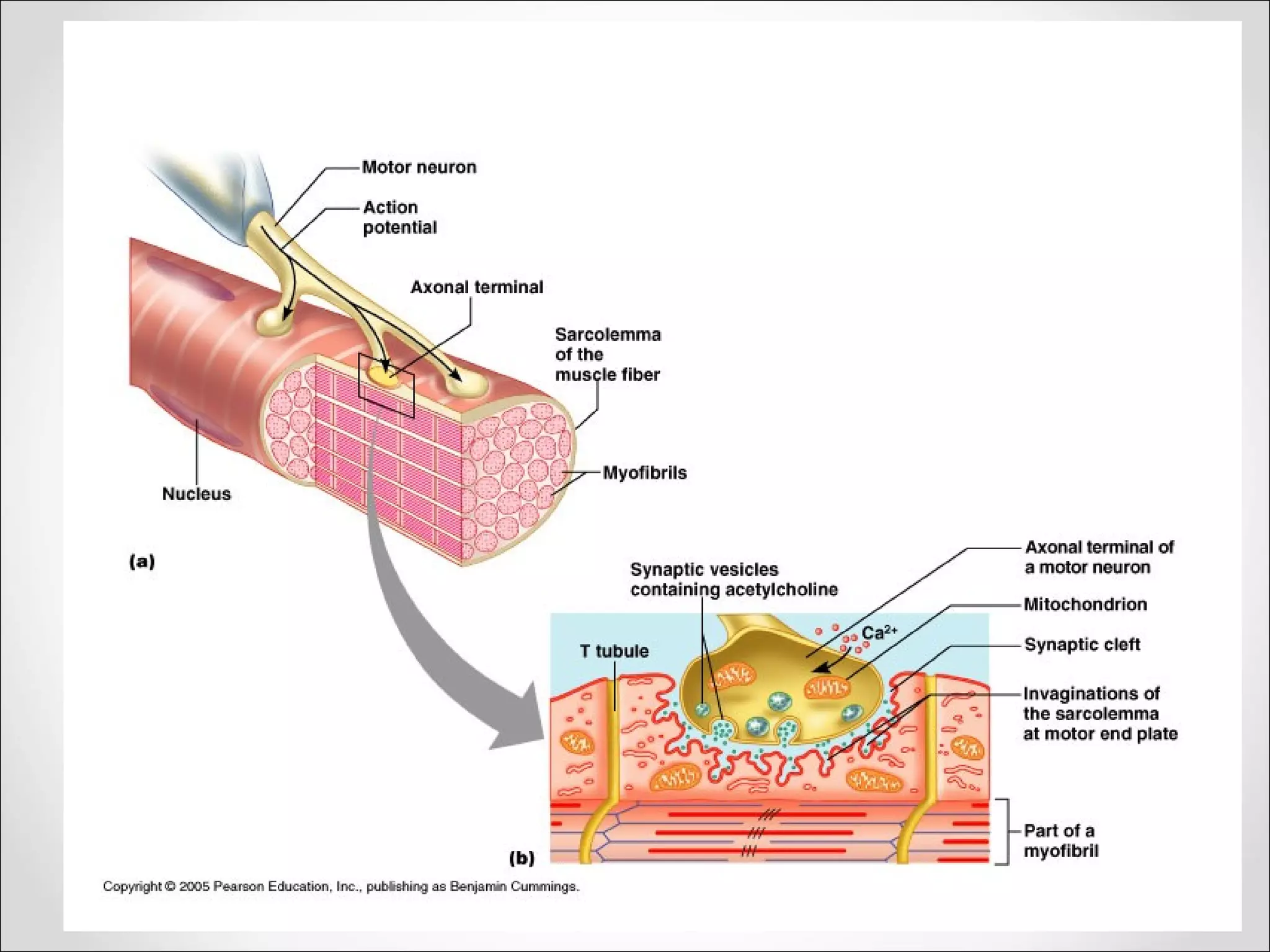
JunctionJunction
Motor neurons innervate
muscle fibers
Motor end plate is where
they meet
Neurotransmitters are
released by nerve signal:
this initiates calcium ion
release and muscle
contraction
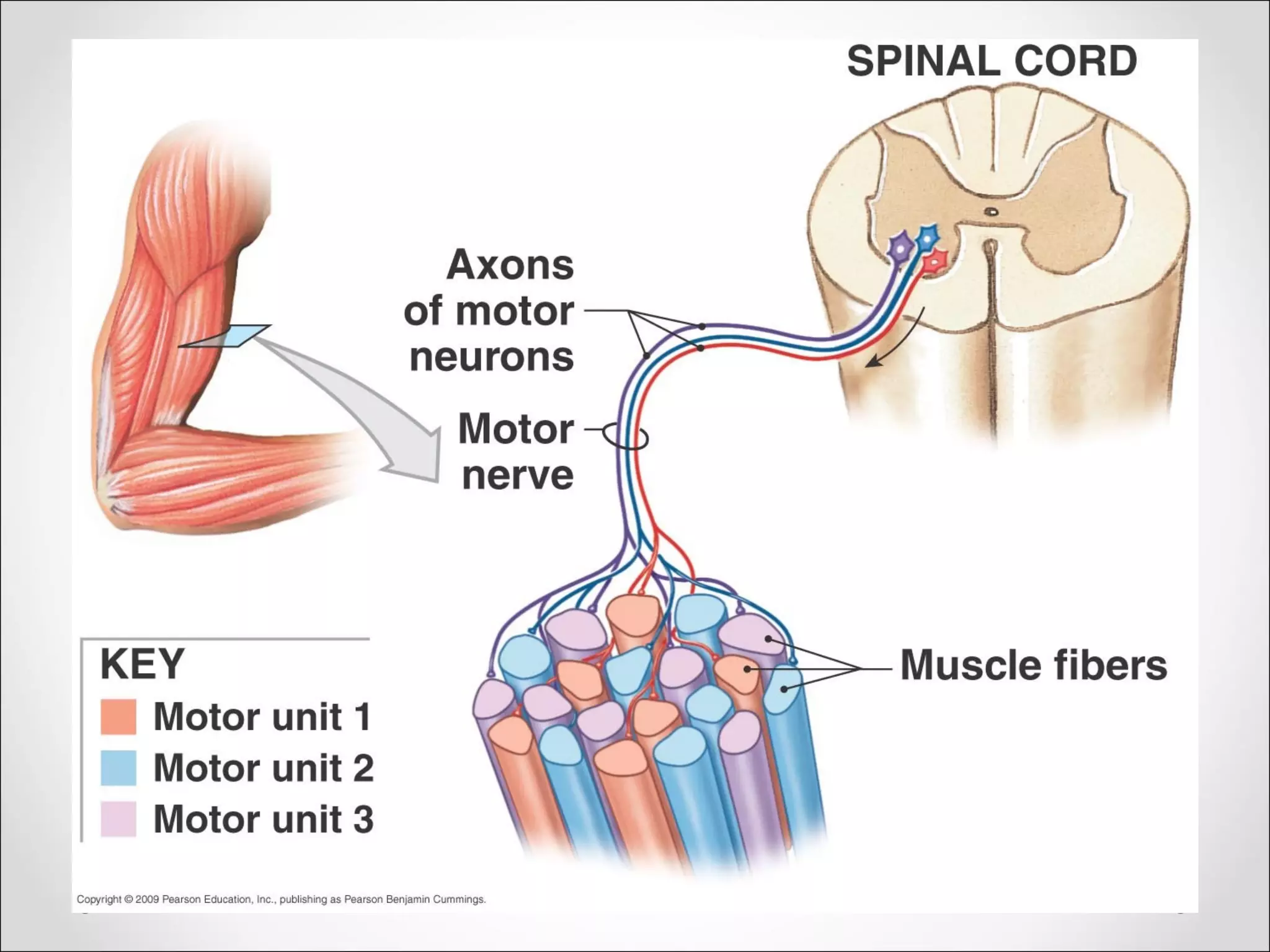
Motor Unit: a motor neuron and all the muscle fibers it innervates (these all contract
together)
•Average is 150, but range is four to several hundred muscle fibers in a motor unit
•The finer the movement, the fewer muscle fibers /motor unit
•The fibers are spread throughout the muscle, so stimulation of a single motor unit causes a
weak contraction of the entire muscle
Types of skeletal muscle fibersTypes of skeletal muscle fibers
• Fast, slow and intermediate
• Whether or not they predominantly use oxygen to
produce ATP (the energy molecule used in muscle
contraction)
o Oxidative – aerobic (use oxygen)
o Glycolytic – make ATP by glycolysis (break down of
sugars without oxygen=anaerobic)
• Fast fibers: “white fibers” – large, predominantly
anaerobic, fatigue rapidly (rely on glycogen reserves);
most of the skeletal muscle fibers are fast
• Slow fibers: “red fibers” – half the diameter, 3X slower, but
can continue contracting; aerobic, more mitochondria,
myoglobin
• Intermediate: in between
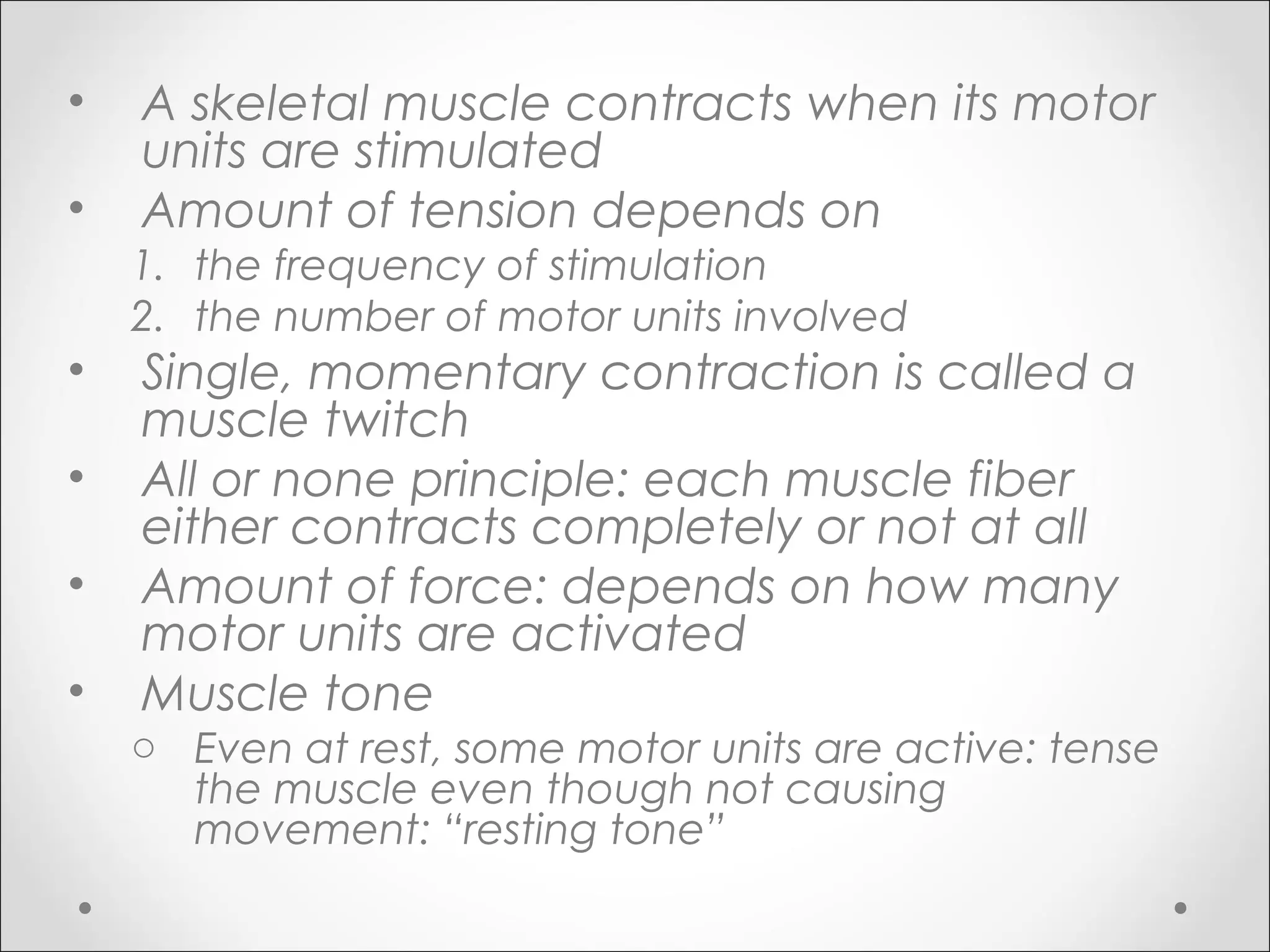
• A skeletal muscle contracts when its motor
units are stimulated
• Amount of tension depends on
1. the frequency of stimulation
2. the number of motor units involved
• Single, momentary contraction is called a
muscle twitch
• All or none principle: each muscle fiber
either contracts completely or not at all
• Amount of force: depends on how many
motor units are activated
• Muscle tone
o Even at rest, some motor units are active: tense
the muscle even though not causing
movement: “resting tone”
• Muscle hypertrophy
o Weight training (repeated intense workouts): increases
diameter and strength of “fast” muscle fibers by increasing
production of
• Mitochondria
• Actin and myosin protein
• Myofilaments containing these contractile proteins
• The myofibril organelles these myofilaments form
o Fibers enlarge (hypertrophy) as number and size of myofibrils
increase
[Muscle fibers (=muscle cells) don’t increase in number but
increase in diameter producing large muscles]
• Endurance training (aerobic): doesn’t produce
hypertrophy
• Muscle atrophy: loss of tone and mass from lack of
stimulation
o Muscle becomes smaller and weaker
Note on terminology: in general, increased size is hypertrophy; increased number
Cardiac muscleCardiac muscle
• Bundles form thick
myocardium
• Cardiac muscle cells are
single cells (not called
fibers)
• Cells branch
• Cells join at intercalated
discs
• 1-2 nuclei in center
• Here “fiber” = long row of
joined cardiac muscle
cells
• Inherent rhythmicity: each
cell! (muscle cells beat
separately without any
stimulation)
Intercalate
d
disc______
____
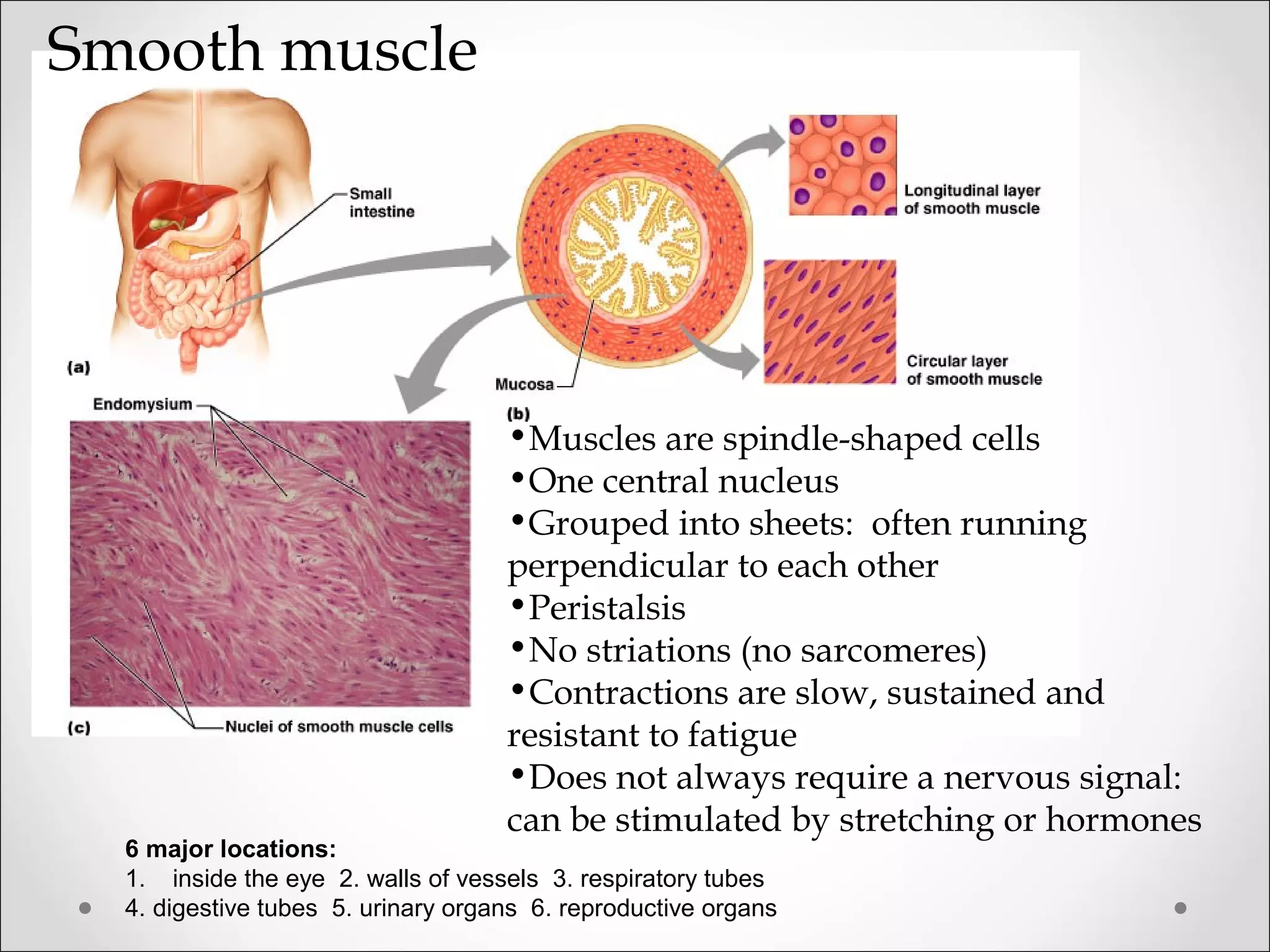
Smooth muscle
•Muscles are spindle-shaped cells
•One central nucleus
•Grouped into sheets: often running
perpendicular to each other
•Peristalsis
•No striations (no sarcomeres)
•Contractions are slow, sustained and
resistant to fatigue
•Does not always require a nervous signal:
can be stimulated by stretching or hormones
6 major locations:
1. inside the eye 2. walls of vessels 3. respiratory tubes
4. digestive tubes 5. urinary organs 6. reproductive organs
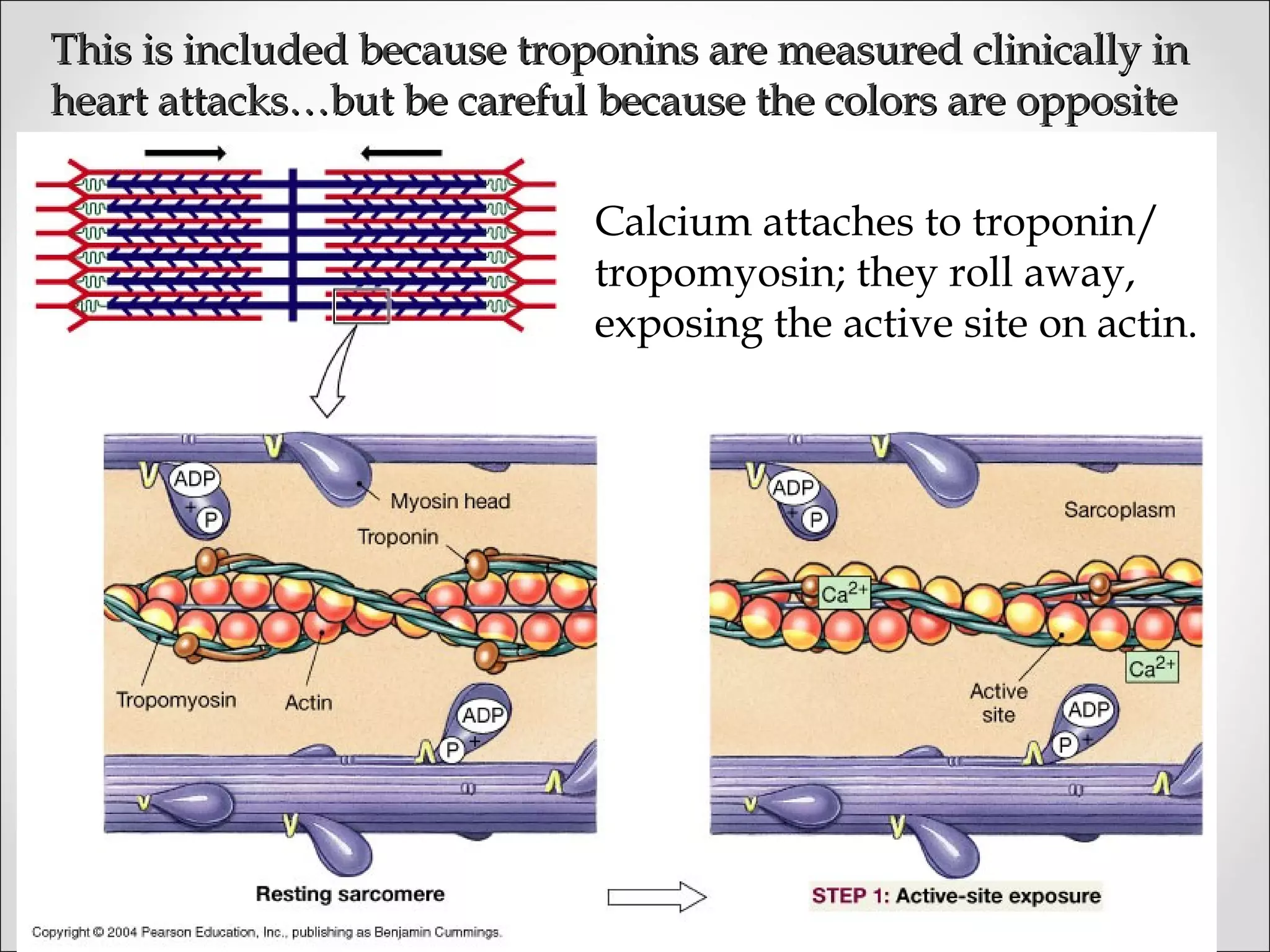
This is included because troponins are measured clinically inThis is included because troponins are measured clinically in
heart attacks…but be careful because the colors are oppositeheart attacks…but be careful because the colors are opposite
Calcium attaches to troponin/
tropomyosin; they roll away,
exposing the active site on actin.
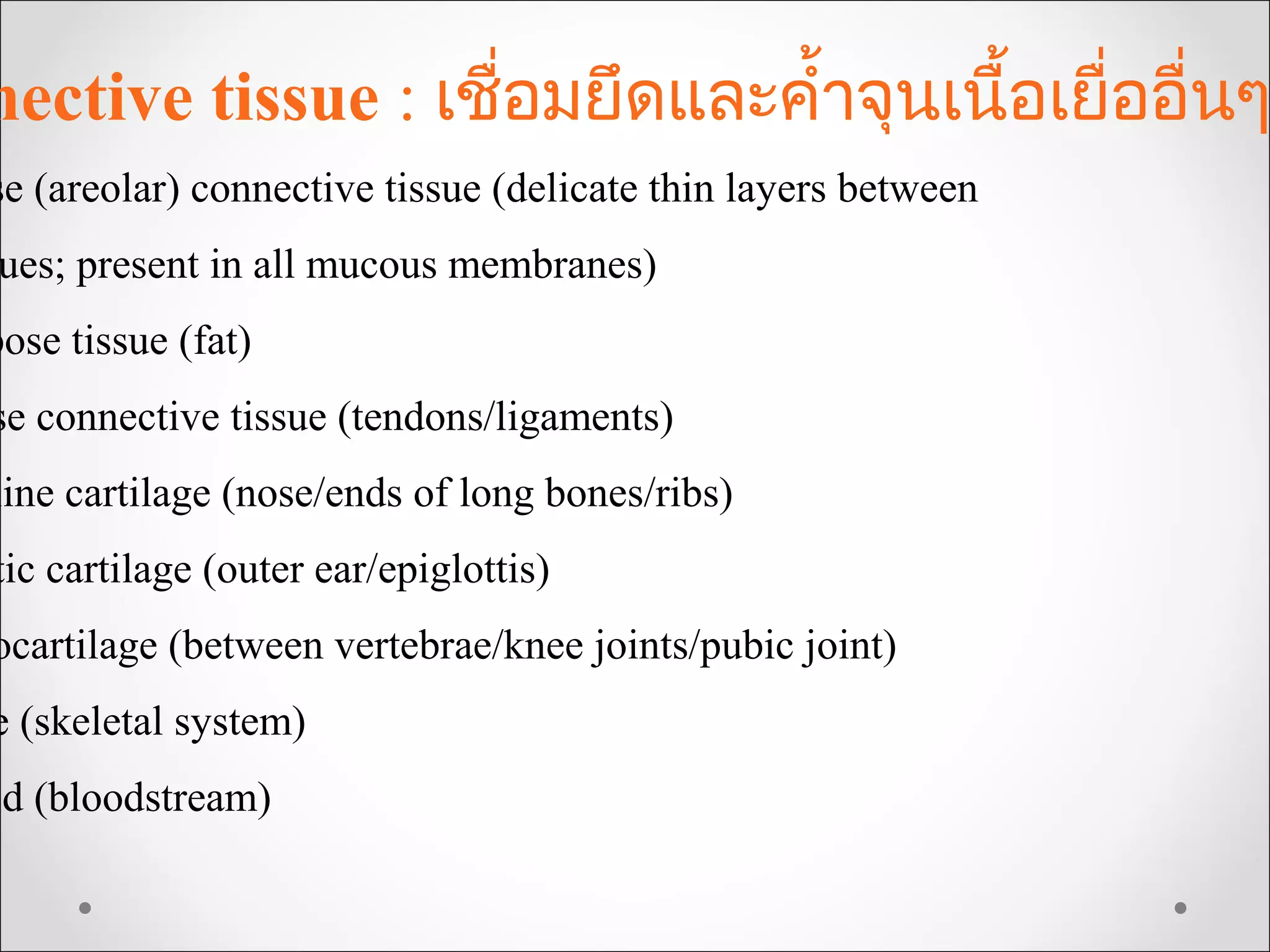
nective tissue : เชื่อมยึดและคำ้ำจุนเนื้อเยื่ออื่นๆ
se (areolar) connective tissue (delicate thin layers between
ues; present in all mucous membranes)
pose tissue (fat)
se connective tissue (tendons/ligaments)
line cartilage (nose/ends of long bones/ribs)
tic cartilage (outer ear/epiglottis)
ocartilage (between vertebrae/knee joints/pubic joint)
e (skeletal system)
od (bloodstream)
Copyright © 2010 Pearson Education, Inc.
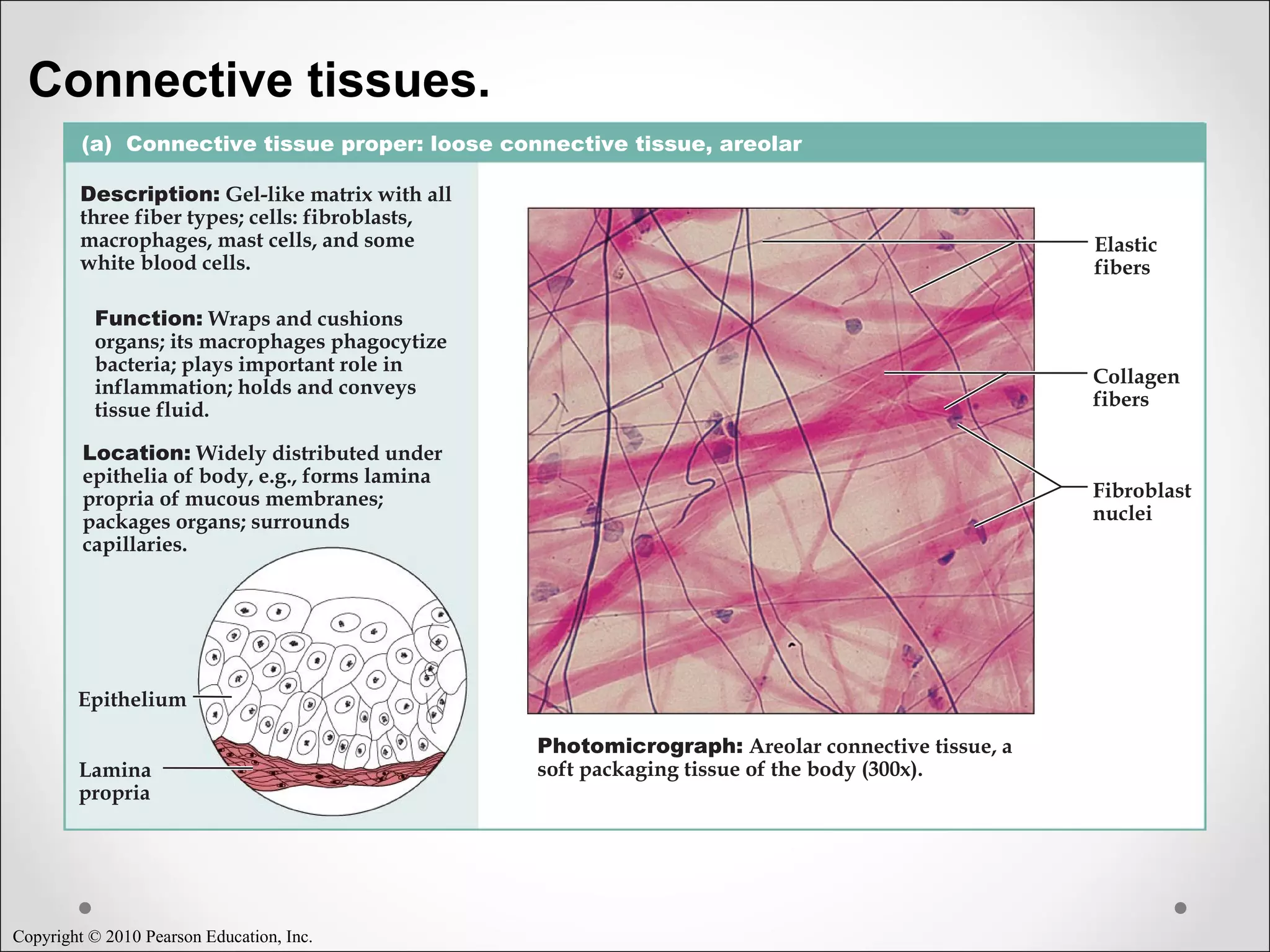
Connective tissues.
(a) Connective tissue proper: loose connective tissue, areolar
Description: Gel-like matrix with all
three fiber types; cells: fibroblasts,
macrophages, mast cells, and some
white blood cells.
Function: Wraps and cushions
organs; its macrophages phagocytize
bacteria; plays important role in
inflammation; holds and conveys
tissue fluid.
Location: Widely distributed under
epithelia of body, e.g., forms lamina
propria of mucous membranes;
packages organs; surrounds
capillaries.
Photomicrograph: Areolar connective tissue, a
soft packaging tissue of the body (300x).
Epithelium
Lamina
propria
Fibroblast
nuclei
Elastic
fibers
Collagen
fibers
Copyright © 2010 Pearson Education, Inc.
Areolar connective tissue: A prototype (model) connective tissue.Areolar connective tissue: A prototype (model) connective tissue.
Macrophage
Fibroblast
Lymphocyte
Fat cell
Mast cell
Neutrophil
Capillary
Cell types Extracellular matrix
Fibers
• Collagen fiber
• Elastic fiber
• Reticular fiber
Ground substance
Copyright © 2010 Pearson Education, Inc.
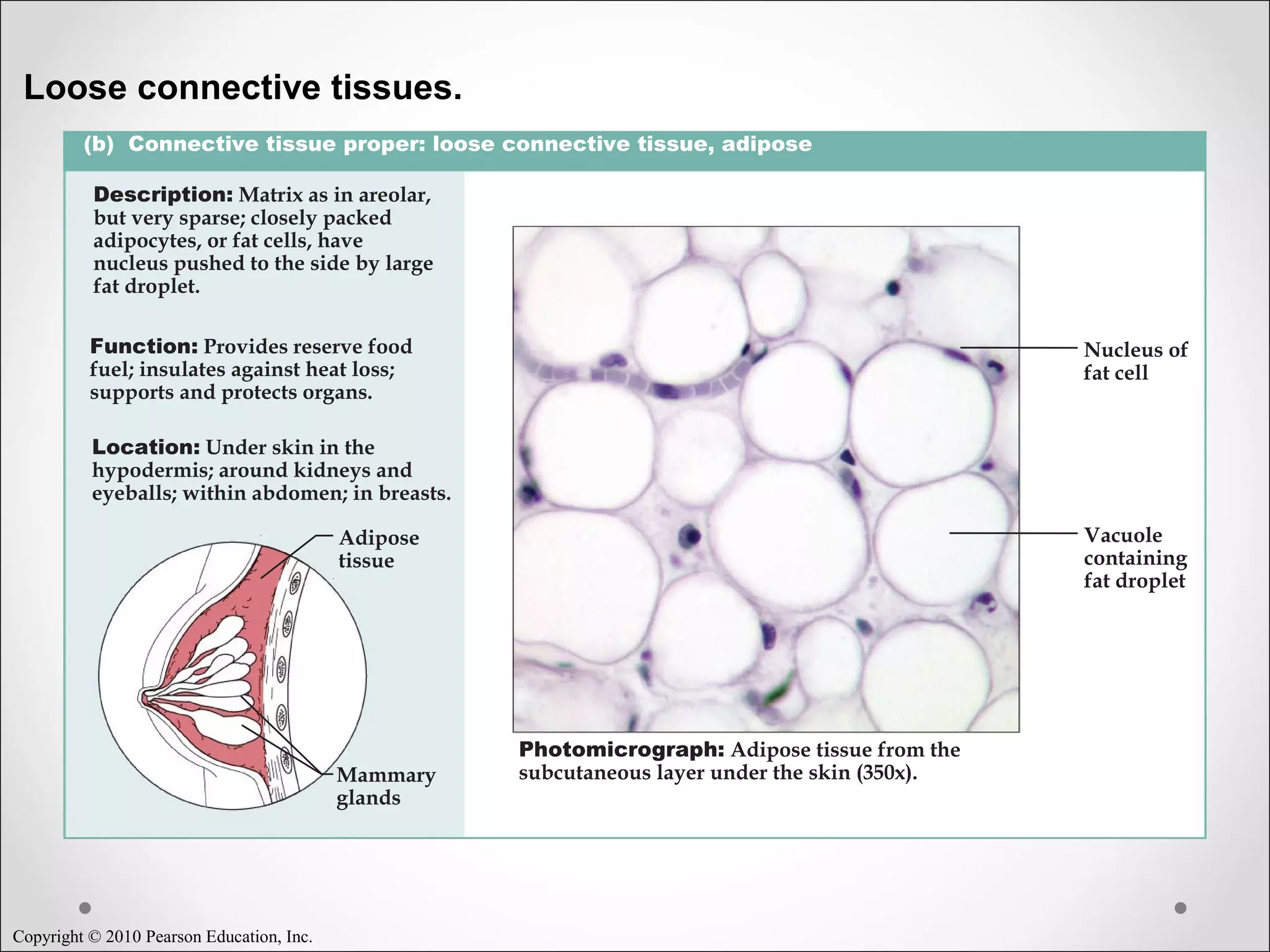
Loose connective tissues.
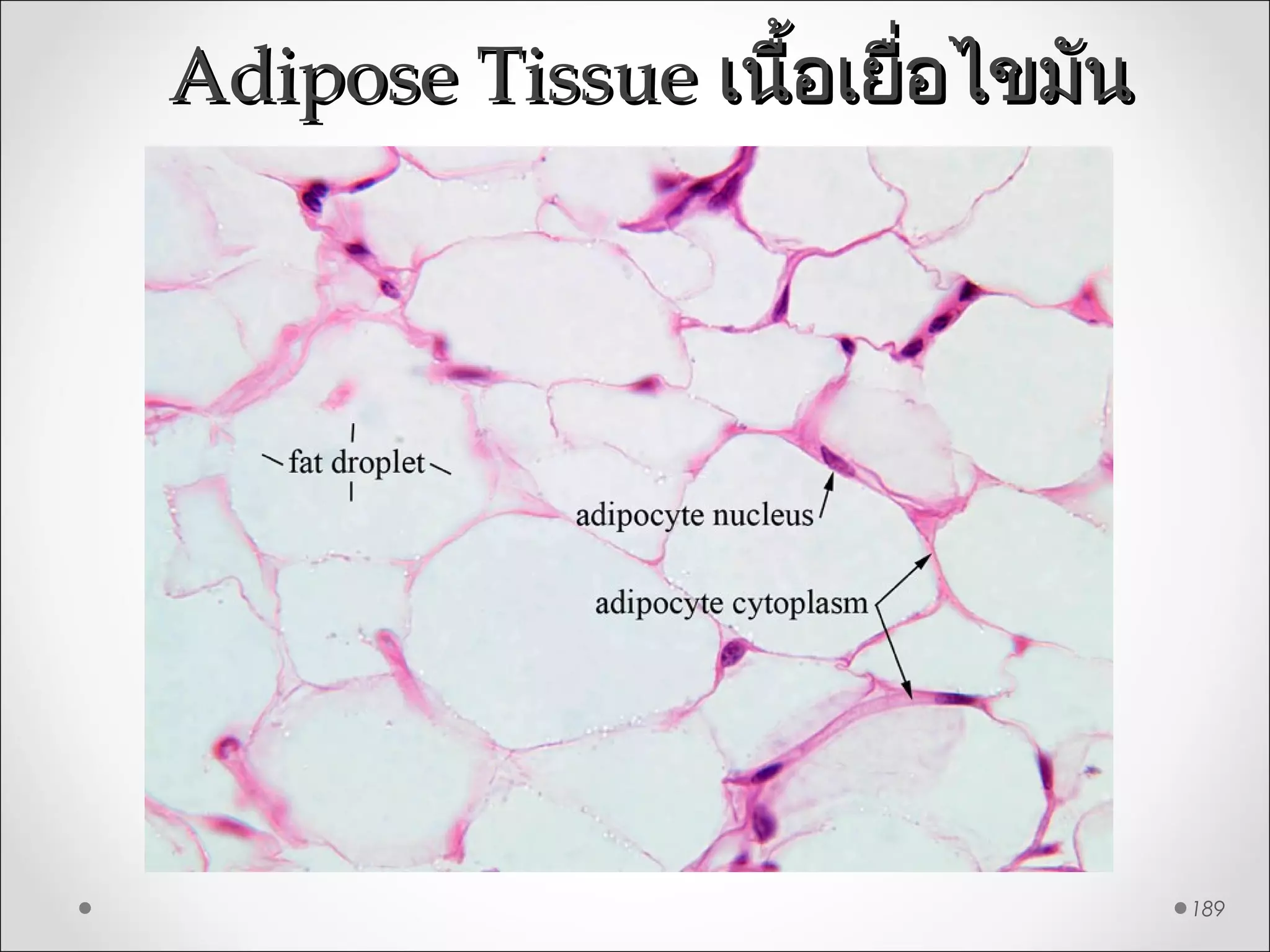
(b) Connective tissue proper: loose connective tissue, adipose
Description: Matrix as in areolar,
but very sparse; closely packed
adipocytes, or fat cells, have
nucleus pushed to the side by large
fat droplet.
Function: Provides reserve food
fuel; insulates against heat loss;
supports and protects organs.
Location: Under skin in the
hypodermis; around kidneys and
eyeballs; within abdomen; in breasts.
Photomicrograph: Adipose tissue from the
subcutaneous layer under the skin (350x).
Nucleus of
fat cell
Vacuole
containing
fat droplet
Adipose
tissue
Mammary
glands
Copyright © 2010 Pearson Education, Inc.
Loose connective tissues, reticularLoose connective tissues, reticular
(c) Connective tissue proper: loose connective tissue, reticular
Description: Network of reticular
fibers in a typical loose ground
substance; reticular cells lie on the
network.
Function: Fibers form a soft internal
skeleton (stroma) that supports other
cell types including white blood cells,
mast cells, and macrophages.
Location: Lymphoid organs (lymph
nodes, bone marrow, and spleen).
Photomicrograph: Dark-staining network of reticular
connective tissue fibers forming the internal skeleton
of the spleen (350x).
Spleen
White blood
cell
(lymphocyte)
Reticular
fibers
Copyright © 2010 Pearson Education, Inc.
Dense connective tissues, dense regularDense connective tissues, dense regular
(d) Connective tissue proper: dense connective tissue, dense regular
Description: Primarily parallel
collagen fibers; a few elastic fibers;
major cell type is the fibroblast.
Function: Attaches muscles to
bones or to muscles; attaches bones
to bones; withstands great tensile
stress when pulling force is applied
in one direction.
Location: Tendons, most
ligaments, aponeuroses.
Photomicrograph: Dense regular connective
tissue from a tendon (500x).
Shoulder
joint
Ligament
Tendon
Collagen
fibers
Nuclei of
fibroblasts
Copyright © 2010 Pearson Education, Inc.
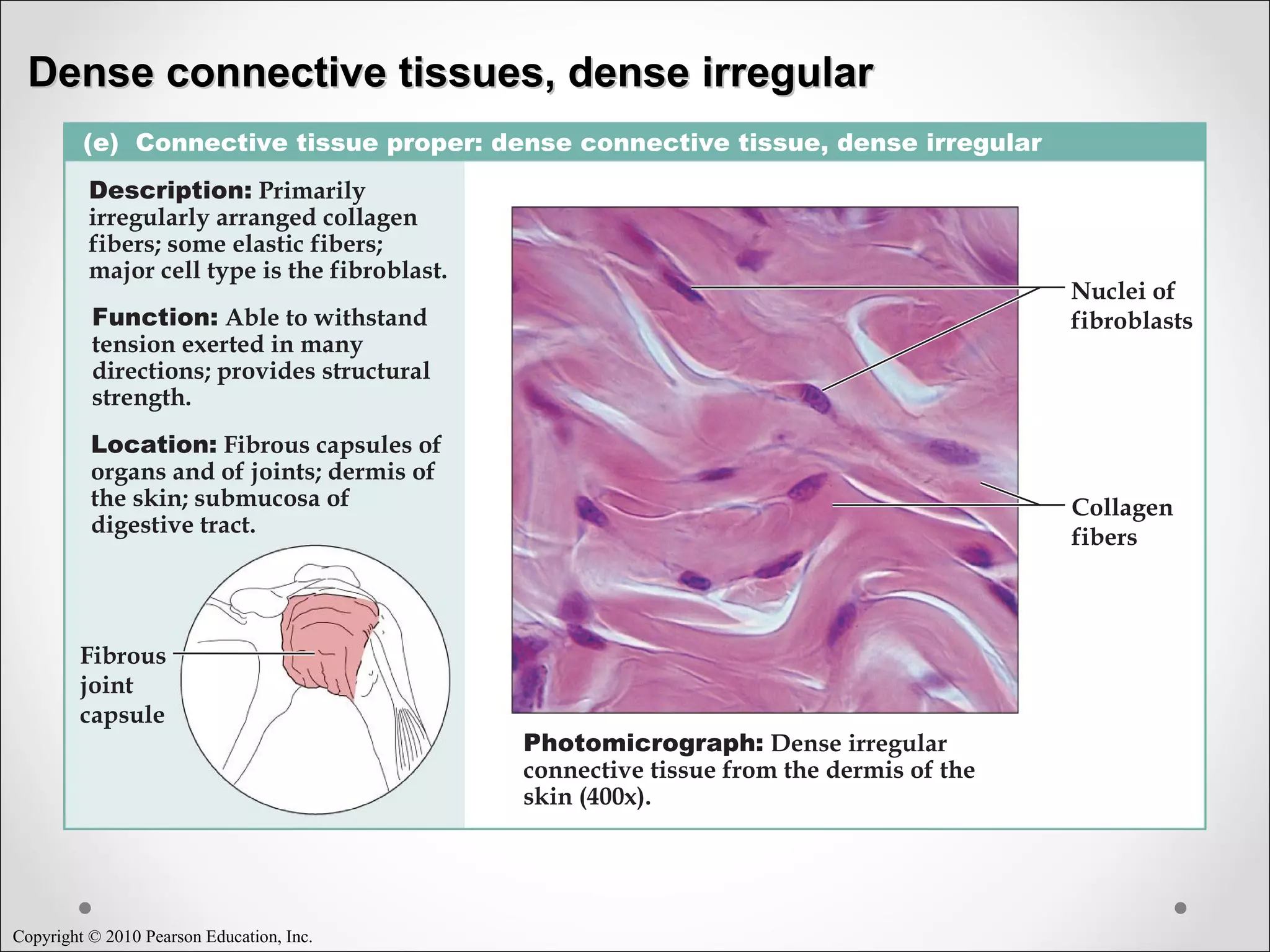
(e) Connective tissue proper: dense connective tissue, dense irregular
Description: Primarily
irregularly arranged collagen
fibers; some elastic fibers;
major cell type is the fibroblast.
Function: Able to withstand
tension exerted in many
directions; provides structural
strength.
Location: Fibrous capsules of
organs and of joints; dermis of
the skin; submucosa of
digestive tract.
Photomicrograph: Dense irregular
connective tissue from the dermis of the
skin (400x).
Collagen
fibers
Nuclei of
fibroblasts
Fibrous
joint
capsule
Dense connective tissues, dense irregularDense connective tissues, dense irregular
Copyright © 2010 Pearson Education, Inc.
(f) Connective tissue proper: dense connective tissue, elastic
Description: Dense regular
connective tissue containing a high
proportion of elastic fibers.
Function: Allows recoil of tissue
following stretching; maintains
pulsatile flow of blood through
arteries; aids passive recoil of lungs
following inspiration.
Location: Walls of large arteries;
within certain ligaments associated
with the vertebral column; within the
walls of the bronchial tubes.
Elastic fibers
Aorta
Heart
Photomicrograph: Elastic connective tissue in
the wall of the aorta (250x).
Dense connective tissues, elasticDense connective tissues, elastic
Copyright © 2010 Pearson Education, Inc.
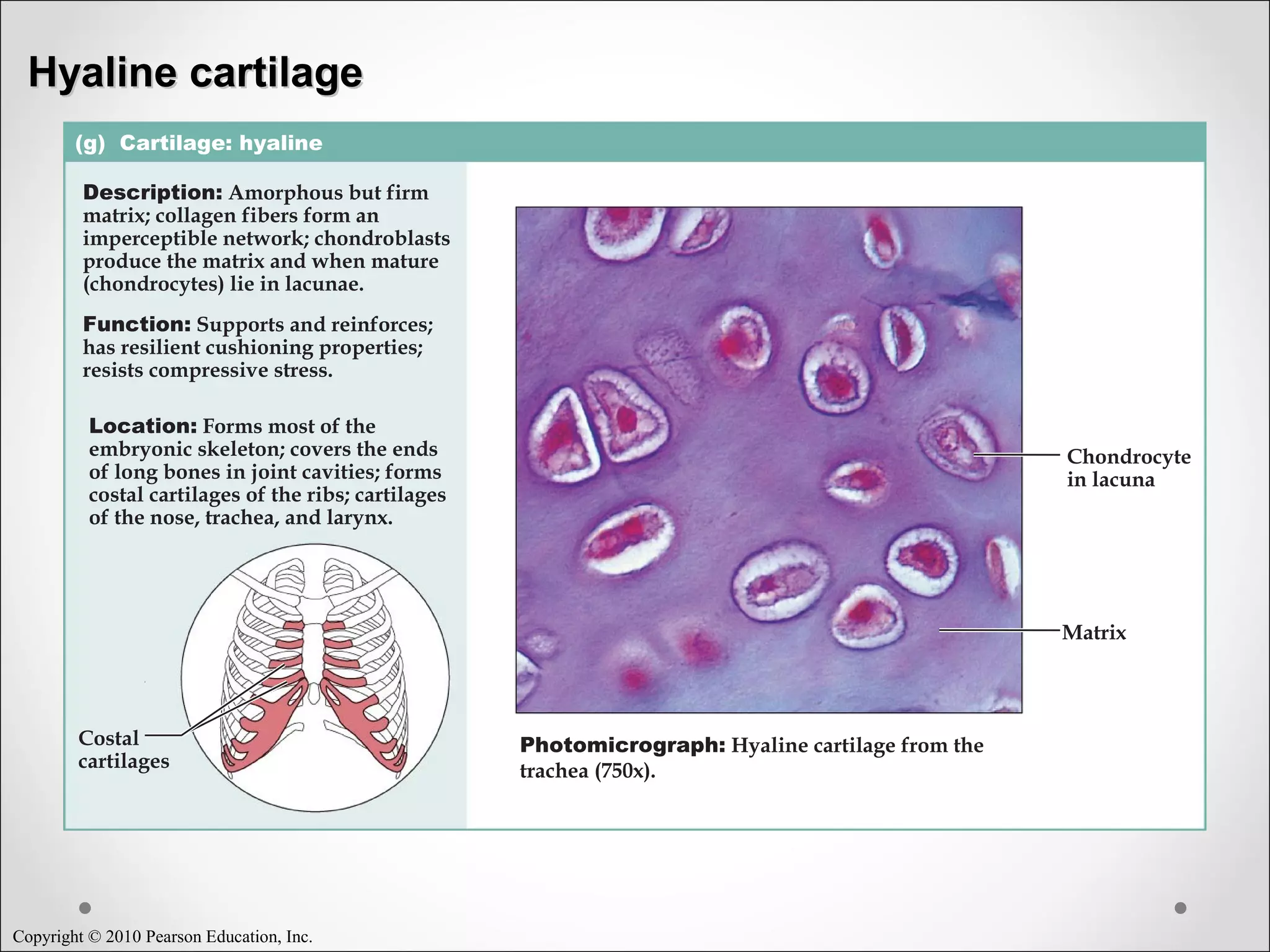
(g) Cartilage: hyaline
Description: Amorphous but firm
matrix; collagen fibers form an
imperceptible network; chondroblasts
produce the matrix and when mature
(chondrocytes) lie in lacunae.
Function: Supports and reinforces;
has resilient cushioning properties;
resists compressive stress.
Location: Forms most of the
embryonic skeleton; covers the ends
of long bones in joint cavities; forms
costal cartilages of the ribs; cartilages
of the nose, trachea, and larynx.
Photomicrograph: Hyaline cartilage from the
trachea (750x).
Costal
cartilages
Chondrocyte
in lacuna
Matrix
Hyaline cartilageHyaline cartilage
Copyright © 2010 Pearson Education, Inc.
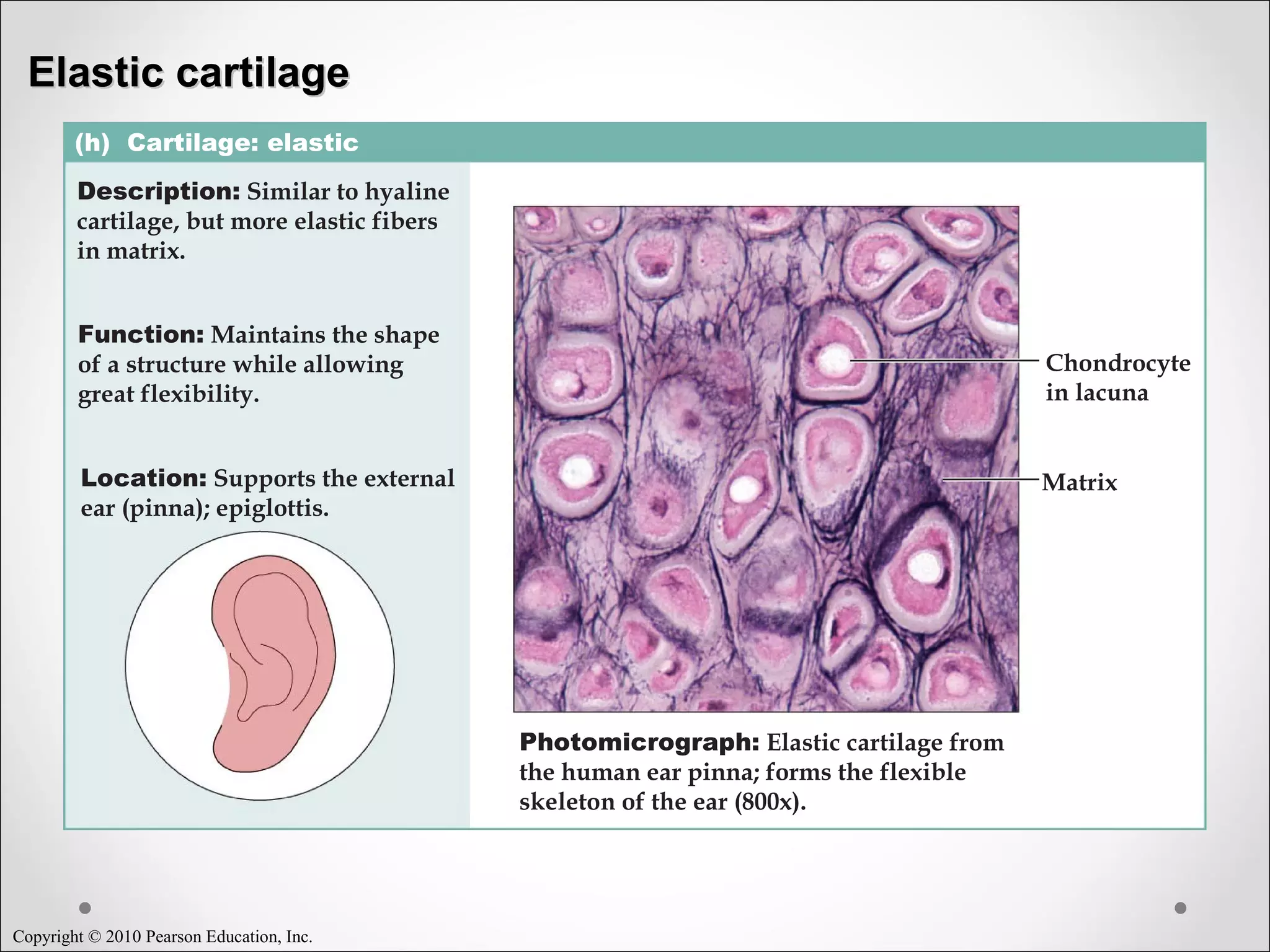
(h) Cartilage: elastic
Description: Similar to hyaline
cartilage, but more elastic fibers
in matrix.
Function: Maintains the shape
of a structure while allowing
great flexibility.
Location: Supports the external
ear (pinna); epiglottis.
Photomicrograph: Elastic cartilage from
the human ear pinna; forms the flexible
skeleton of the ear (800x).
Chondrocyte
in lacuna
Matrix
Elastic cartilageElastic cartilage
Copyright © 2010 Pearson Education, Inc.
(i) Cartilage: fibrocartilage
Description: Matrix similar to
but less firm than that in hyaline
cartilage; thick collagen fibers
predominate.
Function: Tensile strength
with the ability to absorb
compressive shock.
Location: Intervertebral discs;
pubic symphysis; discs of knee
joint.
Photomicrograph: Fibrocartilage of an
intervertebral disc (125x). Special staining
produced the blue color seen.
Intervertebral
discs
Chondrocytes
in lacunae
Collagen
fiber
FibrocartilageFibrocartilage
Copyright © 2010 Pearson Education, Inc.
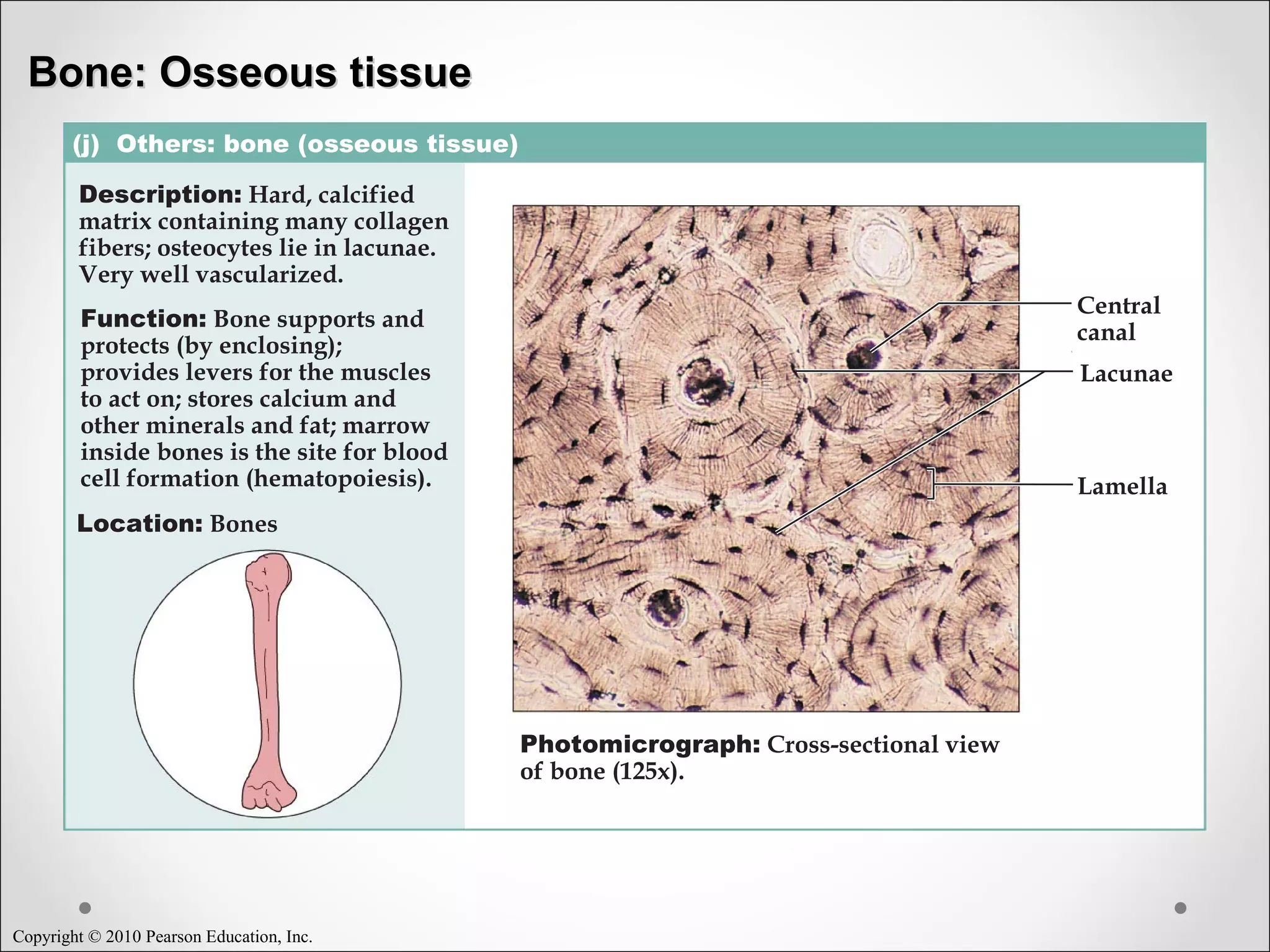
(j) Others: bone (osseous tissue)
Description: Hard, calcified
matrix containing many collagen
fibers; osteocytes lie in lacunae.
Very well vascularized.
Function: Bone supports and
protects (by enclosing);
provides levers for the muscles
to act on; stores calcium and
other minerals and fat; marrow
inside bones is the site for blood
cell formation (hematopoiesis).
Location: Bones
Photomicrograph: Cross-sectional view
of bone (125x).
Lacunae
Lamella
Central
canal
Bone: Osseous tissueBone: Osseous tissue
Copyright © 2010 Pearson Education, Inc.
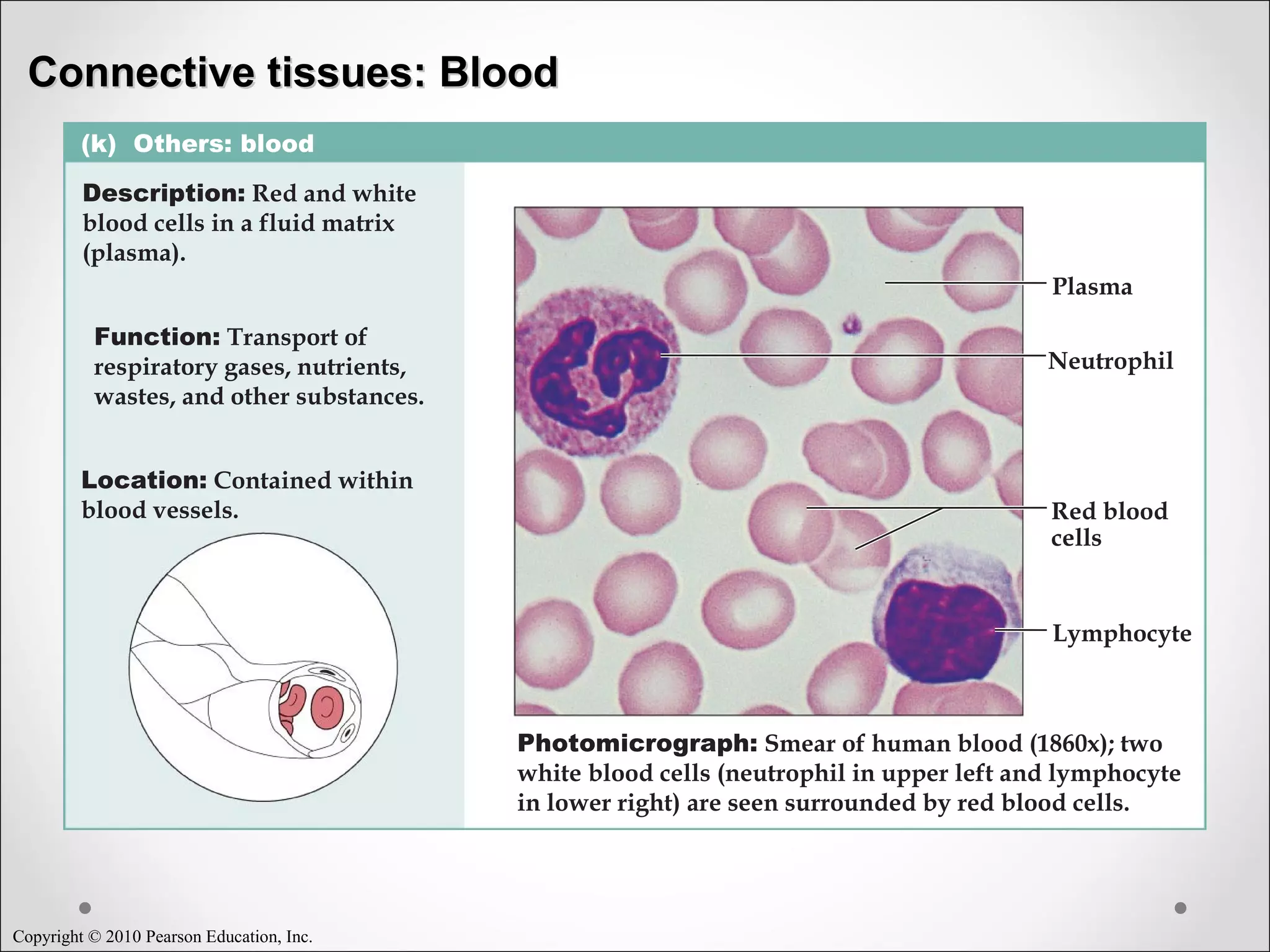
(k) Others: blood
Description: Red and white
blood cells in a fluid matrix
(plasma).
Function: Transport of
respiratory gases, nutrients,
wastes, and other substances.
Location: Contained within
blood vessels.
Photomicrograph: Smear of human blood (1860x); two
white blood cells (neutrophil in upper left and lymphocyte
in lower right) are seen surrounded by red blood cells.
Neutrophil
Red blood
cells
Lymphocyte
Plasma
Connective tissues: BloodConnective tissues: Blood
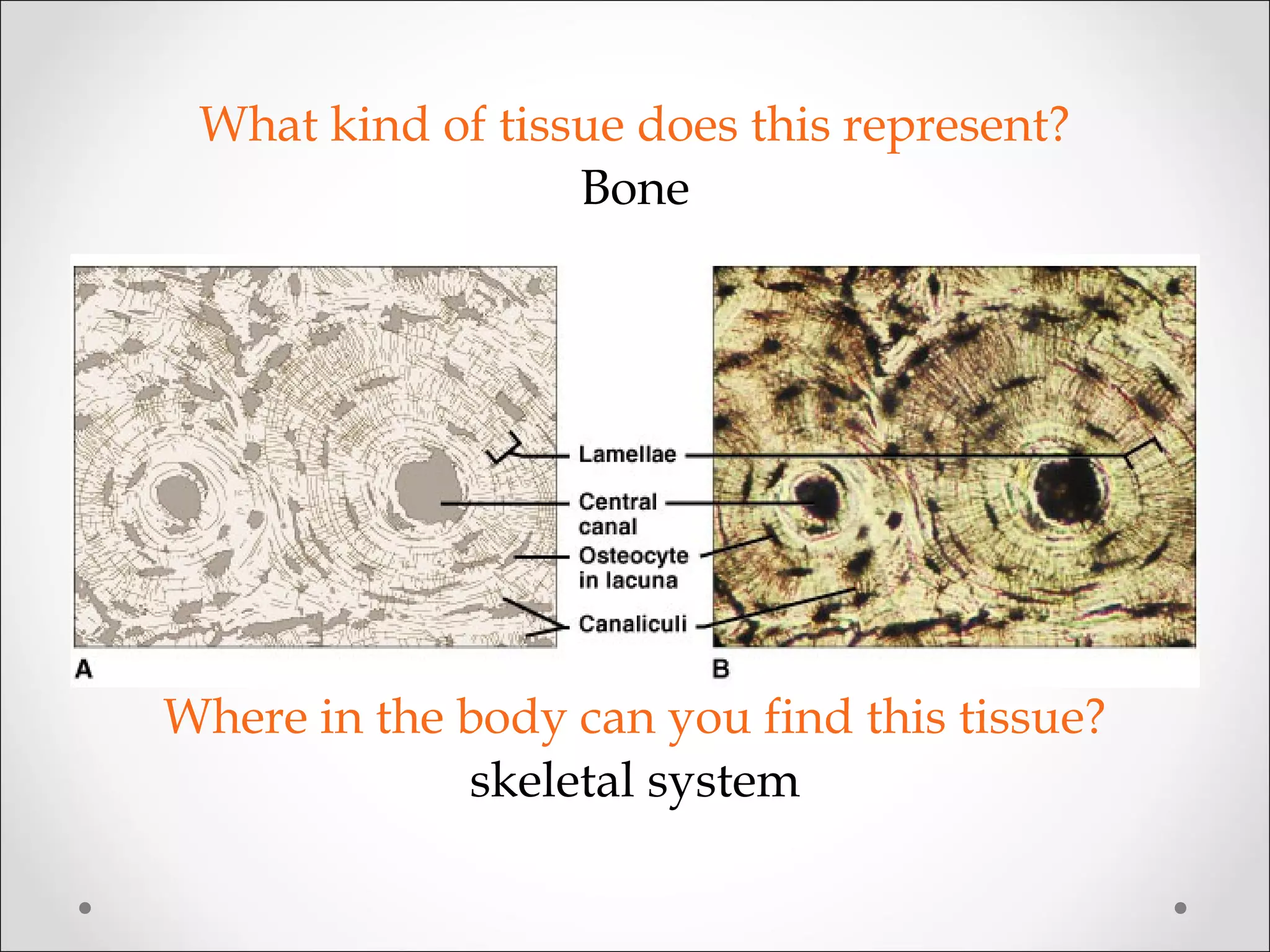
What kind of tissue does this represent?
Where in the body can you find this tissue?
Bone
skeletal system
Adipose TissueAdipose Tissue เนื้อเยื่อไขมันเนื้อเยื่อไขมัน
189
Bone and Cartilage TissueBone and Cartilage Tissue
เนื้อเยื่อกระดูก และ กระดูกอ่อนเนื้อเยื่อกระดูก และ กระดูกอ่อน
190
http://histologyolm.stevegallik.org/node/12
2
http://megansobscurities.blogspot.com/2010_04_01_archive.ht
ml
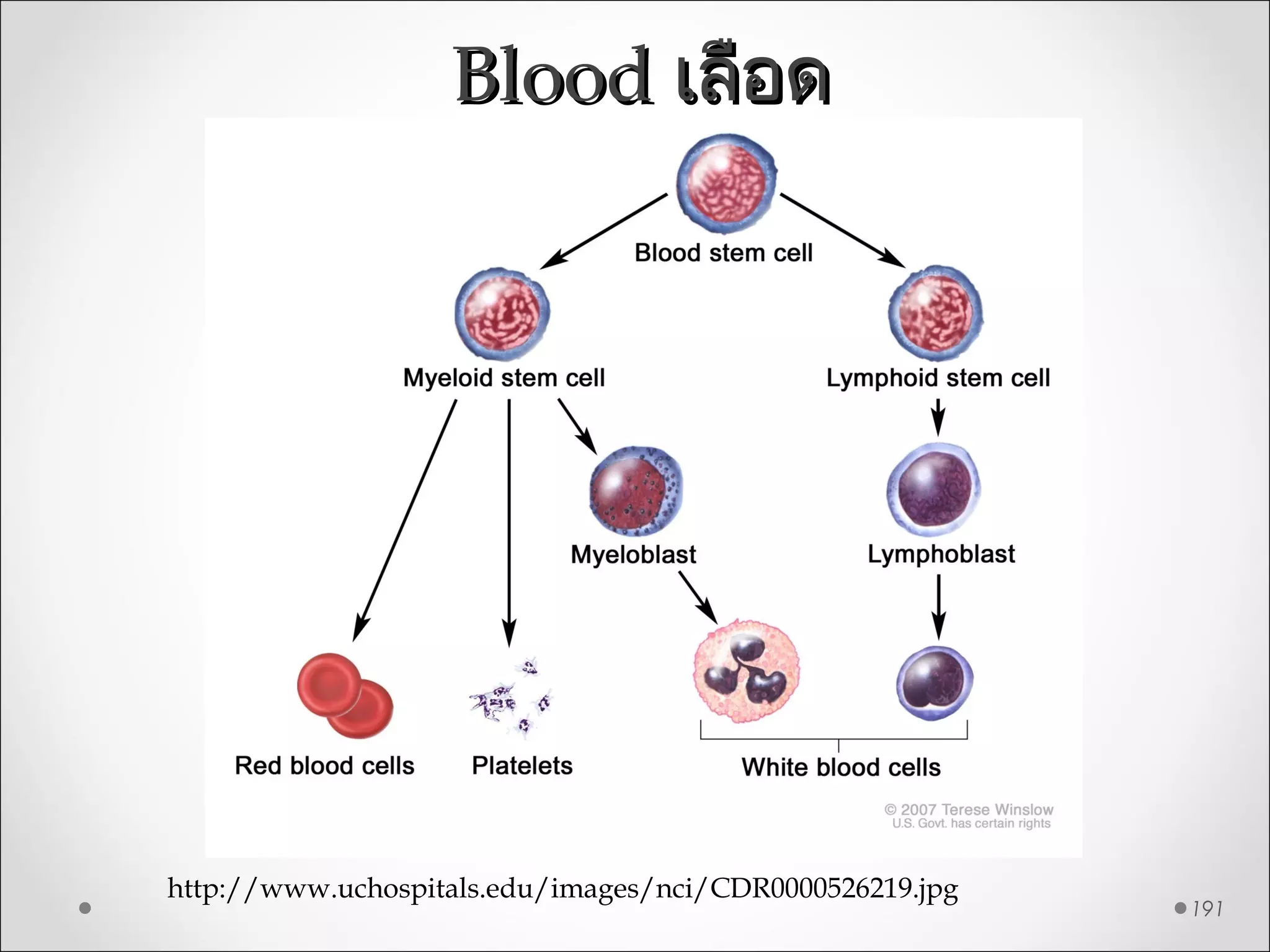
BloodBlood เลือดเลือด
191
http://www.uchospitals.edu/images/nci/CDR0000526219.jpg
MuscleMuscle กล้ำมเนื้อกล้ำมเนื้อ
192
http://apbrwww5.apsu.edu/thompsonj/Anatomy%20&
%20Physiology/2010/2010%20Exam%20Reviews/Exam%203%20Review/CH
%2009%20Smooth%20and%20Cardiac%20Muscle.htm
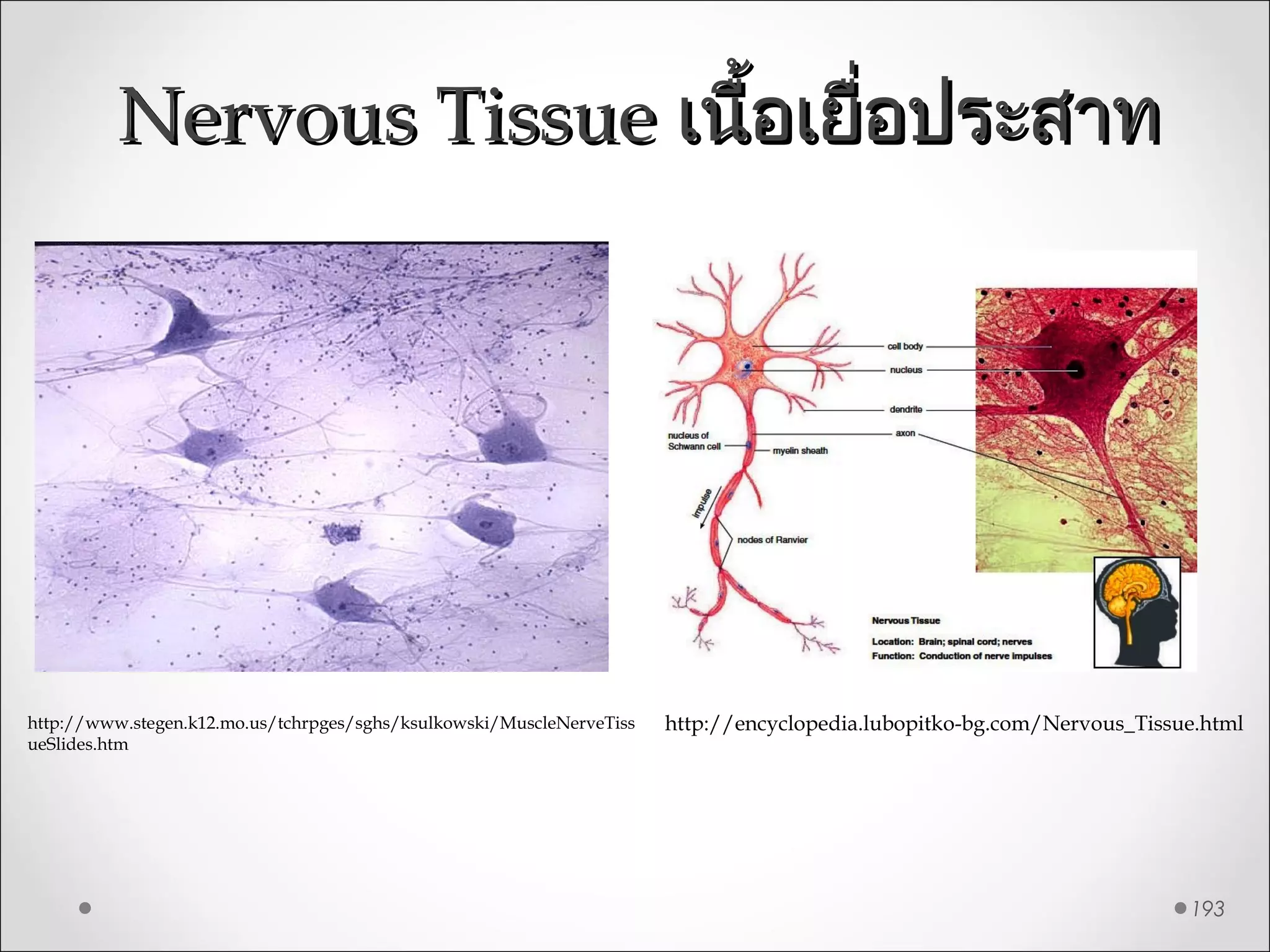
Nervous TissueNervous Tissue เนื้อเยื่อประสำทเนื้อเยื่อประสำท
193
http://www.stegen.k12.mo.us/tchrpges/sghs/ksulkowski/MuscleNerveTiss
ueSlides.htm
http://encyclopedia.lubopitko-bg.com/Nervous_Tissue.html
194
195
Cross-SectionCross-Section of Skinof Skin
ภำพตัดขวำงเนื้อเยื่อผิวหนังภำพตัดขวำงเนื้อเยื่อผิวหนัง
Wound Dressing/SkinWound Dressing/Skin
GraftGraft
196
Hydrogel Wound DressingHydrogel Wound Dressing
http://img.chinamedevice.com/product/897/1466897
.jpg
http://littlestinker06.tripod.com/id3.html
197
http://www.agilethinkers.com/johanna_rothman_qa/
http://blueeyednightowl.blogspot.com/2011/07/q.html
198
GeneticsGenetics พันธุศำสตร์พันธุศำสตร์
1.1 Traits and heredity1.1 Traits and heredity
Parents and Kids
Case Study: Sue case in Chinese
Rumor or Real?
• Husband won 125,000 USD sue the wife for ugly
baby
• Firstly, sue for cheating evidence from ugly child
• Turn out wife spent 100,000 USD for plastic surgery
http://www.examiner.com/article/man-sues-wife-
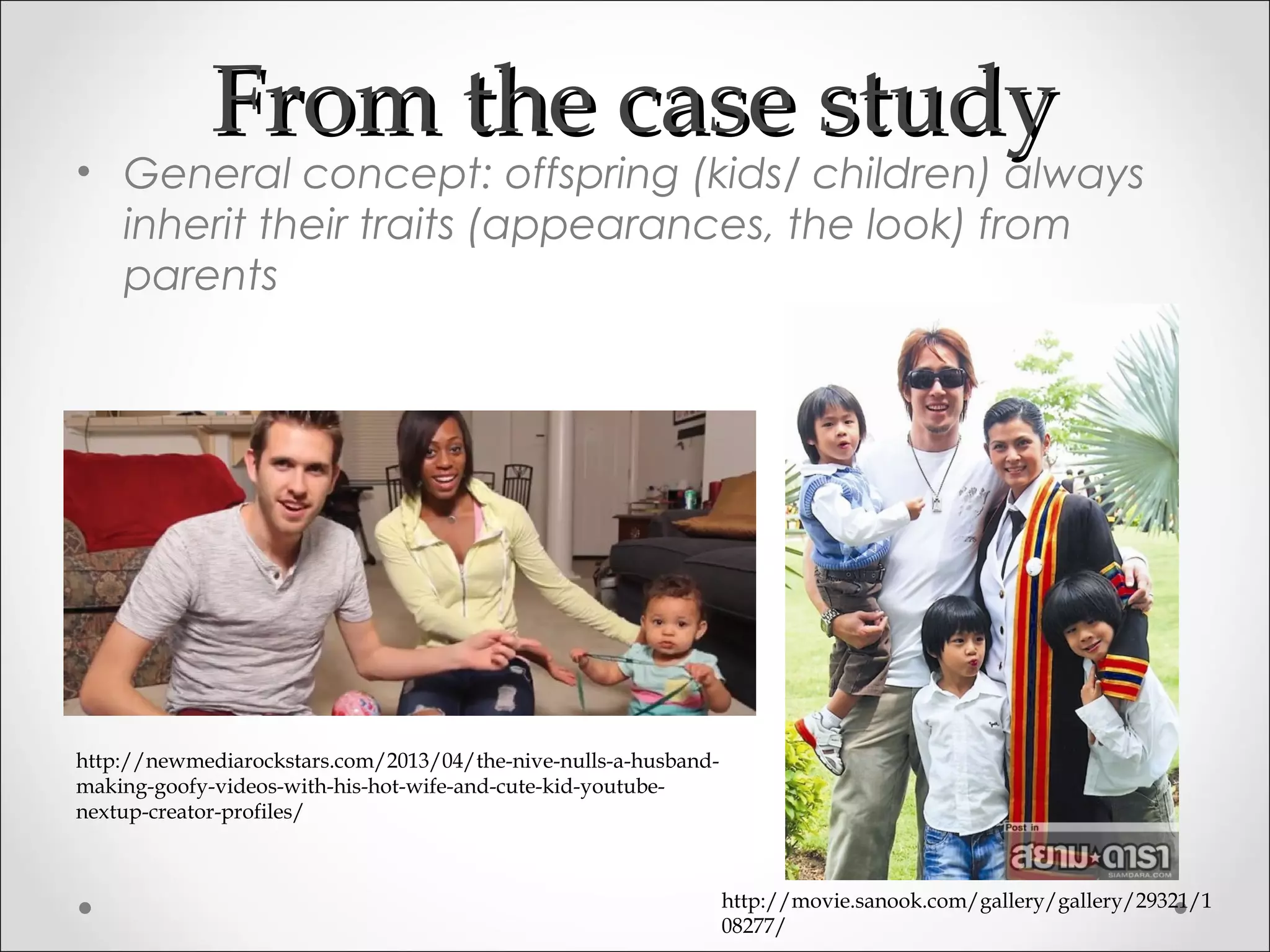
From the case studyFrom the case study
• General concept: offspring (kids/ children) always
inherit their traits (appearances, the look) from
parents
http://movie.sanook.com/gallery/gallery/29321/1
08277/
http://newmediarockstars.com/2013/04/the-nive-nulls-a-husband-
making-goofy-videos-with-his-hot-wife-and-cute-kid-youtube-
nextup-creator-profiles/
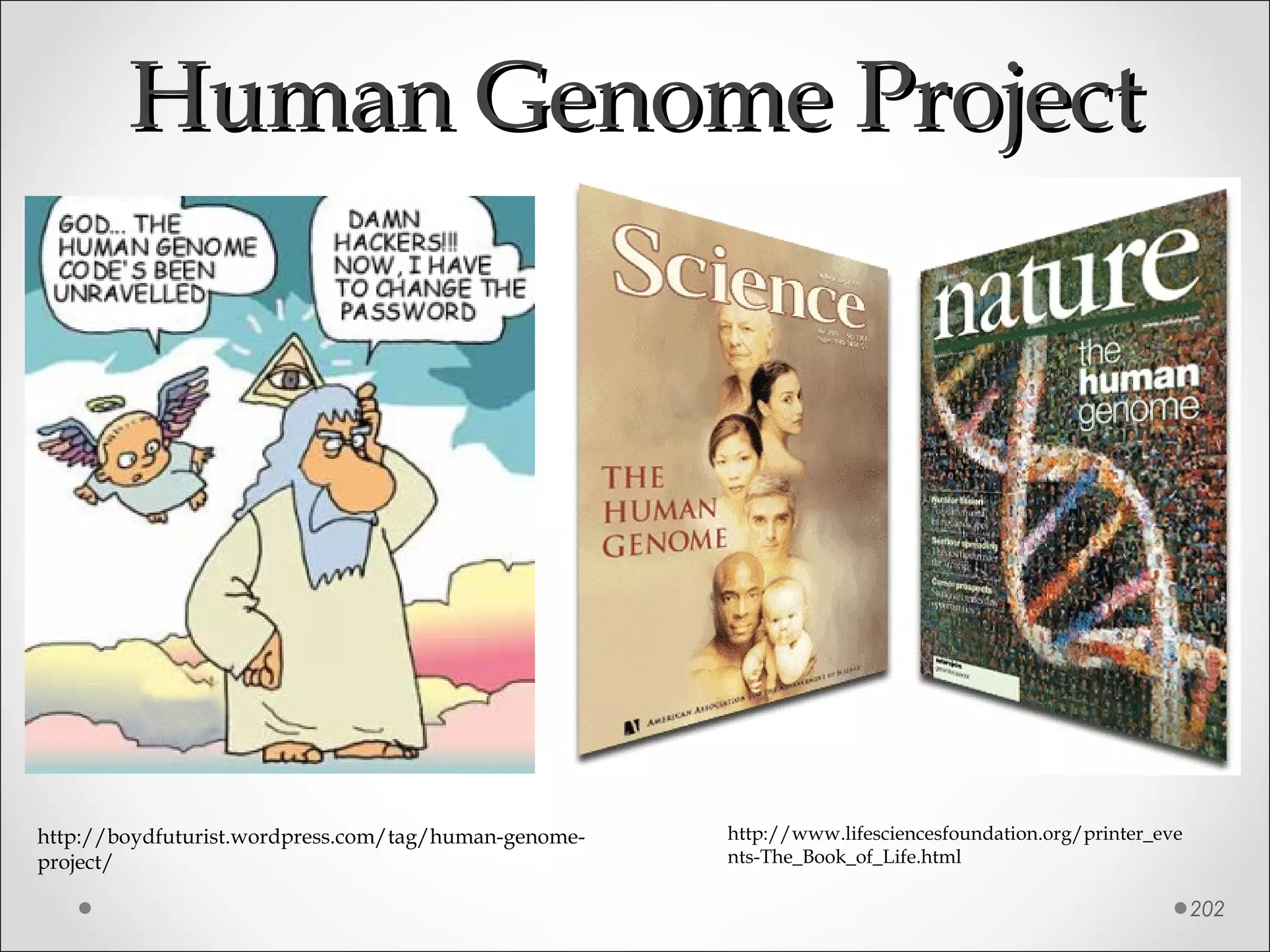
Human Genome ProjectHuman Genome Project
202
http://boydfuturist.wordpress.com/tag/human-genome-
project/
http://www.lifesciencesfoundation.org/printer_eve
nts-The_Book_of_Life.html
203
The human genome contains over 3 billion base pairs,
only approximately 20,000 protein-coding genes.
The rest is associated with non-coding
RNA molecules, regulatory DNA sequences, introns, and
sequences to which no function has yet been assigned.
สารพันธุกรรมในคนมีมากกว่า 3 พันล้านคู่
เบส มีเพียง 20,000 ยีนที่ถูกถอดรหัสในการสร้างเป็น
โปรตีน (1.5%) ที่เหลือทำาหน้าที่ในการควบคุมการ
แสดงออกของยีน, สร้าง non-coding RNA, และที่ยังไม่
Human Genome ProjectHuman Genome Project
การสืบพันธุ์แบบอาศัยการสืบพันธุ์แบบอาศัย
เพศเพศ
oFemale produces homogametic sex เพศหญิง สร้างเซลล์สืบพันธุ์เพศหญิง คือ
Ovum (ไข่)
oMale produces heterogametic sex เพศชาย สร้างเซลล์สืบพันธุ์เพศชาย คือ
Sperm (อสุจิ)
204
http://commons.wikimedia.org/wiki/File:General_cell_cycle.jpg
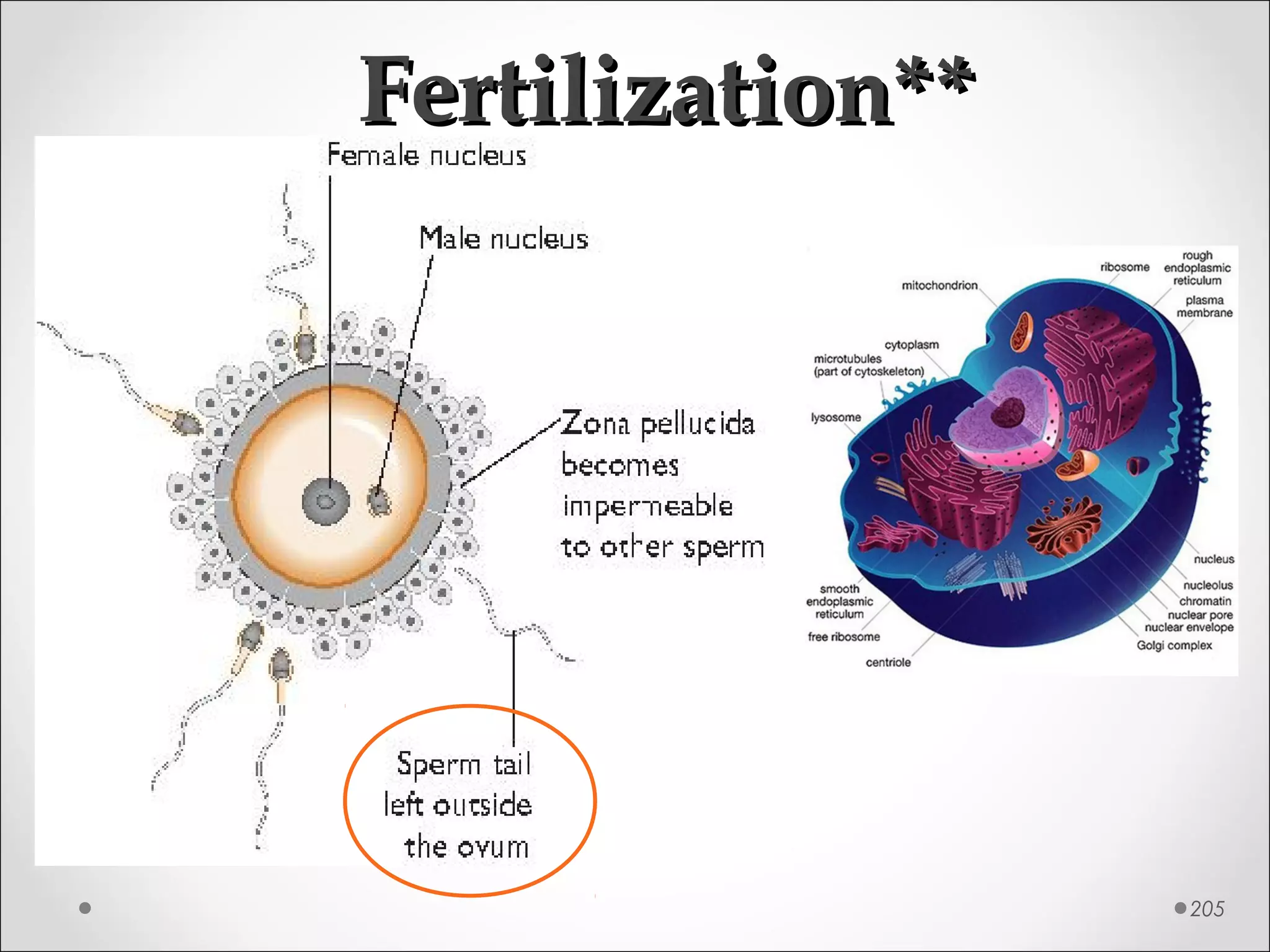
Fertilization**Fertilization**
205
206
Sex-linked gene:
Hemophilia โรคเลือดออกไม่
หยุด,
Color Blindness ตาบอดสี
Autosomal Recessive Trait
ยีนด้อยบนโครโมโซมเพศ
Genotype/PhenotypeGenotype/Phenotype
• Genotype/Phenotype ลักษณะทางพันธุกรรม และ
ลักษณะที่แสดงออก
• เช่น Genotype เป็น XY แต่มียีนที่ทำาให้ร่างกายไม่ตอบ
สนองต่อฮอร์โมนเพศชายให้ลักษณะภายนอกที่แสดงออก
เป็นผู้หญิง
CAIS (complete androgen insensitivity syndrome)
207
XY Female ผู้หญิงที่มีโครโมโซมเพศ
ชาย
GenesGenes สารพันธุกรรมสารพันธุกรรม
208
• DNA: Deoxyribonucleic acid
• RNA: Ribonucleic acid
ChromosomesChromosomes
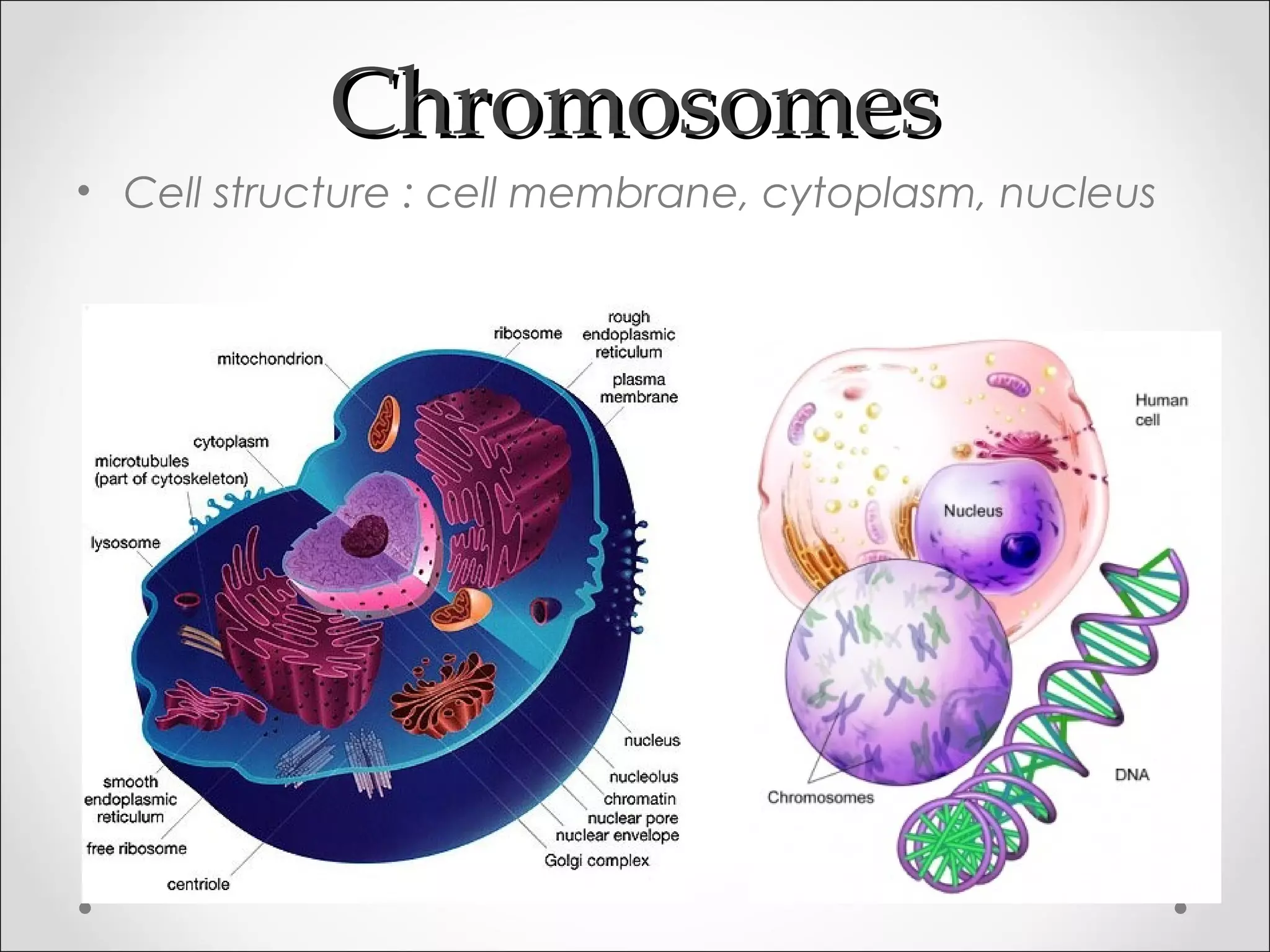
• Cell structure : cell membrane, cytoplasm, nucleus
ChromosomesChromosomes
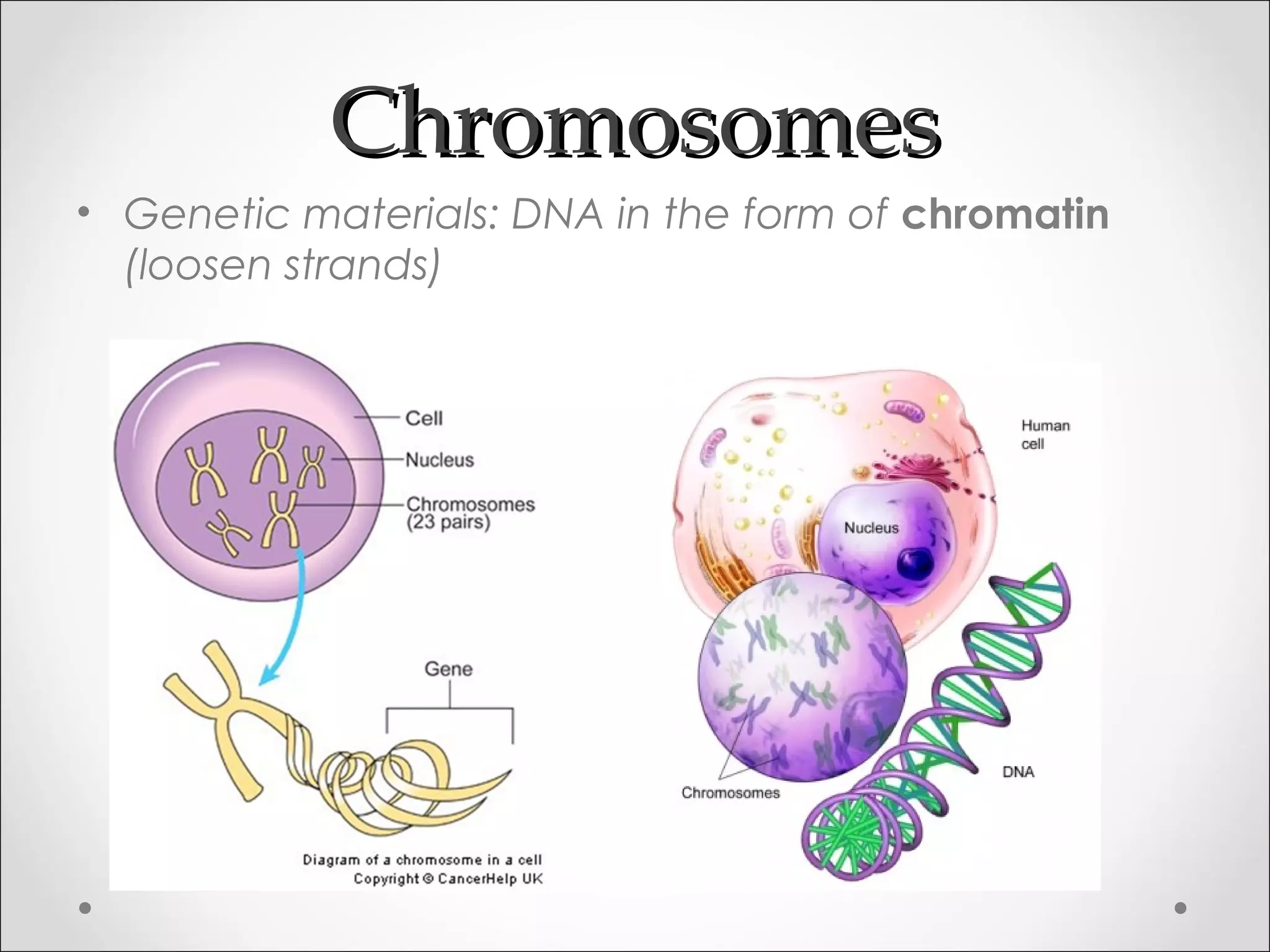
• Genetic materials: DNA in the form of chromatin
(loosen strands)
ChromosomesChromosomes
• During division condense to form chromosome
http://someinterestingfacts.net/wp-content/uploads/2013/01/Cell-Division.jpg
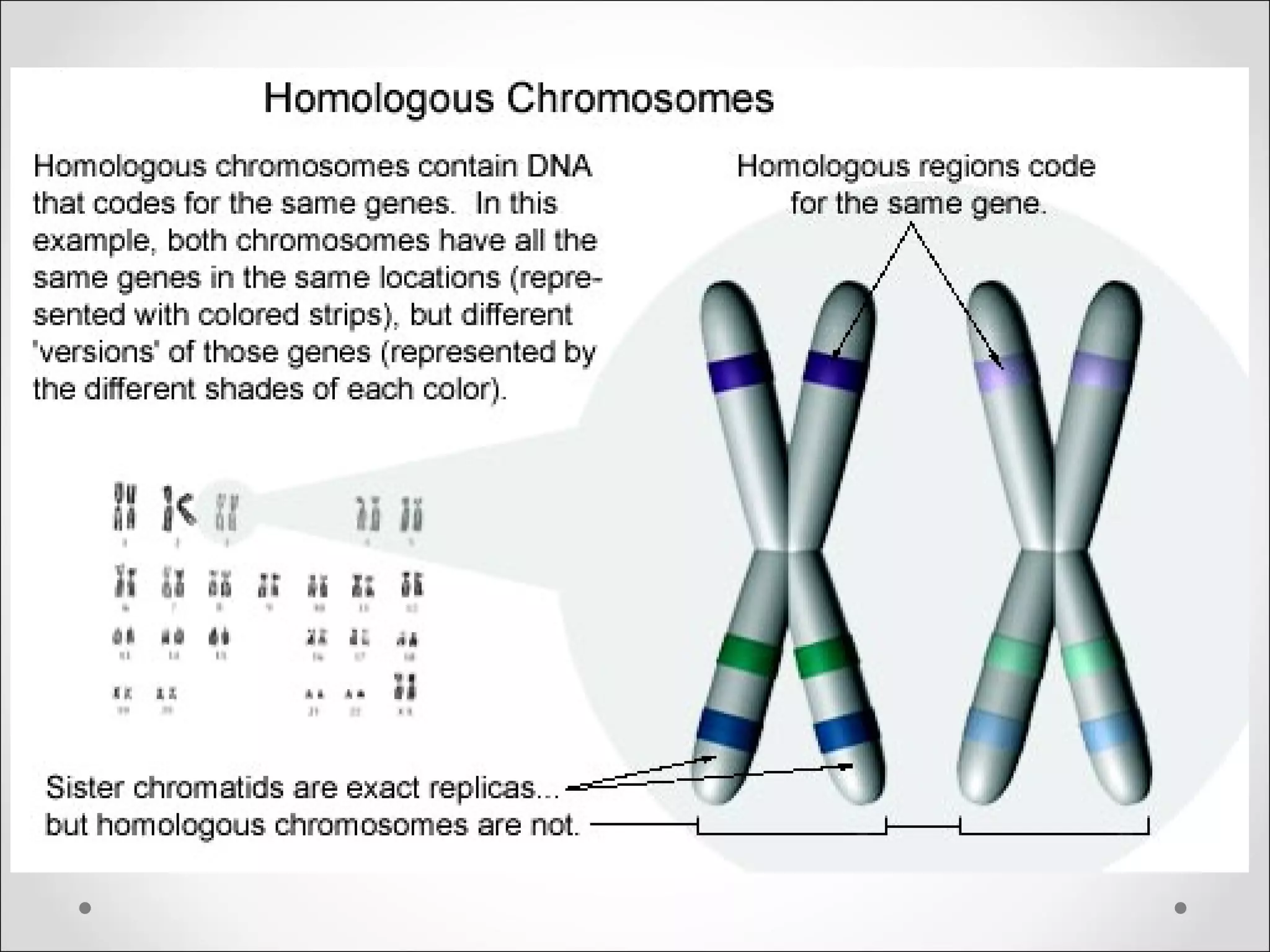
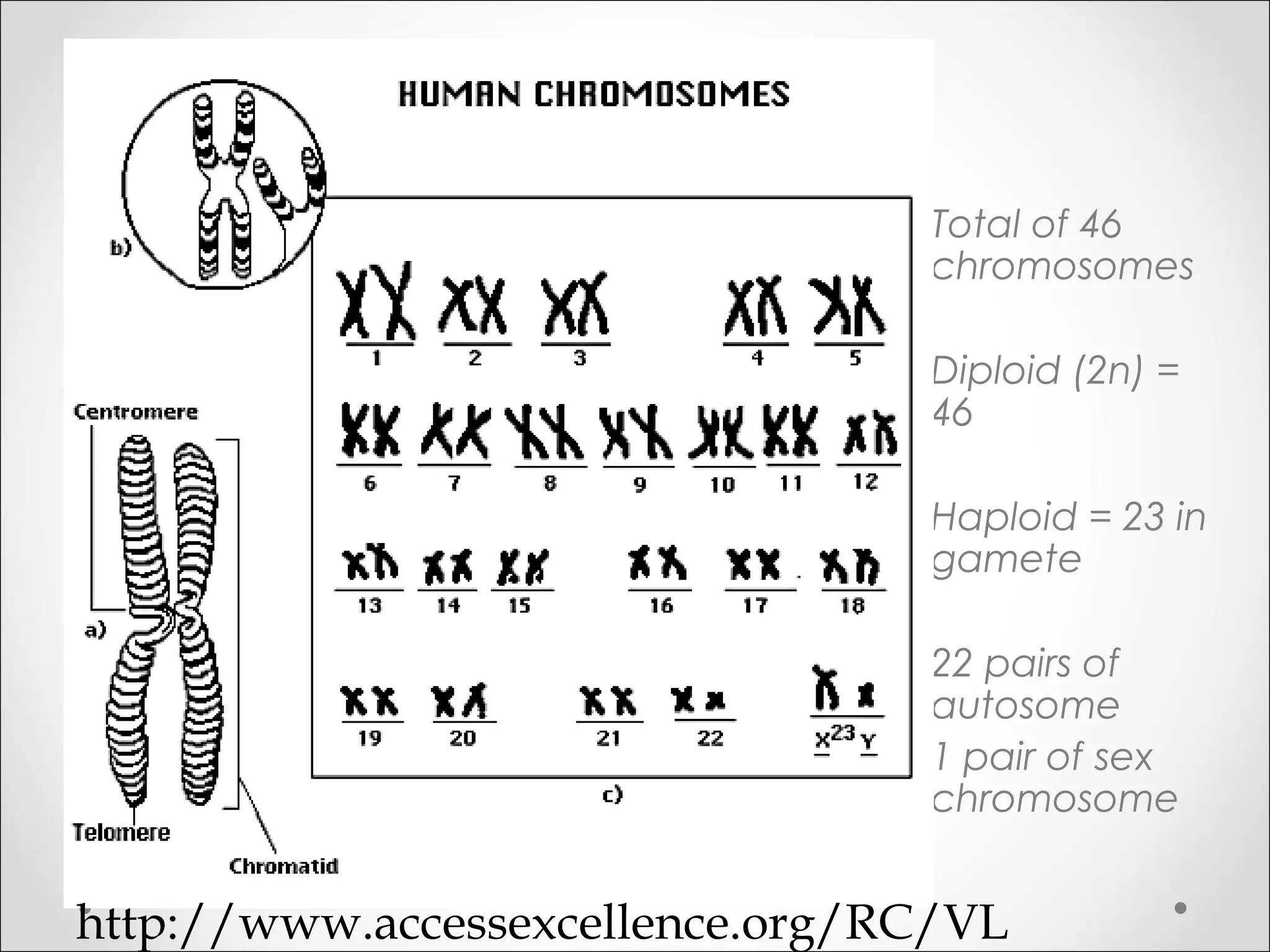
• Total of 46
chromosomes
• Diploid (2n) =
46
• Haploid = 23 in
gamete
• 22 pairs of
autosome
• 1 pair of sex
chromosome
http://www.accessexcellence.org/RC/VL
Diploid chromosome (2n)Diploid chromosome (2n)
• Crucial for cell division, especially, sexual reproduction.
• Gamete has half genetic material from parent (n)
• Zygote has half genetic material from each parent (n
+n = 2n)
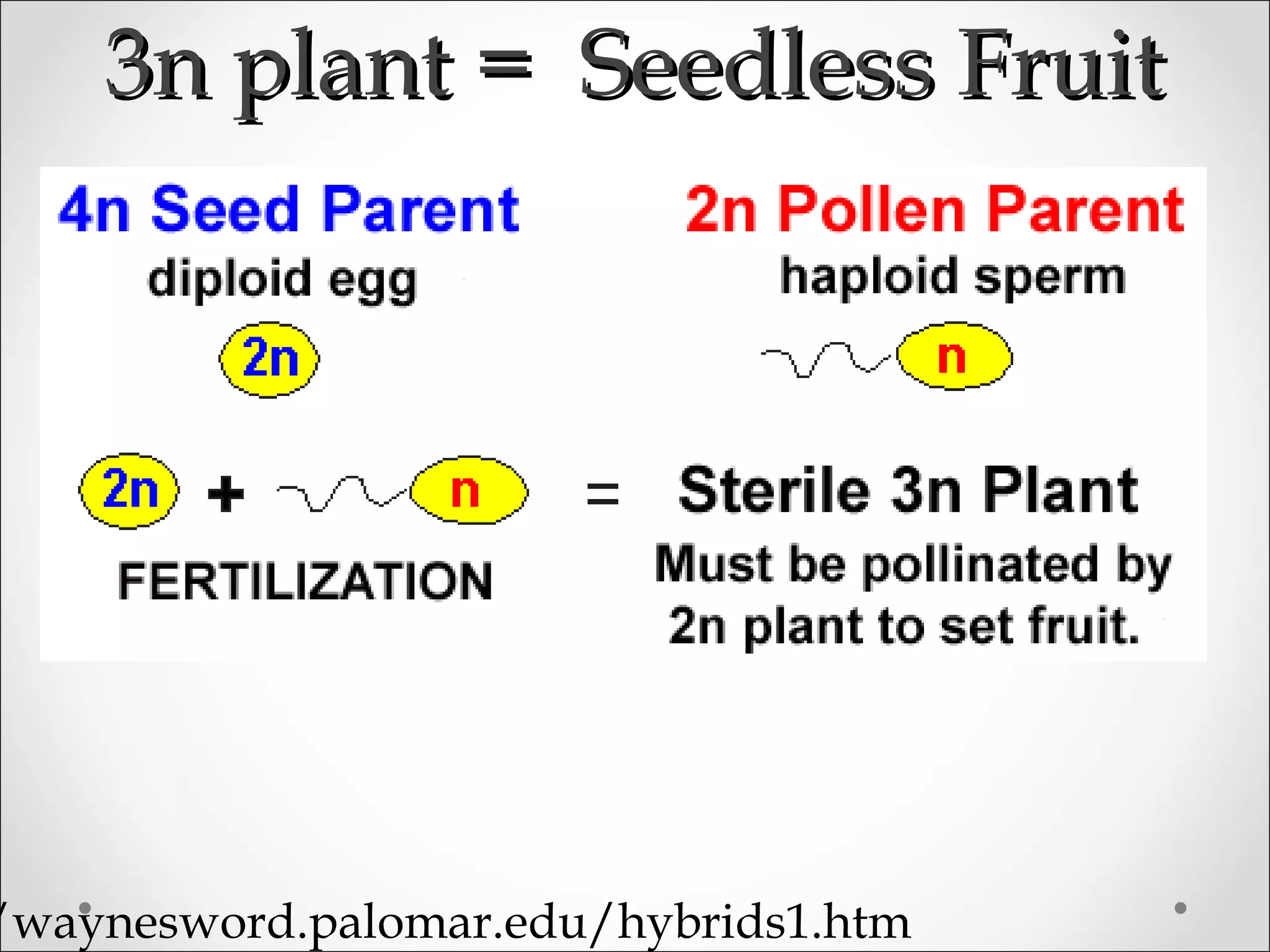
• What do you think would happen with the gamete
from 3n parent? What would the offspring be?
Cell CycleCell Cycle
215
http://legacy.owensboro.kctcs.edu/gcaplan/songbook/B3.%20%20Mitosis.htm
3n plant = Seedless Fruit3n plant = Seedless Fruit
/waynesword.palomar.edu/hybrids1.htm
Seed or Seedless GrapesSeed or Seedless Grapes
2n Normal plant vs 4n2n Normal plant vs 4n plantsplants
(Polyploid)(Polyploid)
1.3 DNA and gene1.3 DNA and gene
• DNA = Deoxyribonucleic Acid
• Chromosome = DNA + (wrapping) protein
• 1 gene = 1 peptides
• Peptide is a building block of proteomics
• Protein is a major inorganic substance in the body
such as collagen.
• Protein called enzyme controls cellular activities.
DNA:DNA:
LadderLadder
of lifeof life
220
• DNA: Deoxyribonucleic acid
• RNA: Ribonucleic acid
Structure of DNA
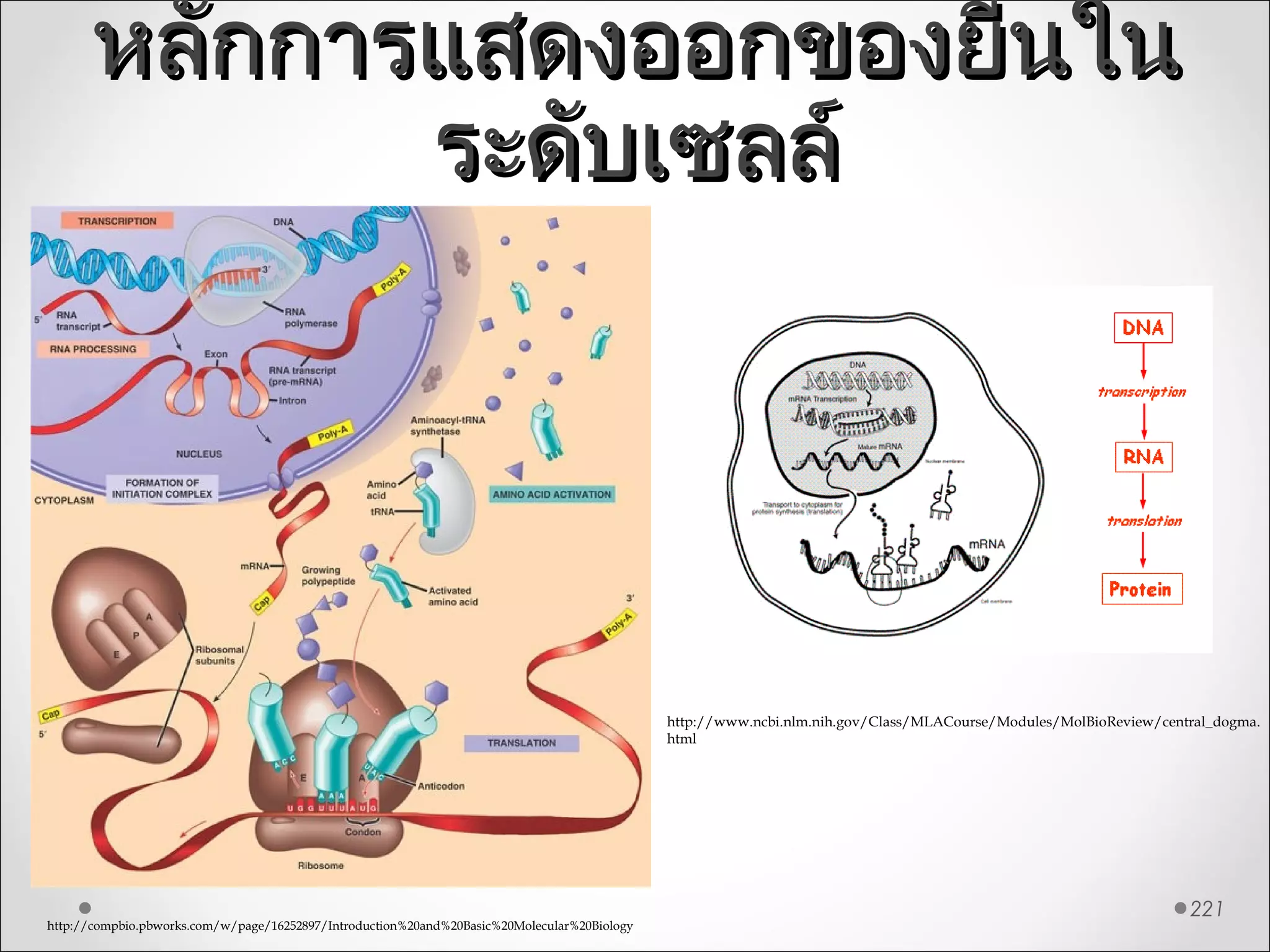
หลักการแสดงออกของยีนในหลักการแสดงออกของยีนใน
ระดับเซลล์ระดับเซลล์
221
http://compbio.pbworks.com/w/page/16252897/Introduction%20and%20Basic%20Molecular%20Biology
http://www.ncbi.nlm.nih.gov/Class/MLACourse/Modules/MolBioReview/central_dogma.
html
การสังเคราะห์คอลลาเจนการสังเคราะห์คอลลาเจน
Nucleus
Cytoplasm
Extracellular Matrix
http://herkules.oulu.fi/isbn9514272374/html/x183.html
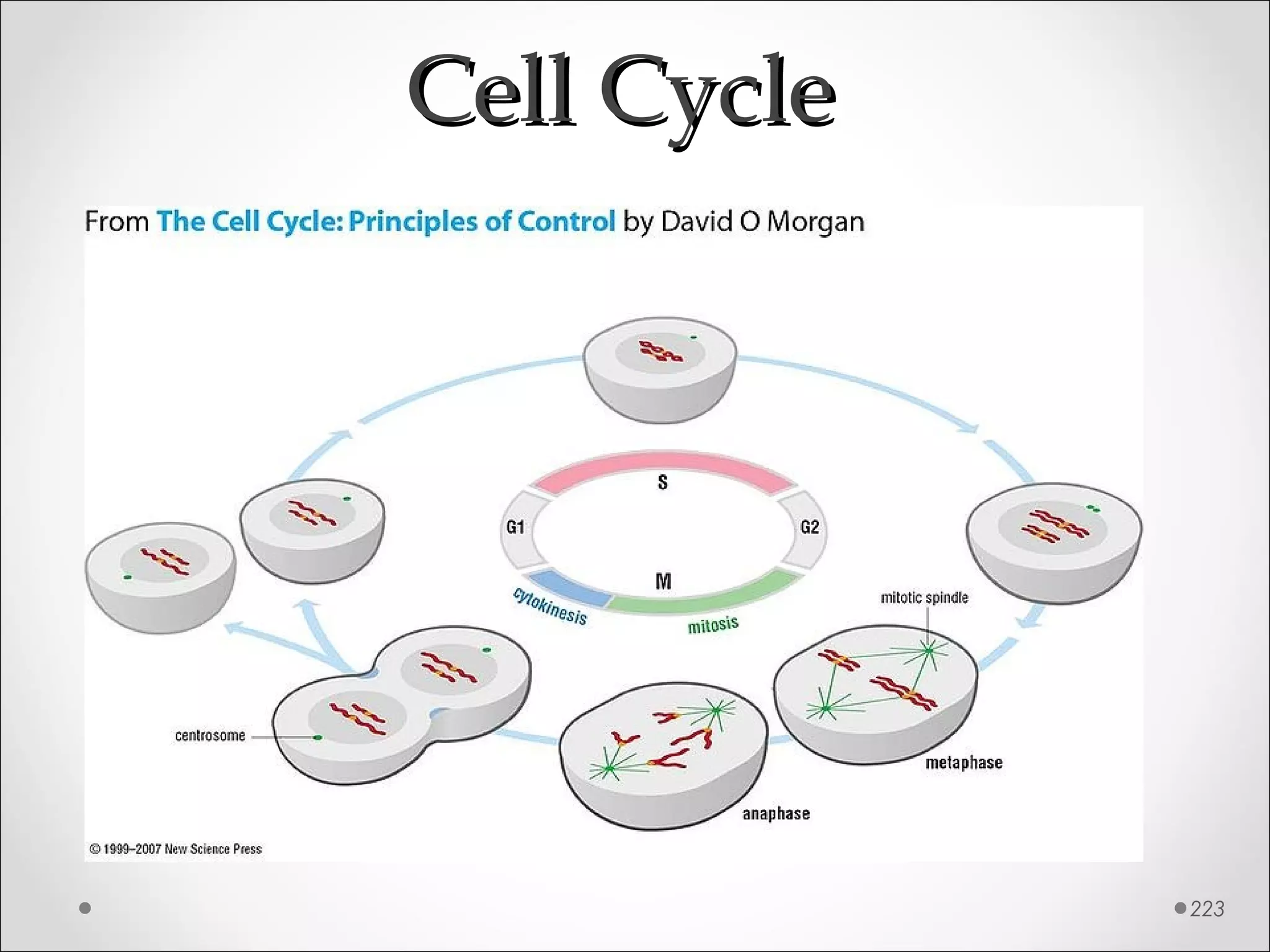
Cell CycleCell Cycle
223
Cell CycleCell Cycle
224
http://legacy.owensboro.kctcs.edu/gcaplan/songbook/B3.%20%20Mitosis.htm
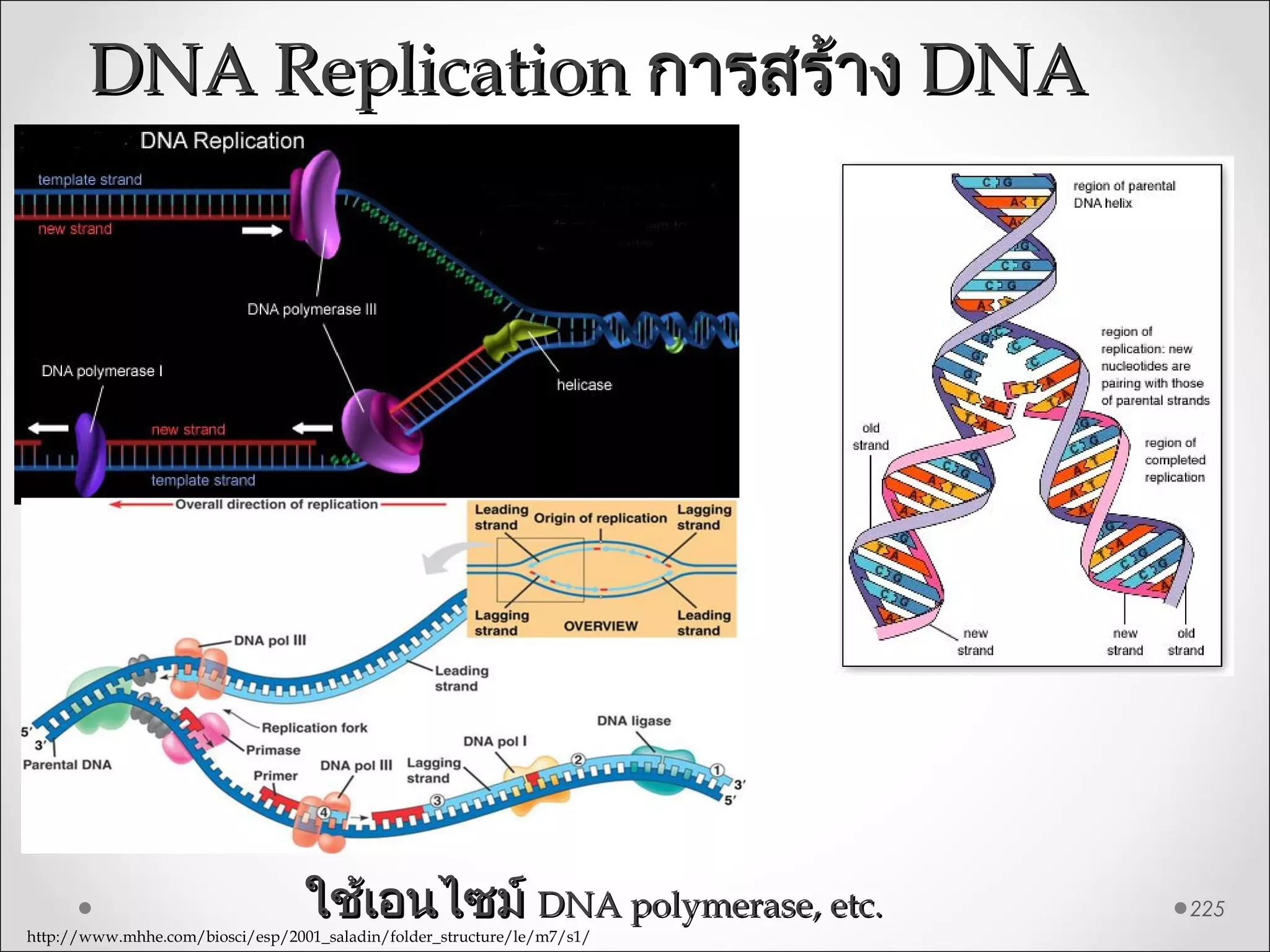
DNA ReplicationDNA Replication การสร้างการสร้าง DNADNA
225ใช้เอนไซม์ใช้เอนไซม์ DNA polymerase, etc.DNA polymerase, etc.
http://www.mhhe.com/biosci/esp/2001_saladin/folder_structure/le/m7/s1/
PCR: Polymerase Chain ReactionPCR: Polymerase Chain Reaction
226
http://www.nobelprize.org/nobel_prizes/chemistry/laureates/1993/illpres/pcr.ht
http://en.wikipedia.org/wiki/File:
PCR_tubes.png
เป็นการเพิ่มจำานวนเป็นการเพิ่มจำานวน copycopy
ของของ DNA/RNADNA/RNA เพียงเพียง
ให้เพียงพอต่อการนำาไปให้เพียงพอต่อการนำาไป
ใช้ต่อใช้ต่อ
DNA FingerprintDNA Fingerprint
227
ใช้เอนไซม์ตัดจำาเพาะ (restriction
enzyme) แยกโดยขนาดที่ต่างกัน
จากการตัดได้ที่ตำาแหน่งต่างกัน
http://www.veteranstoday.com/2012/07/25/breaking-dna-news-elvis-pressley-was-
not-a-turk/dna-fingerprint/
http://www.citylabatucla.org/dnafingerp.html
http://geneed.nlm.nih.gov/topic_subtopic.php?tid=37&sid=38
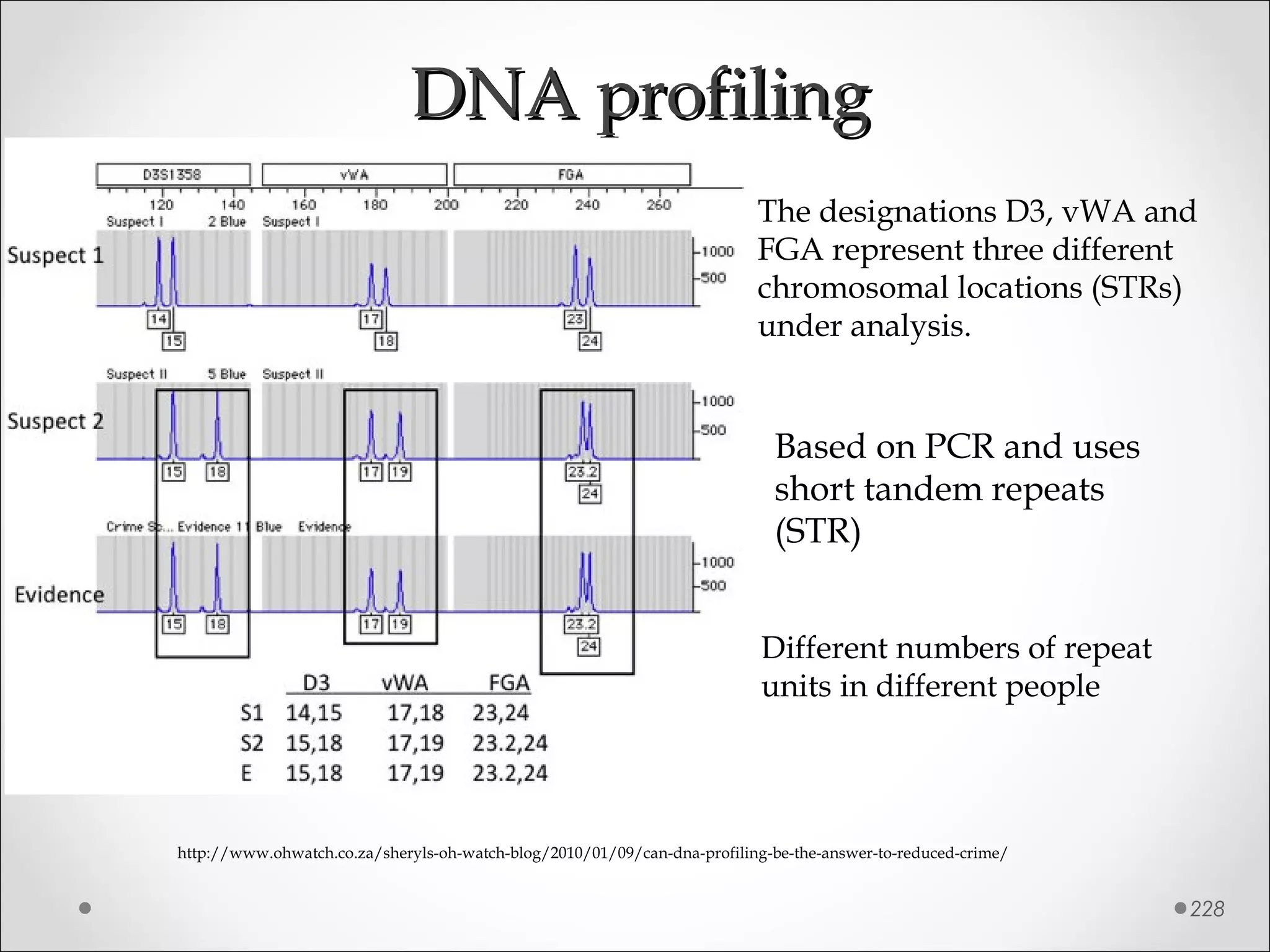
DNA profilingDNA profiling
228
http://www.ohwatch.co.za/sheryls-oh-watch-blog/2010/01/09/can-dna-profiling-be-the-answer-to-reduced-crime/
The designations D3, vWA and
FGA represent three different
chromosomal locations (STRs)
under analysis.
Based on PCR and uses
short tandem repeats
(STR)
Different numbers of repeat
units in different people
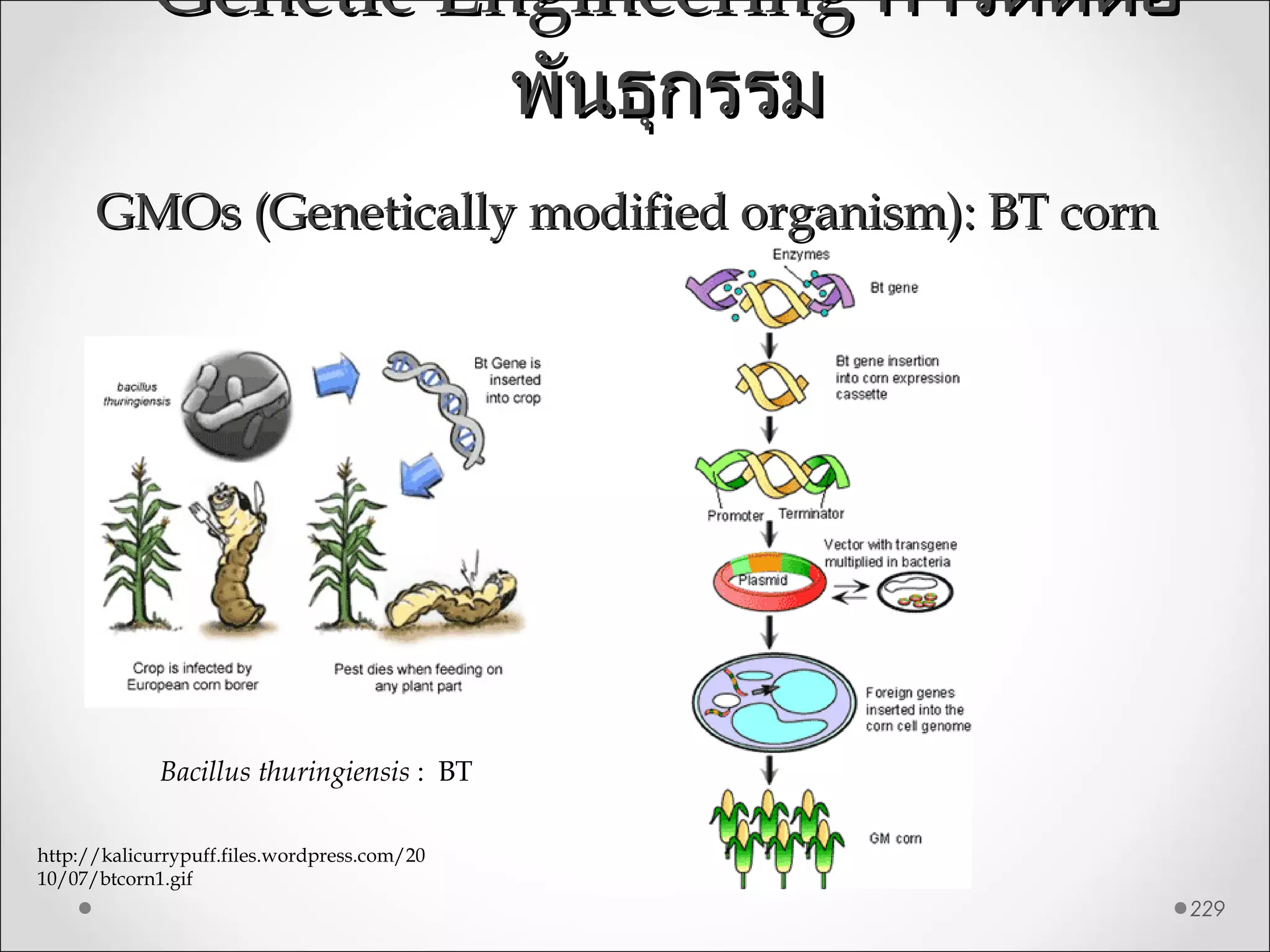
Genetic EngineeringGenetic Engineering การตัดต่อการตัดต่อ
พันธุกรรมพันธุกรรม
229
http://kalicurrypuff.files.wordpress.com/20
10/07/btcorn1.gif
GMOs (Genetically modified organism): BT cornGMOs (Genetically modified organism): BT corn
Bacillus thuringiensis : BT
230
Insulin Production in BacteriaInsulin Production in Bacteria การผลิตอินซูลินในการผลิตอินซูลินใน
แบคทีเรียแบคทีเรีย
http://www.biocyclopedia.com/index/images/Biotechnology/chapter05/04
4_large.jpg
http://www.betacell.org/content/articlepanelview/article_id/1/panel_id/1
RNA interference (RNAi)RNA interference (RNAi)
231
http://gmoevidence.com/usda-rna-interference-pesticides-will-need-special-safety-
testing/
Gene TherapyGene Therapy
232
233
http://www.agilethinkers.com/johanna_rothman_qa/
http://blueeyednightowl.blogspot.com/2011/07/q.html
ReproductionReproduction การสืบพันธุ์การสืบพันธุ์
Asexual reproduction การสืบพันธุ์แบบไม่อาศัยเพศ
Sexual reproduction การสืบพันธุ์อาศัยเพศ
234
http://saburchill.com/ans02/chapters/chap051.h
tml
www.biologycorner.com
http://topicstock.pantip.com/jatujak/to
picstock/2006/11/J4891304/J4891304.ht
ml
www.tutorvista.com http://en.wikinoticia.com/culture-
science/Science/132990-animal-reproduction-types
http://www.newsrt.co.uk/news/sexual-nature-
let-your-animal-instincts-guide-you-for-valentine-
s-day-48220.html
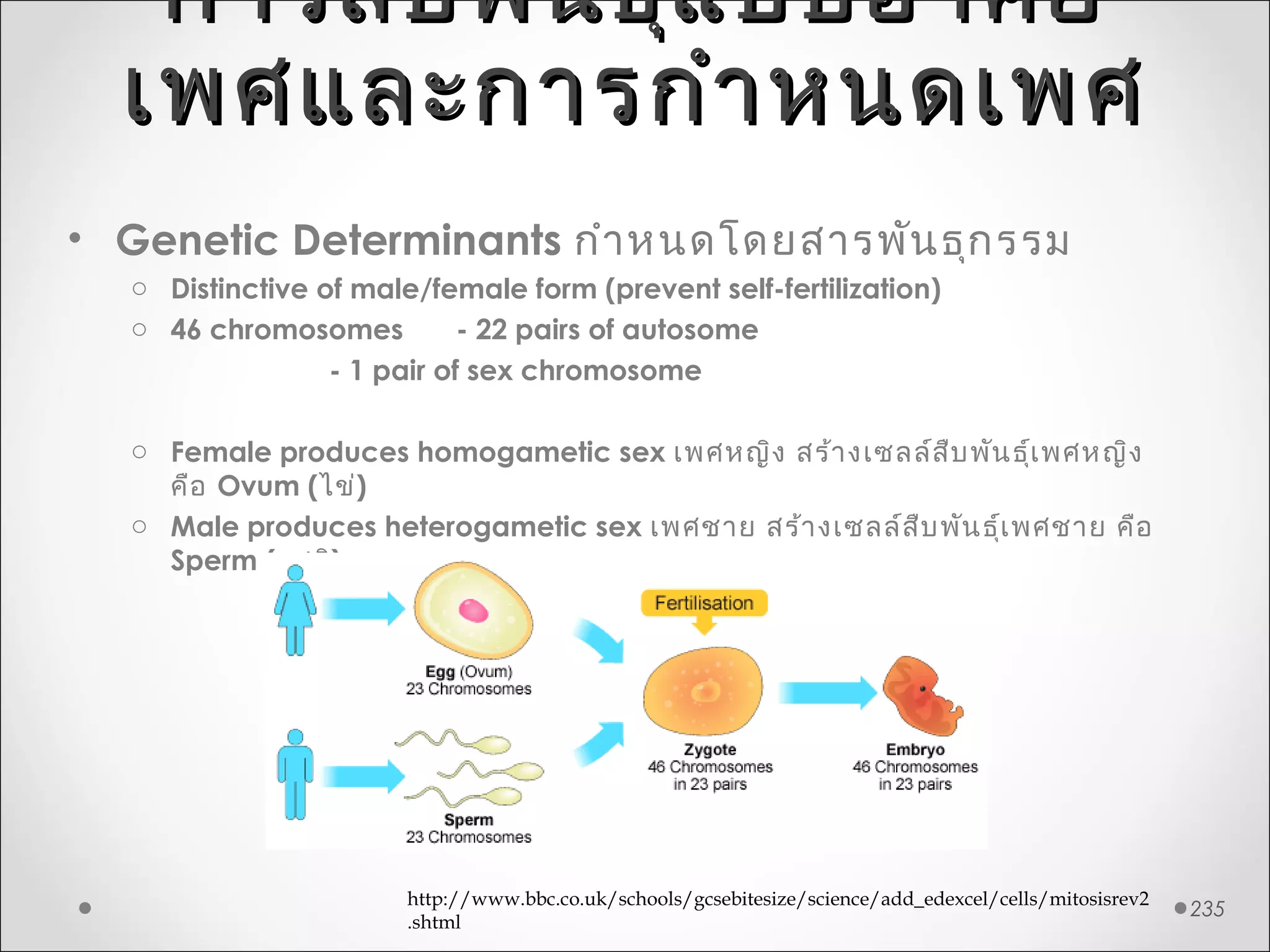
การสืบพันธุ์แบบอาศัยการสืบพันธุ์แบบอาศัย
เพศและการกำาหนดเพศเพศและการกำาหนดเพศ
• Genetic Determinants กำาหนดโดยสารพันธุกรรม
o Distinctive of male/female form (prevent self-fertilization)
o 46 chromosomes - 22 pairs of autosome
- 1 pair of sex chromosome
o Female produces homogametic sex เพศหญิง สร้างเซลล์สืบพันธุ์เพศหญิง
คือ Ovum (ไข่)
o Male produces heterogametic sex เพศชาย สร้างเซลล์สืบพันธุ์เพศชาย คือ
Sperm (อสุจิ)
http://www.bbc.co.uk/schools/gcsebitesize/science/add_edexcel/cells/mitosisrev2
.shtml
235
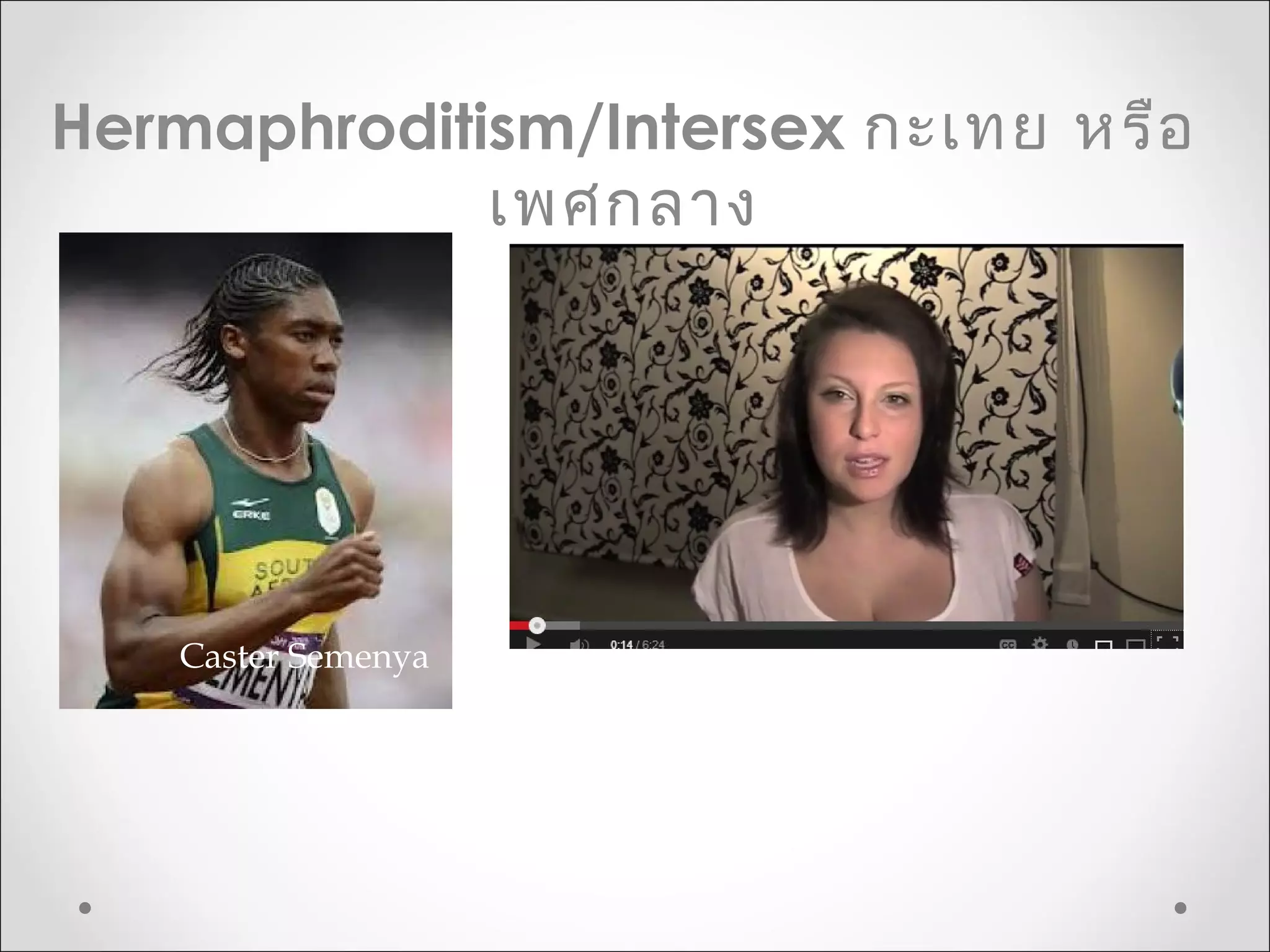
Caster Semenya 
http://www.psdgraphics.com/file/male-and-female-relationship-sign.jpg
Sex Determination
Feminine
Masculine
Scientific research shows every male on this planetScientific research shows every male on this planet
was once a female!was once a female!
http://www.pcgerms.com/scientific-research-shows-every-
male-on-this-planet-was-once-a-female-video/ 237
Genetic determinantsGenetic determinants
• Sex determination by XX or XY
o XX develop ovary
o XY develop testis
• XY female & XX male?!?!
o Y alone is sufficient to determine gonadal sex
• SRY region – sex determining region on the Y chromosome
o Y is small and heterochromatic (dense& incapable of synthesis RNA)
o Y function as “switching”, encoded DNA-binding protein (controller gene that
influence downstream gene)
• XY female – deletion or mutation on Y chromosome
• XX male – translocate of critical piece of Y to one of
autosome or X
238
Caster Semenya 
Hermaphroditism/Intersex กะเทย หรือ
เพศกลาง
True HermaphroditismTrue Hermaphroditism
• Have both testicular and ovarian tissue
240
Left gonad showing ovarian follicles
Right gonad showing seminiferous tubule
SecondarySecondary
HermaphroditismHermaphroditism
• Intersex
XY
• AIS = Androgen Insensitivity Syndrome
• AKA (also known as) testicular feminization (Tfm)
XX
• Adrenogenital syndrome
o Fetal adrenal gland is hyperactive  secrete large quantities of steroids
with strong androgenic activity
o Development of the Wolffian ducts  Male with penis and scrotum, have
genitalia of both sexes (No MIH secrete)
241
The brain, behavioralThe brain, behavioral
dimorphism, and genderdimorphism, and gender
242
Non-primateNon-primate
• Sexually dimorphic behavior พฤติกรรมที่ต่างกันในต่าง
เพศ
- Urination patterns in dog, cocked leg/ squatting
• Courtship behavior
- Mounting
243
244
HumanHuman
Childhood play – doll play, or athletic interest
Gene TherapyGene Therapy
245
246
PhysiologyPhysiology
(Blood&Gut)(Blood&Gut)
สรีรวิทยาสรีรวิทยา
Circulatory SystemCirculatory System
Definition
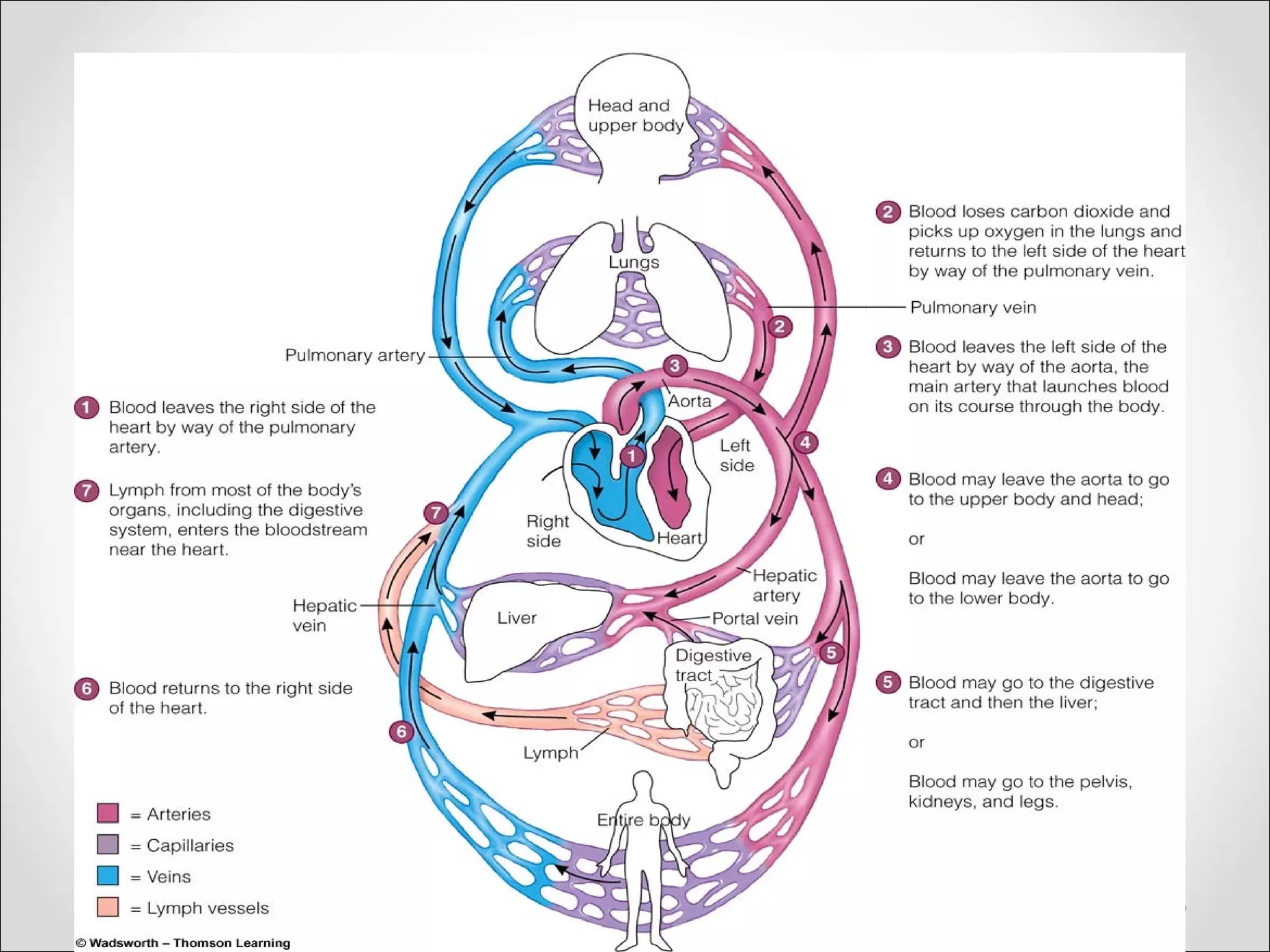
•It is a fluid-filled network of tubes (or vessels) through
which materials move between the environment and
the cells of a multicellular animal.
Characteristics
•It connects all parts of an organism in a way that
allows individual cells to thrive as well as for organisms
to function as a unit
•It is an entirely closed system in human
ทางเดินอาหารทางเดินอาหาร
248
http://www.zo.utexas.edu/faculty/sjasper/images/f30.9.jpg
http://montanahan.blogspot.com/2012_11_01_archive.html
http://visual.merriam-webster.com/human-being/anatomy/digestive-system.php
http://heartsfortheclass.blogspot.com/2012/07/bio-202-renal-system-
key.html
• Exchanges of O2, CO2, water, nutrition andExchanges of O2, CO2, water, nutrition and
wastewaste
Multicellular NeedsMulticellular Needs
• Unicellular organisms don’t need a
circulatory system, because the cell is in
direct contact with the environment and
oxygen, nutrients and wastes can easily
diffuse across the cell membrane by
diffusion.
• Multicellular organisms need a circulatory
system to transport substances made in one
part of the body to sites where they are
needed in another part of the body.
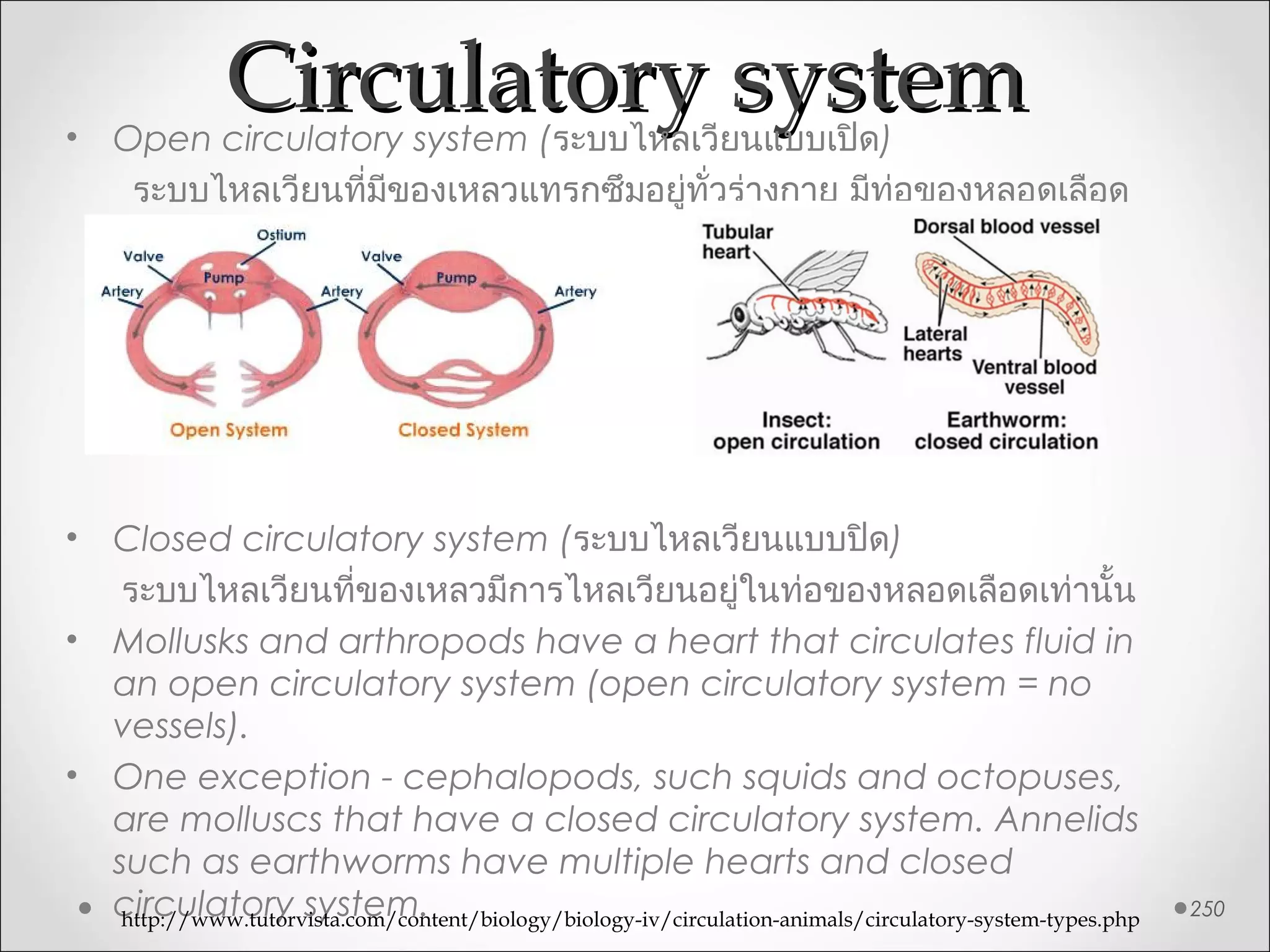
Circulatory systemCirculatory system• Open circulatory system (ระบบไหลเวียนแบบเปิด)
ระบบไหลเวียนที่มีของเหลวแทรกซึมอยู่ทั่วร่างกาย มีท่อของหลอดเลือด
เปิดเข้าสู่ช่องในลำาตัว
• Closed circulatory system (ระบบไหลเวียนแบบปิด)
ระบบไหลเวียนที่ของเหลวมีการไหลเวียนอยู่ในท่อของหลอดเลือดเท่านั้น
• Mollusks and arthropods have a heart that circulates fluid in
an open circulatory system (open circulatory system = no
vessels).
• One exception - cephalopods, such squids and octopuses,
are molluscs that have a closed circulatory system. Annelids
such as earthworms have multiple hearts and closed
circulatory system. 250http://www.tutorvista.com/content/biology/biology-iv/circulation-animals/circulatory-system-types.php
251
Open circulatory system
(ระบบไหลเวียนแบบเปิด)
• An open circulatory system is common in most molluscs and
anthropods. In this type of ciruclatory system, a fluid called
hemolymph ( a mix of blood and lymph), is bathed on organs
and body tissues in a cavity called the homecoel.
• Hemolymph travels through circulatory vessels into cavities or
sinuses, which are open spaces surrounding an organ. The
reason why this fluid is bathed on organs is so the tissues
receive oxygen and nutrients directly.
• The circulation of hemolymph is done with muscle
contractions because there is no blood pressure, which is the
nature of an open system like this.
252
http://w3.shorecrest.org/~Lisa_Peck/MarineBio/syllabus/ch7invertebrates/Invertwp/2007/josh/Circ.ht
Open circulatory system
(ระบบไหลเวียนแบบเปิด)
253http://www.bio.miami.edu/tom/courses/bil265/bil265goods/18_cardiac.ht
ml
Closed systemClosed system
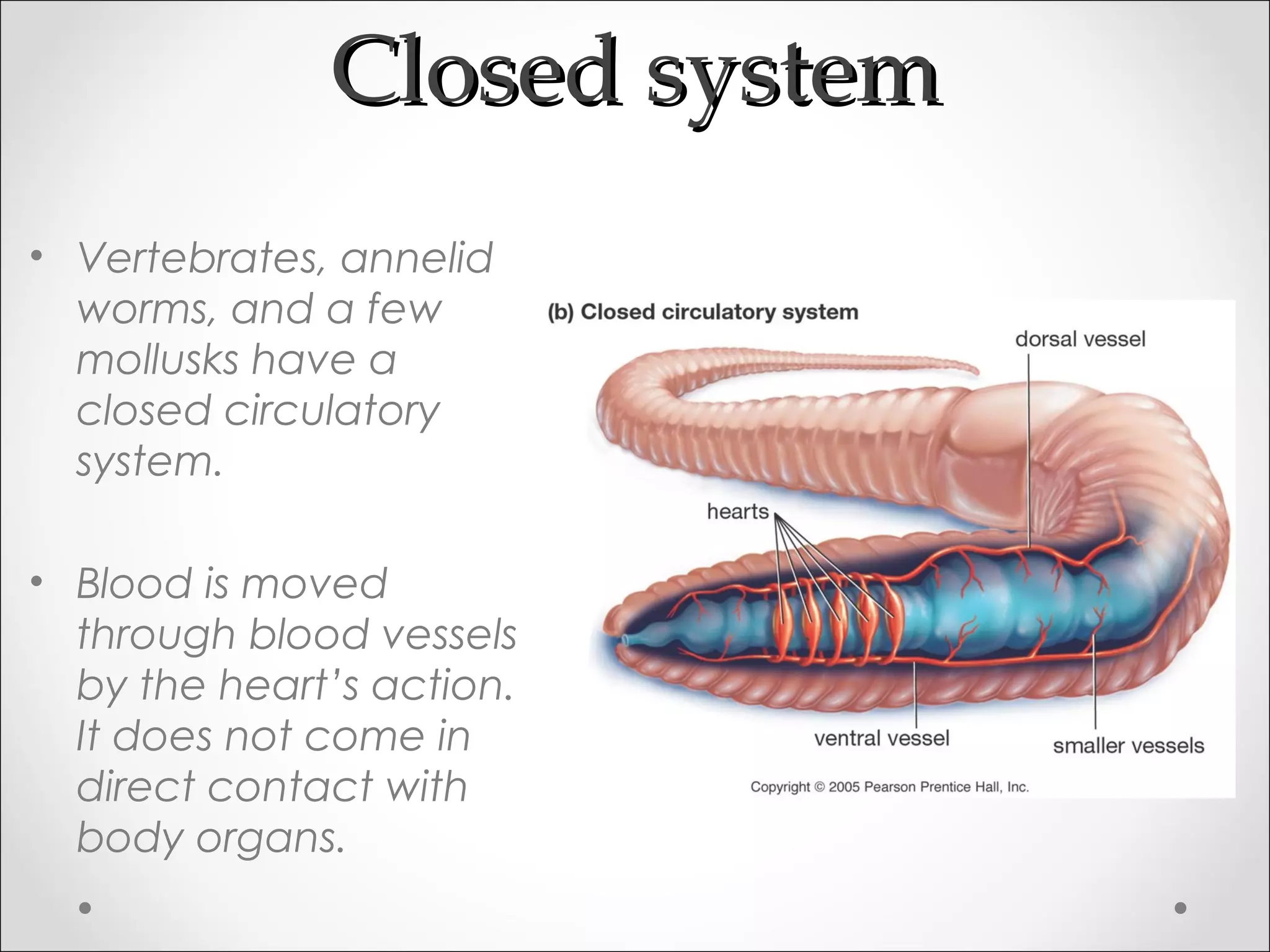
• Vertebrates, annelid
worms, and a few
mollusks have a
closed circulatory
system.
• Blood is moved
through blood vessels
by the heart’s action.
It does not come in
direct contact with
body organs.
Closed Circulatory SystemClosed Circulatory System
FunctionFunction
• Transport materials needed by cells
o Oxygen
o Glucose
• Remove waste materials from cells
o Carbon dioxide
o urea
Major ComponentsMajor Components
• Pump (heart)
o Continuously circulates blood
• Network of tubes
o Arteries- blood away from heart
o Veins- blood back to the heart
• Blood
o Fluid that fills the circulatory system
Specific partsSpecific parts
• Pulmonary arteries- transport blood to lungs
• Pulmonary veins- transport oxygenated
blood to hear
• Aortic arch and trunk- main arteries from
heart
• Common carotid artery- carries blood to
brain
• Renal vein and artery- connects to kidneys
• Mesenteric veins- connects to intestine
Accessory OrgansAccessory Organs
• Lungs- organ where oxygen is taken up and CO2 is
released
• Kidneys- organ where wastes are removed from
blood; critical in regulating fluids in the body
• Small intestine- digestion
• Large intestine- water absorption
The Vertebrate HeartThe Vertebrate Heart
• Vertebrate hearts are separated
into two types of chambers
o Atria (singular: atrium): receive blood from body or
lungs. Contractions of the atria send blood through
a valve to the ventricles.
o Ventricles: receive blood from atria, contract to
send blood to body or lungs.
Two-chambered heartTwo-chambered heart
• The simplest vertebrate heart is the two-
chambered heart, seen in fishes.
• A single atrium receives blood from the body cells.
A ventricle sends blood to the gills to collect
oxygen.
Three-chambered heartThree-chambered heart
• Separate atria allow some
separation of oxygenated
and deoxygenated
blood, which was an
advantage for land
organisms (reptiles,
amphibians).
• Though blood can mix in
the ventricle, mixing is
minimal. Some reptiles
have partial separation of
the ventricle.
Four-chambered heartFour-chambered heart
• The four-chambered
heart, seen in birds and
mammals, allows
complete separation of
oxygenated and
deoxygenated blood.
• Complete separation is
necessary to support a
fast metabolism found in
homeotherms.
The HeartThe Heart
• Located near the center of your chest
• A hollow organ about the size of your fist composed
of cardiac muscle.
• Enclosed in a protective sac of tissue called the
pericardium
• Inside there are two thin layers of epithelial and
connective tissue
• Contractions of the myocardium, a thick cardiac
muscle, pump blood through the circulatory system
• The heart contracts about 72 times a minute
• Each contraction pumps about 70 mL of blood
The HeartThe Heart
• The human heart has four chambers
o Left and right ventricle
o Left and right atrium
• The left side of the heart pumps oxygenated blood
to the body while the right side of the heart pumps
deoxygenated blood to the lungs where oxygen
can be absorbed by the hemoglobin carrying red
blood cells
HeartHeart• Septum, or wall,
separates the right side
form the left side
preventing mixing of
oxygen-rich blood and
oxygen-poor blood
• Flaps of connective
tissue called valves
divide each side into 2
chambers: totaling 4
chambers
o Upper chambers receive
blood = atrium
o Lower chambers pump
blood out of heart =
ventricle
““Dual pump” operationDual pump” operation
The four-chambered heart acts as two pumps.
Heart Anatomy
Keeping TimeKeeping Time
• The sinoatrial (SA)
node is nervous tissue
that times heart
beats.
• The SA node causes
atria to contract, and
sends the signal to the
atrioventricular (AV)
node to signal the
ventricles to contract.
BloodBlood
ComponentsComponents
• Blood is made up of four major
components.
• What do each of these do?
o Plasma: the liquid portion.
o Red blood cells.
o White cells.
o Platelets.
Red blood cellsRed blood cells
• RBCs lose their
nucleus at maturity.
• Make up about 99%
of the blood’s cellular
component.
• Red color is due to
hemoglobin.
HemoglobinHemoglobin
• Hemoglobin is a
complex protein
made up of four
protein strands, plus
iron-rich heme groups.
• Each hemoglobin
molecule can carry
four oxygen atoms.
The presence of
oxygen turns
hemoglobin bright
red.
RBC lifespanRBC lifespan
• RBCs live about 4
months. Iron from
hemoglobin is
recycled in the liver
and spleen.
• The hormone
erythropoeitin, made
by the kidneys,
stimulates the
production of RBCs in
red bone marrow.
• One of the illegal drugs that some top Olympic
athletes have been caught using is erythropoetin.
What would this hormone do that would give
athletes an edge in competitions?
White cellsWhite cells
• White blood cells
defend against
disease by
recognizing proteins
that do not belong to
the body.
• White cells are able
to ooze through the
walls of capillaries to
patrol the tissues and
reach the lymph
system.
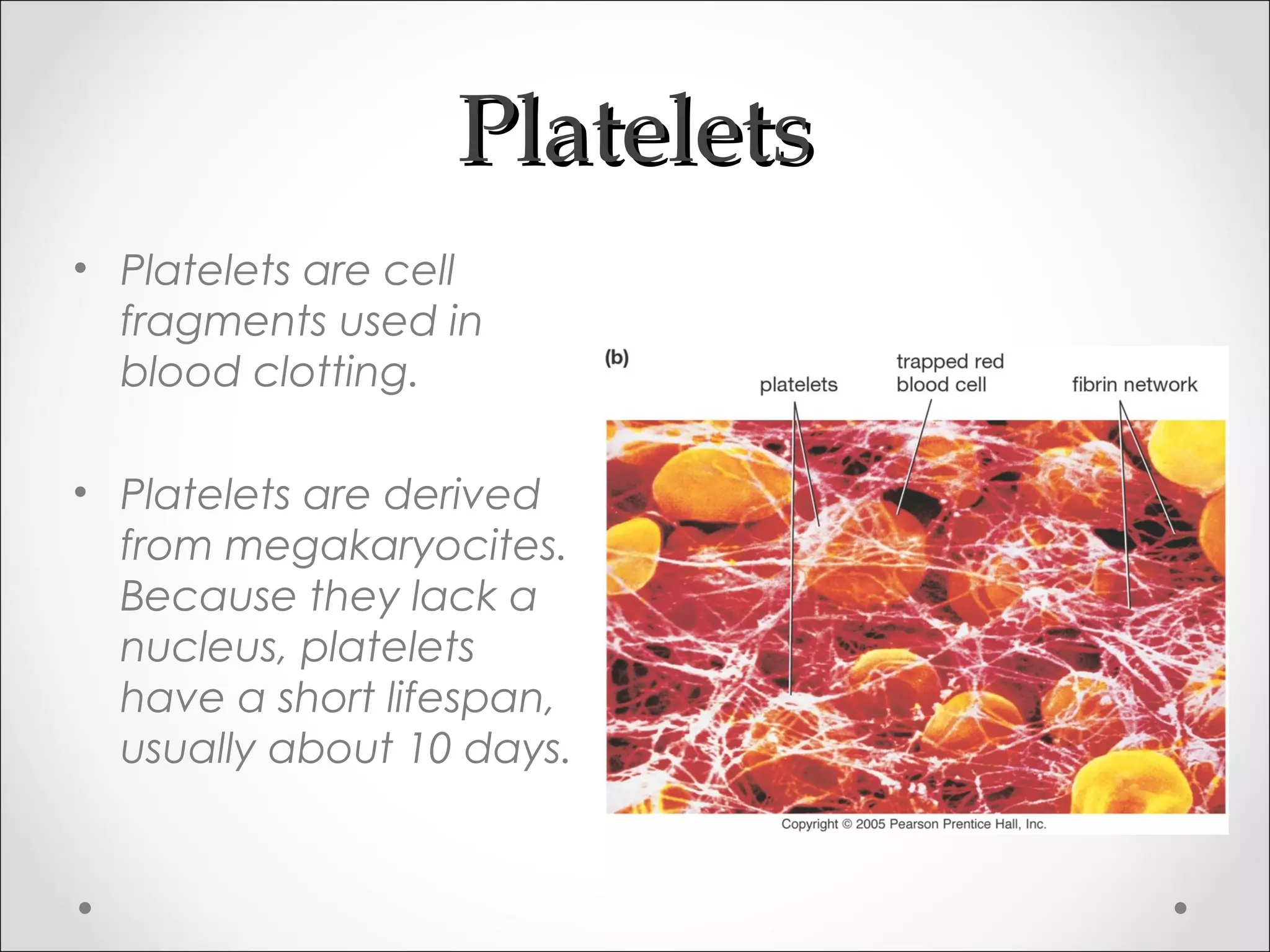
PlateletsPlatelets
• Platelets are cell
fragments used in
blood clotting.
• Platelets are derived
from megakaryocites.
Because they lack a
nucleus, platelets
have a short lifespan,
usually about 10 days.
• Platelets aggregate
at the site of a
wound.
• Broken cells and
platelets release
chemicals to
stimulate thrombin
production.
• Thrombin converts
the protein fibrinogen
into sticky fibrin,
which binds the clot.
Blood clottingBlood clotting
Which blood cells transportWhich blood cells transport
oxygen?oxygen?
1. White cells
2. Red cells
3. Platelets
4. All blood cells
Blood VesselsBlood Vessels
Classes of blood vesselsClasses of blood vessels
• Blood vessels fall into three major classes:
o Arteries and arterioles carry blood away from the heart.
o Veins and venules carry blood to the heart.
o Capillaries allow exchange of nutrients, wastes and
gases.
ArteriesArteries
• Arteries are thick-
walled, and lined
with smooth
muscle.
• How does the
structure of an
artery help with its
function?
ArteriolesArterioles
• Arterioles branch off of arteries.
• Arterioles can constrict to direct and control blood
flow. They may, for example, increase or decrease
blood supply to the skin.
• How might arterioles be involved when:
o Your skin turns red when you are hot.
o A person’s face turns pale with fright.
CapillariesCapillaries
• Body tissues contain a
vast network of thin
capillaries.
• Capillary walls are only
one cell thick, allowing
exchange of gases,
nutrients, and wastes.
• Capillaries are so fine
that RBCs must line up
single-file to go
through them.
VenulesVenules
• Venules are thin-walled collectors of blood.
• Low pressure in the venules allows the capillary
beds to drain into them.
VeinsVeins
• Veins have thinner
walls than arteries.
• Veins have fewer
smooth muscle cells,
but do have valves.
How do valves and
the skeletal muscles
help veins function?
• Besides the ability to contract and move blood,
why do arteries need to be so thick and strong?
• Varicose veins are veins in the legs that are
swollen, stretched, and painful. What factors
could lead to this condition, and how can
varicose veins be prevented?
AtherosclerosisAtherosclerosis
• LDL cholesterol forms
plaques in arteries,
triggering
inflammation.
• The immune system
forms a hard cap over
the plaque, partially
blocking the artery.
Caps can rupture,
creating clots that
can close off an
artery.
Preventing heart attacksPreventing heart attacks
• Both genetic and environmental factors contribute
to atherosclerosis.
• Blood LDL cholesterol can be reduced by a low-fat
diet that emphasizes high-fiber foods, antioxidants,
and “good” fats (monounsaturated fats, omega-3
oils), and reduce trans-fats.
• Regular exercise also contributes significantly to
LDL cholesterol reduction.
What is always true of arteries?What is always true of arteries?
1. Always carry
oxygenated blood.
2. Always carry
deoxygenated blood.
3. Always carry blood to
the heart.
4. Always carry blood
away from the heart.
Besides having to constrict to move blood,Besides having to constrict to move blood,
why are artery walls so thick and strong?why are artery walls so thick and strong?
1. Arteries must move
oxygenated blood.
2. Arteries must
withstand very high
blood pressure when
the heart contracts.
3. Arteries must move
blood out to all parts
of the body.
Why are capillary walls so thin?Why are capillary walls so thin?
1. Because capillaries
are thin and narrow
2. To allow exchange of
gases and nutrients.
3. To force RBCs to
move through in
single file.
• Some people who are at high risk for heart
attacks may be advised by their doctors to take
low doses of aspirin daily. What effects does
aspirin have that would help prevent heart
attacks?
Blood pressureBlood pressure
• Systolic pressure =
pressure when the
heart contracts.
• Diastolic pressure
= pressure
between heart
beats.
• Hypertension (high blood pressure) puts people at
risk for heart disease. What long-term effects
would an increase in blood pressure have on the
heart?
• What other organ system is involved in
hypertension?
From lungs
After passing through the capillaries of the lungs, theAfter passing through the capillaries of the lungs, the
blood which is now oxygenated returns to the heart in theblood which is now oxygenated returns to the heart in the
pulmonary veins.pulmonary veins.
Respiratory and Circulation SystemRespiratory and Circulation System
ระบบหายใจ และ ระบบหมุนเวียนเลือดระบบหายใจ และ ระบบหมุนเวียนเลือด
297http://www.nhlbi.nih.gov/health/health-topics/topics/hlw/system.html
298
http://www.zo.utexas.edu/faculty/sjasper/images/f30.9.jpg
Types of CirculationTypes of Circulation
• Pulmonary circulation = from right side of the heart
to lungs where carbon dioxide leaves the blood
and oxygen is absorbed
• Systemic circulation = from left side of the heart to
organs
o Coronary circulation = through heart tissue
Pulmonary CirculationPulmonary Circulation
• The right side of the heart pumps blood
from the heart to the lungs
• In the lungs, carbon dioxide leaves the
blood while oxygen is absorbed.
• The oxygen-rich blood goes into the left side
of the heart
Systemic CirculationSystemic Circulation
• The oxygen-rich blood
from the left side of the
heart is pumped to the
rest of the body
• Oxygen-poor blood
returns to the right side of
the heart
• This blood is oxygen-poor
because the cells
absorbed the oxygen
and released carbon
dioxide into the blood
• The oxygen-poor blood is
ready for another trip to
the lungs to get oxygen
again
ระบบหมุนเวียนเลือดระบบหมุนเวียนเลือด:: หัวใจ ปอด ไต หลอดหัวใจ ปอด ไต หลอด
เลือดเลือด
302http://www.teachpe.com/anatomy/circulatory_system.php#a http://renalcare.in/functions.html
Digestive SystemDigestive System ระบบย่อยระบบย่อย
อาหารอาหาร
303
http://www.fortheloveofbody.com/wp-
content/uploads/2013/04/digestive_system_functio
ns.jpg
http://www.docstoc.com/docs/32118246/Digestive-Enzymes-Table-11-2_-page-365-
Enzyme-Place-Substrate
What do animals need toWhat do animals need to
live?live?
O2
food
ATP
• Animals make energy
using:
o food
o oxygen
• Animals build bodies
using:
o food for raw materials
• amino acids, sugars,
fats, nucleotides
o ATP energy for synthesis
Nutritional requirementsNutritional requirements
• Animals are heterotrophs
o need to take in food
o Why? fulfills 3 needs…
• fuel = chemical energy for production of ATP
• raw materials = carbon source for synthesis
• essential nutrients = animals cannot make
o elements (N, P, K, Fe, Na, K, Ca...), NAD, FAD, etc.
How do animals get theirHow do animals get their
food?food?
filter (suspension) feeding substrate feeding
fluid feeding bulk feeding
Different diets;Different diets;
different livesdifferent lives
• All animals eat other organisms
o Herbivores
• eat mainly plants
o gorillas, cows,
rabbits, snails
o Carnivores
• eat other animals
o sharks, hawks, spiders, snakes
o Omnivores
• eat animals & plants
o cockroaches, bears, raccoons, humans
o humans evolved as hunters, scavengers & gatherers
Getting & Using FoodGetting & Using Food
• Ingest
o taking in food
• Digest
o mechanical digestion
• breaking up food into smaller pieces
o chemical digestion
• breaking down food into molecules
small enough to be absorbed into cells
• enzymes (hydrolysis)
• Absorb
o absorb across cell membrane
• diffusion
• active transport
• Eliminate
o undigested extracellular material
passes out of digestive system
intracellular
digestion
extracellular
digestion
Digestive systemsDigestive systems
Everybody’s got one!
Human digestive systemHuman digestive system
Alimentary CanalAlimentary Canal
DigestionDigestion
• Digestion – The process of changing food into
simple components which the body can absorb
• Digestive tract or Gastrointestinal tract- where
digestion & absorption take place
• Mouth->esophagus->stomach->small intestine-
>large intestine
• Accessory glands
o salivary glands, pancreas, liver & gall bladder
• secrete digestive juices (enzymes & fluid)
DigestionDigestion
• Muscular action helps to propel liquefied food
through the G.I. tract by:
1. Peristalsis – push food along by rhythmic waves
of smooth muscle contraction in walls of digestive
system
2. Segmentation – inward squeezing for
greater mixing of secretions
3. Sphincter contractions - muscular ring-like valves,
regulate the passage of material between sections
of digestive system
PeristalsisPeristalsis
SegmentationSegmentation
Sphincter ContractionsSphincter Contractions
GI Tract AnatomyGI Tract Anatomy
DigestionDigestion
• Mouth – ingestion of food; chewing (mastication) &
swallowing
1. Bolus – portion of food swallowed
at one time
2. Saliva - water, salts, enzymes,
mucus secreted by salivary glands
to:
a. Moisten food & aids swallowing
b. Begins carbohydrate digestion
Secretions of DigestionSecretions of Digestion
Swallowing (&Swallowing (& notnot choking)choking)
• Epiglottis
o problem: breathe & swallow through same orifice
o flap of cartilage
o closes trachea (windpipe) when swallowing
o food travels down esophagus
• Esophagus
o move food along to stomach by peristalsis
IngestionIngestion
• Mouth
o mechanical digestion
• teeth
o breaking up food
o chemical digestion
• saliva
o amylase
• enzyme digests starch
o mucin
• slippery protein (mucus)
• protects soft lining of digestive system
• lubricates food for easier swallowing
o buffers
• neutralizes acid to prevent tooth decay
o anti-bacterial chemicals
• kill bacteria that enter mouth with food
mouth
break up food
moisten food
digest starch
kill germs
DigestionDigestion
• Esophagus – connects mouth to stomach
1. Epiglottis – closes airway
2. Bolus moved along by peristalsis
3. Cardiac sphincter – keeps food from
backing up into esophagus
StomachStomach
• Functions
ofood storage
• can stretch to fit ~2L food
odisinfect food
• HCl = pH 2
o kills bacteria
o breaks apart cells
ochemical digestion
• pepsin
o enzyme breaks down proteins
o secreted as pepsinogen
• activated by HCl
But the stomach is made out of protein!
What stops the stomach from digesting itself?
mucus secreted by stomach cells protects
stomach lining
stomach
kills germs
store food
break up food
digest proteins
cardiac
sphincter
pyloric
sphincter
mouth
break up food
moisten food
digest starch
kill germs
DigestionDigestion
• Stomach – collecting & churning
1. Gastric glands secrete: gastric juice
(water, enzymes, hydrochloric acid) that
kills most bacteria and begins protein
digestion and mucus to protect lining
2. Chyme – semi-liquid mass of partially
digested food
3. Pyloric sphincter – regulates passage
of chyme into small intestine
• Used to think ulcers
were caused by
stress
o tried to control with
antacids
• Now know ulcers
caused by
bacterial infection
of stomach
o Helicobacter pylori
o now cure with
antibiotics
UlcersUlcers
inflammation of
stomach
inflammation of
esophagus
Colonized by
H. pylori
Free of
H. pylori
white blood cells
cytokines
inflammatory
proteins
(CagA)
cell damaging
proteins
(VacA)
helper T cells
neutrophil cells
H. pylori
Coevolution of parasite & host
RevolutionizingRevolutionizing
healthcarehealthcare"for their discovery of the bacterium Helicobacter pylori and its role in
gastritis and peptic ulcer disease"
J. Robin Warren
Barry Marshall
1982 | 2005
Helicobacter pylori
Secretions of DigestionSecretions of Digestion
Small intestineSmall intestine
• Function
o major organ of digestion & absorption
o chemical digestion
• digestive enzymes
o absorption through lining
• over 6 meters!
• small intestine has huge surface area = 300m2
(~size
of tennis court)
• Structure
o 3 sections
• duodenum = most digestion
• jejunum = absorption of nutrients & water
• ileum = absorption of nutrients & water
DuodenumDuodenum
• 1st section of small intestines
o acid food from stomach mixes with digestive juices from accessory
glands:
 pancreas
 liver
 gall bladder
PancreasPancreas
• Digestive enzymes
o peptidases
• trypsin
o trypsinogen
• chymotrypsin
o chimotrypsinogen
• carboxypeptidase
o procarboxypeptidase
o pancreatic amylase
• Buffers
o reduces acidity
• alkaline solution rich in
bicarbonate (HCO3-)
• buffers acidity of material from
stomach
Explain how this is a
molecular example of
structure-function theme.
Explain how this is a
molecular example of
structure-function theme.
small intestines
stomach
kills germs
break up food
digest proteins
store food
pancreas
produces enzymes to
digest proteins & starch
mouth
break up food
moisten food
digest starch
kill germs
LiverLiver
• Digestive System Functions
o produces bile
• stored in gallbladder until needed
• breaks up fats
o act like detergents to breakup fats
Circulatory System
Connection
bile contains
colors from old
red blood cells
collected in liver
=
iron in RBC rusts &
makes feces brown
pancreas
produces enzymes to
digest proteins & starch
stomach
kills germs
break up food
digest proteins
store food
liver
produces bile
- stored in gall bladder
break up fats
mouth
break up food
moisten food
digest starch
kill germs
Digestive enzymesDigestive enzymes
Absorption by SmallAbsorption by Small
IntestinesIntestines
• Absorption through villi & microvilli
o finger-like projections
• increase surface area for absorption
Absorption of NutrientsAbsorption of Nutrients
• Passive transport
o fructose
• Active (protein pumps) transport
o pump amino acids, vitamins & glucose
• against concentration gradients across intestinal cell membranes
• allows intestine to absorb much higher proportion of nutrients in
the intestine than would be possible with passive diffusion
oworth the cost of ATP!
small intestines
breakdown all foods
- proteins
- starch
- fats
- nucleic acids
absorb nutrients
stomach
kills germs
break up food
digest proteins
store food
pancreas
produces enzymes to
digest proteins & starch
liver
produces bile
- stored in gall bladder
break up fats
mouth
break up food
moisten food
digest starch
kill germs
Large intestines (colon)Large intestines (colon)
• Function
o re-absorb water
• use ~9 liters of water every
day in digestive juices
• > 90% of water reabsorbed
o not enough water absorbed
back to body
• diarrhea
o too much water absorbed back to body
• constipation
Flora of large intestinesFlora of large intestines
• Living in the large intestine is a rich
flora of harmless, helpful bacteria
o Escherichia coli (E. coli)
• a favorite research organism
o bacteria produce vitamins
• vitamin K; biotin, folic acid & other B vitamins
o generate gases
• by-product of bacterial
metabolism
• methane, hydrogen sulfide
RectumRectum
• Last section of colon (large intestines)
o eliminate feces
• undigested materials
oextracellular waste
• mainly cellulose from plants
• roughage or fiber
• salts
• masses of
bacteria
appendix
Colon - concludeColon - conclude
• Large intestine (colon) - reabsorbing &
eliminating
1. Fermentation of undigested
residues by bacteria occurs
2. Terminates at rectum, where water
some minerals are absorbed
3. Anus – sphincter that controls
defecation (excretion of fiber
residue, wastes and some water)
stomach
kills germs
break up food
digest proteins
store food
small intestines
breakdown food
- proteins
- starch
- fats
absorb nutrients
pancreas
produces enzymes to
digest proteins & carbs
liver
produces bile
- stored in gall bladder
break up fats
large intestines
absorb water
mouth
break up food
moisten food
digest starch
kill germs
The Final StageThe Final Stage
Absorption & TransportAbsorption & Transport
• End-products of digestion:
1. CHO >>> Monosaccharides
2. Fats >>> Glycerol + fatty acids
3. Proteins >>> Amino acids
4. Vitamins, minerals & water – no
digestion
AbsorptionAbsorption
Absorption & TransportAbsorption & Transport
• Absorption occurs in the small intestine
1. Wall of small intestine covered with 100s of folds
2. Each fold covered with 1000s of villi
3. Each villi contains 100s of microvilli
The Small Intestine VillaThe Small Intestine Villa
Absorption & TransportAbsorption & Transport
• Absorbed nutrients enter either the:
1. Vascular system – water-soluble
nutrients (monosaccharides, amino
acids, water-soluble vitamins,
minerals, water) enter the blood via
the portal vein for transport to the
liver
Absorption & TransportAbsorption & Transport
2. Lymph system – fat-soluble nutrients
(lipids, fat-soluble vitamins) enter here,
eventually entering the blood near the
heart
3. Transport of lipids – since fats are insoluble in
water, they must be packaged for transport as
lipoproteins (triglyceride, phospholipid, protein,
cholesterol)
Absorption & TransportAbsorption & Transport
4 basic types of lipoprotein:
1. Chylomicrons – very, very low density
(85% triglyceride); absorbed from small
intestine into lymph & circulated to cells
where some of lipid material is picked off
& remnants return to liver
2. VLDL – very low density lipoprotein
(50% triglyceride); made by liver &
travels to cells
Absorption & TransportAbsorption & Transport
3. LDL – low density lipoprotein (50%
cholesterol); remains of VLDL; high
levels increase risk of heart attack
4. HDL – high density lipoprotein (50%
protein); removes cholesterol from blood
for return to liver; high levels decrease
risk of heart attack
Upper GI ProblemsUpper GI Problems
Dysphagia – difficulty swallowing with
tendency to choke/aspirate
1. Foods that are soft texture & smooth
consistency critical to avoid aspiration
(i.e. pudding consistency or pureed)
2. Thickened liquids using commercial
thickeners are easier to swallow
3. Tube feeding into duodenum may be
indicated
Upper GI ProblemsUpper GI Problems
Reflux esophagitis (“heartburn”) which often
occurs due to a hiatal hernia and
Gastritis (inflammation of stomach lining) and
Peptic Ulcers (erosions of the lining of stomach
or
duodenum) require a bland diet to
reduce
gastric secretions and eliminate foods
that
cause pain or discomfort
1. Avoid chocolate, garlic/onions, caffeine,
spicy & fatty foods, mint, alcohol
Gastroesophageal RefluxGastroesophageal Reflux
Digestive ProblemsDigestive Problems
Delayed Gastric Emptying – may be delayed
temporarily following surgery or chronically
due to Diabetes Mellitus
1. Low fiber, low fat speeds gastric
emptying
& prevents bezoars that may form a
blockage
Constipation – prevent with a high fiber diet
and treat by drinking plenty of fluids
including prune juice, get regular exercise &
add laxatives (hydrophilic colloids), as
needed
Digestive ProblemsDigestive Problems
Diarrhea/dehydration – treat underlying
cause and replace fluids & electrolytes to
prevent dehydration
1. Mild cases use juices, sports drinks,
caffeine-free sodas, tea, broth, oral
rehydration formulas (e.g. Pedialyte)
Diverticular Disease
1. Avoid nuts, seeds, hulls (e.g. okra,
strawberries, popcorn) which may
get trapped & cause diverticulitis
Diverticula in the ColonDiverticula in the Colon
Malabsorption SyndromesMalabsorption Syndromes
Dumping Syndrome
Carbohydrate malabsorption that occurs due
to removal of pyloric sphincter from partial
gastrectomy causing osmotic diarrhea
1. Symptoms include weakness, dizziness,
rapid heartbeat, diarrhea, abdominal pain
2. Avoid concentrated sweets, drink fluids
between meals, eat small, frequent meals
Malabsorption SyndromesMalabsorption Syndromes
Lactose Intolerance
Carbohydrate malabsorption due to a lack of
the enzyme lactase that splits lactose into
glucose + galactose
1. Incidence assoc. with aging, certain ethnic
groups, and G.I. disease or surgery
2. Symptoms include cramping, distention,
diarrhea after consuming products
containing
milk or lactose
3. Lactose-Restricted Diet or enzyme tablets &
treated milk are also available
Malabsorption SyndromesMalabsorption Syndromes
Fat Malabsorption – caused by disorders of the
stomach, intestine, pancreas & liver
1. Steatorrhea (fatty, loose, foamy, foul
smelling stools) with subsequent loss of
energy, essential fatty acids, and fat-soluble
vitamins
2. Limit fat intake to 35-40 gms/day
3. Supplementation with fat-soluble vitamins (water-
miscible forms available)
4. Enzyme replacement to aid digestion
& absorption
Malabsorption SyndromesMalabsorption Syndromes
Pancreatitis – inflammation of the pancreas,
resulting in impaired digestion/absorption
1. Symptoms include severe abdominal pain,
and nausea & vomiting
2. Initially, N.P.O. (nothing by mouth) to rest
the pancreas using I.V. fluids to maintain
fluid & electrolyte balance
3. Avoiding alcohol is imperative as diet
progresses
4. Chronic pancreatitis may lead maldigestion
of fats, chronic abdominal pain, weight loss
& diabetes
Malabsorption SyndromesMalabsorption Syndromes
Cystic Fibrosis – hereditary disease
characterized by thick mucus affecting many
body organs, including lungs & pancreas, and
abnormally high electrolyte concentration in
sweat
1. Energy & nutrient needs 120-150% of normal
2. Fat needed to meet high energy needs so
enzyme replacements used to control
steatorrhea
3. Liberal use of fluids & salt
Malabsorption SyndromesMalabsorption Syndromes
Celiac Disease (Gluten-sensitive enteropathy)
– sensitivity to gliadin, part of the protein
gluten, found in wheat, rye, barley & oats
1. Symptoms include weight loss, diarrhea,
fatigue, anemia (iron, folate, Vit. B12),
generalized malabsorption, bone disease
2. Avoiding foods containing gluten requires
reading labels!
An Overview
Noah Hoffman, 2006
Urinary SystemUrinary System
Functions of the Kidney:Functions of the Kidney:
Maintaining balanceMaintaining balance
• Regulation of body fluid volume and
osmolality
• Regulation of electrolyte balance
• Regulation of acid-base balance
• Excretion of waste products (urea,
ammonia, drugs, toxins)
• Production and secretion of hormones
• Regulation of blood pressure
                                                                                                         
                                           
A. Renal Vein
B. Renal Artery
C. Ureter
D. Medulla
E. Renal Pelvis
F. Cortex
1. Ascending loop of
Henle
2. Descending loop of
Henle
3. Peritubular capillaries
4. Proximal tubule
5. Glomerulus
6. Distal tubule
The Kidney and the Nephron
The NephronThe Nephron
• Functional unit of the kidney (1,000,000)
• Responsible for urine formation:
o Filtration
o Secretion
o Reabsorption
•Glomerulus
•Afferent and
Efferent arterioles
•Proximal Tubule
•Loop of Henle
•Distal Tubule
•Collecting Duct
Components of
the nephron
From http://www.emc.maricopa.edu/faculty/farabee/BIOBK/BioBookEXCRET.html
Overview of nephron function
Filtration
THE GLOMERULUS
•Components of plasma cross the three layers of the
glomerular barrier during filtration
•Capillary endothelium
•Basement membrane (net negative charge)
•Epithelium of Bowman’s Capsule (Podocytes –filtration
slits allow size <60kD)
•The ability of a molecule to cross the membrane depends on
size, charge, and shape
• Glomerular filtrate therefore contains all molecules not
contained by the glomerular barrier - it is NOT URINE YET!
Plasma is filtered through the
glomerular barrier
Glomerular Filtration RateGlomerular Filtration Rate
(GFR)(GFR)
• Measure of functional capacity of the kidney
• Dependent on difference in pressures between
capillaries and Bowman’s space
• Normal = 120 ml/min =7.2 L/h=180 L/day!! (99% of
fluid filtered is reabs.)
Reabsorption
and secretion
ReabsorptionReabsorption
• Active Transport –requires ATP
o Na+, K+ ATP pumps
• Passive Transport-
o Na+ symporters (glucose, a.a., etc)
o Na+ antiporters (H+)
o Ion channels
o Osmosis
Factors influencingFactors influencing
ReabsorptionReabsorption
• Saturation: Transporters can get saturated
by high concentrations of a substance -
failure to resorb all of it results in its loss in
the urine (eg, renal threshold for glucose
is about 180mg/dl).
• Rate of flow of the filtrate: affects the time
available for the transporters to reabsorb
molecules.
What is ReabsorbedWhat is Reabsorbed
Where?Where?
Proximal tubule - reabsorbs 65 % of filtered Na+
as well as Cl-
, Ca2+
, PO4, HCO3
-
. 75-90% of H20.
Glucose, carbohydrates, amino acids, and small
proteins are also reabsorbed here.
Loop of Henle - reabsorbs 25% of filtered Na+.
Distal tubule - reabsorbs 8% of filtered Na+.
Reabsorbs HCO3-.
Collecting duct - reabsorbs the remaining 2% of
Na+ only if the hormone aldosterone is present.
H 0 depending on hormone ADH.
SecretionSecretion
• Proximal tubule – uric acid, bile salts, metabolites,
some drugs, some creatinine
• Distal tubule – Most active secretion takes place
here including organic acids, K+, H+, drugs, Tamm-
Horsfall protein (main component of hyaline casts).
Loop of HenleLoop of Henle
o Goal= make isotonic filtrate
into hypertonic urine (don’t
waste H20!!)
o Counter-current multiplier:
• Descending loop is permeable to
Na+, Cl-, H20
• Ascending loop is impermeable to
H20- active NaCl transport
• Creates concentration gradient in
interstitium
• Urine actually leaves hypotonic
but CD takes adv in making
hypertonic
386http://renalcare.in/functions.html
Renal Anatomy
Digestive SystemDigestive System ระบบย่อยระบบย่อย
อาหารอาหาร******
388
http://www.fortheloveofbody.com/wp-
content/uploads/2013/04/digestive_system_functio
ns.jpg
http://www.docstoc.com/docs/32118246/Digestive-Enzymes-Table-11-2_-page-365-
Enzyme-Place-Substrate
389
MusculoskeletalMusculoskeletal
โครงร่างกระดูกและกล้ามเนื้อโครงร่างกระดูกและกล้ามเนื้อ
http://www.merckmanuals.com/home/bone_joint_and_muscle_disorders/b
iology_of_the_musculoskeletal_system/muscles.html
390
http://commons.wikimedia.org/wiki/File:Bone_cross-section.svg
http://kids.britannica.com/comptons/art-117500/A-longitudinal-section-of-the-humerus-reveals-the-
bones-interior
กระดูกกระดูก
Bone and Muscle TrainingBone and Muscle Training
• Low bone mass in astronauts or bed-rest patients
การสูญเสียมวลกระดูก ในนักบินอวกาศ หรือ ผู้ป่วยที่ต้องนอน
พักฟื้นบนเตียงเป็นเวลานาน
• Gain of bone mass and muscle in a tennis player
391
http://www.fanpop.com/clubs/rafael-nadal/images/10818467/title/rafa-hot-body-photo
Rafael Nadal,
left handed tennis player
www.confessionsofanotsowillingworkaholic.com
392http://renalcare.in/functions.html
Renal Anatomy
393
http://www.agilethinkers.com/johanna_rothman_qa/
http://blueeyednightowl.blogspot.com/2011/07/q.html

General biology 8-2-14-2

  • 1.
    General BiologyGeneral Biology ชีววิทยาทั่วไปชีววิทยาทั่วไป AdisriCharoenpanich, PhD Department of Biology, Faculty of Science, Silpakorn University 1 ดร. อดิศรี เจริญพานิช ภาควิชาชีววิทยา คณะวิทยาศาสตร์ มหาวิทยาลัย ศิลปากร acharoe@ncsu.edu
  • 2.
    TopicsTopics • Introductions: TodayTechnologies • Tools and Method in Biological Studies • Biomolecules • Structure and functions of cells • Reproduction • Genetics and Technology • Animal Tissue and Development • Human Physiology 2
  • 3.
  • 4.
    DNA FingerprintDNA Fingerprint 4 ใช้เอนไซม์ตัดจำาเพาะ(restriction enzyme) แยกโดยขนาดที่ต่างกัน จากการตัดได้ที่ตำาแหน่งต่างกัน http://www.veteranstoday.com/2012/07/25/breaking-dna-news-elvis-pressley-was- not-a-turk/dna-fingerprint/ http://www.citylabatucla.org/dnafingerp.html http://geneed.nlm.nih.gov/topic_subtopic.php?tid=37&sid=38
  • 5.
    5 1997 Human ear ona mice, 1997 Human ear grown on an arm, 2012
  • 6.
  • 7.
    Bioprinting – 3DprintingBioprinting – 3D printing 7http://www.clemson.edu/centers-institutes/ibioe/images/research/bioprinting
  • 8.
    8 Aug 5, 2013 CulturedBeef Cell culture = Expensive, Antibiotics, Fetal calf serum Colored red by adding beet juice, why?  no blood supply Maastricht University Netherlands
  • 9.
  • 10.
    GraftsGrafts การปลูกถ่ายการปลูกถ่าย อวัยวะอวัยวะ • Autograftsจากผู้ป่วยเองจากส่วนอื่นในร่างกาย มา ซ่อมแซมส่วนที่เสียหาย เช่น การใช้กระดูดซี่โครงส่วน ปลายหรือกระดูกจากใบหู ในการศัลยกรรมใบหน้า หรือ ผิวหนัง • Allografts จากผู้ให้บริจาค (human donors) เช่น การปลูก ถ่ายไต • Xenografts จากสัตว์ เช่น ลิ้นหัวใจจากหมู วัว • Synthetic biomaterials วัสดุสังเคราะห์ เช่น titanium bone, การฟอกไต, pace maker • Tissue engineering เป็นการสร้างเนื้อเยื่อขึ้นมาใหม่ โดย 10
  • 11.
    Inert Graft Bioactive Graft (Graft+ Bioactive Factors) Synthetic Cell-Free Approaches Grafts Autograft Combination Morbidity at donor site Immunogenicity/ Disease Transmission/ Variable efficiency Allograft Immunogenicity/ Complex material property problems Rejection Tissue Engineering
  • 12.
    Why Tissue Engineering?WhyTissue Engineering? 12 http://biomed.brown.edu/Courses/BI108/BI 108_2007_Groups/group12/Homepage.html http://www.nature.com/nature/journal/v 414/n6859/fig_tab/414118a0_F1.html
  • 13.
    Stem CellsStem Cells andTissueand Tissue EngineeringEngineering (เซลล์ต้นกำาเนิด และวิศวกรรมเนื้อเยื่อ) 13 http://www.theracellinc.com / http://blog.mediligence.com/2010/06/17/cell-therapy-tissue-engineering-and-two-means-to-one-end/
  • 14.
    Stem Cells Isolationand PreservationStem Cells Isolation and Preservation การคัดแยกและเก็บรักษาเซลล์ต้นกำาเนิดการคัดแยกและเก็บรักษาเซลล์ต้นกำาเนิด 14 http://www.genengnews.com/gen-news-highlights/fda-grants-510-k-clearance-for- life-technologies-mesenchymal-stem-cell-medium/81244813/ http://rbg-web2.rbge.org.uk/bbs/learning/exsitu/exsitu.htm www.yalescientific.org
  • 15.
    15 http://midwestresearchswine.com/wp-content/uploads/2011/05/decellularization-organ- comparison.gif PERFUSION DECELLULARIZATION The appropriatemicroenvironment required for the introduction of organ specific cells, along with an intact vascular network and outer capsule capable of maintaining physiological pressures.
  • 16.
    Different Types ofDifferentTypes of Prosthetic ValvesProsthetic Valves 16 Bileaflet mechanical valveBileaflet mechanical valve (St Jude)(St Jude) Monoleaflet mechanical valveMonoleaflet mechanical valve (Medtronic Hall)(Medtronic Hall) Caged ball valve (Starr-Caged ball valve (Starr- Edwards)Edwards) Stented porcine bioprosthesis (Medtronic Mosaic) Stented pericardialStented pericardial bioprosthesis (Carpentier-bioprosthesis (Carpentier- Edwards Magna)Edwards Magna) Stentless porcine bioprosthesisStentless porcine bioprosthesis (Medtronic Freestyle)(Medtronic Freestyle) Percutaneous bioprosthesisPercutaneous bioprosthesis expanded over a balloonexpanded over a balloon (Edwards Sapien);(Edwards Sapien); Self-expandable percutaneousSelf-expandable percutaneous bioprosthesis (CoreValve).bioprosthesis (CoreValve). http://circ.ahajournals.org/content/119/7/1034.full
  • 17.
    Engineering of SkinTissue 17 http://www.mdbiosciences. com/in-vitro/3d-human- skin-equivalent-model/ Culture of Human Skin Equivalent (HSE)
  • 18.
  • 19.
    Tools and Methodsin Biological StudiesTools and Methods in Biological Studies 19http://apps.pathology.jhu.edu/blogs/pathology/tissue-microarrays http://www.genscript.com/images/Figure1-IP.jpg?src=dm http://www.telegraph.co.uk/science/picture- galleries/7397841/Creepy-crawlies-Amazing- Scanning-Electron-Microscope-pictures-of-insects- and-spiders.html http://fineartamerica.com/featured/1-hacat- culture-cells-light-micrograph-dr-torsten- wittmann.html http://www.gala-instrumente.de/images/deben_CCD_Cilia.jpghttp://onlinelibrary.wiley.com/doi/10.1111/php.2012.88.issue-4/issuetoc
  • 20.
  • 21.
    Copyright © TheMcGraw-Hill Companies, Inc.21
  • 22.
    Copyright © TheMcGraw- Hill Companies, Inc. 22
  • 23.
    Copyright © TheMcGraw-Hill Companies, Inc.23
  • 24.
    Copyright © TheMcGraw-Hill Companies, Inc. 24
  • 25.
    Copyright © TheMcGraw- Hill Companies, Inc. 25
  • 26.
  • 27.
  • 28.
  • 29.
  • 30.
  • 31.
  • 32.
  • 33.
  • 34.
  • 35.
  • 36.
    Historically biochemists wouldreduce a protein to its most simple structure.. 1. Isolate, fractionate tissue 2. Purify, column chromatography 3. Reduce large protein to smaller fragments by attacking the protein with chemicals or enzymes that would cleave at specific regions 4. Analyze, chromatography, gel electrophoresis, amino acid analysis, peptide separations, sequence analysis
  • 44.
  • 46.
  • 47.
  • 48.
    BiomoleculesBiomolecules ชีวโมเลกุลชีวโมเลกุล • Organicสารอินทรีย์ / Inorganic สารอนินทรีย์ • สารอนินทรีย์ = นำ้า และ แร่ธาตุ • สารอินทรีย์ = มี คาร์บอน และ ไฮโดรเจน เป็น องค์ประกอบสำาคัญ o Carbohydrate คาร์โบไฮเดรต เช่น นำ้าตาล แป้ง o Protein โปรตีน เช่น กรดอะมิโน คอลลาเจน เอนไซม์ o Lipid ไขมัน ได้แก่ Fat, Oils, Phospholipids, Steroids, Waxes o Nucleic acid กรดนิวคลีอีก ATP, DNA, RNA 48
  • 49.
    Inorganic VS OrganicMoleculesInorganic VS Organic Molecules 49 http://classconnection.s3.amazonaws.com/359/flashcards/551359/jpg/inorganic_versus_organic_molecules1306681267242.jpg
  • 50.
    BiomoleculesBiomolecules 50 From Carbon atom(4 electron at the outer valence shell = 4 bonds with H, N, O, P, S or C itself… to make stable) http://d1jqu7g1y74ds1.cloudfront.net/wp-content/uploads/2010/02/c-atom_e.gif http://bilingualbiology11a.blogspot.com/2010/09/lesson-2-chemistry-of-life-organic.html
  • 51.
  • 52.
    CarbohydrateCarbohydrate 52 • แหล่งพลังงาน เช่นนำ้าตาล แป้ง ไกลโคเจนแหล่งพลังงาน เช่น นำ้าตาล แป้ง ไกลโคเจน • โครงสร้างเซลล์ เช่น เซลลูโลสในผนังเซลล์พืชโครงสร้างเซลล์ เช่น เซลลูโลสในผนังเซลล์พืช,, ไคตินไคติน ในกระดองปู หรือ เปปทิโดไกลแคนในกระดองปู หรือ เปปทิโดไกลแคน (peptidoglycan)(peptidoglycan) ในผนังเซลล์ของแบคทีเรียในผนังเซลล์ของแบคทีเรีย • องค์ประกอบหลัก คือ คาร์บอนองค์ประกอบหลัก คือ คาร์บอน,, ไฮโดรเจนไฮโดรเจน,, และและ ออกซิเจนออกซิเจน • อัตราส่วนของอัตราส่วนของ C:H:OC:H:O ส่วนใหญ่เป็นส่วนใหญ่เป็น 1:2:11:2:1 • Monosaccharide, Disaccharide, PolysaccharidesMonosaccharide, Disaccharide, Polysaccharides http://cnx.org/content/m46008/latest/?collection=col11540/latest
  • 53.
    CarbohydrateCarbohydrate 53 Monosaccharide, Disaccharide, PolysaccharidesMonosaccharide,Disaccharide, Polysaccharides http://cnx.org/content/m46008/latest/?collection=col11540/latest
  • 54.
    ProteinProtein C, H, O,N plus S, PC, H, O, N plus S, P • ประกอบด้วยกรดอะมิโน • เซลล์ทั่วไป มีโปรตีนเป็นองค์ประกอบมากกว่า 50% ของนำ้าหนักแห้ง • โครงร่างและคำ้าจุน keratin, collagen • เอนไซม์ ควบคุมการทำางานของร่างกาย เช่น phosphatase, insulin, hemoglobin • Peptide bond เกิดจาก dehydration ของ หมู่ carboxyl กับหมู่ amiono http://www.clinicares.com/clinical_data.hthttp://www.whitetigernaturalmedicine.com/wp-content/uploads/2012/02/amino-acid- structure.jpg
  • 55.
    ProteinProtein Shape and StructureShapeand Structure • Primary Structure: Polypeptide ที่เรียงตัวต่อกัน ลำาดับตามที่ถอดรหัสจากพันธุกรรม • Secondary Structure: มีการขดเกลียว (alpha helix) หรือพับไปมาเป็นจีบ (Beta pleated sheet) • Tertiary structure: โครงสร้างสามมิติที่เกิดจากพันธะ ต่างๆ • (H-bond, ionic, covalent, disulfide) หรือhydrophobic interaction ของ R-group ใน กรดอะมิโน • Quaternary structure ประกอบด้วยมากกว่า หนึ่ง
  • 56.
    ProteinProtein 56 Amino Acid, Polypeptide,Enzyme, HemoglobinAmino Acid, Polypeptide, Enzyme, Hemoglobin http://www.tutorvista.com/content/biology/biology-iii/cellular- macromolecules/proteins.php http://2012books.lardbucket.org/books/the-basics-of-general-organic-and-biological- chemistry/section_21.html http://themedicalbiochemistrypage.org/protein-structure.php
  • 57.
  • 58.
    LipidLipid• มีมี C,H, OC, H, O เหมือน คาร์โบไฮเดรต แต่อัตราส่วนของเหมือน คาร์โบไฮเดรต แต่อัตราส่วนของ ธาตุและคุณสมบัติต่างกันธาตุและคุณสมบัติต่างกัน • ไม่ละลายนำ้า แต่ละลายได้ดีในตัวทำาละลายอื่นไม่ละลายนำ้า แต่ละลายได้ดีในตัวทำาละลายอื่น • Fat, Oils, Phospholipids, Steroids, WaxesFat, Oils, Phospholipids, Steroids, Waxes http://www.yumsugar.com/Burning-Question-How-Come-Recipes-Call-Oil-Butter-7124992 http://stilettosontheglassceiling.com/wp-content/uploads/2013/11/good-fat.jpg
  • 59.
    Fat and OilsFatand Oils http://www.citycollegiate.com/biochemistry5.htm • ประกอบด้วย กรดไขมันและ กลีเซอรัล (fatty acid + glycerol) • สายไฮโดรคาร์บอน ที่มี – COOH (carboxyl group) อยู่ที่ปลายสุดของโมเลกุล • กรดไขมันอิ่มตัว (saturated fatty acid) • กรดไขมันไม่อิ่มตัว (unsaturated fatty acid)
  • 60.
    PhospholipidsPhospholipids http://www.shmoop.com/biomolecules/lipids.html • องค์ประกอบหลักของเยื่อหุ้ม เซลล์ (plasmamembrane) • มีหมู่ฟอสเฟต เข้ามาแทนที่ กรดไขมันโมเลกุลหนึ่ง ทำาให้ โมเลกุลมีขั้ว • Polar head และ non-polar tale
  • 61.
    SteroidsSteroids http://www.web-books.com/MoBio/Free/Ch1B3.htm • โครงสร้างต่างจาก lipid ชนิดอื่น •องค์ประกอบหลักคือ 4 cycloalkane rings ที่ เชื่อมต่อกัน • เช่น cholesterol, testosterone, estrogen
  • 62.
  • 63.
    Nucleic AcidNucleic Acid 63 RNADNA ATP: Adenosine triphosphate Ribonucleic acid Deoxyribonucleic acid
  • 64.
  • 65.
  • 66.
  • 67.
    Examples of humancells: Variations in shapes and sizes http://iesbscience.files.wordpress.com/2013 /04/blood-cells.jpg http://www.theoslotimes.com/not-all-sperm-are-able-to-successfully-fertilise-an-egg- but-protein-could-give-ivf-couples-hope/ http://images.sciencedaily.com/2007/05/0705200 91842-large.jpg Red Blood cell Nerve cell Sperm and egg
  • 68.
    Eukaryotes vs.Eukaryotes vs. ProkaryotesProkaryotes •Eukaryotes (animals, plants, fungi, protists) and prokaryotes (bacteria) differ greatly in structure.
  • 69.
    Examples ofExamples of UnicellularOrganismsUnicellular Organisms • Amoeba • Bacteria • Some algae • Yeasts • Paramecium http://www.microscopy- uk.org.uk/mag/imgsep01/amoebaproteus450.j pg http://cdn.thedoctorschannel.com/wp- content/uploads/2013/12/Bacteria-1.jpg http://microbewiki.kenyon.edu/images/9/9a /Saccromyces.jpg http://upload.wikimedia.org/ wikipedia/commons/thumb/c /cb/Paramecium.jpg/610px- Paramecium.jpg http://protist.i.hosei.ac.jp/PDB4/PCD2851/C/11.jpg
  • 70.
  • 71.
  • 72.
    Surface area increaseswhile total volume remains constant 5 1 1 Total surface area (height × width × number of sides × number of boxes) Total volume (height × width × length × number of boxes) Surface-to-volume ratio (surface area ÷ volume) 6 1 6 150 125 1.2 750 125 6 Surface-to- volume ratio (6:1) (1.2:1) (6:1) is set by the logistics required to carry out m
  • 73.
    Smaller size ofcellSmaller size of cell  increase surface areaincrease surface area • What is the surface of cells? *** Cell membrane*** What would be the function of cell membrane? *Selective Barrier* allow only selected molecules to move across (in or out)
  • 74.
    Unicellular usuallyUnicellular usually livesin lake, sea, orlives in lake, sea, or river.river. Why???? What is the common feature of these places?
  • 75.
    Water, a majorsubstanceWater, a major substance in living organismin living organism • Stay in water- some unicellular organism • Exchange water with environment • Protect body from water lost . ( skin, mucus, hard shell, wax)
  • 76.
    DiffusionDiffusion • Movement ofthe molecules from the region of a high concentration to the region of a lower concentration. http://cellspd5spering.wikispaces.com/file/view/diffusion.gif/45870401/diffusion.gif
  • 77.
  • 78.
    Diffusion for nutrition/gasDiffusionfor nutrition/gas exchangesexchanges http://3.bp.blogspot.com/-8vhPOBiovaY/UJaais2IeUI/AAAAAAAAAAk/cnj_uolsh3c/s1600/Screen+shot+2012-11-
  • 79.
    2007-2008 The Special CaseofThe Special Case of WaterWater Movement of waterMovement of water acrossacross the cell membranethe cell membrane
  • 80.
    OsmosisOsmosis • Net movementof water molecules across semipermeable membrane • From higher water potential to lower water potential http://estebanwhitmore.wordpress.com/2010/07/27/learning-by-osmosis/
  • 81.
    • Hypotonic Solution–lower conc. solution (more water conc.) • Isotonic Solution - same • Hypertonic Solution -higher http://leavingbio.net/OSMOSIS%20AND%20DIFFUSION_files/image009.jpg
  • 82.
    82 Cytolysis & PlasmolysisCytolysis& Plasmolysis Cytolysis Plasmolysis copyright cmassengale
  • 83.
  • 84.
    Egg OsmosisEgg Osmosis •One of the cup has syrup another one has water. Can you match them with the egg?
  • 85.
    Cells and CellStructureCells and Cell Structure 85 เซลล์เซลล์ สัตว์สัตว์ แบคทีเรีแบคทีเรี ยย http://zeroinfections.blogspot.com/2012/07/cellular- structure-of-bacteria.html
  • 86.
    ส่วนประกอบพื้นฐานของเซลล์ (Basic features ofall cells) - Plasma membrane - Semifluid substance called the cytosol - Genetic material - Ribosomes
  • 87.
    Cell membraneCell membraneเยื่อหุ้มเยื่อหุ้ม เซลล์เซลล์ 87 http://blogs.scientificamerican.com/lab- rat/files/2013/01/CellMembraneDrawing.jpg Phospholipid Bilayers : Selective MembranesPhospholipid Bilayers : Selective Membranes เยื่อเลือกเยื่อเลือก ผ่านผ่าน
  • 88.
    88 NucleusNucleus นิวเคลียสนิวเคลียส ,, EndoplasmicReticulum (ER)Endoplasmic Reticulum (ER) http://micro.magnet.fsu.edu/cells/nucleus/nucleus.h tml นิวเคลียส: ศูนย์กลางของ เซลล์ เป็นที่ เก็บสาร พันธุกรรม (DNA) ER :
  • 89.
  • 90.
    Endoplasmic reticulum : เป็นออร์กาเนลล์ที่มีเยื่อหุ้มบาง2 มีลักษณะเป็นถุงแบนหรือเป็นท่อข ไปมาเป็นโครงข่าย : เชื่อมต่อถึงกันกับ nuclear enve : มีทั้งชนิด Rough ER (RER) Smooth ER (SER) : เกี่ยวข้องกับการสังเคราะห์และ ลำาเลียงสาร (เช่น โปรตีน และไขม ไปสู่ที่ต่างๆ ภายในและภายนอกเซpytreeflash.com/campbell-chpter-12-tour-of-the-cell
  • 91.
    Rough ER (RER): เกี่ยวข้องกับ* 1. การสังเคราะห์โปรตีนบางชนิด 2. การเปลี่ยนแปลงโปรตีนที่สังเค เสร็จ 3. การลำาเลียงสาร (เช่น โปรตีน ไขมัน)ไปสู่ที่ต่างๆ ภายในและภายนอ (* ขึ้นกับชนิด
  • 92.
    Smooth ER (SER): เกี่ยวข้องกับ* 1. metabolism ของคาร์โบไฮเดร 2. สังเคราะห์ไขมัน (เช่น phosph steroids) 3. การกำาจัดสารพิษ (* ขึ้นกับชนิด ของเซลล์) The main SER tasks include synthesis of lipids, maintenance of calcium homeostasis and detoxification reactions necessary for the conversion of harmful water-insoluble substances into water-
  • 93.
    cis face (“receiving” sideof Golgi apparatus) Vesicles move from ER to GolgiVesicles also transport certain proteins back to ER Vesicles coalesce to form new cis Golgi cisternae Cisternal maturation: Golgi cisternae move in a cis- to-trans direction Vesicles form and leave Golgi, carrying specific proteins to other locations or to the plasma mem- brane for secretionVesicles transport specific proteins backward to newer Golgi cisternae Cisternae trans face (“shipping” side of Golgi apparatus) 0.1 0 µm1 6 5 2 3 4 Golgi apparatus: organelle actives in modification, sorting, secretion of cell products and manufactures polysaccharides secreted by cell (pectin, hyaluronic acid) : มีลักษณะเป็นถุงเยื่อหุ้มแบน หลายถุง (cisternae) เรียงซ้อนกัน w.biologyjunction.com/06-%20Cell%20text.ppt#295,16 : เซลล์ที่สร้างสารหลั่ง จะมี Golgi apparatu
  • 94.
    Lysosome : digestiveorganelle where macromolecules are hydrolyzed : เป็นออร์กาเนลล์ที่มีเมมเบรน 1 ชั้น ส่วนใหญ่ พบในเซลล์สัตว์ : ภายในมีเอนไซม์หลายชนิด เช่น lipases, nucleases และ proteases เป็นต้น : เป็นถุงเมมเบรนที่หลุดจาก tran face ของ Golgi apparatus //www.pleasanton.k12.ca.uhttp://www.youtube.com/watch?v=ekdIEpSf-1I
  • 95.
  • 96.
    ความสัมพันธ์ระหว่าง organelle ต่างๆ ในendomembrane system ที่ประกอบ ด้วย nuclear envelope, ER, Golgi apparatus, lysosomes, vacuoles และ plasma membrane
  • 97.
    MitochondriaMitochondria ไมโทคอนเดไมโทคอนเด รียรีย 97 Energy Sourceแหล่งสร้าง พลังงานMitochondrial DNA or mtDNA about 16,500 DNA building blocks (base pairs) Mitochondrial DNA contains 37 genes, all of which are essential for normal mitochondrial function, instructions for making enzymes involved in oxidative phosphorylation,making molecules called transfer RNA (tRNA) and ribosomal RNA (rRNA). Mitochondrial genes are among the estimated 20,000 to 25,000 total genes in the human genome.
  • 98.
    เกี่ยวข้องกับ กระบวนการหายใจระดับ เซลล์ (cellular respiration) 1. บริเวณcristae ของ เยื่อหุ้มชั้นในมี เอ็นไซม์ที่ เกี่ยวข้องกับ electron transport chain และ การ สังเคราะห์ ATP 2. ใน matrix มีเอ็นไซม์ที่ เกี่ยวข้องกับ Kreb’s cycle
  • 99.
    Chloroplast : photosyntheticorganelle; converts energy of sunlight to chemical energy stored in sugar molecules : รูปร่างกลมรี มีเมมเบรน 2 ชั้น เมมเบรนชั้นใน ยื่นเข้าไปเป็นถุงแบนๆ เรียก thylakoid เรียงซ้อนเป็นตั้งเรียก grana เกี่ยวข้องกับ การ สังเคราะห์ด้วยแสงแบบ light reaction w.biologyjunction.com/06-%20Cell%20text.ppt#295,16 Chloroplast Chloroplast DNA Ribosomes Stroma Inner and outer membranes Thylakoid 1 µm Granum
  • 100.
    Ribosome : nonmembranous organelleที่ประกอบด้วย หน่วยย่อย (subunit) 2 หน่วย pytreeflash.com/campbell-chpter-12-tour-of-the-cell
  • 101.
    1. free ribosomesทำำหน้ำที่สร้ำงโปรตีนที่ ใช้ใน cytosol 2. bound ribosomes เป็น ribosome ที่ เกำะอยู่ด้ำนผิวนอกของ ER ทำำหน้ำที่สร้ำงโปรตีน ที่จะถูกส่งไปรวมกับ organelles อื่นๆ และโปรตีน ที่จะถูกส่งออกไปใช้นอกเซลล์ : เกี่ยวข้องกับกำรสังเครำะห์โปรตีน พบเป็นอิสระ ในไซโทพลำซึม (free ribosomes) หรือติดอยู่กับ ER ชนิด RER (bound ribosomes)
  • 102.
    Peroxisomes : ลักษณะเป็นถุงกลมหรือรูปไข่มี เยื่อหุ้ม1 ชั้น ภำยในมีเอนไซม์หลำยชนิด เช่น oxidase และ catalase เป็นต้น Chloroplast Peroxisome Mitochondrion 1 µm : มีเอ็นไซม์ที่ทำำหน้ำที่เกี่ยวข้องกับกำรสร้ำงหรือ ทำำลำย hydrogen peroxide (H2 O2 ) RH2 + O2 oxidase R + H2 O2 2H2 O2 catalase 2H2 O + O2
  • 103.
    Cytoskeleton : reinforcescell’s shape, function in cell movement; components are made of proteins Microtubule : มีลักษณะ เป็นท่อกลวงยำว เกิดจำกกำรจับกันของ tubulin subunit (α: β subunit) Microfilament : หรือ actin filament ประกอบขึ้น ด้วยโปรตีน actin (globular protein) ที่จับกันเป็นสำยยำว 2 Intermediate filament : เป็นเส้นใยบำงๆ มี ขนำดอยู่ระหว่ำง microtubule และ microfilament : มีหลำยชนิดแตก http://www.noble.or
  • 105.
  • 106.
    Diagram comparing themorphologic effects of strongylophorine-26 with those of other inhibitors of cell motility and angiogenesis. A, migrating cells with a lamellipodium extending in the direction of cell migration, focal adhesions, a meshwork of lamellipodial actin filaments and actin stress fibers. B, dihydromotuporamine C and several inhibitors of cell motility and angiogenesis disrupt cell polarity and prevent cell migration by stabilizing focal adhesions and actin stress fibers (14, 15). C, strongylophorine-26 disrupts cell polarity and prevents cell migration by stabilizing focal adhesions and inducing the formation of radial protrusions resembling lamellipodia that contain a dense meshwork of peripheral actin filaments and few stress fibers. http://mct.aacrjournals.org/content/4/5/772/F6.expansion Vinculin Containing Focal Adhesions and Actin Stress Fibers in a Fibroblast-like Cell The picture shows vinculin (green) containing focal adhesions and actin stress fibers (red) in a fibroblast like cell http://www.pediatrics.wisc.edu/research/research- groups/huttenlocher/
  • 107.
    : Microfilaments thatfunction in cellular motility oMuscle contraction Actin filament Myosin filament Myosin motors in muscle cell contraction.(a) Muscle cell Myosin arm http://www.youtube.com/watch?v=zQocsLRm7_A&feature=fvwrel
  • 108.
    - Cytoplasmic streaming Nonmoving cytoplasm(gel) Chloroplast Streaming cytoplasm (sol) Parallel actin filaments Cell wall (b) Cytoplasmic streaming in plant cells /www.youtube.com/watch?v=9gfP-_frDUk&feature=
  • 109.
    - Amoeboid movement (actinand myosin filaments) Cortex (outer cytoplasm): gel with actin network Inner cytoplasm: sol with actin subunits Extending pseudopodium (b) Amoeboid movement http://www.youtube.com/watch?v=7pR7TNzJ_pA
  • 110.
  • 111.
    agella มีโครงสร้ำงคล้ำยกัน (ต่ำงกันที่จำำนวนควำมยำว กอบด้วยกลุ่มของ microtubule 9 ชุด มำจัดเรียงเป็นวงก crotubule อีก 2 อัน (9+2) www.bothbrainsandbeauty.com/acad...ella
  • 112.
    • Flagella beatingpattern (a) Motion of flagella. A flagellum usually undulates, its snakelike motion driving a cell in the same direction as the axis of the flagellum. Propulsion of a human sperm cell is an example of flagellatelocomotion (LM). 1 µm Direction of swimming (b) Motion of cilia. Cilia have a back- and-forth motion that moves the cell in a direction perpendicular to the axis of the cilium. A dense nap of cilia, beating at a rate of about 40 to 60 strokes a second, covers this Colpidium, a freshwater protozoan (SEM).
  • 113.
    • Primary Ciliaas cell’s attenna Veena Singla, et al., Science 313, 629 (2006);
  • 114.
    Central vacuole of cell Plasma membrane Secondary cell wall Primary cellwall Middle lamella 1 µm Central vacuole of cell Central vacuole Cytosol Plasma membrane Plant cell walls Plasmodesmata ละ Cell coat ซลล์พืช: ประกอบด้วยเซลลูโลส (cellulose) เป็นส่วนใหญ lamella ) y cell wall ose + hemicellulose) ary cell wall ose + lignin) ซลล์ของรำและ ยีสต์: ประกอบด้วย cellulose และ chitin ซลล์ของสำหร่ำย: ประกอบด้วย cellulose และ siliga
  • 115.
    115 er and Hausman,2007 เซลล์สัตว์ไม่มี cell wall แต่มีสำรที่ถูกสร้ำง ออกมำอยู่ด้ำนนอกของเยื่อหุ้มเซลล์ เรียกว่ำ extracellular matrix พบว่ำองค์ประกอบและ โครงสร้ำงของ ECM จะแตกต่ำงกันในเซลล์ แต่ละชนิด Cell coat หรือ Extracellular matrix (ECM) ของเซลล์สัตว์
  • 116.
    Glycocalyx: ประกอบด้วย glycoprotein (collagen,fibronectin, proteoglycans) Collagen Fibronectin Plasma membrane EXTRACELLULAR FLUID Micro- filaments CYTOPLASM Integrins Polysaccharide molecule Carbo- hydrates Proteoglycan molecule Core protein Integrin A proteoglycan complex http://jasn.asnjournals.org/content/18/1 หน้ำที่: จดจำำเซลล์ที่อยู่ชิดกัน และยึดเซลล์ให้ติดกัน 1. Collagen fiber ฝังตัวอยู่ในร่ำงแหของ proteoglycans ซึ่งประกอบด้วยคำร์โบไฮเดรต 95 % 2. Fibronectin เป็น glycoprotein ที่เกำะอยู่กับ receptor protein ที่อยู่ที่เยื่อหุ้มเซลล์ (integrin) 3. Integrin จะเชื่อมโยงระหว่ำง ECM กับ
  • 117.
    RGD peptides (Arg-Gly-Asp) TheRGD ( L-arginine, glycine, and L-aspartic acid) tripeptide motif can be found in extracellular matrix (ECM) proteins such as fibronectin, fibrinogen, prothrombin, tenascin, thrombospondin, vitronectin, von Willebrand factor, Adenovirus penton base protein, bone sialoprotein, collagen, decorsin, disintegrins. The exposed RGD motif constitutes a major recognition site for integrin binding. Integrin, a transmembrane heterodimeric protein, is an adhesion protein consisting of an alpha and a beta subunit. http://www.anaspec.com/products/promotions.asp?id=67&col=2&row=2
  • 118.
    The use ofRGD peptides (Arg-Gly-Asp) for drug delivery
  • 119.
    13. Cell junction 13.1Animal cells: Tight junctions Desmosomes Gap junctions 1.1 Adhering junction : Tight junctions และ Desmo 1.2 Communicating junction: Gap junctions
  • 120.
    Animal cells: TIGHT JUNCTIONS ยึดเซลล์และอุดรอยต่อระหว่ำง เซลล์ กั้นไม่ให้สำรผ่ำนระหว่ำง เซลล์พบภำยในลำำไส้ เยื่อบุท่อไต และกระเพำะปัสสำวะDESMOSOMES เชื่อมเยื่อหุ้มเพื่อให้เกิดควำมแข็ง แรง มีเส้นใยยึดติดอยู่ พบใน เซลล์เนื้อเยื่อทุกชนิด GAP JUNCTIONS เป็นช่องติดต่อระหว่ำงเซลล์ โดยมี ควำมกว้ำงประมำณ 20 Ao บริเวณ นี้เป็นที่ให้โมเลกุลของสำรต่ำงๆที่มี ขนำดเล็กผ่ำนไปมำได้ พบได้ใน skin epithelium, endocrine gla nds, smooth muscle, cardiac m
  • 121.
    121 13.2 Plant cell:Communicating junctions Plasmodesmata : มีลักษณะเป็นช่องกว้ำง ประมำณ 20-200 nm : เป็นช่องที่เชื่อมต่อระหว่ำงไซ โทพลำซึมของเซลล์ที่อยู่ติดกัน Interior of cell Interior of cell 0.5 µm Plasmodesmata Plasma membranes Cell walls
  • 122.
  • 123.
    Calcium oxalate crystal Starchgranule - เซลล์พืช
  • 124.
  • 125.
    125 Germ Layer TheoryGermLayer Theory http://www.carteret.edu/keoughp/LFreshwater/NEO/blackboard/EmbDev/germ_layers.jpg
  • 126.
  • 127.
    Tissues – IntroductionTissues– Introduction • a group of similar cells specialized to carry on a particular function • tissue = cells + extracellular matrix o nonliving portion of a tissue that supports cells • 4 types o epithelial = protection, secretion, absorption o connective = support soft body parts and bind structures together o muscle = movement o nervous = conducts impulses used to help control and coordinate body activities
  • 128.
    Animal TissueAnimal Tissueเนื้อเยื่อสัตว์เนื้อเยื่อสัตว์ • Epithelial Tissue เนื้อเยื่อบุผิว จัดจำำแนกกำรเรียงตัว (ชั้น เดียวหรือมำกกว่ำหนึ่ง) และรูปร่ำงของเซลล์ Simple or Stratified – squamous, cuboidal, columnar • Connective Tissue เนื้อเยื่อเกี่ยวพัน ทำำหน้ำที่เชื่อมยึด และคำ้ำจุน เนื้อเยื่ออื่นๆ o เนื้อเยื่อเกี่ยวพันโปร่งบำง แทรกและทำำหน้ำที่ยึดเหนี่ยวเนื้อเยื่ออื่นๆ เช่น พังผืดที่ยึดมัดกล้ำมเนื้อ o เนื้อเยื่อไขมัน มี adipose tissue เป็นที่เก็บสะสมไขมัน เช่น ใต้ชั้น ผิวหนัง ในช่องท้อง เซลล์ไขมันขยำยใหญ่ได้ รับแรงกระแทก เป็น ฉนวนป้องกันกำรสูญเสียควำมร้อนของร่ำงกำย o เนื้อเยื่อเกี่ยวพันแน่นทึบ มี Collagenous fiber หนำแน่น จัดเรียง ตัวอย่ำงมีทิศทำง เช่น เอ็นที่ยึดกล้ำมเนื้อและกระดูก o กระดูกและกระดูกอ่อน o เลือด • Muscle Tissue เนื้อเยื่อกล้ำมเนื้อ ได้แก่ กล้ำมเนื้อลำย กล้ำมเนื้อเรียบ และกล้ำมเนื้อหัวใจ 128
  • 129.
    129 Cross-SectionCross-Section of SkinofSkin ภำพตัดขวำงเนื้อเยื่อผิวหนังภำพตัดขวำงเนื้อเยื่อผิวหนัง
  • 130.
    130 Tissue SectioningTissue Sectioning 1.Preparation of histological specimens o fixation o sections o mounted on slides & stained 2. Sectioning (slicing) an organ or tissue reduces a 3- dimensional structure to a 2-dimensional slice (see the next 3 slides)
  • 131.
    1 2 34 5 1 2 3 4 5 •Slices 1 & 5 miss the yolk / cell nucleus •Cell nucleus is smaller in sections 2 & 4 Tissue Sectioning 131
  • 132.
    132 Tissue SectioningTissue Sectioning •Image A is a cross section of elbow macaroni, resembling a blood vessel, piece of gut, or other tubular organ. • Image B is a longitudinal section of a sweat gland. Notice what a single slice could look like A B
  • 133.
    133 Types of TissueSectionsTypes of Tissue Sections • Longitudinal section o tissue cut along the longest direction of an organ • Cross section o tissue cut perpendicular to the length of an organ • Oblique section o tissue cut at an angle between a cross & longitudinal section
  • 134.
    134 Types of TissueSectionsTypes of Tissue Sections • Would you classify the egg sections as longitudinal, cross, or oblique sections? • How would the egg look if sectioned in the other two planes? Practice at home.
  • 135.
  • 136.
    Epithelial ClassificationsEpithelial Classifications •classified based on shape and # of cell layers • shape o squamous = thin, flat cells o cuboidal = cube-shaped cells o columnar = tall, elongated cells • number o simple = single layer o stratified = 2 or more layers
  • 137.
    Stratified Simple Apical surface Basal surface Apicalsurface Basal surface Classification based on number of cell layers.
  • 138.
  • 139.
    Epithelial TissueEpithelial Tissue •Epithelial Tissue เนื้อเยื่อบุผิว ปกคลุมหรือห่อหุ้มผิวนอกของ ร่ำงกำยและบุผิวของช่องหรือโพรง (body cavity) จัดจำำแนก ตำมรูปร่ำงและกำรเรียงตัว (ชั้นเดียวหรือมำกกว่ำหนึ่ง)และรูป ร่ำงของเซลล์ Simple or Stratified – squamous, cuboidal, columnar 139https://www.boundless.com/physiology/tissues/epithelial-tissue/classifications-of-epithelial-tissue/ ปอ ด ไ ต ลำำ ไส้ หลอดอำ หำร ต่อมนำ้ำลำย ต่อมนำ้ำนม หลอดลม (mucus secretion) ทำงเดิน ปัสสำวะ
  • 146.
    Exocrine glandsExocrine glands •merocrine = release watery, protein-rich fluid by exocytosis o salivary glands, sweat glands • apocrine = lose small portions of their cell body during secretion o mammary glands, ear wax • holocrine = entire cell lysis (breaks apart) during secretion o sebaceous glands of the skin
  • 147.
    Exocrine vs. EndocrineExocrinevs. Endocrine • exocrine = secrete sub. into ducts that open onto surfaces o skin or linings of digestive tract • endocrine = secrete sub. into tissue fluid or blood o hormones
  • 149.
    Serous vs. MucousSerousvs. Mucous • serous = typically watery with lots of enzymes o lubrication • mucous = mucus o digestive and respiratory systems o protection
  • 150.
  • 151.
    Functions of muscletissue  Movement  Maintenance of posture  Joint stabilization  Heat generation
  • 152.
    Special functional characteristicsof muscle  Contractility  Only one action: to shorten  Shortening generates pulling force  Excitability  Nerve fibers cause electrical impulse to travel  Extensibility  Stretch with contraction of an opposing muscle  Elasticity  Recoils passively after being stretched
  • 153.
    Types of MuscleTissueTypes of Muscle Tissue • Skeletal muscle • Cardiac muscle • Smooth muscle
  • 154.
    Types of MuscleTissueTypes of Muscle Tissue Skeletal •Attach to and move skeleton •40% of body weight •Fibers = multinucleate cells (embryonic cells fuse) •Cells with obvious striations •Contractions are voluntary Cardiac: only in the wall of the heart •Cells are striated •Contractions are involuntary (not voluntary) Smooth: walls of hollow organs •Lack striations •Contractions are involuntary (not voluntary)
  • 155.
    Similarities…Similarities… • Their cellsare called fibers because they are elongated • Contraction depends on myofilaments o Actin o Myosin • Plasma membrane is called sarcolemma o Sarcos = flesh o Lemma = sheath
  • 156.
    Skeletal muscleSkeletal muscle Epimysium:surrounds whole muscle Perimysium is around fascicle Endomysium is around each muscle fiber
  • 157.
    SkeletalSkeletal MuscleMuscle • Each muscle:one nerve, one artery, one vein o Branch repeatedly • Attachments o One bone to another o Cross at least one movable joint o Origin: the less movable attachment o Insertion: is pulled toward the origin o Usually one bone moves while the other remains fixed o In muscles of the limb, origin lies proximal to the insertion (by convention) o Note: origin and insertion may switch depending on body position and movement produced
  • 158.
    Attachments continuedAttachments continued •Many muscles span two or more joints o Called biarticular or multijoint muscles o Cause movements at two joints • Direct or “fleshy” attachments o Attachments so short that muscle appears to attach directly to bone • Indirect: connective tissue extends well beyond the muscle (more common) o Tendon: cordlike (most muscles have tendons) o Aponeurosis: flat sheet o Raised bone markings where tendons meet bones • Tubercles, trochanters, crests, etc.
  • 159.
    Some sites showinganimationsSome sites showing animations of muscle contractionof muscle contraction • http://www.youtube.com/watch?v=WVuW560nRII • http://www.youtube.com/watch?v=l-_fgHwHN-E
  • 160.
    Skeletal muscleSkeletal muscle •Fibers (each is one cell) have striations • Myofibrils are organelles of the cell: these are made up of filaments • Sarcomere o Basic unit of contraction o Myofibrils are long rows of repeating sarcomeres o Boundaries: Z discs (or lines) This big cylinder is a fiber: 1 cell -an organelle
  • 161.
    MyofibrilsMyofibrils • Made ofthree types of filaments (or myofilaments): o Thick (myosin) o Thin (actin) o Elastic (titin) ______actin _____________myosintitin_____
  • 162.
    Sliding Filament ModelSlidingFilament Model __relaxed sarcomere__ _partly contracted_ fully contracted “A” band constant because it is caused by myosin, which doesn’t change length Sarcomere shortens because actin pulled towards its middle by myosin cross bridges Titin resists overstretching
  • 163.
  • 164.
    EM (electronEM (electron microscope):partsmicroscope): parts of 2 myofibrilsof 2 myofibrils Labeled and unlabeled
  • 165.
    • Sarcoplasmic reticulumis smooth ER o Tubules surround myofibrils o Cross-channels called “terminal cisternae” o Store Ca++ and release when muscle stimulated to contract o To thin filaments triggering sliding filament mechanism of contraction o T tubules are continuous with sarcolemma, therefore whole muscle (deep parts as well) contracts simultaneously
  • 166.
    NeuromuscularNeuromuscular JunctionJunction Motor neurons innervate musclefibers Motor end plate is where they meet Neurotransmitters are released by nerve signal: this initiates calcium ion release and muscle contraction Motor Unit: a motor neuron and all the muscle fibers it innervates (these all contract together) •Average is 150, but range is four to several hundred muscle fibers in a motor unit •The finer the movement, the fewer muscle fibers /motor unit •The fibers are spread throughout the muscle, so stimulation of a single motor unit causes a weak contraction of the entire muscle
  • 169.
    Types of skeletalmuscle fibersTypes of skeletal muscle fibers • Fast, slow and intermediate • Whether or not they predominantly use oxygen to produce ATP (the energy molecule used in muscle contraction) o Oxidative – aerobic (use oxygen) o Glycolytic – make ATP by glycolysis (break down of sugars without oxygen=anaerobic) • Fast fibers: “white fibers” – large, predominantly anaerobic, fatigue rapidly (rely on glycogen reserves); most of the skeletal muscle fibers are fast • Slow fibers: “red fibers” – half the diameter, 3X slower, but can continue contracting; aerobic, more mitochondria, myoglobin • Intermediate: in between
  • 170.
    • A skeletalmuscle contracts when its motor units are stimulated • Amount of tension depends on 1. the frequency of stimulation 2. the number of motor units involved • Single, momentary contraction is called a muscle twitch • All or none principle: each muscle fiber either contracts completely or not at all • Amount of force: depends on how many motor units are activated • Muscle tone o Even at rest, some motor units are active: tense the muscle even though not causing movement: “resting tone”
  • 171.
    • Muscle hypertrophy oWeight training (repeated intense workouts): increases diameter and strength of “fast” muscle fibers by increasing production of • Mitochondria • Actin and myosin protein • Myofilaments containing these contractile proteins • The myofibril organelles these myofilaments form o Fibers enlarge (hypertrophy) as number and size of myofibrils increase [Muscle fibers (=muscle cells) don’t increase in number but increase in diameter producing large muscles] • Endurance training (aerobic): doesn’t produce hypertrophy • Muscle atrophy: loss of tone and mass from lack of stimulation o Muscle becomes smaller and weaker Note on terminology: in general, increased size is hypertrophy; increased number
  • 172.
    Cardiac muscleCardiac muscle •Bundles form thick myocardium • Cardiac muscle cells are single cells (not called fibers) • Cells branch • Cells join at intercalated discs • 1-2 nuclei in center • Here “fiber” = long row of joined cardiac muscle cells • Inherent rhythmicity: each cell! (muscle cells beat separately without any stimulation) Intercalate d disc______ ____
  • 173.
    Smooth muscle •Muscles arespindle-shaped cells •One central nucleus •Grouped into sheets: often running perpendicular to each other •Peristalsis •No striations (no sarcomeres) •Contractions are slow, sustained and resistant to fatigue •Does not always require a nervous signal: can be stimulated by stretching or hormones 6 major locations: 1. inside the eye 2. walls of vessels 3. respiratory tubes 4. digestive tubes 5. urinary organs 6. reproductive organs
  • 174.
    This is includedbecause troponins are measured clinically inThis is included because troponins are measured clinically in heart attacks…but be careful because the colors are oppositeheart attacks…but be careful because the colors are opposite Calcium attaches to troponin/ tropomyosin; they roll away, exposing the active site on actin.
  • 175.
    nective tissue :เชื่อมยึดและคำ้ำจุนเนื้อเยื่ออื่นๆ se (areolar) connective tissue (delicate thin layers between ues; present in all mucous membranes) pose tissue (fat) se connective tissue (tendons/ligaments) line cartilage (nose/ends of long bones/ribs) tic cartilage (outer ear/epiglottis) ocartilage (between vertebrae/knee joints/pubic joint) e (skeletal system) od (bloodstream)
  • 176.
    Copyright © 2010Pearson Education, Inc. Connective tissues. (a) Connective tissue proper: loose connective tissue, areolar Description: Gel-like matrix with all three fiber types; cells: fibroblasts, macrophages, mast cells, and some white blood cells. Function: Wraps and cushions organs; its macrophages phagocytize bacteria; plays important role in inflammation; holds and conveys tissue fluid. Location: Widely distributed under epithelia of body, e.g., forms lamina propria of mucous membranes; packages organs; surrounds capillaries. Photomicrograph: Areolar connective tissue, a soft packaging tissue of the body (300x). Epithelium Lamina propria Fibroblast nuclei Elastic fibers Collagen fibers
  • 177.
    Copyright © 2010Pearson Education, Inc. Areolar connective tissue: A prototype (model) connective tissue.Areolar connective tissue: A prototype (model) connective tissue. Macrophage Fibroblast Lymphocyte Fat cell Mast cell Neutrophil Capillary Cell types Extracellular matrix Fibers • Collagen fiber • Elastic fiber • Reticular fiber Ground substance
  • 178.
    Copyright © 2010Pearson Education, Inc. Loose connective tissues. (b) Connective tissue proper: loose connective tissue, adipose Description: Matrix as in areolar, but very sparse; closely packed adipocytes, or fat cells, have nucleus pushed to the side by large fat droplet. Function: Provides reserve food fuel; insulates against heat loss; supports and protects organs. Location: Under skin in the hypodermis; around kidneys and eyeballs; within abdomen; in breasts. Photomicrograph: Adipose tissue from the subcutaneous layer under the skin (350x). Nucleus of fat cell Vacuole containing fat droplet Adipose tissue Mammary glands
  • 179.
    Copyright © 2010Pearson Education, Inc. Loose connective tissues, reticularLoose connective tissues, reticular (c) Connective tissue proper: loose connective tissue, reticular Description: Network of reticular fibers in a typical loose ground substance; reticular cells lie on the network. Function: Fibers form a soft internal skeleton (stroma) that supports other cell types including white blood cells, mast cells, and macrophages. Location: Lymphoid organs (lymph nodes, bone marrow, and spleen). Photomicrograph: Dark-staining network of reticular connective tissue fibers forming the internal skeleton of the spleen (350x). Spleen White blood cell (lymphocyte) Reticular fibers
  • 180.
    Copyright © 2010Pearson Education, Inc. Dense connective tissues, dense regularDense connective tissues, dense regular (d) Connective tissue proper: dense connective tissue, dense regular Description: Primarily parallel collagen fibers; a few elastic fibers; major cell type is the fibroblast. Function: Attaches muscles to bones or to muscles; attaches bones to bones; withstands great tensile stress when pulling force is applied in one direction. Location: Tendons, most ligaments, aponeuroses. Photomicrograph: Dense regular connective tissue from a tendon (500x). Shoulder joint Ligament Tendon Collagen fibers Nuclei of fibroblasts
  • 181.
    Copyright © 2010Pearson Education, Inc. (e) Connective tissue proper: dense connective tissue, dense irregular Description: Primarily irregularly arranged collagen fibers; some elastic fibers; major cell type is the fibroblast. Function: Able to withstand tension exerted in many directions; provides structural strength. Location: Fibrous capsules of organs and of joints; dermis of the skin; submucosa of digestive tract. Photomicrograph: Dense irregular connective tissue from the dermis of the skin (400x). Collagen fibers Nuclei of fibroblasts Fibrous joint capsule Dense connective tissues, dense irregularDense connective tissues, dense irregular
  • 182.
    Copyright © 2010Pearson Education, Inc. (f) Connective tissue proper: dense connective tissue, elastic Description: Dense regular connective tissue containing a high proportion of elastic fibers. Function: Allows recoil of tissue following stretching; maintains pulsatile flow of blood through arteries; aids passive recoil of lungs following inspiration. Location: Walls of large arteries; within certain ligaments associated with the vertebral column; within the walls of the bronchial tubes. Elastic fibers Aorta Heart Photomicrograph: Elastic connective tissue in the wall of the aorta (250x). Dense connective tissues, elasticDense connective tissues, elastic
  • 183.
    Copyright © 2010Pearson Education, Inc. (g) Cartilage: hyaline Description: Amorphous but firm matrix; collagen fibers form an imperceptible network; chondroblasts produce the matrix and when mature (chondrocytes) lie in lacunae. Function: Supports and reinforces; has resilient cushioning properties; resists compressive stress. Location: Forms most of the embryonic skeleton; covers the ends of long bones in joint cavities; forms costal cartilages of the ribs; cartilages of the nose, trachea, and larynx. Photomicrograph: Hyaline cartilage from the trachea (750x). Costal cartilages Chondrocyte in lacuna Matrix Hyaline cartilageHyaline cartilage
  • 184.
    Copyright © 2010Pearson Education, Inc. (h) Cartilage: elastic Description: Similar to hyaline cartilage, but more elastic fibers in matrix. Function: Maintains the shape of a structure while allowing great flexibility. Location: Supports the external ear (pinna); epiglottis. Photomicrograph: Elastic cartilage from the human ear pinna; forms the flexible skeleton of the ear (800x). Chondrocyte in lacuna Matrix Elastic cartilageElastic cartilage
  • 185.
    Copyright © 2010Pearson Education, Inc. (i) Cartilage: fibrocartilage Description: Matrix similar to but less firm than that in hyaline cartilage; thick collagen fibers predominate. Function: Tensile strength with the ability to absorb compressive shock. Location: Intervertebral discs; pubic symphysis; discs of knee joint. Photomicrograph: Fibrocartilage of an intervertebral disc (125x). Special staining produced the blue color seen. Intervertebral discs Chondrocytes in lacunae Collagen fiber FibrocartilageFibrocartilage
  • 186.
    Copyright © 2010Pearson Education, Inc. (j) Others: bone (osseous tissue) Description: Hard, calcified matrix containing many collagen fibers; osteocytes lie in lacunae. Very well vascularized. Function: Bone supports and protects (by enclosing); provides levers for the muscles to act on; stores calcium and other minerals and fat; marrow inside bones is the site for blood cell formation (hematopoiesis). Location: Bones Photomicrograph: Cross-sectional view of bone (125x). Lacunae Lamella Central canal Bone: Osseous tissueBone: Osseous tissue
  • 187.
    Copyright © 2010Pearson Education, Inc. (k) Others: blood Description: Red and white blood cells in a fluid matrix (plasma). Function: Transport of respiratory gases, nutrients, wastes, and other substances. Location: Contained within blood vessels. Photomicrograph: Smear of human blood (1860x); two white blood cells (neutrophil in upper left and lymphocyte in lower right) are seen surrounded by red blood cells. Neutrophil Red blood cells Lymphocyte Plasma Connective tissues: BloodConnective tissues: Blood
  • 188.
    What kind oftissue does this represent? Where in the body can you find this tissue? Bone skeletal system
  • 189.
    Adipose TissueAdipose Tissueเนื้อเยื่อไขมันเนื้อเยื่อไขมัน 189
  • 190.
    Bone and CartilageTissueBone and Cartilage Tissue เนื้อเยื่อกระดูก และ กระดูกอ่อนเนื้อเยื่อกระดูก และ กระดูกอ่อน 190 http://histologyolm.stevegallik.org/node/12 2 http://megansobscurities.blogspot.com/2010_04_01_archive.ht ml
  • 191.
  • 192.
  • 193.
    Nervous TissueNervous Tissueเนื้อเยื่อประสำทเนื้อเยื่อประสำท 193 http://www.stegen.k12.mo.us/tchrpges/sghs/ksulkowski/MuscleNerveTiss ueSlides.htm http://encyclopedia.lubopitko-bg.com/Nervous_Tissue.html
  • 194.
  • 195.
    195 Cross-SectionCross-Section of SkinofSkin ภำพตัดขวำงเนื้อเยื่อผิวหนังภำพตัดขวำงเนื้อเยื่อผิวหนัง
  • 196.
    Wound Dressing/SkinWound Dressing/Skin GraftGraft 196 HydrogelWound DressingHydrogel Wound Dressing http://img.chinamedevice.com/product/897/1466897 .jpg http://littlestinker06.tripod.com/id3.html
  • 197.
  • 198.
  • 199.
    1.1 Traits andheredity1.1 Traits and heredity Parents and Kids Case Study: Sue case in Chinese Rumor or Real?
  • 200.
    • Husband won125,000 USD sue the wife for ugly baby • Firstly, sue for cheating evidence from ugly child • Turn out wife spent 100,000 USD for plastic surgery http://www.examiner.com/article/man-sues-wife-
  • 201.
    From the casestudyFrom the case study • General concept: offspring (kids/ children) always inherit their traits (appearances, the look) from parents http://movie.sanook.com/gallery/gallery/29321/1 08277/ http://newmediarockstars.com/2013/04/the-nive-nulls-a-husband- making-goofy-videos-with-his-hot-wife-and-cute-kid-youtube- nextup-creator-profiles/
  • 202.
    Human Genome ProjectHumanGenome Project 202 http://boydfuturist.wordpress.com/tag/human-genome- project/ http://www.lifesciencesfoundation.org/printer_eve nts-The_Book_of_Life.html
  • 203.
    203 The human genomecontains over 3 billion base pairs, only approximately 20,000 protein-coding genes. The rest is associated with non-coding RNA molecules, regulatory DNA sequences, introns, and sequences to which no function has yet been assigned. สารพันธุกรรมในคนมีมากกว่า 3 พันล้านคู่ เบส มีเพียง 20,000 ยีนที่ถูกถอดรหัสในการสร้างเป็น โปรตีน (1.5%) ที่เหลือทำาหน้าที่ในการควบคุมการ แสดงออกของยีน, สร้าง non-coding RNA, และที่ยังไม่ Human Genome ProjectHuman Genome Project
  • 204.
    การสืบพันธุ์แบบอาศัยการสืบพันธุ์แบบอาศัย เพศเพศ oFemale produces homogameticsex เพศหญิง สร้างเซลล์สืบพันธุ์เพศหญิง คือ Ovum (ไข่) oMale produces heterogametic sex เพศชาย สร้างเซลล์สืบพันธุ์เพศชาย คือ Sperm (อสุจิ) 204 http://commons.wikimedia.org/wiki/File:General_cell_cycle.jpg
  • 205.
  • 206.
    206 Sex-linked gene: Hemophilia โรคเลือดออกไม่ หยุด, ColorBlindness ตาบอดสี Autosomal Recessive Trait ยีนด้อยบนโครโมโซมเพศ
  • 207.
    Genotype/PhenotypeGenotype/Phenotype • Genotype/Phenotype ลักษณะทางพันธุกรรมและ ลักษณะที่แสดงออก • เช่น Genotype เป็น XY แต่มียีนที่ทำาให้ร่างกายไม่ตอบ สนองต่อฮอร์โมนเพศชายให้ลักษณะภายนอกที่แสดงออก เป็นผู้หญิง CAIS (complete androgen insensitivity syndrome) 207 XY Female ผู้หญิงที่มีโครโมโซมเพศ ชาย
  • 208.
  • 209.
    ChromosomesChromosomes • Cell structure: cell membrane, cytoplasm, nucleus
  • 210.
    ChromosomesChromosomes • Genetic materials:DNA in the form of chromatin (loosen strands)
  • 211.
    ChromosomesChromosomes • During divisioncondense to form chromosome http://someinterestingfacts.net/wp-content/uploads/2013/01/Cell-Division.jpg
  • 213.
    • Total of46 chromosomes • Diploid (2n) = 46 • Haploid = 23 in gamete • 22 pairs of autosome • 1 pair of sex chromosome http://www.accessexcellence.org/RC/VL
  • 214.
    Diploid chromosome (2n)Diploidchromosome (2n) • Crucial for cell division, especially, sexual reproduction. • Gamete has half genetic material from parent (n) • Zygote has half genetic material from each parent (n +n = 2n) • What do you think would happen with the gamete from 3n parent? What would the offspring be?
  • 215.
  • 216.
    3n plant =Seedless Fruit3n plant = Seedless Fruit /waynesword.palomar.edu/hybrids1.htm
  • 217.
    Seed or SeedlessGrapesSeed or Seedless Grapes
  • 218.
    2n Normal plantvs 4n2n Normal plant vs 4n plantsplants (Polyploid)(Polyploid)
  • 219.
    1.3 DNA andgene1.3 DNA and gene • DNA = Deoxyribonucleic Acid • Chromosome = DNA + (wrapping) protein • 1 gene = 1 peptides • Peptide is a building block of proteomics • Protein is a major inorganic substance in the body such as collagen. • Protein called enzyme controls cellular activities.
  • 220.
    DNA:DNA: LadderLadder of lifeof life 220 •DNA: Deoxyribonucleic acid • RNA: Ribonucleic acid Structure of DNA
  • 221.
  • 222.
  • 223.
  • 224.
  • 225.
    DNA ReplicationDNA Replicationการสร้างการสร้าง DNADNA 225ใช้เอนไซม์ใช้เอนไซม์ DNA polymerase, etc.DNA polymerase, etc. http://www.mhhe.com/biosci/esp/2001_saladin/folder_structure/le/m7/s1/
  • 226.
    PCR: Polymerase ChainReactionPCR: Polymerase Chain Reaction 226 http://www.nobelprize.org/nobel_prizes/chemistry/laureates/1993/illpres/pcr.ht http://en.wikipedia.org/wiki/File: PCR_tubes.png เป็นการเพิ่มจำานวนเป็นการเพิ่มจำานวน copycopy ของของ DNA/RNADNA/RNA เพียงเพียง ให้เพียงพอต่อการนำาไปให้เพียงพอต่อการนำาไป ใช้ต่อใช้ต่อ
  • 227.
    DNA FingerprintDNA Fingerprint 227 ใช้เอนไซม์ตัดจำาเพาะ(restriction enzyme) แยกโดยขนาดที่ต่างกัน จากการตัดได้ที่ตำาแหน่งต่างกัน http://www.veteranstoday.com/2012/07/25/breaking-dna-news-elvis-pressley-was- not-a-turk/dna-fingerprint/ http://www.citylabatucla.org/dnafingerp.html http://geneed.nlm.nih.gov/topic_subtopic.php?tid=37&sid=38
  • 228.
    DNA profilingDNA profiling 228 http://www.ohwatch.co.za/sheryls-oh-watch-blog/2010/01/09/can-dna-profiling-be-the-answer-to-reduced-crime/ Thedesignations D3, vWA and FGA represent three different chromosomal locations (STRs) under analysis. Based on PCR and uses short tandem repeats (STR) Different numbers of repeat units in different people
  • 229.
    Genetic EngineeringGenetic Engineeringการตัดต่อการตัดต่อ พันธุกรรมพันธุกรรม 229 http://kalicurrypuff.files.wordpress.com/20 10/07/btcorn1.gif GMOs (Genetically modified organism): BT cornGMOs (Genetically modified organism): BT corn Bacillus thuringiensis : BT
  • 230.
    230 Insulin Production inBacteriaInsulin Production in Bacteria การผลิตอินซูลินในการผลิตอินซูลินใน แบคทีเรียแบคทีเรีย http://www.biocyclopedia.com/index/images/Biotechnology/chapter05/04 4_large.jpg http://www.betacell.org/content/articlepanelview/article_id/1/panel_id/1
  • 231.
    RNA interference (RNAi)RNAinterference (RNAi) 231 http://gmoevidence.com/usda-rna-interference-pesticides-will-need-special-safety- testing/
  • 232.
  • 233.
  • 234.
    ReproductionReproduction การสืบพันธุ์การสืบพันธุ์ Asexual reproductionการสืบพันธุ์แบบไม่อาศัยเพศ Sexual reproduction การสืบพันธุ์อาศัยเพศ 234 http://saburchill.com/ans02/chapters/chap051.h tml www.biologycorner.com http://topicstock.pantip.com/jatujak/to picstock/2006/11/J4891304/J4891304.ht ml www.tutorvista.com http://en.wikinoticia.com/culture- science/Science/132990-animal-reproduction-types http://www.newsrt.co.uk/news/sexual-nature- let-your-animal-instincts-guide-you-for-valentine- s-day-48220.html
  • 235.
    การสืบพันธุ์แบบอาศัยการสืบพันธุ์แบบอาศัย เพศและการกำาหนดเพศเพศและการกำาหนดเพศ • Genetic Determinantsกำาหนดโดยสารพันธุกรรม o Distinctive of male/female form (prevent self-fertilization) o 46 chromosomes - 22 pairs of autosome - 1 pair of sex chromosome o Female produces homogametic sex เพศหญิง สร้างเซลล์สืบพันธุ์เพศหญิง คือ Ovum (ไข่) o Male produces heterogametic sex เพศชาย สร้างเซลล์สืบพันธุ์เพศชาย คือ Sperm (อสุจิ) http://www.bbc.co.uk/schools/gcsebitesize/science/add_edexcel/cells/mitosisrev2 .shtml 235
  • 236.
  • 237.
    Scientific research showsevery male on this planetScientific research shows every male on this planet was once a female!was once a female! http://www.pcgerms.com/scientific-research-shows-every- male-on-this-planet-was-once-a-female-video/ 237
  • 238.
    Genetic determinantsGenetic determinants •Sex determination by XX or XY o XX develop ovary o XY develop testis • XY female & XX male?!?! o Y alone is sufficient to determine gonadal sex • SRY region – sex determining region on the Y chromosome o Y is small and heterochromatic (dense& incapable of synthesis RNA) o Y function as “switching”, encoded DNA-binding protein (controller gene that influence downstream gene) • XY female – deletion or mutation on Y chromosome • XX male – translocate of critical piece of Y to one of autosome or X 238
  • 239.
  • 240.
    True HermaphroditismTrue Hermaphroditism •Have both testicular and ovarian tissue 240 Left gonad showing ovarian follicles Right gonad showing seminiferous tubule
  • 241.
    SecondarySecondary HermaphroditismHermaphroditism • Intersex XY • AIS= Androgen Insensitivity Syndrome • AKA (also known as) testicular feminization (Tfm) XX • Adrenogenital syndrome o Fetal adrenal gland is hyperactive  secrete large quantities of steroids with strong androgenic activity o Development of the Wolffian ducts  Male with penis and scrotum, have genitalia of both sexes (No MIH secrete) 241
  • 242.
    The brain, behavioralThebrain, behavioral dimorphism, and genderdimorphism, and gender 242
  • 243.
    Non-primateNon-primate • Sexually dimorphicbehavior พฤติกรรมที่ต่างกันในต่าง เพศ - Urination patterns in dog, cocked leg/ squatting • Courtship behavior - Mounting 243
  • 244.
    244 HumanHuman Childhood play –doll play, or athletic interest
  • 245.
  • 246.
  • 247.
    Circulatory SystemCirculatory System Definition •Itis a fluid-filled network of tubes (or vessels) through which materials move between the environment and the cells of a multicellular animal. Characteristics •It connects all parts of an organism in a way that allows individual cells to thrive as well as for organisms to function as a unit •It is an entirely closed system in human
  • 248.
  • 249.
    Multicellular NeedsMulticellular Needs •Unicellular organisms don’t need a circulatory system, because the cell is in direct contact with the environment and oxygen, nutrients and wastes can easily diffuse across the cell membrane by diffusion. • Multicellular organisms need a circulatory system to transport substances made in one part of the body to sites where they are needed in another part of the body.
  • 250.
    Circulatory systemCirculatory system•Open circulatory system (ระบบไหลเวียนแบบเปิด) ระบบไหลเวียนที่มีของเหลวแทรกซึมอยู่ทั่วร่างกาย มีท่อของหลอดเลือด เปิดเข้าสู่ช่องในลำาตัว • Closed circulatory system (ระบบไหลเวียนแบบปิด) ระบบไหลเวียนที่ของเหลวมีการไหลเวียนอยู่ในท่อของหลอดเลือดเท่านั้น • Mollusks and arthropods have a heart that circulates fluid in an open circulatory system (open circulatory system = no vessels). • One exception - cephalopods, such squids and octopuses, are molluscs that have a closed circulatory system. Annelids such as earthworms have multiple hearts and closed circulatory system. 250http://www.tutorvista.com/content/biology/biology-iv/circulation-animals/circulatory-system-types.php
  • 251.
    251 Open circulatory system (ระบบไหลเวียนแบบเปิด) •An open circulatory system is common in most molluscs and anthropods. In this type of ciruclatory system, a fluid called hemolymph ( a mix of blood and lymph), is bathed on organs and body tissues in a cavity called the homecoel. • Hemolymph travels through circulatory vessels into cavities or sinuses, which are open spaces surrounding an organ. The reason why this fluid is bathed on organs is so the tissues receive oxygen and nutrients directly. • The circulation of hemolymph is done with muscle contractions because there is no blood pressure, which is the nature of an open system like this.
  • 252.
  • 253.
  • 254.
    Closed systemClosed system •Vertebrates, annelid worms, and a few mollusks have a closed circulatory system. • Blood is moved through blood vessels by the heart’s action. It does not come in direct contact with body organs.
  • 255.
  • 256.
    FunctionFunction • Transport materialsneeded by cells o Oxygen o Glucose • Remove waste materials from cells o Carbon dioxide o urea
  • 257.
    Major ComponentsMajor Components •Pump (heart) o Continuously circulates blood • Network of tubes o Arteries- blood away from heart o Veins- blood back to the heart • Blood o Fluid that fills the circulatory system
  • 258.
    Specific partsSpecific parts •Pulmonary arteries- transport blood to lungs • Pulmonary veins- transport oxygenated blood to hear • Aortic arch and trunk- main arteries from heart • Common carotid artery- carries blood to brain • Renal vein and artery- connects to kidneys • Mesenteric veins- connects to intestine
  • 259.
    Accessory OrgansAccessory Organs •Lungs- organ where oxygen is taken up and CO2 is released • Kidneys- organ where wastes are removed from blood; critical in regulating fluids in the body • Small intestine- digestion • Large intestine- water absorption
  • 260.
    The Vertebrate HeartTheVertebrate Heart • Vertebrate hearts are separated into two types of chambers o Atria (singular: atrium): receive blood from body or lungs. Contractions of the atria send blood through a valve to the ventricles. o Ventricles: receive blood from atria, contract to send blood to body or lungs.
  • 261.
    Two-chambered heartTwo-chambered heart •The simplest vertebrate heart is the two- chambered heart, seen in fishes. • A single atrium receives blood from the body cells. A ventricle sends blood to the gills to collect oxygen.
  • 262.
    Three-chambered heartThree-chambered heart •Separate atria allow some separation of oxygenated and deoxygenated blood, which was an advantage for land organisms (reptiles, amphibians). • Though blood can mix in the ventricle, mixing is minimal. Some reptiles have partial separation of the ventricle.
  • 263.
    Four-chambered heartFour-chambered heart •The four-chambered heart, seen in birds and mammals, allows complete separation of oxygenated and deoxygenated blood. • Complete separation is necessary to support a fast metabolism found in homeotherms.
  • 264.
    The HeartThe Heart •Located near the center of your chest • A hollow organ about the size of your fist composed of cardiac muscle. • Enclosed in a protective sac of tissue called the pericardium • Inside there are two thin layers of epithelial and connective tissue • Contractions of the myocardium, a thick cardiac muscle, pump blood through the circulatory system • The heart contracts about 72 times a minute • Each contraction pumps about 70 mL of blood
  • 265.
    The HeartThe Heart •The human heart has four chambers o Left and right ventricle o Left and right atrium • The left side of the heart pumps oxygenated blood to the body while the right side of the heart pumps deoxygenated blood to the lungs where oxygen can be absorbed by the hemoglobin carrying red blood cells
  • 266.
    HeartHeart• Septum, orwall, separates the right side form the left side preventing mixing of oxygen-rich blood and oxygen-poor blood • Flaps of connective tissue called valves divide each side into 2 chambers: totaling 4 chambers o Upper chambers receive blood = atrium o Lower chambers pump blood out of heart = ventricle
  • 267.
    ““Dual pump” operationDualpump” operation The four-chambered heart acts as two pumps.
  • 268.
  • 269.
    Keeping TimeKeeping Time •The sinoatrial (SA) node is nervous tissue that times heart beats. • The SA node causes atria to contract, and sends the signal to the atrioventricular (AV) node to signal the ventricles to contract.
  • 270.
  • 271.
    ComponentsComponents • Blood ismade up of four major components. • What do each of these do? o Plasma: the liquid portion. o Red blood cells. o White cells. o Platelets.
  • 272.
    Red blood cellsRedblood cells • RBCs lose their nucleus at maturity. • Make up about 99% of the blood’s cellular component. • Red color is due to hemoglobin.
  • 273.
    HemoglobinHemoglobin • Hemoglobin isa complex protein made up of four protein strands, plus iron-rich heme groups. • Each hemoglobin molecule can carry four oxygen atoms. The presence of oxygen turns hemoglobin bright red.
  • 274.
    RBC lifespanRBC lifespan •RBCs live about 4 months. Iron from hemoglobin is recycled in the liver and spleen. • The hormone erythropoeitin, made by the kidneys, stimulates the production of RBCs in red bone marrow.
  • 275.
    • One ofthe illegal drugs that some top Olympic athletes have been caught using is erythropoetin. What would this hormone do that would give athletes an edge in competitions?
  • 276.
    White cellsWhite cells •White blood cells defend against disease by recognizing proteins that do not belong to the body. • White cells are able to ooze through the walls of capillaries to patrol the tissues and reach the lymph system.
  • 277.
    PlateletsPlatelets • Platelets arecell fragments used in blood clotting. • Platelets are derived from megakaryocites. Because they lack a nucleus, platelets have a short lifespan, usually about 10 days.
  • 278.
    • Platelets aggregate atthe site of a wound. • Broken cells and platelets release chemicals to stimulate thrombin production. • Thrombin converts the protein fibrinogen into sticky fibrin, which binds the clot. Blood clottingBlood clotting
  • 279.
    Which blood cellstransportWhich blood cells transport oxygen?oxygen? 1. White cells 2. Red cells 3. Platelets 4. All blood cells
  • 280.
  • 281.
    Classes of bloodvesselsClasses of blood vessels • Blood vessels fall into three major classes: o Arteries and arterioles carry blood away from the heart. o Veins and venules carry blood to the heart. o Capillaries allow exchange of nutrients, wastes and gases.
  • 282.
    ArteriesArteries • Arteries arethick- walled, and lined with smooth muscle. • How does the structure of an artery help with its function?
  • 283.
    ArteriolesArterioles • Arterioles branchoff of arteries. • Arterioles can constrict to direct and control blood flow. They may, for example, increase or decrease blood supply to the skin. • How might arterioles be involved when: o Your skin turns red when you are hot. o A person’s face turns pale with fright.
  • 284.
    CapillariesCapillaries • Body tissuescontain a vast network of thin capillaries. • Capillary walls are only one cell thick, allowing exchange of gases, nutrients, and wastes. • Capillaries are so fine that RBCs must line up single-file to go through them.
  • 285.
    VenulesVenules • Venules arethin-walled collectors of blood. • Low pressure in the venules allows the capillary beds to drain into them.
  • 286.
    VeinsVeins • Veins havethinner walls than arteries. • Veins have fewer smooth muscle cells, but do have valves. How do valves and the skeletal muscles help veins function?
  • 287.
    • Besides theability to contract and move blood, why do arteries need to be so thick and strong? • Varicose veins are veins in the legs that are swollen, stretched, and painful. What factors could lead to this condition, and how can varicose veins be prevented?
  • 288.
    AtherosclerosisAtherosclerosis • LDL cholesterolforms plaques in arteries, triggering inflammation. • The immune system forms a hard cap over the plaque, partially blocking the artery. Caps can rupture, creating clots that can close off an artery.
  • 289.
    Preventing heart attacksPreventingheart attacks • Both genetic and environmental factors contribute to atherosclerosis. • Blood LDL cholesterol can be reduced by a low-fat diet that emphasizes high-fiber foods, antioxidants, and “good” fats (monounsaturated fats, omega-3 oils), and reduce trans-fats. • Regular exercise also contributes significantly to LDL cholesterol reduction.
  • 290.
    What is alwaystrue of arteries?What is always true of arteries? 1. Always carry oxygenated blood. 2. Always carry deoxygenated blood. 3. Always carry blood to the heart. 4. Always carry blood away from the heart.
  • 291.
    Besides having toconstrict to move blood,Besides having to constrict to move blood, why are artery walls so thick and strong?why are artery walls so thick and strong? 1. Arteries must move oxygenated blood. 2. Arteries must withstand very high blood pressure when the heart contracts. 3. Arteries must move blood out to all parts of the body.
  • 292.
    Why are capillarywalls so thin?Why are capillary walls so thin? 1. Because capillaries are thin and narrow 2. To allow exchange of gases and nutrients. 3. To force RBCs to move through in single file.
  • 293.
    • Some peoplewho are at high risk for heart attacks may be advised by their doctors to take low doses of aspirin daily. What effects does aspirin have that would help prevent heart attacks?
  • 294.
    Blood pressureBlood pressure •Systolic pressure = pressure when the heart contracts. • Diastolic pressure = pressure between heart beats.
  • 295.
    • Hypertension (highblood pressure) puts people at risk for heart disease. What long-term effects would an increase in blood pressure have on the heart? • What other organ system is involved in hypertension?
  • 296.
    From lungs After passingthrough the capillaries of the lungs, theAfter passing through the capillaries of the lungs, the blood which is now oxygenated returns to the heart in theblood which is now oxygenated returns to the heart in the pulmonary veins.pulmonary veins.
  • 297.
    Respiratory and CirculationSystemRespiratory and Circulation System ระบบหายใจ และ ระบบหมุนเวียนเลือดระบบหายใจ และ ระบบหมุนเวียนเลือด 297http://www.nhlbi.nih.gov/health/health-topics/topics/hlw/system.html
  • 298.
  • 299.
    Types of CirculationTypesof Circulation • Pulmonary circulation = from right side of the heart to lungs where carbon dioxide leaves the blood and oxygen is absorbed • Systemic circulation = from left side of the heart to organs o Coronary circulation = through heart tissue
  • 300.
    Pulmonary CirculationPulmonary Circulation •The right side of the heart pumps blood from the heart to the lungs • In the lungs, carbon dioxide leaves the blood while oxygen is absorbed. • The oxygen-rich blood goes into the left side of the heart
  • 301.
    Systemic CirculationSystemic Circulation •The oxygen-rich blood from the left side of the heart is pumped to the rest of the body • Oxygen-poor blood returns to the right side of the heart • This blood is oxygen-poor because the cells absorbed the oxygen and released carbon dioxide into the blood • The oxygen-poor blood is ready for another trip to the lungs to get oxygen again
  • 302.
    ระบบหมุนเวียนเลือดระบบหมุนเวียนเลือด:: หัวใจ ปอดไต หลอดหัวใจ ปอด ไต หลอด เลือดเลือด 302http://www.teachpe.com/anatomy/circulatory_system.php#a http://renalcare.in/functions.html
  • 303.
    Digestive SystemDigestive Systemระบบย่อยระบบย่อย อาหารอาหาร 303 http://www.fortheloveofbody.com/wp- content/uploads/2013/04/digestive_system_functio ns.jpg http://www.docstoc.com/docs/32118246/Digestive-Enzymes-Table-11-2_-page-365- Enzyme-Place-Substrate
  • 304.
    What do animalsneed toWhat do animals need to live?live? O2 food ATP • Animals make energy using: o food o oxygen • Animals build bodies using: o food for raw materials • amino acids, sugars, fats, nucleotides o ATP energy for synthesis
  • 305.
    Nutritional requirementsNutritional requirements •Animals are heterotrophs o need to take in food o Why? fulfills 3 needs… • fuel = chemical energy for production of ATP • raw materials = carbon source for synthesis • essential nutrients = animals cannot make o elements (N, P, K, Fe, Na, K, Ca...), NAD, FAD, etc.
  • 306.
    How do animalsget theirHow do animals get their food?food? filter (suspension) feeding substrate feeding fluid feeding bulk feeding
  • 308.
    Different diets;Different diets; differentlivesdifferent lives • All animals eat other organisms o Herbivores • eat mainly plants o gorillas, cows, rabbits, snails o Carnivores • eat other animals o sharks, hawks, spiders, snakes o Omnivores • eat animals & plants o cockroaches, bears, raccoons, humans o humans evolved as hunters, scavengers & gatherers
  • 310.
    Getting & UsingFoodGetting & Using Food • Ingest o taking in food • Digest o mechanical digestion • breaking up food into smaller pieces o chemical digestion • breaking down food into molecules small enough to be absorbed into cells • enzymes (hydrolysis) • Absorb o absorb across cell membrane • diffusion • active transport • Eliminate o undigested extracellular material passes out of digestive system intracellular digestion extracellular digestion
  • 311.
  • 312.
    Human digestive systemHumandigestive system Alimentary CanalAlimentary Canal
  • 313.
    DigestionDigestion • Digestion –The process of changing food into simple components which the body can absorb • Digestive tract or Gastrointestinal tract- where digestion & absorption take place • Mouth->esophagus->stomach->small intestine- >large intestine • Accessory glands o salivary glands, pancreas, liver & gall bladder • secrete digestive juices (enzymes & fluid)
  • 314.
    DigestionDigestion • Muscular actionhelps to propel liquefied food through the G.I. tract by: 1. Peristalsis – push food along by rhythmic waves of smooth muscle contraction in walls of digestive system 2. Segmentation – inward squeezing for greater mixing of secretions 3. Sphincter contractions - muscular ring-like valves, regulate the passage of material between sections of digestive system
  • 315.
  • 316.
  • 317.
  • 318.
    GI Tract AnatomyGITract Anatomy
  • 319.
    DigestionDigestion • Mouth –ingestion of food; chewing (mastication) & swallowing 1. Bolus – portion of food swallowed at one time 2. Saliva - water, salts, enzymes, mucus secreted by salivary glands to: a. Moisten food & aids swallowing b. Begins carbohydrate digestion
  • 320.
  • 321.
    Swallowing (&Swallowing (&notnot choking)choking) • Epiglottis o problem: breathe & swallow through same orifice o flap of cartilage o closes trachea (windpipe) when swallowing o food travels down esophagus • Esophagus o move food along to stomach by peristalsis
  • 322.
    IngestionIngestion • Mouth o mechanicaldigestion • teeth o breaking up food o chemical digestion • saliva o amylase • enzyme digests starch o mucin • slippery protein (mucus) • protects soft lining of digestive system • lubricates food for easier swallowing o buffers • neutralizes acid to prevent tooth decay o anti-bacterial chemicals • kill bacteria that enter mouth with food
  • 323.
    mouth break up food moistenfood digest starch kill germs
  • 324.
    DigestionDigestion • Esophagus –connects mouth to stomach 1. Epiglottis – closes airway 2. Bolus moved along by peristalsis 3. Cardiac sphincter – keeps food from backing up into esophagus
  • 325.
    StomachStomach • Functions ofood storage •can stretch to fit ~2L food odisinfect food • HCl = pH 2 o kills bacteria o breaks apart cells ochemical digestion • pepsin o enzyme breaks down proteins o secreted as pepsinogen • activated by HCl But the stomach is made out of protein! What stops the stomach from digesting itself? mucus secreted by stomach cells protects stomach lining
  • 326.
    stomach kills germs store food breakup food digest proteins cardiac sphincter pyloric sphincter mouth break up food moisten food digest starch kill germs
  • 327.
    DigestionDigestion • Stomach –collecting & churning 1. Gastric glands secrete: gastric juice (water, enzymes, hydrochloric acid) that kills most bacteria and begins protein digestion and mucus to protect lining 2. Chyme – semi-liquid mass of partially digested food 3. Pyloric sphincter – regulates passage of chyme into small intestine
  • 328.
    • Used tothink ulcers were caused by stress o tried to control with antacids • Now know ulcers caused by bacterial infection of stomach o Helicobacter pylori o now cure with antibiotics UlcersUlcers inflammation of stomach inflammation of esophagus Colonized by H. pylori Free of H. pylori white blood cells cytokines inflammatory proteins (CagA) cell damaging proteins (VacA) helper T cells neutrophil cells H. pylori Coevolution of parasite & host
  • 329.
    RevolutionizingRevolutionizing healthcarehealthcare"for their discoveryof the bacterium Helicobacter pylori and its role in gastritis and peptic ulcer disease" J. Robin Warren Barry Marshall 1982 | 2005 Helicobacter pylori
  • 330.
  • 331.
    Small intestineSmall intestine •Function o major organ of digestion & absorption o chemical digestion • digestive enzymes o absorption through lining • over 6 meters! • small intestine has huge surface area = 300m2 (~size of tennis court) • Structure o 3 sections • duodenum = most digestion • jejunum = absorption of nutrients & water • ileum = absorption of nutrients & water
  • 332.
    DuodenumDuodenum • 1st sectionof small intestines o acid food from stomach mixes with digestive juices from accessory glands:  pancreas  liver  gall bladder
  • 333.
    PancreasPancreas • Digestive enzymes opeptidases • trypsin o trypsinogen • chymotrypsin o chimotrypsinogen • carboxypeptidase o procarboxypeptidase o pancreatic amylase • Buffers o reduces acidity • alkaline solution rich in bicarbonate (HCO3-) • buffers acidity of material from stomach Explain how this is a molecular example of structure-function theme. Explain how this is a molecular example of structure-function theme. small intestines
  • 334.
    stomach kills germs break upfood digest proteins store food pancreas produces enzymes to digest proteins & starch mouth break up food moisten food digest starch kill germs
  • 335.
    LiverLiver • Digestive SystemFunctions o produces bile • stored in gallbladder until needed • breaks up fats o act like detergents to breakup fats Circulatory System Connection bile contains colors from old red blood cells collected in liver = iron in RBC rusts & makes feces brown
  • 336.
    pancreas produces enzymes to digestproteins & starch stomach kills germs break up food digest proteins store food liver produces bile - stored in gall bladder break up fats mouth break up food moisten food digest starch kill germs
  • 337.
  • 338.
    Absorption by SmallAbsorptionby Small IntestinesIntestines • Absorption through villi & microvilli o finger-like projections • increase surface area for absorption
  • 339.
    Absorption of NutrientsAbsorptionof Nutrients • Passive transport o fructose • Active (protein pumps) transport o pump amino acids, vitamins & glucose • against concentration gradients across intestinal cell membranes • allows intestine to absorb much higher proportion of nutrients in the intestine than would be possible with passive diffusion oworth the cost of ATP!
  • 340.
    small intestines breakdown allfoods - proteins - starch - fats - nucleic acids absorb nutrients stomach kills germs break up food digest proteins store food pancreas produces enzymes to digest proteins & starch liver produces bile - stored in gall bladder break up fats mouth break up food moisten food digest starch kill germs
  • 341.
    Large intestines (colon)Largeintestines (colon) • Function o re-absorb water • use ~9 liters of water every day in digestive juices • > 90% of water reabsorbed o not enough water absorbed back to body • diarrhea o too much water absorbed back to body • constipation
  • 342.
    Flora of largeintestinesFlora of large intestines • Living in the large intestine is a rich flora of harmless, helpful bacteria o Escherichia coli (E. coli) • a favorite research organism o bacteria produce vitamins • vitamin K; biotin, folic acid & other B vitamins o generate gases • by-product of bacterial metabolism • methane, hydrogen sulfide
  • 343.
    RectumRectum • Last sectionof colon (large intestines) o eliminate feces • undigested materials oextracellular waste • mainly cellulose from plants • roughage or fiber • salts • masses of bacteria appendix
  • 344.
    Colon - concludeColon- conclude • Large intestine (colon) - reabsorbing & eliminating 1. Fermentation of undigested residues by bacteria occurs 2. Terminates at rectum, where water some minerals are absorbed 3. Anus – sphincter that controls defecation (excretion of fiber residue, wastes and some water)
  • 345.
    stomach kills germs break upfood digest proteins store food small intestines breakdown food - proteins - starch - fats absorb nutrients pancreas produces enzymes to digest proteins & carbs liver produces bile - stored in gall bladder break up fats large intestines absorb water mouth break up food moisten food digest starch kill germs
  • 346.
    The Final StageTheFinal Stage
  • 347.
    Absorption & TransportAbsorption& Transport • End-products of digestion: 1. CHO >>> Monosaccharides 2. Fats >>> Glycerol + fatty acids 3. Proteins >>> Amino acids 4. Vitamins, minerals & water – no digestion
  • 348.
  • 349.
    Absorption & TransportAbsorption& Transport • Absorption occurs in the small intestine 1. Wall of small intestine covered with 100s of folds 2. Each fold covered with 1000s of villi 3. Each villi contains 100s of microvilli
  • 350.
    The Small IntestineVillaThe Small Intestine Villa
  • 351.
    Absorption & TransportAbsorption& Transport • Absorbed nutrients enter either the: 1. Vascular system – water-soluble nutrients (monosaccharides, amino acids, water-soluble vitamins, minerals, water) enter the blood via the portal vein for transport to the liver
  • 352.
    Absorption & TransportAbsorption& Transport 2. Lymph system – fat-soluble nutrients (lipids, fat-soluble vitamins) enter here, eventually entering the blood near the heart 3. Transport of lipids – since fats are insoluble in water, they must be packaged for transport as lipoproteins (triglyceride, phospholipid, protein, cholesterol)
  • 354.
    Absorption & TransportAbsorption& Transport 4 basic types of lipoprotein: 1. Chylomicrons – very, very low density (85% triglyceride); absorbed from small intestine into lymph & circulated to cells where some of lipid material is picked off & remnants return to liver 2. VLDL – very low density lipoprotein (50% triglyceride); made by liver & travels to cells
  • 355.
    Absorption & TransportAbsorption& Transport 3. LDL – low density lipoprotein (50% cholesterol); remains of VLDL; high levels increase risk of heart attack 4. HDL – high density lipoprotein (50% protein); removes cholesterol from blood for return to liver; high levels decrease risk of heart attack
  • 356.
    Upper GI ProblemsUpperGI Problems Dysphagia – difficulty swallowing with tendency to choke/aspirate 1. Foods that are soft texture & smooth consistency critical to avoid aspiration (i.e. pudding consistency or pureed) 2. Thickened liquids using commercial thickeners are easier to swallow 3. Tube feeding into duodenum may be indicated
  • 357.
    Upper GI ProblemsUpperGI Problems Reflux esophagitis (“heartburn”) which often occurs due to a hiatal hernia and Gastritis (inflammation of stomach lining) and Peptic Ulcers (erosions of the lining of stomach or duodenum) require a bland diet to reduce gastric secretions and eliminate foods that cause pain or discomfort 1. Avoid chocolate, garlic/onions, caffeine, spicy & fatty foods, mint, alcohol
  • 358.
  • 359.
    Digestive ProblemsDigestive Problems DelayedGastric Emptying – may be delayed temporarily following surgery or chronically due to Diabetes Mellitus 1. Low fiber, low fat speeds gastric emptying & prevents bezoars that may form a blockage Constipation – prevent with a high fiber diet and treat by drinking plenty of fluids including prune juice, get regular exercise & add laxatives (hydrophilic colloids), as needed
  • 360.
    Digestive ProblemsDigestive Problems Diarrhea/dehydration– treat underlying cause and replace fluids & electrolytes to prevent dehydration 1. Mild cases use juices, sports drinks, caffeine-free sodas, tea, broth, oral rehydration formulas (e.g. Pedialyte) Diverticular Disease 1. Avoid nuts, seeds, hulls (e.g. okra, strawberries, popcorn) which may get trapped & cause diverticulitis
  • 361.
    Diverticula in theColonDiverticula in the Colon
  • 362.
    Malabsorption SyndromesMalabsorption Syndromes DumpingSyndrome Carbohydrate malabsorption that occurs due to removal of pyloric sphincter from partial gastrectomy causing osmotic diarrhea 1. Symptoms include weakness, dizziness, rapid heartbeat, diarrhea, abdominal pain 2. Avoid concentrated sweets, drink fluids between meals, eat small, frequent meals
  • 363.
    Malabsorption SyndromesMalabsorption Syndromes LactoseIntolerance Carbohydrate malabsorption due to a lack of the enzyme lactase that splits lactose into glucose + galactose 1. Incidence assoc. with aging, certain ethnic groups, and G.I. disease or surgery 2. Symptoms include cramping, distention, diarrhea after consuming products containing milk or lactose 3. Lactose-Restricted Diet or enzyme tablets & treated milk are also available
  • 364.
    Malabsorption SyndromesMalabsorption Syndromes FatMalabsorption – caused by disorders of the stomach, intestine, pancreas & liver 1. Steatorrhea (fatty, loose, foamy, foul smelling stools) with subsequent loss of energy, essential fatty acids, and fat-soluble vitamins 2. Limit fat intake to 35-40 gms/day 3. Supplementation with fat-soluble vitamins (water- miscible forms available) 4. Enzyme replacement to aid digestion & absorption
  • 365.
    Malabsorption SyndromesMalabsorption Syndromes Pancreatitis– inflammation of the pancreas, resulting in impaired digestion/absorption 1. Symptoms include severe abdominal pain, and nausea & vomiting 2. Initially, N.P.O. (nothing by mouth) to rest the pancreas using I.V. fluids to maintain fluid & electrolyte balance 3. Avoiding alcohol is imperative as diet progresses 4. Chronic pancreatitis may lead maldigestion of fats, chronic abdominal pain, weight loss & diabetes
  • 366.
    Malabsorption SyndromesMalabsorption Syndromes CysticFibrosis – hereditary disease characterized by thick mucus affecting many body organs, including lungs & pancreas, and abnormally high electrolyte concentration in sweat 1. Energy & nutrient needs 120-150% of normal 2. Fat needed to meet high energy needs so enzyme replacements used to control steatorrhea 3. Liberal use of fluids & salt
  • 367.
    Malabsorption SyndromesMalabsorption Syndromes CeliacDisease (Gluten-sensitive enteropathy) – sensitivity to gliadin, part of the protein gluten, found in wheat, rye, barley & oats 1. Symptoms include weight loss, diarrhea, fatigue, anemia (iron, folate, Vit. B12), generalized malabsorption, bone disease 2. Avoiding foods containing gluten requires reading labels!
  • 368.
    An Overview Noah Hoffman,2006 Urinary SystemUrinary System
  • 369.
    Functions of theKidney:Functions of the Kidney: Maintaining balanceMaintaining balance • Regulation of body fluid volume and osmolality • Regulation of electrolyte balance • Regulation of acid-base balance • Excretion of waste products (urea, ammonia, drugs, toxins) • Production and secretion of hormones • Regulation of blood pressure
  • 371.
                                                                                                                                                          A. Renal Vein B.Renal Artery C. Ureter D. Medulla E. Renal Pelvis F. Cortex 1. Ascending loop of Henle 2. Descending loop of Henle 3. Peritubular capillaries 4. Proximal tubule 5. Glomerulus 6. Distal tubule The Kidney and the Nephron
  • 372.
    The NephronThe Nephron •Functional unit of the kidney (1,000,000) • Responsible for urine formation: o Filtration o Secretion o Reabsorption
  • 373.
    •Glomerulus •Afferent and Efferent arterioles •ProximalTubule •Loop of Henle •Distal Tubule •Collecting Duct Components of the nephron
  • 374.
  • 375.
  • 376.
  • 377.
    •Components of plasmacross the three layers of the glomerular barrier during filtration •Capillary endothelium •Basement membrane (net negative charge) •Epithelium of Bowman’s Capsule (Podocytes –filtration slits allow size <60kD) •The ability of a molecule to cross the membrane depends on size, charge, and shape • Glomerular filtrate therefore contains all molecules not contained by the glomerular barrier - it is NOT URINE YET! Plasma is filtered through the glomerular barrier
  • 378.
    Glomerular Filtration RateGlomerularFiltration Rate (GFR)(GFR) • Measure of functional capacity of the kidney • Dependent on difference in pressures between capillaries and Bowman’s space • Normal = 120 ml/min =7.2 L/h=180 L/day!! (99% of fluid filtered is reabs.)
  • 379.
  • 380.
    ReabsorptionReabsorption • Active Transport–requires ATP o Na+, K+ ATP pumps • Passive Transport- o Na+ symporters (glucose, a.a., etc) o Na+ antiporters (H+) o Ion channels o Osmosis
  • 381.
    Factors influencingFactors influencing ReabsorptionReabsorption •Saturation: Transporters can get saturated by high concentrations of a substance - failure to resorb all of it results in its loss in the urine (eg, renal threshold for glucose is about 180mg/dl). • Rate of flow of the filtrate: affects the time available for the transporters to reabsorb molecules.
  • 382.
    What is ReabsorbedWhatis Reabsorbed Where?Where? Proximal tubule - reabsorbs 65 % of filtered Na+ as well as Cl- , Ca2+ , PO4, HCO3 - . 75-90% of H20. Glucose, carbohydrates, amino acids, and small proteins are also reabsorbed here. Loop of Henle - reabsorbs 25% of filtered Na+. Distal tubule - reabsorbs 8% of filtered Na+. Reabsorbs HCO3-. Collecting duct - reabsorbs the remaining 2% of Na+ only if the hormone aldosterone is present. H 0 depending on hormone ADH.
  • 384.
    SecretionSecretion • Proximal tubule– uric acid, bile salts, metabolites, some drugs, some creatinine • Distal tubule – Most active secretion takes place here including organic acids, K+, H+, drugs, Tamm- Horsfall protein (main component of hyaline casts).
  • 385.
    Loop of HenleLoopof Henle o Goal= make isotonic filtrate into hypertonic urine (don’t waste H20!!) o Counter-current multiplier: • Descending loop is permeable to Na+, Cl-, H20 • Ascending loop is impermeable to H20- active NaCl transport • Creates concentration gradient in interstitium • Urine actually leaves hypotonic but CD takes adv in making hypertonic
  • 386.
  • 388.
    Digestive SystemDigestive Systemระบบย่อยระบบย่อย อาหารอาหาร****** 388 http://www.fortheloveofbody.com/wp- content/uploads/2013/04/digestive_system_functio ns.jpg http://www.docstoc.com/docs/32118246/Digestive-Enzymes-Table-11-2_-page-365- Enzyme-Place-Substrate
  • 389.
  • 390.
  • 391.
    Bone and MuscleTrainingBone and Muscle Training • Low bone mass in astronauts or bed-rest patients การสูญเสียมวลกระดูก ในนักบินอวกาศ หรือ ผู้ป่วยที่ต้องนอน พักฟื้นบนเตียงเป็นเวลานาน • Gain of bone mass and muscle in a tennis player 391 http://www.fanpop.com/clubs/rafael-nadal/images/10818467/title/rafa-hot-body-photo Rafael Nadal, left handed tennis player www.confessionsofanotsowillingworkaholic.com
  • 392.
  • 393.

Editor's Notes

  • #12 Cell free= 1st era Give structural  Soft tissue then –Functional Tissue Inert Graft--- Formation of Scar tissue --- Giant cells (macrophages multiplys)
  • #27 Air is completely transparent, I hope you agree. And water is transparent. If this is indeed the case, then why is it possible to see air bubbles in water? The answer is, that the bubbles have a different refractive index than the surrounding medium, the water. Phase contrast microscopy is now capable of converting a difference in refractive index into a difference in brightness. The optics of the phase contrast microscope would make objects appear brighter or darker (depending on the optics used), thereby increasing their color contrast with the surrounding mounting medium.
  • #237 Semenya, 18, won the women&amp;apos;s 800 metres with ease at last month&amp;apos;s world track and field championships in Berlin amid accusations that she is a man.
  • #240 Semenya, 18, won the women&amp;apos;s 800 metres with ease at last month&amp;apos;s world track and field championships in Berlin amid accusations that she is a man.
  • #313 After chewing and swallowing, it takes 5 to 10 seconds for food to pass down the esophagus to the stomach, where it spends 2 to 6 hours being partially digested. Final digestion and nutrient absorption occur in the small intestine over a period of 5 to 6 hours. In 12 to 24 hours, any undigested material passes through the large intestine, and feces are expelled through the anus.
  • #326 Still, the epithelium is continually eroded, and the epithelium is completely replaced by mitosis every three days. Gastric ulcers, lesions in the stomach lining, are caused by the acid-tolerant bacterium Heliobacter pylori. Ulcers are often treated with antibiotics. Pepsin is secreted in an inactive form, called pepsinogen by specialized chief cells in gastric pits. Parietal cells, also in the pits, secrete hydrochloric acid which converts pepsinogen to the active pepsin only when both reach the lumen of the stomach, minimizing self-digestion. Also, in a positive-feedback system, activated pepsin can activate more pepsinogen molecules.
  • #332 About every 20 seconds, the stomach contents are mixed by the churning action of smooth muscles. As a result of mixing and enzyme action, what begins in the stomach as a recently swallowed meal becomes a nutrient-rich broth known as acid chyme. At the opening from the stomach to the small intestine is the pyloric sphincter, which helps regulate the passage of chyme into the intestine. A squirt at a time, it takes about 2 to 6 hours after a meal for the stomach to empty.
  • #343 Folic acid: coenzyme needed for DNA &amp; RNA synthesis and proper neural tube growth, may have role in cancer prevention Biotin: coenzyme needed for Krebs cycle, fatty acid synthesis &amp; gluconeogenesis
  • #344 The study of the rabbit is fascinating, and from periods of quiet observation we learn some of the peculiarities of its life and habits. One of the most interesting of these is coprophagy. The word comes from the Greek kopros (dung) and phago (eating). This dung eating is not quite so revolting as it sounds at first, for the rabbit makes a special form of pellet which it takes directly from its anus. Coprophagy plays an important part in the digestive/nutritional process. This practice involves ingestion of special soft fecal pellets which are excreted in the early morning hours. This is a significant practice in that the bacterial synthesis of certain B vitamins in the cecum are excreted at this time and if rabbits are prevented from this practice they will die from vitamin B deficiency within a rather short period of time. The special soft pellets are produced at night or during periods of rest and are often called &amp;quot;nocturnal pellets&amp;quot; to distinguish them from the fecal pellets excreted at other times. The process has a distinct analogy with the chewing of the cud by ruminants. Like the cow, rabbits are herbivorous and their diet contains a high proportion of crude fiber. The cellulose of the fiber has to be broken down before complete digestion and absorption can take place. The rabbit has a comparatively large caecum and colon to facilitate this. In order to obtain the maximum nutriment from its food the rabbit has developed the habit of coprophagy, passing certain of its intestinal contents through the system twice. In addition to the improved nutrition, it is possible that the soft pellets fulfill a need to give greater bulk to the stomach contents. The rabbit&amp;apos;s stomach and intestines are geared to bulk supplies and under some conditions the diet may lack bulk. The stomach has a comparatively poor muscular action and relies to a great extent on the pressure of successive meals to push the mass of food along the digestive tract. The composition of the two types of pellets is interesting, the soft pellets having much more protein and less crude fiber. The process is controlled by adrenal glands.