Chapter 22 Gas Exchange 
PowerPoint Lectures for 
Biology: Concepts & Connections, Sixth Edition 
Campbell, Reece, Taylor, Simon, and Dickey 
Copyright © 2009 Pearson Education, Inc. 
Lecture by Richard L. Myers 
Translated by Nabih A. Baeshen
MECHANISMS 
OF GAS EXCHANGE 
Copyright © 2009 Pearson Education, Inc.
22.1 Overview: Gas exchange in an animal with lungs involves 
breathing, transport of gases, and exchange of gases with tissue cells 
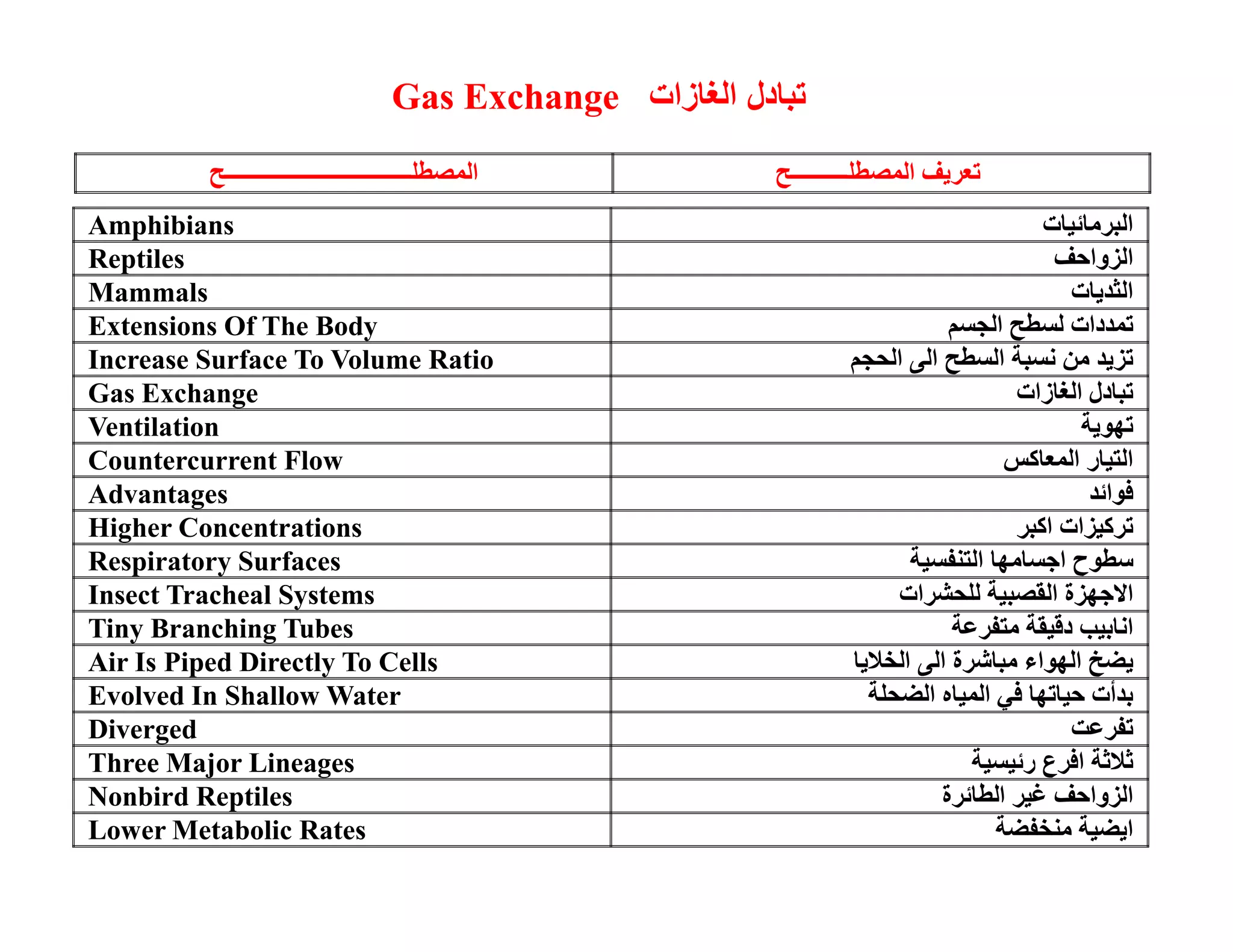
 Three phases ooff ggaass eexxcchhaannggee 
1-Breathing: exchange of CO2 produced during cellular 
respiration with atmospheric O2 
2-Transport of oxygen and carbon dioxide in blood by 
circulatory system. 
3- Body cells take up oxygen from the blood and release 
carbon dioxide to the blood. 
 CCeelllluullaarr rreessppiirraattiioonn rreeqquuiirreess aa ccoonnttiinnuuoouuss 
ssuuppppllyy ooff ooxxyyggeenn aanndd tthhee ddiissppoossaall ooff ccaarrbboonn 
ddiiooxxiiddee 
Copyright © 2009 Pearson Education, Inc.
22.2 Animals exchange O2 and CO2 across moist body surfaces 
 Respiratory surfaces must be thin and moist for diffusion of O2 and CO2 
 Earthworms and other animals use their skin for gas exchange 
 Most animals have specialized body parts that promote gas exchange 
– Gills in fish and amphibians 
– Tracheal systems in arthropods 
– Lungs in tetrapods that live on land 
– Amphibians 
– Reptiles 
– Birds 
– Mammals 
Copyright © 2009 Pearson Education, Inc.
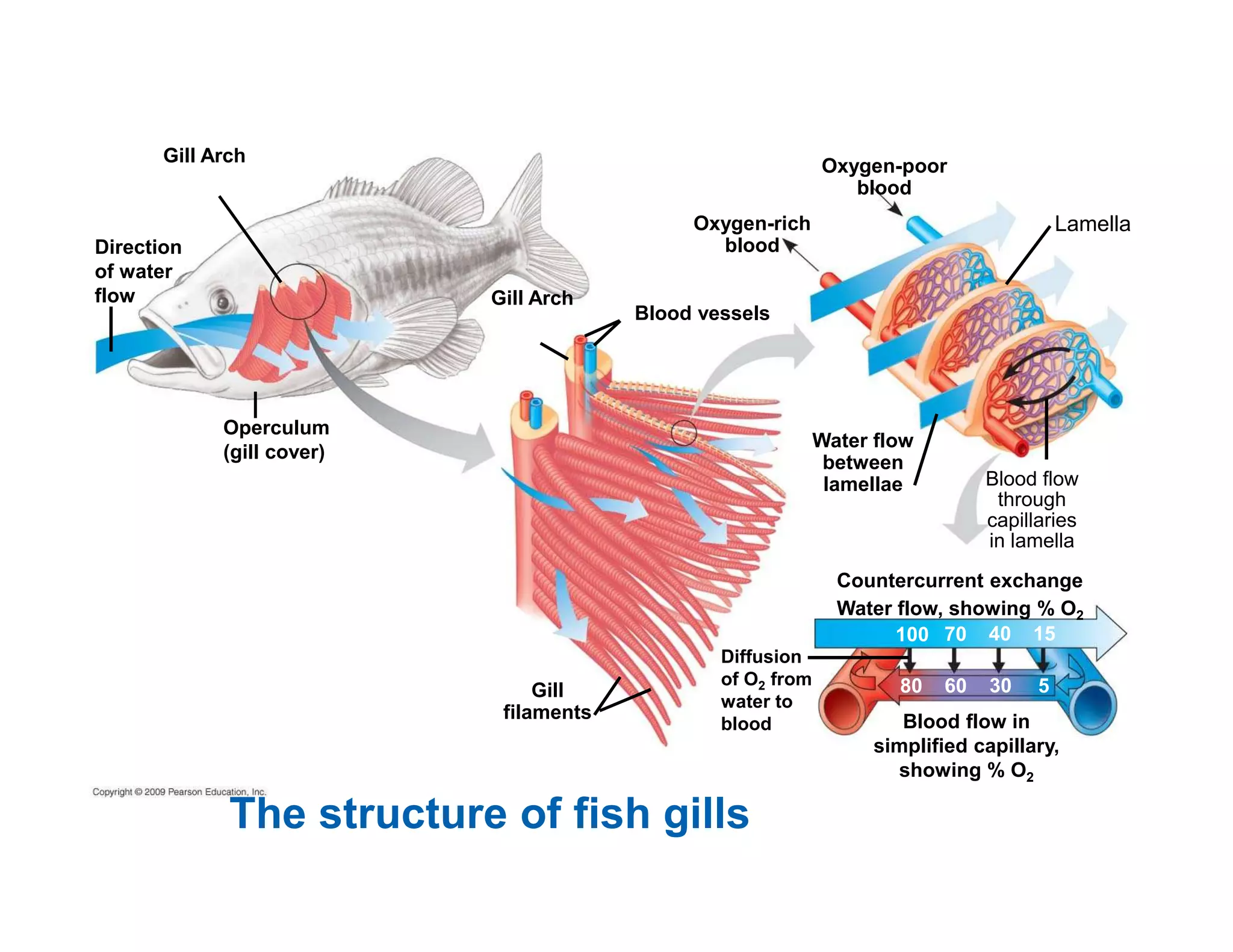
22.3 Gills are adapted for gas exchange in aquatic environments 
 GGiillllss 
– Are extensions of the body 
– Increase surface to volume ratio 
– Increase surface area for gas exchange 
– Oxygen absorbed 
– Carbon dioxide released 
 IInn aa ffiisshh,, ggaass eexxcchhaannggee iiss eennhhaanncceedd bbyy 
– Ventilation of the gills (moving water past the gills) 
– Countercurrent flow of water and blood 
Copyright © 2009 Pearson Education, Inc.
Gill Arch 
Direction 
of water 
flow 
Operculum 
(gill cover) 
Oxygen-rich 
blood 
Blood vessels 
Oxygen-poor 
blood 
Lamella 
Water flow 
between 
lamellae 
Gill Arch 
Blood flow 
Gill 
filaments 
Countercurrent exchange 
Blood flow in 
simplified capillary, 
showing % O2 
Diffusion 
of O2 from 
water to 
blood 
Water flow, showing % O2 
100 70 40 15 
80 60 30 5 
The structure of fish gills 
through 
capillaries 
in lamella
22.4 The tracheal system of insects provides direct exchange 
between the air and body cells 
 Compared to water, using air to breathe has two big 
advantages 
– Air contains higher concentrations of O2 
– Air is lighter and easier to move 
 Air-breathing animals lose water through their 
respiratory surfaces 
Copyright © 2009 Pearson Education, Inc.
22.5 EVOLUTION CONNECTION: The evolution of lungs 
facilitated the movement of tetrapods onto land 
 Tetrapods seem to have evolved in shallow water 
 The first tetrapods on land diverged into three 
major lineages 
– Amphibians use small lungs and their body 
surfaces 
– Nonbird reptiles have lower metabolic rates 
and simpler lungs 
– Birds and mammals have higher metabolic 
rates and more complex lungs 
Copyright © 2009 Pearson Education, Inc.
22.6 In the human respiratory system, branching tubes convey air to 
lungs located in the chest cavity 
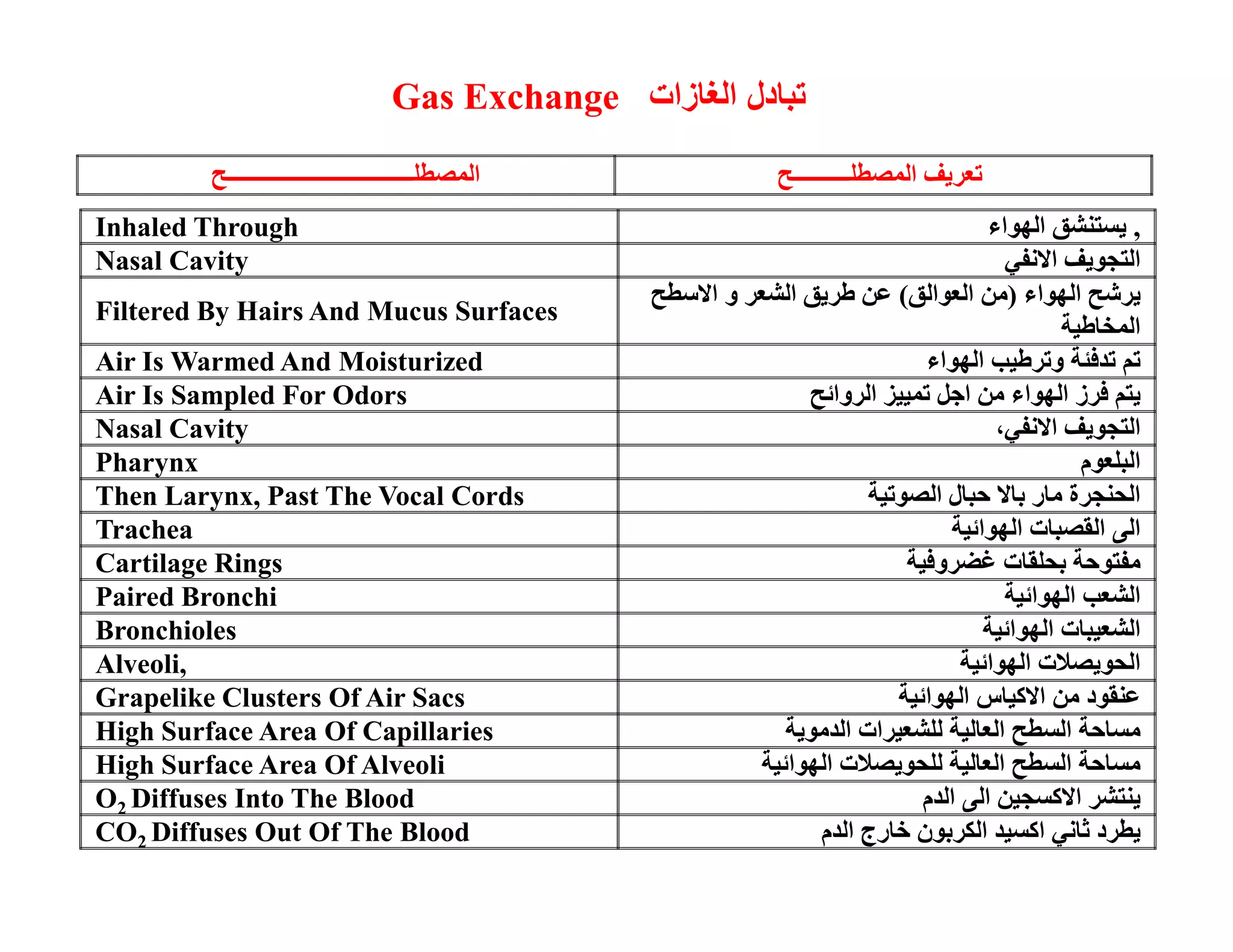
 IInn mmaammmmaallss, air is inhaled through the 
nostrils into the nasal cavity 
– Air is filtered by hairs and mucus surfaces 
– Air is warmed and moisturized 
– Air is sampled for odors 
Copyright © 2009 Pearson Education, Inc.
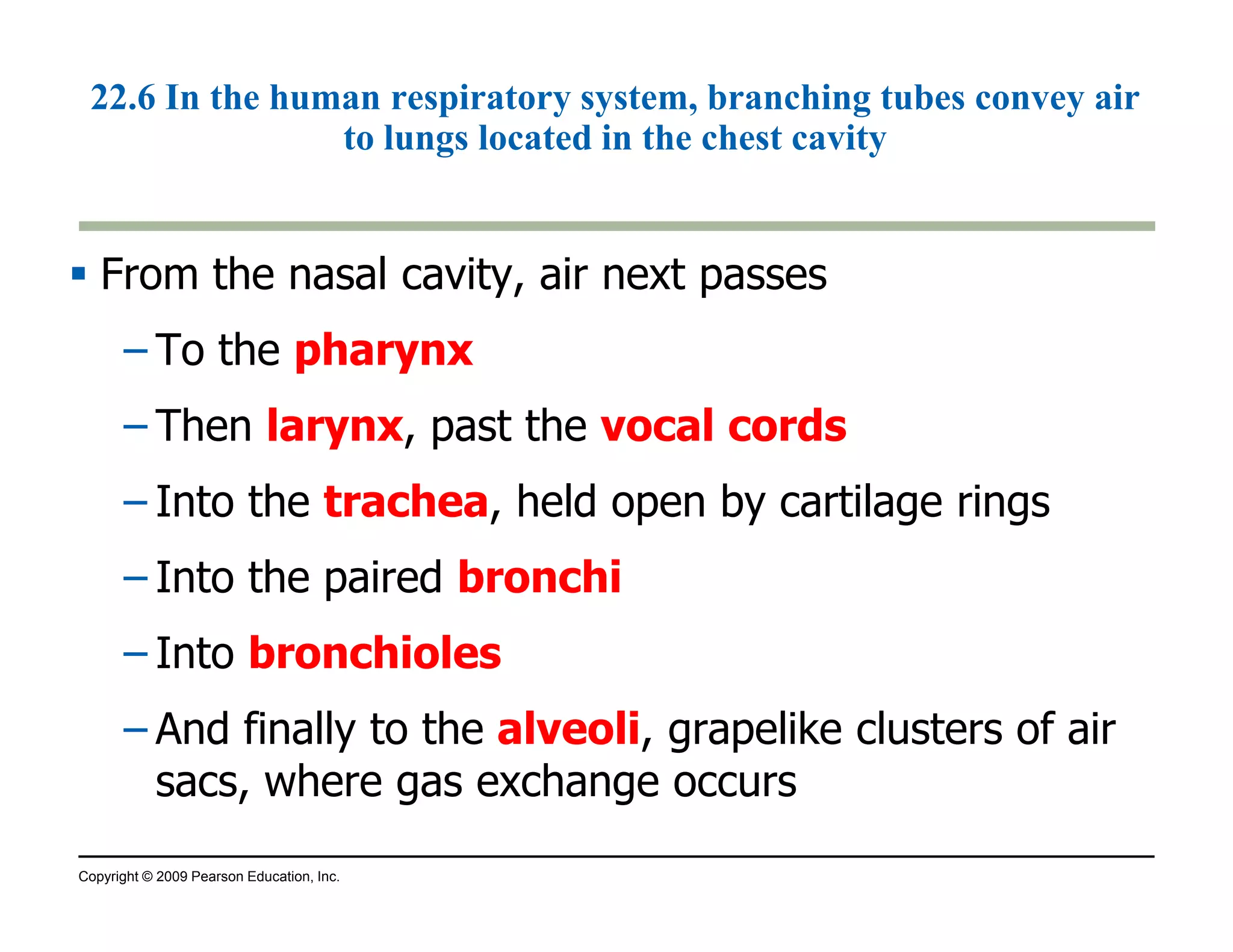
22.6 In the human respiratory system, branching tubes convey air 
to lungs located in the chest cavity 
 From the nasal cavity, air next passes 
– To the pharynx 
– Then larynx, past the vocal cords 
– Into the trachea, held open by cartilage rings 
– Into the paired bronchi 
– Into bronchioles 
– And finally to the alveoli, grapelike clusters of air 
sacs, where gas exchange occurs 
Copyright © 2009 Pearson Education, Inc.
Oxygen-rich 
blood 
Bronchiole 
Oxygen-poor 
blood 
Nasal 
cavity 
Left lung 
Pharynx 
(Esophagus) 
Larynx 
Trachea 
Right lung 
Bronchus 
Alveoli 
Blood 
Capillaries 
Bronchiole 
Diaphragm 
(Heart) 
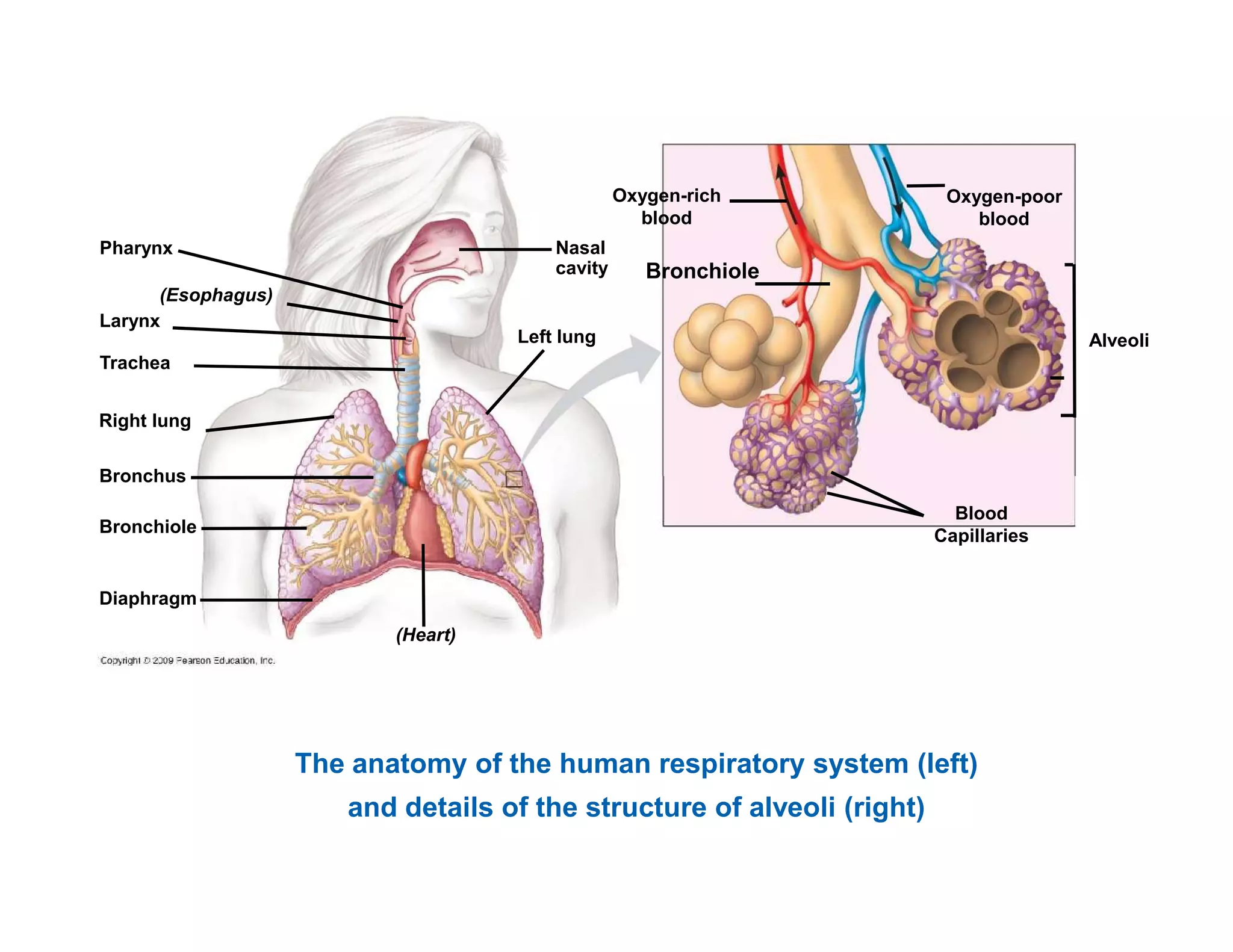
The anatomy of the human respiratory system (left) 
and details of the structure of alveoli (right)
22.6 In the human respiratory system, branching tubes 
convey air to lungs located in the chest cavity 
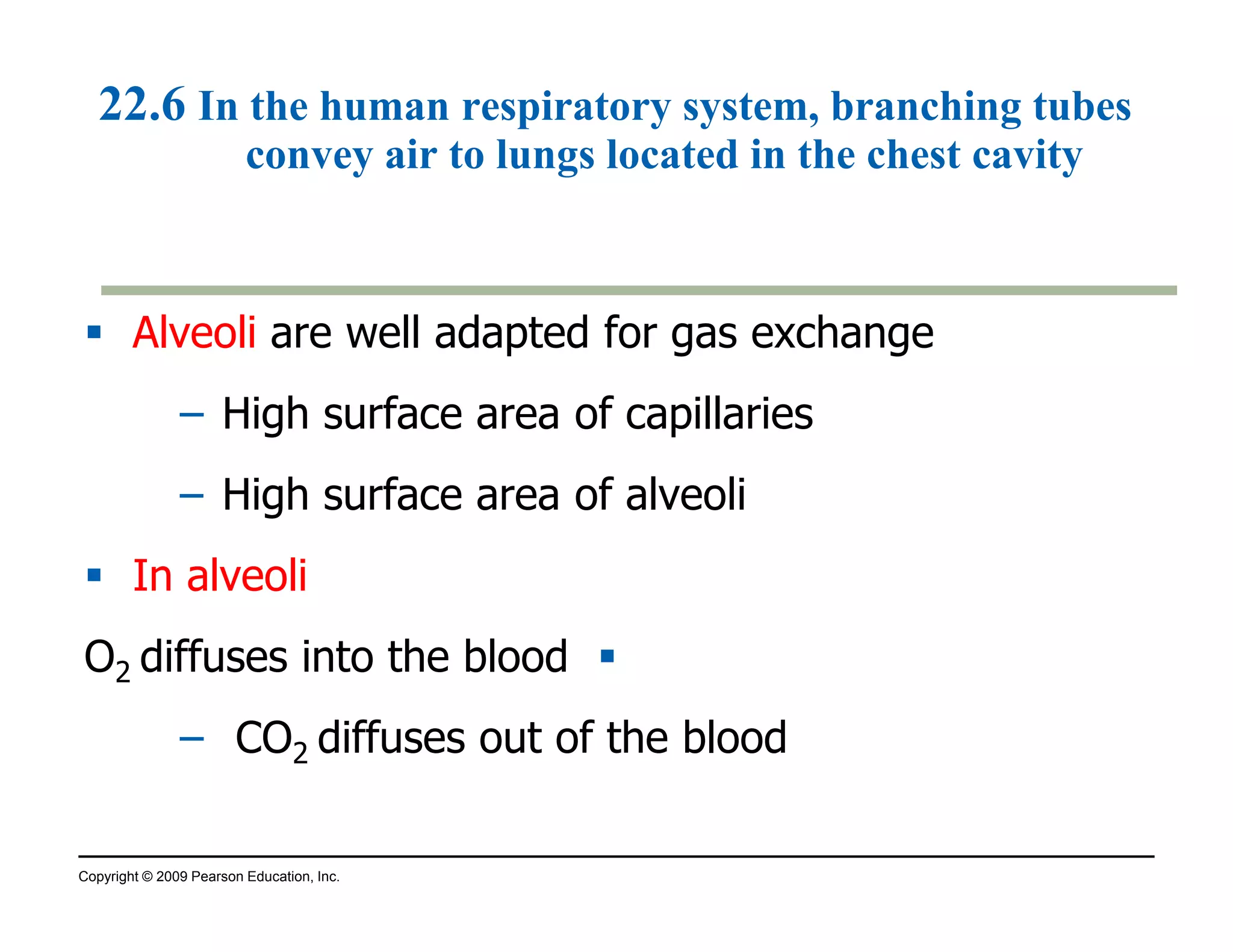
 Alveoli are well adapted for gas exchange 
– High surface area of capillaries 
– High surface area of alveoli 
 In alveoli 
O  2 diffuses into the blood 
– CO2 diffuses out of the blood 
Copyright © 2009 Pearson Education, Inc.
22.7 CONNECTION: Smoking is a serious assault on the 
respiratory system 
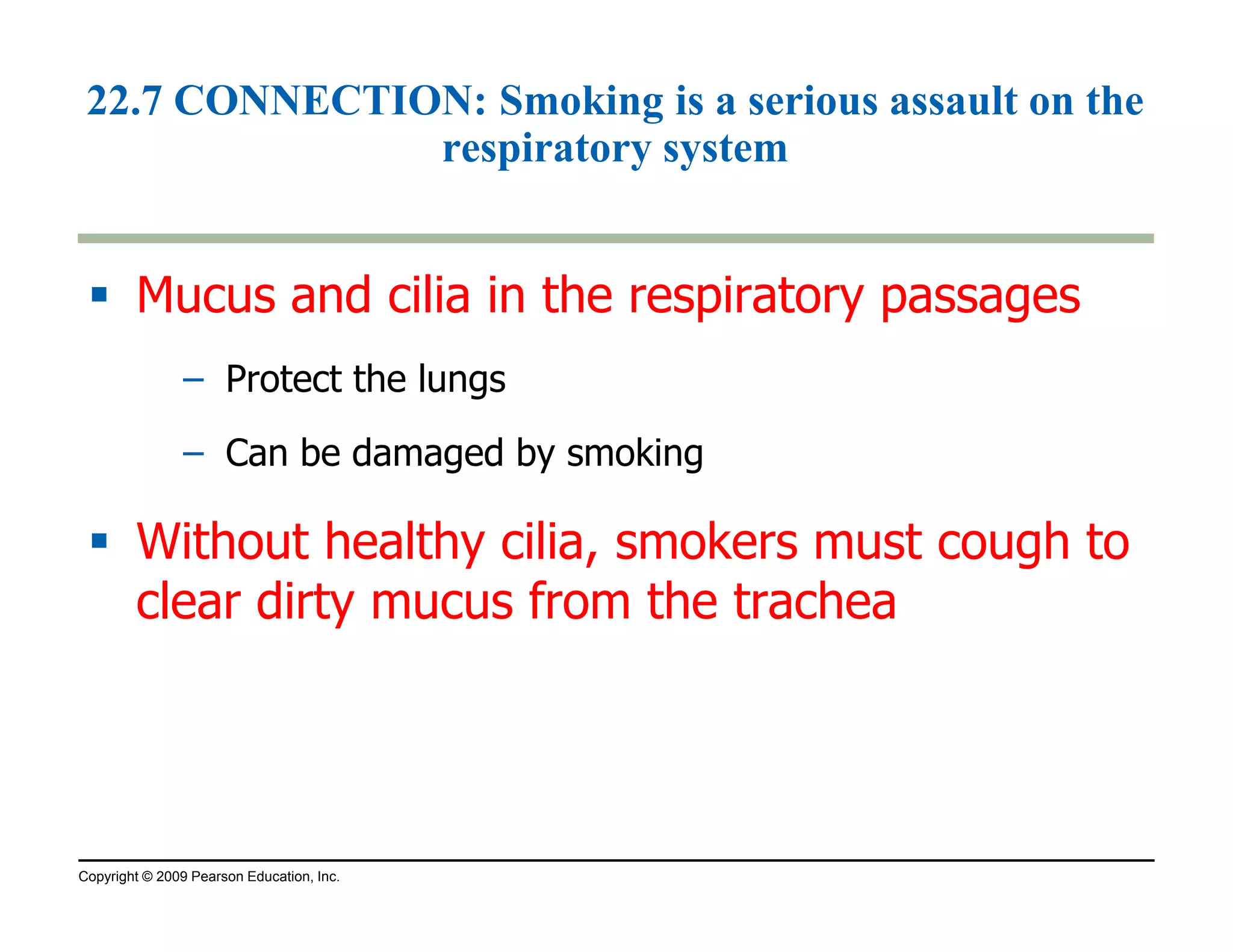
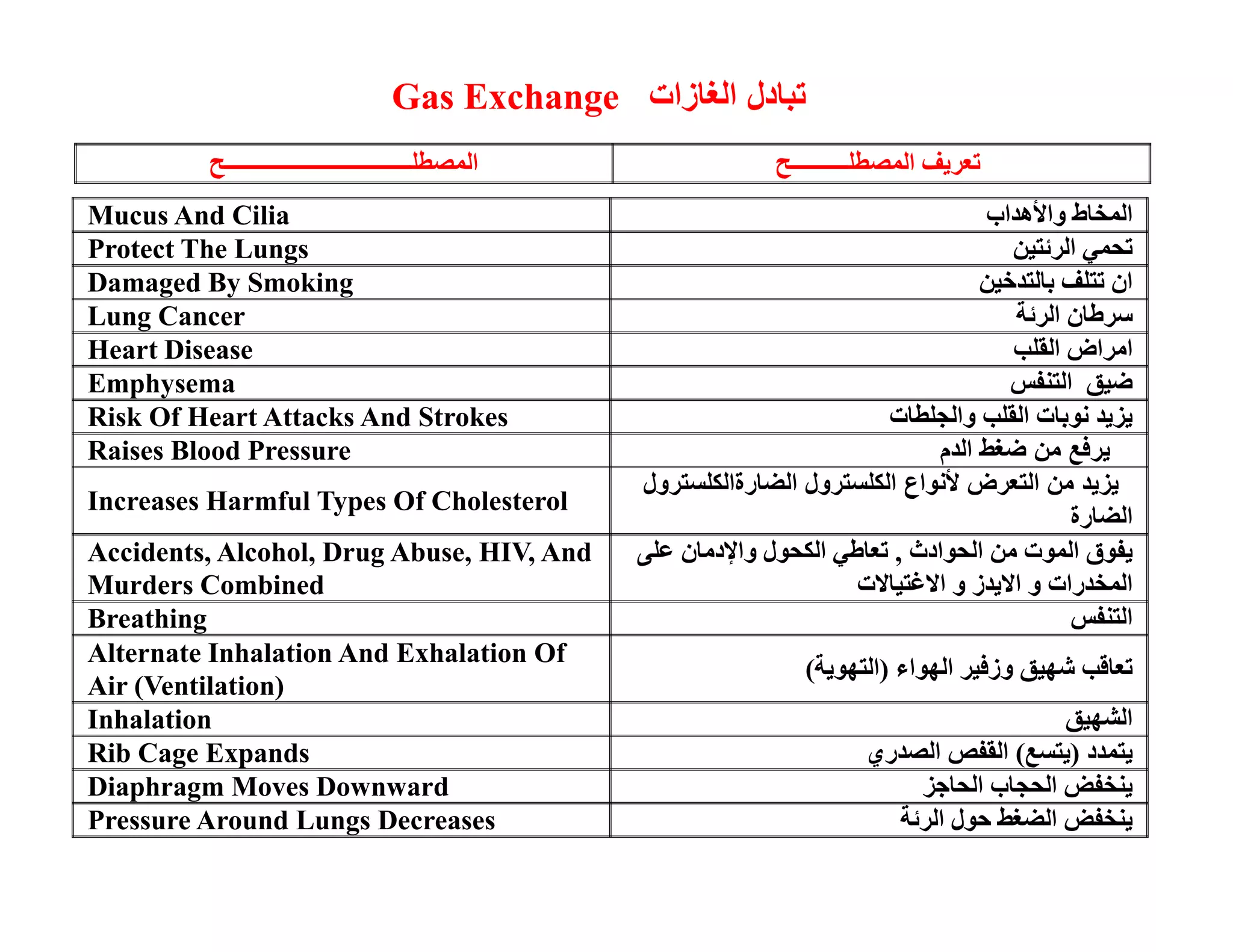
 Mucus and cilia in the respiratory passages 
– Protect the lungs 
– Can be damaged by smoking 
 Without healthy cilia, smokers must cough to 
clear dirty mucus from the trachea 
Copyright © 2009 Pearson Education, Inc.
22.7 CONNECTION: Smoking is a serious assault on the 
respiratory system 
 SSmmookkiinngg ccaann ccaauussee 
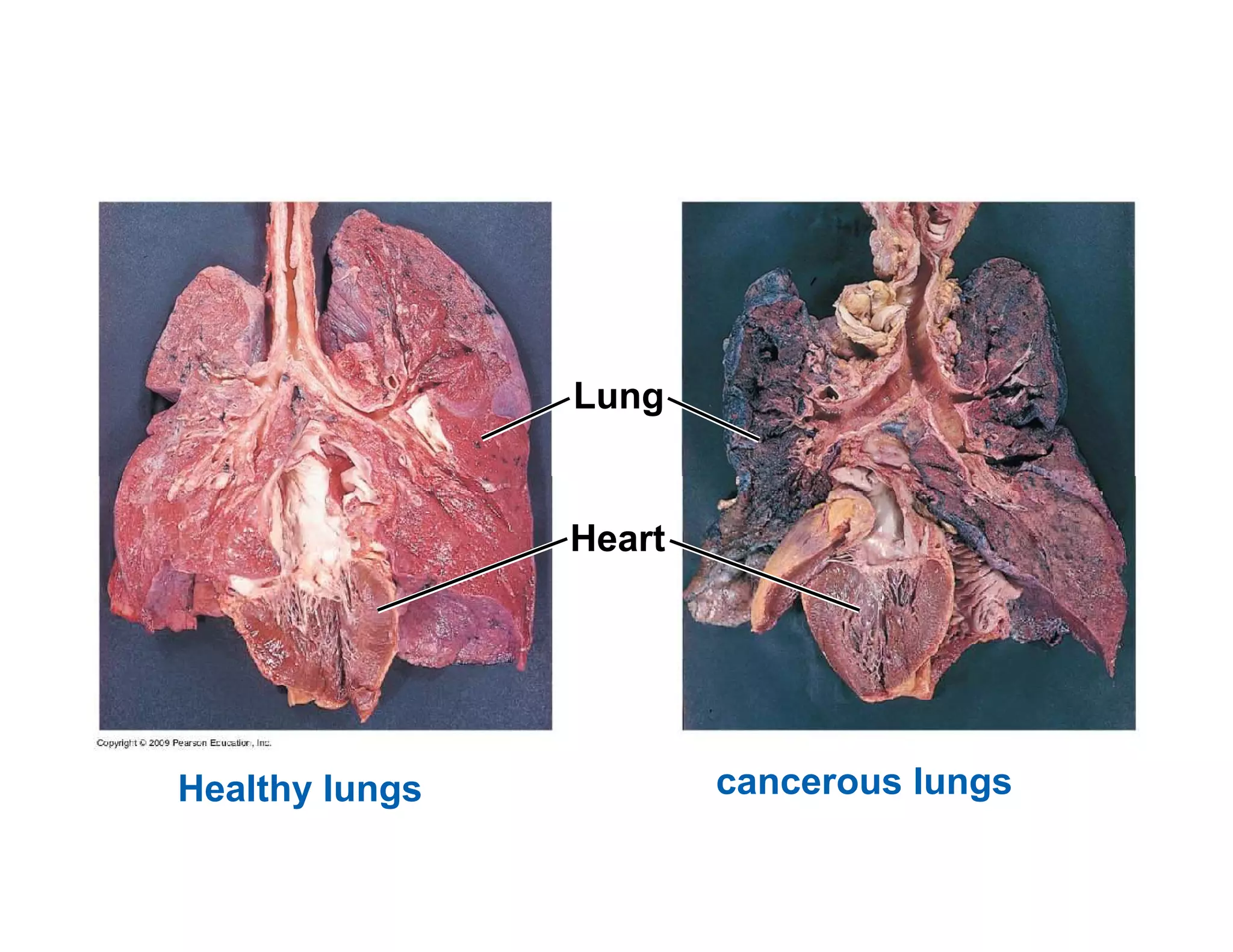
– Lung cancer 
– Heart disease 
– Emphysema 
 SSmmookkiinngg aallssoo 
– Increases the risk of heart attacks and strokes 
– Raises blood pressure 
– Increases harmful types of cholesterol 
 EEvveerryy yyeeaarr iinn UUSSAA,, ssmmookkiinngg kkiillllss aabboouutt 444400,000000 ppeeooppllee,, wwhhiicchh 
iiss mmoorree tthhaann aallll ddeeaatthhss ffrroomm aacccciiddeennttss,, aallccoohhooll,, ddrruugg aabbuussee,, 
HHIIVV,, aanndd mmuurrddeerrss ccoommbbiinneedd 
Copyright © 2009 Pearson Education, Inc.
Lung 
Heart 
Healthy lungs cancerous lungs
22.8 Negative pressure breathing ventilates our lungs 
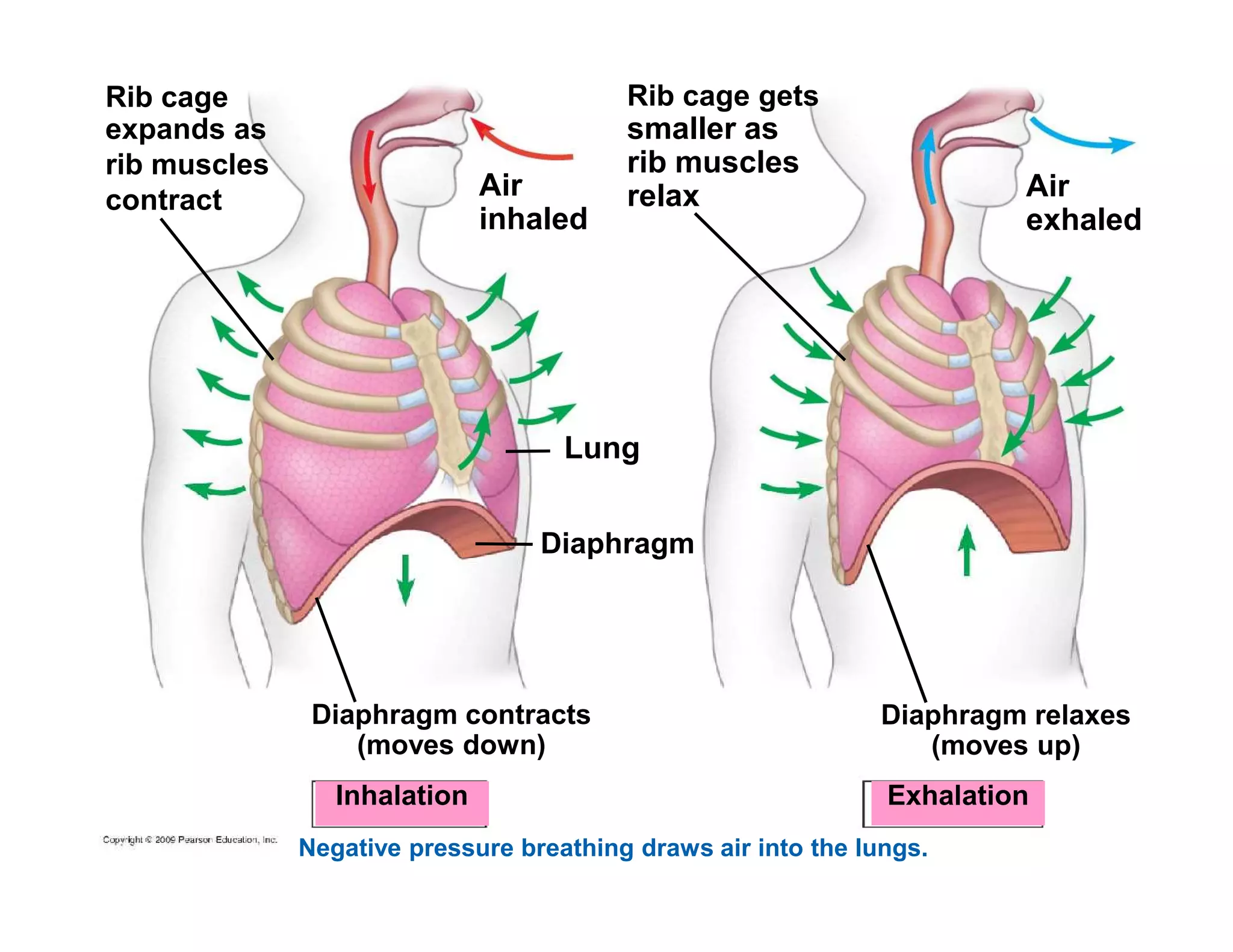
 Breathing is the alternate inhalation and exhalation 
of air (ventilation) 
 Inhalation ooccccuurrss wwhheenn 
– The rib cage expands 
– The diaphragm moves downward 
– The pressure around lungs decreases 
– And air is drawn into the respiratory tract 
Copyright © 2009 Pearson Education, Inc.
22.8 Negative pressure breathing ventilates our lungs 
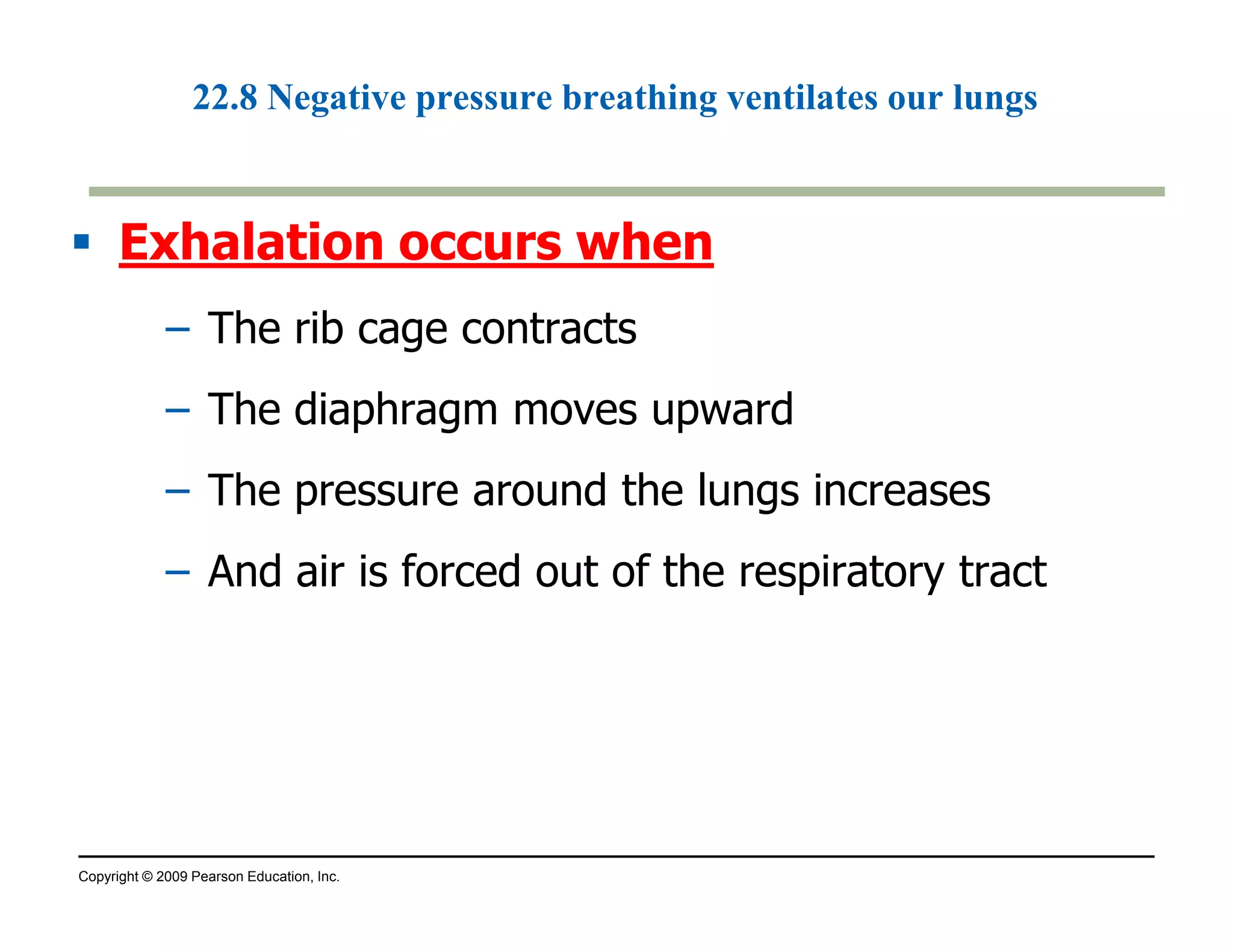
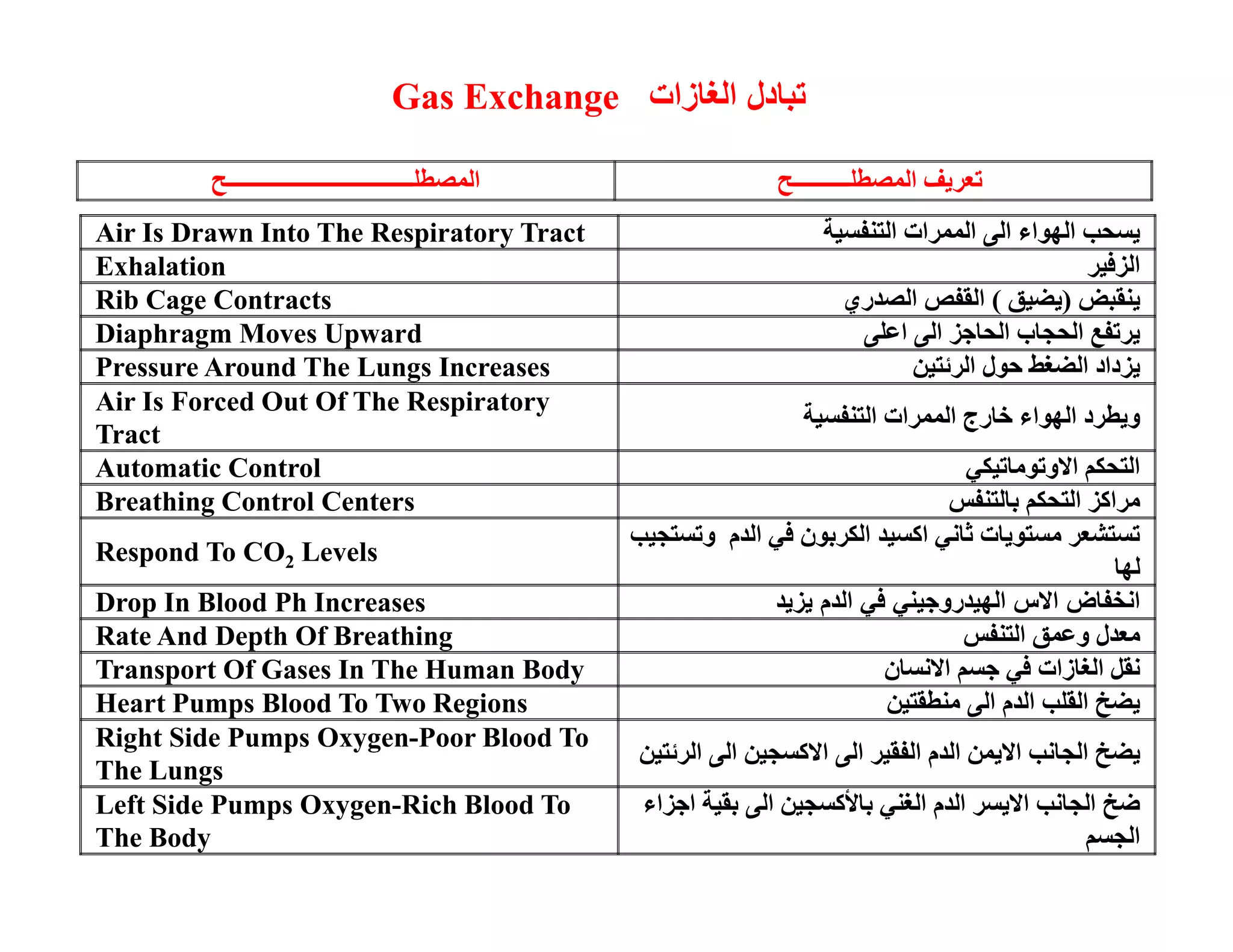
 Exhalation occurs when 
– The rib cage contracts 
– The diaphragm moves upward 
– The pressure around the lungs increases 
– And air is forced out of the respiratory tract 
Copyright © 2009 Pearson Education, Inc.
Air 
inhaled 
Lung 
Air 
exhaled 
Rib cage 
expands as 
rib muscles 
contract 
Rib cage gets 
smaller as 
rib muscles 
relax 
Diaphragm contracts 
(moves down) 
Diaphragm relaxes 
(moves up) 
Diaphragm 
Inhalation Exhalation 
Negative pressure breathing draws air into the lungs.
22.9 Breathing is automatically controlled 
 Breathing is usually under automatic 
control 
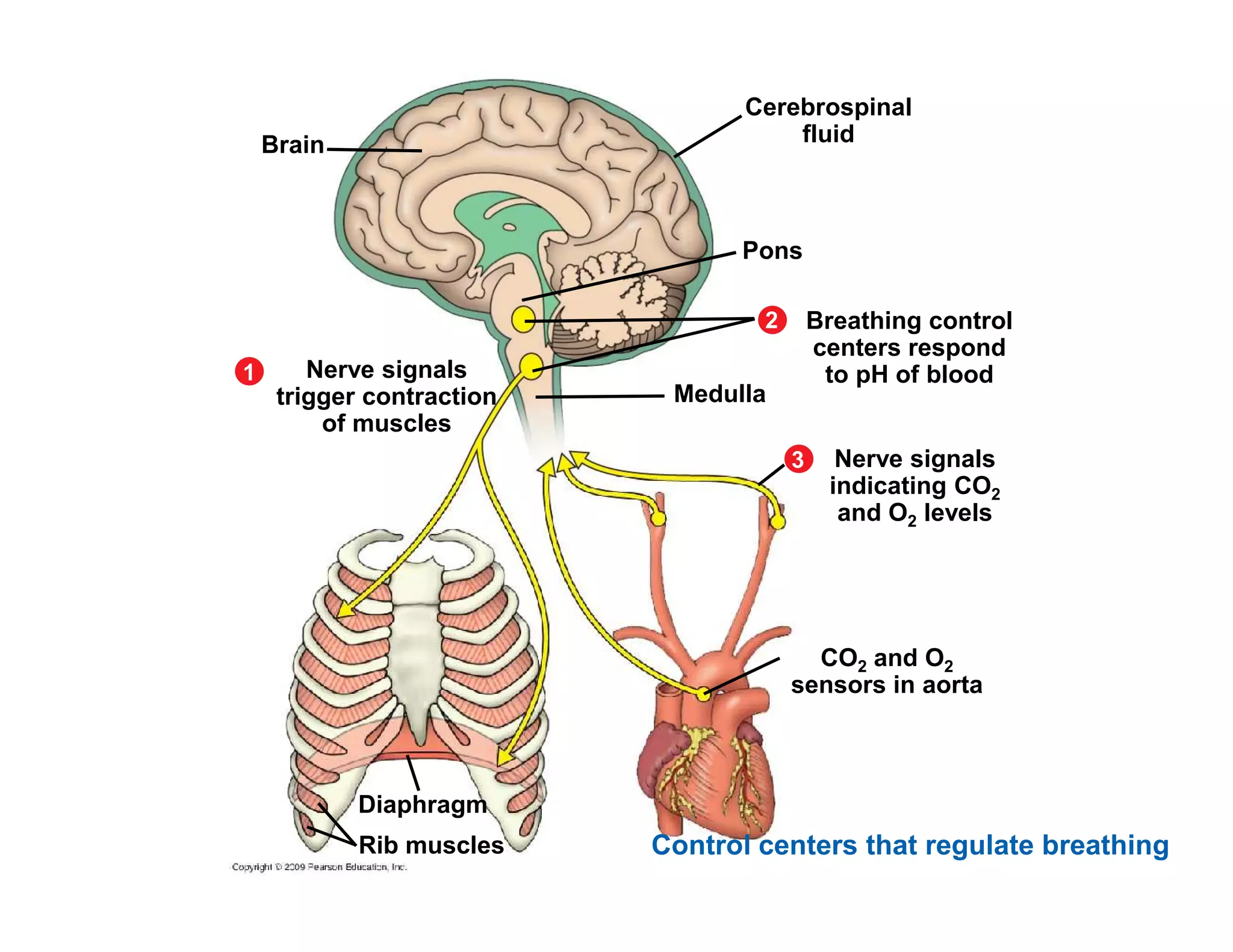
 Breathing control centers in the 
brain sense and respond to CO2 levels in 
the blood 
 A rise in CO2 leading to drop in blood 
pH increases the rate and depth of 
breathing 
Copyright © 2009 Pearson Education, Inc.
Cerebrospinal 
fluid 
Pons 
Medulla 
Brain 
Nerve signals 
trigger contraction 
of muscles 
1 
Breathing control 
centers respond 
to pH of blood 
2 
Nerve signals 
indicating CO 
3 
Diaphragm 
Rib muscles 
CO2 
and O2 levels 
CO2 and O2 
sensors in aorta 
Control centers that regulate breathing
TRANSPORT OF GASES 
IN THE HUMAN BODY 
Copyright © 2009 Pearson Education, Inc.
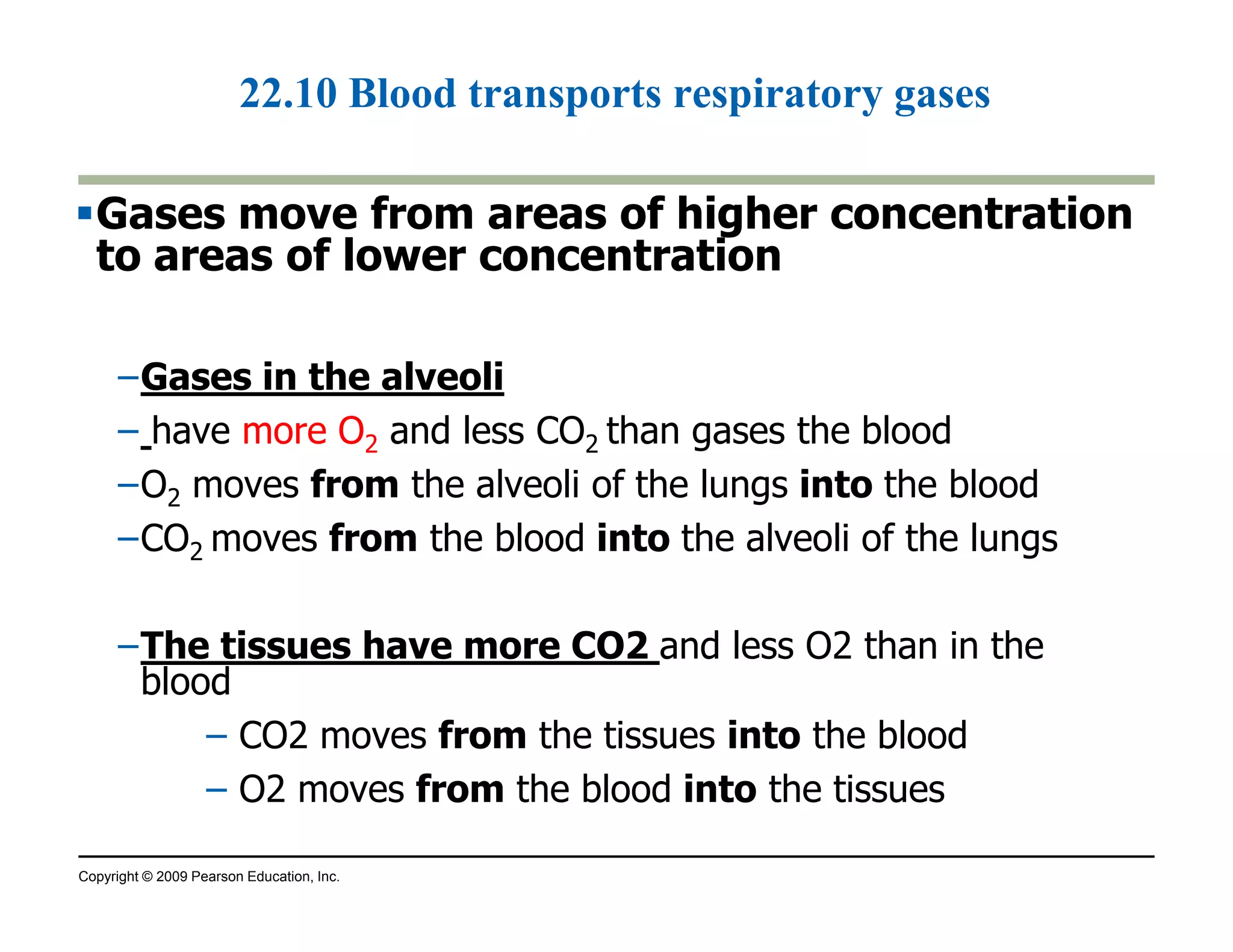
22.10 Blood transports respiratory gases 
 The heart pumps blood to two regions 
– The right side pumps oxygen-poor blood to the lungs 
– The left side pumps oxygen-rich blood to the body 
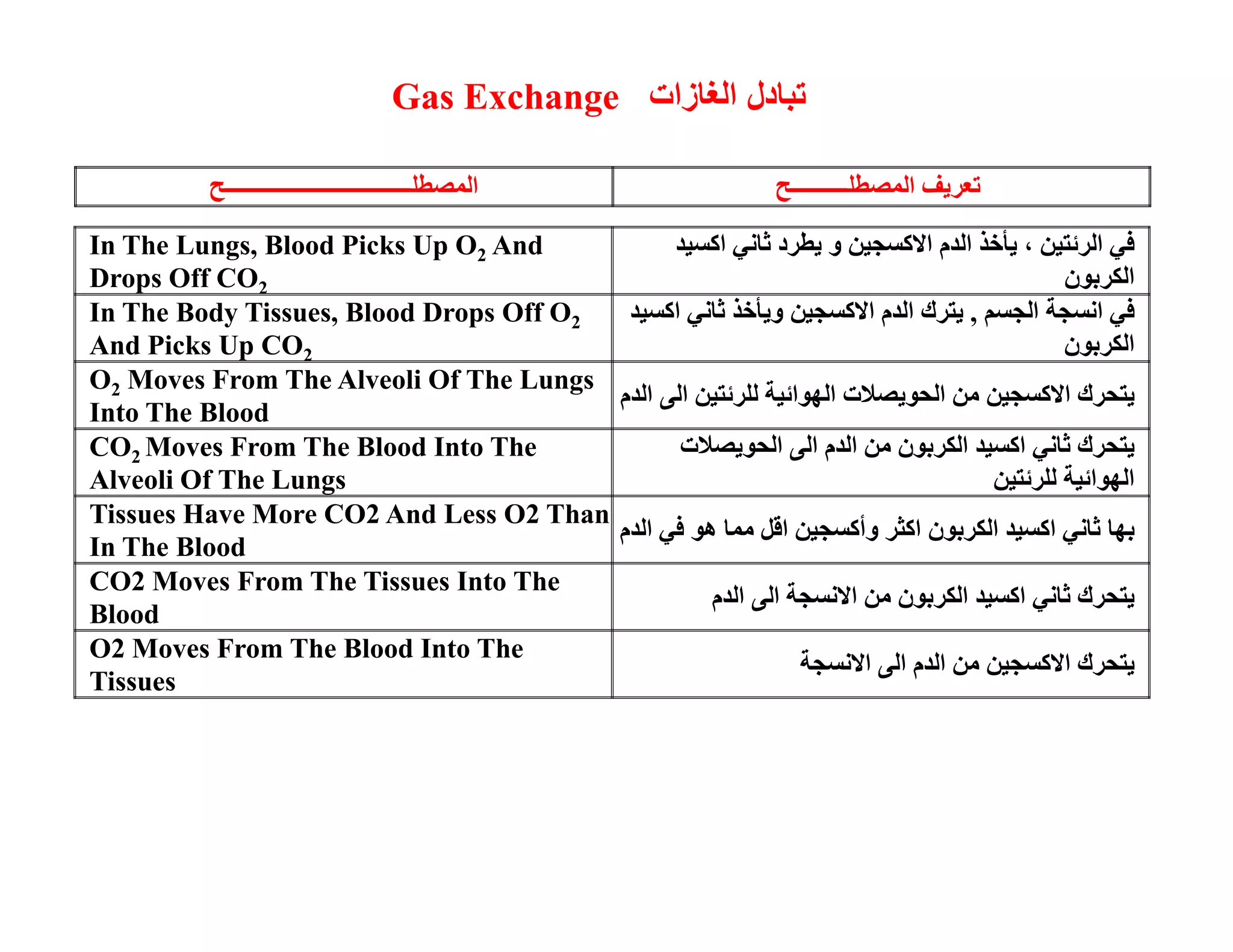
 In the lungs, blood picks up O2 and drops off 
CO2 
 In the body tissues, blood drops off O2 and 
picks up CO2 
Copyright © 2009 Pearson Education, Inc.
22.10 Blood transports respiratory gases 
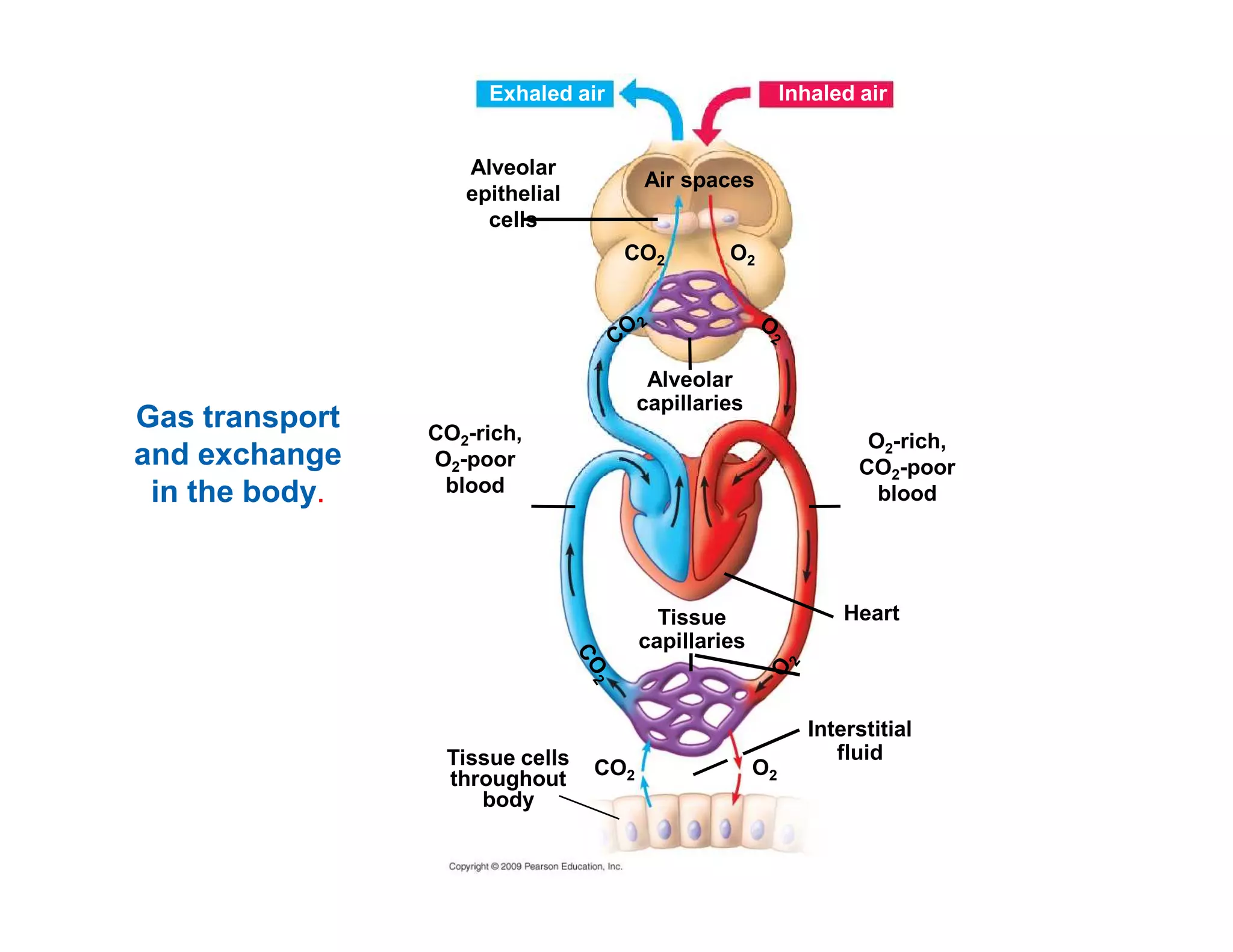
Gases move from areas of higher concentration 
to areas of lower concentration 
–Gases in the alveoli 
– have more O2 and less CO2 than gases the blood 
–O moves from the alveoli of the lungs into the blood 
2 –CO2 moves from the blood into the alveoli of the lungs 
–The tissues have more CO2 and less O2 than in the 
blood 
– CO2 moves from the tissues into the blood 
– O2 moves from the blood into the tissues 
Copyright © 2009 Pearson Education, Inc.
Exhaled air Inhaled air 
Alveolar 
epithelial 
cells 
CO2 O2 
CO2-rich, 
O2-poor 
blood 
O2-rich, 
CO2-poor 
Air spaces 
Alveolar 
capillaries Gas transport 
and exchange 
in the body. 
blood 
Tissue 
capillaries 
Tissue cells 
throughout 
body 
Heart 
Interstitial 
fluid 
CO2 O2
22.11 Hemoglobin carries O2, helps transport CO2, and buffers the 
blood 
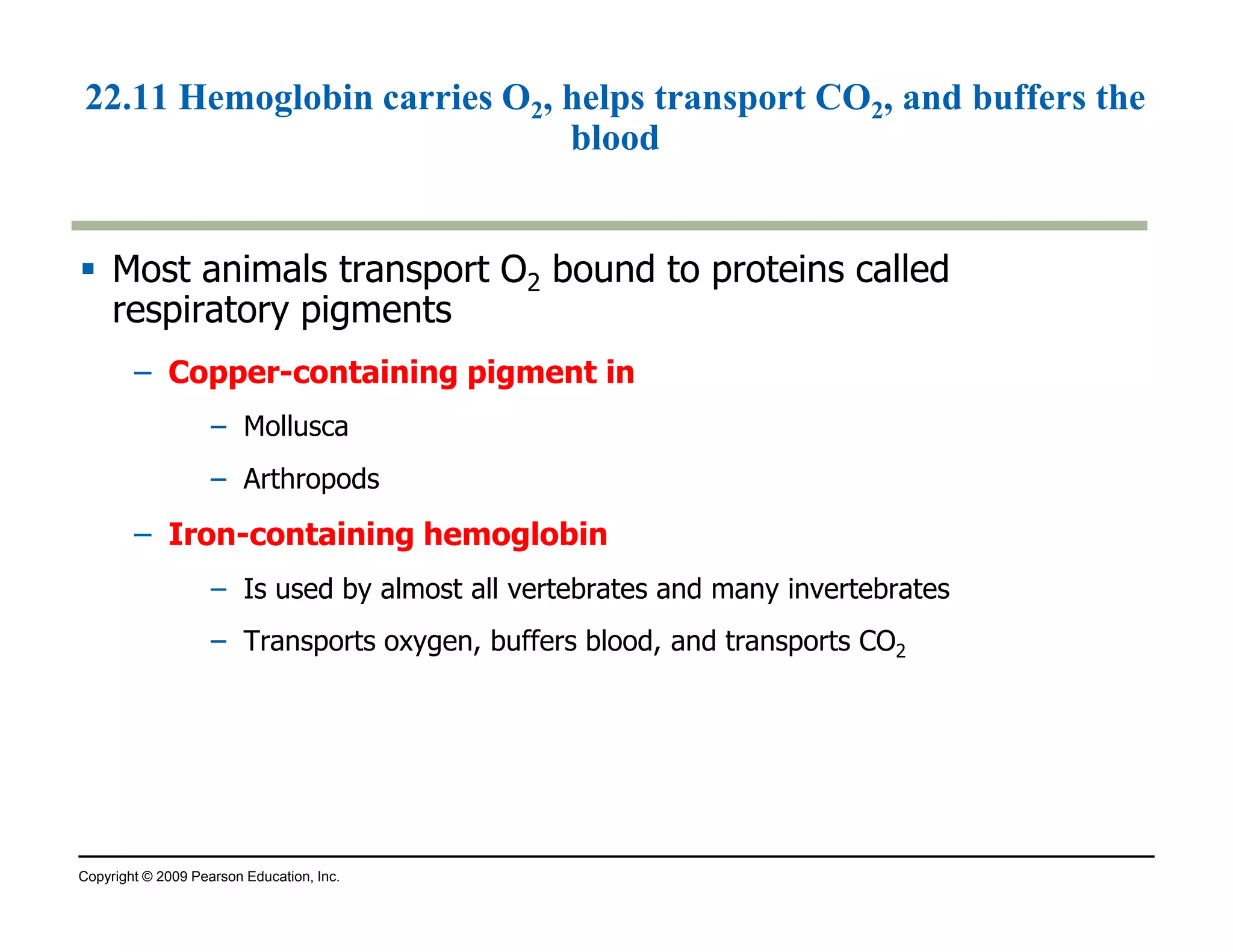
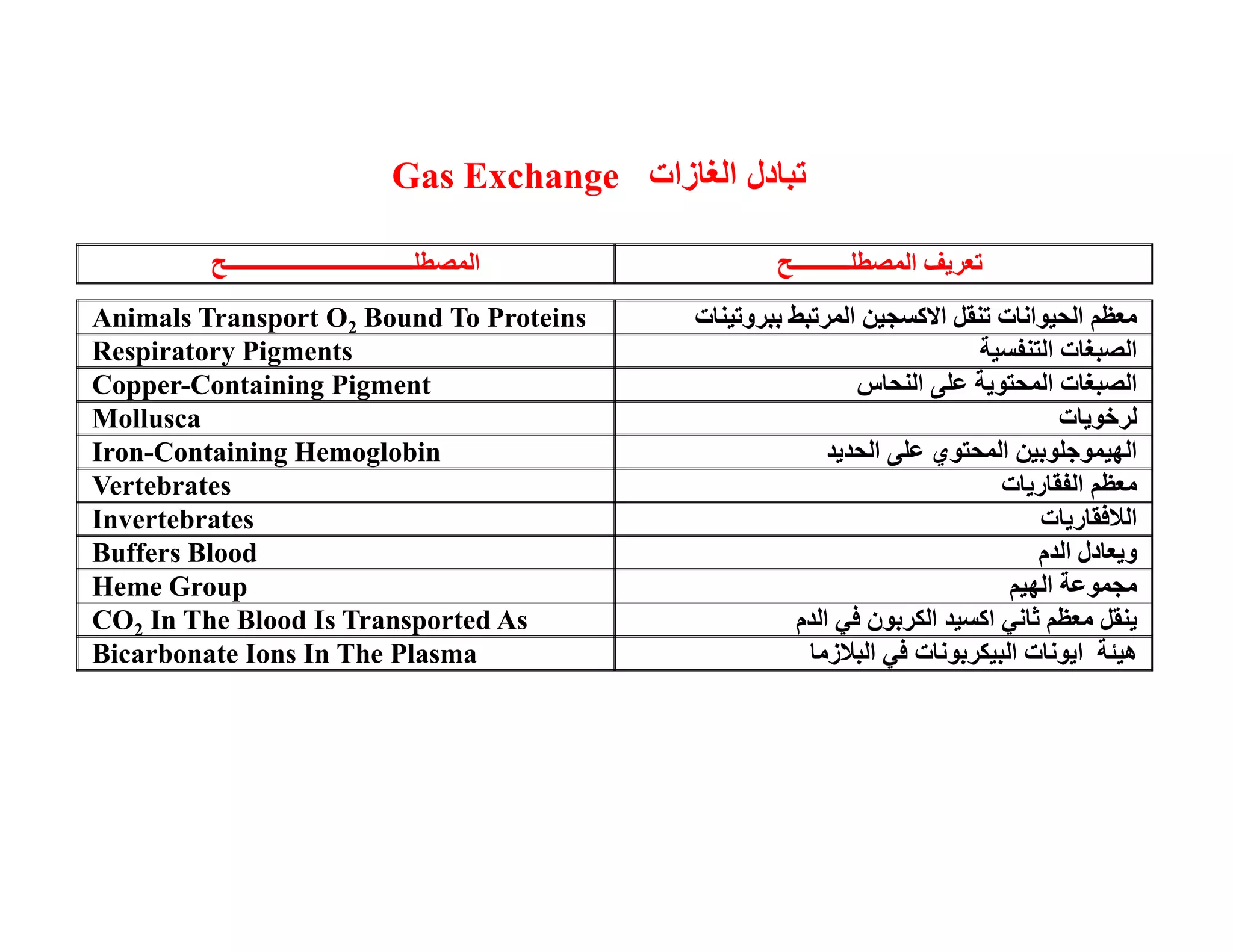
 Most animals transport O2 bound to proteins called 
respiratory pigments 
– Copper-containing pigment in 
– Mollusca 
– Arthropods 
– Iron-containing hemoglobin 
– Is used by almost all vertebrates and many invertebrates 
– Transports oxygen, buffers blood, and transports CO2 
Copyright © 2009 Pearson Education, Inc.
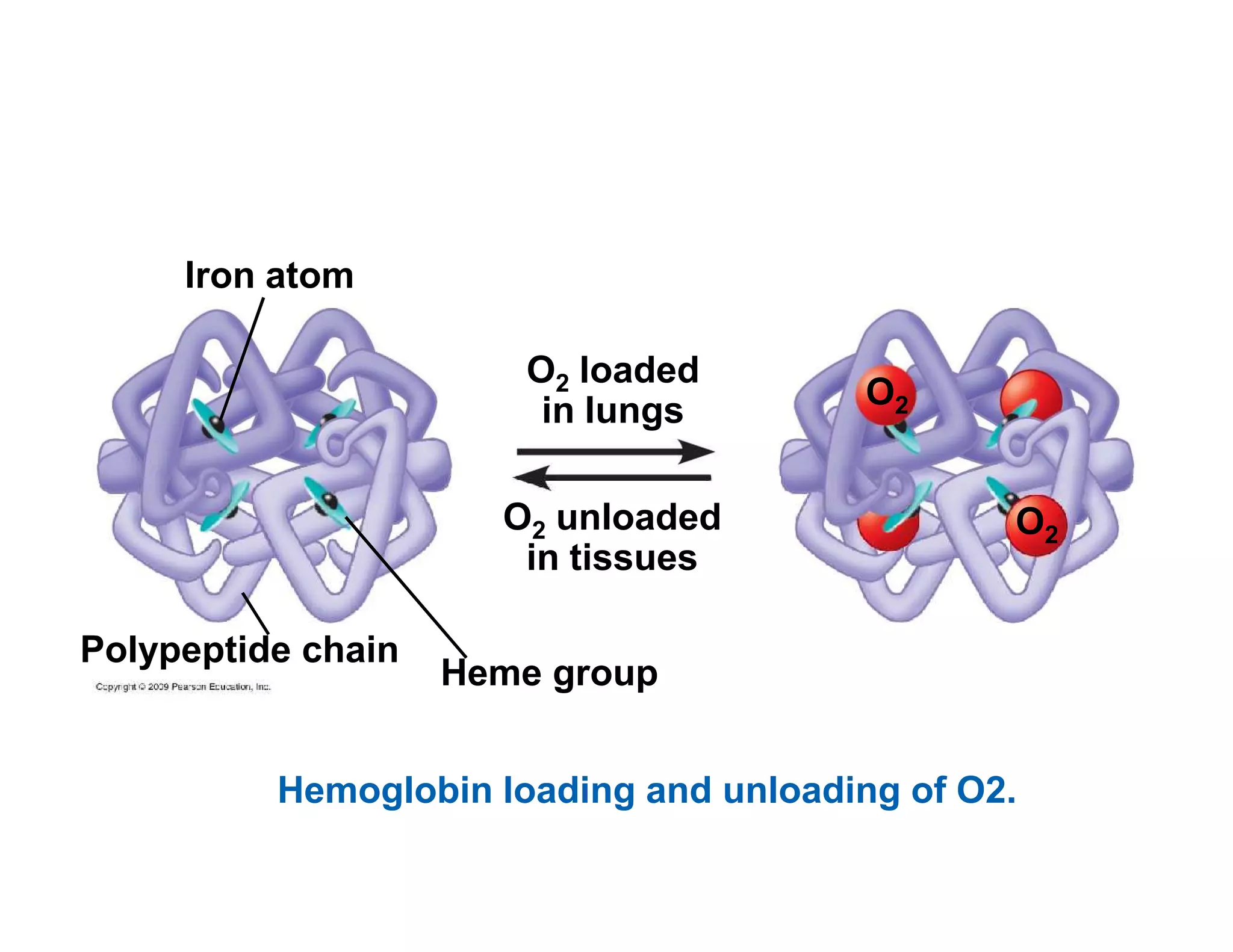
O2 loaded 
in lungs 
Iron atom 
O2 
O2 unloaded 
in tissues 
Polypeptide chain 
O2 
Heme group 
Hemoglobin loading and unloading of O2.
22.11 Hemoglobin carries O2, helps transport CO2, and 
buffers the blood 
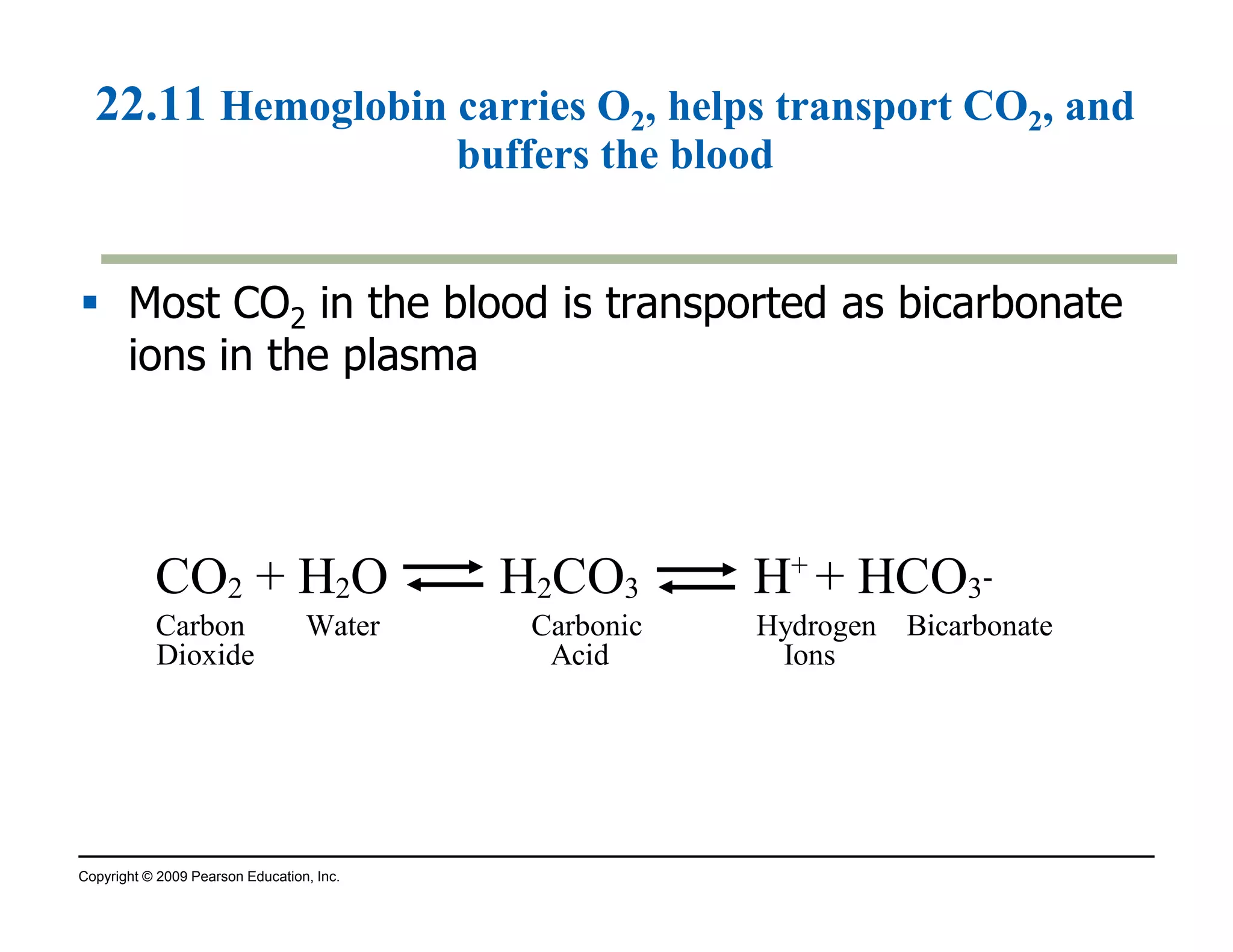
 Most CO2 in the blood is transported as bicarbonate 
ions in the plasma 
CO + H O ı H CO ı H + HCO 
+ 2 2 2 3 3- 
Carbon Water Carbonic Hydrogen Bicarbonate 
Dioxide Acid Ions 
Copyright © 2009 Pearson Education, Inc.
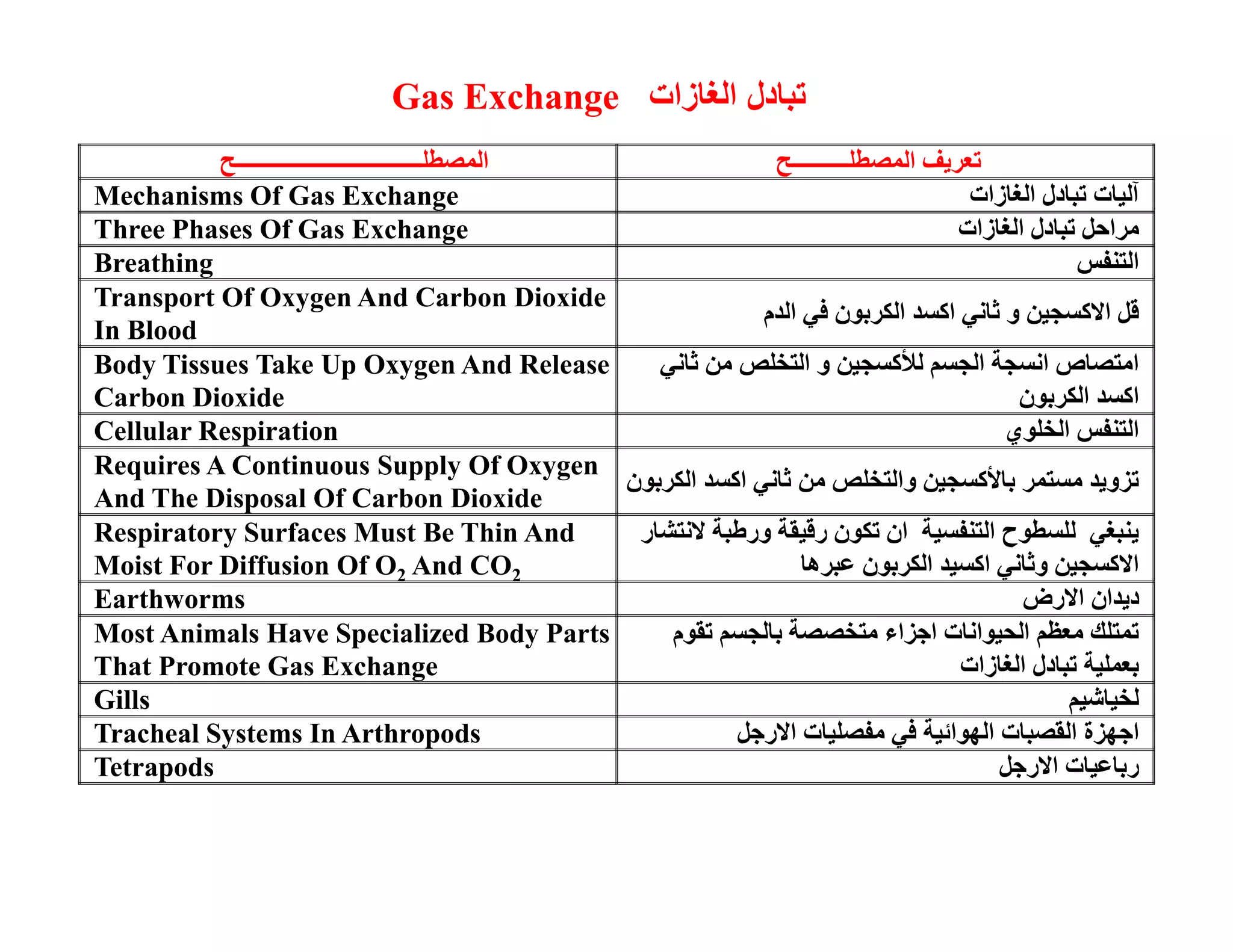
Gas Exchange زات  دل ا 
 
 ـــــــــــــــــــــــــــــــــ  ا  ــــــــــ  ا
آ 
Mechanisms Of Gas Exchange   ت دل ا زات  Three اPhases Of Gas Exchange  دل ا زات
ا 
Breathing  Transport Of Oxygen And Carbon Dioxide 
  ا و ا ا ن ا ! $%
'( !)* ,-'(. / 
م In Blood Body Tissues ا 
ص ا ا و ا Take Up Oxygen And Release 
!)* , 01 ,-'(2 3'- 4-')  ا 
Carbon Dioxide 
ا $%
ن  '( Cellular Respiration ي$1 ا  ا 
Requires A Continuous Supply Of Oxygen 
ن$%
ا  '( ا !)* , 01 وا ,-'(7%
'   و8 
And The Disposal Of Carbon Dioxide Respiratory Surfaces Must Be Thin And 
Moist For Diffusion Of O2 And CO2 
ر :). 4 ورط 4/ ن ر $ ان 4' ح ا $' ! 
 ھ

Chapter 22 gas exchange [compatibility mode]

  • 1.
    Chapter 22 GasExchange PowerPoint Lectures for Biology: Concepts & Connections, Sixth Edition Campbell, Reece, Taylor, Simon, and Dickey Copyright © 2009 Pearson Education, Inc. Lecture by Richard L. Myers Translated by Nabih A. Baeshen
  • 2.
    MECHANISMS OF GASEXCHANGE Copyright © 2009 Pearson Education, Inc.
  • 3.
    22.1 Overview: Gasexchange in an animal with lungs involves breathing, transport of gases, and exchange of gases with tissue cells Three phases ooff ggaass eexxcchhaannggee 1-Breathing: exchange of CO2 produced during cellular respiration with atmospheric O2 2-Transport of oxygen and carbon dioxide in blood by circulatory system. 3- Body cells take up oxygen from the blood and release carbon dioxide to the blood. CCeelllluullaarr rreessppiirraattiioonn rreeqquuiirreess aa ccoonnttiinnuuoouuss ssuuppppllyy ooff ooxxyyggeenn aanndd tthhee ddiissppoossaall ooff ccaarrbboonn ddiiooxxiiddee Copyright © 2009 Pearson Education, Inc.
  • 4.
    22.2 Animals exchangeO2 and CO2 across moist body surfaces Respiratory surfaces must be thin and moist for diffusion of O2 and CO2 Earthworms and other animals use their skin for gas exchange Most animals have specialized body parts that promote gas exchange – Gills in fish and amphibians – Tracheal systems in arthropods – Lungs in tetrapods that live on land – Amphibians – Reptiles – Birds – Mammals Copyright © 2009 Pearson Education, Inc.
  • 5.
    22.3 Gills areadapted for gas exchange in aquatic environments GGiillllss – Are extensions of the body – Increase surface to volume ratio – Increase surface area for gas exchange – Oxygen absorbed – Carbon dioxide released IInn aa ffiisshh,, ggaass eexxcchhaannggee iiss eennhhaanncceedd bbyy – Ventilation of the gills (moving water past the gills) – Countercurrent flow of water and blood Copyright © 2009 Pearson Education, Inc.
  • 6.
    Gill Arch Direction of water flow Operculum (gill cover) Oxygen-rich blood Blood vessels Oxygen-poor blood Lamella Water flow between lamellae Gill Arch Blood flow Gill filaments Countercurrent exchange Blood flow in simplified capillary, showing % O2 Diffusion of O2 from water to blood Water flow, showing % O2 100 70 40 15 80 60 30 5 The structure of fish gills through capillaries in lamella
  • 7.
    22.4 The trachealsystem of insects provides direct exchange between the air and body cells Compared to water, using air to breathe has two big advantages – Air contains higher concentrations of O2 – Air is lighter and easier to move Air-breathing animals lose water through their respiratory surfaces Copyright © 2009 Pearson Education, Inc.
  • 8.
    22.5 EVOLUTION CONNECTION:The evolution of lungs facilitated the movement of tetrapods onto land Tetrapods seem to have evolved in shallow water The first tetrapods on land diverged into three major lineages – Amphibians use small lungs and their body surfaces – Nonbird reptiles have lower metabolic rates and simpler lungs – Birds and mammals have higher metabolic rates and more complex lungs Copyright © 2009 Pearson Education, Inc.
  • 9.
    22.6 In thehuman respiratory system, branching tubes convey air to lungs located in the chest cavity IInn mmaammmmaallss, air is inhaled through the nostrils into the nasal cavity – Air is filtered by hairs and mucus surfaces – Air is warmed and moisturized – Air is sampled for odors Copyright © 2009 Pearson Education, Inc.
  • 10.
    22.6 In thehuman respiratory system, branching tubes convey air to lungs located in the chest cavity From the nasal cavity, air next passes – To the pharynx – Then larynx, past the vocal cords – Into the trachea, held open by cartilage rings – Into the paired bronchi – Into bronchioles – And finally to the alveoli, grapelike clusters of air sacs, where gas exchange occurs Copyright © 2009 Pearson Education, Inc.
  • 11.
    Oxygen-rich blood Bronchiole Oxygen-poor blood Nasal cavity Left lung Pharynx (Esophagus) Larynx Trachea Right lung Bronchus Alveoli Blood Capillaries Bronchiole Diaphragm (Heart) The anatomy of the human respiratory system (left) and details of the structure of alveoli (right)
  • 12.
    22.6 In thehuman respiratory system, branching tubes convey air to lungs located in the chest cavity Alveoli are well adapted for gas exchange – High surface area of capillaries – High surface area of alveoli In alveoli O 2 diffuses into the blood – CO2 diffuses out of the blood Copyright © 2009 Pearson Education, Inc.
  • 13.
    22.7 CONNECTION: Smokingis a serious assault on the respiratory system Mucus and cilia in the respiratory passages – Protect the lungs – Can be damaged by smoking Without healthy cilia, smokers must cough to clear dirty mucus from the trachea Copyright © 2009 Pearson Education, Inc.
  • 14.
    22.7 CONNECTION: Smokingis a serious assault on the respiratory system SSmmookkiinngg ccaann ccaauussee – Lung cancer – Heart disease – Emphysema SSmmookkiinngg aallssoo – Increases the risk of heart attacks and strokes – Raises blood pressure – Increases harmful types of cholesterol EEvveerryy yyeeaarr iinn UUSSAA,, ssmmookkiinngg kkiillllss aabboouutt 444400,000000 ppeeooppllee,, wwhhiicchh iiss mmoorree tthhaann aallll ddeeaatthhss ffrroomm aacccciiddeennttss,, aallccoohhooll,, ddrruugg aabbuussee,, HHIIVV,, aanndd mmuurrddeerrss ccoommbbiinneedd Copyright © 2009 Pearson Education, Inc.
  • 15.
    Lung Heart Healthylungs cancerous lungs
  • 16.
    22.8 Negative pressurebreathing ventilates our lungs Breathing is the alternate inhalation and exhalation of air (ventilation) Inhalation ooccccuurrss wwhheenn – The rib cage expands – The diaphragm moves downward – The pressure around lungs decreases – And air is drawn into the respiratory tract Copyright © 2009 Pearson Education, Inc.
  • 17.
    22.8 Negative pressurebreathing ventilates our lungs Exhalation occurs when – The rib cage contracts – The diaphragm moves upward – The pressure around the lungs increases – And air is forced out of the respiratory tract Copyright © 2009 Pearson Education, Inc.
  • 18.
    Air inhaled Lung Air exhaled Rib cage expands as rib muscles contract Rib cage gets smaller as rib muscles relax Diaphragm contracts (moves down) Diaphragm relaxes (moves up) Diaphragm Inhalation Exhalation Negative pressure breathing draws air into the lungs.
  • 19.
    22.9 Breathing isautomatically controlled Breathing is usually under automatic control Breathing control centers in the brain sense and respond to CO2 levels in the blood A rise in CO2 leading to drop in blood pH increases the rate and depth of breathing Copyright © 2009 Pearson Education, Inc.
  • 20.
    Cerebrospinal fluid Pons Medulla Brain Nerve signals trigger contraction of muscles 1 Breathing control centers respond to pH of blood 2 Nerve signals indicating CO 3 Diaphragm Rib muscles CO2 and O2 levels CO2 and O2 sensors in aorta Control centers that regulate breathing
  • 21.
    TRANSPORT OF GASES IN THE HUMAN BODY Copyright © 2009 Pearson Education, Inc.
  • 22.
    22.10 Blood transportsrespiratory gases The heart pumps blood to two regions – The right side pumps oxygen-poor blood to the lungs – The left side pumps oxygen-rich blood to the body In the lungs, blood picks up O2 and drops off CO2 In the body tissues, blood drops off O2 and picks up CO2 Copyright © 2009 Pearson Education, Inc.
  • 23.
    22.10 Blood transportsrespiratory gases Gases move from areas of higher concentration to areas of lower concentration –Gases in the alveoli – have more O2 and less CO2 than gases the blood –O moves from the alveoli of the lungs into the blood 2 –CO2 moves from the blood into the alveoli of the lungs –The tissues have more CO2 and less O2 than in the blood – CO2 moves from the tissues into the blood – O2 moves from the blood into the tissues Copyright © 2009 Pearson Education, Inc.
  • 24.
    Exhaled air Inhaledair Alveolar epithelial cells CO2 O2 CO2-rich, O2-poor blood O2-rich, CO2-poor Air spaces Alveolar capillaries Gas transport and exchange in the body. blood Tissue capillaries Tissue cells throughout body Heart Interstitial fluid CO2 O2
  • 25.
    22.11 Hemoglobin carriesO2, helps transport CO2, and buffers the blood Most animals transport O2 bound to proteins called respiratory pigments – Copper-containing pigment in – Mollusca – Arthropods – Iron-containing hemoglobin – Is used by almost all vertebrates and many invertebrates – Transports oxygen, buffers blood, and transports CO2 Copyright © 2009 Pearson Education, Inc.
  • 26.
    O2 loaded inlungs Iron atom O2 O2 unloaded in tissues Polypeptide chain O2 Heme group Hemoglobin loading and unloading of O2.
  • 27.
    22.11 Hemoglobin carriesO2, helps transport CO2, and buffers the blood Most CO2 in the blood is transported as bicarbonate ions in the plasma CO + H O ı H CO ı H + HCO + 2 2 2 3 3- Carbon Water Carbonic Hydrogen Bicarbonate Dioxide Acid Ions Copyright © 2009 Pearson Education, Inc.
  • 28.
    Gas Exchange زات دل ا ـــــــــــــــــــــــــــــــــ ا ــــــــــ ا
  • 29.
    آ Mechanisms OfGas Exchange ت دل ا زات Three اPhases Of Gas Exchange دل ا زات
  • 30.
    ا Breathing Transport Of Oxygen And Carbon Dioxide ا و ا ا ن ا ! $%
  • 31.
    '( !)* ,-'(./ م In Blood Body Tissues ا ص ا ا و ا Take Up Oxygen And Release !)* , 01 ,-'(2 3'- 4-') ا Carbon Dioxide ا $%
  • 32.
    ن '(Cellular Respiration ي$1 ا ا Requires A Continuous Supply Of Oxygen ن$%
  • 33.
    ا '(ا !)* , 01 وا ,-'(7%
  • 34.
    ' و8 And The Disposal Of Carbon Dioxide Respiratory Surfaces Must Be Thin And Moist For Diffusion Of O2 And CO2 ر :). 4 ورط 4/ ن ر $ ان 4' ح ا $' ! ھ
  • 35.
  • 36.
    ا '(ا !)* و ,-'(. ا Earthworms د ان . ا رض ا ات ا اء Most Animals Have Specialized Body Parts $ 3'-% 41 8B ) $C 3D E م دل ا زات That Promote Gas Exchange 4 % Gills 3F1 Tracheal Systems In Arthropods B ر. ت ا ! 4G ا$H ت ا ة ا 8HB ا Tetrapods B ر. ت ا ?% ر
  • 37.
    Gas Exchange زات دل ا ـــــــــــــــــــــــــــــــــ ا ــــــــــ ا
  • 38.
  • 39.
    ا Reptiles وا 8 ا Mammals ت J ا Extensions Of The Body 3'- ا ' دات Increase Surface To Volume Ratio 3-C ا K ا ' ا 4') , 8 Gas Exchange زات دل ا Ventilation 4$H Countercurrent Flow ( ر ا ا Advantages G ا$ Higher Concentrations
  • 40.
  • 41.
    Respiratory Surfaces 4'ا H'B ح ا $L Insect Tracheal Systems ات
  • 42.
    :C 4 ةا 8HB. ا Tiny Branching Tubes 4?
  • 43.
    4/ د M%)ا Air Is Piped Directly To Cells P1 ا K ة ا
  • 44.
    F اء $Hا NO Evolved In Shallow Water 4CO ه ا ا ! H أت % Diverged S?
  • 45.
  • 46.
    ا 4*P* NonbirdReptiles ة
  • 47.
  • 48.
    U وا8 ا Lower Metabolic Rates 4O1 4O ا
  • 49.
    Gas Exchange زات دل ا ـــــــــــــــــــــــــــــــــ ا ــــــــــ ا
  • 50.
    Inhaled Through اء$H ا V:' , Nasal Cavity !). ا $- ا Filtered By Hairs And Mucus Surfaces L. و ا
  • 51.
  • 52.
    ط ,? )V ا$ ا , اء ( $H ا F
  • 53.
    4 ط1 ا Air Is Warmed And Moisturized اء $H ا M ط
  • 54.
    و 4W 3 Air Is Sampled For Odors G وا
  • 55.
    ا 8 Bا , اء $H ز ا
  • 56.
    3 Nasal Cavity،!). ا $- ا Pharynx مم$ اا Then Larynx, Past The Vocal Cords 4$ ل ا .% ر ة
  • 57.
    -C ا Trachea4G ا$H ت ا ا K ا Cartilage Rings 4 و
  • 58.
    OU ت C%4$ Paired Bronchi 4G ا$H ا M : ا Bronchioles 4G ا$H ت ا : ا Alveoli, 4G ا$H ت ا P$C ا Grapelike Clusters Of Air Sacs 4G ا$H س ا (. ا , د $? High Surface Area Of Capillaries 4$ ات ا
  • 59.
    : 4 ا' ا 4' High Surface Area Of Alveoli 4G ا$H ت ا P$C 4 ا ' ا 4' O2 Diffuses Into The Blood م ا K ا ,-'(. ا
  • 60.
    : CO2 DiffusesOut Of The Blood م رج ا [ ن $%
  • 61.
    ا '(ا !)* د
  • 62.
    Gas Exchange زات دل ا ـــــــــــــــــــــــــــــــــ ا ــــــــــ ا
  • 63.
    Mucus And Ciliaاب ھ7 ط وا 1 ا Protect The Lungs ,G
  • 64.
    ا !C DamagedBy Smoking ,[ % ان Lung Cancer 4G
  • 65.
  • 66.
    L Heart DiseaseM اض ا
  • 67.
    ا Emphysema ا V] Risk Of Heart Attacks And Strokes ت- وا M ت ا %$) 8 Raises B l o o d P r e s s u r e دم ط ا ن ر Increases Harmful Types Of Cholesterol رروولل ررةةاا رروولل اا ووااعع اا ررضض نن اا دد زز رة ا Accidents, Alcohol, Drug Abuse, HIV, And Murders Combined K? ن د` ل وا $C ا ! ط ادث , $C ا , ت $ ق ا $ ت.U. ز و ا . رات و ا 1 ا Breathing ا Alternate Inhalation And Exhalation Of Air (Ventilation) )4$H اء (ا $H ا
  • 68.
    وز VHF M/ Inhalation VH: ا Rib Cage Expands ري ا0 ) ا a' د ( Diaphragm Moves Downward 8BC ب ا -C اb1 Pressure Around Lungs Decreases 4G
  • 69.
    ل ا $cO اb1
  • 70.
    Gas Exchange زات دل ا ـــــــــــــــــــــــــــــــــ ا ــــــــــ ا
  • 71.
    Air Is DrawnInto The Respiratory Tract 4' ات ا
  • 72.
    ا K اءا $H ا MC' Exhalation
  • 73.
    8 ا RibCage Contracts ري ا0 ) ا VO (b Diaphragm Moves Upward K? ا K ا 8BC ب ا -C ا a
  • 74.
    Pressure Around TheLungs Increases ,G
  • 75.
    ل ا $cO داد ا 8 Air Is Forced Out Of The Respiratory Tract 4' ات ا
  • 76.
    رج ا [اء $H د ا
  • 77.
    و Automatic Control!$ وو. اا 3C اا Breathing Control Centers % 3C ا 8( ا
  • 78.
    Respond To CO2Levels M-' م و ا ! ن $%
  • 79.
    ا '(ا !)* ت $'
  • 80.
    :' H ا ض ا Drop In Blood Ph Increases س ا ! درو ا دم زد# $% Rate And Depth Of Breathing ل و V? ا Transport Of Gases ا In The Human Body '). 3'B ! زات ا ) نا ا Heart Pumps Blood To Two Regions , K م ا M NO Right Side Pumps Oxygen-Poor Blood To ,G
  • 81.
  • 82.
    ,. M)- اا ا م ا ا ا ا NO ا The Lungs Left Side Pumps Oxygen-Rich Blood To 8B 4% K ,-'(7% !
  • 83.
    '. M)- N] ا ا ا م ا ا ا اء The ا Body 3'-
  • 84.
    Gas Exchange زات دل ا In The Lungs, Blood Picks Up O2 And Drops Off CO2 '( ا !)* د
  • 85.
    و ,-'(. ما ا d[e ، ,G
  • 86.
  • 87.
    ا In TheBody Tissues, Blood Drops Off O2 And Picks Up CO2 '( ا !)* d[e و ,-'(. م ا ك ا
  • 88.
    , 3'- ا4-') ا ! ن $%
  • 89.
    ا ك اا ت ا اO2 Moves From The Alveoli Of The Lungs K ,G
  • 90.
    4G $H P$C, ا ا م ,-'(.
  • 91.
    C Into TheBlood ك CO2 Moves ا ا ن ا م ا ا ت From The Blood Into The P$C K , $%
  • 92.
  • 93.
    C ا AlveoliOf The اLungs ,G
  • 94.
    4G $H ـــــــــــــــــــــــــــــــــ ا ــــــــــ ا
  • 95.
    Tissues Have MoreCO2 And Less O2 Than In The Blood م ا ! $ ھ / ا ,-'( وأ
  • 96.
  • 97.
    ا '(ا !)* H% CO2 Moves From The Tissues Into The Blood م ا K ا 4-'). ا , ن $%
  • 98.
    ا '(ا !)* ك
  • 99.
    C O2 MovesFrom The Blood Into The Tissues 4-'). ا K م ا ا , ,-'(. ك ا
  • 100.
  • 101.
    Gas Exchange زات دل ا ـــــــــــــــــــــــــــــــــ ا ــــــــــ ا
  • 102.
    Animals Transport O2Bound To Proteins ت و
  • 103.
  • 104.
    ا ,-'(. ا ت ) ا$C ا 3D Respiratory Pigments 4' ت ا ا Copper-Containing Pigment سC ا K? 4$C ت ا ا Mollusca ت$[
  • 105.
    Iron-Containing Hemoglobin C ا K? ي $C ا ,%$B$H ا Vertebrates ت ر ا 3D Invertebrates ت رP ا Buffers Blood م دل ا و Heme Group 3H ا 4?$- CO2 In The Blood Is Transported As م ا ! ن $%
  • 106.
    ا '(ا !)* 3D Bicarbonate Ions In The Plasma زP ا ! ت)$%
  • 107.
    ت ا )$ا 4W ھ