Cellular Reproduction Biology I Factoids
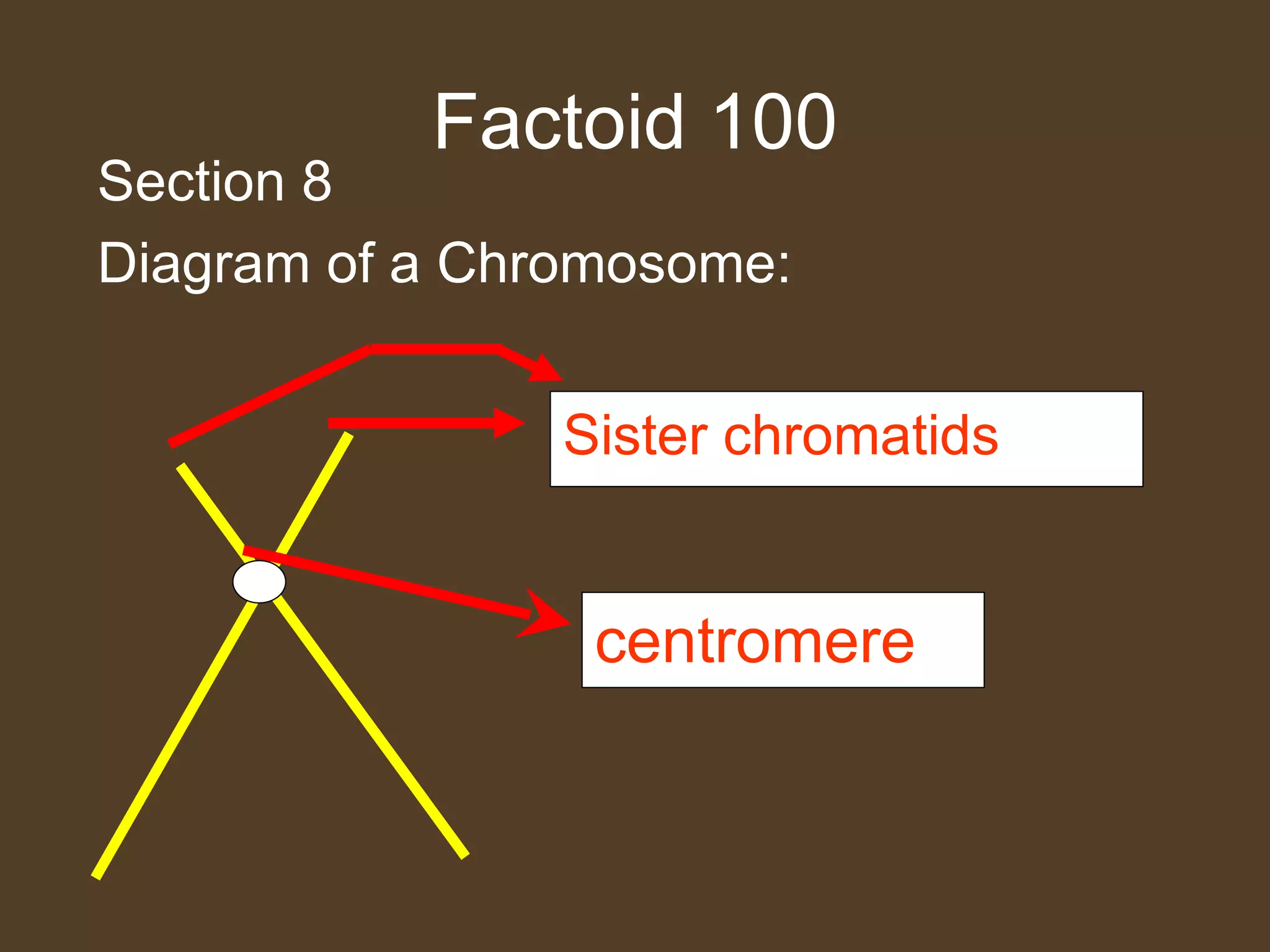
Factoid 100 Section 8 Diagram of a Chromosome: Sister chromatids centromere
Factoid 101 The Cell Cycle is made up of the G1 phase, the S phase, the G2 phase, and the M phase.
Factoid 102 The cell grows during the G1 phase.
Factoid 103 DNA replication occurs during the S phase.
Factoid 104 The organelles duplication and the cell prepares for mitosis during the G2 phase.
Factoid 105 The M phase (M for Mitosis) is divided into prophase, metaphase, anaphase, and telophase.
Factoid 106  During prophase The chromosomes become visible The nuclear membrane disappears The spindle forms
Factoid 107 During Metaphase Chrmosomes line up along the equator of the cell
Factoid 108 During Anaphase spindle fibers pull the sister chromatids apart to opposite poles.
Factoid 109 During telophase Everything done during prophase is “undone”
Factoid 110 During cytokinesis the cell splits.
Factoid 111 Cytokinesis forms by a cleavage furrow in animal cells and by a cell plate in plant cells.
Factoid 112 Organisms have two basic types of cells:  somatic cells are body cells and gametes are sex cells
Factoid 113 Sex cells (gametes) are produced by meiosis. Somatic cells are produced by mitosis.
Factoid 114 Male sex cells are called sperm and female sex cells are called eggs.
Factoid 115 Somatic cells are diploid (2n).  Sex cells are haploid (n).  Meiosis divides the chromosome number in half. Diploid cells    meiosis    haploid cells    fertilization    diploid cells again.
Factoid 116 Humans have 46 chromosomes.  Sperm have 23 chromosomes and eggs have 23 chromosomes.  Sperm (23) + egg (23) = baby (46).
Factoid 117 Meiosis adds genetic variation.  This means that it allows for different shapes, colors, and forms of organisms.
Factoid 118 Meiosis is divided into two parts:  meiosis I and meiosis II.
Factoid 119 Each part of meiosis has 4 parts:  Meiosis I has Prophase I, Metaphase I, Anaphase I, and Telophase I.  Meiosis II has Prophase II, Metaphase II, Anaphase II, and Telophase II.
Factoid 120 An organism is only successful if it successfully spreads its genes to the next generation.  This is the driving force behind most evolution.
Factoid 121 External fertilization occurs outside the body (frogs and fish).  Internal fertilization occurs inside the body (higher animals and humans).
Factoid 122 Asexual reproduction is the production of an offspring involving only 1 parent, produces genetically identical clones, and without splitting the chromosomes.
Factoid 123 Three types of asexual reproduction Binary fission – a single cells splits in half.  Common in bacteria and some protists. Budding – small area of cells grow into a new organism.  Used by fungi and simple animals. Vegetative propagation – plants send out runners that grow into a new plant or a cutting can be made.

Section 8 - Cell Reproduction

  • 1.
  • 2.
    Factoid 100 Section8 Diagram of a Chromosome: Sister chromatids centromere
  • 3.
    Factoid 101 TheCell Cycle is made up of the G1 phase, the S phase, the G2 phase, and the M phase.
  • 4.
    Factoid 102 Thecell grows during the G1 phase.
  • 5.
    Factoid 103 DNAreplication occurs during the S phase.
  • 6.
    Factoid 104 Theorganelles duplication and the cell prepares for mitosis during the G2 phase.
  • 7.
    Factoid 105 TheM phase (M for Mitosis) is divided into prophase, metaphase, anaphase, and telophase.
  • 8.
    Factoid 106 During prophase The chromosomes become visible The nuclear membrane disappears The spindle forms
  • 9.
    Factoid 107 DuringMetaphase Chrmosomes line up along the equator of the cell
  • 10.
    Factoid 108 DuringAnaphase spindle fibers pull the sister chromatids apart to opposite poles.
  • 11.
    Factoid 109 Duringtelophase Everything done during prophase is “undone”
  • 12.
    Factoid 110 Duringcytokinesis the cell splits.
  • 13.
    Factoid 111 Cytokinesisforms by a cleavage furrow in animal cells and by a cell plate in plant cells.
  • 14.
    Factoid 112 Organismshave two basic types of cells: somatic cells are body cells and gametes are sex cells
  • 15.
    Factoid 113 Sexcells (gametes) are produced by meiosis. Somatic cells are produced by mitosis.
  • 16.
    Factoid 114 Malesex cells are called sperm and female sex cells are called eggs.
  • 17.
    Factoid 115 Somaticcells are diploid (2n). Sex cells are haploid (n). Meiosis divides the chromosome number in half. Diploid cells  meiosis  haploid cells  fertilization  diploid cells again.
  • 18.
    Factoid 116 Humanshave 46 chromosomes. Sperm have 23 chromosomes and eggs have 23 chromosomes. Sperm (23) + egg (23) = baby (46).
  • 19.
    Factoid 117 Meiosisadds genetic variation. This means that it allows for different shapes, colors, and forms of organisms.
  • 20.
    Factoid 118 Meiosisis divided into two parts: meiosis I and meiosis II.
  • 21.
    Factoid 119 Eachpart of meiosis has 4 parts: Meiosis I has Prophase I, Metaphase I, Anaphase I, and Telophase I. Meiosis II has Prophase II, Metaphase II, Anaphase II, and Telophase II.
  • 22.
    Factoid 120 Anorganism is only successful if it successfully spreads its genes to the next generation. This is the driving force behind most evolution.
  • 23.
    Factoid 121 Externalfertilization occurs outside the body (frogs and fish). Internal fertilization occurs inside the body (higher animals and humans).
  • 24.
    Factoid 122 Asexualreproduction is the production of an offspring involving only 1 parent, produces genetically identical clones, and without splitting the chromosomes.
  • 25.
    Factoid 123 Threetypes of asexual reproduction Binary fission – a single cells splits in half. Common in bacteria and some protists. Budding – small area of cells grow into a new organism. Used by fungi and simple animals. Vegetative propagation – plants send out runners that grow into a new plant or a cutting can be made.