3.1 Measures of Central Tendency:
    Mode, Median, and Mean

             CHAPTER 3
       AVERAGES AND VARIATION
Page 82
                            Averages

 An average is a single number used to describe an
 entire sample or an entire population.
    There are many ways to compute averages, but we will study
     only three of the major ones.
        Mode, Median, and Mean
Page 82
                             Mode

 The mode of a data set is the value that occurs most
 frequently.
    The easiest average to compute
    For larger data sets, it is useful to order—or sort—the data
     before scanning them for the mode.
    Not every data set has a mode
    The mode is not very stable. Changing just one number in a
     data set can change the mode dramatically.
    The mode is a useful average when we want to know the most
     frequently occurring data value
Page 83
                             Median

 The median is the central value of an ordered
 distribution.
    The median uses the position rather than the specific value of
     each data entry.
    If the extreme values of a data set change, the median usually
     does not change.
    Advantage: if a data set contains an outlier, the median may be
     a better indicator of the center
    Disadvantage: not sensitive to the specific size of a data value
Median

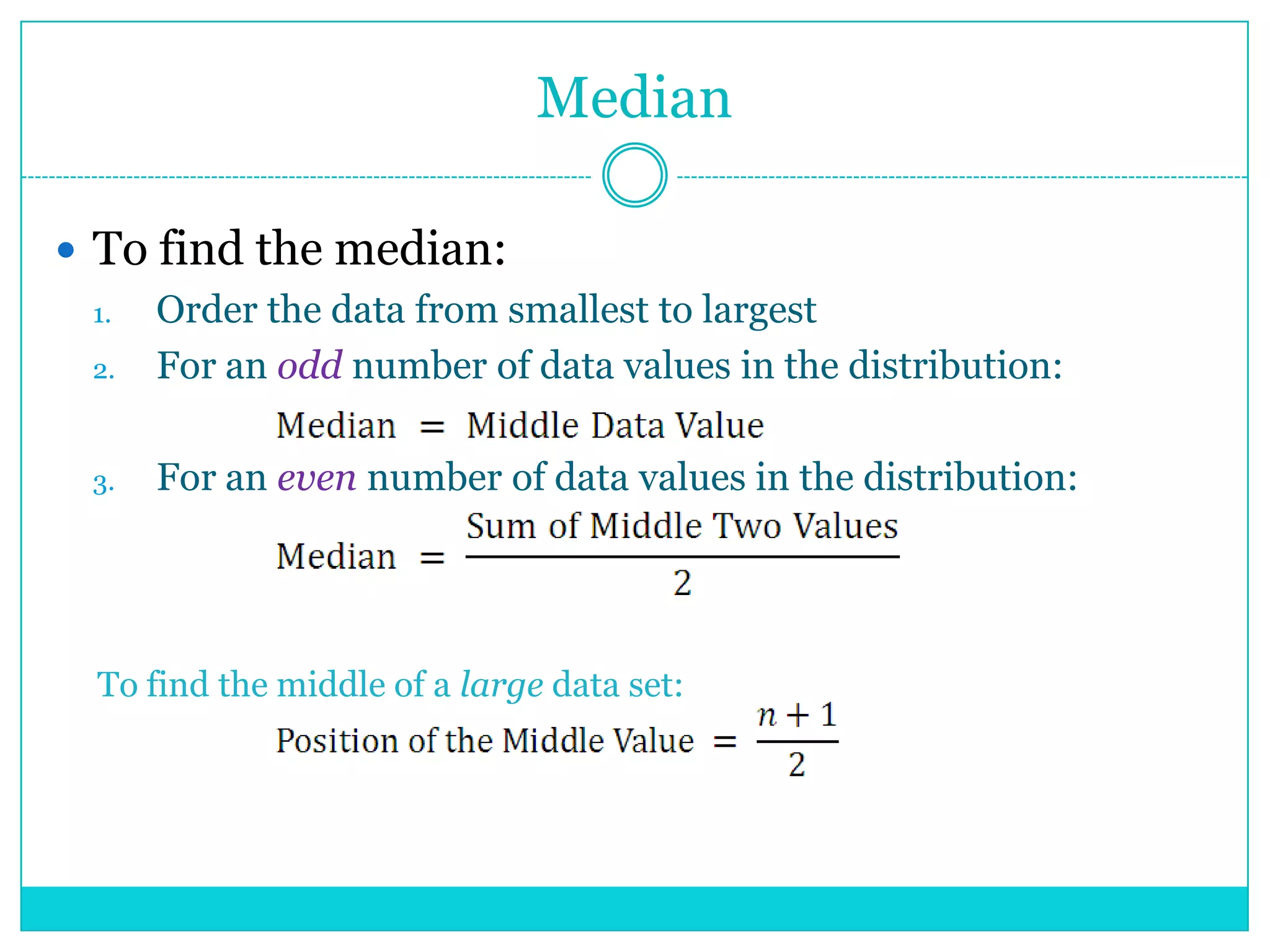
 To find the median:
  1. Order the data from smallest to largest
  2. For an odd number of data values in the distribution:

  3.   For an even number of data values in the distribution:


  To find the middle of a large data set:
Page 85
                              Mean

 The mean is an average that uses the exact value of
 each entry is the mean (sometimes called the
 arithmetic mean).
    The most important/frequently used ―average‖
    When the sample size is large and does not include outliers,
     the mean score usually provides a better measure of central
     tendency.
    Disadvantage: it can be affected by exceptional values/outliers
Mean

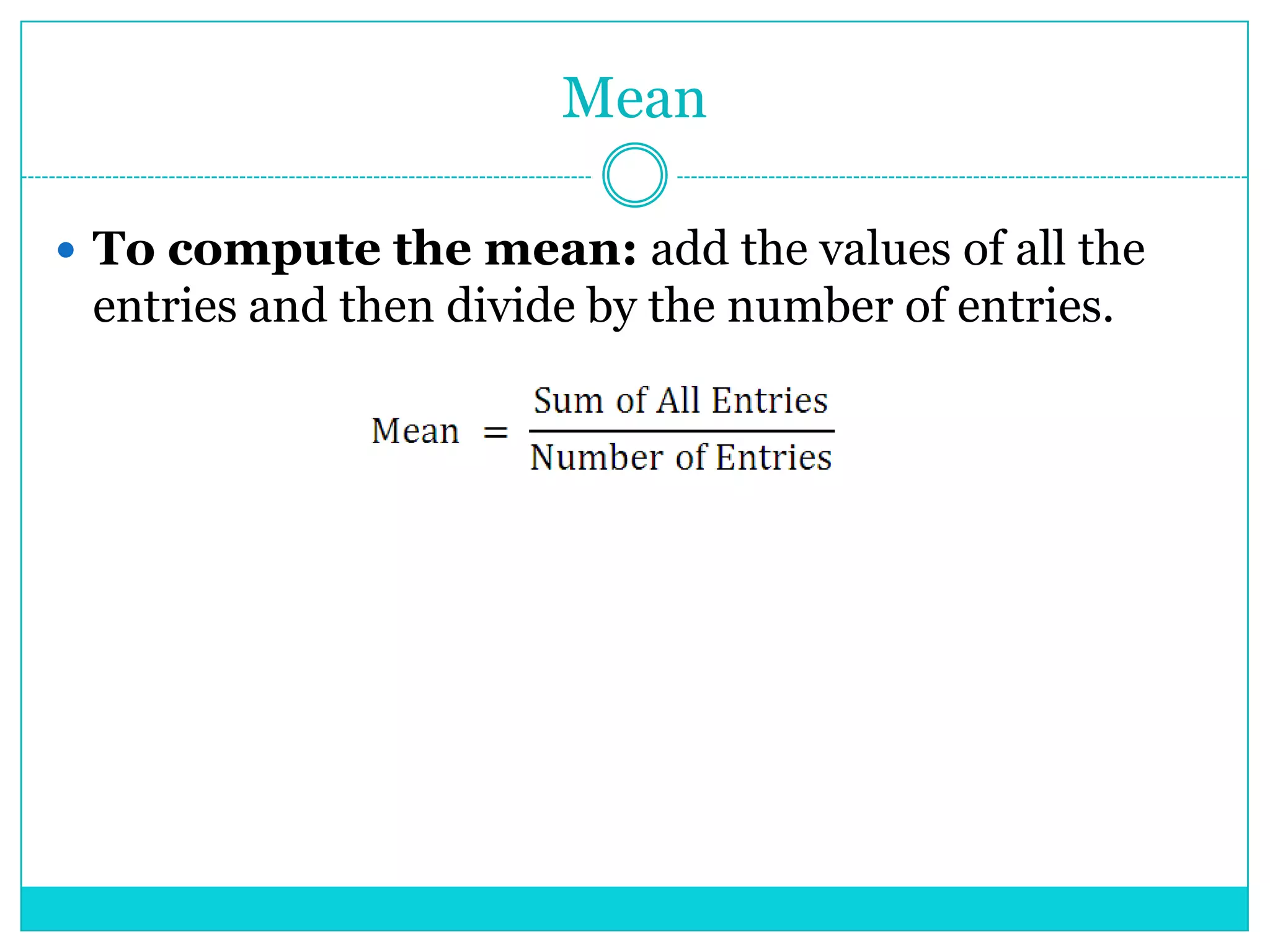
 To compute the mean: add the values of all the
 entries and then divide by the number of entries.
Note AP Formula Sheet!
                                     Mean

                                                               ∑ is the Greek
  Notation                                                    letter S called
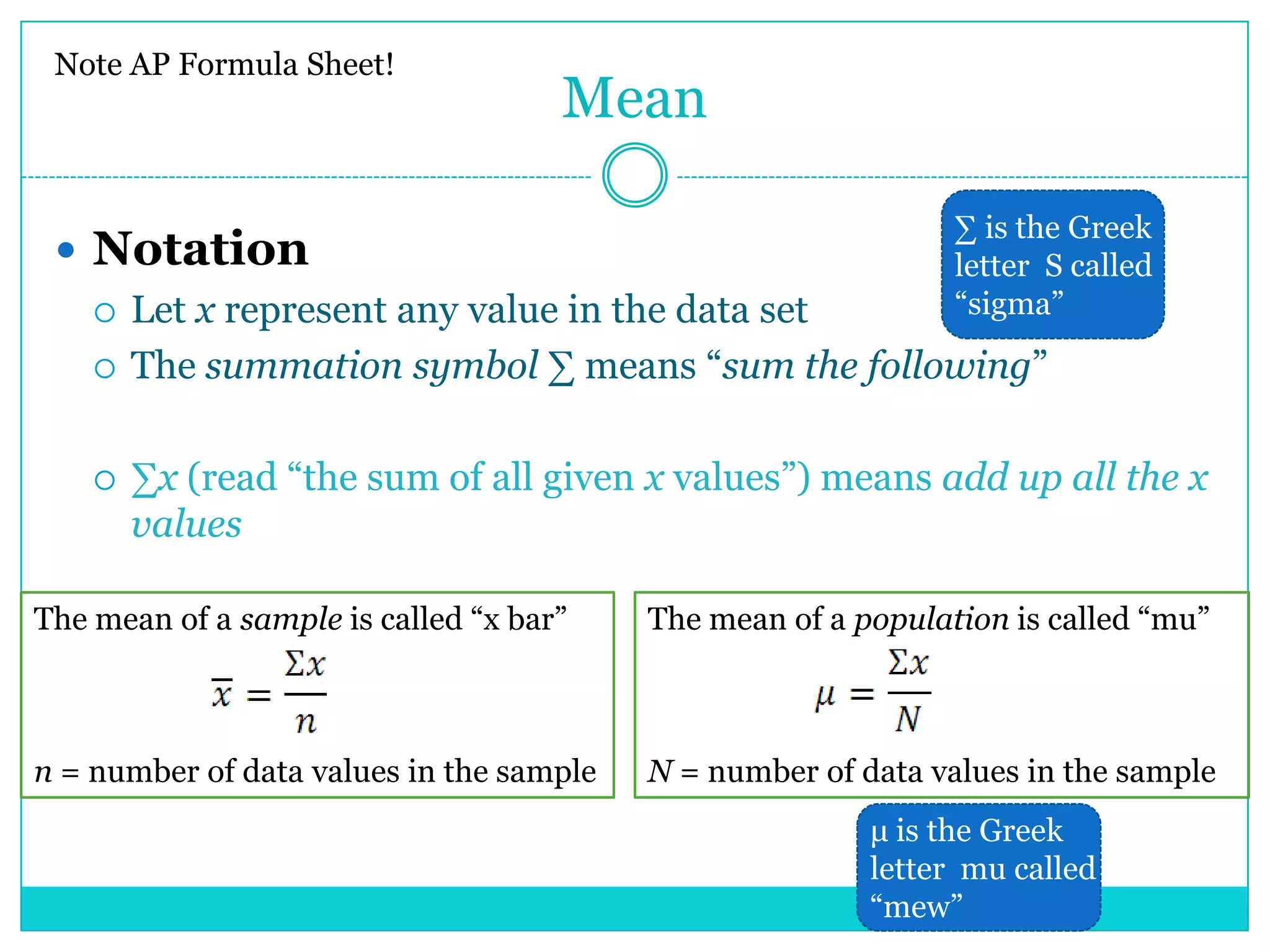
    Let x represent any value in the data set                 ―sigma‖

    The summation symbol ∑ means ―sum the following‖


       ∑x (read ―the sum of all given x values‖) means add up all the x
        values

The mean of a sample is called ―x bar‖    The mean of a population is called ―mu‖


n = number of data values in the sample   N = number of data values in the sample
                                                         μ is the Greek
                                                         letter mu called
                                                         ―mew‖
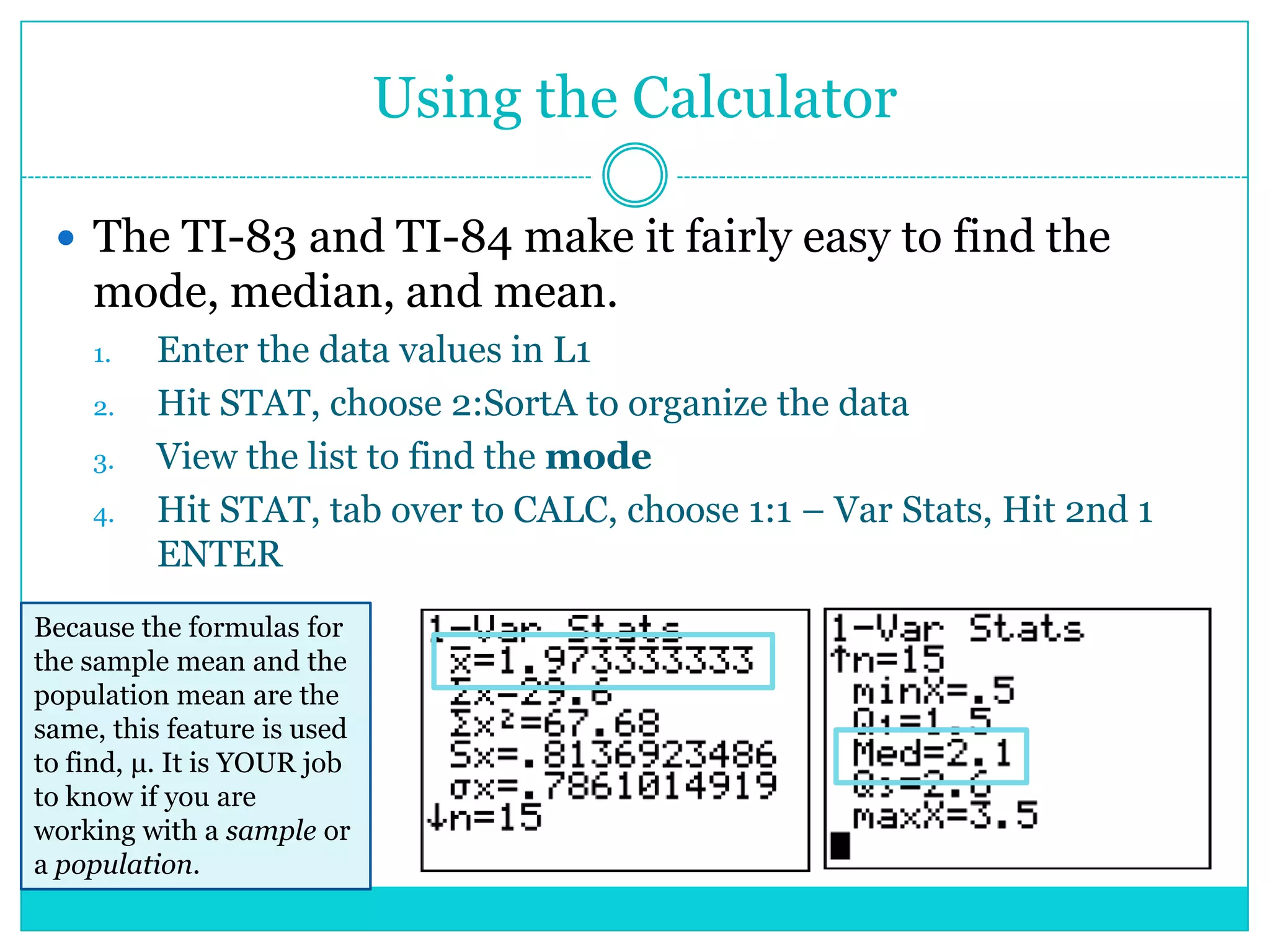
Using the Calculator

  The TI-83 and TI-84 make it fairly easy to find the
    mode, median, and mean.
    1.    Enter the data values in L1
    2.    Hit STAT, choose 2:SortA to organize the data
    3.    View the list to find the mode
    4.    Hit STAT, tab over to CALC, choose 1:1 – Var Stats, Hit 2nd 1
          ENTER
Because the formulas for
the sample mean and the
population mean are the
same, this feature is used
to find, μ. It is YOUR job
to know if you are
working with a sample or
a population.
Mean and Median

 The mean and median of two key measures of center.
    Important for comparing data sets
        State what the values are AND what they tell us about each set or one
         set compared to the other
    Important for describing data sets
        Gives a ―typical‖ number to consider when looking at any data sets


 For Example:
    Consider two data sets A and B where they are both roughly normal
     (bell-shaped) and have about the same spread. The mean of A is 6
     and the mean of B is 4.
        You might say: ―Set A is centered at 6, where set B is centered at 4.
         Since the mean of set B is lower than set A, set B would have lower
         overall values, on average than set A‖
Page 86
                     Resistant Measures

 A resistant measure is one that is not influenced
 by extremely high or low data values.
    The mean is not a resistant measure of center because
     changing the size of only one data value will affect the mean
     and it is affected by outliers.
        The mean is an example of a non-resistant measure.
    The median is more resistant to changes in individual data
     values and outliers.
Page 87
                Data Types and Averages

 Levels of Measurement: nominal, ordinal, interval,
  and ratio
     The mode (if it exists) can be used with all four levels
     The median can be used with data at the ordinal level of above.
     The mean can be used with data at the interval or ratio level
      (there are some exceptions at the ordinal level).
 Be careful with taking the average of averages!
   We need to know the sample size used to find each individual
    average
Page 88
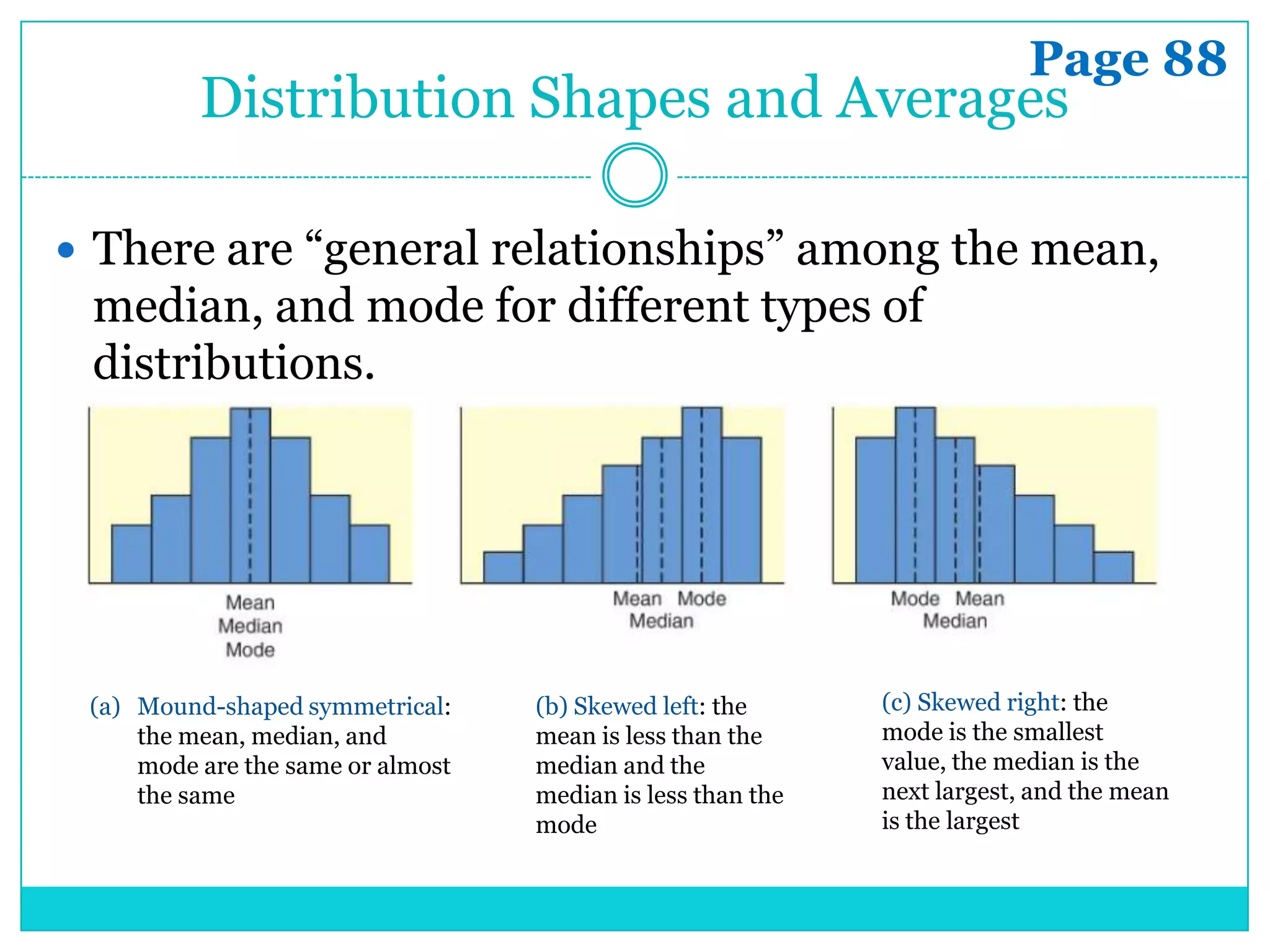
          Distribution Shapes and Averages

 There are ―general relationships‖ among the mean,
 median, and mode for different types of
 distributions.


 (a) Mound-shaped symmetrical:     (b) Skewed left: the      (c) Skewed right: the
     the mean, median, and         mean is less than the     mode is the smallest
     mode are the same or almost   median and the            value, the median is the
     the same                      median is less than the   next largest, and the mean
                                   mode                      is the largest
Homework

 Page 89
   #1, 2, 3, 6, 7, 8, 14

   #17 Parts a, b, & c only

   #18

3.1 measures of central tendency

  • 1.
    3.1 Measures ofCentral Tendency: Mode, Median, and Mean CHAPTER 3 AVERAGES AND VARIATION
  • 2.
    Page 82 Averages  An average is a single number used to describe an entire sample or an entire population.  There are many ways to compute averages, but we will study only three of the major ones.  Mode, Median, and Mean
  • 3.
    Page 82 Mode  The mode of a data set is the value that occurs most frequently.  The easiest average to compute  For larger data sets, it is useful to order—or sort—the data before scanning them for the mode.  Not every data set has a mode  The mode is not very stable. Changing just one number in a data set can change the mode dramatically.  The mode is a useful average when we want to know the most frequently occurring data value
  • 4.
    Page 83 Median  The median is the central value of an ordered distribution.  The median uses the position rather than the specific value of each data entry.  If the extreme values of a data set change, the median usually does not change.  Advantage: if a data set contains an outlier, the median may be a better indicator of the center  Disadvantage: not sensitive to the specific size of a data value
  • 5.
    Median  To findthe median: 1. Order the data from smallest to largest 2. For an odd number of data values in the distribution: 3. For an even number of data values in the distribution: To find the middle of a large data set:
  • 6.
    Page 85 Mean  The mean is an average that uses the exact value of each entry is the mean (sometimes called the arithmetic mean).  The most important/frequently used ―average‖  When the sample size is large and does not include outliers, the mean score usually provides a better measure of central tendency.  Disadvantage: it can be affected by exceptional values/outliers
  • 7.
    Mean  To computethe mean: add the values of all the entries and then divide by the number of entries.
  • 8.
    Note AP FormulaSheet! Mean ∑ is the Greek  Notation letter S called  Let x represent any value in the data set ―sigma‖  The summation symbol ∑ means ―sum the following‖  ∑x (read ―the sum of all given x values‖) means add up all the x values The mean of a sample is called ―x bar‖ The mean of a population is called ―mu‖ n = number of data values in the sample N = number of data values in the sample μ is the Greek letter mu called ―mew‖
  • 9.
    Using the Calculator  The TI-83 and TI-84 make it fairly easy to find the mode, median, and mean. 1. Enter the data values in L1 2. Hit STAT, choose 2:SortA to organize the data 3. View the list to find the mode 4. Hit STAT, tab over to CALC, choose 1:1 – Var Stats, Hit 2nd 1 ENTER Because the formulas for the sample mean and the population mean are the same, this feature is used to find, μ. It is YOUR job to know if you are working with a sample or a population.
  • 10.
    Mean and Median The mean and median of two key measures of center.  Important for comparing data sets  State what the values are AND what they tell us about each set or one set compared to the other  Important for describing data sets  Gives a ―typical‖ number to consider when looking at any data sets  For Example:  Consider two data sets A and B where they are both roughly normal (bell-shaped) and have about the same spread. The mean of A is 6 and the mean of B is 4.  You might say: ―Set A is centered at 6, where set B is centered at 4. Since the mean of set B is lower than set A, set B would have lower overall values, on average than set A‖
  • 11.
    Page 86 Resistant Measures  A resistant measure is one that is not influenced by extremely high or low data values.  The mean is not a resistant measure of center because changing the size of only one data value will affect the mean and it is affected by outliers.  The mean is an example of a non-resistant measure.  The median is more resistant to changes in individual data values and outliers.
  • 12.
    Page 87 Data Types and Averages  Levels of Measurement: nominal, ordinal, interval, and ratio  The mode (if it exists) can be used with all four levels  The median can be used with data at the ordinal level of above.  The mean can be used with data at the interval or ratio level (there are some exceptions at the ordinal level).  Be careful with taking the average of averages!  We need to know the sample size used to find each individual average
  • 13.
    Page 88 Distribution Shapes and Averages  There are ―general relationships‖ among the mean, median, and mode for different types of distributions. (a) Mound-shaped symmetrical: (b) Skewed left: the (c) Skewed right: the the mean, median, and mean is less than the mode is the smallest mode are the same or almost median and the value, the median is the the same median is less than the next largest, and the mean mode is the largest
  • 14.
    Homework  Page 89  #1, 2, 3, 6, 7, 8, 14  #17 Parts a, b, & c only  #18