7.2 PROPERTIES OF
EXPONENTIAL
FUNCTIONS
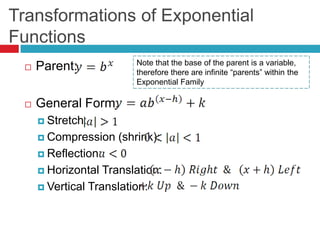
Transformations of Exponential
Functions
                         Note that the base of the parent is a variable,
    Parent:             therefore there are infinite “parents” within the
                         Exponential Family

    General Form:
      Stretch:

      Compression   (shrink):
      Reflection:

      Horizontal  Translation:
      Vertical Translation:
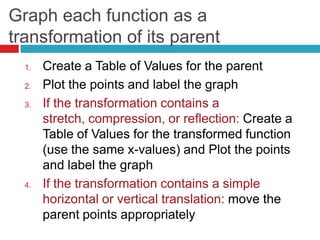
Graph each function as a
transformation of its parent
  1.   Create a Table of Values for the parent
  2.   Plot the points and label the graph
  3.   If the transformation contains a
       stretch, compression, or reflection: Create a
       Table of Values for the transformed function
       (use the same x-values) and Plot the points
       and label the graph
  4.   If the transformation contains a simple
       horizontal or vertical translation: move the
       parent points appropriately
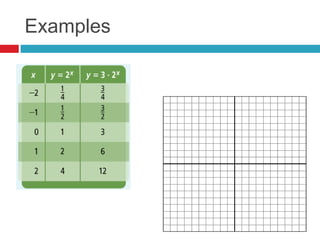
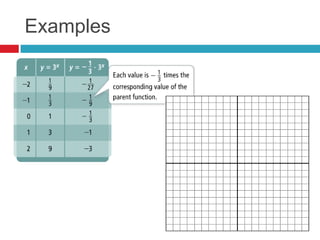
Examples
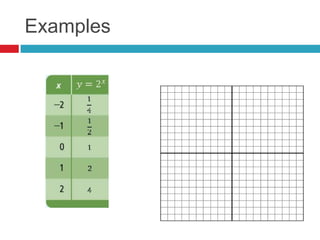
Examples
Examples
The Number e
   The Number e is an irrational number
    approximately equal to 2.71828
   Exponential functions with base e are called
    natural base exponential functions.
     These  exponential functions have the same
      properties as other exponential functions
     To graph functions with base e, use the “e” key on
      the calculator to get a decimal approximation
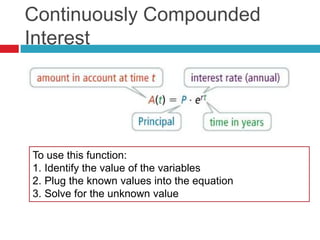
Continuously Compounded
Interest


To use this function:
1. Identify the value of the variables
2. Plug the known values into the equation
3. Solve for the unknown value
Example (p447)
 Suppose you won a contest at the start of 5th
 grade that deposited $3000 in an account that
 pays 5% annual interest compounded
 continuously. How much will you have in the
 account when you enter high school 4 years
 later? Express the answer to the nearest
 dollar.
Homework
   P447 #1 – 4 all, 7 – 27 odd, 28 – 31 all

7.2

  • 1.
  • 2.
    Transformations of Exponential Functions Note that the base of the parent is a variable,  Parent: therefore there are infinite “parents” within the Exponential Family  General Form:  Stretch:  Compression (shrink):  Reflection:  Horizontal Translation:  Vertical Translation:
  • 3.
    Graph each functionas a transformation of its parent 1. Create a Table of Values for the parent 2. Plot the points and label the graph 3. If the transformation contains a stretch, compression, or reflection: Create a Table of Values for the transformed function (use the same x-values) and Plot the points and label the graph 4. If the transformation contains a simple horizontal or vertical translation: move the parent points appropriately
  • 4.
  • 5.
  • 6.
  • 7.
    The Number e  The Number e is an irrational number approximately equal to 2.71828  Exponential functions with base e are called natural base exponential functions.  These exponential functions have the same properties as other exponential functions  To graph functions with base e, use the “e” key on the calculator to get a decimal approximation
  • 8.
    Continuously Compounded Interest To usethis function: 1. Identify the value of the variables 2. Plug the known values into the equation 3. Solve for the unknown value
  • 9.
    Example (p447) Supposeyou won a contest at the start of 5th grade that deposited $3000 in an account that pays 5% annual interest compounded continuously. How much will you have in the account when you enter high school 4 years later? Express the answer to the nearest dollar.
  • 10.
    Homework  P447 #1 – 4 all, 7 – 27 odd, 28 – 31 all