Lecturer: Yee Bee Choo 
IPGKTHO
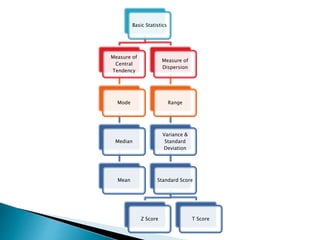
Basic Statistics 
Measure of 
Central 
Tendency 
Mode 
Median 
Mean 
Measure of 
Dispersion 
Range 
Variance & 
Standard 
Deviation 
Standard Score 
Z Score T Score
Two kinds of measures: 
1. Measures of central tendency 
2. Measures of dispersion 
Both these types of measures are useful in 
score reporting. 
They are frequently used to describe data. 
These are often called descriptive statistics 
because they can help you describe your 
data.
Central tendency measures the extent to 
which a set of scores gathers around. 
There are three major measures of central 
tendency: 
1. Mode 
2. Median 
3. Mean
Mode 
◦ The “mode” for a set of data is the number (or item) that 
occurs most frequently. 
◦ Sometimes data can have more than one mode. This 
happens when two or more numbers (or items) occur an 
equal number of times in the data. 
◦ A data set with two modes is called bimodal. 
◦ A data set with 3 modes is called trimodal 
◦ It is also possible to have a set of data with no mode.
Mode 
Mode is the most common number 
To find the mode, put the numbers in order, 
choose the number that appears the most 
frequently. 
Data: 3, 5, 5, 6, 4, 3, 2, 1, 5, 6 
Put in order: 1, 2, 3, 3, 4, 5, 5, 5, 6, 6 
The mode is 5.
Mode 
Bimodal 
Data: 2, 5, 2, 3, 5, 4, 7 
2, 2, 3, 4, 5, 5, 7 
Modes = 2 and 5 
Trimodal 
Data: 2, 5, 2, 7, 5, 4, 7 
2, 2, 4, 5, 5, 7, 7 
Modes = 2, 5, and 7
Mode 
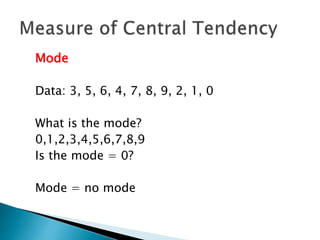
Data: 3, 5, 6, 4, 7, 8, 9, 2, 1, 0 
What is the mode? 
0,1,2,3,4,5,6,7,8,9 
Is the mode = 0? 
Mode = no mode
Mode 
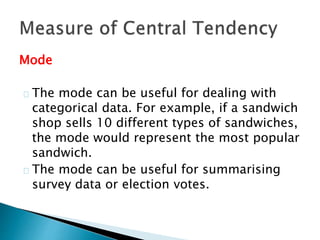
The mode can be useful for dealing with 
categorical data. For example, if a sandwich 
shop sells 10 different types of sandwiches, 
the mode would represent the most popular 
sandwich. 
The mode can be useful for summarising 
survey data or election votes.
Median 
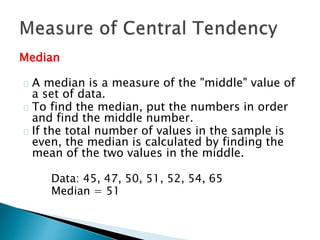
A median is a measure of the "middle" value of 
a set of data. 
To find the median, put the numbers in order 
and find the middle number. 
If the total number of values in the sample is 
even, the median is calculated by finding the 
mean of the two values in the middle. 
Data: 45, 47, 50, 51, 52, 54, 65 
Median = 51
Median 
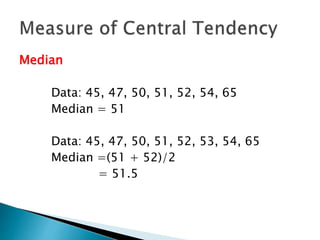
Data: 45, 47, 50, 51, 52, 54, 65 
Median = 51 
Data: 45, 47, 50, 51, 52, 53, 54, 65 
Median =(51 + 52)/2 
= 51.5
Mean 
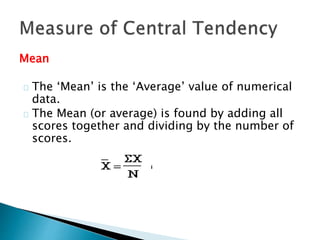
The ‘Mean’ is the ‘Average’ value of numerical 
data. 
The Mean (or average) is found by adding all 
scores together and dividing by the number of 
scores.
Mean 
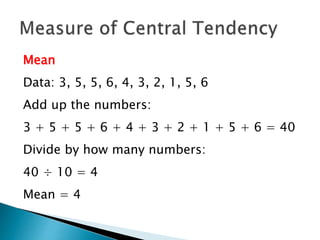
Data: 3, 5, 5, 6, 4, 3, 2, 1, 5, 6 
Add up the numbers: 
3 + 5 + 5 + 6 + 4 + 3 + 2 + 1 + 5 + 6 = 40 
Divide by how many numbers: 
40 ÷ 10 = 4 
Mean = 4
Exercise 1 
Below is a set of marks obtained by 7 
students: 
82 55 73 48 88 67 67 
Find the mean, mode and median.
Exercise 2 
On a standardised reading test, the nationwide average for Year 3 
pupils is 7.0. A teacher is interested in comparing class reading 
scores with the national average. The scores for the 16 pupils in this 
class are as follows: 
8, 6, 5, 10, 5, 6, 8, 9, 
7, 6, 9, 5, 14, 4, 7, 6 
a) Find the mean and the median reading scores for this class. 
b) If the mean is used to define the class average, how does this 
class compare with the national norm? 
c) If the median is used to define the class average, how does this 
class compare with the national norm?
Measure of Dispersion tells about the spread 
of scores in a data set. 
There are three major measures of 
dispersion: 
1. Range 
2. Standard deviation 
3. Variance
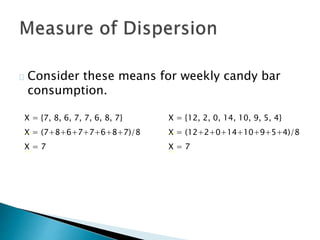
Consider these means for weekly candy bar 
consumption. 
X = {7, 8, 6, 7, 7, 6, 8, 7} 
X = (7+8+6+7+7+6+8+7)/8 
X = 7 
X = {12, 2, 0, 14, 10, 9, 5, 4} 
X = (12+2+0+14+10+9+5+4)/8 
X = 7 
What is the difference?
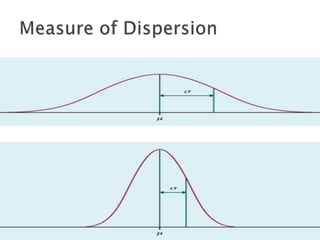
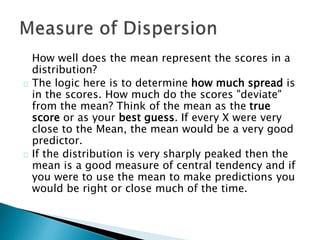
How well does the mean represent the scores in a 
distribution? 
The logic here is to determine how much spread is 
in the scores. How much do the scores "deviate" 
from the mean? Think of the mean as the true 
score or as your best guess. If every X were very 
close to the Mean, the mean would be a very good 
predictor. 
If the distribution is very sharply peaked then the 
mean is a good measure of central tendency and if 
you were to use the mean to make predictions you 
would be right or close much of the time.
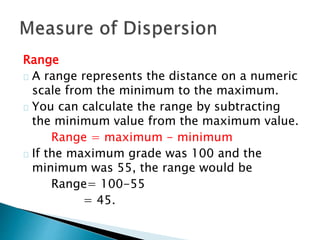
Range 
A range represents the distance on a numeric 
scale from the minimum to the maximum. 
You can calculate the range by subtracting 
the minimum value from the maximum value. 
Range = maximum - minimum 
If the maximum grade was 100 and the 
minimum was 55, the range would be 
Range= 100-55 
= 45.
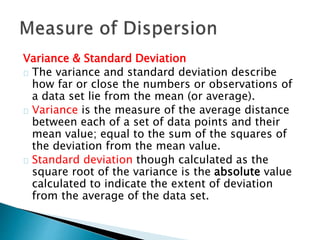
Variance & Standard Deviation 
The variance and standard deviation describe 
how far or close the numbers or observations of 
a data set lie from the mean (or average). 
Variance is the measure of the average distance 
between each of a set of data points and their 
mean value; equal to the sum of the squares of 
the deviation from the mean value. 
Standard deviation though calculated as the 
square root of the variance is the absolute value 
calculated to indicate the extent of deviation 
from the average of the data set.
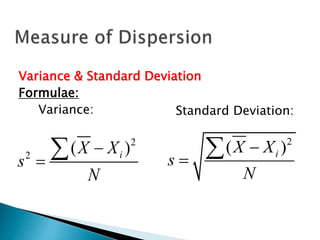
Variance & Standard Deviation 
Formulae: 
Variance: 
2 ( )i X X 
s 
 
N 
  2 
( X  
X 
)s 
2 i N 
  
Standard Deviation:
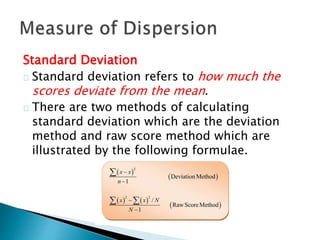
Standard Deviation 
Standard deviation refers to how much the 
scores deviate from the mean. 
There are two methods of calculating 
standard deviation which are the deviation 
method and raw score method which are 
illustrated by the following formulae.
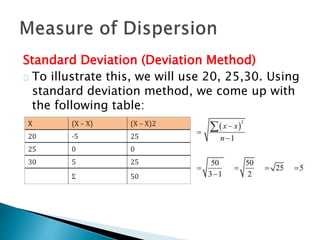
Standard Deviation (Deviation Method) 
To illustrate this, we will use 20, 25,30. Using 
standard deviation method, we come up with 
the following table:
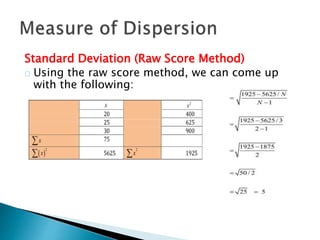
Standard Deviation (Raw Score Method) 
Using the raw score method, we can come up 
with the following:
Standard Deviation 
Both methods result in the same final value of 5. 
If you are calculating standard deviation with a 
calculator, it is suggested that the deviation 
method be used when there are only a few scores 
and the raw score method be used when there are 
many scores. 
This is because when there are many scores, it will 
be tedious to calculate the square of the 
deviations and their sum.
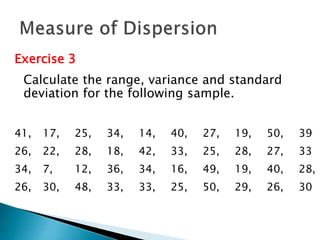
Exercise 3 
Calculate the range, variance and standard 
deviation for the following sample. 
41, 17, 25, 34, 14, 40, 27, 19, 50, 39 
26, 22, 28, 18, 42, 33, 25, 28, 27, 33 
34, 7, 12, 36, 34, 16, 49, 19, 40, 28, 
26, 30, 48, 33, 33, 25, 50, 29, 26, 30
Standard Score 
Standardised scores are necessary when we 
want to make comparisons across tests and 
measurements. 
Z scores and T scores are the more common 
forms of standardised scores. 
A standardised score can be computed for 
every raw score in a set of scores for a test.
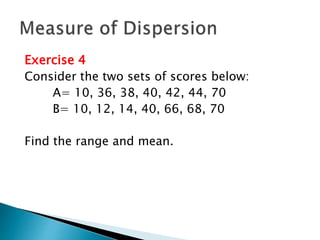
Exercise 4 
Consider the two sets of scores below: 
A= 10, 36, 38, 40, 42, 44, 70 
B= 10, 12, 14, 40, 66, 68, 70 
Find the range and mean.
Standard Score 
Both set A and set B have the same range and 
mean. 
However, set B is more dispersed. The 
difference between the value 70 and other 
values is more significant than set A. 
To make a comparison more clearly, we can 
standardised the score, by transforming it into 
another distribution.
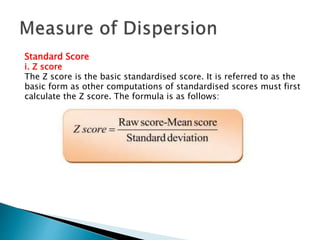
Standard Score 
i. Z score 
The Z score is the basic standardised score. It is referred to as the 
basic form as other computations of standardised scores must first 
calculate the Z score. The formula is as follows:
Standard Score 
i. Z score 
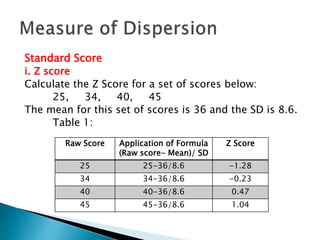
Calculate the Z Score for a set of scores below: 
25, 34, 40, 45 
The mean for this set of scores is 36 and the SD is 8.6. 
Table 1: 
Raw Score Application of Formula 
(Raw score- Mean)/ SD 
Z Score 
25 25-36/8.6 -1.28 
34 34-36/8.6 -0.23 
40 40-36/8.6 0.47 
45 45-36/8.6 1.04
Standard Score 
i. Z score
Exercise 5 
Ahmad obtained 90 marks (total mark is 
100) in English test. The mean for the 
achievement of the whole class is 70 and the 
standard deviation (SD) is 25. In a 
Mathematics test, Ahmad obtained 60 
marks. The mean achievement for 
Mathematics for the whole class is 40 while 
the SD is 15. In which subject does Ahmad 
score better?
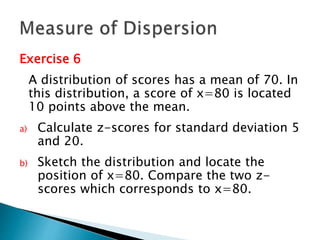
Exercise 6 
A distribution of scores has a mean of 70. In 
this distribution, a score of x=80 is located 
10 points above the mean. 
a) Calculate z-scores for standard deviation 5 
and 20. 
b) Sketch the distribution and locate the 
position of x=80. Compare the two z-scores 
which corresponds to x=80.
Exercise 6 
Mean=5 
Mean=20 
70 X=80 70 X=80 
z-score=2 z-score=0.05
Standard Score 
i. Z score 
Z score values are very small and usually range only 
from –2 to 2. 
Such small values make it inappropriate for score 
reporting especially for those unaccustomed to the 
concept. 
Imagine what a parent may say if his child comes 
home with a report card with a Z score of 0.80 in 
English Language! 
Fortunately, there is another form of standardised 
score - the T score – with values that are more 
palatable to the relevant parties.
Standard Score 
ii. T score 
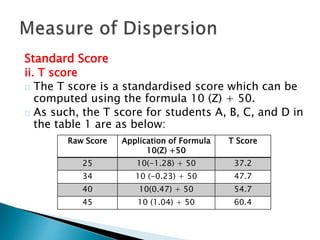
The T score is a standardised score which can be 
computed using the formula 10 (Z) + 50. 
As such, the T score for students A, B, C, and D in 
the table 1 are as below: 
Raw Score Application of Formula 
10(Z) +50 
T Score 
25 10(-1.28) + 50 37.2 
34 10 (-0.23) + 50 47.7 
40 10(0.47) + 50 54.7 
45 10 (1.04) + 50 60.4
Standard Score 
ii. T score 
These values seem perfectly appropriate 
compared to the Z score. 
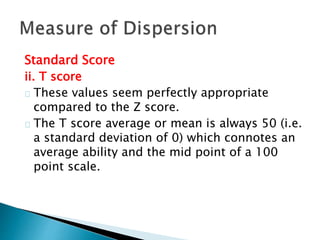
The T score average or mean is always 50 (i.e. 
a standard deviation of 0) which connotes an 
average ability and the mid point of a 100 
point scale.
Interpretation of data 
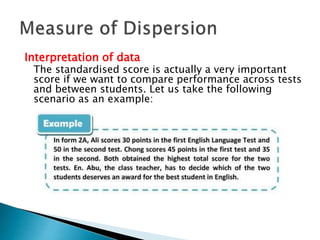
The standardised score is actually a very important 
score if we want to compare performance across tests 
and between students. Let us take the following 
scenario as an example:
Interpretation of data 
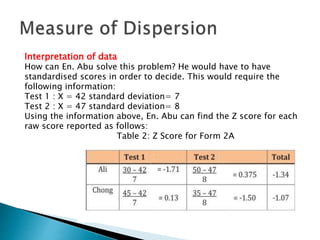
How can En. Abu solve this problem? He would have to have 
standardised scores in order to decide. This would require the 
following information: 
Test 1 : X = 42 standard deviation= 7 
Test 2 : X = 47 standard deviation= 8 
Using the information above, En. Abu can find the Z score for each 
raw score reported as follows: 
Table 2: Z Score for Form 2A
Interpretation of data 
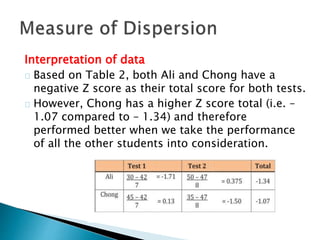
Based on Table 2, both Ali and Chong have a 
negative Z score as their total score for both tests. 
However, Chong has a higher Z score total (i.e. – 
1.07 compared to – 1.34) and therefore 
performed better when we take the performance 
of all the other students into consideration.
Interpretation of data 
THE NORMAL CURVE 
The normal curve is a hypothetical curve that is 
supposed to represent all naturally occurring 
phenomena. 
Test scores that measure any characteristic such 
as intelligence, language proficiency or writing 
ability of a specific population is also expected to 
provide us with a normal curve. 
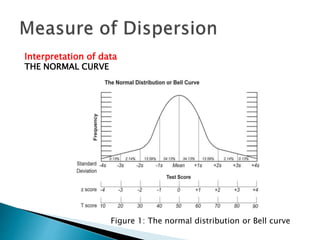
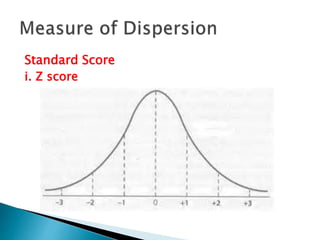
The following is a diagram illustrating how the 
normal curve would look like.
Interpretation of data 
THE NORMAL CURVE 
Figure 1: The normal distribution or Bell curve
Interpretation of data 
THE NORMAL CURVE 
The normal curve in Figure 1 is partitioned according 
to standard deviations (i.e. – 4s, -3s, + 3s, + 4s) 
which are indicated on the horizontal axis. 
The area of the curve between standard deviations is 
indicated in percentage on the diagram. 
For example, the area between the mean (0 standard 
deviation) and +1 standard deviation is 34.13%. 
Similarly, the area between the mean and –1 standard 
deviation is also 34.13%. As such, the area between –1 
and 1 standard deviations is 68.26%.
Interpretation of data 
THE NORMAL CURVE 
In using the normal curve, it is important to 
make a distinction between standard deviation 
values and standard deviation scores. 
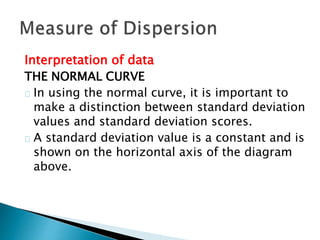
A standard deviation value is a constant and is 
shown on the horizontal axis of the diagram 
above.
Interpretation of data 
THE NORMAL CURVE 
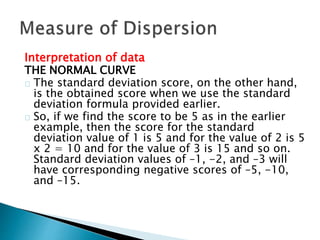
The standard deviation score, on the other hand, 
is the obtained score when we use the standard 
deviation formula provided earlier. 
So, if we find the score to be 5 as in the earlier 
example, then the score for the standard 
deviation value of 1 is 5 and for the value of 2 is 5 
x 2 = 10 and for the value of 3 is 15 and so on. 
Standard deviation values of –1, -2, and –3 will 
have corresponding negative scores of –5, -10, 
and –15.

Topic 8a Basic Statistics

  • 1.
    Lecturer: Yee BeeChoo IPGKTHO
  • 2.
    Basic Statistics Measureof Central Tendency Mode Median Mean Measure of Dispersion Range Variance & Standard Deviation Standard Score Z Score T Score
  • 3.
    Two kinds ofmeasures: 1. Measures of central tendency 2. Measures of dispersion Both these types of measures are useful in score reporting. They are frequently used to describe data. These are often called descriptive statistics because they can help you describe your data.
  • 4.
    Central tendency measuresthe extent to which a set of scores gathers around. There are three major measures of central tendency: 1. Mode 2. Median 3. Mean
  • 5.
    Mode ◦ The“mode” for a set of data is the number (or item) that occurs most frequently. ◦ Sometimes data can have more than one mode. This happens when two or more numbers (or items) occur an equal number of times in the data. ◦ A data set with two modes is called bimodal. ◦ A data set with 3 modes is called trimodal ◦ It is also possible to have a set of data with no mode.
  • 6.
    Mode Mode isthe most common number To find the mode, put the numbers in order, choose the number that appears the most frequently. Data: 3, 5, 5, 6, 4, 3, 2, 1, 5, 6 Put in order: 1, 2, 3, 3, 4, 5, 5, 5, 6, 6 The mode is 5.
  • 7.
    Mode Bimodal Data:2, 5, 2, 3, 5, 4, 7 2, 2, 3, 4, 5, 5, 7 Modes = 2 and 5 Trimodal Data: 2, 5, 2, 7, 5, 4, 7 2, 2, 4, 5, 5, 7, 7 Modes = 2, 5, and 7
  • 8.
    Mode Data: 3,5, 6, 4, 7, 8, 9, 2, 1, 0 What is the mode? 0,1,2,3,4,5,6,7,8,9 Is the mode = 0? Mode = no mode
  • 9.
    Mode The modecan be useful for dealing with categorical data. For example, if a sandwich shop sells 10 different types of sandwiches, the mode would represent the most popular sandwich. The mode can be useful for summarising survey data or election votes.
  • 10.
    Median A medianis a measure of the "middle" value of a set of data. To find the median, put the numbers in order and find the middle number. If the total number of values in the sample is even, the median is calculated by finding the mean of the two values in the middle. Data: 45, 47, 50, 51, 52, 54, 65 Median = 51
  • 11.
    Median Data: 45,47, 50, 51, 52, 54, 65 Median = 51 Data: 45, 47, 50, 51, 52, 53, 54, 65 Median =(51 + 52)/2 = 51.5
  • 12.
    Mean The ‘Mean’is the ‘Average’ value of numerical data. The Mean (or average) is found by adding all scores together and dividing by the number of scores.
  • 13.
    Mean Data: 3,5, 5, 6, 4, 3, 2, 1, 5, 6 Add up the numbers: 3 + 5 + 5 + 6 + 4 + 3 + 2 + 1 + 5 + 6 = 40 Divide by how many numbers: 40 ÷ 10 = 4 Mean = 4
  • 14.
    Exercise 1 Belowis a set of marks obtained by 7 students: 82 55 73 48 88 67 67 Find the mean, mode and median.
  • 15.
    Exercise 2 Ona standardised reading test, the nationwide average for Year 3 pupils is 7.0. A teacher is interested in comparing class reading scores with the national average. The scores for the 16 pupils in this class are as follows: 8, 6, 5, 10, 5, 6, 8, 9, 7, 6, 9, 5, 14, 4, 7, 6 a) Find the mean and the median reading scores for this class. b) If the mean is used to define the class average, how does this class compare with the national norm? c) If the median is used to define the class average, how does this class compare with the national norm?
  • 16.
    Measure of Dispersiontells about the spread of scores in a data set. There are three major measures of dispersion: 1. Range 2. Standard deviation 3. Variance
  • 17.
    Consider these meansfor weekly candy bar consumption. X = {7, 8, 6, 7, 7, 6, 8, 7} X = (7+8+6+7+7+6+8+7)/8 X = 7 X = {12, 2, 0, 14, 10, 9, 5, 4} X = (12+2+0+14+10+9+5+4)/8 X = 7 What is the difference?
  • 19.
    How well doesthe mean represent the scores in a distribution? The logic here is to determine how much spread is in the scores. How much do the scores "deviate" from the mean? Think of the mean as the true score or as your best guess. If every X were very close to the Mean, the mean would be a very good predictor. If the distribution is very sharply peaked then the mean is a good measure of central tendency and if you were to use the mean to make predictions you would be right or close much of the time.
  • 20.
    Range A rangerepresents the distance on a numeric scale from the minimum to the maximum. You can calculate the range by subtracting the minimum value from the maximum value. Range = maximum - minimum If the maximum grade was 100 and the minimum was 55, the range would be Range= 100-55 = 45.
  • 21.
    Variance & StandardDeviation The variance and standard deviation describe how far or close the numbers or observations of a data set lie from the mean (or average). Variance is the measure of the average distance between each of a set of data points and their mean value; equal to the sum of the squares of the deviation from the mean value. Standard deviation though calculated as the square root of the variance is the absolute value calculated to indicate the extent of deviation from the average of the data set.
  • 22.
    Variance & StandardDeviation Formulae: Variance: 2 ( )i X X s  N   2 ( X  X )s 2 i N   Standard Deviation:
  • 23.
    Standard Deviation Standarddeviation refers to how much the scores deviate from the mean. There are two methods of calculating standard deviation which are the deviation method and raw score method which are illustrated by the following formulae.
  • 24.
    Standard Deviation (DeviationMethod) To illustrate this, we will use 20, 25,30. Using standard deviation method, we come up with the following table:
  • 25.
    Standard Deviation (RawScore Method) Using the raw score method, we can come up with the following:
  • 26.
    Standard Deviation Bothmethods result in the same final value of 5. If you are calculating standard deviation with a calculator, it is suggested that the deviation method be used when there are only a few scores and the raw score method be used when there are many scores. This is because when there are many scores, it will be tedious to calculate the square of the deviations and their sum.
  • 27.
    Exercise 3 Calculatethe range, variance and standard deviation for the following sample. 41, 17, 25, 34, 14, 40, 27, 19, 50, 39 26, 22, 28, 18, 42, 33, 25, 28, 27, 33 34, 7, 12, 36, 34, 16, 49, 19, 40, 28, 26, 30, 48, 33, 33, 25, 50, 29, 26, 30
  • 28.
    Standard Score Standardisedscores are necessary when we want to make comparisons across tests and measurements. Z scores and T scores are the more common forms of standardised scores. A standardised score can be computed for every raw score in a set of scores for a test.
  • 29.
    Exercise 4 Considerthe two sets of scores below: A= 10, 36, 38, 40, 42, 44, 70 B= 10, 12, 14, 40, 66, 68, 70 Find the range and mean.
  • 30.
    Standard Score Bothset A and set B have the same range and mean. However, set B is more dispersed. The difference between the value 70 and other values is more significant than set A. To make a comparison more clearly, we can standardised the score, by transforming it into another distribution.
  • 31.
    Standard Score i.Z score The Z score is the basic standardised score. It is referred to as the basic form as other computations of standardised scores must first calculate the Z score. The formula is as follows:
  • 32.
    Standard Score i.Z score Calculate the Z Score for a set of scores below: 25, 34, 40, 45 The mean for this set of scores is 36 and the SD is 8.6. Table 1: Raw Score Application of Formula (Raw score- Mean)/ SD Z Score 25 25-36/8.6 -1.28 34 34-36/8.6 -0.23 40 40-36/8.6 0.47 45 45-36/8.6 1.04
  • 33.
  • 34.
    Exercise 5 Ahmadobtained 90 marks (total mark is 100) in English test. The mean for the achievement of the whole class is 70 and the standard deviation (SD) is 25. In a Mathematics test, Ahmad obtained 60 marks. The mean achievement for Mathematics for the whole class is 40 while the SD is 15. In which subject does Ahmad score better?
  • 35.
    Exercise 6 Adistribution of scores has a mean of 70. In this distribution, a score of x=80 is located 10 points above the mean. a) Calculate z-scores for standard deviation 5 and 20. b) Sketch the distribution and locate the position of x=80. Compare the two z-scores which corresponds to x=80.
  • 36.
    Exercise 6 Mean=5 Mean=20 70 X=80 70 X=80 z-score=2 z-score=0.05
  • 37.
    Standard Score i.Z score Z score values are very small and usually range only from –2 to 2. Such small values make it inappropriate for score reporting especially for those unaccustomed to the concept. Imagine what a parent may say if his child comes home with a report card with a Z score of 0.80 in English Language! Fortunately, there is another form of standardised score - the T score – with values that are more palatable to the relevant parties.
  • 38.
    Standard Score ii.T score The T score is a standardised score which can be computed using the formula 10 (Z) + 50. As such, the T score for students A, B, C, and D in the table 1 are as below: Raw Score Application of Formula 10(Z) +50 T Score 25 10(-1.28) + 50 37.2 34 10 (-0.23) + 50 47.7 40 10(0.47) + 50 54.7 45 10 (1.04) + 50 60.4
  • 39.
    Standard Score ii.T score These values seem perfectly appropriate compared to the Z score. The T score average or mean is always 50 (i.e. a standard deviation of 0) which connotes an average ability and the mid point of a 100 point scale.
  • 40.
    Interpretation of data The standardised score is actually a very important score if we want to compare performance across tests and between students. Let us take the following scenario as an example:
  • 41.
    Interpretation of data How can En. Abu solve this problem? He would have to have standardised scores in order to decide. This would require the following information: Test 1 : X = 42 standard deviation= 7 Test 2 : X = 47 standard deviation= 8 Using the information above, En. Abu can find the Z score for each raw score reported as follows: Table 2: Z Score for Form 2A
  • 42.
    Interpretation of data Based on Table 2, both Ali and Chong have a negative Z score as their total score for both tests. However, Chong has a higher Z score total (i.e. – 1.07 compared to – 1.34) and therefore performed better when we take the performance of all the other students into consideration.
  • 43.
    Interpretation of data THE NORMAL CURVE The normal curve is a hypothetical curve that is supposed to represent all naturally occurring phenomena. Test scores that measure any characteristic such as intelligence, language proficiency or writing ability of a specific population is also expected to provide us with a normal curve. The following is a diagram illustrating how the normal curve would look like.
  • 44.
    Interpretation of data THE NORMAL CURVE Figure 1: The normal distribution or Bell curve
  • 45.
    Interpretation of data THE NORMAL CURVE The normal curve in Figure 1 is partitioned according to standard deviations (i.e. – 4s, -3s, + 3s, + 4s) which are indicated on the horizontal axis. The area of the curve between standard deviations is indicated in percentage on the diagram. For example, the area between the mean (0 standard deviation) and +1 standard deviation is 34.13%. Similarly, the area between the mean and –1 standard deviation is also 34.13%. As such, the area between –1 and 1 standard deviations is 68.26%.
  • 46.
    Interpretation of data THE NORMAL CURVE In using the normal curve, it is important to make a distinction between standard deviation values and standard deviation scores. A standard deviation value is a constant and is shown on the horizontal axis of the diagram above.
  • 47.
    Interpretation of data THE NORMAL CURVE The standard deviation score, on the other hand, is the obtained score when we use the standard deviation formula provided earlier. So, if we find the score to be 5 as in the earlier example, then the score for the standard deviation value of 1 is 5 and for the value of 2 is 5 x 2 = 10 and for the value of 3 is 15 and so on. Standard deviation values of –1, -2, and –3 will have corresponding negative scores of –5, -10, and –15.

Editor's Notes

  • #4 Descriptive statistics are procedures that aim to summarise the raw scores in more meaningful way.
  • #28 Mean = 1193/40 = 29.82 = 30 Variance = 4214/39 = 108.05 (deviation method) SD = square root of 108.05 = 10.39
  • #30 Range = 60 Mean = 40
  • #31 Range = 60 Mean = 40
  • #35 English = (90-70)/25 =0.80 Mathematics = (60-40)/15= 1.33 Ahmad scores better in Mathematics.
  • #36 Z-scores for (80-70)/5 = 2 Z-scores for (80-70)/20 = 0.50
  • #37 Z-scores for (80-70)/5 = 2 Z-scores for (80-70)/20 = 0.50