Introduction to the Logical
Framework Approach
Pacific Research & Evaluation Associates
www.prea.com.au
FIRST, A BIT OF HISTORY
Once upon a time, there was a lot of development
money being invested into projects.
Funding agencies were having a hard time assessing
whether projects were successful or not, and
whether the money was wisely invested.
The reason was that projects were not clear in their
objectives, and what ‘success’ would look like.
So a new project planning tool was sought……
History -2
The Logical Framework Approach (LFA) dates back to
the early 1970s, when USAID spearheaded its use.
Its popularity rose over time, with many
international development agencies advocating its
use in grant application.
Its popularity dropped in recent times with some
agencies for a number of reasons, such as
perceptions that the LFA is inflexible, and that its
linear model (the logframe) does not represent the
complex nature of development issues.
History -3
However, the LFA remains in use with many funding
agencies.
The critique of the LFA should not dissuade you to
use it. Rather, it is a reminder that any tool can be
useful, or not, depending on how it is put to use.
When used properly, it remains a robust project
design and planning tool. Like all tools, it requires
good training for it to be put to good use.
That was
the past…
now for
the
present….
LOGICAL FRAMEWORK APPROACH
What is the Logical Framework
Approach?
The Logical Framework Approach (LFA) is a project
design process based on participation, critical
analysis, strategic thinking, and logic.
The LFA is made up of a sequence of steps. Each step
builds on the previous one, and taken as a whole, it
provides a robust project design methodology.
It is important to distinguish the LFA from the
logframe matrix.
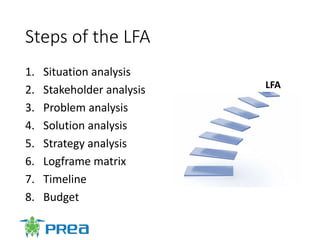
1. Situation analysis
2. Stakeholder analysis
3. Problem analysis
4. Solution analysis
5. Strategy analysis
6. Logframe matrix
7. Timeline
8. Budget
Steps of the LFA
LFA
What is the logframe matrix?
The logframe matrix (LFM) is one of the main steps,
and outputs of the LFA.
The logframe matrix documents the project’s goal,
purpose, outputs and activities, the assumptions and
the relationships between all these items.
It also documents the indicators that will help
measure the success of the project and where the
information will come from (the foundation of a
monitoring and evaluation plan!)
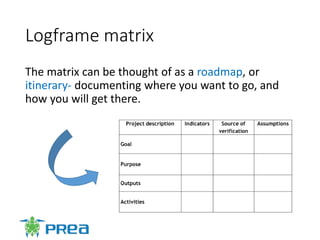
Logframe matrix
The matrix can be thought of as a roadmap, or
itinerary- documenting where you want to go, and
how you will get there.
TIP – Don’t jump
straight to the logframe
Many people tend to jump straight to the logframe
matrix, as this is often what the funding agency
wants to see.
But remember the old saying: “rubbish in, rubbish
out”.
A solid, useful logframe is built on strong foundations
offered by the preceding steps. Jumping straight to
the logframe may result in a flimsy design that will
not lead to successful projects. And if that is the
case, don’t blame the logframe!
TIP – Logframe matrix
Interested in learning about the
LFA?
Pacific Research & Evaluation Associates deliver
training on the LFA in Australia, across the Pacific,
and beyond.
PREA’s training is participatory, interactive, and fun
(visit the website for testimonials).
PREA can customise training to meet your project
planning needs.
Visit www.prea.com.au to find out more about PREA,
and for contact details.

Introduction to the Logical Framework Approach

  • 1.
    Introduction to theLogical Framework Approach Pacific Research & Evaluation Associates www.prea.com.au
  • 2.
    FIRST, A BITOF HISTORY Once upon a time, there was a lot of development money being invested into projects. Funding agencies were having a hard time assessing whether projects were successful or not, and whether the money was wisely invested. The reason was that projects were not clear in their objectives, and what ‘success’ would look like. So a new project planning tool was sought……
  • 3.
    History -2 The LogicalFramework Approach (LFA) dates back to the early 1970s, when USAID spearheaded its use. Its popularity rose over time, with many international development agencies advocating its use in grant application. Its popularity dropped in recent times with some agencies for a number of reasons, such as perceptions that the LFA is inflexible, and that its linear model (the logframe) does not represent the complex nature of development issues.
  • 4.
    History -3 However, theLFA remains in use with many funding agencies. The critique of the LFA should not dissuade you to use it. Rather, it is a reminder that any tool can be useful, or not, depending on how it is put to use. When used properly, it remains a robust project design and planning tool. Like all tools, it requires good training for it to be put to good use.
  • 5.
    That was the past… nowfor the present…. LOGICAL FRAMEWORK APPROACH
  • 6.
    What is theLogical Framework Approach? The Logical Framework Approach (LFA) is a project design process based on participation, critical analysis, strategic thinking, and logic. The LFA is made up of a sequence of steps. Each step builds on the previous one, and taken as a whole, it provides a robust project design methodology. It is important to distinguish the LFA from the logframe matrix.
  • 7.
    1. Situation analysis 2.Stakeholder analysis 3. Problem analysis 4. Solution analysis 5. Strategy analysis 6. Logframe matrix 7. Timeline 8. Budget Steps of the LFA LFA
  • 8.
    What is thelogframe matrix? The logframe matrix (LFM) is one of the main steps, and outputs of the LFA. The logframe matrix documents the project’s goal, purpose, outputs and activities, the assumptions and the relationships between all these items. It also documents the indicators that will help measure the success of the project and where the information will come from (the foundation of a monitoring and evaluation plan!)
  • 9.
    Logframe matrix The matrixcan be thought of as a roadmap, or itinerary- documenting where you want to go, and how you will get there.
  • 10.
    TIP – Don’tjump straight to the logframe
  • 11.
    Many people tendto jump straight to the logframe matrix, as this is often what the funding agency wants to see. But remember the old saying: “rubbish in, rubbish out”. A solid, useful logframe is built on strong foundations offered by the preceding steps. Jumping straight to the logframe may result in a flimsy design that will not lead to successful projects. And if that is the case, don’t blame the logframe! TIP – Logframe matrix
  • 12.
    Interested in learningabout the LFA? Pacific Research & Evaluation Associates deliver training on the LFA in Australia, across the Pacific, and beyond. PREA’s training is participatory, interactive, and fun (visit the website for testimonials). PREA can customise training to meet your project planning needs. Visit www.prea.com.au to find out more about PREA, and for contact details.