Project Cycle Management:
An Introduction
Dr. M. Nazrul Islam
Professor, Agril Extn Edu.
GTI, BAU, Mymensingh
Brief overview
 Project definition
 Project Development Cycle
 Logical steps of project control
 Project Identification
 Participatory Problem Identification
 Problem Analysis
 Project Diagramming
 Formulation of Objectives (Objective Tree)
 Problem Statement
 Project Formulation
A project is a set of interrelated activities
performed by a group of people in order to
achieve its objectives within a limited time
and resources.
PROJECT DEVELOPMENT CYCLE
Project Definition
PROJECT DEVELOPMENT CYCLE
The feasibility study is
an integral part in
developing a project
 IdentificationIdentification:: preliminary idea creation, planning,
and pre-feasibility studies to refine ideas.
 DeliberationDeliberation:: formalization of group, conducting
feasibility studies, and decision to proceed.
 ImplementationImplementation:: securing capital, construction
materials, obtaining permits, and hiring
management and team
 ExecutionExecution:: mobilization of manpower, equipment,
and materials to carry out the plan.
 EvaluationEvaluation:: determine what did and did not work
(to plan again).
PROJECT DEVELOPMENT CYCLE
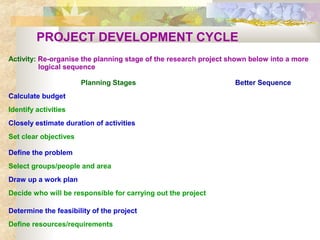
Activity: Re-organise the planning stage of the research project shown below into a more
logical sequence
Planning Stages Better Sequence
Calculate budget
Identify activities
Closely estimate duration of activities
Set clear objectives
Define the problem
Select groups/people and area
Draw up a work plan
Decide who will be responsible for carrying out the project
Determine the feasibility of the project
Define resources/requirements
PROJECT DEVELOPMENT CYCLE
PROJECT CYCLE
PROJECT
IMPLEMENTATION
PROJECT COMPLETION
End of project
Impact analysis
Project completion report
MANAGEMENT of
INFORMATION
(Project Control)
Monitoring Progress
Analysis of Variance
Annual Report
Reviews
Problem Identification
Project Definition
Setting of Objectives
Logic Diagram
Feasibility Studies
PROJECT IDENTIFICATION
(and Reformulation)
Work breakdown
Scheduling
Task allocation
Budget and accounts
Project management
Supervision
Coordination
PROJECT EXECUTION
Hiring of Consultants
Mobilization of manpower
Procurement
Disbursement of materials
Project Completion
Studies
PCR submission
Identify weaknesses
PMU/PIU
Logical Steps of Project Control
(management of information)
 Identify the key areas to be controlled (e.g.
time, costs)
 Set the control standard (e.g. how much,
how many and in what period of time)
 Execute the plan
 Measure the results (known as monitoring)
 Compare results with control standard
 Take corrective action if required
Identification of Project
Project concepts may evolve from:
 Investigative work completed by others (systematic
and comprehensive studies such as market
surveys, agricultural survey)
 Outcome of less fundamental approaches (such as
a decision to expand or replicate existing activities)
 Product of academic interest
 Whim of government leaders or the politically
influential
 Participatory problem assessment
Concept of Participatory Planning
Participatory Planning is a methodology,
which helps to identify problems and to plan
solutions with the active participation of the
stakeholders.
Participatory Planning
Key assumptions:
 People attached with a project will understand it
more fully
 People who are involved in planning a project will
be more motivated to make it work
 Plans developed in this way will be more realistic
because it is based on better knowledge and
capabilities
Participatory Planning Tools
(identification of problems)
 Problem tree
 Causal diagram
 Matrix ranking
 Preference ranking
 FGD
 Stakeholder analysis
Problem Analysis
Activity:
A large donor organization and the government
of a developing country are worried about
falling yields of the country’s main export crop.
A consultant has been hired to analyze the
situation and identify the problem. The
consultant interviewed several relevant people,
asking each about the problem. The different
perceptions of the problem by those
interviewed are shown in the report below:
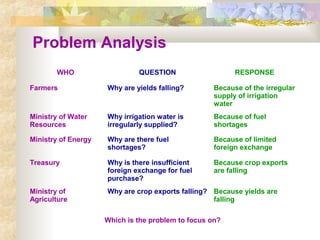
Problem Analysis
WHO QUESTION RESPONSE
Farmers Why are yields falling? Because of the irregular
supply of irrigation
water
Ministry of Water
Resources
Why irrigation water is
irregularly supplied?
Because of fuel
shortages
Ministry of Energy Why are there fuel
shortages?
Because of limited
foreign exchange
Treasury Why is there insufficient
foreign exchange for fuel
purchase?
Because crop exports
are falling
Ministry of
Agriculture
Why are crop exports falling? Because yields are
falling
Which is the problem to focus on?
Problem Analysis
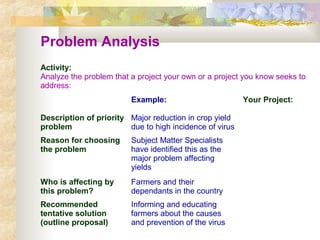
Activity:
Analyze the problem that a project your own or a project you know seeks to
address:
Example: Your Project:
Description of priority
problem
Major reduction in crop yield
due to high incidence of virus
Reason for choosing
the problem
Subject Matter Specialists
have identified this as the
major problem affecting
yields
Who is affecting by
this problem?
Farmers and their
dependants in the country
Recommended
tentative solution
(outline proposal)
Informing and educating
farmers about the causes
and prevention of the virus
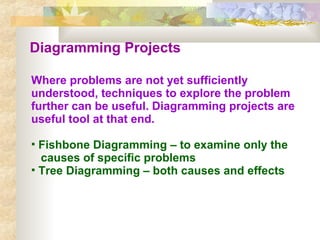
Where problems are not yet sufficiently
understood, techniques to explore the problem
further can be useful. Diagramming projects are
useful tool at that end.
 Fishbone Diagramming – to examine only the
causes of specific problems
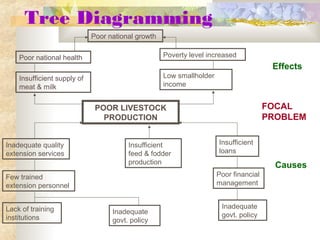
 Tree Diagramming – both causes and effects
Diagramming Projects
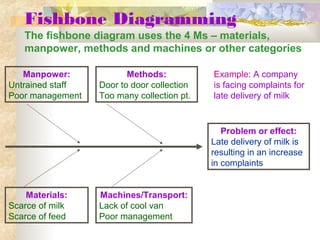
Fishbone Diagramming
The fishbone diagram uses the 4 Ms – materials,
manpower, methods and machines or other categories
Manpower:
Untrained staff
Poor management
Methods:
Door to door collection
Too many collection pt.
Materials:
Scarce of milk
Scarce of feed
Machines/Transport:
Lack of cool van
Poor management
Problem or effect:
Late delivery of milk is
resulting in an increase
in complaints
Example: A company
is facing complaints for
late delivery of milk
Tree Diagramming
POOR LIVESTOCK
PRODUCTION
Insufficient supply of
meat & milk
Low smallholder
income
Poor national health
Poor national growth
Poverty level increased
Inadequate quality
extension services
Insufficient
feed & fodder
production
Insufficient
loans
Few trained
extension personnel
Lack of training
institutions
Poor financial
management
Inadequate
govt. policyInadequate
govt. policy
Effects
Causes
FOCAL
PROBLEM
POOR LIVESTOCK
PRODUCTION
Insufficient supply of
meat & milk
Poor national health
Poor national growth
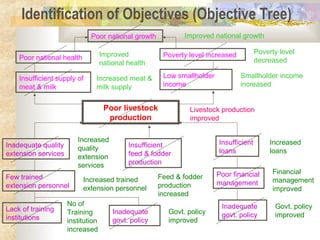
Identification of Objectives (Objective Tree)
Poor livestock
production
Insufficient supply of
meat & milk
Low smallholder
income
Poor national health
Poor national growth
Poverty level increased
Inadequate quality
extension services
Insufficient
feed & fodder
production
Insufficient
loans
Few trained
extension personnel
Lack of training
institutions
Poor financial
management
Inadequate
govt. policyInadequate
govt. policy
Increased
quality
extension
services
Increased trained
extension personnel
No of
Training
institution
increased
Govt. policy
improved
Govt. policy
improved
Increased
loans
Financial
management
improved
Feed & fodder
production
increased
Increased meat &
milk supply
Improved
national health
Smallholder income
increased
Poverty level
decreased
Improved national growth
Livestock production
improved
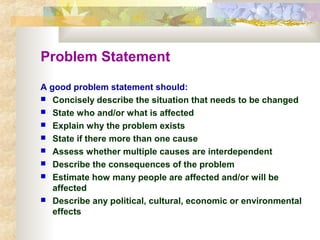
Problem Statement
A good problem statement should:
 Concisely describe the situation that needs to be changed
 State who and/or what is affected
 Explain why the problem exists
 State if there more than one cause
 Assess whether multiple causes are interdependent
 Describe the consequences of the problem
 Estimate how many people are affected and/or will be
affected
 Describe any political, cultural, economic or environmental
effects
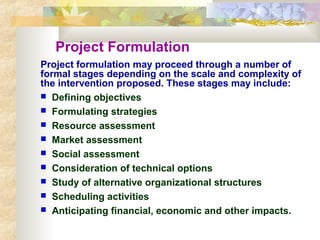
Project Formulation
Project formulation may proceed through a number of
formal stages depending on the scale and complexity of
the intervention proposed. These stages may include:
 Defining objectives
 Formulating strategies
 Resource assessment
 Market assessment
 Social assessment
 Consideration of technical options
 Study of alternative organizational structures
 Scheduling activities
 Anticipating financial, economic and other impacts.
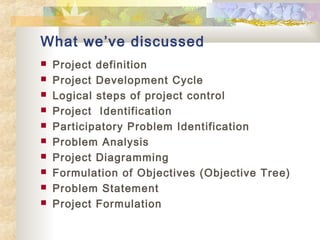
What we’ve discussed
 Project definition
 Project Development Cycle
 Logical steps of project control
 Project Identification
 Participatory Problem Identification
 Problem Analysis
 Project Diagramming
 Formulation of Objectives (Objective Tree)
 Problem Statement
 Project Formulation
An Introduction to Project Cycle Management

An Introduction to Project Cycle Management

  • 1.
    Project Cycle Management: AnIntroduction Dr. M. Nazrul Islam Professor, Agril Extn Edu. GTI, BAU, Mymensingh
  • 2.
    Brief overview  Projectdefinition  Project Development Cycle  Logical steps of project control  Project Identification  Participatory Problem Identification  Problem Analysis  Project Diagramming  Formulation of Objectives (Objective Tree)  Problem Statement  Project Formulation
  • 3.
    A project isa set of interrelated activities performed by a group of people in order to achieve its objectives within a limited time and resources. PROJECT DEVELOPMENT CYCLE Project Definition
  • 4.
    PROJECT DEVELOPMENT CYCLE Thefeasibility study is an integral part in developing a project
  • 5.
     IdentificationIdentification:: preliminaryidea creation, planning, and pre-feasibility studies to refine ideas.  DeliberationDeliberation:: formalization of group, conducting feasibility studies, and decision to proceed.  ImplementationImplementation:: securing capital, construction materials, obtaining permits, and hiring management and team  ExecutionExecution:: mobilization of manpower, equipment, and materials to carry out the plan.  EvaluationEvaluation:: determine what did and did not work (to plan again). PROJECT DEVELOPMENT CYCLE
  • 6.
    Activity: Re-organise theplanning stage of the research project shown below into a more logical sequence Planning Stages Better Sequence Calculate budget Identify activities Closely estimate duration of activities Set clear objectives Define the problem Select groups/people and area Draw up a work plan Decide who will be responsible for carrying out the project Determine the feasibility of the project Define resources/requirements PROJECT DEVELOPMENT CYCLE
  • 7.
    PROJECT CYCLE PROJECT IMPLEMENTATION PROJECT COMPLETION Endof project Impact analysis Project completion report MANAGEMENT of INFORMATION (Project Control) Monitoring Progress Analysis of Variance Annual Report Reviews Problem Identification Project Definition Setting of Objectives Logic Diagram Feasibility Studies PROJECT IDENTIFICATION (and Reformulation) Work breakdown Scheduling Task allocation Budget and accounts Project management Supervision Coordination PROJECT EXECUTION Hiring of Consultants Mobilization of manpower Procurement Disbursement of materials Project Completion Studies PCR submission Identify weaknesses PMU/PIU
  • 8.
    Logical Steps ofProject Control (management of information)  Identify the key areas to be controlled (e.g. time, costs)  Set the control standard (e.g. how much, how many and in what period of time)  Execute the plan  Measure the results (known as monitoring)  Compare results with control standard  Take corrective action if required
  • 9.
    Identification of Project Projectconcepts may evolve from:  Investigative work completed by others (systematic and comprehensive studies such as market surveys, agricultural survey)  Outcome of less fundamental approaches (such as a decision to expand or replicate existing activities)  Product of academic interest  Whim of government leaders or the politically influential  Participatory problem assessment
  • 10.
    Concept of ParticipatoryPlanning Participatory Planning is a methodology, which helps to identify problems and to plan solutions with the active participation of the stakeholders.
  • 11.
    Participatory Planning Key assumptions: People attached with a project will understand it more fully  People who are involved in planning a project will be more motivated to make it work  Plans developed in this way will be more realistic because it is based on better knowledge and capabilities
  • 12.
    Participatory Planning Tools (identificationof problems)  Problem tree  Causal diagram  Matrix ranking  Preference ranking  FGD  Stakeholder analysis
  • 13.
    Problem Analysis Activity: A largedonor organization and the government of a developing country are worried about falling yields of the country’s main export crop. A consultant has been hired to analyze the situation and identify the problem. The consultant interviewed several relevant people, asking each about the problem. The different perceptions of the problem by those interviewed are shown in the report below:
  • 14.
    Problem Analysis WHO QUESTIONRESPONSE Farmers Why are yields falling? Because of the irregular supply of irrigation water Ministry of Water Resources Why irrigation water is irregularly supplied? Because of fuel shortages Ministry of Energy Why are there fuel shortages? Because of limited foreign exchange Treasury Why is there insufficient foreign exchange for fuel purchase? Because crop exports are falling Ministry of Agriculture Why are crop exports falling? Because yields are falling Which is the problem to focus on?
  • 15.
    Problem Analysis Activity: Analyze theproblem that a project your own or a project you know seeks to address: Example: Your Project: Description of priority problem Major reduction in crop yield due to high incidence of virus Reason for choosing the problem Subject Matter Specialists have identified this as the major problem affecting yields Who is affecting by this problem? Farmers and their dependants in the country Recommended tentative solution (outline proposal) Informing and educating farmers about the causes and prevention of the virus
  • 16.
    Where problems arenot yet sufficiently understood, techniques to explore the problem further can be useful. Diagramming projects are useful tool at that end.  Fishbone Diagramming – to examine only the causes of specific problems  Tree Diagramming – both causes and effects Diagramming Projects
  • 17.
    Fishbone Diagramming The fishbonediagram uses the 4 Ms – materials, manpower, methods and machines or other categories Manpower: Untrained staff Poor management Methods: Door to door collection Too many collection pt. Materials: Scarce of milk Scarce of feed Machines/Transport: Lack of cool van Poor management Problem or effect: Late delivery of milk is resulting in an increase in complaints Example: A company is facing complaints for late delivery of milk
  • 18.
    Tree Diagramming POOR LIVESTOCK PRODUCTION Insufficientsupply of meat & milk Low smallholder income Poor national health Poor national growth Poverty level increased Inadequate quality extension services Insufficient feed & fodder production Insufficient loans Few trained extension personnel Lack of training institutions Poor financial management Inadequate govt. policyInadequate govt. policy Effects Causes FOCAL PROBLEM POOR LIVESTOCK PRODUCTION Insufficient supply of meat & milk Poor national health Poor national growth
  • 19.
    Identification of Objectives(Objective Tree) Poor livestock production Insufficient supply of meat & milk Low smallholder income Poor national health Poor national growth Poverty level increased Inadequate quality extension services Insufficient feed & fodder production Insufficient loans Few trained extension personnel Lack of training institutions Poor financial management Inadequate govt. policyInadequate govt. policy Increased quality extension services Increased trained extension personnel No of Training institution increased Govt. policy improved Govt. policy improved Increased loans Financial management improved Feed & fodder production increased Increased meat & milk supply Improved national health Smallholder income increased Poverty level decreased Improved national growth Livestock production improved
  • 20.
    Problem Statement A goodproblem statement should:  Concisely describe the situation that needs to be changed  State who and/or what is affected  Explain why the problem exists  State if there more than one cause  Assess whether multiple causes are interdependent  Describe the consequences of the problem  Estimate how many people are affected and/or will be affected  Describe any political, cultural, economic or environmental effects
  • 21.
    Project Formulation Project formulationmay proceed through a number of formal stages depending on the scale and complexity of the intervention proposed. These stages may include:  Defining objectives  Formulating strategies  Resource assessment  Market assessment  Social assessment  Consideration of technical options  Study of alternative organizational structures  Scheduling activities  Anticipating financial, economic and other impacts.
  • 22.
    What we’ve discussed Project definition  Project Development Cycle  Logical steps of project control  Project Identification  Participatory Problem Identification  Problem Analysis  Project Diagramming  Formulation of Objectives (Objective Tree)  Problem Statement  Project Formulation