Introduction to  Participatory Project Planning For the betterment of  your project proposal
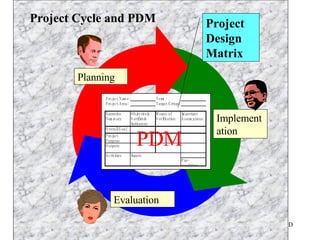
Project Cycle and PDM Planning Implementation Evaluation Project Cycle and PDM Project  Design Matrix PDM
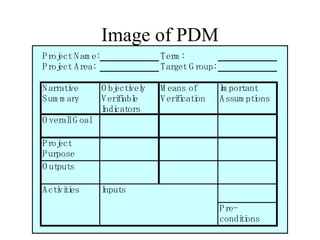
Image of PDM
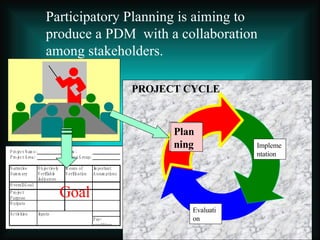
Participatory Planning is aiming to produce a PDM  with a collaboration among stakeholders. Planning Implementation Evaluation PROJECT CYCLE Planning Goal
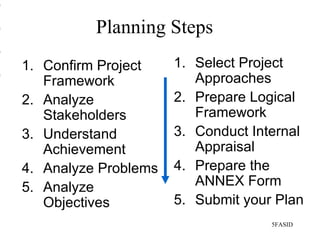
Planning Steps Confirm Project Framework Analyze Stakeholders  Understand Achievement Analyze Problems Analyze Objectives Select Project Approaches Prepare Logical Framework Conduct Internal Appraisal Prepare the ANNEX Form Submit your Plan
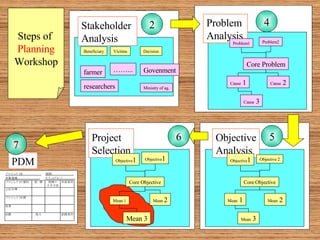
Stakeholder  Analysis Problem  Analysis Objective Analysis Project Selection PDM Steps of  Planning Workshop Beneficiary Victims Decision Govenment Ministry of ag. farmer researchers …… ... Stakeholder  Analysis 2 Cause  1 Core Problem Cause  2 Problem  Analysis Problem1 Problem2 Cause  3 4 Mean  1 Core Objective Mean  2 Objective Analysis Objective 1 Objective 2 Mean  3 5 Mean 1 Core Objective Mean  2 Project  Selection Objective 1 Objective 1 Mean 3 6 PDM 7
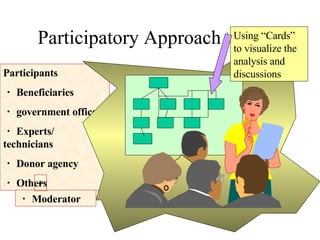
Participatory Approach Participants ・ Beneficiaries  ・ government officers ・ Experts/ technicians ・ Donor agency  ・ Others ・ Moderator + Using “Cards” to visualize the analysis and discussions
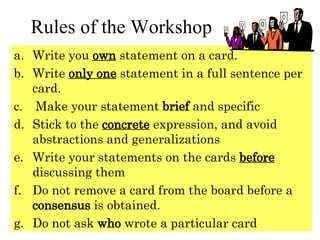
Rules of the Workshop Write you  own   statement on a card. Write  only one  statement in a full sentence per card. Make your statement  brief  and specific Stick to the  concrete  expression, and avoid abstractions and generalizations Write your statements on the cards  before  discussing them Do not remove a card from the board before a  consensus  is obtained. Do not ask  who  wrote a particular card
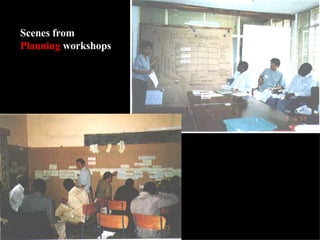
Scenes from  Planning  workshops
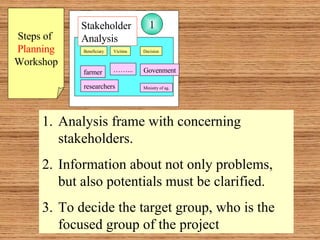
Stakeholder  Analysis Steps of  Planning Workshop Analysis frame with concerning stakeholders. Information about not only problems, but also potentials must be clarified.  To decide the target group, who is the focused group of the project  Beneficiary Victims Decision Govenment Ministry of ag. farmer researchers …… ... Stakeholder  Analysis 1
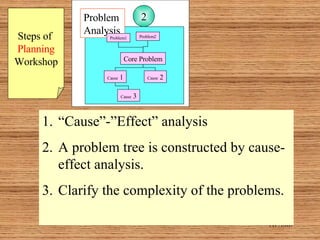
Steps of  Planning Workshop “ Cause”-”Effect” analysis A problem tree is constructed by cause-effect analysis. Clarify the complexity of the problems. Problem  Analysis Cause  1 Core Problem Cause  2 Problem  Analysis Problem1 Problem2 Cause  3 2
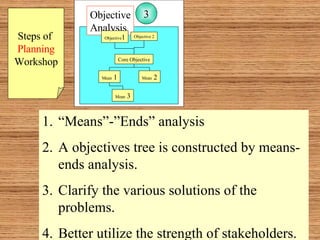
Steps of  Planning Workshop “ Means”-”Ends” analysis A objectives tree is constructed by means-ends analysis. Clarify the various solutions of the problems. Better utilize the strength of stakeholders. Objective Analysis Mean  1 Core Objective Mean  2 Objective Analysis Objective 1 Objective 2 Mean  3 3
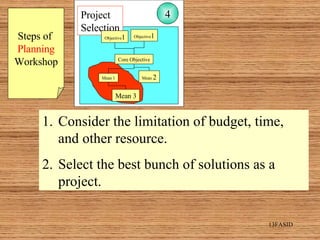
Steps of  Planning Workshop Consider the limitation of budget, time, and other resource. Select the best bunch of solutions as a project. Project Selection Mean 1 Core Objective Mean  2 Project  Selection Objective 1 Objective 1 Mean 3 4
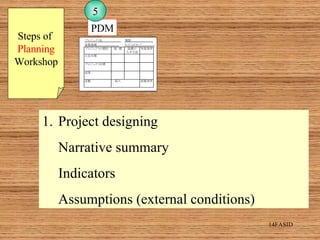
Steps of  Planning Workshop Project designing Narrative summary Indicators Assumptions (external conditions) PDM PDM 5
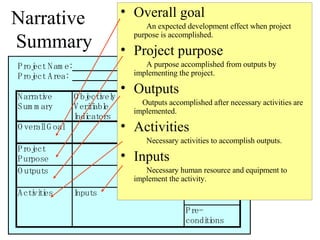
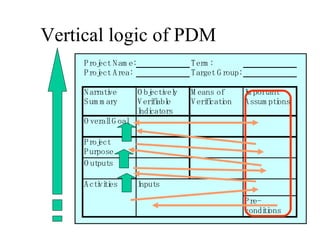
Narrative  Summary Overall goal     An expected development effect when project purpose is accomplished. Project purpose     A purpose accomplished from outputs by implementing the project. Outputs     Outputs accomplished after necessary activities are implemented. Activities     Necessary activities to accomplish outputs. Inputs     Necessary human resource and equipment to implement the activity.
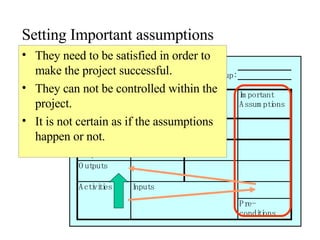
Setting Important assumptions They need to be satisfied in order to make the project successful.  They can not be controlled within the project. It is not certain as if the assumptions happen or not.    
Vertical logic of PDM
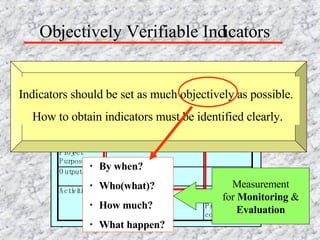
Objectively Verifiable Indicators ・ By when? ・ Who(what)? ・ How much? ・ What happen? Measurement for  Monitoring  & Evaluation Indicators should be set as much objectively as possible.  How to obtain indicators must be identified clearly.
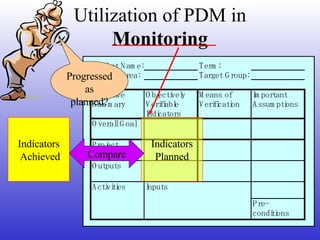
Utilization of PDM in  Monitoring Indicators Achieved Indicators Planned Compare Progressed as planned?
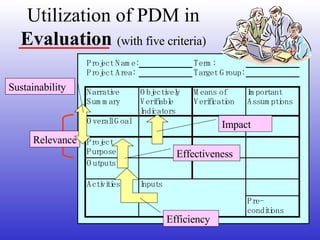
Utilization of PDM in  Evaluation  (with five criteria) Efficiency Effectiveness Impact Relevance Sustainability
For further information; There are several learning materials available in websites of World Bank http://www-wds.worldbank.org/servlet/WDS_IBank_Servlet?pcont=details&eid=000160016_20050607122225 “ The logframe handbook : a logical framework approach to project cycle management, Vol. 1 of 1 “ Asian Development Bank http://www.adb.org/Documents/Guidelines/Logical_Framework/default.asp “ Using the Logical Framework for Sector Analysis and Project Design: A User's Guide”

Participatory project planning

  • 1.
    Introduction to Participatory Project Planning For the betterment of your project proposal
  • 2.
    Project Cycle andPDM Planning Implementation Evaluation Project Cycle and PDM Project Design Matrix PDM
  • 3.
  • 4.
    Participatory Planning isaiming to produce a PDM with a collaboration among stakeholders. Planning Implementation Evaluation PROJECT CYCLE Planning Goal
  • 5.
    Planning Steps ConfirmProject Framework Analyze Stakeholders Understand Achievement Analyze Problems Analyze Objectives Select Project Approaches Prepare Logical Framework Conduct Internal Appraisal Prepare the ANNEX Form Submit your Plan
  • 6.
    Stakeholder AnalysisProblem Analysis Objective Analysis Project Selection PDM Steps of Planning Workshop Beneficiary Victims Decision Govenment Ministry of ag. farmer researchers …… ... Stakeholder Analysis 2 Cause 1 Core Problem Cause 2 Problem Analysis Problem1 Problem2 Cause 3 4 Mean 1 Core Objective Mean 2 Objective Analysis Objective 1 Objective 2 Mean 3 5 Mean 1 Core Objective Mean 2 Project Selection Objective 1 Objective 1 Mean 3 6 PDM 7
  • 7.
    Participatory Approach Participants・ Beneficiaries ・ government officers ・ Experts/ technicians ・ Donor agency ・ Others ・ Moderator + Using “Cards” to visualize the analysis and discussions
  • 8.
    Rules of theWorkshop Write you own statement on a card. Write only one statement in a full sentence per card. Make your statement brief and specific Stick to the concrete expression, and avoid abstractions and generalizations Write your statements on the cards before discussing them Do not remove a card from the board before a consensus is obtained. Do not ask who wrote a particular card
  • 9.
    Scenes from Planning workshops
  • 10.
    Stakeholder AnalysisSteps of Planning Workshop Analysis frame with concerning stakeholders. Information about not only problems, but also potentials must be clarified. To decide the target group, who is the focused group of the project Beneficiary Victims Decision Govenment Ministry of ag. farmer researchers …… ... Stakeholder Analysis 1
  • 11.
    Steps of Planning Workshop “ Cause”-”Effect” analysis A problem tree is constructed by cause-effect analysis. Clarify the complexity of the problems. Problem Analysis Cause 1 Core Problem Cause 2 Problem Analysis Problem1 Problem2 Cause 3 2
  • 12.
    Steps of Planning Workshop “ Means”-”Ends” analysis A objectives tree is constructed by means-ends analysis. Clarify the various solutions of the problems. Better utilize the strength of stakeholders. Objective Analysis Mean 1 Core Objective Mean 2 Objective Analysis Objective 1 Objective 2 Mean 3 3
  • 13.
    Steps of Planning Workshop Consider the limitation of budget, time, and other resource. Select the best bunch of solutions as a project. Project Selection Mean 1 Core Objective Mean 2 Project Selection Objective 1 Objective 1 Mean 3 4
  • 14.
    Steps of Planning Workshop Project designing Narrative summary Indicators Assumptions (external conditions) PDM PDM 5
  • 15.
    Narrative SummaryOverall goal     An expected development effect when project purpose is accomplished. Project purpose     A purpose accomplished from outputs by implementing the project. Outputs    Outputs accomplished after necessary activities are implemented. Activities     Necessary activities to accomplish outputs. Inputs     Necessary human resource and equipment to implement the activity.
  • 16.
    Setting Important assumptionsThey need to be satisfied in order to make the project successful. They can not be controlled within the project. It is not certain as if the assumptions happen or not.    
  • 17.
  • 18.
    Objectively Verifiable Indicators・ By when? ・ Who(what)? ・ How much? ・ What happen? Measurement for Monitoring & Evaluation Indicators should be set as much objectively as possible. How to obtain indicators must be identified clearly.
  • 19.
    Utilization of PDMin Monitoring Indicators Achieved Indicators Planned Compare Progressed as planned?
  • 20.
    Utilization of PDMin Evaluation (with five criteria) Efficiency Effectiveness Impact Relevance Sustainability
  • 21.
    For further information;There are several learning materials available in websites of World Bank http://www-wds.worldbank.org/servlet/WDS_IBank_Servlet?pcont=details&eid=000160016_20050607122225 “ The logframe handbook : a logical framework approach to project cycle management, Vol. 1 of 1 “ Asian Development Bank http://www.adb.org/Documents/Guidelines/Logical_Framework/default.asp “ Using the Logical Framework for Sector Analysis and Project Design: A User's Guide”

Editor's Notes

  • #2 Introduction to PCM Welcome to the introduction to PCM. This automatic presentation will give you a brief introduction of PCM. The presentation proceeds automatically. So just sit back and relax. Please enjoy the world of the new tool improving your projects. Let’s start!