Completing the Audit 
Chapter 24 
©2005 Prentice Hall Business Publishing, Auditing and Assurance Services 10/e, Arens/Elder/Beasley 24 - 1
Learning Objective 1 
Conduct a review for contingent 
liabilities and commitments. 
©2005 Prentice Hall Business Publishing, Auditing and Assurance Services 10/e, Arens/Elder/Beasley 24 - 2
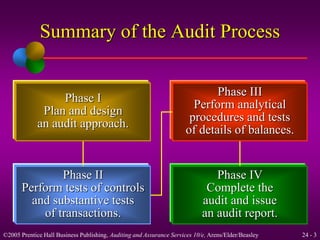
Summary of the Audit Process 
Phase I 
Plan and design 
an audit approach. 
Phase II 
Perform tests of controls 
and substantive tests 
of transactions. 
Phase III 
Perform analytical 
procedures and tests 
of details of balances. 
Phase IV 
Complete the 
audit and issue 
an audit report. 
©2005 Prentice Hall Business Publishing, Auditing and Assurance Services 10/e, Arens/Elder/Beasley 24 - 3
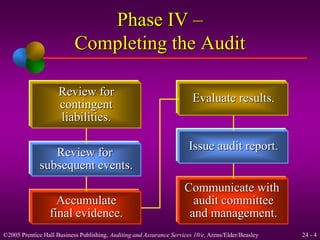
Phase IV – 
Completing the Audit 
Review for 
contingent 
liabilities. 
Review for 
subsequent events. 
Accumulate 
final evidence. 
Evaluate results. 
Issue audit report. 
Communicate with 
audit committee 
and management. 
©2005 Prentice Hall Business Publishing, Auditing and Assurance Services 10/e, Arens/Elder/Beasley 24 - 4
Contingent Liabilities 
A contingent liability is potential future 
obligation to an outside party for an 
unknown amount resulting from 
activities that have already taken place. 
©2005 Prentice Hall Business Publishing, Auditing and Assurance Services 10/e, Arens/Elder/Beasley 24 - 5
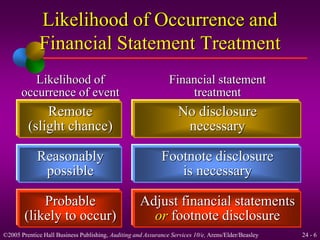
Likelihood of Occurrence and 
Financial Statement Treatment 
Likelihood of 
occurrence of event 
Remote 
(slight chance) 
Reasonably 
possible 
Financial statement 
treatment 
No disclosure 
necessary 
Footnote disclosure 
is necessary 
Probable 
(likely to occur) 
Adjust financial statements 
or footnote disclosure 
©2005 Prentice Hall Business Publishing, Auditing and Assurance Services 10/e, Arens/Elder/Beasley 24 - 6
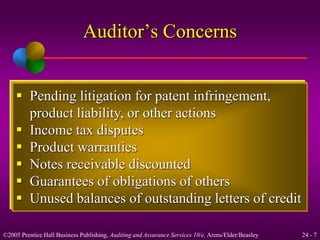
Auditor’s Concerns 
 Pending litigation for patent infringement, 
product liability, or other actions 
 Income tax disputes 
 Product warranties 
 Notes receivable discounted 
 Guarantees of obligations of others 
 Unused balances of outstanding letters of credit 
©2005 Prentice Hall Business Publishing, Auditing and Assurance Services 10/e, Arens/Elder/Beasley 24 - 7
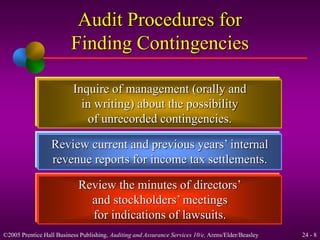
Audit Procedures for 
Finding Contingencies 
Inquire of management (orally and 
in writing) about the possibility 
of unrecorded contingencies. 
Review current and previous years’ internal 
revenue reports for income tax settlements. 
Review the minutes of directors’ 
and stockholders’ meetings 
for indications of lawsuits. 
©2005 Prentice Hall Business Publishing, Auditing and Assurance Services 10/e, Arens/Elder/Beasley 24 - 8
Audit Procedures for 
Finding Contingencies 
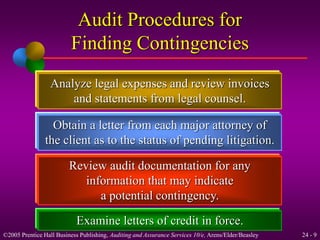
Analyze legal expenses and review invoices 
and statements from legal counsel. 
Obtain a letter from each major attorney of 
the client as to the status of pending litigation. 
Review audit documentation for any 
information that may indicate 
a potential contingency. 
Examine letters of credit in force. 
©2005 Prentice Hall Business Publishing, Auditing and Assurance Services 10/e, Arens/Elder/Beasley 24 - 9
Learning Objective 2 
Obtain and evaluate letters 
from the client’s attorneys. 
©2005 Prentice Hall Business Publishing, Auditing and Assurance Services 10/e, Arens/Elder/Beasley 24 - 10
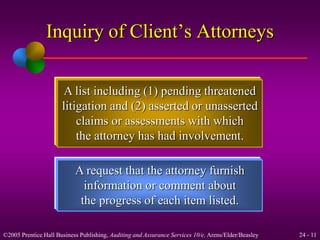
Inquiry of Client’s Attorneys 
A list including (1) pending threatened 
litigation and (2) asserted or unasserted 
claims or assessments with which 
the attorney has had involvement. 
A request that the attorney furnish 
information or comment about 
the progress of each item listed. 
©2005 Prentice Hall Business Publishing, Auditing and Assurance Services 10/e, Arens/Elder/Beasley 24 - 11
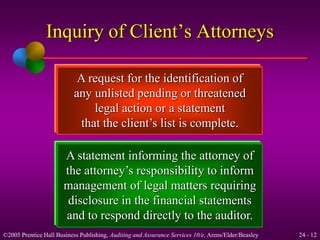
Inquiry of Client’s Attorneys 
A request for the identification of 
any unlisted pending or threatened 
legal action or a statement 
that the client’s list is complete. 
A statement informing the attorney of 
the attorney’s responsibility to inform 
management of legal matters requiring 
disclosure in the financial statements 
and to respond directly to the auditor. 
©2005 Prentice Hall Business Publishing, Auditing and Assurance Services 10/e, Arens/Elder/Beasley 24 - 12
Sarbanes-Oxley Act 
Congress included provisions in this Act directing 
the SEC to use rules requiring attorneys serving 
public companies to report material violations 
by the company of federal securities laws. 
The American Bar Association amended 
its attorney-client confidentiality rules to 
permit attorneys to breach confidentiality 
if a client is committing a crime or fraud. 
©2005 Prentice Hall Business Publishing, Auditing and Assurance Services 10/e, Arens/Elder/Beasley 24 - 13
Learning Objective 3 
Conduct a post-balance-sheet 
review for subsequent events. 
©2005 Prentice Hall Business Publishing, Auditing and Assurance Services 10/e, Arens/Elder/Beasley 24 - 14
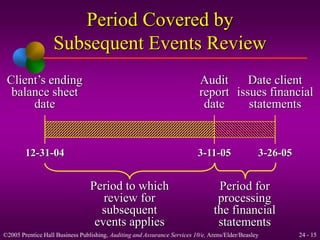
Period Covered by 
Subsequent Events Review 
Client’s ending 
balance sheet 
date 
12-31-04 
Date client 
issues financial 
statements 
3-26-05 
Audit 
report 
date 
3-11-05 
Period to which 
review for 
subsequent 
events applies 
Period for 
processing 
the financial 
statements 
©2005 Prentice Hall Business Publishing, Auditing and Assurance Services 10/e, Arens/Elder/Beasley 24 - 15
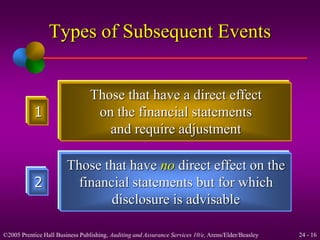
Types of Subsequent Events 
1 
Those that have a direct effect 
on the financial statements 
and require adjustment 
2 
Those that have no direct effect on the 
financial statements but for which 
disclosure is advisable 
©2005 Prentice Hall Business Publishing, Auditing and Assurance Services 10/e, Arens/Elder/Beasley 24 - 16
Requiring Adjustment 
 Declaration of bankruptcy by a customer 
with an accounts receivable balance 
 Settlement of a litigation at an amount different 
from the amount recorded on the books 
 Disposal of equipment not being used in 
operations at a price below the current book value 
 Sale of investments at a price below recorded cost 
©2005 Prentice Hall Business Publishing, Auditing and Assurance Services 10/e, Arens/Elder/Beasley 24 - 17
Advisability of Disclosure 
 Decline in the market value of securities held 
for temporary investment or resale 
 Issuance of bonds or equity securities 
 Decline in the market value of inventory as 
consequence of government action barring 
further sale of a product 
 Uninsured loss of inventories as a result of fire 
 A merger or an acquisition 
©2005 Prentice Hall Business Publishing, Auditing and Assurance Services 10/e, Arens/Elder/Beasley 24 - 18
Audit Tests 
 Inquire of management 
 Correspond with attorneys 
 Review internal statements prepared 
subsequent to the balance sheet date 
 Review records prepared subsequent 
to the balance sheet date 
 Examine minutes issued subsequent 
to the balance sheet date 
 Obtain a letter of representation 
©2005 Prentice Hall Business Publishing, Auditing and Assurance Services 10/e, Arens/Elder/Beasley 24 - 19
Dual Dating 
The first date is the date for the 
completion of field work except 
for a specific exception. 
The second date, which is always 
later, deals with the exception. 
©2005 Prentice Hall Business Publishing, Auditing and Assurance Services 10/e, Arens/Elder/Beasley 24 - 20
Learning Objective 4 
Design and perform the final steps 
in the evidence-accumulation 
segment of the audit. 
©2005 Prentice Hall Business Publishing, Auditing and Assurance Services 10/e, Arens/Elder/Beasley 24 - 21
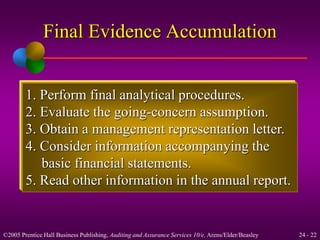
Final Evidence Accumulation 
1. Perform final analytical procedures. 
2. Evaluate the going-concern assumption. 
3. Obtain a management representation letter. 
4. Consider information accompanying the 
basic financial statements. 
5. Read other information in the annual report. 
©2005 Prentice Hall Business Publishing, Auditing and Assurance Services 10/e, Arens/Elder/Beasley 24 - 22
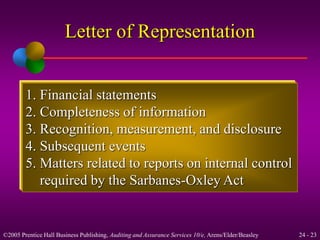
Letter of Representation 
1. Financial statements 
2. Completeness of information 
3. Recognition, measurement, and disclosure 
4. Subsequent events 
5. Matters related to reports on internal control 
required by the Sarbanes-Oxley Act 
©2005 Prentice Hall Business Publishing, Auditing and Assurance Services 10/e, Arens/Elder/Beasley 24 - 23
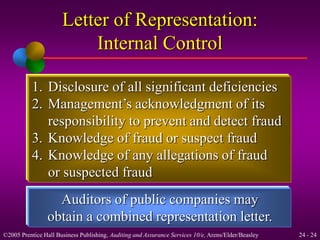
Letter of Representation: 
Internal Control 
1. Disclosure of all significant deficiencies 
2. Management’s acknowledgment of its 
responsibility to prevent and detect fraud 
3. Knowledge of fraud or suspect fraud 
4. Knowledge of any allegations of fraud 
or suspected fraud 
Auditors of public companies may 
obtain a combined representation letter. 
©2005 Prentice Hall Business Publishing, Auditing and Assurance Services 10/e, Arens/Elder/Beasley 24 - 24
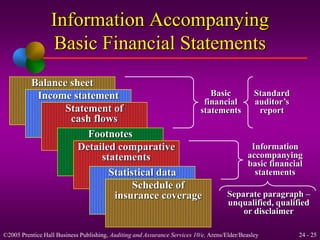
Information Accompanying 
Basic Financial Statements 
Balance sheet 
Income statement 
Statement of 
cash flows 
Footnotes 
Detailed comparative 
statements 
Statistical data 
Schedule of 
Basic 
financial 
statements 
insurance coverage 
Standard 
auditor’s 
report 
Information 
accompanying 
basic financial 
statements 
Separate paragraph – 
unqualified, qualified 
or disclaimer 
©2005 Prentice Hall Business Publishing, Auditing and Assurance Services 10/e, Arens/Elder/Beasley 24 - 25
Learning Objective 5 
Integrate the audit evidence 
gathered, and evaluate the 
overall audit results. 
©2005 Prentice Hall Business Publishing, Auditing and Assurance Services 10/e, Arens/Elder/Beasley 24 - 26
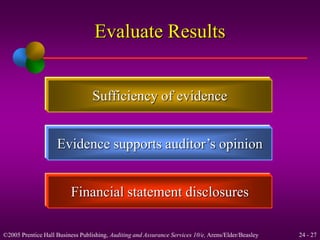
Evaluate Results 
Sufficiency of evidence 
Evidence supports auditor’s opinion 
Financial statement disclosures 
©2005 Prentice Hall Business Publishing, Auditing and Assurance Services 10/e, Arens/Elder/Beasley 24 - 27
Evaluate Results 
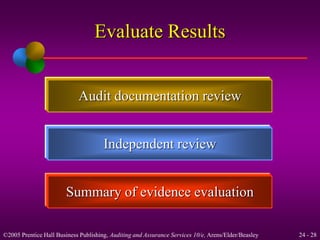
Audit documentation review 
Independent review 
Summary of evidence evaluation 
©2005 Prentice Hall Business Publishing, Auditing and Assurance Services 10/e, Arens/Elder/Beasley 24 - 28
YES NO 
Completing the 
Engagement Checklist 
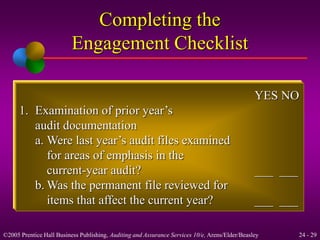
1. Examination of prior year’s 
audit documentation 
a. Were last year’s audit files examined 
for areas of emphasis in the 
current-year audit? ___ ___ 
b.Was the permanent file reviewed for 
items that affect the current year? ___ ___ 
©2005 Prentice Hall Business Publishing, Auditing and Assurance Services 10/e, Arens/Elder/Beasley 24 - 29
YES NO 
Completing the 
Engagement Checklist 
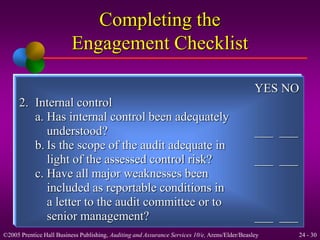
2. Internal control 
a. Has internal control been adequately 
understood? ___ ___ 
b. Is the scope of the audit adequate in 
light of the assessed control risk? ___ ___ 
c. Have all major weaknesses been 
included as reportable conditions in 
a letter to the audit committee or to 
senior management? ___ ___ 
©2005 Prentice Hall Business Publishing, Auditing and Assurance Services 10/e, Arens/Elder/Beasley 24 - 30
YES NO 
Completing the 
Engagement Checklist 
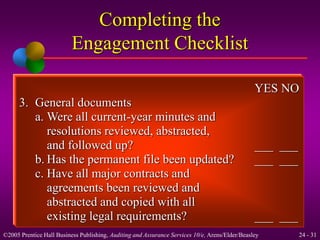
3. General documents 
a. Were all current-year minutes and 
resolutions reviewed, abstracted, 
and followed up? ___ ___ 
b. Has the permanent file been updated? ___ ___ 
c. Have all major contracts and 
agreements been reviewed and 
abstracted and copied with all 
existing legal requirements? ___ ___ 
©2005 Prentice Hall Business Publishing, Auditing and Assurance Services 10/e, Arens/Elder/Beasley 24 - 31
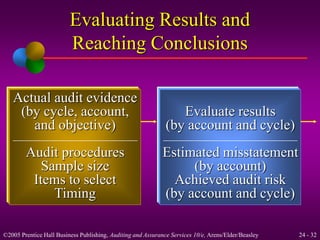
Evaluating Results and 
Reaching Conclusions 
Actual audit evidence 
(by cycle, account, 
and objective) 
Audit procedures 
Sample size 
Items to select 
Timing 
Evaluate results 
(by account and cycle) 
Estimated misstatement 
(by account) 
Achieved audit risk 
(by account and cycle) 
©2005 Prentice Hall Business Publishing, Auditing and Assurance Services 10/e, Arens/Elder/Beasley 24 - 32
Evaluating Results and 
Reaching Conclusions 
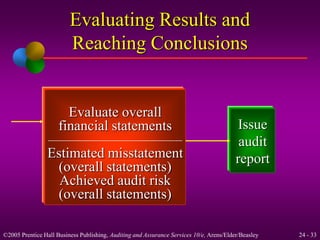
Evaluate overall 
financial statements 
Estimated misstatement 
(overall statements) 
Achieved audit risk 
(overall statements) 
Issue 
audit 
report 
©2005 Prentice Hall Business Publishing, Auditing and Assurance Services 10/e, Arens/Elder/Beasley 24 - 33
Issue the Audit Report 
The audit report is the only thing that most users 
see in the audit process and the consequences of 
issuing an inappropriate report can be severe. 
©2005 Prentice Hall Business Publishing, Auditing and Assurance Services 10/e, Arens/Elder/Beasley 24 - 34
Learning Objective 6 
Communicate effectively with the 
audit committee and management. 
©2005 Prentice Hall Business Publishing, Auditing and Assurance Services 10/e, Arens/Elder/Beasley 24 - 35
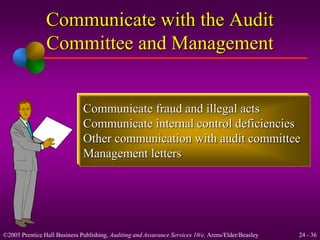
Communicate with the Audit 
Committee and Management 
Communicate fraud and illegal acts 
Communicate internal control deficiencies 
Other communication with audit committee 
Management letters 
©2005 Prentice Hall Business Publishing, Auditing and Assurance Services 10/e, Arens/Elder/Beasley 24 - 36
Learning Objective 7 
Identify the auditor’s 
responsibilities when 
facts affecting the audit 
report are discovered 
after its issuance. 
©2005 Prentice Hall Business Publishing, Auditing and Assurance Services 10/e, Arens/Elder/Beasley 24 - 37
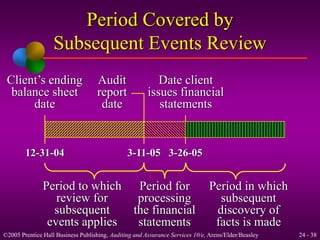
Period Covered by 
Subsequent Events Review 
Date client 
issues financial 
statements 
3-26-05 
Client’s ending 
balance sheet 
date 
12-31-04 
Audit 
report 
date 
Period to which 
review for 
subsequent 
events applies 
3-11-05 
Period for 
processing 
the financial 
statements 
Period in which 
subsequent 
discovery of 
facts is made 
©2005 Prentice Hall Business Publishing, Auditing and Assurance Services 10/e, Arens/Elder/Beasley 24 - 38
End of Chapter 24 
©2005 Prentice Hall Business Publishing, Auditing and Assurance Services 10/e, Arens/Elder/Beasley 24 - 39

Completing the audit

  • 1.
    Completing the Audit Chapter 24 ©2005 Prentice Hall Business Publishing, Auditing and Assurance Services 10/e, Arens/Elder/Beasley 24 - 1
  • 2.
    Learning Objective 1 Conduct a review for contingent liabilities and commitments. ©2005 Prentice Hall Business Publishing, Auditing and Assurance Services 10/e, Arens/Elder/Beasley 24 - 2
  • 3.
    Summary of theAudit Process Phase I Plan and design an audit approach. Phase II Perform tests of controls and substantive tests of transactions. Phase III Perform analytical procedures and tests of details of balances. Phase IV Complete the audit and issue an audit report. ©2005 Prentice Hall Business Publishing, Auditing and Assurance Services 10/e, Arens/Elder/Beasley 24 - 3
  • 4.
    Phase IV – Completing the Audit Review for contingent liabilities. Review for subsequent events. Accumulate final evidence. Evaluate results. Issue audit report. Communicate with audit committee and management. ©2005 Prentice Hall Business Publishing, Auditing and Assurance Services 10/e, Arens/Elder/Beasley 24 - 4
  • 5.
    Contingent Liabilities Acontingent liability is potential future obligation to an outside party for an unknown amount resulting from activities that have already taken place. ©2005 Prentice Hall Business Publishing, Auditing and Assurance Services 10/e, Arens/Elder/Beasley 24 - 5
  • 6.
    Likelihood of Occurrenceand Financial Statement Treatment Likelihood of occurrence of event Remote (slight chance) Reasonably possible Financial statement treatment No disclosure necessary Footnote disclosure is necessary Probable (likely to occur) Adjust financial statements or footnote disclosure ©2005 Prentice Hall Business Publishing, Auditing and Assurance Services 10/e, Arens/Elder/Beasley 24 - 6
  • 7.
    Auditor’s Concerns Pending litigation for patent infringement, product liability, or other actions  Income tax disputes  Product warranties  Notes receivable discounted  Guarantees of obligations of others  Unused balances of outstanding letters of credit ©2005 Prentice Hall Business Publishing, Auditing and Assurance Services 10/e, Arens/Elder/Beasley 24 - 7
  • 8.
    Audit Procedures for Finding Contingencies Inquire of management (orally and in writing) about the possibility of unrecorded contingencies. Review current and previous years’ internal revenue reports for income tax settlements. Review the minutes of directors’ and stockholders’ meetings for indications of lawsuits. ©2005 Prentice Hall Business Publishing, Auditing and Assurance Services 10/e, Arens/Elder/Beasley 24 - 8
  • 9.
    Audit Procedures for Finding Contingencies Analyze legal expenses and review invoices and statements from legal counsel. Obtain a letter from each major attorney of the client as to the status of pending litigation. Review audit documentation for any information that may indicate a potential contingency. Examine letters of credit in force. ©2005 Prentice Hall Business Publishing, Auditing and Assurance Services 10/e, Arens/Elder/Beasley 24 - 9
  • 10.
    Learning Objective 2 Obtain and evaluate letters from the client’s attorneys. ©2005 Prentice Hall Business Publishing, Auditing and Assurance Services 10/e, Arens/Elder/Beasley 24 - 10
  • 11.
    Inquiry of Client’sAttorneys A list including (1) pending threatened litigation and (2) asserted or unasserted claims or assessments with which the attorney has had involvement. A request that the attorney furnish information or comment about the progress of each item listed. ©2005 Prentice Hall Business Publishing, Auditing and Assurance Services 10/e, Arens/Elder/Beasley 24 - 11
  • 12.
    Inquiry of Client’sAttorneys A request for the identification of any unlisted pending or threatened legal action or a statement that the client’s list is complete. A statement informing the attorney of the attorney’s responsibility to inform management of legal matters requiring disclosure in the financial statements and to respond directly to the auditor. ©2005 Prentice Hall Business Publishing, Auditing and Assurance Services 10/e, Arens/Elder/Beasley 24 - 12
  • 13.
    Sarbanes-Oxley Act Congressincluded provisions in this Act directing the SEC to use rules requiring attorneys serving public companies to report material violations by the company of federal securities laws. The American Bar Association amended its attorney-client confidentiality rules to permit attorneys to breach confidentiality if a client is committing a crime or fraud. ©2005 Prentice Hall Business Publishing, Auditing and Assurance Services 10/e, Arens/Elder/Beasley 24 - 13
  • 14.
    Learning Objective 3 Conduct a post-balance-sheet review for subsequent events. ©2005 Prentice Hall Business Publishing, Auditing and Assurance Services 10/e, Arens/Elder/Beasley 24 - 14
  • 15.
    Period Covered by Subsequent Events Review Client’s ending balance sheet date 12-31-04 Date client issues financial statements 3-26-05 Audit report date 3-11-05 Period to which review for subsequent events applies Period for processing the financial statements ©2005 Prentice Hall Business Publishing, Auditing and Assurance Services 10/e, Arens/Elder/Beasley 24 - 15
  • 16.
    Types of SubsequentEvents 1 Those that have a direct effect on the financial statements and require adjustment 2 Those that have no direct effect on the financial statements but for which disclosure is advisable ©2005 Prentice Hall Business Publishing, Auditing and Assurance Services 10/e, Arens/Elder/Beasley 24 - 16
  • 17.
    Requiring Adjustment Declaration of bankruptcy by a customer with an accounts receivable balance  Settlement of a litigation at an amount different from the amount recorded on the books  Disposal of equipment not being used in operations at a price below the current book value  Sale of investments at a price below recorded cost ©2005 Prentice Hall Business Publishing, Auditing and Assurance Services 10/e, Arens/Elder/Beasley 24 - 17
  • 18.
    Advisability of Disclosure  Decline in the market value of securities held for temporary investment or resale  Issuance of bonds or equity securities  Decline in the market value of inventory as consequence of government action barring further sale of a product  Uninsured loss of inventories as a result of fire  A merger or an acquisition ©2005 Prentice Hall Business Publishing, Auditing and Assurance Services 10/e, Arens/Elder/Beasley 24 - 18
  • 19.
    Audit Tests Inquire of management  Correspond with attorneys  Review internal statements prepared subsequent to the balance sheet date  Review records prepared subsequent to the balance sheet date  Examine minutes issued subsequent to the balance sheet date  Obtain a letter of representation ©2005 Prentice Hall Business Publishing, Auditing and Assurance Services 10/e, Arens/Elder/Beasley 24 - 19
  • 20.
    Dual Dating Thefirst date is the date for the completion of field work except for a specific exception. The second date, which is always later, deals with the exception. ©2005 Prentice Hall Business Publishing, Auditing and Assurance Services 10/e, Arens/Elder/Beasley 24 - 20
  • 21.
    Learning Objective 4 Design and perform the final steps in the evidence-accumulation segment of the audit. ©2005 Prentice Hall Business Publishing, Auditing and Assurance Services 10/e, Arens/Elder/Beasley 24 - 21
  • 22.
    Final Evidence Accumulation 1. Perform final analytical procedures. 2. Evaluate the going-concern assumption. 3. Obtain a management representation letter. 4. Consider information accompanying the basic financial statements. 5. Read other information in the annual report. ©2005 Prentice Hall Business Publishing, Auditing and Assurance Services 10/e, Arens/Elder/Beasley 24 - 22
  • 23.
    Letter of Representation 1. Financial statements 2. Completeness of information 3. Recognition, measurement, and disclosure 4. Subsequent events 5. Matters related to reports on internal control required by the Sarbanes-Oxley Act ©2005 Prentice Hall Business Publishing, Auditing and Assurance Services 10/e, Arens/Elder/Beasley 24 - 23
  • 24.
    Letter of Representation: Internal Control 1. Disclosure of all significant deficiencies 2. Management’s acknowledgment of its responsibility to prevent and detect fraud 3. Knowledge of fraud or suspect fraud 4. Knowledge of any allegations of fraud or suspected fraud Auditors of public companies may obtain a combined representation letter. ©2005 Prentice Hall Business Publishing, Auditing and Assurance Services 10/e, Arens/Elder/Beasley 24 - 24
  • 25.
    Information Accompanying BasicFinancial Statements Balance sheet Income statement Statement of cash flows Footnotes Detailed comparative statements Statistical data Schedule of Basic financial statements insurance coverage Standard auditor’s report Information accompanying basic financial statements Separate paragraph – unqualified, qualified or disclaimer ©2005 Prentice Hall Business Publishing, Auditing and Assurance Services 10/e, Arens/Elder/Beasley 24 - 25
  • 26.
    Learning Objective 5 Integrate the audit evidence gathered, and evaluate the overall audit results. ©2005 Prentice Hall Business Publishing, Auditing and Assurance Services 10/e, Arens/Elder/Beasley 24 - 26
  • 27.
    Evaluate Results Sufficiencyof evidence Evidence supports auditor’s opinion Financial statement disclosures ©2005 Prentice Hall Business Publishing, Auditing and Assurance Services 10/e, Arens/Elder/Beasley 24 - 27
  • 28.
    Evaluate Results Auditdocumentation review Independent review Summary of evidence evaluation ©2005 Prentice Hall Business Publishing, Auditing and Assurance Services 10/e, Arens/Elder/Beasley 24 - 28
  • 29.
    YES NO Completingthe Engagement Checklist 1. Examination of prior year’s audit documentation a. Were last year’s audit files examined for areas of emphasis in the current-year audit? ___ ___ b.Was the permanent file reviewed for items that affect the current year? ___ ___ ©2005 Prentice Hall Business Publishing, Auditing and Assurance Services 10/e, Arens/Elder/Beasley 24 - 29
  • 30.
    YES NO Completingthe Engagement Checklist 2. Internal control a. Has internal control been adequately understood? ___ ___ b. Is the scope of the audit adequate in light of the assessed control risk? ___ ___ c. Have all major weaknesses been included as reportable conditions in a letter to the audit committee or to senior management? ___ ___ ©2005 Prentice Hall Business Publishing, Auditing and Assurance Services 10/e, Arens/Elder/Beasley 24 - 30
  • 31.
    YES NO Completingthe Engagement Checklist 3. General documents a. Were all current-year minutes and resolutions reviewed, abstracted, and followed up? ___ ___ b. Has the permanent file been updated? ___ ___ c. Have all major contracts and agreements been reviewed and abstracted and copied with all existing legal requirements? ___ ___ ©2005 Prentice Hall Business Publishing, Auditing and Assurance Services 10/e, Arens/Elder/Beasley 24 - 31
  • 32.
    Evaluating Results and Reaching Conclusions Actual audit evidence (by cycle, account, and objective) Audit procedures Sample size Items to select Timing Evaluate results (by account and cycle) Estimated misstatement (by account) Achieved audit risk (by account and cycle) ©2005 Prentice Hall Business Publishing, Auditing and Assurance Services 10/e, Arens/Elder/Beasley 24 - 32
  • 33.
    Evaluating Results and Reaching Conclusions Evaluate overall financial statements Estimated misstatement (overall statements) Achieved audit risk (overall statements) Issue audit report ©2005 Prentice Hall Business Publishing, Auditing and Assurance Services 10/e, Arens/Elder/Beasley 24 - 33
  • 34.
    Issue the AuditReport The audit report is the only thing that most users see in the audit process and the consequences of issuing an inappropriate report can be severe. ©2005 Prentice Hall Business Publishing, Auditing and Assurance Services 10/e, Arens/Elder/Beasley 24 - 34
  • 35.
    Learning Objective 6 Communicate effectively with the audit committee and management. ©2005 Prentice Hall Business Publishing, Auditing and Assurance Services 10/e, Arens/Elder/Beasley 24 - 35
  • 36.
    Communicate with theAudit Committee and Management Communicate fraud and illegal acts Communicate internal control deficiencies Other communication with audit committee Management letters ©2005 Prentice Hall Business Publishing, Auditing and Assurance Services 10/e, Arens/Elder/Beasley 24 - 36
  • 37.
    Learning Objective 7 Identify the auditor’s responsibilities when facts affecting the audit report are discovered after its issuance. ©2005 Prentice Hall Business Publishing, Auditing and Assurance Services 10/e, Arens/Elder/Beasley 24 - 37
  • 38.
    Period Covered by Subsequent Events Review Date client issues financial statements 3-26-05 Client’s ending balance sheet date 12-31-04 Audit report date Period to which review for subsequent events applies 3-11-05 Period for processing the financial statements Period in which subsequent discovery of facts is made ©2005 Prentice Hall Business Publishing, Auditing and Assurance Services 10/e, Arens/Elder/Beasley 24 - 38
  • 39.
    End of Chapter24 ©2005 Prentice Hall Business Publishing, Auditing and Assurance Services 10/e, Arens/Elder/Beasley 24 - 39