Chapter: 4
Outcome -4 Know how to make audit program and planning
and what should include in audit program
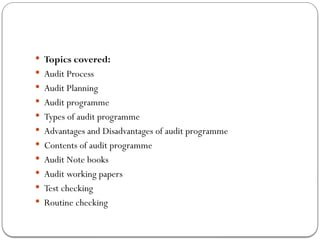
 Topics covered:
 Audit Process
 Audit Planning
 Audit programme
 Types of audit programme
 Advantages and Disadvantages of audit programme
 Contents of audit programme
 Audit Note books
 Audit working papers
 Test checking
 Routine checking
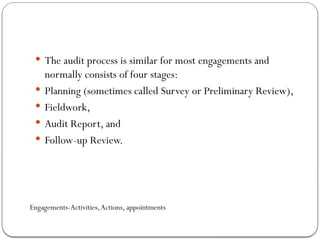
 The audit process is similar for most engagements and
normally consists of four stages:
 Planning (sometimes called Survey or Preliminary Review),
 Fieldwork,
 Audit Report, and
 Follow-up Review.
Engagements-Activities,Actions, appointments
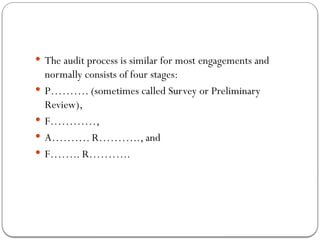
 The audit process is similar for most engagements and
normally consists of four stages:
 P………. (sometimes called Survey or Preliminary
Review),
 F…………,
 A………. R……….., and
 F…….. R………..
 After deciding about the type of audit to be conducted the auditor takes the
following preliminary steps:
 1. Letter of appointment:Auditor should check whether his appointment is in order according to
the legal provisions.
 2. Audit engagement letter:Auditor sends this letter to his client confirming the acceptance of
appointment as auditor.
 3. Study nature, scope and duties. (nature of auditor’s work)
 4. Acquire knowledge about the business and its nature.
 5. Verification of legal documents.(Permits, Licenses,Approvals, Registration)
 6. Obtain the list of all type of books maintained in the company.
 7. Examine accounting system.(Manual, Computerized, Single and Double entry)
 8. Examine internal check system. (How the men, machines and money are
controlled)
 9. Duties of members of the client’s staff.(Manuals, Operating Procedures)
 10. List of principal officials.(Who is responsible for various sections or departments)
 11. Instruction to the client.(About theAudit Program Schedule, Books needed, Information
needed)
 12. Preparation of an audit programme.(Schedule)
 13. Distribution of audit work.(Assigning the tasks to members of audit team)
 14. Preparation and submission of audit report.
 After deciding about the type of audit to be
conducted the auditor takes the following
preliminary steps:
 1. Letter of appointment:Auditor should check
whether his appointment is in order according to the legal
provisions.
 2. Audit engagement letter:Auditor sends this letter
to his client confirming the acceptance of appointment as
auditor.
 3. Study nature, scope and duties.
 4. Acquire knowledge about the business and its
nature.
 5. Verification of legal documents.
 6. Obtain the list of all type of books maintained
in the company.
 7. Examine accounting system.
 8. Examine internal check system.
 9. Duties of members of the client’s staff.
 10. List of principal officials.
 11. Instruction to the client.
 12. Preparation of an audit programme.
 13. Distribution of audit work.
 14. Preparation and submission of audit report.
Those related to
A. Contract Procedure
B. Information and PreliminaryActs of
Auditor
C. Conduct ofAudit
D. Reporting of theAudit
 After deciding about the type of audit to be conducted the auditor takes the
following preliminary steps:
 1. L………. of A………..:Auditor should check whether his appointment is in order
according to the legal provisions.
 2. A……… E……….. letter:Auditor sends this letter to his client confirming the
acceptance of appointment as auditor.
 3. Study N………., S………. and D……..
 4. Acquire knowledge about the B……….. and its N……….
 5. Verification of l……..l documents.
 6. Obtain the list of all type of b………..s maintained in the company.
 7. Examine a……….. S………..
 8. Examine I………… C……… system.
 9. Duties of M…………. of the client’s staff.
 10. List of P…………l officials.
 11. I………….n to the client.
 12. Preparation of an A………. P …………
 13. D………….n of audit work.
 14. Preparation and submission of A…….. R……….
 Audit note book or Audit memorandum
 Audit note book is the book kept by the audit clerk. It is a
register or diary maintained by audit clerk during the
course of audit.
 AUDIT PLANNING
 An audit plan is the specific guideline to be followed when
conducting an internal or external audit.
 Internal audits are usually conducted by a company’s accounting staff
and are primarily used for a management review of accounting processes.
 External audits are conducted by external public accounting firms
or private certified public accountants (CPA) to ensure outside
stakeholders that the company’s financial information is prepared in
accordance with that jurisdiction's accepted accounting principles.
 External audits usually use a formal plan for auditors to follow.
 In most cases, an audit plan consists of the following phases: planning,
fieldwork, a follow-up meeting, and a remedial audit.
 Assessing audit risk and inherent risk is an essential part of audit
planning because it determines the quantity and quality of evidence that
will need to be gathered and the staff that need to be assigned to the
particular audit.
 An audit plan is the specific guideline to be followed
when conducting an internal or external audit.
 ………conducted by a company’s accounting staff
 ………conducted by external public accounting
firms or private certified public accountants (CPA)
 External audits usually use a …………….
 audit plan consists of p………, f………, a f………
meeting, and a ……… audit.
 Assessing audit ……… and inherent risk is an
essential part of audit planning
 “Audit risk” is the risk that an auditor may give an
inappropriate audit opinion on financial Statements
that is materially misstated.
 “Inherent Risk” is “the susceptibility (Exposure) of an
account balance or class of transactions to
misstatements that could be material, individually or
when aggregated with misstatements in other balances
or classes, assuming that there are no related internal
controls”.
 Audit risk (also referred to as residual risk) refers to the risk that
an auditor may issue an unqualified report due to the auditor's
failure to detect material misstatement either due to error or
fraud.This risk is composed of:
 Inherent risk (IR), the risk involved in the nature of business or
transaction. Example, transactions involving exchange of cash may have
higher IR than transactions involving settlement by cheques.The
term inherent risk may have other definitions in other contexts.[1]
;
 Control risk (CR), the risk that a misstatement may not be prevented
or detected and corrected due to weakness in the entity's
internal control mechanism. Example, control risk assessment may be
higher in an entity where separation of duties is not well defined; and
 Detection risk (DR), the probability that the audit procedures may fail
to detect existence of a material error or fraud. Detection risk may be
due to sampling error or non-sampling error.[2]
 “Audit risk” is the risk that an auditor may give an i………
audit opinion on financial Statements that is materially
m……….
[There is a material misstatement but the auditor could
not identify and given an qualified opinion]
 “Inherent Risk” is “the s………y (Exposure) of an
account balance or class of transactions to
misstatements that could be m………l, individually or
when aggregated with misstatements in other balances or classes,
assuming that there are no related internal controls”.
[There is a possibility of misstatement in a class of
transactions/balance of an account due to poor internal
control]
Give Examples for inherent risk.
For example,
 Financial transactions that require complex calculations are inherently more
likely to be misstated than simple calculations.
 Cash on hand is by nature more susceptible to theft than a large inventory of
coal.
 Rapid technological developments in a particular industry may create a higher
risk of inventory becoming obsolete more quickly than in other industries.
 A company that is struggling financially may inherently have a greater incentive
to misstate financial information to meet certain covenants.
 A company that has improperly reported a particular balance in the past may
be inherently more likely to misstate it again.
 These are the types of factors that auditors consider as they assess inherent
risk.
(Investopedia)
 Inherent risk refer to the risk that could not be protected or
detected by entity’s internal control.This risk could
happened as the result of complexity of client nature of
business or transactions. Sometime, that nature of business
could link to complexity of financial transactions and require
high involvement with judgement.
 The risk is normally high if the transaction or even involve
highly with human judgement.
 Control risk or internal control risk is the risk that current
internal control could not detect or fail to protect significant
error or misstatement in the financial statements.
 Detection risk is the risk that auditor fail to detect the
material misstatement in the financial statements and then
issued incorrect opinion to the audited financial statements.
 Audit note book or Audit memorandum
 It is the book kept by the audit clerk.
 It is a register or diary maintained by the audit clerk during
the course of audit.
 For every firm that he audits, the auditor maintains the
separate book in which audit clerk notes down many
important points, difficulties and new points in
which he has to discuss with his senior officer or the auditor.
 Audit note book or Audit memorandum
 It is the book kept by the audit clerk.
 It is a register or d…… maintained by the audit clerk during
the course of audit.
 For every firm that he audits, the auditor maintains the
separate book in which audit clerk notes down many i ……
t p …… s, d …… s and n …… points in which he has
to discuss with his senior officer or the auditor.
 Advantages of audit note book
 It enables the auditor to record all important
points, which arise during the course of audit.
 It acts as documentary evidences in favour of auditor in
future.
 It helps to prepare audit report.
 It can also be a guide for audit clerks during
subsequent audit.
 It is a tool to measure the efficiency of audit staff.
Advantages of Audit Note Book
 enables the auditor to record all important points
 documentary evidences
 helps to prepare audit report
 can also be a guide for audit clerks
 a tool to measure the efficiency
 Documentation
 The auditor should collect and preserve all documents
relating a client and audit according to their importance or
materiality.
 These documents including statements, notes, copy of
minutes detailed documents, reply to letter and other
valuable information pertaining to accounts under audit.
These documents are properly arranged and preserved carefully.
 According to statement on the SAP (Standard Audit
Practices) issued by the council of institute of chartered
accountant of India defines “The auditor should document
matters which are important in providing evidence
that was carried out in accordance with the basic
principles of auditing”.
Documentation
 collect and preserve all documents
 statements, notes, copy of minutes detailed
documents, reply to letter and other valuable
information
 SAP
 auditor should document matters which are
important in providing evidence that was carried
out in accordance with the basic principles of
auditing”
 Audit working papers
 In connection with each audit, the auditor will be having a
number of detailed documents statements, notes,
minutes, and other valuable information pertaining
to the accounts, which are under audit.
 These papers are properly arranged and preserved carefully.
These papers are property of the auditor.These files are
called audit working papers.
 Contents of audit working papers
 The trial balance
 Schedule of debtors and creditors
 Depreciation statements
 Schedule of investments
 Bank reconciliation statements
 Details of cash balance checked
 Adjusting entries
 A draft of final accounts
 Certificate regarding stock in trade and its valuation
 Contingent liabilities certified by managements.
 AUDIT PROGRAMME
 MEANING:
 An audit programme is a written and predetermined plan of
action for conducting an audit.
 It is an action plan containing exact details in regards to the conduct
of a particular audit.
 The audit program is prepared by the senior staff in consultation
with the auditor.
 Audit programme is detailed plan of the audit work to be
performed, specifying the procedures to be followed in the verification
of each item in the financial statement and giving the estimated time
required.
 Thus audit programme is the detailed scheme of an audit work. It
spells the work to be done and duration of time to complete an audit
and how the auditor assign the work between senior and junior clerks.
 spells the work to be done and duration
 specifying the procedures to be followed
 prepared by the senior staff
 action plan
 Types of Audit Programmes
 Fixed audit program or Pre determined or planned or tailor
made
 Flexible or Skeleton or progressive audit program
 Fixed Audit programme
 A fixed program is a pre-planned and detailed program of
audit. It is prepared in advance in such a way to audit engagement in
hand therefore is called tailor made audit program .
 Flexible audit programme
 It is more flexible that fixed audit program. It is drawn according
to nature, scope and limitation of the audit engagements in
hand.
 Advantages of audit programme
 It defines the duties of clerks clearly.
 To know the volume of work done earlier
 It fixes the responsibility of audit staff
 It defends the auditor
 It serves as a guide
 It is helpful to the new audit staff
 It brings uniformity in auditing
 Timely completion of audit
 Effective control over audit staff
 To assess the cost of audit.
 Disadvantages of audit programme
 It makes audit work mechanical.
 Out of date and useless.
 No chance to use intelligence.
 Unable to cover all the points.
 Not suitable to all types of audit.
 How to overcome the drawbacks?
 It must be revised and made up to date.
 It should be given encouragement and to use his
intelligence in the work.
 It should be revised in the light of past experience.
 Flexible and human touch audit program may be drawn.
 revised and made up to date
 given encouragement
 to use his intelligence
 revised in the light of past experience
 human touch
 Contents of audit programme.
 1. Name -The audit program contains the name of client.The
auditor can write the name of business.
 2. Objects-The audit program contains the objects of the business
enterprise.There are various objects of any business unit.
 3. Date-The audit program contains the date of start of an audit.
 4. Duration-The audit program contains the time limit of starting
and completing the work.
 5. Accounting System-The audit program contains information
about accounting system.
 6. Old Reports-The audit program keeps the contents of old audit
report.The auditor can pay attention to old reports.
 N………..
 O……….
 D……
 D……….
 A………g S……..m
 O……. R…….
 Test checking
 In large business firms where the number of transactions to be
checked is large and time at the disposal of auditor is limited, the test
checking is substitute instead of detailed auditing.
 Testing and test checking means to select and examine a representative
sample from a large number of similar items.
 Routine checking
 The auditor checks the prime entry and ledgers with reference to
vouchers. He also checks the casting , posting, calculations additional
and balancing in vouchers to support the entries made in the original
entry ledgers and subsidiary books .The process of such checking in a
routine manner by the auditor is called routine checking.
 Audit Plan refers to the scheme formulated by the auditor
that comprises of strategy or approach, that is followed for
carrying out audit.
 On the other hand, audit programme implies a range of
verification procedures, which are applied to the final
accounts, to acquire audit evidence, and thus helping auditor
in providing an informed opinion.
The Types of Audit Reports
 Here are the four types of audit reports that are given by external auditors:
 1. Unqualified Opinion
 An unqualified opinion indicates that the information presented in a company’s financial report is clean.As
in a medical patient’s clean bill of health, an unqualified opinion shows that the audited financial
statements can be presumed to be free from misstatements.
 2. Qualified Opinion
 An opinion rendered in a qualified audit report is similar to an unqualified opinion; however, the auditing
body cannot express an unqualified opinion for several reasons. One reason could be that the company did
not present its financial records in accordance with generally acceptable accounting principles (GAAP).
 3. Disclaimer Opinion
 Auditors give a disclaimer when they are unable to express a definite opinion.This can be due to the lack
of properly maintained financial records or the absence or insufficient support from the management. For
instance, an auditor may not have had the opportunity to fulfill tasks that they deem to be crucial to the
audit, such as observing operational procedures or reviewing particular procedures.
 4. Adverse Opinion
 When auditors issue an adverse opinion, it indicates that there has been a gross misstatement and, possibly,
fraud, in the preparation of the company’s financial records.An adverse opinion shows that the company’s
records have not been prepared in accordance with GAAP. Public entities that receive this kind of opinion
are obligated to Financial statements with adverse audit opinions are typically rejected by financial
institutions or investors.
 Supplementary Study Material

 Audit risk (also referred to as residual risk) refers to the risk that an auditor may issue
an unqualified report due to the auditor's failure to detect material
misstatement either due to error or fraud.This risk is composed of:
 Inherent risk (IR), the risk involved in the nature of business or transaction. Example,
transactions involving exchange of cash may have higher IR than transactions involving
settlement by cheques.The term inherent risk may have other definitions in other contexts.[1]
;
 Control risk (CR), the risk that a misstatement may not be prevented or detected and
corrected due to weakness in the entity's internal control mechanism. Example, control risk
assessment may be higher in an entity where separation of duties is not well defined; and
 Detection risk (DR), the probability that the audit procedures may fail to detect existence
of a material error or fraud. Detection risk may be due to sampling error or
non-sampling error.[2]
 Exercise:
 Identify the type of audit risk in the following cases.
 Z limited has appointed Mr. Kevin as auditor for the first time.The
company is a manufacturer of spare parts for automobiles.The
operation manual states that any item of worth more than RO 50
must be purchased only after the approval of the finance department
after the request has been successively forwarded through the
section supervisor and the manager of the production department.
The auditor notices that some of the purchases having a value more
than RO 50 are purchased by different units from their budget
allocated to them without the approval of the finance department.
 What is audit risk and what type of audit risk is observed in the
above case? Give reason.
 Due to large number and complex system of cash discount
and incentives, the auditor of Company X has chosen few
samples and satisfied himself that the transactions are
authentic and accurate. However, the size of the sample and
method of sampling used by the auditor may not be
appropriate for such type of transactions.
 What is audit risk and what type of audit risk may be found
in the above case?Why?
 BusinessY makes most of the payments through bank via
cheques, except for the payment of salaries which are paid in
cash.The business has large number of temporary workers
who do not have bank accounts and the payments are to be
made in cash. Such payments are large in number and the
payments vary significantly among the workers.The wages to
these workers are paid weekly. Income statements of the
business for previous years’ show that the wage payments are
nearly 40 percent of total expenses of the company.
 What is audit risk and what type of audit risk is observed in
the above case? Give reason.
 Company L has recently developed control systems in the
organization and implanted during the previous year.The control
procedures in certain areas are ambiguous and more than one
individual is held responsible for certain material. For example,
the stores can be accessed by the heads of all departments and
are given a freedom to take the material by recording in the
stores register.The duty of the stores supervisor is to verify the
stock at often and report the same to accounting department.All
the heads and the stores supervisor are responsible for the stock.
Is there any risk in engaging this company to the auditor? If so,
what type of risk is involved in this case?Why?

Auditng and Control 1- Audit and work Chapter 4.pptx

  • 1.
    Chapter: 4 Outcome -4Know how to make audit program and planning and what should include in audit program
  • 2.
     Topics covered: Audit Process  Audit Planning  Audit programme  Types of audit programme  Advantages and Disadvantages of audit programme  Contents of audit programme  Audit Note books  Audit working papers  Test checking  Routine checking
  • 3.
     The auditprocess is similar for most engagements and normally consists of four stages:  Planning (sometimes called Survey or Preliminary Review),  Fieldwork,  Audit Report, and  Follow-up Review. Engagements-Activities,Actions, appointments
  • 4.
     The auditprocess is similar for most engagements and normally consists of four stages:  P………. (sometimes called Survey or Preliminary Review),  F…………,  A………. R……….., and  F…….. R………..
  • 5.
     After decidingabout the type of audit to be conducted the auditor takes the following preliminary steps:  1. Letter of appointment:Auditor should check whether his appointment is in order according to the legal provisions.  2. Audit engagement letter:Auditor sends this letter to his client confirming the acceptance of appointment as auditor.  3. Study nature, scope and duties. (nature of auditor’s work)  4. Acquire knowledge about the business and its nature.  5. Verification of legal documents.(Permits, Licenses,Approvals, Registration)  6. Obtain the list of all type of books maintained in the company.  7. Examine accounting system.(Manual, Computerized, Single and Double entry)  8. Examine internal check system. (How the men, machines and money are controlled)  9. Duties of members of the client’s staff.(Manuals, Operating Procedures)  10. List of principal officials.(Who is responsible for various sections or departments)  11. Instruction to the client.(About theAudit Program Schedule, Books needed, Information needed)  12. Preparation of an audit programme.(Schedule)  13. Distribution of audit work.(Assigning the tasks to members of audit team)  14. Preparation and submission of audit report.
  • 6.
     After decidingabout the type of audit to be conducted the auditor takes the following preliminary steps:  1. Letter of appointment:Auditor should check whether his appointment is in order according to the legal provisions.  2. Audit engagement letter:Auditor sends this letter to his client confirming the acceptance of appointment as auditor.  3. Study nature, scope and duties.  4. Acquire knowledge about the business and its nature.  5. Verification of legal documents.  6. Obtain the list of all type of books maintained in the company.  7. Examine accounting system.  8. Examine internal check system.  9. Duties of members of the client’s staff.  10. List of principal officials.  11. Instruction to the client.  12. Preparation of an audit programme.  13. Distribution of audit work.  14. Preparation and submission of audit report. Those related to A. Contract Procedure B. Information and PreliminaryActs of Auditor C. Conduct ofAudit D. Reporting of theAudit
  • 7.
     After decidingabout the type of audit to be conducted the auditor takes the following preliminary steps:  1. L………. of A………..:Auditor should check whether his appointment is in order according to the legal provisions.  2. A……… E……….. letter:Auditor sends this letter to his client confirming the acceptance of appointment as auditor.  3. Study N………., S………. and D……..  4. Acquire knowledge about the B……….. and its N……….  5. Verification of l……..l documents.  6. Obtain the list of all type of b………..s maintained in the company.  7. Examine a……….. S………..  8. Examine I………… C……… system.  9. Duties of M…………. of the client’s staff.  10. List of P…………l officials.  11. I………….n to the client.  12. Preparation of an A………. P …………  13. D………….n of audit work.  14. Preparation and submission of A…….. R……….
  • 8.
     Audit notebook or Audit memorandum  Audit note book is the book kept by the audit clerk. It is a register or diary maintained by audit clerk during the course of audit.
  • 9.
     AUDIT PLANNING An audit plan is the specific guideline to be followed when conducting an internal or external audit.  Internal audits are usually conducted by a company’s accounting staff and are primarily used for a management review of accounting processes.  External audits are conducted by external public accounting firms or private certified public accountants (CPA) to ensure outside stakeholders that the company’s financial information is prepared in accordance with that jurisdiction's accepted accounting principles.  External audits usually use a formal plan for auditors to follow.  In most cases, an audit plan consists of the following phases: planning, fieldwork, a follow-up meeting, and a remedial audit.  Assessing audit risk and inherent risk is an essential part of audit planning because it determines the quantity and quality of evidence that will need to be gathered and the staff that need to be assigned to the particular audit.
  • 10.
     An auditplan is the specific guideline to be followed when conducting an internal or external audit.  ………conducted by a company’s accounting staff  ………conducted by external public accounting firms or private certified public accountants (CPA)  External audits usually use a …………….  audit plan consists of p………, f………, a f……… meeting, and a ……… audit.  Assessing audit ……… and inherent risk is an essential part of audit planning
  • 11.
     “Audit risk”is the risk that an auditor may give an inappropriate audit opinion on financial Statements that is materially misstated.  “Inherent Risk” is “the susceptibility (Exposure) of an account balance or class of transactions to misstatements that could be material, individually or when aggregated with misstatements in other balances or classes, assuming that there are no related internal controls”.
  • 12.
     Audit risk(also referred to as residual risk) refers to the risk that an auditor may issue an unqualified report due to the auditor's failure to detect material misstatement either due to error or fraud.This risk is composed of:  Inherent risk (IR), the risk involved in the nature of business or transaction. Example, transactions involving exchange of cash may have higher IR than transactions involving settlement by cheques.The term inherent risk may have other definitions in other contexts.[1] ;  Control risk (CR), the risk that a misstatement may not be prevented or detected and corrected due to weakness in the entity's internal control mechanism. Example, control risk assessment may be higher in an entity where separation of duties is not well defined; and  Detection risk (DR), the probability that the audit procedures may fail to detect existence of a material error or fraud. Detection risk may be due to sampling error or non-sampling error.[2]
  • 13.
     “Audit risk”is the risk that an auditor may give an i……… audit opinion on financial Statements that is materially m………. [There is a material misstatement but the auditor could not identify and given an qualified opinion]  “Inherent Risk” is “the s………y (Exposure) of an account balance or class of transactions to misstatements that could be m………l, individually or when aggregated with misstatements in other balances or classes, assuming that there are no related internal controls”. [There is a possibility of misstatement in a class of transactions/balance of an account due to poor internal control]
  • 14.
    Give Examples forinherent risk. For example,  Financial transactions that require complex calculations are inherently more likely to be misstated than simple calculations.  Cash on hand is by nature more susceptible to theft than a large inventory of coal.  Rapid technological developments in a particular industry may create a higher risk of inventory becoming obsolete more quickly than in other industries.  A company that is struggling financially may inherently have a greater incentive to misstate financial information to meet certain covenants.  A company that has improperly reported a particular balance in the past may be inherently more likely to misstate it again.  These are the types of factors that auditors consider as they assess inherent risk. (Investopedia)
  • 15.
     Inherent riskrefer to the risk that could not be protected or detected by entity’s internal control.This risk could happened as the result of complexity of client nature of business or transactions. Sometime, that nature of business could link to complexity of financial transactions and require high involvement with judgement.  The risk is normally high if the transaction or even involve highly with human judgement.
  • 16.
     Control riskor internal control risk is the risk that current internal control could not detect or fail to protect significant error or misstatement in the financial statements.  Detection risk is the risk that auditor fail to detect the material misstatement in the financial statements and then issued incorrect opinion to the audited financial statements.
  • 17.
     Audit notebook or Audit memorandum  It is the book kept by the audit clerk.  It is a register or diary maintained by the audit clerk during the course of audit.  For every firm that he audits, the auditor maintains the separate book in which audit clerk notes down many important points, difficulties and new points in which he has to discuss with his senior officer or the auditor.
  • 18.
     Audit notebook or Audit memorandum  It is the book kept by the audit clerk.  It is a register or d…… maintained by the audit clerk during the course of audit.  For every firm that he audits, the auditor maintains the separate book in which audit clerk notes down many i …… t p …… s, d …… s and n …… points in which he has to discuss with his senior officer or the auditor.
  • 19.
     Advantages ofaudit note book  It enables the auditor to record all important points, which arise during the course of audit.  It acts as documentary evidences in favour of auditor in future.  It helps to prepare audit report.  It can also be a guide for audit clerks during subsequent audit.  It is a tool to measure the efficiency of audit staff.
  • 20.
    Advantages of AuditNote Book  enables the auditor to record all important points  documentary evidences  helps to prepare audit report  can also be a guide for audit clerks  a tool to measure the efficiency
  • 21.
     Documentation  Theauditor should collect and preserve all documents relating a client and audit according to their importance or materiality.  These documents including statements, notes, copy of minutes detailed documents, reply to letter and other valuable information pertaining to accounts under audit. These documents are properly arranged and preserved carefully.  According to statement on the SAP (Standard Audit Practices) issued by the council of institute of chartered accountant of India defines “The auditor should document matters which are important in providing evidence that was carried out in accordance with the basic principles of auditing”.
  • 22.
    Documentation  collect andpreserve all documents  statements, notes, copy of minutes detailed documents, reply to letter and other valuable information  SAP  auditor should document matters which are important in providing evidence that was carried out in accordance with the basic principles of auditing”
  • 23.
     Audit workingpapers  In connection with each audit, the auditor will be having a number of detailed documents statements, notes, minutes, and other valuable information pertaining to the accounts, which are under audit.  These papers are properly arranged and preserved carefully. These papers are property of the auditor.These files are called audit working papers.
  • 24.
     Contents ofaudit working papers  The trial balance  Schedule of debtors and creditors  Depreciation statements  Schedule of investments  Bank reconciliation statements  Details of cash balance checked  Adjusting entries  A draft of final accounts  Certificate regarding stock in trade and its valuation  Contingent liabilities certified by managements.
  • 25.
     AUDIT PROGRAMME MEANING:  An audit programme is a written and predetermined plan of action for conducting an audit.  It is an action plan containing exact details in regards to the conduct of a particular audit.  The audit program is prepared by the senior staff in consultation with the auditor.  Audit programme is detailed plan of the audit work to be performed, specifying the procedures to be followed in the verification of each item in the financial statement and giving the estimated time required.  Thus audit programme is the detailed scheme of an audit work. It spells the work to be done and duration of time to complete an audit and how the auditor assign the work between senior and junior clerks.
  • 26.
     spells thework to be done and duration  specifying the procedures to be followed  prepared by the senior staff  action plan
  • 27.
     Types ofAudit Programmes  Fixed audit program or Pre determined or planned or tailor made  Flexible or Skeleton or progressive audit program  Fixed Audit programme  A fixed program is a pre-planned and detailed program of audit. It is prepared in advance in such a way to audit engagement in hand therefore is called tailor made audit program .  Flexible audit programme  It is more flexible that fixed audit program. It is drawn according to nature, scope and limitation of the audit engagements in hand.
  • 28.
     Advantages ofaudit programme  It defines the duties of clerks clearly.  To know the volume of work done earlier  It fixes the responsibility of audit staff  It defends the auditor  It serves as a guide  It is helpful to the new audit staff  It brings uniformity in auditing  Timely completion of audit  Effective control over audit staff  To assess the cost of audit.
  • 29.
     Disadvantages ofaudit programme  It makes audit work mechanical.  Out of date and useless.  No chance to use intelligence.  Unable to cover all the points.  Not suitable to all types of audit.
  • 30.
     How toovercome the drawbacks?  It must be revised and made up to date.  It should be given encouragement and to use his intelligence in the work.  It should be revised in the light of past experience.  Flexible and human touch audit program may be drawn.
  • 31.
     revised andmade up to date  given encouragement  to use his intelligence  revised in the light of past experience  human touch
  • 32.
     Contents ofaudit programme.  1. Name -The audit program contains the name of client.The auditor can write the name of business.  2. Objects-The audit program contains the objects of the business enterprise.There are various objects of any business unit.  3. Date-The audit program contains the date of start of an audit.  4. Duration-The audit program contains the time limit of starting and completing the work.  5. Accounting System-The audit program contains information about accounting system.  6. Old Reports-The audit program keeps the contents of old audit report.The auditor can pay attention to old reports.
  • 33.
     N………..  O………. D……  D……….  A………g S……..m  O……. R…….
  • 34.
     Test checking In large business firms where the number of transactions to be checked is large and time at the disposal of auditor is limited, the test checking is substitute instead of detailed auditing.  Testing and test checking means to select and examine a representative sample from a large number of similar items.  Routine checking  The auditor checks the prime entry and ledgers with reference to vouchers. He also checks the casting , posting, calculations additional and balancing in vouchers to support the entries made in the original entry ledgers and subsidiary books .The process of such checking in a routine manner by the auditor is called routine checking.
  • 35.
     Audit Planrefers to the scheme formulated by the auditor that comprises of strategy or approach, that is followed for carrying out audit.  On the other hand, audit programme implies a range of verification procedures, which are applied to the final accounts, to acquire audit evidence, and thus helping auditor in providing an informed opinion.
  • 36.
    The Types ofAudit Reports  Here are the four types of audit reports that are given by external auditors:  1. Unqualified Opinion  An unqualified opinion indicates that the information presented in a company’s financial report is clean.As in a medical patient’s clean bill of health, an unqualified opinion shows that the audited financial statements can be presumed to be free from misstatements.  2. Qualified Opinion  An opinion rendered in a qualified audit report is similar to an unqualified opinion; however, the auditing body cannot express an unqualified opinion for several reasons. One reason could be that the company did not present its financial records in accordance with generally acceptable accounting principles (GAAP).  3. Disclaimer Opinion  Auditors give a disclaimer when they are unable to express a definite opinion.This can be due to the lack of properly maintained financial records or the absence or insufficient support from the management. For instance, an auditor may not have had the opportunity to fulfill tasks that they deem to be crucial to the audit, such as observing operational procedures or reviewing particular procedures.  4. Adverse Opinion  When auditors issue an adverse opinion, it indicates that there has been a gross misstatement and, possibly, fraud, in the preparation of the company’s financial records.An adverse opinion shows that the company’s records have not been prepared in accordance with GAAP. Public entities that receive this kind of opinion are obligated to Financial statements with adverse audit opinions are typically rejected by financial institutions or investors.
  • 37.
     Supplementary StudyMaterial   Audit risk (also referred to as residual risk) refers to the risk that an auditor may issue an unqualified report due to the auditor's failure to detect material misstatement either due to error or fraud.This risk is composed of:  Inherent risk (IR), the risk involved in the nature of business or transaction. Example, transactions involving exchange of cash may have higher IR than transactions involving settlement by cheques.The term inherent risk may have other definitions in other contexts.[1] ;  Control risk (CR), the risk that a misstatement may not be prevented or detected and corrected due to weakness in the entity's internal control mechanism. Example, control risk assessment may be higher in an entity where separation of duties is not well defined; and  Detection risk (DR), the probability that the audit procedures may fail to detect existence of a material error or fraud. Detection risk may be due to sampling error or non-sampling error.[2]
  • 38.
     Exercise:  Identifythe type of audit risk in the following cases.  Z limited has appointed Mr. Kevin as auditor for the first time.The company is a manufacturer of spare parts for automobiles.The operation manual states that any item of worth more than RO 50 must be purchased only after the approval of the finance department after the request has been successively forwarded through the section supervisor and the manager of the production department. The auditor notices that some of the purchases having a value more than RO 50 are purchased by different units from their budget allocated to them without the approval of the finance department.  What is audit risk and what type of audit risk is observed in the above case? Give reason.
  • 39.
     Due tolarge number and complex system of cash discount and incentives, the auditor of Company X has chosen few samples and satisfied himself that the transactions are authentic and accurate. However, the size of the sample and method of sampling used by the auditor may not be appropriate for such type of transactions.  What is audit risk and what type of audit risk may be found in the above case?Why?
  • 40.
     BusinessY makesmost of the payments through bank via cheques, except for the payment of salaries which are paid in cash.The business has large number of temporary workers who do not have bank accounts and the payments are to be made in cash. Such payments are large in number and the payments vary significantly among the workers.The wages to these workers are paid weekly. Income statements of the business for previous years’ show that the wage payments are nearly 40 percent of total expenses of the company.  What is audit risk and what type of audit risk is observed in the above case? Give reason.
  • 41.
     Company Lhas recently developed control systems in the organization and implanted during the previous year.The control procedures in certain areas are ambiguous and more than one individual is held responsible for certain material. For example, the stores can be accessed by the heads of all departments and are given a freedom to take the material by recording in the stores register.The duty of the stores supervisor is to verify the stock at often and report the same to accounting department.All the heads and the stores supervisor are responsible for the stock. Is there any risk in engaging this company to the auditor? If so, what type of risk is involved in this case?Why?