Whitepaper
3D Display Technology
Active-, Passive-, Autostereo, Volumetric Displays
© Competence Centre for Virtual Reality and Cooperative Engineering w. V. – Virtual Dimension Center (VDC)
Dr.-Ing. Dipl.-Kfm. Christoph Runde
Virtual Dimension Center (VDC) Fellbach
Auberlenstr. 13
70736 Fellbach
www.vdc-fellbach.de
Active-, Passive-, Autostereo, Volumetric Displays
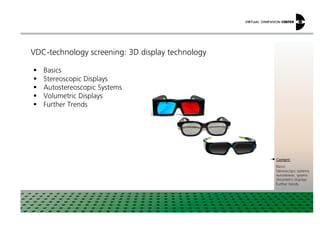
VDC-technology screening: 3D display technology
Basics
Stereoscopic Displays
Autostereoscopic Systems
Volumetric Displays
Further Trends
xxx:
xxxContent:
Basics
Stereoscopic systems
Autostereosc. systems
Volumetric displays
Further trends
Basics: Terms and motivation
3D visualization = spatial vision
Providing two, slightly offset perspectives
for the viewer
Possibly head tracking
Thereby:
xxx:
xxxContent:
Basics
Stereoscopic systems
Autostereosc. systems
Volumetric displays
Further trends
Thereby:
Brain assigns spatialities better
Better feeling for the near and far
Building a mental, spatial environment
model is easier
Support for 3D interaction (space must
be known for this)
Whitepaper
3D Display Technology
Source: Runde, C.: Konzeption und Einführung von
Virtueller Realität als Komponente der Digitalen
Fabrik in Industrieunternehmen. Zugl.: Stuttgart,
Univ., Diss., 2007, IPA-IAO Forschung und Praxis,
455. Heimsheim: Jost-Jetter Verlag, 2007
Graphical depth criteria
What does the brain calculate/
work with?
xxx:
xxx
www.vdc-fellbach.de info@vdc.fellbach.de Tel.: +49 (0) 711 58 53 09-0
www.vdc-fellbach.de info@vdc-fellbach.de Tel.: +49 (0) 711 58 53 09-0
© Kompetenzzentrum Virtuelle Realität und Kooperatives Engineering w. V. – Virtual Dimension Center VDC 4
Content:
Basics
Projection systems
Types of construction
projection systems
Display systems
Autostereosc. systems
Volumetr. displays
Further trends
Basics: Stereo solutions
Two views are generated
These two views have to be transported separately to the two eyes
Note: natural eye distance (about 6.5cm) allows reasonable
stereoscopic vision at a distance of up to 15m
Greater distance: increase parallax
Quality criteria, amongst others:
xxx:
xxxContent:
Basics
Stereoscopic systems
Autostereosc. systems
Volumetric displays
Further trends
Quality criteria, amongst others:
oOptical crosstalk (eye receives false signal): ghosting
oOverall brightness
oUniformity of brightness distribution (hot spots)
oFocus (tinting)
oContrast, dynamics
Stereoscopic Displays
xxx:
xxxContent:
Basics
Stereoscopic systems
Autostereosc. systems
Volumetric displays
Further trends
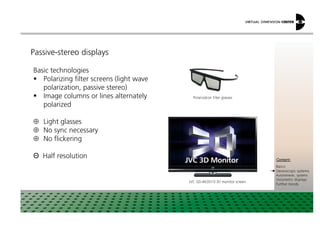
Passive-stereo displays
Polarization filter glasses
Basic technologies
Polarizing filter screens (light wave
polarization, passive stereo)
Image columns or lines alternately
polarized
xxx:
xxxContent:
Basics
Stereoscopic systems
Autostereosc. systems
Volumetric displays
Further trends
JVC GD-463D10 3D monitor screen
⊕ Light glasses
⊕ No sync necessary
⊕ No flickering
Θ Half resolution
Planar® display
Uses two screens
Pane lets through front display and
mirrors upper
Resolution 1920 x 1200x
⊕ No reduction of resolution because of
Polarization filter glasses
xxx:
xxxContent:
Basics
Stereoscopic systems
Autostereosc. systems
Volumetric displays
Further trends
⊕ No reduction of resolution because of
stereoscopy
⊕ However steady image
Θ Space requirement
Θ Price
Planar SD2620W-351
Possibility to test at:
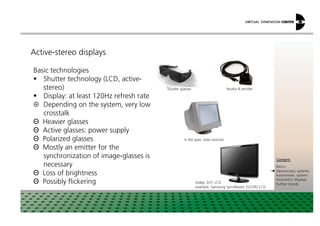
Active-stereo displays
Basic technologies
Shutter technology (LCD, active-
stereo)
Display: at least 120Hz refresh rate
⊕ Depending on the system, very low
crosstalk
Shutter glasses Nvidia IR emitter
xxx:
xxxContent:
Basics
Stereoscopic systems
Autostereosc. systems
Volumetric displays
Further trends
crosstalk
Θ Heavier glasses
Θ Active glasses: power supply
Θ Polarized glasses
Θ Mostly an emitter for the
synchronization of image-glasses is
necessary
Θ Loss of brightness
Θ Possibly flickering today: DLP, LCD
example: Samsung SyncMaster 2233RZ LCD
In the past: tube monitor
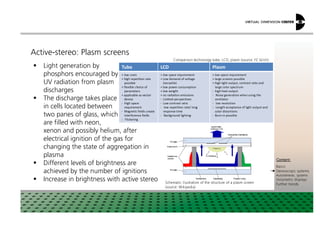
Active-stereo: Plasm screens
Light generation by
phosphors encouraged by
UV radiation from plasm
discharges
The discharge takes place
in cells located between
two panes of glass, which
dƵďĞ > WůĂƐŵ
н ůŽǁ ĐŽƐƚƐ
н ŚŝŐŚ ƌĞƉĞƚŝƚŝŽŶ ƌĂƚĞ
ƉŽƐƐŝďůĞ
н ĨůĞdžŝďůĞ ĐŚŽŝĐĞ ŽĨ
ƉĂƌĂŵĞƚĞƌƐ
н ĂƉƉůŝĐĂďůĞ ĂƐ ǀĞĐƚŽƌ
ĚĞǀŝĐĞ
Ͳ ,ŝŐŚ ƐƉĂĐĞ
ƌĞƋƵŝƌĞŵĞŶƚ
Ͳ DĂŐŶĞƚŝĐ ĨŝĞůĚƐ ĐƌĞĂƚĞ
н ůŽǁ ƐƉĂĐĞ ƌĞƋƵŝƌĞŵĞŶƚ
н Žǁ ĚĞŵĂŶĚ ŽĨ ǀŽůƚĂŐĞ
;ǀĞƌƐĂƚŝůĞͿ
н ůŽǁ ƉŽǁĞƌ ĐŽŶƐƵŵƉƚŝŽŶ
н ůŽǁ ǁĞŝŐŚƚ
н ŶŽ ƌĂĚŝĂƚŝŽŶ ĞŵŝƐƐŝŽŶƐ
Ͳ ŝŵŝƚĞĚ ƉĞƌƐƉĞĐƚŝǀĞƐ
Ͳ Žǁ ĐŽŶƚƌĂƐƚ ƌĂƚŝŽ
Ͳ ůŽǁ ƌĞƉĞƚŝƚŝŽŶ ƌĂƚĞͬ ůŽŶŐ
ƌĞƐƉŽŶƐĞ ƚŝŵĞ
н ůŽǁ ƐƉĂĐĞ ƌĞƋƵŝƌĞŵĞŶƚ
н ůĂƌŐĞ ƐĐƌĞĞŶƐ ƉŽƐƐŝďůĞ
н ŚŝŐŚ ůŝŐŚƚ ŽƵƚƉƵƚ͕ ĐŽŶƚƌĂƐƚ ƌĂƚŝŽ ĂŶĚ
ůĂƌŐĞ ĐŽůŽƌ ƐƉĞĐƚƌƵŵ
Ͳ ŚŝŐŚ ŚĞĂƚ ŽƵƚƉƵƚ
Ͳ EŽŝƐĞ ŐĞŶĞƌĂƚŝŽŶ ǁŚĞŶ ƵƐŝŶŐ ƚŚĞ
ǀĞŶƚŝůĂƚŽƌ
Ͳ ůŽǁ ƌĞƐŽůƵƚŝŽŶ
Ͳ ĞŶŐƚŚ ĂĐĐĞƉƚĂŶĐĞ ŽĨ ůŝŐŚƚ ŽƵƚƉƵƚ ĂŶĚ
ĐŽůŽƌ ĚŝƐƚŽƌƚŝŽŶƐ
Comparison technology tube, LCD, plasm (source: FZ Jülich)
xxx:
xxxContent:
Basics
Stereoscopic systems
Autostereosc. systems
Volumetric displays
Further trends
two panes of glass, which
are filled with neon,
xenon and possibly helium, after
electrical ignition of the gas for
changing the state of aggregation in
plasma
Different levels of brightness are
achieved by the number of ignitions
Increase in brightness with active stereo Schematic illustration of the structure of a plasm screen
(source: Wikipedia)
Ͳ DĂŐŶĞƚŝĐ ĨŝĞůĚƐ ĐƌĞĂƚĞ
ŝŶƚĞƌĨĞƌĞŶĐĞ ĨŝĞůĚƐ
Ͳ ůŝĐŬĞƌŝŶŐ
ƌĞƐƉŽŶƐĞ ƚŝŵĞ
Ͳ ĂĐŬŐƌŽƵŶĚ ůŝŐŚƚŝŶŐ
ĐŽůŽƌ ĚŝƐƚŽƌƚŝŽŶƐ
Ͳ ƵƌŶͲŝŶ ƉŽƐƐŝďůĞ
Active-stereo: Plasm screens
Panasonic:
85 inches and 103 inches
3D plasma screens on offer,
150 inches as a prototype
xxx:
xxxContent:
Basics
Stereoscopic systems
Autostereosc. systems
Volumetric displays
Further trends
Possibility to test at:
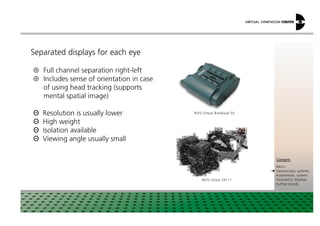
Separated displays for each eye
⊕ Full channel separation right-left
⊕ Includes sense of orientation in case
of using head tracking (supports
mental spatial image)
Θ Resolution is usually lower NVIS Virtual Binokular SV
xxx:
xxxContent:
Basics
Stereoscopic systems
Autostereosc. systems
Volumetric displays
Further trends
Θ Resolution is usually lower
Θ High weight
Θ Isolation available
Θ Viewing angle usually small
NVIS nVisor SX111
NVIS Virtual Binokular SV
Autostereoscopic Systems
xxx:
xxxContent:
Basics
Stereoscopic systems
Autostereosc. systems
Volumetric displays
Further trends
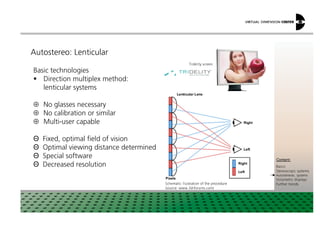
Autostereo: Lenticular
Basic technologies
Direction multiplex method:
lenticular systems
⊕ No glasses necessary
⊕ No calibration or similar
Tridelity screen
xxx:
xxxContent:
Basics
Stereoscopic systems
Autostereosc. systems
Volumetric displays
Further trends
⊕ No calibration or similar
⊕ Multi-user capable
Θ Fixed, optimal field of vision
Θ Optimal viewing distance determined
Θ Special software
Θ Decreased resolution
Schematic illustration of the procedure
(source: www.3d-forums.com)
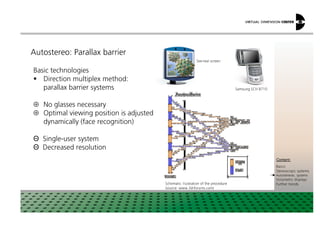
Autostereo: Parallax barrier
Basic technologies
Direction multiplex method:
parallax barrier systems
⊕ No glasses necessary
⊕ Optimal viewing position is adjusted
See-real screen
Samsung SCH B710
xxx:
xxxContent:
Basics
Stereoscopic systems
Autostereosc. systems
Volumetric displays
Further trends
⊕ Optimal viewing position is adjusted
dynamically (face recognition)
Θ Single-user system
Θ Decreased resolution
Schematic illustration of the procedure
(source: www.3d-forums.com)
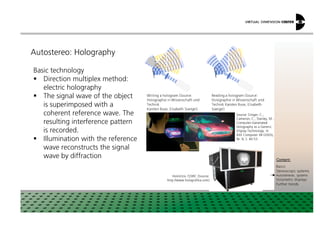
Autostereo: Holography
Basic technology
Direction multiplex method:
electric holography
The signal wave of the object
is superimposed with a
coherent reference wave. The
Reading a hologram (Source:
Holographie in Wissenschaft und
Technik Karsten Buse, Elisabeth
Soergel)
Writing a hologram (Source:
Holographie in Wissenschaft und
Technik
Karsten Buse, Elisabeth Soergel)
xxx:
xxxContent:
Basics
Stereoscopic systems
Autostereosc. systems
Volumetric displays
Further trends
coherent reference wave. The
resulting interference pattern
is recorded.
Illumination with the reference
wave reconstructs the signal
wave by diffraction
Source: Slinger, C.;
Cameron, C.; Stanley, M.:
Computer-Generated
Holography as a Generic
Display Technology. In:
IEEE Computer 38 (2005),
Nr. 8, S. 46-53
HoloVizio 720RC (Source:
http://www.holografika.com)
Technologies
Toshiba: use of digital lens raster from the company AU Optronics
Additional monochrome TN () panel
Additional convex shaped layer of so-called reactive mesogens (RM)
(UV light-cured liquid crystal: refractive index varies with polarization of
incident light)
xxx:
xxxContent:
Basics
Stereoscopic systems
Autostereosc. systems
Volumetric displays
Further trends
GRIN or ELC lenses (LG displays)
- see ct 2011
Projection on fog, steam
⊕ Scalable
Θ No stereo-3D
Volumetric Displays
xxx:
xxxContent:
Basics
Stereoscopic systems
Autostereosc. systems
Volumetric displays
Further trends
Volumetric displays
Presentation of computer graphics in 3D
space, not on the surface
⊕ No glasses necessary
⊕ Depth criterion motion parallax without
tracking
Pure Depth 12.1 RGB BLU
xxx:
xxxContent:
Basics
Stereoscopic systems
Autostereosc. systems
Volumetric displays
Further trends
tracking
⊕ Depth criterion accommodation
⊕ Multi-user capable
⊕ Partly scalable
Θ Almost always partially transparent
Θ Limited color reproduction
Θ Low resolution
Θ Further disadvantages depending on the
system type
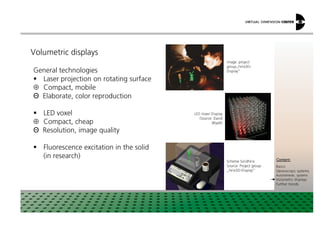
Volumetric displays
General technologies
Laser projection on rotating surface
⊕ Compact, mobile
Θ Elaborate, color reproduction
LED voxel
Image: project
group„Felix3D-
Display“
xxx:
xxxContent:
Basics
Stereoscopic systems
Autostereosc. systems
Volumetric displays
Further trends
LED voxel
⊕ Compact, cheap
Θ Resolution, image quality
Fluorescence excitation in the solid
(in research)
Scheme SolidFelix
Source: Project group
„Felix3D-Display“
LED Voxel Display
(Source: David
Wyatt)
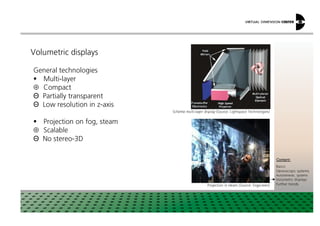
Volumetric displays
General technologies
Multi-layer
⊕ Compact
Θ Partially transparent
Θ Low resolution in z-axis
Scheme multi-layer display (Source: Lightspace Technologies)
xxx:
xxxContent:
Basics
Stereoscopic systems
Autostereosc. systems
Volumetric displays
Further trends
Projection on fog, steam
⊕ Scalable
Θ No stereo-3D
Scheme multi-layer display (Source: Lightspace Technologies)
Projection in steam (Source: Fogscreen)
Further Trends
xxx:
xxxContent:
Basics
Stereoscopic systems
Autostereosc. systems
Volumetric displays
Further trends
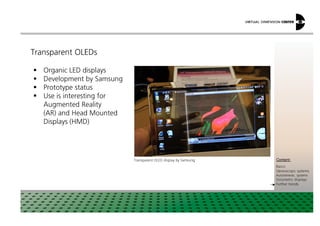
Transparent OLEDs
Organic LED displays
Development by Samsung
Prototype status
Use is interesting for
Augmented Reality
(AR) and Head Mounted
xxx:
xxxContent:
Basics
Stereoscopic systems
Autostereosc. systems
Volumetric displays
Further trends
(AR) and Head Mounted
Displays (HMD)
Transparent OLED display by Samsung
HDR displays
Uniform background lighting:
brightest white and darkest black
brighter
Only shifting, not improving the
dynamics
HDR (High Dynamic Range):
Very strong effect, especially
with monochrome images
xxx:
xxxContent:
Basics
Stereoscopic systems
Autostereosc. systems
Volumetric displays
Further trends
HDR (High Dynamic Range):
prototypes since 2004
HDR displays increase brightness
values by backlighting
Thereby, the display is not
illuminated surface-wide with the
same brightness from behind, but
is partially illuminated brighter and
darker
Contrast range of up to 200.000:1 Sim2 HDR 47
Background with
color support
Thank you very much for your interest!
You are interested in this topic and you are looking for contact persons/ implementation
partners? Please contact us.
© Competence Centre for Virtual Reality and Cooperative Engineering w. V. – Virtual Dimension Center (VDC)
Virtual Dimension Center (VDC) Fellbach
Auberlenstraße 13
70736 Fellbach
www.vdc-fellbach.de

3D Display Technology: VDC-Whitepaper

  • 1.
    Whitepaper 3D Display Technology Active-,Passive-, Autostereo, Volumetric Displays © Competence Centre for Virtual Reality and Cooperative Engineering w. V. – Virtual Dimension Center (VDC) Dr.-Ing. Dipl.-Kfm. Christoph Runde Virtual Dimension Center (VDC) Fellbach Auberlenstr. 13 70736 Fellbach www.vdc-fellbach.de Active-, Passive-, Autostereo, Volumetric Displays
  • 2.
    VDC-technology screening: 3Ddisplay technology Basics Stereoscopic Displays Autostereoscopic Systems Volumetric Displays Further Trends xxx: xxxContent: Basics Stereoscopic systems Autostereosc. systems Volumetric displays Further trends
  • 3.
    Basics: Terms andmotivation 3D visualization = spatial vision Providing two, slightly offset perspectives for the viewer Possibly head tracking Thereby: xxx: xxxContent: Basics Stereoscopic systems Autostereosc. systems Volumetric displays Further trends Thereby: Brain assigns spatialities better Better feeling for the near and far Building a mental, spatial environment model is easier Support for 3D interaction (space must be known for this)
  • 4.
    Whitepaper 3D Display Technology Source:Runde, C.: Konzeption und Einführung von Virtueller Realität als Komponente der Digitalen Fabrik in Industrieunternehmen. Zugl.: Stuttgart, Univ., Diss., 2007, IPA-IAO Forschung und Praxis, 455. Heimsheim: Jost-Jetter Verlag, 2007 Graphical depth criteria What does the brain calculate/ work with? xxx: xxx www.vdc-fellbach.de info@vdc.fellbach.de Tel.: +49 (0) 711 58 53 09-0 www.vdc-fellbach.de info@vdc.fellbach.de Tel.: +49 (0) 711 58 53 09-0 www.vdc-fellbach.de info@vdc-fellbach.de Tel.: +49 (0) 711 58 53 09-0 © Kompetenzzentrum Virtuelle Realität und Kooperatives Engineering w. V. – Virtual Dimension Center VDC 4 Content: Basics Projection systems Types of construction projection systems Display systems Autostereosc. systems Volumetr. displays Further trends
  • 5.
    Basics: Stereo solutions Twoviews are generated These two views have to be transported separately to the two eyes Note: natural eye distance (about 6.5cm) allows reasonable stereoscopic vision at a distance of up to 15m Greater distance: increase parallax Quality criteria, amongst others: xxx: xxxContent: Basics Stereoscopic systems Autostereosc. systems Volumetric displays Further trends Quality criteria, amongst others: oOptical crosstalk (eye receives false signal): ghosting oOverall brightness oUniformity of brightness distribution (hot spots) oFocus (tinting) oContrast, dynamics
  • 6.
  • 7.
    Passive-stereo displays Polarization filterglasses Basic technologies Polarizing filter screens (light wave polarization, passive stereo) Image columns or lines alternately polarized xxx: xxxContent: Basics Stereoscopic systems Autostereosc. systems Volumetric displays Further trends JVC GD-463D10 3D monitor screen ⊕ Light glasses ⊕ No sync necessary ⊕ No flickering Θ Half resolution
  • 8.
    Planar® display Uses twoscreens Pane lets through front display and mirrors upper Resolution 1920 x 1200x ⊕ No reduction of resolution because of Polarization filter glasses xxx: xxxContent: Basics Stereoscopic systems Autostereosc. systems Volumetric displays Further trends ⊕ No reduction of resolution because of stereoscopy ⊕ However steady image Θ Space requirement Θ Price Planar SD2620W-351 Possibility to test at:
  • 9.
    Active-stereo displays Basic technologies Shuttertechnology (LCD, active- stereo) Display: at least 120Hz refresh rate ⊕ Depending on the system, very low crosstalk Shutter glasses Nvidia IR emitter xxx: xxxContent: Basics Stereoscopic systems Autostereosc. systems Volumetric displays Further trends crosstalk Θ Heavier glasses Θ Active glasses: power supply Θ Polarized glasses Θ Mostly an emitter for the synchronization of image-glasses is necessary Θ Loss of brightness Θ Possibly flickering today: DLP, LCD example: Samsung SyncMaster 2233RZ LCD In the past: tube monitor
  • 10.
    Active-stereo: Plasm screens Lightgeneration by phosphors encouraged by UV radiation from plasm discharges The discharge takes place in cells located between two panes of glass, which dƵďĞ > WůĂƐŵ н ůŽǁ ĐŽƐƚƐ н ŚŝŐŚ ƌĞƉĞƚŝƚŝŽŶ ƌĂƚĞ ƉŽƐƐŝďůĞ н ĨůĞdžŝďůĞ ĐŚŽŝĐĞ ŽĨ ƉĂƌĂŵĞƚĞƌƐ н ĂƉƉůŝĐĂďůĞ ĂƐ ǀĞĐƚŽƌ ĚĞǀŝĐĞ Ͳ ,ŝŐŚ ƐƉĂĐĞ ƌĞƋƵŝƌĞŵĞŶƚ Ͳ DĂŐŶĞƚŝĐ ĨŝĞůĚƐ ĐƌĞĂƚĞ н ůŽǁ ƐƉĂĐĞ ƌĞƋƵŝƌĞŵĞŶƚ н Žǁ ĚĞŵĂŶĚ ŽĨ ǀŽůƚĂŐĞ ;ǀĞƌƐĂƚŝůĞͿ н ůŽǁ ƉŽǁĞƌ ĐŽŶƐƵŵƉƚŝŽŶ н ůŽǁ ǁĞŝŐŚƚ н ŶŽ ƌĂĚŝĂƚŝŽŶ ĞŵŝƐƐŝŽŶƐ Ͳ ŝŵŝƚĞĚ ƉĞƌƐƉĞĐƚŝǀĞƐ Ͳ Žǁ ĐŽŶƚƌĂƐƚ ƌĂƚŝŽ Ͳ ůŽǁ ƌĞƉĞƚŝƚŝŽŶ ƌĂƚĞͬ ůŽŶŐ ƌĞƐƉŽŶƐĞ ƚŝŵĞ н ůŽǁ ƐƉĂĐĞ ƌĞƋƵŝƌĞŵĞŶƚ н ůĂƌŐĞ ƐĐƌĞĞŶƐ ƉŽƐƐŝďůĞ н ŚŝŐŚ ůŝŐŚƚ ŽƵƚƉƵƚ͕ ĐŽŶƚƌĂƐƚ ƌĂƚŝŽ ĂŶĚ ůĂƌŐĞ ĐŽůŽƌ ƐƉĞĐƚƌƵŵ Ͳ ŚŝŐŚ ŚĞĂƚ ŽƵƚƉƵƚ Ͳ EŽŝƐĞ ŐĞŶĞƌĂƚŝŽŶ ǁŚĞŶ ƵƐŝŶŐ ƚŚĞ ǀĞŶƚŝůĂƚŽƌ Ͳ ůŽǁ ƌĞƐŽůƵƚŝŽŶ Ͳ ĞŶŐƚŚ ĂĐĐĞƉƚĂŶĐĞ ŽĨ ůŝŐŚƚ ŽƵƚƉƵƚ ĂŶĚ ĐŽůŽƌ ĚŝƐƚŽƌƚŝŽŶƐ Comparison technology tube, LCD, plasm (source: FZ Jülich) xxx: xxxContent: Basics Stereoscopic systems Autostereosc. systems Volumetric displays Further trends two panes of glass, which are filled with neon, xenon and possibly helium, after electrical ignition of the gas for changing the state of aggregation in plasma Different levels of brightness are achieved by the number of ignitions Increase in brightness with active stereo Schematic illustration of the structure of a plasm screen (source: Wikipedia) Ͳ DĂŐŶĞƚŝĐ ĨŝĞůĚƐ ĐƌĞĂƚĞ ŝŶƚĞƌĨĞƌĞŶĐĞ ĨŝĞůĚƐ Ͳ ůŝĐŬĞƌŝŶŐ ƌĞƐƉŽŶƐĞ ƚŝŵĞ Ͳ ĂĐŬŐƌŽƵŶĚ ůŝŐŚƚŝŶŐ ĐŽůŽƌ ĚŝƐƚŽƌƚŝŽŶƐ Ͳ ƵƌŶͲŝŶ ƉŽƐƐŝďůĞ
  • 11.
    Active-stereo: Plasm screens Panasonic: 85inches and 103 inches 3D plasma screens on offer, 150 inches as a prototype xxx: xxxContent: Basics Stereoscopic systems Autostereosc. systems Volumetric displays Further trends Possibility to test at:
  • 12.
    Separated displays foreach eye ⊕ Full channel separation right-left ⊕ Includes sense of orientation in case of using head tracking (supports mental spatial image) Θ Resolution is usually lower NVIS Virtual Binokular SV xxx: xxxContent: Basics Stereoscopic systems Autostereosc. systems Volumetric displays Further trends Θ Resolution is usually lower Θ High weight Θ Isolation available Θ Viewing angle usually small NVIS nVisor SX111 NVIS Virtual Binokular SV
  • 13.
  • 14.
    Autostereo: Lenticular Basic technologies Directionmultiplex method: lenticular systems ⊕ No glasses necessary ⊕ No calibration or similar Tridelity screen xxx: xxxContent: Basics Stereoscopic systems Autostereosc. systems Volumetric displays Further trends ⊕ No calibration or similar ⊕ Multi-user capable Θ Fixed, optimal field of vision Θ Optimal viewing distance determined Θ Special software Θ Decreased resolution Schematic illustration of the procedure (source: www.3d-forums.com)
  • 15.
    Autostereo: Parallax barrier Basictechnologies Direction multiplex method: parallax barrier systems ⊕ No glasses necessary ⊕ Optimal viewing position is adjusted See-real screen Samsung SCH B710 xxx: xxxContent: Basics Stereoscopic systems Autostereosc. systems Volumetric displays Further trends ⊕ Optimal viewing position is adjusted dynamically (face recognition) Θ Single-user system Θ Decreased resolution Schematic illustration of the procedure (source: www.3d-forums.com)
  • 16.
    Autostereo: Holography Basic technology Directionmultiplex method: electric holography The signal wave of the object is superimposed with a coherent reference wave. The Reading a hologram (Source: Holographie in Wissenschaft und Technik Karsten Buse, Elisabeth Soergel) Writing a hologram (Source: Holographie in Wissenschaft und Technik Karsten Buse, Elisabeth Soergel) xxx: xxxContent: Basics Stereoscopic systems Autostereosc. systems Volumetric displays Further trends coherent reference wave. The resulting interference pattern is recorded. Illumination with the reference wave reconstructs the signal wave by diffraction Source: Slinger, C.; Cameron, C.; Stanley, M.: Computer-Generated Holography as a Generic Display Technology. In: IEEE Computer 38 (2005), Nr. 8, S. 46-53 HoloVizio 720RC (Source: http://www.holografika.com)
  • 17.
    Technologies Toshiba: use ofdigital lens raster from the company AU Optronics Additional monochrome TN () panel Additional convex shaped layer of so-called reactive mesogens (RM) (UV light-cured liquid crystal: refractive index varies with polarization of incident light) xxx: xxxContent: Basics Stereoscopic systems Autostereosc. systems Volumetric displays Further trends GRIN or ELC lenses (LG displays) - see ct 2011 Projection on fog, steam ⊕ Scalable Θ No stereo-3D
  • 18.
  • 19.
    Volumetric displays Presentation ofcomputer graphics in 3D space, not on the surface ⊕ No glasses necessary ⊕ Depth criterion motion parallax without tracking Pure Depth 12.1 RGB BLU xxx: xxxContent: Basics Stereoscopic systems Autostereosc. systems Volumetric displays Further trends tracking ⊕ Depth criterion accommodation ⊕ Multi-user capable ⊕ Partly scalable Θ Almost always partially transparent Θ Limited color reproduction Θ Low resolution Θ Further disadvantages depending on the system type
  • 20.
    Volumetric displays General technologies Laserprojection on rotating surface ⊕ Compact, mobile Θ Elaborate, color reproduction LED voxel Image: project group„Felix3D- Display“ xxx: xxxContent: Basics Stereoscopic systems Autostereosc. systems Volumetric displays Further trends LED voxel ⊕ Compact, cheap Θ Resolution, image quality Fluorescence excitation in the solid (in research) Scheme SolidFelix Source: Project group „Felix3D-Display“ LED Voxel Display (Source: David Wyatt)
  • 21.
    Volumetric displays General technologies Multi-layer ⊕Compact Θ Partially transparent Θ Low resolution in z-axis Scheme multi-layer display (Source: Lightspace Technologies) xxx: xxxContent: Basics Stereoscopic systems Autostereosc. systems Volumetric displays Further trends Projection on fog, steam ⊕ Scalable Θ No stereo-3D Scheme multi-layer display (Source: Lightspace Technologies) Projection in steam (Source: Fogscreen)
  • 22.
  • 23.
    Transparent OLEDs Organic LEDdisplays Development by Samsung Prototype status Use is interesting for Augmented Reality (AR) and Head Mounted xxx: xxxContent: Basics Stereoscopic systems Autostereosc. systems Volumetric displays Further trends (AR) and Head Mounted Displays (HMD) Transparent OLED display by Samsung
  • 24.
    HDR displays Uniform backgroundlighting: brightest white and darkest black brighter Only shifting, not improving the dynamics HDR (High Dynamic Range): Very strong effect, especially with monochrome images xxx: xxxContent: Basics Stereoscopic systems Autostereosc. systems Volumetric displays Further trends HDR (High Dynamic Range): prototypes since 2004 HDR displays increase brightness values by backlighting Thereby, the display is not illuminated surface-wide with the same brightness from behind, but is partially illuminated brighter and darker Contrast range of up to 200.000:1 Sim2 HDR 47 Background with color support
  • 25.
    Thank you verymuch for your interest! You are interested in this topic and you are looking for contact persons/ implementation partners? Please contact us. © Competence Centre for Virtual Reality and Cooperative Engineering w. V. – Virtual Dimension Center (VDC) Virtual Dimension Center (VDC) Fellbach Auberlenstraße 13 70736 Fellbach www.vdc-fellbach.de