27. Denture Processing


This program of instruction is protected by copyright ©. No portion of this
program of instruction may be reproduced, recorded or transferred by any
means electronic, digital, photographic, mechanical etc., or by any
information storage or retrieval system, without prior permission.
Preparing Dentures for Processing


Injection molding
  We recommend the SR Ivocap System
  • Less distortion during processing
  • Minimal pin opening


Result: Laboratory remount much simplified.
Preparing Dentures for Processing


Injection molding
  We recommend the SR Ivocap System
  • Less distortion during processing
  • Minimal pin opening
Flasking

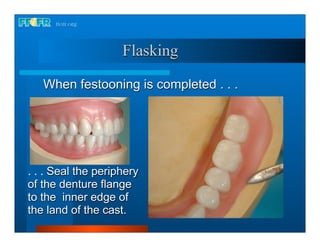
   When festooning is completed . . .


. . . Seal the periphery
of the denture flange
to the inner edge of
the land of the cast.
Flasking

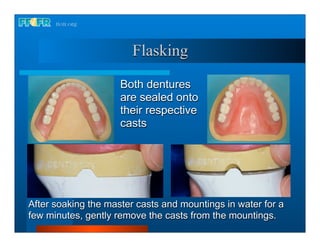
                     Both dentures
                     are sealed onto
                     their respective
                     casts


After soaking the master casts and mountings in water for a
few minutes, gently remove the casts from the mountings.
Flasking


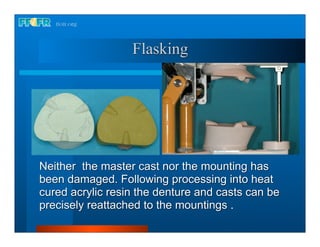
Neither the master cast nor the mounting has
been damaged. Following processing into heat
cured acrylic resin the denture and casts can be
precisely reattached to the mountings .
Flasking
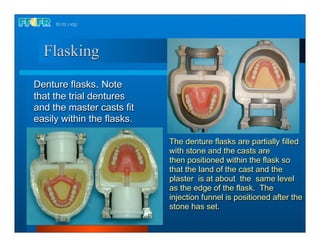
Denture flasks. Note
that the trial dentures
and the master casts fit
easily within the flasks.

                            The denture flasks are partially filled
                            with stone and the casts are
                            then positioned within the flask so
                            that the land of the cast and the
                            plaster is at about the same level
                            as the edge of the flask. The
                            injection funnel is positioned after the
                            stone has set.
Flasking
                             The injection channels must
                            be 3-5 mm in diameter. For
                            the maxilla one channel is
                            sufficient. For the mandible
                            two are required.


An appropriate separating
medium is applied to the
surface of the stone.
Flasking


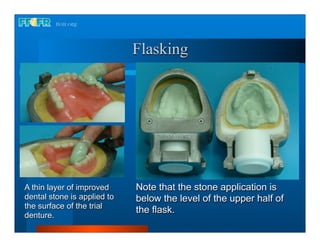
A thin layer of improved     Note that the stone application is
dental stone is applied to   below the level of the upper half of
the surface of the trial
                             the flask.
denture.
Flasking


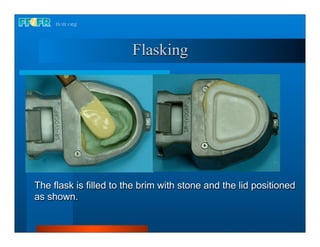
The flask is filled to the brim with stone and the lid positioned
as shown.
Boil Out
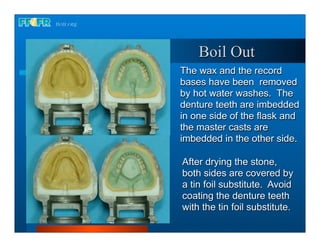
The wax and the record
bases have been removed
by hot water washes. The
denture teeth are imbedded
in one side of the flask and
the master casts are
imbedded in the other side.

After drying the stone,
both sides are covered by
a tin foil substitute. Avoid
coating the denture teeth
with the tin foil substitute.
Capsule Preparation
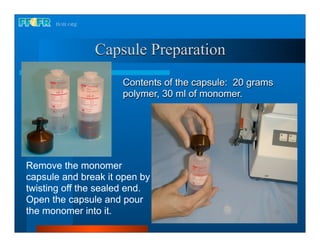
                     Contents of the capsule: 20 grams
                     polymer, 30 ml of monomer.


Remove the monomer
capsule and break it open by
twisting off the sealed end.
Open the capsule and pour
the monomer into it.
Mixing the Resin
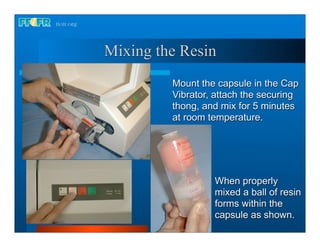
         Mount the capsule in the Cap
         Vibrator, attach the securing
         thong, and mix for 5 minutes
         at room temperature.


                  When properly
                  mixed a ball of resin
                  forms within the
                  capsule as shown.
Preparing the Resin for Injection


Remove the empty monomer container, place the capsule on
the capsule plunger and press the contents upwards. There
should be no air between the plunger and the contents.
Assemble and Clamp the Flask


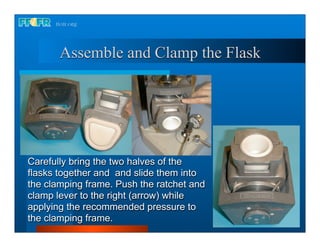
Carefully bring the two halves of the
flasks together and and slide them into
the clamping frame. Push the ratchet and
clamp lever to the right (arrow) while
applying the recommended pressure to
the clamping frame.
Inserting the SR Ivocap Capsules


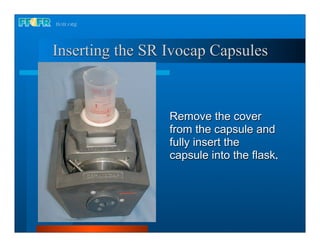
                 Remove the cover
                 from the capsule and
                 fully insert the
                 capsule into the flask.
Mounting the Pressure Apparatus
Fully extend the plunger of the
pressure apparatus, by pulling the
piston rod when the compressed air
locking valve is open.

Place the SR Ivocap pressure
apparatus on the flask, lift the safety
loop, and press the plunger into the
capsule until the vise shanks are
correctly positioned on the flask.
Then pull down the safety loop until it
snaps into place.
Polymerization of the Acrylic Resin

                            Place the SR Ivocap assembly in
                            the polymerization bath as shown.
                            The surface of the water should be
                            covered by plastic floaters in order
                            to prevent unnecessary loss of
                            heat.


The water should boil during the entire cycle. The water level
must reach the red mark on the clamping frame but not
exceed this level. Polymerization takes 35 minutes.
Polymerization of the Acrylic Resin

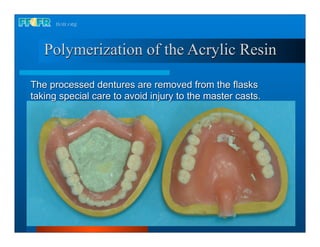
The processed dentures are removed from the flasks
taking special care to avoid injury to the master casts.

27.denture processing

  • 1.
    27. Denture Processing Thisprogram of instruction is protected by copyright ©. No portion of this program of instruction may be reproduced, recorded or transferred by any means electronic, digital, photographic, mechanical etc., or by any information storage or retrieval system, without prior permission.
  • 2.
    Preparing Dentures forProcessing Injection molding We recommend the SR Ivocap System • Less distortion during processing • Minimal pin opening Result: Laboratory remount much simplified.
  • 3.
    Preparing Dentures forProcessing Injection molding We recommend the SR Ivocap System • Less distortion during processing • Minimal pin opening
  • 4.
    Flasking When festooning is completed . . . . . . Seal the periphery of the denture flange to the inner edge of the land of the cast.
  • 5.
    Flasking Both dentures are sealed onto their respective casts After soaking the master casts and mountings in water for a few minutes, gently remove the casts from the mountings.
  • 6.
    Flasking Neither the mastercast nor the mounting has been damaged. Following processing into heat cured acrylic resin the denture and casts can be precisely reattached to the mountings .
  • 7.
    Flasking Denture flasks. Note thatthe trial dentures and the master casts fit easily within the flasks. The denture flasks are partially filled with stone and the casts are then positioned within the flask so that the land of the cast and the plaster is at about the same level as the edge of the flask. The injection funnel is positioned after the stone has set.
  • 8.
    Flasking The injection channels must be 3-5 mm in diameter. For the maxilla one channel is sufficient. For the mandible two are required. An appropriate separating medium is applied to the surface of the stone.
  • 9.
    Flasking A thin layerof improved Note that the stone application is dental stone is applied to below the level of the upper half of the surface of the trial the flask. denture.
  • 10.
    Flasking The flask isfilled to the brim with stone and the lid positioned as shown.
  • 11.
    Boil Out The waxand the record bases have been removed by hot water washes. The denture teeth are imbedded in one side of the flask and the master casts are imbedded in the other side. After drying the stone, both sides are covered by a tin foil substitute. Avoid coating the denture teeth with the tin foil substitute.
  • 12.
    Capsule Preparation Contents of the capsule: 20 grams polymer, 30 ml of monomer. Remove the monomer capsule and break it open by twisting off the sealed end. Open the capsule and pour the monomer into it.
  • 13.
    Mixing the Resin Mount the capsule in the Cap Vibrator, attach the securing thong, and mix for 5 minutes at room temperature. When properly mixed a ball of resin forms within the capsule as shown.
  • 14.
    Preparing the Resinfor Injection Remove the empty monomer container, place the capsule on the capsule plunger and press the contents upwards. There should be no air between the plunger and the contents.
  • 15.
    Assemble and Clampthe Flask Carefully bring the two halves of the flasks together and and slide them into the clamping frame. Push the ratchet and clamp lever to the right (arrow) while applying the recommended pressure to the clamping frame.
  • 16.
    Inserting the SRIvocap Capsules Remove the cover from the capsule and fully insert the capsule into the flask.
  • 17.
    Mounting the PressureApparatus Fully extend the plunger of the pressure apparatus, by pulling the piston rod when the compressed air locking valve is open. Place the SR Ivocap pressure apparatus on the flask, lift the safety loop, and press the plunger into the capsule until the vise shanks are correctly positioned on the flask. Then pull down the safety loop until it snaps into place.
  • 18.
    Polymerization of theAcrylic Resin Place the SR Ivocap assembly in the polymerization bath as shown. The surface of the water should be covered by plastic floaters in order to prevent unnecessary loss of heat. The water should boil during the entire cycle. The water level must reach the red mark on the clamping frame but not exceed this level. Polymerization takes 35 minutes.
  • 19.
    Polymerization of theAcrylic Resin The processed dentures are removed from the flasks taking special care to avoid injury to the master casts.