Concepts of Complete
                     Denture Occlusion


This program of instruction is protected by copyright ©. No portion of
this program of instruction may be reproduced, recorded or transferred
by any means electronic, digital, photographic, mechanical etc., or by
any information storage or retrieval system, without prior permission.
Differences between Natural and Complete
                 Denture Occlusion
     Natural Dentition                Denture “Dentition”
n   Retained in PDL             n   Mobile bases on mucosa
n   Units move                  n   Teeth move as an unit
     independently               n   Malocclusion affects
n   Malocclusion effects not         entire base immediately
     immediate
                                 n   Non-vertical forces affect
n   Non-vertical forces              all teeth and is traumatic
     affect only teeth
     involved and usually
                                 n   Incising affects all teeth
     well tolerated                   attached to base
n   Incising doesn’t affect     n   Bilateral balance is often
     posteriors                       desired for base stability
n   Bilateral balance is rare   n   Decreased tactile sense
n   Tactile sensitivity
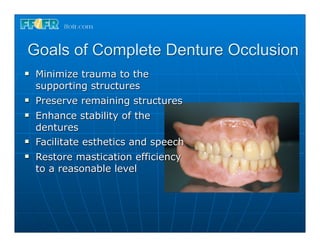
Goals of Complete Denture Occlusion
n   Minimize trauma to the
     supporting structures
n   Preserve remaining structures
n   Enhance stability of the
     dentures
n   Facilitate esthetics and speech
n   Restore mastication efficiency
     to a reasonable level
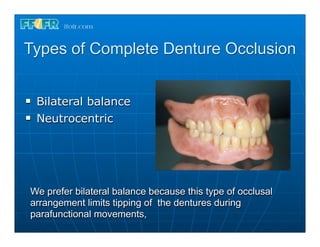
Types of Complete Denture Occlusion


n   Bilateral balance
n   Neutrocentric


 We prefer bilateral balance because this type of occlusal
 arrangement limits tipping of the dentures during
 parafunctional movements,
Bilateral Balanced Denture Occlusion

      The stable simultaneous contact of
      opposing upper and lower teeth in
      centric relation position with a smooth
      bilateral gliding contact to any eccentric
      position within the normal range of
      mandibular function, developed to
      lessen or limit tipping or rotation of the
      denture bases in relation to the
      supporting structures.
Bilateral Balanced Denture Occlusion
n   Traditionally bilateral balance was
     achieved with anatomic posterior
     denture teeth. However, it can be
     achieved with nonanatomic teeth using
     balancing ramps or by manipulating the
     compensating curve.
Bilateral Balanced Denture Occlusion
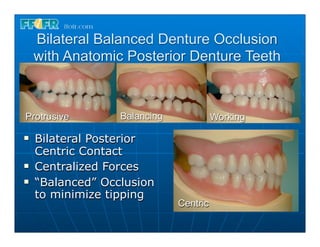
     with Anatomic Posterior Denture Teeth


Protrusive         Balancing             Working

n   Bilateral Posterior
     Centric Contact
n   Centralized Forces
n   “Balanced” Occlusion
     to minimize tipping
                               Centric
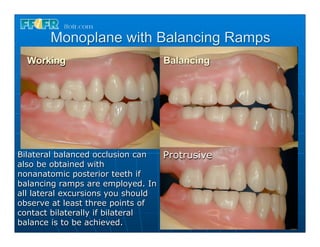
Monoplane with Balancing Ramps
  Working                       Balancing


Bilateral balanced occlusion can  Protrusive
also be obtained with
nonanatomic posterior teeth if
balancing ramps are employed. In
all lateral excursions you should
observe at least three points of
contact bilaterally if bilateral
balance is to be achieved.
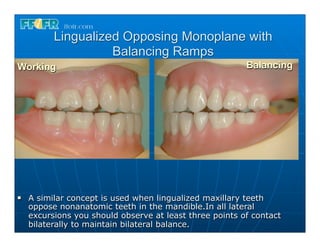
Lingualized Opposing Monoplane with
                     Balancing Ramps
Working                                                   Balancing


n   A similar concept is used when lingualized maxillary teeth
     oppose nonanatomic teeth in the mandible.In all lateral
     excursions you should observe at least three points of contact
     bilaterally to maintain bilateral balance.
Monoplane Occlusion
            (Neutrocentric Concept)
This concept of occlusion assumes that the anterior-
posterior plane of occlusion should be parallel to the
denture foundation area and not dictated by condylar
inclination.
The plane of occlusion is completely flat and level.
There is no curve of Wilson or Curve of Spee
(compensating curve) incorporated into the set up.
There is no vertical overlap of the anterior teeth.

When using this concept of occlusion the patient is
instructed not to incise the bolus. With this tooth
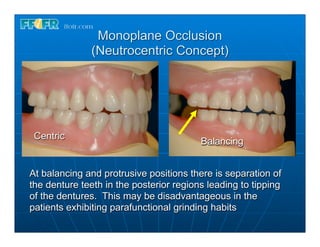
Monoplane Occlusion
              (Neutrocentric Concept)


 Centric
                                         Balancing


At balancing and protrusive positions there is separation of
the denture teeth in the posterior regions leading to tipping
of the dentures. This may be disadvantageous in the
patients exhibiting parafunctional grinding habits
Hanau’s Quint
n   Five Factors Affecting Occlusal Balance
     • Condylar Inclination
     • Incisal Guidance
     • Occlusal Plane Inclination
     • Compensating Curve
     • Cuspal Inclination
Hanau’s Quint
n   Inter-relationship of these five factors may
     be described by Theilman’s Formula
n   In order to maintain a balanced occlusion:
        Condylar Inclination x Incisal Guidance
C=
      OccPlane x Cuspal Inclination x CompCurve
Hanau’s Quint
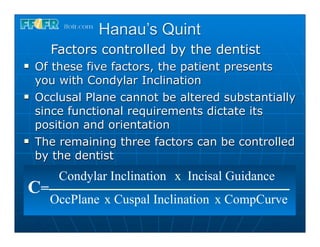
       Factors controlled by the dentist
n   Of these five factors, the patient presents
     you with Condylar Inclination
n   Occlusal Plane cannot be altered substantially
     since functional requirements dictate its
     position and orientation
n   The remaining three factors can be controlled
     by the dentist
         Condylar Inclination x Incisal Guidance
 C=
       OccPlane x Cuspal Inclination x CompCurve
Hanau’s Quint
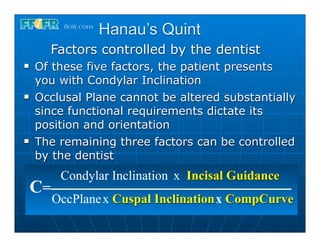
       Factors controlled by the dentist
n   Of these five factors, the patient presents
     you with Condylar Inclination
n   Occlusal Plane cannot be altered substantially
     since functional requirements dictate its
     position and orientation
n   The remaining three factors can be controlled
     by the dentist
           Condylar Inclination x Incisal Guidance
     C=
          OccPlane x Cuspal Inclination x CompCurve
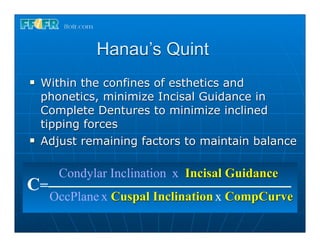
Hanau’s Quint
n   Within the confines of esthetics and
     phonetics, minimize Incisal Guidance in
     Complete Dentures to minimize inclined
     tipping forces
n   Adjust remaining factors to maintain balance

        Condylar Inclination x Incisal Guidance
C=
      OccPlane x Cuspal Inclination x CompCurve
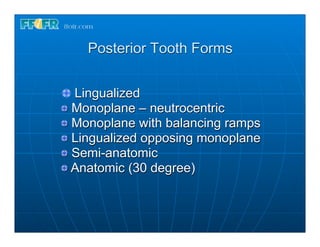
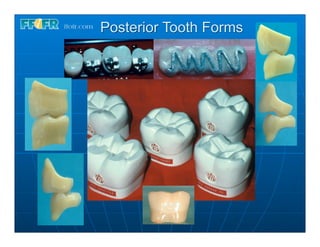
Posterior Tooth Forms


Lingualized
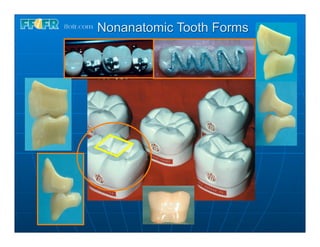
Monoplane – neutrocentric
Monoplane with balancing ramps
Lingualized opposing monoplane
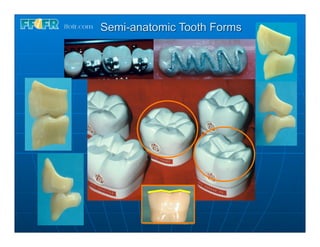
Semi-anatomic
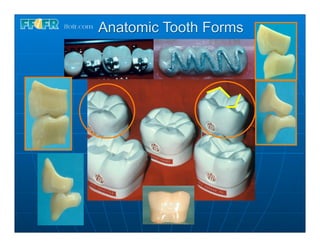
Anatomic (30 degree)
Posterior Tooth Forms
Anatomic Tooth Forms
Nonanatomic Tooth Forms
Semi-anatomic Tooth Forms
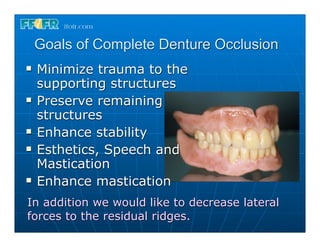
Goals of Complete Denture Occlusion
n   Minimize trauma to the
     supporting structures
n   Preserve remaining
     structures
n   Enhance stability
n   Esthetics, Speech and
     Mastication
n   Enhance mastication
In addition we would like to decrease lateral
forces to the residual ridges.
General Concepts of Denture Occlusion
n   Common Features
     • Functional anatomy is the main determinant of
       denture tooth position
     • Simultaneous, bilateral posterior contact in centric
       relation (centric occlusion)
     • Centralization of centric occlusal forces over the
       mandibular residual ridges
        n Buccal-Lingually
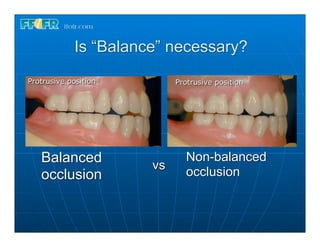
Is “Balance” necessary?
Protrusive position         Protrusive position


   Balanced            vs
                              Non-balanced
   occlusion                  occlusion
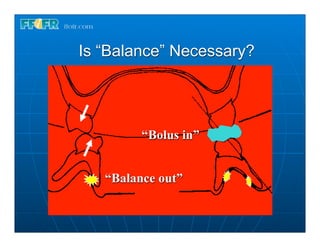
Is “Balance” Necessary?


         “Bolus in”


   “Balance out”
Is “Balance” Necessary?

“Society is made up of happy neurotics,
unhappy neurotics, and a few psychotics,
 and some of each become partially or
         totally edentulous.”
        Theodore Berg, Jr., D.D.S.


  * Balance is for Parafunctional
            Movements
Is “Balance” Necessary?
 Tests of Balanced and Non-balanced
               Occlusions
Trapozzano, V. R.: JPD 10: 476-487, 1960.


1) No patient preference
2) Balanced slightly more efficient
3) Percentage of patients using
 eccentric movements during
 mastication is small
Is “Balance” Necessary?

“Simplification of Occlusion in Complete
    Denture Practice: Posterior Tooth
     Form and Clinical Procedures”
 Dale Smith: DCNA 14: No. 3; July, 1970.


1) Advocates cuspless teeth primarily
 for ease of use
2) May use balanced occlusion but
 can’t prove that it is necessary
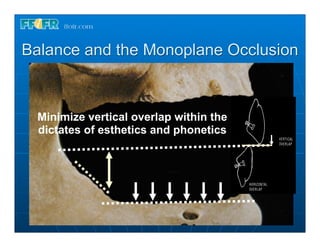
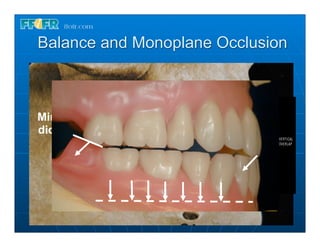
Balance and the Monoplane Occlusion


 Minimize vertical overlap within the
 dictates of esthetics and phonetics
Balance and Monoplane Occlusion


Minimize vertical overlap within the
dictates of esthetics and phonetics
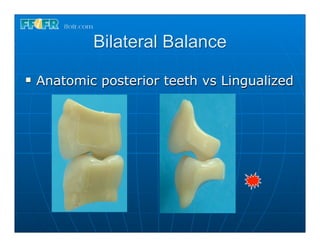
Bilateral Balance
n   Anatomic posterior teeth vs Lingualized
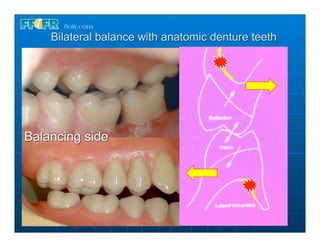
Bilateral balance with anatomic denture teeth


Balancing side
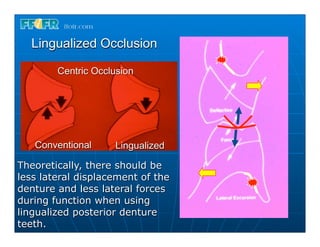
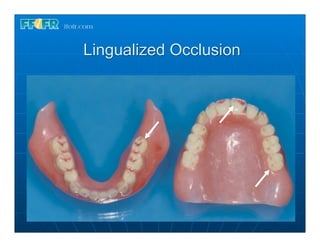
Lingualized Occlusion

        Centric Occlusion


   Conventional     Lingualized

Theoretically, there should be
less lateral displacement of the
denture and less lateral forces
during function when using
lingualized posterior denture
teeth.
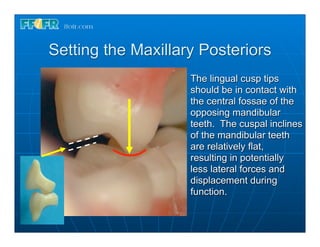
Setting the Maxillary Posteriors
                    The lingual cusp tips
                    should be in contact with
                    the central fossae of the
                    opposing mandibular
                    teeth. The cuspal inclines
                    of the mandibular teeth
                    are relatively flat,
                    resulting in potentially
                    less lateral forces and
                    displacement during
                    function.
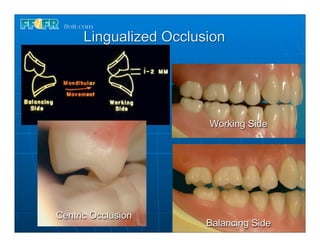
Lingualized Occlusion


                        Working Side


Centric Occlusion
                        Balancing Side
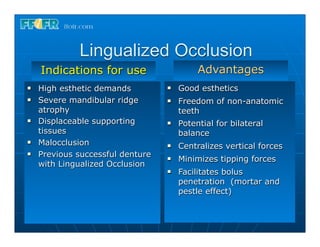
Lingualized Occlusion
     Indications for use                     Advantages
n   High esthetic demands         n   Good esthetics
n   Severe mandibular ridge       n   Freedom of non-anatomic
     atrophy                            teeth
n   Displaceable supporting       n   Potential for bilateral
     tissues                            balance
n   Malocclusion                  n   Centralizes vertical forces
n   Previous successful denture   n   Minimizes tipping forces
     with Lingualized Occlusion
                                   n   Facilitates bolus
                                        penetration (mortar and
                                        pestle effect)
Complete Denture Occlusion


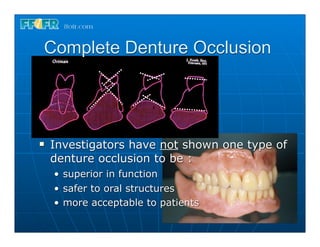
n   Investigators have not shown one type of
     denture occlusion to be :
     • superior in function
     • safer to oral structures
     • more acceptable to patients
Complete Denture Occlusion
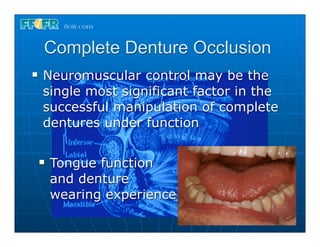
n    Neuromuscular control may be the
      single most significant factor in the
      successful manipulation of complete
      dentures under function

     n   Tongue function
          and denture
          wearing experience
v   Visit ffofr.org for hundreds of additional
     lectures on Complete Dentures, Implant
     Dentistry, Removable Partial Dentures,
     Esthetic Dentistry and Maxillofacial
     Prosthetics.
v   The lectures are free.
v   Our objective is to create the best and
     most comprehensive online programs of
     instruction in Prosthodontics

(Replace) 15.concepts of complete denture occlusion

  • 1.
    Concepts of Complete Denture Occlusion This program of instruction is protected by copyright ©. No portion of this program of instruction may be reproduced, recorded or transferred by any means electronic, digital, photographic, mechanical etc., or by any information storage or retrieval system, without prior permission.
  • 2.
    Differences between Naturaland Complete Denture Occlusion Natural Dentition Denture “Dentition” n Retained in PDL n Mobile bases on mucosa n Units move n Teeth move as an unit independently n Malocclusion affects n Malocclusion effects not entire base immediately immediate n Non-vertical forces affect n Non-vertical forces all teeth and is traumatic affect only teeth involved and usually n Incising affects all teeth well tolerated attached to base n Incising doesn’t affect n Bilateral balance is often posteriors desired for base stability n Bilateral balance is rare n Decreased tactile sense n Tactile sensitivity
  • 3.
    Goals of CompleteDenture Occlusion n Minimize trauma to the supporting structures n Preserve remaining structures n Enhance stability of the dentures n Facilitate esthetics and speech n Restore mastication efficiency to a reasonable level
  • 4.
    Types of CompleteDenture Occlusion n Bilateral balance n Neutrocentric We prefer bilateral balance because this type of occlusal arrangement limits tipping of the dentures during parafunctional movements,
  • 5.
    Bilateral Balanced DentureOcclusion The stable simultaneous contact of opposing upper and lower teeth in centric relation position with a smooth bilateral gliding contact to any eccentric position within the normal range of mandibular function, developed to lessen or limit tipping or rotation of the denture bases in relation to the supporting structures.
  • 6.
    Bilateral Balanced DentureOcclusion n Traditionally bilateral balance was achieved with anatomic posterior denture teeth. However, it can be achieved with nonanatomic teeth using balancing ramps or by manipulating the compensating curve.
  • 7.
    Bilateral Balanced DentureOcclusion with Anatomic Posterior Denture Teeth Protrusive Balancing Working n Bilateral Posterior Centric Contact n Centralized Forces n “Balanced” Occlusion to minimize tipping Centric
  • 8.
    Monoplane with BalancingRamps Working Balancing Bilateral balanced occlusion can Protrusive also be obtained with nonanatomic posterior teeth if balancing ramps are employed. In all lateral excursions you should observe at least three points of contact bilaterally if bilateral balance is to be achieved.
  • 9.
    Lingualized Opposing Monoplanewith Balancing Ramps Working Balancing n A similar concept is used when lingualized maxillary teeth oppose nonanatomic teeth in the mandible.In all lateral excursions you should observe at least three points of contact bilaterally to maintain bilateral balance.
  • 10.
    Monoplane Occlusion (Neutrocentric Concept) This concept of occlusion assumes that the anterior- posterior plane of occlusion should be parallel to the denture foundation area and not dictated by condylar inclination. The plane of occlusion is completely flat and level. There is no curve of Wilson or Curve of Spee (compensating curve) incorporated into the set up. There is no vertical overlap of the anterior teeth. When using this concept of occlusion the patient is instructed not to incise the bolus. With this tooth
  • 11.
    Monoplane Occlusion (Neutrocentric Concept) Centric Balancing At balancing and protrusive positions there is separation of the denture teeth in the posterior regions leading to tipping of the dentures. This may be disadvantageous in the patients exhibiting parafunctional grinding habits
  • 12.
    Hanau’s Quint n Five Factors Affecting Occlusal Balance • Condylar Inclination • Incisal Guidance • Occlusal Plane Inclination • Compensating Curve • Cuspal Inclination
  • 13.
    Hanau’s Quint n Inter-relationship of these five factors may be described by Theilman’s Formula n In order to maintain a balanced occlusion: Condylar Inclination x Incisal Guidance C= OccPlane x Cuspal Inclination x CompCurve
  • 14.
    Hanau’s Quint Factors controlled by the dentist n Of these five factors, the patient presents you with Condylar Inclination n Occlusal Plane cannot be altered substantially since functional requirements dictate its position and orientation n The remaining three factors can be controlled by the dentist Condylar Inclination x Incisal Guidance C= OccPlane x Cuspal Inclination x CompCurve
  • 15.
    Hanau’s Quint Factors controlled by the dentist n Of these five factors, the patient presents you with Condylar Inclination n Occlusal Plane cannot be altered substantially since functional requirements dictate its position and orientation n The remaining three factors can be controlled by the dentist Condylar Inclination x Incisal Guidance C= OccPlane x Cuspal Inclination x CompCurve
  • 16.
    Hanau’s Quint n Within the confines of esthetics and phonetics, minimize Incisal Guidance in Complete Dentures to minimize inclined tipping forces n Adjust remaining factors to maintain balance Condylar Inclination x Incisal Guidance C= OccPlane x Cuspal Inclination x CompCurve
  • 17.
    Posterior Tooth Forms Lingualized Monoplane– neutrocentric Monoplane with balancing ramps Lingualized opposing monoplane Semi-anatomic Anatomic (30 degree)
  • 18.
  • 19.
  • 20.
  • 21.
  • 22.
    Goals of CompleteDenture Occlusion n Minimize trauma to the supporting structures n Preserve remaining structures n Enhance stability n Esthetics, Speech and Mastication n Enhance mastication In addition we would like to decrease lateral forces to the residual ridges.
  • 23.
    General Concepts ofDenture Occlusion n Common Features • Functional anatomy is the main determinant of denture tooth position • Simultaneous, bilateral posterior contact in centric relation (centric occlusion) • Centralization of centric occlusal forces over the mandibular residual ridges n Buccal-Lingually
  • 24.
    Is “Balance” necessary? Protrusiveposition Protrusive position Balanced vs Non-balanced occlusion occlusion
  • 25.
    Is “Balance” Necessary? “Bolus in” “Balance out”
  • 26.
    Is “Balance” Necessary? “Societyis made up of happy neurotics, unhappy neurotics, and a few psychotics, and some of each become partially or totally edentulous.” Theodore Berg, Jr., D.D.S. * Balance is for Parafunctional Movements
  • 27.
    Is “Balance” Necessary? Tests of Balanced and Non-balanced Occlusions Trapozzano, V. R.: JPD 10: 476-487, 1960. 1) No patient preference 2) Balanced slightly more efficient 3) Percentage of patients using eccentric movements during mastication is small
  • 28.
    Is “Balance” Necessary? “Simplificationof Occlusion in Complete Denture Practice: Posterior Tooth Form and Clinical Procedures” Dale Smith: DCNA 14: No. 3; July, 1970. 1) Advocates cuspless teeth primarily for ease of use 2) May use balanced occlusion but can’t prove that it is necessary
  • 29.
    Balance and theMonoplane Occlusion Minimize vertical overlap within the dictates of esthetics and phonetics
  • 30.
    Balance and MonoplaneOcclusion Minimize vertical overlap within the dictates of esthetics and phonetics
  • 31.
    Bilateral Balance n Anatomic posterior teeth vs Lingualized
  • 32.
    Bilateral balance withanatomic denture teeth Balancing side
  • 33.
    Lingualized Occlusion Centric Occlusion Conventional Lingualized Theoretically, there should be less lateral displacement of the denture and less lateral forces during function when using lingualized posterior denture teeth.
  • 34.
    Setting the MaxillaryPosteriors The lingual cusp tips should be in contact with the central fossae of the opposing mandibular teeth. The cuspal inclines of the mandibular teeth are relatively flat, resulting in potentially less lateral forces and displacement during function.
  • 35.
    Lingualized Occlusion Working Side Centric Occlusion Balancing Side
  • 36.
  • 37.
    Lingualized Occlusion Indications for use Advantages n High esthetic demands n Good esthetics n Severe mandibular ridge n Freedom of non-anatomic atrophy teeth n Displaceable supporting n Potential for bilateral tissues balance n Malocclusion n Centralizes vertical forces n Previous successful denture n Minimizes tipping forces with Lingualized Occlusion n Facilitates bolus penetration (mortar and pestle effect)
  • 38.
    Complete Denture Occlusion n Investigators have not shown one type of denture occlusion to be : • superior in function • safer to oral structures • more acceptable to patients
  • 39.
    Complete Denture Occlusion n Neuromuscular control may be the single most significant factor in the successful manipulation of complete dentures under function n Tongue function and denture wearing experience
  • 40.
    v Visit ffofr.org for hundreds of additional lectures on Complete Dentures, Implant Dentistry, Removable Partial Dentures, Esthetic Dentistry and Maxillofacial Prosthetics. v The lectures are free. v Our objective is to create the best and most comprehensive online programs of instruction in Prosthodontics