Packing and Curing
Third step: Packing
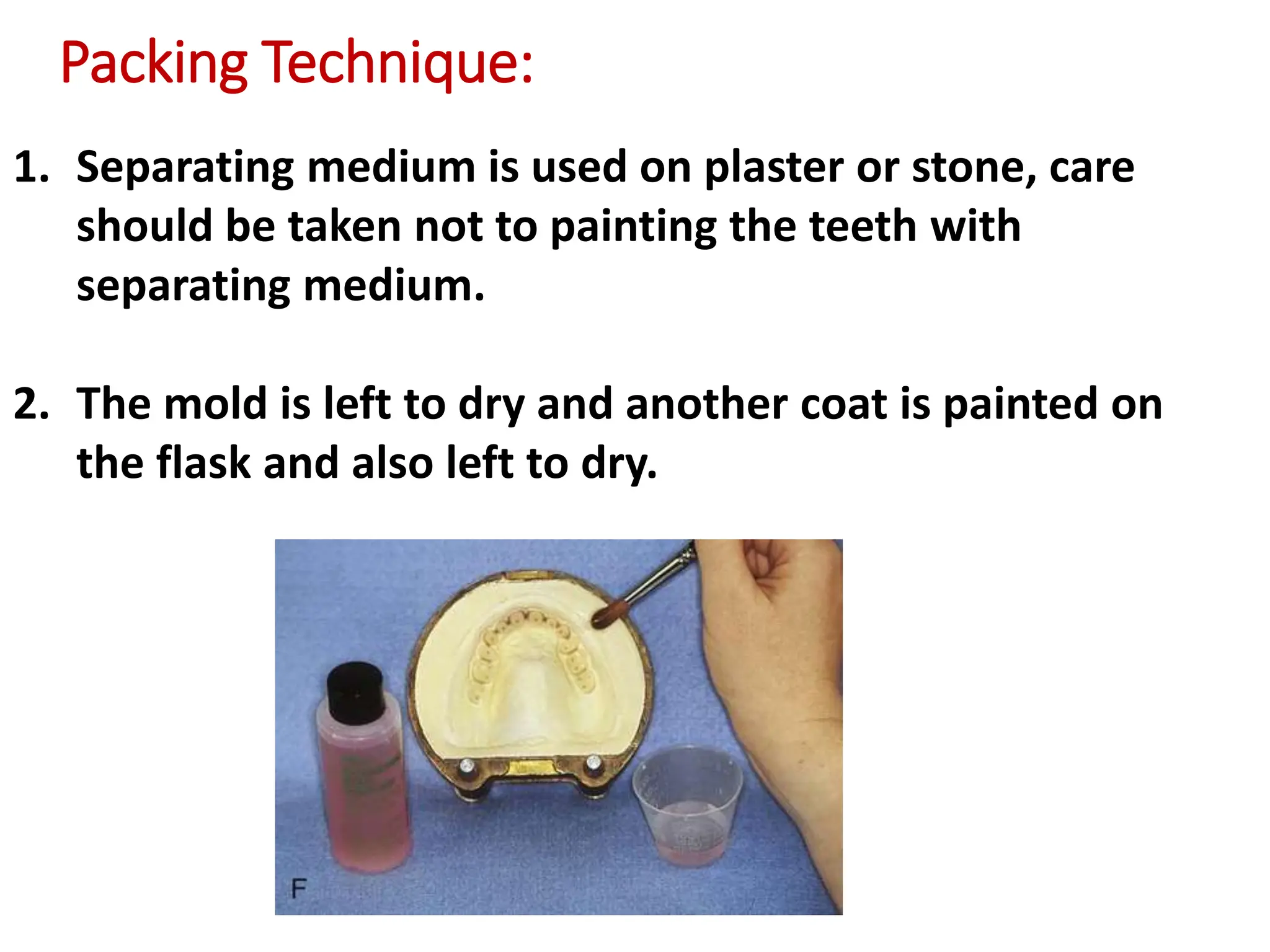
1. Separating medium is used on plaster or stone, care
should be taken not to painting the teeth with
separating medium.
2. The mold is left to dry and another coat is painted on
the flask and also left to dry.
Packing Technique:
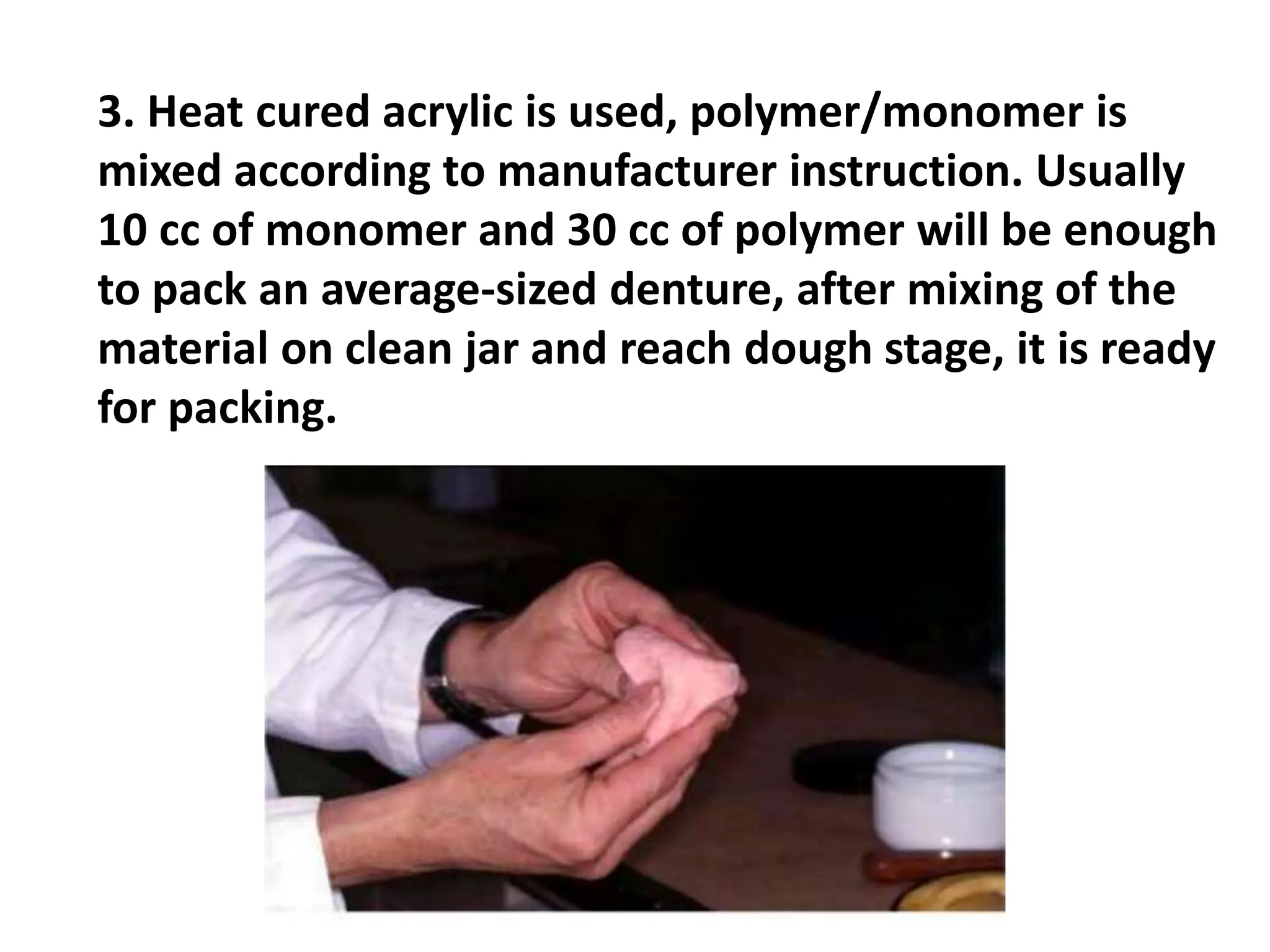
3. Heat cured acrylic is used, polymer/monomer is
mixed according to manufacturer instruction. Usually
10 cc of monomer and 30 cc of polymer will be enough
to pack an average-sized denture, after mixing of the
material on clean jar and reach dough stage, it is ready
for packing.
- The placement of too much material produce a
denture base that has excessive thickness and
resultant malposition of teeth.
- On the other hand, the use of too little material
lead to denture base voids or porosity.
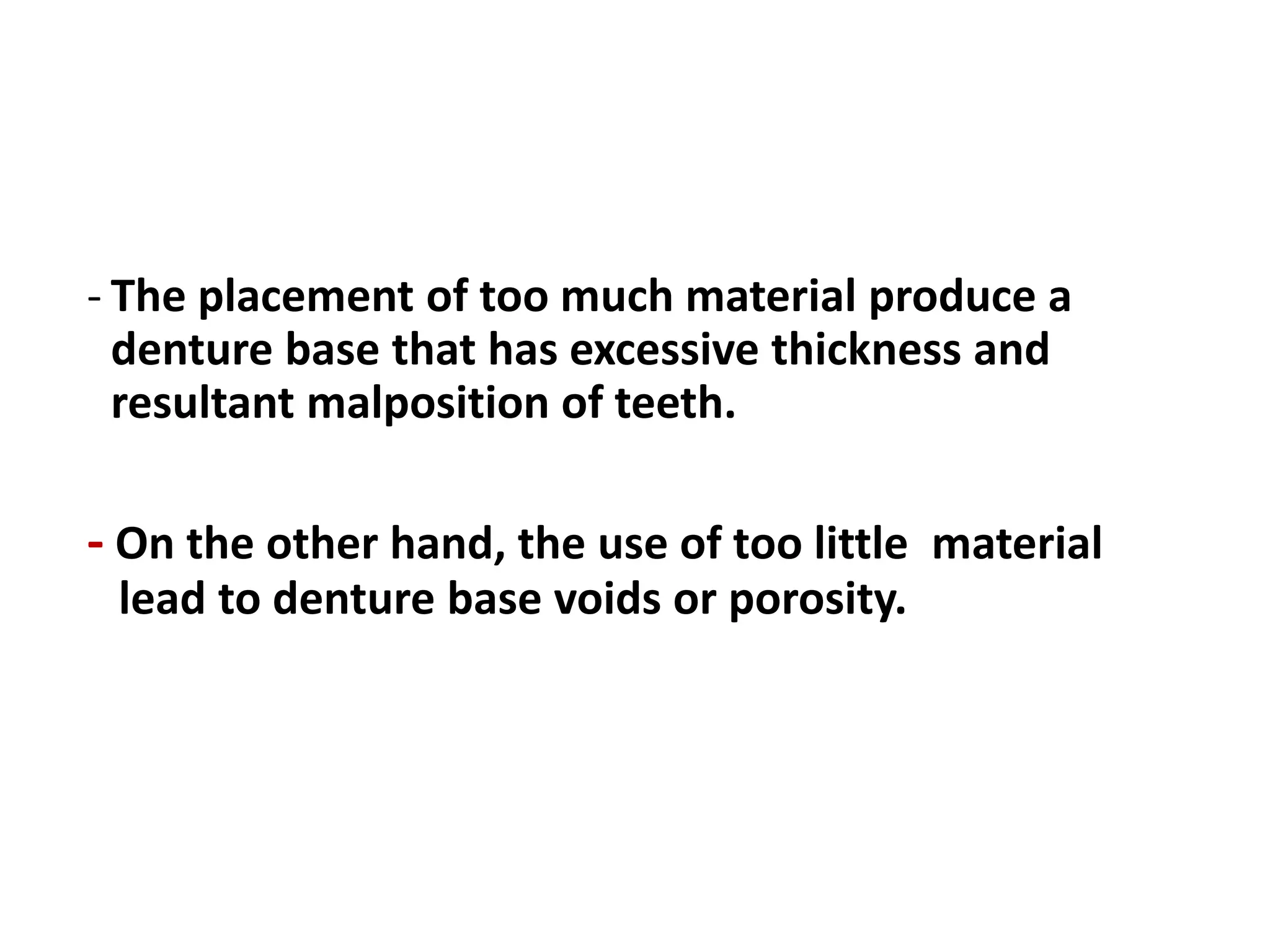
4. Packing the material in the upper half of the flask, being
sure to press it well into the area around the teeth. Use
enough material to insure over packing on the first closure
using nylon sheet. spring clamp and the clamp is closed
tightly.
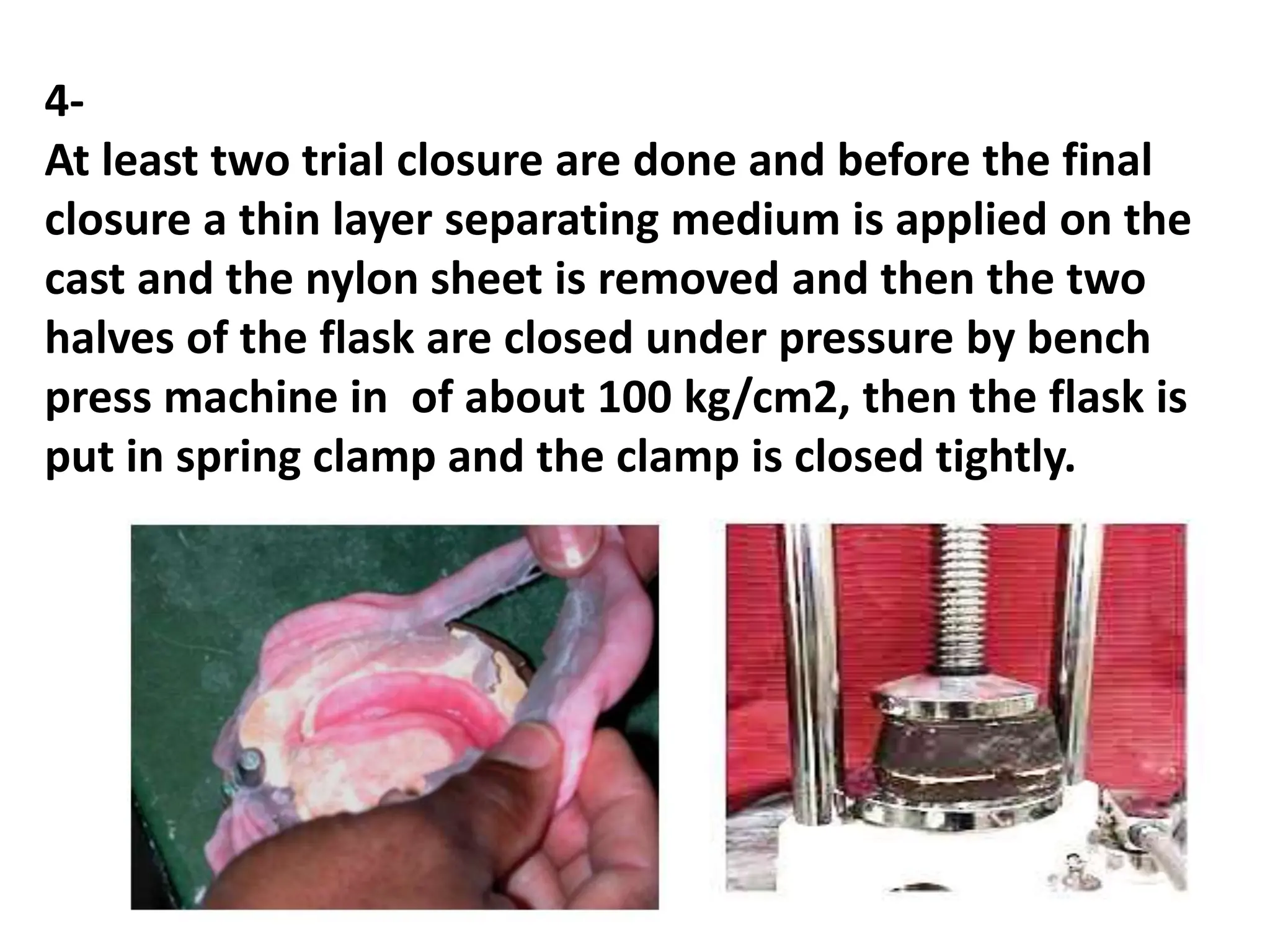
4-
At least two trial closure are done and before the final
closure a thin layer separating medium is applied on the
cast and the nylon sheet is removed and then the two
halves of the flask are closed under pressure by bench
press machine in of about 100 kg/cm2, then the flask is
put in spring clamp and the clamp is closed tightly.
Fourth step: Curing
Curing
polymerization of acrylic resin by heat, the amount
of heat must be controlled while processing acrylic
resin.
A. Long cycle
(Slow cycle curing method)
The flask and clamp are placed in a curing unite. The
denture is processed for 8 hours in water held at a
constant temperature of 74°C and then increasing the
temperature to 100°C for 1 hour.
Types of curing cycle:
The flask put in water at 74°C for 1-1/2 hours. Then
boil (increasing the temperature to 100°C) for 30
minutes for adequate polymerization of the thinner
portions.
B. Short period
(Rapid cycle curing method)
The best curing cycle is the slow curing cycle because
most of the conversion of monomer to polymer
occurs during the period of polymerization at 70-74°C
and the rapid curing cycle may cause vaporization of
unreacted monomer which could induce greater
dimensional changes in the dentures.
After curing the flask should be cooled slowly i.e. bench
cooled . Sudden cooling or rapid cooling can result in
warpage of the denture due to differential thermal
contraction of the resin and the gypsum mold.
Cooling overnight is ideal to allow adequate release of
internal stresses. However, bench cooling for 30 minutes
followed by placing under tap water for 15 minutes is
sufficient.
Fifth step : Deflasking
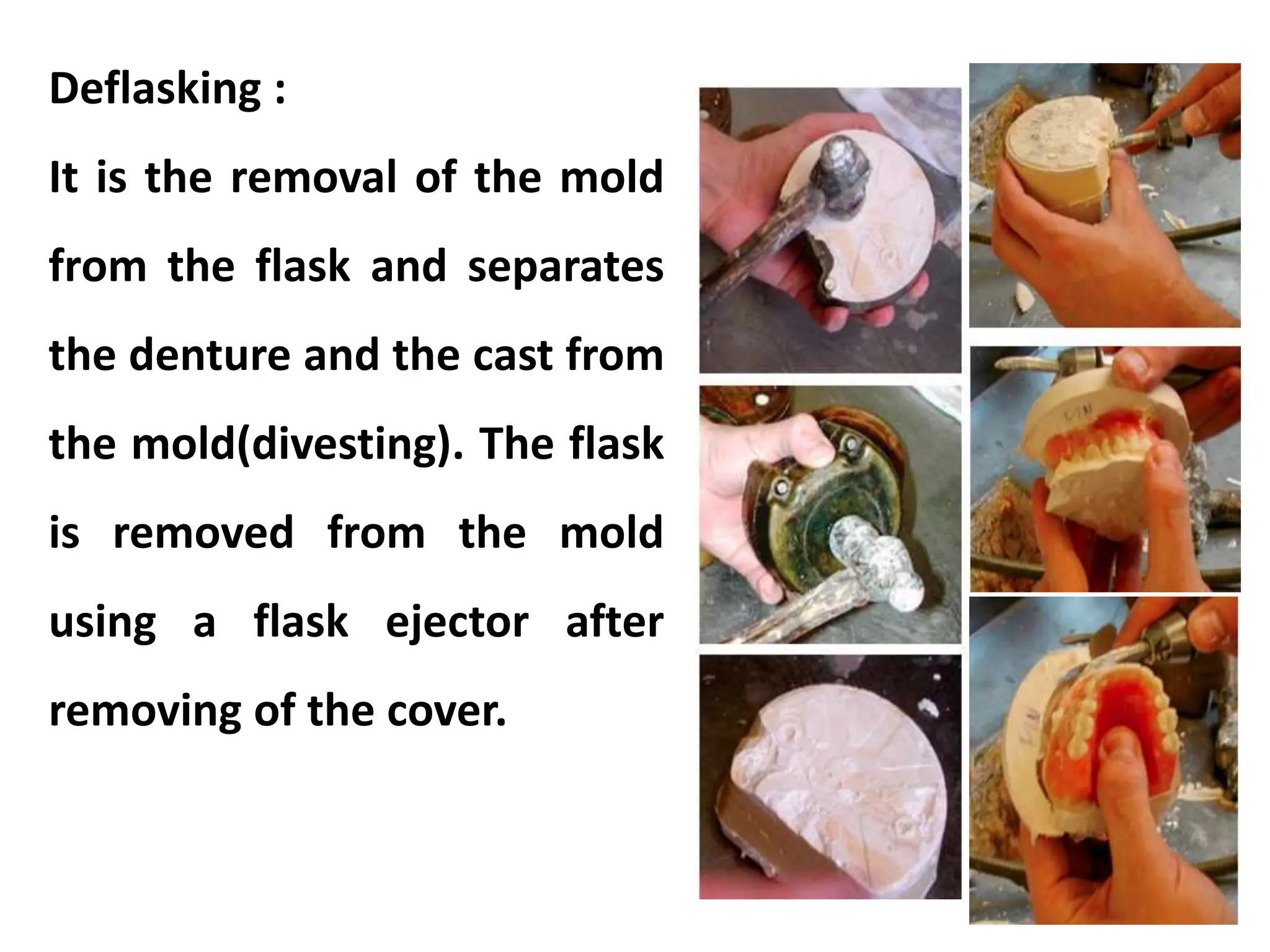
Deflasking :
It is the removal of the mold
from the flask and separates
the denture and the cast from
the mold(divesting). The flask
is removed from the mold
using a flask ejector after
removing of the cover.
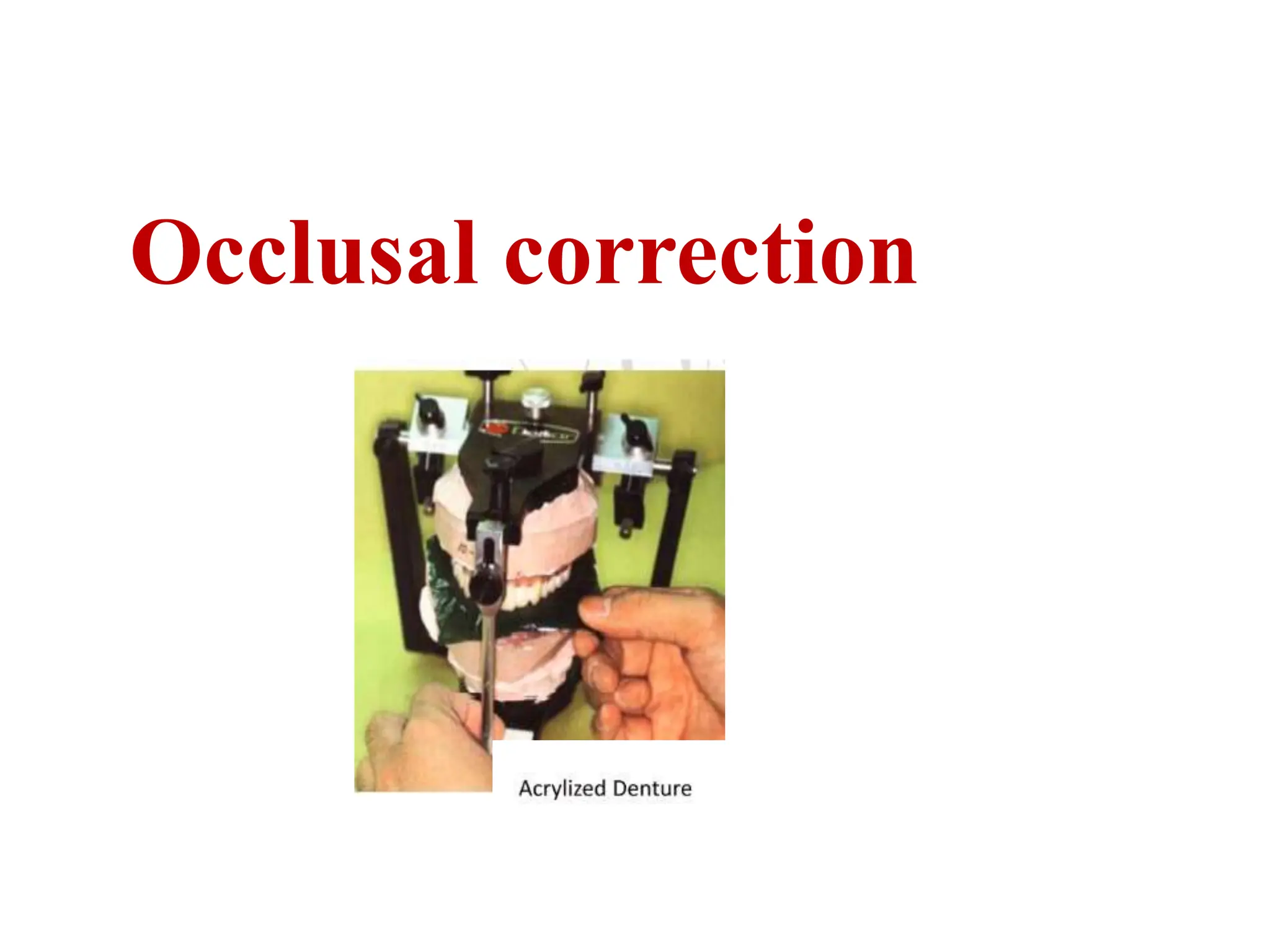
Occlusal correction
Artificial teeth may move about to a minor degree
during waxing and processing of the trial denture to a
resin one this movement is due primarily to dimensional
changes in the waxed denture base, the investing
material, and in the resin denture base during curing.
Occlusal discrepancies caused by these dimensional
changes can be eliminated before the dentures are
polished by selective grinding.
Selective grinding
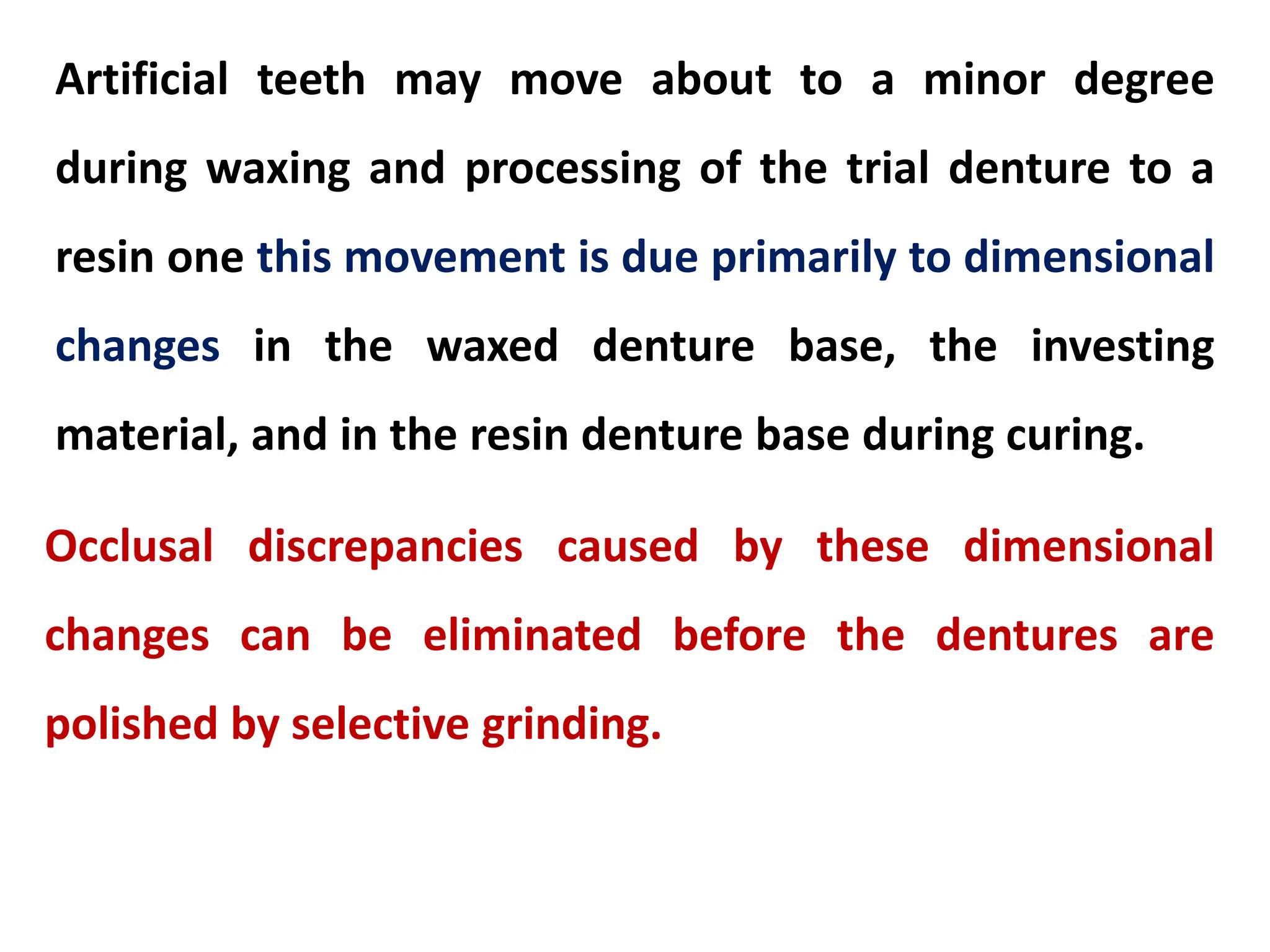
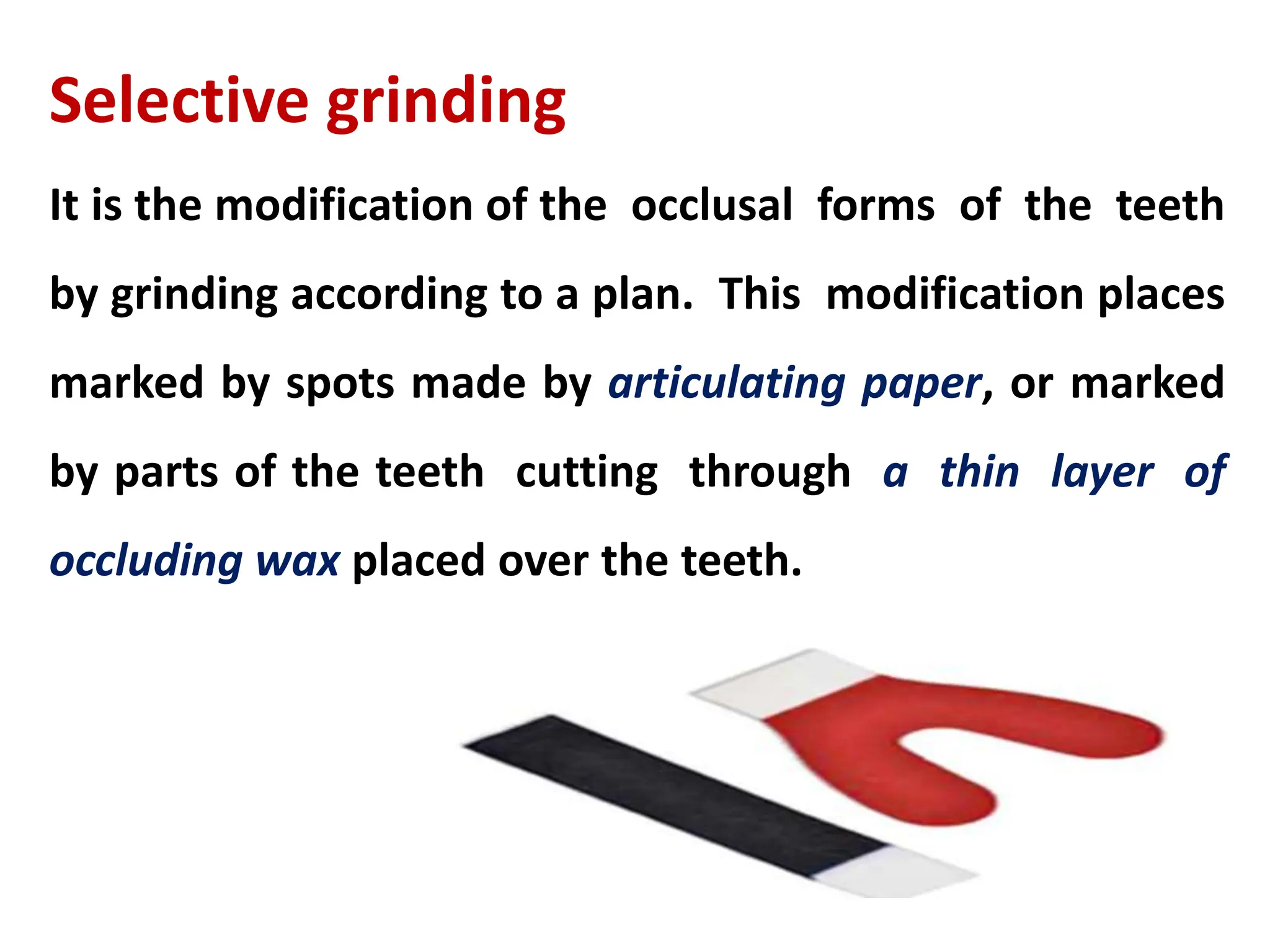
It is the modification of the occlusal forms of the teeth
by grinding according to a plan. This modification places
marked by spots made by articulating paper, or marked
by parts of the teeth cutting through a thin layer of
occluding wax placed over the teeth.
Never grind a centric cusp tip unless it contacts
prematurely in all excursions of the mandible. Always
grind the opposing fossa. i.e. if the cusp is premature
contact in centric relation and is also premature in
balancing or working, then the cusp should be
reduced; if the cusp is in premature contact in
centric relation, but is not in working or balancing
prematurity, then the opposing fossa or marginal
ridge should be reduced).
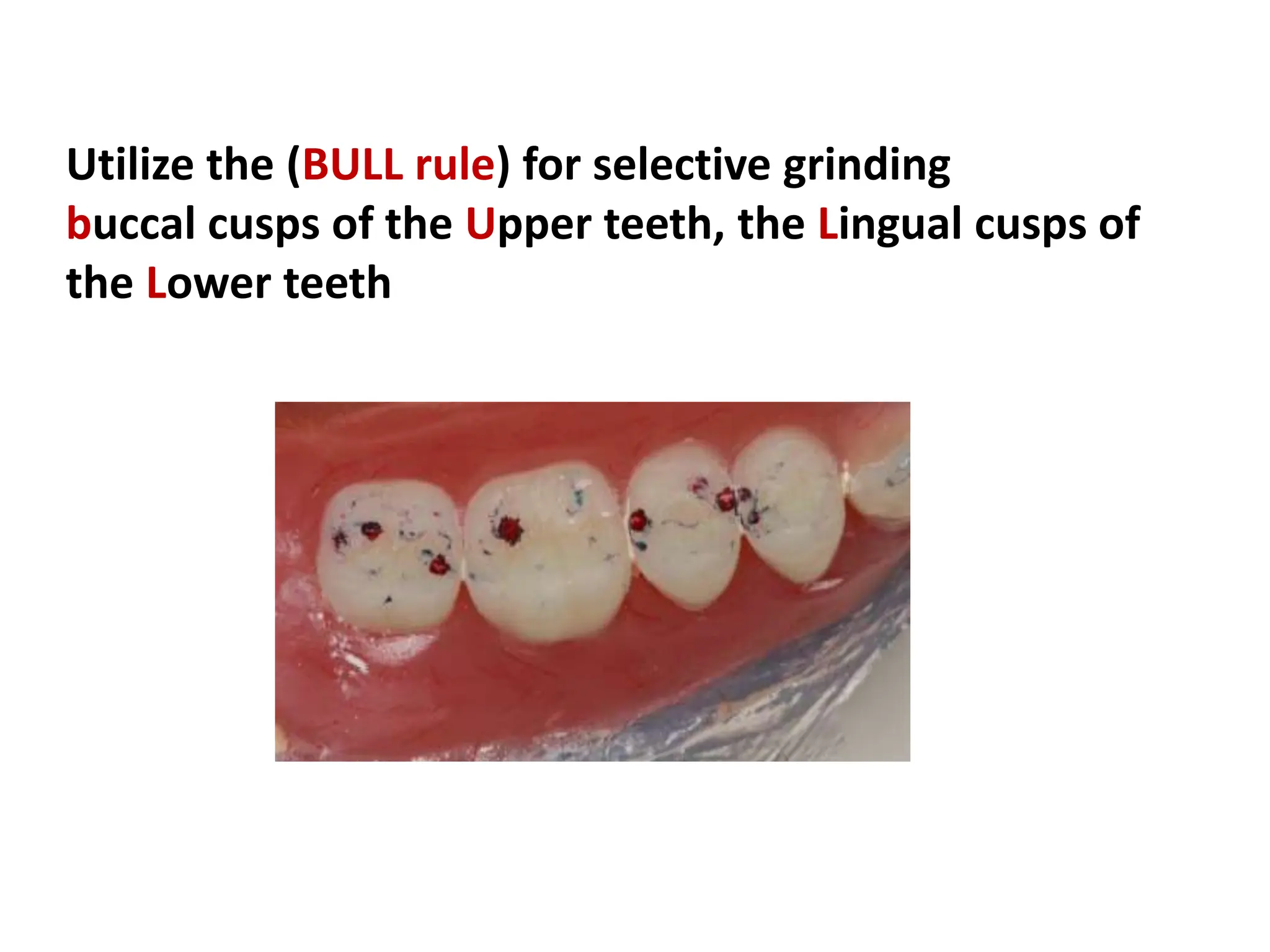
Utilize the (BULL rule) for selective grinding
buccal cusps of the Upper teeth, the Lingual cusps of
the Lower teeth
Re-established the vertical dimension of occlusion at
this time, changes in the vertical dimension can be
noted by corresponding opening in the relationship of
the incisal pin to the incisal table.
-If excessive opening between incisal pin and incisal table, the flask
do not correctly closed.
-If the incisal pin touches the incisal table, the denture may have
been under packed.
-If there is 1-1.5 mm of incisal pin opening, proper technique have
been followed through the investing and packing procedures.
methods used in correcting
errors
1. Intraoral (inside
patient mouth,
clinically).
2. Extraoral (on
the articulator, in
the laboratory).
Sixth step:
Finishing and polishing
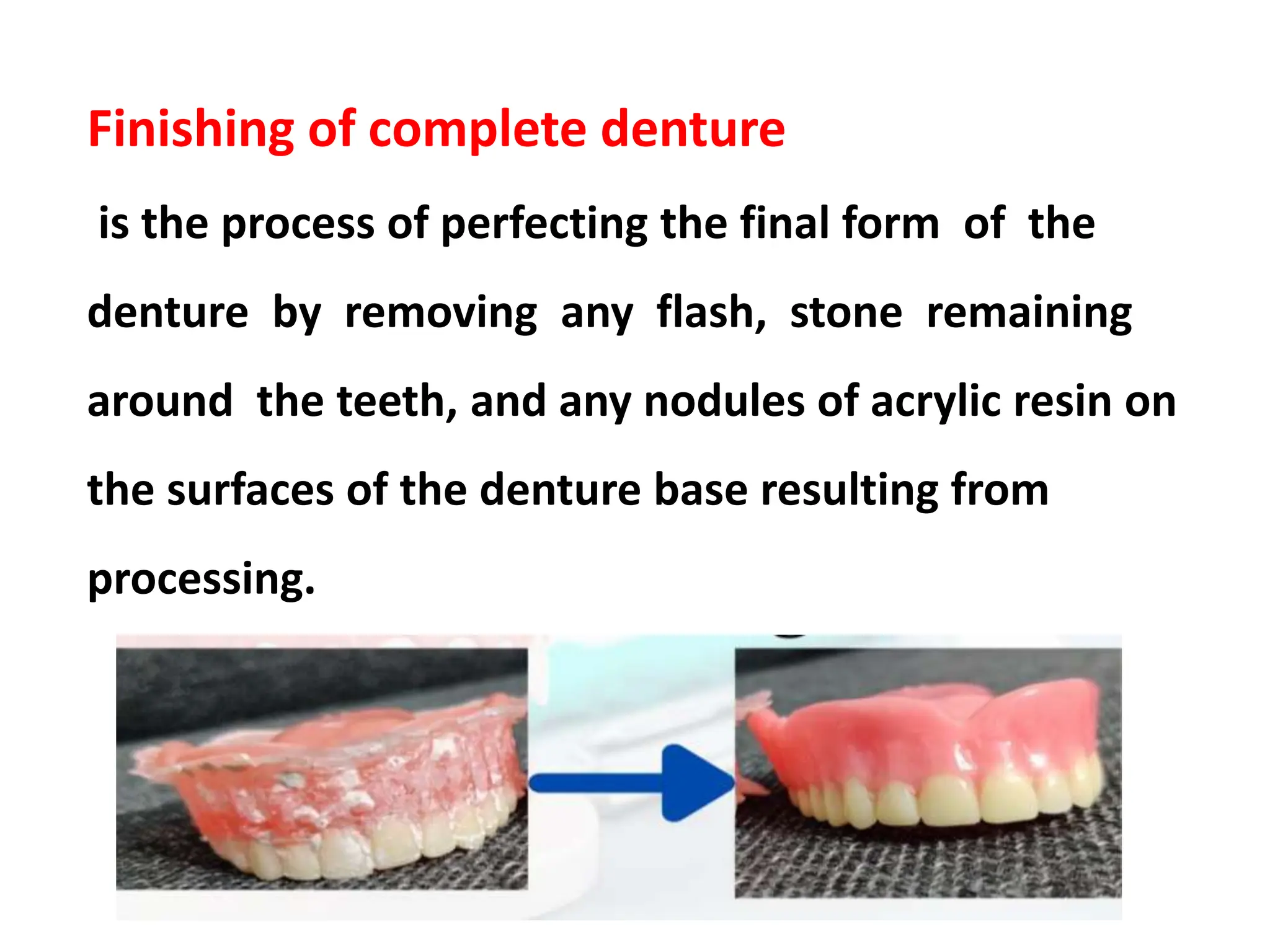
Finishing of complete denture
is the process of perfecting the final form of the
denture by removing any flash, stone remaining
around the teeth, and any nodules of acrylic resin on
the surfaces of the denture base resulting from
processing.
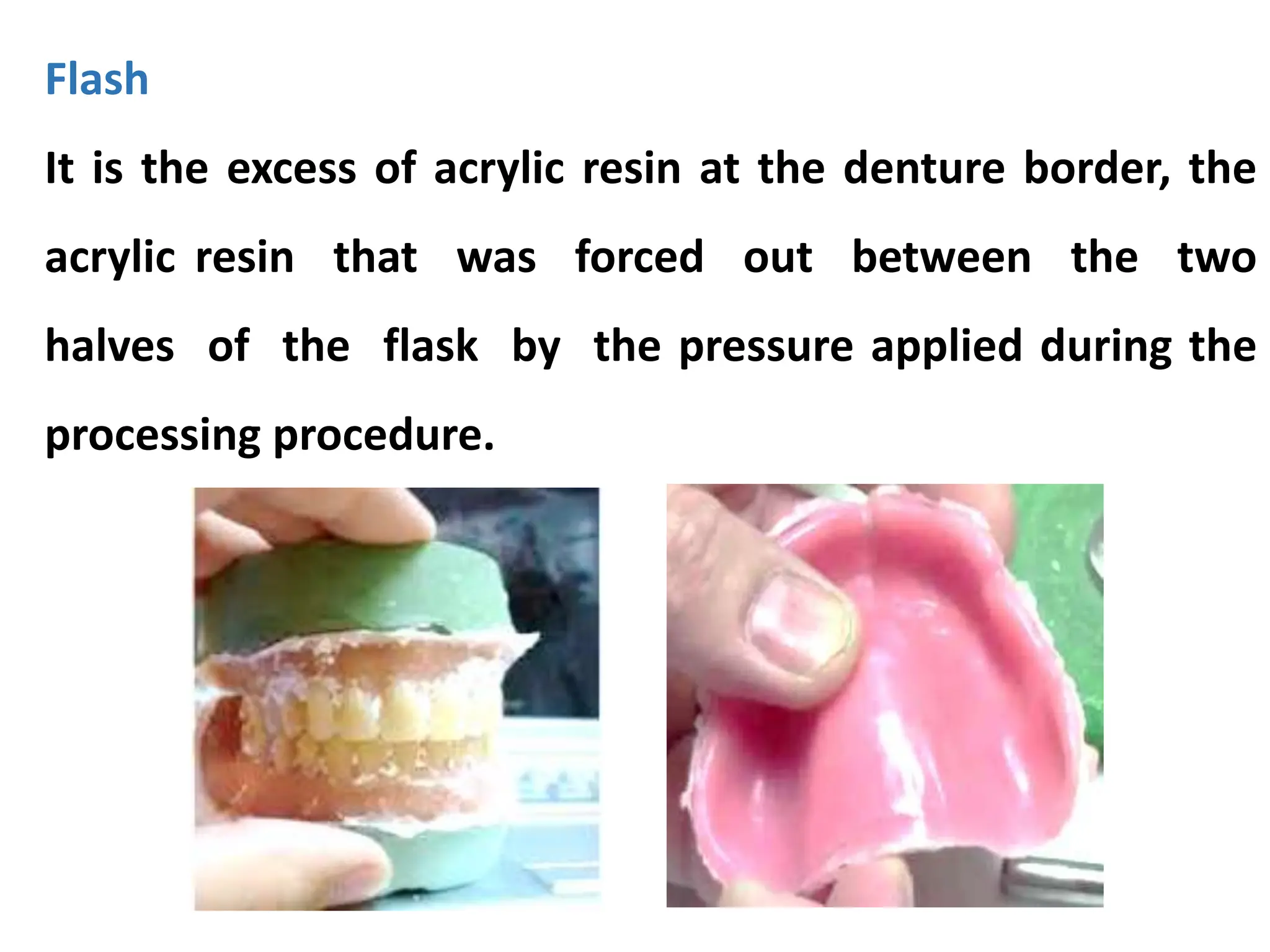
Flash
It is the excess of acrylic resin at the denture border, the
acrylic resin that was forced out between the two
halves of the flask by the pressure applied during the
processing procedure.
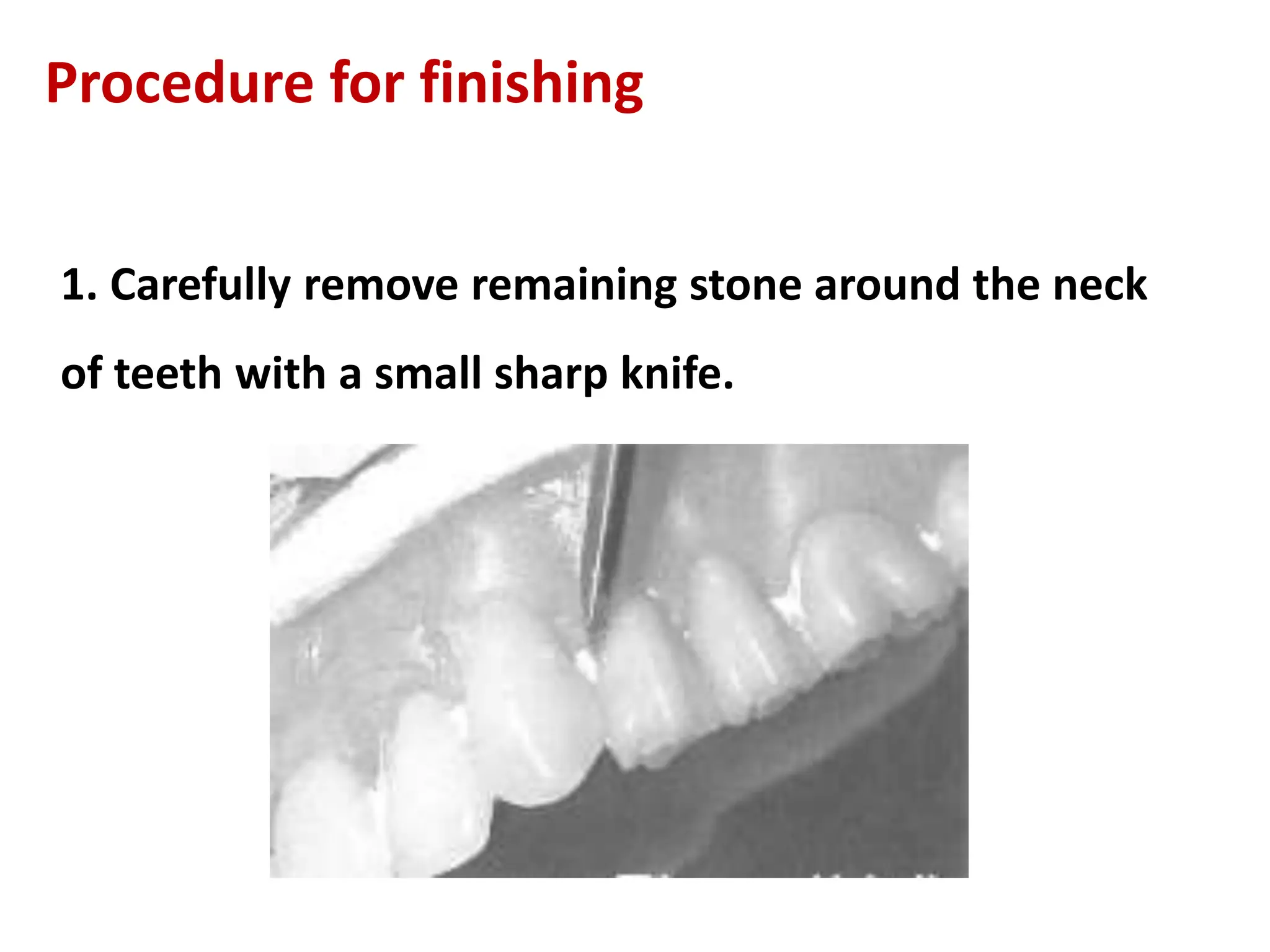
Procedure for finishing
1. Carefully remove remaining stone around the neck
of teeth with a small sharp knife.
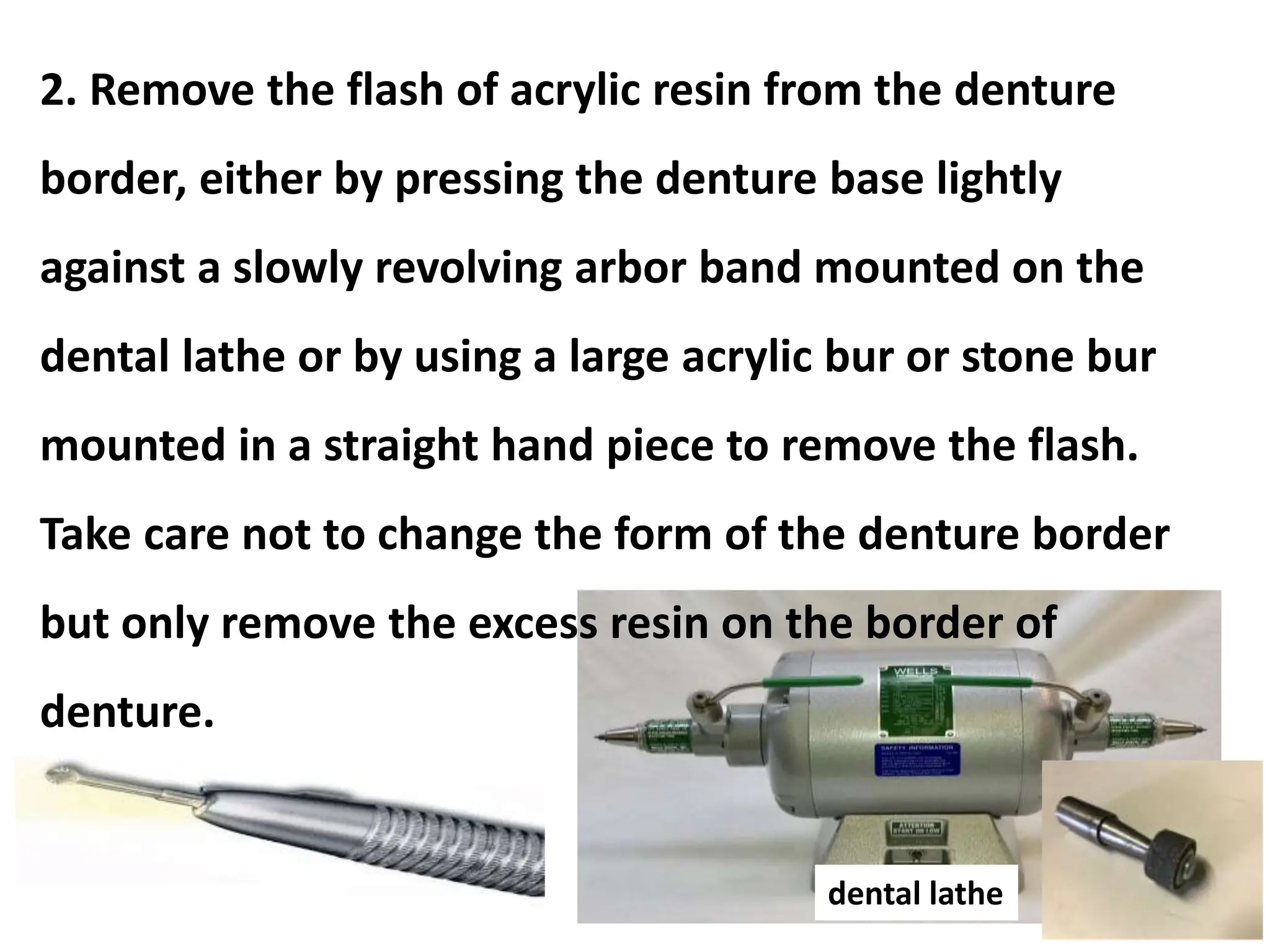
dental lathe
2. Remove the flash of acrylic resin from the denture
border, either by pressing the denture base lightly
against a slowly revolving arbor band mounted on the
dental lathe or by using a large acrylic bur or stone bur
mounted in a straight hand piece to remove the flash.
Take care not to change the form of the denture border
but only remove the excess resin on the border of
denture.
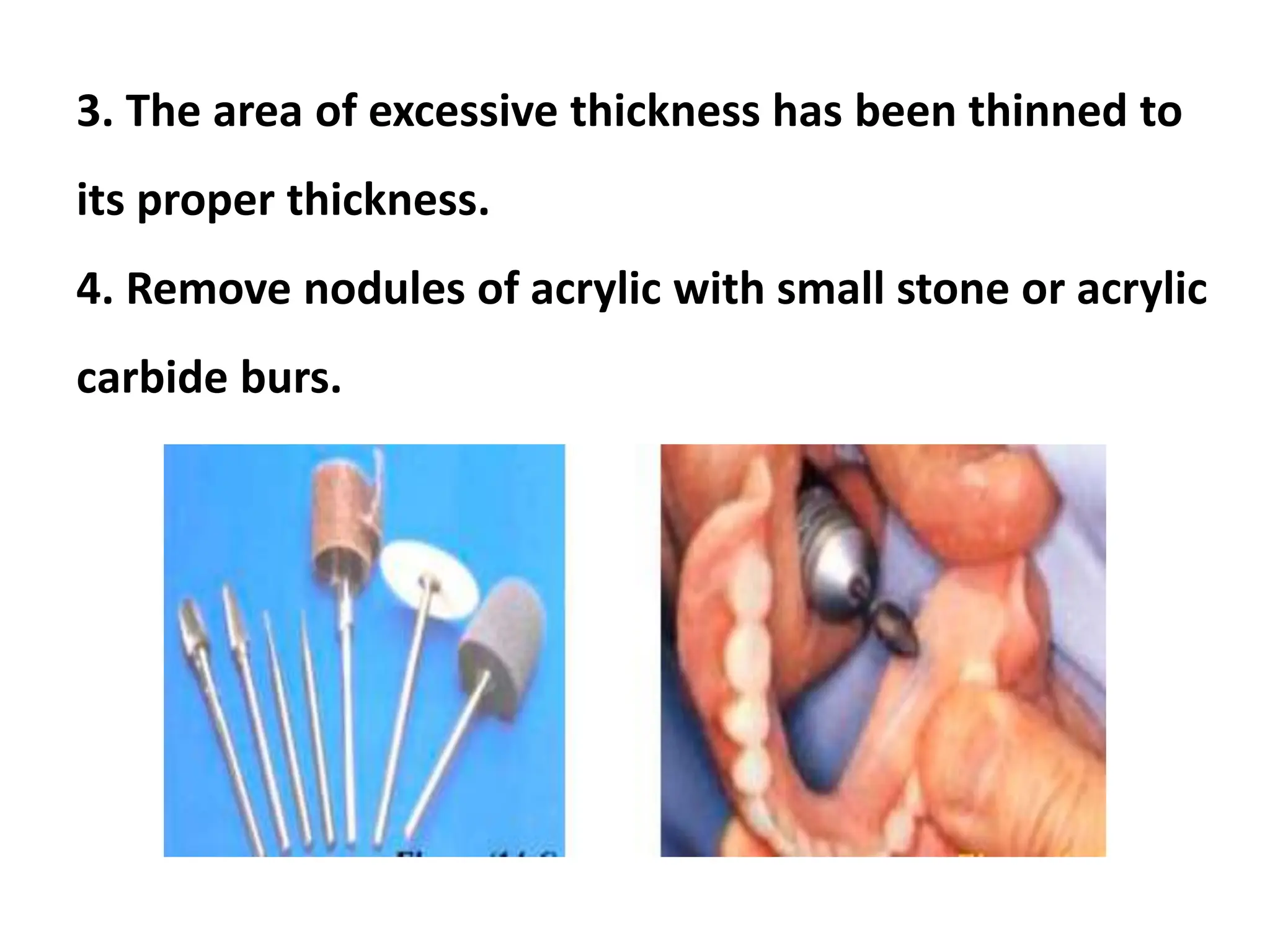
3. The area of excessive thickness has been thinned to
its proper thickness.
4. Remove nodules of acrylic with small stone or acrylic
carbide burs.
Polishing
is a process of removing scratches. Polishing
consists of making the dentures smooth and
glossy without changing the contours
Principles of polishing
1. The tissue surface of a denture is never polished as a
polishing destroys the details necessary for good fit and
retention.
2. Care must be taken when using pumice (it should be used
as wet slurry) as this material is very abrasive and may
obliterate the details placed on the denture when they
were waxes (festooned).
3. When polishing, only the denture base and not the teeth
are polished.
4. During the finishing and polishing we should minimize the
reduction of bulk because this cause warpage.
Procedure of polishing
A. smoothing
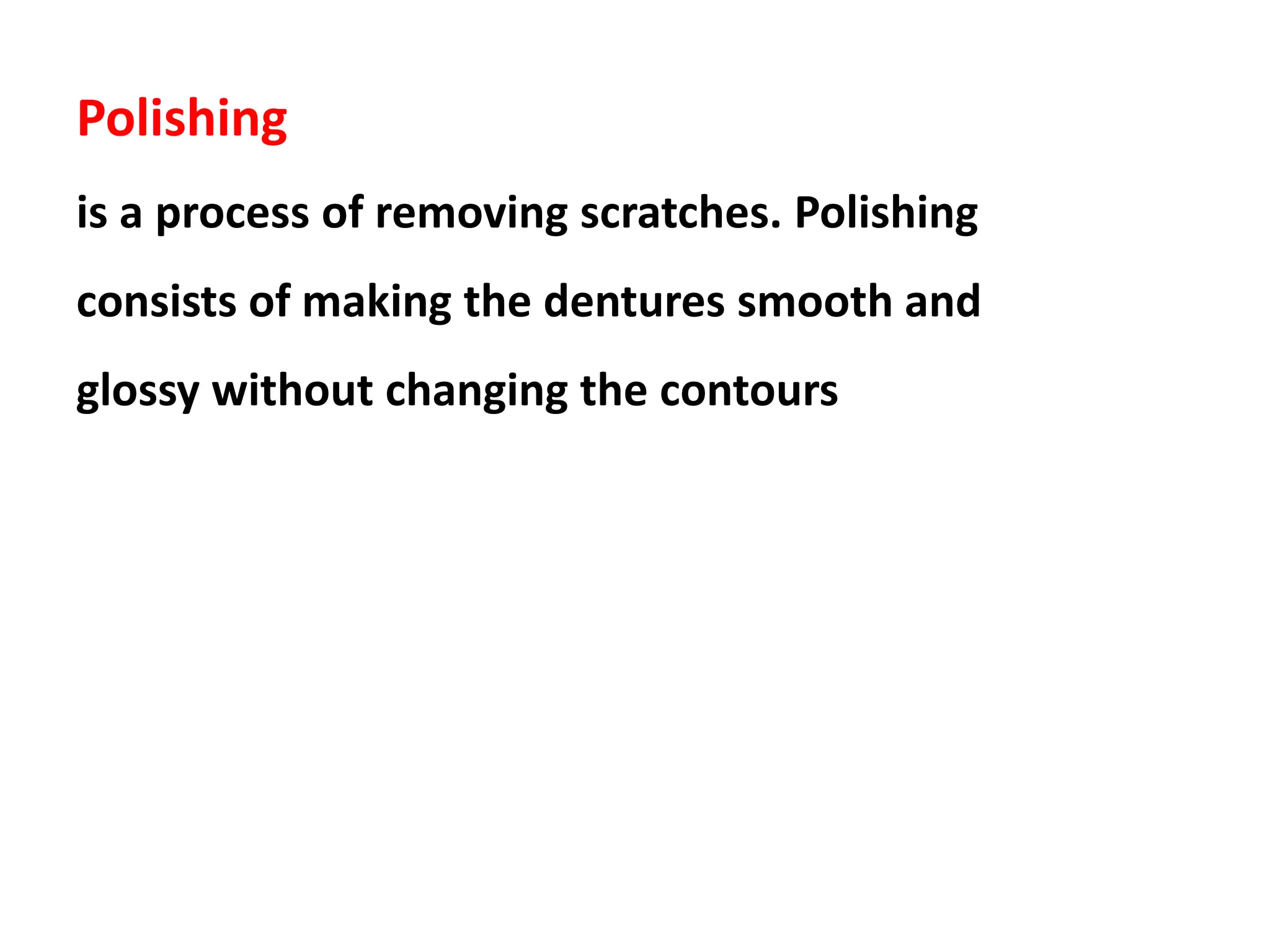
1. Polish labial, buccal, lingual, and
palatal external surfaces of the denture
with wet pumice on rag wheel attached
to dental lathe running at slow speed.
Keep plenty of pumice on the denture
surface and keep the denture moving at
all times; press the denture lightly
against the wheel at slow speed.
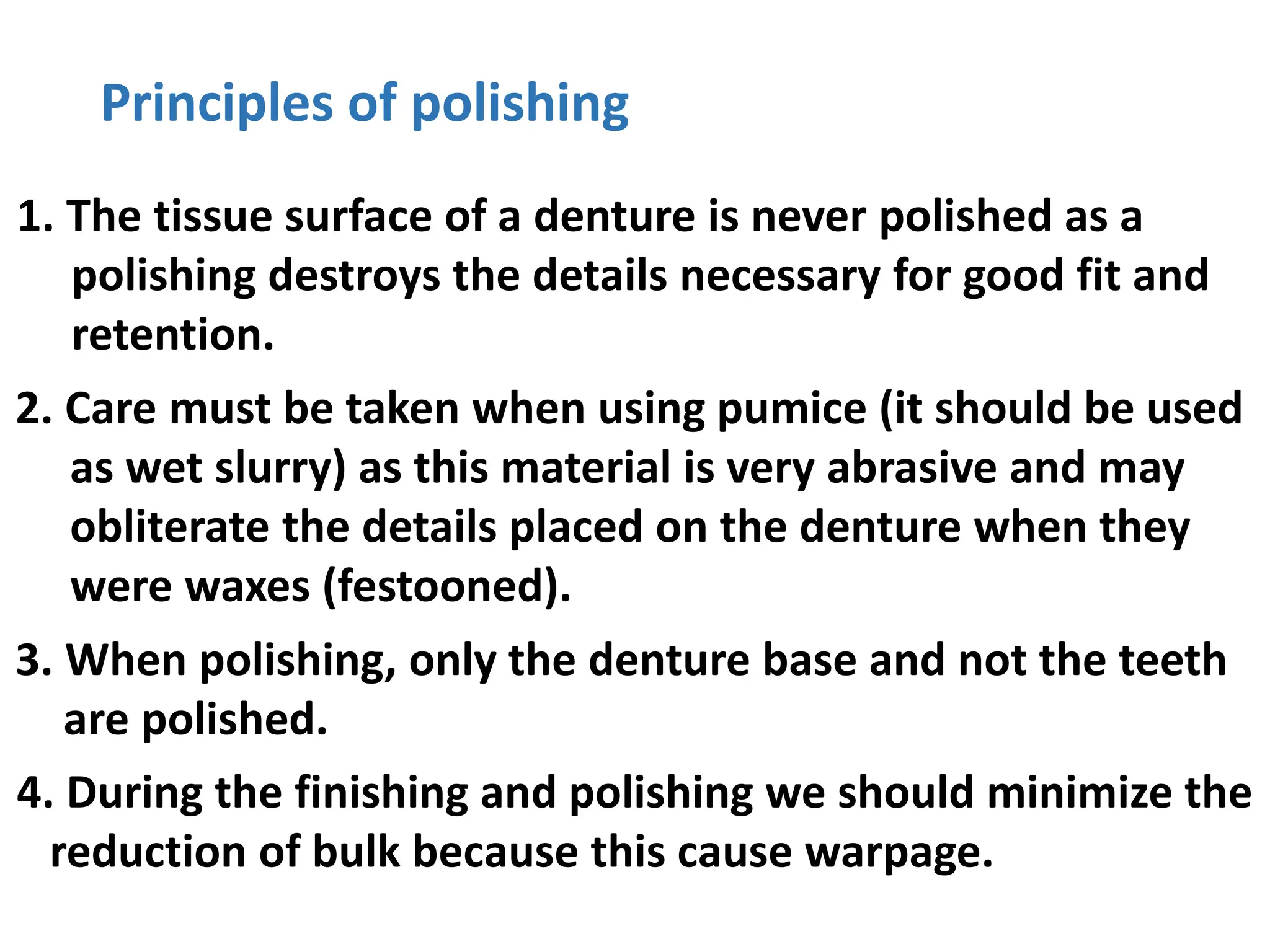
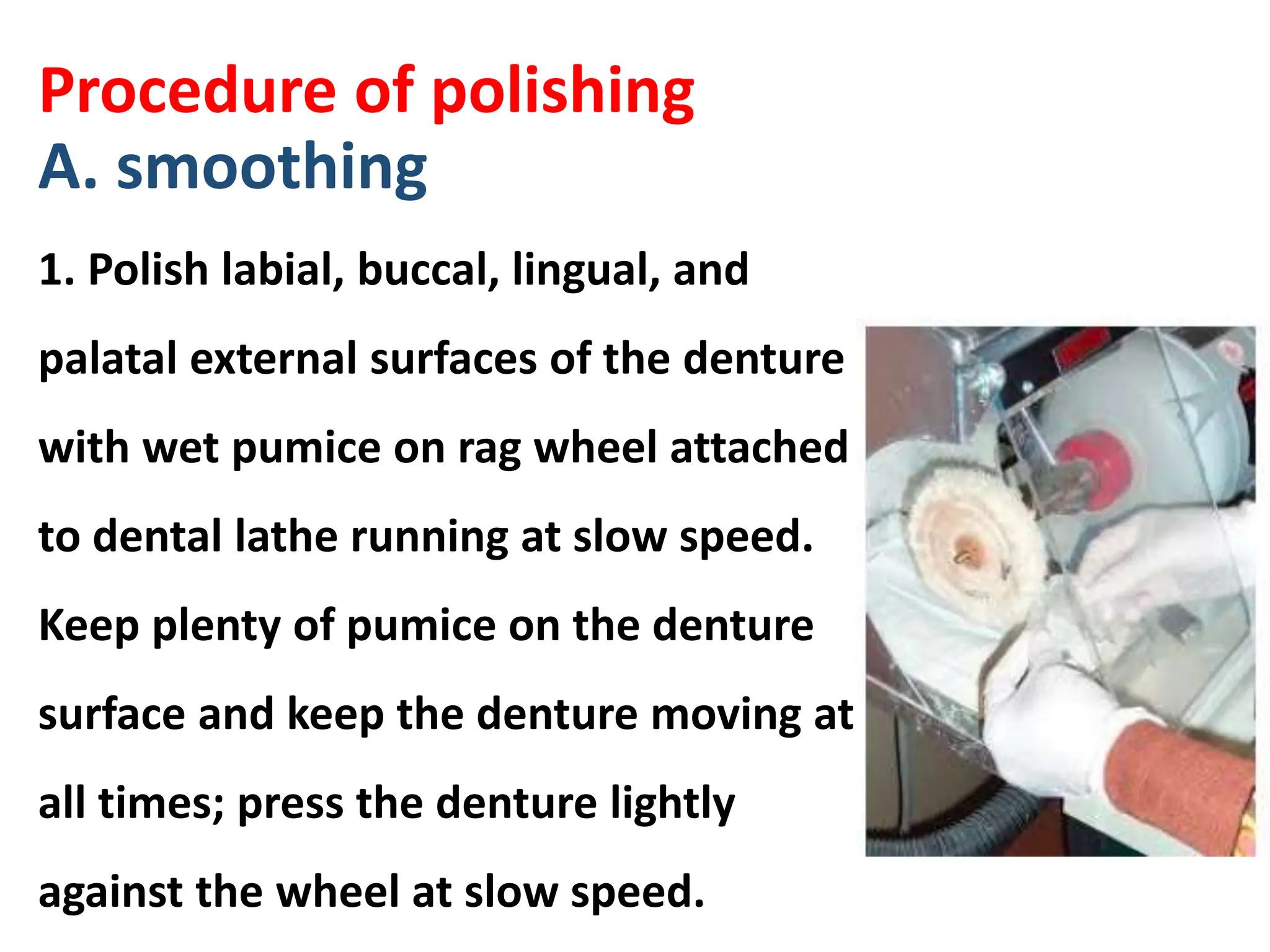
2. Polish acrylic around the teeth with wet pumice and a
brush wheel attached to dental lathe moving at slow
speed. Be careful not remove previously developed
contours.
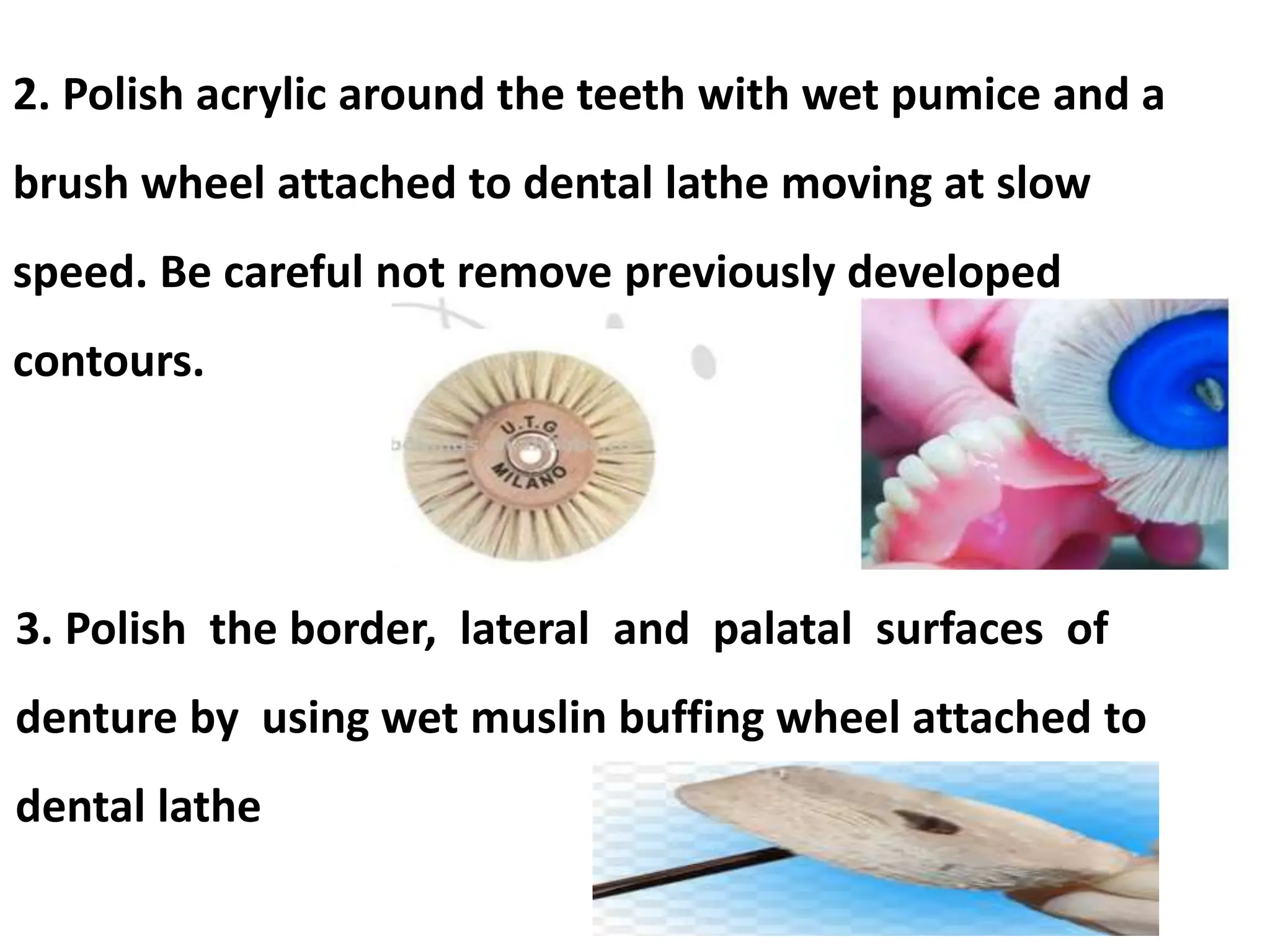
3. Polish the border, lateral and palatal surfaces of
denture by using wet muslin buffing wheel attached to
dental lathe
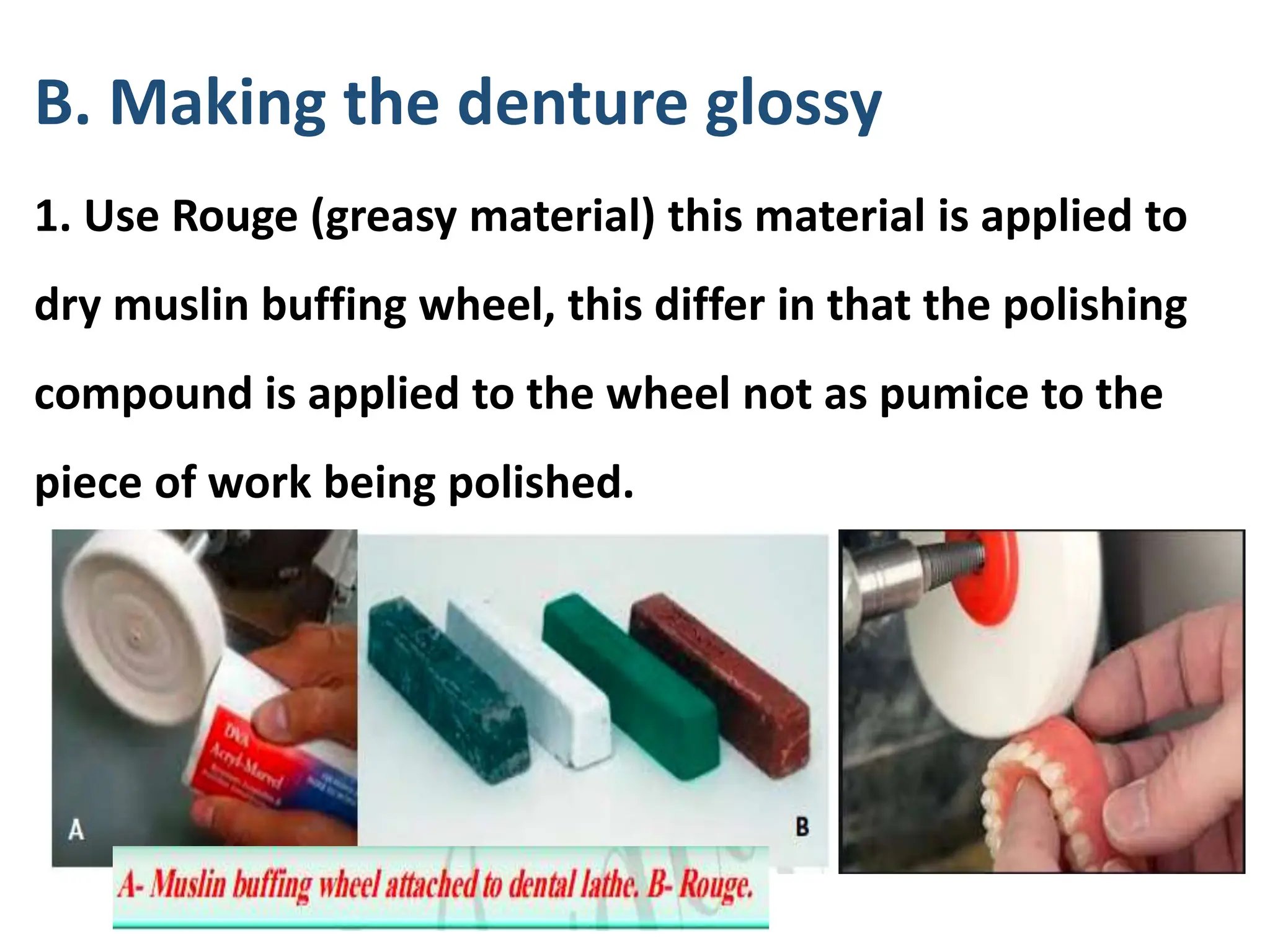
B. Making the denture glossy
1. Use Rouge (greasy material) this material is applied to
dry muslin buffing wheel, this differ in that the polishing
compound is applied to the wheel not as pumice to the
piece of work being polished.
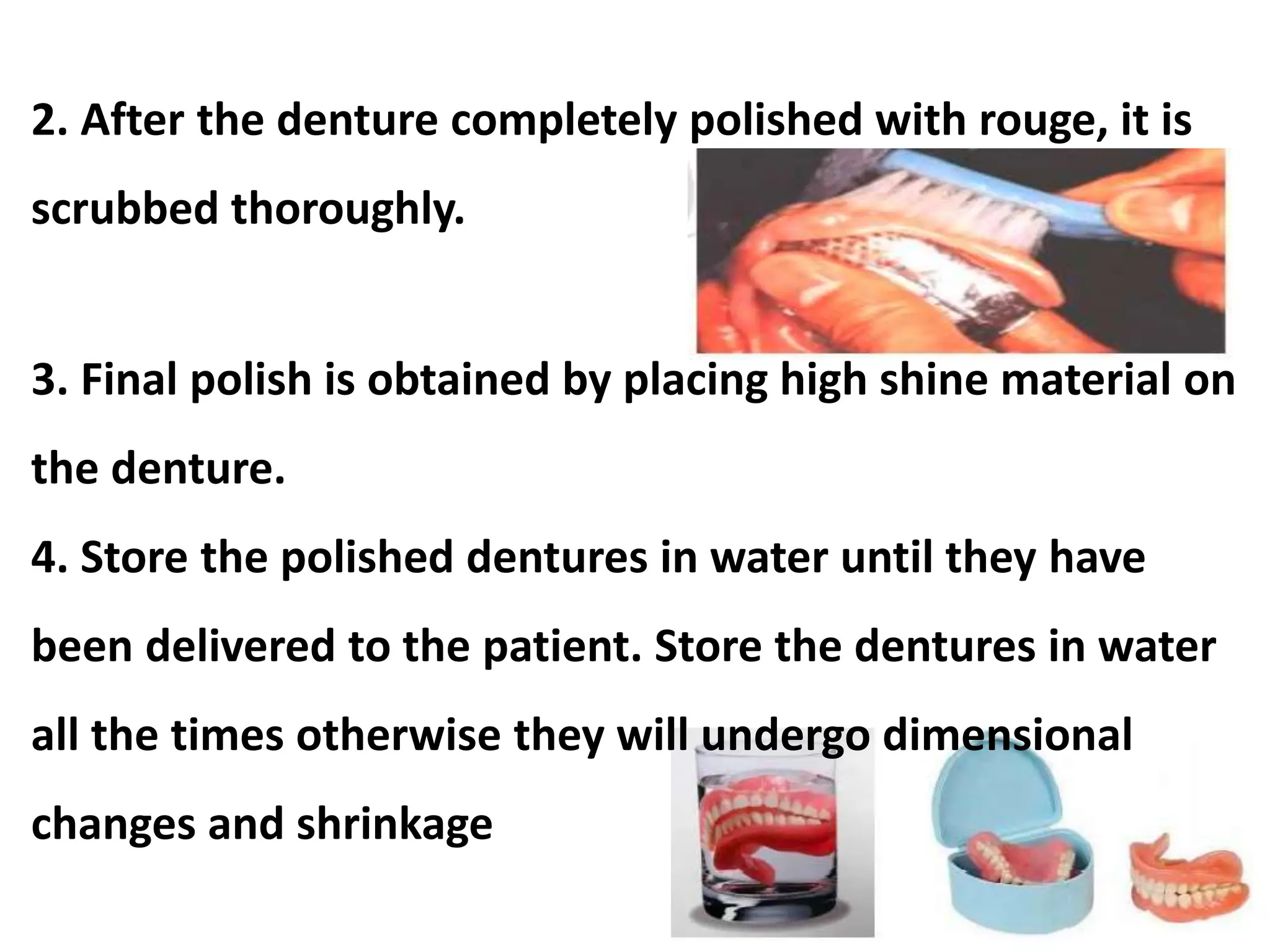
2. After the denture completely polished with rouge, it is
scrubbed thoroughly.
3. Final polish is obtained by placing high shine material on
the denture.
4. Store the polished dentures in water until they have
been delivered to the patient. Store the dentures in water
all the times otherwise they will undergo dimensional
changes and shrinkage
Processing Errors:
Porosity can be of two types: internal porosity and
external porosity.
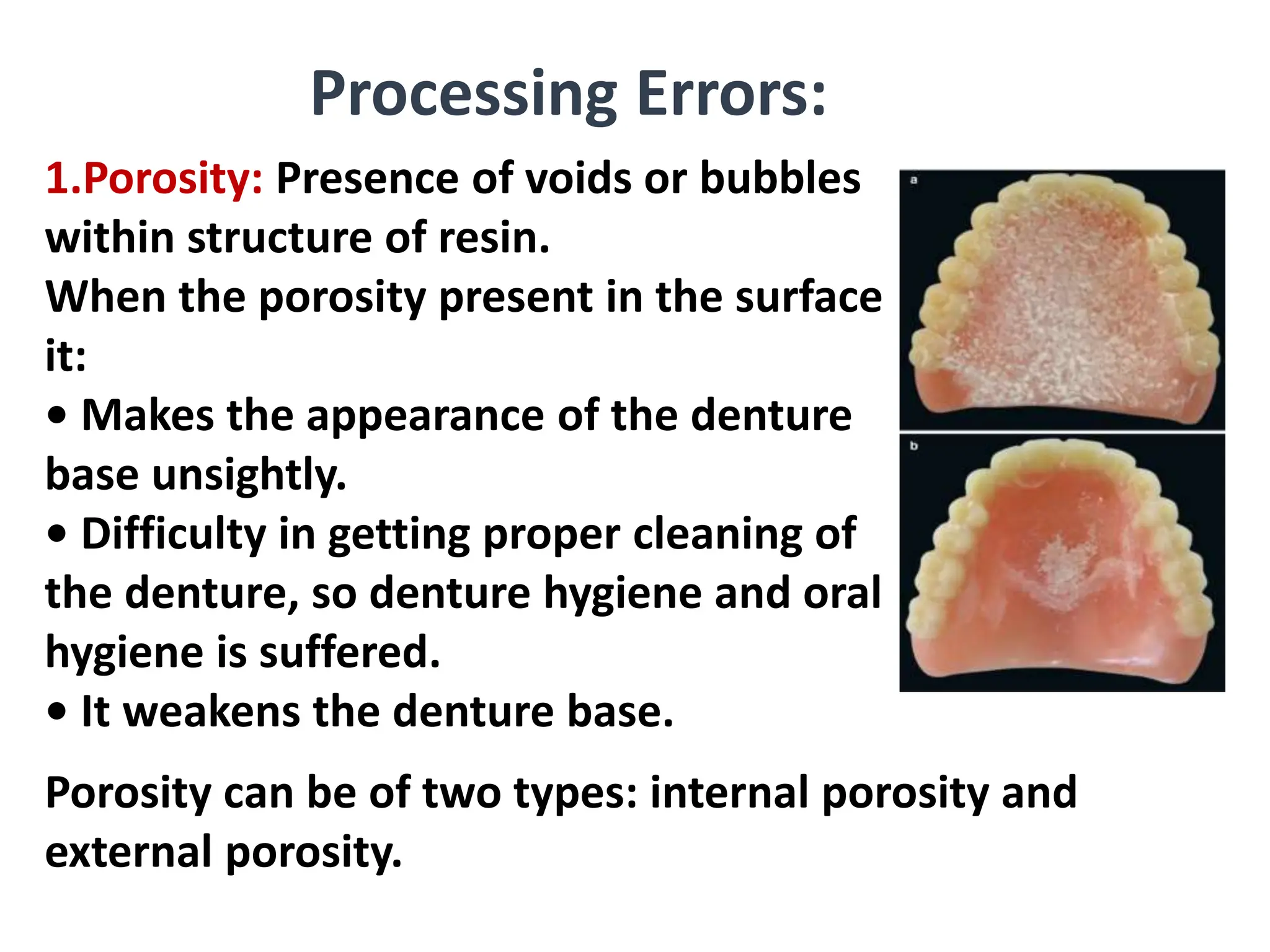
1.Porosity: Presence of voids or bubbles
within structure of resin.
When the porosity present in the surface
it:
• Makes the appearance of the denture
base unsightly.
• Difficulty in getting proper cleaning of
the denture, so denture hygiene and oral
hygiene is suffered.
• It weakens the denture base.
Internal denture porosity:
Not present on the surface of the denture. It is
developed in thick portion of the denture base.
Caused by: Vaporization of unreacted monomer when
the temperature of the resin increases above the boiling
point of the monomer (100°C).
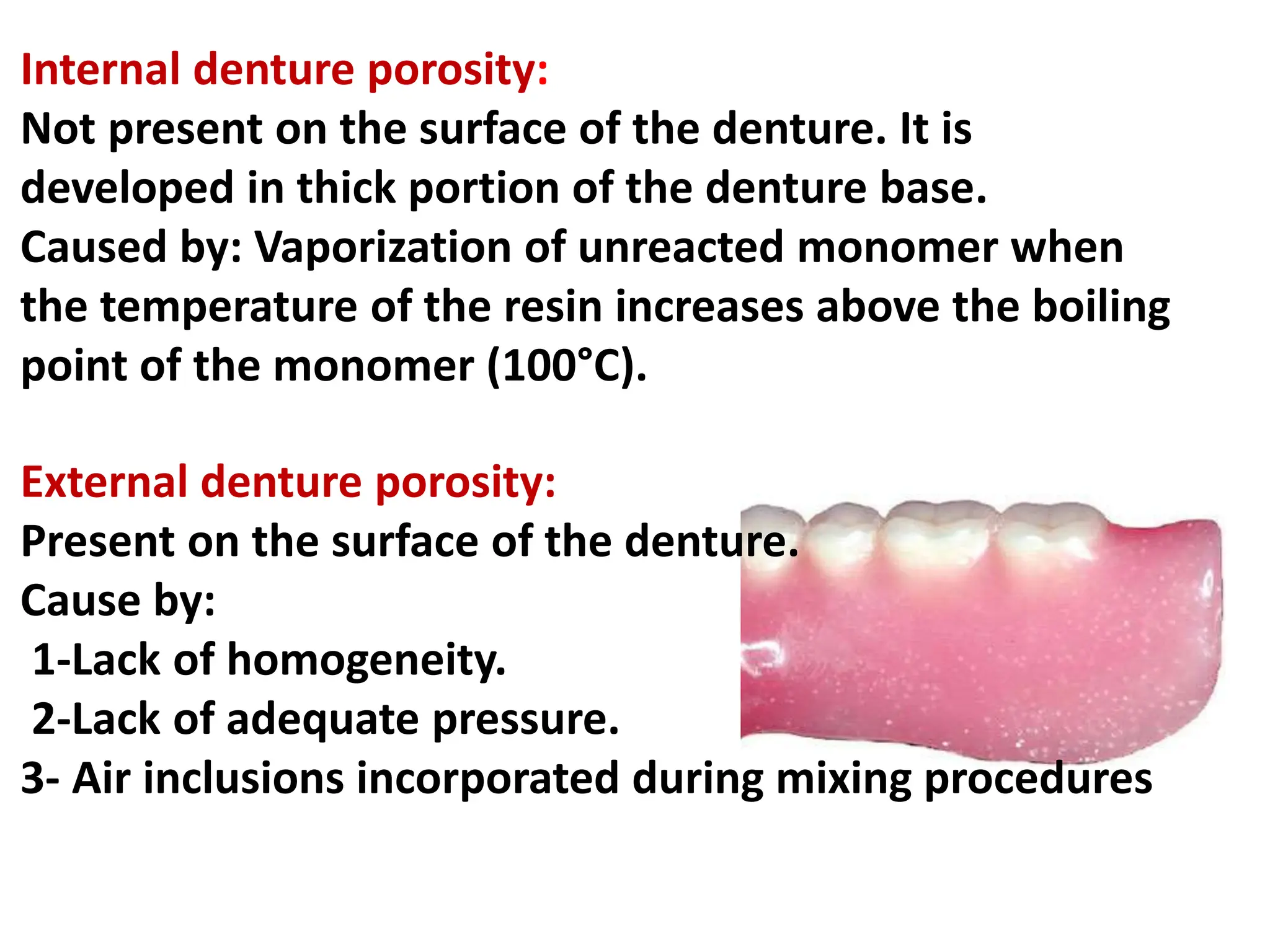
External denture porosity:
Present on the surface of the denture.
Cause by:
1-Lack of homogeneity.
2-Lack of adequate pressure.
3- Air inclusions incorporated during mixing procedures
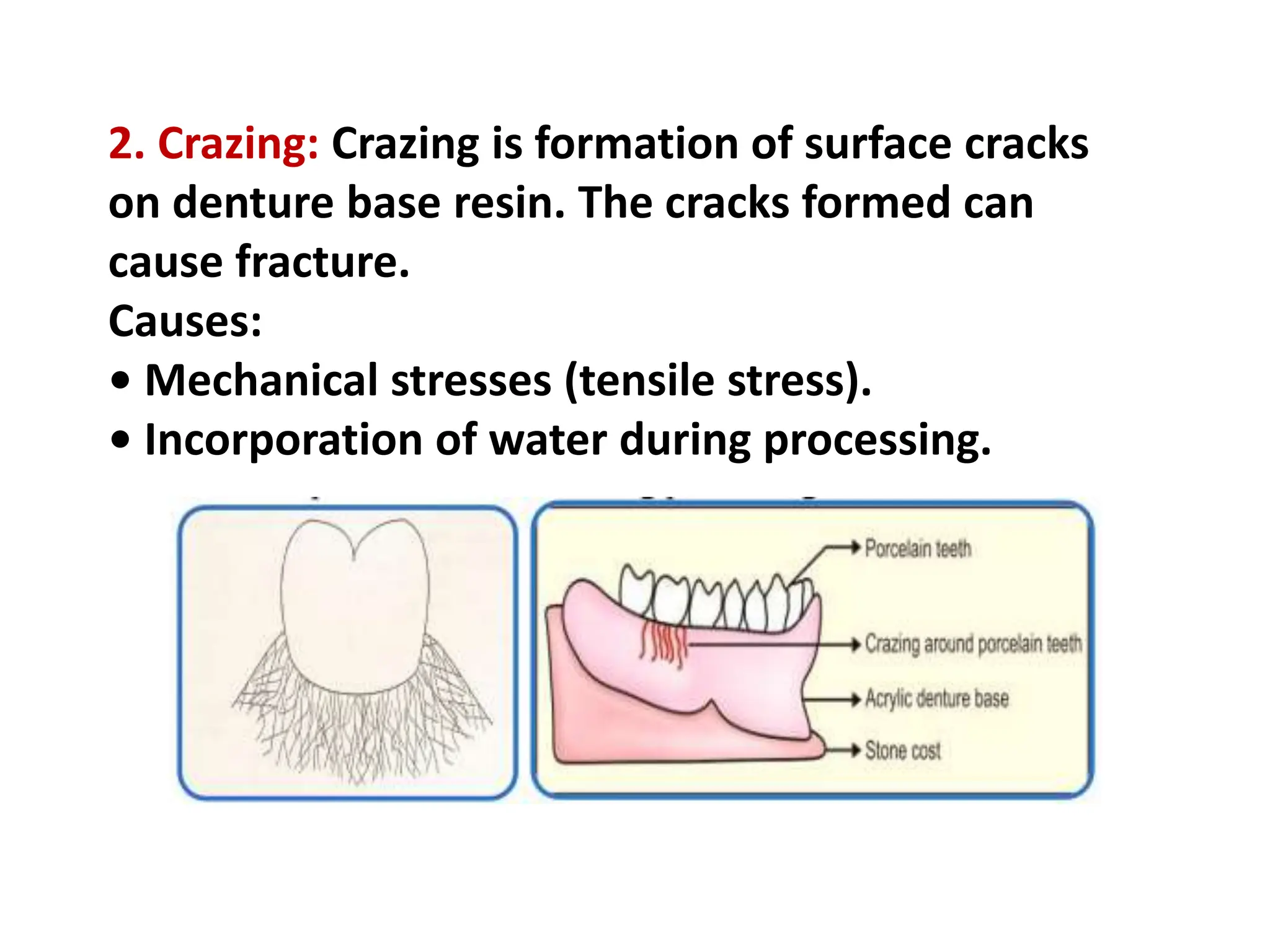
2. Crazing: Crazing is formation of surface cracks
on denture base resin. The cracks formed can
cause fracture.
Causes:
• Mechanical stresses (tensile stress).
• Incorporation of water during processing.
3. Denture warpage: it is change in shape or deformation
of denture which affect the fit of the denture.
Cause by:
• Release of stresses causes by rapid cooling
• packing of the acrylic in rubber stage or improper
deflasking).
• Rise in temperature while polishing.
• Immersion of processed denture in hot water.
• Repeated wetting and drying cause warpage of
the denture.
Thank you

Packing and Curing (1)_e81d748ffc20fbf6abcbaadd89994af5.pptx

  • 1.
  • 2.
  • 3.
    1. Separating mediumis used on plaster or stone, care should be taken not to painting the teeth with separating medium. 2. The mold is left to dry and another coat is painted on the flask and also left to dry. Packing Technique:
  • 4.
    3. Heat curedacrylic is used, polymer/monomer is mixed according to manufacturer instruction. Usually 10 cc of monomer and 30 cc of polymer will be enough to pack an average-sized denture, after mixing of the material on clean jar and reach dough stage, it is ready for packing.
  • 5.
    - The placementof too much material produce a denture base that has excessive thickness and resultant malposition of teeth. - On the other hand, the use of too little material lead to denture base voids or porosity.
  • 6.
    4. Packing thematerial in the upper half of the flask, being sure to press it well into the area around the teeth. Use enough material to insure over packing on the first closure using nylon sheet. spring clamp and the clamp is closed tightly.
  • 7.
    4- At least twotrial closure are done and before the final closure a thin layer separating medium is applied on the cast and the nylon sheet is removed and then the two halves of the flask are closed under pressure by bench press machine in of about 100 kg/cm2, then the flask is put in spring clamp and the clamp is closed tightly.
  • 8.
  • 9.
    Curing polymerization of acrylicresin by heat, the amount of heat must be controlled while processing acrylic resin.
  • 10.
    A. Long cycle (Slowcycle curing method) The flask and clamp are placed in a curing unite. The denture is processed for 8 hours in water held at a constant temperature of 74°C and then increasing the temperature to 100°C for 1 hour. Types of curing cycle:
  • 11.
    The flask putin water at 74°C for 1-1/2 hours. Then boil (increasing the temperature to 100°C) for 30 minutes for adequate polymerization of the thinner portions. B. Short period (Rapid cycle curing method)
  • 12.
    The best curingcycle is the slow curing cycle because most of the conversion of monomer to polymer occurs during the period of polymerization at 70-74°C and the rapid curing cycle may cause vaporization of unreacted monomer which could induce greater dimensional changes in the dentures.
  • 13.
    After curing theflask should be cooled slowly i.e. bench cooled . Sudden cooling or rapid cooling can result in warpage of the denture due to differential thermal contraction of the resin and the gypsum mold. Cooling overnight is ideal to allow adequate release of internal stresses. However, bench cooling for 30 minutes followed by placing under tap water for 15 minutes is sufficient.
  • 14.
    Fifth step :Deflasking
  • 15.
    Deflasking : It isthe removal of the mold from the flask and separates the denture and the cast from the mold(divesting). The flask is removed from the mold using a flask ejector after removing of the cover.
  • 16.
  • 17.
    Artificial teeth maymove about to a minor degree during waxing and processing of the trial denture to a resin one this movement is due primarily to dimensional changes in the waxed denture base, the investing material, and in the resin denture base during curing. Occlusal discrepancies caused by these dimensional changes can be eliminated before the dentures are polished by selective grinding.
  • 18.
    Selective grinding It isthe modification of the occlusal forms of the teeth by grinding according to a plan. This modification places marked by spots made by articulating paper, or marked by parts of the teeth cutting through a thin layer of occluding wax placed over the teeth.
  • 19.
    Never grind acentric cusp tip unless it contacts prematurely in all excursions of the mandible. Always grind the opposing fossa. i.e. if the cusp is premature contact in centric relation and is also premature in balancing or working, then the cusp should be reduced; if the cusp is in premature contact in centric relation, but is not in working or balancing prematurity, then the opposing fossa or marginal ridge should be reduced).
  • 20.
    Utilize the (BULLrule) for selective grinding buccal cusps of the Upper teeth, the Lingual cusps of the Lower teeth
  • 21.
    Re-established the verticaldimension of occlusion at this time, changes in the vertical dimension can be noted by corresponding opening in the relationship of the incisal pin to the incisal table. -If excessive opening between incisal pin and incisal table, the flask do not correctly closed. -If the incisal pin touches the incisal table, the denture may have been under packed. -If there is 1-1.5 mm of incisal pin opening, proper technique have been followed through the investing and packing procedures.
  • 22.
    methods used incorrecting errors 1. Intraoral (inside patient mouth, clinically). 2. Extraoral (on the articulator, in the laboratory).
  • 23.
  • 24.
    Finishing of completedenture is the process of perfecting the final form of the denture by removing any flash, stone remaining around the teeth, and any nodules of acrylic resin on the surfaces of the denture base resulting from processing.
  • 25.
    Flash It is theexcess of acrylic resin at the denture border, the acrylic resin that was forced out between the two halves of the flask by the pressure applied during the processing procedure.
  • 26.
    Procedure for finishing 1.Carefully remove remaining stone around the neck of teeth with a small sharp knife.
  • 27.
    dental lathe 2. Removethe flash of acrylic resin from the denture border, either by pressing the denture base lightly against a slowly revolving arbor band mounted on the dental lathe or by using a large acrylic bur or stone bur mounted in a straight hand piece to remove the flash. Take care not to change the form of the denture border but only remove the excess resin on the border of denture.
  • 28.
    3. The areaof excessive thickness has been thinned to its proper thickness. 4. Remove nodules of acrylic with small stone or acrylic carbide burs.
  • 29.
    Polishing is a processof removing scratches. Polishing consists of making the dentures smooth and glossy without changing the contours
  • 30.
    Principles of polishing 1.The tissue surface of a denture is never polished as a polishing destroys the details necessary for good fit and retention. 2. Care must be taken when using pumice (it should be used as wet slurry) as this material is very abrasive and may obliterate the details placed on the denture when they were waxes (festooned). 3. When polishing, only the denture base and not the teeth are polished. 4. During the finishing and polishing we should minimize the reduction of bulk because this cause warpage.
  • 31.
    Procedure of polishing A.smoothing 1. Polish labial, buccal, lingual, and palatal external surfaces of the denture with wet pumice on rag wheel attached to dental lathe running at slow speed. Keep plenty of pumice on the denture surface and keep the denture moving at all times; press the denture lightly against the wheel at slow speed.
  • 32.
    2. Polish acrylicaround the teeth with wet pumice and a brush wheel attached to dental lathe moving at slow speed. Be careful not remove previously developed contours. 3. Polish the border, lateral and palatal surfaces of denture by using wet muslin buffing wheel attached to dental lathe
  • 33.
    B. Making thedenture glossy 1. Use Rouge (greasy material) this material is applied to dry muslin buffing wheel, this differ in that the polishing compound is applied to the wheel not as pumice to the piece of work being polished.
  • 34.
    2. After thedenture completely polished with rouge, it is scrubbed thoroughly. 3. Final polish is obtained by placing high shine material on the denture. 4. Store the polished dentures in water until they have been delivered to the patient. Store the dentures in water all the times otherwise they will undergo dimensional changes and shrinkage
  • 35.
    Processing Errors: Porosity canbe of two types: internal porosity and external porosity. 1.Porosity: Presence of voids or bubbles within structure of resin. When the porosity present in the surface it: • Makes the appearance of the denture base unsightly. • Difficulty in getting proper cleaning of the denture, so denture hygiene and oral hygiene is suffered. • It weakens the denture base.

  • 36.
    Internal denture porosity: Notpresent on the surface of the denture. It is developed in thick portion of the denture base. Caused by: Vaporization of unreacted monomer when the temperature of the resin increases above the boiling point of the monomer (100°C). External denture porosity: Present on the surface of the denture. Cause by: 1-Lack of homogeneity. 2-Lack of adequate pressure. 3- Air inclusions incorporated during mixing procedures
  • 37.
    2. Crazing: Crazingis formation of surface cracks on denture base resin. The cracks formed can cause fracture. Causes: • Mechanical stresses (tensile stress). • Incorporation of water during processing.
  • 38.
    3. Denture warpage:it is change in shape or deformation of denture which affect the fit of the denture. Cause by: • Release of stresses causes by rapid cooling • packing of the acrylic in rubber stage or improper deflasking). • Rise in temperature while polishing. • Immersion of processed denture in hot water. • Repeated wetting and drying cause warpage of the denture.
  • 39.