Boxing Impressions and Making Casts

                  John Beumer III, DDS, MS
                              and
                       Robert Duell, DDS
              Division of Advanced Prosthodontics
                   UCLA School of Dentistry

This program of instruction is protected by copyright ©. No portion of
this program of instruction may be reproduced, recorded or transferred
by any means electronic, digital, photographic, mechanical etc., or by
any information storage or retrieval system, without prior permission.
Procedures
   Box impressions
   Pour master casts in stone
   Trim and index cast
Boxing Master Impressions and
    Making Master Casts
•   Purpose - Fabricate a cast that
    • Preserves the peripheral role
    • Provides a protective rim around the cast
      (land). This rim (land) must be 4-6 mm
      wide.
    • Produce a dense cast of vacuum mixed
      stone of the proper dimension (10- 15 mm
      thick) to permit flasking.
Boxing the Maxillary Master Impression


       Two methods
       • Pumice and plaster method
       • Bead and box with wax rods and
           sheet strips
Boxing - Beading and Boxing with Wax

Maxillary impression
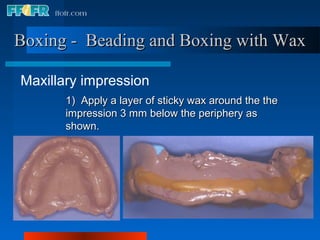
       1) Apply a layer of sticky wax around the the
       impression 3 mm below the periphery as
       shown.
Boxing – Beading and Boxing with Wax

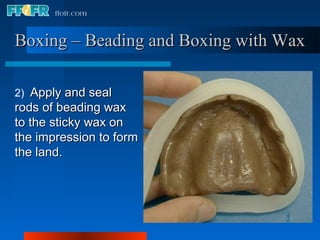
2) Apply and seal
rods of beading wax
to the sticky wax on
the impression to form
the land.
Boxing – Beading and Boxing with Wax
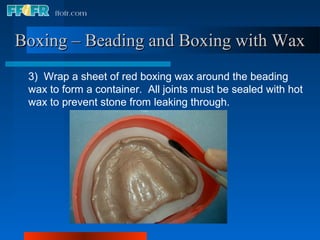
 3) Wrap a sheet of red boxing wax around the beading
 wax to form a container. All joints must be sealed with hot
 wax to prevent stone from leaking through.
Boxing -Plaster and Pumice Method

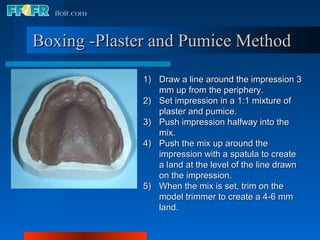
              1) Draw a line around the impression 3
                 mm up from the periphery.
              2) Set impression in a 1:1 mixture of
                 plaster and pumice.
              3) Push impression halfway into the
                 mix.
              4) Push the mix up around the
                 impression with a spatula to create
                 a land at the level of the line drawn
                 on the impression.
              5) When the mix is set, trim on the
                 model trimmer to create a 4-6 mm
                 land.
Boxing – Plaster Pumice Method

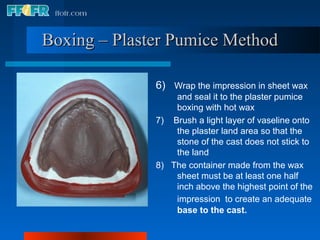
              6) Wrap the impression in sheet wax
                  and seal it to the plaster pumice
                  boxing with hot wax
              7) Brush a light layer of vaseline onto
                  the plaster land area so that the
                  stone of the cast does not stick to
                  the land
              8) The container made from the wax
                  sheet must be at least one half
                  inch above the highest point of the
                  impression to create an adequate
                  base to the cast.
Pouring the Cast


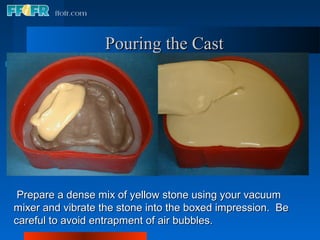
 Prepare a dense mix of yellow stone using your vacuum
mixer and vibrate the stone into the boxed impression. Be
careful to avoid entrapment of air bubbles.
Boxing the Mandibular Impression
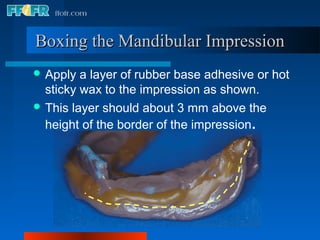
 Apply  a layer of rubber base adhesive or hot
  sticky wax to the impression as shown.
 This layer should about 3 mm above the
  height of the border of the impression.
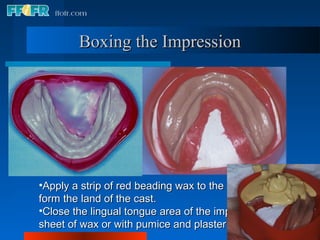
Boxing the Impression


•Apply a strip of red beading wax to the sticky wax layer to
form the land of the cast.
•Close the lingual tongue area of the impression with a
sheet of wax or with pumice and plaster.
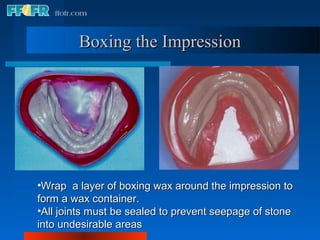
Boxing the Impression


•Wrap a layer of boxing wax around the impression to
form a wax container.
•All joints must be sealed to prevent seepage of stone
into undesirable areas
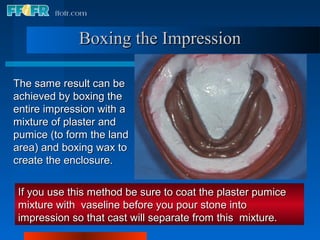
Boxing the Impression

The same result can be
achieved by boxing the
entire impression with a
mixture of plaster and
pumice (to form the land
area) and boxing wax to
create the enclosure.

If you use this method be sure to coat the plaster pumice
mixture with vaseline before you pour stone into
impression so that cast will separate from this mixture.
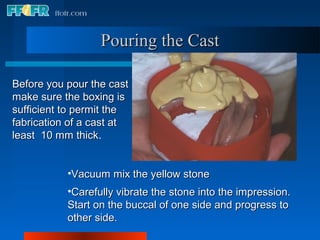
Pouring the Cast

Before you pour the cast
make sure the boxing is
sufficient to permit the
fabrication of a cast at
least 10 mm thick.
               thick


           •Vacuum mix the yellow stone
           •Carefully vibrate the stone into the impression.
           Start on the buccal of one side and progress to
           other side.
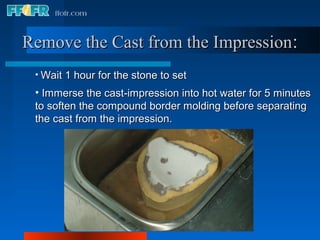
Remove the Cast from the Impression:
 • Wait 1 hour for the stone to set

 • Immerse the cast-impression into hot water for 5 minutes
 to soften the compound border molding before separating
 the cast from the impression.
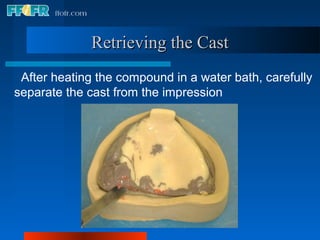
Retrieving the Cast
 After heating the compound in a water bath, carefully
separate the cast from the impression
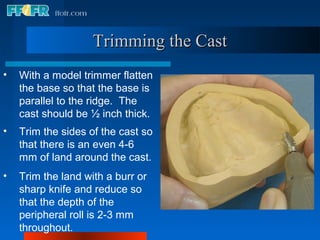
Trimming the Cast
•   With a model trimmer flatten
    the base so that the base is
    parallel to the ridge. The
    cast should be ½ inch thick.
•   Trim the sides of the cast so
    that there is an even 4-6
    mm of land around the cast.
•   Trim the land with a burr or
    sharp knife and reduce so
    that the depth of the
    peripheral roll is 2-3 mm
    throughout.
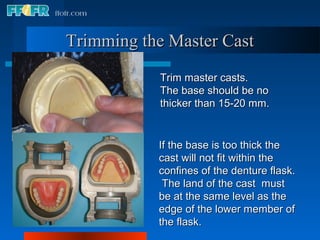
Trimming the Master Cast
           Trim master casts.
           The base should be no
           thicker than 15-20 mm.


           If the base is too thick the
           cast will not fit within the
           confines of the denture flask.
            The land of the cast must
           be at the same level as the
           edge of the lower member of
           the flask.
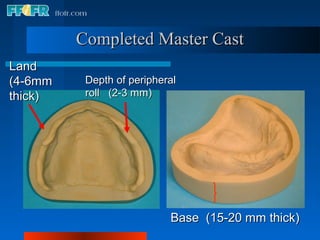
Completed Master Cast
Land
(4-6mm    Depth of peripheral
thick)    roll (2-3 mm)


                           Base (15-20 mm thick)
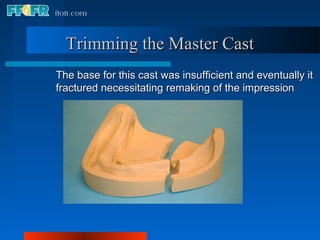
Trimming the Master Cast
The base for this cast was insufficient and eventually it
fractured necessitating remaking of the impression
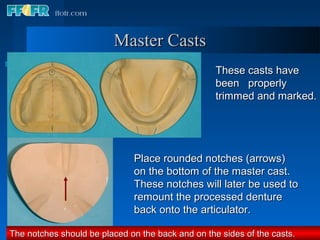
Master Casts
                                                   These casts have
                                                   been properly
                                                   trimmed and marked.


                              Place rounded notches (arrows)
                              on the bottom of the master cast.
                              These notches will later be used to
                              remount the processed denture
                              back onto the articulator.

The notches should be placed on the back and on the sides of the casts.
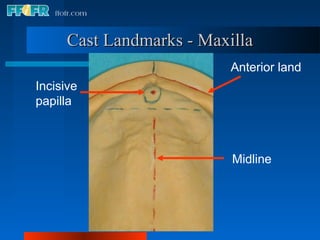
Cast Landmarks - Maxilla
                           Anterior land
Incisive
papilla


                           Midline
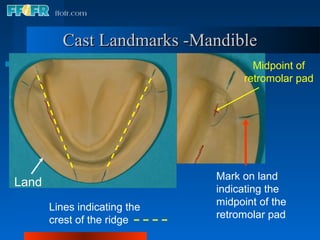
Cast Landmarks -Mandible
                                     Midpoint of
                                   retromolar pad


                              Mark on land
Land
                              indicating the
       Lines indicating the   midpoint of the
       crest of the ridge     retromolar pad
 Visitffofr.org for hundreds of additional
  lectures on Complete Dentures, Implant
  Dentistry, Removable Partial Dentures,
  Esthetic Dentistry and Maxillofacial
  Prosthetics.
 The lectures are free.
 Our objective is to create the best and most
  comprehensive online programs of
  instruction in Prosthodontics

8.boxing impressions and making casts

  • 1.
    Boxing Impressions andMaking Casts John Beumer III, DDS, MS and Robert Duell, DDS Division of Advanced Prosthodontics UCLA School of Dentistry This program of instruction is protected by copyright ©. No portion of this program of instruction may be reproduced, recorded or transferred by any means electronic, digital, photographic, mechanical etc., or by any information storage or retrieval system, without prior permission.
  • 2.
    Procedures Box impressions  Pour master casts in stone  Trim and index cast
  • 3.
    Boxing Master Impressionsand Making Master Casts • Purpose - Fabricate a cast that • Preserves the peripheral role • Provides a protective rim around the cast (land). This rim (land) must be 4-6 mm wide. • Produce a dense cast of vacuum mixed stone of the proper dimension (10- 15 mm thick) to permit flasking.
  • 4.
    Boxing the MaxillaryMaster Impression Two methods • Pumice and plaster method • Bead and box with wax rods and sheet strips
  • 5.
    Boxing - Beadingand Boxing with Wax Maxillary impression 1) Apply a layer of sticky wax around the the impression 3 mm below the periphery as shown.
  • 6.
    Boxing – Beadingand Boxing with Wax 2) Apply and seal rods of beading wax to the sticky wax on the impression to form the land.
  • 7.
    Boxing – Beadingand Boxing with Wax 3) Wrap a sheet of red boxing wax around the beading wax to form a container. All joints must be sealed with hot wax to prevent stone from leaking through.
  • 8.
    Boxing -Plaster andPumice Method 1) Draw a line around the impression 3 mm up from the periphery. 2) Set impression in a 1:1 mixture of plaster and pumice. 3) Push impression halfway into the mix. 4) Push the mix up around the impression with a spatula to create a land at the level of the line drawn on the impression. 5) When the mix is set, trim on the model trimmer to create a 4-6 mm land.
  • 9.
    Boxing – PlasterPumice Method 6) Wrap the impression in sheet wax and seal it to the plaster pumice boxing with hot wax 7) Brush a light layer of vaseline onto the plaster land area so that the stone of the cast does not stick to the land 8) The container made from the wax sheet must be at least one half inch above the highest point of the impression to create an adequate base to the cast.
  • 10.
    Pouring the Cast Prepare a dense mix of yellow stone using your vacuum mixer and vibrate the stone into the boxed impression. Be careful to avoid entrapment of air bubbles.
  • 11.
    Boxing the MandibularImpression  Apply a layer of rubber base adhesive or hot sticky wax to the impression as shown.  This layer should about 3 mm above the height of the border of the impression.
  • 12.
    Boxing the Impression •Applya strip of red beading wax to the sticky wax layer to form the land of the cast. •Close the lingual tongue area of the impression with a sheet of wax or with pumice and plaster.
  • 13.
    Boxing the Impression •Wrapa layer of boxing wax around the impression to form a wax container. •All joints must be sealed to prevent seepage of stone into undesirable areas
  • 14.
    Boxing the Impression Thesame result can be achieved by boxing the entire impression with a mixture of plaster and pumice (to form the land area) and boxing wax to create the enclosure. If you use this method be sure to coat the plaster pumice mixture with vaseline before you pour stone into impression so that cast will separate from this mixture.
  • 15.
    Pouring the Cast Beforeyou pour the cast make sure the boxing is sufficient to permit the fabrication of a cast at least 10 mm thick. thick •Vacuum mix the yellow stone •Carefully vibrate the stone into the impression. Start on the buccal of one side and progress to other side.
  • 16.
    Remove the Castfrom the Impression: • Wait 1 hour for the stone to set • Immerse the cast-impression into hot water for 5 minutes to soften the compound border molding before separating the cast from the impression.
  • 17.
    Retrieving the Cast After heating the compound in a water bath, carefully separate the cast from the impression
  • 18.
    Trimming the Cast • With a model trimmer flatten the base so that the base is parallel to the ridge. The cast should be ½ inch thick. • Trim the sides of the cast so that there is an even 4-6 mm of land around the cast. • Trim the land with a burr or sharp knife and reduce so that the depth of the peripheral roll is 2-3 mm throughout.
  • 19.
    Trimming the MasterCast Trim master casts. The base should be no thicker than 15-20 mm. If the base is too thick the cast will not fit within the confines of the denture flask. The land of the cast must be at the same level as the edge of the lower member of the flask.
  • 20.
    Completed Master Cast Land (4-6mm Depth of peripheral thick) roll (2-3 mm) Base (15-20 mm thick)
  • 21.
    Trimming the MasterCast The base for this cast was insufficient and eventually it fractured necessitating remaking of the impression
  • 22.
    Master Casts These casts have been properly trimmed and marked. Place rounded notches (arrows) on the bottom of the master cast. These notches will later be used to remount the processed denture back onto the articulator. The notches should be placed on the back and on the sides of the casts.
  • 23.
    Cast Landmarks -Maxilla Anterior land Incisive papilla Midline
  • 24.
    Cast Landmarks -Mandible Midpoint of retromolar pad Mark on land Land indicating the Lines indicating the midpoint of the crest of the ridge retromolar pad
  • 25.
     Visitffofr.org forhundreds of additional lectures on Complete Dentures, Implant Dentistry, Removable Partial Dentures, Esthetic Dentistry and Maxillofacial Prosthetics.  The lectures are free.  Our objective is to create the best and most comprehensive online programs of instruction in Prosthodontics