29 Preparing Dentures for Delivery


 This program of instruction is protected by copyright ©. No portion of
 this program of instruction may be reproduced, recorded or transferred by
 any means electronic, digital, photographic, mechanical etc., or by any
 information storage or retrieval system, without prior permission.
19. Preparing Dentures for Delivery


  a. Fabrication of facebow transfer jig
  b. Finish and polish
  c. Fabrication of clinical remount casts


                        *Described in this section
19. Preparing Dentures for Delivery


  a. Fabrication of facebow transfer jig
  b. Finish and polish
  c. Fabrication of clinical remount casts


                        *Described in this section
Preparing Dentures for Delivery

    Fabrication of face bow remount jig
    Removing Processed Dentures from Master
     Casts
    Finishing Polishing Dentures
    Fabrication of clinical remount casts
    Mount the maxillary remount cast on the
     articulator preserving the facebow transfer
     record
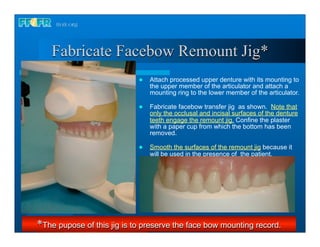
Fabricate Facebow Remount Jig*
                               Attach processed upper denture with its mounting to
                                the upper member of the articulator and attach a
                                mounting ring to the lower member of the articulator.

                               Fabricate facebow transfer jig as shown. Note that
                                only the occlusal and incisal surfaces of the denture
                                teeth engage the remount jig. Confine the plaster
                                with a paper cup from which the bottom has been
                                removed.

                               Smooth the surfaces of the remount jig because it
                                will be used in the presence of the patient.


*The pupose of this jig is to preserve the face bow mounting record.
Removing Dentures from Casts and Polishing

       Instruments and Materials
          Plaster knife
          Acrylic Burs
          Pumice
          Rag polishing wheels
          Felt cones
          Brush wheels
          Kingsly scraper
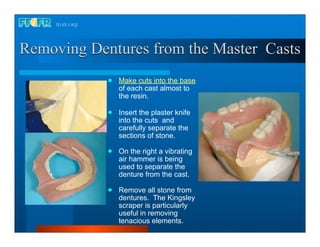
Removing Dentures from the Master Casts
               Make cuts into the base
                of each cast almost to
                the resin.

               Insert the plaster knife
                into the cuts and
                carefully separate the
                sections of stone.

               On the right a vibrating
                air hammer is being
                used to separate the
                denture from the cast.

               Remove all stone from
                dentures. The Kingsley
                scraper is particularly
                useful in removing
                tenacious elements.
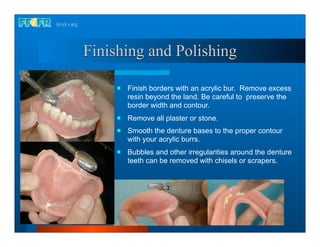
Finishing and Polishing

        Finish borders with an acrylic bur. Remove excess
         resin beyond the land. Be careful to preserve the
         border width and contour.
        Remove all plaster or stone.
        Smooth the denture bases to the proper contour
         with your acrylic burrs.
        Bubbles and other irregularities around the denture
         teeth can be removed with chisels or scrapers.
Finishing and Polishing
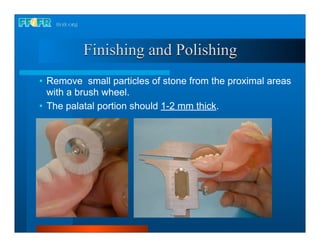
• Remove small particles of stone from the proximal areas
  with a brush wheel.
• The palatal portion should 1-2 mm thick.
Finishing and Polishing
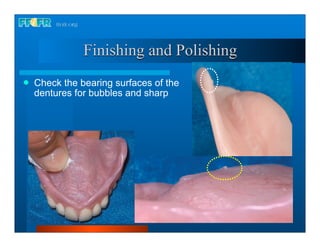
   Check the bearing surfaces of the
    dentures for bubbles and sharp
Finishing and Polishing
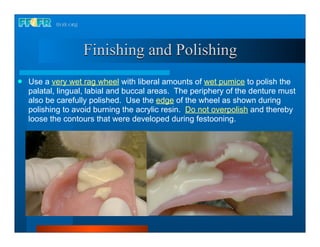
   Use a very wet rag wheel with liberal amounts of wet pumice to polish the
    palatal, lingual, labial and buccal areas. The periphery of the denture must
    also be carefully polished. Use the edge of the wheel as shown during
    polishing to avoid burning the acrylic resin. Do not overpolish and thereby
    loose the contours that were developed during festooning.
Finishing and Polishing
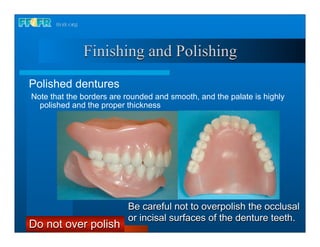
Polished dentures
Note that the borders are rounded and smooth, and the palate is highly
  polished and the proper thickness


                          Be careful not to overpolish the occlusal
                          or incisal surfaces of the denture teeth.
Do not over polish
Finishing and Polishing
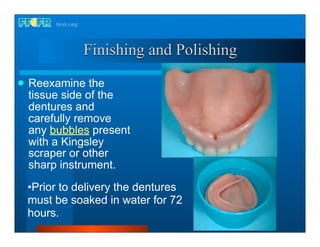
   Reexamine the
    tissue side of the
    dentures and
    carefully remove
    any bubbles present
    with a Kingsley
    scraper or other
    sharp instrument.
    •Prior to delivery the dentures
    must be soaked in water for 72
    hours.
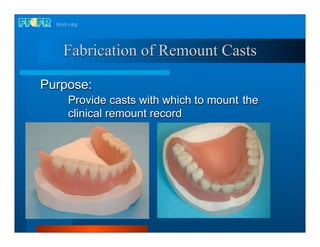
Fabrication of Remount Casts

Purpose:
    Provide casts with which to mount the
    clinical remount record
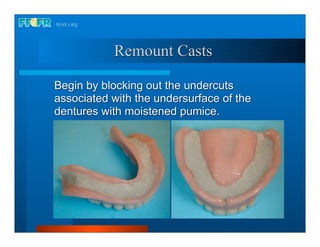
Remount Casts

Begin by blocking out the undercuts
associated with the undersurface of the
dentures with moistened pumice.
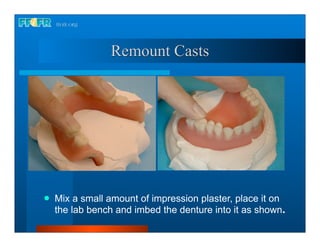
Remount Casts


   Mix a small amount of impression plaster, place it on
    the lab bench and imbed the denture into it as shown.
Remount Casts


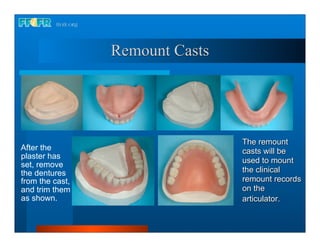
                                 The remount
After the                        casts will be
plaster has
                                 used to mount
set, remove
the dentures                     the clinical
from the cast,                   remount records
and trim them                    on the
as shown.                        articulator.
You are now ready to perform the
         clinical remount procedure

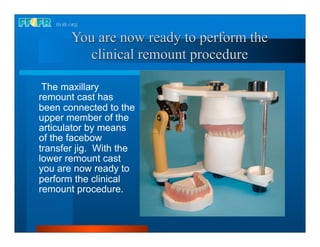
 The maxillary
remount cast has
been connected to the
upper member of the
articulator by means
of the facebow
transfer jig. With the
lower remount cast
you are now ready to
perform the clinical
remount procedure.

29.preparing dentures for delivery

  • 1.
    29 Preparing Denturesfor Delivery This program of instruction is protected by copyright ©. No portion of this program of instruction may be reproduced, recorded or transferred by any means electronic, digital, photographic, mechanical etc., or by any information storage or retrieval system, without prior permission.
  • 2.
    19. Preparing Denturesfor Delivery a. Fabrication of facebow transfer jig b. Finish and polish c. Fabrication of clinical remount casts *Described in this section
  • 3.
    19. Preparing Denturesfor Delivery a. Fabrication of facebow transfer jig b. Finish and polish c. Fabrication of clinical remount casts *Described in this section
  • 4.
    Preparing Dentures forDelivery  Fabrication of face bow remount jig  Removing Processed Dentures from Master Casts  Finishing Polishing Dentures  Fabrication of clinical remount casts  Mount the maxillary remount cast on the articulator preserving the facebow transfer record
  • 5.
    Fabricate Facebow RemountJig*  Attach processed upper denture with its mounting to the upper member of the articulator and attach a mounting ring to the lower member of the articulator.  Fabricate facebow transfer jig as shown. Note that only the occlusal and incisal surfaces of the denture teeth engage the remount jig. Confine the plaster with a paper cup from which the bottom has been removed.  Smooth the surfaces of the remount jig because it will be used in the presence of the patient. *The pupose of this jig is to preserve the face bow mounting record.
  • 6.
    Removing Dentures fromCasts and Polishing Instruments and Materials  Plaster knife  Acrylic Burs  Pumice  Rag polishing wheels  Felt cones  Brush wheels  Kingsly scraper
  • 7.
    Removing Dentures fromthe Master Casts  Make cuts into the base of each cast almost to the resin.  Insert the plaster knife into the cuts and carefully separate the sections of stone.  On the right a vibrating air hammer is being used to separate the denture from the cast.  Remove all stone from dentures. The Kingsley scraper is particularly useful in removing tenacious elements.
  • 8.
    Finishing and Polishing  Finish borders with an acrylic bur. Remove excess resin beyond the land. Be careful to preserve the border width and contour.  Remove all plaster or stone.  Smooth the denture bases to the proper contour with your acrylic burrs.  Bubbles and other irregularities around the denture teeth can be removed with chisels or scrapers.
  • 9.
    Finishing and Polishing •Remove small particles of stone from the proximal areas with a brush wheel. • The palatal portion should 1-2 mm thick.
  • 10.
    Finishing and Polishing  Check the bearing surfaces of the dentures for bubbles and sharp
  • 11.
    Finishing and Polishing  Use a very wet rag wheel with liberal amounts of wet pumice to polish the palatal, lingual, labial and buccal areas. The periphery of the denture must also be carefully polished. Use the edge of the wheel as shown during polishing to avoid burning the acrylic resin. Do not overpolish and thereby loose the contours that were developed during festooning.
  • 12.
    Finishing and Polishing Polisheddentures Note that the borders are rounded and smooth, and the palate is highly polished and the proper thickness Be careful not to overpolish the occlusal or incisal surfaces of the denture teeth. Do not over polish
  • 13.
    Finishing and Polishing  Reexamine the tissue side of the dentures and carefully remove any bubbles present with a Kingsley scraper or other sharp instrument. •Prior to delivery the dentures must be soaked in water for 72 hours.
  • 14.
    Fabrication of RemountCasts Purpose: Provide casts with which to mount the clinical remount record
  • 15.
    Remount Casts Begin byblocking out the undercuts associated with the undersurface of the dentures with moistened pumice.
  • 16.
    Remount Casts  Mix a small amount of impression plaster, place it on the lab bench and imbed the denture into it as shown.
  • 17.
    Remount Casts The remount After the casts will be plaster has used to mount set, remove the dentures the clinical from the cast, remount records and trim them on the as shown. articulator.
  • 18.
    You are nowready to perform the clinical remount procedure The maxillary remount cast has been connected to the upper member of the articulator by means of the facebow transfer jig. With the lower remount cast you are now ready to perform the clinical remount procedure.