PHILOSOPHY
OF RPD DESIGN
Dr. Jissa Sunny
● Introduction
● Rationale
● Indications
● Stress considerations
● Forces acting on partial dentures
● Lever principle
● Principles of design
● Philosophy of design
● Fundamental design principles
● Conclusion
● References
CONTENTS
REMOVABLE PARTIAL DENTURE
A removabledenturethatreplacessometeethin a partiallyedentulousarch;the
removable partialdenturecanbereadilyinserted andremoved fromthemouthby
the patient.
● Anyconsiderationofthe logical design ofapartialdenturemust establishthebasic
requirementsof sucha restoration.ie retention,stability,support,functionand
esthetics.
INTRODUCTION
● In partialdenturedesign, themain concernis forprostheses
thatarepartiallysupportedbyteeth andpartiallysupportedby
softtissues.
Prosthesesthatareentirely supportedbyteeth
○ Straightforward
○ Derive allof theirsupportfromthe remaining teeth
○ A single impression maybe usedtorecordtheteeth andsofttissues.
○ Indirect retentionor flexibledirectretentionis notrequired.
○ Retentiveclasping is basedonconvenience
● Removablepartialdenturesshouldenhancethehealthof remaining dentitionand
surroundingoraltissues.
● It is importantto understandthe movements takingplaceon thecomponentsand
logically design them in ordertocontrolthe movements takingplacein them.
● Dr M. M.Devan, the primarypurpose of removable partial denturetherapymust always be“the
preservation of that which remains, and not the meticulous replacement of that which has been
lost”.
● Maintaining orimproving phonetics, establishing or increasing masticatory efficiency, stabilizing dental
relationships, and developing the required esthetics.
RATIONALE FOR REMOVABLE
PARTIAL DENTURE THERAPY
● Long-spanedentulous area
● Noabutmenttoothposteriortothe edentulousspace
● Reducedperiodontalsupportforremaining teeth
● Need forcross-archstabilization
● Immediate need toreplaceextractedteeth
INDICATIONS
● Excessivebone loss withintheresidual ridge
● Physicaloremotionalproblemsexhibitedbypatients
● Estheticsofprimaryconcern
● Patientdesires
● Unfavorablemaxillomandibularrelationships
STRESS CONSIDERATIONS IN
PARTIAL DENTURE
Torsional
Horizontal
Displacing
Dislodging
Vertical
● Thesearethe least harmfulandarebornewell if withinphysiologiclimits
VERTICAL-DISPLACING STRESSES
● Thesearethe forceswhich tendtolift thepartialdenturefromitsrest position
VERTICAL- DISLODGING STRESSES
● Theyoriginateas acomponentofrhythmicchewing strokes.
● Theseforcesareeffectivein mesio-distalandbuccolingualdirection
● Theselateralstressesaremostdamaging
HORIZONTAL STRESSES
● It is atwisting rotationaltypeofforce
● Combinationofbothvertical andhorizontalforce
TORSIONAL STRESS
● The abilityof living tissuestotolerateforcesis largely dependentupon
■ The magnitudeandintensity
■ The duration
■ The direction
■ The frequency
FORCES ACTING ON PARTIAL
DENTURES
THE INCLINED PLANE AND THE LEVER
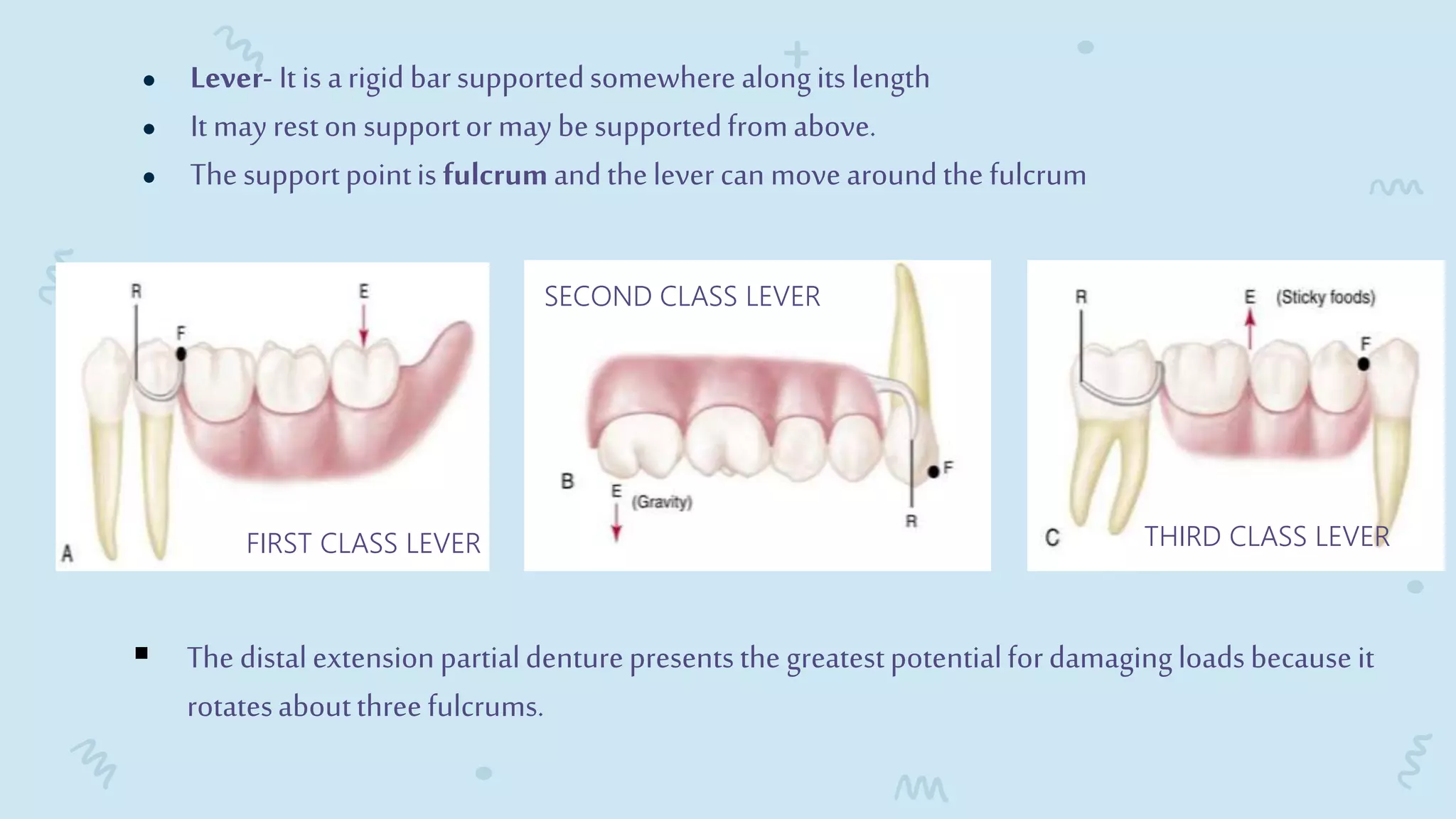
● Lever- Itis arigid barsupportedsomewherealongits length
● It mayreston supportor maybesupportedfromabove.
● The supportpointis fulcrumandthelever can movearoundthe fulcrum
FIRST CLASS LEVER THIRD CLASS LEVER
SECOND CLASS LEVER
 The distalextensionpartialdenturepresentsthe greatestpotentialfordamagingloadsbecauseit
rotatesaboutthreefulcrums.
● One fulcrumis on thehorizontalplanethatextendsthroughtwo
principalabutments,one oneach sideofthe dentalarch,and
generally istermed theprincipal fulcrumline.
● This fulcrumcontrolsthe rotationalmovement ofthe denturein the
sagittalplane.
● Rotationalmovement aroundthis fulcrumline is thegreatestin
magnitude,butis notnecessarily themost damaging.
● Therefore,horizontalorlateralforcesof muchless magnitudecanbe
moredestructiveto thehardandsofttissuesofthe periodontium.
● A secondfulcrum line lies in the sagittalplane andextendsthrough
the occlusalrest onthe terminalabutmentandalongthe crestof the
residualridge onone sideofthe arch.
● This fulcrumline controlsthe rotationalmovements ofthe denturein
the frontalplane
● Theresultantforcesaremorenearlyhorizontalandarenotwell
resisted bytheoralstructures.Therefore,theseforcescanbe
moderatelydamaging.
● Thethird fulcrumis locatedin thevicinity ofthemidline, just
lingual tothe anteriorteeth
● This fulcrumline isoriented verticallyandcontrolsrotational
movement in thehorizontalplane
● Consequently,theseforcescanbeextremelydamaging and
shouldreceive significantattentionduring thedesign process.
A.H.Schmidtin1953
● The dentistmusthaveathoroughknowledgeofboththe mechanicalandbiological factors
involved in removable partialdenturedesign.
● The treatmentplanmustbebasedon acompleteexaminationanddiagnosisofthe individual
patient.
● Thedentistmustcorrelatethe pertinentfactorsanddetermine aproperplanoftreatment.
● A removablepartialdentureshouldrestoreformandfunctionwithoutinjury totheremaining
oralstructures.
PRINCIPLES OF DESIGN
● In restoringocclusion, theprosthesisshouldalso restoreanormalordesirablefacialcontourand
notimpedethe normalmovement ofthe tongueandothertissues.
● A removable partialdentureis a formoftreatmentandnotacure.
● Oraltissuesneverremain static,butareconstantlyundergoing change, reflecting the general
healthandageofthe patient.The patientshouldberecalled periodicallyto preventany
deleterious changesfromtakingplace.
BASICREQUIREMENTSINPARTIALDENTUREDESIGNthatmust bemet ifthe restorationis tofunction
adequatelyandwith comfort.
1. Support-Thisis achievedbythe useofadequatedenturebasesandocclusalrests.
2. Stability-Thisis necessarynotonlyforthe restorationbutalso forthe teeth themselves. Connectors
aswell asretainersstabilizethe restorationandtheabutmentsagainstlateralstresses.
3. Retention -Retainers,bothdirect andindirect,resistthe forcesofdislodgment and
rotationof therestoration.
4. Esthetics -Judicious shapingoftipped ordriftedteeth bystonesallowsforthe more
harmoniousrestorationofmissing teeth. Theimmediateinsertion partialdenture
provides mentalcomforttothe patient.
PHILOSOPHY OF DESIGN
Stress
Equalization
Physiologic
Basing
Broad Stress
Distribution
● The resiliency ofthe toothsupportedbyperiodontalligament in anapicaldirectionis not
comparabletothe greaterresiliency anddisplacementofthe mucosacovering thedentulousridge.
● It is thebelief ofthis schoolofthoughtthattherigid connectionbetweenthe denturebaseandthe
direct retaineronthe abutmentteethis damaging
● Thussomeformofstressdirectororstressequalizeris essential toprotecttheabutmentteeth.
STRESS EQUALIZATION
● Stressequalizer
● Stressbreakers
● Stressdirectors
● A device or systemthatrelieves specific dentalstructuresofpartor all oftheocclusal forcesand
redirects thoseforcestootherloadbearing structuresorregions. (GPT-9)
● A stressbreakeris something likea hingejoint placedwithinthe dentureframework,which
allowsthe twopartsofthe frameworkon either sideofthe jointtomove freely.(Mc Cracken)
AIMS
● Todirect occlusalforces in thelong axisof theabutmentteeth.
● Toprevent harmfulloadsbeing appliedtothe remaining naturalteeth.
● Toshareloadas earlyaspossiblebetween thenaturalteethandsaddleareasaccordingtothe
abilityofthesedifferenttissuestoacceptthe loads.
● Toensurethatpartof theloadappliedto thesaddleis distributedasevenly aspossibleover
the wholemucosal surface
● Toprovidegreatercomforttothepatient.
● TYPE1: Thesetypeshaveamovable joint betweenthe direct retainerandthe denture
baseandpermit vertical movement andhingeactionofthe distalextensiondenture
base.
○ Hinge
○ Sleeve
○ Cylinder
○ Ball andsocket
● TYPE2: flexibleconnectionbetween direct retaineranddenturebase.
○ Wroughtwiresoldered tomajorconnector
○ Splitmajorconnectors
○ Claspshaving stressbreakingeffect
○ Disjunctpartialdentures
● The mostcommonlyusedstressdirectorsaresimple hinges interposedbetween thedenturebases
andtheadjacentclasping assemblies.Thesehinges aredesigned to permitvertical movement of
the denturebaseswithoutcausing undueloading oftheabutments.
● Lengthof edentulous span
● Qualityof ridge support
○ Large,well-formedridges arecapableofwithstandinggreaterloadsthanare
small, thin,orknife-edgedridges.
○ Broadridges with parallelsides permit theuseof denturebaseswithlonger
vertical surfaces.Providesstability.
● Claspflexibility
○ The moreflexible theretentivearm oftheclasp,theless loadis transferredto
the abutment.
FACTORS INFLUENCING STRESSES
TRANSMITTED TO ABUTMENT TEETH
● Claspdesign
○ claspthatis designed tobepassivewhen it is completely seatedonthe abutmenttoothwill exert
less loadon thetooththanwill onethatis notpassive.
○ A claspshouldbedesigned sothatduringinsertionor removal oftheprosthesis,the reciprocal
armcontactsthe toothbeforethe retentivetippasses overthegreatestbulge ofthe abutment.
This will stabilizeorneutralizethe loadtowhich theabutmentis subjectedas theretentive tip
passesover thegreatestbulge ofthetooth.
● Lengthof clasp
Flexibility canbeincreased bylengthening theclasp.
● Materialusedinclaspconstruction
A claspconstructedof achromium-basedalloywill normallyexerta greaterloadonthe abutmentthan
will a gold-basedalloy
● Surfacecharacteristics of theabutment
Thesurfaceof acastgold restorationoffersmorefrictionalresistanceto clasparmmovement thandoes
the enamel surfaceofatooth.
● Occlusalharmony
Ideally, theocclusal loadshouldbeappliedin the centerof thedenture-bearingarea,bothantero-
posteriorlyandfacio-lingually.
ADVANTAGES
○ Minimal direct retention
○ Used in conjunctionwith intracoronalattachments.
○ Theoretically,stressdirectorsminimizethe tippingforceson abutmentteeth,therebylimiting
boneresorption.
DISADVANTAGES
○ Comparativelyfragile andtheirincorporationintoremovable partialdenture
frameworkscan becostly.
○ Thesedevices require constantmaintenance
○ Difficultorimpossibletorepair.
○ Ofthe threeschoolsofthoughtsof partialdenturedesign, the stress
equalizationschool hasthefewest advocates.
● The physiologicbasing is producedeitherby
○ Displacing ordepressing theridgemucosaduringthe impression makingprocedure
○ Relining the denturebaseafterithasbeen constructed.
● Displacing themucosaduring theimpression procedurerecordsit in itsfunctioningandnotthe
anatomicform.This denturebaseformedover displaced tissue,will adaptmorereadilytothe
depressedtissuewhen occlusal forceactsandwill be betterable towithstandtheforcethatis
generated.
PHYSIOLOGIC BASING
● Equalizationcan bestbeaccomplishedbyrecording the anatomyofthe edentulousridgein its functional
formandensuring thattheassociateddenturebaseaccuratelyreflects thisanatomy.
● Advocatesofthis theorybelieve thatdenturebasesformedover compressed tissueswill showanincreased
abilitytowithstandvertical forces.
● Proponentsofthistheorybelieve thatdenture basemovement occurring asaresult ofsofttissue
compressionandrecovery exertsaphysiologicallystimulatingeffecton thetissuesofthe residualridges.
Theyalsobelieve thatthis actionpromotestissuehealthandreducesthe necessity forfrequentrelining or
rebasingprocedures.
ADVANTAGES
● The minimal retention requirements associated with
physiologic basing result in lightweight prostheses requiring
minimal maintenance and repair.
● The forgiving nature of retentive produces a significant
reduction in the forces transmitted to the abutment teeth. As a
result, advocates of this theory believe that abutments are
retained for longer periods.
DISADVANTAGES
● Becausetheartificialteethareslightly abovethe occlusalplane whenthe dentureis
notin function,therewill alwaysbe prematurecontactsbetween theopposingteeth
andtheprosthesisduring closure.Thismaybesomewhatannoyingtothe patientand
mayresultin somediscomfort.
● It is difficulttoproduceeffectiveindirectretention
● Notwell stabilizedagainstlateralforces.
● Distributingthe forcesof occlusionover asmanyteeth andas much oftheavailable
softtissueareaas possible.
● Accomplished byusing additionalrestsandclaspassemblies andbyensuringthatthe
associateddenturebasesprovidebroadcoverage
BROAD STRESS DISTRIBUTION
ADVANTAGES
● Proponentsofthisphilosophybelieve thatforcestransmittedtothe supportingteeth and
residualridges maybe minimizedbydistributingtheseforcesover a greaternumberof teeth
andalarger softtissuearea.
● Increased contactwiththe remainingteeth andsofttissuesminimizes thelateralforcesonthe
remaining structures.
● The useofmultiple claspassemblies areintendedto provideadditionalresistanceto horizontal
movement.
● The resultantprosthesesareeasierandless expensive toconstruct.
● Therigid componentsminimizerotationalmovements andprovideexcellent horizontal
stabilization
DISADVANTAGES
● The increasedcoverage providedbysuch prosthesesmaynotbeacceptedbysomepatients.
● Complicatesoralhygiene.
● Support for removable partial dentures may be derived from the
remaining teeth, the hard and soft tissues of the residual ridge, or
both.
● Teeth are connected to the surrounding bone via thin periodontal
ligaments.
● Under function, healthy teeth may be displaced as much as 0.2 mm.
In contrast, soft tissues overlying residual bone generally may be
displaced 1.0 mm or more.
● As a result, there may be a significant difference in the support
provided by the teeth and the tissues of the residual ridge.
FUNDAMENTAL DESIGN
CONSIDERATIONS
CLASS I REMOVABLE PARTIAL
DENTURES
CLASSI
Bilateraledentulousareaslocatedposteriortothe remaining naturalteeth
● Derive supportfromthe remaining teethandresidual ridges
● Topreservetheremaining teeth andresidualridges,removable partialdenturesmust
provideanequitable distribution of forces
Remaining NaturalTeeth
Force
Rapiddestructionofthe periodontaltissues
Potentialabutmentloss
ResidualRidges
Force
Destructionofthe associated
tissues
Decreasein ridgeheight.
OPTIMUM SUPPORT FOR DISTAL EXTENSION DENTURE BASES
● All portionsofaresidualridge thatarecapableofproviding supportshouldbecoveredbyan accurately
fittingdenturebase.
● Broadcoverage permitsafavorabledistributionofstresses-snowshoeeffect
Inadequatesofttissue coverage
Breakdownof
Underlying bone
Decreasein ridge
volume.
Stress
concentration
• Adequatesupportofadistalextensionbaseis oftensocritical that
asecondimpression ofthe residualridge is required
FLEXIBLE DIRECT RETENTION
● The softtissuesaredisplaceableandallowvertical movement ofthe denturebasesuponloading .
● Verticaldisplacement ofthe denturebasesmayresultin theapplicationofstressestothe most
posteriorabutments.
● Improperlydesigned direct retainersmaymagnifythesestresses.The resultantrockingforcesmay
damagethe associatedperiodontaltissuesandproducemobility oftheabutmentteeth.
● Therefore,direct retainersmust permitdissipationofforcesresulting fromdenture
basemovement.
● Eachdirectretainershouldbedesigned toflexor moveinto anareaof greater
undercutasforcesareappliedtothe removablepartialdenture.
● Claspdesign is akeyfactorin successful removable partialdentureservice.
INDIRECT RETENTION
● Stickyfoods liftdenturebasesawayfromthe supportingtissues.
● Rotationoftheremovable partialdenture aroundthe mostposteriorabutment
● Auxiliary rests shouldbe placedasfaraspracticalfromthe fulcrumline.
● The auxiliaryrestsminimizerotationandaidin retentionofthe associatedprosthesis-Indirect
retainers.
● Clasp assemblies are largelyresponsible for direct retention,
● Proper extension and adaptation of one or moredenture bases also contributeto
retention of a removable partial denture.
● A class I prosthesis usually requires only two clasp assemblies
● If a distobuccal undercut is present, an infrabulge clasp (tor 1/2 t) is preferred
● If a mesiobuccal undercut is present, a wrought-wire clasp is preferred
● Thereciprocal elements must be rigid. Thesecomponents may be inthe form of
bracing arms or lingual plating
SUMMARY
● Two indirect retainers should generallybeused ina Class I design.
● Lingual plating may beused to augment indirect retention.
● Themajor connector must berigid and must not impinge ongingival tissues.
○ Inthe maxillaryarch,a broad major connector maybe used to derive additional support from thehard
palate.
● Minor connectors must be rigid and should bepositioned to enhancecomfort, cleanliness, and theplacement
of artificial teeth.
● Occlusion -maximum intercuspation should coincide with centricrelation.
● Denture bases should bedesigned to provide broad coverage.
Selective pressure impressions are recommended
CLASSIII
A unilateraledentulousareawith naturalteeth remaining bothanteriorandposteriortoit
CLASS III REMOVABLE PARTIAL
DENTURES
● ClassIII removablepartialdenturesaresupportedbyteethor dentalimplantsatbothends ofan
edentulousspace, denturebasesgenerally donotrotateorlift awayfromtheunderlying tissues.
Therefore,compensationforrotationalforcesis notneeded.
● Supportshouldbeprovided entirelybythe abutmentteeth.
● Due tothefavorabledistributionofabutments,classIII removable partialdenturesoftenfunction
like fixedprostheses.
● Residualridges shouldbeusedforsupportonly whenedentulousspansarelong or abutments
displaydecreasedperiodontalsupport.
● ClassIII removable partialdenturesdo nottendtomove in function.Directretentionis needed
onlytoprevent dislodgement ofthe prosthesis.
● Indirect retentiongenerally is notnecessary.
● Directretention -Because these prostheses areentirelytooth borne, the trasmission of harmfulforces to the
abutment teeth and residual ridges can be minimized.
● Clasps -Quadrilateral positioning of direct retainersis considered ideal (simple circlet clasps)
Reciprocal elements must be rigid.
● Rests- When possible, rests and/or rest seats
should bepositioned adjacent to the edentulous spaces.
Rests should be usedto support major connectors
and lingual plating.
SUMMARY
● Indirect retention isusuallynotrequired
● Major and minor connectorsmust berigid
● Occlusion- sameas forkennedy’sclassI andclassII arches.
● Denture bases
○ Functionalimpressionsarenotrequired.
○ Coverageofthe residualridge areasshould bedeterminedbyappearance,
comfort,andthe avoidanceoffoodimpaction.
CLASSII
A unilateraledentulousarealocatedposteriortothe remainingnaturalteeth.
CLASS II REMOVABLE PARTIAL
DENTURES
● The unilateraldistalextensionside mustbedesigned asaClassI removable partialdenture,
whereasthe tooth-supportedside mustbedesigned asaClass III removablepartialdenture.
● The prosthesismust include awell-adapteddenturebase,properlydesigned direct retention,and
appropriatelypositionedindirect retention.
● A kennedyclass IIremovable partial dentureshould have three clasp
assemblies.
●
● For a kennedyclass ii application with nomodifications, clasp assemblies should
bepositioned as far posterior as is practical and as far anterior as esthetics will
permit.
● Theprimaryaxis of rotation passes throughthe most posterior abutment on each
side of the dental arch.An indirect retainer should be placed opposite the distal
extension base and as far from the rotational axis as practical.
● One indirect retainer is generally adequate. It should be
located on the side opposite the distal extension base
SUMMARY
CLASSIV
A single, butbilateral(crossing themidline), edentulousarea locatedanteriortothe
remaining naturalteeth.
CLASS IV REMOVABLE PARTIAL
DENTURES
• A classIV design shouldberegardedasaclassI removable partialdenturein reverse,
particularlyif the edentulousspanis lengthy.
• The prosthesismust include awell-adapteddenturebase,properlydesigned direct
retention,andappropriatelypositionedindirectretention.
● Every effort should bemade to preserve the hardand soft tissue
components of the anterior edentulous ridge.
● A quadrilateral configuration of direct retainers is considered ideal.
● Themajor connector should berigid, and broad palatal coverage should
beused in the maxillaryarch.
● Indirect retention should belocated as far posterior to the fulcrumline as
possible.
● Functional impression may beindicated if the edentulous area is
extensive.
SUMMARY
CONCLUSION
• If potentiallydestructiveforcescanbeminimized,thenthe physiologictolerancesofthe supporting
structuresarenotexceeded andpathologicchangedoes notoccur.
• The forcesthatoccurwith removable prosthesisfunctioncanbewidely distributedanddirected,
andtheireffect minimized byappropriatedesign ofthe removable partialdenture.
• An appropriatedesign includesthe selection andlocationof componentsin conjunctionwitha
harmoniousocclusion.
● Mccracken’s removable partial prosthodontics- 12th edition
● Stewarts clinical removable partial prosthodontic, 4ed (2008)
● Perry, C. (1956). A philosophy of partial denture design. The
journal of prosthetic dentistry, 6(6), 775–784.
REFERENCES
THANK YOU

Philosophy of rpd

  • 1.
  • 2.
    ● Introduction ● Rationale ●Indications ● Stress considerations ● Forces acting on partial dentures ● Lever principle ● Principles of design ● Philosophy of design ● Fundamental design principles ● Conclusion ● References CONTENTS
  • 3.
    REMOVABLE PARTIAL DENTURE Aremovabledenturethatreplacessometeethin a partiallyedentulousarch;the removable partialdenturecanbereadilyinserted andremoved fromthemouthby the patient. ● Anyconsiderationofthe logical design ofapartialdenturemust establishthebasic requirementsof sucha restoration.ie retention,stability,support,functionand esthetics. INTRODUCTION
  • 4.
    ● In partialdenturedesign,themain concernis forprostheses thatarepartiallysupportedbyteeth andpartiallysupportedby softtissues. Prosthesesthatareentirely supportedbyteeth ○ Straightforward ○ Derive allof theirsupportfromthe remaining teeth ○ A single impression maybe usedtorecordtheteeth andsofttissues. ○ Indirect retentionor flexibledirectretentionis notrequired. ○ Retentiveclasping is basedonconvenience
  • 5.
    ● Removablepartialdenturesshouldenhancethehealthof remainingdentitionand surroundingoraltissues. ● It is importantto understandthe movements takingplaceon thecomponentsand logically design them in ordertocontrolthe movements takingplacein them.
  • 6.
    ● Dr M.M.Devan, the primarypurpose of removable partial denturetherapymust always be“the preservation of that which remains, and not the meticulous replacement of that which has been lost”. ● Maintaining orimproving phonetics, establishing or increasing masticatory efficiency, stabilizing dental relationships, and developing the required esthetics. RATIONALE FOR REMOVABLE PARTIAL DENTURE THERAPY
  • 7.
    ● Long-spanedentulous area ●Noabutmenttoothposteriortothe edentulousspace ● Reducedperiodontalsupportforremaining teeth ● Need forcross-archstabilization ● Immediate need toreplaceextractedteeth INDICATIONS
  • 8.
    ● Excessivebone losswithintheresidual ridge ● Physicaloremotionalproblemsexhibitedbypatients ● Estheticsofprimaryconcern ● Patientdesires ● Unfavorablemaxillomandibularrelationships
  • 9.
    STRESS CONSIDERATIONS IN PARTIALDENTURE Torsional Horizontal Displacing Dislodging Vertical
  • 10.
    ● Thesearethe leastharmfulandarebornewell if withinphysiologiclimits VERTICAL-DISPLACING STRESSES
  • 11.
    ● Thesearethe forceswhichtendtolift thepartialdenturefromitsrest position VERTICAL- DISLODGING STRESSES
  • 12.
    ● Theyoriginateas acomponentofrhythmicchewingstrokes. ● Theseforcesareeffectivein mesio-distalandbuccolingualdirection ● Theselateralstressesaremostdamaging HORIZONTAL STRESSES
  • 13.
    ● It isatwisting rotationaltypeofforce ● Combinationofbothvertical andhorizontalforce TORSIONAL STRESS
  • 14.
    ● The abilityofliving tissuestotolerateforcesis largely dependentupon ■ The magnitudeandintensity ■ The duration ■ The direction ■ The frequency FORCES ACTING ON PARTIAL DENTURES
  • 16.
    THE INCLINED PLANEAND THE LEVER
  • 17.
    ● Lever- Itisarigid barsupportedsomewherealongits length ● It mayreston supportor maybesupportedfromabove. ● The supportpointis fulcrumandthelever can movearoundthe fulcrum FIRST CLASS LEVER THIRD CLASS LEVER SECOND CLASS LEVER  The distalextensionpartialdenturepresentsthe greatestpotentialfordamagingloadsbecauseit rotatesaboutthreefulcrums.
  • 18.
    ● One fulcrumison thehorizontalplanethatextendsthroughtwo principalabutments,one oneach sideofthe dentalarch,and generally istermed theprincipal fulcrumline. ● This fulcrumcontrolsthe rotationalmovement ofthe denturein the sagittalplane. ● Rotationalmovement aroundthis fulcrumline is thegreatestin magnitude,butis notnecessarily themost damaging. ● Therefore,horizontalorlateralforcesof muchless magnitudecanbe moredestructiveto thehardandsofttissuesofthe periodontium.
  • 19.
    ● A secondfulcrumline lies in the sagittalplane andextendsthrough the occlusalrest onthe terminalabutmentandalongthe crestof the residualridge onone sideofthe arch. ● This fulcrumline controlsthe rotationalmovements ofthe denturein the frontalplane ● Theresultantforcesaremorenearlyhorizontalandarenotwell resisted bytheoralstructures.Therefore,theseforcescanbe moderatelydamaging.
  • 20.
    ● Thethird fulcrumislocatedin thevicinity ofthemidline, just lingual tothe anteriorteeth ● This fulcrumline isoriented verticallyandcontrolsrotational movement in thehorizontalplane ● Consequently,theseforcescanbeextremelydamaging and shouldreceive significantattentionduring thedesign process.
  • 21.
    A.H.Schmidtin1953 ● The dentistmusthaveathoroughknowledgeofboththemechanicalandbiological factors involved in removable partialdenturedesign. ● The treatmentplanmustbebasedon acompleteexaminationanddiagnosisofthe individual patient. ● Thedentistmustcorrelatethe pertinentfactorsanddetermine aproperplanoftreatment. ● A removablepartialdentureshouldrestoreformandfunctionwithoutinjury totheremaining oralstructures. PRINCIPLES OF DESIGN
  • 22.
    ● In restoringocclusion,theprosthesisshouldalso restoreanormalordesirablefacialcontourand notimpedethe normalmovement ofthe tongueandothertissues. ● A removable partialdentureis a formoftreatmentandnotacure. ● Oraltissuesneverremain static,butareconstantlyundergoing change, reflecting the general healthandageofthe patient.The patientshouldberecalled periodicallyto preventany deleterious changesfromtakingplace.
  • 23.
    BASICREQUIREMENTSINPARTIALDENTUREDESIGNthatmust bemet iftherestorationis tofunction adequatelyandwith comfort. 1. Support-Thisis achievedbythe useofadequatedenturebasesandocclusalrests. 2. Stability-Thisis necessarynotonlyforthe restorationbutalso forthe teeth themselves. Connectors aswell asretainersstabilizethe restorationandtheabutmentsagainstlateralstresses.
  • 24.
    3. Retention -Retainers,bothdirectandindirect,resistthe forcesofdislodgment and rotationof therestoration. 4. Esthetics -Judicious shapingoftipped ordriftedteeth bystonesallowsforthe more harmoniousrestorationofmissing teeth. Theimmediateinsertion partialdenture provides mentalcomforttothe patient.
  • 25.
  • 26.
    ● The resiliencyofthe toothsupportedbyperiodontalligament in anapicaldirectionis not comparabletothe greaterresiliency anddisplacementofthe mucosacovering thedentulousridge. ● It is thebelief ofthis schoolofthoughtthattherigid connectionbetweenthe denturebaseandthe direct retaineronthe abutmentteethis damaging ● Thussomeformofstressdirectororstressequalizeris essential toprotecttheabutmentteeth. STRESS EQUALIZATION
  • 27.
    ● Stressequalizer ● Stressbreakers ●Stressdirectors ● A device or systemthatrelieves specific dentalstructuresofpartor all oftheocclusal forcesand redirects thoseforcestootherloadbearing structuresorregions. (GPT-9) ● A stressbreakeris something likea hingejoint placedwithinthe dentureframework,which allowsthe twopartsofthe frameworkon either sideofthe jointtomove freely.(Mc Cracken)
  • 28.
    AIMS ● Todirect occlusalforcesin thelong axisof theabutmentteeth. ● Toprevent harmfulloadsbeing appliedtothe remaining naturalteeth. ● Toshareloadas earlyaspossiblebetween thenaturalteethandsaddleareasaccordingtothe abilityofthesedifferenttissuestoacceptthe loads. ● Toensurethatpartof theloadappliedto thesaddleis distributedasevenly aspossibleover the wholemucosal surface ● Toprovidegreatercomforttothepatient.
  • 29.
    ● TYPE1: Thesetypeshaveamovablejoint betweenthe direct retainerandthe denture baseandpermit vertical movement andhingeactionofthe distalextensiondenture base. ○ Hinge ○ Sleeve ○ Cylinder ○ Ball andsocket ● TYPE2: flexibleconnectionbetween direct retaineranddenturebase. ○ Wroughtwiresoldered tomajorconnector ○ Splitmajorconnectors ○ Claspshaving stressbreakingeffect ○ Disjunctpartialdentures
  • 30.
    ● The mostcommonlyusedstressdirectorsaresimplehinges interposedbetween thedenturebases andtheadjacentclasping assemblies.Thesehinges aredesigned to permitvertical movement of the denturebaseswithoutcausing undueloading oftheabutments.
  • 31.
    ● Lengthof edentulousspan ● Qualityof ridge support ○ Large,well-formedridges arecapableofwithstandinggreaterloadsthanare small, thin,orknife-edgedridges. ○ Broadridges with parallelsides permit theuseof denturebaseswithlonger vertical surfaces.Providesstability. ● Claspflexibility ○ The moreflexible theretentivearm oftheclasp,theless loadis transferredto the abutment. FACTORS INFLUENCING STRESSES TRANSMITTED TO ABUTMENT TEETH
  • 32.
    ● Claspdesign ○ claspthatisdesigned tobepassivewhen it is completely seatedonthe abutmenttoothwill exert less loadon thetooththanwill onethatis notpassive. ○ A claspshouldbedesigned sothatduringinsertionor removal oftheprosthesis,the reciprocal armcontactsthe toothbeforethe retentivetippasses overthegreatestbulge ofthe abutment. This will stabilizeorneutralizethe loadtowhich theabutmentis subjectedas theretentive tip passesover thegreatestbulge ofthetooth. ● Lengthof clasp Flexibility canbeincreased bylengthening theclasp.
  • 33.
    ● Materialusedinclaspconstruction A claspconstructedofachromium-basedalloywill normallyexerta greaterloadonthe abutmentthan will a gold-basedalloy ● Surfacecharacteristics of theabutment Thesurfaceof acastgold restorationoffersmorefrictionalresistanceto clasparmmovement thandoes the enamel surfaceofatooth. ● Occlusalharmony Ideally, theocclusal loadshouldbeappliedin the centerof thedenture-bearingarea,bothantero- posteriorlyandfacio-lingually.
  • 34.
    ADVANTAGES ○ Minimal directretention ○ Used in conjunctionwith intracoronalattachments. ○ Theoretically,stressdirectorsminimizethe tippingforceson abutmentteeth,therebylimiting boneresorption.
  • 35.
    DISADVANTAGES ○ Comparativelyfragile andtheirincorporationintoremovablepartialdenture frameworkscan becostly. ○ Thesedevices require constantmaintenance ○ Difficultorimpossibletorepair. ○ Ofthe threeschoolsofthoughtsof partialdenturedesign, the stress equalizationschool hasthefewest advocates.
  • 36.
    ● The physiologicbasingis producedeitherby ○ Displacing ordepressing theridgemucosaduringthe impression makingprocedure ○ Relining the denturebaseafterithasbeen constructed. ● Displacing themucosaduring theimpression procedurerecordsit in itsfunctioningandnotthe anatomicform.This denturebaseformedover displaced tissue,will adaptmorereadilytothe depressedtissuewhen occlusal forceactsandwill be betterable towithstandtheforcethatis generated. PHYSIOLOGIC BASING
  • 37.
    ● Equalizationcan bestbeaccomplishedbyrecordingthe anatomyofthe edentulousridgein its functional formandensuring thattheassociateddenturebaseaccuratelyreflects thisanatomy. ● Advocatesofthis theorybelieve thatdenturebasesformedover compressed tissueswill showanincreased abilitytowithstandvertical forces. ● Proponentsofthistheorybelieve thatdenture basemovement occurring asaresult ofsofttissue compressionandrecovery exertsaphysiologicallystimulatingeffecton thetissuesofthe residualridges. Theyalsobelieve thatthis actionpromotestissuehealthandreducesthe necessity forfrequentrelining or rebasingprocedures.
  • 38.
    ADVANTAGES ● The minimalretention requirements associated with physiologic basing result in lightweight prostheses requiring minimal maintenance and repair. ● The forgiving nature of retentive produces a significant reduction in the forces transmitted to the abutment teeth. As a result, advocates of this theory believe that abutments are retained for longer periods.
  • 39.
    DISADVANTAGES ● Becausetheartificialteethareslightly abovetheocclusalplane whenthe dentureis notin function,therewill alwaysbe prematurecontactsbetween theopposingteeth andtheprosthesisduring closure.Thismaybesomewhatannoyingtothe patientand mayresultin somediscomfort. ● It is difficulttoproduceeffectiveindirectretention ● Notwell stabilizedagainstlateralforces.
  • 40.
    ● Distributingthe forcesofocclusionover asmanyteeth andas much oftheavailable softtissueareaas possible. ● Accomplished byusing additionalrestsandclaspassemblies andbyensuringthatthe associateddenturebasesprovidebroadcoverage BROAD STRESS DISTRIBUTION
  • 41.
    ADVANTAGES ● Proponentsofthisphilosophybelieve thatforcestransmittedtothesupportingteeth and residualridges maybe minimizedbydistributingtheseforcesover a greaternumberof teeth andalarger softtissuearea. ● Increased contactwiththe remainingteeth andsofttissuesminimizes thelateralforcesonthe remaining structures. ● The useofmultiple claspassemblies areintendedto provideadditionalresistanceto horizontal movement.
  • 42.
    ● The resultantprosthesesareeasierandlessexpensive toconstruct. ● Therigid componentsminimizerotationalmovements andprovideexcellent horizontal stabilization DISADVANTAGES ● The increasedcoverage providedbysuch prosthesesmaynotbeacceptedbysomepatients. ● Complicatesoralhygiene.
  • 43.
    ● Support forremovable partial dentures may be derived from the remaining teeth, the hard and soft tissues of the residual ridge, or both. ● Teeth are connected to the surrounding bone via thin periodontal ligaments. ● Under function, healthy teeth may be displaced as much as 0.2 mm. In contrast, soft tissues overlying residual bone generally may be displaced 1.0 mm or more. ● As a result, there may be a significant difference in the support provided by the teeth and the tissues of the residual ridge. FUNDAMENTAL DESIGN CONSIDERATIONS
  • 44.
    CLASS I REMOVABLEPARTIAL DENTURES CLASSI Bilateraledentulousareaslocatedposteriortothe remaining naturalteeth
  • 45.
    ● Derive supportfromtheremaining teethandresidual ridges ● Topreservetheremaining teeth andresidualridges,removable partialdenturesmust provideanequitable distribution of forces
  • 46.
  • 47.
    OPTIMUM SUPPORT FORDISTAL EXTENSION DENTURE BASES ● All portionsofaresidualridge thatarecapableofproviding supportshouldbecoveredbyan accurately fittingdenturebase. ● Broadcoverage permitsafavorabledistributionofstresses-snowshoeeffect
  • 48.
    Inadequatesofttissue coverage Breakdownof Underlying bone Decreaseinridge volume. Stress concentration • Adequatesupportofadistalextensionbaseis oftensocritical that asecondimpression ofthe residualridge is required
  • 49.
    FLEXIBLE DIRECT RETENTION ●The softtissuesaredisplaceableandallowvertical movement ofthe denturebasesuponloading . ● Verticaldisplacement ofthe denturebasesmayresultin theapplicationofstressestothe most posteriorabutments. ● Improperlydesigned direct retainersmaymagnifythesestresses.The resultantrockingforcesmay damagethe associatedperiodontaltissuesandproducemobility oftheabutmentteeth.
  • 50.
    ● Therefore,direct retainersmustpermitdissipationofforcesresulting fromdenture basemovement. ● Eachdirectretainershouldbedesigned toflexor moveinto anareaof greater undercutasforcesareappliedtothe removablepartialdenture. ● Claspdesign is akeyfactorin successful removable partialdentureservice.
  • 51.
    INDIRECT RETENTION ● Stickyfoodsliftdenturebasesawayfromthe supportingtissues. ● Rotationoftheremovable partialdenture aroundthe mostposteriorabutment ● Auxiliary rests shouldbe placedasfaraspracticalfromthe fulcrumline. ● The auxiliaryrestsminimizerotationandaidin retentionofthe associatedprosthesis-Indirect retainers.
  • 53.
    ● Clasp assembliesare largelyresponsible for direct retention, ● Proper extension and adaptation of one or moredenture bases also contributeto retention of a removable partial denture. ● A class I prosthesis usually requires only two clasp assemblies ● If a distobuccal undercut is present, an infrabulge clasp (tor 1/2 t) is preferred ● If a mesiobuccal undercut is present, a wrought-wire clasp is preferred ● Thereciprocal elements must be rigid. Thesecomponents may be inthe form of bracing arms or lingual plating SUMMARY
  • 54.
    ● Two indirectretainers should generallybeused ina Class I design. ● Lingual plating may beused to augment indirect retention. ● Themajor connector must berigid and must not impinge ongingival tissues. ○ Inthe maxillaryarch,a broad major connector maybe used to derive additional support from thehard palate. ● Minor connectors must be rigid and should bepositioned to enhancecomfort, cleanliness, and theplacement of artificial teeth. ● Occlusion -maximum intercuspation should coincide with centricrelation. ● Denture bases should bedesigned to provide broad coverage. Selective pressure impressions are recommended
  • 55.
    CLASSIII A unilateraledentulousareawith naturalteethremaining bothanteriorandposteriortoit CLASS III REMOVABLE PARTIAL DENTURES
  • 56.
    ● ClassIII removablepartialdenturesaresupportedbyteethordentalimplantsatbothends ofan edentulousspace, denturebasesgenerally donotrotateorlift awayfromtheunderlying tissues. Therefore,compensationforrotationalforcesis notneeded. ● Supportshouldbeprovided entirelybythe abutmentteeth. ● Due tothefavorabledistributionofabutments,classIII removable partialdenturesoftenfunction like fixedprostheses. ● Residualridges shouldbeusedforsupportonly whenedentulousspansarelong or abutments displaydecreasedperiodontalsupport.
  • 57.
    ● ClassIII removablepartialdenturesdo nottendtomove in function.Directretentionis needed onlytoprevent dislodgement ofthe prosthesis. ● Indirect retentiongenerally is notnecessary.
  • 58.
    ● Directretention -Becausethese prostheses areentirelytooth borne, the trasmission of harmfulforces to the abutment teeth and residual ridges can be minimized. ● Clasps -Quadrilateral positioning of direct retainersis considered ideal (simple circlet clasps) Reciprocal elements must be rigid. ● Rests- When possible, rests and/or rest seats should bepositioned adjacent to the edentulous spaces. Rests should be usedto support major connectors and lingual plating. SUMMARY
  • 59.
    ● Indirect retentionisusuallynotrequired ● Major and minor connectorsmust berigid ● Occlusion- sameas forkennedy’sclassI andclassII arches. ● Denture bases ○ Functionalimpressionsarenotrequired. ○ Coverageofthe residualridge areasshould bedeterminedbyappearance, comfort,andthe avoidanceoffoodimpaction.
  • 60.
  • 61.
    ● The unilateraldistalextensionsidemustbedesigned asaClassI removable partialdenture, whereasthe tooth-supportedside mustbedesigned asaClass III removablepartialdenture. ● The prosthesismust include awell-adapteddenturebase,properlydesigned direct retention,and appropriatelypositionedindirect retention.
  • 62.
    ● A kennedyclassIIremovable partial dentureshould have three clasp assemblies. ● ● For a kennedyclass ii application with nomodifications, clasp assemblies should bepositioned as far posterior as is practical and as far anterior as esthetics will permit. ● Theprimaryaxis of rotation passes throughthe most posterior abutment on each side of the dental arch.An indirect retainer should be placed opposite the distal extension base and as far from the rotational axis as practical. ● One indirect retainer is generally adequate. It should be located on the side opposite the distal extension base SUMMARY
  • 63.
    CLASSIV A single, butbilateral(crossingthemidline), edentulousarea locatedanteriortothe remaining naturalteeth. CLASS IV REMOVABLE PARTIAL DENTURES
  • 64.
    • A classIVdesign shouldberegardedasaclassI removable partialdenturein reverse, particularlyif the edentulousspanis lengthy. • The prosthesismust include awell-adapteddenturebase,properlydesigned direct retention,andappropriatelypositionedindirectretention.
  • 65.
    ● Every effortshould bemade to preserve the hardand soft tissue components of the anterior edentulous ridge. ● A quadrilateral configuration of direct retainers is considered ideal. ● Themajor connector should berigid, and broad palatal coverage should beused in the maxillaryarch. ● Indirect retention should belocated as far posterior to the fulcrumline as possible. ● Functional impression may beindicated if the edentulous area is extensive. SUMMARY
  • 66.
    CONCLUSION • If potentiallydestructiveforcescanbeminimized,thenthephysiologictolerancesofthe supporting structuresarenotexceeded andpathologicchangedoes notoccur. • The forcesthatoccurwith removable prosthesisfunctioncanbewidely distributedanddirected, andtheireffect minimized byappropriatedesign ofthe removable partialdenture. • An appropriatedesign includesthe selection andlocationof componentsin conjunctionwitha harmoniousocclusion.
  • 67.
    ● Mccracken’s removablepartial prosthodontics- 12th edition ● Stewarts clinical removable partial prosthodontic, 4ed (2008) ● Perry, C. (1956). A philosophy of partial denture design. The journal of prosthetic dentistry, 6(6), 775–784. REFERENCES
  • 68.