9. Record Base and Wax Rim Fabrication   Michael Hamada, DDS and John Beumer III,  DDS, MS Division of Advanced Prosthodontics, Biomaterials and Hospital Dentistry UCLA  School of Dentistry This program of instruction is protected by copyright ©.  No portion of this program of instruction may be reproduced, recorded or transferred by any means electronic, digital, photographic, mechanical etc., or by any information storage or retrieval system, without prior permission.
8. Boxing Impressions and Making Casts John Beumer III,  DDS, MS and Robert Duell, DDS Division of Advanced Prosthodontics, Biomaterials and Hospital Dentistry UCLA  School of Dentistry This program of instruction is protected by copyright ©.  No portion of this program of instruction may be reproduced, recorded or transferred by any means electronic, digital, photographic, mechanical etc., or by any information storage or retrieval system, without prior permission.
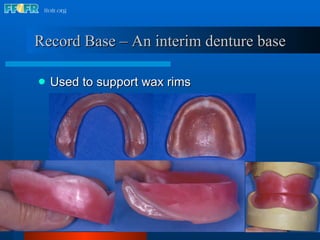
Record Base – An interim denture base Used to support wax rims
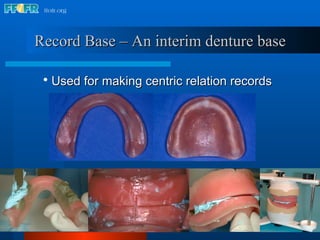
Record Base – An interim denture base Used for making centric relation records
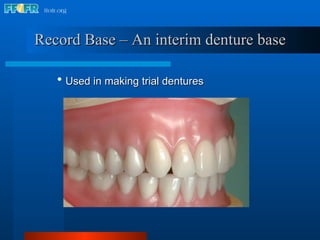
Record Base – An interim denture base Used in making trial dentures
Characteristics of an Ideal Record Base Strength and rigidity Accuracy  The record base should not rock on the cast Smooth, rounded well polished borders Thickness of borders and palate must resemble those of the finished dentures Palate must be 1-2 mm thick Thickness and contour of the denture borders are defined by the land of the master cast.  The record base must not extend onto the land of the cast
Materials Used for Record Bases Tray resin  Brittle but very accurate Autopolymerizing  acrylic resin  Strong but less accurate Light cure resin  Accurate but brittle and expensive
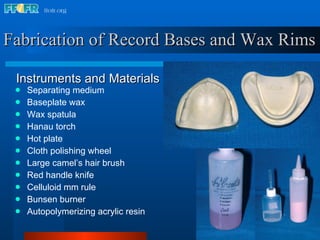
Fabrication of Record Bases and Wax Rims Separating medium Baseplate wax Wax spatula Hanau torch Hot plate Cloth polishing wheel Large camel’s hair brush Red handle knife Celluloid mm rule Bunsen burner Autopolymerizing acrylic resin Instruments and Materials
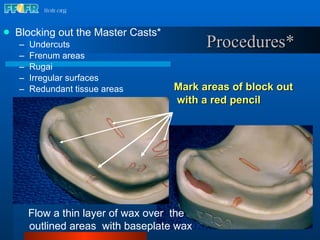
Procedures*   Blocking out the Master Casts* Undercuts Frenum areas Rugai Irregular surfaces Redundant tissue areas Mark areas of block out with   a red pencil Flow a thin layer of wax over  the outlined areas  with baseplate wax
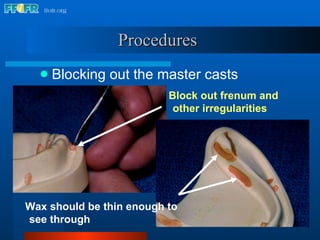
Procedures   Blocking out the master casts Block out frenum and other irregularities Wax should be thin enough to see through
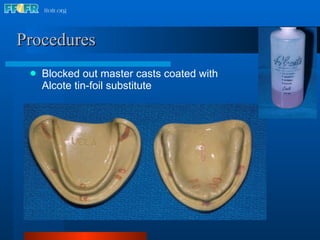
Procedures   Blocked out master casts coated with Alcote tin-foil substitute
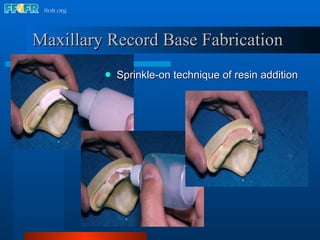
Maxillary Record Base Fabrication   Sprinkle-on technique of resin addition
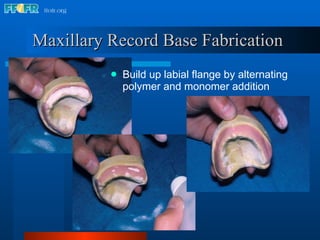
Maxillary Record Base Fabrication   Build up labial flange by alternating polymer and monomer addition
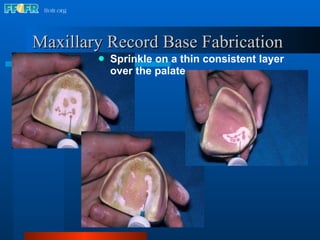
Maxillary Record Base Fabrication   Sprinkle on a thin consistent layer over the palate
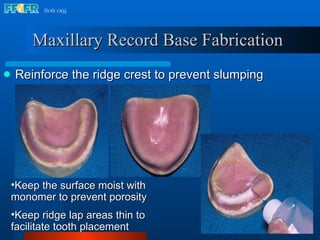
Maxillary Record Base Fabrication   Reinforce the ridge crest to prevent slumping Keep the surface moist with monomer to prevent porosity Keep ridge lap areas thin to facilitate tooth placement
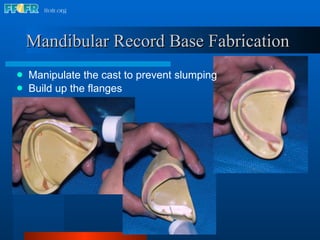
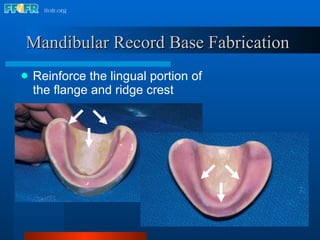
Mandibular Record Base Fabrication   Manipulate the cast to prevent slumping Build up the flanges
Mandibular Record Base Fabrication   Reinforce the lingual portion of the flange and ridge crest
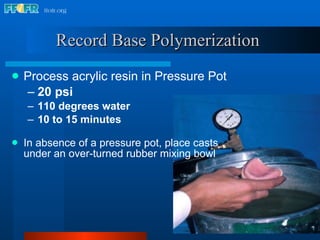
Record Base Polymerization   Process acrylic resin in Pressure Pot 20 psi 110 degrees water 10 to 15 minutes In absence of a pressure pot, place casts under an over-turned rubber mixing bowl
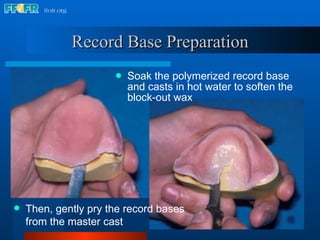
Record Base Preparation Soak the polymerized record base and casts in hot water to soften the block-out wax Then, gently pry the record bases from the master cast
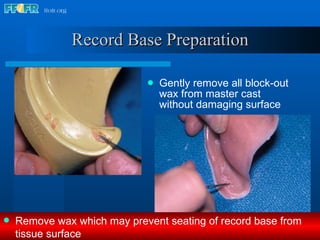
Record Base Preparation Gently remove all block-out wax from master cast without damaging surface  Remove wax which may prevent seating of record base from tissue surface
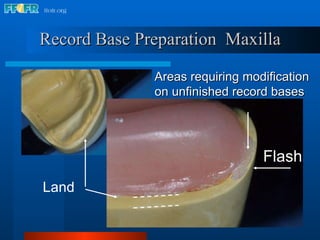
Record Base Preparation  Maxilla Areas requiring modification on unfinished record bases Land Flash
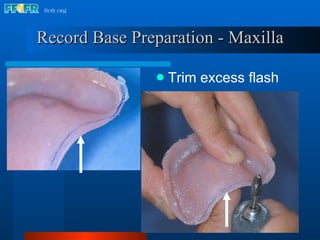
Record Base Preparation - Maxilla Trim excess flash
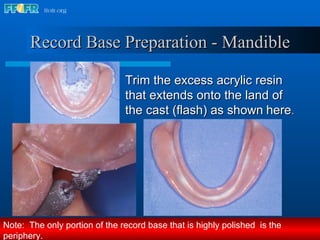
Trim the excess acrylic resin that extends onto the land of the cast (flash) as shown   here . Note:  The only portion of the record base that is highly polished  is the periphery. Record Base Preparation - Mandible
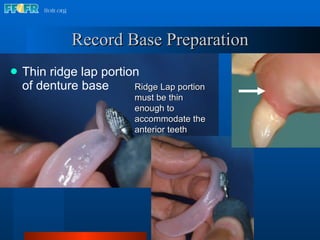
Record Base Preparation Thin ridge lap portion of denture base Ridge Lap portion  must be thin enough to accommodate the anterior teeth
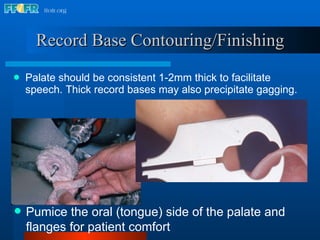
Record Base Contouring/Finishing Palate should be consistent 1-2mm thick to facilitate speech. Thick record bases may also precipitate gagging. Pumice the oral (tongue) side of the palate and flanges for patient comfort
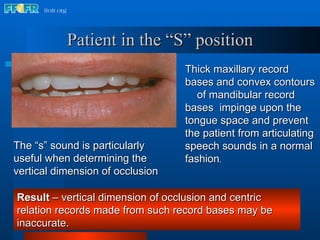
Thick maxillary record bases and convex contours  of mandibular record bases  impinge upon the tongue space and prevent the patient from articulating speech sounds in a normal fashion .  Result  – vertical dimension of occlusion and centric relation records made from such record bases may be inaccurate. The “s” sound is particularly useful when determining the vertical dimension of occlusion Patient in the “S” position
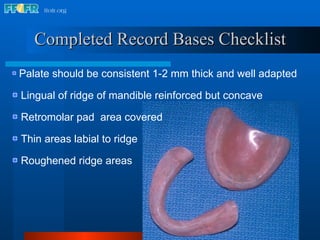
Completed Record Bases Checklist Palate should be consistent 1-2 mm thick and well adapted Lingual of ridge of mandible reinforced but concave Retromolar pad  area covered Thin areas labial to ridge Roughened ridge areas
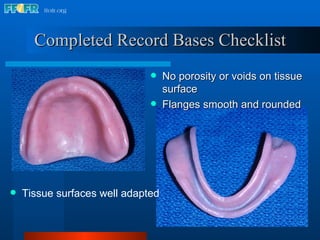
Completed Record Bases Checklist No porosity or voids on tissue surface Flanges smooth and rounded Tissue surfaces well adapted
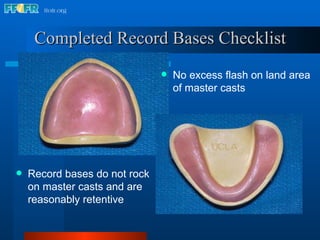
Completed Record Bases Checklist No excess flash on land area of master casts Record bases do not rock on master casts and are reasonably retentive
Wax Occlusion Rims - Purpose Serve as a means of transfer of face bow transfer records Aid in orientation of the incisors and the occlusal plane when properly contoured Aid in developing contours of the lips and cheek when properly contoured Used in developing the vertical dimension of occlusion Used in making tentative centric relation records Serve as a general aid in selection of teeth
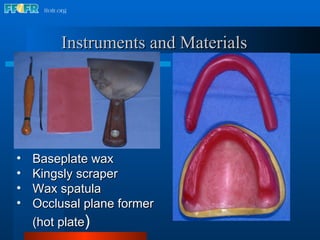
Instruments and Materials Baseplate wax Kingsly scraper Wax spatula Occlusal plane former (hot plate )
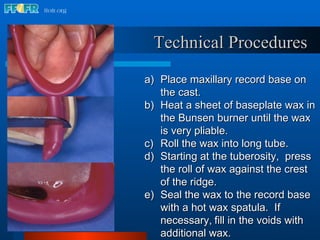
Place maxillary record base on the cast. Heat a sheet of baseplate wax in the Bunsen burner until the wax is very pliable. Roll the wax into long tube. Starting at the tuberosity,  press the roll of wax against the crest of the ridge. Seal the wax to the record base with a hot wax spatula.  If necessary,   fill in the voids with additional wax. Technical Procedures
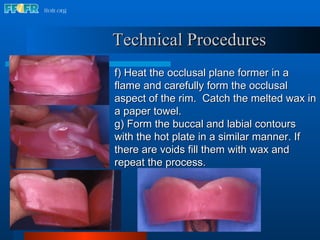
f) Heat the occlusal plane former in a flame and carefully form the occlusal aspect of the rim.  Catch the melted wax in a paper towel. g) Form the buccal and labial contours with the hot plate in a similar manner. If there are voids fill them with wax and repeat the process. Technical Procedures
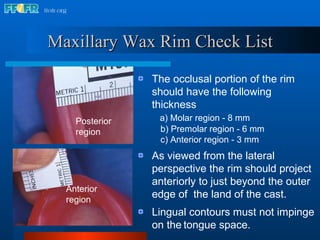
Maxillary Wax Rim Check List The occlusal portion of the rim  should have the following thickness a) Molar region - 8 mm b) Premolar region - 6 mm c) Anterior region - 3 mm As viewed from the lateral perspective the rim should project anteriorly to just beyond the outer edge of  the land of the cast. Lingual contours must not impinge on the   tongue space. Anterior region Posterior region
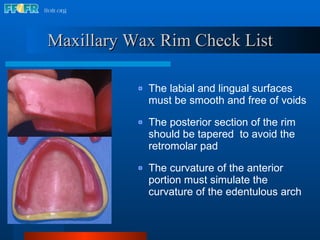
Maxillary Wax Rim Check List The labial and lingual surfaces must be smooth and free of voids The posterior section of the rim should be tapered  to avoid the retromolar pad The curvature of the anterior portion must simulate the curvature of the edentulous arch
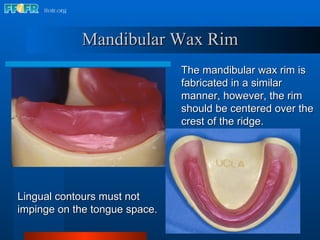
The mandibular wax rim is fabricated in a similar manner, however, the rim should be centered over the crest of the ridge. Lingual contours must not impinge on the tongue space. Mandibular Wax Rim
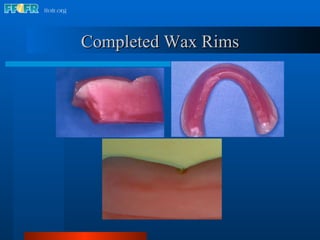
Completed Wax Rims
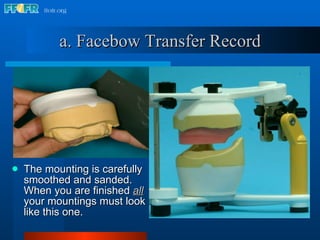
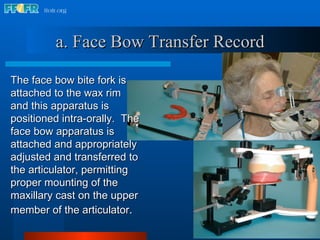
a.   Face Bow Transfer Record The face bow bite fork is attached to the wax rim and this apparatus is positioned intra-orally.  The face bow apparatus is attached and appropriately adjusted and transferred to the articulator, permitting proper mounting of the maxillary cast on the upper member of the articulator .
a. Facebow Transfer Record The mounting is carefully smoothed and sanded.  When you are finished  all  your mountings must look like this one.
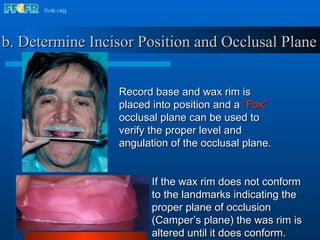
b.   Determine Incisor Position and Occlusal Plane Record base and wax rim is placed into position and a  “Fox”  occlusal plane can be used to verify the proper level and angulation of the occlusal plane. If the wax rim does not conform to the landmarks indicating the proper plane of occlusion (Camper’s plane) the was rim is altered until it does conform.
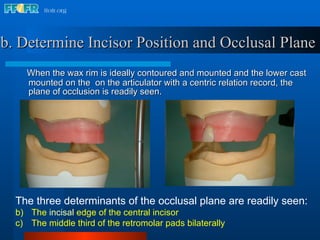
When the wax rim is ideally contoured and mounted and the lower cast mounted on the  on the articulator with a centric relation record, the plane of occlusion is readily seen. The three determinants of the occlusal plane are readily seen: The  incisal  edge of the central incisor The middle third of the retromolar pads bilaterally b. Determine Incisor Position and Occlusal Plane
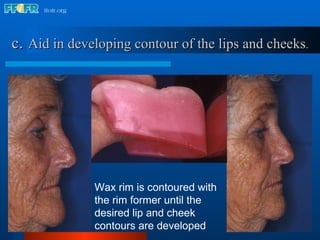
c .   Aid in developing contour of the lips and cheeks . Wax rim is contoured with the rim former until the desired lip and cheek contours are developed
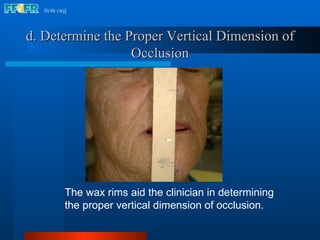
d. Determine the Proper Vertical Dimension of Occlusion The wax rims aid the clinician in determining the proper vertical dimension of occlusion.
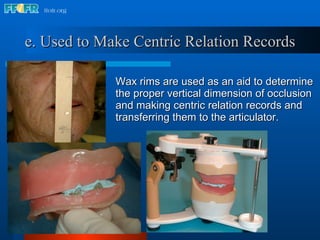
Wax rims are used as an aid to determine the proper vertical dimension of occlusion and making centric relation records and transferring them to the articulator. e. Used to Make Centric Relation Records
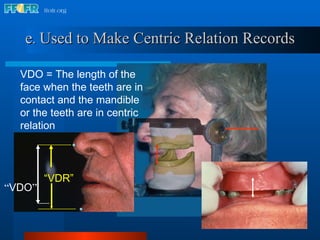
e .   Used to Make Centric Relation Records “ VDR” “ VDO ”  VDO = The length of the face when the teeth are in contact and the mandible or the teeth are in centric relation
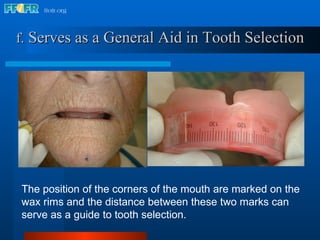
f.   Serves as a General Aid in Tooth Selection The position of the corners of the mouth are marked on the wax rims and the distance between these two marks can serve as a guide to tooth selection.
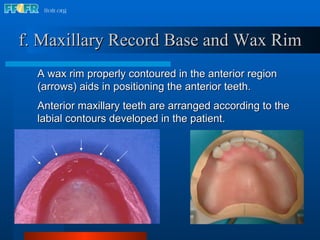
A wax rim properly contoured in the anterior region (arrows) aids in positioning the anterior teeth. Anterior maxillary teeth are arranged according to the labial contours developed in the patient. f. Maxillary Record Base and Wax Rim

9.record base and wax rim fabrication

  • 1.
    9. Record Baseand Wax Rim Fabrication Michael Hamada, DDS and John Beumer III, DDS, MS Division of Advanced Prosthodontics, Biomaterials and Hospital Dentistry UCLA School of Dentistry This program of instruction is protected by copyright ©. No portion of this program of instruction may be reproduced, recorded or transferred by any means electronic, digital, photographic, mechanical etc., or by any information storage or retrieval system, without prior permission.
  • 2.
    8. Boxing Impressionsand Making Casts John Beumer III, DDS, MS and Robert Duell, DDS Division of Advanced Prosthodontics, Biomaterials and Hospital Dentistry UCLA School of Dentistry This program of instruction is protected by copyright ©. No portion of this program of instruction may be reproduced, recorded or transferred by any means electronic, digital, photographic, mechanical etc., or by any information storage or retrieval system, without prior permission.
  • 3.
    Record Base –An interim denture base Used to support wax rims
  • 4.
    Record Base –An interim denture base Used for making centric relation records
  • 5.
    Record Base –An interim denture base Used in making trial dentures
  • 6.
    Characteristics of anIdeal Record Base Strength and rigidity Accuracy The record base should not rock on the cast Smooth, rounded well polished borders Thickness of borders and palate must resemble those of the finished dentures Palate must be 1-2 mm thick Thickness and contour of the denture borders are defined by the land of the master cast. The record base must not extend onto the land of the cast
  • 7.
    Materials Used forRecord Bases Tray resin Brittle but very accurate Autopolymerizing acrylic resin Strong but less accurate Light cure resin Accurate but brittle and expensive
  • 8.
    Fabrication of RecordBases and Wax Rims Separating medium Baseplate wax Wax spatula Hanau torch Hot plate Cloth polishing wheel Large camel’s hair brush Red handle knife Celluloid mm rule Bunsen burner Autopolymerizing acrylic resin Instruments and Materials
  • 9.
    Procedures* Blocking out the Master Casts* Undercuts Frenum areas Rugai Irregular surfaces Redundant tissue areas Mark areas of block out with a red pencil Flow a thin layer of wax over the outlined areas with baseplate wax
  • 10.
    Procedures Blocking out the master casts Block out frenum and other irregularities Wax should be thin enough to see through
  • 11.
    Procedures Blocked out master casts coated with Alcote tin-foil substitute
  • 12.
    Maxillary Record BaseFabrication Sprinkle-on technique of resin addition
  • 13.
    Maxillary Record BaseFabrication Build up labial flange by alternating polymer and monomer addition
  • 14.
    Maxillary Record BaseFabrication Sprinkle on a thin consistent layer over the palate
  • 15.
    Maxillary Record BaseFabrication Reinforce the ridge crest to prevent slumping Keep the surface moist with monomer to prevent porosity Keep ridge lap areas thin to facilitate tooth placement
  • 16.
    Mandibular Record BaseFabrication Manipulate the cast to prevent slumping Build up the flanges
  • 17.
    Mandibular Record BaseFabrication Reinforce the lingual portion of the flange and ridge crest
  • 18.
    Record Base Polymerization Process acrylic resin in Pressure Pot 20 psi 110 degrees water 10 to 15 minutes In absence of a pressure pot, place casts under an over-turned rubber mixing bowl
  • 19.
    Record Base PreparationSoak the polymerized record base and casts in hot water to soften the block-out wax Then, gently pry the record bases from the master cast
  • 20.
    Record Base PreparationGently remove all block-out wax from master cast without damaging surface Remove wax which may prevent seating of record base from tissue surface
  • 21.
    Record Base Preparation Maxilla Areas requiring modification on unfinished record bases Land Flash
  • 22.
    Record Base Preparation- Maxilla Trim excess flash
  • 23.
    Trim the excessacrylic resin that extends onto the land of the cast (flash) as shown here . Note: The only portion of the record base that is highly polished is the periphery. Record Base Preparation - Mandible
  • 24.
    Record Base PreparationThin ridge lap portion of denture base Ridge Lap portion must be thin enough to accommodate the anterior teeth
  • 25.
    Record Base Contouring/FinishingPalate should be consistent 1-2mm thick to facilitate speech. Thick record bases may also precipitate gagging. Pumice the oral (tongue) side of the palate and flanges for patient comfort
  • 26.
    Thick maxillary recordbases and convex contours of mandibular record bases impinge upon the tongue space and prevent the patient from articulating speech sounds in a normal fashion . Result – vertical dimension of occlusion and centric relation records made from such record bases may be inaccurate. The “s” sound is particularly useful when determining the vertical dimension of occlusion Patient in the “S” position
  • 27.
    Completed Record BasesChecklist Palate should be consistent 1-2 mm thick and well adapted Lingual of ridge of mandible reinforced but concave Retromolar pad area covered Thin areas labial to ridge Roughened ridge areas
  • 28.
    Completed Record BasesChecklist No porosity or voids on tissue surface Flanges smooth and rounded Tissue surfaces well adapted
  • 29.
    Completed Record BasesChecklist No excess flash on land area of master casts Record bases do not rock on master casts and are reasonably retentive
  • 30.
    Wax Occlusion Rims- Purpose Serve as a means of transfer of face bow transfer records Aid in orientation of the incisors and the occlusal plane when properly contoured Aid in developing contours of the lips and cheek when properly contoured Used in developing the vertical dimension of occlusion Used in making tentative centric relation records Serve as a general aid in selection of teeth
  • 31.
    Instruments and MaterialsBaseplate wax Kingsly scraper Wax spatula Occlusal plane former (hot plate )
  • 32.
    Place maxillary recordbase on the cast. Heat a sheet of baseplate wax in the Bunsen burner until the wax is very pliable. Roll the wax into long tube. Starting at the tuberosity, press the roll of wax against the crest of the ridge. Seal the wax to the record base with a hot wax spatula. If necessary, fill in the voids with additional wax. Technical Procedures
  • 33.
    f) Heat theocclusal plane former in a flame and carefully form the occlusal aspect of the rim. Catch the melted wax in a paper towel. g) Form the buccal and labial contours with the hot plate in a similar manner. If there are voids fill them with wax and repeat the process. Technical Procedures
  • 34.
    Maxillary Wax RimCheck List The occlusal portion of the rim should have the following thickness a) Molar region - 8 mm b) Premolar region - 6 mm c) Anterior region - 3 mm As viewed from the lateral perspective the rim should project anteriorly to just beyond the outer edge of the land of the cast. Lingual contours must not impinge on the tongue space. Anterior region Posterior region
  • 35.
    Maxillary Wax RimCheck List The labial and lingual surfaces must be smooth and free of voids The posterior section of the rim should be tapered to avoid the retromolar pad The curvature of the anterior portion must simulate the curvature of the edentulous arch
  • 36.
    The mandibular waxrim is fabricated in a similar manner, however, the rim should be centered over the crest of the ridge. Lingual contours must not impinge on the tongue space. Mandibular Wax Rim
  • 37.
  • 38.
    a. Face Bow Transfer Record The face bow bite fork is attached to the wax rim and this apparatus is positioned intra-orally. The face bow apparatus is attached and appropriately adjusted and transferred to the articulator, permitting proper mounting of the maxillary cast on the upper member of the articulator .
  • 39.
    a. Facebow TransferRecord The mounting is carefully smoothed and sanded. When you are finished all your mountings must look like this one.
  • 40.
    b. Determine Incisor Position and Occlusal Plane Record base and wax rim is placed into position and a “Fox” occlusal plane can be used to verify the proper level and angulation of the occlusal plane. If the wax rim does not conform to the landmarks indicating the proper plane of occlusion (Camper’s plane) the was rim is altered until it does conform.
  • 41.
    When the waxrim is ideally contoured and mounted and the lower cast mounted on the on the articulator with a centric relation record, the plane of occlusion is readily seen. The three determinants of the occlusal plane are readily seen: The incisal edge of the central incisor The middle third of the retromolar pads bilaterally b. Determine Incisor Position and Occlusal Plane
  • 42.
    c . Aid in developing contour of the lips and cheeks . Wax rim is contoured with the rim former until the desired lip and cheek contours are developed
  • 43.
    d. Determine theProper Vertical Dimension of Occlusion The wax rims aid the clinician in determining the proper vertical dimension of occlusion.
  • 44.
    Wax rims areused as an aid to determine the proper vertical dimension of occlusion and making centric relation records and transferring them to the articulator. e. Used to Make Centric Relation Records
  • 45.
    e . Used to Make Centric Relation Records “ VDR” “ VDO ” VDO = The length of the face when the teeth are in contact and the mandible or the teeth are in centric relation
  • 46.
    f. Serves as a General Aid in Tooth Selection The position of the corners of the mouth are marked on the wax rims and the distance between these two marks can serve as a guide to tooth selection.
  • 47.
    A wax rimproperly contoured in the anterior region (arrows) aids in positioning the anterior teeth. Anterior maxillary teeth are arranged according to the labial contours developed in the patient. f. Maxillary Record Base and Wax Rim