

ARTICULATORS IN
FIXED PARTIAL
DENTURE
By-
Dr. Isha Sethi
M.D.S Third year
Department of prosthodontics, crowns and bridges
CONTENTS
 INTRODUCTION
 EVOLUTION OF ARTICULATORS
 USES
 PURPOSES
 CLASSIFICATION SYSTEMS
 SELECTION OF ARTICULATOR
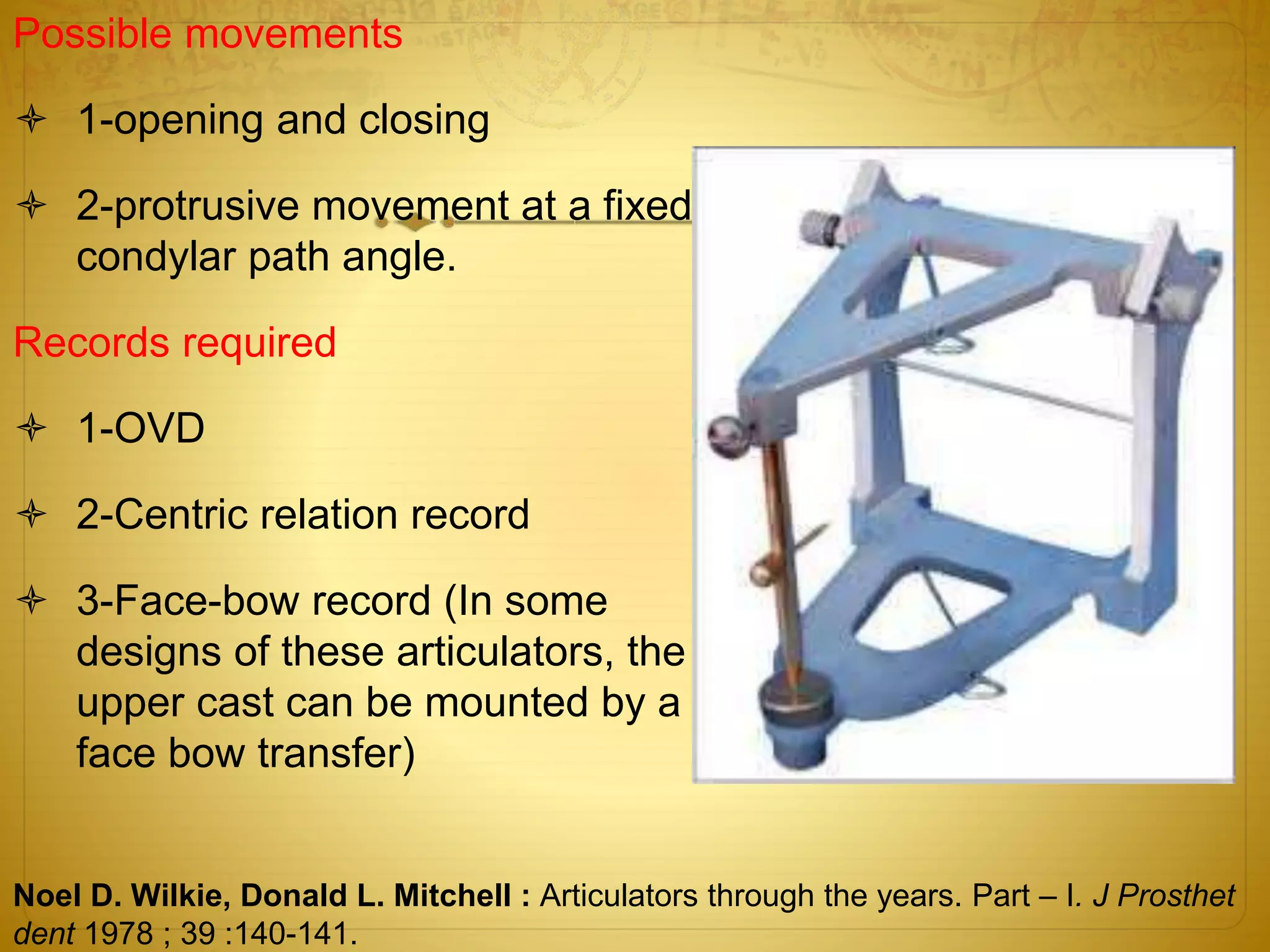
 MEAN VALUE ARTICULATOR
 SEMIADJUSTABLE ARTICULATORS
 SUMMARY
 REFERENCES
Part 1
INTRODUCTION
According to GPT 9, some of the relatable definitions are-
 Articulate : 1. to join together as a joint; 2. the relating
of contacting surfaces of the teeth or their artificial
replicas in the maxillae to those in the mandible
 Articulate : in speech, to enunciate clearly or be
clearly spoken
THE GLOSSARY OF PROSTHODONTIC TERMS
Ninth Edition
GPT-9
j.prosthet.dent
Volume 117 Issue 5S
 Articulation : 1. the place of union or junction between
two or more bones
 2. in speech, the enunciation of words and sentences
 3. in dentistry, the static and dynamic contact
relationship between the occlusal surfaces of the teeth
during function
THE GLOSSARY OF PROSTHODONTIC TERMS
Ninth Edition
GPT-9
j.prosthet.dent
Volume 117 Issue 5S
 Articulator - a mechanical instrument that represents
the temporomandibular joints and jaws, to which
maxillary and mandibular casts may be attached to
simulate some or all mandibular movements
THE GLOSSARY OF PROSTHODONTIC TERMS
Ninth Edition
GPT-9
j.prosthet.dent
Volume 117 Issue 5S
 Articulators are surrounded by an aura of mystery, but
at the end of the day they are a tool to help a dentist
to give his patient a successful restoration, saving
time, money and hassle.
 I would like to say, “Begin with, the end in mind”.
Using of articulators in the construction Of crown and bridges work in Baghdad:(A survey study)
Dr. Ammar A. Alsa'ady
MDJ
Vol.:5 No.:2 2008
Evolution of Articulators
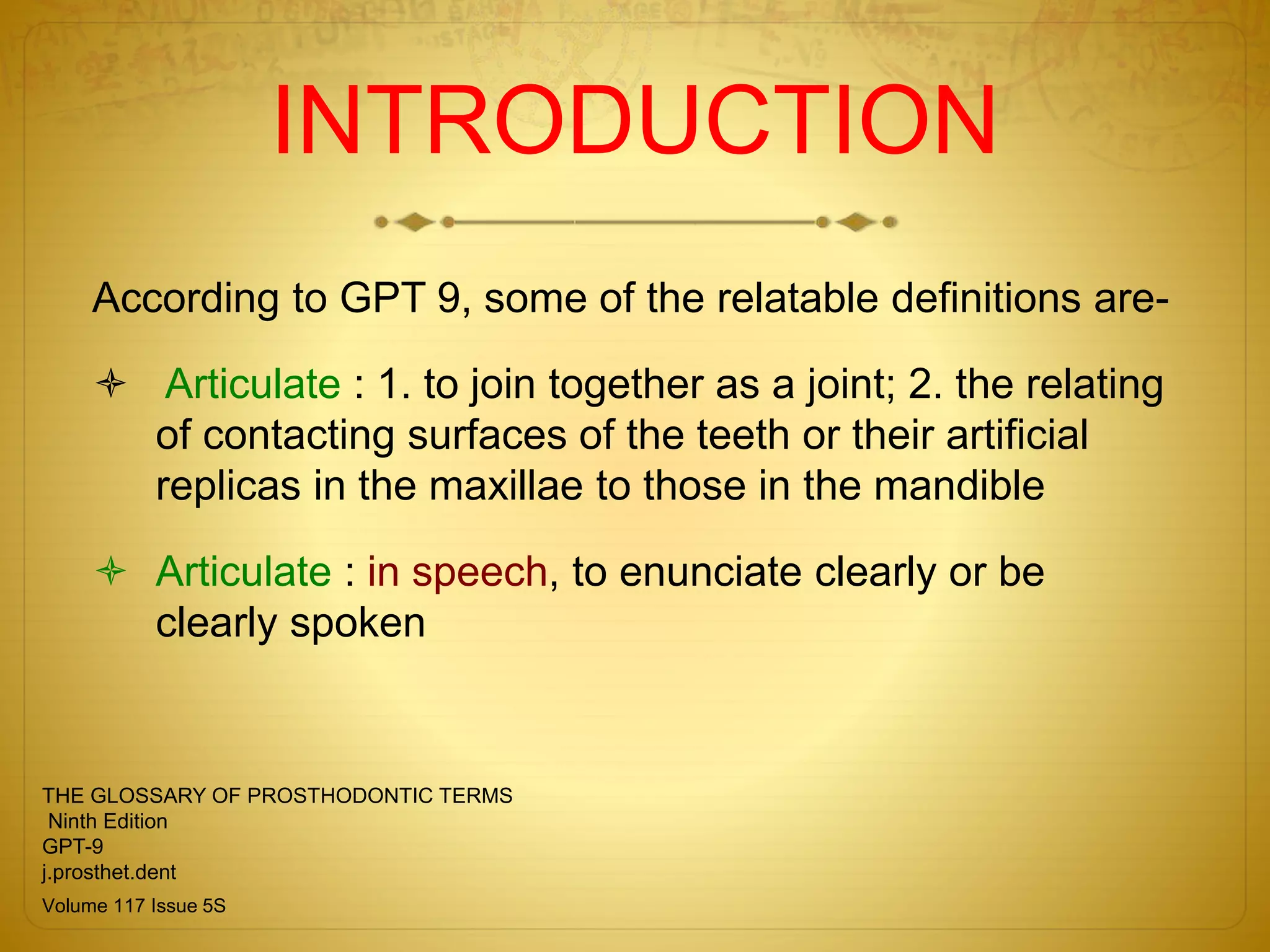
 The plaster articulator devised by Philip Pfaff in
1756 consisted of plaster extension on the distal
portion of the maxillary and mandibular casts
grooved to each other. This was commonly
known as ‘slab articulator’.
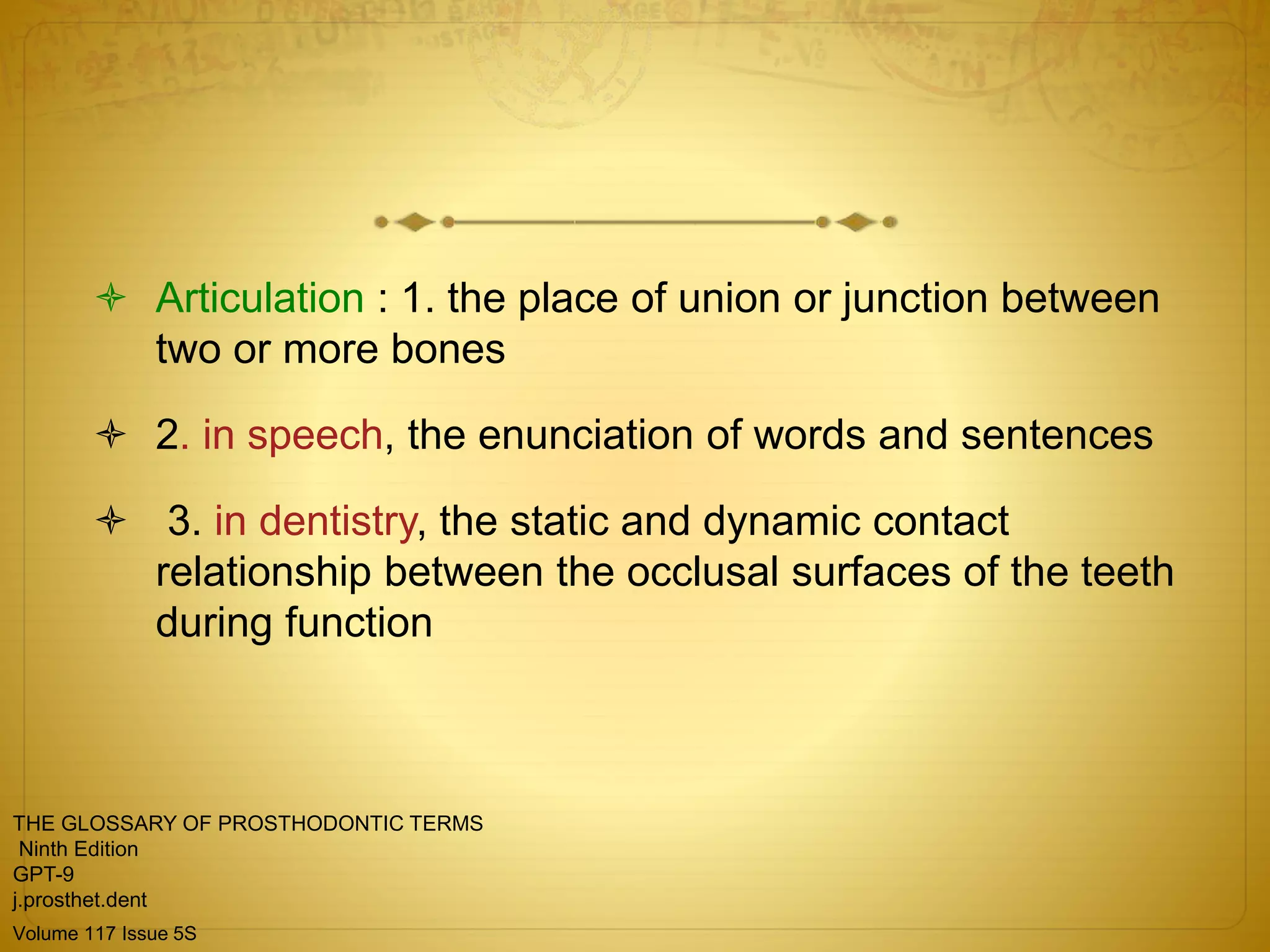
 J.B.Gariot described the first mechanical
articulator in 1805. He designed the hinge joint
articulator, which consisted of two metal frames,
to which the casts were attached, a hinge to join
them and a setscrew to hold the frames in a
fixed vertical -position.
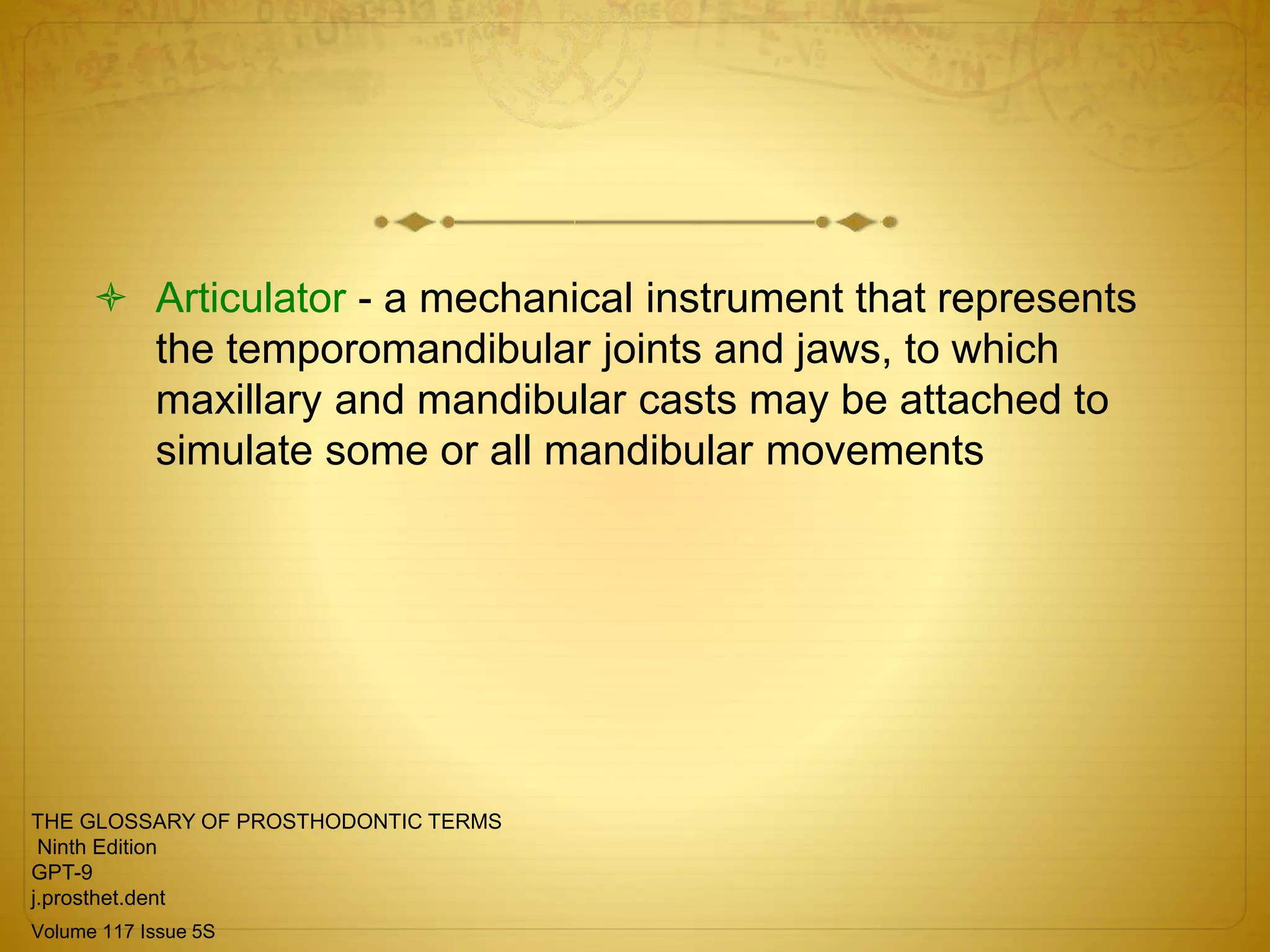
 In 1840, Cameron and Evans made attempts
to device the ‘plane line’ articulator.
 Bonwill, a mathematician, in 1858, developed
an articulator based on his theory of occlusion
or the theory of equilateral triangle with which
he demonstrated the anatomic and balanced
occlusion.
Noel D. Wilkie, Donald L. Mitchell : Articulators through the years. Part – I. J Prosthet dent 1978 ; 39 :140-141.
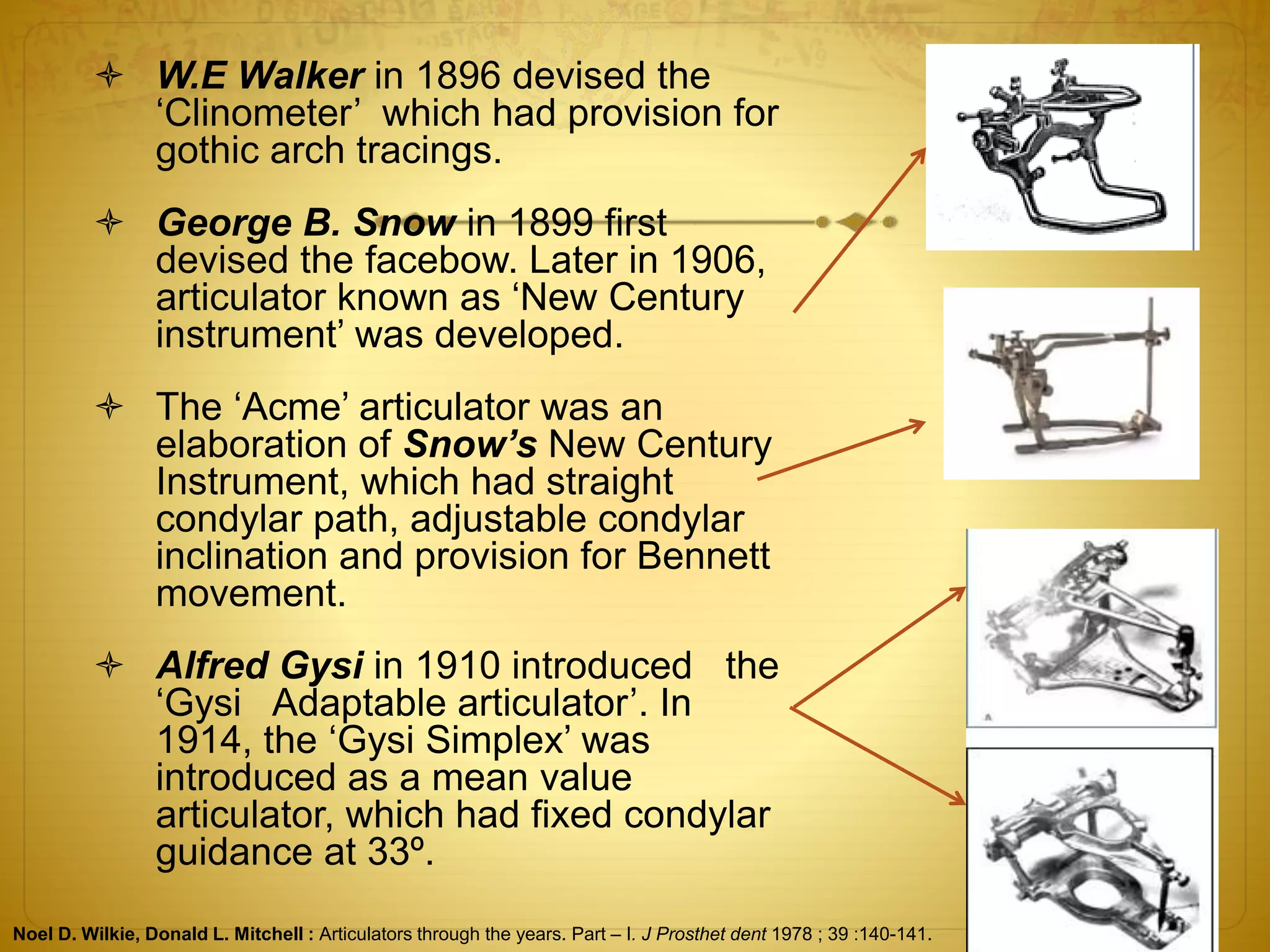
 W.E Walker in 1896 devised the
‘Clinometer’ which had provision for
gothic arch tracings.
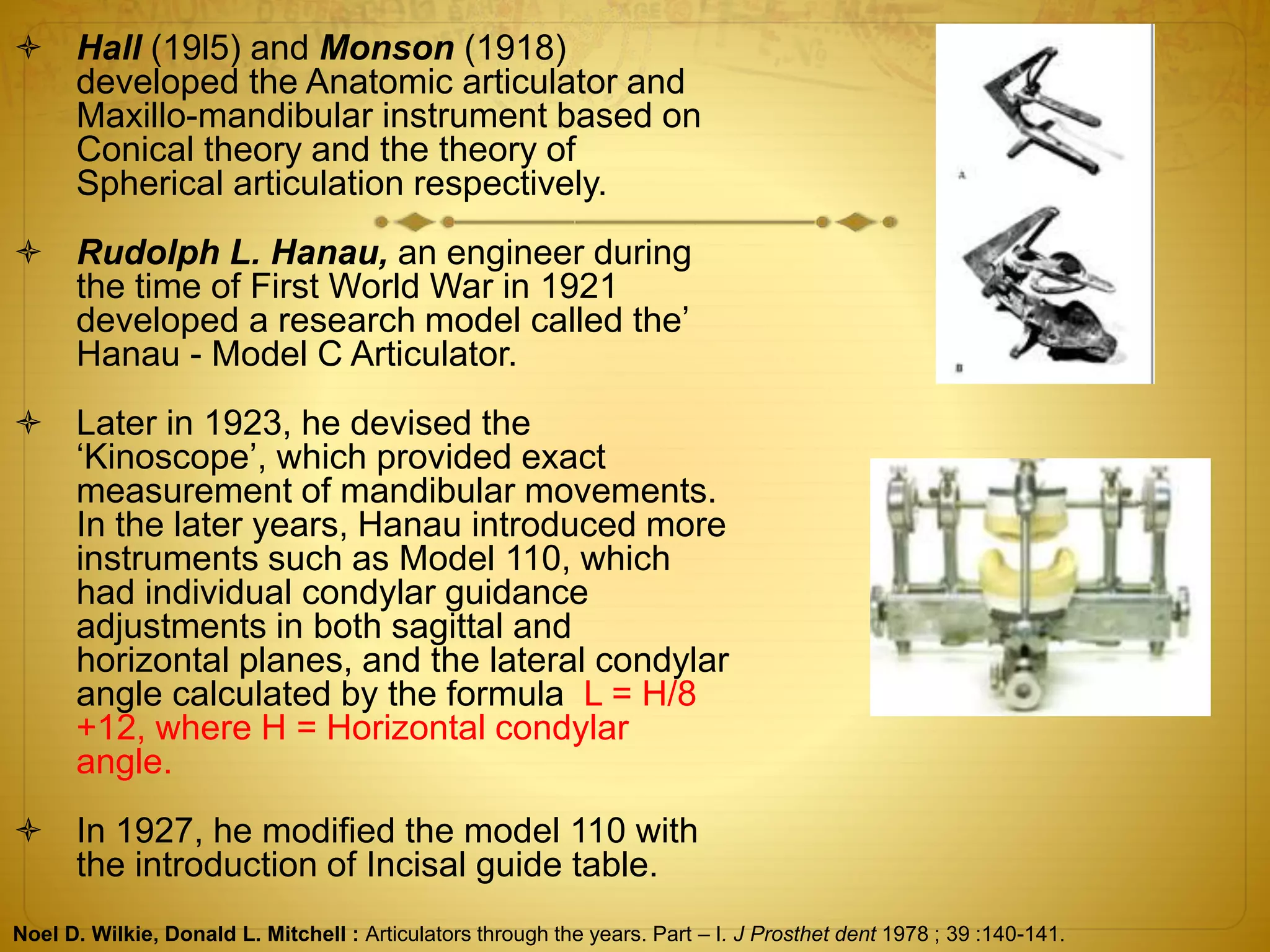
 George B. Snow in 1899 first
devised the facebow. Later in 1906,
articulator known as ‘New Century
instrument’ was developed.
 The ‘Acme’ articulator was an
elaboration of Snow’s New Century
Instrument, which had straight
condylar path, adjustable condylar
inclination and provision for Bennett
movement.
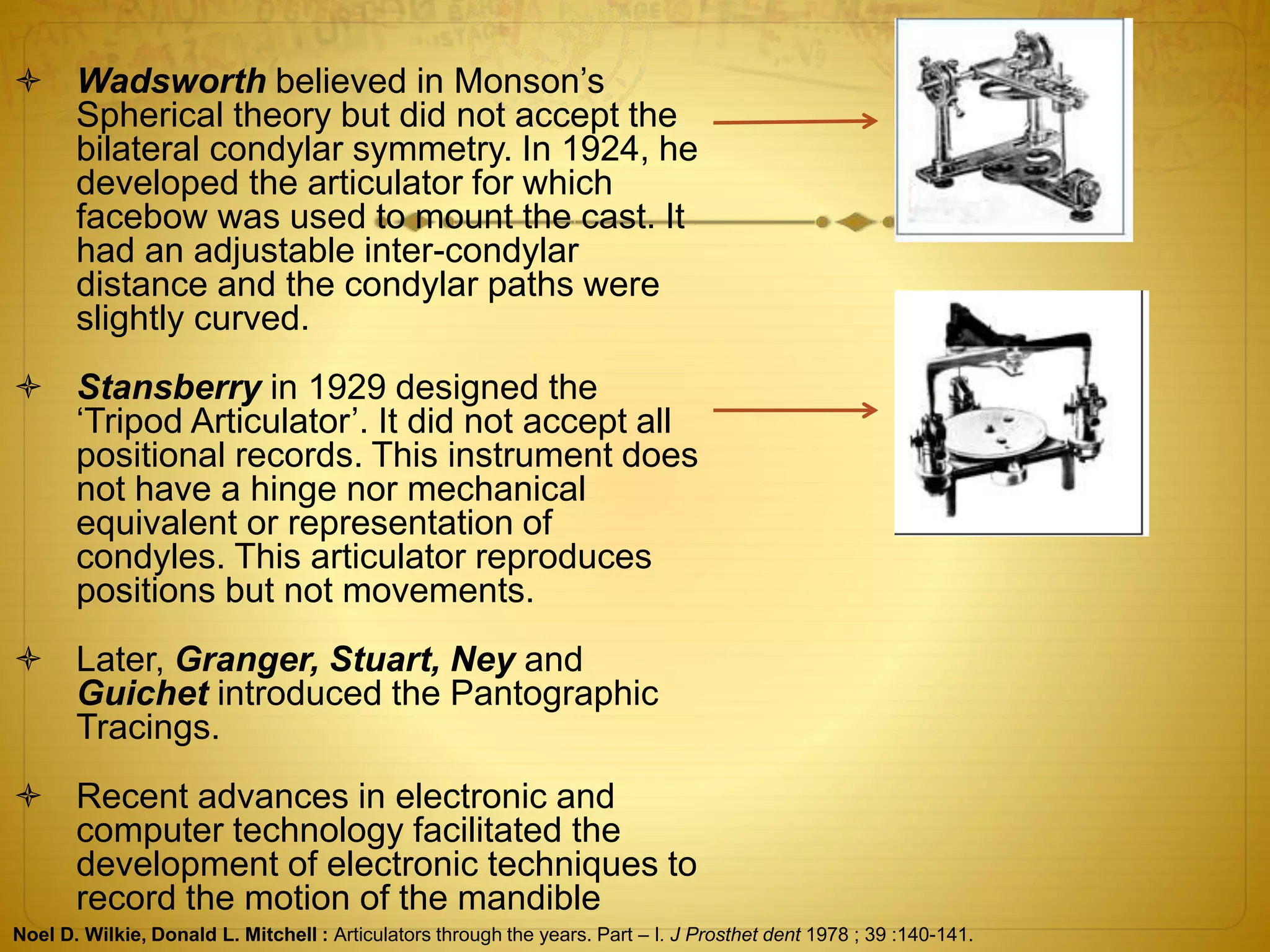
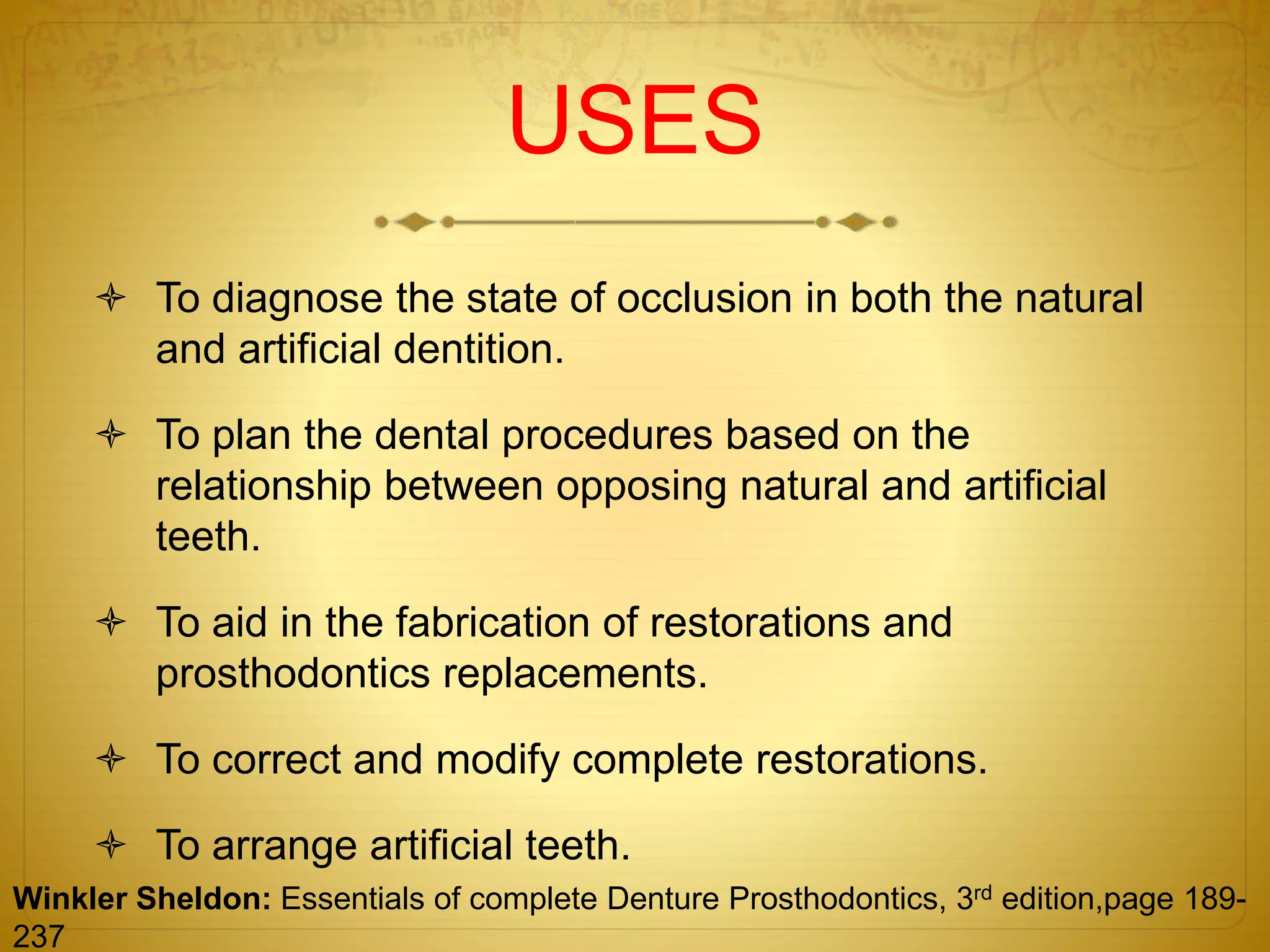
 Alfred Gysi in 1910 introduced the
‘Gysi Adaptable articulator’. In
1914, the ‘Gysi Simplex’ was
introduced as a mean value
articulator, which had fixed condylar
guidance at 33º.
Noel D. Wilkie, Donald L. Mitchell : Articulators through the years. Part – I. J Prosthet dent 1978 ; 39 :140-141.
 Hall (19l5) and Monson (1918)
developed the Anatomic articulator and
Maxillo-mandibular instrument based on
Conical theory and the theory of
Spherical articulation respectively.
 Rudolph L. Hanau, an engineer during
the time of First World War in 1921
developed a research model called the’
Hanau - Model C Articulator.
 Later in 1923, he devised the
‘Kinoscope’, which provided exact
measurement of mandibular movements.
In the later years, Hanau introduced more
instruments such as Model 110, which
had individual condylar guidance
adjustments in both sagittal and
horizontal planes, and the lateral condylar
angle calculated by the formula L = H/8
+12, where H = Horizontal condylar
angle.
 In 1927, he modified the model 110 with
the introduction of Incisal guide table.
Noel D. Wilkie, Donald L. Mitchell : Articulators through the years. Part – I. J Prosthet dent 1978 ; 39 :140-141.
 Wadsworth believed in Monson’s
Spherical theory but did not accept the
bilateral condylar symmetry. In 1924, he
developed the articulator for which
facebow was used to mount the cast. It
had an adjustable inter-condylar
distance and the condylar paths were
slightly curved.
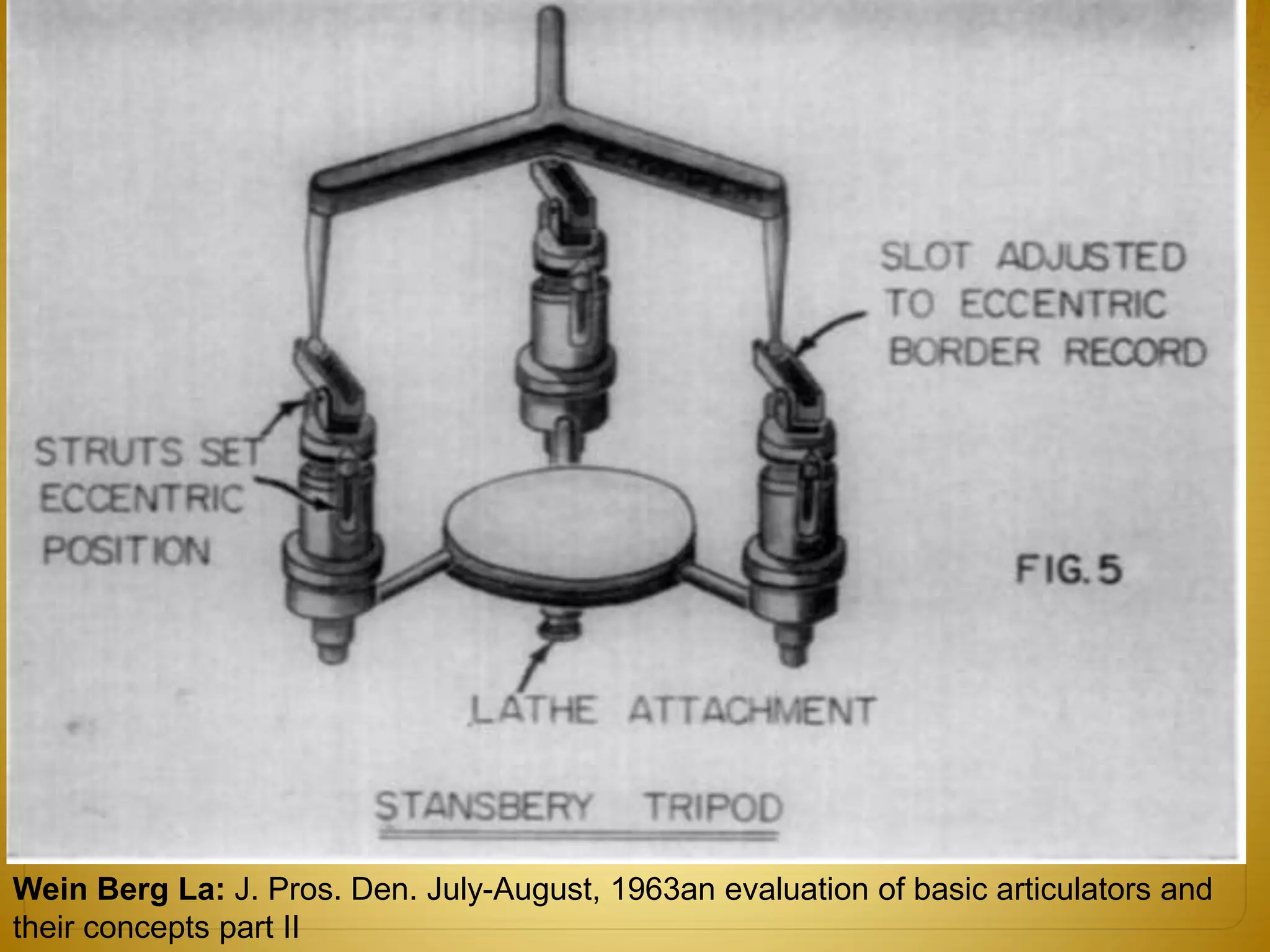
 Stansberry in 1929 designed the
‘Tripod Articulator’. It did not accept all
positional records. This instrument does
not have a hinge nor mechanical
equivalent or representation of
condyles. This articulator reproduces
positions but not movements.
 Later, Granger, Stuart, Ney and
Guichet introduced the Pantographic
Tracings.
 Recent advances in electronic and
computer technology facilitated the
development of electronic techniques to
record the motion of the mandible
Noel D. Wilkie, Donald L. Mitchell : Articulators through the years. Part – I. J Prosthet dent 1978 ; 39 :140-141.
USES
 To diagnose the state of occlusion in both the natural
and artificial dentition.
 To plan the dental procedures based on the
relationship between opposing natural and artificial
teeth.
 To aid in the fabrication of restorations and
prosthodontics replacements.
 To correct and modify complete restorations.
 To arrange artificial teeth.
Winkler Sheldon: Essentials of complete Denture Prosthodontics, 3rd edition,page 189-
237
PURPOSES
 To hold the maxillary and mandibular casts in a
determined fixed relationship
 Mounting of dental casts for diagnosis, treatment
planning and patient presentation
 Fabrication of occlusal surfaces for dental restoration.
 Arrangement of artificial teeth for complete and
removable partial denture.
Winkler Sheldon: Essentials of complete Denture Prosthodontics, 3rd edition,page 189-
REQUIREMENTS OF AN ARTICULATOR
Minimal Articulator Requirements
 The articulator must accurately maintain centric position.
 The patient’s casts must be easily removable and
attachable to the articulator without losing their correct
horizontal and vertical relationship.
 The articulator should have an incisal guide pin with a
positive stop that is adjustable and calibrated .
 The articulator should be able to open and close in a
hinge-like fashion.
 The articulator should accept a face-bow transfer utilizing
an anterior reference point.
Winkler Sheldon: Essentials of complete Denture Prosthodontics, 3rd edition,page 189-
 The construction should be accurate rigid and of a non
corrosive material. The moving parts should resist
wear. The adjustments should be able to move freely
and be definitely secured.
 The design should be such that there is adequate
distance between the upper and lower members and
that vision is not obscured from the rear. The
articulator should be stable on the laboratory bench
and not too bulky and heavy.
Winkler Sheldon: Essentials of complete Denture Prosthodontics, 3rd edition,page 189-
Additional requirements
These articulator requirements are necessary if dentures
are to be fabricated with balanced occlusion.
 The condylar guides should allow right lateral, left lateral, and
protrusive movements
 The condylar guides should be adjustable horizontally.
 The articulator should have provisions for adjustment of Bennett
movement.
 The incisal guide table should be a mechanical table that can be
adjusted in the sagittal and frontal planes or a table that can be
customized with autopolymerizing resin or by grinding.
Winkler Sheldon: Essentials of complete Denture Prosthodontics, 3rd edition,page 189-
 The condylar elements as a part of the lower frame
and the condylar guides as a part of the upper frame.
 A mechanism to accept a third reference point from a
face-bow transfer record.
 A terminal hinge position-locking device.
 Removable mounting plates that can be repositioned
accurately.
 Adjustable intercondylar width of the elements, when
graphic tracings to be used to set and/or select
condylar guidance.
Winkler Sheldon: Essentials of complete Denture Prosthodontics, 3rd edition,page 189-
Regardless of how simple or complex an
articulator may be, its effectiveness depends on
 1.how well the operator understands its construction and
purpose;
 2. how enthusiastic the dentist is for the particular
instrument;
 3. how well the dentist understands the anatomy of the
joints, their movements, and the neuromuscular system;
 4. how much precision and accuracy are used in
registering jaw relations;
 5. how sensitive the instrument is to these records.
Classification systems
1. GILLIS CLSSIFICATION 1926:
 The adaptable (or) Adjustable
 The Average (or) Fixed type
2. BOUCHER’S
CLASSIFICATION1934
 Nonadjustable
 Adjustable
1. two-dimensional instrument
2. three-dimensional instrument
3. KINGERY’S CLASSIFICATION
1934:
 Simple articulators
 Adaptable (or) adjustable articulators
Yeshwante B.et al, Int J Dent Health Sci 2017; 4(3):674-683
4. BECK’S CLASSIFICATION
1962:
 Suspension instrument
 Axis instrument
 Tripod instrument
Yeshwante B.et al, Int J Dent Health Sci 2017; 4(3):674-683
5. WEINBERG’S
CLASSIFICATION 1963:
 Arbitrary [Monson spherical theory]
 Positional [Stanbery tripod concept]
 Semi adjustable [Hanau H concept]
 Fully adjustable
[Hanau kinescope concept]
[Gysi trubyte concept]
[McCollum concept]
Yeshwante B.et al, Int J Dent Health Sci 2017; 4(3):674-683
Wein Berg La: J. Pros. Den. July-August, 1963an evaluation of basic articulators and
their concepts part II
6. POSSELT CLASSIFICATION
1968:
 Plain line
 Mean value
 Adjustable
Yeshwante B.et al, Int J Dent Health Sci 2017; 4(3):674-683
7. THOMAS CLASSIFICATION 1968:
 Arbitarary [non adjustable]
 Positional [Axis & Non axis type; static type]
 Functional [Axis & Non axis type; functional
records]
Yeshwante B.et al, Int J Dent Health Sci 2017; 4(3):674-683
8. SHARRY’S CLASSIFICATION
1974:
 Simple Hinge type
 Fixed guided type
 Adjustable instruments
Yeshwante B.et al, Int J Dent Health Sci 2017; 4(3):674-683
9. BOUCHER’S
CLASSIFICATION
 A] Based on theories of occlusion
 B] The type of record used for their adjustment
-Those utilizing the Inter occlusal records
-Those using the Graphic adjustment record
-Those utilizing hinge-axis location for
adjusting the articulator.
Yeshwante B.et al, Int J Dent Health Sci 2017; 4(3):674-683
Based on theories of occlusion
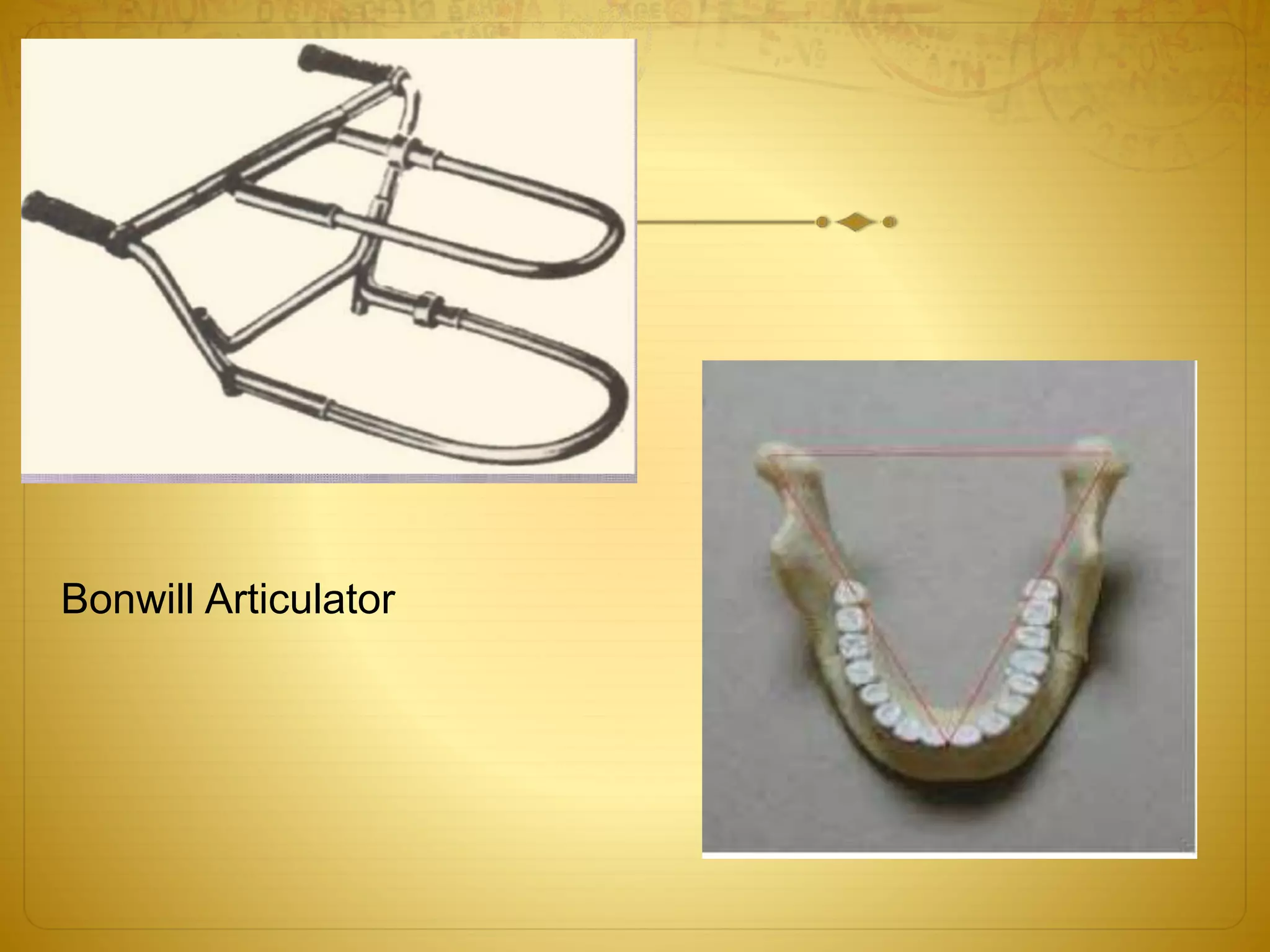
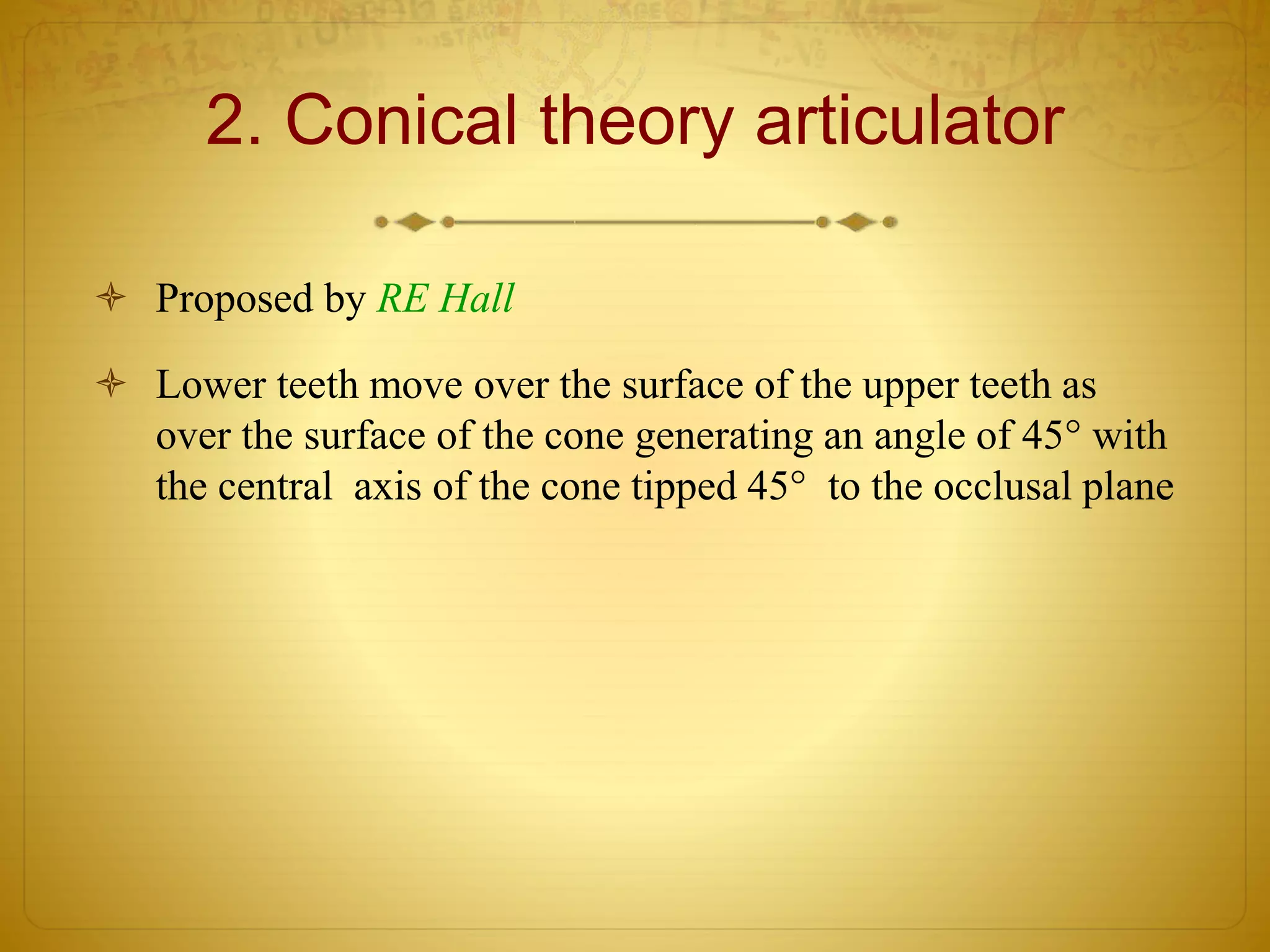
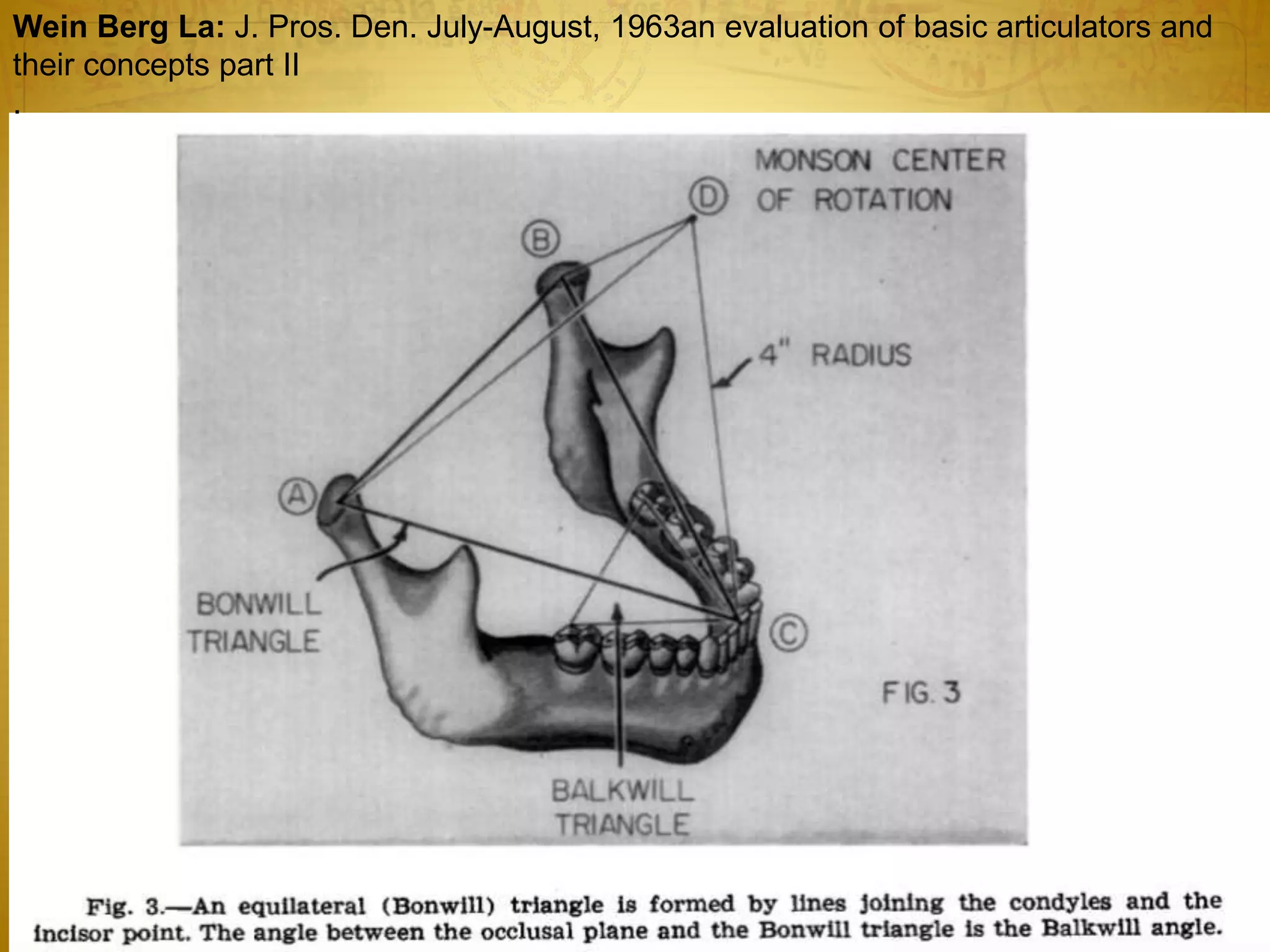
1. Bonwill theory articulators
 Designed by WGA Bonwill
 The teeth moves in relation to each other as guided by condylar
and incisal guidance
 Also known as theory of equilateral triangle
 Distance between the two condyles is equal to the distance
between midpoint of the mandibular incisors and condyle
 Theoretically the dimension of equilateral triangle is 4 inches
 These articulators allow lateral movements and permits the
movement of the mechanism only in horizontal plane
Bonwill Articulator
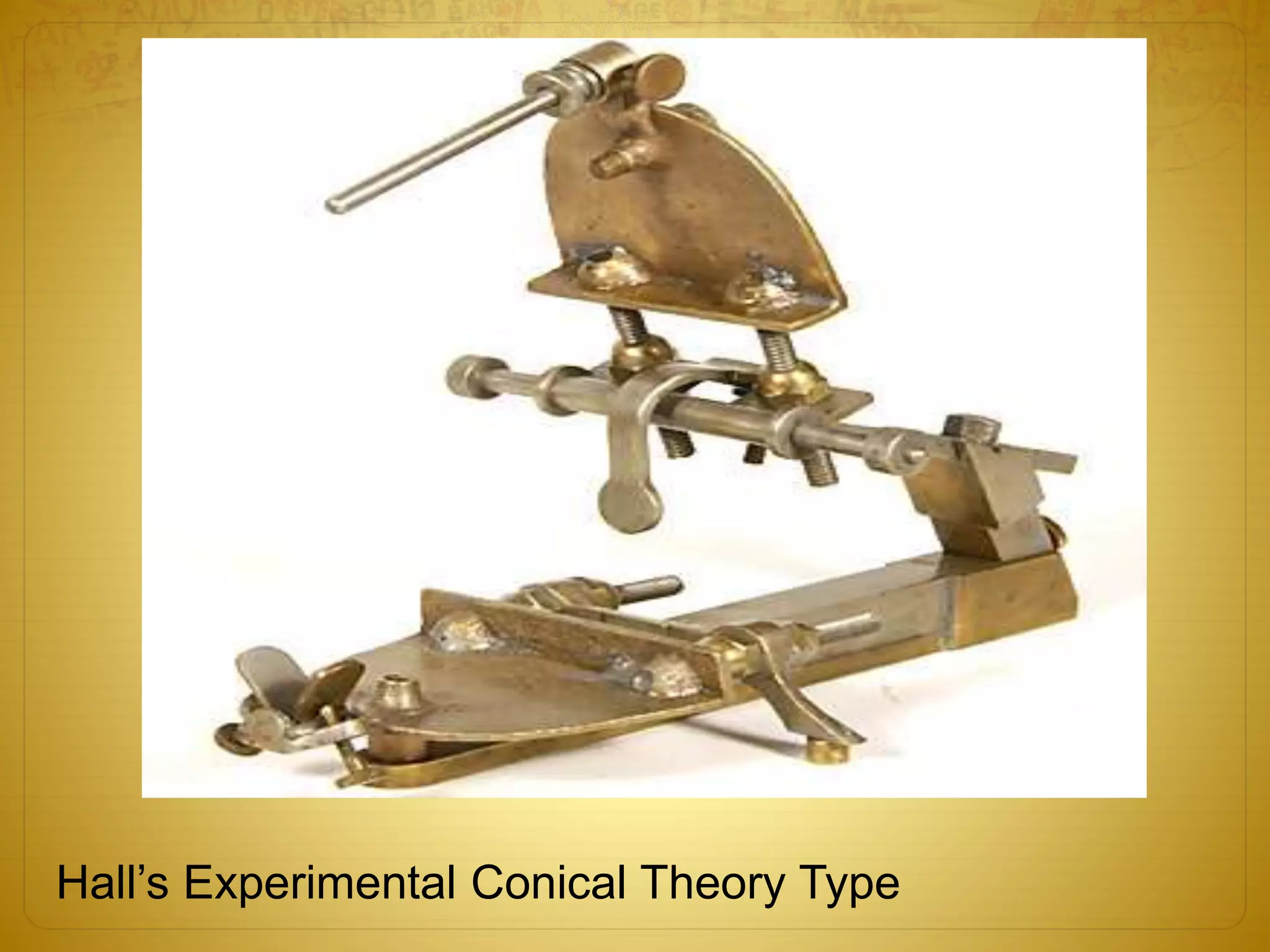
2. Conical theory articulator
 Proposed by RE Hall
 Lower teeth move over the surface of the upper teeth as
over the surface of the cone generating an angle of 45° with
the central axis of the cone tipped 45° to the occlusal plane
Hall’s Experimental Conical Theory Type
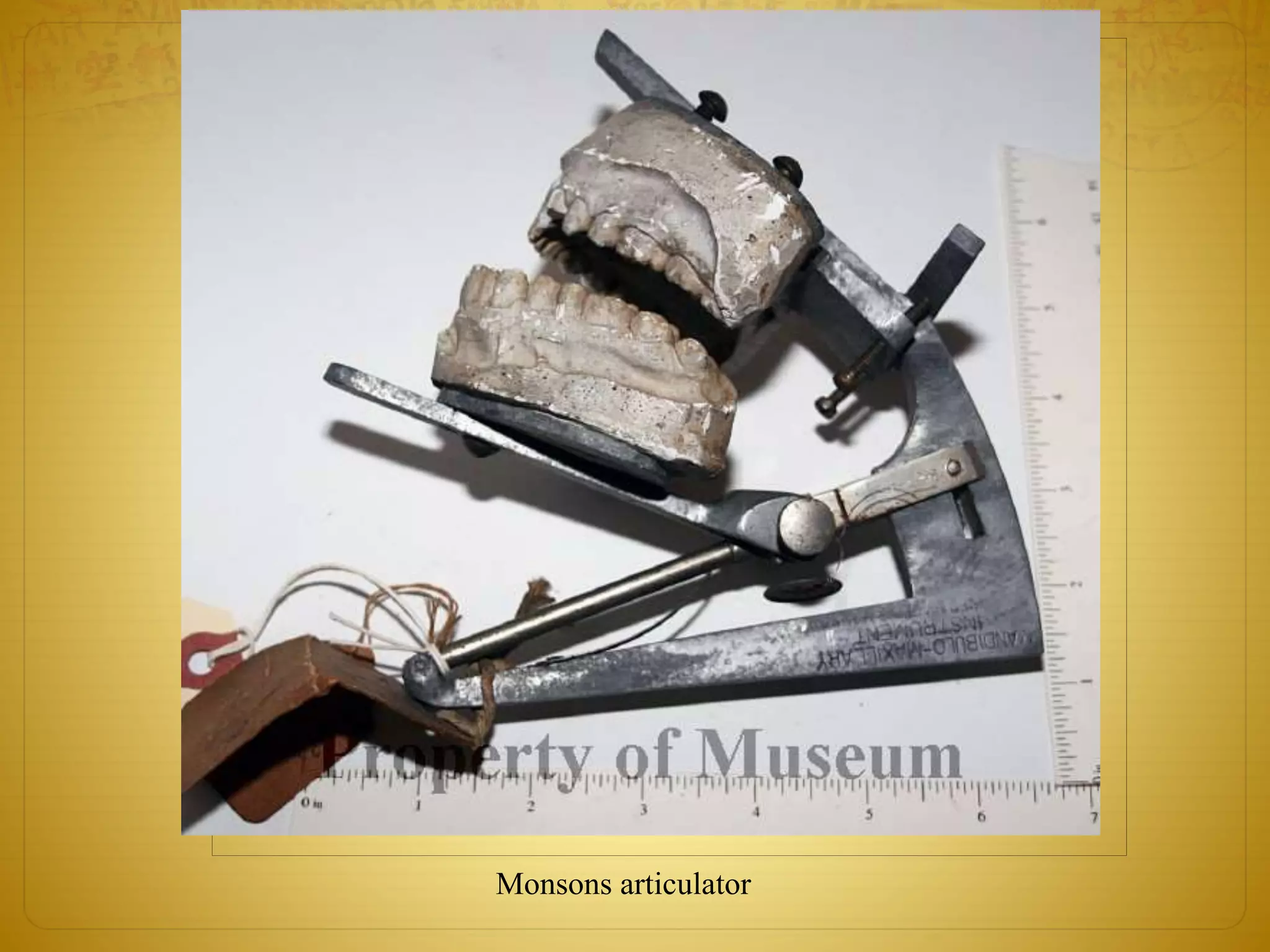
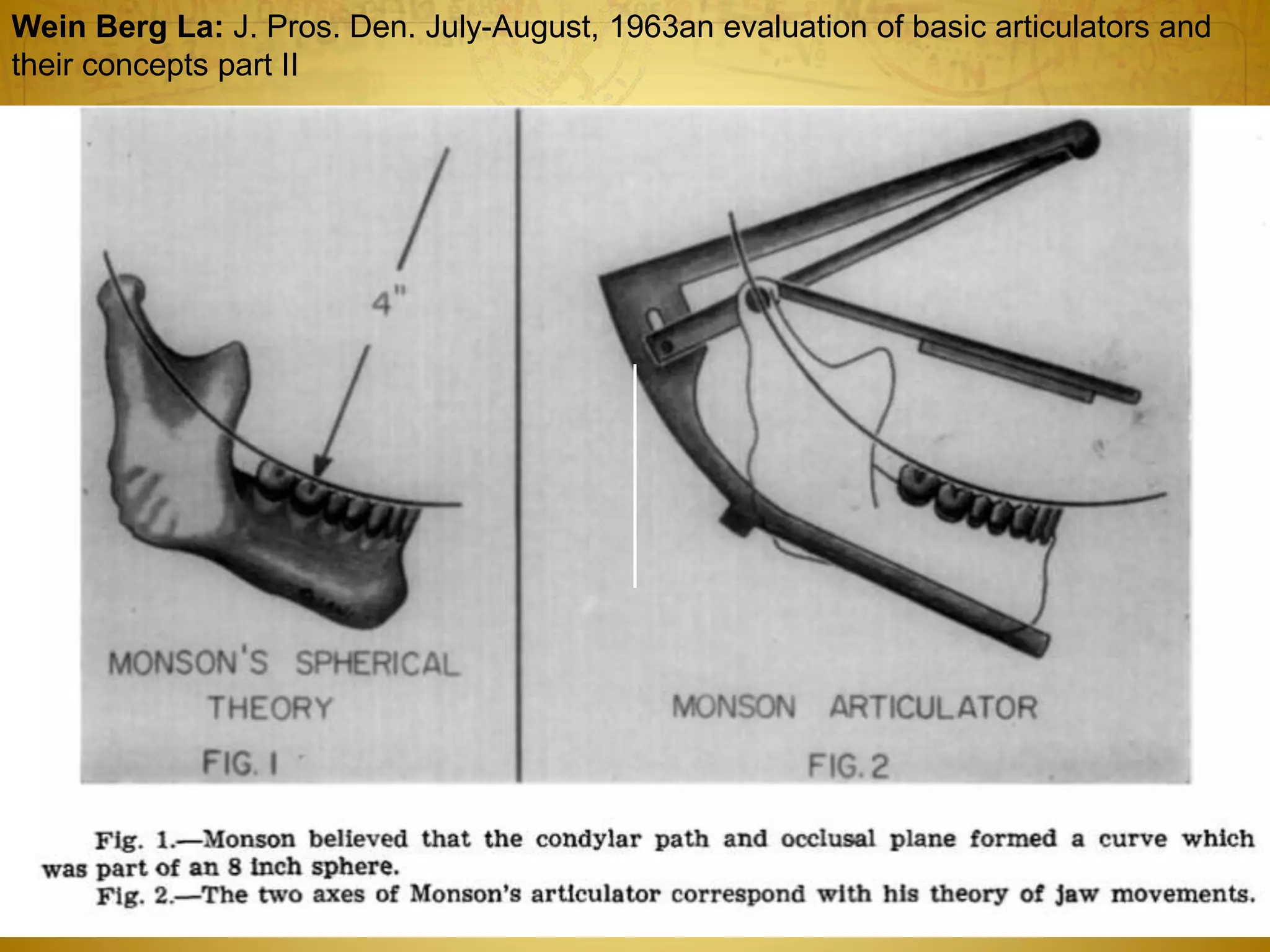
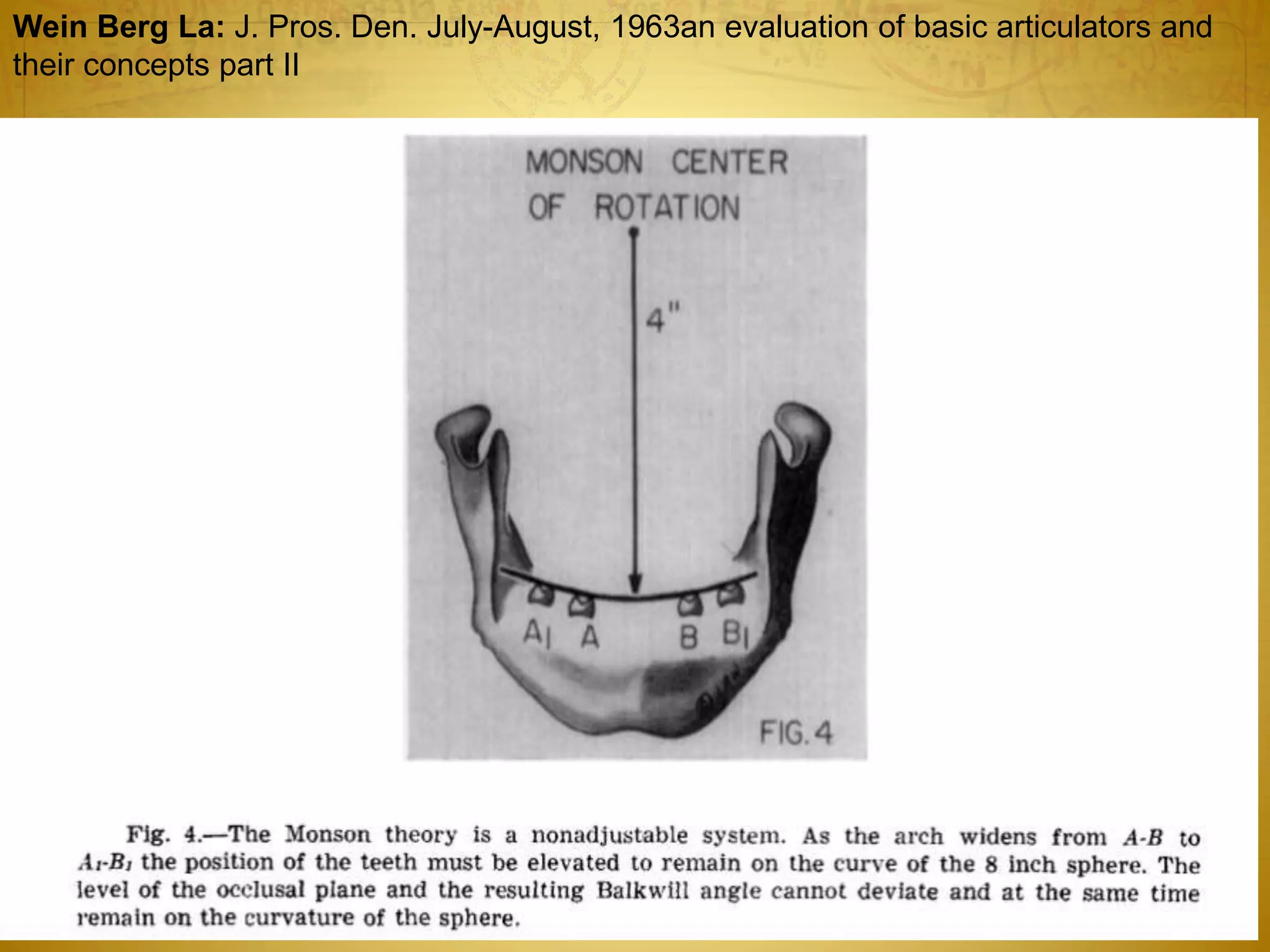
3.Spherical theory articulator
 Lower teeth move over the surface of the upper teeth as
over the surface of the sphere with a diameter of 8” with the
center located at the glabella
 The surface of the sphere moved over the glenoid fossa &
articulating eminences.
Monsons articulator
Wein Berg La: J. Pros. Den. July-August, 1963an evaluation of basic articulators and
their concepts part II
Wein Berg La: J. Pros. Den. July-August, 1963an evaluation of basic articulators and
their concepts part II
.
Wein Berg La: J. Pros. Den. July-August, 1963an evaluation of basic articulators and
their concepts part II
The type of record used for their
adjustment
 Eccentric pathways can be dynamically registered either
-graphically (pantographic method)
-stereographically (engraved method)
-positionally registered (checkbite method),
 -determined by the articulator (mechanical
equivalents)
 -adjusted entirely on the patient.
Articulators based on the type of record
used for their adjustment
1. Inter occlusal record adjustment
 Made of base plate wax, zinc oxide eugenol,
plaster & acrylic resin
2. Graphic record adjustment.
 Records of extreme border positions of
mandibular movements.
 Face bow pantograph can be attached
3. Hinge Axis location for adjusting articulator
 The correct location of the opening and closing
axis of the mandible should be made, if not the correct
adjustment of these instrument is not possible
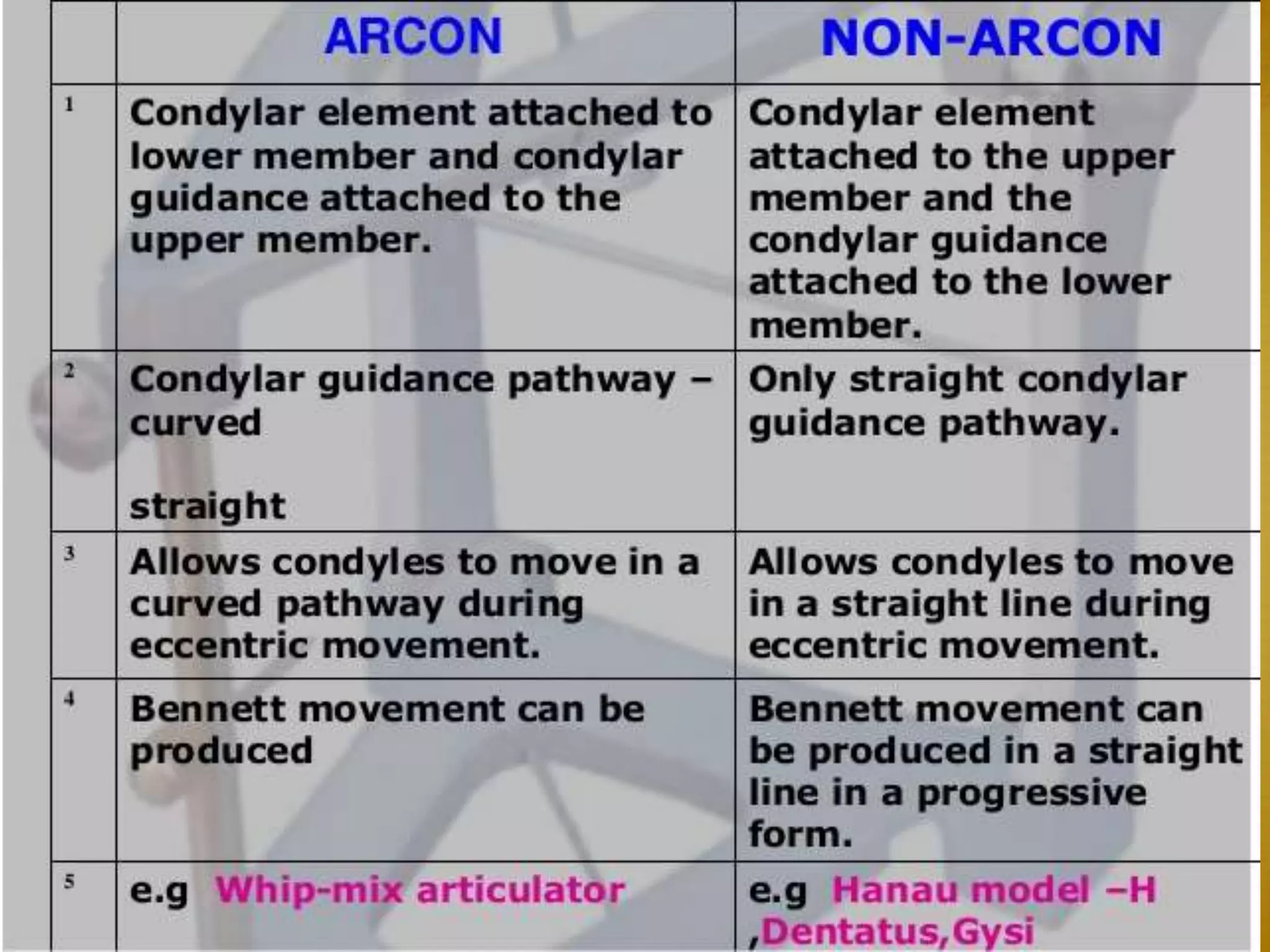
10.Based on condylar element
attachment- Bergstorm
 A] Arcon
Articulator+condyle
The condylar element is attached to the lower member
and guidance to the upper member. Eg.-Whip mix
 B] Non Arcon
condylar element on upper member and guidance on
the lower member. Eg.- Hanau H2 series, Dentatus.
Yeshwante B.et al, Int J Dent Health Sci 2017; 4(3):674-683
11. HEARTWELL AND RAHN’S
CLASSIFICATION
 Class I - Instruments that will receive and produce
pantographs and graphic tracings.
 Class II - Instruments that will not receive pantographs.
Hinge type
Arbitrary
Adjustable
Instruments that are designed for use in
complete denture construction.
Yeshwante B.et al, Int J Dent Health Sci 2017; 4(3):674-683
12. NEW SYSTEM CLASSIFICATION BY
RIHANI 1980 :
 Non adjustable - A simple holding instrument capable of
accepting single static registration. Only vertical motion is
acceptable.
 Semi adjustable – An instrument that simulates condylar
pathways by using average or mechanical equivalents for
all or part of the motion. These instruments allow for
orientation of casts relative to the joints and may be arcon
or non-arcon instrument.
 Fully adjustable – An instrument that will accept three
dimensional dynamic registration. These instruments allow
for orientation of the casts to the T.M.J. and replication of
all mandibular movements.
Yeshwante B.et al, Int J Dent Health Sci 2017; 4(3):674-683
13. At the international prosthodontic workshop
on complete denture occlusion at the University
of Michigan in 1972
 Instrument Intent
 Instrument capability
 Recording procedure
 Record acceptance
• Class I : Hinge Type
• Class II : Arbitrary – type A, type B, type C
• Class III : Average -type A, type B
• Class IV : Special – type A, type B
Winkler Sheldon: Essentials of complete Denture Prosthodontics, 3rd edition,page 189-
CLASS I (Hinge Type)
 Simple holding instrument capable of accepting a single
interocclusal record
 vertical movements may be possible but only for
convinience.
 Use in cases where a tentative jaw relation is done
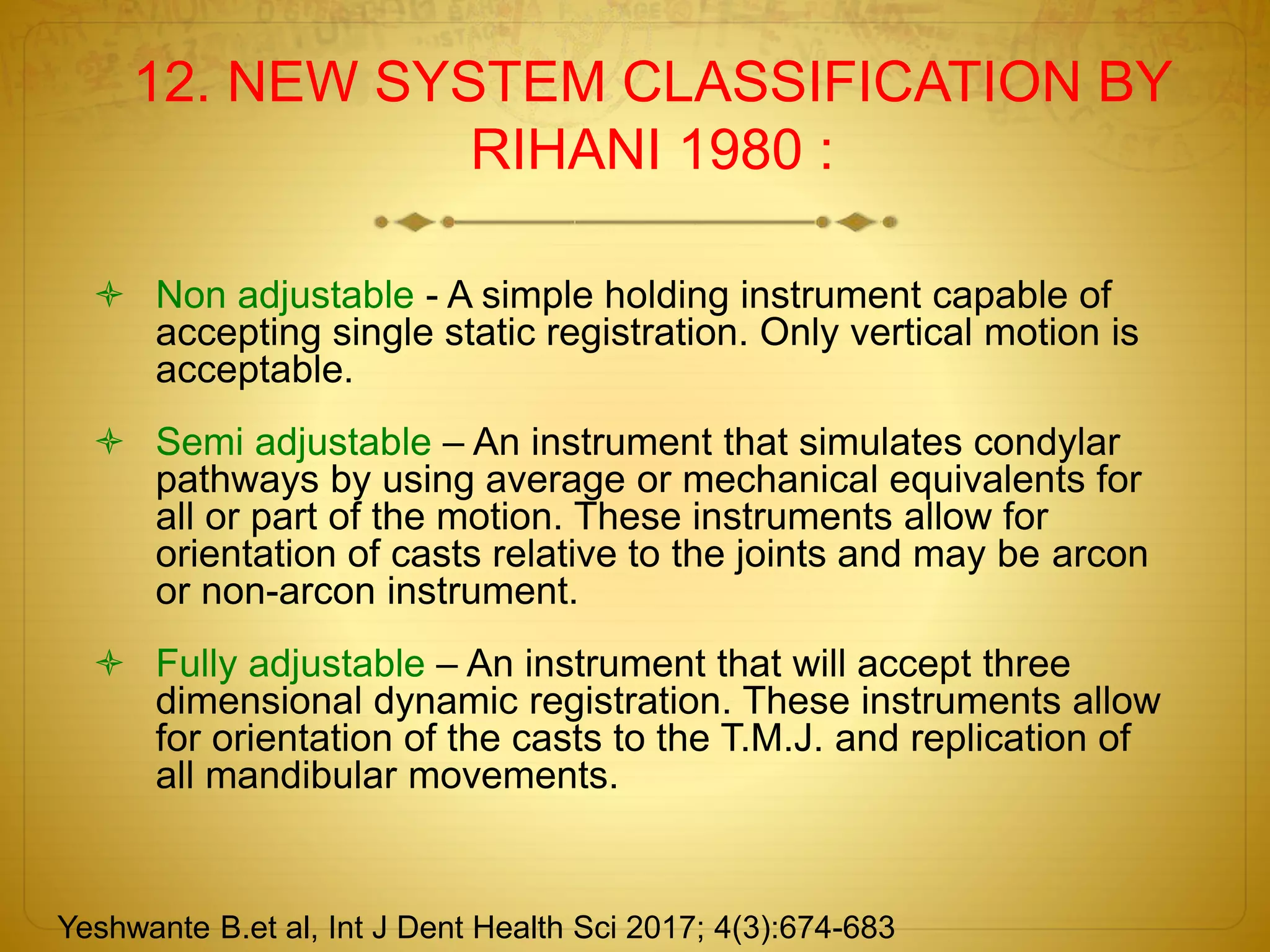
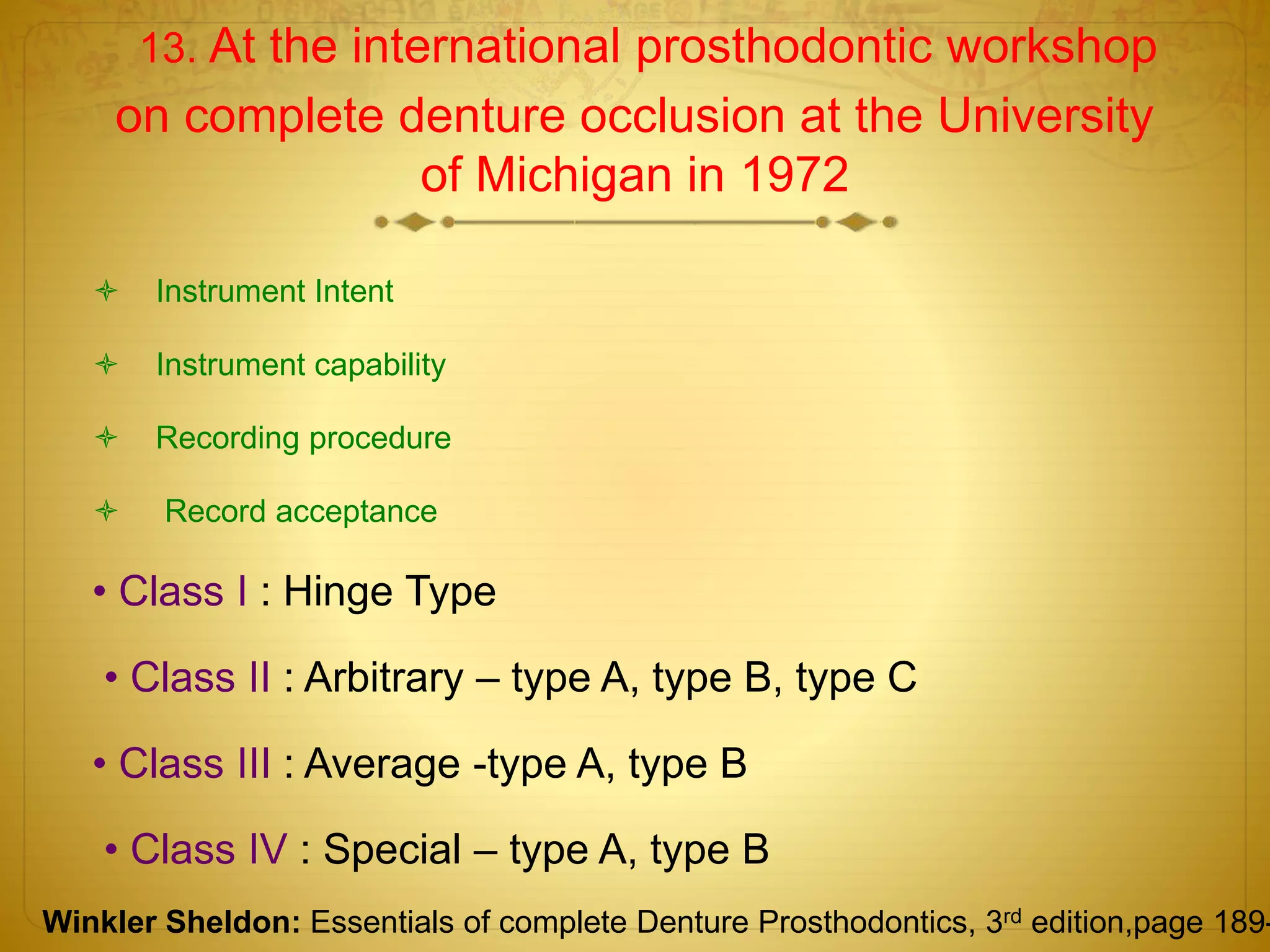
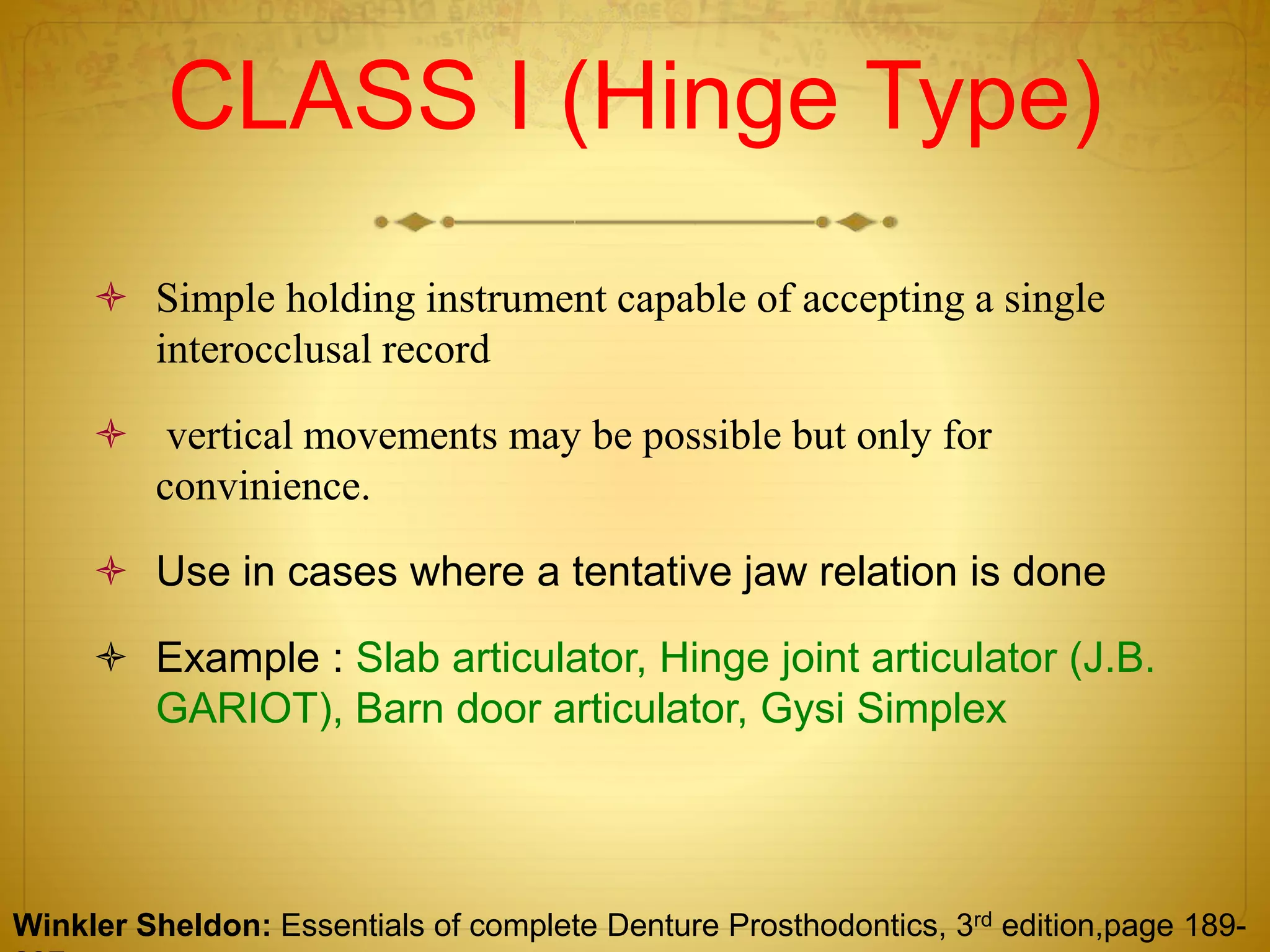
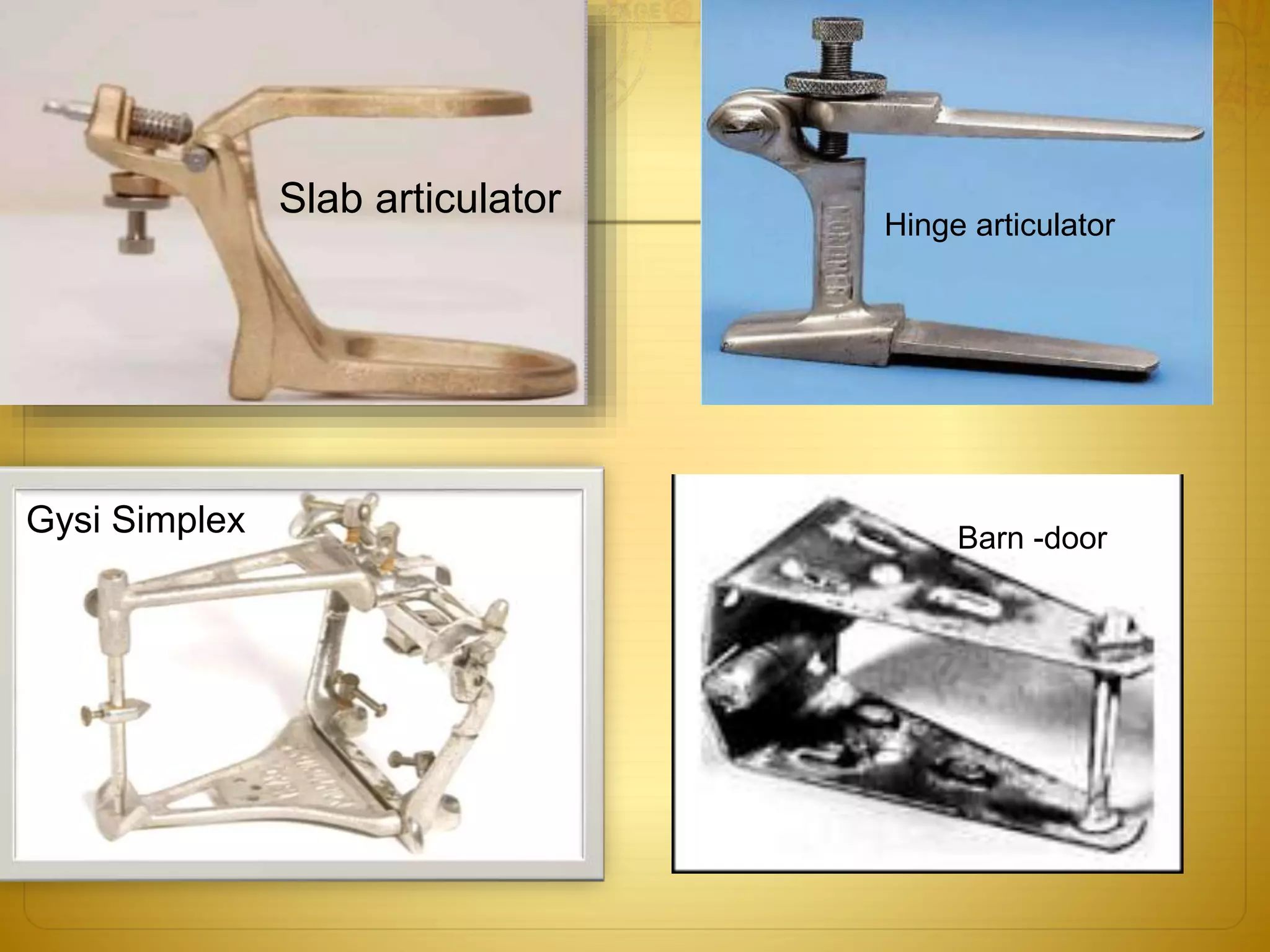
 Example : Slab articulator, Hinge joint articulator (J.B.
GARIOT), Barn door articulator, Gysi Simplex
Winkler Sheldon: Essentials of complete Denture Prosthodontics, 3rd edition,page 189-
Slab articulator
Gysi Simplex
Hinge articulator
Barn -door
CLASS II (Arbitrary)
These articulators permit horizontal and vertical movements
but they do not orient the movement to TMJ
 Type A
– Eccentric motion is unrelated to patient motion.
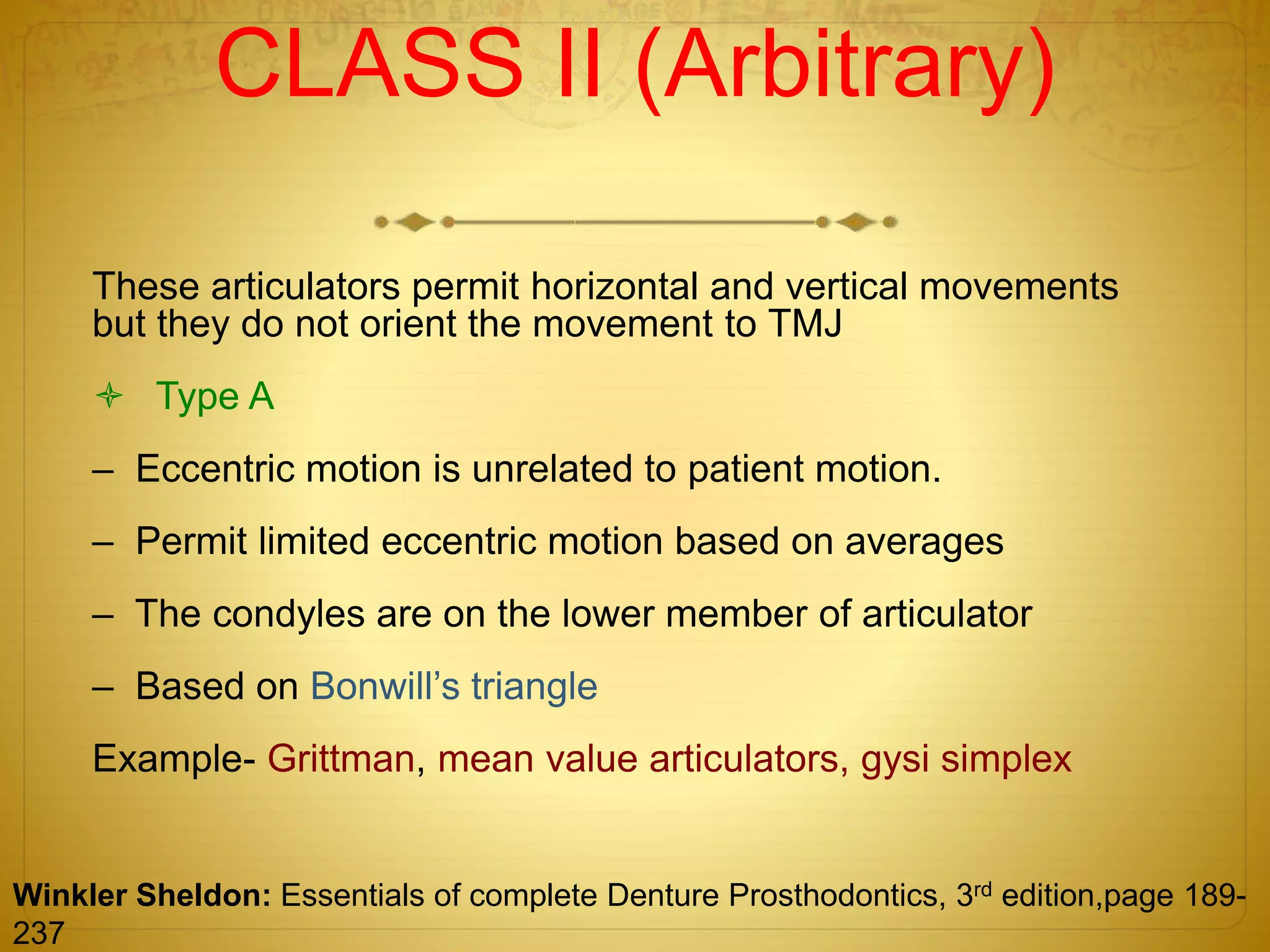
– Permit limited eccentric motion based on averages
– The condyles are on the lower member of articulator
– Based on Bonwill’s triangle
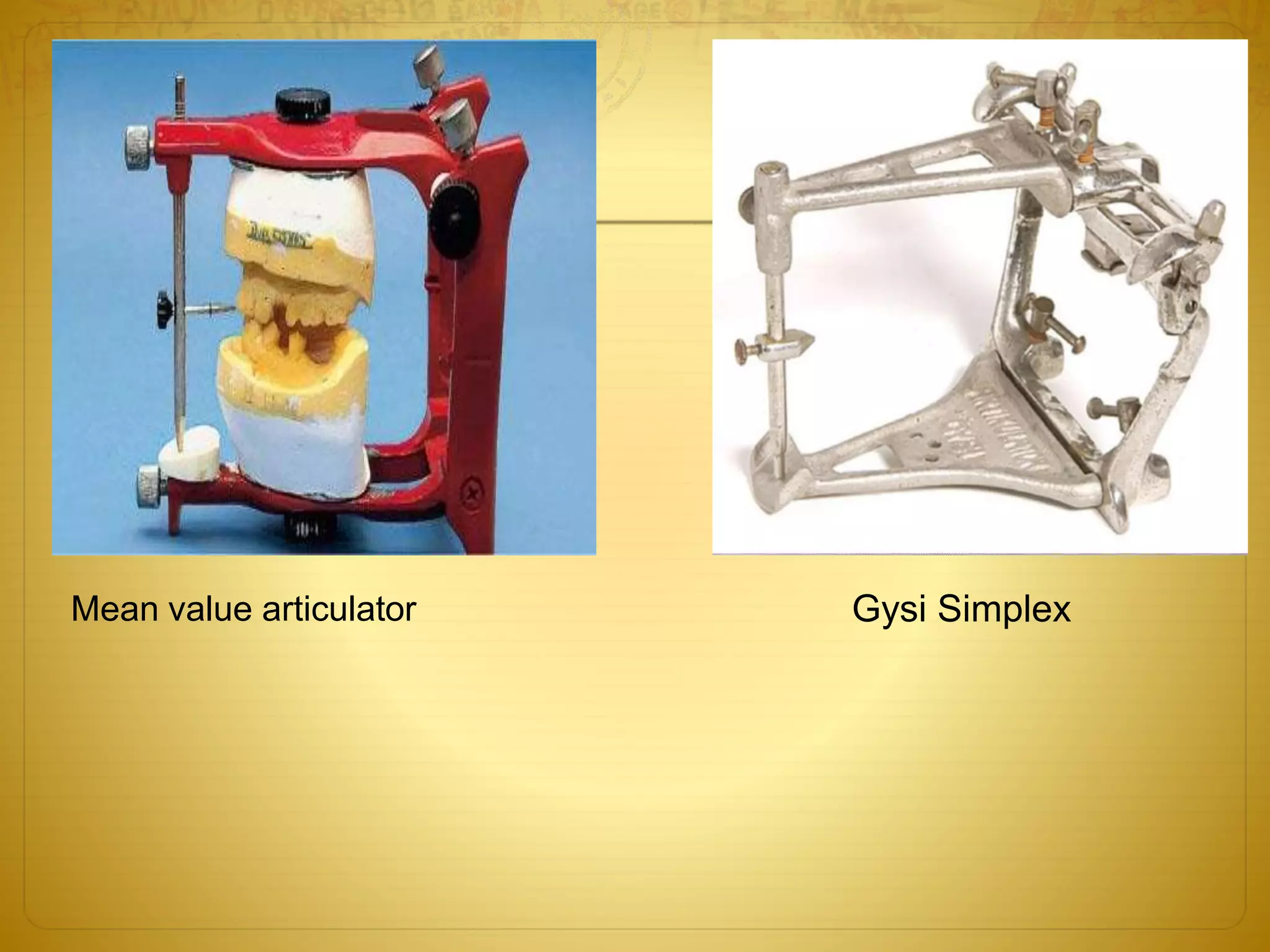
Example- Grittman, mean value articulators, gysi simplex
Winkler Sheldon: Essentials of complete Denture Prosthodontics, 3rd edition,page 189-
237
Mean value articulator Gysi Simplex
 TYPE B
– Permit limited eccentric motion based on arbitrary theory of
motion
– Based on spherical theory of occlusion
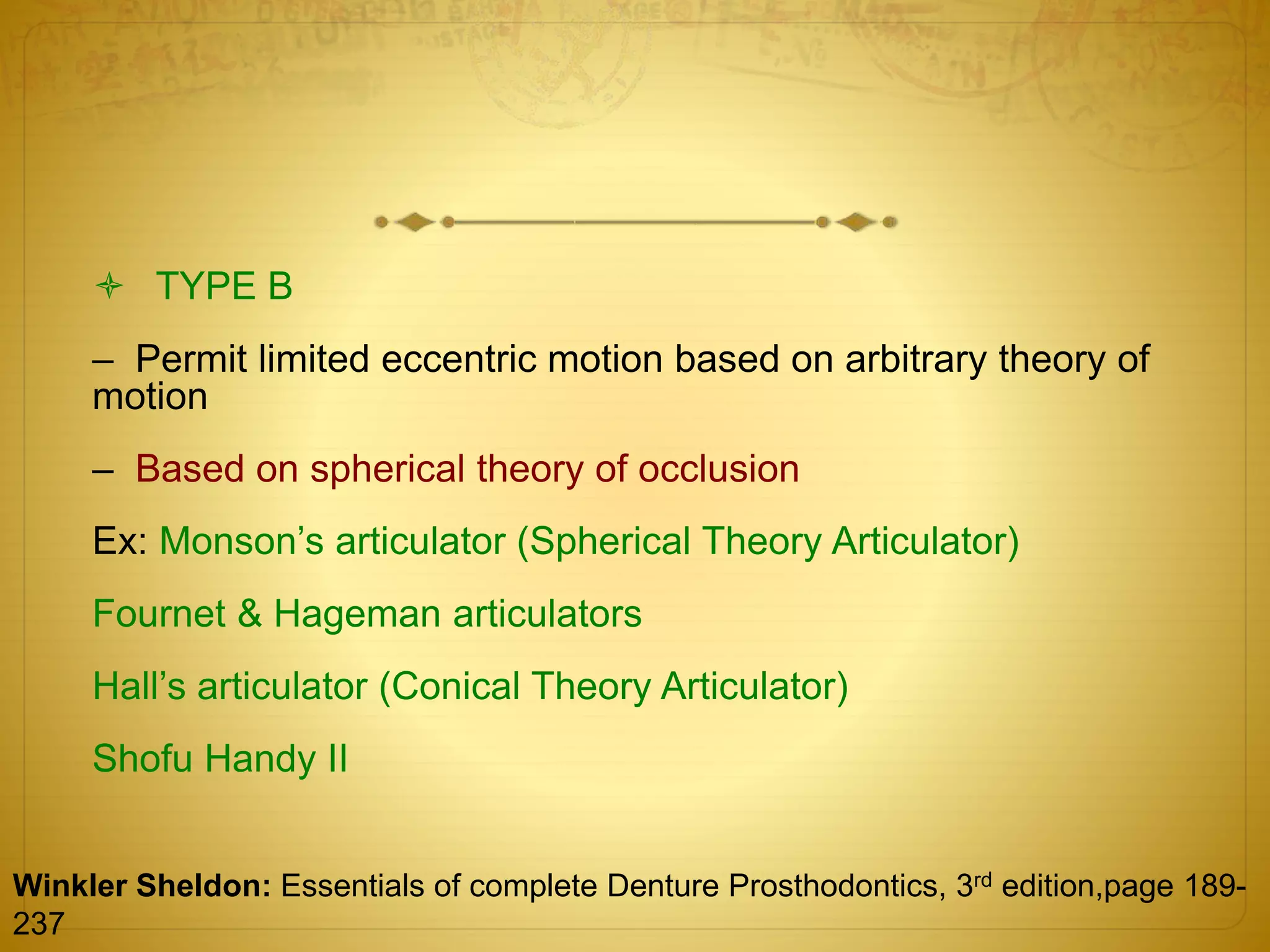
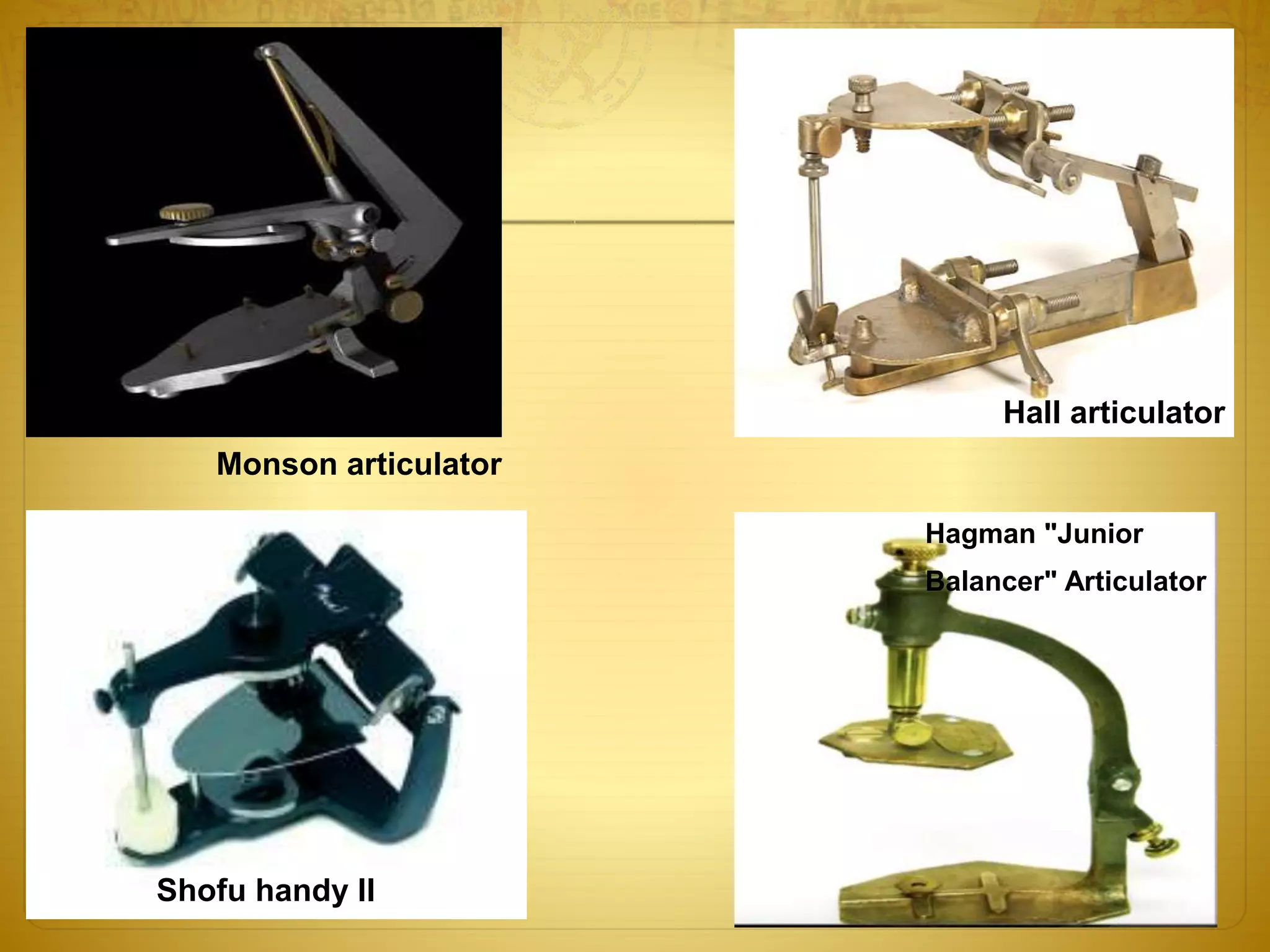
Ex: Monson’s articulator (Spherical Theory Articulator)
Fournet & Hageman articulators
Hall’s articulator (Conical Theory Articulator)
Shofu Handy II
Winkler Sheldon: Essentials of complete Denture Prosthodontics, 3rd edition,page 189-
237
Monson articulator
Hall articulator
Shofu handy II
Hagman "Junior
Balancer" Articulator
 TYPE C
– Permit limited eccentric motion based on engraved records
obtained from the patient
- Casts are mounted arbitrarily
- Adjusted by needle house chew in method.
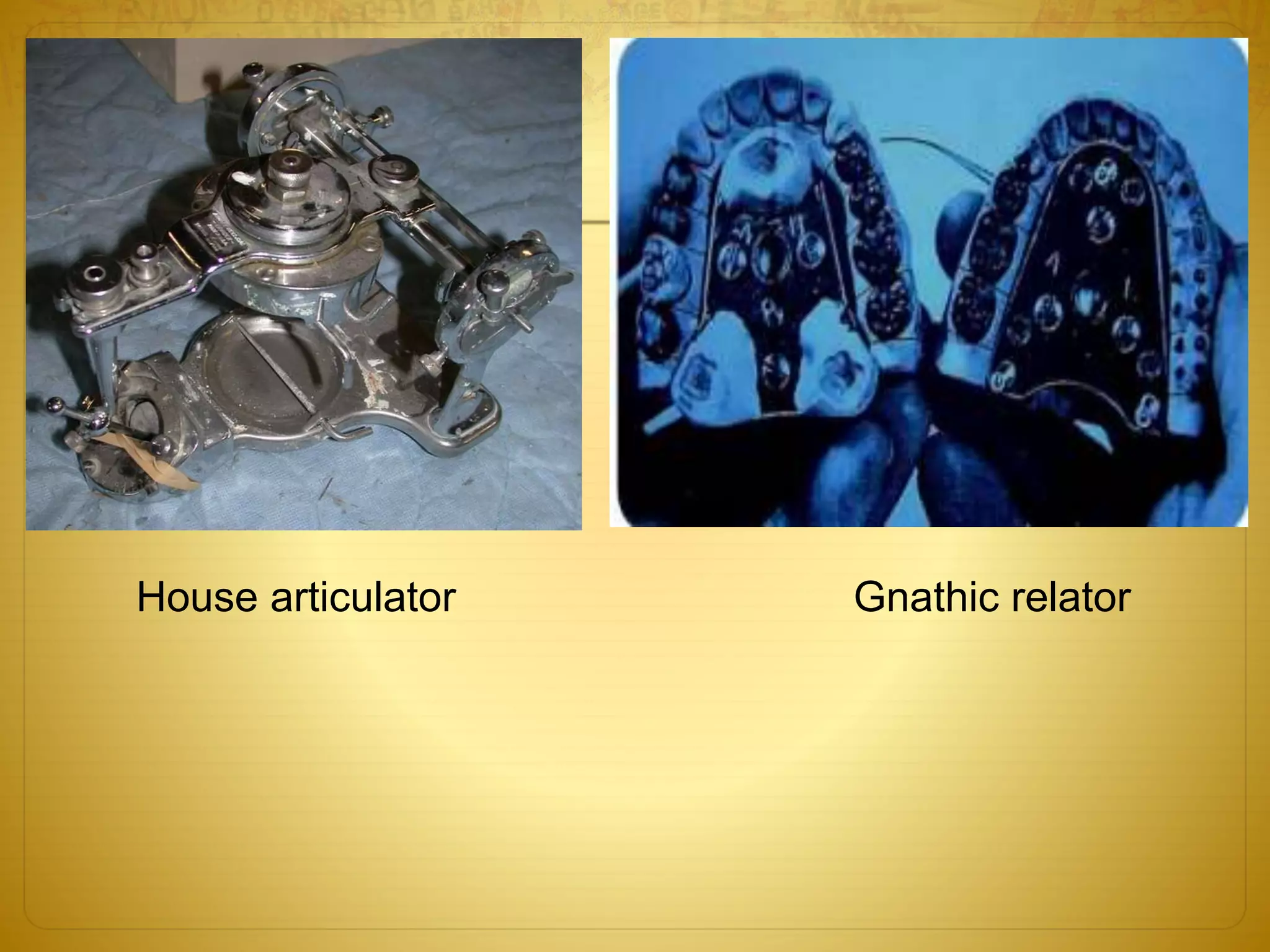
• Ex: House’s articulator (1920)
Gnathic Relator
Winkler Sheldon: Essentials of complete Denture Prosthodontics, 3rd edition,page 189-
House articulator Gnathic relator
Class III (Average)
 They permit horizontal and vertical motion
 Do accept face-bow transfer but these facility is limited
 Do Not / Cannot allow total customization of condylar pathways
 They simulate condylar pathways by using average or
mechanical equivalents for the whole or part of the condylar
motion
 good centric lock, progressive and immediate side shift controls
 All the examples are arcon instruments, accept facebows, and
have mounting plates for unlimited case load
Winkler Sheldon: Essentials of complete Denture Prosthodontics, 3rd edition,page 189-
Class III Type A
 Accept static protrusive interocclusal records / registrations
+ Accepts a face-bow transfer
 Uses equivalents for other types of motions.
 Examples
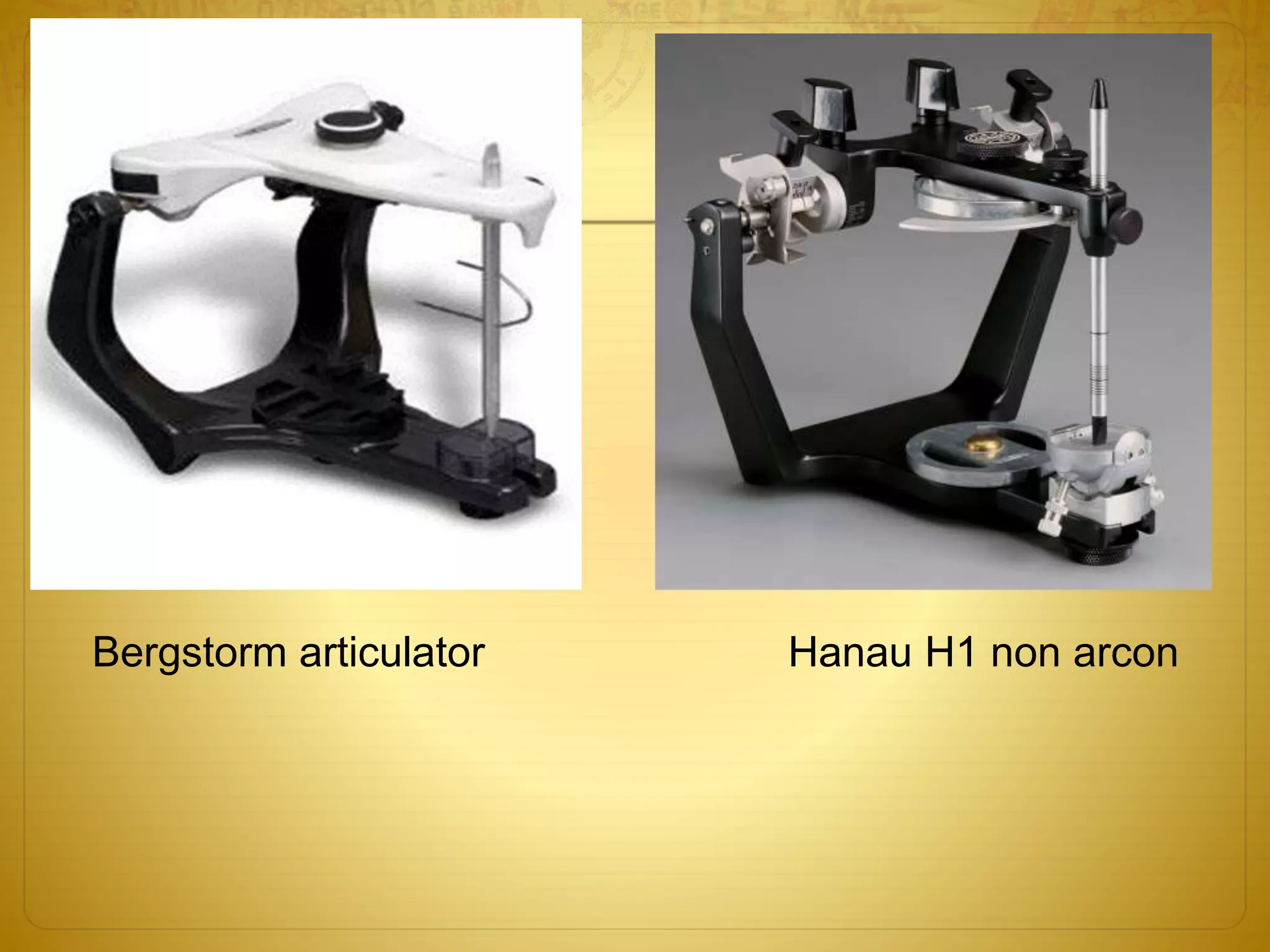
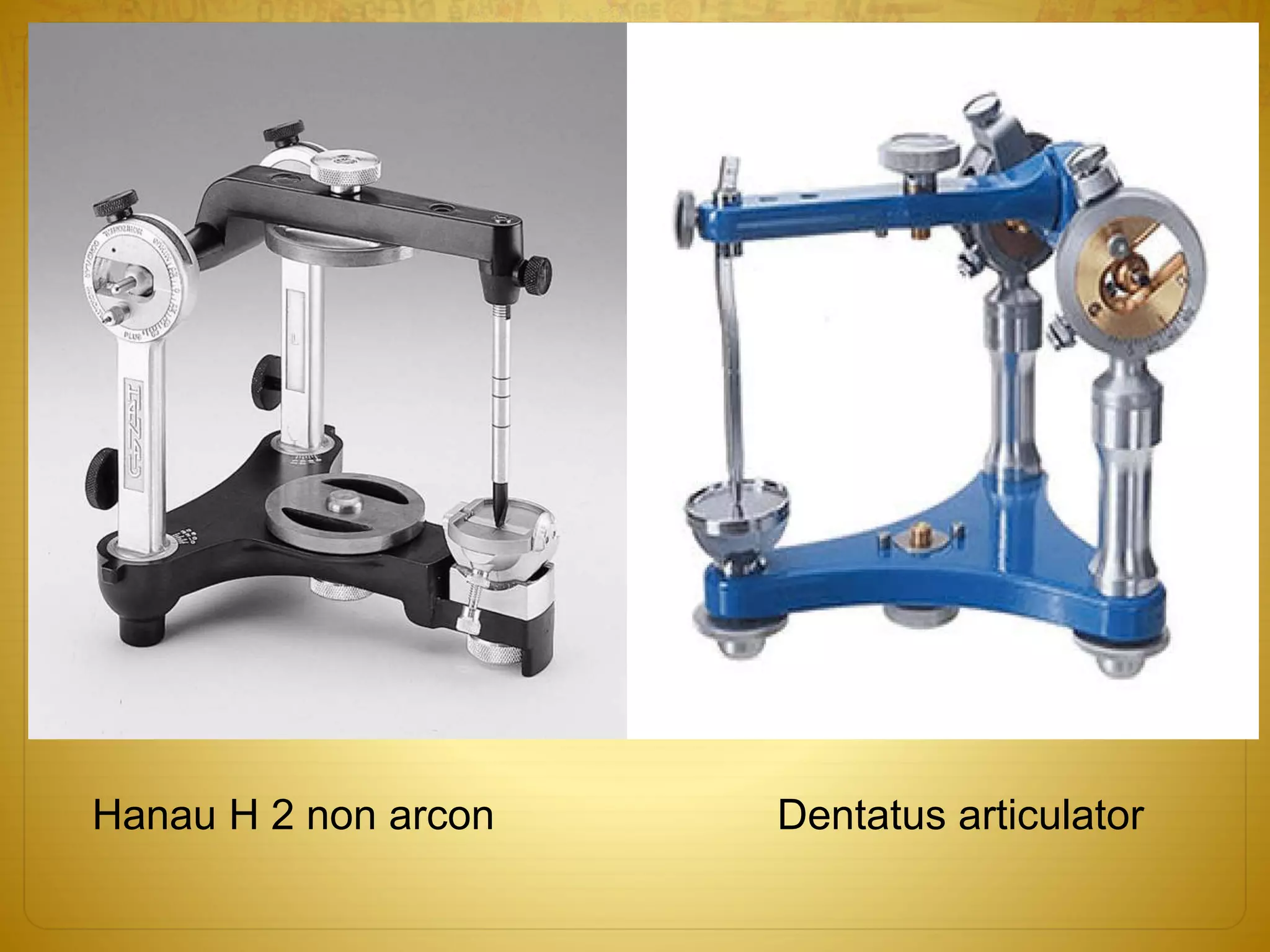
Hanau H articulator ( RUDOLPH HANAU,1923) NON ARCON
Hanau H2 articulator NON ARCON
Bergstrom articulator (ARCON)
Dentatus (1944, Sweden)
Winkler Sheldon: Essentials of complete Denture Prosthodontics, 3rd edition,page 189-
Bergstorm articulator Hanau H1 non arcon
Hanau H 2 non arcon Dentatus articulator
Class III, TYPE B
 Accept a Static Lateral, protrusive interocclusal
records + face- bow transfer
 Use equivalents for other types of motions
 Example –
Trubyte articulator
Tripod articulator
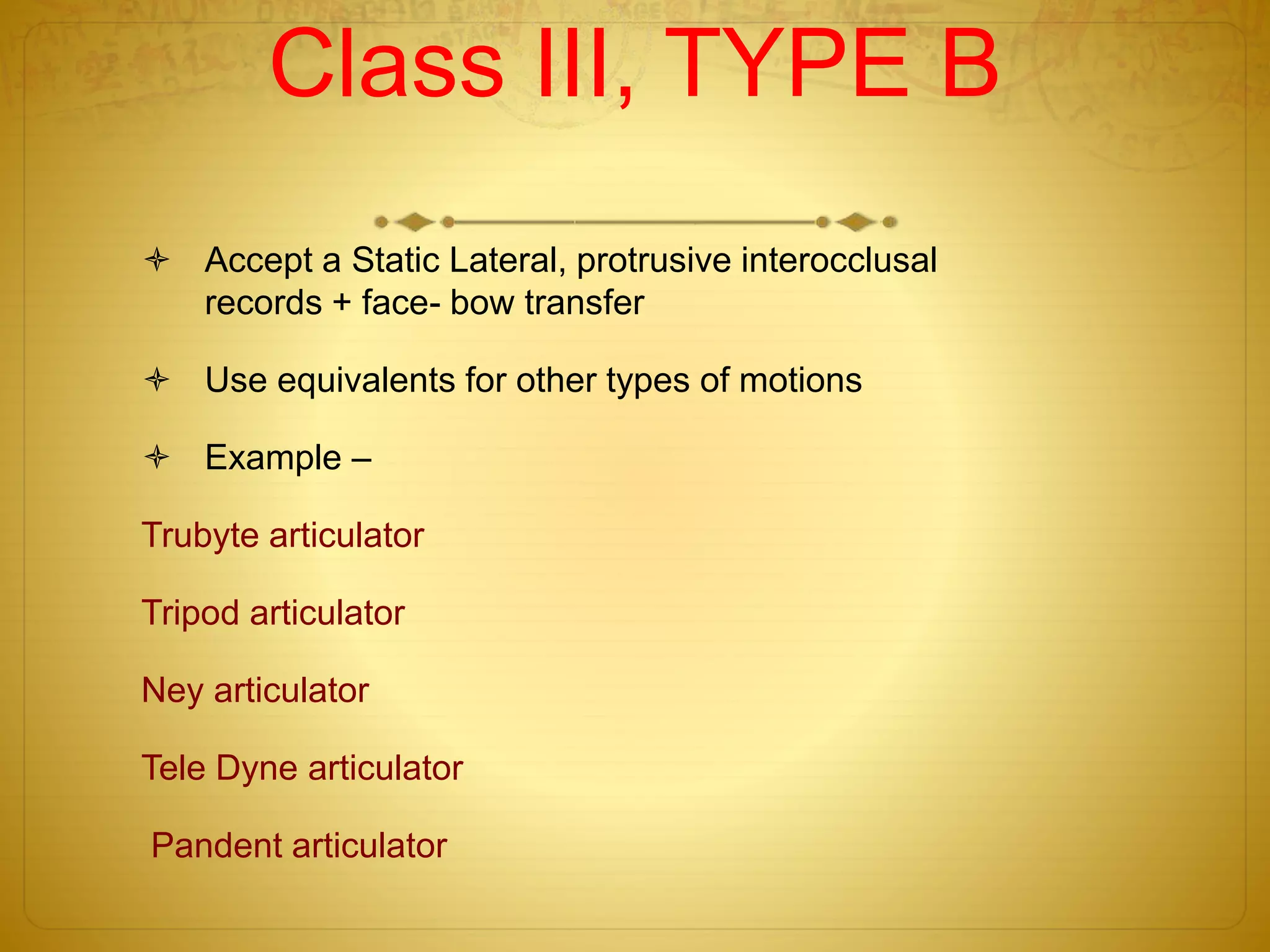
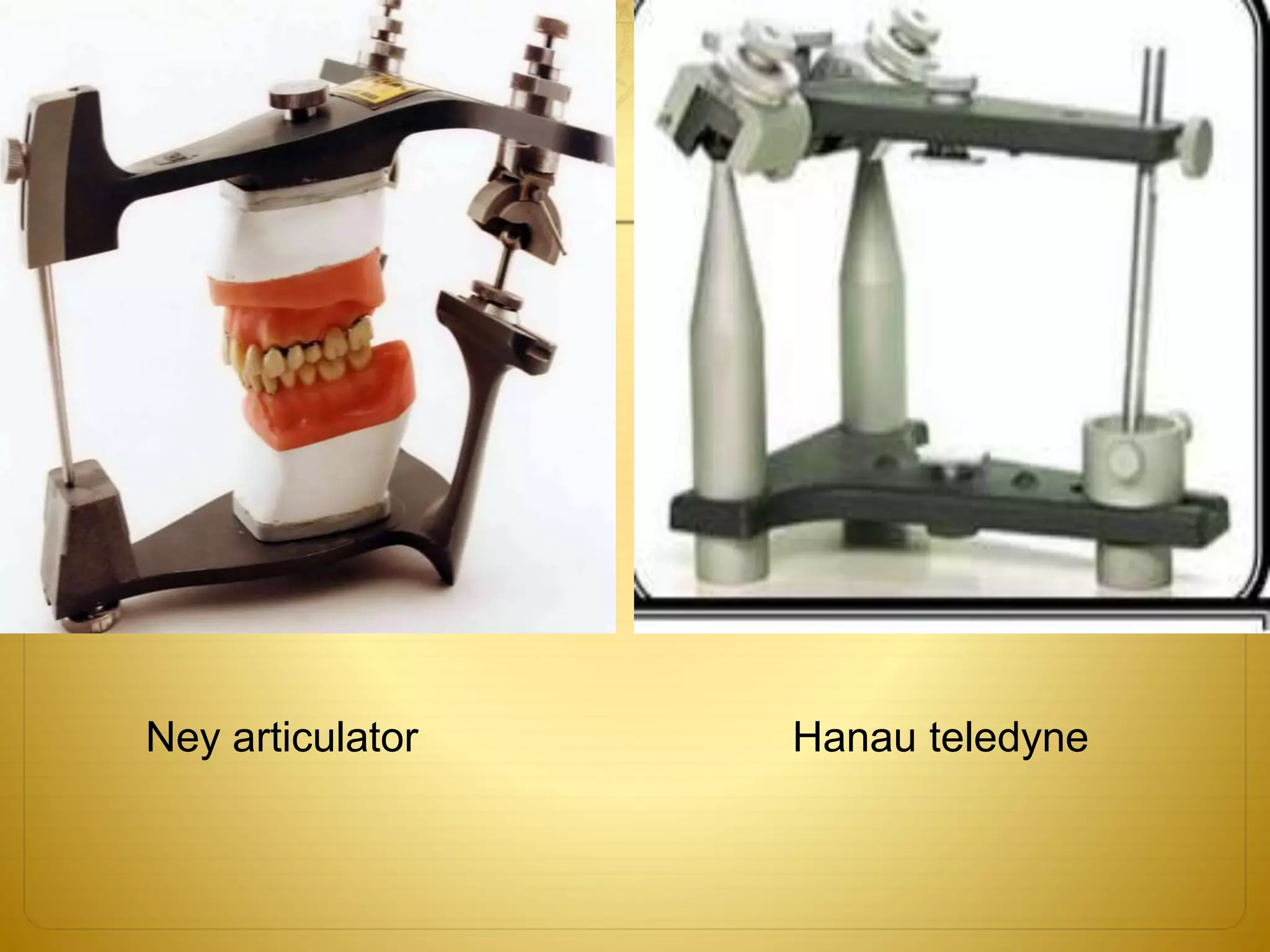
Ney articulator
Tele Dyne articulator
Pandent articulator
Ney articulator Hanau teledyne
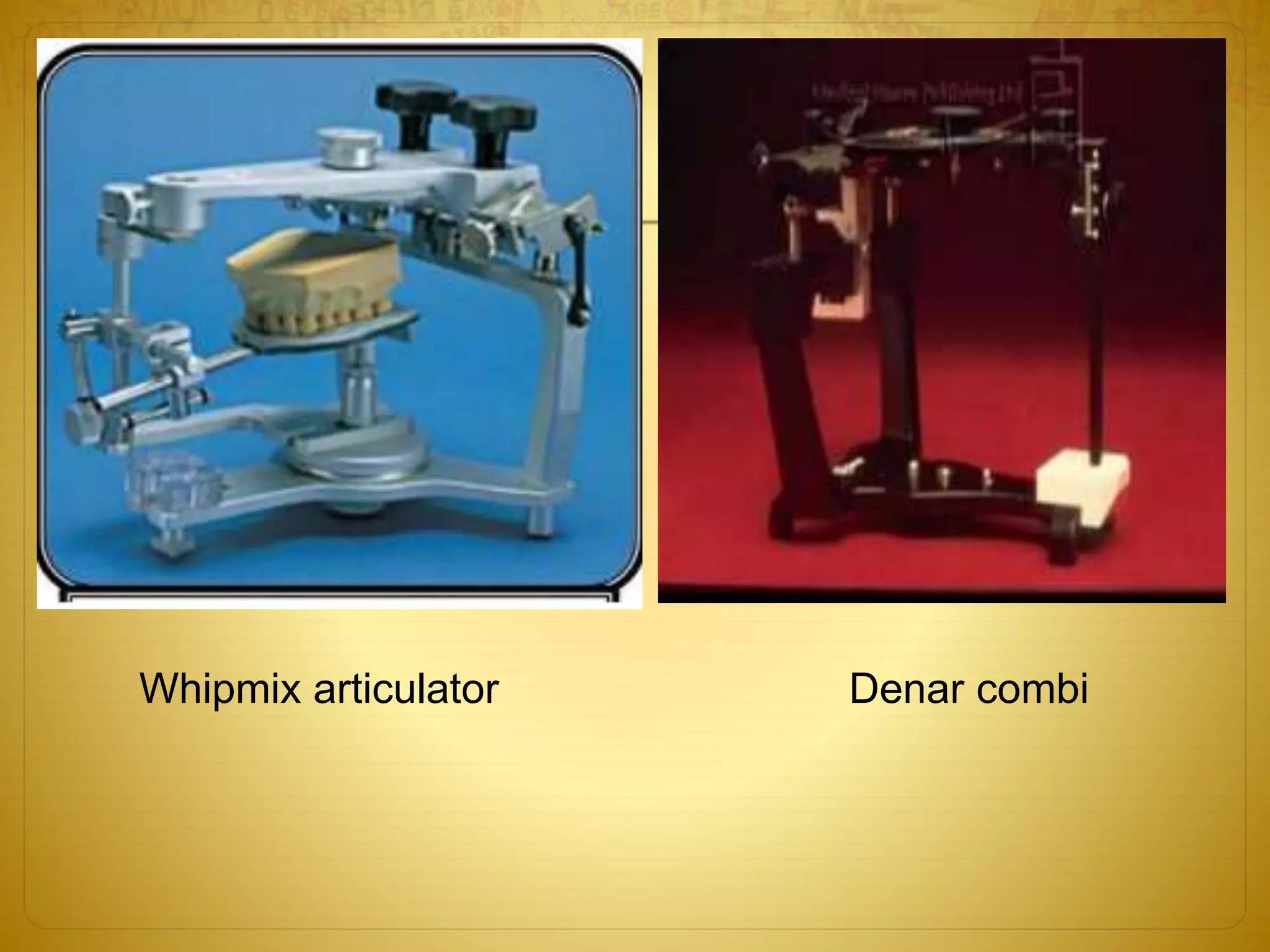
Denar combiWhipmix articulator
Class IV (Special)
 accept three dimensional dynamic registration.
 capable of accurately reproducing the condylar
pathway for each patient
 allow point (joint) orientation of the casts using Face
Bow Transfer
 These instruments should hold adjustments, contain
good centric locking mechanism, versatile incisal
guide tables, and stable mounting features, and be
precision engineered
Winkler Sheldon: Essentials of complete Denture Prosthodontics, 3rd edition,page 189-
Type A
 Accept three dimensional dynamic registration + utilise a
face-bow transfer
 Condylar pathways are formed by registration engraved by
the patient.
 This path is non-modifiable
 Exp.
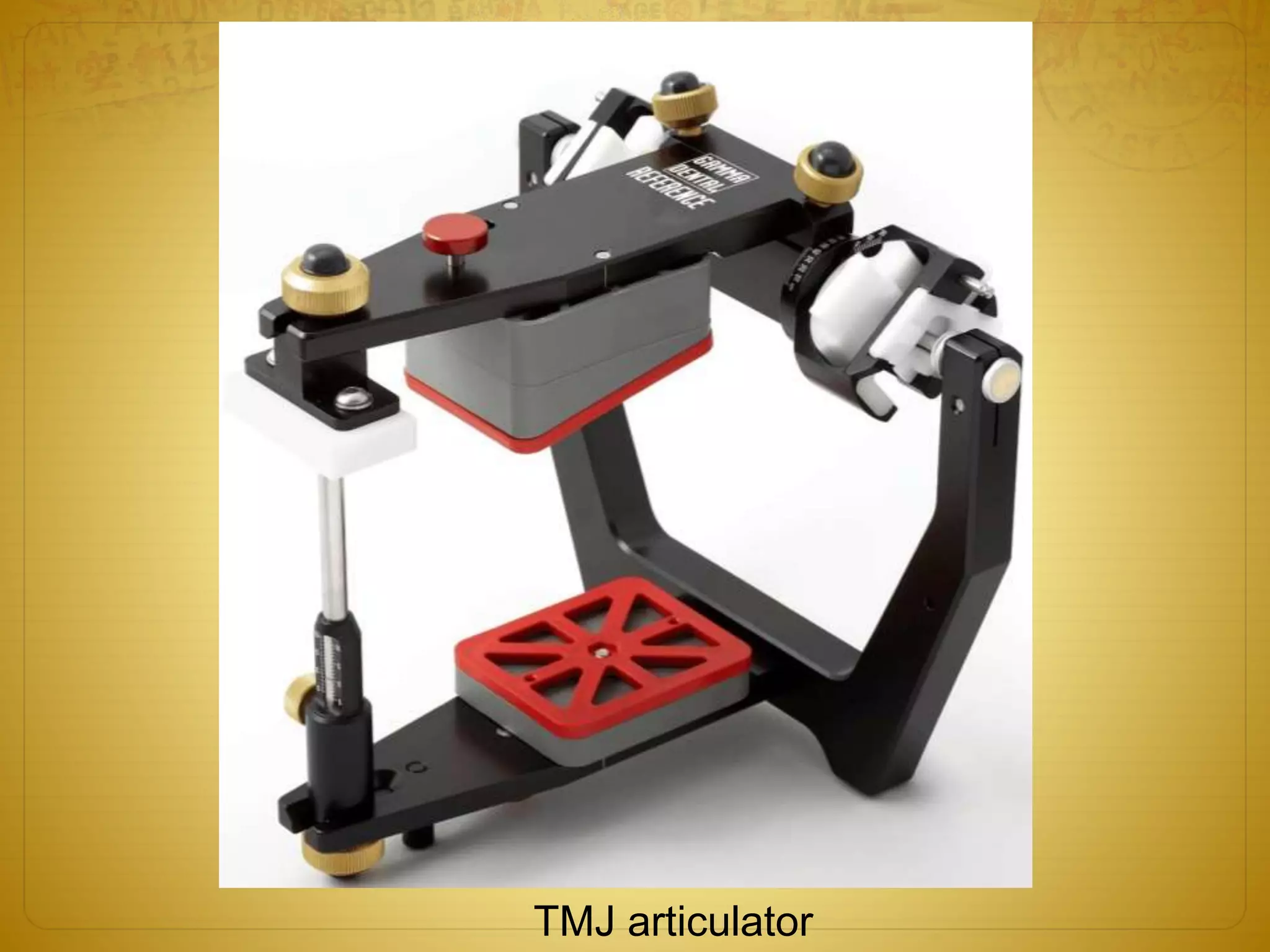
TMJ articulator – Kenneth Swanson (1965)
(uses Stereograph)
TMJ articulator
Type B
 Accept three dimensional dynamic registration + utilise a
face-bow transfer.
 Condylar pathway can be selectively angled and
customized / modified.
 The procedure utilises pantographic tracings
 Eg;
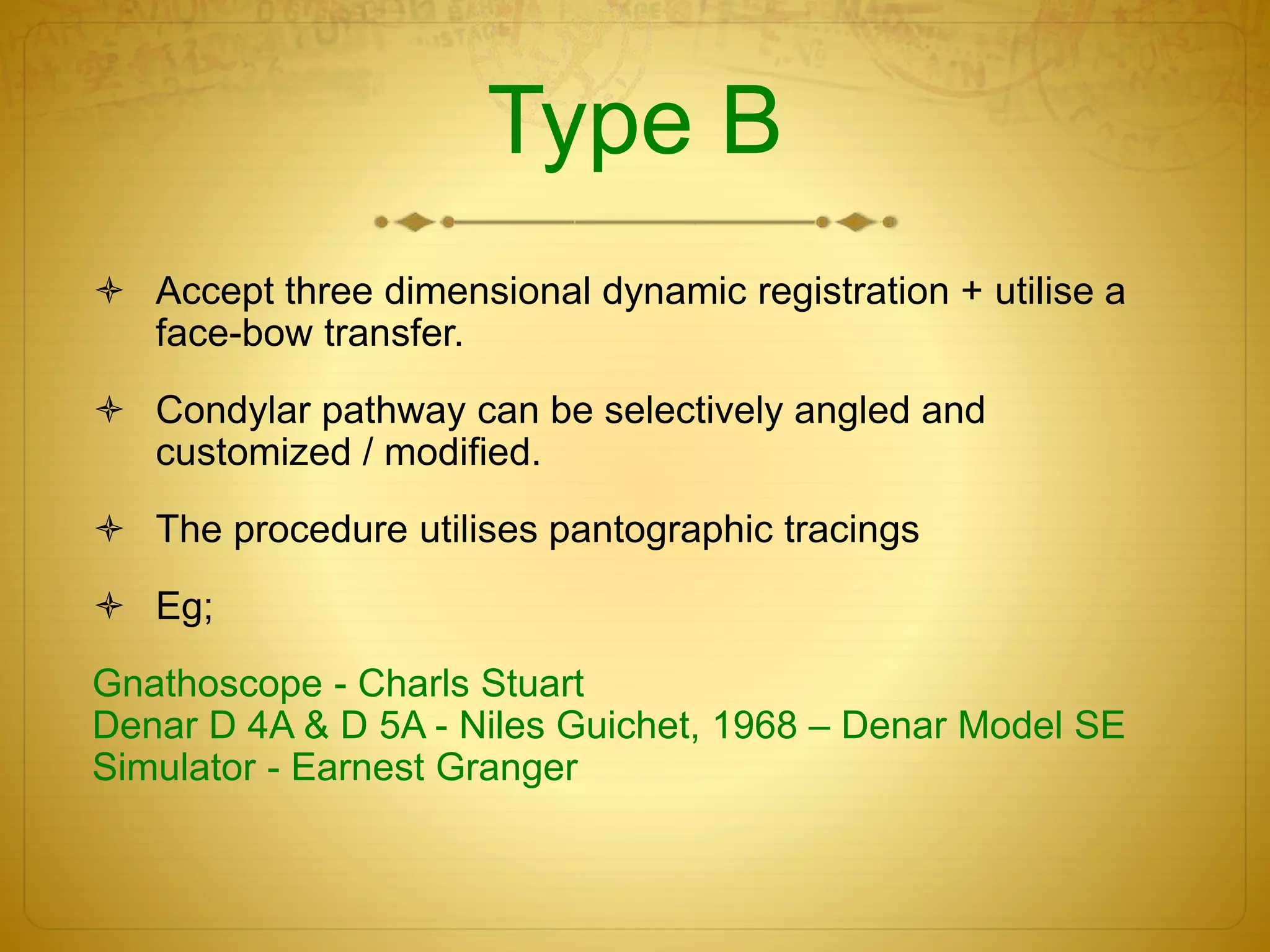
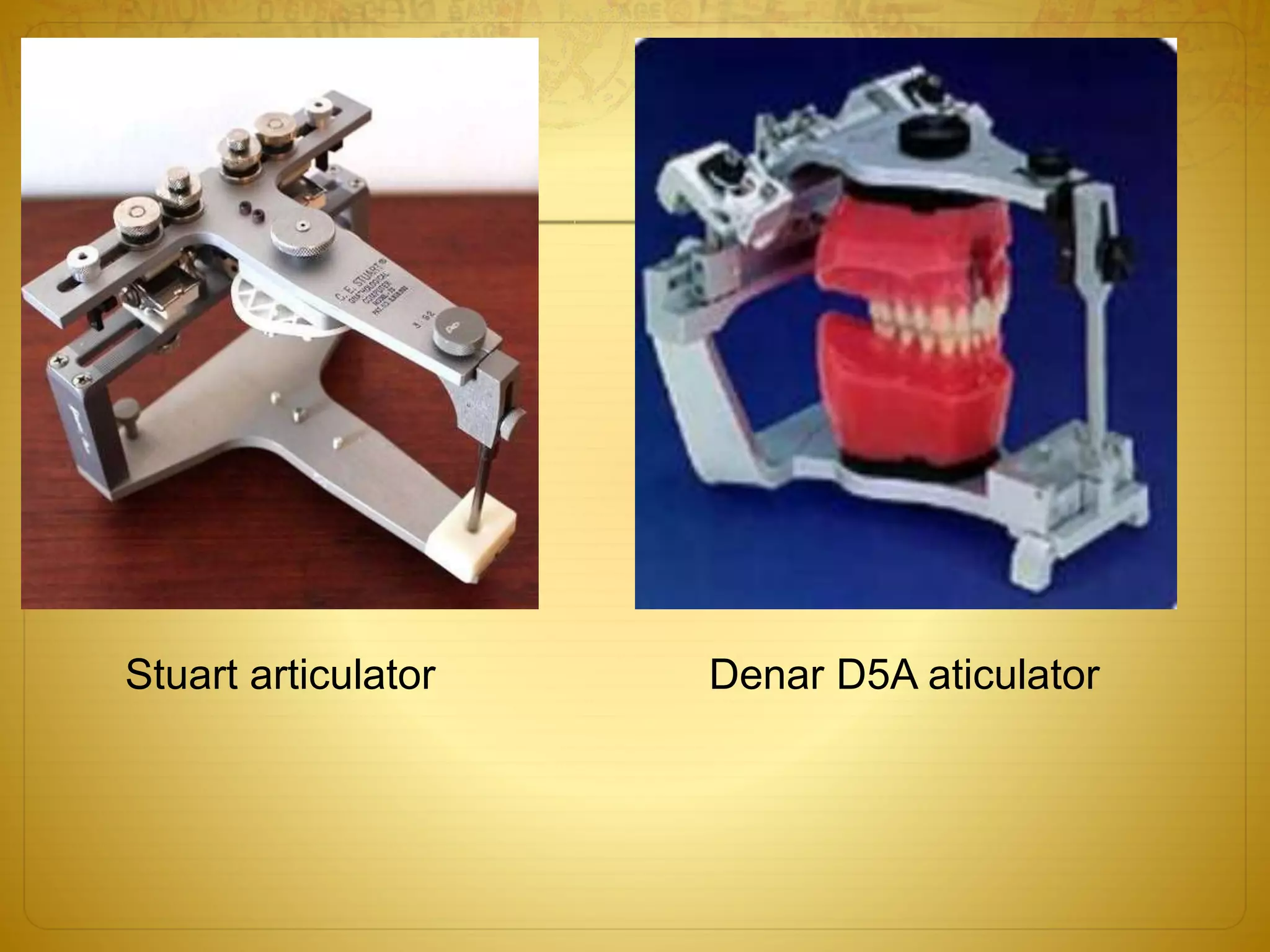
Gnathoscope - Charls Stuart
Denar D 4A & D 5A - Niles Guichet, 1968 – Denar Model SE
Simulator - Earnest Granger
Stuart articulator Denar D5A aticulator
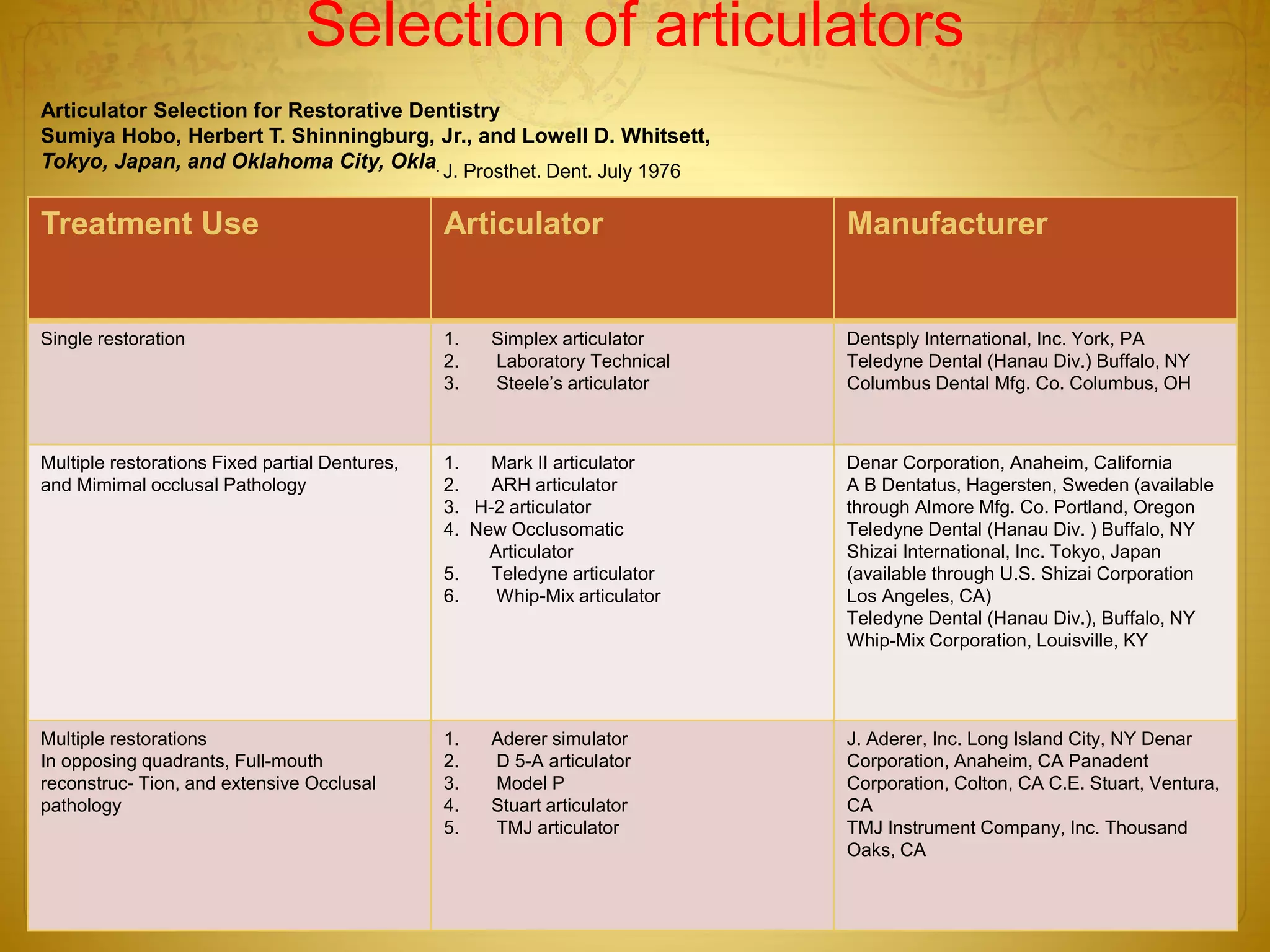
Selection of articulators
Treatment Use Articulator Manufacturer
Single restoration 1. Simplex articulator
2. Laboratory Technical
3. Steele’s articulator
Dentsply International, Inc. York, PA
Teledyne Dental (Hanau Div.) Buffalo, NY
Columbus Dental Mfg. Co. Columbus, OH
Multiple restorations Fixed partial Dentures,
and Mimimal occlusal Pathology
1. Mark II articulator
2. ARH articulator
3. H-2 articulator
4. New Occlusomatic
Articulator
5. Teledyne articulator
6. Whip-Mix articulator
Denar Corporation, Anaheim, California
A B Dentatus, Hagersten, Sweden (available
through Almore Mfg. Co. Portland, Oregon
Teledyne Dental (Hanau Div. ) Buffalo, NY
Shizai International, Inc. Tokyo, Japan
(available through U.S. Shizai Corporation
Los Angeles, CA)
Teledyne Dental (Hanau Div.), Buffalo, NY
Whip-Mix Corporation, Louisville, KY
Multiple restorations
In opposing quadrants, Full-mouth
reconstruc- Tion, and extensive Occlusal
pathology
1. Aderer simulator
2. D 5-A articulator
3. Model P
4. Stuart articulator
5. TMJ articulator
J. Aderer, Inc. Long Island City, NY Denar
Corporation, Anaheim, CA Panadent
Corporation, Colton, CA C.E. Stuart, Ventura,
CA
TMJ Instrument Company, Inc. Thousand
Oaks, CA
Articulator Selection for Restorative Dentistry
Sumiya Hobo, Herbert T. Shinningburg, Jr., and Lowell D. Whitsett,
Tokyo, Japan, and Oklahoma City, Okla. J. Prosthet. Dent. July 1976
Mean value articulator
 The two members are joined by 2 joints that represent the
TMJ.
 The horizontal condylar path is fixed at certain angle that
ranges from 30-40 degrees which is the average of the
most patients.
 The incisal guide table is also fixed at a certain angle from
horizontal.
 On the fixed condylar path articulators, the upper
members are movable (the condyle) and the lower
members are stationary.
Noel D. Wilkie, Donald L. Mitchell : Articulators through the years. Part – I. J Prosthet
dent 1978 ; 39 :140-141.
Possible movements
 1-opening and closing
 2-protrusive movement at a fixed
condylar path angle.
Records required
 1-OVD
 2-Centric relation record
 3-Face-bow record (In some
designs of these articulators, the
upper cast can be mounted by a
face bow transfer)
Noel D. Wilkie, Donald L. Mitchell : Articulators through the years. Part – I. J Prosthet
dent 1978 ; 39 :140-141.
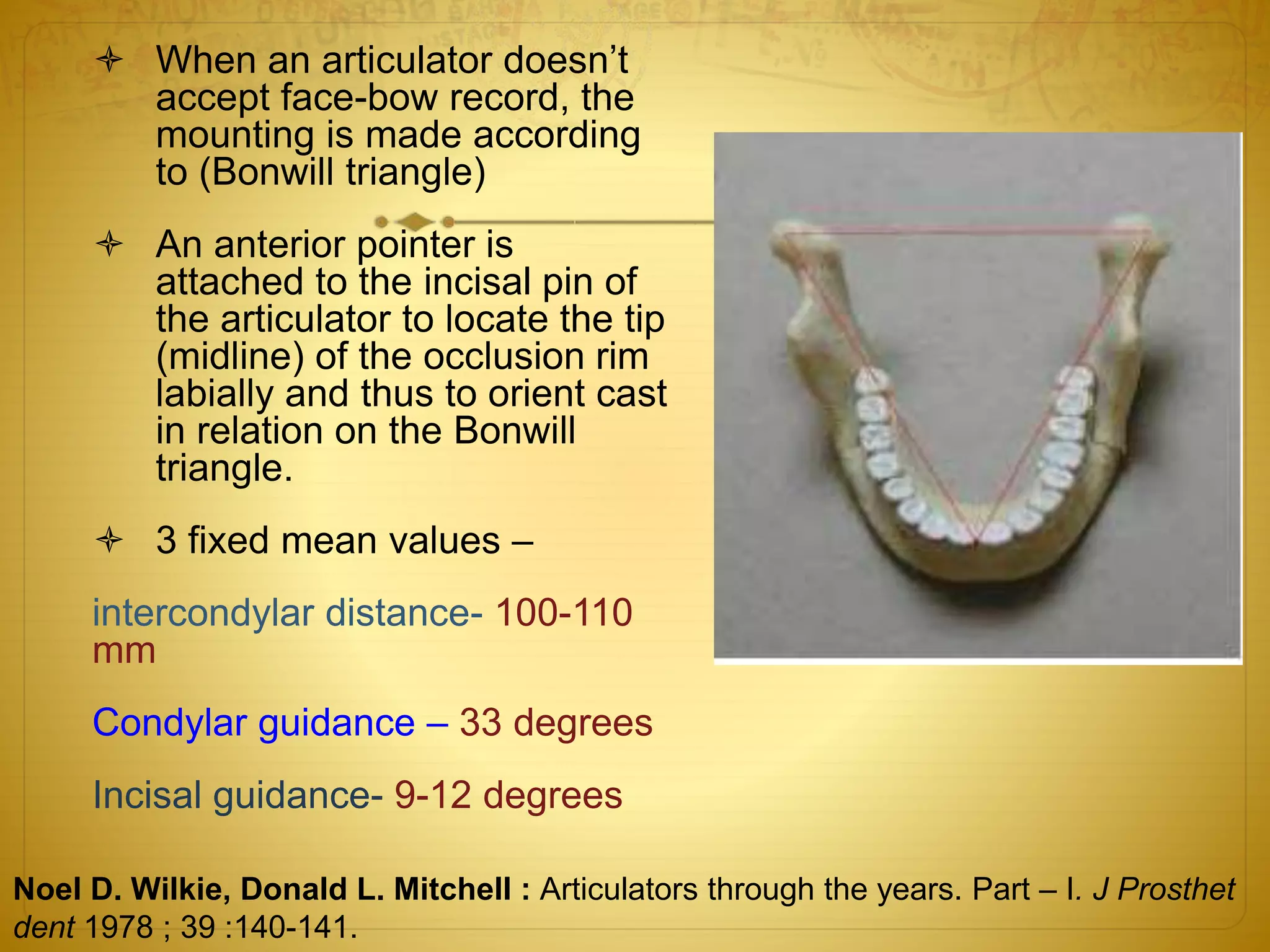
 When an articulator doesn’t
accept face-bow record, the
mounting is made according
to (Bonwill triangle)
 An anterior pointer is
attached to the incisal pin of
the articulator to locate the tip
(midline) of the occlusion rim
labially and thus to orient cast
in relation on the Bonwill
triangle.
 3 fixed mean values –
intercondylar distance- 100-110
mm
Condylar guidance – 33 degrees
Incisal guidance- 9-12 degrees
Noel D. Wilkie, Donald L. Mitchell : Articulators through the years. Part – I. J Prosthet
dent 1978 ; 39 :140-141.
Disadvantages:
 Most of these articulators do not accept face-bow
record
 The condylar path moves to a fixed angle and it is
successful in patients whose condylar angle
approximates that of the articulator.
 No lateral movements.
Noel D. Wilkie, Donald L. Mitchell : Articulators through the years. Part – I. J Prosthet
dent 1978 ; 39 :140-141.
Part II
SEMI ADJUSTABLE
ARTICULATORS IN FPD
Semi adjustable articulator
 The semi-adjustable articulator (SAA) plays an important role in
Dentistry, since it allows adequate diagnosis and treatment
planning to promote the oral health of our patients.
 The SAA reduces the intervention of prosthodontists; when well
employed, it simplifies the daily clinical routine, reducing the
number of sessions, chair time and need of interventions in the
patient’s mouth, besides allowing more accurate procedures,
consequently without damages to the stomatognathic system.
Semi-adjustable articulators
Fabrício nesi1, lísia emi nishimori2, cleverson de oliveira e silva3, fabiano carlos marson4, sergio sábio5, giovani de
oliveira corrêa6*
Jscd vol.1,n.1,pp.14-21 (Apr – jun 2014)
 As mentioned by Shavel, “a dentist can do a full-mouth rehab case
on a semi-adjustable articulator as long as he has a fully adjustable
brain”.
 SAA may also be divided into
-ArCon (condyles on the lower member, e.g. Whip-Mix, Denar, Bio-Art,
Gnatus, etc.) or
-non-ArCon (condyles on the upper member, e.g. Dentatus, Hanau).
Semi-adjustable articulators
Fabrício nesi1, lísia emi nishimori2, cleverson de oliveira e silva3, fabiano carlos marson4, sergio sábio5, giovani de
oliveira corrêa6*
Jscd vol.1,n.1,pp.14-21 (Apr – jun 2014)
Articulator parts
Body – central portion to which the members are fixated. Its function is to establish
the bicondylar distance and the distance between the members.
 Members – horizontal extensions on which the mounting guides and plates are
fixated.
 Condylar balls – represent the condyles, with small, medium or large
intercondylar distance.
 Angulation of the glenoid cavity roof – guides the protrusion movements of the
articulator.
 Condylar housing – guides the protrusion movements of the articulator.
 Incisal table – located at the anterior portion of the lower member; provides
support to the incisal pin.
Semi-adjustable articulators
Fabrício nesi1, lísia emi nishimori2, cleverson de oliveira e silva3, fabiano carlos marson4, sergio sábio5, giovani de
oliveira corrêa6*
Jscd vol.1,n.1,pp.14-21 (Apr – jun 2014)
Incisal pin – is supported on the incisal table and maintains the height between the
members.
Mounting plates – receive application of plaster for fixation of dental casts to the
articulator.
Facebow – accessory device employed for mounting of the maxillary dental cast in
the articulator and establishment of intercondylar distance (S, M, L).
Semi-adjustable articulators
Fabrício nesi1, lísia emi nishimori2, cleverson de oliveira e silva3, fabiano carlos marson4, sergio sábio5, giovani de
oliveira corrêa6*
Jscd vol.1,n.1,pp.14-21 (Apr – jun 2014)
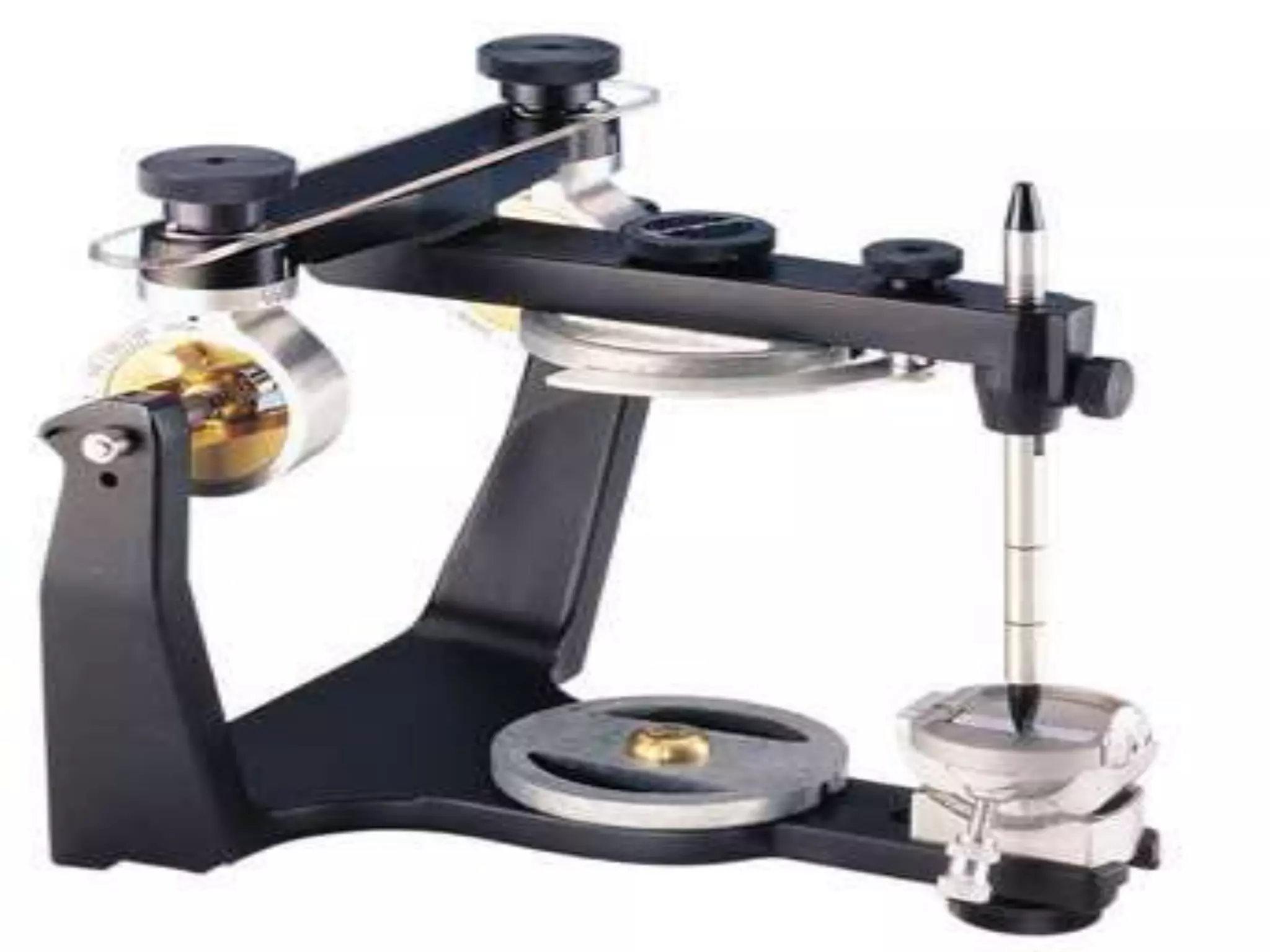
HANAU wide vue
ARCON ARTICULATOR
Condylar guidance
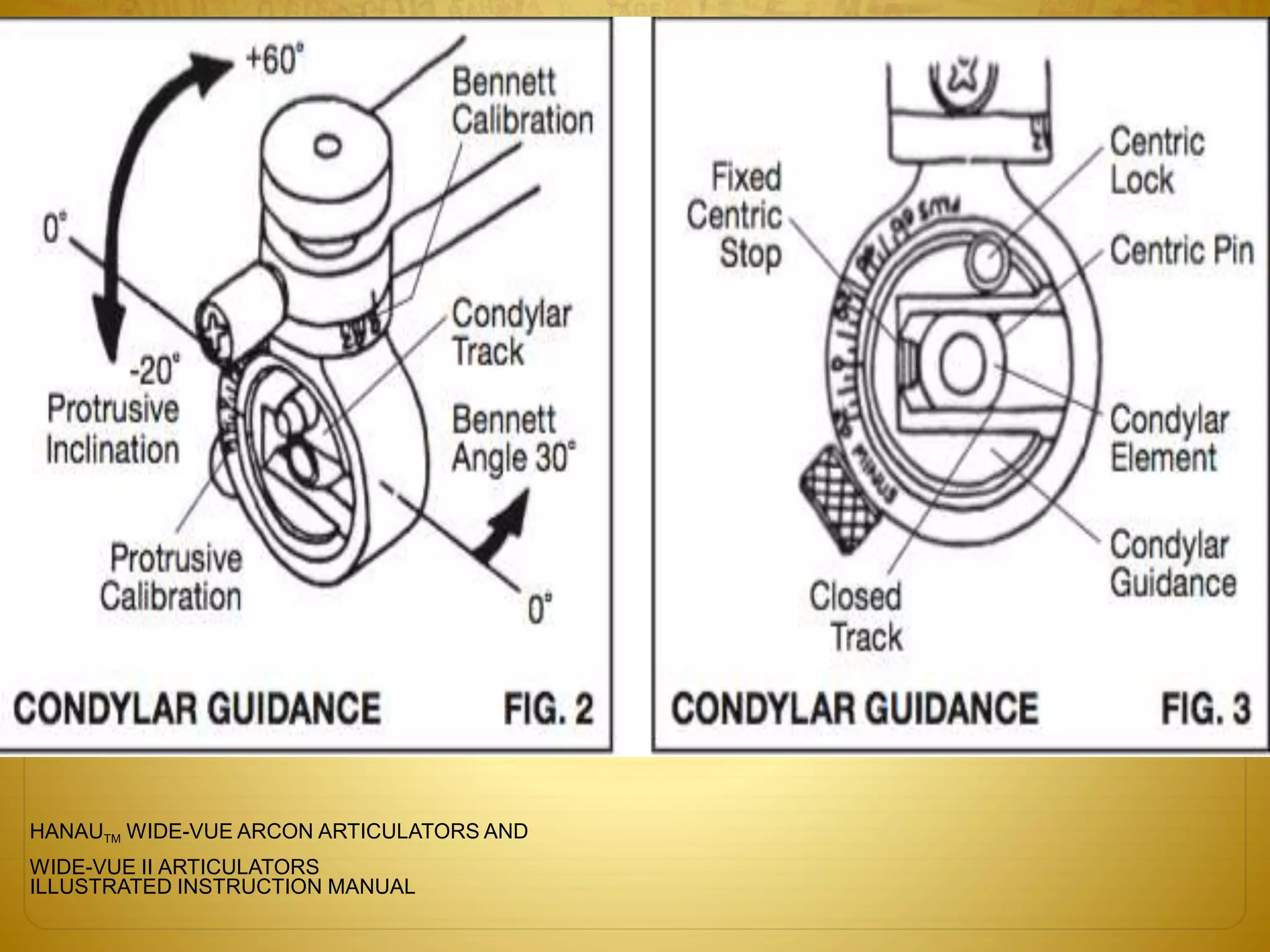
 The Condylar Guidances are the control centers of the
Articulator and they adjustably assimilate the multiple
function of the glenoid fossa.
 The Condylar Track may be adjustably inclined on the
horizontal transverse axis from a “zero” to a plus 60 degree
or to a minus 20 degree. These inclinations are termed the
protrusive inclination and simulate the patient’s superior
wall of the fossa.
 The Condylar Track may also be adjusted on the vertical
axis from a “zero” sagittal to 30. This angle is termed the
progressive Bennett angle and corresponds to the medial
wall of the patient’s fossa.
HANAUTM WIDE-VUE ARCON ARTICULATORS AND
WIDE-VUE II ARTICULATORS
HANAUTM WIDE-VUE ARCON ARTICULATORS AND
WIDE-VUE II ARTICULATORS
ILLUSTRATED INSTRUCTION MANUAL
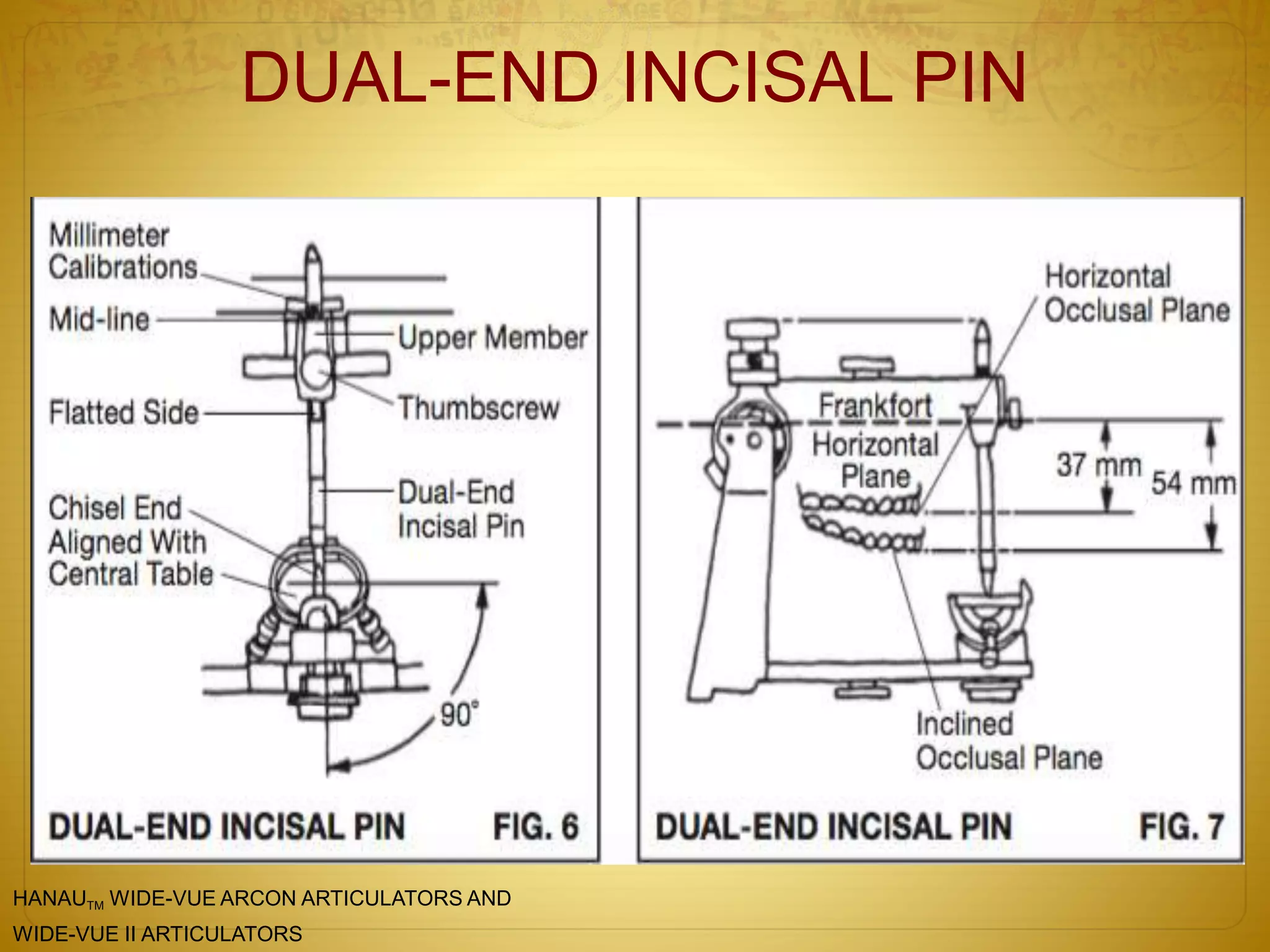
DUAL-END INCISAL PIN
 The Incisal Pin serves as the forward control of the
Articulator. It cooperatively maintains a vertical stop
and provides a stylus contact for the excursive
movements of the Articulator against the various
inclined guiding surfaces of the Incisal Guide.
 A mid-line groove is cut in the Incisal Pin about one
inch from the spherical tip. Five additional lines
calibrated in millimeters extend on either side thereof.
These lines are used for recording or altering the
vertical dimension.
HANAUTM WIDE-VUE ARCON ARTICULATORS AND
WIDE-VUE II ARTICULATORS
DUAL-END INCISAL PIN
HANAUTM WIDE-VUE ARCON ARTICULATORS AND
WIDE-VUE II ARTICULATORS
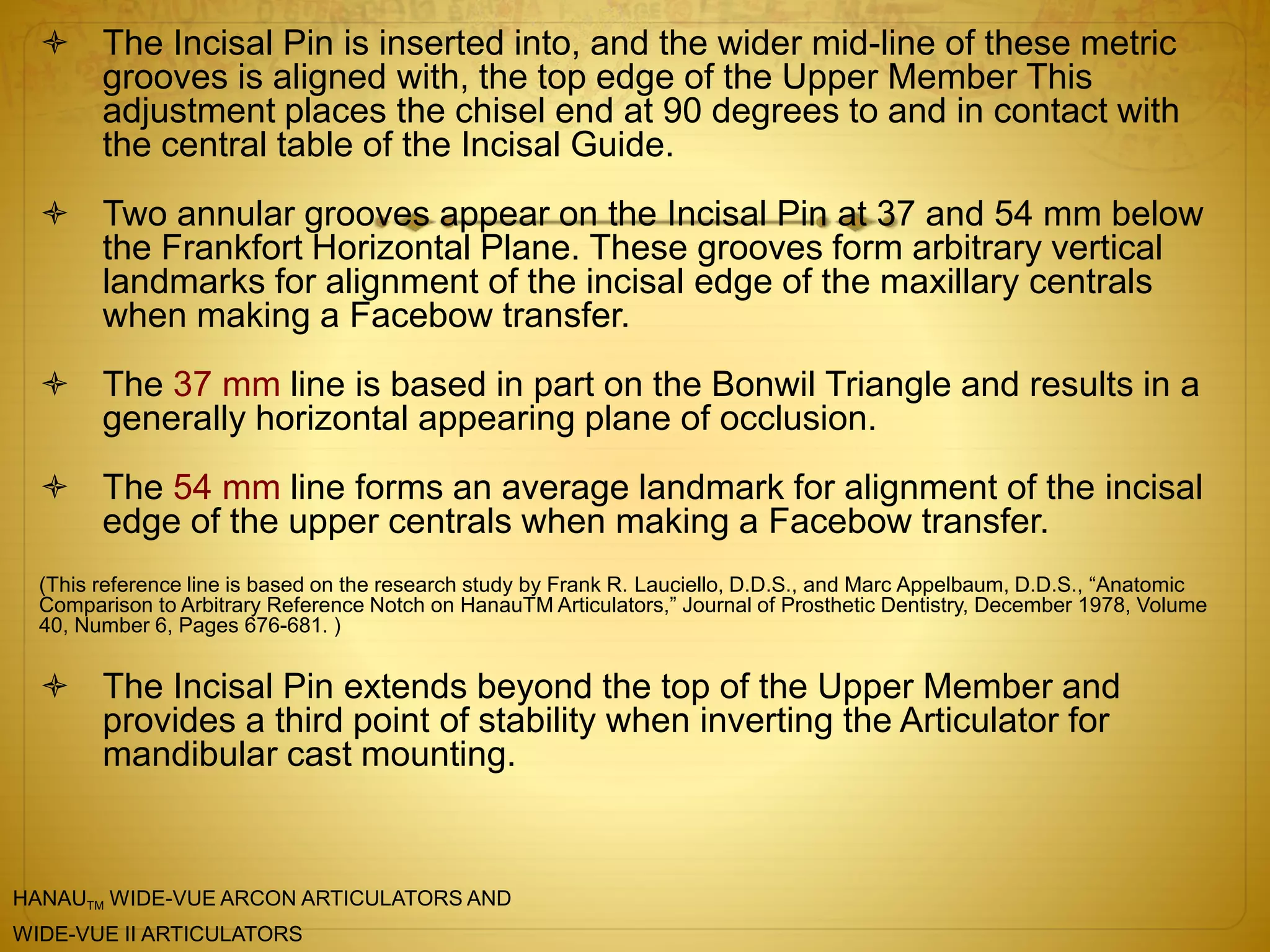
 The Incisal Pin is inserted into, and the wider mid-line of these metric
grooves is aligned with, the top edge of the Upper Member This
adjustment places the chisel end at 90 degrees to and in contact with
the central table of the Incisal Guide.
 Two annular grooves appear on the Incisal Pin at 37 and 54 mm below
the Frankfort Horizontal Plane. These grooves form arbitrary vertical
landmarks for alignment of the incisal edge of the maxillary centrals
when making a Facebow transfer.
 The 37 mm line is based in part on the Bonwil Triangle and results in a
generally horizontal appearing plane of occlusion.
 The 54 mm line forms an average landmark for alignment of the incisal
edge of the upper centrals when making a Facebow transfer.
(This reference line is based on the research study by Frank R. Lauciello, D.D.S., and Marc Appelbaum, D.D.S., “Anatomic
Comparison to Arbitrary Reference Notch on HanauTM Articulators,” Journal of Prosthetic Dentistry, December 1978, Volume
40, Number 6, Pages 676-681. )
 The Incisal Pin extends beyond the top of the Upper Member and
provides a third point of stability when inverting the Articulator for
mandibular cast mounting.
HANAUTM WIDE-VUE ARCON ARTICULATORS AND
WIDE-VUE II ARTICULATORS
ADJUSTABLE INCISAL GUIDE
 The Adjustable Incisal Guide provides an independent adjustment
of anterior guidance. It cooperates with the Incisal Pin and
Condylar Guidances to present a stable, three-dimensional
programmed guide pattern for the mounted casts.
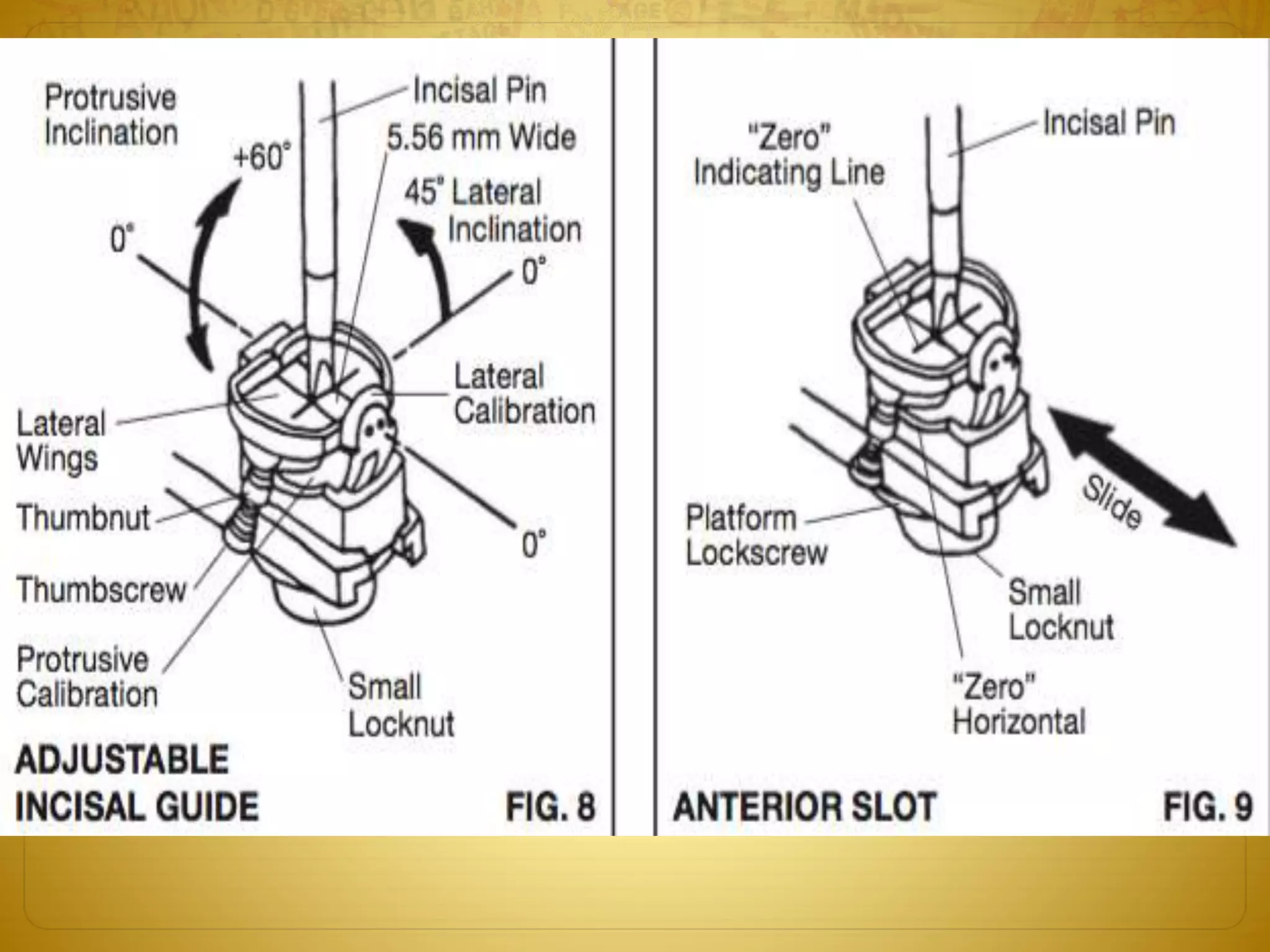
 The Incisal Guide rotates antero-posteriorly from a horizontal
“zero” degree to a 60 degree positive inclination of protrusion
.The central guiding table is 5.56 mm wide and forms the inclined
surface for the protrusive guidance of the Incisal Pin.
 Separately adjustable Lateral Wings elevate by a Thumbscrew
from a “zero” horizontal to a 45 degree incline
 An anterior slot, in the Lower Member, allows repositioning of the
Incisal Guide.
 This adjustment will place the Incisal Pin contact on the rotational
center of the Guide, thereby maintaining the vertical dimension
when adjusting the inclination for protrusion.
HANAUTM WIDE-VUE ARCON ARTICULATORS AND
WIDE-VUE II ARTICULATORS
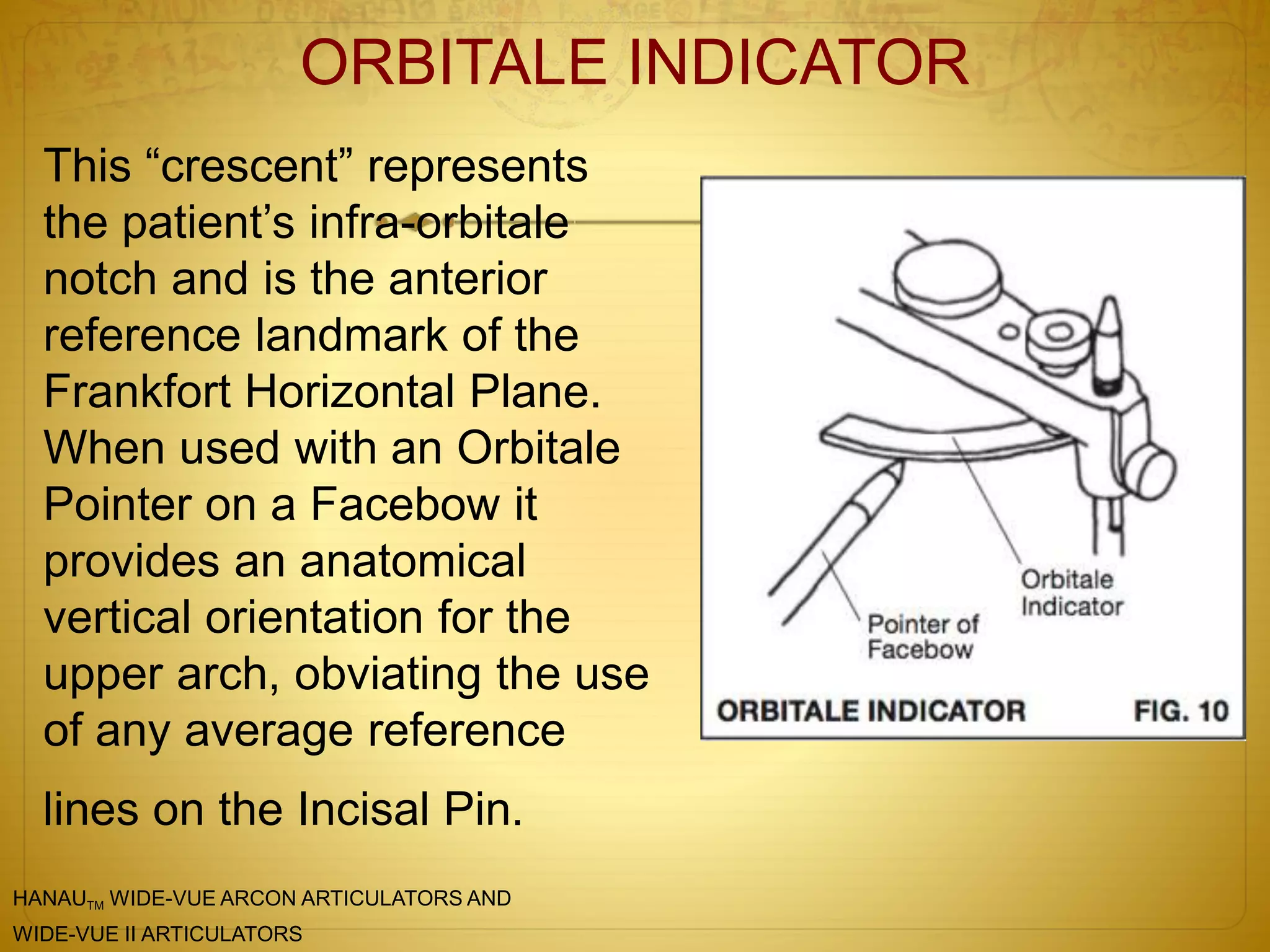
ORBITALE INDICATOR
This “crescent” represents
the patient’s infra-orbitale
notch and is the anterior
reference landmark of the
Frankfort Horizontal Plane.
When used with an Orbitale
Pointer on a Facebow it
provides an anatomical
vertical orientation for the
upper arch, obviating the use
of any average reference
lines on the Incisal Pin.
HANAUTM WIDE-VUE ARCON ARTICULATORS AND
WIDE-VUE II ARTICULATORS
Uses of the articulator
 Orientation of the Maxillary Cast.
 Centric Relation Record
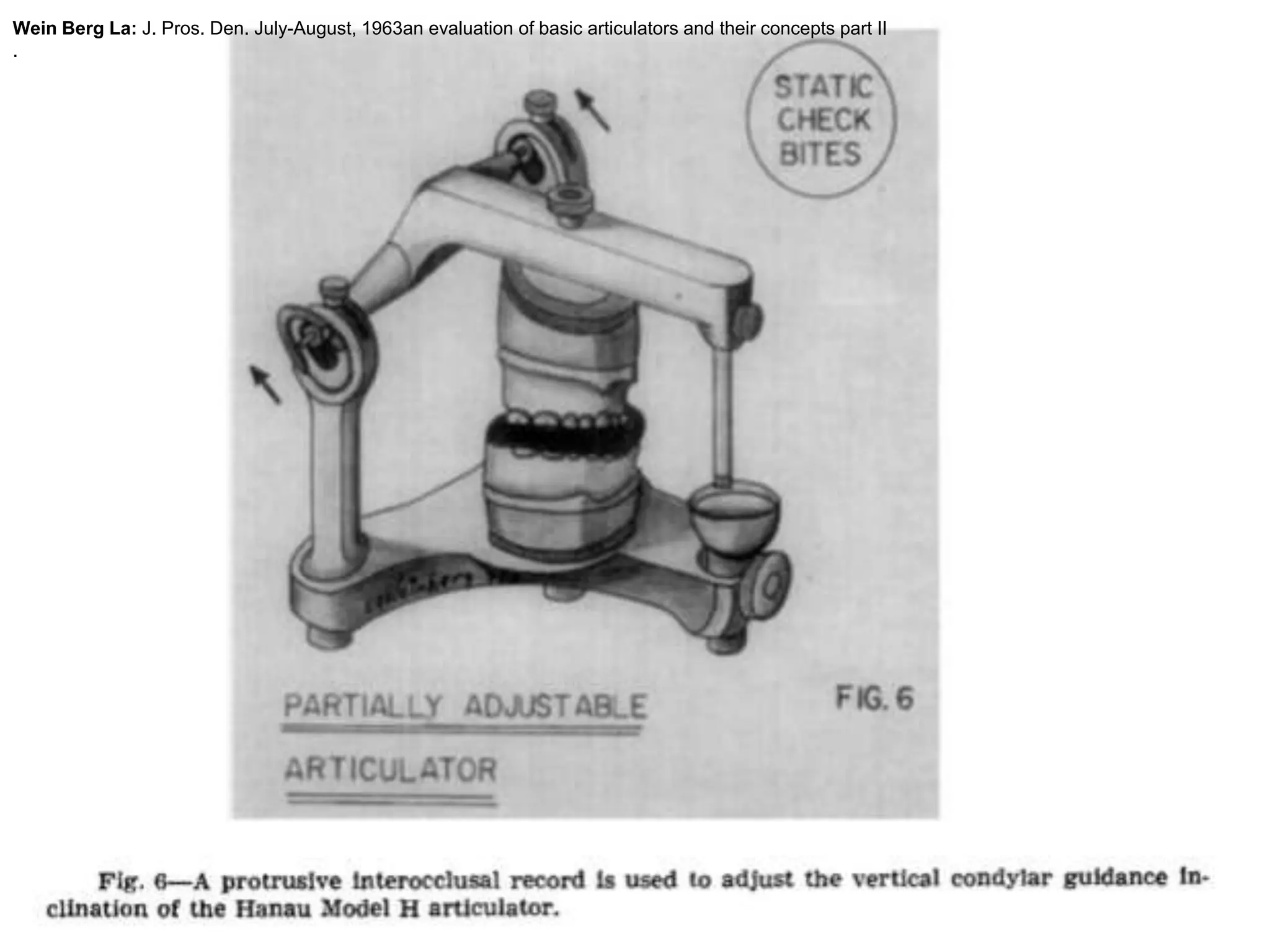
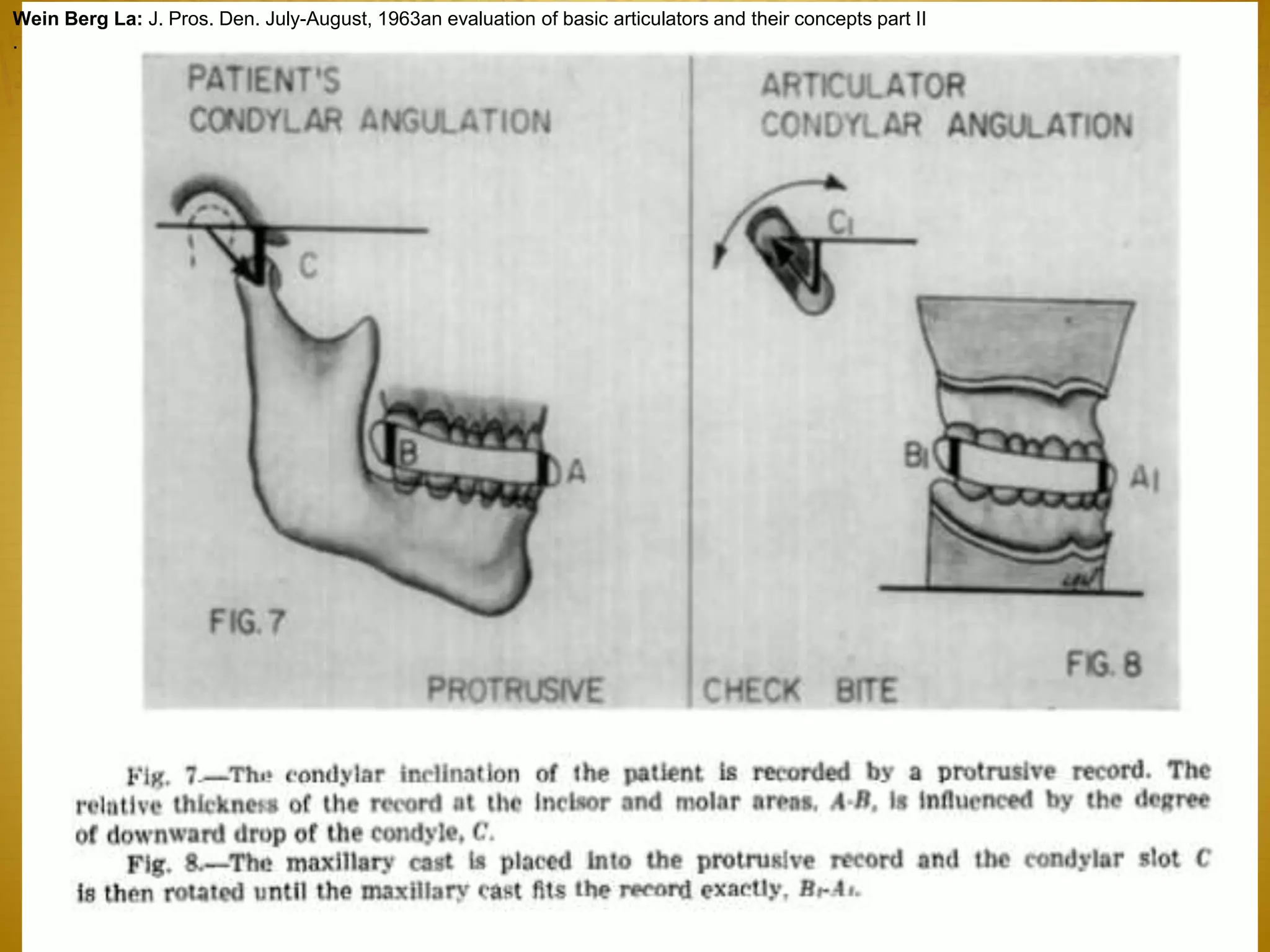
 Protrusive records (figure 6,7,8)
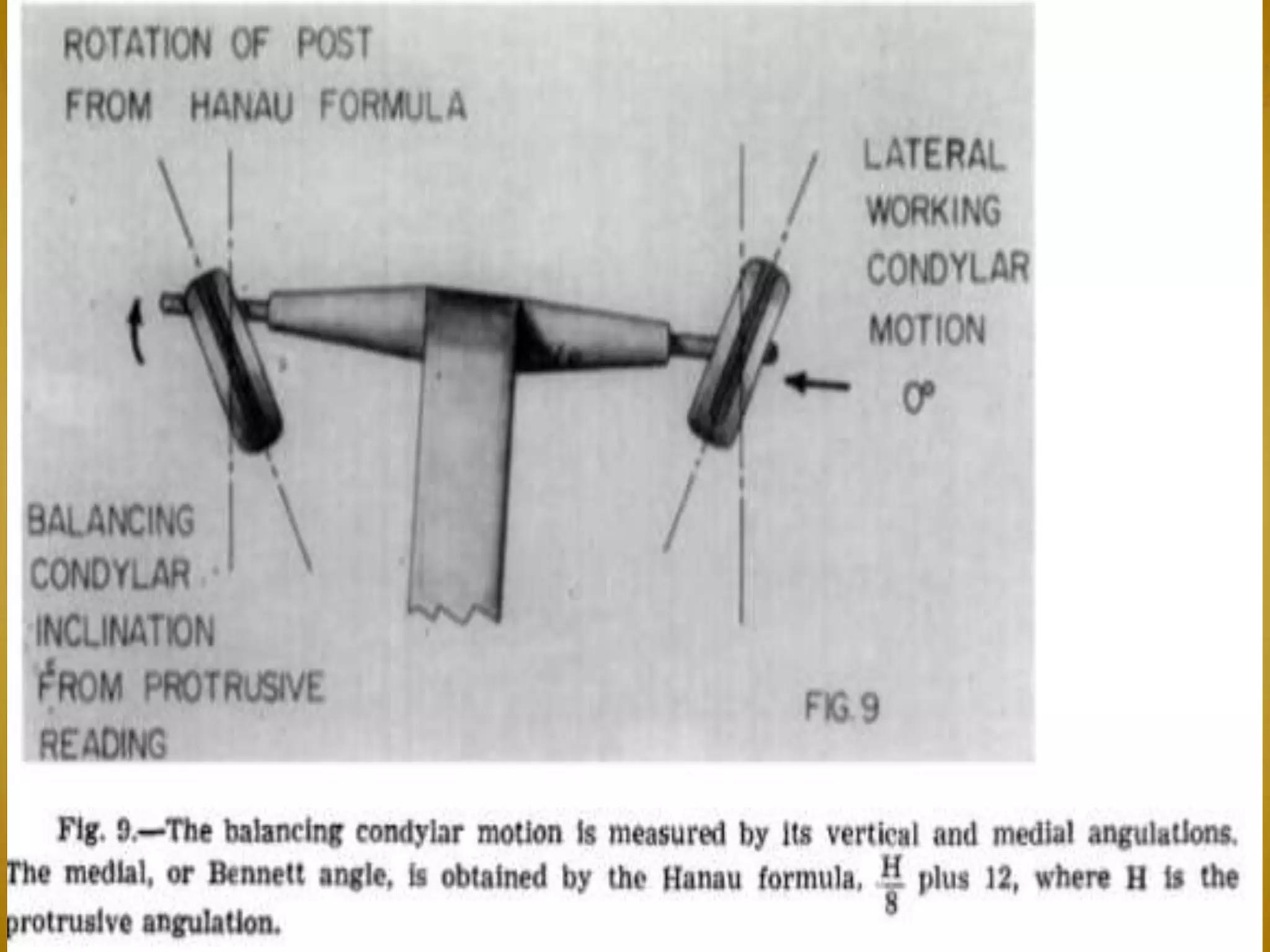
 Balancing condylar motion (figure 9)
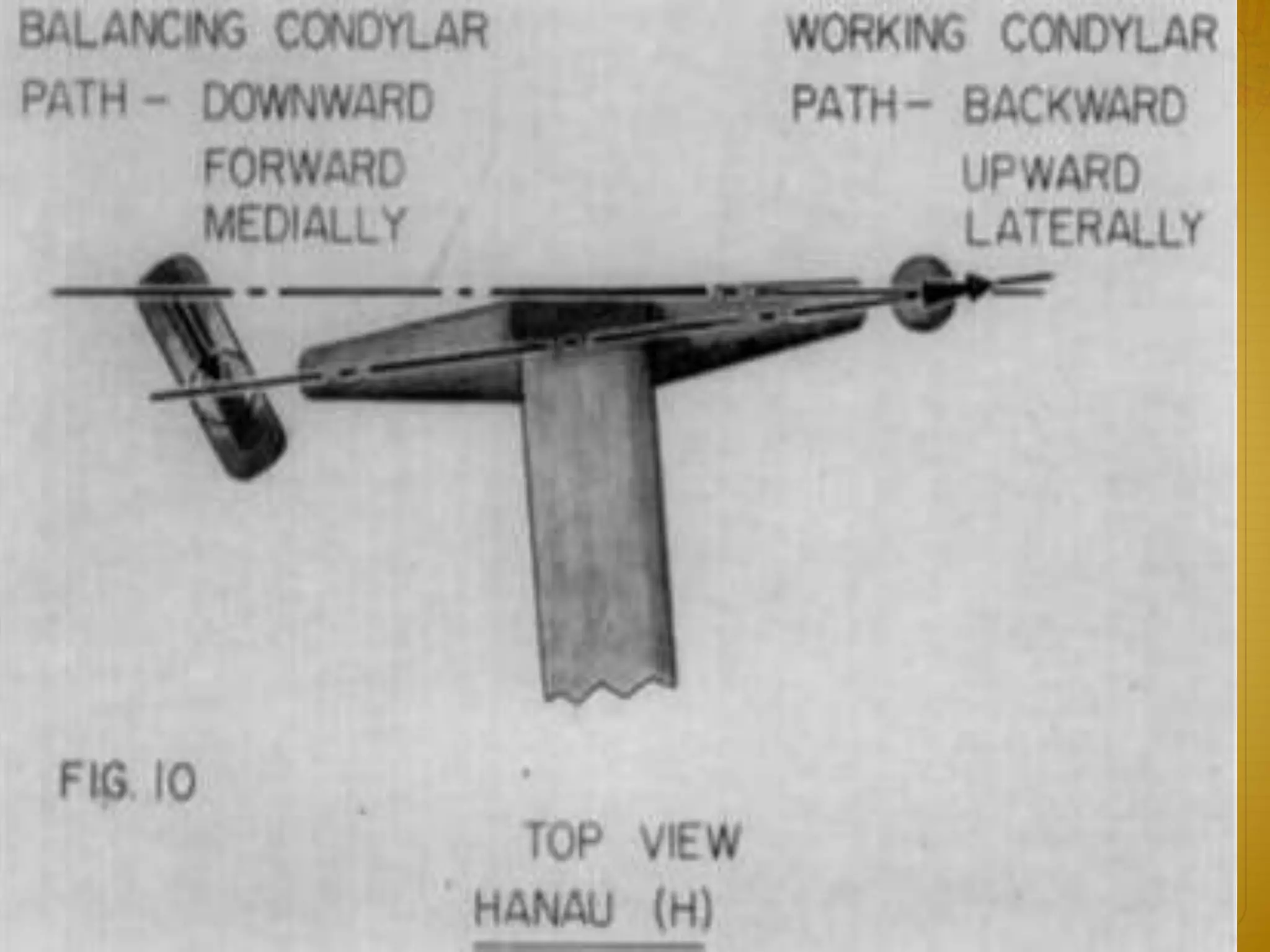
 Working condylar motion (figure 10)
 Border movements of the instrument- (greater the
bennett angle, more is the lateral shift)
Wein Berg La: J. Pros. Den. July-August, 1963an evaluation of basic articulators and
their concepts part II
Wein Berg La: J. Pros. Den. July-August, 1963an evaluation of basic articulators and their concepts part II
.
Wein Berg La: J. Pros. Den. July-August, 1963an evaluation of basic articulators and their concepts part II
.
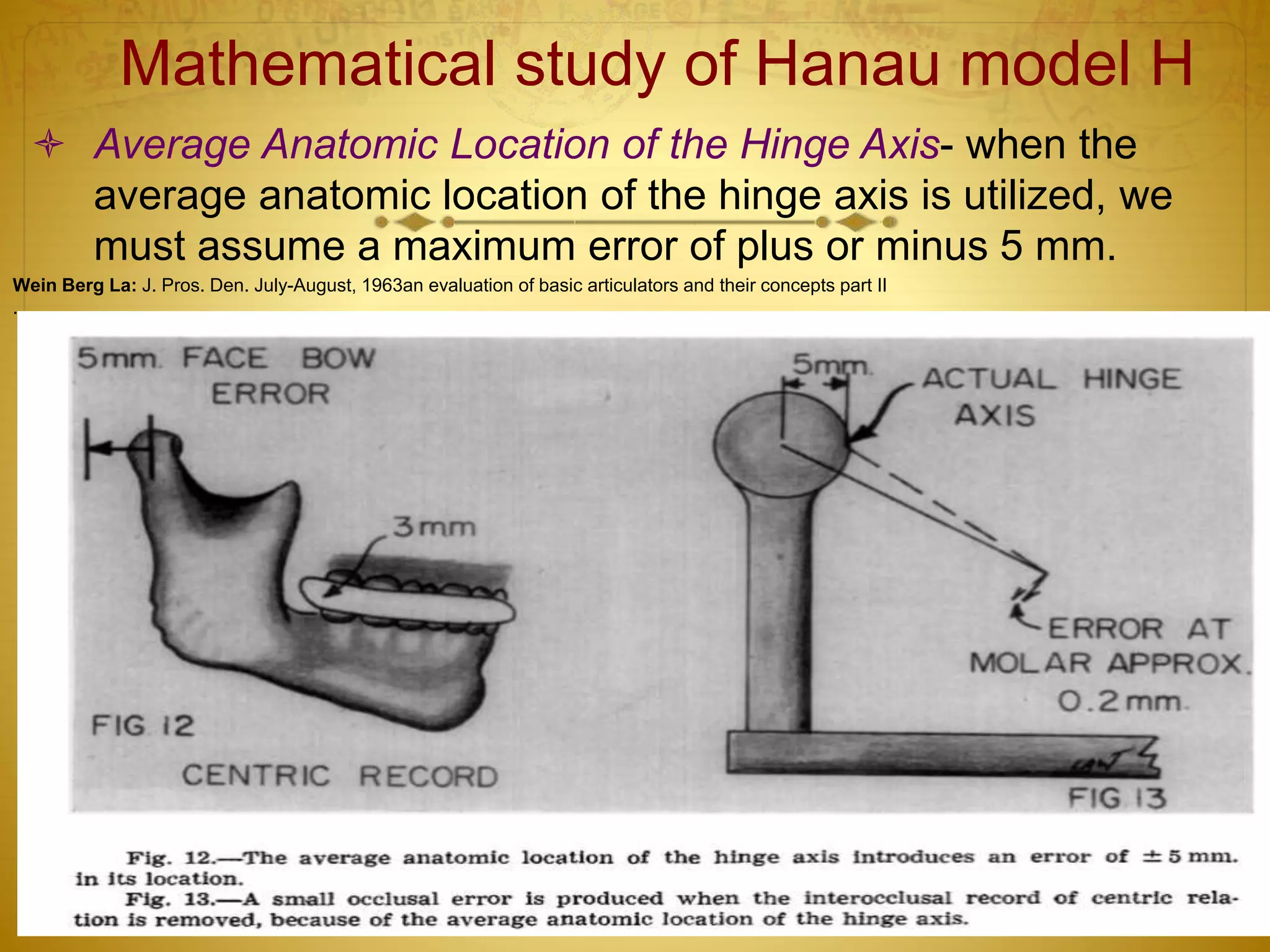
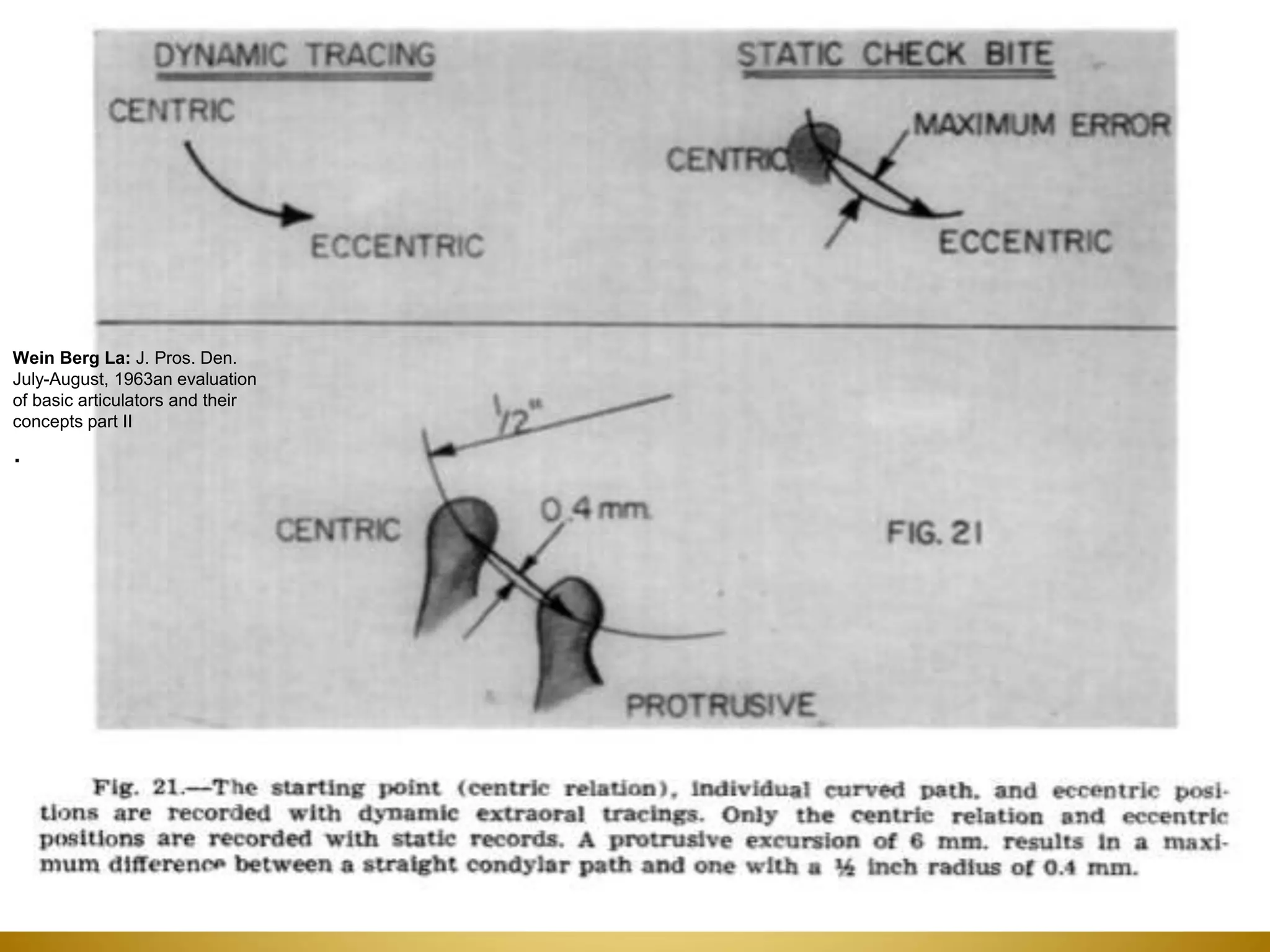
Mathematical study of Hanau model H
 Average Anatomic Location of the Hinge Axis- when the
average anatomic location of the hinge axis is utilized, we
must assume a maximum error of plus or minus 5 mm.
Wein Berg La: J. Pros. Den. July-August, 1963an evaluation of basic articulators and their concepts part II
.
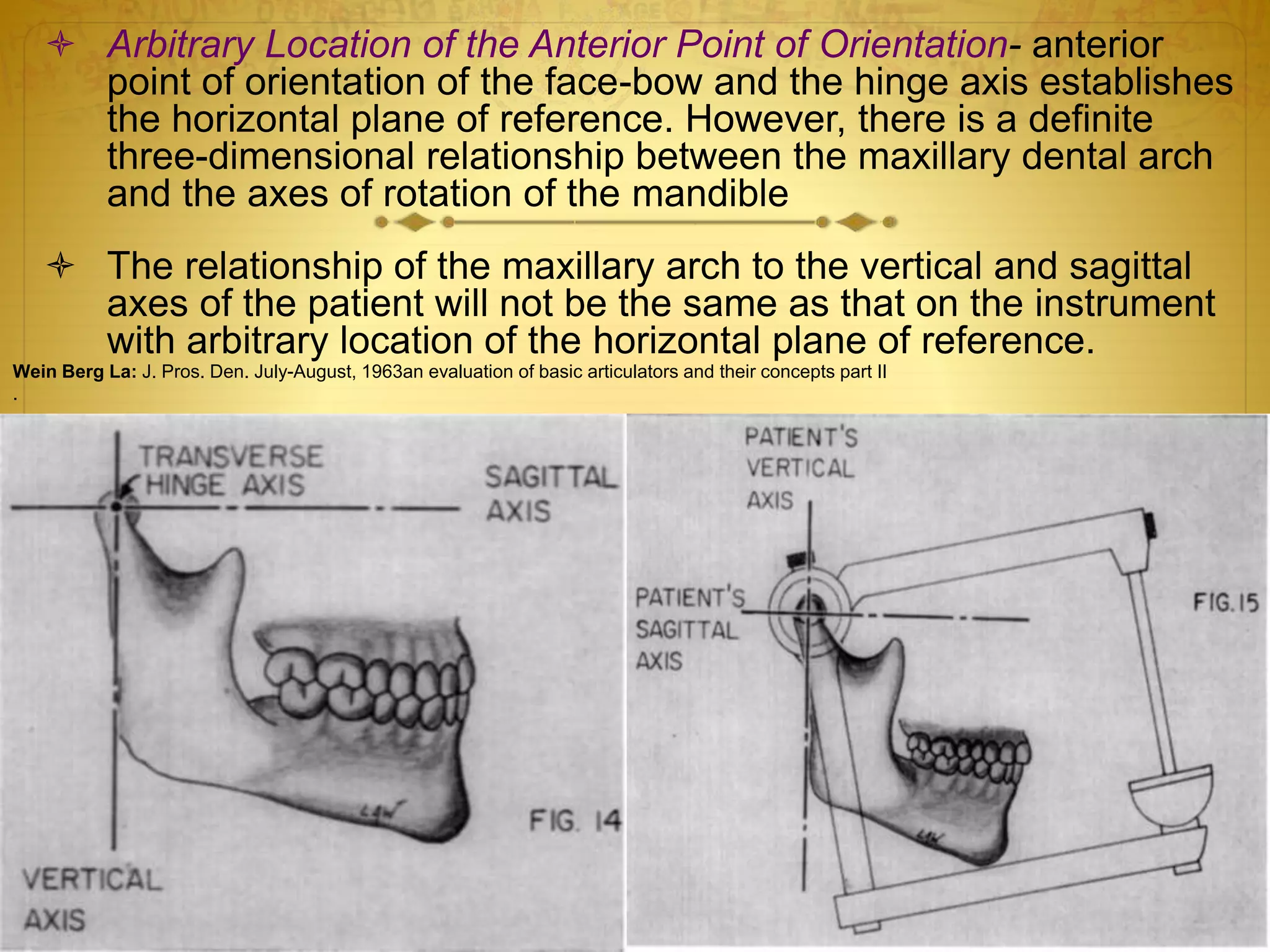
 Arbitrary Location of the Anterior Point of Orientation- anterior
point of orientation of the face-bow and the hinge axis establishes
the horizontal plane of reference. However, there is a definite
three-dimensional relationship between the maxillary dental arch
and the axes of rotation of the mandible
 The relationship of the maxillary arch to the vertical and sagittal
axes of the patient will not be the same as that on the instrument
with arbitrary location of the horizontal plane of reference.
Wein Berg La: J. Pros. Den. July-August, 1963an evaluation of basic articulators and their concepts part II
.
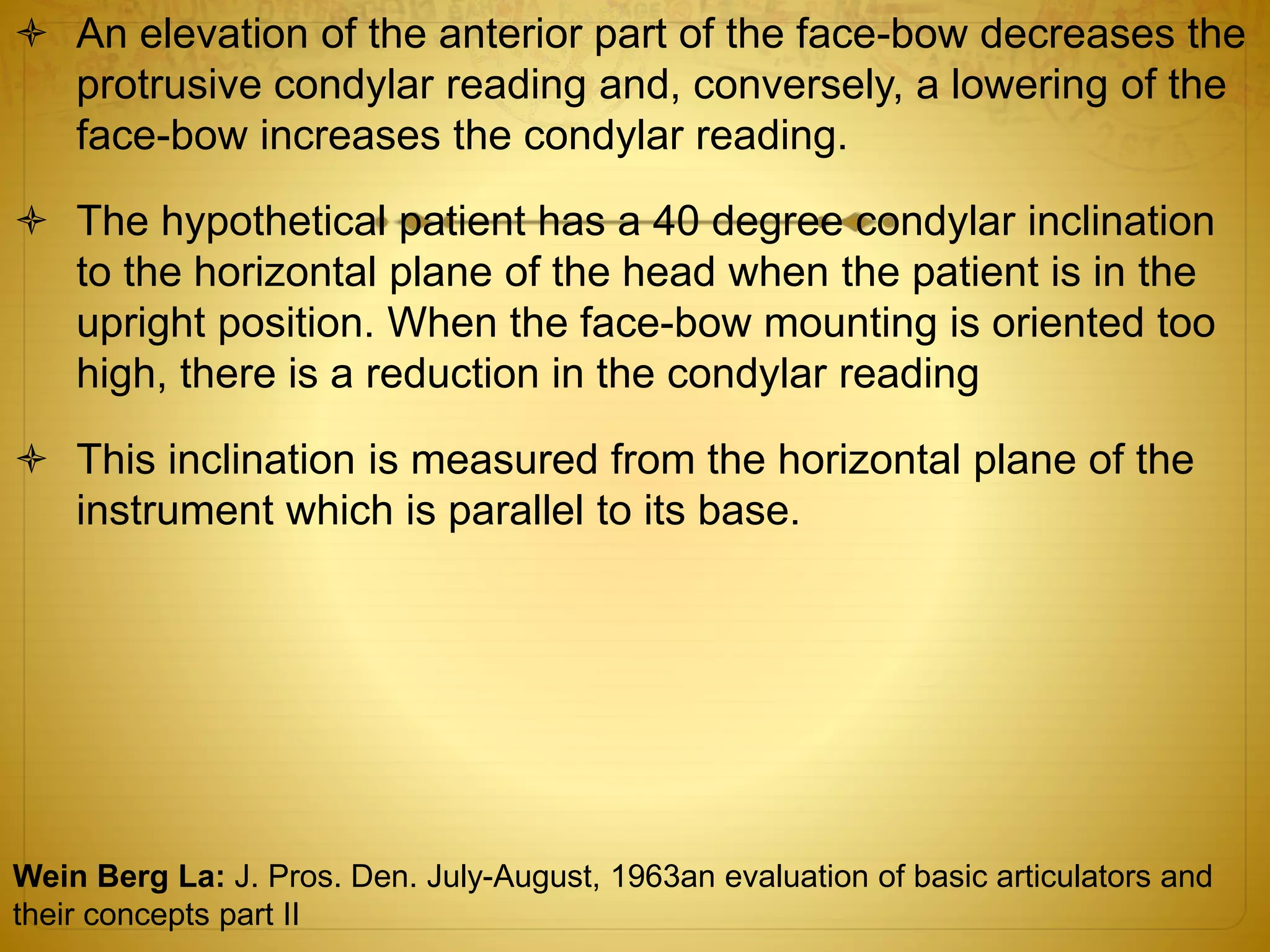
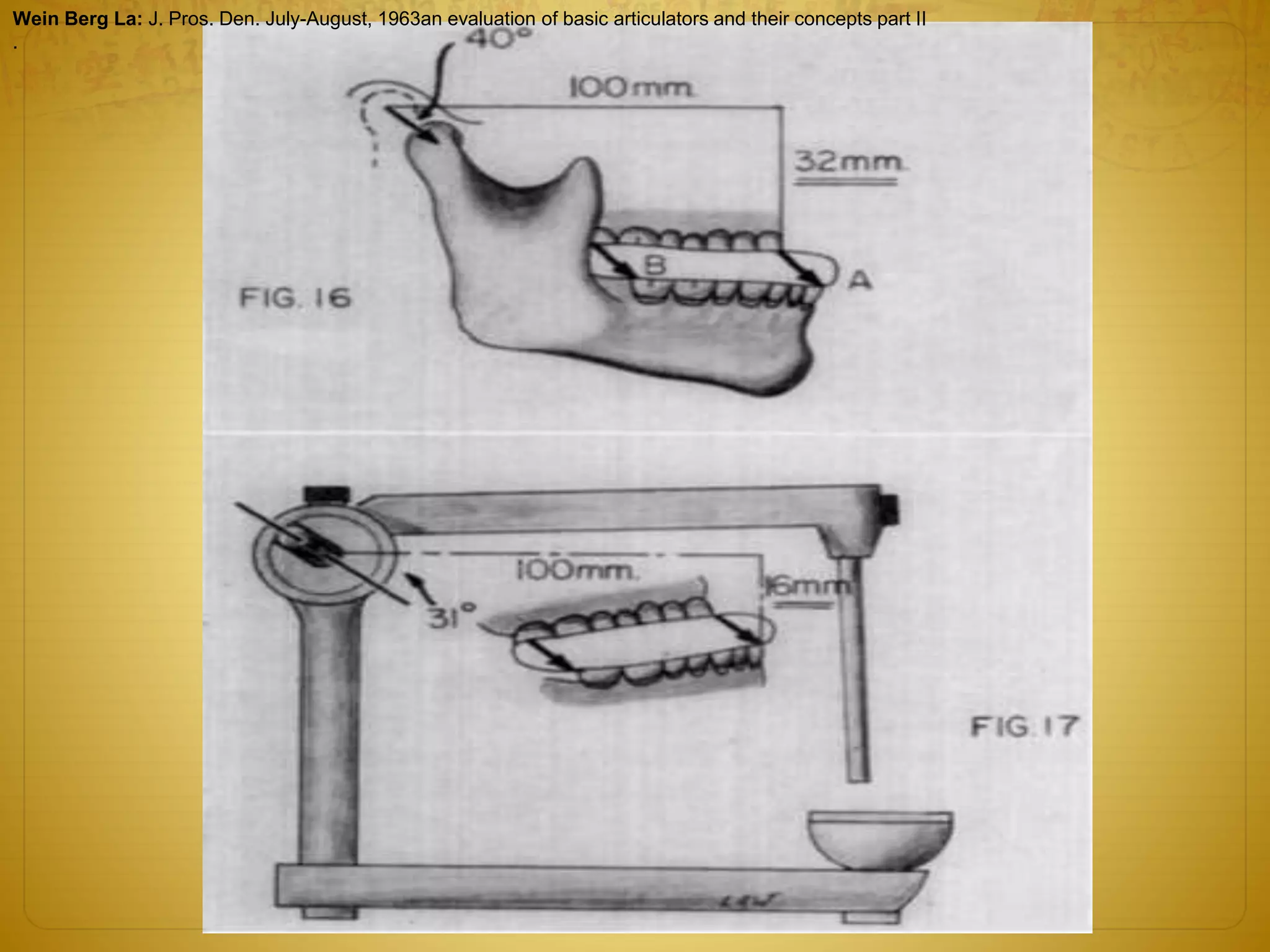
 An elevation of the anterior part of the face-bow decreases the
protrusive condylar reading and, conversely, a lowering of the
face-bow increases the condylar reading.
 The hypothetical patient has a 40 degree condylar inclination
to the horizontal plane of the head when the patient is in the
upright position. When the face-bow mounting is oriented too
high, there is a reduction in the condylar reading
 This inclination is measured from the horizontal plane of the
instrument which is parallel to its base.
Wein Berg La: J. Pros. Den. July-August, 1963an evaluation of basic articulators and
their concepts part II
Wein Berg La: J. Pros. Den. July-August, 1963an evaluation of basic articulators and their concepts part II
.
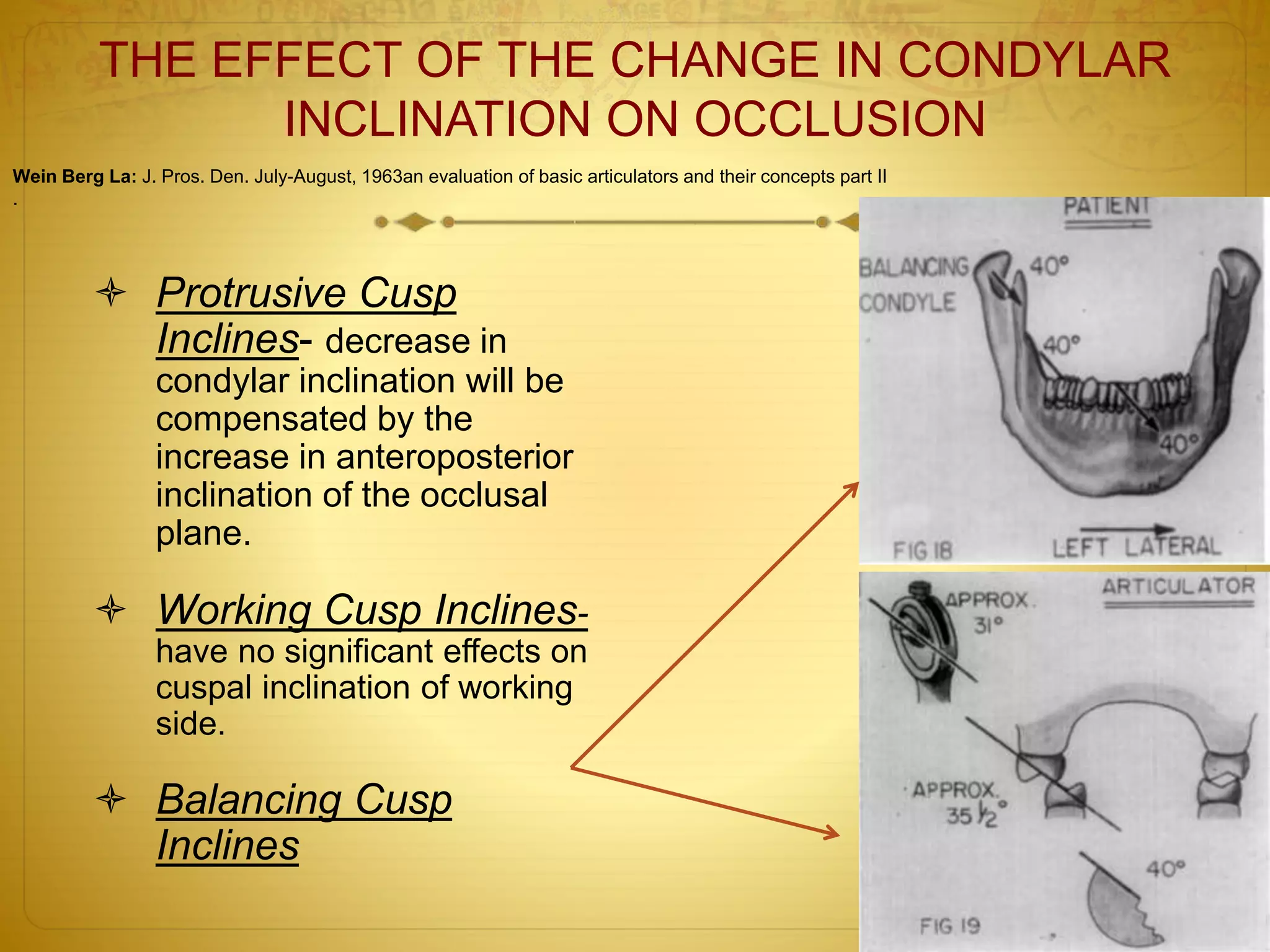
THE EFFECT OF THE CHANGE IN CONDYLAR
INCLINATION ON OCCLUSION
 Protrusive Cusp
Inclines- decrease in
condylar inclination will be
compensated by the
increase in anteroposterior
inclination of the occlusal
plane.
 Working Cusp Inclines-
have no significant effects on
cuspal inclination of working
side.
 Balancing Cusp
Inclines
Wein Berg La: J. Pros. Den. July-August, 1963an evaluation of basic articulators and their concepts part II
.
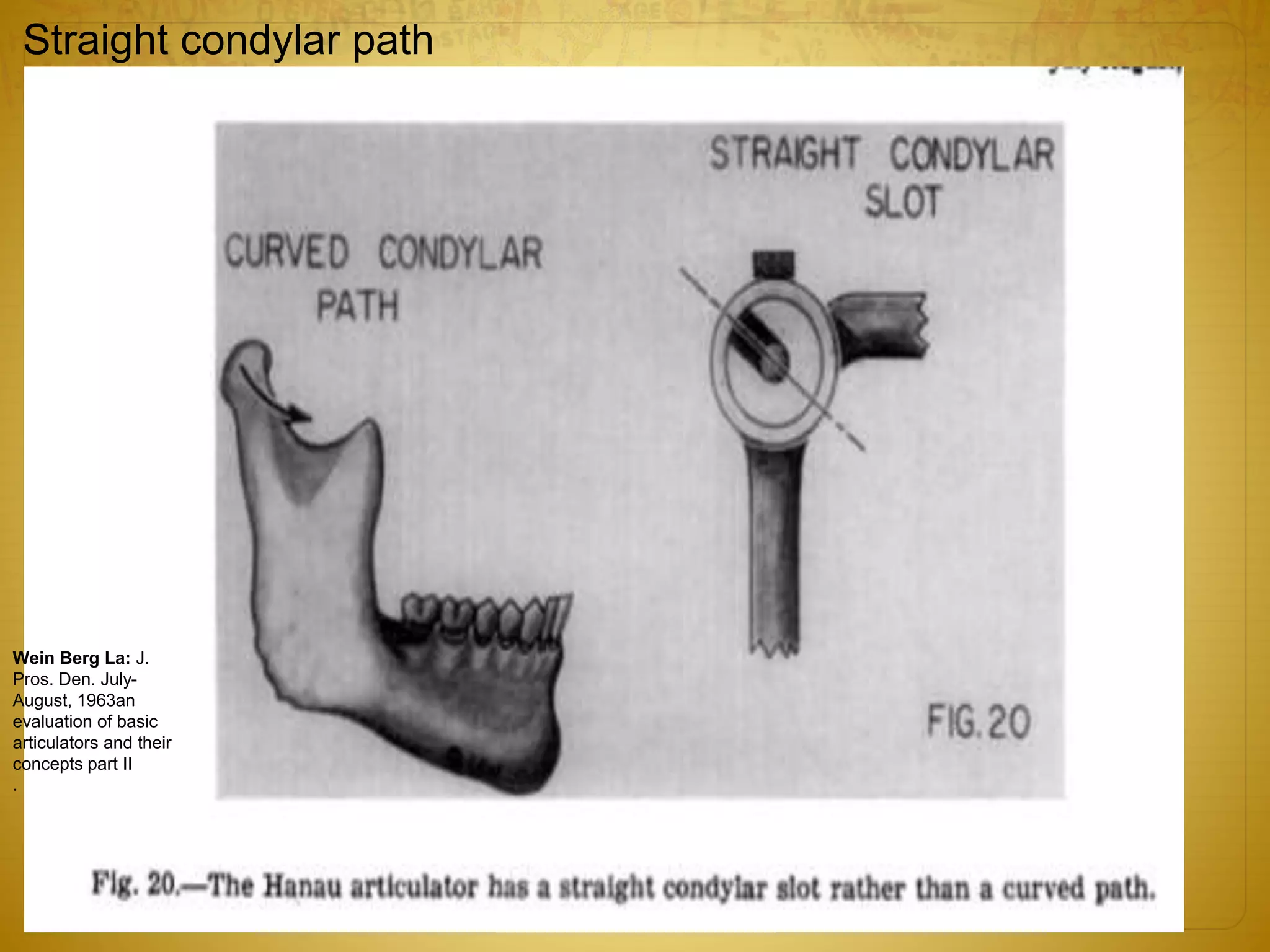
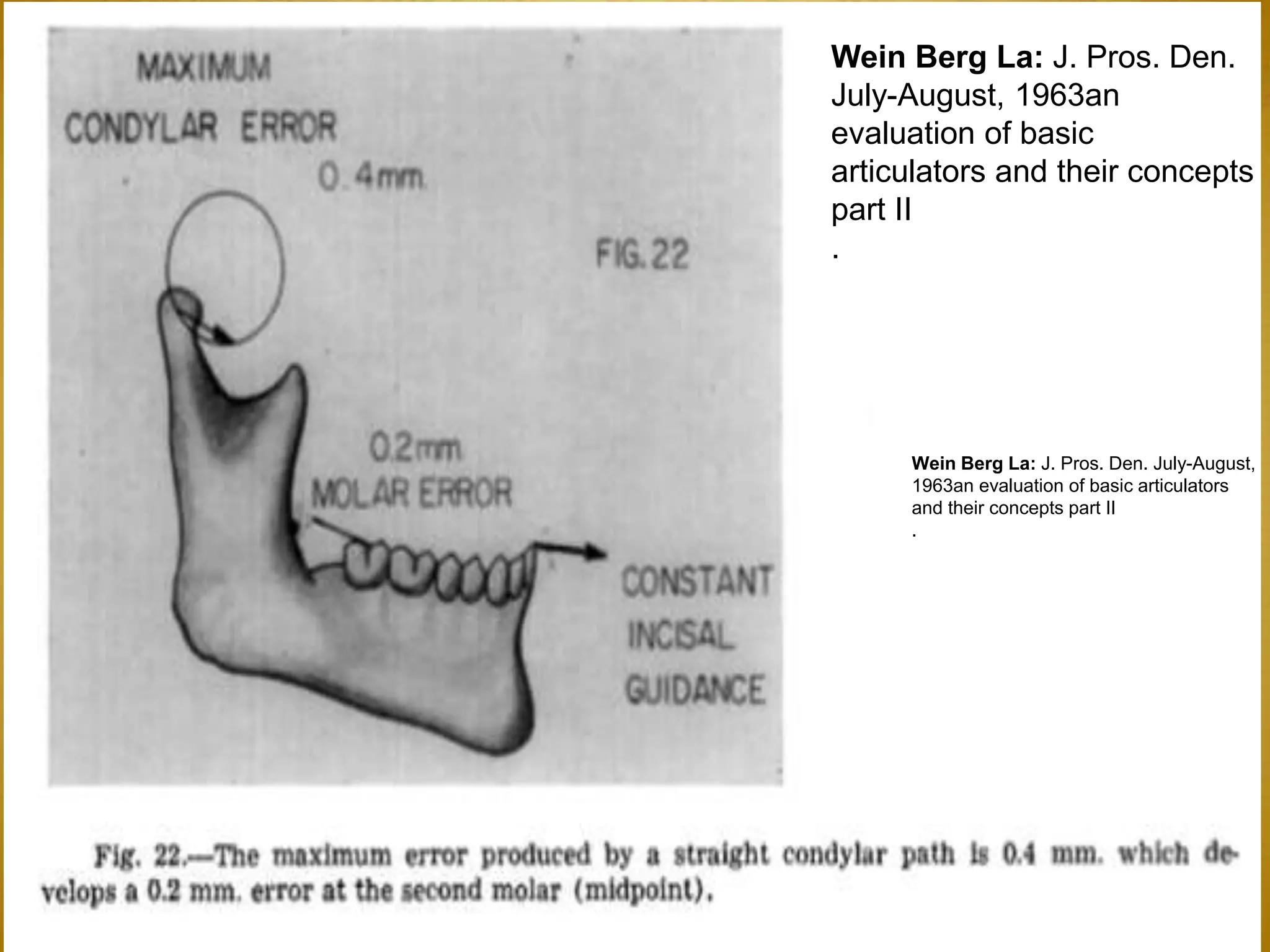
Straight condylar path
Wein Berg La: J.
Pros. Den. July-
August, 1963an
evaluation of basic
articulators and their
concepts part II
.
Wein Berg La: J. Pros. Den.
July-August, 1963an evaluation
of basic articulators and their
concepts part II
.
Wein Berg La: J. Pros. Den.
July-August, 1963an
evaluation of basic
articulators and their concepts
part II
.
Wein Berg La: J. Pros. Den. July-August,
1963an evaluation of basic articulators
and their concepts part II
.
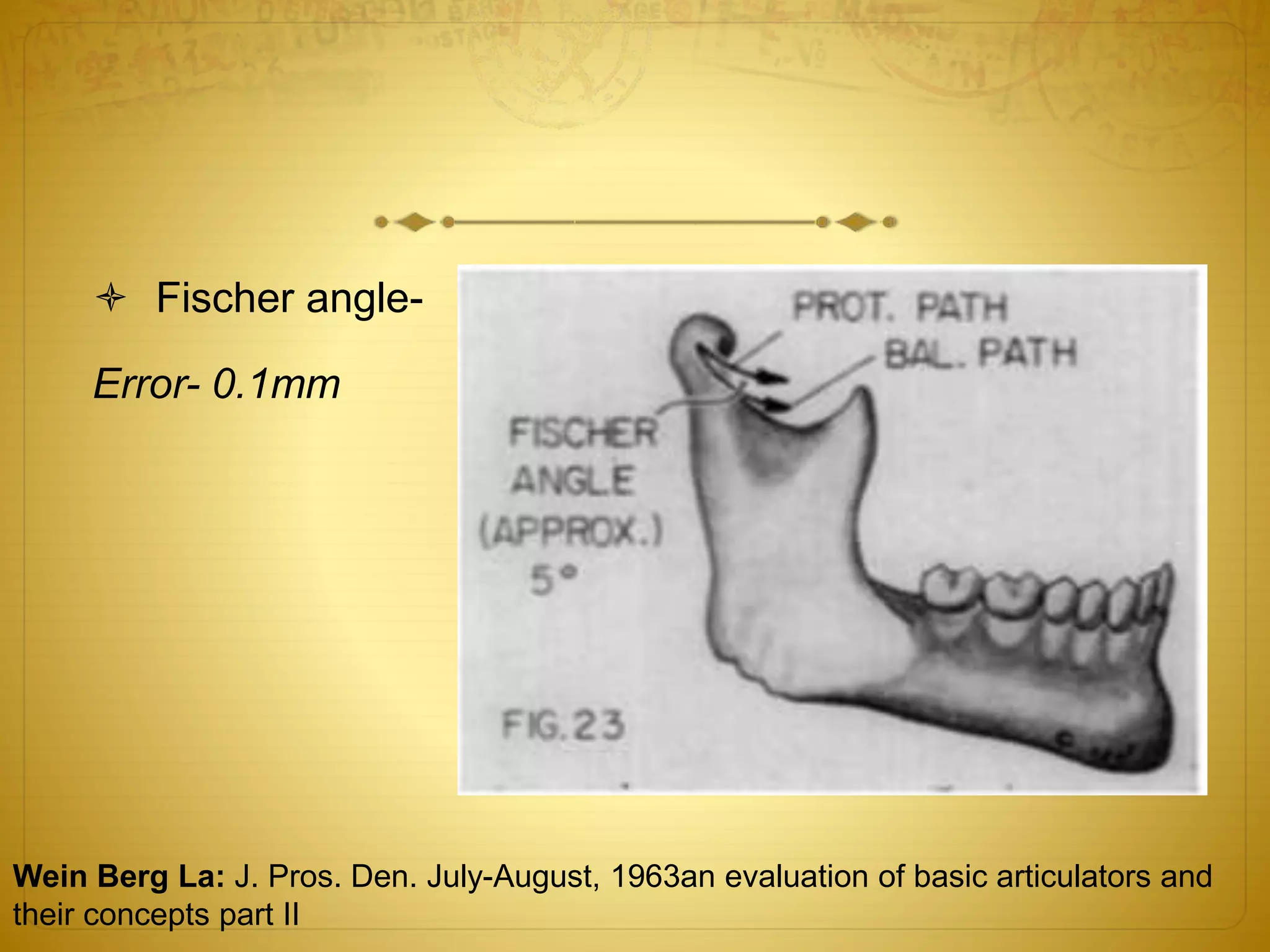
 Fischer angle-
Error- 0.1mm
Wein Berg La: J. Pros. Den. July-August, 1963an evaluation of basic articulators and
their concepts part II
Working positions: centric relation (CR) and
maximum intercuspation (MI)
 When fixed dentures or single-tooth restorations are fabricated and there
is occlusal stability, the maximum intercuspation position (MI) of the
patient may be considered for recording and for the prosthesis.
 In cases of extensive oral rehabilitation, with periodontal problems or
loss of occlusion dimension, the occlusal stability may be absent or the
occlusion may interfere with the health of the stomatognathic system.
 These cases require utilization of condylar positioning for establishment
of the working position. This condylar position is the centric relation
(CR); after being adopted as working position, it should be harmonious
with the dental relationship.
Semi-adjustable articulators
Fabrício nesi1, lísia emi nishimori2, cleverson de oliveira e silva3, fabiano carlos marson4, sergio sábio5, giovani de oliveira corrêa6*
Jscd vol.1,n.1,pp.14-21 (Apr – jun 2014)
Limitations of SAA and their compensations
Semi-adjustable articulators
Fabrício nesi1, lísia emi nishimori2, cleverson de oliveira e silva3, fabiano carlos marson4,
sergio sábio5, giovani de oliveira corrêa6*
Jscd vol.1,n.1,pp.14-21 (Apr – jun 2014)
Shape and angulation of the articular eminence
 limitation- the upper wall of the “mandibular cavity” of the SAA is
straight and rigid, whereas this structure in the TMJ is curved.
 Compensation: customization of the anterior guidance while the
provisional crowns are worn and its transfer to the incisal table
on the articulator reduces the possibility of contacts between the
posterior teeth during excursive mandibular movements. This
customization guides the establishment of cusp height and fossa
depth.
Semi-adjustable articulators
Fabrício nesi1, lísia emi nishimori2, cleverson de oliveira e silva3, fabiano carlos marson4,
sergio sábio5, giovani de oliveira corrêa6*
Jscd vol.1,n.1,pp.14-21 (Apr – jun 2014)
Recording of intercondylar distance
 Limitation: the SAA records only three intercondylar distances
(small, medium and large), whereas the patients may present
different variations in these distances. According to the
determinants of occlusal morphology, this factor is known to
influence the direction of ridges and grooves of posterior teeth
and the conformation of the palatal cavity of anterior teeth. Thus,
occlusal interferences may be incorporated in prostheses if this
factor is not compensated for.
 Compensation: customization of anterior guidance.
Semi-adjustable articulators
Fabrício nesi1, lísia emi nishimori2, cleverson de oliveira e silva3, fabiano carlos marson4,
sergio sábio5, giovani de oliveira corrêa6*
Jscd vol.1,n.1,pp.14-21 (Apr – jun 2014)
Immediate lateral displacement
 Limitation: in many situations, the condyle at the non-working side
exhibits mild movement in lateral direction before contacting the medial
wall of the mandibular fossa and initiating its downward, forward and
inward movement.
 In the SAA, the condylar ball is in close contact with the medial wall of
the metallic mandibular fossa and thus is unable to reproduce these
characteristics.
 When present, the immediate lateral displacement may influence the
cusp height and fossa depth.
 Compensation: customization of anterior guidance.
Semi-adjustable articulators
Fabrício nesi1, lísia emi nishimori2, cleverson de oliveira e silva3, fabiano carlos marson4, sergio sábio5, giovani de
oliveira corrêa6*
Jscd vol.1,n.1,pp.14-21 (Apr – jun 2014)
Position of mandibular rotation axis
 Limitation: the rotation axis transferred to the SAA by the
facebow does not correspond to the actual rotation axis present
on the condyles. Thus, there may be differences in the opening
and closure paths between the articulator and the mandible,
which will influence the correct positioning of cusps and
posterior teeth in the prostheses.
 Compensation: interocclusal recording in vertical dimension of
occlusion for mounting of dental casts, or occlusal recording with
minimum thickness for dental casts mounted in centric relation.
Semi-adjustable articulators
Fabrício nesi1, lísia emi nishimori2, cleverson de oliveira e silva3, fabiano carlos marson4,
sergio sábio5, giovani de oliveira corrêa6*
Jscd vol.1,n.1,pp.14-21 (Apr – jun 2014)
Mounting of maxillary
cast
 The facebow allows mounting of the maxillary dental cast on the SAA at the same
spatial positioning of the maxilla in relation to the skull.
 The facebow is positioned by placing the bite-fork in the patient’s mouth with three
portions of low fusing impression compound, being one at the anterior region and two
at the posterior region.
 The bite-fork is placed in the mouth and should be stabilized during placement of the
facebow.
 The facebow is then positioned and connected to the bite-fork handle, keeping them
closer.
 Following, the ear pieces are introduced in the patient’s external ears; the patient is
asked to keep the position of the facebow by applying a gentle forward and upward
pressure with the hands, to keep it as close as possible to the condyles.
 The third point of the facebow, namely the orbital pointer, is then fixated to the
transverse bar of the facebow..
Semi-adjustable articulators
Fabrício nesi1, lísia emi nishimori2, cleverson de oliveira e silva3, fabiano carlos marson4, sergio sábio5, giovani de oliveira corrêa6*
Jscd vol.1,n.1,pp.14-21 (Apr – jun 2014)
Mounting of mandibular dental cast and
recording of CR
 Since the centric relation (CR) is a craniomandibular position not related with
the teeth, recording of this position should be achieved with the teeth
separated as minimally as possible, to compensate for the first limitation of
the SAA.
 This is facilitated by direct placement of a chemically cured acrylic resin jig in
the mouth.
 The first centric contact should be identified with acetate and articulating
paper, to check the accuracy of mounting of dental casts in CR.
 Recording is obtained with softened wax, addition silicone or chemically
cured acrylic resin in the mouth; it is then placed on the maxillary dental cast
and the mandibular dental cast is positioned against the recording with the
articulator turned upside down; both should be joined with elastics or wood
sticks fixated on the dental casts with low fusing impression compound or
sticky wax.
Semi-adjustable articulators
Fabrício nesi1, lísia emi nishimori2, cleverson de oliveira e silva3, fabiano carlos marson4, sergio sábio5, giovani de
oliveira corrêa6*
Jscd vol.1,n.1,pp.14-21 (Apr – jun 2014)
 During mounting of dental casts in centric relation, the condylar
balls should be correctly and passively placed in the condylar
guidance, i.e. at the intersection between the lateral and posterior
walls; to avoid this, the condylar balls may be locked by
tightening the screw of the lateral rod of the condylar guidance,
moved in opposite direction.
 After stone setting, the guidance should be set to average values,
i.e. 30 degrees for antero-posterior inclination and 15 degrees for
the Bennett angle.
 After mounting of dental casts on the SAA, the most important
step is to check the agreement of occlusal contacts in centric
relation position between the dental casts and the mouth.
Semi-adjustable articulators
Fabrício nesi1, lísia emi nishimori2, cleverson de oliveira e silva3, fabiano carlos marson4, sergio sábio5, giovani de
oliveira corrêa6*
Jscd vol.1,n.1,pp.14-21 (Apr – jun 2014)
WHIPMIX ARCON
ARTICULATOR
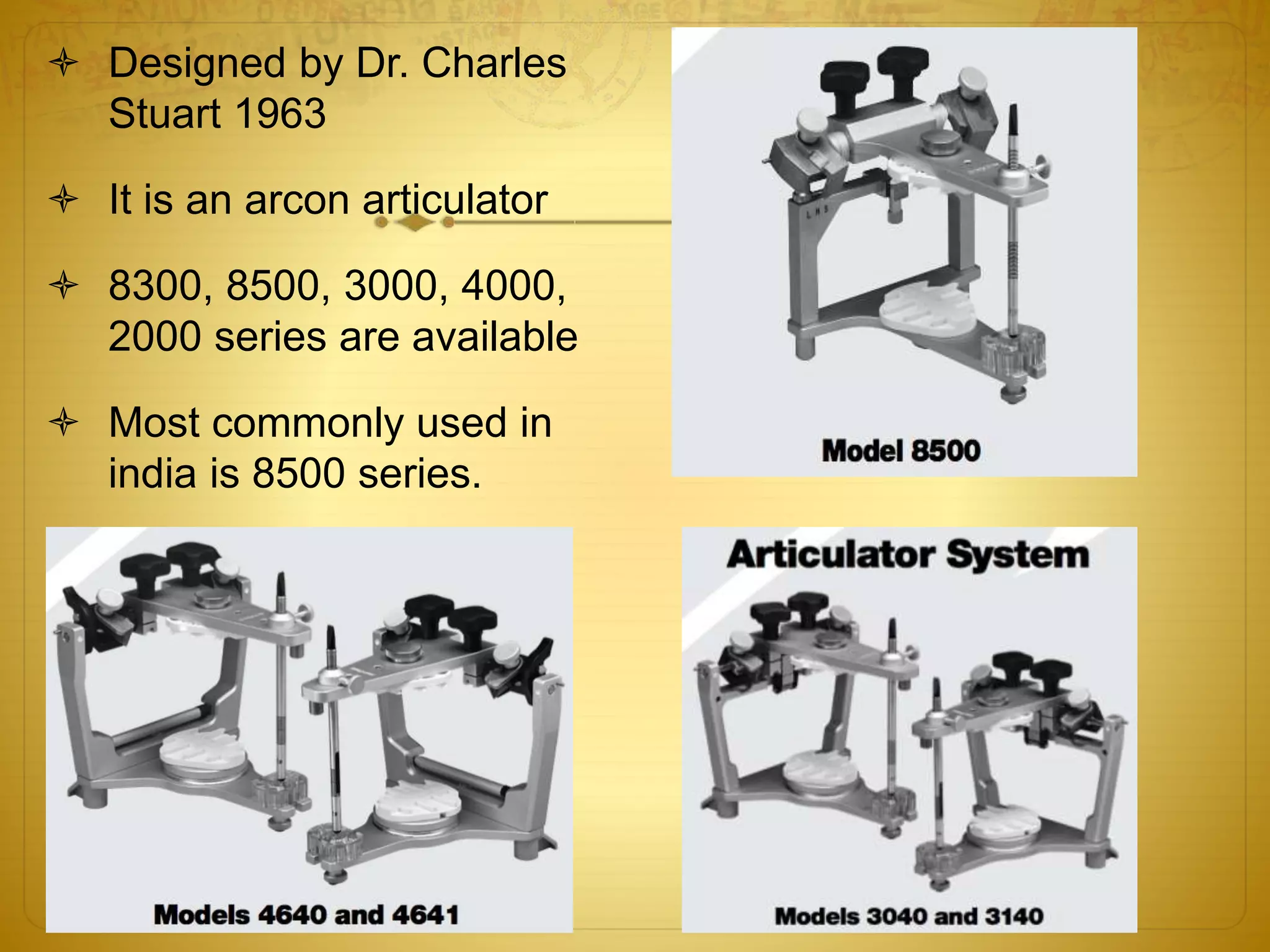
 Designed by Dr. Charles
Stuart 1963
 It is an arcon articulator
 8300, 8500, 3000, 4000,
2000 series are available
 Most commonly used in
india is 8500 series.
Whip mix articulator
system 8500 series
 Whip Mix articulators are designed to enable the user to quickly and
easily mount casts of a patient’s dentition on a mechanical device
that will reproduce their natural relationship and movements with an
acceptable degree of accuracy.
 The simplicity and speed with which the necessary registrations are
obtained and transferred to a Whip Mix articulator enable the
operator to accomplish corrective and restorative dentistry with
much greater precision than has ever before been possible without
the use of expensive equipment and time consuming techniques.
 Being arcon type instruments, Whip Mix articulators are ideal for the
study of occlusion and the movements of the temporomandibular
joints. With the condyle located on the lower member and the
guidance on the upper member, Whip Mix semi-adjustable
articulators have become the preferred choice of many teaching
institutions.
The 8500 Series Articulator System
Features
 Protrusive Condylar Inclination: adjustable 0 – 70 degrees
 Progressive Side Shift: adjustable 0 – 40 degrees
 Adjustable intercondylar distance:
S (96mm)
M (110mm)
L (124mm)
 Spring latch assembly holds articulator in centric position
when locked and allows for easy separation of upper and
lower members when released
 Non-skid rubber feet for stabilizing articulator when open
:
Articulator manipulation
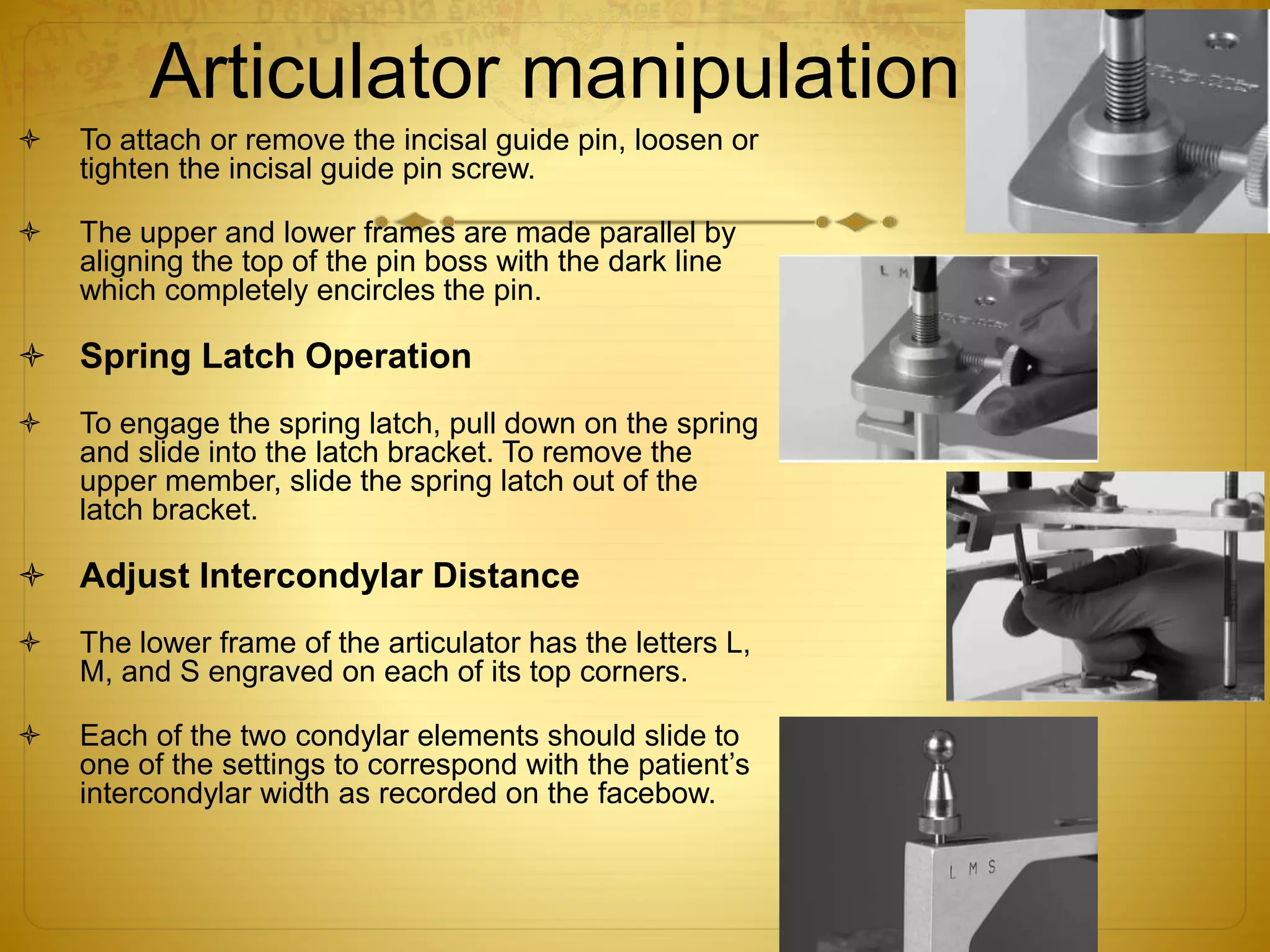
 To attach or remove the incisal guide pin, loosen or
tighten the incisal guide pin screw.
 The upper and lower frames are made parallel by
aligning the top of the pin boss with the dark line
which completely encircles the pin.
 Spring Latch Operation
 To engage the spring latch, pull down on the spring
and slide into the latch bracket. To remove the
upper member, slide the spring latch out of the
latch bracket.
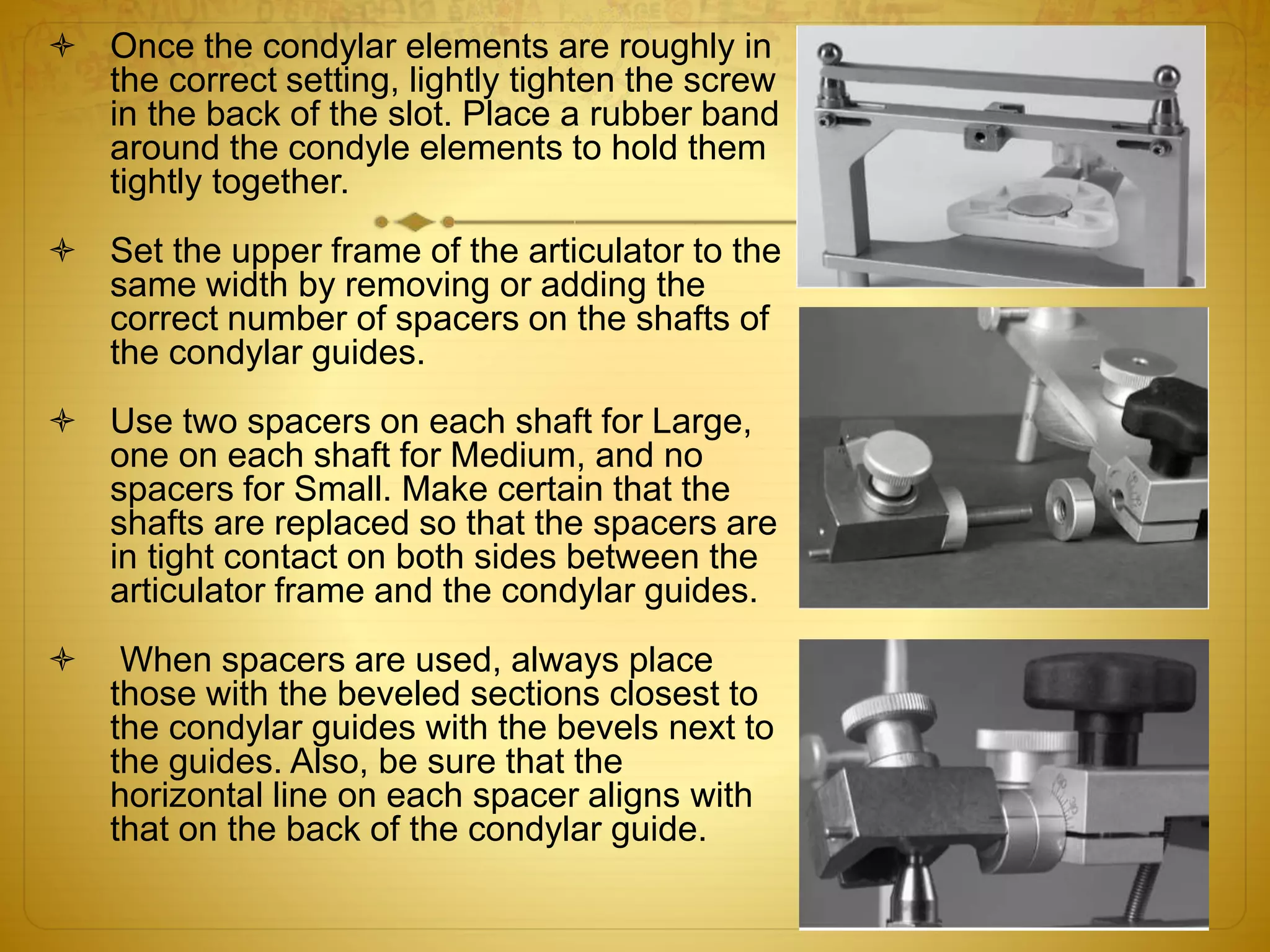
 Adjust Intercondylar Distance
 The lower frame of the articulator has the letters L,
M, and S engraved on each of its top corners.
 Each of the two condylar elements should slide to
one of the settings to correspond with the patient’s
intercondylar width as recorded on the facebow.
 Once the condylar elements are roughly in
the correct setting, lightly tighten the screw
in the back of the slot. Place a rubber band
around the condyle elements to hold them
tightly together.
 Set the upper frame of the articulator to the
same width by removing or adding the
correct number of spacers on the shafts of
the condylar guides.
 Use two spacers on each shaft for Large,
one on each shaft for Medium, and no
spacers for Small. Make certain that the
shafts are replaced so that the spacers are
in tight contact on both sides between the
articulator frame and the condylar guides.
 When spacers are used, always place
those with the beveled sections closest to
the condylar guides with the bevels next to
the guides. Also, be sure that the
horizontal line on each spacer aligns with
that on the back of the condylar guide.
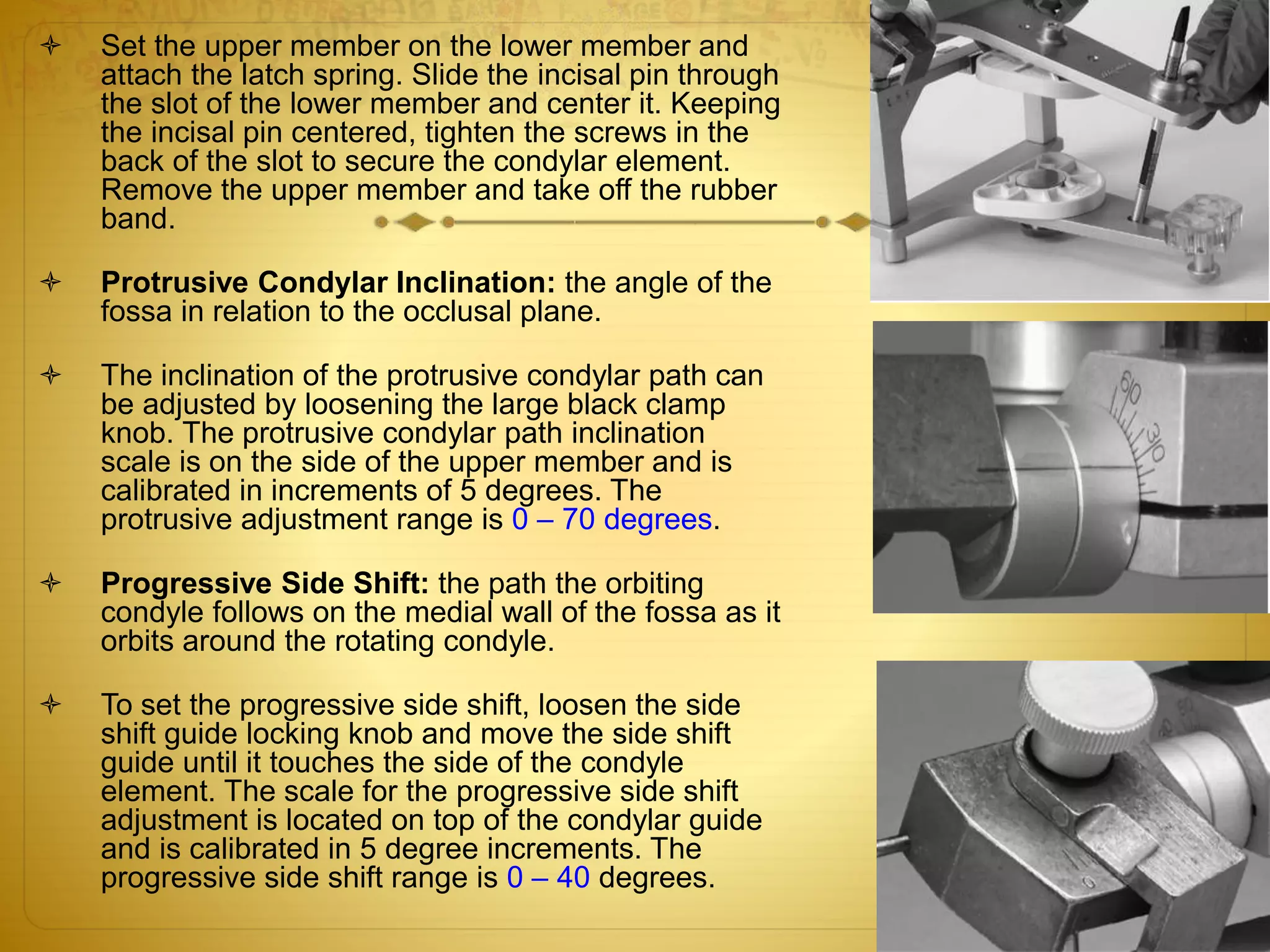
 Set the upper member on the lower member and
attach the latch spring. Slide the incisal pin through
the slot of the lower member and center it. Keeping
the incisal pin centered, tighten the screws in the
back of the slot to secure the condylar element.
Remove the upper member and take off the rubber
band.
 Protrusive Condylar Inclination: the angle of the
fossa in relation to the occlusal plane.
 The inclination of the protrusive condylar path can
be adjusted by loosening the large black clamp
knob. The protrusive condylar path inclination
scale is on the side of the upper member and is
calibrated in increments of 5 degrees. The
protrusive adjustment range is 0 – 70 degrees.
 Progressive Side Shift: the path the orbiting
condyle follows on the medial wall of the fossa as it
orbits around the rotating condyle.
 To set the progressive side shift, loosen the side
shift guide locking knob and move the side shift
guide until it touches the side of the condyle
element. The scale for the progressive side shift
adjustment is located on top of the condylar guide
and is calibrated in 5 degree increments. The
progressive side shift range is 0 – 40 degrees.
 In addition to a facebow record, the only records
needed for complete programming of the 8500
series are:
• Lateral bite records
• Protrusive bite record
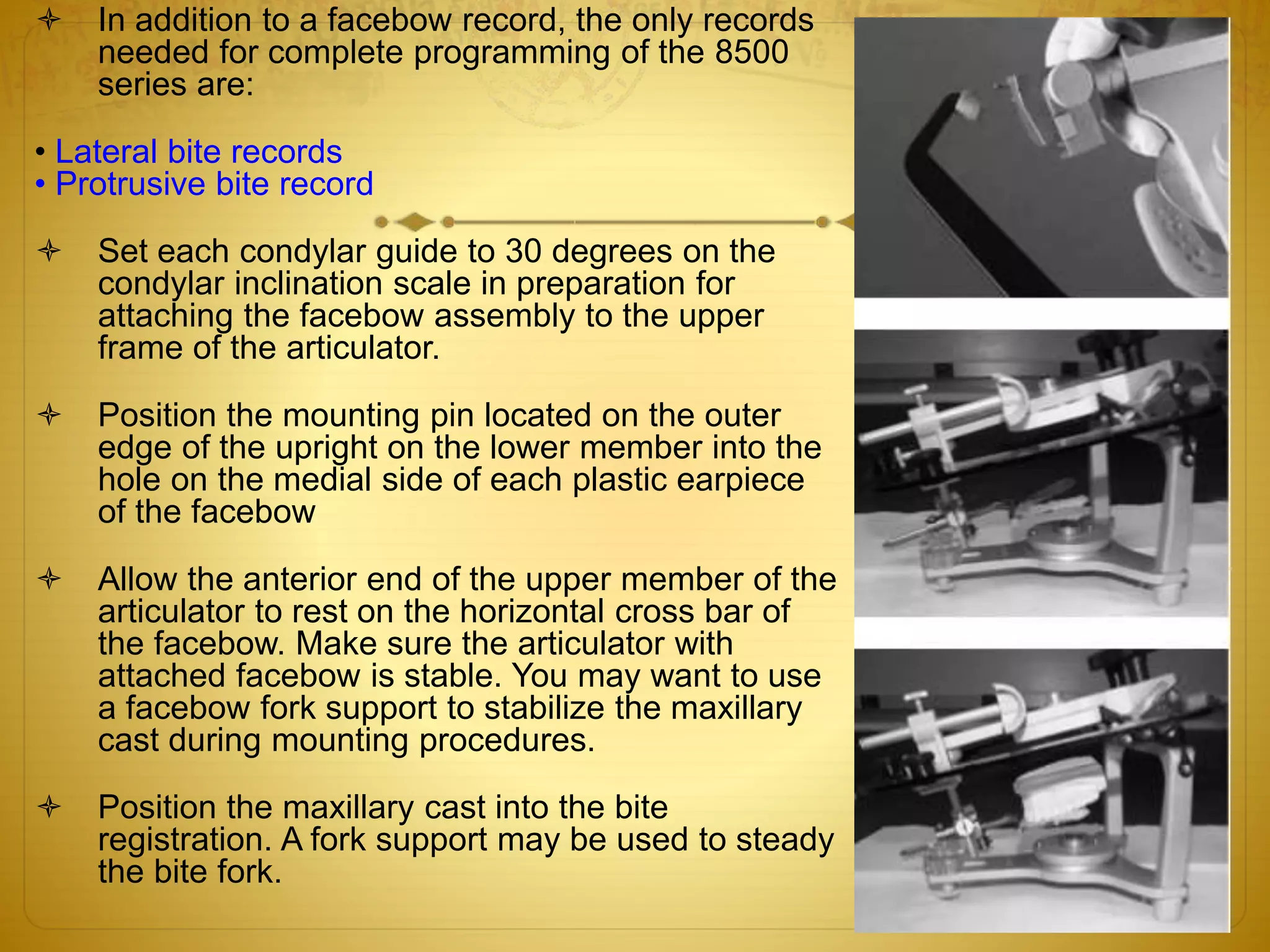
 Set each condylar guide to 30 degrees on the
condylar inclination scale in preparation for
attaching the facebow assembly to the upper
frame of the articulator.
 Position the mounting pin located on the outer
edge of the upright on the lower member into the
hole on the medial side of each plastic earpiece
of the facebow
 Allow the anterior end of the upper member of the
articulator to rest on the horizontal cross bar of
the facebow. Make sure the articulator with
attached facebow is stable. You may want to use
a facebow fork support to stabilize the maxillary
cast during mounting procedures.
 Position the maxillary cast into the bite
registration. A fork support may be used to steady
the bite fork.
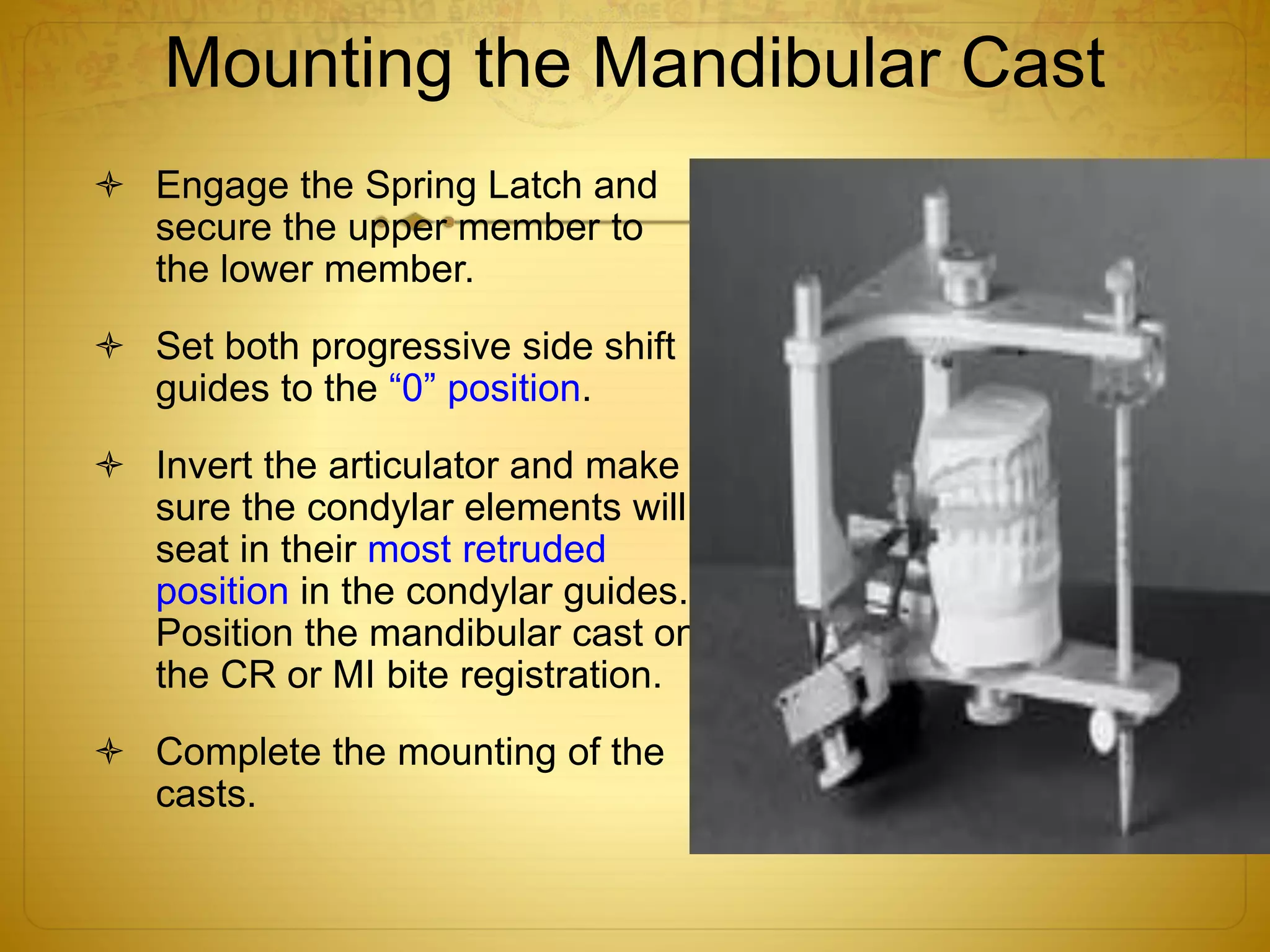
Mounting the Mandibular Cast
 Engage the Spring Latch and
secure the upper member to
the lower member.
 Set both progressive side shift
guides to the “0” position.
 Invert the articulator and make
sure the condylar elements will
seat in their most retruded
position in the condylar guides.
Position the mandibular cast on
the CR or MI bite registration.
 Complete the mounting of the
casts.
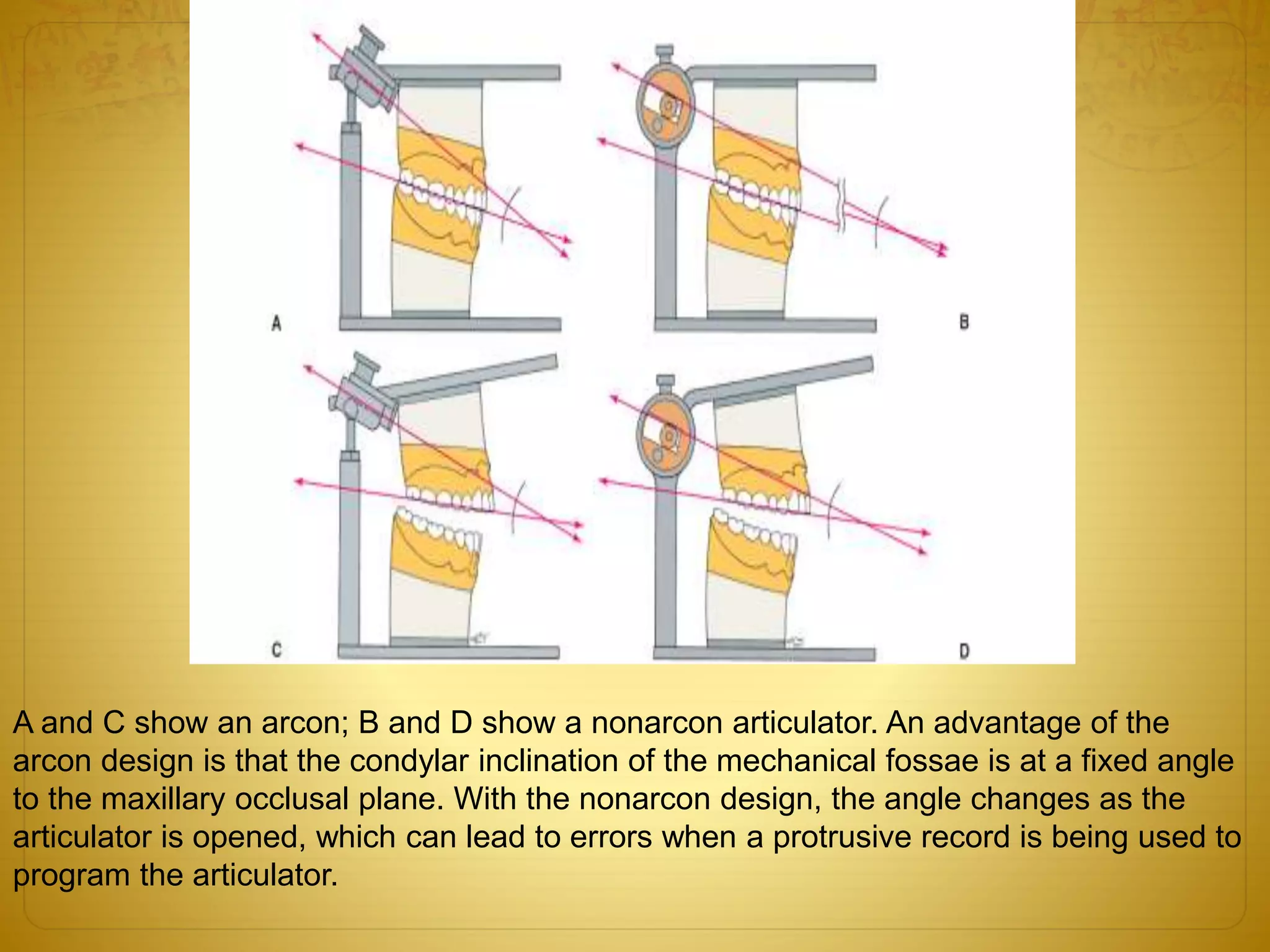
A and C show an arcon; B and D show a nonarcon articulator. An advantage of the
arcon design is that the condylar inclination of the mechanical fossae is at a fixed angle
to the maxillary occlusal plane. With the nonarcon design, the angle changes as the
articulator is opened, which can lead to errors when a protrusive record is being used to
program the articulator.
THANK YOU

Articulators in fixed partial denture

  • 1.
    ARTICULATORS IN FIXED PARTIAL DENTURE By- Dr.Isha Sethi M.D.S Third year Department of prosthodontics, crowns and bridges
  • 2.
    CONTENTS  INTRODUCTION  EVOLUTIONOF ARTICULATORS  USES  PURPOSES  CLASSIFICATION SYSTEMS  SELECTION OF ARTICULATOR  MEAN VALUE ARTICULATOR  SEMIADJUSTABLE ARTICULATORS  SUMMARY  REFERENCES Part 1
  • 3.
    INTRODUCTION According to GPT9, some of the relatable definitions are-  Articulate : 1. to join together as a joint; 2. the relating of contacting surfaces of the teeth or their artificial replicas in the maxillae to those in the mandible  Articulate : in speech, to enunciate clearly or be clearly spoken THE GLOSSARY OF PROSTHODONTIC TERMS Ninth Edition GPT-9 j.prosthet.dent Volume 117 Issue 5S
  • 4.
     Articulation :1. the place of union or junction between two or more bones  2. in speech, the enunciation of words and sentences  3. in dentistry, the static and dynamic contact relationship between the occlusal surfaces of the teeth during function THE GLOSSARY OF PROSTHODONTIC TERMS Ninth Edition GPT-9 j.prosthet.dent Volume 117 Issue 5S
  • 5.
     Articulator -a mechanical instrument that represents the temporomandibular joints and jaws, to which maxillary and mandibular casts may be attached to simulate some or all mandibular movements THE GLOSSARY OF PROSTHODONTIC TERMS Ninth Edition GPT-9 j.prosthet.dent Volume 117 Issue 5S
  • 6.
     Articulators aresurrounded by an aura of mystery, but at the end of the day they are a tool to help a dentist to give his patient a successful restoration, saving time, money and hassle.  I would like to say, “Begin with, the end in mind”. Using of articulators in the construction Of crown and bridges work in Baghdad:(A survey study) Dr. Ammar A. Alsa'ady MDJ Vol.:5 No.:2 2008
  • 7.
    Evolution of Articulators The plaster articulator devised by Philip Pfaff in 1756 consisted of plaster extension on the distal portion of the maxillary and mandibular casts grooved to each other. This was commonly known as ‘slab articulator’.  J.B.Gariot described the first mechanical articulator in 1805. He designed the hinge joint articulator, which consisted of two metal frames, to which the casts were attached, a hinge to join them and a setscrew to hold the frames in a fixed vertical -position.  In 1840, Cameron and Evans made attempts to device the ‘plane line’ articulator.  Bonwill, a mathematician, in 1858, developed an articulator based on his theory of occlusion or the theory of equilateral triangle with which he demonstrated the anatomic and balanced occlusion. Noel D. Wilkie, Donald L. Mitchell : Articulators through the years. Part – I. J Prosthet dent 1978 ; 39 :140-141.
  • 8.
     W.E Walkerin 1896 devised the ‘Clinometer’ which had provision for gothic arch tracings.  George B. Snow in 1899 first devised the facebow. Later in 1906, articulator known as ‘New Century instrument’ was developed.  The ‘Acme’ articulator was an elaboration of Snow’s New Century Instrument, which had straight condylar path, adjustable condylar inclination and provision for Bennett movement.  Alfred Gysi in 1910 introduced the ‘Gysi Adaptable articulator’. In 1914, the ‘Gysi Simplex’ was introduced as a mean value articulator, which had fixed condylar guidance at 33º. Noel D. Wilkie, Donald L. Mitchell : Articulators through the years. Part – I. J Prosthet dent 1978 ; 39 :140-141.
  • 9.
     Hall (19l5)and Monson (1918) developed the Anatomic articulator and Maxillo-mandibular instrument based on Conical theory and the theory of Spherical articulation respectively.  Rudolph L. Hanau, an engineer during the time of First World War in 1921 developed a research model called the’ Hanau - Model C Articulator.  Later in 1923, he devised the ‘Kinoscope’, which provided exact measurement of mandibular movements. In the later years, Hanau introduced more instruments such as Model 110, which had individual condylar guidance adjustments in both sagittal and horizontal planes, and the lateral condylar angle calculated by the formula L = H/8 +12, where H = Horizontal condylar angle.  In 1927, he modified the model 110 with the introduction of Incisal guide table. Noel D. Wilkie, Donald L. Mitchell : Articulators through the years. Part – I. J Prosthet dent 1978 ; 39 :140-141.
  • 10.
     Wadsworth believedin Monson’s Spherical theory but did not accept the bilateral condylar symmetry. In 1924, he developed the articulator for which facebow was used to mount the cast. It had an adjustable inter-condylar distance and the condylar paths were slightly curved.  Stansberry in 1929 designed the ‘Tripod Articulator’. It did not accept all positional records. This instrument does not have a hinge nor mechanical equivalent or representation of condyles. This articulator reproduces positions but not movements.  Later, Granger, Stuart, Ney and Guichet introduced the Pantographic Tracings.  Recent advances in electronic and computer technology facilitated the development of electronic techniques to record the motion of the mandible Noel D. Wilkie, Donald L. Mitchell : Articulators through the years. Part – I. J Prosthet dent 1978 ; 39 :140-141.
  • 11.
    USES  To diagnosethe state of occlusion in both the natural and artificial dentition.  To plan the dental procedures based on the relationship between opposing natural and artificial teeth.  To aid in the fabrication of restorations and prosthodontics replacements.  To correct and modify complete restorations.  To arrange artificial teeth. Winkler Sheldon: Essentials of complete Denture Prosthodontics, 3rd edition,page 189- 237
  • 12.
    PURPOSES  To holdthe maxillary and mandibular casts in a determined fixed relationship  Mounting of dental casts for diagnosis, treatment planning and patient presentation  Fabrication of occlusal surfaces for dental restoration.  Arrangement of artificial teeth for complete and removable partial denture. Winkler Sheldon: Essentials of complete Denture Prosthodontics, 3rd edition,page 189-
  • 13.
    REQUIREMENTS OF ANARTICULATOR Minimal Articulator Requirements  The articulator must accurately maintain centric position.  The patient’s casts must be easily removable and attachable to the articulator without losing their correct horizontal and vertical relationship.  The articulator should have an incisal guide pin with a positive stop that is adjustable and calibrated .  The articulator should be able to open and close in a hinge-like fashion.  The articulator should accept a face-bow transfer utilizing an anterior reference point. Winkler Sheldon: Essentials of complete Denture Prosthodontics, 3rd edition,page 189-
  • 14.
     The constructionshould be accurate rigid and of a non corrosive material. The moving parts should resist wear. The adjustments should be able to move freely and be definitely secured.  The design should be such that there is adequate distance between the upper and lower members and that vision is not obscured from the rear. The articulator should be stable on the laboratory bench and not too bulky and heavy. Winkler Sheldon: Essentials of complete Denture Prosthodontics, 3rd edition,page 189-
  • 15.
    Additional requirements These articulatorrequirements are necessary if dentures are to be fabricated with balanced occlusion.  The condylar guides should allow right lateral, left lateral, and protrusive movements  The condylar guides should be adjustable horizontally.  The articulator should have provisions for adjustment of Bennett movement.  The incisal guide table should be a mechanical table that can be adjusted in the sagittal and frontal planes or a table that can be customized with autopolymerizing resin or by grinding. Winkler Sheldon: Essentials of complete Denture Prosthodontics, 3rd edition,page 189-
  • 16.
     The condylarelements as a part of the lower frame and the condylar guides as a part of the upper frame.  A mechanism to accept a third reference point from a face-bow transfer record.  A terminal hinge position-locking device.  Removable mounting plates that can be repositioned accurately.  Adjustable intercondylar width of the elements, when graphic tracings to be used to set and/or select condylar guidance. Winkler Sheldon: Essentials of complete Denture Prosthodontics, 3rd edition,page 189-
  • 17.
    Regardless of howsimple or complex an articulator may be, its effectiveness depends on  1.how well the operator understands its construction and purpose;  2. how enthusiastic the dentist is for the particular instrument;  3. how well the dentist understands the anatomy of the joints, their movements, and the neuromuscular system;  4. how much precision and accuracy are used in registering jaw relations;  5. how sensitive the instrument is to these records.
  • 18.
  • 19.
    1. GILLIS CLSSIFICATION1926:  The adaptable (or) Adjustable  The Average (or) Fixed type
  • 20.
    2. BOUCHER’S CLASSIFICATION1934  Nonadjustable Adjustable 1. two-dimensional instrument 2. three-dimensional instrument
  • 21.
    3. KINGERY’S CLASSIFICATION 1934: Simple articulators  Adaptable (or) adjustable articulators Yeshwante B.et al, Int J Dent Health Sci 2017; 4(3):674-683
  • 22.
    4. BECK’S CLASSIFICATION 1962: Suspension instrument  Axis instrument  Tripod instrument Yeshwante B.et al, Int J Dent Health Sci 2017; 4(3):674-683
  • 23.
    5. WEINBERG’S CLASSIFICATION 1963: Arbitrary [Monson spherical theory]  Positional [Stanbery tripod concept]  Semi adjustable [Hanau H concept]  Fully adjustable [Hanau kinescope concept] [Gysi trubyte concept] [McCollum concept] Yeshwante B.et al, Int J Dent Health Sci 2017; 4(3):674-683
  • 24.
    Wein Berg La:J. Pros. Den. July-August, 1963an evaluation of basic articulators and their concepts part II
  • 25.
    6. POSSELT CLASSIFICATION 1968: Plain line  Mean value  Adjustable Yeshwante B.et al, Int J Dent Health Sci 2017; 4(3):674-683
  • 26.
    7. THOMAS CLASSIFICATION1968:  Arbitarary [non adjustable]  Positional [Axis & Non axis type; static type]  Functional [Axis & Non axis type; functional records] Yeshwante B.et al, Int J Dent Health Sci 2017; 4(3):674-683
  • 27.
    8. SHARRY’S CLASSIFICATION 1974: Simple Hinge type  Fixed guided type  Adjustable instruments Yeshwante B.et al, Int J Dent Health Sci 2017; 4(3):674-683
  • 28.
    9. BOUCHER’S CLASSIFICATION  A]Based on theories of occlusion  B] The type of record used for their adjustment -Those utilizing the Inter occlusal records -Those using the Graphic adjustment record -Those utilizing hinge-axis location for adjusting the articulator. Yeshwante B.et al, Int J Dent Health Sci 2017; 4(3):674-683
  • 29.
    Based on theoriesof occlusion 1. Bonwill theory articulators  Designed by WGA Bonwill  The teeth moves in relation to each other as guided by condylar and incisal guidance  Also known as theory of equilateral triangle  Distance between the two condyles is equal to the distance between midpoint of the mandibular incisors and condyle  Theoretically the dimension of equilateral triangle is 4 inches  These articulators allow lateral movements and permits the movement of the mechanism only in horizontal plane
  • 30.
  • 31.
    2. Conical theoryarticulator  Proposed by RE Hall  Lower teeth move over the surface of the upper teeth as over the surface of the cone generating an angle of 45° with the central axis of the cone tipped 45° to the occlusal plane
  • 32.
  • 33.
    3.Spherical theory articulator Lower teeth move over the surface of the upper teeth as over the surface of the sphere with a diameter of 8” with the center located at the glabella  The surface of the sphere moved over the glenoid fossa & articulating eminences.
  • 34.
  • 35.
    Wein Berg La:J. Pros. Den. July-August, 1963an evaluation of basic articulators and their concepts part II
  • 36.
    Wein Berg La:J. Pros. Den. July-August, 1963an evaluation of basic articulators and their concepts part II .
  • 37.
    Wein Berg La:J. Pros. Den. July-August, 1963an evaluation of basic articulators and their concepts part II
  • 38.
    The type ofrecord used for their adjustment  Eccentric pathways can be dynamically registered either -graphically (pantographic method) -stereographically (engraved method) -positionally registered (checkbite method),  -determined by the articulator (mechanical equivalents)  -adjusted entirely on the patient.
  • 39.
    Articulators based onthe type of record used for their adjustment 1. Inter occlusal record adjustment  Made of base plate wax, zinc oxide eugenol, plaster & acrylic resin 2. Graphic record adjustment.  Records of extreme border positions of mandibular movements.  Face bow pantograph can be attached
  • 40.
    3. Hinge Axislocation for adjusting articulator  The correct location of the opening and closing axis of the mandible should be made, if not the correct adjustment of these instrument is not possible
  • 41.
    10.Based on condylarelement attachment- Bergstorm  A] Arcon Articulator+condyle The condylar element is attached to the lower member and guidance to the upper member. Eg.-Whip mix  B] Non Arcon condylar element on upper member and guidance on the lower member. Eg.- Hanau H2 series, Dentatus. Yeshwante B.et al, Int J Dent Health Sci 2017; 4(3):674-683
  • 42.
    11. HEARTWELL ANDRAHN’S CLASSIFICATION  Class I - Instruments that will receive and produce pantographs and graphic tracings.  Class II - Instruments that will not receive pantographs. Hinge type Arbitrary Adjustable Instruments that are designed for use in complete denture construction. Yeshwante B.et al, Int J Dent Health Sci 2017; 4(3):674-683
  • 43.
    12. NEW SYSTEMCLASSIFICATION BY RIHANI 1980 :  Non adjustable - A simple holding instrument capable of accepting single static registration. Only vertical motion is acceptable.  Semi adjustable – An instrument that simulates condylar pathways by using average or mechanical equivalents for all or part of the motion. These instruments allow for orientation of casts relative to the joints and may be arcon or non-arcon instrument.  Fully adjustable – An instrument that will accept three dimensional dynamic registration. These instruments allow for orientation of the casts to the T.M.J. and replication of all mandibular movements. Yeshwante B.et al, Int J Dent Health Sci 2017; 4(3):674-683
  • 44.
    13. At theinternational prosthodontic workshop on complete denture occlusion at the University of Michigan in 1972  Instrument Intent  Instrument capability  Recording procedure  Record acceptance • Class I : Hinge Type • Class II : Arbitrary – type A, type B, type C • Class III : Average -type A, type B • Class IV : Special – type A, type B Winkler Sheldon: Essentials of complete Denture Prosthodontics, 3rd edition,page 189-
  • 45.
    CLASS I (HingeType)  Simple holding instrument capable of accepting a single interocclusal record  vertical movements may be possible but only for convinience.  Use in cases where a tentative jaw relation is done  Example : Slab articulator, Hinge joint articulator (J.B. GARIOT), Barn door articulator, Gysi Simplex Winkler Sheldon: Essentials of complete Denture Prosthodontics, 3rd edition,page 189-
  • 46.
  • 47.
    CLASS II (Arbitrary) Thesearticulators permit horizontal and vertical movements but they do not orient the movement to TMJ  Type A – Eccentric motion is unrelated to patient motion. – Permit limited eccentric motion based on averages – The condyles are on the lower member of articulator – Based on Bonwill’s triangle Example- Grittman, mean value articulators, gysi simplex Winkler Sheldon: Essentials of complete Denture Prosthodontics, 3rd edition,page 189- 237
  • 48.
  • 49.
     TYPE B –Permit limited eccentric motion based on arbitrary theory of motion – Based on spherical theory of occlusion Ex: Monson’s articulator (Spherical Theory Articulator) Fournet & Hageman articulators Hall’s articulator (Conical Theory Articulator) Shofu Handy II Winkler Sheldon: Essentials of complete Denture Prosthodontics, 3rd edition,page 189- 237
  • 50.
    Monson articulator Hall articulator Shofuhandy II Hagman "Junior Balancer" Articulator
  • 51.
     TYPE C –Permit limited eccentric motion based on engraved records obtained from the patient - Casts are mounted arbitrarily - Adjusted by needle house chew in method. • Ex: House’s articulator (1920) Gnathic Relator Winkler Sheldon: Essentials of complete Denture Prosthodontics, 3rd edition,page 189-
  • 52.
  • 53.
    Class III (Average) They permit horizontal and vertical motion  Do accept face-bow transfer but these facility is limited  Do Not / Cannot allow total customization of condylar pathways  They simulate condylar pathways by using average or mechanical equivalents for the whole or part of the condylar motion  good centric lock, progressive and immediate side shift controls  All the examples are arcon instruments, accept facebows, and have mounting plates for unlimited case load Winkler Sheldon: Essentials of complete Denture Prosthodontics, 3rd edition,page 189-
  • 54.
    Class III TypeA  Accept static protrusive interocclusal records / registrations + Accepts a face-bow transfer  Uses equivalents for other types of motions.  Examples Hanau H articulator ( RUDOLPH HANAU,1923) NON ARCON Hanau H2 articulator NON ARCON Bergstrom articulator (ARCON) Dentatus (1944, Sweden) Winkler Sheldon: Essentials of complete Denture Prosthodontics, 3rd edition,page 189-
  • 55.
  • 56.
    Hanau H 2non arcon Dentatus articulator
  • 57.
    Class III, TYPEB  Accept a Static Lateral, protrusive interocclusal records + face- bow transfer  Use equivalents for other types of motions  Example – Trubyte articulator Tripod articulator Ney articulator Tele Dyne articulator Pandent articulator
  • 58.
  • 59.
  • 60.
    Class IV (Special) accept three dimensional dynamic registration.  capable of accurately reproducing the condylar pathway for each patient  allow point (joint) orientation of the casts using Face Bow Transfer  These instruments should hold adjustments, contain good centric locking mechanism, versatile incisal guide tables, and stable mounting features, and be precision engineered Winkler Sheldon: Essentials of complete Denture Prosthodontics, 3rd edition,page 189-
  • 61.
    Type A  Acceptthree dimensional dynamic registration + utilise a face-bow transfer  Condylar pathways are formed by registration engraved by the patient.  This path is non-modifiable  Exp. TMJ articulator – Kenneth Swanson (1965) (uses Stereograph)
  • 62.
  • 63.
    Type B  Acceptthree dimensional dynamic registration + utilise a face-bow transfer.  Condylar pathway can be selectively angled and customized / modified.  The procedure utilises pantographic tracings  Eg; Gnathoscope - Charls Stuart Denar D 4A & D 5A - Niles Guichet, 1968 – Denar Model SE Simulator - Earnest Granger
  • 64.
  • 65.
    Selection of articulators TreatmentUse Articulator Manufacturer Single restoration 1. Simplex articulator 2. Laboratory Technical 3. Steele’s articulator Dentsply International, Inc. York, PA Teledyne Dental (Hanau Div.) Buffalo, NY Columbus Dental Mfg. Co. Columbus, OH Multiple restorations Fixed partial Dentures, and Mimimal occlusal Pathology 1. Mark II articulator 2. ARH articulator 3. H-2 articulator 4. New Occlusomatic Articulator 5. Teledyne articulator 6. Whip-Mix articulator Denar Corporation, Anaheim, California A B Dentatus, Hagersten, Sweden (available through Almore Mfg. Co. Portland, Oregon Teledyne Dental (Hanau Div. ) Buffalo, NY Shizai International, Inc. Tokyo, Japan (available through U.S. Shizai Corporation Los Angeles, CA) Teledyne Dental (Hanau Div.), Buffalo, NY Whip-Mix Corporation, Louisville, KY Multiple restorations In opposing quadrants, Full-mouth reconstruc- Tion, and extensive Occlusal pathology 1. Aderer simulator 2. D 5-A articulator 3. Model P 4. Stuart articulator 5. TMJ articulator J. Aderer, Inc. Long Island City, NY Denar Corporation, Anaheim, CA Panadent Corporation, Colton, CA C.E. Stuart, Ventura, CA TMJ Instrument Company, Inc. Thousand Oaks, CA Articulator Selection for Restorative Dentistry Sumiya Hobo, Herbert T. Shinningburg, Jr., and Lowell D. Whitsett, Tokyo, Japan, and Oklahoma City, Okla. J. Prosthet. Dent. July 1976
  • 66.
    Mean value articulator The two members are joined by 2 joints that represent the TMJ.  The horizontal condylar path is fixed at certain angle that ranges from 30-40 degrees which is the average of the most patients.  The incisal guide table is also fixed at a certain angle from horizontal.  On the fixed condylar path articulators, the upper members are movable (the condyle) and the lower members are stationary. Noel D. Wilkie, Donald L. Mitchell : Articulators through the years. Part – I. J Prosthet dent 1978 ; 39 :140-141.
  • 67.
    Possible movements  1-openingand closing  2-protrusive movement at a fixed condylar path angle. Records required  1-OVD  2-Centric relation record  3-Face-bow record (In some designs of these articulators, the upper cast can be mounted by a face bow transfer) Noel D. Wilkie, Donald L. Mitchell : Articulators through the years. Part – I. J Prosthet dent 1978 ; 39 :140-141.
  • 68.
     When anarticulator doesn’t accept face-bow record, the mounting is made according to (Bonwill triangle)  An anterior pointer is attached to the incisal pin of the articulator to locate the tip (midline) of the occlusion rim labially and thus to orient cast in relation on the Bonwill triangle.  3 fixed mean values – intercondylar distance- 100-110 mm Condylar guidance – 33 degrees Incisal guidance- 9-12 degrees Noel D. Wilkie, Donald L. Mitchell : Articulators through the years. Part – I. J Prosthet dent 1978 ; 39 :140-141.
  • 69.
    Disadvantages:  Most ofthese articulators do not accept face-bow record  The condylar path moves to a fixed angle and it is successful in patients whose condylar angle approximates that of the articulator.  No lateral movements. Noel D. Wilkie, Donald L. Mitchell : Articulators through the years. Part – I. J Prosthet dent 1978 ; 39 :140-141.
  • 70.
  • 71.
    Semi adjustable articulator The semi-adjustable articulator (SAA) plays an important role in Dentistry, since it allows adequate diagnosis and treatment planning to promote the oral health of our patients.  The SAA reduces the intervention of prosthodontists; when well employed, it simplifies the daily clinical routine, reducing the number of sessions, chair time and need of interventions in the patient’s mouth, besides allowing more accurate procedures, consequently without damages to the stomatognathic system. Semi-adjustable articulators Fabrício nesi1, lísia emi nishimori2, cleverson de oliveira e silva3, fabiano carlos marson4, sergio sábio5, giovani de oliveira corrêa6* Jscd vol.1,n.1,pp.14-21 (Apr – jun 2014)
  • 72.
     As mentionedby Shavel, “a dentist can do a full-mouth rehab case on a semi-adjustable articulator as long as he has a fully adjustable brain”.  SAA may also be divided into -ArCon (condyles on the lower member, e.g. Whip-Mix, Denar, Bio-Art, Gnatus, etc.) or -non-ArCon (condyles on the upper member, e.g. Dentatus, Hanau). Semi-adjustable articulators Fabrício nesi1, lísia emi nishimori2, cleverson de oliveira e silva3, fabiano carlos marson4, sergio sábio5, giovani de oliveira corrêa6* Jscd vol.1,n.1,pp.14-21 (Apr – jun 2014)
  • 73.
    Articulator parts Body –central portion to which the members are fixated. Its function is to establish the bicondylar distance and the distance between the members.  Members – horizontal extensions on which the mounting guides and plates are fixated.  Condylar balls – represent the condyles, with small, medium or large intercondylar distance.  Angulation of the glenoid cavity roof – guides the protrusion movements of the articulator.  Condylar housing – guides the protrusion movements of the articulator.  Incisal table – located at the anterior portion of the lower member; provides support to the incisal pin. Semi-adjustable articulators Fabrício nesi1, lísia emi nishimori2, cleverson de oliveira e silva3, fabiano carlos marson4, sergio sábio5, giovani de oliveira corrêa6* Jscd vol.1,n.1,pp.14-21 (Apr – jun 2014)
  • 74.
    Incisal pin –is supported on the incisal table and maintains the height between the members. Mounting plates – receive application of plaster for fixation of dental casts to the articulator. Facebow – accessory device employed for mounting of the maxillary dental cast in the articulator and establishment of intercondylar distance (S, M, L). Semi-adjustable articulators Fabrício nesi1, lísia emi nishimori2, cleverson de oliveira e silva3, fabiano carlos marson4, sergio sábio5, giovani de oliveira corrêa6* Jscd vol.1,n.1,pp.14-21 (Apr – jun 2014)
  • 75.
  • 77.
    Condylar guidance  TheCondylar Guidances are the control centers of the Articulator and they adjustably assimilate the multiple function of the glenoid fossa.  The Condylar Track may be adjustably inclined on the horizontal transverse axis from a “zero” to a plus 60 degree or to a minus 20 degree. These inclinations are termed the protrusive inclination and simulate the patient’s superior wall of the fossa.  The Condylar Track may also be adjusted on the vertical axis from a “zero” sagittal to 30. This angle is termed the progressive Bennett angle and corresponds to the medial wall of the patient’s fossa. HANAUTM WIDE-VUE ARCON ARTICULATORS AND WIDE-VUE II ARTICULATORS
  • 78.
    HANAUTM WIDE-VUE ARCONARTICULATORS AND WIDE-VUE II ARTICULATORS ILLUSTRATED INSTRUCTION MANUAL
  • 79.
    DUAL-END INCISAL PIN The Incisal Pin serves as the forward control of the Articulator. It cooperatively maintains a vertical stop and provides a stylus contact for the excursive movements of the Articulator against the various inclined guiding surfaces of the Incisal Guide.  A mid-line groove is cut in the Incisal Pin about one inch from the spherical tip. Five additional lines calibrated in millimeters extend on either side thereof. These lines are used for recording or altering the vertical dimension. HANAUTM WIDE-VUE ARCON ARTICULATORS AND WIDE-VUE II ARTICULATORS
  • 80.
    DUAL-END INCISAL PIN HANAUTMWIDE-VUE ARCON ARTICULATORS AND WIDE-VUE II ARTICULATORS
  • 81.
     The IncisalPin is inserted into, and the wider mid-line of these metric grooves is aligned with, the top edge of the Upper Member This adjustment places the chisel end at 90 degrees to and in contact with the central table of the Incisal Guide.  Two annular grooves appear on the Incisal Pin at 37 and 54 mm below the Frankfort Horizontal Plane. These grooves form arbitrary vertical landmarks for alignment of the incisal edge of the maxillary centrals when making a Facebow transfer.  The 37 mm line is based in part on the Bonwil Triangle and results in a generally horizontal appearing plane of occlusion.  The 54 mm line forms an average landmark for alignment of the incisal edge of the upper centrals when making a Facebow transfer. (This reference line is based on the research study by Frank R. Lauciello, D.D.S., and Marc Appelbaum, D.D.S., “Anatomic Comparison to Arbitrary Reference Notch on HanauTM Articulators,” Journal of Prosthetic Dentistry, December 1978, Volume 40, Number 6, Pages 676-681. )  The Incisal Pin extends beyond the top of the Upper Member and provides a third point of stability when inverting the Articulator for mandibular cast mounting. HANAUTM WIDE-VUE ARCON ARTICULATORS AND WIDE-VUE II ARTICULATORS
  • 82.
    ADJUSTABLE INCISAL GUIDE The Adjustable Incisal Guide provides an independent adjustment of anterior guidance. It cooperates with the Incisal Pin and Condylar Guidances to present a stable, three-dimensional programmed guide pattern for the mounted casts.  The Incisal Guide rotates antero-posteriorly from a horizontal “zero” degree to a 60 degree positive inclination of protrusion .The central guiding table is 5.56 mm wide and forms the inclined surface for the protrusive guidance of the Incisal Pin.  Separately adjustable Lateral Wings elevate by a Thumbscrew from a “zero” horizontal to a 45 degree incline  An anterior slot, in the Lower Member, allows repositioning of the Incisal Guide.  This adjustment will place the Incisal Pin contact on the rotational center of the Guide, thereby maintaining the vertical dimension when adjusting the inclination for protrusion. HANAUTM WIDE-VUE ARCON ARTICULATORS AND WIDE-VUE II ARTICULATORS
  • 84.
    ORBITALE INDICATOR This “crescent”represents the patient’s infra-orbitale notch and is the anterior reference landmark of the Frankfort Horizontal Plane. When used with an Orbitale Pointer on a Facebow it provides an anatomical vertical orientation for the upper arch, obviating the use of any average reference lines on the Incisal Pin. HANAUTM WIDE-VUE ARCON ARTICULATORS AND WIDE-VUE II ARTICULATORS
  • 85.
    Uses of thearticulator  Orientation of the Maxillary Cast.  Centric Relation Record  Protrusive records (figure 6,7,8)  Balancing condylar motion (figure 9)  Working condylar motion (figure 10)  Border movements of the instrument- (greater the bennett angle, more is the lateral shift) Wein Berg La: J. Pros. Den. July-August, 1963an evaluation of basic articulators and their concepts part II
  • 86.
    Wein Berg La:J. Pros. Den. July-August, 1963an evaluation of basic articulators and their concepts part II .
  • 87.
    Wein Berg La:J. Pros. Den. July-August, 1963an evaluation of basic articulators and their concepts part II .
  • 90.
    Mathematical study ofHanau model H  Average Anatomic Location of the Hinge Axis- when the average anatomic location of the hinge axis is utilized, we must assume a maximum error of plus or minus 5 mm. Wein Berg La: J. Pros. Den. July-August, 1963an evaluation of basic articulators and their concepts part II .
  • 91.
     Arbitrary Locationof the Anterior Point of Orientation- anterior point of orientation of the face-bow and the hinge axis establishes the horizontal plane of reference. However, there is a definite three-dimensional relationship between the maxillary dental arch and the axes of rotation of the mandible  The relationship of the maxillary arch to the vertical and sagittal axes of the patient will not be the same as that on the instrument with arbitrary location of the horizontal plane of reference. Wein Berg La: J. Pros. Den. July-August, 1963an evaluation of basic articulators and their concepts part II .
  • 92.
     An elevationof the anterior part of the face-bow decreases the protrusive condylar reading and, conversely, a lowering of the face-bow increases the condylar reading.  The hypothetical patient has a 40 degree condylar inclination to the horizontal plane of the head when the patient is in the upright position. When the face-bow mounting is oriented too high, there is a reduction in the condylar reading  This inclination is measured from the horizontal plane of the instrument which is parallel to its base. Wein Berg La: J. Pros. Den. July-August, 1963an evaluation of basic articulators and their concepts part II
  • 93.
    Wein Berg La:J. Pros. Den. July-August, 1963an evaluation of basic articulators and their concepts part II .
  • 94.
    THE EFFECT OFTHE CHANGE IN CONDYLAR INCLINATION ON OCCLUSION  Protrusive Cusp Inclines- decrease in condylar inclination will be compensated by the increase in anteroposterior inclination of the occlusal plane.  Working Cusp Inclines- have no significant effects on cuspal inclination of working side.  Balancing Cusp Inclines Wein Berg La: J. Pros. Den. July-August, 1963an evaluation of basic articulators and their concepts part II .
  • 95.
    Straight condylar path WeinBerg La: J. Pros. Den. July- August, 1963an evaluation of basic articulators and their concepts part II .
  • 96.
    Wein Berg La:J. Pros. Den. July-August, 1963an evaluation of basic articulators and their concepts part II .
  • 97.
    Wein Berg La:J. Pros. Den. July-August, 1963an evaluation of basic articulators and their concepts part II . Wein Berg La: J. Pros. Den. July-August, 1963an evaluation of basic articulators and their concepts part II .
  • 98.
     Fischer angle- Error-0.1mm Wein Berg La: J. Pros. Den. July-August, 1963an evaluation of basic articulators and their concepts part II
  • 99.
    Working positions: centricrelation (CR) and maximum intercuspation (MI)  When fixed dentures or single-tooth restorations are fabricated and there is occlusal stability, the maximum intercuspation position (MI) of the patient may be considered for recording and for the prosthesis.  In cases of extensive oral rehabilitation, with periodontal problems or loss of occlusion dimension, the occlusal stability may be absent or the occlusion may interfere with the health of the stomatognathic system.  These cases require utilization of condylar positioning for establishment of the working position. This condylar position is the centric relation (CR); after being adopted as working position, it should be harmonious with the dental relationship. Semi-adjustable articulators Fabrício nesi1, lísia emi nishimori2, cleverson de oliveira e silva3, fabiano carlos marson4, sergio sábio5, giovani de oliveira corrêa6* Jscd vol.1,n.1,pp.14-21 (Apr – jun 2014)
  • 100.
    Limitations of SAAand their compensations Semi-adjustable articulators Fabrício nesi1, lísia emi nishimori2, cleverson de oliveira e silva3, fabiano carlos marson4, sergio sábio5, giovani de oliveira corrêa6* Jscd vol.1,n.1,pp.14-21 (Apr – jun 2014)
  • 101.
    Shape and angulationof the articular eminence  limitation- the upper wall of the “mandibular cavity” of the SAA is straight and rigid, whereas this structure in the TMJ is curved.  Compensation: customization of the anterior guidance while the provisional crowns are worn and its transfer to the incisal table on the articulator reduces the possibility of contacts between the posterior teeth during excursive mandibular movements. This customization guides the establishment of cusp height and fossa depth. Semi-adjustable articulators Fabrício nesi1, lísia emi nishimori2, cleverson de oliveira e silva3, fabiano carlos marson4, sergio sábio5, giovani de oliveira corrêa6* Jscd vol.1,n.1,pp.14-21 (Apr – jun 2014)
  • 102.
    Recording of intercondylardistance  Limitation: the SAA records only three intercondylar distances (small, medium and large), whereas the patients may present different variations in these distances. According to the determinants of occlusal morphology, this factor is known to influence the direction of ridges and grooves of posterior teeth and the conformation of the palatal cavity of anterior teeth. Thus, occlusal interferences may be incorporated in prostheses if this factor is not compensated for.  Compensation: customization of anterior guidance. Semi-adjustable articulators Fabrício nesi1, lísia emi nishimori2, cleverson de oliveira e silva3, fabiano carlos marson4, sergio sábio5, giovani de oliveira corrêa6* Jscd vol.1,n.1,pp.14-21 (Apr – jun 2014)
  • 103.
    Immediate lateral displacement Limitation: in many situations, the condyle at the non-working side exhibits mild movement in lateral direction before contacting the medial wall of the mandibular fossa and initiating its downward, forward and inward movement.  In the SAA, the condylar ball is in close contact with the medial wall of the metallic mandibular fossa and thus is unable to reproduce these characteristics.  When present, the immediate lateral displacement may influence the cusp height and fossa depth.  Compensation: customization of anterior guidance. Semi-adjustable articulators Fabrício nesi1, lísia emi nishimori2, cleverson de oliveira e silva3, fabiano carlos marson4, sergio sábio5, giovani de oliveira corrêa6* Jscd vol.1,n.1,pp.14-21 (Apr – jun 2014)
  • 104.
    Position of mandibularrotation axis  Limitation: the rotation axis transferred to the SAA by the facebow does not correspond to the actual rotation axis present on the condyles. Thus, there may be differences in the opening and closure paths between the articulator and the mandible, which will influence the correct positioning of cusps and posterior teeth in the prostheses.  Compensation: interocclusal recording in vertical dimension of occlusion for mounting of dental casts, or occlusal recording with minimum thickness for dental casts mounted in centric relation. Semi-adjustable articulators Fabrício nesi1, lísia emi nishimori2, cleverson de oliveira e silva3, fabiano carlos marson4, sergio sábio5, giovani de oliveira corrêa6* Jscd vol.1,n.1,pp.14-21 (Apr – jun 2014)
  • 105.
    Mounting of maxillary cast The facebow allows mounting of the maxillary dental cast on the SAA at the same spatial positioning of the maxilla in relation to the skull.  The facebow is positioned by placing the bite-fork in the patient’s mouth with three portions of low fusing impression compound, being one at the anterior region and two at the posterior region.  The bite-fork is placed in the mouth and should be stabilized during placement of the facebow.  The facebow is then positioned and connected to the bite-fork handle, keeping them closer.  Following, the ear pieces are introduced in the patient’s external ears; the patient is asked to keep the position of the facebow by applying a gentle forward and upward pressure with the hands, to keep it as close as possible to the condyles.  The third point of the facebow, namely the orbital pointer, is then fixated to the transverse bar of the facebow.. Semi-adjustable articulators Fabrício nesi1, lísia emi nishimori2, cleverson de oliveira e silva3, fabiano carlos marson4, sergio sábio5, giovani de oliveira corrêa6* Jscd vol.1,n.1,pp.14-21 (Apr – jun 2014)
  • 106.
    Mounting of mandibulardental cast and recording of CR  Since the centric relation (CR) is a craniomandibular position not related with the teeth, recording of this position should be achieved with the teeth separated as minimally as possible, to compensate for the first limitation of the SAA.  This is facilitated by direct placement of a chemically cured acrylic resin jig in the mouth.  The first centric contact should be identified with acetate and articulating paper, to check the accuracy of mounting of dental casts in CR.  Recording is obtained with softened wax, addition silicone or chemically cured acrylic resin in the mouth; it is then placed on the maxillary dental cast and the mandibular dental cast is positioned against the recording with the articulator turned upside down; both should be joined with elastics or wood sticks fixated on the dental casts with low fusing impression compound or sticky wax. Semi-adjustable articulators Fabrício nesi1, lísia emi nishimori2, cleverson de oliveira e silva3, fabiano carlos marson4, sergio sábio5, giovani de oliveira corrêa6* Jscd vol.1,n.1,pp.14-21 (Apr – jun 2014)
  • 107.
     During mountingof dental casts in centric relation, the condylar balls should be correctly and passively placed in the condylar guidance, i.e. at the intersection between the lateral and posterior walls; to avoid this, the condylar balls may be locked by tightening the screw of the lateral rod of the condylar guidance, moved in opposite direction.  After stone setting, the guidance should be set to average values, i.e. 30 degrees for antero-posterior inclination and 15 degrees for the Bennett angle.  After mounting of dental casts on the SAA, the most important step is to check the agreement of occlusal contacts in centric relation position between the dental casts and the mouth. Semi-adjustable articulators Fabrício nesi1, lísia emi nishimori2, cleverson de oliveira e silva3, fabiano carlos marson4, sergio sábio5, giovani de oliveira corrêa6* Jscd vol.1,n.1,pp.14-21 (Apr – jun 2014)
  • 108.
  • 109.
     Designed byDr. Charles Stuart 1963  It is an arcon articulator  8300, 8500, 3000, 4000, 2000 series are available  Most commonly used in india is 8500 series.
  • 110.
    Whip mix articulator system8500 series  Whip Mix articulators are designed to enable the user to quickly and easily mount casts of a patient’s dentition on a mechanical device that will reproduce their natural relationship and movements with an acceptable degree of accuracy.  The simplicity and speed with which the necessary registrations are obtained and transferred to a Whip Mix articulator enable the operator to accomplish corrective and restorative dentistry with much greater precision than has ever before been possible without the use of expensive equipment and time consuming techniques.  Being arcon type instruments, Whip Mix articulators are ideal for the study of occlusion and the movements of the temporomandibular joints. With the condyle located on the lower member and the guidance on the upper member, Whip Mix semi-adjustable articulators have become the preferred choice of many teaching institutions.
  • 111.
    The 8500 SeriesArticulator System Features  Protrusive Condylar Inclination: adjustable 0 – 70 degrees  Progressive Side Shift: adjustable 0 – 40 degrees  Adjustable intercondylar distance: S (96mm) M (110mm) L (124mm)  Spring latch assembly holds articulator in centric position when locked and allows for easy separation of upper and lower members when released  Non-skid rubber feet for stabilizing articulator when open :
  • 112.
    Articulator manipulation  Toattach or remove the incisal guide pin, loosen or tighten the incisal guide pin screw.  The upper and lower frames are made parallel by aligning the top of the pin boss with the dark line which completely encircles the pin.  Spring Latch Operation  To engage the spring latch, pull down on the spring and slide into the latch bracket. To remove the upper member, slide the spring latch out of the latch bracket.  Adjust Intercondylar Distance  The lower frame of the articulator has the letters L, M, and S engraved on each of its top corners.  Each of the two condylar elements should slide to one of the settings to correspond with the patient’s intercondylar width as recorded on the facebow.
  • 113.
     Once thecondylar elements are roughly in the correct setting, lightly tighten the screw in the back of the slot. Place a rubber band around the condyle elements to hold them tightly together.  Set the upper frame of the articulator to the same width by removing or adding the correct number of spacers on the shafts of the condylar guides.  Use two spacers on each shaft for Large, one on each shaft for Medium, and no spacers for Small. Make certain that the shafts are replaced so that the spacers are in tight contact on both sides between the articulator frame and the condylar guides.  When spacers are used, always place those with the beveled sections closest to the condylar guides with the bevels next to the guides. Also, be sure that the horizontal line on each spacer aligns with that on the back of the condylar guide.
  • 114.
     Set theupper member on the lower member and attach the latch spring. Slide the incisal pin through the slot of the lower member and center it. Keeping the incisal pin centered, tighten the screws in the back of the slot to secure the condylar element. Remove the upper member and take off the rubber band.  Protrusive Condylar Inclination: the angle of the fossa in relation to the occlusal plane.  The inclination of the protrusive condylar path can be adjusted by loosening the large black clamp knob. The protrusive condylar path inclination scale is on the side of the upper member and is calibrated in increments of 5 degrees. The protrusive adjustment range is 0 – 70 degrees.  Progressive Side Shift: the path the orbiting condyle follows on the medial wall of the fossa as it orbits around the rotating condyle.  To set the progressive side shift, loosen the side shift guide locking knob and move the side shift guide until it touches the side of the condyle element. The scale for the progressive side shift adjustment is located on top of the condylar guide and is calibrated in 5 degree increments. The progressive side shift range is 0 – 40 degrees.
  • 115.
     In additionto a facebow record, the only records needed for complete programming of the 8500 series are: • Lateral bite records • Protrusive bite record  Set each condylar guide to 30 degrees on the condylar inclination scale in preparation for attaching the facebow assembly to the upper frame of the articulator.  Position the mounting pin located on the outer edge of the upright on the lower member into the hole on the medial side of each plastic earpiece of the facebow  Allow the anterior end of the upper member of the articulator to rest on the horizontal cross bar of the facebow. Make sure the articulator with attached facebow is stable. You may want to use a facebow fork support to stabilize the maxillary cast during mounting procedures.  Position the maxillary cast into the bite registration. A fork support may be used to steady the bite fork.
  • 116.
    Mounting the MandibularCast  Engage the Spring Latch and secure the upper member to the lower member.  Set both progressive side shift guides to the “0” position.  Invert the articulator and make sure the condylar elements will seat in their most retruded position in the condylar guides. Position the mandibular cast on the CR or MI bite registration.  Complete the mounting of the casts.
  • 118.
    A and Cshow an arcon; B and D show a nonarcon articulator. An advantage of the arcon design is that the condylar inclination of the mechanical fossae is at a fixed angle to the maxillary occlusal plane. With the nonarcon design, the angle changes as the articulator is opened, which can lead to errors when a protrusive record is being used to program the articulator.
  • 119.