Docking Techniques
Introduction
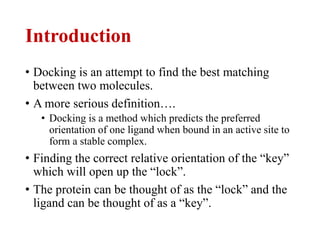
• Docking is an attempt to find the best matching
between two molecules.
• A more serious definition….
• Docking is a method which predicts the preferred
orientation of one ligand when bound in an active site to
form a stable complex.
• Finding the correct relative orientation of the “key”
which will open up the “lock”.
• The protein can be thought of as the “lock” and the
ligand can be thought of as a “key”.
Ligand in catalytic pocket
Protein(Cysteine Protease)
Protein with Ligand
Introduction
Successful docking methods search high-dimensional
spaces effectively and use a scoring function that correctly
ranks candidate dockings
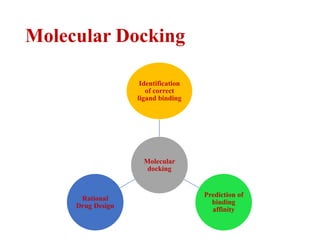
Molecular Docking
Molecular
docking
Identification
of correct
ligand binding
Prediction of
binding
affinity
Rational
Drug Design
Types of Docking
Rigid Docking (Lock and Key)
In rigid docking, the internal geometry of both the
receptor and ligand are treated as rigid.
Flexible Docking (Induced fit)
An enumeration on the rotations of one of the
molecules (usually smaller one) is performed. Every
rotation the energy is calculated; later the most
optimum pose is selected.
Docking can be between….
• Protein – Ligand
• Protein – Protein
• Protein – Nucleotide
Requirements
• Protein (Enzyme, peptide)
• Ligand (Drug, novel compound, testing compound,
organic compound)
• Docking Software (Autodock)
• Result analysis
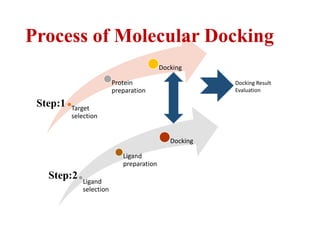
Target
selection
Protein
preparation
Docking
Ligand
selection
Ligand
preparation
Docking
Docking Result
Evaluation
Process of Molecular Docking
Step:1
Step:2
Bruton’s tyrosine kinase inhibitors
DOCKING
DOCKING
Screening of Compounds
 SANJEEVINI – IIT Delhi
 GOLD – University of Cambridge ,UK
 AUTODOCK - Scripps Research Institute,USA
 GemDock(Generic Evolutionary Method for Molecular Docking) A tool,
developed by Jinn-Moon Yang, a professor of the Institute of Bioinformatics,
National Chiao Tung University, Taiwan
 Hex Protein Docking - University of Aberdeen, UK
 GRAMM (Global Range Molecular Matching) Protein docking - A
Center for Bioinformatics, University of Kansas, USA
Docking Software
Limitations(Pharmacophore & Docking)
• The major limitation in virtual screening by
pharmacophore is the absence of good scoring
metrics.
• Whereas docking simulations are based on scoring
functions trying to predict the affinity, and similarity
searches utilize similarity metrics.
• Pharmacophore queries do not have a reliable,
general scoring metric.
• Most commonly, the quality of fitting the ligand into a
pharmacophore query is expressed by the root mean square
deviation between the features of the query and atoms of
the molecule.
Application
• Pharmacophore approaches are successful subfields
of computer-aided drug design (CADD) which have
become one of the major tools
• hit identification
• lead optimization
• rational design of novel drugs.
• Virtual screening (hit identification)
• Drug Discovery (lead optimization)
• Bioremediation

Docking techniques

  • 1.
  • 2.
    Introduction • Docking isan attempt to find the best matching between two molecules. • A more serious definition…. • Docking is a method which predicts the preferred orientation of one ligand when bound in an active site to form a stable complex. • Finding the correct relative orientation of the “key” which will open up the “lock”. • The protein can be thought of as the “lock” and the ligand can be thought of as a “key”.
  • 3.
    Ligand in catalyticpocket Protein(Cysteine Protease) Protein with Ligand
  • 4.
    Introduction Successful docking methodssearch high-dimensional spaces effectively and use a scoring function that correctly ranks candidate dockings
  • 5.
    Molecular Docking Molecular docking Identification of correct ligandbinding Prediction of binding affinity Rational Drug Design
  • 6.
    Types of Docking RigidDocking (Lock and Key) In rigid docking, the internal geometry of both the receptor and ligand are treated as rigid. Flexible Docking (Induced fit) An enumeration on the rotations of one of the molecules (usually smaller one) is performed. Every rotation the energy is calculated; later the most optimum pose is selected.
  • 7.
    Docking can bebetween…. • Protein – Ligand • Protein – Protein • Protein – Nucleotide
  • 8.
    Requirements • Protein (Enzyme,peptide) • Ligand (Drug, novel compound, testing compound, organic compound) • Docking Software (Autodock) • Result analysis
  • 9.
  • 10.
    Bruton’s tyrosine kinaseinhibitors DOCKING DOCKING Screening of Compounds
  • 11.
     SANJEEVINI –IIT Delhi  GOLD – University of Cambridge ,UK  AUTODOCK - Scripps Research Institute,USA  GemDock(Generic Evolutionary Method for Molecular Docking) A tool, developed by Jinn-Moon Yang, a professor of the Institute of Bioinformatics, National Chiao Tung University, Taiwan  Hex Protein Docking - University of Aberdeen, UK  GRAMM (Global Range Molecular Matching) Protein docking - A Center for Bioinformatics, University of Kansas, USA Docking Software
  • 12.
    Limitations(Pharmacophore & Docking) •The major limitation in virtual screening by pharmacophore is the absence of good scoring metrics. • Whereas docking simulations are based on scoring functions trying to predict the affinity, and similarity searches utilize similarity metrics. • Pharmacophore queries do not have a reliable, general scoring metric. • Most commonly, the quality of fitting the ligand into a pharmacophore query is expressed by the root mean square deviation between the features of the query and atoms of the molecule.
  • 13.
    Application • Pharmacophore approachesare successful subfields of computer-aided drug design (CADD) which have become one of the major tools • hit identification • lead optimization • rational design of novel drugs. • Virtual screening (hit identification) • Drug Discovery (lead optimization) • Bioremediation