2.5 Quadratic Equations
Chapter 2 Equations and Inequalities
Concepts and Objectives
⚫ Objectives for this section:
⚫ Solve quadratic equations by factoring.
⚫ Solve quadratic equations by the square root
property.
⚫ Solve quadratic equations by completing the square.
⚫ Solve quadratic equations by using the quadratic
formula.
Quadratic Equations
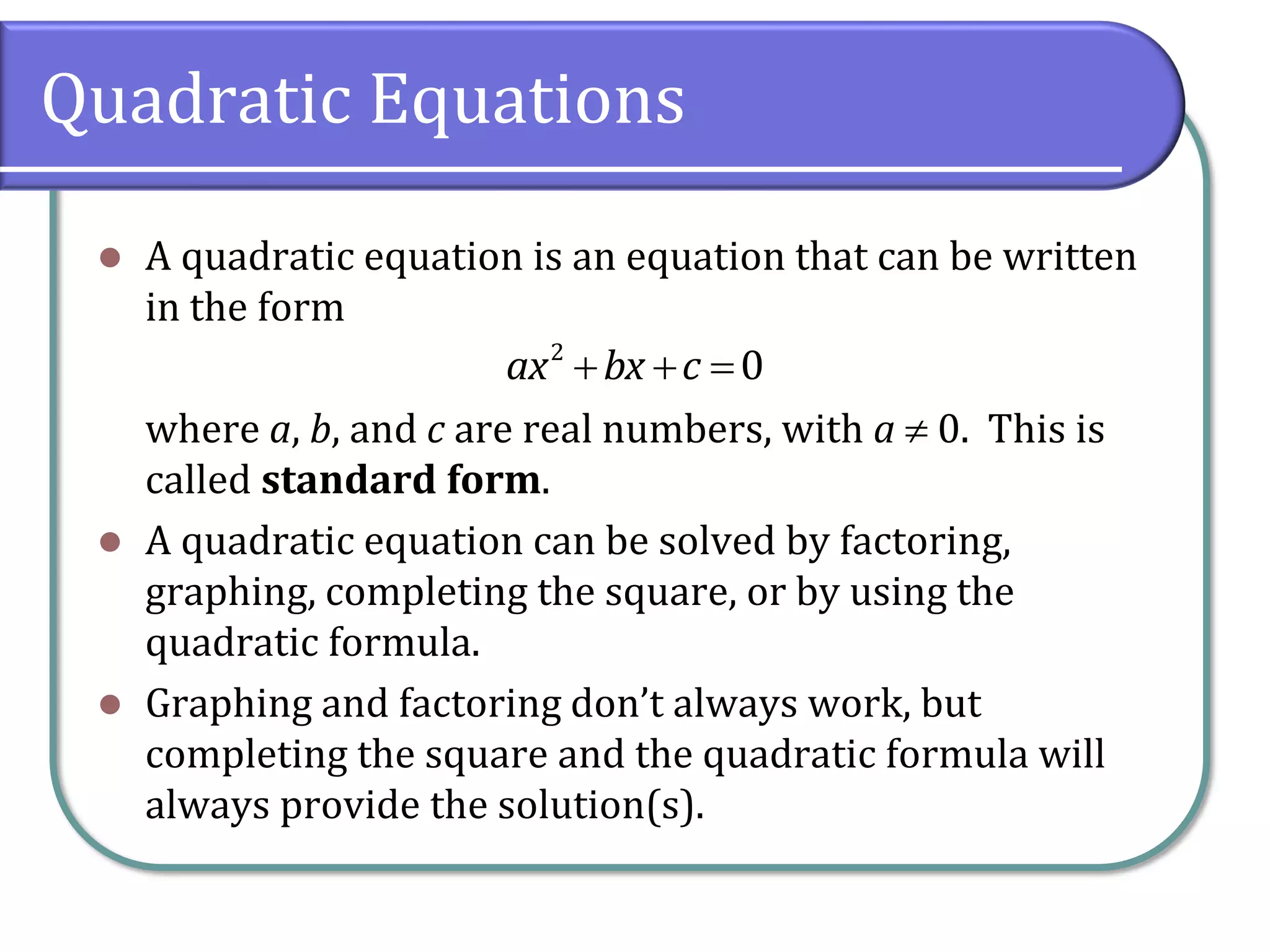
⚫ A quadratic equation is an equation that can be written
in the form
where a, b, and c are real numbers, with a  0. This is
called standard form.
⚫ A quadratic equation can be solved by factoring,
graphing, completing the square, or by using the
quadratic formula.
⚫ Graphing and factoring don’t always work, but
completing the square and the quadratic formula will
always provide the solution(s).
+ + =
2
0
ax bx c
Factoring Quadratic Equations
⚫ Factoring works because of the zero-factor property:
⚫ If a and b are complex numbers with ab = 0, then
a = 0 or b = 0 or both.
⚫ To solve a quadratic equation by factoring:
⚫ Put the equation into standard form (= 0).
⚫ If the equation has a GCF, factor it out.
⚫ Using the method of your choice, factor the quadratic
expression.
⚫ Set each factor equal to zero and solve both factors.
Factoring Quadratic Equations
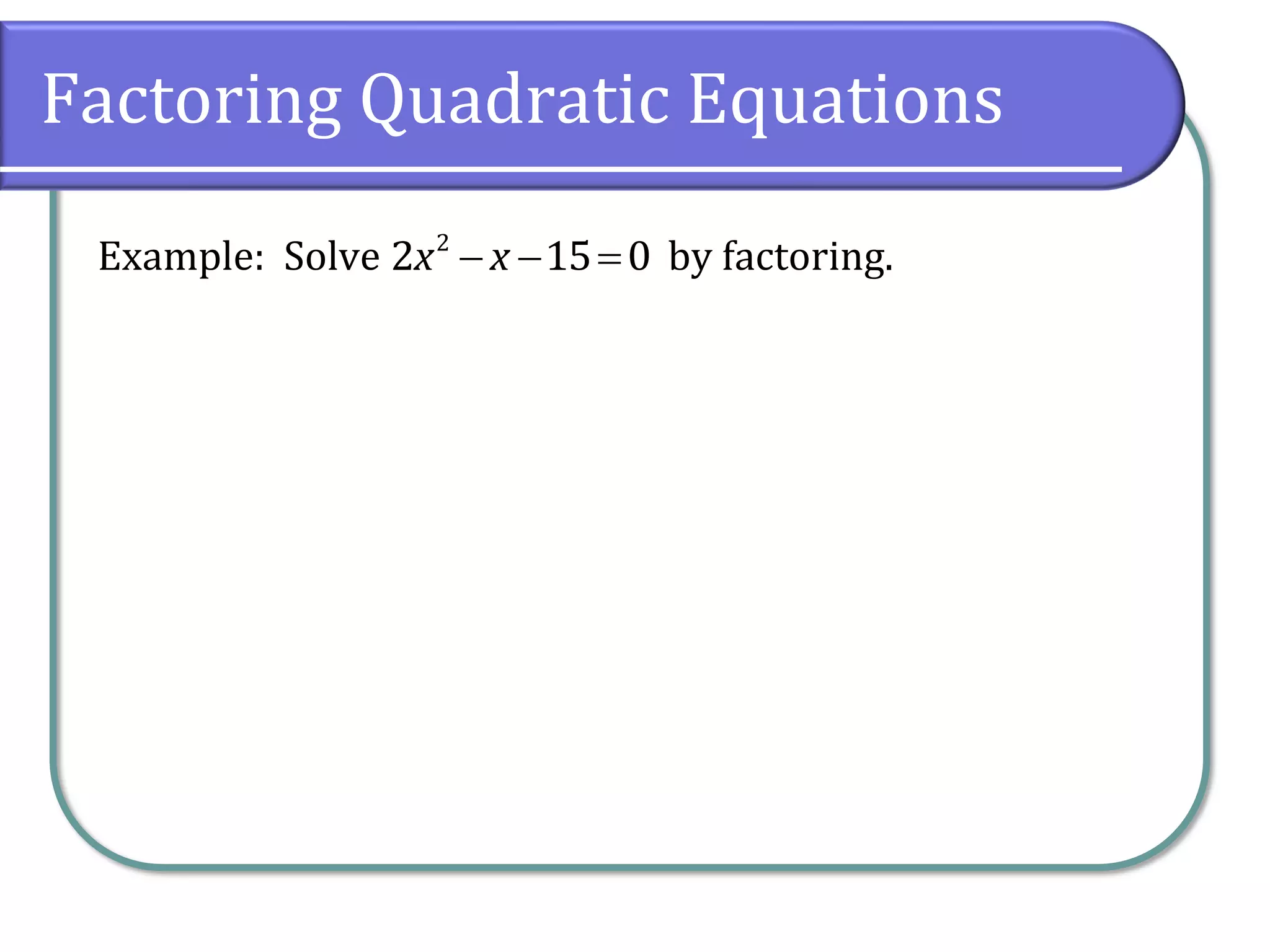
Example: Solve by factoring.
− − =
2
2 15 0
x x
Factoring Quadratic Equations
Example: Solve by factoring.
The solution set is
− − =
2
2 15 0
x x
= = − = −
2, 1, 15
a b c –30
–1
–6 5
6 5
0
2 2
x x
  
− + =
  
  
( )
5
3 0
2
x x
 
− + =
 
 
5
3 0 or 0
2
x x
− = + =
= −
5
, 3
2
x
5
, 3
2
 
−
 
 
Square Root Property
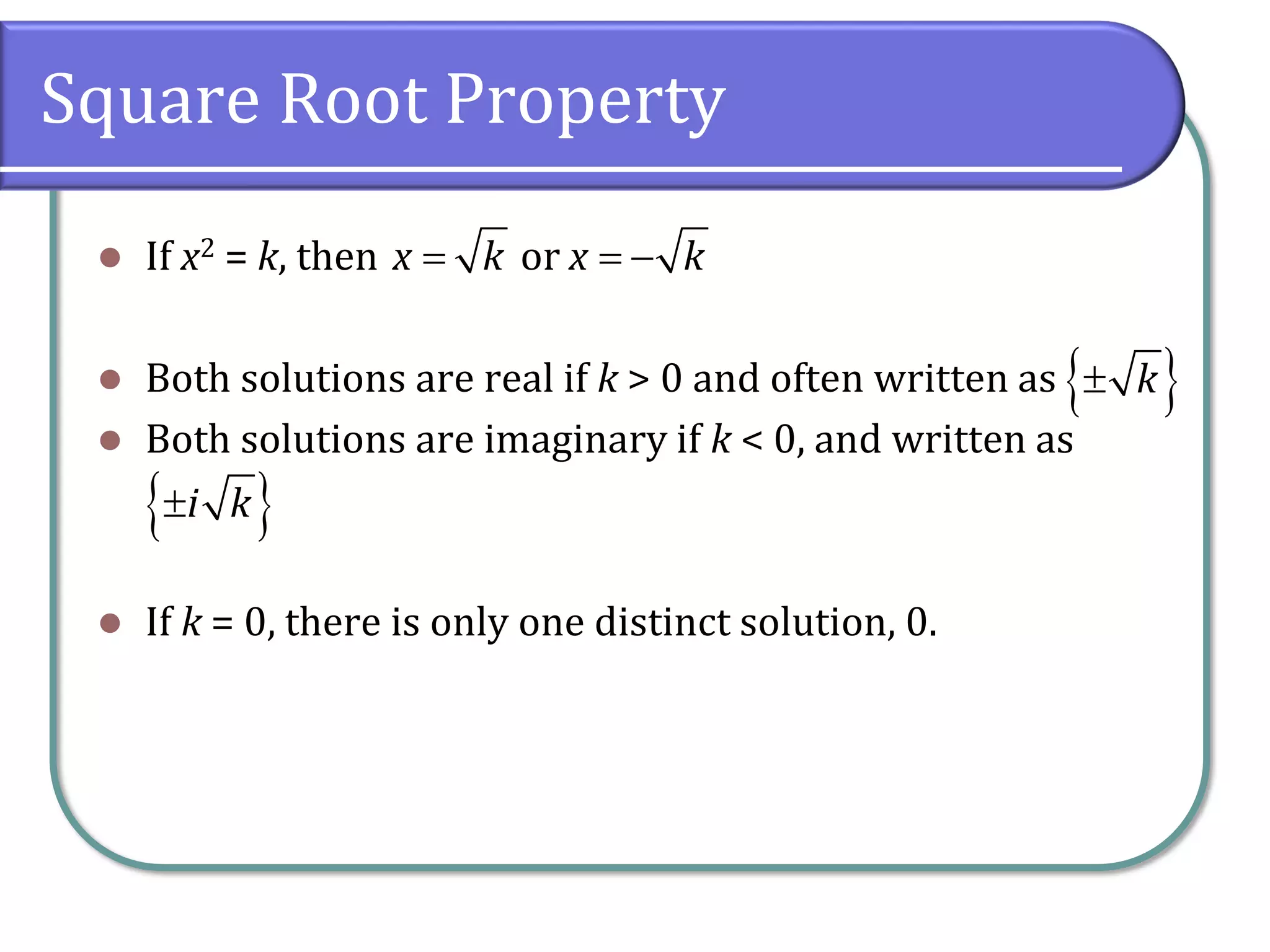
⚫ If x2 = k, then
⚫ Both solutions are real if k > 0 and often written as
⚫ Both solutions are imaginary if k < 0, and written as
⚫ If k = 0, there is only one distinct solution, 0.
or
x k x k
= = −
 
i k

 
k

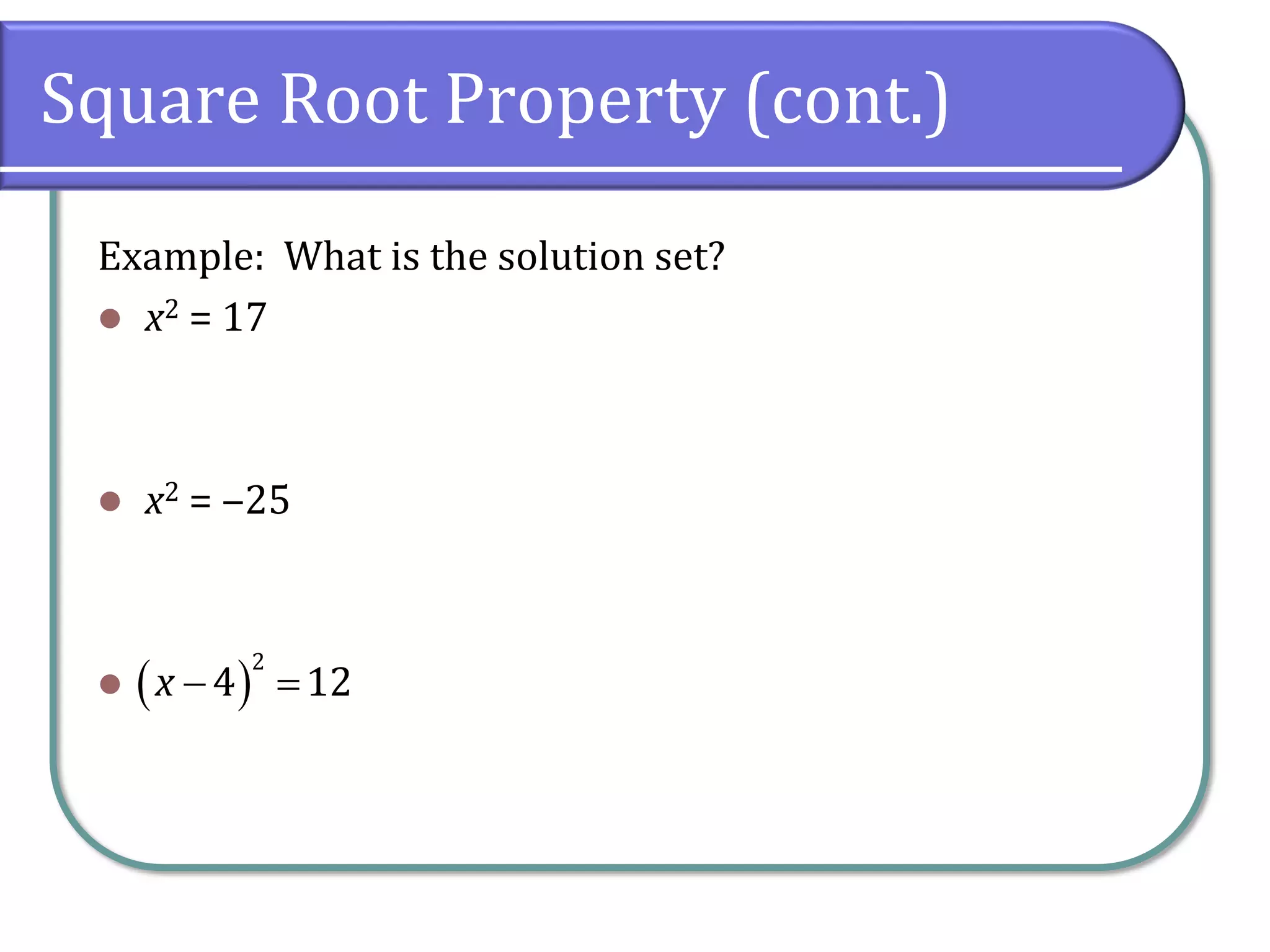
Square Root Property (cont.)
Example: What is the solution set?
⚫ x2 = 17
⚫ x2 = ‒25
⚫ ( )
2
4 12
x − =
Square Root Property (cont.)
Example: What is the solution set?
⚫ x2 = 17
⚫ x2 = ‒25
⚫ ( )
2
4 12
x − =
 
17

 
5i

4 12
4 2 3
x
x
− = 
= 
25 5
x i
=  − = 
 
4 2 3

17
x = 
Remember to simplify
any radicals!
Completing the Square
⚫ As the last example shows, we can use the square root
property if x is part of a binomial square.
⚫ It is possible to manipulate the equation to produce a
binomial square on one side and a constant on the other.
We can then use the square root property to solve the
equation. This method is called completing the square.
Completing the Square (cont.)
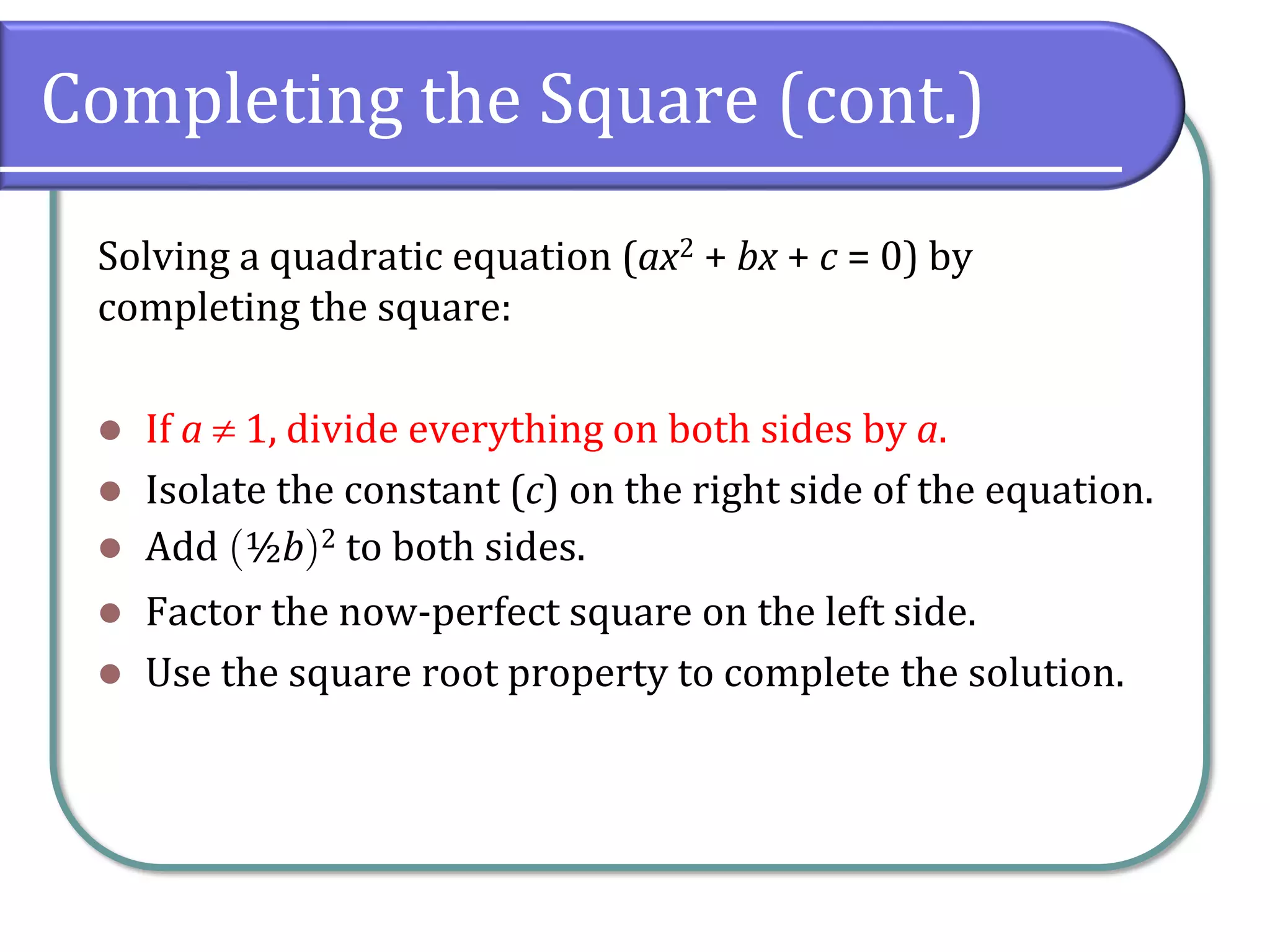
Solving a quadratic equation (ax2 + bx + c = 0) by
completing the square:
⚫ If a  1, divide everything on both sides by a.
⚫ Isolate the constant (c) on the right side of the equation.
⚫ Add ½b2 to both sides.
⚫ Factor the now-perfect square on the left side.
⚫ Use the square root property to complete the solution.
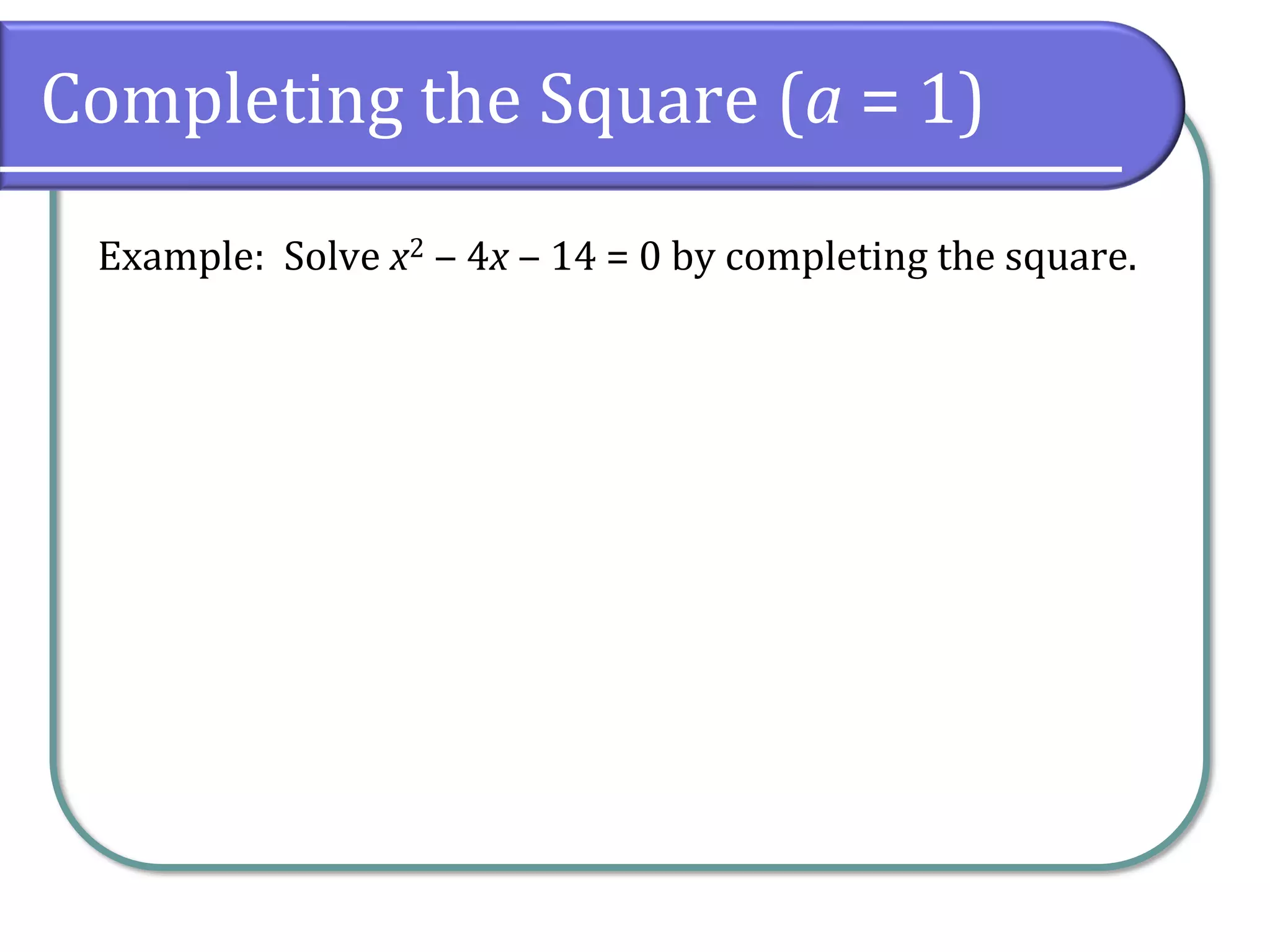
Completing the Square (a = 1)
Example: Solve x2 ‒ 4x ‒ 14 = 0 by completing the square.
Completing the Square (a = 1)
Example: Solve x2 ‒ 4x ‒ 14 = 0 by completing the square.
( )
2
2
2 2 2
2
4 14 0
4 14
4 14
1
2
2 2
2 18
2
2 8
3
x x
x x
x x
x
x
x
− − =
− =
+ = +
=
− = 
−

−
=
Completing the Square (a  1)
Example: Solve 4x2 + 6x + 5 = 0 by completing the square.
Completing the Square (a  1)
Example: Solve 4x2 + 6x + 5 = 0 by completing the square.
2
2
2
2
2 2
2
2
4 6 5 0
3 5
0 Divide by 4
2 4
3 5
2 4
3 3 5 3 1 3
Add to each side
2 4 4 4 2 2
3 11
4 16
3 11
4 16
3 11
4 4
x x
x x
x x
x x
x
x
x i
+ + =
+ + =
+ = −
 
     
+ + = − +
     
 
     
 
 
+ = −
 
 
+ =  −
= − 
3 11
The solution set is
4 4
i
 
 
− 
 
 
 
Quadratic Formula
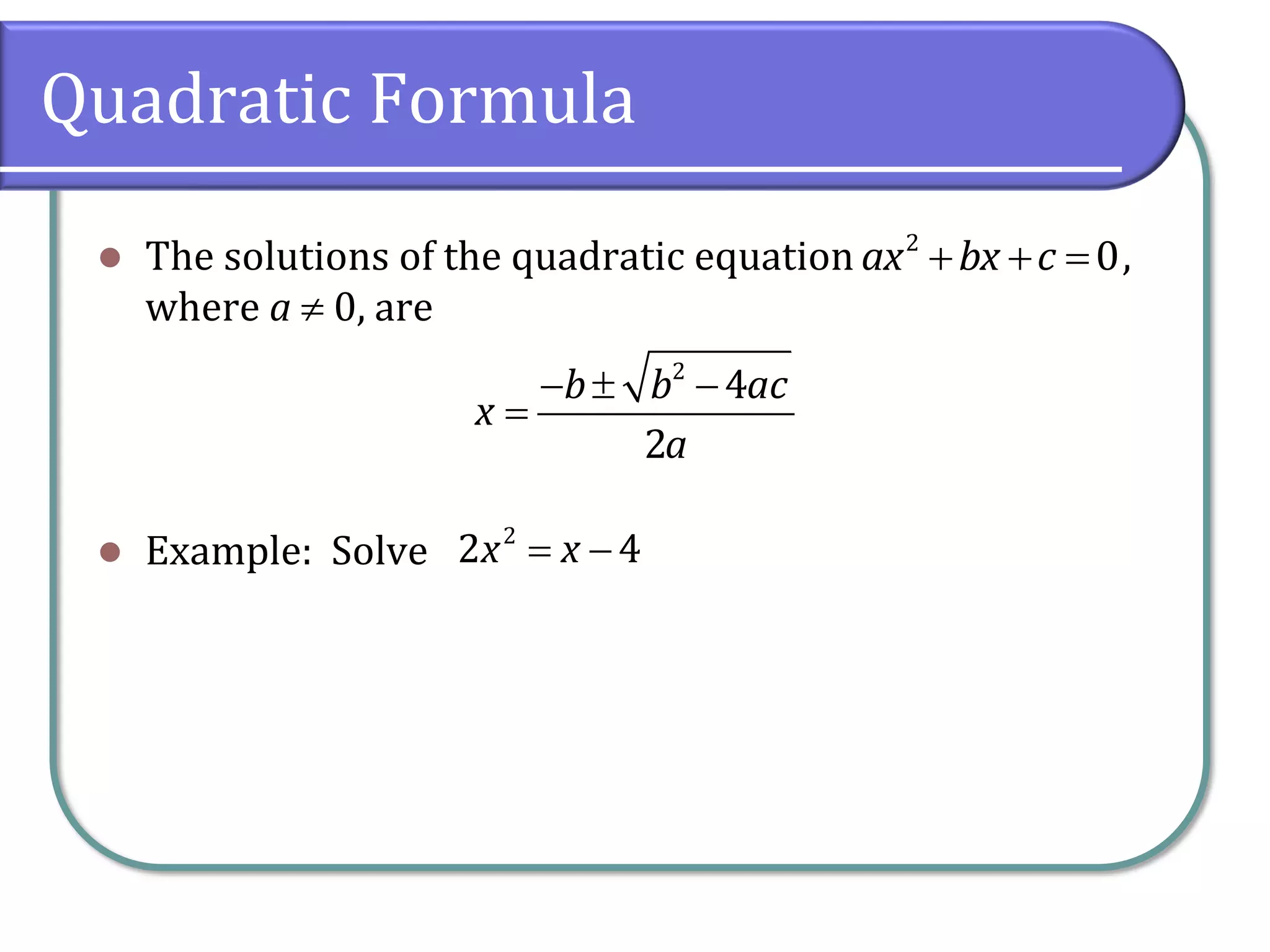
⚫ The solutions of the quadratic equation ,
where a  0, are
⚫ Example: Solve
+ + =
2
0
ax bx c
−  −
=
2
4
2
b b ac
x
a
= −
2
2 4
x x
Quadratic Formula
⚫ Example: Solve = −
2
2 4
x x
− + =
2
2 4 0
x x a c
b 4
, ,
2 1
=
= =
−
Quadratic Formula
⚫ Example: Solve
The solution set is
= −
2
2 4
x x
− + =
2
2 4 0
x x −
= =
= 4
, ,
1
2
a c
b
( ) ( ) ( )( )
( )
−  −
− −
=
2
1 1
2
4 2 4
2
x
 −  −
= =
1 1 32 1 31
4 4

=
1 31
4
i  
 

 
 
 
1 31
4 4
i
The Discriminant
⚫ The discriminant is the quantity under the radical in the
quadratic formula: b2 − 4ac.
⚫ When the numbers a, b, and c are integers, the value of
the discriminant can be used to determine whether the
solutions of a quadratic equation are rational, irrational,
or nonreal complex numbers.
− 
=
−
2
2
4
b
x
b ac
a
Discriminant
The Discriminant (cont.)
⚫ The number and type of solutions based on the value of
the discriminant are shown in the following table.
⚫ Remember, a, b, and c must be integers.
Discriminant Number of Solutions Type of Solution
Positive, perfect
square
Two (can be factored) Rational
Positive, not a
perfect square
Two Irrational
Zero One (a double solution) Rational
Negative Two Nonreal complex
Classwork
⚫ College Algebra 2e
⚫ 2.5: 6-18 (even); 2.4: 6-16 (even); 2.3: 28, 30, 32, 33,
36, 37, 44, 46-48
⚫ 2.5 Classwork Check
⚫ Quiz 2.4

2.5 Quadratic Equations

  • 1.
    2.5 Quadratic Equations Chapter2 Equations and Inequalities
  • 2.
    Concepts and Objectives ⚫Objectives for this section: ⚫ Solve quadratic equations by factoring. ⚫ Solve quadratic equations by the square root property. ⚫ Solve quadratic equations by completing the square. ⚫ Solve quadratic equations by using the quadratic formula.
  • 3.
    Quadratic Equations ⚫ Aquadratic equation is an equation that can be written in the form where a, b, and c are real numbers, with a  0. This is called standard form. ⚫ A quadratic equation can be solved by factoring, graphing, completing the square, or by using the quadratic formula. ⚫ Graphing and factoring don’t always work, but completing the square and the quadratic formula will always provide the solution(s). + + = 2 0 ax bx c
  • 4.
    Factoring Quadratic Equations ⚫Factoring works because of the zero-factor property: ⚫ If a and b are complex numbers with ab = 0, then a = 0 or b = 0 or both. ⚫ To solve a quadratic equation by factoring: ⚫ Put the equation into standard form (= 0). ⚫ If the equation has a GCF, factor it out. ⚫ Using the method of your choice, factor the quadratic expression. ⚫ Set each factor equal to zero and solve both factors.
  • 5.
    Factoring Quadratic Equations Example:Solve by factoring. − − = 2 2 15 0 x x
  • 6.
    Factoring Quadratic Equations Example:Solve by factoring. The solution set is − − = 2 2 15 0 x x = = − = − 2, 1, 15 a b c –30 –1 –6 5 6 5 0 2 2 x x    − + =       ( ) 5 3 0 2 x x   − + =     5 3 0 or 0 2 x x − = + = = − 5 , 3 2 x 5 , 3 2   −    
  • 7.
    Square Root Property ⚫If x2 = k, then ⚫ Both solutions are real if k > 0 and often written as ⚫ Both solutions are imaginary if k < 0, and written as ⚫ If k = 0, there is only one distinct solution, 0. or x k x k = = −   i k    k 
  • 8.
    Square Root Property(cont.) Example: What is the solution set? ⚫ x2 = 17 ⚫ x2 = ‒25 ⚫ ( ) 2 4 12 x − =
  • 9.
    Square Root Property(cont.) Example: What is the solution set? ⚫ x2 = 17 ⚫ x2 = ‒25 ⚫ ( ) 2 4 12 x − =   17    5i  4 12 4 2 3 x x − =  =  25 5 x i =  − =    4 2 3  17 x =  Remember to simplify any radicals!
  • 10.
    Completing the Square ⚫As the last example shows, we can use the square root property if x is part of a binomial square. ⚫ It is possible to manipulate the equation to produce a binomial square on one side and a constant on the other. We can then use the square root property to solve the equation. This method is called completing the square.
  • 11.
    Completing the Square(cont.) Solving a quadratic equation (ax2 + bx + c = 0) by completing the square: ⚫ If a  1, divide everything on both sides by a. ⚫ Isolate the constant (c) on the right side of the equation. ⚫ Add ½b2 to both sides. ⚫ Factor the now-perfect square on the left side. ⚫ Use the square root property to complete the solution.
  • 12.
    Completing the Square(a = 1) Example: Solve x2 ‒ 4x ‒ 14 = 0 by completing the square.
  • 13.
    Completing the Square(a = 1) Example: Solve x2 ‒ 4x ‒ 14 = 0 by completing the square. ( ) 2 2 2 2 2 2 4 14 0 4 14 4 14 1 2 2 2 2 18 2 2 8 3 x x x x x x x x x − − = − = + = + = − =  −  − =
  • 14.
    Completing the Square(a  1) Example: Solve 4x2 + 6x + 5 = 0 by completing the square.
  • 15.
    Completing the Square(a  1) Example: Solve 4x2 + 6x + 5 = 0 by completing the square. 2 2 2 2 2 2 2 2 4 6 5 0 3 5 0 Divide by 4 2 4 3 5 2 4 3 3 5 3 1 3 Add to each side 2 4 4 4 2 2 3 11 4 16 3 11 4 16 3 11 4 4 x x x x x x x x x x x i + + = + + = + = −         + + = − +                   + = −     + =  − = −  3 11 The solution set is 4 4 i     −       
  • 16.
    Quadratic Formula ⚫ Thesolutions of the quadratic equation , where a  0, are ⚫ Example: Solve + + = 2 0 ax bx c −  − = 2 4 2 b b ac x a = − 2 2 4 x x
  • 17.
    Quadratic Formula ⚫ Example:Solve = − 2 2 4 x x − + = 2 2 4 0 x x a c b 4 , , 2 1 = = = −
  • 18.
    Quadratic Formula ⚫ Example:Solve The solution set is = − 2 2 4 x x − + = 2 2 4 0 x x − = = = 4 , , 1 2 a c b ( ) ( ) ( )( ) ( ) −  − − − = 2 1 1 2 4 2 4 2 x  −  − = = 1 1 32 1 31 4 4  = 1 31 4 i            1 31 4 4 i
  • 19.
    The Discriminant ⚫ Thediscriminant is the quantity under the radical in the quadratic formula: b2 − 4ac. ⚫ When the numbers a, b, and c are integers, the value of the discriminant can be used to determine whether the solutions of a quadratic equation are rational, irrational, or nonreal complex numbers. −  = − 2 2 4 b x b ac a Discriminant
  • 20.
    The Discriminant (cont.) ⚫The number and type of solutions based on the value of the discriminant are shown in the following table. ⚫ Remember, a, b, and c must be integers. Discriminant Number of Solutions Type of Solution Positive, perfect square Two (can be factored) Rational Positive, not a perfect square Two Irrational Zero One (a double solution) Rational Negative Two Nonreal complex
  • 21.
    Classwork ⚫ College Algebra2e ⚫ 2.5: 6-18 (even); 2.4: 6-16 (even); 2.3: 28, 30, 32, 33, 36, 37, 44, 46-48 ⚫ 2.5 Classwork Check ⚫ Quiz 2.4