Quadratic Equations
Definition
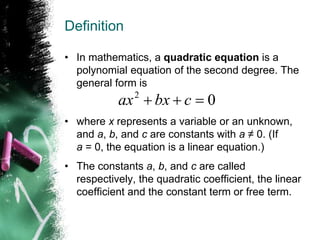
• In mathematics, a quadratic equation is a
polynomial equation of the second degree. The
general form is
• where x represents a variable or an unknown,
and a, b, and c are constants with a ≠ 0. (If
a = 0, the equation is a linear equation.)
• The constants a, b, and c are called
respectively, the quadratic coefficient, the linear
coefficient and the constant term or free term.
0
2


 c
bx
ax
Quadratic & Roots
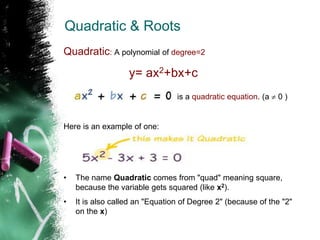
Quadratic: A polynomial of degree=2
y= ax2+bx+c
is a quadratic equation. (a  0 )
Here is an example of one:
• The name Quadratic comes from "quad" meaning square,
because the variable gets squared (like x2).
• It is also called an "Equation of Degree 2" (because of the "2"
on the x)
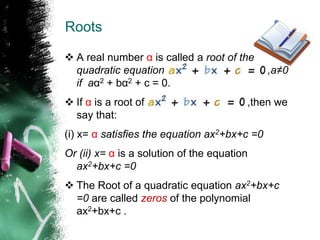
Roots
 A real number α is called a root of the
quadratic equation ,a≠0
if aα2 + bα2 + c = 0.
 If α is a root of ,then we
say that:
(i) x= α satisfies the equation ax2+bx+c =0
Or (ii) x= α is a solution of the equation
ax2+bx+c =0
 The Root of a quadratic equation ax2+bx+c
=0 are called zeros of the polynomial
ax2+bx+c .
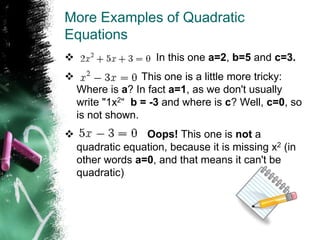
More Examples of Quadratic
Equations
 In this one a=2, b=5 and c=3.
 This one is a little more tricky:
Where is a? In fact a=1, as we don't usually
write "1x2“ b = -3 and where is c? Well, c=0, so
is not shown.
 Oops! This one is not a
quadratic equation, because it is missing x2 (in
other words a=0, and that means it can't be
quadratic)
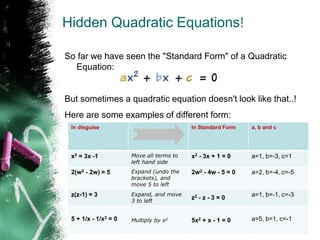
Hidden Quadratic Equations!
So far we have seen the "Standard Form" of a Quadratic
Equation:
But sometimes a quadratic equation doesn't look like that..!
Here are some examples of different form:
In disguise In Standard Form a, b and c
x2 = 3x -1 Move all terms to
left hand side
x2 - 3x + 1 = 0 a=1, b=-3, c=1
2(w2 - 2w) = 5 Expand (undo the
brackets), and
move 5 to left
2w2 - 4w - 5 = 0 a=2, b=-4, c=-5
z(z-1) = 3 Expand, and move
3 to left
z2 - z - 3 = 0 a=1, b=-1, c=-3
5 + 1/x - 1/x2 = 0 Multiply by x2
5x2 + x - 1 = 0 a=5, b=1, c=-1
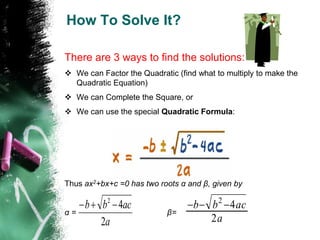
How To Solve It?
There are 3 ways to find the solutions:
 We can Factor the Quadratic (find what to multiply to make the
Quadratic Equation)
 We can Complete the Square, or
 We can use the special Quadratic Formula:
Thus ax2+bx+c =0 has two roots α and β, given by
α = β=
a
ac
b
b
2
4
2



a
ac
b
b
2
4
2



Discriminant
 The expression b2 - 4ac in the formula
 It is called the Discriminant, because it can "discriminate"
between the possible types of answer.It can be denoted by “D”
 when b2 - 4ac, D is positive, you get two real solutions
 when it is zero you get just ONE real solution (both answers are
the same)
 when it is negative you get two Complex solutions
Value of D Nature of Roots Roots
D > 0 Real and Unequal [(-b±√D)/2a]
D = 0 Real and Equal Each root = (-b/2a)
D < 0 No real roots None
Using the Quadratic Formula
Just put the values of a, b and c into the Quadratic Formula, and do
the calculation
Example: Solve 5x² + 6x + 1 = 0
Coefficients are: a = 5, b = 6, c = 1
Quadratic Formula: x = [ -b ± √(b2-4ac) ] / 2a
Put in a, b and c:
x=
Solve: x =
x =
x =
x = -0.2 or -1
 
  













5
2
1
5
4
6
6 2
 
  






 


10
20
36
6
 
  






 

10
16
6
  




 

10
4
6
Continue..
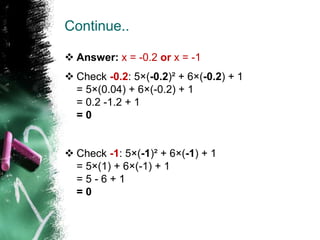
 Answer: x = -0.2 or x = -1
 Check -0.2: 5×(-0.2)² + 6×(-0.2) + 1
= 5×(0.04) + 6×(-0.2) + 1
= 0.2 -1.2 + 1
= 0
 Check -1: 5×(-1)² + 6×(-1) + 1
= 5×(1) + 6×(-1) + 1
= 5 - 6 + 1
= 0
Factoring Quadratics
 To "Factor" (or "Factorize") a Quadratic is to find what to multiply
to get the Quadratic
It is called "Factoring" because you find the factors (a factor is
something you multiply by)
 Example
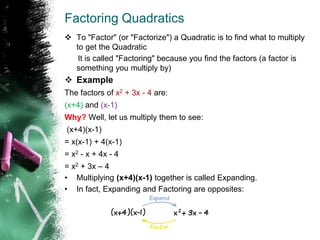
The factors of x2 + 3x - 4 are:
(x+4) and (x-1)
Why? Well, let us multiply them to see:
(x+4)(x-1)
= x(x-1) + 4(x-1)
= x2 - x + 4x - 4
= x2 + 3x – 4
• Multiplying (x+4)(x-1) together is called Expanding.
• In fact, Expanding and Factoring are opposites:
Examples of Factor
To solve by factoring:
1. Set the equation equal to zero.
2. Factor. The factors will be linear expressions.
3. Set each linear factor equal to zero.
4. Solve both linear equations.
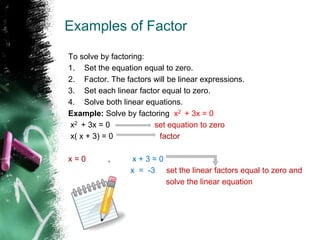
Example: Solve by factoring x2 + 3x = 0
x2 + 3x = 0 set equation to zero
x( x + 3) = 0 factor
x = 0 , x + 3 = 0
x = -3 set the linear factors equal to zero and
solve the linear equation
Completing the Square
Solving General Quadratic Equations by Completing the
Square:
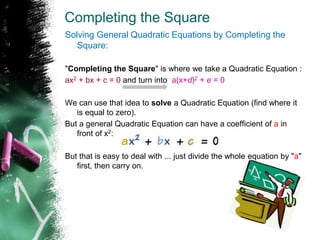
"Completing the Square" is where we take a Quadratic Equation :
ax2 + bx + c = 0 and turn into a(x+d)2 + e = 0
We can use that idea to solve a Quadratic Equation (find where it
is equal to zero).
But a general Quadratic Equation can have a coefficient of a in
front of x2:
But that is easy to deal with ... just divide the whole equation by "a"
first, then carry on.
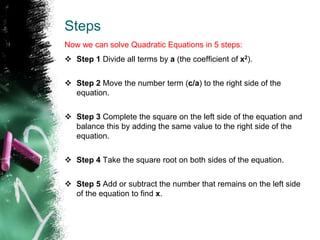
Steps
Now we can solve Quadratic Equations in 5 steps:
 Step 1 Divide all terms by a (the coefficient of x2).
 Step 2 Move the number term (c/a) to the right side of the
equation.
 Step 3 Complete the square on the left side of the equation and
balance this by adding the same value to the right side of the
equation.
 Step 4 Take the square root on both sides of the equation.
 Step 5 Add or subtract the number that remains on the left side
of the equation to find x.
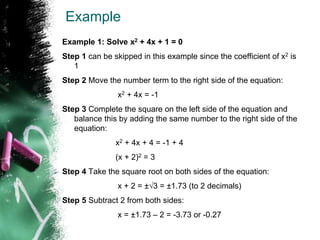
Example
Example 1: Solve x2 + 4x + 1 = 0
Step 1 can be skipped in this example since the coefficient of x2 is
1
Step 2 Move the number term to the right side of the equation:
x2 + 4x = -1
Step 3 Complete the square on the left side of the equation and
balance this by adding the same number to the right side of the
equation:
x2 + 4x + 4 = -1 + 4
(x + 2)2 = 3
Step 4 Take the square root on both sides of the equation:
x + 2 = ±√3 = ±1.73 (to 2 decimals)
Step 5 Subtract 2 from both sides:
x = ±1.73 – 2 = -3.73 or -0.27

QUADRATIC.pptx

  • 1.
  • 2.
    Definition • In mathematics,a quadratic equation is a polynomial equation of the second degree. The general form is • where x represents a variable or an unknown, and a, b, and c are constants with a ≠ 0. (If a = 0, the equation is a linear equation.) • The constants a, b, and c are called respectively, the quadratic coefficient, the linear coefficient and the constant term or free term. 0 2    c bx ax
  • 3.
    Quadratic & Roots Quadratic:A polynomial of degree=2 y= ax2+bx+c is a quadratic equation. (a  0 ) Here is an example of one: • The name Quadratic comes from "quad" meaning square, because the variable gets squared (like x2). • It is also called an "Equation of Degree 2" (because of the "2" on the x)
  • 4.
    Roots  A realnumber α is called a root of the quadratic equation ,a≠0 if aα2 + bα2 + c = 0.  If α is a root of ,then we say that: (i) x= α satisfies the equation ax2+bx+c =0 Or (ii) x= α is a solution of the equation ax2+bx+c =0  The Root of a quadratic equation ax2+bx+c =0 are called zeros of the polynomial ax2+bx+c .
  • 5.
    More Examples ofQuadratic Equations  In this one a=2, b=5 and c=3.  This one is a little more tricky: Where is a? In fact a=1, as we don't usually write "1x2“ b = -3 and where is c? Well, c=0, so is not shown.  Oops! This one is not a quadratic equation, because it is missing x2 (in other words a=0, and that means it can't be quadratic)
  • 6.
    Hidden Quadratic Equations! Sofar we have seen the "Standard Form" of a Quadratic Equation: But sometimes a quadratic equation doesn't look like that..! Here are some examples of different form: In disguise In Standard Form a, b and c x2 = 3x -1 Move all terms to left hand side x2 - 3x + 1 = 0 a=1, b=-3, c=1 2(w2 - 2w) = 5 Expand (undo the brackets), and move 5 to left 2w2 - 4w - 5 = 0 a=2, b=-4, c=-5 z(z-1) = 3 Expand, and move 3 to left z2 - z - 3 = 0 a=1, b=-1, c=-3 5 + 1/x - 1/x2 = 0 Multiply by x2 5x2 + x - 1 = 0 a=5, b=1, c=-1
  • 7.
    How To SolveIt? There are 3 ways to find the solutions:  We can Factor the Quadratic (find what to multiply to make the Quadratic Equation)  We can Complete the Square, or  We can use the special Quadratic Formula: Thus ax2+bx+c =0 has two roots α and β, given by α = β= a ac b b 2 4 2    a ac b b 2 4 2   
  • 8.
    Discriminant  The expressionb2 - 4ac in the formula  It is called the Discriminant, because it can "discriminate" between the possible types of answer.It can be denoted by “D”  when b2 - 4ac, D is positive, you get two real solutions  when it is zero you get just ONE real solution (both answers are the same)  when it is negative you get two Complex solutions Value of D Nature of Roots Roots D > 0 Real and Unequal [(-b±√D)/2a] D = 0 Real and Equal Each root = (-b/2a) D < 0 No real roots None
  • 9.
    Using the QuadraticFormula Just put the values of a, b and c into the Quadratic Formula, and do the calculation Example: Solve 5x² + 6x + 1 = 0 Coefficients are: a = 5, b = 6, c = 1 Quadratic Formula: x = [ -b ± √(b2-4ac) ] / 2a Put in a, b and c: x= Solve: x = x = x = x = -0.2 or -1                   5 2 1 5 4 6 6 2                10 20 36 6               10 16 6           10 4 6
  • 10.
    Continue..  Answer: x= -0.2 or x = -1  Check -0.2: 5×(-0.2)² + 6×(-0.2) + 1 = 5×(0.04) + 6×(-0.2) + 1 = 0.2 -1.2 + 1 = 0  Check -1: 5×(-1)² + 6×(-1) + 1 = 5×(1) + 6×(-1) + 1 = 5 - 6 + 1 = 0
  • 11.
    Factoring Quadratics  To"Factor" (or "Factorize") a Quadratic is to find what to multiply to get the Quadratic It is called "Factoring" because you find the factors (a factor is something you multiply by)  Example The factors of x2 + 3x - 4 are: (x+4) and (x-1) Why? Well, let us multiply them to see: (x+4)(x-1) = x(x-1) + 4(x-1) = x2 - x + 4x - 4 = x2 + 3x – 4 • Multiplying (x+4)(x-1) together is called Expanding. • In fact, Expanding and Factoring are opposites:
  • 12.
    Examples of Factor Tosolve by factoring: 1. Set the equation equal to zero. 2. Factor. The factors will be linear expressions. 3. Set each linear factor equal to zero. 4. Solve both linear equations. Example: Solve by factoring x2 + 3x = 0 x2 + 3x = 0 set equation to zero x( x + 3) = 0 factor x = 0 , x + 3 = 0 x = -3 set the linear factors equal to zero and solve the linear equation
  • 13.
    Completing the Square SolvingGeneral Quadratic Equations by Completing the Square: "Completing the Square" is where we take a Quadratic Equation : ax2 + bx + c = 0 and turn into a(x+d)2 + e = 0 We can use that idea to solve a Quadratic Equation (find where it is equal to zero). But a general Quadratic Equation can have a coefficient of a in front of x2: But that is easy to deal with ... just divide the whole equation by "a" first, then carry on.
  • 14.
    Steps Now we cansolve Quadratic Equations in 5 steps:  Step 1 Divide all terms by a (the coefficient of x2).  Step 2 Move the number term (c/a) to the right side of the equation.  Step 3 Complete the square on the left side of the equation and balance this by adding the same value to the right side of the equation.  Step 4 Take the square root on both sides of the equation.  Step 5 Add or subtract the number that remains on the left side of the equation to find x.
  • 15.
    Example Example 1: Solvex2 + 4x + 1 = 0 Step 1 can be skipped in this example since the coefficient of x2 is 1 Step 2 Move the number term to the right side of the equation: x2 + 4x = -1 Step 3 Complete the square on the left side of the equation and balance this by adding the same number to the right side of the equation: x2 + 4x + 4 = -1 + 4 (x + 2)2 = 3 Step 4 Take the square root on both sides of the equation: x + 2 = ±√3 = ±1.73 (to 2 decimals) Step 5 Subtract 2 from both sides: x = ±1.73 – 2 = -3.73 or -0.27