TDMA Technology
OUTLINE
● What is TDMA technology
● How TDMA works
● Features of TDMA
● Evolution of TDMA
● Synchronization in TDMA
● FDMA vs TDMA
● CDMA vs TDMA
● E-TDMA
● Advantages and disadvantages of TDMA
● References
2
What is TDMA
Technology?
3
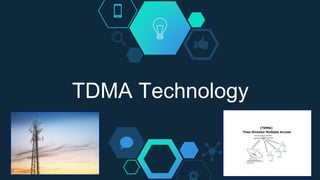
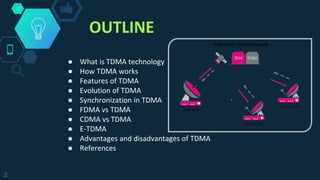
● Time Division Multiple Access(TDMA) is a digital
cellular telephone communication technology.
● It facilitates many users to share the same
frequency without interference.
● It’s technology divides a signal into different time
slots.
● Hence increase the data carrying capacity.
How TDMA works?
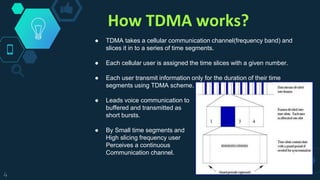
● TDMA takes a cellular communication channel(frequency band) and
slices it in to a series of time segments.
● Each cellular user is assigned the time slices with a given number.
● Each user transmit information only for the duration of their time
segments using TDMA scheme.
● Leads voice communication to
buffered and transmitted as
short bursts.
● By Small time segments and
High slicing frequency user
Perceives a continuous
Communication channel.
4
“
5
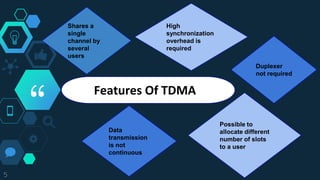
Shares a
single
channel by
several
users
Data
transmission
is not
continuous
Duplexer
not required
High
synchronization
overhead is
required
Possible to
allocate different
number of slots
to a user
Features Of TDMA
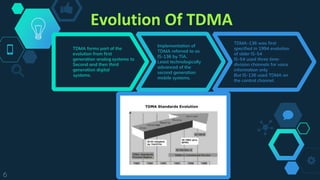
Evolution Of TDMA
TDMA forms part of the
evolution from first
generation analog systems to
Second and then third
generation digital
systems.
Implementation of
TDMA referred to as
IS-136 by TIA.
Least technologically
advanced of the
second generation
mobile systems.
TDMA-136 was first
specified in 1994 evolution
of older IS-54
IS-54 used three time-
division channels for voice
information only
But IS-136 used TDMA on
the control channel.
6
Evolution of TDMA
Second Generation:
● Global System for Mobile Communications (GSM) was the first
commercially operated digital cellular system. It was first
developed in the 1980s.
● GSM uses TDMA (Time Division Multiple Access) technology. It is
the dominant cellular standard today.
● TDMA IS-136 is the digital enhancement of the analog AMPS
technology. It was called D-AMPS when it was first introduced in
late 1991 to protect the substantial investment that service
providers had made in AMPS technology.
● Personal Digital Cellular (PDC) is the second largest digital mobile
standard. Like GSM, it is based on the TDMA access technology.
● Personal Handyphone System (PHS) is a digital system used in
Japan, first launched in 1995 as a cheaper alternative to cellular
systems.
7
Synchronization in TDMA
◇ Network synchronization is required to ensure that all
bursts arrive at the satellite in their correct time slots. For
this purpose, timing markers are provided by the reference
bursts, which are tied to a highly stable clock at the
reference station and transmitted through the satellite link
to the traffic stations.
◇ At any given traffic station, detection of the unique word (or
burst code word) in the reference burst signals the start of
receiving frame (SORF), the marker coinciding with the last
bit in the unique word.
8
Synchronization in TDMA
◇ It would be desirable to have the highly stable clock located
aboard the satellite because this would eliminate the
variations in propagation delay arising from the uplink for
the reference station, but this is not practical because of
weight and space limitations. Hence, there is a need to carry
out network synchronization.
◇ A major advantage of the TDMA mode of operation is that
the burst time plan is essentially under software control so
that changes in traffic patterns can be accommodated much
more readily than is the case with FDMA.
9
E-TDMA
10
● First generation digital cellular radio use digital speech
compression and TDMA to carry three voice circuits on
each duplex 30kHz radio channel pair.
● TDMA structure provides for expansion to six voice
circuits per RF channel.
● Further capacity increases can be acheived by using
digital speed interpolation(DSI).
● The capacities of analog and full and half rate digital
access methods are compared in an interference-limited
environment.
● An implementation of DSI and half rate speech is called
Extended TDMA.
FDMA vs TDMA
TDMA
● It’s entire bandwidth is shared
among different subscribers at
fixed predetermined or
dynamically assigned time
intervals.
11
FDMA
● Entire band of
frequencies is divided
into multiple
RF channels/carriers.
● Each carrier allocated
to different users.
CDMA vs TDMA
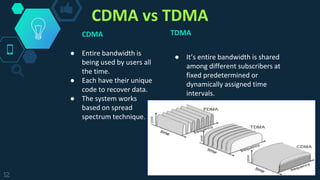
TDMA
● It’s entire bandwidth is shared
among different subscribers at
fixed predetermined or
dynamically assigned time
intervals.
12
CDMA
● Entire bandwidth is
being used by users all
the time.
● Each have their unique
code to recover data.
● The system works
based on spread
spectrum technique.
TDMA...
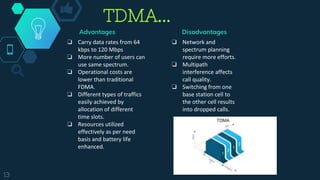
Advantages
❏ Carry data rates from 64
kbps to 120 Mbps
❏ More number of users can
use same spectrum.
❏ Operational costs are
lower than traditional
FDMA.
❏ Different types of traffics
easily achieved by
allocation of different
time slots.
❏ Resources utilized
effectively as per need
basis and battery life
enhanced.
Disadvantages
❏ Network and
spectrum planning
require more efforts.
❏ Multipath
interference affects
call quality.
❏ Switching from one
base station cell to
the other cell results
into dropped calls.
13
References
➢ https://www.ques10.com
➢ https://www.tutorialspoint.com
➢ https://searchnetworking.techtarget.com/definition/TDMA
➢ https://ieeexplore.ieee.org/document/267954/
➢ https://www.electronicdesign.com/communications/funda
mentals-communications-access-technologies-fdma-tdma-
cdma-ofdma-and-sdma
14
THANK
YOU!
15

TDMA Technology

  • 1.
  • 2.
    OUTLINE ● What isTDMA technology ● How TDMA works ● Features of TDMA ● Evolution of TDMA ● Synchronization in TDMA ● FDMA vs TDMA ● CDMA vs TDMA ● E-TDMA ● Advantages and disadvantages of TDMA ● References 2
  • 3.
    What is TDMA Technology? 3 ●Time Division Multiple Access(TDMA) is a digital cellular telephone communication technology. ● It facilitates many users to share the same frequency without interference. ● It’s technology divides a signal into different time slots. ● Hence increase the data carrying capacity.
  • 4.
    How TDMA works? ●TDMA takes a cellular communication channel(frequency band) and slices it in to a series of time segments. ● Each cellular user is assigned the time slices with a given number. ● Each user transmit information only for the duration of their time segments using TDMA scheme. ● Leads voice communication to buffered and transmitted as short bursts. ● By Small time segments and High slicing frequency user Perceives a continuous Communication channel. 4
  • 5.
    “ 5 Shares a single channel by several users Data transmission isnot continuous Duplexer not required High synchronization overhead is required Possible to allocate different number of slots to a user Features Of TDMA
  • 6.
    Evolution Of TDMA TDMAforms part of the evolution from first generation analog systems to Second and then third generation digital systems. Implementation of TDMA referred to as IS-136 by TIA. Least technologically advanced of the second generation mobile systems. TDMA-136 was first specified in 1994 evolution of older IS-54 IS-54 used three time- division channels for voice information only But IS-136 used TDMA on the control channel. 6
  • 7.
    Evolution of TDMA SecondGeneration: ● Global System for Mobile Communications (GSM) was the first commercially operated digital cellular system. It was first developed in the 1980s. ● GSM uses TDMA (Time Division Multiple Access) technology. It is the dominant cellular standard today. ● TDMA IS-136 is the digital enhancement of the analog AMPS technology. It was called D-AMPS when it was first introduced in late 1991 to protect the substantial investment that service providers had made in AMPS technology. ● Personal Digital Cellular (PDC) is the second largest digital mobile standard. Like GSM, it is based on the TDMA access technology. ● Personal Handyphone System (PHS) is a digital system used in Japan, first launched in 1995 as a cheaper alternative to cellular systems. 7
  • 8.
    Synchronization in TDMA ◇Network synchronization is required to ensure that all bursts arrive at the satellite in their correct time slots. For this purpose, timing markers are provided by the reference bursts, which are tied to a highly stable clock at the reference station and transmitted through the satellite link to the traffic stations. ◇ At any given traffic station, detection of the unique word (or burst code word) in the reference burst signals the start of receiving frame (SORF), the marker coinciding with the last bit in the unique word. 8
  • 9.
    Synchronization in TDMA ◇It would be desirable to have the highly stable clock located aboard the satellite because this would eliminate the variations in propagation delay arising from the uplink for the reference station, but this is not practical because of weight and space limitations. Hence, there is a need to carry out network synchronization. ◇ A major advantage of the TDMA mode of operation is that the burst time plan is essentially under software control so that changes in traffic patterns can be accommodated much more readily than is the case with FDMA. 9
  • 10.
    E-TDMA 10 ● First generationdigital cellular radio use digital speech compression and TDMA to carry three voice circuits on each duplex 30kHz radio channel pair. ● TDMA structure provides for expansion to six voice circuits per RF channel. ● Further capacity increases can be acheived by using digital speed interpolation(DSI). ● The capacities of analog and full and half rate digital access methods are compared in an interference-limited environment. ● An implementation of DSI and half rate speech is called Extended TDMA.
  • 11.
    FDMA vs TDMA TDMA ●It’s entire bandwidth is shared among different subscribers at fixed predetermined or dynamically assigned time intervals. 11 FDMA ● Entire band of frequencies is divided into multiple RF channels/carriers. ● Each carrier allocated to different users.
  • 12.
    CDMA vs TDMA TDMA ●It’s entire bandwidth is shared among different subscribers at fixed predetermined or dynamically assigned time intervals. 12 CDMA ● Entire bandwidth is being used by users all the time. ● Each have their unique code to recover data. ● The system works based on spread spectrum technique.
  • 13.
    TDMA... Advantages ❏ Carry datarates from 64 kbps to 120 Mbps ❏ More number of users can use same spectrum. ❏ Operational costs are lower than traditional FDMA. ❏ Different types of traffics easily achieved by allocation of different time slots. ❏ Resources utilized effectively as per need basis and battery life enhanced. Disadvantages ❏ Network and spectrum planning require more efforts. ❏ Multipath interference affects call quality. ❏ Switching from one base station cell to the other cell results into dropped calls. 13
  • 14.
    References ➢ https://www.ques10.com ➢ https://www.tutorialspoint.com ➢https://searchnetworking.techtarget.com/definition/TDMA ➢ https://ieeexplore.ieee.org/document/267954/ ➢ https://www.electronicdesign.com/communications/funda mentals-communications-access-technologies-fdma-tdma- cdma-ofdma-and-sdma 14
  • 15.