HBC1011 Biochemistry I
Lecture 26– Coenzymes and Vitamins
Ng Chong Han, PhD
ITAR1010, 06-2523751
chng@mmu.edu.my
Overview
• Coenzymes classification
• ATP, NAD+/NADH, NADP+/NADPH, FAD, FMN
• Classification of vitamins
– Water soluble vitamins
– Fat soluble vitamins
• Ubiquinone
• Cytochromes
2
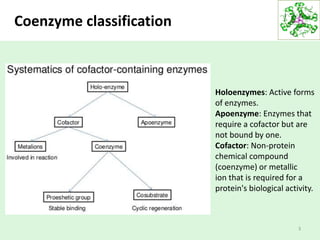
Coenzyme classification
3
Holoenzymes: Active forms
of enzymes.
Apoenzyme: Enzymes that
require a cofactor but are
not bound by one.
Cofactor: Non-protein
chemical compound
(coenzyme) or metallic
ion that is required for a
protein's biological activity.
Coenzymes
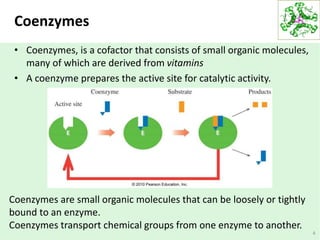
• Coenzymes, is a cofactor that consists of small organic molecules,
many of which are derived from vitamins
• A coenzyme prepares the active site for catalytic activity.
4
Coenzymes are small organic molecules that can be loosely or tightly
bound to an enzyme.
Coenzymes transport chemical groups from one enzyme to another.
Coenzymes: ATP
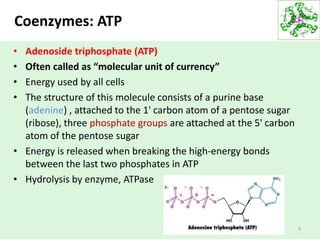
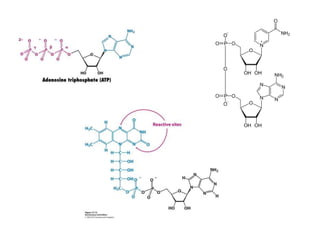
• Adenoside triphosphate (ATP)
• Often called as “molecular unit of currency”
• Energy used by all cells
• The structure of this molecule consists of a purine base
(adenine) , attached to the 1' carbon atom of a pentose sugar
(ribose), three phosphate groups are attached at the 5' carbon
atom of the pentose sugar
• Energy is released when breaking the high-energy bonds
between the last two phosphates in ATP
• Hydrolysis by enzyme, ATPase
5
Coenzymes: NAD+/NADH
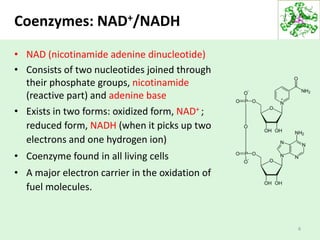
• NAD (nicotinamide adenine dinucleotide)
• Consists of two nucleotides joined through
their phosphate groups, nicotinamide
(reactive part) and adenine base
• Exists in two forms: oxidized form, NAD+ ;
reduced form, NADH (when it picks up two
electrons and one hydrogen ion)
• Coenzyme found in all living cells
• A major electron carrier in the oxidation of
fuel molecules.
6
Coenzymes: NADP+/NADPH
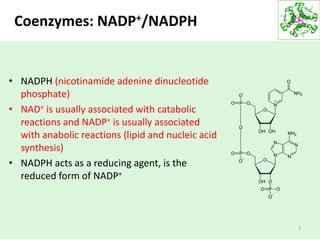
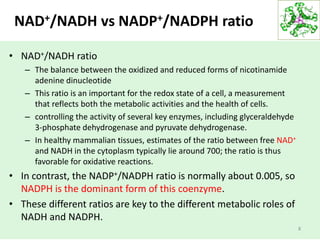
• NADPH (nicotinamide adenine dinucleotide
phosphate)
• NAD+ is usually associated with catabolic
reactions and NADP+ is usually associated
with anabolic reactions (lipid and nucleic acid
synthesis)
• NADPH acts as a reducing agent, is the
reduced form of NADP+
7
NAD+/NADH vs NADP+/NADPH ratio
• NAD+/NADH ratio
– The balance between the oxidized and reduced forms of nicotinamide
adenine dinucleotide
– This ratio is an important for the redox state of a cell, a measurement
that reflects both the metabolic activities and the health of cells.
– controlling the activity of several key enzymes, including glyceraldehyde
3-phosphate dehydrogenase and pyruvate dehydrogenase.
– In healthy mammalian tissues, estimates of the ratio between free NAD+
and NADH in the cytoplasm typically lie around 700; the ratio is thus
favorable for oxidative reactions.
• In contrast, the NADP+/NADPH ratio is normally about 0.005, so
NADPH is the dominant form of this coenzyme.
• These different ratios are key to the different metabolic roles of
NADH and NADPH.
8
Coenzymes: FAD
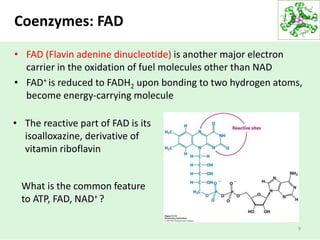
• FAD (Flavin adenine dinucleotide) is another major electron
carrier in the oxidation of fuel molecules other than NAD
• FAD+ is reduced to FADH2 upon bonding to two hydrogen atoms,
become energy-carrying molecule
9
• The reactive part of FAD is its
isoalloxazine, derivative of
vitamin riboflavin
What is the common feature
to ATP, FAD, NAD+ ?
Coenzymes: FMN
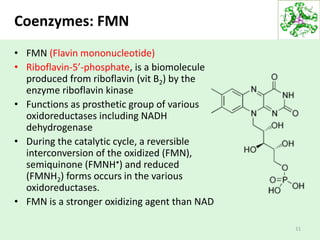
• FMN (Flavin mononucleotide)
• Riboflavin-5’-phosphate, is a biomolecule
produced from riboflavin (vit B2) by the
enzyme riboflavin kinase
• Functions as prosthetic group of various
oxidoreductases including NADH
dehydrogenase
• During the catalytic cycle, a reversible
interconversion of the oxidized (FMN),
semiquinone (FMNH•) and reduced
(FMNH2) forms occurs in the various
oxidoreductases.
• FMN is a stronger oxidizing agent than NAD
11
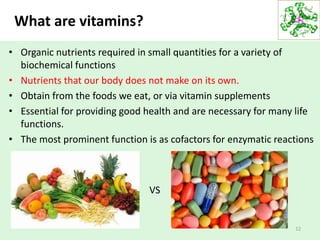
What are vitamins?
• Organic nutrients required in small quantities for a variety of
biochemical functions
• Nutrients that our body does not make on its own.
• Obtain from the foods we eat, or via vitamin supplements
• Essential for providing good health and are necessary for many life
functions.
• The most prominent function is as cofactors for enzymatic reactions
12
VS
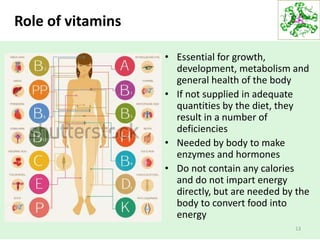
Role of vitamins
• Essential for growth,
development, metabolism and
general health of the body
• If not supplied in adequate
quantities by the diet, they
result in a number of
deficiencies
• Needed by body to make
enzymes and hormones
• Do not contain any calories
and do not impart energy
directly, but are needed by the
body to convert food into
energy
13
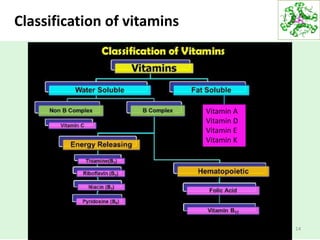
Classification of vitamins
14
Vitamin A
Vitamin D
Vitamin E
Vitamin K
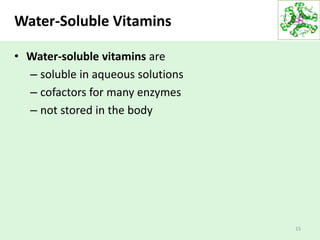
Water-Soluble Vitamins
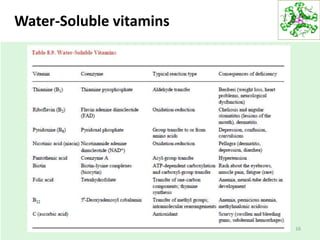
• Water-soluble vitamins are
– soluble in aqueous solutions
– cofactors for many enzymes
– not stored in the body
15
Water-Soluble vitamins
16
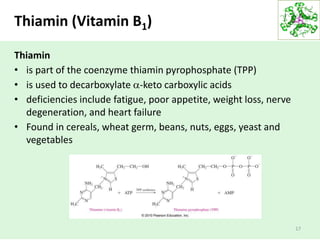
Thiamin (Vitamin B1)
Thiamin
• is part of the coenzyme thiamin pyrophosphate (TPP)
• is used to decarboxylate -keto carboxylic acids
• deficiencies include fatigue, poor appetite, weight loss, nerve
degeneration, and heart failure
• Found in cereals, wheat germ, beans, nuts, eggs, yeast and
vegetables
17
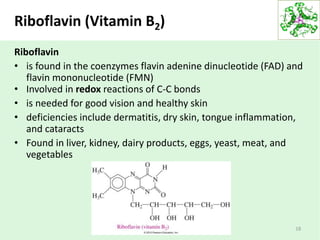
Riboflavin (Vitamin B2)
Riboflavin
• is found in the coenzymes flavin adenine dinucleotide (FAD) and
flavin mononucleotide (FMN)
• Involved in redox reactions of C-C bonds
• is needed for good vision and healthy skin
• deficiencies include dermatitis, dry skin, tongue inflammation,
and cataracts
• Found in liver, kidney, dairy products, eggs, yeast, meat, and
vegetables
18
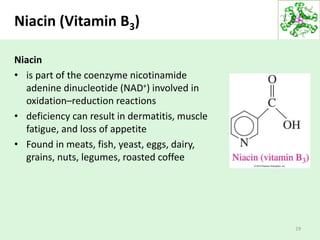
Niacin (Vitamin B3)
Niacin
• is part of the coenzyme nicotinamide
adenine dinucleotide (NAD+) involved in
oxidation–reduction reactions
• deficiency can result in dermatitis, muscle
fatigue, and loss of appetite
• Found in meats, fish, yeast, eggs, dairy,
grains, nuts, legumes, roasted coffee
19
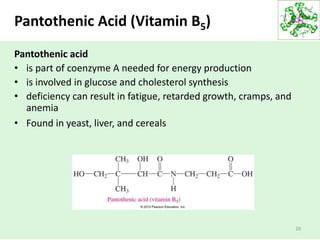
Pantothenic Acid (Vitamin B5)
Pantothenic acid
• is part of coenzyme A needed for energy production
• is involved in glucose and cholesterol synthesis
• deficiency can result in fatigue, retarded growth, cramps, and
anemia
• Found in yeast, liver, and cereals
20
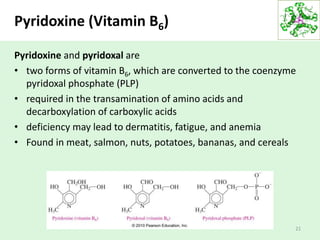
Pyridoxine (Vitamin B6)
Pyridoxine and pyridoxal are
• two forms of vitamin B6, which are converted to the coenzyme
pyridoxal phosphate (PLP)
• required in the transamination of amino acids and
decarboxylation of carboxylic acids
• deficiency may lead to dermatitis, fatigue, and anemia
• Found in meat, salmon, nuts, potatoes, bananas, and cereals
21
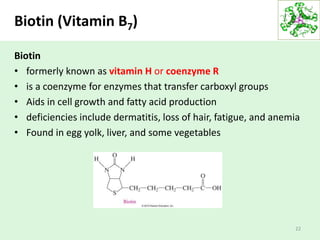
Biotin (Vitamin B7)
22
Biotin
• formerly known as vitamin H or coenzyme R
• is a coenzyme for enzymes that transfer carboxyl groups
• Aids in cell growth and fatty acid production
• deficiencies include dermatitis, loss of hair, fatigue, and anemia
• Found in egg yolk, liver, and some vegetables
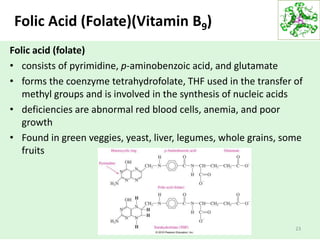
Folic Acid (Folate)(Vitamin B9)
23
Folic acid (folate)
• consists of pyrimidine, p-aminobenzoic acid, and glutamate
• forms the coenzyme tetrahydrofolate, THF used in the transfer of
methyl groups and is involved in the synthesis of nucleic acids
• deficiencies are abnormal red blood cells, anemia, and poor
growth
• Found in green veggies, yeast, liver, legumes, whole grains, some
fruits
Cobalamin (Vitamin B12)
Cobalamin
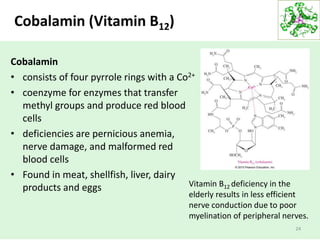
• consists of four pyrrole rings with a Co2+
• coenzyme for enzymes that transfer
methyl groups and produce red blood
cells
• deficiencies are pernicious anemia,
nerve damage, and malformed red
blood cells
• Found in meat, shellfish, liver, dairy
products and eggs
24
Vitamin B12 deficiency in the
elderly results in less efficient
nerve conduction due to poor
myelination of peripheral nerves.
Ascorbic Acid (Vitamin C)
Vitamin C
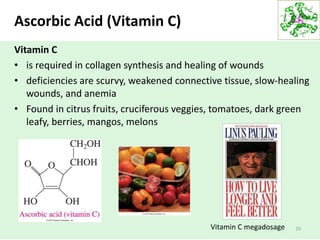
• is required in collagen synthesis and healing of wounds
• deficiencies are scurvy, weakened connective tissue, slow-healing
wounds, and anemia
• Found in citrus fruits, cruciferous veggies, tomatoes, dark green
leafy, berries, mangos, melons
25Vitamin C megadosage
Fat-Soluble Vitamins
Fat-soluble vitamins are
• vitamins A, D, E, and K
• soluble in lipids but not in aqueous solutions
• stored in the body
• important in vision, bone formation, antioxidants, and blood
clotting
26
Toxicity: Lipid-soluble vitamins may accumulate in
the fatty tissue, leading to toxic effect.
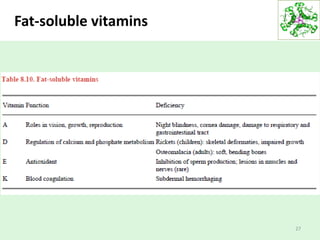
Fat-soluble vitamins
27
Retinol (Vitamin A)
28
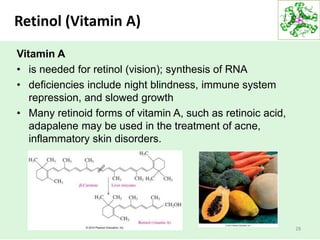
Vitamin A
• is needed for retinol (vision); synthesis of RNA
• deficiencies include night blindness, immune system
repression, and slowed growth
• Many retinoid forms of vitamin A, such as retinoic acid,
adapalene may be used in the treatment of acne,
inflammatory skin disorders.
Cholecalciferol (Vitamin D)
29
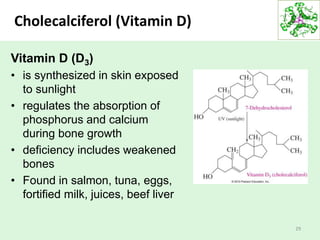
Vitamin D (D3)
• is synthesized in skin exposed
to sunlight
• regulates the absorption of
phosphorus and calcium
during bone growth
• deficiency includes weakened
bones
• Found in salmon, tuna, eggs,
fortified milk, juices, beef liver
Tocopherol (Vitamin E)
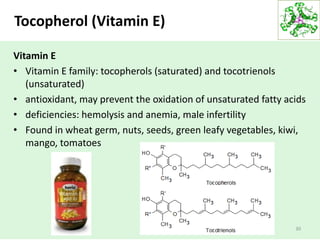
Vitamin E
• Vitamin E family: tocopherols (saturated) and tocotrienols
(unsaturated)
• antioxidant, may prevent the oxidation of unsaturated fatty acids
• deficiencies: hemolysis and anemia, male infertility
• Found in wheat germ, nuts, seeds, green leafy vegetables, kiwi,
mango, tomatoes
30
Menaquinon (Vitamin K)
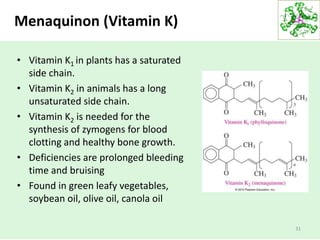
• Vitamin K1 in plants has a saturated
side chain.
• Vitamin K2 in animals has a long
unsaturated side chain.
• Vitamin K2 is needed for the
synthesis of zymogens for blood
clotting and healthy bone growth.
• Deficiencies are prolonged bleeding
time and bruising
• Found in green leafy vegetables,
soybean oil, olive oil, canola oil
31
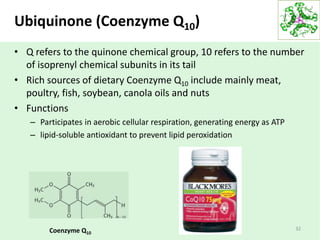
Ubiquinone (Coenzyme Q10)
Coenzyme Q10
• Q refers to the quinone chemical group, 10 refers to the number
of isoprenyl chemical subunits in its tail
• Rich sources of dietary Coenzyme Q10 include mainly meat,
poultry, fish, soybean, canola oils and nuts
• Functions
– Participates in aerobic cellular respiration, generating energy as ATP
– lipid-soluble antioxidant to prevent lipid peroxidation
32
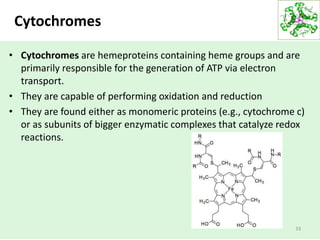
Cytochromes
• Cytochromes are hemeproteins containing heme groups and are
primarily responsible for the generation of ATP via electron
transport.
• They are capable of performing oxidation and reduction
• They are found either as monomeric proteins (e.g., cytochrome c)
or as subunits of bigger enzymatic complexes that catalyze redox
reactions.
33
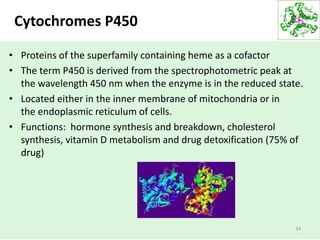
Cytochromes P450
• Proteins of the superfamily containing heme as a cofactor
• The term P450 is derived from the spectrophotometric peak at
the wavelength 450 nm when the enzyme is in the reduced state.
• Located either in the inner membrane of mitochondria or in
the endoplasmic reticulum of cells.
• Functions: hormone synthesis and breakdown, cholesterol
synthesis, vitamin D metabolism and drug detoxification (75% of
drug)
34
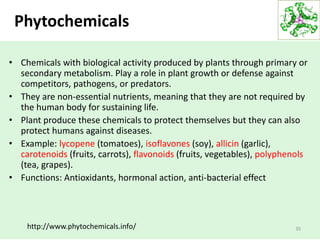
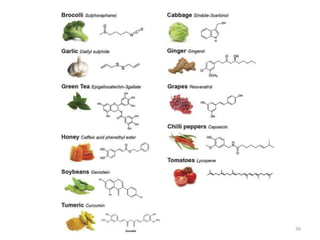
Phytochemicals
• Chemicals with biological activity produced by plants through primary or
secondary metabolism. Play a role in plant growth or defense against
competitors, pathogens, or predators.
• They are non-essential nutrients, meaning that they are not required by
the human body for sustaining life.
• Plant produce these chemicals to protect themselves but they can also
protect humans against diseases.
• Example: lycopene (tomatoes), isoflavones (soy), allicin (garlic),
carotenoids (fruits, carrots), flavonoids (fruits, vegetables), polyphenols
(tea, grapes).
• Functions: Antioxidants, hormonal action, anti-bacterial effect
35http://www.phytochemicals.info/
36
Why most vitamin supplements give you
expensive urine?
• The biggest deficiency in the Western diet comes from a lack of
fruits and vegetables and a lack of Omega 3 fatty acids.
• Prof. Rory Collins from the University of Oxford studied vitamin
consumption in 20,000 people over 5 years and concluded that,
"Vitamin pills are a waste of time.
• The Harvard physicians study group on 22,071 male physicians
found that taking isolated supplements of beta-carotene was
shown to be of no benefit.
37
Vitamin pills are not fruits and vegetables!!!
While vitamin supplements can help those with specific
deficiencies, a good diet is enough to keep the average
person healthy.
Antioxidants: Pro- or Anti-Cancer?
• Fruits and vegetables contain essential vitamins, minerals, fibre and
other nutrients including antioxidants.
• A good start to optimal health is to eat at least 5 servings of fruits and
vegetables a day.
• Individuals who have diets rich in fruits and vegetables may have a
reduced risk of cancer compared with those who eat a much higher
proportion of high-fat and processed foods.
• Numerous studies have examined the association between dietary
antioxidant intake and the risk of cancer.
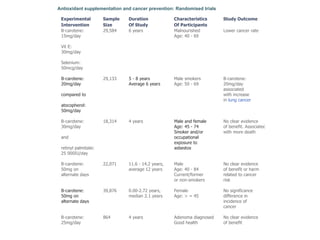
• As shown, a major surprise of these studies has been that antioxidant
supplementation actually appears to be harmful in some disease
groups.
Should I take antioxidants?
• If you're being treated for cancer, it is not a good idea to take high doses
of antioxidant nutrients as they may interfere with cancer treatment.
38
 
 
supplementation actually appears to be harmful in some disease groups.
Antioxidant supplementation and cancer prevention: Randomised trials
 Experimental 
 Intervention
 Sample 
 Size
 Duration 
 Of Study
 Characteristics 
 Of Participants
 Study Outcome 
 B­carotene: 
 15mg/day
 
 Vit E: 
 30mg/day
 
 Selenium:
 50mcg/day
 
 29,584  6 years  Malnourished
 Age: 40 ­ 69
 Lower cancer rate
 B­carotene: 
 20mg/day
 
 compared to
 
 atocopherol: 
 50mg/day
  
 29,133   5 ­ 8 years
 Average 6 years
  
 Male smokers
 Age: 50 ­ 69
 B­carotene: 
 20mg/day 
 associated 
 with increase
 in lung cancer
  
 B­carotene: 
 30mg/day 
 
 and 
 
 retinyl palmitate:
 25 000IU/day
 
 18,314  4 years   Male and female  
 Age: 45 ­ 74
 Smoker and/or 
 occupational 
 exposure to 
 asbestos
   
 No clear evidence 
 of benefit. Associated
 with more death
 B­carotene: 
 50mg on 
 alternate days
  
 22,071  11.6 ­ 14.2 years, 
 average 12 years
 Male
 Age: 40 ­ 84
 Current/former 
 or non­smokers
 
 No clear evidence
 of benefit or harm
 related to cancer
 risk
 
 B­carotene:
 50mg on
 alternate days 
  
 39,876   0.00­2.72 years, 
 median 2.1 years
  
 Female
 Age: > = 45 
 No significance 
 difference in 
 incidence of 
 cancer
 
 B­carotene: 
 25mg/day
 
 864  4 years  Adenoma diagnosed
 Good health
 No clear evidence 
 of benefit
 
Summary
1. Vitamins are often precursors to coenzymes
2. Vitamins are small biomolecules that are needed in small
amounts in the diets of higher animals.
3. The water-soluble vitamins are vitamin C (ascorbate, an
antioxidant) and the vitamin B complex (components of
coenzymes).
4. The fat-soluble vitamins are vitamin A (a precursor of retinol), D
(a regulator of calcium and phosphorus metabolism), E (an
antioxidant in membranes), and K (a participant in the
carboxylation of glutamate).
40
Study questions
1. What is a coenzyme?
2. What are the roles of vitamins?
3. What are water soluble vitamins?
4. What are lipid soluble vitamins?
5. What is ubiquinone?
6. What is cytochrome?
41

229983 lecture 26

  • 1.
    HBC1011 Biochemistry I Lecture26– Coenzymes and Vitamins Ng Chong Han, PhD ITAR1010, 06-2523751 chng@mmu.edu.my
  • 2.
    Overview • Coenzymes classification •ATP, NAD+/NADH, NADP+/NADPH, FAD, FMN • Classification of vitamins – Water soluble vitamins – Fat soluble vitamins • Ubiquinone • Cytochromes 2
  • 3.
    Coenzyme classification 3 Holoenzymes: Activeforms of enzymes. Apoenzyme: Enzymes that require a cofactor but are not bound by one. Cofactor: Non-protein chemical compound (coenzyme) or metallic ion that is required for a protein's biological activity.
  • 4.
    Coenzymes • Coenzymes, isa cofactor that consists of small organic molecules, many of which are derived from vitamins • A coenzyme prepares the active site for catalytic activity. 4 Coenzymes are small organic molecules that can be loosely or tightly bound to an enzyme. Coenzymes transport chemical groups from one enzyme to another.
  • 5.
    Coenzymes: ATP • Adenosidetriphosphate (ATP) • Often called as “molecular unit of currency” • Energy used by all cells • The structure of this molecule consists of a purine base (adenine) , attached to the 1' carbon atom of a pentose sugar (ribose), three phosphate groups are attached at the 5' carbon atom of the pentose sugar • Energy is released when breaking the high-energy bonds between the last two phosphates in ATP • Hydrolysis by enzyme, ATPase 5
  • 6.
    Coenzymes: NAD+/NADH • NAD(nicotinamide adenine dinucleotide) • Consists of two nucleotides joined through their phosphate groups, nicotinamide (reactive part) and adenine base • Exists in two forms: oxidized form, NAD+ ; reduced form, NADH (when it picks up two electrons and one hydrogen ion) • Coenzyme found in all living cells • A major electron carrier in the oxidation of fuel molecules. 6
  • 7.
    Coenzymes: NADP+/NADPH • NADPH(nicotinamide adenine dinucleotide phosphate) • NAD+ is usually associated with catabolic reactions and NADP+ is usually associated with anabolic reactions (lipid and nucleic acid synthesis) • NADPH acts as a reducing agent, is the reduced form of NADP+ 7
  • 8.
    NAD+/NADH vs NADP+/NADPHratio • NAD+/NADH ratio – The balance between the oxidized and reduced forms of nicotinamide adenine dinucleotide – This ratio is an important for the redox state of a cell, a measurement that reflects both the metabolic activities and the health of cells. – controlling the activity of several key enzymes, including glyceraldehyde 3-phosphate dehydrogenase and pyruvate dehydrogenase. – In healthy mammalian tissues, estimates of the ratio between free NAD+ and NADH in the cytoplasm typically lie around 700; the ratio is thus favorable for oxidative reactions. • In contrast, the NADP+/NADPH ratio is normally about 0.005, so NADPH is the dominant form of this coenzyme. • These different ratios are key to the different metabolic roles of NADH and NADPH. 8
  • 9.
    Coenzymes: FAD • FAD(Flavin adenine dinucleotide) is another major electron carrier in the oxidation of fuel molecules other than NAD • FAD+ is reduced to FADH2 upon bonding to two hydrogen atoms, become energy-carrying molecule 9 • The reactive part of FAD is its isoalloxazine, derivative of vitamin riboflavin What is the common feature to ATP, FAD, NAD+ ?
  • 11.
    Coenzymes: FMN • FMN(Flavin mononucleotide) • Riboflavin-5’-phosphate, is a biomolecule produced from riboflavin (vit B2) by the enzyme riboflavin kinase • Functions as prosthetic group of various oxidoreductases including NADH dehydrogenase • During the catalytic cycle, a reversible interconversion of the oxidized (FMN), semiquinone (FMNH•) and reduced (FMNH2) forms occurs in the various oxidoreductases. • FMN is a stronger oxidizing agent than NAD 11
  • 12.
    What are vitamins? •Organic nutrients required in small quantities for a variety of biochemical functions • Nutrients that our body does not make on its own. • Obtain from the foods we eat, or via vitamin supplements • Essential for providing good health and are necessary for many life functions. • The most prominent function is as cofactors for enzymatic reactions 12 VS
  • 13.
    Role of vitamins •Essential for growth, development, metabolism and general health of the body • If not supplied in adequate quantities by the diet, they result in a number of deficiencies • Needed by body to make enzymes and hormones • Do not contain any calories and do not impart energy directly, but are needed by the body to convert food into energy 13
  • 14.
    Classification of vitamins 14 VitaminA Vitamin D Vitamin E Vitamin K
  • 15.
    Water-Soluble Vitamins • Water-solublevitamins are – soluble in aqueous solutions – cofactors for many enzymes – not stored in the body 15
  • 16.
  • 17.
    Thiamin (Vitamin B1) Thiamin •is part of the coenzyme thiamin pyrophosphate (TPP) • is used to decarboxylate -keto carboxylic acids • deficiencies include fatigue, poor appetite, weight loss, nerve degeneration, and heart failure • Found in cereals, wheat germ, beans, nuts, eggs, yeast and vegetables 17
  • 18.
    Riboflavin (Vitamin B2) Riboflavin •is found in the coenzymes flavin adenine dinucleotide (FAD) and flavin mononucleotide (FMN) • Involved in redox reactions of C-C bonds • is needed for good vision and healthy skin • deficiencies include dermatitis, dry skin, tongue inflammation, and cataracts • Found in liver, kidney, dairy products, eggs, yeast, meat, and vegetables 18
  • 19.
    Niacin (Vitamin B3) Niacin •is part of the coenzyme nicotinamide adenine dinucleotide (NAD+) involved in oxidation–reduction reactions • deficiency can result in dermatitis, muscle fatigue, and loss of appetite • Found in meats, fish, yeast, eggs, dairy, grains, nuts, legumes, roasted coffee 19
  • 20.
    Pantothenic Acid (VitaminB5) Pantothenic acid • is part of coenzyme A needed for energy production • is involved in glucose and cholesterol synthesis • deficiency can result in fatigue, retarded growth, cramps, and anemia • Found in yeast, liver, and cereals 20
  • 21.
    Pyridoxine (Vitamin B6) Pyridoxineand pyridoxal are • two forms of vitamin B6, which are converted to the coenzyme pyridoxal phosphate (PLP) • required in the transamination of amino acids and decarboxylation of carboxylic acids • deficiency may lead to dermatitis, fatigue, and anemia • Found in meat, salmon, nuts, potatoes, bananas, and cereals 21
  • 22.
    Biotin (Vitamin B7) 22 Biotin •formerly known as vitamin H or coenzyme R • is a coenzyme for enzymes that transfer carboxyl groups • Aids in cell growth and fatty acid production • deficiencies include dermatitis, loss of hair, fatigue, and anemia • Found in egg yolk, liver, and some vegetables
  • 23.
    Folic Acid (Folate)(VitaminB9) 23 Folic acid (folate) • consists of pyrimidine, p-aminobenzoic acid, and glutamate • forms the coenzyme tetrahydrofolate, THF used in the transfer of methyl groups and is involved in the synthesis of nucleic acids • deficiencies are abnormal red blood cells, anemia, and poor growth • Found in green veggies, yeast, liver, legumes, whole grains, some fruits
  • 24.
    Cobalamin (Vitamin B12) Cobalamin •consists of four pyrrole rings with a Co2+ • coenzyme for enzymes that transfer methyl groups and produce red blood cells • deficiencies are pernicious anemia, nerve damage, and malformed red blood cells • Found in meat, shellfish, liver, dairy products and eggs 24 Vitamin B12 deficiency in the elderly results in less efficient nerve conduction due to poor myelination of peripheral nerves.
  • 25.
    Ascorbic Acid (VitaminC) Vitamin C • is required in collagen synthesis and healing of wounds • deficiencies are scurvy, weakened connective tissue, slow-healing wounds, and anemia • Found in citrus fruits, cruciferous veggies, tomatoes, dark green leafy, berries, mangos, melons 25Vitamin C megadosage
  • 26.
    Fat-Soluble Vitamins Fat-soluble vitaminsare • vitamins A, D, E, and K • soluble in lipids but not in aqueous solutions • stored in the body • important in vision, bone formation, antioxidants, and blood clotting 26 Toxicity: Lipid-soluble vitamins may accumulate in the fatty tissue, leading to toxic effect.
  • 27.
  • 28.
    Retinol (Vitamin A) 28 VitaminA • is needed for retinol (vision); synthesis of RNA • deficiencies include night blindness, immune system repression, and slowed growth • Many retinoid forms of vitamin A, such as retinoic acid, adapalene may be used in the treatment of acne, inflammatory skin disorders.
  • 29.
    Cholecalciferol (Vitamin D) 29 VitaminD (D3) • is synthesized in skin exposed to sunlight • regulates the absorption of phosphorus and calcium during bone growth • deficiency includes weakened bones • Found in salmon, tuna, eggs, fortified milk, juices, beef liver
  • 30.
    Tocopherol (Vitamin E) VitaminE • Vitamin E family: tocopherols (saturated) and tocotrienols (unsaturated) • antioxidant, may prevent the oxidation of unsaturated fatty acids • deficiencies: hemolysis and anemia, male infertility • Found in wheat germ, nuts, seeds, green leafy vegetables, kiwi, mango, tomatoes 30
  • 31.
    Menaquinon (Vitamin K) •Vitamin K1 in plants has a saturated side chain. • Vitamin K2 in animals has a long unsaturated side chain. • Vitamin K2 is needed for the synthesis of zymogens for blood clotting and healthy bone growth. • Deficiencies are prolonged bleeding time and bruising • Found in green leafy vegetables, soybean oil, olive oil, canola oil 31
  • 32.
    Ubiquinone (Coenzyme Q10) CoenzymeQ10 • Q refers to the quinone chemical group, 10 refers to the number of isoprenyl chemical subunits in its tail • Rich sources of dietary Coenzyme Q10 include mainly meat, poultry, fish, soybean, canola oils and nuts • Functions – Participates in aerobic cellular respiration, generating energy as ATP – lipid-soluble antioxidant to prevent lipid peroxidation 32
  • 33.
    Cytochromes • Cytochromes arehemeproteins containing heme groups and are primarily responsible for the generation of ATP via electron transport. • They are capable of performing oxidation and reduction • They are found either as monomeric proteins (e.g., cytochrome c) or as subunits of bigger enzymatic complexes that catalyze redox reactions. 33
  • 34.
    Cytochromes P450 • Proteinsof the superfamily containing heme as a cofactor • The term P450 is derived from the spectrophotometric peak at the wavelength 450 nm when the enzyme is in the reduced state. • Located either in the inner membrane of mitochondria or in the endoplasmic reticulum of cells. • Functions: hormone synthesis and breakdown, cholesterol synthesis, vitamin D metabolism and drug detoxification (75% of drug) 34
  • 35.
    Phytochemicals • Chemicals withbiological activity produced by plants through primary or secondary metabolism. Play a role in plant growth or defense against competitors, pathogens, or predators. • They are non-essential nutrients, meaning that they are not required by the human body for sustaining life. • Plant produce these chemicals to protect themselves but they can also protect humans against diseases. • Example: lycopene (tomatoes), isoflavones (soy), allicin (garlic), carotenoids (fruits, carrots), flavonoids (fruits, vegetables), polyphenols (tea, grapes). • Functions: Antioxidants, hormonal action, anti-bacterial effect 35http://www.phytochemicals.info/
  • 36.
  • 37.
    Why most vitaminsupplements give you expensive urine? • The biggest deficiency in the Western diet comes from a lack of fruits and vegetables and a lack of Omega 3 fatty acids. • Prof. Rory Collins from the University of Oxford studied vitamin consumption in 20,000 people over 5 years and concluded that, "Vitamin pills are a waste of time. • The Harvard physicians study group on 22,071 male physicians found that taking isolated supplements of beta-carotene was shown to be of no benefit. 37 Vitamin pills are not fruits and vegetables!!! While vitamin supplements can help those with specific deficiencies, a good diet is enough to keep the average person healthy.
  • 38.
    Antioxidants: Pro- orAnti-Cancer? • Fruits and vegetables contain essential vitamins, minerals, fibre and other nutrients including antioxidants. • A good start to optimal health is to eat at least 5 servings of fruits and vegetables a day. • Individuals who have diets rich in fruits and vegetables may have a reduced risk of cancer compared with those who eat a much higher proportion of high-fat and processed foods. • Numerous studies have examined the association between dietary antioxidant intake and the risk of cancer. • As shown, a major surprise of these studies has been that antioxidant supplementation actually appears to be harmful in some disease groups. Should I take antioxidants? • If you're being treated for cancer, it is not a good idea to take high doses of antioxidant nutrients as they may interfere with cancer treatment. 38
  • 39.
        supplementation actually appears to be harmful in some disease groups. Antioxidant supplementation and cancer prevention: Randomised trials  Experimental   Intervention  Sample   Size  Duration   Of Study  Characteristics   Of Participants  Study Outcome   B­carotene:   15mg/day    Vit E:   30mg/day    Selenium:  50mcg/day    29,584  6 years  Malnourished  Age: 40 ­ 69  Lower cancer rate  B­carotene:   20mg/day    compared to    atocopherol:   50mg/day     29,133  5 ­ 8 years  Average 6 years     Male smokers  Age: 50 ­ 69  B­carotene:   20mg/day   associated   with increase  in lung cancer     B­carotene:   30mg/day     and     retinyl palmitate:  25 000IU/day    18,314  4 years   Male and female    Age: 45 ­ 74  Smoker and/or   occupational   exposure to   asbestos      No clear evidence   of benefit. Associated  with more death  B­carotene:   50mg on   alternate days     22,071  11.6 ­ 14.2 years,   average 12 years  Male  Age: 40 ­ 84  Current/former   or non­smokers    No clear evidence  of benefit or harm  related to cancer  risk    B­carotene:  50mg on  alternate days      39,876   0.00­2.72 years,   median 2.1 years     Female  Age: > = 45   No significance   difference in   incidence of   cancer    B­carotene:   25mg/day    864  4 years  Adenoma diagnosed  Good health  No clear evidence   of benefit  
  • 40.
    Summary 1. Vitamins areoften precursors to coenzymes 2. Vitamins are small biomolecules that are needed in small amounts in the diets of higher animals. 3. The water-soluble vitamins are vitamin C (ascorbate, an antioxidant) and the vitamin B complex (components of coenzymes). 4. The fat-soluble vitamins are vitamin A (a precursor of retinol), D (a regulator of calcium and phosphorus metabolism), E (an antioxidant in membranes), and K (a participant in the carboxylation of glutamate). 40
  • 41.
    Study questions 1. Whatis a coenzyme? 2. What are the roles of vitamins? 3. What are water soluble vitamins? 4. What are lipid soluble vitamins? 5. What is ubiquinone? 6. What is cytochrome? 41

Editor's Notes

  • #19 RDA recommended dietary allowances
  • #27 Anomeric carbon, stereocenter
  • #28 100 plus 500ml 34g carbo 136kcal Tropicana orange juice 26g 9% 110cal
  • #32 the oxidizing agent is called an electron acceptor and the reducing agent is called an electron donor