Vitamins
• To recognize vitamins by name
• To understand their distribution in various
food sources
• To understand the signs and symptoms of
diseases resulting from deficiencies
• To understand their role in metabolism
Objectives:
A group of organic nutrients required in small
quantities for a variety of biochemical
functions and which , generally , cannot be
synthesized by body and must therefore be
supplied in the diet.
Vitamins
Vitamins are essential for several
enzymatic functions in human metabolism
? They are categorized on basis of their solubility
- Fat soluble (Vitamin A,D,E and K) are soluble in
fats, bile salts increases their absorption and
they are fairly resistant to heating
- water soluble( Vitamin B and C)
Vitamin B complex are essential for normal cell
metabolism
Easily destroyed by cooking or food processing.
Vitamins
Dietary vitamin deficiency may
be caused by
• Inadequate dietary intake
• Inadequate intestinal absorption
• Inadequate utilization
• Increased requirements of vitamins by
the body
• Drug induced deficiency
Fat soluble vitamins
Vitamin A- is present in the diet as retinol or as
β-carotene
• Found in fish, liver, eggs, butter, yellow & green
vegetables, fruits
• Needed for healthy skin, eyes, bones, teeth.
• Function: Vitamin A(retinol) is the precursor of retinel,
the light-sensitive group in rhodopsin and other visual
pigments.
• Deficiency causes night blindness, skin disorders,
kidney stones
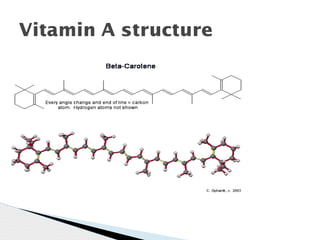
Vitamin A structure
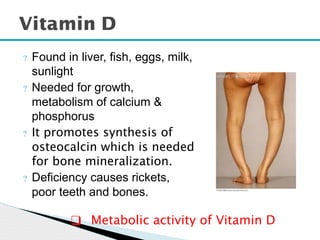
? Found in liver, fish, eggs, milk,
sunlight
? Needed for growth,
metabolism of calcium &
phosphorus
? It promotes synthesis of
osteocalcin which is needed
for bone mineralization.
? Deficiency causes rickets,
poor teeth and bones.
Vitamin D
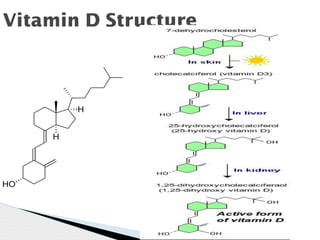
❑ Metabolic activity of Vitamin D
Vitamin D Structure
VITAMIN D
❑ Vitamin D comprises a group of sterols;
the most important of which are
cholecalciferol (vitamin D3) & ergosterol
(vitamin D2).
❑ Humans & animal utilize only vitamin D3
& they can produce it inside their bodies
from cholesterol.
❑ Cholesterol is converted to
7-dehydro-cholesterol (7DC), which is a
precursor of vitamin D3.
VITAMIN D
❑ Exposure to the ultraviolet rays in the
sunlight convert 7-dehydro-cholesterol
(7DC) to cholecalciferol.
❑ Vitamin D3 is metabolically inactive until it is
hydroxylated in the kidney & the liver to the
active form 1,25 Dihydroxycholecalciferol.
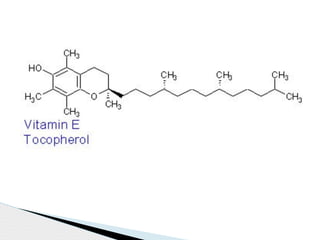
VITAMIN E
❑The term vitamin E describes a
family of 8 antioxidants,
4 tocopherols (α,β, γ, & δ) and
4 tocotrienols.
❑α-tocopherol is the active form of
vitamin E in the human body.
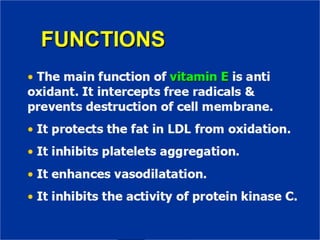
FUNCTIONS
• The main function of vitamin E is anti
oxidant. It intercepts free radicals &
prevents destruction of cell membrane.
• It protects the fat in LDL from oxidation.
• It inhibits platelets aggregation.
• It enhances vasodilatation.
• It inhibits the activity of protein kinase C.
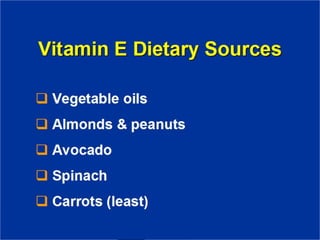
Vitamin E Dietary
Sources
❑ Vegetable oils
❑ Almonds & peanuts
❑ Avocado
❑ Spinach
❑ Carrots (least)
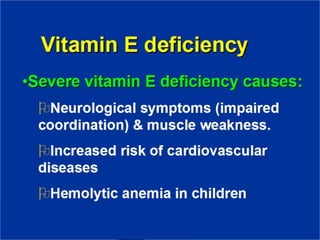
Vitamin E deficiency
•Severe vitamin E deficiency
causes:
Neurological symptoms (impaired
coordination) & muscle weakness.
Increased risk of cardiovascular
diseases
Hemolytic anemia in children
THERAPEUTIC USES
❑ Prevention of cardiovascular diseases
❑ Diabetes Mellitus
❑ Cancer prevention
❑ Boost immunity
❑ Dementia
TOXICITY
Excess vitamin E may cause:
✔ Impaired blood clotting leading to
increased risk of bleeding in some
persons.
✔It is recommended that vitamin E
supplements to be stopped one month
before elective surgery.
? Found in whole grains, leafy vegetables, milk,
butter, vegetable oils
? Needed for healthy cell membranes, red blood
cells
? Converts free radicals to inactive forms that are
excreted in bile thus prevent hemolysis of RBCs
? Deficiency causes red cell rupture, muscle
disorders
Vitamin E
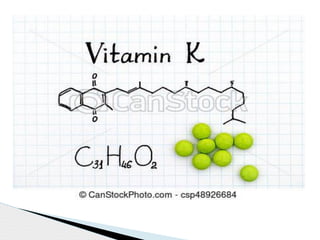
VITAMIN K
• The K is derived from the German
word Koagulation.
• There are 2 naturally occurring forms
of vitamin K. Plants synthesize
phylloquinone (vitamin K1) & bacteria
synthesize menaquinone-3 (vit K2).
• Menaquinone-4 is produced in animals
from vit K1, but its function is yet to be
discovered.
FUNCTIONS
•Vitamin K is needed for production of
vitamin K-dependent coagulation factors in
the liver.
•Other functions include:
✔Assist in bone mineralization. The
mineral binding capacity of osteocalcin
requires vit K.
✔Gas6 is vit K-dependent protein
identified in 1993. It is important for
neuronal function.
SOURCES OF VITAMIN K
Bacteria in large intestine produce
vit K2 and supply 40-50% of human
requirement.
Vegetable oils
Almonds & peanuts
Avocado & Broccoli
Spinach, Lettuce, parsley (raw)
? Found in leafy vegetables, soybeans, made by
intestinal bacteria
? Needed for normal blood clotting
? Deficiency causes slow clotting, hemorrhaging.
Vitamin K
❑ This vitamin is the only acting coenzyme
among fat soluble vitamins
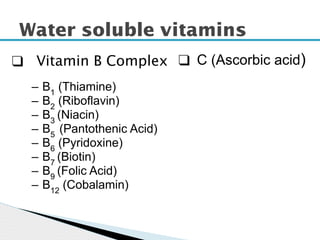
Water soluble vitamins
– B1
(Thiamine)
– B2
(Riboflavin)
– B3
(Niacin)
– B5
(Pantothenic Acid)
– B6
(Pyridoxine)
– B7
(Biotin)
– B9
(Folic Acid)
– B12
(Cobalamin)
❑ C (Ascorbic acid)
❑ Vitamin B Complex
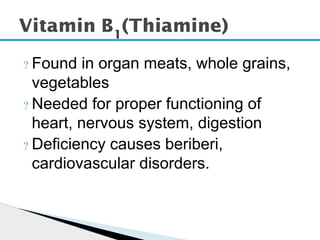
? Found in organ meats, whole grains,
vegetables
? Needed for proper functioning of
heart, nervous system, digestion
? Deficiency causes beriberi,
cardiovascular disorders.
Vitamin B1
(Thiamine)
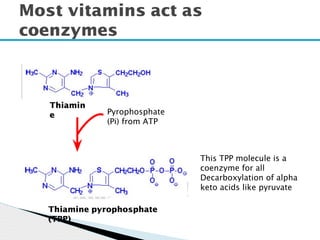
Most vitamins act as
coenzymes
Thiamin
e Pyrophosphate
(Pi) from ATP
Thiamine pyrophosphate
(TPP)
This TPP molecule is a
coenzyme for all
Decarboxylation of alpha
keto acids like pyruvate
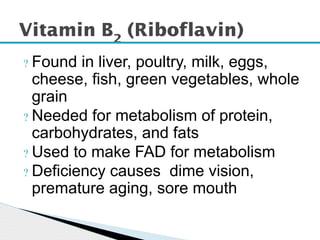
? Found in liver, poultry, milk, eggs,
cheese, fish, green vegetables, whole
grain
? Needed for metabolism of protein,
carbohydrates, and fats
? Used to make FAD for metabolism
? Deficiency causes dime vision,
premature aging, sore mouth
Vitamin B2
(Riboflavin)
? Riboflavin is a component of the flavin
coenzymes such as the FAD and FMN.
? It is mainly used in the energy metabolism of
Sugars and Lipids. The activation of FMN and
FAD is an ATP-dependent.
? Food sources and distribution:
Fish, meat, poultry, cereal, nuts,
? Signs and symptoms of deficiency
- Pellagra (pella agra: rough skin) characterized
by inflammation of mucous membranes
- dermatitis( red itchy skin), diarrhea, red swollen
tongue observed in chronic alcoholics
? Needed for metabolism, digestion, nerves, skin
B3
(Niacin)
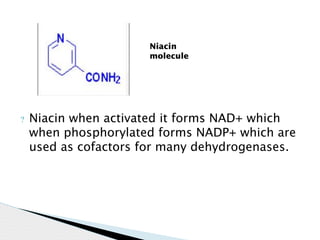
? Niacin when activated it forms NAD+ which
when phosphorylated forms NADP+ which are
used as cofactors for many dehydrogenases.
Niacin
molecule
? Food sources and distribution:
Ubiquitous
Easily destroyed by heating
? Signs and symptoms of deficiency
Very rare
Neuromuscular degeneration
B5
(Pantothenic acid)
? Found in meats, liver, whole grains,
vegetables
? Needed for sodium and phosphorus
balance
? Deficiency causes anemia, nausea,
loss of appetite, nervousness
Vitamin B6
(Pyridoxine)
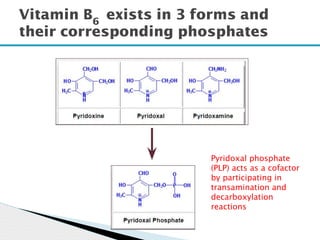
Vitamin B6
exists in 3 forms and
their corresponding phosphates
Pyridoxal phosphate
(PLP) acts as a cofactor
by participating in
transamination and
decarboxylation
reactions
? Food sources and distribution:
Can be synthesized by intestinal bacteria
Found in most foods
? Signs and symptoms of deficiency
Very rare, include dermatitis, muscle pain
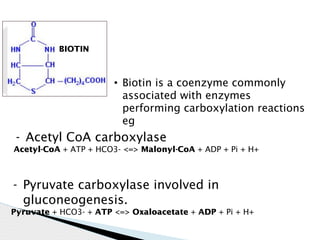
B7
(Biotin)
• Biotin is a coenzyme commonly
associated with enzymes
performing carboxylation reactions
eg
BIOTIN
- Acetyl CoA carboxylase
Acetyl-CoA + ATP + HCO3- <=> Malonyl-CoA + ADP + Pi + H+
- Pyruvate carboxylase involved in
gluconeogenesis.
Pyruvate + HCO3- + ATP <=> Oxaloacetate + ADP + Pi + H+
? Found in green vegetables, liver, whole grains,
legumes
? Needed for manufacture of proteins and red blood
cells, needed for cell division, helps prevent spina
bifida
? Deficiency causes inflamed tongue, diarrhea, B12
deficiency.
? Its active form is tetrahydropholate (THF)
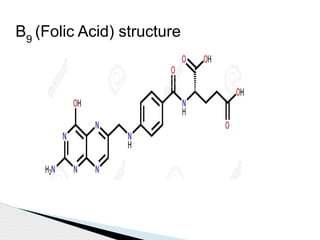
B9
(Folic Acid)
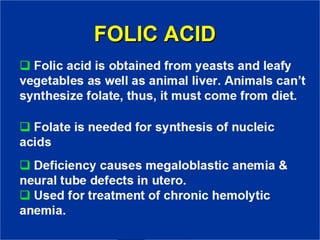
FOLIC ACID
❑ Folic acid is obtained from yeasts and
leafy vegetables as well as animal liver.
Animals can’t synthesize folate, thus, it
must come from diet.
❑ Folate is needed for synthesis of nucleic
acids
❑ Deficiency causes megaloblastic anemia
& neural tube defects in utero.
❑ Used for treatment of chronic hemolytic
anemia.
B9
(Folic Acid) structure
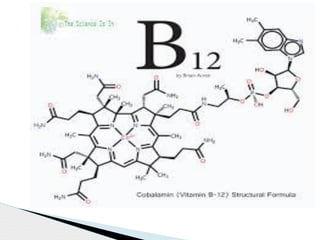
COBALOMIN (VIT B12)
❑ B12 functions as a cofactor for
enzymes required for the catabolism of
fatty acids & the conversion of
homocysteine to methionine.
❑ B12 is not available in plant &
deficiency may occur in strict
vegetarians & in pts with GIT
problems & those on prolonged
antibiotic treatment.
❑ Deficiency causes megaloblastic
anemia, SACDC, & high homocysteine
in blood which is a risk of IHD &
stroke.
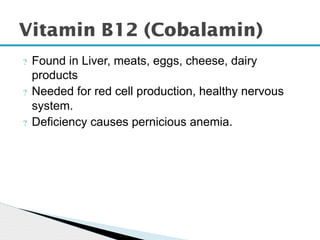
? Found in Liver, meats, eggs, cheese, dairy
products
? Needed for red cell production, healthy nervous
system.
? Deficiency causes pernicious anemia.
Vitamin B12 (Cobalamin)
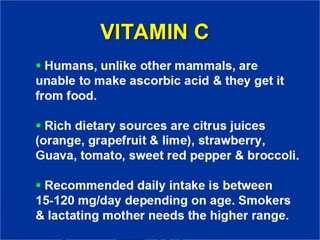
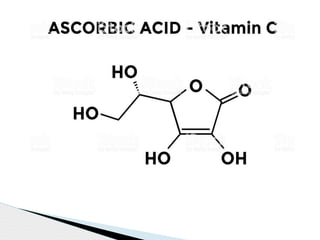
VITAMIN C
▪ Humans, unlike other mammals, are
unable to make ascorbic acid & they
get it from food.
▪ Rich dietary sources are citrus juices
(orange, grapefruit & lime),
strawberry, Guava, tomato, sweet red
pepper & broccoli.
▪ Recommended daily intake is
between 15-120 mg/day
depending on age. Smokers & lactating
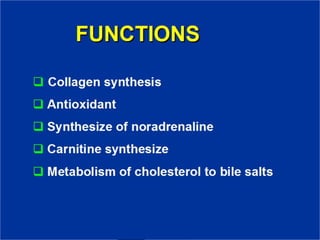
FUNCTIONS
❑ Collagen synthesis
❑ Antioxidant
❑ Synthesize of noradrenaline
❑ Carnitine synthesize
❑ Metabolism of cholesterol to bile salts
Vitamin C deficiency
❑ Severe deficiency leads to Scurvy with
the following manifestations:
Bleeding & bruising easily
Hair & teeth loss
Joint pain & swelling
Fatigue & lack of concentration
THERAPEUTIC USES
• Cardiovascular diseases
• Cataracts
• Diabetes Mellitus
• Cancer prevention
• Common cold
• Lead toxicity
? Found in citrus and other fruits, leafy
vegetables, tomatoes, potatoes
? Needed for healthy blood vessels,
resistance to infection, healing
? Deficiency causes scurvy, bleeding
gums
Vitamin C (Ascorbic acid)
? Some vitamins have ability to remove free
radicals from the body and thus act as
antioxidants
? This activity protects the body from heart
disease, cancer, alzheimer’s disease
? These vitamins include; carotenoids (vit A),
vitamin C and vitamin E
Antioxidants
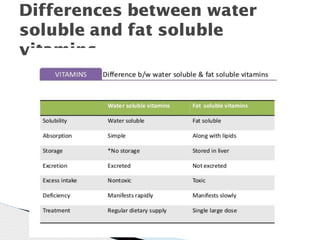
Differences between water
soluble and fat soluble
vitamins
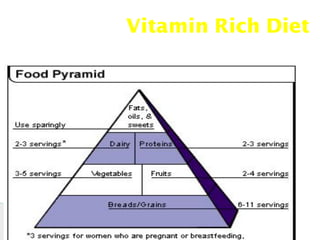
Vitamin Rich Diet
? Discuss the two classes of vitamins, their
sources and implication in disease
? What are the differences between fat soluble
and water soluble vitamins
? Describe one way that vitamins are used in
the metabolic process
Questions
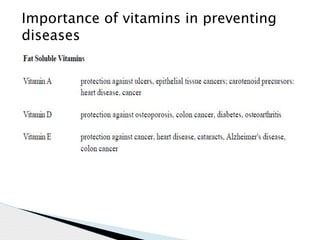
Importance of vitamins in preventing
diseases
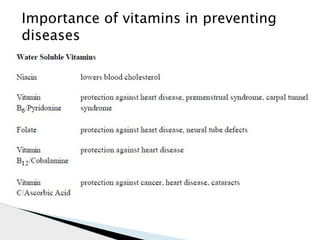
Importance of vitamins in preventing
diseases
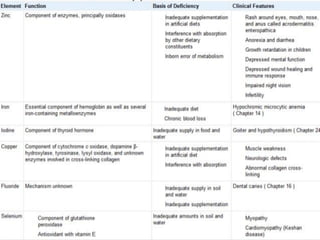
? Calcium and phosphorous- needed for the
dramatic increase in skeletal growth.
? Iron – for transporting oxygen in the blood
stream and preventing anemia
? Zinc- vital for protein formation and gene
expression
Minerals include:
Vitamins include:
Vitamin A,E,C
Folate
Others include: Fiber for normal bowel
function, Cholesterol and sodium.
Key Mineral and Vitamin
Needs
? Calcium
◦ Essential for fetal development of bones and teeth
◦ Supplements might be needed in cases of poor
maternal stores or pregnancies involving more than
one fetus
? Iron and iodine
◦ Iron essential for increased hemoglobin synthesis
as fetal development and growth requires sufficient
oxygen
◦ Iodine is essential for production of more thyroxine
? Folate ( Vitamin B)
◦ Builds mature red blood cells during pregnancy
◦ Needed during early periconceptional period
◦ Recommend daily folate intake of 600 mcg during
pregnancy, 400 mcg per day for non-pregnant
women during childbearing years
◦ Some women may require folate supplements
Key Mineral and Vitamin
Needs
Key Mineral and Vitamin
Needs
? Vitamin D
◦ Is a fat soluble vitamin which ensures absorption
and utilization of calcium and phosphorus for fetal
bone growth
◦ Daily intake of three to four cups fortified milk
◦ Exposure to sunlight increases endogenous
synthesis of vitamin D

11-Vitamin Structure and Function Lecture UCU.pdf

  • 1.
  • 2.
    • To recognizevitamins by name • To understand their distribution in various food sources • To understand the signs and symptoms of diseases resulting from deficiencies • To understand their role in metabolism Objectives:
  • 3.
    A group oforganic nutrients required in small quantities for a variety of biochemical functions and which , generally , cannot be synthesized by body and must therefore be supplied in the diet. Vitamins Vitamins are essential for several enzymatic functions in human metabolism
  • 4.
    ? They arecategorized on basis of their solubility - Fat soluble (Vitamin A,D,E and K) are soluble in fats, bile salts increases their absorption and they are fairly resistant to heating - water soluble( Vitamin B and C) Vitamin B complex are essential for normal cell metabolism Easily destroyed by cooking or food processing. Vitamins
  • 5.
    Dietary vitamin deficiencymay be caused by • Inadequate dietary intake • Inadequate intestinal absorption • Inadequate utilization • Increased requirements of vitamins by the body • Drug induced deficiency
  • 6.
    Fat soluble vitamins VitaminA- is present in the diet as retinol or as β-carotene • Found in fish, liver, eggs, butter, yellow & green vegetables, fruits • Needed for healthy skin, eyes, bones, teeth. • Function: Vitamin A(retinol) is the precursor of retinel, the light-sensitive group in rhodopsin and other visual pigments. • Deficiency causes night blindness, skin disorders, kidney stones
  • 7.
  • 8.
    ? Found inliver, fish, eggs, milk, sunlight ? Needed for growth, metabolism of calcium & phosphorus ? It promotes synthesis of osteocalcin which is needed for bone mineralization. ? Deficiency causes rickets, poor teeth and bones. Vitamin D ❑ Metabolic activity of Vitamin D
  • 9.
  • 10.
    VITAMIN D ❑ VitaminD comprises a group of sterols; the most important of which are cholecalciferol (vitamin D3) & ergosterol (vitamin D2). ❑ Humans & animal utilize only vitamin D3 & they can produce it inside their bodies from cholesterol. ❑ Cholesterol is converted to 7-dehydro-cholesterol (7DC), which is a precursor of vitamin D3.
  • 11.
    VITAMIN D ❑ Exposureto the ultraviolet rays in the sunlight convert 7-dehydro-cholesterol (7DC) to cholecalciferol. ❑ Vitamin D3 is metabolically inactive until it is hydroxylated in the kidney & the liver to the active form 1,25 Dihydroxycholecalciferol.
  • 12.
    VITAMIN E ❑The termvitamin E describes a family of 8 antioxidants, 4 tocopherols (α,β, γ, & δ) and 4 tocotrienols. ❑α-tocopherol is the active form of vitamin E in the human body.
  • 14.
    FUNCTIONS • The mainfunction of vitamin E is anti oxidant. It intercepts free radicals & prevents destruction of cell membrane. • It protects the fat in LDL from oxidation. • It inhibits platelets aggregation. • It enhances vasodilatation. • It inhibits the activity of protein kinase C.
  • 15.
    Vitamin E Dietary Sources ❑Vegetable oils ❑ Almonds & peanuts ❑ Avocado ❑ Spinach ❑ Carrots (least)
  • 16.
    Vitamin E deficiency •Severevitamin E deficiency causes: Neurological symptoms (impaired coordination) & muscle weakness. Increased risk of cardiovascular diseases Hemolytic anemia in children
  • 17.
    THERAPEUTIC USES ❑ Preventionof cardiovascular diseases ❑ Diabetes Mellitus ❑ Cancer prevention ❑ Boost immunity ❑ Dementia
  • 18.
    TOXICITY Excess vitamin Emay cause: ✔ Impaired blood clotting leading to increased risk of bleeding in some persons. ✔It is recommended that vitamin E supplements to be stopped one month before elective surgery.
  • 19.
    ? Found inwhole grains, leafy vegetables, milk, butter, vegetable oils ? Needed for healthy cell membranes, red blood cells ? Converts free radicals to inactive forms that are excreted in bile thus prevent hemolysis of RBCs ? Deficiency causes red cell rupture, muscle disorders Vitamin E
  • 20.
    VITAMIN K • TheK is derived from the German word Koagulation. • There are 2 naturally occurring forms of vitamin K. Plants synthesize phylloquinone (vitamin K1) & bacteria synthesize menaquinone-3 (vit K2). • Menaquinone-4 is produced in animals from vit K1, but its function is yet to be discovered.
  • 22.
    FUNCTIONS •Vitamin K isneeded for production of vitamin K-dependent coagulation factors in the liver. •Other functions include: ✔Assist in bone mineralization. The mineral binding capacity of osteocalcin requires vit K. ✔Gas6 is vit K-dependent protein identified in 1993. It is important for neuronal function.
  • 23.
    SOURCES OF VITAMINK Bacteria in large intestine produce vit K2 and supply 40-50% of human requirement. Vegetable oils Almonds & peanuts Avocado & Broccoli Spinach, Lettuce, parsley (raw)
  • 24.
    ? Found inleafy vegetables, soybeans, made by intestinal bacteria ? Needed for normal blood clotting ? Deficiency causes slow clotting, hemorrhaging. Vitamin K ❑ This vitamin is the only acting coenzyme among fat soluble vitamins
  • 25.
    Water soluble vitamins –B1 (Thiamine) – B2 (Riboflavin) – B3 (Niacin) – B5 (Pantothenic Acid) – B6 (Pyridoxine) – B7 (Biotin) – B9 (Folic Acid) – B12 (Cobalamin) ❑ C (Ascorbic acid) ❑ Vitamin B Complex
  • 26.
    ? Found inorgan meats, whole grains, vegetables ? Needed for proper functioning of heart, nervous system, digestion ? Deficiency causes beriberi, cardiovascular disorders. Vitamin B1 (Thiamine)
  • 27.
    Most vitamins actas coenzymes Thiamin e Pyrophosphate (Pi) from ATP Thiamine pyrophosphate (TPP) This TPP molecule is a coenzyme for all Decarboxylation of alpha keto acids like pyruvate
  • 28.
    ? Found inliver, poultry, milk, eggs, cheese, fish, green vegetables, whole grain ? Needed for metabolism of protein, carbohydrates, and fats ? Used to make FAD for metabolism ? Deficiency causes dime vision, premature aging, sore mouth Vitamin B2 (Riboflavin)
  • 29.
    ? Riboflavin isa component of the flavin coenzymes such as the FAD and FMN. ? It is mainly used in the energy metabolism of Sugars and Lipids. The activation of FMN and FAD is an ATP-dependent.
  • 30.
    ? Food sourcesand distribution: Fish, meat, poultry, cereal, nuts, ? Signs and symptoms of deficiency - Pellagra (pella agra: rough skin) characterized by inflammation of mucous membranes - dermatitis( red itchy skin), diarrhea, red swollen tongue observed in chronic alcoholics ? Needed for metabolism, digestion, nerves, skin B3 (Niacin)
  • 31.
    ? Niacin whenactivated it forms NAD+ which when phosphorylated forms NADP+ which are used as cofactors for many dehydrogenases. Niacin molecule
  • 32.
    ? Food sourcesand distribution: Ubiquitous Easily destroyed by heating ? Signs and symptoms of deficiency Very rare Neuromuscular degeneration B5 (Pantothenic acid)
  • 33.
    ? Found inmeats, liver, whole grains, vegetables ? Needed for sodium and phosphorus balance ? Deficiency causes anemia, nausea, loss of appetite, nervousness Vitamin B6 (Pyridoxine)
  • 34.
    Vitamin B6 exists in3 forms and their corresponding phosphates Pyridoxal phosphate (PLP) acts as a cofactor by participating in transamination and decarboxylation reactions
  • 35.
    ? Food sourcesand distribution: Can be synthesized by intestinal bacteria Found in most foods ? Signs and symptoms of deficiency Very rare, include dermatitis, muscle pain B7 (Biotin)
  • 36.
    • Biotin isa coenzyme commonly associated with enzymes performing carboxylation reactions eg BIOTIN - Acetyl CoA carboxylase Acetyl-CoA + ATP + HCO3- <=> Malonyl-CoA + ADP + Pi + H+ - Pyruvate carboxylase involved in gluconeogenesis. Pyruvate + HCO3- + ATP <=> Oxaloacetate + ADP + Pi + H+
  • 37.
    ? Found ingreen vegetables, liver, whole grains, legumes ? Needed for manufacture of proteins and red blood cells, needed for cell division, helps prevent spina bifida ? Deficiency causes inflamed tongue, diarrhea, B12 deficiency. ? Its active form is tetrahydropholate (THF) B9 (Folic Acid)
  • 38.
    FOLIC ACID ❑ Folicacid is obtained from yeasts and leafy vegetables as well as animal liver. Animals can’t synthesize folate, thus, it must come from diet. ❑ Folate is needed for synthesis of nucleic acids ❑ Deficiency causes megaloblastic anemia & neural tube defects in utero. ❑ Used for treatment of chronic hemolytic anemia.
  • 39.
  • 40.
    COBALOMIN (VIT B12) ❑B12 functions as a cofactor for enzymes required for the catabolism of fatty acids & the conversion of homocysteine to methionine. ❑ B12 is not available in plant & deficiency may occur in strict vegetarians & in pts with GIT problems & those on prolonged antibiotic treatment. ❑ Deficiency causes megaloblastic anemia, SACDC, & high homocysteine in blood which is a risk of IHD & stroke.
  • 41.
    ? Found inLiver, meats, eggs, cheese, dairy products ? Needed for red cell production, healthy nervous system. ? Deficiency causes pernicious anemia. Vitamin B12 (Cobalamin)
  • 43.
    VITAMIN C ▪ Humans,unlike other mammals, are unable to make ascorbic acid & they get it from food. ▪ Rich dietary sources are citrus juices (orange, grapefruit & lime), strawberry, Guava, tomato, sweet red pepper & broccoli. ▪ Recommended daily intake is between 15-120 mg/day depending on age. Smokers & lactating
  • 44.
    FUNCTIONS ❑ Collagen synthesis ❑Antioxidant ❑ Synthesize of noradrenaline ❑ Carnitine synthesize ❑ Metabolism of cholesterol to bile salts
  • 45.
    Vitamin C deficiency ❑Severe deficiency leads to Scurvy with the following manifestations: Bleeding & bruising easily Hair & teeth loss Joint pain & swelling Fatigue & lack of concentration
  • 46.
    THERAPEUTIC USES • Cardiovasculardiseases • Cataracts • Diabetes Mellitus • Cancer prevention • Common cold • Lead toxicity
  • 47.
    ? Found incitrus and other fruits, leafy vegetables, tomatoes, potatoes ? Needed for healthy blood vessels, resistance to infection, healing ? Deficiency causes scurvy, bleeding gums Vitamin C (Ascorbic acid)
  • 49.
    ? Some vitaminshave ability to remove free radicals from the body and thus act as antioxidants ? This activity protects the body from heart disease, cancer, alzheimer’s disease ? These vitamins include; carotenoids (vit A), vitamin C and vitamin E Antioxidants
  • 50.
    Differences between water solubleand fat soluble vitamins
  • 51.
  • 52.
    ? Discuss thetwo classes of vitamins, their sources and implication in disease ? What are the differences between fat soluble and water soluble vitamins ? Describe one way that vitamins are used in the metabolic process Questions
  • 53.
    Importance of vitaminsin preventing diseases
  • 54.
    Importance of vitaminsin preventing diseases
  • 57.
    ? Calcium andphosphorous- needed for the dramatic increase in skeletal growth. ? Iron – for transporting oxygen in the blood stream and preventing anemia ? Zinc- vital for protein formation and gene expression Minerals include: Vitamins include: Vitamin A,E,C Folate Others include: Fiber for normal bowel function, Cholesterol and sodium.
  • 58.
    Key Mineral andVitamin Needs ? Calcium ◦ Essential for fetal development of bones and teeth ◦ Supplements might be needed in cases of poor maternal stores or pregnancies involving more than one fetus ? Iron and iodine ◦ Iron essential for increased hemoglobin synthesis as fetal development and growth requires sufficient oxygen ◦ Iodine is essential for production of more thyroxine
  • 59.
    ? Folate (Vitamin B) ◦ Builds mature red blood cells during pregnancy ◦ Needed during early periconceptional period ◦ Recommend daily folate intake of 600 mcg during pregnancy, 400 mcg per day for non-pregnant women during childbearing years ◦ Some women may require folate supplements Key Mineral and Vitamin Needs
  • 60.
    Key Mineral andVitamin Needs ? Vitamin D ◦ Is a fat soluble vitamin which ensures absorption and utilization of calcium and phosphorus for fetal bone growth ◦ Daily intake of three to four cups fortified milk ◦ Exposure to sunlight increases endogenous synthesis of vitamin D